CORRIGENDA
p.72, lines 23 - 25
PRO!<ESS.IO AL SOC LlSATIO A D \ l lllDHAWAL FRot-: CO RSES OF PROFESSIO AL EDUC AT 101'
by
Lynn tt Anne Davis
I
thesih submitted in partial fulfilment of the r quirements for the degree of 1 stcr of Arts
(SocioloITT) in th Australian ationaI Uni r ity.
Thi
thesis is
M01n wor~
and
all t1Psoiree 1se~ in
its coMoosition ha
1e
een
ackno
01l~c1c1ec.List of Tables Lis of Figures Abs ract
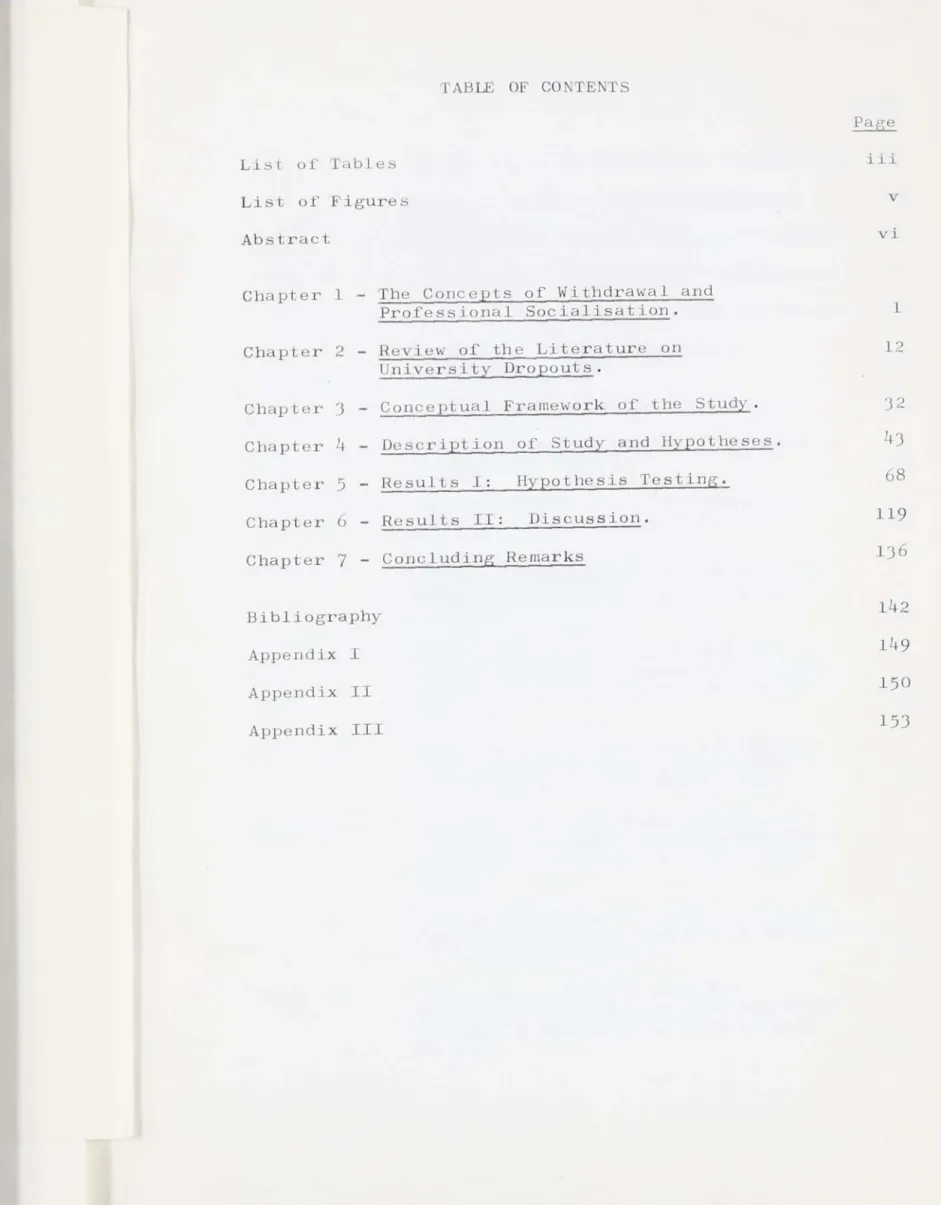
TABlE OF CO TE TS
Chapter 1 - The Concepts of Withdrawal and Professional Socialisation. Chapter 2 - Revi w of the Literature on
University Dropouts .
Chapter 3 - Conceptual Framework of the Study . Chapt r 4 - D scription of Study and Hypotheses. Chapt r
5
-
Results I : Hypothesis Testing.Chapter 6 - R sults II: Discussion. Chapter 7 - Concluding Remarks
Bibliography Appendix I Appendix II App ndix III
i i
i i i
V vi
1
12
32
4J 68 119 136142 149 150
Table l able 2 Tabl J Table 4 Table 5 Table 6
Table 7 Table 8
Table 9
Table 10
Table 11
Table 12
Table
13
Tabl
14
fable
1
5
i i i
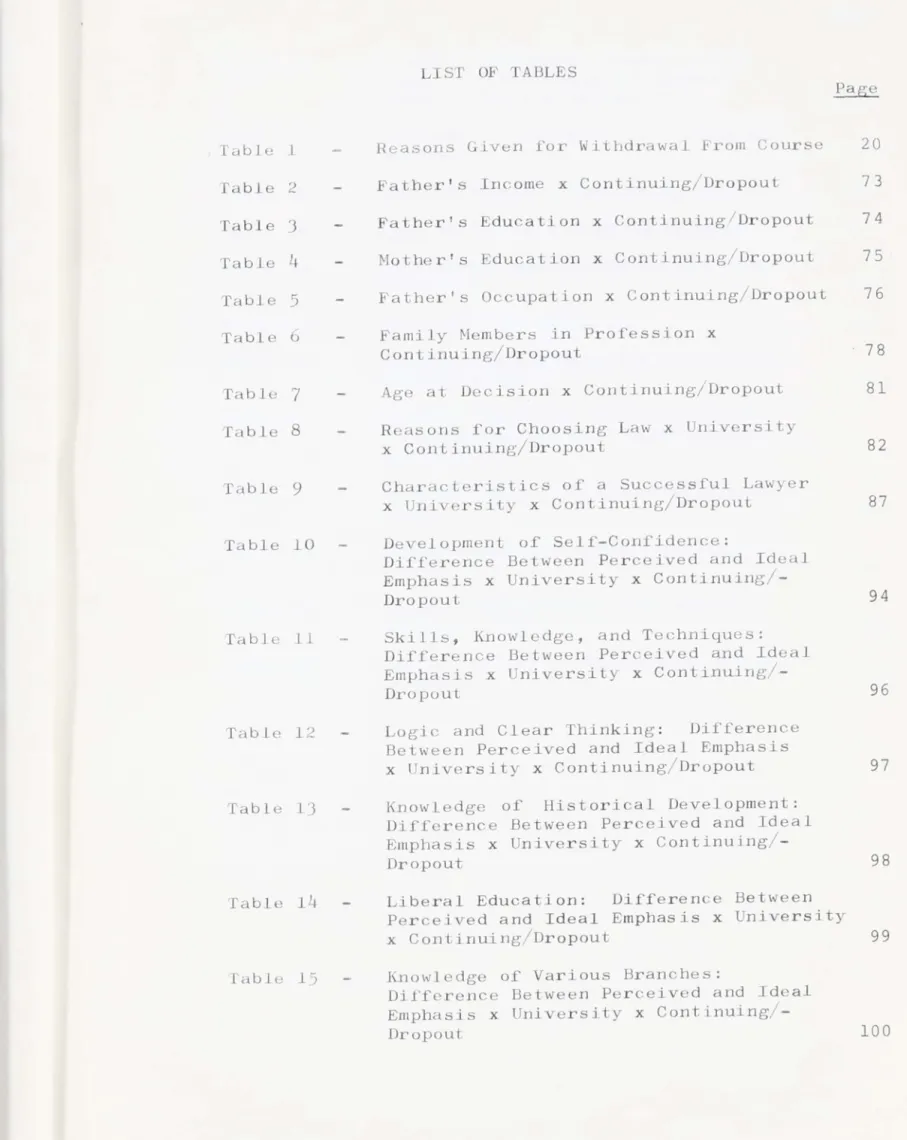
LIST OF TABLES
Reasons Given fo Withdrawal From Cour e 20 Fa h r ' s Income x Continuing/ Dropout 73 F th r ' s du ation x Continuing/Dropout 74 Moth r ' s Education x Continuing/ Dropout 75 Father's Occupation x Continuing/ Dropout 76 Family Members in ProI'ession x
Continuing/ Dropout 78
Ag at Decision x Continuing/ Dropout 81 Reasons for Choosing Law x ni ersity
x Continuing/ Dropout 82
Characteristics of a SuccessI'ul Lawyer
x Uni ersity x Continuing/ Dropout 87 De elopm nt of Self-Confidence:
Difference Betw en Perceived and Ideal Emphasis x University x Continuing/
-Dropout 94
Skill5, Knowledg, and T chniques: Difference Between Percei ed and Ideal Emphasis x University x Continuing/ -Dropout
Logi and Clear Thinking: Differen e Between Perceived and Ideal Emphasis x University x Con inuing/ Dropout Knowledge of Histor i al Developm nt: Difference Between Perceived and Ideal Emphasis x University x Continuing/ -Dropout
Liberal Education: Differen e Between Percei ed and Ideal Emphasis x Uni ersity
96
97
98
x Continuing/ Dropout 99
Knowledge of Various Branches:
Differen Betw en Perceiv d and Id al Emphasis x Uni rsity x Continuing/
T ble J 6
Table
17
Table 18
Tabl 19
Tabl 20
Table 21
Table 22
Table 2J
Table 2Lt
Table 25
Table
26
Table 27
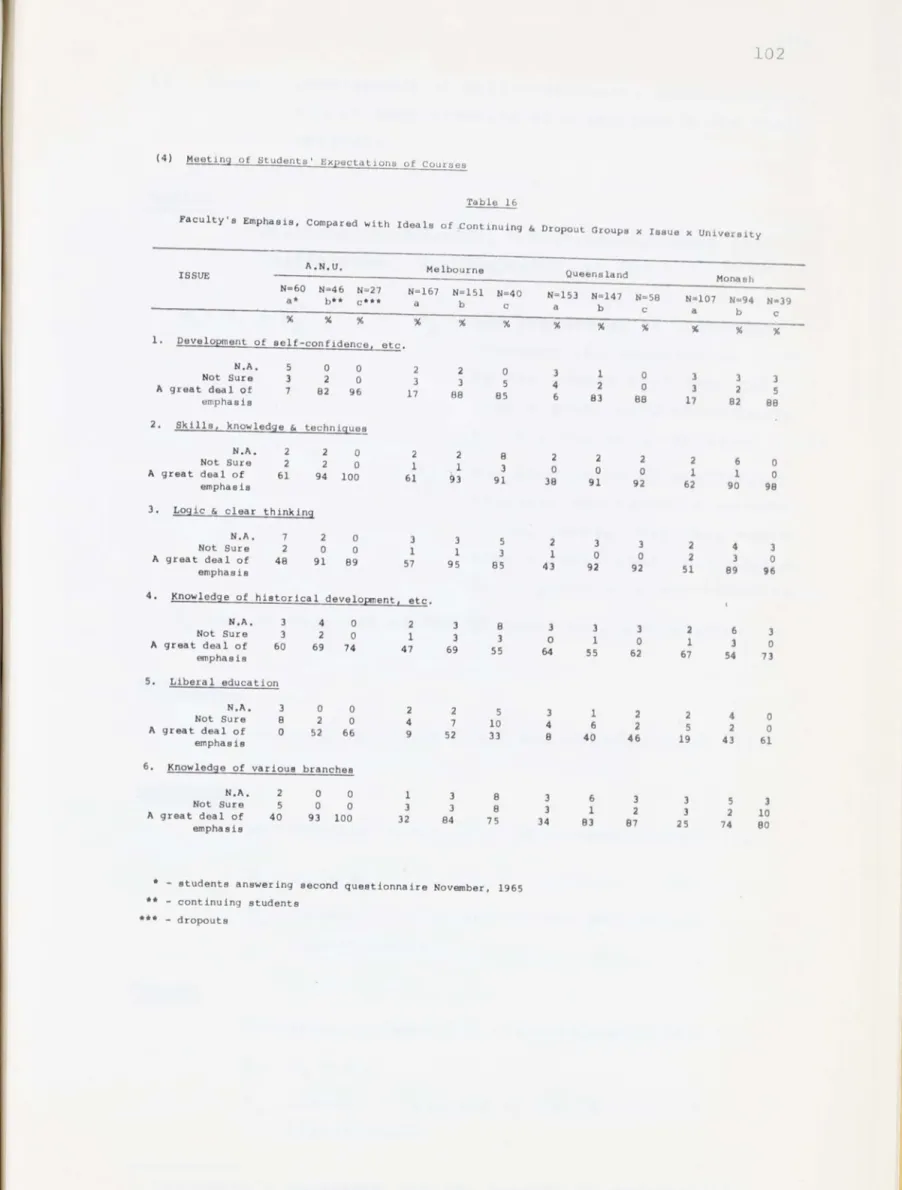
Fa ulty's Emphas·s, Compar d with Id aJs of Cont·nujng and Dropout
Groups x Issu x University
AttlLudes x Uni . rsity x Con inujng
/-Dropout
Marital SLatus x Continuing/ Dropout
ype of Course x Continuing/DropouL
i
102
109
116
117
S bolarsbip Assistance x Continuing/
-Dropout 118
Age x Continuing/ Dropout 125
Scholarship Assistance x Continuing/
-Dropout x Age 126
Younger Students: Father's Income
x Continuing/Dropout x Scholarship
Assistance 127
Type of Course x Continuing/ Dropout x Age
Marital Status x Continuing/ Dropout
X Age
Father' s Education x Continuing/
-Dropout x Age
Age at Decision x Continuing/ Dropout
x Age
130
131
132
L.IST OF FIGURES
ABSTRACT
Chapt r l jnt oduces the probl m of unlvcrsity dropouts with a discussion of i ts size, and of the estimat d osts
involved. I t proceeds to deal with the diffi ulti s
i
associated with the d finition of' "dropout", and then
introduces the cone pt of socialisation (and in parLicular of secondary socialisation). Possible appli ations of the cone pt to the analysis of proi'essional education are
discussed, and in particular the application of the concept to the question of whether students remain in
their courses or withdraw from them. Emphasis is placed on the importance to this perspective of both individual
and institutional var iables.
Chapter 2 contains a summary review of the l i t rature pertaining to university dropouts . The principal theme
of this review is the development from descriptive to analytical studies of the problem, from simple to more complex persp cti s, and from a concern with student characteristics to a r ealisation that the intera tion b L e n the studenL and his educational environment is an ·mportant factor to be inv tigated.
vii
pro:f ssional shoo to the stud nt, o.f the el ments making up th prof ssional r o l .
Indi idu 1 attribut s ar divided into
(1) background fa tors (father's income, oc upation, and ducation; mother's education; relativ s i n the legal profession; and ag at which the
decision to study Law was made) (2) academic ability
(J) orientation factors (attitudes, reasons for choosing Law, perceived characteristics of a successful lawyer, and expectations of the law cours )
(4) situational factors (marital status, full-time or part- time course, scholarship assistance)
Institutional attributes are divided into
(1) orientation factors (academic/vocational emphasis , implicit attitudes and values) (2) .faulty/ student interaction
(J) facilities for learning (flexible teaching
methods, carefully constructed course organisation, library facilities)
Chapt r 4 des ribes th development of the pres nt study :from a large-sale in estigation of professional education in Au tralian uni er i t i s; the natur of be group
sLud· d·
viii
in the stud ; and the inadequacies of the avallabl
information wi h regard to esLing the op ration of the
con p ual frameworl outlined in Chapter J.
The specific hypotheses to b t sted in the present study are presented in both descriptive and formalis d fashion.
Chapter
5
presents the results oI' the testing of Lhehypothese specified in Chapter
4.
Significant differ nces between lontinuing students and
dropouts were di cover d i n relaLlon to father's education,
age at which the d cision to study Law was made, marital s Lat us, type of ·course (full-time, part-time, and external) , and r ceipt of cholarship assistance. As well, th re
were differences between the two groups at some of the
universiti s studied in relation to attitudes, perceived
hara teristic-s of a successful lawyer, and the extent to
whi h the ourse fulfilled students' expectations.
Chapter 6 puts forward a typological construct of the
dropout bas don th hypothe es tested and found to be
supporLed by the data in Chapter
5
,
In n attempt to gain a further understanding of
Lhese r lationship, both th continuing s udents and the dropout.s re ubdi id d into older and young r groups, <lt1d som , oI' the r lationships which were found to hold in
ix
consists oI' a brie discuss.ion of the implic-ations of ihe res arch in relation to th theor tical position
ouLlined earlier in Lhe dissertatjon; the impli~ations 1or further r search; and the pra tical implications 0£
Chap er l
TIIB CO CEPTS OF WITHDRAWAL AD PROFESSIO AL SOCI L[SAfIO.
Size and CosLs or th Problem o.f \ i tbdrawal
One of the major problems fa ing many in5tiLutions o.f tertiary education is that of 11wastage11 which ensues when
s Lud nLs withdraw .from th courses in \bicb they are nrolled before completing the r quirements .for graduation from these institutions. The problem bas both indi idual and
institutional as pects : with r egard to the .form r, the ational Union of Australian University S udents (78) has estimated the cost to th student per annum of an Australian
Arts degr e as being between $1,J86 and $1,765; and with
regard to the latter aspect, the Martin Committe (77, p.220)
in 1964 estimated that by 1975 nee ssary capital xpenditure alone would r ach a le el of £2,100 per
equivalent .ful -time student (based on 1963 cost levels). The past ten to fifteen years in the United Stats have witness d a considerable incre s in interest in the problem
(in 1961, Time magazine reported that the Ford Foundation alone ga e $1,JJ0,000 for 11dropout11 research (16)), but in
Australia ducational research app ars as yet to have been limit d to questions concerning failure rates, and attempts Lo de elop efficient methods of discriminating bet\een
poLentiall passing and failing students. Yet withdrawal woulds m to be a ry r al problem for ustralian
2
and i t is suggested that withdrawals from ustralir1n
univ0rsities ar not limit d to caseH o acad mi failure,
and that failure jtseli' n ed not necessarily b i<n~Pd as
resulting from insufficient ability or aptitude. This
latter poinL was i l lustra d by Anderson and West rn (69, p. 212) in 1966, when t h y obs rved in a comparison
of two earlier ~tudies that:
In the economics department where the emphasis
was academi , the ntering studen s with cademic orientations w re significantly more succ ssful in examinations and better adjusted. In the
Australian medial school whee the mphasis was
ov rwh lmlngly professional, students with this orientation bad significantly better examination r sults.
Theo era11 rate of graduation from ustralian
uni ersities (for 1ull-time students, allo¼ing a maximum
time jn which to complete degrees) has been estimated at
b tween 60% and 65% (19, p. 1). Slightly more than half
this percentage graduate in minimum time, and th rate of graduation differs for arious categories of students.
.In an ongoing stud of entrants, to Australian uni ersities
in 1961 being onducted by the Commonwealth Department of Edu ation and Science, first reports indicate (74, p. 10)
that .55% of the 8,600 full-time students and
29%
of th1,680 part-time students graduated within minimum time
plus one year, and that Jl% of the full-time and 62% of
the part-t·me stud .nts had discontinued their studies (these discontinuance rates do not include students ,ho
transf'err d to o Lher uni ersi ti s) . Rates of
(Ior instanne, th p r enLag s of m~dical sLud nts disc-ant inuing their course rang d .f om zero at the
University of rasmanJa to 32% at Monash Unive sity), and be tween J'acu l t Les (.from L6% in fa cul L.i s o.f ffi(. di i ne Lo
JC!%
in racuJ Lj s o.f law -nd J2% in .facu] ties of' ve L rinary
s,i n ) .
In the United States, on first examination wastage
f _i gures would appear to be somewhaL high r Lhan in Australia. In study of 15,535 students entering 25 Unit0d SLat s
uni ersitics in 19Jl and 1932, Mc eely (66, p. GJO) found LbaL 62% of Lhe students eft without graduating during Lhe succeeding four years: howev r, 17% transf rr d to oLher alleges or universitie , gi ing a nett loss to
tertiary education of 45%. In a survey of 12,667 students who enter ed 1~9 institutions of higher learning in 1950, Iffert (66, p. 6JO) found that a similar rate of 19.5% had gradu Led within our years .from time o ntran .e. H also r marled LhaL dropout r a t s aried beLween di ferent types o.f institutions, the a rag rate for publi institutions
being 67%, and .for pri te institutions only 52%.
In Lho Unit d lingdom, student wastage was estim ted
al 1~% by Lhe Robbins Committee in 1963, and at 13% by the Uni ers·ty Grants Committe in 1968 (75, p. 7) - both
.figures re.fl Ling a dropout rat mu h lower than that p rtaining in both the U.S. and Australia. How
gain Lh sc raLos varied both b t, een uni •ersiti 5% a L Oxb idgo up to 2CJ% in th nci t. chnoJ og-ic aJ
r, on e (rrom
4
D0.f.init1onf:i of' "Dropouts"
It should b not d, howe r, that both tLempts t national accounting (such as the i'or going) and Jndi,idual
resea ch into 1.b problem of' stud nL withdrawal a P hampered b a lacl of agr m nt on definition o.f the subject
population . For lnstan e, the attempts at estimation o.f naLJonal wastag .figures may be consid rably in.flated by
.failure to tak ac ount o.f students trans.ferring .from on institution o.f tertiary education to another - in one study
(65, p. 2), 8~ of the dr opouts .from one institution w re .found to be continuing their education els where. This may be a factor of particular i mportance in the United States, with its greater diversity of tertiary edu ational
institutions.
Dc.finitional di.f.ferences in individual research
projects introduce considerable difficulty into attempts
to construct a coherent, o erall pie ture o.f dropout research . Tho contributions Lhus .far made will be discussed in the
follO\ i ng chapter - at his point , the intention is simply to .illustrate by example that researchers in this area
have in some ways xacerbated an already confusing
situ Lion. Some in estigators ha e undertaken to study all students enrolling in a particular institution at a p r t i ular time, and not enrolled at a later, specified
time prior to graduation (65, 39, 27, 34, 18, 35, 62) thes studies do not distinguish between cases wher
withdrawal was oluntary and those where the student was
5
drop out wiLhin asp c·r1 d period
(35,
29, 55)
-
g.nerallythe ireshman year - whereas others do not di tingu·sh betw en studenLs lea ing at any ime ov r Lhre - or£our-year p riod
(J'-i,
J9).
In som case , a distinction js made betwe n olunLary withdrawals and dismissals, or betwe n sLudents who w· hdraw wi h passing and failing grades (14, 26,5'-1).
In a f w instances oLher, more spe ialised, distin tions havebeen made: none study
('-18)
a dropout was defined as any s udent who bad withdrawn at some tage and not ompleted four years ' course work at a point four years after entry, c en i f tha student was currently enrolled in thejnstitution; anoth r study
(55)
used a £our-foldclassifi ation in studying college students, omparing:
(i)
(ii)
(i"i)
(i )
defaulters (stud nts who withdr w during semester)
success£ul persisters (stud nts who persisted successfully (academi ally) Lhrough one year)
probation persister (students who persisted
dropouts
unsuccessfully through one year) (students who persisted successfully
but voluntarily did not return £or the second year).
It js suggested that for most general purposes, the
classification which would pro e most useful would be one which took ac ount of (i) the stage a whi h s udents
withdr w,
(ii)
whether withdrawal was voluntary or mandatory, nd (iii) wh ther stud nts ' a ad mi per£ormance was6
nLil such d finitional diffi ulties as ha e be n
indicated are resol d, comparisons and aggr gations of h
available data will be of limit d value, of ljm1t d u e for either research or administrati e purposes except as
suggestive of tr nds. This fact should be kep in mind
when reviewing the literatur pres n ed in the following
chapter. ntil such tim as a standard terminology relating
o dropou L· behaviour is adopted, i t is imper a i that a h resear her hould specify precisely the nature 0£ the sample being stud ·ed.
The Con ept of Professional Socialisation
The study which is the subject 0£ he present repor is
concerned with the question of why students withdraw from
ourses of professional education (specifically, from c ours e s in la w ) • These ourses are viewed as ongoing processes of adult (or secondary) so ialisation, with Lhe
pro£essional school conceived as the socialising agency,
The term "so ialisation" has been used extensively in
sociologi al literature to mean "the pro ess by whi h
people selec i ely acquire the attitudes and alues, the
j n ter es ts, kills, and knowledge - in short, the ulture currenL in the groups of which they are, or seek to
become, a member" (
44,
p. 287). Originally, the term w s u~ d i n a de elopmental context to describ thejnduction of the child into a working so ial system; mor
rolus. In be prc->sc->n L ,on ext, · L is sugge ted i.ba t proressional edu,ation is a "proc ss by whi .h students sel tiv ly acquire the at i ud sand alu s, interests, skil ls, and knowl dge curren in th prof'e ion o wbi•h
the s ek ob ome am mber." It i sugg s ed that the acqu ition of he professional rol in olve bo h dir t
'
learnjng through ormally organised edu ation programmes, 7
and indirect learning as a byprodu t of in ractjon between
the stud n and his significant o her (especially peers. and -facult ). It is also sugges ed that the prof . ional role may be defined somewhat dif.ferently by tbe pro e ional
s-hool and by the orps of practi ing pro.fes ionals, thus invol ing the individual in successive rol a qui i ion
ash mo es, ir tly into the professionals bool, and tben into the milieu of practising professionals.
Merton
(44,
p.71)
puts forward the thesis that aprofession ba
••. its own normative subculture, a body of hared and transmitted ideas, value and standards toward which m mb rs of the profession are expect d to orient Lheir bebaviour. The norms and standards define techni ally and morally allowable pattern of b ha iour, indi ating what i prescribed, preferred, permitt d, or pr o cribed. The
subculture, th n, refers to more Lhan habitual beha iour; its norms codify the alues of the
pro-fession. • •• and i t is he .fu.nc ion of he •.• [profes ion
1]
s hool o tran mit this sub ultureLo succ ssi e generations o.f neophytes.
The compo.ition o-f -alue making up a profe ional
8
are essential to the pro ssional role
(44,
p. 71). Moreo er,tb so ial n ironm nt constitu ed by ch pro£e sional chool
arie for the ·nctividual studen sand groups of s udenis
within it: since the patterns of int raction wil,h s·gnil'ican others are only similar and not identical, the varia ions
resul in a variety of so ialisation ou omes wi hin the same institution
(44,
pp.6J,
287). What is more, the admissions poli y of the professional school has theconsequ nee of determining, to a large extent, the social
environment of the students - thus, such variations as occur
fall within limits determined by tbe so ialising agen y. Paraphrasing Merton
(44,
p.6J)
,
the rele ance of thisperspe ive to the analysis of student withdrawal may be
expressed as follows:
Students of the same m asured degree of intelligen e or apti ude vary with r espect to their status and social
relations with others in the sociali ing agen~y (pro£es ional
£a ulLy), and, as a result, in the extent to whi h they a quire l,he a titudes and values, the skills and knowledge
of their ho en profession. On this conception, one would
expect to find substantial differen es in the extent to
whi h they acquire the attitud sand alues, the skills and
knowledge of their chosen profession. On this conception,
one would expect to find substantial difference in the
extent and ffectiven ss of professional learning among
students of approximately the same intelligence and aptitude.
Learning and performan e vary not only as the indi idual qualities of students vary but also as their social
en ironments ary, with their distinctive alue orientations
and th i r distinctive organisation of relations among
9
One mighL add a autionary not aL thj . tage, to the eff ct that Mr on is r erring to he m r i .an p of slonal school, a post-graduate institution exclusi l r con<' ,rned with pro essional raining. In Australia, professional
hools are undergraduate institutions and are therefore ·on J rned as w 11 with more g neral du a ional obje t i es. The Aus raljan situation, then, in its present state would
nots em to consti ut as pure a case of prof ssional sociali ation as the American case outlined by Merton. This fact may l ead o Lbe additional complexity that
faculty members within a professional school may vary in th relative emphasis which they gi e to general edu ational objective and specif' ally professional education, and
thereby add to the potential conflicts n ountered by the stud nL.
Stanton Wheeler (lJ , p. 112) bas drawn up a framework .for Lbe analysis of so .ialisation in organisations, whi h
<'ould well be used to indicate the preconditions for the most (or least) favourable socialisation outcomes in an institution such as a professionals hool (see Fig.
1).
Seen in these terms, the optimum condition for
su cessful socialisation would be that where the institution pro ided lear normative definitions, many opportunities for performance to be demonstrat d, and rewards for
suj tabl performance; and where the individual was capable o~ both performance and 1 arning the norms presented by
10
so< 1alisation out<om would b, l s than id al. J n the
exLr me case (<'ompleLe failure in the socialisation pro~es ),
there would b ambiguity or conflicL in Lb normativ~
struC'ture presented by the institution,i would pro ide rew
opportuniti s I'or p r forman e, nd would not posses Lh
power o rew rd performanc s; s·milarly, h ind i ridu 1
would b . apabl neither of 1 arning Lhe norms nor of
performing satisfactorily, and in addition he would be
in uf_ficiently moti at d to perform.
Ind .pendent
VariabJes
orms
Performances
Re\ards, Sanctions,
Motivb
Intervening Mechani ms
Organisational Individual
Capa ity
to present
clear norms Capa ity to
provide
per forman e
opportunities
Capacity to
selectively reward
per for mance
ig. l
Capacity o 1 .arn
the norms
Capacity
to perform
Motivation
to perform
ocialis-ation
Outcomes
with all Lypological onstruct, i t i unlikely that
either extrem ase would oft n b ncoun+ered in
institutions of professional edu ation, but the ariety
11
inlervening me .hanisms support our arli r observation that 111 arning and performance vary not only as tb individual qualities
or
students vary bu also as their socialen i ronmen ts ary.11 Morea er, the conceptualisation of dropouts from curses of professional edu ation as
instanc s of incomplete or unsu c ssful socialisation into a proI'essional role, and th empha ls on the relevance to
this socialisation proc ss of both indi idual and
12
Chapt r 2
RE .IEW OF THE LJ r~RArUHE O lJ 11 ERS.IT) DHOPOlJ 1 S
Much of th e ear l i r liter aLur e on dropouts i of a purely des ripti e kind : research was generally ~onfin d to attempts to isolate those chara t ristics of dropouts which distinguished them from students who remain d to graduate (and, l ss often, attempts to distinguish between different types of dropouts) , and to classification of th reasons given .for withdrawal.
The most commonly investigated characteristics are
biological and social factors (such as ag at matriculation, sex, ~ocioeconomic status, and hometown location and size); a ademic .factors (secondary school preparation, scholastic apLitude, and acad mic p rformanc L university); and personality fa tors . Ar view of the numerous studies of these fac ors re eals that the findings are equi o al -each factor bas been found by some investigator to ha e some relationship to some particular group of dropouts, but the relationships ary in nature and ext nt a cording to the group under study and th methods us d i n obtaining
Lhe in.formation.
Similarly, Lhe reasons given by students themsel es for dropping out co er a wid range of .fa ,tors and how little consist ncy betw en studies: perhaps the most frequently cited reasons ha been poor grades, finanuial diffil.ult iJlne ::, 1 and di::, atis.fa tion with the parti ular
BIOLOG CAL AD SOC AL FACTORS
(1) Age a ation. In h" s r vi w of dropout 1
lJ
research, Summerski l l
(66,
p.631)
draws th general conclusion that age per se does not a feet attrition,although older students may encounter more obsta 1 s to
graduation. In the group of withdrawees investigated by
Koelsche
(37),
the median age at time of enrolment wasbetween 18 and 19 years,which is normal for the overall
college population; Bragg (12) found no significant
difference in the ages of continuing students and withdrawees
in her study; and Goble (24) reported that in bis sample
graduates matriculated at an older age than dropouts.
(2) ~ - Little difference has been found between the
attrition rates for male and female students (12,
35, 64).
Most studies, however, have been concerned-with the rateof withdrawal during the first year; Slocum (62) found that
after one year the proportions of male
(67%)
and f male(66%)
students who remained in college were very similar, butthat these proportions diverged in succeeding years -
51%
for male students and
41%
for female students after twoyears , and
4~%
andJ3%
respectively after three years. It has been emphasised that even if male and female studentswithdraw at similar rates, this would not imply that they
, ithdraw for similar reasons: since female students are
generally more highly elected academically than male
1
The terms, ynonymousl
students, nonacademic factor may play a more important part in their de ision to w'thdraw (2,
J4,
62,6J, 59).
he1961 Austr lian study I'ound that, while quivalent
proportions of male and female full-time stud nts have
discontinued (about one-third of both groups), among part-time
students approximat ly 6~ of the mal sand
75%
of the femaleshave discontinued [personal communication].
(J) Socioeconomic factors. The findings in this area are
equivocal, and suggest that more attention should b paid to
the role of such factors in determining the individual student's adjustment to a given environment. The issue is
a complex one, involving the interaction of many variables,
and further mention will b made of attempts to under tand
the problem from this point of view.
The relationship between parents' education and rates
of withdrawal has received careful attention: Snyder
(64)
found no significant difference on this variable between
students who withdrew and the college population as a whol ,
although there was a small difference in favour of the
withdrawal group. Slocum (62) and Goble (24), however,
concluded from their investigations that a higher level
of parental education was associated with a greater chance
of survival at college; Goetz and Leach (25) found no
significant difference betwe n the education of fathers
of ontinuers and withdrawees, but the level of mothers'
15
With r gard io the relationship between par nis' occupational tatus and rates of withdrawal, the 1Jndings
are no less ambiguous. Both Little (J8) and Snyder (64)
found no asso iation between fath r' s occupation and
withdrawa l; Caskey
(41)
found that a smaller per entagf ofdropou s ' parents were in the pro~essional group, and Slo um (62) found a significantly higher survival rate for children of fathers in professional and techni al occupations, wi h the highest withdrawal rate among children of manual
labourers and those in service occupations. Slater (60) found that the rate of withdrawal fell markedly when
students were enrolled in colleges which prepared them to enter occupations similar to those in which their fathers
were employed.
Slocum (62) also cited family attitudes as an important
factor, claiming that parental interest as perceived by the student is influential in his decision whether to withdraw
or remain; Murray (46) similarly reported a favourable parental attitude toward college as being related to
persistence in college.
In addition1 Brown
(14)
found that the factor ofsiblings who att nded and/or graduated from college made
a contribution to the prediction of continuation or
noncontinuation in college, and Goble (24) reported a higher incidence of relatives having att nded university among graduates than among dropouts.
(
4)
- - - -
Hometown ..Location and size. Summerskill (66, p.633)
16
and som how" re l at d to succ ss or .fai lure at college.
Som atten ion has al -o been given to siz nd type of h'gh
school attended as a factor associated with wjthdrawal. Slocum
(
6
2)
found that size of high school was nota sociated either with arademit, survival or with academic. performance at c:oJ l ge; but Su.nun r skill 8 t;at s that th r e is some evidence that students from larger high schools have s·gnificantly better chances of graduating from allege,
a statement whi h i s supported in the findings reported by
Goble
(24).
ACADEMIC FACTORS
(l)
Secondary school preparation. Studies of therelationship betwe n academic achievement in highs hool
and allege withdrawal rates have generally indicated a
positive correlation between high school rank and college
survival (12,
24, 37, 62).
(2) Scholastic aptitude . The findings with regard t o t he
relationship between scholasti aptitude and withdrawal
are generally in agr ement - Summerskill
(66)
found that average scholastic aptitude scores were lower for dropoutsthan for graduates in 16 of the
19
studies he reviewed.A similar finding was reported amongst British students
by Lucas et al (40). The position with regard to t he role
of academi abili y i n student withdrawals is cl early
AbJlity and arhievement ratings sePm to be useful primarily for spott Lng only tho~(· -,i udPnt~ on hp low nd of the . cale who will clParly drop out du( to academir £ailur alone, •••
Supporting this conr lu. ion is th finding by AndPrson and Rirhes
(2)
thal among a sample of medi.al stud .nts, tho e dropping out for a ademic reasons cored significantly lower on an aptitude test than other student , but that tho edropping out for nonacademic r sons record d higher aptitude scores than any other group 0£ students.
(J) AC'ademic. performance at college. Be.fore reviewing the evidence concerning the re lat ion ship betw8en arademl c
performance and withdrawal9 i t should be emphasised that poor performance in itself does not necessarily 1ndicate a low level of ability9 nor does the fact that a student w1th low grades subsequ ntly withdraws from the university imply that he withdraw b e ~ ~ of his low grades - the dee i si on to withdraw may have been made at an earlier tage,
resulting in lack of intere t and poor examination per£ormanr.e. Goetz and Leach
(25),
while .ompiling data on the collegeperformance o withdrawee disco ered that some 0£ these student had discontinued attendanc at .lasses without ini'orming th univer it .In these instan e , the student,s 1 grads w r recorded as failur s, which would result in a
lowering of their academi a erages, and of the academic performance 0£ th group .onsidered as a whole. Clearl in .SU<·b .es, th reason for withdrawal pr.< ded the low gr des.
Grad.-polnt av rages ot' withdrawal groups ha ·p b en
18
that the PA's of mal sud nts who ontinued were
signifi antly high r than those o male students who
withdrew, but there was no similar dif erence b tween f male
stud nts; Goetz and Le ch (25), GoblP
(2L~),
and Bragg (12)also found tha continuing students had higher GPA·s than
those who withdrew.
A second approach has been to use grad -point a rages
in det rmining a le el of sati fa tor academic performance,
and then to estimate the proportions o students progr ssing
s tisfa torily and unsatisfactorily at the time of withdrawal.
Koelsche
(37)
found that62%
of the dropouts in his samplewere progressing unsatisfactorily at the time of withdrawal;
Halladay and Andrew (27) estimated this proportion at
64%;
and Slocum
(62)
found that51%
of those studied were inscholastic difficulties at the time of withdrawal. The
variations in percentages reported may be in part due to
differences in the definition of 11 satisfactory performance 11 •
SUBJECTIVE REASO S FOR WITHDRAWAL.
A number of studies ha e in luded an attempt to
asc rtain wi hdrawee ' perceptions of the causes contributing
to their withdrawal. The technique 01~ asking students why
thy withdrew suff rs from a number of fairly obvious
inadequacies, but while it may not be ad isable to rely
olel on the subjective r ports of withdra, es, nor would
i be satisfactory to rel on faculty reports or official
r or d s as th on 1
stud n ts.
19
In assessjng the importance attributed to arJous fac tors
by stud nts who hav withdrawn rom th ir (ours ol stu y,
it should bP noted that s0m fa .tors ma· b mort- a r ptabl _,
to themselves, to par nts, and to the in titution conrern d,
and thus be given an emphasis i.n subj C':tiv reports whieh is
di proportionate to the role which they play in the de ,ision to withdraw. This is perhaps an
:n
vi able disadvantage of the questionnaire te hnique, esp cially if the in ormation is obtained some time a ter withdrawal, and it may be that this difficul y will only be surmounted by the use ofcounselling interviews at the time of withdrawal.
vertheless, even i f the subjective reports of students
who have withdrawn are not an entirely accurate refl tion of the factors involved in the decision to withdraw, they
may sere an additional purpos in telling us some hing about the evaluative standards imposed by the societi s i n whlch these students live and study.
Table l shows the percentag s of studen s gi ing a
ariety of reasons for withdrawal, obtained in five dl.fferent studie
(
2J,
J2, J5, J7,
64).
Some of the factors designated by different titles may in fac:t over the same set of cir wnstances, either from
the in est iga tor's point of view or from that of' the
student. For example, "changed objectives"
(2J, J2)
maybe int rpreted as similar in meaning to "unsuitable choice
of c.ourse"
(64).
It should be remember d that the studies r rred to w r c,arried out in Amer· an universities, and20
Table 1
REASONS GIVE FOR WITHDRAWAL FROM COURSE
Factors Iffert & Johnson Koelsche Snyder G-ekowski
Contributing C ark
(2J)
(J5)
(J7)
(
64)
&to Withdrawal Schwartz
(32)
Poor grad s
2J%
2%
primary11%
'7%
9%
econdary11%
0 interest
8%
s condary7%
in courses
6%
Poor high school
o.
4%
preparation
Changed
21%
objectives
5%
Finan ial
7%
25%
primary12%
difficulty
17%
secondary
7%
Return to work
1%
primary46%
12%
7%
To get married
7%
9%
primary16%
Sickness
7%
7%
primary14%
7%
secondary6%
Dissatisfaction
6%
curriculum6%
16%
with the
2CJ%
particular college instruction
2%
administration
J%
Dis ipl·nary
6%
Person lity
11%
12%
adjustment difficulty
21
TABLE 1 (cont.)
Factors Iffert & Johnson Koelsche Snyder Gekowski
Contributing Clark
(
2J)
(J5)
(J7)
(64)
&to Withdrawal Schwartz
(J
2)
Climate
5%
Military service primary
5%
10,,
Change of
residence
7%
Exclusion
1%
Unsuitable choice
of course
6%
Commuting problems
4%
education systems most probably entail differences in the
importance attributed to various factors in withdrawal.
The greater diversity in American institutions of tertiary
education gives students a wider choice, both of courses
and of institutions, than is presently the case in Australia,
and may thus lead to factors such as 11dissatisfaction within
the particular college [university ]11
, and 11unsuitable choice
of course11 playing a greater part in withdrawals in the
American context.
In reviewing the literature on students' reasons for
withdrawal, Summerskill
(66)
found that the most frequentlymentioned reasons were lack of interest in college, lack
of interest in studies, marriage or marriage plans,
military service, and illness (both personal and in
imm diat family). Swnmerskill adds a cautionary note,
22
factors list din Table I, concerning the lack 01
distinction betwe n reason and outcome.
Even assuming that he subjective reports of'
withdraw es can be accepted at face value, i t seems unlikely that those students who ontinue w·th th ir courses of
study encounter none of the problems contributing to
withdrawal. The studies by Slocum (62) and by Gekowski and
Schwartz (23) found th~t continuing students experi need similar difficulties to those reported by withdrawees as
factors in the decision to withdraw; and Goetz and Leach
(25)
found thatonly three factors generally related to
attrition differentiated the groups:
witbdrawees felt that problems of marriage,
family finance, and general unhappiness were somewhat more important than continuers.
ate that even in the latter studies, the findings indicate
that withdrawees perceived a number of problems as being
more important than did continuers, but no evidence is
given that the incidence of such problems is higher for
students who withdraw.
PERSONALITY FACTORS.
The fact that one person with problems withdraws
while another person with problems continues leads to the
question of whether certain personality variables can be
found which differentiate the two groups. A large number
of studi shave been concerned with this problem, producing
summarises the literature on personality variables as
follows: dropouts are more rigid and fearful of nhange, less willing to accept the responsibility of adult
ind P~ndence, la king in internalis d goals and valu.s, tend to feel asily and perhapA hopelessly dpfeated when
2 i
fac d with the prosp ct of possibl ailurP or disappointment, and tend to rationalise their failures in an unrealistic
manner~
Rose and Elton
(55),
whose unusually detailedclassification of withdraw es and continuing students has
already been mentioned, have made one of the most thorough investigations of personality characteristics, starting from the hypothesis that
Withdrawal within semester would seem to constitute a psychologically different kind of act than the successful or unsuccessful completion of a semester after which the student does not return to allege.
Their findings indicate that personality characteristics signifi antly differentiate between types of persistence (successful and unsuccessful), between types of withdrawal (dropout or d fault), and between withdrawing and continuing students .
Suczek
(65)
reported that personality factors appearedto be r lated both to dropping out and to the student's activity after dropping out. He found that
Student who return to the original ampus are an unusually mature group with a high level of
complexity t the time they first enter the
Uni ersit • Stud nt who are "true" dropouts are somewhat less mature, less complex, and less
.institut· on] and continue the 'r highe e Ul.ation ls wher r s mb.l the stud nt.s who continu
w · thout int rru~tion at •• . [ the-: ins ti tut· on of first enrolmen
J,
.in r lat iv ly gr a terconventionalit , control and ompl'anc to authorl ty. • ••
(6
5
,
p .J5)
and Lu as et al (40) found that in a sample of Br'tish
students, severe personality disturbances o curred with
disproportionate frequency among dropouts wh ,n compared
with students who continued.
CO TEXTUAL FACTORS.
A number of studies have examined the importance of
the s udent ' s vocational orientation to his edu ational
24
environm n t . Slater (60) found that he rate of withdrawal
was h 'ghest where the de ision to att nd ollege was made
by someone other than the student, followed by those students
who had a desire to attend ollege but were indifferent to
their chosen course. The highest survi al rates were
found amongst those whose objectives in attending college
were ·ntelle tual pursuit and vocational ambition. Goetz
and Leach (25) found, however, that a greater proportion
of wi thdrawees than of continuers had enrolled in ourses
which wer related to career or vo ational goals.
Slocum (62) found no difference between the proportions
of con inuing students and w·thdrawees who had indicated
at th time o enrolment that they planned to complete the
bachelor's degree; but he reported that oc upational
uncerta.int at time o:f -.ntr app ar d o be common among
male w·thdraw sand tho
scholast · c d · f. i cult •
In Iook.1-ng at students' reactions to the courses and
far..1.l it ie s offered by th ir college, <..-oe t z and Leac- h ( 2 5)
reported a number of findings which indicate that students
do not simply remain at college because their requ1rement
ar, mor r adily fulfilled than those of students who lea
co11Pge. Withdrawees jn their study gave more favourable
reports than continuing students when r.onsidering both the
enthusiasm of the teaching staff and the nwnber of courses
ofi'er,d by the coll g in their major fiPld of interest.
However, continuing students were more inclined to view
the college as emphasising intellectual and cultural
pursuits outsid the classroom. Brown
(14)
also found thatstudents continuing in colleg reported less satisfaction
with se eral of the programmes, services, and facilities
offered. On the other hand, Gekowski and Schwartz (2J)
found that more withdrawees than continuing students felt
that their courses were poor preparation for their vocational
object.iv <;, and that withdrawees gave a less i'avourable
o erall evaluation of their faculty than did continuing
students.
Contact with staff members has received a certain
amount of attention: in Slocum' s study (62), continuing
students felt freer to talk over their personal problems with
i'aculty members, and Gekowski and Schwartz (2J) found that
a gr at r number of ontinuing students could name and had
had contact with their faculty ad is rs . Se eral studies
(14. 2J, 24, 62) hav shown a grater amount of
26
students, ~lthou~h Slocum {62) did not find an djfferenre
in Lh _ number of rriends a L allege report .d by th
groups. Goble
(
24
),
how er, r eported a greater perr ivedab"l.Liy to make friends among continuing students than
among dropouts •
.I TERACT.IO HYPOTHESES.
The con.fusing picture presented by th s arc-h .for
single fa tors related to withdrawal from institutions
of tertiary education has led to recent attempts to view the
problem rom a more analytical perspe t i e postulating an
inLera ,tion process between students and the learning
en ironment, a p rspecti e lending i t elf to the analysis
of a wide range o.f institutions rather than an attempt to
explain, or m r ely to pre ent , data collected .from a single
institution or r ela1 Jng to a single variable (or limit d
complex or drlable::,) • W1lliams
(7J)
suggested the need .for such an approach in hi obser ation that:Correlates of dropout beha iour identified in past
studie include the personality ariables of
dep.nd ncy, unre.flectivenes , rigidity, anxiety, irresponsibilJt , impul ivenc s, n ed for change, c-on.formity, social discom.fort, and alues holding that education shou.l ct have ocat ional utility and that hard work is good in and of it el.f • .In addition to their neg i e fla our, se eral o.f
these traits are seemingly ontradictory. The
el ment that seems to be missing from this picture of the dropout is th nature of the environments in whi<h these traits ha e been manif t d.
r ecent approximation to this suggested approach is
f o un d J. n the w or 1 of Per ,. in ( 4 9 ,
.5
0 , .5 1 , .5 2 , 5 J ) , w 11 i h27
them~e l v s and their pe c p tion of' Lhe college atmosphc•rp
with r g rd to both a ademi and nonarad0mic a pectf>, a11d
the rela ionship o these perc ptions to tudent
dissatis action and dropout. The framework o this
r s ar h i s broad enough to includ not only th
interaction of a wide range of ollege atmospheres and
stud nt attitudes, but also a wide range of student
responses - that is, satisfaction/dissatisfaction and
persistence/dropout - as well.
Pervin's work is based on the view that
(50,
p.281)
th college is a system in the sense that i t iscomposed of a number of interdependent parts
(students, faculty, and administration) which share, to one degree or another, certain values and charact ristics. Furthermore, the college is vi wed as a social system in th sense that the parts and goals involve people - there are individual and group needs to be satisfied,
He has developed an instrument for institutional research
(TAPE - Transactional Analysis of Personality and Environment) ,
and u ing i t has collected data from students in a wide range
of fields of study at a large number of universities. He
envisages the complete analysis of the ollege as a social
system as entailing administration of TAPE to all elements
in the system (students, faculty, and administration), the
resultant data providing information about where and to
what extent these elements agree and disagree in their
percept ions.
P rvin's approach to the fact that some students
withdraw from the ourses in which they are enroll d,
28
B yond some f w common character ·stics, coll ges are vastly different f rom one another.
Furthermore, there ·s evidence Lhat students
generally sel ct a col lege whose i mage fits
th ir own needs, pro i ding for a match between
student and college environment. In many cases, however, students are forced t o choose
on som other basis, have a distor ted image of
their preferred college or have an unrealistic
image of their own needs. Each of these means
a lack of fit betw en the needs of the individual
and the press or sources of reward and frustration in the college environment.
A lack of fit between student and college
characteristics should .•• lead to some kinds
of dissatisfaction with the college experience ,
which ultimately may lead to dropping out of
college.
In conceptualising dropout behaviour thus, Pervin sees
as necessary a distinction between withdrawal for academic
and nonacademic reasons. The data so far obtained in his
studies of the college as a social system
(51)
indicatethat there is a high correlation between perceived self/
college discrepancies and dropping out for nonacademic
reasons, but that this relationship does not hold in the
case of withdrawal due to academic factors.
Following on from this analysis, one could ask, in
addition t o whether there are discrepancies between the
student's perception of himself and his educational
environment,
1) what is the nature and the source of these
discrepancies?
2) if the student i s forced to select a course
of study on grounds other than his per ceived
him in his de0ision and how will these lead
t o p rceiv~d discrepancies b tw n self
and ,nvironment?
J) in what way is the stud nt's image of his
preferred course of study distorted?
4)
in what way is the student's perception orhis own needs distorted?
In addition, one may recognise that the student is not
a fixed and unchanging entity, and ask whether hanges
occurring during the course of study may lead to the percei ed
discrepancies which P rvin conceives as being involved in
dropping out.
A less theoretical approach to the problem has been taken
by Panos and Astin
(48),
who have undertaken to examine howa large number of student characteristics and features of
the college environment are related to dropping out of college.
Using multiple regression techniques, they have examined data coll cted from
60,000
students enrolled in246
institutionsof higher learning and have concluded that their results
support the hypothesis that educational outcomes are
determined both by the individual's personal characteristics and by the environmental context.
Panos and Astin suggest, on the basis of their analysis,
that (
48,
p.68)
at least two conceptually distinct, though perhaps
r lated, patterns of environmental effects increase
the students' chances of dropping out of college.
Th fir t pattern is con,erned primarily with
lnterp rsonal r lationships •••
The erond pat.tern ••• app ars to involve influences
JO
Environmental charac eristics, how ver, make a
,onsj derably smaller contrj but ion to the variaw·.e J n the
criterion varjable than do student characteristics,
Lhat diff ren es in th attri tion r a s a t dif:f rent
uggesting
insi.:itut.ions may be more a function of dif':f,renr.es in their
enterjng students than of differences in n ironmen al
character is ti s.
Panos and Astin do, however, con lude by advising
that future research take into account both individual and
institutional factors when considering dropout behaviour.
Wegner and Sewell (68) have also addressed themselves
to studying the r elationship between student input and
institutional characteristics as determinants of educational
outcomes. Specifically, they have investigated four
questions (68, p.
4):
(1) Do different types of colleges recruit students
with different haracteristics and are these
characteristics related to the probability of graduating from college?
(2) Are there institutional differences in graduation rates which cannot be accounted for by the background characteristics of students ••• ?
(J) From what types of schools do students of different intelligence and socioeconomic status levels experience the greatest probability of graduating?
(4)
Are students of different intelligence and socioeconomic status distributed amonginstitutions in accordance with their chances
of graduating from them?
In answer to their first question, the data suggest
(68, pp.8-12) that the student characteristics of rank in
Jl
soc~o .conomiL status ar relat d to probabilit of
graduation, and that differences in institutional graduation
r a t s correspond to the type of stud nts recruited by th
institution •
. In answer to the second question, Wegner and S well
(68 , pp. 12-14) report findings of notable similari y to
thos reported by Panos and As in. They state that the
type of college attended has an independent effe ton the
students ' chances of graduating: student input fa .tors
contribute most
(25%)
to the variance in graduation rates,but type of college attended accounts for
J%
of the variancebeyond what can be explained by student characteristics.
Finally, in answer to the remaining two questions, it
was found (68, pp. 14-16) that students of different
socioeconomic and intelligence levels display varying
probabilities of graduating from the different types of
.olleges; and that although the distribution of students
among the various types of institutions is sometimes in
accordance with their probability of graduation from these
institutions, students with high socioeconomic status are
distributed in a manner more favourable to completion of
their college edu ation.
This re iew of recent and more complex approaches to
th problem of dropout behaviour brings us back to the
point at which we concluded the preceding chapter: the
observation that in the process of socialisation into a
profes ional r o l , 111 arning and performance vary not only
as the individual quali ies of tudents ary but also as
CO GEPT A;!:, _ _FRAMEWORK OF THE STIJUY
While the conten s o the pr vious two chapt rs ha
sugg sted that an exceedingly complex b havioural mod 1 '3 2
would be necessary to ,ount for any individual's derision
to wi hdraw from a ourse of professional education, it is
now proposed to discuss a simplifi d conceptual framework
b~sed on both the theoretical cone pts discussed in Chapter
l, and the empirical eviden e presented in Chapter 2. Many
of the core ideas of the framework owe their origins to the
analysis by Western and Anderson (70) of education and
prof ssional socialisation.
To begin with, this study is based on the premise that
professional education involves a pro ess of so ialisation
into a particular role, and that this socialisation process
involves not only the acquisition of specific knowledge and
skill , but also of the attitudes and values which
fa ilitate performance of this role in a manner acceptable
to the social system in which i t is located. Moreov r,
role learning occurs not only in circumstances defined by
th professional school as formal learning situations, but
in informal situations arising from contact with other
stud nts and with faculty members. A second, related,
pr mise is that compl te comprehension of the socialisation
J1
char· ntAristics both of individuals and of in.ti+ution , and
the int r ction of th<!Se.
Generally stated, the hypothesis which underlie· the
pr sent study is that ther are a nwnber o individual
attribut sand institut·onal characteristi<'s whi .hare
rel vant to the success ul acquisition of the kill and
knowledge, attitudes and values whi h def'ine the role o a
member of a given profession, and that where there is la k
of ongruence betwe n these individual attributes and
institutional chara teristi s, there is a high probability
that the individual will withdraw from the course of
professional education (or pro ess of induction into the
professional role) .
It is important to note here that professional schools
vary, at least to som extent, in their definitions of both
the cognitive and the evaluative aspects 01 the professional
role . Consequently, when we refer to the process of
prof ssional socialisation in a prof ssional s .hool we are
speaking of socialisation into a particular definition of
the professional role. As noted in an earlier chapter,
role d f"nitions not only vary somewhat between socialising
agenci s, but i t is also probable that the corps of
pra t"sing professionals may diff r from the schools in
its role definition, thus requiring a pro ess of
readjus ment following on graduation from the prof ssional
school. It is, howe er, the phas of so.ialisation which
tak s place in the profess·onal s hool with which we are
It now remaj ns to sp cify jn g ea r d t i 1 those attribut s of the indJvidual whJ"c-h u ~r=, -- .cr1~ J ,, ive · d a· h aving · r 1 vane to his acqujsltion of the prof ssional rol.,
and those attribu es of th so ialising institution which
affect he transmission of its d inition o the
professional r o l .
CHARACTERISTICS OF THE INDIVIDUAL
Those attributes of the individual which are suggested
as important factors in professional so ,ialisation are
divided into four categories:
(1) ba kground factors
(2) academic ability
(J) orientation factors
(4)
situational factorsBack.ground Factors.
It is suggested that the amount of congruence between
the image of his chosen profession with which the recruit
enters the professional school, and the image of the
profession which is propagated by the professional school,
will be an important factor in facilitating the learning
of the professional role as defined by the school. The
concept of anticipatory socialisation is important here
if, during the pre-training· phase ( 70 , p.
96),
theindi idual has had many opportunities to construct an
a. urate as ssm nt of the skill and knowledge, attitud s
would hypothesise hat hjs a curate asses ment would lead
to le s conflict and~ more ready acquisition of the lPmen s
o the professional <ulture. Western and Andrson (70,
pp.
96-97)
mak. the two point that th extent ofantic·patory socialisation taking place i in part
dependent upon the "vi ibility11 o.f th p ofes ional role
(the suggest, for instance, that the role of a doc or is
more 11visible11 than the role of' an economist), and tha th
image of the profession formed during the pr -training
phase may be based on lay concepts of he profession and not
on role definitions operating within the profession itsel •
The background factors put forward as important in the
formation of an accurate image of the profession are:
(a) father's in ome: i t is suggested that since, despite
scholarship assistance, in Australia at least a professional
education is expensive, the economic status of the family
will be important in determining the proximity or
remoteness of such a possibility for the hild, and hence
in determining the amount of consideration given to a
professional career. This factor may be more important
in terms of ruling out any consideration of professional
care rs in general, rather than in directing attention to
a particular career.
(b) par n£~~ducation: the educational level of the
parents is seen as being important in two ways - irstly,
in det rrnining the amount of accurate information regarding
s ,c()ndl , in determining the educat i ona 1 aspi ra :ion.,, ed. t lJP
par~nts for he child, and ultimately of' th~ in i idual .ror
hi.mse If.
(c) Jr.:d:qer' s oc ·,u atio!!,whil not JndPp ndPnt of -th
. actors m ntioned above, is seen as c ontri but ing in an
additional manner - it is suggested that individual with
.rathBrs in th profession, or in oc upations involv.1ng
clo::;e conta ,t wi h members of the profession, would hare
a
greater stock o experienc s from whi h to derive ac urate
information concerning professional roles.
(ct)
family members and close friends involved in theprofession: similarly, those individuals with members of
the family and lose friends in the profession would have
more information available in f orming their image of the
profession. In both this and the preceding factor, the
relevan,e of Western and Anderson' s point concerning lay
images of the prof ssion is clear, in tha the hildr n
of non-professional amilies (and also, but perhaps to a
1 sser d gree, of families in other professional groups)
are more likel to form their images o.f the profession
.from lay not .ions rather than from information provided
dir tly b pra tising professionals.
(e) ~ge at decision: finally, i t is suggested that the
ag• at which the ind"vidual decides to enter the profession
will be important, in that a decision at an earlier age
would .indi<-ate a longer period of anti ipatory socialisation,