Formal Aspects of Computing
of Computing
Mechanized proofs of opacity:
a comparison of two techniques
John Derrick
1, Simon Doherty
1, Brijesh Dongol
2,
Gerhard Schellhorn
3, Oleg Travkin
4and Heike Wehrheim
4 1Department of Computing, University of Sheffield, Sheffield, UK2Department of Computer Science, Brunel University, London, UK 3Institut f ¨ur Informatik, Universit¨at Augsburg, 86135 Augsburg, Germany 4Institut f ¨ur Informatik, Universit¨at Paderborn, 33098 Paderborn, Germany
Abstract. Software transactional memory (STM) provides programmers with a high-level programming abstrac-tion for synchronizaabstrac-tion of parallel processes, allowing blocks of codes that execute in an interleaved manner to be treated as atomic blocks. This atomicity property is captured by a correctness criterion calledopacity, which relates the behaviour of an STM implementation to those of a sequential atomic specification. In this paper, we prove opacity of a recently proposed STM implementation: the Transactional Mutex Lock (TML) by Dalessan-dro et al. For this, we employ two different methods: the first method directly shows all histories of TML to be opaque (proof by induction), using a linearizability proof of TML as an assistance; the second method shows TML to be a refinement of an existing intermediate specification called TMS2 which is known to be opaque (proof by simulation). Both proofs are carried out within interactive provers, the first with KIV and the second with both Isabelle and KIV. This allows to compare not only the proof techniques in principle, but also their complexity in mechanization. It turns out that the second method, already leveraging an existing proof of opacity of TMS2, allows the proof to be decomposed into two independent proofs in the way that the linearizability proof does not.
Keywords: Software transactional memory; Opacity; Verification; Refinement; KIV; Isabelle.
1. Introduction
Software transactional memory (STM) is a mechanism that provides anillusion of atomicityin concurrent pro-grams and thus aims to reduce the burden of implementing synchronization mechanisms on a programmer. The analogy of STM is with database transactions, which perform a series of accesses/updates to data (via read and write operations) atomically in an all-or-nothing manner. Similarly with an STM, if a transaction succeeds, all its operations succeed, and otherwise, all its operations fail. Intuitively, an STM should behave like a lock mech-anism for critical sections: transactions appear to be executed sequentially, but—unlike conventional locking mechanisms—STMs should (and do) allow for concurrency between transactions. STM implementations are
increasingly finding their way into standard programming languages, e.g., the new classStampedLockof the Java 8 release (which uses STM-like features), the ScalaSTM library, a new language feature in Clojure that uses an STM implementation internally for all data manipulation, the G++ 4.7 compiler (which supports STM features directly in the compiler) etc.
STM algorithms can be categorized in terms of their update mechanism. The first variant iseager. These implementations try to maximize throughput by allowing the read and write operations of a transaction to take effect immediately (directupdates). Concurrent read and write operation may conflict with each other and therefore, the variables accessed need to be protected, e.g., by locks. Some of the eager implementations also allow the shared data to become temporarily inconsistent when a conflict occurs. To restore consistency, at least one of the involved transactions is aborted and all of its effects (updates) are undone using rollback mechanisms. The second variant usesdeferred updates. These implementations avoid conflicting changes by deferring single updates to one big compound update at the end of transaction, i.e., the commit operation. Read and write operations are collected throughout a transaction’s execution without modifying the shared memory. At the commit operation, the collected reads and writes are validated for conflicts with other transactions. If a conflict occurs, the transaction aborts and no roll back is necessary. If no conflict occurs, memory updates become globally visible during the commit. The STM algorithm Transactional Mutex Lock (TML) [DDS+10], which we study in this paper uses
eager updates.
An STM implementation always needs a careful fine-tuning between the objective of allowing concurrency (thereby gaining high performance) and that of guaranteeing atomicity (which potentially limits performance). To achieve a large degree of concurrency, most STM implementations employ fine-grained operations, not employing global locks. Hence, subtle errors arising only in specific interleavings of transactions are likely to occur but difficult to detect via, e.g., testing. This makes formal verification an indispensable ingredient of STM design.
The meaning of “correctness” of an STM implementation is open to interpretation. A correctness criterion for STMs broadly has to state the following property: every concurrent execution of transactions should behave like a sequential one. Formally, such executions are described ashistories, i.e., sequences of events of invocations and responses of operations. One of the earliest correctness notions isstrict serializability[Pap79], which stems from the database community. While it captures most of the desirable properties of an STM, like real-time order preservation and serialization of transactions, strict serializability does not define the behaviour of aborting transactions. Therefore, several new correctness conditions emerged to fill the gap, e.g.,opacity1[GK10],TMS1
andTMS2[DGLM13], andvirtual world consistency[IR12]. Opacity requires all transactions (including aborting transactions) to agree on a single history of committed transactions, whereas TMS1 and virtual world consistency are weaker in that they allow different aborting transactions to observe different committed histories.
Attiya et al. [AGHR13] have shown that opacity is equivalent to a condition known asobservational refine-ment, which guarantees refinement of clients when using an opaque STM implementation in place of an atomic specification.2Furthermore, opacity is known to imply TMS1 [LLM12b], i.e., any STM opaque implementation
also satisfies TMS1. Therefore, the notion of correctness that we use in this paper is opacity [GK10], following the nomenclature of Attiya et al. [AGHR13] (under the assumption that our given set of histories is prefix closed).
Having decided on a notion of correctness, the next question is about the verification technique to be used. Our interest is in showing opacity for every possible usage of the STM, i.e., any number of processes executing all possible transactions. Intricate interplays between transactions in STMs easily lead to errors in manual proofs. For instance, Lesani and Palsberg showed that the DSTM and McRT algorithms (which were supposedly opaque) are actually not opaque [LP13]. Therefore, we aim for mechanized formal verification.
In this paper, we present two formal, mechanized proofs of correctness of the Transactional Mutex Lock (TML). As correctness criterion we employ the recently given definition of opacity of [GK10]. As described above, it provides strong guarantees to programmers in the form ofobservational refinementallowing programmers to reason about programs using opaque STMs in terms of atomic transactions.
Our first proof technique is fully mechanized within the interactive prover KIV [EPS+14] and leverages existing
proof techniques [DSW11] for linearizability [HW90]. More specifically, the approach consists of two steps: we (1) show that all histories of TML are linearizable to histories in which first of all just reads and writes to memory
1 There are numerous variations in the definition of opacity. The original definition [GK08] is notprefix closed, i.e., a history can be opaque, but one of its prefixes may not. This potentially allows unwanted anomalies, in this case the “early-read” anomaly, where a transaction is able to read and return a value prior to it being written by a committing transaction. This issue has been addressed in an updated version of opacity [GK10] by additionally requiring the original definition of opacity to hold for all prefixes of a history.
occuratomically, and (2) establish an invariant about such histories stating that they all have “matching” histories in which whole transactions are executed atomically. These two steps are necessary for covering the two sorts of non-atomicity in STMs: STMs decompose (atomic) transactions into several operations (begin, read, write etc.), but also further decompose these operations into several steps (accessing and manipulating so-called meta-data) as to allow for a maximum of concurrency. The former decomposition is accounted for in step (2), the latter in step (1). A preliminary version of this method was outlined in [DDS+15]. The present paper gives a more complete description of the proof and describes our mechanization.
Our second proof technique is also a fully mechanized method, in this case the proof has been done indepen-dently with with the interactive prover Isabelle [NPW02] and with KIV. We focus on the Isabelle proof, with some comparison in Sect.5. In particular, we show that the TML implementation satisfiesTMS2[DGLM13]. TMS2 has in turn been shown to implement opacity [LLM12b] using the PVS interactive theorem prover. Following Doherty et al., each correctness condition is defined as anInput/Output Automaton (IOA)[LV95] that only gener-ates histories accepted by the condition in question. This readily gives us a formal specification, which can be used as the abstract level in a proof of refinement. Furthermore, the IOA framework is part of the standard Isabelle distribution. Our proof therefore proceeds by encoding TMS2 and TML as IOA within Isabelle, then proving the existence of a forward simulation, which in turn has been shown to ensure trace refinement of IOA [LV95]. Our second proof technique is closely related to that of Lesani et al. [LLM12a], who verify the NOrec algorithm [DSS10] using the PVS proof assistant [ORS92]. Both techniques have evolved from the same set of earlier work on linearizability verification [DGLM04]. Although the algorithms verified are different, it is possible to draw some comparisons between the Isabelle and PVS encodings of IOA and simulation proofs (see Sect.6for details). In the last section of the paper, we compare and evaluate the two proof methods. We argue that the second proof method is simpler: it leverages the fact that traces of TMS2 are opaque, and does not require that we explicitly maintain a “matching” history in which entire transactions are executed atomically. We also identify various differences between the formalizations employed in each proof, and discuss the trade-offs involved.
Related workA comprehensive survey of STM verification methods can be found in [Les14,COC+15]; here we
give a short overview. Model checking (e.g., [COP+07]) is generally not suitable for our aims of rigorously verifying
algorithms against all possible executions. One promising approach is by Guerraoui et al. [GHS08,GHS10], who present a method for model checking opacity using a reduction theorem that lifts opacity (for two threads and two variables) to opacity (for an arbitrary number of processes and variables). However, their specifications do not consider the values that are read/written, and hence, the link to the definition of opacity in [GK10], which requires amemory semanticsis unclear. Moreover, as far as we are aware, the proof of their reduction theorem itself has not been mechanized.
Li et al. [LZCF10] have verified STM algorithms, however they show correctness against their own abstract specification. Lesani [Les14] developed a formal proof method for opacity by splitting opacity into a number of other conditions (markability). In spirit, this technique is similar to linearization proofs which rely on finding statements in the code which represent linearization points. Very recent work includes [ASP16], which proved the
CaPR+algorithm correct with respect to a notion calledconflict opacity, which is a subset of opacity.CaPR+is an STM algorithm with a rollback feature for aborting transactions. Emmi et al. [EMM10] describe a method for infering invariants in order to prove strict serializability of TM algorithms. This simplifies a crucial task in mechanized proofs; similar techniques could be used for other correctness conditions, including opacity.
OverviewThe paper is structured as follows: Section2gives an introduction to STM, presents our TML case study and defines the correctness criterion of opacity. In Sect.3, we describe our first proof approach including a description of its application to TML. The second proof approach, again including its application to TML, is given in Sect.4. We compare and discuss both approaches in Sect.5. Section6concludes and discusses related work.
2. Software transactional memory and opacity
Fig. 1.The Transactional Mutex Lock (TML)
To support the concept of software transactions, STMs usually provide a number of operations to program-mers: operations to start (TMBegin) or to end a transaction (TMEnd), and operations to read or write shared data (TMRead,TMWrite).3These operations can be called (invoked) from within a program (possibly with some
arguments, e.g., the variable to be read) and then will return with a response. Except for operations that start transactions, all other operations might potentially respond withabort, thereby aborting the whole transaction. STMs expect the programmer to always start withTMBegin, then a number of reads and writes can follow, and eventually the transaction is ended by callingTMEndunless one of the other operations has already aborted.
We present the TML algorithm in Sect.2.1, formalise the concept of histories in Sect.2.2, and give the informal and formal definitions of opacity in Sect.2.3.
2.1. Example: Transactional Mutex Lock
In this paper, we will study a particular implementation of STMs, namely the Transactional Mutex Lock (TML) of Dalessandro et al. [DDS+10], which is given in Fig.1. It provides exactly the four types of operations, but
operation TMEndin this algorithm will never respond with abort. Line numbers are denoted B1etc, and the references in the comments to LP are explained later.
TML adopts a very strict policy for synchronisation among transactions: as soon as one transaction has successfully written to a variable, all other transactions running concurrently will be aborted when they invoke another read or write operation. To this end, TML uses a global counterglb(initially 0) and local variable
loc, which is used to store a copy ofglb. Variableglbrecords whether there is alive writing transaction, i.e., a transaction which has been started, has not yet ended nor aborted, and has executed (or is executing) a write operation. More precisely,glbis odd if there is a live writing transaction, and even otherwise. Initially, we have no live writing transaction and thusglbis 0 (and hence even).
OperationTMBegincopies the value ofglbinto its local variablelocand checks whetherglbis even. If so, the transaction is started, and otherwise, the process attempts to start again by rereadingglb. ATMRead
operation succeeds as long asglbequalsloc(meaning no writes have occurred since the transaction began), otherwise it aborts the current transaction. The first execution ofTMWriteattempts to incrementglbusing acas
(compare-and-swap), which atomically compares the first and second parameters, and sets the first parameter to the third if the comparison succeeds. If thecasattempt fails, a write by another transaction must have occured, and hence, the current transaction aborts. Otherwiselocis incremented (making its value odd) and the write is performed. Note that becauselocbecomes odd after the first successful write, all successive writes that are part of the same transaction will perform the write directly after testinglocat lineW1. Further note that if thecassucceeds,glbbecomes odd, which prevents other transactions from starting, and causes all concurrent live transactions still wanting to read or write to abort. Thus a writing transaction that successfully updatesglb
effectively locks shared memory. OperationTMEndchecks to see if a write has occurred by testing whetherlocis odd. If the test succeeds,glbis set toloc+1. At lineE2,locis guaranteed to be equal toglb, and therefore this update has the effect of incrementingglbto an even value, allowing other transactions to begin.
Table 1.Events appearing in the histories of TML
invocations possible matching responses
invp(TMBegin) resp(TMBegin(ok))
invp(TMEnd) resp(TMEnd(commit)),resp(TMEnd(abort))
invp(TMRead(x)) resp(TMRead(v)),resp(TMRead(abort))
invp(TMWrite(x,v)) resp(TMWrite(ok)),resp(TMWrite(abort))
The key question we want to answer in this paper is: “Does TML correctly implement an STM?”. That is, does TML guarantee that transactions look as though they were executed atomically, even when a large number of transactions are running concurrently. Concurrently here means that the individual lines in the operations (i.e.,
B1,B2, etc) can be interleaved by different calling processes. We start by first fixing the meaning of “correctness” for an STM implementation as opacity [GK08], and this is defined in terms of histories. We thus begin by introducing some notation and definitions concerning histories in the next subsection, before defining opacity in Sect.2.3.
2.2. Histories
As standard in the literature, opacity is defined on thehistoriesof an implementation. Histories are sequences ofeventsthat record all interactions between the implementation and its clients. Histories form an abstraction of the actual interleaving of individual lines of code, and thus an event is either an invocation (inv) or a response (res). For the TML implementation, possible invocation and matching response events are given in Table1. In the table,pis a process identifier from a set of processesP(and is given as a subscript to an invocation or response),
xis an address of a variable andva value.
To define the semantics of a (sequential) history we model shared memory by a setLof addresses (or locations) mapped to values denoted by a setV. We will use the terms addresses and locations interchangeably. Hence the typeMem L →V describes the possible states of the shared memory. We assume that initially all addresses hold the valueO ∈V.
Example 2.1 In each of our examples we assumeV Zand thatO 0. The following historyh1is a possible
execution of the TML. It accesses the addressxby two processes 2 and 3 running concurrently.
h1 inv3(TMBegin),inv2(TMBegin),res3(TMBegin(ok)),res2(TMBegin(ok)),inv3(TMWrite(x,4)), inv2(TMRead(x)),res2(TMRead(0)),res3(TMWrite(ok)),inv3(TMEnd),res3(TMEnd(commit))
which is visualised as follows
2
NotationWe use the following notation on histories: for a historyh,h
pis the projection onto the events of processponly andh[i..j] the subsequence ofhfromh(i) toh(j) inclusive. For a response evente, we letrval(e) denote the value returned bye; for instancerval(TMBegin(ok)) ok. Ifeis not a response event, then we letrval(e) ⊥. 2
We are interested in three different types of histories. At the concrete level the TML implementation produces histories where the events are interleaved.h1 above is an example of such a history. At the abstract level we
are interested insequential histories, which are ones where there is no interleaving at any level-transactions are atomic: completed transactions end before the next transaction starts. As part of the proof of opacity we use an intermediate specification which hasalternating histories, in which transactions may be interleaved but operations (e.g., reads, writes) are non-interleaved.
interaction between an STM implementation and its clients. Given a projectionh
pof a historyhonto a processp, a consecutive subsequencet s0, . . . ,smofh
pis atransactionof processpifs0invp(TMBegin) and• eitherrval(sm)∈ {commit,abort}orsm is the last event of processpinh
p, and• for all 0< i < m, eventsi is not a transaction invocation, i.e.,si invp(TMBegin) and not a transaction completion, i.e.,rval(si)∈ {commit,abort}.
Furthermore,tiscommittingwheneverrval(sm)commitandabortingwheneverrval(sm)abort. In these cases, the transactiontiscompleted, otherwisetislive. A history iswell-formedif it consists of transactions only and there is at most one live transaction per process.
Example 2.2 The historyh1given above is well-formed, and contains a committing transaction of process 3 and
a live transaction of process 2. 2
2.3. Opacity
The basic principle behind the definition of opacity (and similar definitions) is the comparison of a given concur-rent history against a sequential one. Within the concurconcur-rent history in question, we distinguish betweenliveand completedtransactions; completed transactions are in turn split into committed (those that end by successfully committing) and aborted transactions (those that end by aborting). Opacity imposes a number of constraints, that can be categorised into three main types as follows:
1. There are two ordering constraints, which describe how events occuring in a concurrent history may be sequentialised, i.e., reordered to form a sequential history (with no interleaving of transactions).
(a) Transactions must preserve program order [Lam79], i.e., theorder of operations within a processmust be maintained when sequentialising a concurrent history.
(b) Like linearizability [HW90], transactions must obey areal-time orderingconstraint, i.e., only transactions that overlap may be reordered when sequentialising a concurrent history. The real-time ordering constraint for opacity is weaker than linearizability in that operations that do not overlap may be reordered (in a different order to their real-time order) provided the transactions they belong to overlap.
2. There are foursemantic constraintsthat describe validity of a sequential historyhsobtained from a concurrent history (in a manner satisfying the ordering constraints above). A transaction may write to a location, then subsequently read from the same location; we refer to such a read as aself-referencingread.
(a) Committing transactions inhsmust beserialised, i.e., each write must modify memory in an appropriate manner, and each non self-referencing read must be consistent with all previous committed writes inhs. (b) Aborting transactions inhsmust not modify memory (i.e., their writes must not take effect), and
further-more each non self-referencing read must be consistent with all previous committed writes inhs. (c) Live transactions inhsmust behave as aborting transactions because it is not possible to determine whether
or not a transaction will commit successfuly.
(d) For all transactions (including live and aborting transactions) all self-referencing reads must beinternally consistent, i.e., each self-referencing read to a locationlmust be consistent with the last previous write to locationlby the same transaction.
3. There is aprefix-closure constraint, which requires that each prefix of a concurrent history can be sequentialised so that the ordering and semantic constraints above are satisfied.
There are numerous formalisations of opacity in the literature. Our presentation mainly follows Attiya et al. [AGHR13], but we explicitly include the prefix-closure constraint to ensure consistency with other accepted definitions [LLM12b,GK10,HLR10]. Without this prefix-closure constraint it is possible for a history to suffer from an “early read” anomaly, where a transaction may appear to see a committing write from a different transaction before the write physically takes place (see [GK10] for details).4
4 Our original paper [DDS+15] presents the definition by Attiya et al. [AGHR13], without the prefix-closure property. However, the set
of histories that we consider [DDS+15] are inductively generated by TML, and hence, ensures prefix-closure. Moreover, the two versions
The most important difference between our formulation of opacity and the standard formulations to be found in [LLM12b,GK10,HLR10] is that in our setting, events are indexed by processes rather than transaction identifiers. This difference is motivated by a desire to be faithful to an STM interface that one would expect to find in a multithreaded library or programming language, where each process can execute several transactions. We discuss the consequences of this decision in Sect.5.
We now formalise opacity via a series of definitions leading up to the definition of an opaque history (Defi-nition2.5). As we mentioned above, the basic principle is the comparison of a given concurrent history against a sequential one. The matching sequential history has to (a) consist of the same events, and (b) preserve the real-time order of transactions, and (c) events within processes need to have the same ordering. To help formalise this we introduce the following notation. We say a historyhisequivalentto a historyh (capturing conditions (a) and (c)), denotedh≡h, if for all processesp∈P,h
ph p. Further, thereal-time orderon transactionst1andt2ina historyhis defined ast1≺h t2ift1is a completed transaction and the last event oft1inhoccurs before the first
event oft2. However, we do not consider arbitrary sequential histories as candidates for this matching. Rather,
these need to satisfy the semantics constraints explained above. We detail one after the other in the following.
Sequential history semanticsWe now define formally the notion of sequentiality, noting that sequentiality refers to transactions: a sequential history is alternating and does not interleave events of different transactions. We first define non-interleaved histories.
Definition 2.1 (Non-interleaved history)A well-formed history h isnon-interleavedif transactions of different processes do not overlap. That is, for any processespandqand historiesh1,h2andh3, ifhh1invp(TMBegin)
h2invq(TMBegin)h3(whereconcatenates sequences) andh2contains noTMBeginoperations, then either h2contains a response eventesuch thatrval(e)∈ {abort,ok}, orh3contains no operations of processp. 2
In addition to being non-interleaved, a sequential history has to ensure that the behaviour is meaningful with respect to the reads and writes of the transactions. For this, we look at each address in isolation and define what a valid sequential behaviour on a single address is.
Definition 2.2 (Valid history)Leth ev0, . . . ,ev2n−1be a sequence of alternating invocation and matching
response events (cf. Table1) starting with an invocation and ending with a response.
We sayhisvalidif there exists a sequence of statesσ0, . . . , σn such thatσ0(l)0 for alll ∈ L, and for alli
such that 0≤i<nandp∈P:
1. ifev2i invp(TMWrite(l,v)) andev2i+1resp(TMWrite(ok)) thenσi+1σi[l :v] 2. ifev2i invp(TMRead(l)) andev2i+1resp(TMRead(v)) thenσi(l)vandσi+1 σi.
3. for all other pairs of events (reads and writes with an abort response, as well as begins and ends)σi+1 σi.
We writeh(σ) ifσ is a sequence of states that makeshvalid (since the sequence is unique, if it exists, it can be
viewed as the semantics ofh). 2
The point of STMs is that the effect of the writes only takes place if the transaction commits. Writes in a transaction that abort do not affect the memory. However, all reads must be consistent with previously committed writes. Therefore, only some histories of an object reflect ones that could be produced by an STM. We call these thelegalhistories, and they are defined as follows.
Definition 2.3 (Legal histories)Lethsbe a non-interleaved history andian index ofhs. Leths be the projection ofhs[0..(i−1)] onto all events of committed transactions plus the events of the transaction to whichhs(i) belongs. Then we sayhsis legal atiwheneverhs is valid. We sayhsis legaliff it is legal at each indexi. 2
This allows us to define sequentiality for a single history, which we lift to the level of specifications.
Definition 2.4 (Sequential history)A well-formed historyhs issequentialif it is non-interleaved and legal. We
denote bySthe set of all possible well-formed sequential histories. 2
and addingTMEnd(abort) responses for all other pending operations. The sequential history must then have the same events as those of one of the histories incomplete(h). The successfully completed transactions may be visible to other transactions, and the aborted transactions must be invisible.5
Definition 2.5 (Opaque history)A historyh isend-to-end opaqueiff for somehc ∈ complete(h), there exists a sequential historyhs∈Ssuch thathc≡hsand≺hc⊆≺hs. A historyhisopaqueiff each prefixh ofhis end-to-end opaque; a set of historiesHisopaqueiff eachh∈His opaque; and an STM implementation isopaqueiff its
set of histories is opaque. 2
In Definition2.5, conditionshc≡hsand≺hc⊆≺hsestablish the ordering constraints and the requirement that
hs ∈ S ensures the memory semantics constraints. Finally, the prefix-closure constraints are ensured because end-to-end opacity is checked for each prefix ofh.
Example 2.3 The historyh1in Example2.1is opaque; the corresponding sequential history is
hs inv2(TMBegin),res2(TMBegin(ok)),inv2(TMRead(x),res2(TMRead(0)),inv3(TMBegin),res3(TMBegin(ok)), inv3(TMWrite(x,4)),res3(TMWrite(ok)),inv3(TMEnd),res3(TMEnd(commit))
The mapping fromh1tohsis visualised as follows.
Reordering ofTMRead(x,0) andTMBegin(ok) inh1is allowed because their corresponding transactions overlap
(even though the operations themselves do not). 2
It is also instructive to consider histories that are not opaque. For simplicity, we only consider examples in which interleaving occurs at the level of transactions. More complex examples of histories that do not satisfy opacity where interleaving additionally occurs at the level of operations can also be constructed.
Example 2.4 A very simple example ish2, which violates memory semantics, since it reads a value 4, that has not
been written:
h2 inv1(TMBegin),res1(TMBegin(ok)),inv1(TMRead(x)),res1(TMRead(4))
A second more complex example ish3below
h3 inv1(TMBegin),res1(TMBegin(ok)),inv2(TMBegin),res2(TMBegin(ok)), inv1(TMWrite(x,3)),res1(TMWrite(ok)),inv2(TMRead(x)),res2(TMRead(3))
which is visualised as follows
Transaction 2 reads value 3 written by transaction 1, which is still live. This is disallowed by opacity, since all values read must be from a state where only the effects of transactions that have already committed are visible.
Now consider a third example:
h4 inv1(TMBegin),res1(TMBegin(ok)),inv1(TMRead(x)),res1(TMRead(0)), inv2(TMBegin),res2(TMBegin(ok)),inv2(TMWrite(x,4)),res2(TMWrite(ok)), inv2(TMWrite(y,4)),res2(TMWrite(ok)),inv2(TMEnd),res2(TMEnd(commit)), inv1(TMRead(y)),res1(TMRead(4))
which is visualised as follows:
Inh4 transaction 1 readsx 0 from initial memory, then transaction 2 runs, which writesx y 4 and
commits. Finally transaction 1 readsy 4 . This also violates opacity, since it is not possible to order the trans-actions sequentially: either transaction 1 is ordered first (and readsx y 0), or transaction 2 is ordered first (in which case transaction 1 should readx y 4). In general, however, an implementation could allow process 1 to ready0, i.e., if we replace the last event inh4byres2(TMRead(0)), the modified history satisfies opacity.2
Our TML example cannot generate historiesh2,h3, orh4. Historyh2is avoided because all successful reads
and writes take place directly in memory. For bothh3 andh4, the final read is not possible—in both histories,
these reads will abort because they will detect that the write in a different process has incrementedglb.
This example also illustrates the relationship with strict serializability. For example, neitherh3norh4violate
strict serializability [Pap79]. To satisfy strict serializability, forh3 we must guarantee that transaction 1 always
commits, while forh4we require that transaction 1 detects the inconsistent reads when attempting a commit, and
to abort.
Strict serializability is too weak, and histories such ash4are problematic for implementations in which reads
and writes to transaction variables are alternated with computations that use these values. To see this, suppose all committing transactions are required to preserve the invariantxy(the transactions inh4satisfy this invariant).
Then, assuming all transactions act as if they are atomic, transaction 1 could rely on reading equal values forx
andy. Even though transaction 1 will not be able to successfully commit, it could attempt to computex/(y+4−x) after readingxandy, which would give an unexpected division by zero.
Returning to our question of implementation correctness of the TML, this can now be rephrased as: Are all the well-formed histories generated by TML opaque?Having provided the necessary formalism to pose this question, we now explain our first proof method for showing opacity of TML.
3. Proving opacity: method 1—using linearizability
Proving opacity of an STM object is difficult, as it determines a relationship between a fine-grained imple-mentation in which individual statements (and hence, operations) may be interleaved, in terms of a sequential specification in which sequences of transactional memory operations are considered atomic.
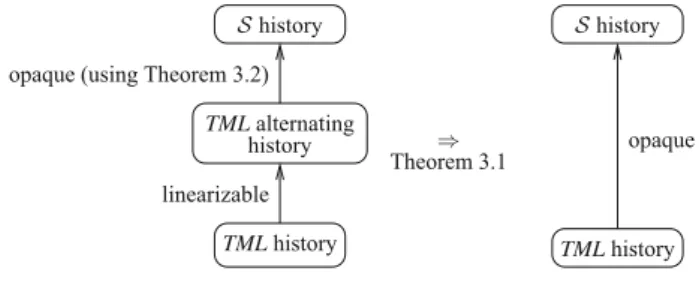
To bridge the large gap between the implementation level in which there are interleavings on both the level of operations and transactions, and the sequential specification in which neither operations nor transactions are interleaved, we split the proof into two steps. We first show that in TML all operations (i.e., write, read, start, begin) act as though they occuratomicallyat one point in between its invocation and response: we show TML to belinearizable[HW90]. This allows us to carry out the proof of opacity of TML in a simpler setting: we only prove opacity for thealternatinghistories of TML, i.e., the ones in which every invocation is directly followed by the response. Proving opacity for an alternating history is simplified by the fact that it is easy to define the semantics of read and write operations over these alternating histories (Sect.3.4). Specifying these semantics directly over histories with interleaved operations would be much more difficult. Figure2visualises the overall approach.
Our proofs have been automated in KIV [EPS+14], the resulting development may be viewed online [TML16].
The link also contains additional notes on our KIV proof.
TMLhistory
Shistory
TMLalternating history opaque (using Theorem 3.2)
linearizable
Theorem 3.1⇒
TMLhistory
Shistory
opaque
Fig. 2.Method 1: proof steps
3.1. Linearizability and opacity
The first part of the correctness proof of the TML implementation proceeds by showing it to belinearizable [HW90], which is the standard correctness criterion for concurrent objects. Linearizability provides the illusion that each operation applied by concurrent processes takes effect instantaneously at some point between its invocation and its return. This point is known as thelinearization point. In other words, if two operations overlap, then their output agrees with the sequential execution determined by the order of linearization points.
As with opacity, the formal definition of linearizability is given in terms of histories (of invocation/response events); for every concurrent history an equivalent alternating (invocations immediately followed by the matching response) history must exist that preserves real time order of operations. Thereal-time orderon operation calls6
o1ando2in a historyhis defined aso1≺≺h o2if the return ofo1precedes the invocation ofo2inh.
Linearizability differs from opacity in that it does not deal with transactions; thus transactions may still be interleaved in a matched alternating history. As with opacity, the given concurrent history may be incomplete. Thus the definition of linearizability uses a functioncompletethat adds matching returns to some of the pending invocations to a historyh, and then removes any remaining pending invocations.
Definition 3.1 (Linearizability)A historyhislinearizedby alternating historyha, if there exists a historyhc∈ complete(h) such thathc≡haand≺≺hc⊆≺≺ha. A concurrent object is linearizable with respect to a specification
A(a set of alternating histories) if for each concurrent historyh, there is an alternating historyha ∈ Athat
linearizes it. 2
With linearizability formalised, we now present the main theorem for our proof method, which enables opacity to be proved via histories of the atomic specification of an STM.
Theorem 3.1 A concrete historyhis opaque if there exists an alternating historyha such thath is linearizable with respect toha andhais opaque.
Proof Suppose (a)h is linearizable with respect toha and (b)ha is opaque with respect tohs. Then, by (a), there exists a historyhc∈complete(h) such thathc≡haand≺≺hc⊆≺≺ha and by (b), there exists a well-formed sequential historyhssuch thatha ≡hsand≺ha⊆≺hs. We must show thathc≡hsand≺hc⊆≺hsholds. Clearly,
hc≡hsbecause≡is transitive, and if≺≺hc⊆≺≺haand≺ha⊆≺hs, then≺hc⊆≺hsbecause preserving the real-time
order of operations also preserves the real-time order of transactions. 2
Linearizability proofs often use a setAof alternating histories which is generated by abstract operations that use a different state space than the concrete algorithms, e.g. the abstract operations may work on a queue, while the concrete algorithms manipulate pointer structures. In applying our result to TML, we do not change the state space, since the final setS of sequential histories we have to use in the opacity proof are histories of the same algorithm. Therefore we prove that every concurrent historyhwill be linearized by an alternating history
ha ∈ A, whereA is the set of alternating histories that the original algorithm may produce by sequentially executing operations.
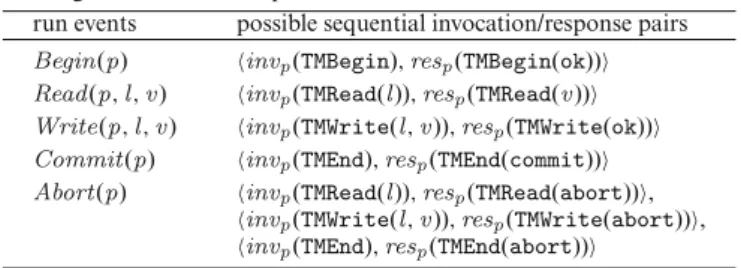
The alternating historieshaconsidered in linearizability are all complete, i.e. each invocation is immediately followed by a corresponding return. Therefore reasoning over alternating histories can be simplified by abstracting each invocation/response pairs into a singlerun eventas summarised in Table2. Run eventBegin(p) denotes a
TMBeginoperation by process p; run events Read(p,l,v) and Write(p,l,v)denote successful read and write operations by processpon addressl with valuev; run eventCommit(p) denotes a successfulTMEndoperation by processp; andAbort(p) denotes an operation invocation that aborts.
Table 2.Run events abstracting matching invocation/return pairs
run events possible sequential invocation/response pairs
Begin(p) invp(TMBegin),resp(TMBegin(ok))
Read(p,l,v) invp(TMRead(l)),resp(TMRead(v))
Write(p,l,v) invp(TMWrite(l,v)),resp(TMWrite(ok))
Commit(p) invp(TMEnd),resp(TMEnd(commit))
Abort(p) invp(TMRead(l)),resp(TMRead(abort)), invp(TMWrite(l,v)),resp(TMWrite(abort)), invp(TMEnd),resp(TMEnd(abort))
Arunis a sequence of run events. Thus we specifically show that the runr corresponding tohais opaque.
Example 3.1 The run corresponding to the history
ha inv2(TMBegin),res2(TMBegin(ok)),inv2(TMRead(l),res2(TMRead(0)),inv3(TMBegin),res3(TMBegin(ok)), inv3(TMWrite(l,4)),res3(TMWrite(ok)),inv3(TMEnd),res3(TMEnd(commit)),
inv2(TMRead(l),res2(TMRead(abort))
isBegin(2),Read(2,l,0),Begin(3),Write(3,l,4),Commit(3),Abort(2). 2
BecauseAbort(p)relates to several possible pairs of events, a run is more abstract than a complete alternating history. However from the view of opacity, the pairs thatAbort(p)represents are indistinguishable, so in effect the encoding just simplifies the mechanized proof.
3.2. Modelling TML in KIV
Before we discuss the proof steps, we first describe how the different specifications are modelled in KIV.
The concrete specification: To model the concrete state of the TML, we use KIV’s record type, which is used to define a constructormkcs(make concrete statecs) containing a list of fields of some type. Fieldglbrepresents the global variableglb, andmemrepresents the memory state and hence maps addresses to values (in this case integers). Local variables are mappings from processes (of type Proc) to values; for the TML, we have local variablepcfor the program counter,locfor the local copy ofglb, as well as variablesl(representingaddrin the pseudocode) andv(representingvalin the pseudocode). We thus use the following state.
CState =
mkcs(. .glb : nat, . .mem : L → V, . .pc : Proc → PC,
. .loc : Proc → nat, . .l : Proc → L, . .v : Proc → V)
Modelling atomic statements: Modelling one step of a TML algorithm as a KIV state transition is done in two stages. We first model the step of one process working on global variablesglbandmemand its local variables
pc,loc,landv. As an example, consider the statement labelledW2, which is modelled bywrite2-defbelow. Here,COPis used to denote that the step is internal (i.e., neither an invocation nor a response; such steps have an additional input resp. output parameter) andwrite2is the index of the operation. Modifications toglbandpc
are conditional, denoted by⊃, on the testloc = glb. Thus, ifloc = glb, thenpc’is set toW3, otherwisepc’
is set toW6. The transitions alter the concrete state, the after state is denoted by dashed variables.
write2-def:
COP(write2)(glb, mem, pc, loc, l, v, glb’, mem’, pc’, loc’, l’, v’)
↔
( pc = W2 ∧ loc’ = loc ∧ mem’ = mem ∧ l’ = l ∧ v’ = v
∧ glb’ = (loc = glb ⊃ loc + 1;glb) ∧ pc’ = (loc = glb ⊃ W3;W6) );
step ofTMEnd setpc’ = N. Whenpc = T, the process is within a transaction, but currently not executing an operation. Successful return steps of reads and writes (starting withpc = R3, W6) setpc’ = N. The invokung steps ofTMRead,TMWriteandTMEndare enabled whenpc = T.
Promotion to system wide stepsThe process-local specification of a step is then promoted to a stepCOp(cj,p)
done by processpon the full statecs. The promotion uses function update, wheref[p:d] is functionf withp
overwritten to returnd.
The interesting part of this promotion is that we add an auxiliary variablerthat records run events, which describes the intermediate level of our proof. The variableris updated exactly at thelinearization pointsof each of the operationsTMBegin,TMRead,TMEnd, andTMWrite.
The linearization points of each operation are annotated in comments in the code in Fig.1. The expression on the right of “r’ =” below is an if-then-else expression describingr’, i.e. the value ofrin the post state. Thus, for example, the first line states thatr’is set tor + Begin(p), which concatenatesBegin(p)tor, whenever the instruction atB1is executed and an even value ofglbis loaded intoloc. In this case, the operation will definitely go on to start a transaction as the outcome of the next test atB2is determined locally.
OperationTMReadlinearizes atR2to a non-abortingReadif the value ofglbis the same as the stored value inloc, and linearizes to an abortingReadif the value ofglbchanges. OperationTMWritelinearizes successfully when the memory is updated atW5, and linearizes toAbortif thecasatW2fails. Finally, operationTMEndnever aborts, yet there are two linearization points depending on whether the transaction has successfully executed a
TMWrite. If no writes were performed, thenlocmust be even; in such a transactionTMEndmust linearize atE1. Otherwise if the transaction had performed a successful write, thenlocmust have been set to an odd value at
W4, therefore, the linearization point forTMEndfor such a transaction isE2. The last line of the formula covers all remaining cases, where no LP is executed, andr is kept equal tor.
COp(cj, p)(cs, r, cs’, r’)
↔ ∃ pc’, loc’, l’, v’.
COP(cj)(cs.glb, cs.mem, cs.pc(p), cs.loc(p),cs.l(p), cs.v(p), cs’.glb, cs’.mem, pc’, loc’, l’, v’)
∧ cs’.pc = cs.pc[p := pc’] ∧ cs’.loc = cs.loc[p := loc’]
∧ cs’.l = cs.l[p := l’] ∧ cs’.v = cs.v[p := v’]
∧ r’ = (pc = B1 ∧ even(glb) ⊃ r + Begin(p) ;
(pc = R2 ∧ loc = glb ⊃ r + Read(p, l, v) ;
(pc = R2 ∧ loc glb ⊃ r + Abort(p) ;
(pc = W2 ∧ glb loc ⊃ r + Abort(p) ;
(pc = W5 ⊃ r + Write(p, l, v) ;
(pc = E1 ∧ even(loc) ⊃ r + Commit(p) ;
(pc = E2 ⊃ r + Commit(p) ;
r ))))))));
3.3. Step 1: proving linearizability with respect to the intermediate specification
Having described how we model the TML implementation in KIV, including the embedding of the linearization points in the promoted operations, the next step is to show that every historyhof this TML implementation is linearized by an alternating history of the intermediate specification. To simplify the proof, the alternating histories have been represented by runs and the run we want to use is already included as an auxiliary variable in the code. Proving that each historyhcreated by interleaved run is linearized to an alternating history represented by runris done by proving two lemmas in KIV for each of the four operations (TMWriteetc).
The first lemma states: When executed by processp, no operation ever passes more than one linearization point (LP) in any execution (regardless whether other processes executing instructions interleaved with the steps ofp) before executing a return (so in particular, even ifTMBegins gets stuck in its loop it never executes more than one LP).
The second lemma states: If an operation reaches a return and terminates, then the operation has executed exactly one LP, i.e. exactly one run event of processphas been added to the runr. The arguments of this run event agree with the actual input/output of the invoking/response transition. As an example, the write operation adds
That these two lemmas are sufficient for proving linearizability, i.e. that any interleaved historyhwill linearize tor can be argued as follows. The second lemma implies that for any finished operation, whereh contains a matching pair, the runr will contain a unique run event that represents this matching pair. For any operation that is still executing,h will have an invoke event, and there are two cases for r: either it will contain a run event that represents this invoke event and some (yet to be executed) return event, or no event (according to the first lemma). Thus in the definition of linearization,complete(h) can be chosen to add the return events for all operations, where the first case applies, i.e., where the operation has passed its LP, and drop the pending invoke otherwise. This results in a historycomplete(h) with the same matching pairs as those represented byr
with a one-to-one mapping between them. The mapping preserves real-time order (as required by linearizability) since if one operation finishes before another one starts, the former will definitely execute its LP earlier, so the corresponding run event inr will be earlier in the sequence than the one of the second operation.
The proofs for linearizability with this encoding are rather simple. We exploit here that in our example the LPs of an operation executed by processpcan be placed at the execution of an instruction bythisprocess, and do not depend on future executions (more intricate examples where linearization points are executed by other threads or depend on the future run require more complex techniques [SDW14,DD15]). The method used here is akin to the technique used by Vafeiadis [Vaf07], where concrete states are augmented with auxiliary variables representing the abstract state together with additional modifications of the auxiliary state at the linearization points. Since we have chosen the LP ofTMWRiteto be the actual write to memory, abstract and concrete memory never differ, so we can even avoid an auxiliary variable for abstract memory.
3.4. Step 2: proving opacity of alternating histories using runs
In this subsection we prove an alternating history which linearizes a concurrent TML history is itself opaque. Together with the results defined above this will be sufficient to show opacity of the TML.
Firstly, we define opacity for runs, and show that proving opacity of runs is equivalent to proving opacity of alternating histories. Secondly, we discuss the KIV proof of opacity for TML runs. (Note that the descriptions below differ slightly from the actual KIV proof online; as we use modified function names here to keep this paper self-contained, i.e., the proof can be understood without having to refer to the KIV specification online.) Defining opacity for runsMany of the definitions follow over from the definitions for histories in Sect.2. We also need to define the semantics of a valid run on a sequence of states. To define opacity of a run, we first define the semantics of each run event from Table2on the memory statemem ∈ Mem to produce the next statemem. Notationmem[l:v] denotes functional override, wheremem(l) is updated tov.
Begin(p)(mem,mem) mem mem
Read(p,l,v)(mem,mem) mem mem ∧mem(l)v
Write(p,l,v)(mem,mem) mem mem[l :v]
Commit(p)(mem,mem) mem mem Abort(p)(mem,mem) mem mem
Since TML is an eager algorithm, we do not need to distinguish the semantics of run events used in defining the setAof legal alternating histories in Definition.3.1from the semantics of run events viewed as abbreviations of two events needed for opacity. (cf. Definition2.2of a valid history). The latter definition is always as above, the former definition has to specify the effect of sequentially executing the operations of TML on memory. Here, both are the same. For a lazy algorithm that collects a write-set in its write operation, the semantics ofWrite(p)
would be identity, while the semantics ofCommit(p)would apply the write-set to get frommemtomem. The semantics of individual run events are lifted to the level of runs as follows. Below, σ is a sequence of memory states and#σdefines the length ofσ, which by the first conjunct is one more than the length ofr. By the second conjunct, for eachn, the transition fromσ(n) toσ(n+ 1) is generated usingr(n). Because the memory state has been made explicit,r(σ) only holds for valid and legal runs.
r(σ)#σ #r+ 1∧ ∀n •n<#r ⇒r(n)(σ(n), σ(n+ 1));
in Definitions2.2and2.3, respectively, wherecommitted restricts a given run to the run events of committed transactions plus the (live) transaction to whichr(n) belongs as defined in Definition2.3.
ee opaque(r,rs)(r ≡rs)∧(≺r⊆≺rs)∧ ¬interleaved(rs)∧
∀n •n <#rs⇒ ∃σ •σ(0)(λx•0)∧committed(rs[0..n])(σ)
We must now ensure that proving opacity of runs is sufficient for proving opacity of complete alternating histories. This is established via the following theorem. We say a runr correspondsto an alternating historyha
iffr can be obtained fromha by replacing each pair of matching events inha by the corresponding run event from Table2.
Theorem 3.2 An alternating historyha is end-to-end opaque if there exists a runr thatcorrespondstoha and there is anrs such thatee opaque(r,rs) holds.
Proof The proof of this theorem is straightforward as the definition of opacity of a run is built on the opacity of
an alternating history. 2
The invariants for opacityThe rest of the proof is now about proving that for each state (cs,r) of the TML augmented with runs, it is possible to find a sequential runrssuch thatopaque(r,rs) holds.
As with our work on linearizability [SDW14], we prove this via construction of an appropriate invariant. The main proof then shows that all augmented states (cs,r) satisfy the predicate∃rs •INV(cs,r,rs). The formula
INV(cs,r,rs) defines a number of invariants that, in particular, implyopaque(r,rs).
Informally, formulaINV(cs,r,rs) encodes the observation that the (legal) transaction sequencesrsgenerated by the TML implementation always consist of three parts.
1. A first part that alternates finished transactions and live transactions with an even value forloc(p) that is already smaller than the current value ofglb. The processespexecuting such live transactions have only done reads. They are still able to successfully commit, but they are no longer able to successfully read or write. 2. A second part that consists of transactions of processespthat haveloc(p) = glb(orloc(p)+1 = glb, in case a
writing transaction exists). These are the live readers, that still are able to do more reads if there is no writer. 3. Finally, an optional live writing transaction. The processpexecuting this transaction either satisfiesodd(loc(p))∧
loc(p)glborpc(p)W4∧odd(glb)∧glbloc(p) + 1.
That the partitioning is an invariant is established by proving some additional simpler properties of the TML implementation with respect to the corresponding sequential runrs. The most important ones are as follows, wherepis assumed to be the process generating the transaction.
INV1 Transactions for whichloc(p) is even have not performed any writes.
INV2 Any live transaction with an odd value ofloc(p) is the last transaction inrs, andloc(p)glbin this case. As a direct consequence there is at most one live transaction with an odd value forloc(p).
INV3 If the sequential runrs contains a live transactiont by processpwithloc(p)glborpc(p)W4, any finished transaction must occur beforet. This ensures that when a live transaction becomes a writer, it must not be reordered with a finished one, but only with live readers.
INV4 Live transactions are ordered (non-strictly) by their local values ofloc. This property is crucial for pre-serving real-time order, since a largerlocimplies that the transaction has started later.
INV5 Strengtheningopaque(r,rs), the state sequence σ that is needed to ensure that the last event ofrs is valid (cf. Definition2.3) always ends with current memory. Formally, for any augmented statecs,r the sequential historyrsis such, that for its projectionrs to events of committed transactions plus the events of the last transaction a (unique) state sequenceσ withrsσ exists where the last element ofσ is equal tocs.mem.
INV6 Aborted transactions contain no write operations.
Opacity proof in KIV The proof proceeds by assumingINV(cs,r,rs) holds for somers, and shows that the invariant holds after any step of the TML specification. If the step generatescs,r it must be possible to construct a new sequencers such thatINV(cs,r ,rs ) holds. For all steps that do not linearize (i.e. do not modifyr) this is easy, we simply choosers rs. Therefore, each of these proofs except for the operation atW4(that increments
To explain the proofs, note that by constructionrs is always a sequence of transactions, i.e. it has the form
ts(0)ts(1)· · ·ts(#ts−1) concatenating the events of individual transactions, each executed by some process. We therefore can assume a functiontseq(rs), which generates this sequence of transactions fromrsin order.7
This sequence satisfies the invariants above, so as already discussed, it consists of three parts: (1) Completed transactions and “old” live readers, (2) live readers, and (3) possibly one writer at the end. Each linearization step of a TML operation executed by processpadds a corresponding run eventretor, i.e.r rre, and we have to show that we can find an appropriaters. With the exception of starting a new transaction withreBegin(p) (which simply adds the same event at the end ofrs) the newrs then must addreto the end of the appropriate live transaction, sayts(j), leaving all others unchanged. The sequencets then may reorder the transactionsts(i) such that opacity (and in particular the memory semantics ofrs) is preserved. In most cases there is no need to reorder, i.e. the choice forts ists[j :ts(j)re].
Because opacity holds for the transaction sequencersbefore the LP step, we know from Definition2.5that for each transactionts(k) a memory sequenceσkexists, that fits the run events of the committed transactions before
ktogether with the run events ints(k). In the following, we refer toσkasthe memory sequence validatingts[0..k]. The task then is to find for eachka new memory sequenceσk that validatests[0..k]. There are three cases.
1. Fork j, we chooseσ :σmem, wheremem is computed from the last elementmem :last(σ) by applying the semantics of the added eventreonlast(σ). Note that this preserves propertyINV5, since in the case of a write operation propertyINV2guarantees (sincelocis odd atW5) thatrs[k] in this case is the last transaction, and the memory update of the algorithm agrees with the one done by the operation.
2. Fork <j, we chooseσk σk, since the extended transaction is not present.
3. Forj <k, we chooseσk σkwhenreis not a commit. The difficult case remaining is the one wherets(j) is committing. However, becausets(j) is not the last transaction in the sequence, it cannot have an oddlocdue toINV2, and byINV1, the transaction has not performed any writes. Therefore, the memory sequenceσjthat validatests[0..j] is of the formσ0memn, wherememnis a sequence ofmems of lengthn. The memory
sequenceσk that validatests[0..k] has prefixσ0memn, sincej <k. Therefore,σk σ0memnσ
and the new memory sequence that validatests(k) can be set toσ0memn+1σ.
This proves the main invariant thatrs is legal. However, there is an additional problem when (a) run eventre
is aCommitorAbortor (b)loc(p) is incremented atW4. Case (a) may violateINV3, which is necessary to ensure that real-time order inr is preserved, (b) may violateINV4.
The simplest example is a runr Begin(1),Begin(2). A possible transaction sequence is simplyts t1,t2
where t1 Begin(1) andt2 Begin(2). For scenario (a), process 2 may linearize a TMEnd resulting in r rCommit(2). The new transaction sequencets must now have the completed transaction 2beforethe live transaction 1 due toINV3, i.e.ts t2,t1 wheret2 Begin(2),Commit(2). For scenario (b), process
1 may linearize aTMWrite, i.e. r r Commit(1). Transaction 1 must now be moved to the end of the transaction sequence to preserveINV4. This results ints t2,t1wheret1 Begin(1),Write(1,l,v). Note
that swappingt1andt2is possible in both cases, since both transactions have done reads only, implying that the
memory sequence needed to validate both transaction sequencest1,t2andt2,t1repeats a constant memory.
In general, for both scenarios, a transaction with currentloc(p) value must be moved. Case (a) must move the committing reader to the start among those whose value oflocequalsloc(p). In terms of the split of the transaction sequence into three parts, the transaction was one of the transactions of part 2, and must now become the last trans-action of part 1. Case (b) must move the transtrans-action that executesW4to the end ofts(it moves from part 2 to become the single writer of part 3). Both cases can be reduced to a lemma, that says that adjacent transactionsts(n),ts(n+ 1) executed by processespandq, respectively, can be reordered wheneverloc(p) loc(q). This is because by propertyINV2, bothloc(p) andloc(q) must be even and byINV1neither may have performed any writes.
7 Technically, a transaction sequencetsis represented in KIV as a sequence of rangesm
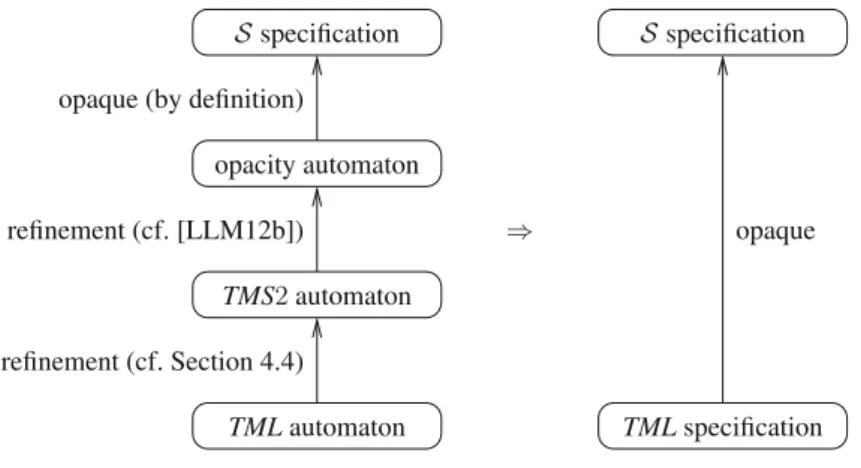
Fig. 3.Method 2: proof steps
MechanizationThe entirety of Method 1 has been mechanized in KIV, excepting elements of the development that directly involve the notion ofhistoriesfrom Sect.2. The definition of opacity over histories presented in Sect.
2.3has not been mechanized. However, a definition of opacity over runs has been mechanized along with all the definitions on which it depends, and the definition ofee opaque. Theorems3.1and3.2(which connect runs to histories) have not been mechanized. The definitions and proofs in the remainder of the development have been fully mechanized. In particular: the TML model; the linearizability proof outlined in Sect.3.3; and the semantics and invariant proofs described in Sect.3.4.
Specifying and proving opacity using KIV required four weeks of work. In particular, half the time was invested to develop an elegant formalisation of transactions that does not have to refer to auxiliary data like transaction identifiers and does not have to explicitly specify permutations. The most difficult part of the proof was figuring out a good lemma that gives criteria for preserving the semantics. This proof and the proofs of the main goals for each of the 7 linearization points andpc(p)W4 are rather complex. They each have between 50 and 100 interactions. Our first guess for defining the invariant left out the two propertiesINV4andINV6, they were added during the proof, which also took ca. two person weeks. Streamlining these techniques in the context of a larger example (e.g., the TL2 algorithm [DSS06]) is a topic of future work.
4. Proving opacity: method 2—using a simulation with TMS2
The method in Sect.3achieves some level of decomposition for opacity proofs by linearizing TML histories to alternating histories. However, the proof method can be improved in two key areas: (1) The alternating history that we obtain must be coupled with the execution of the TML to prove opacity, i.e., the proof of opacity for the alternating histories relies on additional properties of the TML algorithm. (2) Using the alternating histories of the concrete algorithm represents a design choice, which gives a simple characterization of the effect on memory for eager algorithms only.
In this section, we address both issues and present an alternative proof of correctness of the TML algorithm, following a structure that is conventional for simulation proofs. This new proof leverages two existing results from the literature: the TMS2 specification by Doherty et al. [DGLM13], and the mechanized proof by Lesani et al. [LLM12b], which shows that the TMS2 specification implements an opaque specification (that generates all possible opaque histories). The specifications in [DGLM13,LLM12b] are formalised as Input/Ouput automata (IOA) [LT87], and hence, for the sake of continuity we also model the TML algorithm using IOA. An overview of this proof method is given in Fig.3. All proofs between the TML and TMS2 specifications are fully mechanized using the Isabelle [NPW02] theorem prover.
This section is organised as follows. First we present some background (Sect.4.1), in particular, the IOA formalism and its forward simulation proof rule. In Sects.4.2and4.3we present the TMS2 automaton (originally defined in [DGLM13]) and the TML automaton, respectively. The simulation proof as well as the invariants that we use are described in Sect.4.4.