TABLE OF CONTENTS:
Vol. 42, No. 2, March 1989
ARTICLES
90
President’s Address-Is it time for a change? by Willam A. Laycock
Plant Ecology
93
Crested wheatgrass growth and replacement following fertilization,
thinning, and neighbor plant removal by Bret E. Olson and James H.
Richards
98 Pinyon-juniper chaining and seeding for big game in central Utah by J.G.
Skousen, J.N. Davis, and J.D. Brotherson
104 Atrazine and
fertilizer effects on Sandhills subirrigated meadow
by John
J. Brejda, Lowell E. Moser, Steven S. Waller, Stephen R. Lowry, Patrick
E. Reece, and James T. Nichols
Plant Physiology
109
Genetic variability of Mg, Ca, and K in crested wheatgrass
by H.F.
Mayland and K.H. Asay
113 Observations on biomass dynamics of a crested wheatgrass and native
shortgrass
ecosystem in southern Wyoming
by Edward F. Redente, Mario
E. Biondini, and John C. Moore
Plant-Animal Interactions
118 Seeded wheatgrass yield and nutritive quality on New Mexico big sage-
brush range by Jerry L. Holechek, Richard E. Estell, Charles B. Kuyken-
dall, Raul Valdez, Manuel Cardenas, and Gregorio Nunez-Hernandez
122 Silicon in C-3 grasses: Effects on forage quality and sheep preference by
Glenn E. Shewmaker, H.F. Mayland, R.C. Rosenau, and K.H. Asay
128 American jointvetch improves summer range for white-tailed
deer
by
Thomas W. Keegan, Mark K. Johnson, and Billy D. Nelson
Economics
134
Comparing the economic value of forage on public lands for wildlife and
livestock
by John Loomis, Dennis Donnelly, and Cindy Sorg-Swanson
Soils
139 Inflltration parameters for rangeland soils
by W.J. Rawls, D.L. Braken-
siek, and M.R. Savabi
Grazing Management
Published bimonthly-January, March, May, July, September, November Copyright 1989 by the Society for Range Management
149
lNDlVlDUALSUBSCRlPTlONisbymembershipin the Society for Range Management.
LIBRARY or other INSTITUTIONAL SUBSCRIP- TIONS on a calendar year basis are $58.00 for the United States postpaid and $66.00 for other coun- tries, postpaid. Payment from outside the United States should be remitted in US dollars by interna- tional money order or draft on a New York bank. BUSINESS CORRESPONDENCE, concerning sub- scriptions, advertising, reprints, back issues, and related matters, should be addressed to the Manag- ing Editor, 1839 York Street, Denver, Colorado
802oe.
153
158
163
165
Experimental evaluation of the grazing optimization hypothesis by
Samuel C. Williamson, James K. Detling, Jerrold L. Dodd, and Melvin L.
Dyer
Cattle nutrition and grazing behavior during short-duration-grazing peri-
ods on crested wheatgrass range by Kenneth C. Olson, Gerald B. Rouse,
and John C. Malechek
Growth dynamics of fourwing saltbush as affected by different grazing
management systems
by David L. Price, Gary B. Donart, and G. Morris
Southward
Observation on cattle liveweight changes and fecal indices in Sudan by
Ibrahim M. Hashim and Babo Fadlalla
Economic consequences of alternative stocking rate adjustment tactics: a
shnulationapproachby
R.K. Riechers, J.R. Conner, and R.K. Heitschmidt
EDITORIALCORRESPONDENCE, concerning manu-scripts or other editorial matters, should be addressed
TECHNICAL NOTES
to the Editor, 1839 York Street, Denver, Colorado
172 Leafy spurge and the species composition of a mixed-grass prairie by
86206.
Joyce W. Belcher and Scott D. Wilson
INSTRUCTIONS FOR AUTHORS appear on the
inside back cover of most issues. A Style Manual is
176 Reviewers for 1988
also available from the Society for Range Manage-mentat theaboveaddress@$2.00forsingle.copie.s; $1.25 each for 2 or more.
THE JOURNAL OF RANGE MANAGEMENT (ISSN 0022-409X) is published six times yearly for $58.00 per year by the Society for Range Management, 1839 York Street, Denver, Colorado 80208. SECOND CLASS POSTAGE paid at Denver, Colorado. POSTMASTER: Return l nHm journal wlth address change-RETURN POSTAGE GUARANTEED-to Society for Range Management, 1839 York Street, Denver, Colorado 80206.
Managing Editor PETER V. JACKSON Ill
1839 York Street Denver, Colorado 80206 Edttor
PATRICIA G. SMITH
Society for Range Management 1839 York Street
ASSOCIATE EDITORS DON C. ADAMS
USDA ARS
Livestock & Range Research Rtl.Box3
Miles City, Montana 59301 WILL BLACKBURN
N.W. Watershed Res. Center
RICHARD H. HART USDA-ARS 8408 Hildreth Rd. Cheyenne, Wyoming 82009 RODNEY HEITSCHMIDT
Box 1658
Vernon, Texas 76384 Denver, Colorado 80266 270 South Orchard
(303) 355-7070 Boise, Idaho 63705 PETE W. JACOBY, JR.
P.O. Box 1658 Vernon, Texas 76384 HOWARD MORTON
2000 E. Allen Road Tucson, Arizona 85719 Book Revlew Edltor
GRANT A. HARRIS
Forestry and Range Management Washington State University Pullman, Washington 991646410
CARLTON BRITTON Range&Wildlife Mgmt Texas Tech University Lubbock, Texas 79469 TIMOTHY E. FULBRIGHT
College of Agriculture Texas A&l
POB 156, Sta. 1 Kingsville. Texas 78363
BRUCE ROUNDY 325 Biological Sciences East Building, Univ. Arizona Tucson, Arizona 65721 DAVID M. SWIFT
Natural Resources Ecology Colorado State University Ft. Collins, Colorado 80523 PAUL TUELLER
Range Wildlife 8 Forestry UNR loo0 Valley Road Rena, Nevada 89512 STEVE WHISENANT
Texas ABM Univesity Dept. of Range Science
President’s Address
Is it time for a change?
WILLIAM A. LAYCOCKI want to try to do two things in this The Watershed/Ripnrian Task group was formed at Corpus address-talk about some of the pm- Christi, with Fred Gifford as chairman, to provide a focus for the g~ss and plans ofthe new task groups concerns about watershed and riparian issues not only within formed in the last year and then talk SRM but nationwide. This task group has arranged for a sympo- aboutsome new ideas and somepoten- sium at the 1990 annual meeting in Rena to address how healthy, tial new directions that SRM should self-perpetuating riparia” zones and intact watershed are impor- at least consider. tant components of a quality environment. The National Wildlife Federation, Trout Unlimited, Sierra Club, The Wilderness Soci- Some Thank You’s ety, National Audubon Society, The Izaak Walton League, and the First, I would like to express my Defenders of Wildlife have all been invited to participate. The task thanks to some of the people that group also reviewed the 1988 GAO report on riparian areas. helped me make it through the year as The Wildlife/ Wildlife Habitat Task Group was also formed at president of SRM. First, I would like to thank my wife, Charlotte, Corpus Christi with Kieth Severson as chaimxm. The Task Group for her support, help, and encouragement during the year and for is planning a text book, to be published by SRM if it is approved,
putting up with the long periods of my absence from home. Within dealing with Wildlife and Wildlife Habitat on Rangelands. The SRM I would like to give special thanks to Pete Jackson. He is the Task Group also plans to sponsor a symposium “Can Livestock Be one person that really holds this organization together and is truly Used To Enhance Wildlife Habitat?“at the 1990 SRM meeting in “Mr. Range Management.” Presidents are around for only one Rena An important contact has been made through the Task year, so Pete is the one that is known by people and organizations Group with the president of The Wildlife Society, which should outside the Society as the one to contact about Range Manage- lead to closer and better relations and cooperation between our
ment. Anotherindividualwho isdoingatremendousjobfor SRM ‘v/o S°CLet’eS ‘” the future’
in Washington, D.C., is Ray Housley. I made4tripsto DCduring The Task Group on Small Tract Range and Pasfure Manage- the year and, every time, was impressed with the variety of people menf with Emphasis on Horses was also formed at Corpus Christi that Ray knows and that know Ray as the SRM representative. with John Buckhouse as chairman. The committee was very small Any expression of thanks is not complete without thanking the to start with but has now expanded. The task group feels that the staff in our Denver office. They really are a dedicated group of c”ncer” for management of small tracts is real and should be people and, by dealing with the day-to-day routine matters of the represented in SRMrThey are exploring the possibility of prepar- Society, make it run. The other group of people who attend to the mg a book dealing with the subject.
professional work of the Society are the committee chairmen, the The Remote Sensing Task Group met informally at Corpus members of the various committees and task groups, and the Christi was fommlized as a task group a couple of months late with Section officers and committees. Except for our Denver staff, Paul Tueller as chairman. This working group is committed to the SRM is run by volunteers, most of whom have another job. We future importance of remote sensing for rangeland resources never can say thank you enough to these people as well as all of the inventory and monitoring. A reconsideration of this matter is members of SRM who make this such a” exciting organization. important now in light of the increased emphasis on the inventory
and monitoring of the earth’s renewable natural resources. Dr. Special Task Groups Tueller and some other members of the working group have been involved in planning a session on International Range Inventory The standing committees of SRM do the routine and CO”ti”Ui”g and Monitoring t” be part “f the i”tern&““al conference 0” work of the Society and we cannot function without them. The “Global Natural Resource Monitoring and Assessment: Preparing progress made by each of these committees Will be published in for the 21st Century% be held in Venice, Italy, in september 1989. Rongelands and I urge you to read their reports. What I want to do The Coordinated Resources Manogemenf Task Group also has in this report is talk about the progress being made by the special b
Task Groups formed during the last year and a half that are dealing ized as a Task Group in March with Brent Lathmp as chainnan. ee” working together informally for several years and was formal- with different or potentially important issues.
The Conservation Reserve Program Task Group was formed This group also has planned a CRMP symposium for the 1990 late in 1987 to address the implications of this major program and meeting in Rena. A workshop for State Advocacy team members and a Task Group breakfast were held at the Billings meeting. to consider the charges given to SRM by Wilson Scaling at the The newest group is the Task Group
for
Unity in Terms and CRP symposium in Denver in September, 1987. The committee, Concepts formed in January and met for the first time in Billings. chaired by Harold Goetz, has Contacted all Section presidents and The Charges given this “ew Task Group were to continue pr”fes_ requested that they each establish CRP committees within eachSection. SRM’s program on CRP was presented at a meeting of the sional dialogue on terminology and ecological concepts relating to Grazing Lands Forum in October 1988 and also as part of a range classification, inventory, and monitoring and seek agency commonality and unityin technology and methodology relatingto program presented to the USDA Joint Council in January, 1989. rangeland condition and trend.
One of the main concerns of SRM, as well as many other organize-
tions, is how to keep erodible lands now in CRP in that protective Publications cover when the CRP contmcts end in the mid 1990’s.
Several other accomplishments by committees and others dur- This address W&S presented 22 wxuary 1989 at &C an.3 annual meeting “the ing 1988 need some comment. At Corpus Christi, the Publications
society
for
rfangc Management in Billings, Montana. Dr. Layc.oclrwas 1988 presxientof the sosisty.
Committee presented the Board of Directors with an updated version of the Glossary of Terms. The subcommittee that prepared it had done a tremendous amount of work bringing the terms up to date. Even so, there were still a number of terms in the glossary that lacked universal acceptance, and some terms (such as a few from the RISC Report) were missing. First Vice-President Tom Bedell took the draft Glossary and has spent a great deal of time adding the missing terms and trying to make it as accurate as possible. The Glosscry should be published early in 1989.
Two other publications were prepared in 1988 and will be pub- lished by SRM in 1989. One is a Range Research Initiative that has been in preparation for several years by several members-Gary Evans, Phil Sims, Fee Busby, and others. It outlines range research needs along with the additional budget required. A similar docu- ment by the Research Affairs Committee, prepared at the request of the Experiment Station Committee on Policy, was completed about the same time. The two documents are completely parallel in subject matter and budget requests. The range research initiative paper is now available from the SRM office in Denver. This publication was presented to the USDA Joint Council and dis- cussed at their meeting in Washington, D.C., in January.
The other publication, entitled “Assessment of Rangeland Con- dition and Trend of the United States, 1989,“was prepared in 1988 by a subcommittee of the Public Affairs Committee. It is the culmination of several years of work by the subcommittee chaired by Dr. George Ruyle and with members from FS, BLM, and SCS and several universities. It shows the most current data on range condition and trend within each agency. One of the problems brought out in the report is that some of the data is not as recent as it should be because of lack of money, manpower, and emphasis within each agency to monitor rangelands at the proper intensity and frequency. The results of this study were also presented to the USDA Joint Council in January. This publication also should be available from the Denver office by the time this article is in print or shortly thereafter.
Are Changes Needed?
There are a number of encouraging things about SRM and range management in general. Membership in SRM increased slightly in 1988 and we went over the 5,000 member mark for the first time in several years. After a continuous decline for 5-6 years, the number of students in colleges and university range science departments has leveled off and some schools have had small increases in student enrollment the last two years. There have heen more jobs available for range management graduates the last couple of years, and summer jobs for students are plentiful.
In spite of all of these positive signs, there are other indications that the profession may be in trouble. As I commented in a column in 1988, the image of the profession and of SRM to many other groups is not what we want it to be. We are perceived by many of the environmental organizati,ons as strictly a livestock organiza- tion. This perception prevents SRM from forming coalitions with some wildlife, fsheries, and other types of organizations that would be beneficial to SRM and to rangelands.
Funding for range management programs and range manage- ment research has declined dramatically in the last decade and a half. Some of this has been budget cuts from Congress but much has been the result of shifts of funding from range to other activities as a result of priority shifts within the Forest Service and BLM. The Rangelands Research Grants Program under CSRS has not been allocated any funds again in the FY90 President’s budget. Range management research in the Forest Service has been cut to the level that it hardly exists. All of these things indicate a low priority for range management in the federal government.
The 2 GAO reports issued in June, 1988, dealing with riparian
areas and overstocked allotments were very critical of the range management programs of our two largest land management agen- cies and of livestock grazing on public lands. Livestock graxing on public lands seems to be under attack from a number of fronts. One example is Earth First’s slogan of ‘Cattle Free by 93”, which describes one of their goals for public lands.
One thing that some people believe reinforces our image as a grazing organization is the Trail Boss logo. This is an emotional subject but we (SRM) need to seriously consider our logo and what it portrays. To many, it simply portrays a single use orientation for SRM. In a letter from a former SRM president he stated: “True, I would miss the Trail Boss-for a while. But, in real life his job changed too, with time. In today’s world, resisting change is court- ing disaster. We cannot afford to let that happen.”
Along with, or before we consider changing our logo, I believe we have to consider changing our name. As I indicated in the October President’s Notes in Rangelands. we need to add some- thing to our name to make us identifiable in a world where country and regional Rangeland Societies are becoming common. I was fortunate enough to he able to travel to Kenya, Mexico, and India in 1988. In every situation, I found that SRM was referred to as the “United States Rangeland Society”, the “American Society for Range Management” or something similar. I took part in the closing ceremony of the 3rd International Rangeland Congress in India and was introduced as the president of the “American Range- land Society” in spite of numerous letters to the organizers on official SRM stationery. As I pointed out earlier, we are no longer “THE Society for Range Management and we are not the “INTERNATIONAL.” Society. We are just one of a number of rangeland societies in the world and our name should reflect it. I received some mail supporting a change to the “North American Rangeland Society*’ or “North American Society for Range Man- agement”. Some mail simply said, “Leave our name alone.”
I also received mail indicating that simply adding a country or regional part to our name was not enough. These letters advocated a name change to something completely different such as the “Society for Natural Resource Management”as well as a change in our logo. One writer said, “It’s time (actually 15-20 years past time) the society made a serious effort to convey the message of multiple use management to the rest of the United States (world?).” Another writer said, “As the Society for Natural Resource Management, we would broaden our membership base immeasurably. We have long prided ourselves on membership diversity; this change would truly give us opportunities for diversity of backgrounds and expertise in our society”.
In August, I received two thoughtful and thought provoking letters from two ranchers, both quite active in SRM affairs. I am going to quote a few things from these letters and hope that they serve to make all of us think about the role of SRM, its name, and its members.
To have a first class, respected, professional-scientific society that is creative and gaining stature in the scientific arena is a must for SRM. The Soil Science Society, Society of Agronomy and Animal Science Society have few to no farmer or rancher members. These are old societies and I am sure they represent the right way to be an effective society....(We) haveconvinced ourselves that the opportunity for growth on a permanent, constructive basis lies within the employees of the (agencies and universities) that have the responsibility for developing new technology plus getting all of it applied where needed....If all of the professional people who work in range management from the class- room to the ranch were SRM members and were properly trained, our ranchers would soon become interested in the application of sound practices and be a strong support group for SRM and its programs. Ranchers could become members, and we will have a few, but let’s not waste our real responsibility of being a strong, sound source of scientific information and professional guidance in range management....Let’s work to stock SRM with the right kind (of individuals) and then assist
and encourage them to carry the ball in the game where ranchers are involved. I pexsonally would feel honored to belong to the organization that was recognized as representing the very best scientific and profes- sional people in the field of Range Management...So let’s forget trying to be all things for all people and concentrate on being the best in our field.”
Is this the direction SRM should take? Many members will say “no” but, considering the source of the comments, I think we have to take the ideas seriously and at least consider them.
In the other letter, similar ideas were presented--“We are look- ing for new members. Especially new members who can influence the application of sound range use practices. What better group could we solicit than the large number of technical people who work with landowners every day as agency representatives?...If every person from the university to the ranch who works with rangeland management was an active member of SRM, we would see miracles occurring on the land. We could double our member- ship and quadruple our on-the-land accomplishments if we just had as members, the university and agency people who, by their assignments, should belong to SRM.” I don’t believe anyone would disagree with the latter quote.
In
Summary
To survive, any organization has to be dynamic and not become a dinosaur. Most of the ideas I have presented above came from members, members who are deeply concerned about the future of the range management profession and of SRM. The least we can do is seriously consider all of those potential areas of change as well as other areas that might need change that I have not even thought
of. I encourage all of the officers, directors, and committees of SRM; all of the Advisory Council officers and members; and all other members of SRM to think seriously about the future of SRM and to not resist change just because the way we operate now or what we call ourselves is “the way it always has been.”
It has been an honor and a pleasure to serve as president of SRM. One thing that became very obvious to me is that one year is too short for one person to have very much influence on the course of a dynamic organization such as SRM. 1 encourage all members of SRM to work together and work with the officers and commit- tees of both the parent Society and the Sections to continue to help SRM both improve and grow.
Crested wheatgrass growth and replacement following fer-
tilization, thinning, and neighbor plant removal
BRET E. OLSON AND JAMES H. RICHARDS
AlwtnCt
The growth 8nd annual replacement of crested whatgrass
(Agropj~on desertorum (Flscb. cx Lhtb) ScbuU.) tliiers are
affected by resource
l
variability. FertlUzation and grasbtg affectthe resources avaiiable to crested wbatgrm phnts directly, by
iacrasing nutrient supply or by reducing pbotosyntbetk 8ra 8nd root eior@ion, and indirectly, by clunging tbe competitive status of neighboring phnts. To determine tbe time end menner of
crested whatgram response to 8ltemtions in resource 8v8il8bility,
we uwessed the growth, flowering, and repiacement of tiliers on plants treated as follows: tiller tbbming, neighbor piant removal, combbted thinning and neigbbor phnt removrl, and nitrogen fer- tiiization. These treatments were repeated on different sets of plants in early spring 1984 and 1985. Plant response was btferred from tiller heights, number of flowering cubns, and new spring tiller production witbin tbe season of manipulation, and the number and beigbts of replacement tiilers tbe followbrg spring. Neigbbor removal, and in 1 year fertiilsation, btcreased tbe size of tillers and stbnuiated the emergence of new sprbtgtiilers. Fertillza- tion effects did not persist into tbe foliowing year whereas neighbor remov8l increased 8mumi tiiier replrcement at least two-fold on target plants. TUler-tiller competition was not important in phnts of crested wheatgrass beause tiiier growth and replacement on thinned plants did not differ from that of in&t plants. This result occurred when thinned end in&t piants were compved when botb were growing witb or without neighbors. Thinned plents replaced only the remaining tillers by tbe following spring. They did not regain their pretreatment strtus, presumably beause of the encroachment of neighbors. These results indicate that thinned plents probably would lose their position in 8 phnt community unless their neighbors 8re affected simihrly.
Key Words: Agropyron &sertorum, bunch-, tilkr dynamics,
competition
The productivity of grasslands fluctuates in time and space as water and nutrient availability varies. Populations of long-lived clonal grasses in these grasslands may respond to fluctuations in water and nutrient availability by altering the number of plants, the number of tillers per plant, or the size of individual tillers. In many undisturbed grasslands, increases in plant numbers by seedling recruitment or reductions by the mortality of established bunch- grasses are uncommon (West et al. 1979, Gurevitch 1986, Salihi and Norton 1987). When plant population dynamics are unimpor- tant in grasslands, the response to water and nutrient availability occurs in the plasticity of tiller numbers per plant, and tiller size.
Harper (1977) cites several studies in which tiller (or shoot) and plant population processes maintain a dynamic equilibrium with
Authors are research associate, Reclamation Research Unit, Montana State Uni- versity, Boreman 59717; and associate professor, Department of Range Science and the Ecology Center, Utah State University, Logan 84322-5230. At the time of the research, the first author was research assistant, Depattmcnt of Range Science, Utah State University, Logan.
The Utah Agricultural Experiment Station (Project 780) and the National Science Foundation (BSR-8207171 and BSR-8705492) supported thii research. This is Jour- nal Paper No. 3368 of the Utah Agricultural Experiment Station, Logan, Utah. We thank J.L.K. Pcderscn for tield assistance and D.A. Pyke for constructive comments on the manuscript.
Manuscript accepted 1 September 1988.
JOURNAL OF RANGE MANAGEMENT 42(2). March 1989
resource availability, but most of these studies were conducted with rhizomatous grasses in glasshouses or growth chambers. Sev- eral field studies have shown that the removal of neighboring bunchgrasses increases tiller number, tiller sire, or basal area of the remaining grasses (Mueggler 1972, Robberecht et al. 1983, Fowler 1986, Gurevitch 1986, Nobel and Franc0 1986). Competition among grasses is usually used to explain these responses. Within grasses, tiller-tiller interactions may also be competitive (Kirby and Faris 1972, Colvill and Marshall 1984) or mutually beneficial (Giiford and Marshall 1973, Welker et al. 1985). A positive response of grasses to neighbor removal could be explained by a relaxation of tiller-tiller competition. Competition among tillers has seldom been determined with grasses in the field.
In grasslands, resource variability may result from localized disturbances or areas of defecation by large herbivores, or changes in the competitive status of grasses following grazing. Because of the hierarchical organization of bunchgrasses, grass response to resource variability will first be expressed in population processes of tillers.
For this study, we used the tussock-forming Nordan crested wheatgrass (Agropyron desertorum Fisch. ex Link) Schult.). Crested wheatgrass has been established on more than 5 million hectares in western North America because it tolerates drought and herbivory better than most of the native grasses (Rogler and Lorenz 1983). Tiller growth, flowering, and replacement were assessed in the field following: (i) fertilizing small areas, (ii) thin- ning individual plants, and (iii) removing neighbor plants. These treatments simulated areas of resource enhancement, a reduction in the competitive status of plants, and a reduction in plant densi- ties, respectively.
Plant response to such treatments may be expressed immedi- ately or in following years. Therefore, growth, tillering, and flower- ing within the spring growing season and tiller replacement by the following spring growing season were monitored. Although the focus of thii study was on tiller population processes, plant response can be inferred directly, and population and community dynamics indirectly, from such observations.
Materials and Methods
The study area, Tintic Valley in west-central Utah (39” Sl’N, 112O 08’W, 1,750 meters above sea level), typifies Great Basin foothill rangelands. Soils are Typic Haploxerolls; textures range from coarse to fine sandy loams. Utah juniper (Juniperus osteo- sperma (Torr) Little) and basin big sagebrush (Artemisia triden- tata ssp. tridentata Nutt.) were mechanically removed at the site in 1951. That autumn, crested wheatgrass was seeded to increase livestock forage and remains the dominant species. Long-term (2%year) average annual precipitation 9 km from the site is 370 mm. During this study, weather information was obtained from an automated station located 1 km from the site. Total annual precipi- tation was slightly above the long-term average in 1984 (122%) and
1985 (108%).
Tillers of crested wheatgrass live a maximum of 14 months at our site. Without perturbation, almost all tillers are produced in
autumn, overwinter, resume growth in spring, flower in late June, and senesce shortly thereafter. With the onset of autumn rains, replacement tillers are produced from axillary buds on the senes- cent tillers (Mueller and Richards 1986).
The study was repeated during 2 years on different sets of plants. Treatments were imposed on 20-21 April 1984 and 23-24 April 1985, 2 to 3 weeks after snowmelt. The treatments were: plant thinning, neighbor plant removal, combined plant thinning and neighbor plant removal (19851986 cycle only), nitrogen fertiliza- tion, and controls. Plants were thinned by selectively removing 50% of the tillers on a plant with a razor blade. Care was taken not to damage adjacent tillers. Neighboring plants within a 1.5 m radius in 1984, 1 m radius in 1985, of target individuals were removed with a glyphosate herbicide. We used a nonpersistent herbicide rather than mechanical removal to minimize soil distur- bance. Nitrogen fertilizer was applied as ammonium nitrate in solution at 56.1 kg ha-’ of nitrogen. At the same time all other treatments received an equivalent watering treatment.
We used a randomized complete block design with 3 replicates. Within each block, a 5-m by 5-m plot was randomly assigned to each of 4 treatments in 1984, and to 5 treatments in 1985. A l-meter buffer separated each plot. In each plot, 5 randomly selected plants were monitored. In the thinning and neighbor removal treatments, only monitored plants were treated whereas all plants within fertil- ized plots received treatment. We analyzed the mean response of the 5 monitored plants.
To determine plant response, 20 and 10 tillers per plant were marked with wire rings on 9 May 1984 and 11 May 1985, respec- tively. Half of the marked tillers were equally spaced on the perime- ter and the remaining tillers were similarly spaced within the core of the plant. Overall, each treatment consisted of 300 tillers in 1984, 150 in 1985, evenly distributed on 15 plants (5 plants per treatment per block, 3 blocks).
In both years, tillers were measured immediately after all had been marked and subsequent observations were at 7day intervals until summer senescence. Observations included tiller heights (most extended leaf), emergence of new spring tillers, and the phenological status of all marked and new spring tillers. All tillers are produced intravaginally in this species; therefore, new spring tillers and autumn tillers emerged within the wire rings of their living and senescent progenitors, respectively. Most autumn tillers survived winter. Those that survived were replacements for the marked tillers that had been subjected to treatment a year earlier. Annual tiller replacement was the average number of replacement tillers per progenitor. Observations on the replacement tillers included heights.
All data were analyzed as a randomized complete block analysis of variance and means were separated with Tukey’s standardized range test. Each year was analyzed separately. Control plants were not included in the analysis of spring tiller production because they did not produce new spring tillers. Within a treatment, analysis of variance of new spring tiller heights included only plants which produced at least 1 new tiller.
Results
In cold-desert regions such as the Great Basin, winter precipita- tion (snow) is the main source of soil water for the spring-early summer growing period. At our site, September through March precipitation was 30% greater in 1984 (293 mm) than in 1985 (227 mm). In April, as the fall-produced tillers were resuming growth and floral primordia were forming, precipitation was almost 60% greater in 1984 (42.4 mm) than in 1985 (26.7 mm). In 1984, April was relatively wet and May was dry whereas the converse occurred in 1985 (Fig. 1).
T 20
5 zl 15
F IJ 10 c .a M 5
fi 0 L
1984
April May June
1985
April May June
Fig. 1. Springprecipitation during 1984 and 1985 at the Tinric study area.
Tiller Growth, Flowering and Production
Fertilization increased the percentage of flowering culms (61%) over all treatments (average 34%) in 1984 (Fig. 2a; KO.05). In contrast, there were no significant differences among the low per- centage (average 10%) of tillers flowering in 1985. Tillers on fertil-
0 Controls
eZa Thinning
EZZI Thinning + Neighbor Removal 6Il Neighbor Removal
I Fertilization
-2
(b>
5
300E .F 200 r”
k 100
E 0
1984 1985
1984
Fig. 2. (a) Percentage of marked tillers of A. desertorumjlowering during eachgrowingseason. (b) Heights of markedtillersat cessation ofgrowth.
Vertical bars represent standard error of the mean (n = 3).
ized plants were 25 to 5% taller than all other tillers by late June in 1984 (Fig. 2b; PCO.05). In 1985, the tillers on plants without neighbors were about 16% taller than those on plants with neigh- bors, including the fertilized plants (PCO.01). Average tiller heights in 1985 were lower than in 1984.
All treatments both years stimulated at least some spring tiller production, whereas control plants only produced new tillers in the autumn. There was no significant difference in spring tillering between the fertilized and thinned-neighbor removal plants, and the other treatments in 1985 because of high plant-to-plant varia- bility for tillering (Fig. 3a). Within a treatment, tillering did not
ezd Thinning
El Thinning + Neighbor Removal m Neighbor Removal
I Fertilization
c1 Controls El Thinning
h6zI Thinning + Neighbor Removal Gil Neighbor Removal
I Fertilization
(b>
,
1984-19851984 1985
Fig. 3. (a) Averagespring tillerproductionper marked tiller of A. deserto- rum. (b) Heights of spring-produced tillers at cessation of growth. Verti- cal bars represent standard error of the mean (n = 3).
occur on all plants (range 4-10 of 15 plants in 1984, l-12 of 15 in 1985). Unlike flowering, which was greater in 1984 than in 1985, spring tillering was higher in 1985 than in 1984. New spring tillers on fertilized plants were taller than those on thinned plants in 1984 (Fig. 3b; X0.05); high variability among plants resulted in no significant differences in 1985.
Tiller Replacement by the Following Spring
Although fertilization and neighbor removal increased tiller growth, flowering, and tillering shortly after the treatments were imposed, effects of fertilization were not evident the following spring (Fig. 4a). However, tiller replacement in both years was much higher on plants whose neighbors had been removed than on those with neighbors, including the fertilized plants (Fig. 4a; IYO.05). Similarly, replacement tiller height on plants without neighbors was greater than on plants with neighbors both years (Fig. 4b; PCO.01).
Discussion
Since establishment and mortality of crested wheatgrass plants
1984-1985 1985-1986
Fig. 4. (a) Annual tilkr replacement on plants of A. desertorum 1 year following treatments. (b) Mean height of replacement tillers. The first year indicates the spring when treatments were applied; the second year indicates when replacement was observed. Vertical bars represent stand- ard error of the mean (n = 3).
were infrequent at the study site (Salihi and Norton 1987, M.K. Owens unpublished data), plant response to resource variability was expressed mainly in changes in tiller growth, flowering and replacement. The effects of these processes differed between years and treatments, presumably because each manipulation affected the magnitude of resource availability and the biology of the plants in a different manner.
Roots of crested wheatgrass grow rapidly in the moist upper layers of the soil profile in April and May (Caldwell et al. 1981, Eissenstat 1986). These fine roots effectively increase nitrogen and phosphorus uptake (Caldwell et al. 1981, 1985, 1987), which may enhance floral development and increase tiller growth. Following the wet April of 1984, fertilization did increase flowering and tiller heights (Fig. 2a, b); e.g., tillers on these plants were up to 8% taller than those on control plants. Others have also found increased tiller size with fertilization of wildland plants (McGraw 1985, Shaver et al. 1986). In contrast, fertilization had no effect on tiller size or flowering following the drier April of 1985, but did increase the production of new spring tillers. Tillering often increases with fertilization (Noble et al. 1979, Fetcherand Shaver 1983, McGraw 1985), usually with a concomitant increase in the mortality of mature tillers. In this study, however, the increase in tillering with fertilization did not increase tiller mortality (unpublished data).
The year to year differences in developmental response to fertili- zation probably were not influenced by total annual precipitation as both years were slightly above normal, but were affected by the different amounts and timing of spring precipitation (Fig. 1). Small differences in soil moisture during early tiller growth and floral development affect crested wheatgrass response to fertilization (McGinnies 1968). With ample soil moisture in April, increased
tiller growth and flowering may have been the quickest way for crested wheatgrass to respond to a pulse of nutrients. Such rapid growth did not occur during the dry April of 1985, however. Although nitrogen would have still been available in May, the induction period for floral primordia had passed, thus the nitrogen was apparently allocated to the production of new spring tillers.
Although fertilization increased flowering and tiller size in 1984 and the number of spring tillers in 1985, the effects of fertilization were not evident in 1985 and 1986, respectively. The lack of any carryover effects may reflect the rapid use of the nitrogen, the relatively low rate of application, the continued presence of neigh- bor plants, immobilization by soil microorganisms (Ingham et al.
1986), or other losses of nitrogen.
McGinnies (1968) found that annual applications of nitrogen - fertilizer to crested wheatgrass produced higher yields than bien- nial applications indicating rapid use, or immobilization, in the year of application. He also detected no carryover effect on yield response to nitrogen applications of less than 67 kg ha-‘, which is higher than the rate that was used in this study. Furthermore, neighbor plants were also fertilized; thus they provided a constant background of competitors for the same resources in time and space.
If our added nitrogen had been immobilized by microorganisms, we would have expected increased production 2 to 3 years after fertilization when the nitrogen is mineralized as some have found in the Great Plains (Mason and Miltimore 1972, White 1985). Increased production was not evident in 1987,2 to 3 years after the 1984 and 1985 nitrogen applications, however.
Unlike fertilization, neighbor removal eliminated any competi- tors around monitored plants. Because root systems of neighbor- ing plants overlap substantially in cold desert regions, reduced competition increases resource availability rapidly for the remain- ing individuals (Caldwell et al. 1985,1987). Similar rapid increases in resource availability may occur anytime abiotic or biotic factors, e.g., grazing (Olson and Richards 1988a), reduce plant size or cause the selective mortality of mature plants on rangelands.
Despite increased resource availability with neighbor removal, flowering and tiller heights increased relatively little following removal (Fig. 2a, b). But neighbor removal, especially when com- bined with thinning, increased the production of new spring tillers (Fig. 3a). Because flower development and growth of existing tillers were presumably determined soon after neighbors were removed in late April, the production of new spring tillers was probably the only remaining developmental response to enhanced resource availability.
Unlike fertilization, neighbor removal significantly increased tiller replacement by the following spring (Fig. 4a). Annual tiller replacement on plants without neighbors was high enough that the plots could approach pretreatment tiller densities within 2 years (about 500 tillers me2). For example, the neighbor removal treat- ment in 1985 (radius = 1 m) created a 3.14m2 bare zone (above- ground) around target individuals. If target individuals and plants on the perimeter of these bare zones can colonize them equally, then an average-sized plant (100 tillers per plant, unpublished data) in the center could potentially colonize 0.78 mz of the area. The remaining area would be colonized by plants on the perimeter of the bare zone. A central plant with 390 tillers (500 tillers m-s X 0.78 mr) would represent full occupation of this area. The 2.6 annual tiller replacement in 1985 would increase tiller numbers from 100 to 260 per plant only 1 year after the removal of neighbors. If this increase in the number of replacement tillers is combined with the 60% increase in their size relative to controls (Fig. 4b), the forage yield of plants in the center of the l-m radius (1985) bare zones would exceed that of equal areas nearby. Although the thinned- neighbor removal plants had an even higher replacement than
neighbor removal only plants, they began with 50% fewer tillers thus it would take them longer to reach pretreatment tiller densities.
Tiller processes may reflect either sharing of or competition for resources among tillers within plants (Kirby and Faris 1972, Gif- ford and Marshall 1973). Plant thinning, by reducing competition or the demands for resource sharing among tillers, should have stimulated growth rates or tillering of the remaining tillers if tiller- tiller competition was important but it did not. Thinning only reduced the competitive status of plants. Thinned plants main- tained themselves with tiller replacement close to or slightly above 1 both years (Fig. 4a), but replacement should have been 2 for these plants to regain pretreatment tiller numbers. Reducing tiller numbers by thinning probably had a concomitant effect on below- ground function. Reducing tiller size of crested wheatgrass by severe clipping has been shown to curtail root growth up to 50% and phosphate acquisition by 60% within 2 weeks (Richards 1984, Caldwell et al. 1987). In this study, intact neighbors may have quickly occupied soil volume lost by the thinned plants; roots of crested wheatgrass rapidly invade zones of enriched or disturbed soil (Eissenstat 1986, Eissenstat and Caldwell 1988). Such rapid encroachment or resource depletion by neighbors probably pre- vented thinned plants from regaining their pretreatment status.
To further define the relative importance of tiller-tiller versus plant-plant competition, thinned plants were compared with intact plants in the absence of neighbors. Tiller heights and flowering were similar between thinned and intact plants when both were without neighbors. Thinned plants, however, had somewhat higher spring tillering (Fig. 3a) and tiller replacement (Fig. 4a) than intact plants. These differences likely reflect thinning-induced microclimatic differences within plants that can influence tiller production (Deregibus et al. 1985). Apparently, thinned plants with neighbors could not regain their prethinning size because of plant-plant competition, and not because of constraints on tillering within plants.
The remarkably consistent replacement of tillers on control plants indicated that each of these bunches was maintaining a constant tiller density, and thus competitive position in the stand. Changes in resource availability or competitive status alter this equilibrium, but it can be quickly restored by the high tiller replacement capabilities of crested wheatgrass. Tiller replacement may be constrained, however, by neighboring plants, e.g., thinned bunches with intact neighbors were unable to regain their pre- treatment status and their position in the stand. The thinning of bunchgrasses has been observed on many rangelands (Pechanec et al. 1937, Sharp 1970, Olson and Richards 1988b). Our study indi- cates that the recovery of thinned grasses will depend on the grazed status of their neighbors along with climatic trends. In this cold- desert region where plant population dynamics are relatively unimportant, stands of crested wheatgrass apparently persist by rapidly adjusting tiller population processes to changes in resour- ces and neighbors.
Literature Cited
Caldwell, M.M., J.H. Richbuds, D.A. Johmon, R.S. Now& and R.S. Dmce. 1981. Coping with herbivory: photosynthetic capacity and resource allocation in 2 semiarid Agropyron bunchgrasses. Oecologia 50:14-24.
Caldwell, M.M. D.M. Eissenstat, J.H. Richards, and M.F. Allen. 1985.
Competition for phosphorus: differential uptake from dual-isotope- labeled interspaces between shrub and grass. Science 228:384-386. Caldwell, M.M., J.H. Richards, J.H. Manwaring, and D.M. Eiesenstat.
1987. Rapid shifts in phosphate acquisition show direct competition between neighboring plants. Nature 3273615416.
Colvill, K.E., and C. Mmimll. 1984. Tiller dynamics and assimilate parti-
tioning in ,!.olium perenne with particular reference to flowering. Ann. Appl. Biol. 104543-557.
DeregIbus, V.A., R.A. Sanchez, JJ. CaaaI,and M.J. TrIIca. 1985.Tillering responses to enrichment of red light beneath the canopy in humid natural grassland. J. Appl. Ecol. 22: 199-206.
Eksenstat, D.M. 19(M. Belowground resource exploitation in semiarid plants: a comparative study using two tussock grasses that differ in competitive ability. Diss., Utah St&c University, Logan, Utah.
Eksenstat. D.M.. and M.M. Ctidwell. 1988. Seasonal timinn of root growth in favorable microsites. Ecology 69870873. -
Fetcher, N., end G.R. Shaver. 1983. Life histories of tillers of Eriophorum vuginatum in relation to tundra disturbance. J. Ed. 71:131-147. Fowler, N.L. 1986. Densitydependent population regulation in a Texas
grassland. Ecology 67545-554.
Cilford, R.M., and C. ManhaIL 1973. Photosynthesis and assimilate dis- tribution in Lolium multijorum Lam. following differential tiller dcfoli- ation. Aust. J. Biol. Sci. 26517-526.
GurevItch, J. 1986. Competition and the local distribution of the grass Stipa neomexicana. Ecology 6746-57.
Harper, J.L. 1977. Population biology of plants. Academic Press, London, U.K.
In~m,E.R.,J.A.Trofymow,R.N.Am~H.W.Hunt,C.R.Morley,J.C. Moore, and D.C. Coleman. 1986. Trophic interactions and nitrogen cycling in a semi-arid grassland. I. Seasonal dynamics of the natural populations, their interactions and effects on nitrogen cycling. J. Appl. Bcol. 23:597-614.
Kirby, EJ., end D.G. Fuk. 1972. The effect of plant density on tiller growth and morphology in barley. J. Agr. Sci. 78:281-288.
Mason, J.L., and J.E. Miltimixe. 1972. Ten year yield response of beardless wheatgrass from a single nitrogen application. J. Range Manage. 25:269-272.
McGhmks, WJ. 1968. Effects of nitrogen fertilizer on an old stand of crested wheatgrass. Agr. J. 60~560-562.
McGraw, J.B. 1985. Experimental ecology of Dryus ocroperulcr ecotypes. III. Environmental factors and plant growth. Amt. and Alp. Res. 17229-239.
Mueggler, W.F. 1972. Influence of competition on the response of blue- bunch wheatgrass to clipping. J. Range Manage. 25:88-92.
Muelkr, R J., and J.H. Rkherds. 1986. Morphological analysis of tillering in Agropyron desertorum. Ann. Bot. 57:91 l-921.
Nobel, P.S., end A.C. France. 1986. Annual root growth and intraspecific competition for a dqert bunchgrass. J. Ecol. 74:1119-l 126.
Noble, J.C., A.D. BeIl, and J.L. Harper. 1979. The population biology of plants with clonal growth. I. The morphology and structural demo- graphy of Carex arenaria. J. Ecol. 67:983-1012.
Olson, B.E., end J.H. Rlchuds. 19888. Annual replacement of the tillers of Agropyron desertorum following graxing. Chxologia 76: l-6.
Olson, B.E., and J.H. Richards. 1988b. Spatial arrangement of tiller replacement in Agropyron deserrorum following grazing. Decologia 767-10.
Pechanec, J.F., G.D. Pickford, and G. Stewart. 1937. Effects of the 1934 drought on native vegetation of the Snake River plains, Idaho. Ecology l&490-505.
Richards, J.H. 1984. Root growth response to defoliation in two Agro- pyron bunchgrasses: field observations with an improved root periscope. Oecologia 64~21-25.
Robberecht, R., B.E. Mahall, and P.S. Nobel. 1983. Experimental removal of intraspecific competitors&e& on water relations and productivity of a desert bunchgrass, Hikria rigidu. Oecologia 60~21-24.
Rockr. G.A.. and R J. Lorenz. 1983. Crested wheatarass-Earlv historv in tKe United’Stams. J. Range Manage. 3691-93. -
SaIihl, D.O., end B.E. Norton. 1987. Survival of perennial grass seedlings under intensive management in semiarid rangelands. J. Appl. Ecol. 24145-153.
Sharp, L.A. 1970. Suggested management programs for graxing crested wheatgrass. Univ. Idaho Forest, Wildl., Range Exp. Sta. BulI. No. 4.
Shaver, G.R., F.S. Chapln, end B.L. Gartner. 1986. Factors limiting sea- sonal growth and peak biomass accumulation in Eriophorum vaginaturn in Alaskan tussock tundra. J. Ecology 74257-278.
WeIker, J.M., EJ. Rykiel, D.D. Brkke, and J.D. Goescbl. 1985. Carbon import among vegetative tillers within two bunchgrasses: assessment with carbon-l 1 labelling. Oecologia 67:209-212.
West, N.E., K.H. Rea, and R.O. Ham&s. 1979. Plant demographic studies in sagebrushgrass communities of southeastern Idaho. Ecology 60~376-388. White, L.M. 1985. Long-term residual effects of nitrogen fertilization on
western wheatgrass. J. Range Manage. 38461466.
Pinyon-juniper chaining and seeding for big game in cen-
tracUtah
-
_J.G. SKOUSEN, J.N. DAVIS, AND J.D. BROTHERSON
Abstract
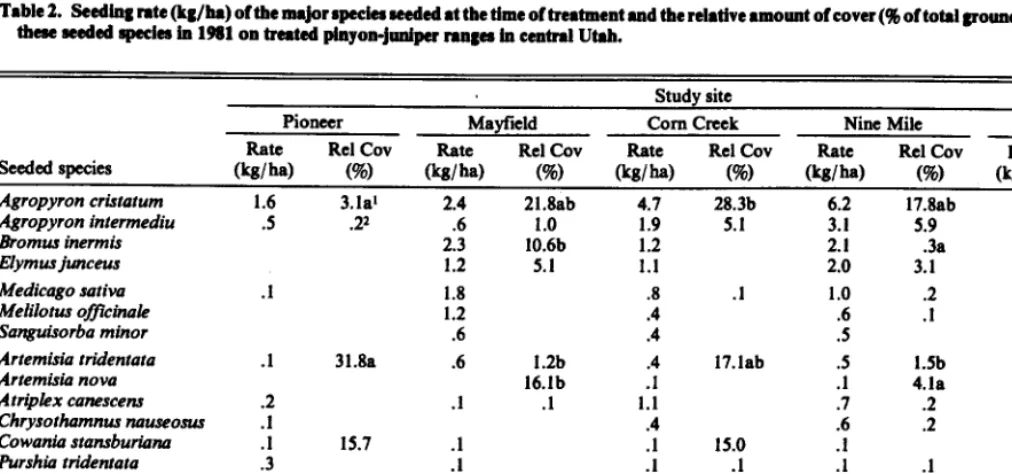
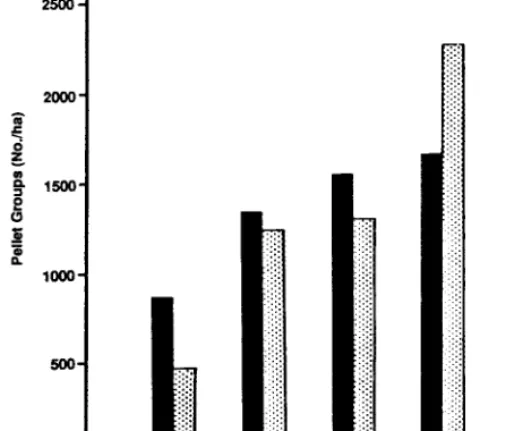
Vegetation and soils were evaluated on 5 different-aged, mechani- cally treated and seeded pinyon-juniper sites and compared to adjacent untreated areas. Plant cover was significantly changed after treatment: trees were reduced from 26 to 6% total ground cover; shrubs were increased from 2 to 8% ground cover; and herbaceous plants increased from 2 to 13% ground cover. Annuals and perennial forbs were 75% of the total plant cover on the 2-year-old site, perennial grasses and shrubs dominated the plant cover (52 to 83%) on three, 14 to 20-year-old sites, while shrubs and trees combined for 84% of the plant cover on the 24year-old site. Two Agropyron grass species showed good establishment and persistence after seeding. Seeded forbs contributed about 5% of the total plant cover on the 2-year-old treated site and they declined on older treated sites. Seeding of shrubs was only successful on sites where the shrub species was already present in the understory naturally. Seeding of nonnative shrub seed did not produce stands. Even though tree cover was reduced after treatment, total tree density was not. Shrub density increased from an average of 800 plants/ha on untreated areas to 2,750 plants/ha on treated areas. Juniper mortality during mechanical treatment varied from 60 to 91% and was related to the percentage of trees estimated to be 60+ years old (r = 0.97) and with the number of trees greater than 5 cm in stem diameter (r = 0.71) on the adjacent untreated sites. Big game pellet group counts were not different between untreated and treated sites, suggesting that big game make use of these treated areas because of increased forage and browse and in spite of reduced security cover.
Key Words: revegetation, tree mortality, woodland structure, pioneer species, competition
The pinyon-juniper (pinus spp.-Juniperus spp.) woodland type covers from 17 to 32.5 million ha in the southwestern United States (Kuchler 1964, West et al. 1975). More than 25% of Utah’s land area is dominated by pinyon-juniper, which often suppresses growth of understory shrubs, grasses, and forbs. Big game popula- tions in Utah use the pinyon-juniper type extensively for winter range (Plummer et al. 1968). During the severe winter of 1948-1949, poor winter range contributed to losses of up to 42% in some deer herds, while other deer herds with good winter range had losses comparable to those occurring during a moderate winter. Because of such losses the Utah Division of Wildlife Resources in coopera- tion with the USDA Forest Service’s Intermountain Research Station initiated a program to improve depleted big game winter range. Such improvements involved mechanical tree removal and artificially seeding adapted grass, forb, and shrub species to increase forage production (Plummer 1958, Plummer et al. 1960,
At the time of the research, authors were biological aid and research wildlife biologist, Utah State Division of Wildlife Resources, Shrub Sciences Laboratory, Intermountain Research Station, Forest Service, U.S. Department of Agriculture, Provo 84601; and professor, Department of Botany and Range Science, Brigham Young University, Provo 84602. Current address for J.G. Skousen: Division of Plant and Soil Sciences, West Virginia University, Morgantown 26506.
This research was made possible with Federal funds for wildlife restoration pro- vided through Pittman-Robertson Project W-82-R, Job I, in cooperation with the Intermountain Research Station, USDA Forest Service, and the Utah Division of Wildlife Resources.
Manuscript accepted 15 September 1988.
1968, 1970).
Average tree kill with cabling or chaining ranges from 40 to 80% (Arnold et al. 1964, Aro 1971, 1975, Parker 1971). In the Great Basin, Phillips (1977) noted that chaining reduces tree overstory by nearly 100% and that the majority of trees observed on chained areas are those that survived the chaining. There is little evidence on most sites of rapid invasion by young trees establishing from seed (Stevens 1987). Reduction of tree cover by mechanical methods reduces competition for light, soil nutrients, and moisture (O’Rourke and Ogden 1969) and stimulates understory browse and grass growth (Arnold et al. 1964, Phillips 1977, Plummer et al. 1968). An early study in Utah (Plummer et al. 1970) estimated that total understory production before treatment of several pinyon- juniper sites was 22 kg/ha. Ten years after 2-way chaining and seeding with 4 grasses and 3 legumes, total production increased to 1,912 kg/ha on grazed areas and 1,717 kg/ha on ungrazed areas.
Despite increases in forage production, some problems asso- ciated with pinyon-juniper treatment for big game include: (1) a 5-to IO-year rejuvenation period before some of the slower growing browse species become available; and (2) loss of security cover for big game animals if large open tracts of land (greater than 250 m wide) are treated. In an attempt to alleviate such problems researchers recommend clearing small, localized areas, or long, narrow, contoured strips from 30 to 200 m in width and seeding desirable species in the openings (Minnich 1969, Phillips 1977, Short et al. 1977, Short and McCulloch 1977).
The objectives of this study were to evaluate: (1) plant species composition and cover changes between treated and adjacent untreated sites; (2) seeded species establishment and growth on treated areas; (3) mechanical treatment effects on woody plant densities; and (4) the consequences of these changes in relation to big game use. Because differences existed between sites, the study examined similarities and general trends of vegetation change in response to mechanical treatment and seeding, and the influence that management may have had on treated sites.
Study Sites
The areas selected for study are along the western benches of the Pahvant Mountains in Millard County and on the Wasatch Pla- teau in Sanpete County in central Utah. The Utah Division of Wildlife Resources owns 4 of the study sites. These were treated specifically to increase forage and browse production for big game. A 5th site (Nine Mile) is privately owned and was treated to improve forage production primarily for sheep.
Elevation, aspect, slope, and precipitation were similar on these sites (Table 1). Soils had a thin, light-colored surface horizon, underlain by a subsurface horizon of weathered parent material derived from limestone, sandstone, and shale. The soils were mod- erately calcareous with pH ranging from 6.5 to 7.5. Soil textures were sandy loams, loams, and clay loams.
Vegetation cover before treatment consisted of pinyon pine (pinus edulis Engelm.), Utah juniper (Juniperus osteosperma (Torr.) Little), Gambel oak (Quercus gumbelii Nutt.), and infre- quent and scattered grasses, forbs, and shrubs in the understory