Iteratively Detected Multi-Carrier Interleave Division Multiple Access
Rong Zhang and Lajos Hanzo
Invited Paper
School of ECS., Univ. of Southampton, SO17 1BJ, UK.
Tel: +44-23-80-593 125, Fax: +44-23-80-593 045
Email: [email protected], http://www-mobile.ecs.soton.ac.uk
Abstract— In this paper a novel transceiver is proposed, which amalgamates the benefits of multi-carrier transmissions with those of interleave division multiple access (IDMA), leading to the concept of multi-carrier IDMA (MC-IDMA), which invokes spreading in both the time as well as in the frequency domain. In the proposed MC-IDMA system the classic position of spreading and interleaving is reversed and hence the chips are interleaved, which are then mapped to multiple carriers. The different users are distinguished by their unique, user-specific interleavers. With the aid of turbo-style iterative joint detection and decoding, MC-IDMA becomes capable of supporting a large user-population. This is particularly so, when sophisticated non-linear detectors are used. More quantitatively, it is demonstrated for example that the proposed MC-IDMA system is capable of supporting three times more users than the spreading gain ofG= 16, while
maintaining a modest complexity.
I. INTRODUCTION
In Direct Sequence (DS) spread spectrum communications [1] the employment of channel coding is crucial. Viterbi’s classic work [2] suggests that bandwidth expansion dedicated to low-rate channel coding has the potential of fully exploiting the achievable processing gain, while simultaneously offering a high coding gain as well as approaching the capacity of the multiple access channel contaminated by Additive White Gaussian Noise (AWGN). As a further development, the concept of code-spread CDMA was suggested by Frenger et al. in [3], where the authors proposed the employment of so-called maximum-free-distance low-rate codes, which combine channel coding and DS-spreading. More specifically, these maximum-free-distance low-rate codes are designed by first finding the ’best’ generator polynomials specifying the most meritorious convolutional code for a specific constraint length having the maximum free distance. The resultant codes are then concatenated an appropriate number of times, according to the specific code rate required. The resultant performance was shown to be better than that of conventional CDMA and of the low-rate orthogonal code-spread CDMA scheme of [2]. In [4] Mahadevappa and Proakis further augmented the concept of chip-interleaved CDMA, which is capable of mitigating the effect of both Inter-Symbol-Interference (ISI) and Multiple Access Interference (MAI). The performance
Acknowledgements: The work reported in this paper has formed part of the Core 4 Research Programme of the Virtual Centre of Excellence in Mobile and Personal Communications, Mobile VCE, www.mobilevce.com, whose funding support, including that of EPSRC, is gratefully acknowledged. Fully detailed technical reports on this research are available to Industrial Members of Mobile VCE.
of chip-interleaved CDMA and code-spread CDMA was also compared by Frenger et al. in [3].
The concept of interleave division multiple access (IDMA) accrued from the philosophy of code-spread CDMA [3] as well as chip-interleaved CDMA [4] and hence inherited all the attractive properties of CDMA. The IDMA philosophy was then further developed by Ping and his team [5], [6] as well as by H¨oher and Sch¨oneich [7] [8]. As alluded to above, IDMA entails reversing the position of DS-spreading and interleaving, leading to chip-interleaving instead of bit-interleaving. Then different users are distinguished by their unique user-specific interleavers combined with turbo-style iterative joint detection as well as channel decoding [9]. Owing to its meritorious properties, IDMA has been proposed for numerous applications, such as next-generation cellular uplink systems [7] as well as for time-hopping UWB systems [10].
Spreading S/P IFFT P/S CP
..
.
..
.
CP S/P
FFT P/S
..
.
..
.
SISO
MUD DES
SISO Iterative Receiver
Wideband Channel
πj−1
πj
sj dj
πj bj
La DES(sj(n))
Le DES(sj(n))
Le M U D(dij(u))
LDES(bj(m))
di j
[image:2.595.59.525.57.241.2]La M U D(dij(u))
Fig. 1. Multi-Carrier Interleave Division Multiple Access Transceiver
II. TRANSCEIVERARCHITECTURE OFMC-IDMA
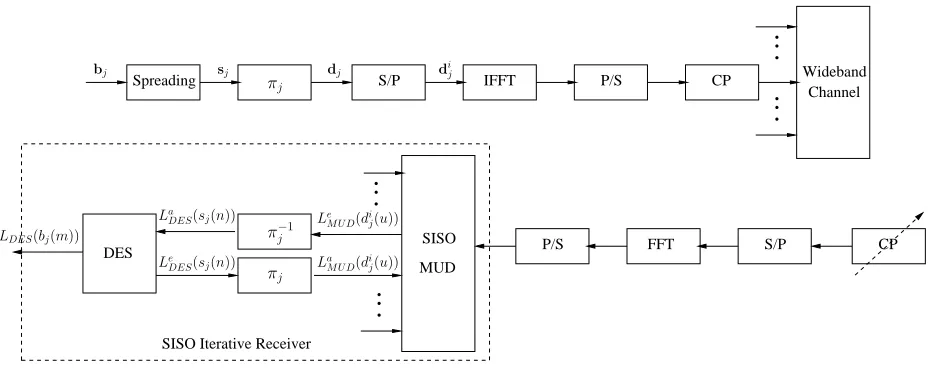
In this section we propose a flexible multi-carrier IDMA (MC-IDMA) scheme using spreading in both the time- and frequency-domain. The transceiver of the uncoded MC-IDMA system is depicted in Fig. 1. Assuming BPSK modulation, denote the jth user’s transmitted bit stream of length M as bj = [bj(1), bj(2),· · · , bj(M)]. This bit stream is then spread by a spreading code having a spreading gain of G in order to obtain the chip-sequence sj = [sj(1), sj(2),· · ·, sj(N)], of N = GM chip-duration, which is then interleaved by a user-specific random interleaverπjin order to obtain the chip-sequence dj of lengthN, as seen in Fig. 1.
In the multi-carrier modulation module, the bit stream dj is first S/P converted toU parallel streams in order to obtain dij =
di
j(1), dij(2),· · ·, dij(U) T
, i= 1,2,· · ·, N/U, where
idenotes the OFDM symbol index and()T denotes the matrix transpose. It is then multiplied by a (U×U)-dimensional inverse fast Fourier transform (IFFT) matrix denoted by F and having entries ofF(p, q) =e−j2πpq/U, p, q = 0,1,· · ·, U−1. Then the time-domain symbols are P/S converted and a cyclic prefix (CP) is concatenated, which is longer than the channel’s delay spread in order to avoid inter-symbol-interference. Let us consider the downlink scenario, where each user’s signal is transmitted through the sameL-path wideband channel having a channel impulse response (CIR) of h= [h0, h1,· · ·, hL−1].
Consider the ith OFDM symbol. At the receiver of Fig. 1 the CP is first removed and the resultant time-domain signal is demodulated upon multiplying it by the FFT matrix FH , where ()H denotes the Hermitian transpose yielding:
Y=FHHF K X
k=1
dik+FHn, (1)
where the matrix H is a circulant matrix. Multiplication of the noise by the matrix FH does not change its statistical properties and power, hence FHn remains an AWGN noise process.
The circulant convolution matrix H can be decomposed as H = QHΛQ, where Λ is a diagonal matrix having entries
constituted by the eigenvalues of H, while the unitary matrix QH has rows constituted by the eigenvectors of H. Since the rows of the FFT matrix F are also eigenvectors of H, we have F =QH. Upon introducing W =FHHF, we have W = Λ
[13].
When using a CP and an IFFT/FFT-based implementation, multi-carrier techniques effectively transform the frequency selective channel into a frequency-flat channel for each sub-carrier. Then we can rewrite the received signal’s expression in the form of its FD representation as follows:
Y= Λ
K X
k=1
dik+N. (2)
III. ITERATIVERECEIVER OFMC-IDMA
For the sake of attaining the best possible performance, the iterative receiver of Fig. 1 is employed [5] [9]. The receiver of Fig. 1 consists of a Soft-In-Soft-Out (SISO) Multiuser Detector (MUD) and a bank ofKindividual SISO De-Spreaders (DES), where the soft information exchanged between the receiver components is constituted by the extrinsic Log-Likelihood Ratios (LLRs) [14]. At each iteration, the SISO MUD of Fig. 1 generates the extrinsic output information LeM U D and deinterleaves it in order to create the stream LaDES, which is forwarded as a priori information to the SISO DES, as seen in Fig. 1.
In the feedback loop, the SISO DES computes the extrinsic information stream of LeDES, which is then interleaved to generate the stream LaM U D as a priori information for the SISO MUD of Fig. 1. The SISO MUD employs Soft Inter-ference Cancellation (sIC) on a subcarrier-by-subcarrier basis. The iterations are terminated, when the affordable detection complexity is exhausted. Finally, the a posteriori LLRs of LDES of Fig. 1, which represent the original information are subjected to a hard/soft decision.
A. Soft Interference Cancellation - Multiuser Detector (MUD)
the iterative detection of MC-IDMA is implemented on a subcarrier-by-subcarrier basis. Without loss of generality, we consider theu-th subcarrier of the ith OFDM symbol of user
j. Then the received signal of (2) can be written as:
y(u) = Λ(u)dji(u) +ξ(u), (3)
where ξ(u) denotes the sum of the multi-user interference imposed on the uth subcarrier of the ith OFDM symbol plus the Additive White Gaussian Noise (AWGN). Assuming that the a priori information
LaM U D(di
k(u)), k= 1,2,· · ·, K is available for the SISO MUD, the Expection (E) and the Variance (V) ofdi
k(u)may be expressed as [5]:
E(dik(u)) = tanh(LaM U D(dik(u))/2) (4)
V(dik(u)) = 1−E(dik(u))
2
. (5)
Noting that the interference imposed on the received signal in (3) is given by ξ(u) = PK
k=1,k6=jΛ(u)dik(u), the SISO MUD requires the estimation of the interference variance and mean given by [5] [9],
E(y(u)) =
K X
k=1
Λ(u)E(dik(u)) (6)
V(y(u)) =
K X
k=1
|Λ(u)|2V(dik(u)) +σ
2
(7)
E(ξ(u)) = E(y(u))−Λ(u)E(dij(u)) (8)
V(ξ(u)) = V(y(u))− |Λ(u)|2V(dij(u)), (9)
whereE(y(u))andV(y(u))denotes the total received signal’s mean and variance, whileE(ξ(u))andV(ξ(u))represents the mean and variance of the interference .
The extrinsic LLR LeM U D(di
j(u))of Fig. 1 is thus computed as:
LeM U D(dij(u)) = log
p(y(u)|di
j(u) = +1)
p(y(u)|di
j(u) =−1) !
. (10)
According to the central limit theorem, ξ(u)can be approx-imated by a Gaussian variable, when the number of users is sufficiently high and the resultant conditional Gaussian Probability Density Function (PDF) p(y(u)|di
j(u) = ±1) is given by [5]:
1
p
2πV(ξ(u))exp
−(y(u)−(±Λ(u) +E(ξ(u))))
2
2V(ξ(u))
. (11)
Upon substituting (11) into (10), we arrive at [5]:
LeM U D(di
j(u)) = 2Λ(u)
y(i)−E(ξ(u))
V(ξ(u)) , (12)
which describes the Soft Interference Cancellation (SIC) em-ployed by the SISO MUD.
B. Soft Chip Combining - De-Spreader (DES)
This extrinsic information is then de-interleaved using the corresponding user-specific chip-interleaver in order to obtain LaDES(sk(n))of Fig. 1, which acts as a priori information for the SISO DES. Without loss of generality, we consider the
mth information bit bj(m) of user j. The information bit is
.
.
.
.
s(1).
.
LDES(bj(m))La DES(s
m j(G))
Le
DES(smj(1)) LeDES(smj(G))
La DES(s
m j(g)) s(g)
s(G) La
DES(s m j(1))
Le DES(s
[image:3.595.333.540.60.175.2]m j(g))
Fig. 2. Soft chip information combining process of the SISO de-spreader
spread by the codes= [s(1), s(2),· · · , s(G)]in order to form the spread sequencesm
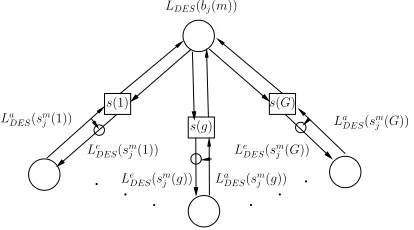
j (g), g= 1,2,· · · , G , whereGis the spreading gain. As a benefit of random chip-interleaving, the a priori information associated with each chip and provided for the SISO DES LaDES(sj(n))is independent of each other. Hence, as depicted in Fig. 2, the APP LLR ofbj(m)may be expressed as [5]:
LDES(bj(m)) = G X
g=1
s(g)LaDES(smj (g)). (13)
In the feedback loop, the SISO DES processes LDES(bj(m)) for the sake of generating the extrinsic LLR ofsm
j (g), which is then passed back to the SISO MUD in the form of:
LeDES(smj (g)) = s(g)LDES(bj(m))−LaDES(smj (g))(14).
The iterations are terminated, when a predefined termination criterion is satisfied. Finally, the LLRs LDES(bj(m))of Fig. 1, which represent the original information are subjected to a soft/hard decision, yieldingbj(m). Provided that a sufficiently long chip interleaver is used by the MC-IDMA system, the SISO de-spreader computes its APP LLRs by combining the a priori information of more-or-less independently faded chips and hence benefits both time-and frequency-diversity.
C. Chip Interleaving of MC-IDMA
Multi-carrier transmission provides two degrees of freedom to achieve diversity, namely TD and FD diversity [1]. Nat-urally, an additional spatial diversity may also be achieved, if multiple antennas are invoked. More explicitly, both the TD and FD fading may be mitigated by receiving multiple independently faded TD and FD signal replicas. In the design of multi-carrier transmission, it is desirable to arrange for each subcarrier to experience frequency-flat fading, while ensuring that the adjacent subcarriers experience independent fading. Traditional bit interleaving is unable to fully exploit the inherent diversity and hence, multi-carrier systems often experience correlated fading across the adjacent subcarriers [11].
00 00 00 11 11 11 00 00 00 11 11 11 00 00 00 11 11 11 00 00 00 11 11 11 00 00 00 11 11 11 00 00 00 11 11 11 00 00 00 11 11 11 00 00 00 11 11 11 00 00 00 11 11 11 00 00 00 11 11 11 00 00 00 11 11 11 00 00 00 11 11
11 00001111
00 00 00 11 11 11 00 00 00 11 11 11 00 00 00 11 11 11 00 00 00 11 11 11 00 00 00 11 11 11 00 00 00 11 11 11 00 00 00 11 11 11 00 00 00 11 11 11 00 00 00 11 11 11 00 00 00 11 11 11 00 00 11 11 00 00 11 11 00 00 11 11 00 00 11 11 sub ca rri ers time slots
.
.
.
. . .
worst scenario common scenario best scenario
Fig. 3. Different chip-interleaving scenarios in both the time- and frequency-domain of the proposed MC-IDMA scheme
is achieved and FD chip-interleaving assists us in ensuring that the subcarriers experience more-or-less independent fading.
More specifically, Fig. 3 shows the stylized effects of chip-interleaving on MC-IDMA. The best scenario is when every pair of chips of an information bit is mapped to different subcarriers and time slots. Therefore each chip experiences independent fading and hence fully exploits the available TD and FD diversity. However, when using random interleaving, this situation may not always be ensured. In the most common scenario a pair of two chips of a given information bit may or may not be mapped to different subcarriers and time slots. Nonetheless, some TD and FD diversity can still be achieved. Finally, often each chip of a specific information bit is mapped to a different subcarrier or to a different time slots, but the chips may remain separated in only one of the domains. In this case, either TD or FD diversity is achieved, provided that the chips of a specific bit are mapped to independently faded TD or FD positions.
IV. SIMULATIONRESULTS
In this section, we characterize the attainable performance of our proposed MC-IDMA scheme. In our simulations,U = 64
subcarriers were employed and L = 4 chip-spaced paths having an equal power were assumed. The normalized Doppler frequency of each subcarrier isfdTs= 0.001and we assumed the availability of ideal channel state information. In other words, both the TD fading envelope and the FD Channel Transfer Function (FDCHTF) were assumed to be perfectly known. We transmitted a total of214
bits. The spreading code used has a balanced number of chips having values of+1and
−1. For the sake of maintaining a modest complexity, at most
I= 10detection iterations were employed.
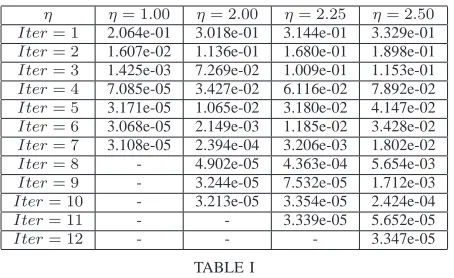
Table I shows the achievable BER performance under various user-load scenarios upon increasing the number of iterations, when having a spreading gain of G = 4. For the sake of characterizing the achievable throughput of the system, we define the effective user-load asη=K/G, where
G is the spreading gain and K is the maximum number of
η η= 1.00 η= 2.00 η= 2.25 η= 2.50
Iter= 1 2.064e-01 3.018e-01 3.144e-01 3.329e-01
Iter= 2 1.607e-02 1.136e-01 1.680e-01 1.898e-01
Iter= 3 1.425e-03 7.269e-02 1.009e-01 1.153e-01
Iter= 4 7.085e-05 3.427e-02 6.116e-02 7.892e-02
Iter= 5 3.171e-05 1.065e-02 3.180e-02 4.147e-02
Iter= 6 3.068e-05 2.149e-03 1.185e-02 3.428e-02
Iter= 7 3.108e-05 2.394e-04 3.206e-03 1.802e-02
Iter= 8 - 4.902e-05 4.363e-04 5.654e-03
Iter= 9 - 3.244e-05 7.532e-05 1.712e-03
Iter= 10 - 3.213e-05 3.354e-05 2.424e-04
Iter= 11 - - 3.339e-05 5.652e-05
Iter= 12 - - - 3.347e-05
TABLE I
ACHIEVABLEBERUNDER VARIOUS USER-LOAD SCENARIOS UPON INCREASING THE NUMBER OF ITERATIONS,WHEN USING A SPREADING GAIN OFG= 4AND AIMING FOR A SINGLE-USERBERPERFORMANCE OF
3×10⁻⁵ATEb/N0= 16dB
0 2 4 6 8 10 12 14 16 18 20
[image:4.595.317.544.56.195.2]Eb/N0(dB) 10-5 10-4 10-3 10-2 10-1 1 BER 1 User 4 Users 8 Users 9 Users 10 Users
Fig. 4. Performance of uncoded MC-IDMA, when communicating over a chip-spaced equal-power 4-path wideband Rayleigh fading channel and using a spreading gain ofG= 4andI= 10iterations
users supported. We aimed for achieving a single-user BER performance of 3×10⁻⁵
at Eb/N0 = 16dB. It can be seen
that onlyI= 6iterations were needed in order to approach the single-user performance in the so-called fully-loaded scenario, where we have a normalized user-load ofη= 1. Furthermore, only a slightly increased number of I = 9 iterations were needed in the scenario at η = 2, I = 10 iterations were required at η = 2.25 andI= 12 iterations were necessitated at η = 2.5. This implies that our MC-IDMA scheme has a modest complexity and is capable of achieving a single-user performance, despite supporting a high user-load.
Figs. 4, 5 and 6 show the BER versusEb/N0performance
of the MC-IDMA scheme having spreading gains of G= 4,
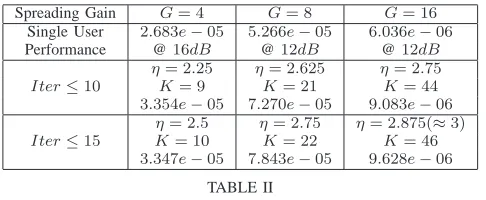
G= 8andG= 16, respectively. The single-user bound is also shown in Figs 4-6 as a benchmarker. It can be seen that a near-single-user performance can be achieved by the MC-IDMA system, when supporting as many asK= 9,K= 21,K= 44
users, respectively. This implies that MC-IDMA is capable of supporting a high normalized user-load ofη = 2.25,η= 2.625
[image:4.595.310.550.271.438.2]0 2 4 6 8 10 12 14 16 18 20
Eb/N0(dB) 10-5
10-4 10-3 10-2 10-1 1
BER 1 User
[image:5.595.310.550.53.222.2]8 Users 16 Users 20 Users 21 Users 22 Users 23 Users 24 Users
Fig. 5. Performance of uncoded MC-IDMA, when communicating over a chip-spaced equal-power 4-path wideband Rayleigh fading channel and using a spreading gain ofG= 8andI= 10iterations
Spreading Gain G= 4 G= 8 G= 16
Single User 2.683e−05 5.266e−05 6.036e−06 Performance @16dB @12dB @12dB
η= 2.25 η= 2.625 η= 2.75
Iter≤10 K= 9 K= 21 K= 44
3.354e−05 7.270e−05 9.083e−06
η= 2.5 η= 2.75 η= 2.875(≈3)
Iter≤15 K= 10 K= 22 K= 46
3.347e−05 7.843e−05 9.628e−06 TABLE II
NORMALIZED USER-LOAD FOR DIFFERENT NUMBER OF ITERATIONS AND FOR SPREADING GAINS OFG= 4,G= 8ANDG= 16
isI= 10. Table II summarizes the normalized user-load that can be achieved using different maximum number of iterations in conjunction with spreading gains of G = 4, G = 8 and
G= 16. When the maximum number of iterations isI= 15, a high normalized user-load ofη≈3is achieved with the aid of a spreading gain ofG= 16.
It can also be seen from Figs 4-6 that the attainable single-user performance improves upon increasing the spreading gain. With the aid of chip-interleaving, more independently faded TD and FD chips are combined by the SISO de-spreader, resulting in more reliable a posteriori LLRs. Furthermore, in conjunction with a higher spreading gain and a large number of users, the multiuser interference component ξ(i) of (3) is accurately approximated by the Gaussian PDF.
V. CONCLUSION
The concept of IDMA was extended to MC-IDMA, which achieved a high diversity gain both in the TD and FD. The system is capable of supporting a normalized user-load as high as η ≈ 3 in conjunction with a spreading gain of
G= 16, while maintaining a modest complexity. The benefits of IDMA accrue from the two lessons learned from Shannon’s theory. Firstly never discard information before making a decision, which requires the employment of soft information and secondly, render the interference Gaussian distributed by using both TD and FD interleaving as well as spreading. Our
0 2 4 6 8 10 12 14 16 18 20
Eb/N0(dB) 10-5
10-4 10-3 10-2 10-1 1
BER 1 User
[image:5.595.46.289.279.379.2]32 Users 40 Users 44 Users 45 Users 46 Users 47 Users 48 Users
Fig. 6. Performance of uncoded MC-IDMA, when communicating over a chip-spaced equal-power 4-path wideband Rayleigh fading channel and using a spreading gain ofG= 16andI= 10iterations
future research is aiming at jointly optimizing the spreading factor and code-rate of MC-IDMA systems.
REFERENCES
[1] L. Hanzo, L.-L. Yang, E.-L. Kuan, and K. Yen, Single- and Multi-Carrier DS-CDMA: Multi-User Detection, Space-Time Spreading, Synchronisa-tion, Networking and Standards. Wiley-IEEE Press, 2003.
[2] A. J. Viterbi, “Very low rate convolutional codes for maximum theo-retical performance of spread spectrum multiple-access channels,” IEEE Journal on Selected Areas in Communication, vol. 8, pp. 641–649, Aug. 1990.
[3] P. Frenger, P. Orten, and T. Ottosson, “Code-spread CDMA using maxi-mum free distance low-rate convolutional codes,” IEEE Transactions on Wireless Communications, vol. 48, pp. 135 – 144, Jan. 2000. [4] R. H. Mahadevappa and J. G. Proakis, “Mitigating multiple access
interference and intersymbol interference in uncoded CDMA systems with chip-level interleaving,” IEEE Transactions on Wireless Communi-cations, vol. 1, pp. 781–792, Oct. 2002.
[5] L. Ping, L. Liu, K. Wu, and L. W. K., “Interleave-division multiple-access,” IEEE Transactions on Wireless Communications, vol. 5, pp. 938–947, Apr. 2006.
[6] L. Liu, J. Tong, and L. Ping, “Analysis and optimization of CDMA systems with chip-level interleavers,” IEEE Journal on Selected Areas in Communication, vol. 24, pp. 141 – 150, Jan. 2006.
[7] H. Schoeneich and P. A. Hoeher, “Adaptive interleave-division multiple access-A potential air interference for 4G bearer services and wireless LANs,” in Proc. WOCN 04, Muscat, Oman, June7–9, 2004, pp. 179 – 182.
[8] P. A. Hoeher and H. Schoeneich, “Interleave-division multiple access from a multiuser point of view,” in Proc. 4th Int. Symposium on Turbo Codes and Related Topics in connection with the 6th Int. ITG-Conference on Source and Channel Coding, Munich, Germany, Sept.3–7, 2006, pp. 140 – 144.
[9] X. Wang and H. V. Poor, “Iterative (turbo) soft interference cancellation and decoding for coded CDMA,” IEEE Transactions on Communica-tions, vol. 47, pp. 1046–1061, July 1999.
[10] K. Li, X. Wang, G. Yue, and L. Ping, “A low-rate code-spread and chip-interleaved time-hopping UWB system,” IEEE Journal on Selected Areas in Communication, vol. 24, pp. 864 – 870, Apr. 2006. [11] L. Hanzo, M. M¨unster, B. Choi, and T. Keller, OFDM and MC-CDMA
for Broadcasting Multi-User Communications, WLANs and Broadcast-ing. Wiley-IEEE Press, 2003.
[12] L. L. Yang and L. Hanzo, “Performance of generalized multicarrier DS-CDMA over Nakagami-m fading channels,” IEEE Transactions on Communications, vol. 50, pp. 956–966, June 2002.
[13] A. Goldsmith, Wireless Communication. Cambridge University Press, 2005.