PRIMARY VISUAL CORTEX NEURONS THAT CONTRIBUTE
TO RESOLVE THE APERTURE PROBLEM
K. GUO,a,b* R. ROBERTSON,aA. NEVADO,a M. PULGARIN,aS. MAHMOODIaAND M. P. YOUNGa aInstitute for Neuroscience and Psychology, Brain and Behaviour Group, School of Biology, Henry Wellcome Building for Neuroecology, University of Newcastle, Newcastle upon Tyne NE2 4HH, UK b
Department of Psychology, University of Lincoln, Lincoln LN6 7TS, UK
Abstract—It is traditional to believe that neurons in primary visual cortex are sensitive only or principally to stimulation within a spatially restricted receptive field (classical receptive field). It follows from this that they should only be capable of encoding the direction of stimulus movement orthogonal to the local contour, since this is the only information available in their classical receptive field “aperture.” This direction is not necessarily the same as the motion of the entire object, as the direction cue within an aperture is ambiguous to the global direction of motion, which can only be derived by integrating with unambiguous components of the object. Re-cent results, however, show that primary visual cortex neu-rons can integrate spatially and temporally distributed cues outside the classical receptive field, and so we reexamined whether primary visual cortex neurons suffer the “aperture problem.” With the stimulation of an optimally oriented bar drifting across the classical receptive field in different global directions, here we show that a subpopulation of primary visual cortex neurons (25/81) recorded from anesthetized and paralyzed marmosets is capable of integrating informative unambiguous direction cues presented by the bar ends, well outside their classical receptive fields, to encode global mo-tion direcmo-tion. Although the stimuli within the classical recep-tive field were identical, their directional responses were sig-nificantly modulated according to the global direction of stimulus movement. Hence, some primary visual cortex neu-rons are not local motion energy filters, but may encode signals that contribute directly to global motion processing. © 2005 Published by Elsevier Ltd on behalf of IBRO.
Key words: direction selectivity, aperture problem, motion, primary visual cortex, monkey.
Individual measurements of local contour direction are inherently ambiguous (Wallach, 1976). One striking exam-ple is the so-called “aperture problem” (Marr, 1982), the motion of a featureless line seen behind a circular aperture is perceptually ambiguous: for any global direction of mo-tion, the perceived direction is perpendicular to the
orien-tation of the line. To overcome this “aperture problem,” the visual system must have the capability of computing un-ambiguous directional cues derived from “line terminators,” and weighting them more than ambiguous signals pro-duced by line interior.
Traditionally, vision is viewed as hierarchical analysis of the retinal input (Livingstone and Hubel, 1988; Felleman and Van Essen, 1991; Lennie, 1998). Specifically, visual information is conceived to be amplified and conveyed at high gain and fidelity to and through a hierarchically orga-nized visual cortex by feed-forward connections, where the information is successively extracted by receptive fields of increasing size and sophistication, each effectively a local filter, situated at each successive stage. In this bottom-up “vision-as-analysis” framework, neurons in the primary vi-sual cortex (area V1) are sensitive only or principally to stimulation within spatially restricted receptive fields (clas-sical receptive fields, CRFs). They would invariably suffer the “aperture problem,” and would only encode the com-ponent of stimulus movement orthogonal to the local con-tour presented within their CRFs (Movshon et al., 1985; Snowden, 1994; Andersen, 1997), since this is the only information available in their CRF “aperture.” This direction is not necessarily the same as the motion of entire object or surface of which the neuron’s preferred contour is only a small component. The “true” direction of motion could presumably only be determined by neurons with CRFs lying over unambiguous components of the object, such as end-points of the line, or corners in a more complex shape. Pack et al. (2003)showed that end-stopped V1 neurons could certainly signal (apparent) motion unambiguously, when the end-points of a line intersect their CRFs.
The activities of V1 neurons are not only determined by feed-forward inputs (reviewed inGilbert, 1998; Lamme et al., 1998; Angelucci and Bullier, 2003; Lorenceau, 2003; Chisum and Fitzpatrick, 2004). In fact, only a small portion of excitatory synapses (⬍5%) on V1 neurons is from lateral geniculate nucleus, the principal relay between the eye and the visual cortex (e.g.Peters and Payne, 1993). Con-sequently, over 95% of the excitatory synapses, even in geniculo-recipient layers in area V1, are from other cortical neurons and other nuclei. This very extensive network of lateral and feedback connections should enable V1 neu-rons to have access to a wide variety of spatially and temporally dispersed evidence on which to base their com-putations (Young, 2000). Indeed, neurophysiological stud-ies have demonstrated that V1 neurons can integrate ori-entation, contrast, luminance and relative motion informa-tion from regions beyond their CRFs, and can contribute to perceptual pop-out, contour integration, surface perception *Correspondence to: K. Guo, Department of Psychology, University
of Lincoln, Lincoln LN6 7TS, UK. Tel: ⫹44-0-1522-886294; fax: ⫹44-0-1522-886026.
E-mail address: [email protected] (K. Guo).
Abbreviations:CRF, classical receptive field; DI, direction index; MI, modulation index; MT, middle temporal visual cortex; V1, primary visual cortex; 1-ANOVA, one-way analysis of variance; 2-ANOVA, two-way analysis of variance.
0306-4522/06$30.00⫹0.00 © 2005 Published by Elsevier Ltd on behalf of IBRO. doi:10.1016/j.neuroscience.2005.12.016
and figure-ground segregation (reviewed inGilbert, 1998; Fitzpatrick, 2000; Albright and Stoner, 2002; Lee, 2003; Chisum and Fitzpatrick, 2004). It is intriguing to speculate that V1 neurons behaving in this way would not view the world through an aperture, and consequently would not suffer the “aperture problem.” They could be capable of signaling information about global motion direction through integrating informative unambiguous motion cues pre-sented outside their CRFs. To examine this, we compared the directional responses of V1 neurons, sampled in anes-thetized and paralyzed marmosets, to an optimally ori-ented bar, with length extending beyond the CRF, drifted across the CRF in a variety of global directions.
EXPERIMENTAL PROCEDURES
Animal preparation
Standard electrophysiological techniques for extracellular record-ing were used for four adult marmosets (Callitrix jacchus, 350 – 500 g) (Guo et al., 2004a). The number of animals used and their suffering were minimized, and all procedures complied with the “Principles of laboratory animal care” (NIH publication no. 86 –23, revised 1985) and UK Home Office regulations on animal exper-imentation (Animals (Scientific Procedures) Act, 1986). Briefly, the animals were anesthetized with halothane (0.8 –2%) and a 70:30 mixture of N2O and O2, and alfentanil (30g/kg/h). During the recording, they were paralyzed with a continuous i.v. infusion of vecuronium bromide (0.1 mg/kg/h) in glucose–saline and artifi-cially ventilated. The rectal temperature (⬃38 °C), expired CO2 (3.5– 4.5%), blood pressure and electrocardiogram were continu-ously monitored and maintained. A small craniotomy was posi-tioned over the central visual field representation of area V1.
Pupils were dilated with atropine. The corneas were protected with zero-power contact lenses, and artificial pupils (3 mm diam-eter) were positioned in front of each eye. The refractive state of each eye was measured by direct ophthalmoscopy, and additional lenses were used to focus the eyes on the stimulus monitor.
Visual stimuli, recording and data analysis
Visual stimuli were generated by VSG 2/3 graphics system (Cam-bridge Research Systems, Cam(Cam-bridge, UK) and displayed on a gamma-corrected high frequency non-interlaced color monitor (110 Hz, Sony GDM-F500T9; Sony, Tokyo, Japan) with the res-olution of 1024⫻768 pixels. At a viewing distance of 57 cm the monitor subtended a visual angle of 40⫻30°. The mean lumi-nance of uniform gray background was 6.0 cd/m2.
The activity of V1 neurons was recorded using glass-coated tungsten microelectrodes (1–2 M⍀impedance), and was amplified and sampled through CED1401 plus digital interface (Cambridge Electronic Design, Cambridge, UK). Spikes were stored with a 0.1-ms interval resolution. Single neuron activity was determined on the basis of the size and shape of the spike waveform, and was confirmed by a spike-sorting program (Spike2, Cambridge Electronic Design) with a template-matching procedure. The approximate lam-inar position of recorded neurons was determined by the depth of the microelectrode and the characteristic features of layer 4 (such as non-orientation selective, high spontaneous activity and brisk “on” and “off” responses). No attempt was made to select neurons from a particular layer of cortex.
Having isolated a neuron and determined the dominant eye (non-dominant eye was covered with a black disk during the recording), the CRF was carefully mapped using a sweeping bar and a sinusoidal grating patch moving across the screen with variable length, width and velocity. Within the patch, the optimal grating drifted continuously in the neuron’s preferred direction. In
this way, we estimated CRF width and breadth profiles (Guo et al., 2004a). To avoid underestimating the size of the CRF, the CRF was further covered with a uniform gray background and an annular window was centered on the CRF. A drifting sinusoidal grating with moderately high contrast (⬃70%) and the neuron’s preferred direction was presented within the window. The outer diameter of the annulus was fixed at 10°, while the inner diameter was adjusted until there was no response in excess of spontane-ous activity. The final size of the inner diameter of the annulus was treated as the size of the CRF of the recorded neuron. A drifting sinusoidal grating with the size of the CRF was then placed at the center of the CRF. The grating’s orientation/direction, spatial and temporal frequency were systematically varied to quantitatively determine the neuron’s preferred tuning characteristics. For all neurons reported in this experiment, their CRF locations were within central 10° and CRF diameters ranged from 0.6° to 1.5°.
The CRF of each neuron recorded was classified as “simple” or “complex” on the basis of the spatial arrangement of “on” and “off” regions and the presence of spatial summation within each region (Hubel and Wiesel, 1968). These classifications were later confirmed by the frequency component of their responses to the optimal drifting sinusoidal grating (Skottun et al., 1991). We re-corded preferentially from complex cells for the reasons that com-plex cells tend to be more direction selective than simple cells (Hubel and Wiesel, 1968; Conway and Livingstone, 2003).
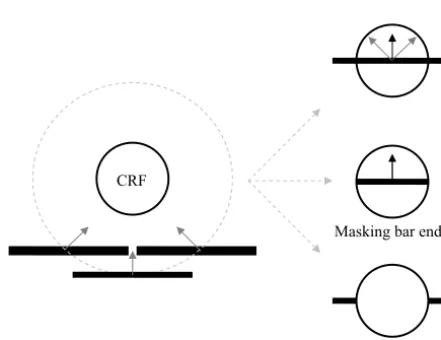
The neuron’s direction selectivity, tested with the drifting grat-ing, was characterized by a direction index (DI), expressed as 1⫺N/P, wherePandNare the neuron’s firing rate to motion in its preferred and opposite directions (each minus spontaneous firing rate). Neurons with no direction preference will give a DI of 0. A unidirectional neuron gives an index near 1, and a neuron inhib-ited by motion in the null direction gives a value⬎1 (DeValois et al., 1982; Hawken et al., 1988; Chaudhuri and Albright, 1997). To investigate whether V1 neurons can integrate unambigu-ous directional cues presented outside their CRFs, an optimally oriented bar (⫾70% contrast) was drifted across the CRF in one of nine different global directions (⫾40° around the preferred direc-tion in 10° intervals;Fig. 1). The component velocity, orthogonal to the preferred orientation and determined by neuron’s preferred
CRF
Masking bar ends
[image:2.603.319.540.462.632.2]Masking CRF
Fig. 1. Stimulus conditions. An optimally oriented bar was drifted
across the neuron’s CRF in one of nine different global directions
(⫾40° around the preferred direction in 10° intervals, indicated by gray
temporal frequency, was kept constant for different global motion directions. The width of the bar was determined by the neuron’s preferred spatial frequency, and the length of the bar was varied from two to eight times CRF diameter. The start and finish posi-tions of the drifting bar were also adjusted according to the global direction to ensure that the center of the bar was in the center of the CRF when it was drifted halfway across the CRF, and the total drifting distance was three times CRF diameter. During the stim-ulus presentation, therefore, the movements of the bar segment within the CRF were identical for different global directions.
Control conditions involved the bar being masked either out-side (masking bar ends) or inout-side (masking CRF) the CRF of the
recorded neuron (Fig. 1). In the masking bar ends condition, the
movement of the bar was restricted within the CRF and looked identical although the global directions were varied. In the mask-ing CRF condition, the neuron’s CRF did not receive any direct visual stimulation while the bar segments outside the CRF were drifted across both sides of the CRF.
Each stimulus condition was presented to the dominant eye for 15–30 repetitions in randomized order. The inter-stimulus in-terval was 1000 ms.
As this experimental design comprised nine levels of global motion direction (⫾40° around the preferred direction in 10° inter-vals) and three levels of bar length (two, four, and eight times CRF diameter), two-way analysis of variance (2-ANOVA) was carried out after averaging the neuron’s discharge for the duration of CRF stimulus presentation (from the bar entering the CRF till the bar leaving the CRF, same duration for the drifting bars with different directions and velocities). Appropriate post hoc testing of differ-ences between levels of global direction (Tukey’s least significant procedure) was carried out following detection of significant over-all variable ratios. One-way analysis of variance (1-ANOVA) and post hoc test (Tukey’s least significant procedure) were also car-ried out for the test condition of masking CRF to detect whether the neuronal responses were statistically different for the different global directions of the bar ends movement and the spontaneous activity (sampled during the inter-stimulus interval between⫺250 ms and 0 ms before the presentation of the bar), and for the test condition of masking bar ends to detect whether the neuronal responses were statistically different for the different invisible global directions of the bar movement.
RESULTS
Eighty-one V1 neurons (14 simple cells and 67 complex cells) were recorded from four anesthetized and paralyzed marmosets. Consonant with processing information from a spatially restricted small CRF, most of the recorded neu-rons (69%, 56/81) suffered the “aperture problem.” Their responses to the component motion of the bar segment within the CRF were indistinguishable, although the global motion direction of the entire bar was varied (2-ANOVA, direction: P⬎0.05). These neurons thus appear only to signal the direction of stimulus movement orthogonal to the orientation, even when this direction is not the same as the motion of entire object.
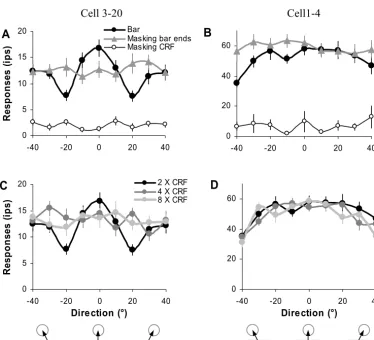
A substantial group of neurons (31%, 25/81; 4 simple cells and 21 complex cells), however, was significantly modulated by the global direction of the stimulus move-ment.Fig. 2shows two examples. These neurons showed clear direction selectivity to the drifting gratings presented within their CRFs (DI⫽0.76 and 0.5 for cells 3–20 and 1– 4). When a single bar with the neuron’s preferred ori-entation and length of two times CRF diameter was drifted across the CRF in the preferred direction (indicated as 0°
inFig. 2A and B), the neurons had maximum firing rates. When the global drifting directions were shifted up to 40° away from the preferred direction, their responses gradu-ally decreased although the movements of the bar seg-ment within the CRF were identical for different global directions (ANOVA,P⬍0.05; black curve with solid circle symbols in Fig. 2A and B). For cells 3–20, its response reduced up to 55% when the global direction was 20° away from its preferred direction; for cells 1– 4, the firing rate reduced up to 39% for the global direction 40° away from its preferred direction.
When the bar ends outside the CRF were masked (masking bar ends, seeFig. 1for an example), the movement of the bar segment inside the CRF was always perceived as drifting in the neuron’s preferred direction as invisible bar ends presented outside the CRF could not provide unambig-uous global directional cues. Consequently, with this mask-ing, the responses of the two neurons inFig. 2were statisti-cally indistinguishable among the different global directions of the bar movement (1-ANOVA,P⬎0.05; gray curve with solid triangle symbols inFig. 2A and B). When the bar segment inside the CRF was masked (masking CRF, seeFig. 1for an example), the neurons did not receive any direct CRF stim-ulation, although the global directional cues were clearly pre-sented by the bar ends outside the CRF. For this pattern of masking, the responses of two neurons were not significant different from their spontaneous activities (1-ANOVA, P⬎0.05; thin black curve with open circle symbols inFig. 2A and B).
Despite the local directions of the bar movement within the CRF being identical, the responses of some V1 neu-rons were modulated by the global motion directions, and this modulation is likely derived from the unambiguous directional information provided by the bar ends outside the CRF region. To further investigate how far the V1 neurons can integrate these global directional cues, we systematically varied the length of the bar as two, four and eight times the CRF diameter, and compared the neuronal responses to the bars with different lengths and drifting in various global directions. Although its response was sig-nificantly modulated by the global direction of a short bar (2⫻ CRF diameter), cells 3–20 failed to integrate the di-rectional cues from the bar ends of longer bars (4 and 8⫻ CRF diameter). Its responses were statistically indistin-guishable for the different global motion directions (ANOVA, P⬎0.05;Fig. 2C). Cells 1– 4, on the other hand, integrated the global directional cues provided by the ends of the longest bar tested (8⫻ CRF diameter, Fig. 2D). Its re-sponses to the identical CRF stimuli were systematically modulated by the global directions no matter the length of the bar used (2-way ANOVA, direction: P⬍0.05; length: P⬎0.05), up to the limit tested.
presented close to their CRFs (bar length⫽2⫻CRF diam-eter), while 19 and 10 neurons could still integrate these
directional cues presented relatively far away from their CRFs (bar length⫽4 and 8⫻CRF diameter;Fig. 3A). We
Cell 3-20 Cell1-4
0 5 10 15 20
-40 -20 0 20 40
Re
sp
o
n
se
s (
ip
s)
Bar
Masking bar ends Masking CRF
A
0 20 40 60
-40 -20 0 20 40
B
0 5 10 15 20
-40 -20 0 20 40 Direction (°)
R
es
pons
es
(
ips
)
2 X CRF 4 X CRF 8 X CRF
C
0 20 40 60
-40 -20 0 20 40 Direction (°)
[image:4.603.113.487.77.417.2]D
Fig. 2.Example of two neurons (cells 3–20: A and C; cells 1– 4: B and D) whose directional responses were systematically modulated by the global
directions of an optimally oriented bar drifting across their CRFs. A and B show neuronal responses to the optimally oriented bar with the length of
two times CRF diameter drifting across the CRF in various global directions (⫾40° around the preferred direction in 10° intervals), the bar was either
intact or masked at the bar segments inside or outside the CRF (masking CRF or bar ends). C and D show neuronal responses to the optimally oriented bar with various length (two, four, and eight times CRF diameter) drifting across the CRF in various global directions. Error bars indicate standard error of the mean.
0 5 10 15 20 25
N
u
mbe
r of
ne
ur
ons
2 X CRF 4 X CRF 8 X CRF
A
0 20 40 60 80 100
-40 -20 0 20 40
Direction (°)
N
o
rm
al
ised
n
eu
ro
n
resp
o
n
ses (
%
)
2 X CRF 4 X CRF 8 X CRF Masking CRF Spontaneous
B
Fig. 3. (A) The frequency distribution of V1 neurons whose directional responses to the identical CRF stimuli were modulated by the global directions
[image:4.603.125.476.524.685.2]also directly compared neuronal responses to various global directions generated by the bars with different lengths for these 25 neurons (neuronal discharge to the shortest bar drifting in the preferred direction was treated as 100%; Fig. 3B). The normalized directional response was most significantly modulated by the shortest bar, and the tuning curve became broader and flatter with increas-ing bar length. In the control condition of maskincreas-ing CRF, although the global directional cues were clearly presented by the bar ends outside the CRF, the responses of these 25 neurons were statistically indistinguishable for the different directions of the bar ends movement, and were not signifi-cantly different from their spontaneous activities (1-ANOVA, P⬎0.05;Fig. 3B).
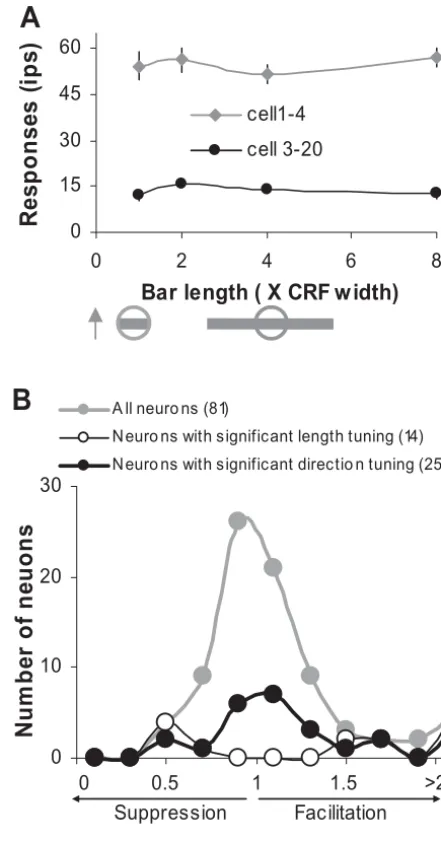
The majority of V1 neurons show effects of spatial summation, normally suppression, to stimuli extended be-yond their CRFs (for reviews seeGilbert, 1998; Fitzpatrick, 2000), and therefore have some measure of end-stopping (DeAngelis et al., 1994; Jones et al., 2001; Sceniak et al., 2001) as demonstrated byHubel and Wiesel (1965). Re-cently,Pack et al. (2003)have suggested that only end-stopped neurons in monkey V1 can encode global direc-tion signals in a manner that is largely independent of the orientation of the CRF stimulus. Our results, however, suggest that V1 neurons’ capability of computing global directions seems not to be strictly restricted by the size of the CRF or summation field. We measured the neuron’s length tuning function by presenting optimally oriented bars drifting across the CRF in the preferred direction; the length of the bar was varied as one, two, four, or eight times CRF diameter. Fig. 4A shows the length tuning responses of two neurons whose directional responses were modulated by the global motion directions as dem-onstrated inFig. 2. These two neurons did not show any end-stopped tuning properties within the range of bar length tested. Their responses were not significant differ-ent for the drifting bars with various lengths (1-ANOVA, P⬎0.05).
To further examine how the property of length tuning relates to the capability of integrating global motion direc-tion, we calculated a modulation index (MI), defined as the neuronal response (minus spontaneous activity) to the longest bar (8⫻CRF diameter) divided by the response to the shortest bar (1⫻CRF diameter), for each neuron, and we plotted the frequency of their MI distribution with 0.2 bin width (Fig. 4B). If a neuron’s response to the CRF presen-tation was suppressed by the longer bar, its MI should be less than 1. If its response was facilitated by the longer bar, on the other hand, its MI should be larger than 1. Out of the 81 neurons we sampled (gray curve with solid circles inFig. 4B), only 14 neurons showed significant length tuning for the bar length up to eight times CRF diameter (1-ANOVA, P⬍0.05; thin black curve with open circles in Fig. 4B); while 25 neurons showed modulated responses to the global motion directions (black curve with solid circles in Fig. 4B). Most of these neurons (16/25) did not show any length tuning effect to the longer bars. However, there was a tendency for those neurons showing length tuning to have a higher probability of responding to the global
mo-tion signals. Out of 14 neurons showing length tuning effect, nine had modulated responses to the global direc-tions of the bar movement. For 67 neurons not showing length tuning responses within our test range, only 16 had modulated responses to the global motion directions.
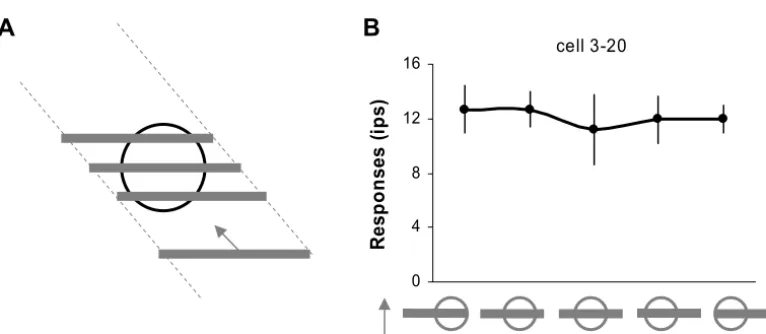
In our experiments, although the length of the entire bar was fixed for a given trial, the portion of the (single) bar falling on either side of the CRF changed when the bar drifted across the CRF in the non-preferred directions. Fig. 5A shows one example. In this trial the bar with the neuron’s preferred orientation drifted across the CRF in its non-preferred direction. For the two portions of the bar falling outside the CRF, the right portion was longer than
0
15
30
45
60
0
2
4
6
8
Bar length ( X CRF w idth)
R
e
s
p
o
n
se
s (
ip
s
)
cell1-4
cell 3-20
A
0
10
20
30
Modulation inde x
N
u
m
b
e
r of
ne
uons
A ll neuro ns (81)
N euro ns with significant length tuning (14)
N euro ns with significant directio n tuning (25)
0 0.5 1 1.5 >2
Suppression Facilitation
[image:5.603.316.537.83.504.2]B
Fig. 4. (A) The length tuning responses of two example neurons. The
the left portion before the bar reached the center of the CRF; and then it was shorter than the left portion after the bar passed the center of the CRF. To exclude the unlikely possibility that this dynamic change of the bar length on either side of the CRF could modulate neuronal responses (i.e. non-linear integration from regions outside the CRF), we carried out an additional experiment, where we sys-tematically manipulated the distribution of the bar length on both side of the CRF while keeping the total bar length constant, and compared the neuronal responses to these bars drifting in the preferred direction for those neurons showing sensitivity to the global motion directions. The bar segments outside the CRF were either located on one side of CRF, or 75% of the length was presented on one side while 25% on the other side of the CRF, or were equally distributed on both side of the CRF (see Fig. 5B for an example). For cells 3–20, there was no significant re-sponse difference to these test conditions (1-ANOVA, P⬎0.05;Fig. 5B). Therefore, its reduced response to the non-preferred directions was most likely due to the inte-gration of the global directional cues available outside its CRF (see alsoFigs. 2 and3). Out of 22 neurons tested with these control stimuli, 21 showed indistinguishable responses to the various bar length distributions outside their CRFs (1-ANOVA,P⬎0.05).
When a field of short bars or a plaid pattern containing conflicting local and global motion signals is presented within the CRF, neurons in the middle temporal visual cortex (MT), a specific motion selective area in monkey visual cortex where the neurons are capable of encoding the global motion cues, appear initially to respond primarily to the component of motion perpendicular to the contour’s orientation. After a short period, responses gradually shift to encode the global motion direction (Pack and Born, 2001; Pack et al., 2001; Smith et al., 2005). To investigate whether there is a similar temporal evolution of the shift in V1 response properties while integrating the global direc-tional cues presented outside the CRFs, we compared time-courses of neuronal responses to the preferred and the least preferred global motion directions. Although in our
experiments the starting and ending positions of the bar movement for a given trial were varied according to the global bar directions, the entering and leaving points of the CRF, and the duration of the bar movement within the CRF were identical for various global directions (seeFig. 1for an example). In this time-course analysis, we only com-pared neuronal responses to the bar movements within the CRF. For two neuron examples showing modulated re-sponses to different global directions (see Fig. 2), their discharges were plotted as peristimulus time histograms (PSTHs) with 10 ms bins; time 0 indicates the time when the bar entered the CRF (Fig. 6A and B). Compared with the response to the preferred direction, the response to the least preferred direction was clearly delayed and sup-pressed at the earliest stage of the neuronal response. We further calculated each neuron’s response latency using cumulative sum analysis (Maunsell and Gibson, 1992; Raiguel et al., 1999). The latency was taken to be the time corresponding to the first bin after the bar entering the CRF where the bin exceeded the spontaneous firing rate by two standard deviations and which was followed by at least two successively increasing bins. The difference of response latencies between the preferred and the least preferred global directions was 40 and 30 ms for cells 3–20 and 1– 4, respectively.
For the population analysis of 25 neurons showing sensitivity to the global motion directions, we chose the time when the bar entered the CRF as time 0 and accord-ingly averaged and normalized neuronal responses to the preferred and the least preferred global motion directions. As shown inFig. 6C, compared with the response to the preferred global direction, the response to the least pre-ferred direction was delayed by 20 ms⫾3 (mean⫾S.E.M.), and the peak response was suppressed by 36%⫾5. These delayed and suppressed responses to the non-preferred global directions are probably due to the result of resolving conflicting local motion signals (Nowlan and Sejnowski, 1995; Grossberg et al., 2001) rather than simple suppres-sion introduced by the bar segments presented outside the CRF, as the total bar length was identical for various global
cell 3-20
0 4 8 12 16
R
es
pons
es
(
ips
)
[image:6.603.108.491.76.243.2]B
A
Fig. 5. (A) Stimulus example. When a single bar drifted across the CRF in the non-preferred directions, the portion of the bar falling on either side
directions and most of the neurons did not show modulated responses to different bar length or different distribution of bar length on both side of the CRF (seeFigs. 4and5).
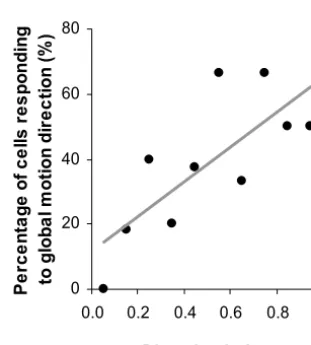
In our V1 sample, the neuron’s DI, measured with a drifting sinusoidal grating whose direction was always per-pendicular to the orientation, ranged from 0.02–1.04 with the mean value of 0.44⫾0.03. To examine how the prop-erty of direction selectivity relates to the capability of inte-grating global directional cues, we calculated the DI for each of the 81 neurons, and plotted the percentage of neurons showing modulated responses to the global directions as a function of their DI (0.1 bin width,Fig. 7). There was a tendency for neurons with higher sensitivity to motion stimuli (higher DI) to have a higher probability of responding to the global direction of the bar move-ment (linear regression: correlation coefficient r⫽0.75, P⫽0.006).
DISCUSSION
Research on brain mechanisms of motion processing has tended to emphasize a hierarchical pathway for motion analysis. In the primary motion detection stage (area V1),
direction selective neurons act as local motion energy filters (Adelson and Bergen, 1985; Grzywacz and Yuille, 1990) and respond to the motion of image constituents within particular bandpass characteristics for orientation, spatial and temporal frequency. These neurons simply encode the motion of the oriented components comprising a complex pattern rather than the global motion of the pattern itself. Neurons in the later motion integration stage (i.e. area MT) perform more complex computations based on extensive local motion measurements provided by V1, and detect the “true” direction of global motion that is independent of the motion of contours within them (Movs-hon et al., 1985; Rodman and Albright, 1989; Stoner and Albright, 1994; Pack and Born, 2001; Pack et al., 2004).
In this framework, V1 neurons are simply local spatio-temporal filters, extracting local motion measurements and transmitting them to higher visual areas for further pro-cessing. They inevitably suffer the “aperture problem” while dealing with a moving contour extended beyond their CRFs. However, neurophysiological studies have revealed that some V1 neurons are capable of signaling some com-plex motion signals presented within their CRFs, such as pattern motion (Tinsley et al., 2003; Guo et al., 2004a) and second-order motion signals (Chaudhuri and Albright, 1997; O’Keefe and Movshon, 1998). Furthermore, the well-documented phenomenon of center-surround interac-tion shows that V1 neurons can integrate orientainterac-tion, rel-ative motion, contrast and luminance signals from regions beyond their CRFs (Knierim and Van Essen, 1992; Kapa-dia et al., 1995; Lamme, 1995; Rossi et al., 1996; Zipser et al., 1996; Kastner et al., 1997; MacEvoy et al., 1998; Jones et al., 2001; Angelucci et al., 2002; Cavanaugh et al., 2002; Levitt and Lund, 2002; Guo et al., 2005), suggesting that the function of V1 neurons is far from that of local spatio-temporal filters.
Inferential model of visual processing suggests a con-trasting view of the function of V1 neurons (Knill and Rich-ards, 1996; Young, 2000; Friston, 2002; Guo et al., 2004b). In this model, visual neurons should have access, through their embedding neural network, to information about the
0 20 40 60 80
0.0 0.2 0.4 0.6 0.8 1.0
Direction index
P
e
rc
e
n
ta
ge
o
f c
e
lls
r
e
s
p
on
ding
to
gl
ob
a
l m
o
ti
on
di
re
c
ti
o
n
(
%
[image:7.603.86.255.83.438.2])
Fig. 7. The percentage of neurons showing modulated responses to
the global motion directions as function of their DI.
0 30 60 90
0 50 100 150 200
R
e
s
p
o
ns
e
s
(
ips
)
Preferred direction Least preferred direction
A
cell 3-200 50 100 150 200
0 50 100 150 200 250 300
R
e
s
pon
s
e
s
(
ips
)
B
cell 1-40 20 40 60 80
0 250 500 750
Time (ms)
R
e
s
p
ons
e
s
(
ips
)
[image:7.603.348.504.534.707.2]C
all cellsFig. 6. Directional responses to the preferred and the least preferred
distribution of prior probabilities of stimuli (Lee, 1995; Young, 2000), and the output of a neuron critically de-pends on the interaction between the likelihood function (i.e. CRF visual input) and the prior probability (i.e. extra-CRF information) rather than simply on direct visual input from its CRF (Guo and Li, 1997; Gilbert, 1998; Young, 2000; Sharma et al., 2003). In light of this, when process-ing the motion of a extended bar passprocess-ing through the CRF, the interpretation of V1 neurons should be the result of interaction between the ambiguous direction signals de-rived from the bar segment inside the CRF and the unam-biguous direction signals derived from the bar ends outside the CRF. Accordingly, their directional responses would be expected to be modulated by the “actual” direction of the moving bar.
In our experiment, although the component motion was identical within the CRF, the directional responses of a substantial group of V1 neuron were significantly modu-lated according to the global direction of the moving bar, and this response modulation is most likely derived from the unambiguous directional cues presented by the bar ends, outside the CRF region. However, it is not clear whether the observed neuronal modulations in this exper-iment can truly reflect recovery of the global motion. As our stimuli used to test the neurons’ preferred tuning char-acteristics (sinusoidal gratings) and global motion modu-lations (drifting bars) had different direction test range (grating: 0 –360°; bar:⫾40° around the neuron’s preferred direction) and different orientation information (grating: ori-entation perpendicular to its direction; bar: constant orien-tation), it is difficult to directly compare the direction tuning yielded in response to the gratings and bars. In our future study, it will be interesting to address this question by employing stimuli without orientation information, such as moving dot patterns. However, our observation that the peak of the modulation tuning function for the main exper-iment coincides with the peak of the directional tuning function for the gratings suggests that the modulated neu-ronal responses in area V1 are directly related to the processing of global motion information, and a substantial group of V1 neurons can contribute directly to the global motion processing rather than only perform local motion measurements.
How can some V1 neurons integrate local motion sig-nals into global motion measurements? Some recent stud-ies suggest that this capability of V1 neurons depends on local receptive field properties (i.e. “end-stopped” responses; Pack et al., 2003, 2004) or receptive field shape (Tinsley et al., 2003). Using two-flash apparent motion stimuli (Pack et al., 2003) and “barber pole” illusion stimuli (Pack et al., 2004), Pack et al. suggested that the computation of global motion occurs on a spatial scale that is similar to V1 CRF diameter. However, our results do not accord with this suggestion that only “end-stopped” V1 neurons can com-pute the global motion direction. Most of neurons showing capability of global direction integration in this study are not “end-stopped,” at least within the quite extensive length summation range we tested (Fig. 4). Therefore, the capa-bility of integrating and computing various local motion
cues in area V1 seems not to be strictly restricted by the size of the CRF or summation field. It is also unlikely that the receptive field shape can fully determine the global motion selectivity of V1 neurons as the neuron’s activity in computing the global directions decreased with the in-creasing distance between the global directional cues (bar ends) and the center of the CRF (Fig. 3). Given these considerations, it is reasonable to assume that CRF itself or feed-forward connections in V1 cannot fully account for V1 neuronal responses to global motion signals.
The lateral and feedback connections may play a crit-ical role in V1 motion information integration. The exten-sive lateral/horizontal connection enables V1 neurons to integrate visual information available from regions beyond the CRFs (for reviews, see Gilbert, 1998; Chisum and Fitzpatrick, 2004). When an elongated bar is drifted through a neuron’s CRF in various directions, although the direction of the bar segment within the CRF of the recorded neuron is ambiguous, the bar ends containing the unam-biguous directional cues, pass through the CRF of the neighboring motion sensitive neurons. These unambigu-ous motion signals could be fed to the recorded neuron via lateral connections, and enable the neuron to integrate direction vectors from various part of the bar into a more global representation of the “actual” direction of the entire bar movement, provided the unambiguous motion signals from the bar ends are given much more weight than the ambiguous motion signals from the bar interior.
V1 neurons also receive feedback connections from a number of extrastriate areas (Lamme et al., 1998; Ange-lucci and Bullier, 2003). Those feedback influences from neurons with larger CRF and complex computation capa-bilities may inform V1 neurons with the processing results of higher areas, and allow them to integrate some global information (Hupé et al., 1998, 2001; Hochstein and Ahissar, 2002; Guo et al., 2004a). As MT neurons are capable of performing more complex computations based on extensive local motion measurements provided by V1, and detecting the direction of global motion (Movshon et al., 1985; Andersen, 1997; Pack et al., 2004), it is possible that some V1 neurons might receive the critical feedback information from MT and thus inherit the com-puted property or properties of global motion selectivity so clearly evident in MT. This feedback information may fur-ther provide the top-down priors for geometric inference in area V1 in a hierarchical Bayesian inference framework which has been demonstrated in the computation of per-ceptual contours, surface shapes and object saliency (re-viewed inLee, 2003).
V1 and around 60 ms in MT) the response gradually shifts to encode the global motion direction, regardless of orientation. In our experiment, we also observed a clear time difference of neuronal responses to different global motion directions. Although the component mo-tion within the CRF was kept as the neuron’s preferred direction, the neuronal response was delayed and re-duced when the global motion direction was less pre-ferred (Fig. 6). However, unlike the results from Pack et al. (2001, 2003, 2004), this modulation started from the earliest part of neuronal responses. This may be due to the way we presented the stimuli. The motion onset in our experiment starts from regions outside the CRF rather than inside the CRF (seeFig. 1for an example). Consequently, the computation of the global motion di-rection could start even before the bar enters the CRF of the recorded neuron. Although it may be sub-threshold, this unambiguous motion information could be passed to the recorded neuron via feedback influences or lateral interactions within V1, and the time difference we ob-served could be the result of resolving conflicting local motion signals (Nowlan and Sejnowski, 1995; Gross-berg et al., 2001). From this study, it is difficult to differ-entiate the contribution from lateral interaction and feed-back influence. The early surround modulation to neu-ronal responses may suggest that the unambiguous direction signals come from lateral interactions. How-ever, given the existence of fast speed feedback con-nections from MT to V1 (e.g. Movshon and Newsome, 1996), it is possible that some higher-lever computations may also be involved in V1 directional computations (top-down interactions).
In light of our results, a natural interpretation is that neurons in area V1 are not only specialized for extracting local features and conveying information of a low-level nature, such as local motion measurements, as suggested by the classical model of “vision-as-analysis”; but also represent and communicate signals that may contribute to relatively global processing as proposed by the model of “vision-as-inference.” On this interpretation, V1 is an active interpreter of the visual world, and is involved in many levels of visual computation, including global motion com-putation demonstrated in this study.
Acknowledgments—This work is supported by the Wellcome Trust, HFSPO and EU FP5. We thank Dr. A. Thiele, M. Roberts and W. Zinke for assistance with physiological recordings.
REFERENCES
Adelson EH, Bergen JR (1985) Spatio-temporal energy models for the perception of motion. J Opt Soc Am A 2:284 –299.
Albright TD, Stoner GR (2002) Contextual influences on visual pro-cessing. Annu Rev Neurosci 25:339 –379.
Andersen RA (1997) Neural mechanisms of visual motion perception in primates. Neuron 18:865– 872.
Angelucci A, Bullier J (2003) Reaching beyond the classical receptive field of V1 neurons: horizontal or feedback axons? J Physiol Paris 97:141–154.
Angelucci A, Levitt JB, Walton EJS, Hupe JM, Bullier J, Lund JS (2002) Circuits for local and global signal integration in primary visual cortex. J Neurosci 22:8633– 8646.
Cavanaugh JR, Bair W, Movshon JA (2002) Natural and interaction of signals from the receptive field center and surround in macaque V1 neurons. J Neurophysiol 88:2530 –2546.
Chaudhuri A, Albright TD (1997) Neuronal responses to edges defined by luminance vs. temporal texture in macaque area V1. Vis Neu-rosci 14:949 –962.
Chisum HJ, Fitzpatrick D (2004) The contribution of vertical and hor-izontal connections to the receptive field center and surround in V1. Neural Netw 17:681– 693.
Conway BR, Livingstone MS (2003) Space-time maps and two-bar interactions of different classes of direction-selective cells in ma-caque V1. J Neurophysiol 89:2726 –2742.
DeAngelis GC, Freeman RD, Ohzawa I (1994) Length and width tuning of neurons in the cat’s primary visual cortex. J Neurophysiol 71:347–374.
DeValois RL, Yund EW, Hepler N (1982) The orientation and direction selectivity of cells in macaque visual cortex. Vision Res 22:531– 544.
Felleman DJ, Van Essen DC (1991) Distributed hierarchical process-ing in the primate cerebral cortex. Cereb Cortex 1:1– 47. Fitzpatrick D (2000) Seeing beyond the receptive field in primary visual
cortex. Curr Opin Neurobiol 10:438 – 443.
Friston K (2002) Functional integration and inference in the brain. Prog Neurobiol 68:113–143.
Gilbert CD (1998) Adult cortical dynamics. Physiol Rev 78:467– 485. Grossberg S, Mingolla E, Viswanathan L (2001) Neural dynamics of
motion integration and segmentation within and across apertures. Vision Res 41:2521–2553.
Grzywacz NM, Yuille AL (1990) A model for the estimate of local image velocity by cells in the visual cortex. Proc R Soc Lond B Biol Sci 239:129 –161.
Guo K, Li CY (1997) Eye position-dependent activation of neurons in striate cortex of macaque. Neuroreport 8:1405–1409.
Guo K, Benson PJ, Blakemore C (2004a) Pattern motion is present in V1 of awake but not anaesthetized monkeys. Eur J Neurosci 19:1055–1066.
Guo K, Nevado A, Robertson RG, Pulgarin M, Thiele A, Young MP (2004b) Effects on orientation perception of manipulating the spa-tiotemporal prior probability of stimuli. Vision Res 44:2349 –2358. Guo K, Robertson RG, Mahmoodi S, Young MP (2005) Centre-sur-round interactions in response to natural scene stimulation in the primary visual cortex. Eur J Neurosci 21:536 –548.
Hawken MJ, Paker AJ, Lund JS (1988) Laminar organization and contrast sensitivity of direction-selective cells in the striate cortex of the Old World monkey. J Neurosci 8:3541–3548.
Hochstein S, Ahissar M (2002) View from the top: hierarchies and reverse hierarchies in the visual system. Neuron 36:791– 804. Hubel DH, Wiesel TN (1965) Receptive fields and functional
architec-ture in two non-striate visual areas (18 and 19) of the cat. J Neu-rophysiol 28:229 –289.
Hubel DH, Wiesel TN (1968) Receptive fields and functional architec-ture of monkey striate cortex. J Physiol (Lond) 195:215–243. Hupé JM, James AC, Girard P, Lomber SG, Payne BR, Bullier J (2001)
Feedback connections act on the early part of the responses in monkey visual cortex. J Neurophysiol 85:134 –145.
Hupé JM, James AC, Payne BR, Lomber SG, Girard P, Bullier J (1998) Cortical feedback improves discrimination between figure and background by V1, V2 and V3 neurons. Nature 394:784 –787. Jones HE, Grieve KL, Wang W, Sillito AM (2001) Surround
suppres-sion in primate V1. J Neurophysiol 86:2011–2028.
Kapadia MK, Westheimer G, Gilbert CD (1995) Dynamics of spatial summation in primary visual cortex of alert monkeys. Proc Natl Acad Sci U S A 96:12073–12078.
Knierim JJ, Van Essen DC (1992) Neuronal responses to static texture patterns in area V1 of the alert macaque monkey. J Neurophysiol 67:961–980.
Knill DC, Richards W (1996) Perception as bayesian inference. Cambridge: Cambridge University Press.
Lamme VAF (1995) The neurophysiology of figure-ground segregation in primary visual cortex. J Neurosci 15:1605–1615.
Lamme VAF, Super H, Spekreijse H (1998) Feedforward, horizontal, and feedback processing in the visual cortex. Curr Opin Neurobiol 8:529 –535.
Lee TS (1995) A bayesian framework for understanding texture seg-mentation in the primary visual cortex. Vision Res 35:2643–2657. Lee TS (2003) Computations in the early vision. J Physiol Paris
97:121–139.
Lennie P (1998) Single units and visual cortical organization. Percep-tion 27:889 –935.
Levitt JB, Lund JS (2002) The spatial extent over which neurons in macaque striate cortex pool visual signals. Vis Neurosci 19:439 – 452. Livingstone MS, Hubel DH (1988) Segregation of form, color, move-ment, and depth: anatomy, physiology, and perception. Science 240:740 –749.
Lorenceau J (2003) Geometry and the visual brain. J Physiol Paris 97:99 –103.
MacEvoy SP, Kim W, Paradiso MA (1998) Integration of surface information in primary visual cortex. Nat Neurosci 1:616 – 620. Marr D (1982) Vision. San Francisco: Freeman.
Maunsell JHR, Gibson JR (1992) Visual response latencies in striate cortex of macaque monkey. J Neurophysiol 68:1332–1344. Movshon JA, Adelson EH, Gizzi MS, Newsome WT (1985) The
anal-ysis of moving visual patterns. In: Study group on pattern recog-nition mechanisms (Chagas C, Gattass R, Gross CG eds), pp 117–151. Vatican City: Pontifica Academia Scientiarum. Movshon JA, Newsome WT (1996) Visual response properties of
striate cortical neurons projecting to area MT in macaque mon-keys. J Neurosci 16:7733–7741.
Nowlan SJ, Sejnowski TJ (1995) A selection model for motion pro-cessing in area MT of primates. J Neurosci 15:1195–1241. O’Keefe LP, Movshon JA (1998) Processing of first- and second-order
motion signals by neurons in area MT of the macaque monkey. Vis Neurosci 15:305–317.
Pack CC, Born RT (2001) Temporal dynamics of a neural solution to the aperture problem in visual area MT of macaque brain. Nature 409:1040 –1042.
Pack CC, Berezovskii VK, Born RT (2001) Dynamic properties of neurons in cortical area MT in alert and anaesthetized macaque monkeys. Nature 414:905–908.
Pack CC, Gartland AJ, Born RT (2004) Integration of contour and terminator signals in visual area MT of alert macaque. J Neurosci 24:3268 –3280.
Pack CC, Livingstone MS, Duffy KR, Born RT (2003) End-stopping and the aperture problem: two-dimensional motion signals in ma-caque V1. Neuron 39:671– 680.
Peters A, Payne BR (1993) Numerical relationships between genicu-locortical afferents and pyramidal cell modules in cat primary visual cortex. Cereb Cortex 3:69 –78.
Raiguel SE, Xiao DK, Marcar VL, Orban GA (1999) Response latency of macaque area MT/V5 neurons and its relationship to stimulus parameters. J Neurophysiol 82:1944 –1956.
Rodman HR, Albright TD (1989) Single-unit analysis of pattern-motion selective properties in the middle temporal visual area (MT). Exp Brain Res 75:53– 64.
Rossi AF, Rittenhouse CD, Paradiso MA (1996) The representation of brightness in primary visual cortex. Science 273:1104 –1107. Sceniak MP, Hawken MJ, Shapley R (2001) Visual spatial
character-ization of macaque V1 neurons. J Neurophysiol 85:1873–1887. Sharma J, Dragoi V, Tenenbaum J, Miller EK, Sue M (2003) V1
neurons signal acquisition of an internal representation of stimulus location. Science 300:1758 –1763.
Skottun BC, De Valois RL, Grosof DH, Movshon JA, Albrecht DG, Bonds AB (1991) Classifying simple and complex cells on the basis of response modulation. Vision Res 31:1079 –1086.
Smith MA, Majaj NJ, Movshon JA (2005) Dynamics of motion signaling by neurons in macaque area MT. Nat Neurosci 8:220 –228. Snowden RJ (1994) Motion processing in the primate cerebral cortex.
In: Visual detection of motion (Smith AT, Snowden RJ, eds), pp 51– 83. London: Academic Press.
Stoner GR, Albright TD (1994) Visual motion integration: A neurophys-iological and psychophysical perspective. In: Visual detection of motion (Smith AT, Snowden RJ, eds), pp 250 –290. London: Aca-demic Press.
Tinsley CJ, Webb BS, Barraclough NE, Vincent CJ, Parker A, Der-rington AM (2003) The nature of V1 neural responses to 2D moving patterns depends on receptive-field structure in the marmoset monkey. J Neurophysiol 90:930 –937.
Wallach H (1976) The direction of motion of straight line. In: On perception (Wallach H, ed), pp 201–216. New York: Quadrangle. Young MP (2000) The architecture of visual cortex and inferential
processes in vision. Spat Vis 13:137–146.
Zipser K, Lamme VAF, Schiller PH (1996) Contextual modulation in primary visual cortex. J Neurosci 16:7376 –7389.