Original article
Elevated expression levels of miR-143/5 in saphenous vein smooth
muscle cells from patients with Type 2 diabetes drive persistent changes
in phenotype and function
Kirsten Riches
a,b, Aliah R. Alshanwani
a,b, Philip Warburton
a,b, David J. O
’
Regan
b,c, Stephen G. Ball
a,b,
Ian C. Wood
b,d, Neil A. Turner
a,b, Karen E. Porter
a,b,⁎
a
Division of Cardiovascular and Diabetes Research, Leeds Institute of Genetics, Health and Therapeutics (LIGHT), University of Leeds, Leeds, UK b
Multidisciplinary Cardiovascular Research Centre (MCRC), University of Leeds, Leeds, UK c
Department of Cardiac Surgery, The Yorkshire Heart Centre, Leeds General Infirmary, Leeds, UK dSchool of Biomedical Sciences, Faculty of Biological Sciences, University of Leeds, Leeds, UK
a b s t r a c t
a r t i c l e i n f o
Article history:
Received 3 January 2014
Received in revised form 28 May 2014 Accepted 31 May 2014
Available online 10 June 2014
Keywords:
Type 2 diabetes smooth muscle cell microRNA-143/145 TGFβ
differentiation
Type 2 diabetes (T2DM) promotes premature atherosclerosis and inferior prognosis after arterial reconstruction. Vascular smooth muscle cells (SMC) respond to patho/physiological stimuli, switching between quiescent con-tractile and activated synthetic phenotypes under the control of microRNAs (miRs) that regulate multiple genes critical to SMC plasticity. The importance of miRs to SMC function specifically in T2DM is unknown. This study was performed to evaluate phenotype and function in SMC cultured from non-diabetic and T2DM patients, to explore any aberrancies and investigate underlying mechanisms. Saphenous vein SMC cultured from T2DM patients (T2DM-SMC) exhibited increased spread cell area, disorganised cytoskeleton and impaired proliferation relative to cells from non-diabetic patients (ND-SMC), accompanied by a persistent, selective up-regulation of miR-143 and miR-145. Transfection of premiR-143/145 into ND-SMC induced morphological and functional characteristics similar to native T2DM-SMC; modulating miR-143/145 targets Kruppel-like factor 4, alpha smooth muscle actin and myosin VI. Conversely, transfection of antimiR-143/145 into T2DM-SMC conferred characteristics of the ND phenotype. Exposure of ND-SMC to transforming growth factor beta (TGFβ) induced a diabetes-like phenotype; elevated miR-143/145, increased cell area and reduced proliferation. Furthermore, these effects were dependent on miR-143/145. In conclusion, aberrant expression of miR-143/145 induces a dis-tinct saphenous vein SMC phenotype that may contribute to vascular complications in patients with T2DM, and is potentially amenable to therapeutic manipulation.
© 2014 The Authors. Published by Elsevier Ltd. This is an open access article under the CC BY-NC-ND license (http://creativecommons.org/licenses/by-nc-nd/3.0/).
1. Introduction
Insulin resistance leading to type 2 diabetes mellitus (T2DM) confers a risk equivalent to 15 years of aging[1]. Early diagnosis is difficult as the disease is initially symptomless; hence up to half of patients have evidence of cardiovascular complications by the time diabetes is con-firmed[2]. Such individuals are vulnerable to accelerated atherosclero-sis and premature coronary heart disease (CHD), and revascularisation procedures are also problematic with disappointing long-term out-comes[3]. Despite this, coronary artery bypass grafting (CABG) using autologous saphenous vein (SV) remains the optimal treatment for dia-betes patients with multivessel disease, following which graft failure is a
significant problem[4,5]. Importantly, structural abnormalities in SV of diabetic subjects are evident pre-operatively, the severity of which ap-pears to be associated with poor glycaemic control[6].
Clinical trials revealed that intensive control of hyperglycaemia is ef-fective in retarding and preventing the microvascular complications of diabetes[7]yet medium term, macrovascular complications persist par-ticularly in patients with diabetes and active CHD[7,8]. Development of vascular complications as a result of prior exposure to hyperinsulinaemia and hyperglycaemia in diabetes appears to confer persistent alterations in vascular gene expression, indicative of epigenetic modulation that is referred to as metabolic memory (reviewed in[9]). Elucidating molecu-lar mechanisms that underlie this phenomenon is therefore of great interest.
Smooth muscle cells (SMC) of blood vessel walls switch between dif-ferentiated and dedifdif-ferentiated phenotypes in response to local cues. Phenotypic switching is essential during vascular development, repair and adaptation, but also contributes to progression of atherosclerosis ⁎ Corresponding author at: Division of Cardiovascular and Diabetes Research, Worsley
Building, Clarendon Way, University of Leeds, Leeds LS2 9JT, UK. Tel.: +44 113 3434806; fax: +44 113 3434803.
E-mail address:[email protected](K.E. Porter).
http://dx.doi.org/10.1016/j.yjmcc.2014.05.018
0022-2828/© 2014 The Authors. Published by Elsevier Ltd. This is an open access article under the CC BY-NC-ND license (http://creativecommons.org/licenses/by-nc-nd/3.0/).
Contents lists available atScienceDirect
Journal of Molecular and Cellular Cardiology
and bypass graft failure[10]. Effective adaptation to arterial environ-ments early after implantation is a determinant of the long-term patency of SV grafts[11]; hence the ability of SMC to retain plasticity during ad-aptation and“arterialisation”is vital. Failure of SMC to respond dynami-cally to conditions of increasedflow and pressure early after grafting conceivably jeopardises the longer-term patency of SV used as arterial bypass grafts[12].
We previously reported that human SV-SMC cultured from patients with T2DM were phenotypically and functionally distinct from those of non-diabetic individuals[13]. Key features were rhomboid morphology, F-actin fragmentation and reduced proliferation capacity[13], any of which can conceivably contribute to impaired vessel remodelling in di-abetic patients following bypass grafting.
Recent evidence suggests that changes in SMC phenotype and func-tion during vascular remodelling are controlled by epigenetic mecha-nisms, including microRNAs (miRs) (reviewed in[14]). These small non-coding RNAs act in a tissue- and cell-specific manner, regulating target genes by inducing mRNA degradation or translational repression [15]. Altered levels of miRs have been associated with a number of car-diovascular complications in diabetes (reviewed in[16,17]), however little is known about how diabetesper semodulates phenotype and function of vascular SMC. Dysregulation of miRs induced by the meta-bolic milieu may contribute to altered gene expression and SMC aber-rancies in individuals with T2DM[18].
In this study, we discovered that SMC cultured from T2DM patients expressed increased levels of miR-143 and−145 and elucidated roles for these miRs in driving cellular dysfunction.
2. Materials and methods
2.1. Cell culture
SMC were cultured as we previously described from explants of SV [19]obtained from patients without known diabetes (ND-SMC), or with diagnosed type 2 diabetes (T2DM-SMC) receiving oral therapy alone or oral therapy plus insulin. All patients were undergoing elective CABG surgery at the Leeds General Infirmary. Local ethical committee approval and informed, written patient consent was obtained and the study conformed to the principles outlined in the Declaration of Helsinki.
2.2. Cell area measurements
Cells were imaged at x100 magnification and the boundaries of 50 subconfluent individual cells per patient were traced. Spread cell areas were calculated using Image J software (http://imagej.nih.gov/ij/). For each patient population, cell areas were ordered (1000μm2increments) from which a distribution profile and average cell area was determined.
2.3. Rhodamine phalloidin immunofluorescence
Cells were cultured for 48 h in full growth medium (FGM) andfixed in 4% paraformaldehyde. F-actinfibres were labelled using rhodamine phalloidin (1:40) as previously described[20].
2.4. Quantitative real-time RT-PCR
Cellular RNA was extracted and real-time RT-PCR was performed using intron-spanning human ACTA2 primers and Taqman probes (Ap-plied Biosystems, Foster City, California) and Ap(Ap-plied Biosystems 7500 Real-Time PCR System. Data are expressed as percentage of glyceralde-hyde 3-phosphate dehydrogenase (GAPDH) endogenous control mRNA expression using the formula 2-ΔCTx 100.
2.5. Proliferation assays
Proliferation assays were performed over 7 days as previously de-scribed[13].
2.6. Quantification of miR expression levels
RNA was isolated and relative expression levels of miR-125b, −133a,−143 and−145 determined using specific TaqMan microRNA assays (Applied Biosystems, Foster City, California) and real-time PCR according to manufacturer’s protocols. Data analysis was performed using the comparative CT method, and values normalised to U6 expression.
2.7. Transfection of premiRs and antimiRs
Subconfluent cells were transfected with premiRs (30 nM) or antimiRs (60 nM) for miR-143 and miR-145, and associated negative controls. Endpoints were measured 72 h later (cell morphology, RNA isolation, F-actin staining) or proliferation assays performed.
2.8. Immunoblotting
SMC were transfected with relevant premiRs, antimiRs or negative controls. Following transfection, whole cell homogenates were sequentially prepared 3, 5, 7 and 10 days later. Protein lysates were immunoblotted for alpha-smooth muscle actin (α-SMA), calcineurin (PPP3CA), calcium/calmodulin-dependent protein kinase 2 delta (CaMKIIδ), kruppel-like factor 4 (KLF4), insulin-like growth factor-1 re-ceptor (IGF-1R), insulin rere-ceptor substrate-1 (IRS-1), myosin VI or pro-tein kinase C epsilon (PKCε), as described previously[21]. GAPDH acted as a loading control. Selected proteins were also investigated from na-tive ND- and T2DM-SMC cultured under identical conditions.
2.9. Induction of miR expression
SMC were treated with high glucose (25 mM), insulin (100 nM), pro-inflammatory cytokines (a combination of interleukin (IL)-1αand tu-mour necrosis factor (TNF)-α, both 10 ng/mL), or TGFβ(0.1-10 ng/mL) in low serum (0.4%)-containing medium for 48 h. Cells maintained in 5.5 mM glucose for the same timeframe acted as controls. RNA was ex-tracted and miR-143 and miR-145 expression levels determined.
2.10. TGFβsignalling blockade
For functional experiments, T2DM-SMC were treated with 10μg/ml anti-TGFβRII neutralising antibody or control polyclonal goat IgG for 48 h after which end-points were measured (cell morphology, RNA isola-tion, F-actin staining). For proliferaisola-tion, media was refreshed after 48 h andfinal cell counts performed after 96 h. Data were expressed as in-crease in cell number between days 0 and 4.
2.11. Chronic TGFβtreatment
ND-SMC were treated daily with 1 ng/ml TGFβor vehicle for 7 d in media containing 2.5% FCS. TGFβwas then withdrawn and culture was continued for a further 7 d. Cell area measurements were performed and RNA was extracted on days 7, 11 and 14. Data were expressed as fold change in miR-143/145 levels in cells treated with TGFβversus vehicle at each time point.
2.12. Statistical analysis
were evaluated using contingency tables and two-sided Fishers exact test. All experimental data were tested for normality and analysed using parametric or non-parametric unpaired ratiot-tests, one-way ratio ANOVA or two-way ANOVA with post-hoc test as appropriate (GraphPad Prism software). P b 0.05 was considered statistically significant.
3. Results
3.1. Subject characteristics
SV-SMC were cultured from a total of 130 patients recruited be-tween August 2008 and January 2014. The mean age of non-diabetic in-dividuals (n = 77, 84% male) was 65.2 ± 1.05 (range 42–83) years. For T2DM patients (n = 53, 100% male) the mean age was 63.0 ± 1.4 (range 34–85) years. The lack of female subjects in the T2DM group was a re-flection of the predominance of male gender undergoing CABG surgery and greater prevalence of T2DM in male subjects, together with the ret-rospective analysis of subject characteristics.
More detailed data were acquired for 57 of the non-diabetic and 44 of the T2DM patients. Whilst plasma levels of LDL-cholesterol and creat-inine were similar between cohorts, fasting glucose and HbA1c were significantly elevated in the diabetic patients (Table 1). All T2DM pa-tients were receiving oral therapy (metformin/sulfonylureas/gliptins), and 30% of these were also receiving insulin (Table 2). Routine cardio-vascular medications were similar in both cohorts (Table 2).
Plasma levels of glucose, glycated haemoglobin (HbA1c), LDL choles-terol (LDL-C) and creatinine in non-diabetic and T2DM patients at the time of surgery. Data are expressed as median (range). Whilst choles-terol and creatinine levels were similar, both fasting glucose and HbA1c were significantly elevated in the diabetic patients (Mann– Whit-ney unpaired t-test, NS - not statistically significant).
Comparison of drug therapies between the patient cohorts. Typical cardiovascular treatments: cholesterol-lowering drugs (statins), angiotensin-modulating agents (ACE-I, ARBs), beta adrenergic receptor blockers (β-blockers), anticoagulation therapies and diuretics were common to both patient groups. All diagnosed T2DM patients were re-ceiving oral therapies (predominantly metformin) with some patients also receiving sulfonylureas or gliptins. Of these, 30% were also receiving insulin therapy.
3.2. SV-SMC from T2DM donors exhibit distinct morphology and impaired proliferation
In contrast to the spindle morphology of ND-SMC, cells cultured from T2DM patients were predominantly rhomboid (Fig. 1A), consis-tent with our previous report[13]. The majority of ND-SMC had spread areasb10,000μm2(Fig. 1B). In contrast, T2DM-SMC displayed greater morphological heterogeneity (Fig. 1B) reflected by mean spread cell area ~60% larger than ND-SMC (Fig. 1C). There was a trend towards in-creased ACTA2 mRNA levels (the gene encodingα-SMA, a marker of SMC differentiation) in T2DM-SMC although this did not reach
statistical significance (Fig. 1D). Additionally, T2DM-SMC exhibited a disrupted F-actin cytoskeleton with truncatedfibres compared to SMC (Supplementary Fig. 1A) and proliferated more slowly than ND-SMC (Supplementary Fig. 1B), consistent with our previous observa-tions[13]. These divergent profiles appear specific to SV-SMC since we recently observed no disparity in proliferation rate of SMC cultured from internal mammary artery of ND and T2DM patients[22].
3.3. Expression of miR-143 and miR-145 is elevated in T2DM-SMC
Dysregulated expression of miRs has been implicated in T2DM com-plications[16,17]Therefore we determined expression levels of“ candi-date”miRs (125b, 133a, 143 and 145) using quantitative RT-PCR (Fig. 1E). MiR-143 and−145 are highly expressed in SMC in vascular walls where they reportedly regulate SMC homeostasis and differentia-tion[23,24]. MiR-125b and miR-133a were investigated given the re-ported increase in miR-125b in vascular SMC ofdb/dbmice[25]and the contribution of miR-133a to abnormal cardiac function in a rabbit model of diabetes[26]. Neither miR-125b nor miR-133a levels differed between SMC populations, but miR-143 and miR-145 were both elevat-ed (~60%) in T2DM-SMC (Fig. 1E). Absolute miR-145 levels were ~10-fold higher than miR-143 in both ND- and T2DM-SMC, but there was a strong correlation between them (Fig. 1F). Expression levels of miR-143 and−145 remained stable throughout passaging (Supplementary Fig. 2).
3.4. MiR-143 and miR-145 regulate SV-SMC morphology
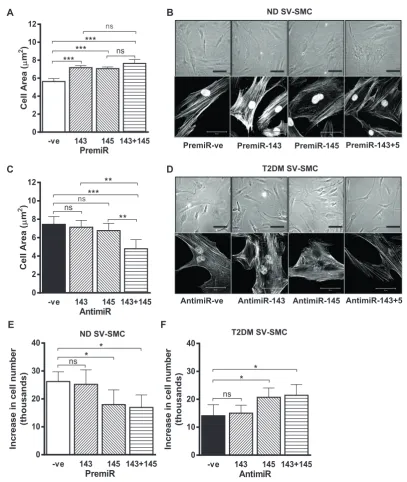
To determine whether miR-143 and/or−145 were driving changes in SV-SMC morphology, we artificially manipulated them by transfec-tion with premiRs or antimiRs (Fig. 2). As miR-143 and miR-145 were proportionally higher in T2DM-SMC we used antimiRs to reduce ex-pression levels in T2DM-SMC. Conversely, we used premiRs to increase expression in ND-SMC. Transfection of ND-SMC with premiR-143 and −145 (alone or combined) led to a 36% increase in spread cell area (Fig. 2A) and the appearance of truncated F-actinfibres similar to those in native T2DM-SMC (Fig. 2B). In T2DM-SMC the combination of antimiR-143 + 145 together was required to modulate spread cell area (~36% reduction) (Fig. 2C) and also visibly reduced the abundance of truncated F-actinfibres (Fig. 2D).
3.5. MiR-145 regulates SMC proliferation
To determine whether altered miR-143/145 expression contributed to the divergent SMC proliferation between non-diabetic and T2DM patients, appropriately transfected cells were incorporated into proliferation assays. Overexpression of premiR-143 + 145 reduced
Table 1
Biochemical characteristics of patients from whom SV-SMC were cultured. No diabetes Type 2 diabetes P value Fasting glucose (mmol/L) 5.4 (4.9-9.9) 8.1 (4.3-15.7) ***Pb0.001 HbA1c (mmol/mol) 42.5 (32.0-56.0) 66.0 (32.0-94.0) ***Pb0.001 HbA1c (%) 6.04 (5.08-7.27) 8.19 (5.08-10.75) ***Pb0.001 LDL-C (mmol/L) 3.9 (2.4-7.8) 3.9 (2.2-6.6) P = 0.97 Creatinine (μmol/L) 97.0 (50.0-147.0) 100.7 (54.0-203.0) P = 0.57 Plasma levels of glucose, glycated haemoglobin (HbA1c), LDL cholesterol (LDL-C) and creatinine in non-diabetic and T2DM patients at the time of surgery. Data are expressed as median (range). Whilst cholesterol and creatinine levels were similar, both fasting glucose and HbA1c were significantly elevated in the diabetic patients (Mann–Whitney unpaired t-test, NS - not statistically significant).
Table 2
Clinical characteristics of patients from whom SV-SMC were cultured.
No diabetes Type 2 diabetes P value Oral therapy
Metformin - 85.6%
-+ Sulfonylurea - 21.4%
-+ Gliptin - 7.1%
-Oral + insulin therapy - 30.8% -Statins 80.0% 78.6% P = 1.00 ACE inhibitors/ARBs 91.0% 73.3% P = 0.37
proliferation of ND-SMC by 35% (Pb0.05,Fig. 2E). Conversely, transfec-tion of T2DM-SMC with antimiR-143 + 145 increased cell proliferatransfec-tion by 50% (Pb0.05,Fig. 2F). In both cases, the functional effect on prolifer-ation was attributable solely to miR-145; manipulating miR-143 alone was ineffective (Figs. 2E,F).
3.6. Identification of miR-143/145 targets in SV-SMC
We used immunoblotting to investigate protein targets potentially responsible for mediating the effects of altered miR-143/145 expression on SMC function. Six validated miR-143 and−145 target genes whose activities are known to regulate SMC function and/or phenotype (KLF4, myosin VI, CaMKIIδ, IGF-1R, IRS-1 and PKCε)[27–30]were explored.α -SMA was studied because endogenous ACTA2 mRNA levels were generally higher in T2DM-SMC (Fig. 1D) and there was a strong correla-tion between miR-145 and ACTA2 mRNA levels (Pb0.001, r2= 0.6324, n = 20). Initial experiments revealed that protein levels of CaMKIIδ, IRS-1 and PKCεwere unaffected by miR-143 + 145 modulation at any time point (Supplementary Fig. 3). For targets where some regulation was evident, day 7 post-transfection was optimum for evaluating protein ex-pression following premiR transfection in ND-SMC, and day 10 for antimiR transfected T2DM-SMC (Supplementary Fig. 4).
In ND-SMC, protein levels ofα-SMA (a marker of differentiation) in-creased in response to elevating miR-143/145 levels (premiR-143/145) alone or combined, whilst miR inhibition using antimiR-143 + 145-transfected T2DM-SMC exhibitedN40% decrease inα-SMA expression. In each case, modulation appeared predominantly attributable to miR-145 (Fig. 3A). KLF4 (a potential direct target of miR-145) protein levels followed the opposite pattern; they were reduced by either premiR-143 or premiR-145 in ND-SMC and increased following transfection of either antimiR-143 or−145 (Fig. 3A). Although both premiR-143 and
−145 induced IGF-1R protein expression, neither antimiR reduced IGF-1R protein levels (Fig. 3A). For myosin VI, a small yet consistent re-duction was observed following premiR transfection with a comparable increase in response to antimiRs (Fig. 3A).
Immunoblotting of lysates from native ND- and T2DM-SMC revealed inherent variability in target protein levels between samples, although there was a trend towards increasedα-SMA and decreased KLF4 protein levels in T2DM-SMC (Figs. 3B,C), in agreement with the premiR/antimiR studies (Fig. 3A). There were no discernible differences in IGF-1R ex-pression (Fig. 3D), but myosin VI expression was significantly lower in native T2DM-SMC than in ND-SMC (Fig. 3E) compatible with the effect of artificially manipulating miR-143 and−145 levels (Fig. 3A). Expres-sion levels of miR-143 and miR-145 were quantified in RNA extracted from cells from the same patient donors as the protein samples; demon-strating that miR-143 and miR-145 were significantly elevated in the T2DM-SMC used specifically in these experiments (Figs. 3F,G), and in agreement with data inFig. 1E and Supplementary Fig. 2.
3.7. TGFβmodifies miR-143/145, cell area and proliferation
In order to identify the molecular mechanisms underlying elevated miR-143/145 in T2DM-SMC, we used a variety of“diabetogenic”stimuli to investigate their ability to increase miR-143/145 levels in ND-SMC (Fig. 4). Whilst glucose, insulin and inflammatory cytokines (IL-1αand TNFα) did not induce miR-143 or−145 expression over the timeframe studied, TGFβ(10 ng/mL) provoked a 2.5-fold increase in miR-143 and −145 after 48 h (Figs. 4A,B). This effect was concentration-dependent (data not shown), being maximal at 1 ng/mL TGFβ. Treatment of ND-SMC with 1 ng/mL TGFβincreased spread cell area by 57% (Figs. 4C,D), increased fragmented F-actinfibres (Fig. 4E), and impaired cell prolifer-ation by 37% (Fig. 4F).
T2DM
ND
B
C
A
D
E
F
miR-125b miR-133a miR-143 miR-145 0.0
0.5 1.0 1.5
2.0 ND
T2DM
R
el
ati
ve
e
xpress
io
n *
*
ns ns
0.0 0.5 1.0 1.5 2.0 2.5 3.0 0.0
0.5 1.0 1.5 2.0 2.5 3.0
miR-143
m
iR
-145
Slope = 0.85
P<0.001
r
2= 0.6197
Cell area (x10
3μm
2)
R
el
ativ
e freq
ue
nc
y
1 2 3 4 5 6 7 8 9 10 11 12 13 14 15 16 17 18 19 20 0
2 4 6 8 10
ND
T2DM
≥
Fig. 1. Differential morphology and miR expression of SV-SMC from non-diabetic and type 2 diabetic patients. (A)Representative phase contrast images of SV-SMC. Cells from non-diabetic patients (ND) show typical spindle-shaped morphology whereas those from patients with type 2 diabetes (T2DM) exhibit a more rhomboid morphology. Scale bar =100μm.(B)
3.8. MiR-143/145 modulate effects of TGFβon ND-SMC function
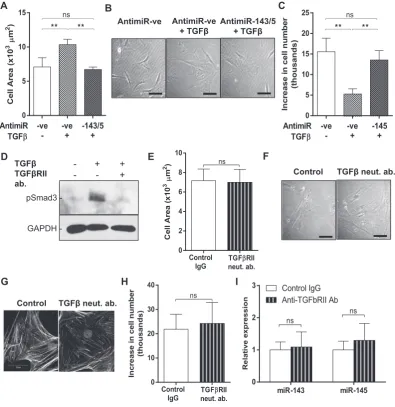
To investigate the relationship between miR-143 + 145 and TGFβ -mediated cellular effects, ND-SMC were transfected with antimiRs prior to TGFβstimulation. In control (antimiR negative) cells, TGFβ in-duced a 48% increase in cell area whilst in antimiR-143 + 145-transfected cells this increase was prevented (Pb0.01,Figs. 5A,B). Sim-ilarly, TGFβreduced proliferation in control cells by 65%, an effect
completely negated in antimiR-145-transfected cells (P b0.01, Fig. 5C). These data suggest that increased cell area and reduced prolif-eration rate in response to TGFβis mediated via miR-143/5.
We then explored whether inhibition of TGFβsignallingper secould reinstate ND characteristics to T2DM-SMC. A TGFβRII neutralising anti-body used at a concentration that abrogated TGFβ-induced Smad3 phosphorylation (Fig. 5D) did not modulate T2DM-SMC cell morpholo-gy (Figs. 5E,F), F-actin organisation (Fig. 5G), proliferation (Fig. 5H) or
ND SV-SMC
F
T2DM SV-SMCE
PremiR-ve PremiR-143 PremiR-145 PremiR-143+5
AntimiR-ve AntimiR-143 AntimiR-145 AntimiR-143+5 ND SV-SMC
T2DM SV-SMC
B
A
[image:5.595.88.496.48.531.2]D
C
Fig. 2. Effect of altering miR-143 and miR-145 levels on SV-SMC morphology and function. (A)Cell areas of ND-SMC transfected with premiR negative (−ve) or premiR-143/145 sep-arately and in combination (***Pb0.001, ns = not significant, n = 4 patient donors).(B)Representative phase contrast images (upper panel, scale bar = 100μm) or rhodamine phalloidin staining (lower panel, scale bar = 50μm) of SV-SMC from 2 different non-diabetic patients transfected with premiR negative (−ve) or premiR-143/145 separately and in combination.(C)
Cell areas of T2DM-SMC transfected with antimiR negative (−ve) or antimiR-143/145 separately and in combination (***Pb0.001, **Pb0.01, ns = not significant, n = 4 patient donors).
expression of miR-143 or−145 (Fig. 5I). Thus although we show that TGFβmodifies cellular properties through miR-143 and−145, these ef-fects are not readily reversible in cultured cells.
3.9. Chronic exposure to TGFβ exerts persistent effects on ND-SMC phenotype
To investigate whether long-term application of TGFβcould induce persistent changes in cellular phenotype even after its removal, ND-SMC were treated for 7 d with TGFβand then cultured for an additional 7 d without TGFβtreatment. TGFβinduced a 1.9-fold increase in cell area after 7 days (Figs. 6A,B), which was maintained after the removal of TGFβfor at least one further week (Figs. 6A,B). In parallel, TGFβ in-duced a 2.5-fold and 2.2-fold increase in miR-143 and miR-145 expres-sion respectively after 7 days (Figs. 6C,D). However in contrast to the persistent effect on cell morphology, expression of 143 and miR-145 returned towards basal levels following withdrawal of TGFβ.
4. Discussion
4.1. Human saphenous vein smooth muscle cells from diabetic patients exhibit a distinct and persistent phenotype
Structural anomalies and varying degrees offibrotic thickening have been observed in intact SV prior to use as bypass grafts[31–33]. In
addition, pre-operative abnormalities have been detected in SV har-vested from T2DM patients[6]but characterisation at the level of the SMC has not previously been reported. To our knowledge this is the first study to associate dysregulation of miR-143/145 with aber-rancies of SV-SMC phenotype and function specific to patients with T2DM.
The principal function of differentiated vascular SMC is contraction, yet their remarkable plasticity confers an ability to undergo phenotypic switching. Vessel remodelling in response to altered bloodflow, and re-pair mechanisms following vascular injury are characterised by dedifferentiated, synthetic SMC with reduced expression of differentiat-ed contractile markers (reviewdifferentiat-ed in[10]). These classical phenotypes represent extremes of the differentiation scale although SMC may exist in intermediate states[34]. Our data indicate a distinct phenotype in T2DM-SMC, exhibiting both classical differentiated and dedifferentiated characteristics that likely compromise remodelling of venous grafts by preventing dynamic structural changes that are necessary early after im-plantation to withstand arterial haemodynamic forces (“arterialisation”) [11]. Importantly, this adaptive phase is temporally distinct from ensuing maladaptive intimal thickening and occlusion[35], and requires mainte-nance of SMC plasticity to execute appropriate cellular function, includ-ing proliferation[12]. The data we present therefore is in the context of early graft failure through inadequate arterialisation rather than the sub-sequent development of intimal hyperplasia. In support of this proposal, recent translational studies demonstrated that loss of primary patency in α-SMA- GAPDH-α-SMA ND T2DM 0 25 50 75 100 125 150 R ela tiv e ex pre ssi on KLF4- GAPDH-KLF4 ND T2DM 0 20 40 60 80 100 Re la tiv e ex pr es si on GAPDH- IGF-1R-IGF-1R ND T2DM 0 20 40 60 80 100 120 140 R ela tiv e ex pre ssi on * Myosin VI- GAPDH-Myosin VI
A
B
C
143+ -ve 143 145 145
1.00 2.31 9.96 8.33
* *
1.00 0.88 0.65 0.56 ±0.0 ±0.5 ±1.4 ±3.6 ±0.0 ±0.1 ±0.1 ±0.1
1.00 2.36 5.97 4.04
* ** **
1.00 1.11 1.09 0.98 1.00 0.74 0.19 0.35
** **
1.00 1.72 1.77 1.67
1.00 0.89 0.75 0.82 1.00 1.10 1.15 1.14 ±0.0 ±3.3 ±2.3 ±1.4 ±0.0 ±0.1 ±0.1 ±0.1 ±0.0 ±0.2 ±0.1 ±0.1 ±0.0 ±0.4 ±0.4 ±0.6
±0.0 ±0.1 ±0.1 ±0.1 ±0.0 ±0.1 ±0.2 ±0.2 α-SMA IGF-1R KLF4 Myosin VI GAPDH 143+ -ve 143 145 145 PremiR AntimiR
1.00 1.00 1.00 1.00 1.00 1.00 1.00 1.00
ND SV-SMC T2DM SV-SMC
[image:6.595.104.502.53.414.2]E
D
Re la tiv e ex pre ssi on ND T2DM 0 20 40 60 80 100 * Re la tiv e ex pre ssi on ND T2DM 0 1 2 3 4 5*
miR-145 miR-143F
G
SV grafts was associated with a failure to remodel efficiently within the first 30 days[36].
We discovered increased levels of miR-143 and−145 in SV-SMC cultured from T2DM patients that persisted in long-term culture and in the absence of deleterious stimuli. This modest (1.6-fold) elevation is comparable with other studies that have investigated miR expression in atherosclerosis in native tissues and cells[37–39]. Over-expression of miR-145 (and to a lesser degree miR-143) in ND-SMC increased cell area, disturbed F-actin dynamics and impaired proliferation reminiscent of native T2DM-SMC. Conversely, inhibition of miR-143 + 145 in T2DM-SMC reduced cell area, restored F-actin organisation and in-creased proliferation to a level indistinguishable from native ND-SMC. Patients with T2DM have elevated plasma levels of TGFβ[40]and we demonstrated that TGFβmodulated miR-143/145 expression, cell area and proliferation akin to the native phenotype of T2DM-SMC; effects mediated in part via miR-143 + 145. Our mainfindings are summarised inFig. 7.
4.2. MiR expression and function is cell type and species-specific
Animal studies have shown that miR-143/145 expression is upregu-lated in the liver of mouse models of obesity[41], and downregulated in SMC of rats with metabolic syndrome[42]. No differences in plasma levels of miR-143/145 were observed in a study of T2DM and non-diabetic patients[43]; however the source of plasma miRs is most likely circulating and endothelial cells rather than SMC. Our study is therefore thefirst to discover elevated expression levels of miR-143 and−145, specifically in SV-SMC from T2DM patients, conferring characteristics that persist in culture and throughout passaging.
MiR-143 and−145 are SMC-enriched miRs, yet expression is re-ported in other tissues such as liver, adipose tissue and plasma[41, 43]. Both are transcribed from the same locus in a bicistronic transcript unit[27]and accordingly we observed similar fold increases in expres-sion of miR-143 and−145. Relative expression levels of miR-145 were 10-fold higher than miR-143, consistent with previous reports[44].
We observed no difference in expression of miR-125b and miR-133a between SV-SMC from human non-diabetic and T2DM patients, despite previous associations with T2DM in cardiovascular cells of animal models[25,26,45]. These anomalies may therefore highlight species-, tissue- or cell type-specific differences. Of particular relevance is a re-cent report that miR-145 expression wasreducedin coronary SMC of rats with metabolic syndrome and associated with impaired collateral growth[42]. Of critical importance however, and of direct relevance to our study, was a demonstration that whilst reinstatement of physiolog-ical miR-145 levels completely restored collateral growth, overexpres-sion of miR-145 severely compromised this function, underscoring the necessity for“physiological”levels of miR-145 for normal vascular structure and function[42].
4.3. miR-143 and−145 modulate SV-SMC morphology and function
We observed an association between T2DM, larger SMC size and in-creased expression levels of miR-143 and−145, concurring with re-ports that aortic SMC from diabetic rats have larger cytoplasmic volumes than their non-diabetic counterparts[46], and that vascular SMC of miR-143/145 knockout mice are smaller than those of wild-type littermates[47]. We also showed that manipulation of miR-143 and miR-145 regulated actin expression and organisation. Interestingly, a number of regulators of actin dynamics are known targets of these
A
E
Control
TGF
β
C
Control
TGF
β
B
[image:7.595.96.490.56.369.2]D
F
Fig. 4. Effect of TGFβon miR-143/145 expression, cell morphology and proliferation. (A,B)ND-SMC were treated with high glucose (25 mM), insulin (100 nM), IL- 1αand TNF-α(both 10 ng/mL) or TGFβ(10 ng/mL) for 48 h, and expression of miR-145 and miR-143 analyzed by RT-PCR (***Pb0.001, ns = not significant, n = 5 patient donors).(C)Quantification of cell areas of ND-SMC treated with 1 ng/mL TGFβ(***Pb0.001, n = 5 patient donors).(D)Representative phase contrast images of cells from same experiment (scale bar = 100μm).(E)
miRs[43,47]. Through the promotion of contractile gene expression, miR-145 overexpression has been shown to inhibit the development of neointimal hyperplasia in injured murine arteries[23,48]. Interest-ingly in a very small human study, miR-145 downregulation in“ tradi-tionally”harvested SV was associated with poorer patency than in veins harvested using a“no touch”technique where miR-145 levels were reportedly higher[49].
We previously reported that T2DM-SMC exhibit impaired prolifera-tion rate[13]; results corroborated in the present study and additionally found to be characteristic of SV, but not internal mammary artery. This impairment was effectively rescued by transfection with antimiR-145 and conversely, premiR-145 transfection into ND-SMC reduced prolifer-ation. Manipulation of miR-143 in either SMC population was ineffec-tive, indicating that specifically miR-145 modulates proliferative activity. In accordance with ourfindings, overexpression of miR-145 and to a lesser degree miR-143, suppressed proliferation of rat aortic
[27]and human pulmonary artery SMC[50]. As the most abundantly expressed in the vasculature, miR-145 is associated with differentiated SMC[23]with apparent greater influence than miR-143[44]. Reduced levels of miR-143/145 were observed in proliferative vascular SMC fol-lowing carotid injury in a murine model[27]. However, no such differ-ences were evident in cardiac muscle in the same animals, again highlighting the cell and tissue-type specificity of miR expression, fea-tures that are potentially attractive for therapeutic miR manipulation.
4.4. Identification of miR-143/145 targets in SV-SMC
Our data suggest that overexpression of miR-145 reduced expression of KLF4 and increased expression of the differentiation markerα-SMA. In human pulmonary artery SMC, miR-143 or−145 overexpression down-regulated KLF4, although the magnitude of effect was greater with miR-145[44]. Lentiviral transfer of miR-145 into murine carotid arteries
B
AntimiR-ve + TGFβ
AntimiR-ve AntimiR-143/5
+ TGFβ
C
A
E
D
G
H
Control TGFβ neut. ab.
I
Control TGFβ neut. ab. pSmad3
-TGFβ TGFβRII ab.
GAPDH
-+
-+
+
[image:8.595.104.500.53.461.2]F
in vivoincreased expression of markers of SMC differentiation, including α-SMA[27]. KLF4 is not expressed in healthy blood vessels but is rapidly induced following vascular injury where it is associated with transcrip-tional repression of SMC differentiation marker genes includingα-SMA [51]. Recent studies provide new evidence that loss of KLF4 and subse-quent SMC differentiation is driven at least in part by miR-143/145[27, 47]. In the current study, whilst a trend towards increasedα-SMA and de-creased KLF4 in T2DM-SMC was apparent, this was not statistically signif-icant. It is likely that the high inter-patient variation together with
the semi-quantitative nature of immunoblotting were contributing fac-tors. Myosin VI regulates cellular adhesion, endocytosis and gene tran-scription and of particular relevance to this study, has been shown to stabilise F-actin fibres [52,53]. It is plausible that the persistent disorganised F-actin cytoskeleton that we observed in T2DM-SMC may be related to reduced expression of myosin VI, although a more detailed study of the time course of this effect would be required.
4.5. TGFβup-regulates miR-143/145 and alters SV-SMC phenotype and function
Upregulation of miR-143/145 could conceivably be caused by any number of factors within the diabetic milieu. Elevated concentrations of glucose, insulin and inflammatory cytokines reportedly modulate ex-pression of various microRNAs[25,54,55]. We examined the effect of several stimuli on miR-143/145 expression and discovered TGFβas a candidate, concurring with reports in pulmonary and coronary artery SMC[44,56]. One of these studies clearly demonstrated rapid transcrip-tional induction of miR-143/145 and increased contractile gene expres-sion by TGFβin human pulmonary artery SMC, and importantly, this was specific to SMC of human, but not rodent origin[44]. Furthermore, in our study, treatment of ND-SMC with TGFβincreased spread cell area and reduced proliferation similar to levels observed in T2DM-SMC; effects rescued by miR-143 + 145 knockdown. Elevated plasma levels of TGFβin T2DM patientsin vivo[40,57,58]may therefore aug-ment vascular dysfunction evident in this patient group, at least in part through elevating miR-143/145 expression. Inhibition of TGFβsignalling through Smad3 failed to re-establish a ND phenotype in T2DM-SMC, in-dicating that continued TGFβsignalling in T2DM cells is not required for
Day 11
Day 7 Day 14
Control
TGFβ
C
D
[image:9.595.135.454.55.386.2]A
B
Fig. 6. Prolonged effect of TGFβon ND-SMC phenotype.ND-SMC were cultured for 7 days with 1 ng/mL TGFβor vehicle control, and then for a further 7 days in media with no treatment. Cell areas, miR-143 and miR-145 expression were monitored on days 7, 11 and 14. Data are expressed as fold increase in cells cultured with TGFβfor 7 days relative to vehicle-treated cells maintained for the same time period (dotted line).(A)Fold-induction in spread cell area at each time point (n = 4).(B)Representative phase contrast images of ND-SMC from the same experiment (scale bar = 100μm).(C)Induction of miR-143 expression (n = 4) and(D)miR-145 expression in the same cells (n = 4).
Cell area
↑
TruncatedF-actin
↑
α-SMA↑
Cell proliferation
↓
KLF4↓
Myosin VI
↓
Diabetic stimuli, e.g. TGFβ
Diabetic stimuli, e.g. TGFβ miR-145
↑
miR-143
↑
[image:9.595.36.284.556.692.2]these sustained phenotypic differences that more likely arose from ear-lierin vivoTGFβexposure. This concept was confirmed by our data re-vealing a persistent effect of TGFβ on cell morphology that was retained for a week following its withdrawal. Additionally, secretion of TGFβfrom cultured ND- and T2DM-SMC was similar (data not shown). To examine the persistent nature of TGFβstimulation further we also monitored miR-143/145 levels following the removal of TGFβ. In this case, and in contrast to the effects on cell morphology, expression of miR-143/145 returned towards baseline levels. It is possible that ex-posure time of greater than a week would be necessary to confer a prolonged upregulation of miR-143/145. Indeed, in terms of the pro-gression of T2DM it is likely that patients endure elevated TGFβlevels for months or years (a scenario that is difficult to modelin vitro), which may inflict persistent upregulation of miR-143/145. Whilst in our study we clearly demonstrated that miR-143/145 does drive TGFβ-mediated cellular effects (i.e. they were abrogated by antimiR transfection), the diabetic milieu is complex and other factors are likely to act in concert with TGFβin vivoin maintaining elevated miR-143/145 expression as we observed in native T2DM cells.
4.6. Clinical Perspective
Effective adaptation to arterial environments after grafting is a key determinant of SV graft patency[11]and hence the ability of SMC to re-tain plasticity during this early phase of adaptation and“arterialisation” is of major importance. We have revealed a distinct and persistent phe-notype of T2DM-SMC possessing characteristics in common with both classically differentiated and dedifferentiated SMC that would poten-tially compromise this plasticity. Owing to the silent, progressive nature of insulin resistance leading to T2DM, the vasculature is exposed to cir-culating metabolic disturbances for a prolonged period. Clinical data un-equivocally illustrate the harmful nature of metabolic memory and have led to intense activity aimed at deciphering the underlying molecular mechanisms[59]. For example, even transient exposure to high glucose appears sufficient to impose long-term changes in gene expression in cultured vascular endothelial cells[60]. Our data indicate that elevated levels of miR-143/145 in human SV-SMC induced by diabetogenic stim-uli such as TGFβmay represent one such mechanism (summarised in Fig. 7). Species and tissue specificity is undoubtedly an important aspect of miR expression; defining potential disparate functions of individual miRs according to pathophysiology and/or cell type are key consider-ations[24]. Therapeutic manipulation of miR-143/-145 in SV-SMC may therefore provide a novel opportunity to erase metabolic memory and restore vascular function in T2DM patients.
Acknowledgements
We acknowledge Jean Kaye for cell culture expertise, and Penny Rice for collation of supplementary patient data.
Sources of funding:This study was funded by The British Heart Foundation (CH/92005) and the Dunhill Medical Trust (R261/0712). S.G. Ball is a British Heart Foundation Professor of Cardiology. The funding bodies had no role in the collection or interpretation of data, writing of the report or the decision to submit the article for publication.
Disclosures:None
Appendix A. Supplementary data
Supplementary data to this article can be found online athttp://dx. doi.org/10.1016/j.yjmcc.2014.05.018.
References
[1]Booth GL, Kapral MK, Fung K, Tu JV. Relation between age and cardiovascular disease in men and women with diabetes compared with non-diabetic people: a population-based retrospective cohort study. Lancet 2006;368:29–36.
[2]Kumar P, Clark ML. Clinical Medicine. 7th ed. Edinburgh, New York: Elsevier/ Saunders; 2009.
[3]Hakala T, Pitkanen O, Halonen P, Mustonen J, Turpeinen A, Hippelainen M. Early and late outcome after coronary artery bypass surgery in diabetic patients. Scand Cardiovasc J 2005;39:177–81.
[4]Flaherty JD, Davidson CJ. Diabetes and coronary revascularization. JAMA 2005;293:1501–8.
[5]Lawrie GM, Morris Jr GC, Glaeser DH. Influence of diabetes mellitus on the results of coronary bypass surgery. Follow-up of 212 diabetic patients ten to 15 years after surgery. JAMA 1986;256:2967–71.
[6]Lorusso R, Pentiricci S, Raddino R, Scarabelli TM, Zambelli C, Villanacci V, et al. Influ-ence of type 2 diabetes on functional and structural properties of coronary artery by-pass conduits. Diabetes 2003;52:2814–20.
[7]Brown A, Reynolds LR, Bruemmer D. Intensive glycemic control and cardiovascular disease: an update. Nat Rev Cardiol 2010;7:369–75.
[8]Skyler JS, Bergenstal R, Bonow RO, Buse J, Deedwania P, Gale EA, et al. Intensive gly-cemic control and the prevention of cardiovascular events: implications of the ACCORD, ADVANCE, and VA Diabetes Trials: a position statement of the American Diabetes Association and a Scientific Statement of the American College of Cardiology Foundation and the American Heart Association. J Am Coll Cardiol 2009;53:298–304.
[9]Cooper ME. Metabolic memory: implications for diabetic vascular complications. Pediatr Diabetes 2009;10:343–6.
[10]Owens GK, Kumar MS, Wamhoff BR. Molecular regulation of vascular smooth mus-cle cell differentiation in development and disease. Physiol Rev 2004;84:767–801.
[11]Owens CD. Adaptive changes in autogenous vein grafts for arterial reconstruction: clinical implications. J Vasc Surg 2010;51:736–46.
[12] Owens CD, Gasper WJ, Rahman AS, Conte MS. Vein graft failure. J Vasc Surg 2014.
http://dx.doi.org/10.1016/j.jvs.2013.08.019[in press].
[13]Madi HA, Riches K, Warburton P, O'Regan DJ, Turner NA, Porter KE. Inherent differ-ences in morphology, proliferation, and migration in saphenous vein smooth muscle cells cultured from nondiabetic and Type 2 diabetic patients. Am J Physiol Cell Phys-iol 2009;297:C1307–17.
[14]Albinsson S, Sessa WC. Can microRNAs control vascular smooth muscle phenotypic modulation and the response to injury? Physiol Genomics 2011;43:529–33.
[15]Bartel DP. MicroRNAs: target recognition and regulatory functions. Cell 2009;136:215–33.
[16]Pandey AK, Agarwal P, Kaur K, Datta M. MicroRNAs in diabetes: tiny players in big disease. Cell Physiol Biochem 2009;23:221–32.
[17]Reddy MA, Natarajan R. Epigenetic mechanisms in diabetic vascular complications. Cardiovasc Res 2011;90:421–9.
[18]Porter KE, Riches K. The vascular smooth muscle cell: a therapeutic target in Type 2 diabetes? Clin Sci (Lond) 2013;125:167–82.
[19]Porter KE, Naik J, Turner NA, Dickinson T, Thompson MM, London NJ. Simvastatin in-hibits human saphenous vein neointima formation via inhibition of smooth muscle cell proliferation and migration. J Vasc Surg 2002;36:150–7.
[20]Turner NA, Aley PK, Hall KT, Warburton P, Galloway S, Midgley L, et al. Simva-statin inhibits TNFα-induced invasion of human cardiac myofibroblasts via both MMP-9-dependent and -independent mechanisms. J Mol Cell Cardiol 2007;43:168–76.
[21]Turner NA, Ball SG, Balmforth AJ. The mechanism of angiotensin II-induced extracel-lular signal-regulated kinase-1/2 activation is independent of angiotensin AT1A re-ceptor internalisation. Cell Signal 2001;13:269–77.
[22]Riches K, Warburton P, O'Regan DJ, Turner NA, Porter KE. Type 2 diabetes impairs venous, but not arterial smooth muscle cell function: Possible role of differential RhoA activity. Cardiovasc Revasc Med 2014;15:141–8.
[23]Cheng Y, Liu X, Yang J, Lin Y, Xu DZ, Lu Q, et al. MicroRNA-145, a novel smooth mus-cle cell phenotypic marker and modulator, controls vascular neointimal lesion for-mation. Circ Res 2009;105:158–66.
[24]Small EM, Olson EN. Pervasive roles of microRNAs in cardiovascular biology. Nature 2011;469:336–42.
[25]Villeneuve LM, Kato M, Reddy MA, Wang M, Lanting L, Natarajan R. Enhanced levels of microRNA-125b in vascular smooth muscle cells of diabetic db/db mice lead to in-creased inflammatory gene expression by targeting the histone methyltransferase Suv39h1. Diabetes 2010;59:2904–15.
[26]Xiao J, Luo X, Lin H, Zhang Y, Lu Y, Wang N, et al. MicroRNA miR-133 represses HERG K + channel expression contributing to QT prolongation in diabetic hearts. J Biol Chem 2007;282:12363–7.
[27]Cordes KR, Sheehy NT, White MP, Berry EC, Morton SU, Muth AN, et al. miR-145 and miR-143 regulate smooth muscle cell fate and plasticity. Nature 2009;460:705–10.
[28]Szczyrba J, Loprich E, Wach S, Jung V, Unteregger G, Barth S, et al. The microRNA pro-file of prostate carcinoma obtained by deep sequencing. Mol Cancer Res 2010;8:529–38.
[29]Shi B, Sepp-Lorenzino L, Prisco M, Linsley P, deAngelis T, Baserga R. Micro RNA 145 targets the insulin receptor substrate-1 and inhibits the growth of colon cancer cells. J Biol Chem 2007;282:32582–90.
[30]Quintavalle M, Elia L, Condorelli G, Courtneidge SA. MicroRNA control of podosome formation in vascular smooth muscle cells in vivo and in vitro. J Cell Biol 2010;189:13–22.
[31]Giannoukas AD, Labropoulos N, Stavridis G, Bailey D, Glenville B, Nicolaides AN. Pre-bypass quality assessment of the long saphenous vein wall with ultrasound and his-tology. Eur J Vasc Endovasc Surg 1997;14:37–40.
[image:10.595.308.562.74.743.2][33]Varty K, Jones L, Porter KE, Bell PRF, London NJM. A quantitative study of long saphe-nous vein morphology in patients undergoing arterial surgery. Phlebology 1995;10:90–3.
[34]Alexander MR, Owens GK. Epigenetic control of smooth muscle cell differentiation and phenotypic switching in vascular development and disease. Annu Rev Physiol 2012;74:13–40.
[35]Wong AP, Nili N, Jackson ZS, Qiang B, Leong-Poi H, Jaffe R, et al. Expansive remodel-ing in venous bypass grafts: novel implications for vein graft disease. Atherosclerosis 2008;196:580–9.
[36]Gasper WJ, Owens CD, Kim JM, Hills N, Belkin M, Creager MA, et al. Thirty-day vein remodeling is predictive of midterm graft patency after lower extremity bypass. J Vasc Surg 2013;57:9–18.
[37]Cipollone F, Felicioni L, Sarzani R, Ucchino S, Spigonardo F, Mandolini C, et al. A unique microRNA signature associated with plaque instability in humans. Stroke 2011;42:2556–63.
[38]Raitoharju E, Lyytikainen LP, Levula M, Oksala N, Mennander A, Tarkka M, et al. miR-21, miR-210, miR-34a, and miR-146a/b are up-regulated in human atherosclerotic plaques in the Tampere Vascular Study. Atherosclerosis 2011;219:211–7.
[39]Santovito D, Mandolini C, Marcantonio P, De NV, Bucci M, Paganelli C, et al. Overex-pression of microRNA-145 in atherosclerotic plaques from hypertensive patients. Expert Opin Ther Targets 2013;17:217–23.
[40]Pfeiffer A, Middelberg-Bisping K, Drewes C, Schatz H. Elevated plasma levels of transforming growth factor-beta 1 in NIDDM. Diabetes Care 1996;19:1113–7.
[41]Jordan SD, Kruger M, Willmes DM, Redemann N, Wunderlich FT, Bronneke HS, et al. Obesity-induced overexpression of miRNA-143 inhibits insulin-stimulated AKT acti-vation and impairs glucose metabolism. Nat Cell Biol 2011;13:434–46.
[42]Hutcheson R, Terry R, Chaplin J, Smith E, Musiyenko A, Russell JC, et al. MicroRNA-145 Restores Contractile Vascular Smooth Muscle Phenotype and Coronary Collateral Growth in the Metabolic Syndrome. Arterioscler Thromb Vasc Biol 2013;33:727–36.
[43]Zampetaki A, Kiechl S, Drozdov I, Willeit P, Mayr U, Prokopi M, et al. Plasma microRNA profiling reveals loss of endothelial miR-126 and other microRNAs in type 2 diabetes. Circ Res 2010;107:810–7.
[44]Davis-Dusenbery BN, Chan MC, Reno KE, Weisman AS, Layne MD, Lagna G, et al. down-regulation of Kruppel-like factor-4 (KLF4) by microRNA-143/145 is critical for modulation of vascular smooth muscle cell phenotype by transforming growth factor-beta and bone morphogenetic protein 4. J Biol Chem 2011;286:28097–110.
[45]Feng B, Chen S, George B, Feng Q, Chakrabarti S. miR133a regulates cardiomyocyte hypertrophy in diabetes. Diabetes Metab Res Rev 2010;26:40–9.
[46]Etienne P, Pares-Herbute N, Mani-Ponset L, Gabrion J, Rabesandratana H, Herbute S, et al. Phenotype modulation in primary cultures of aortic smooth muscle cells from streptozotocin-diabetic rats. Differentiation 1998;63:225–36.
[47]Xin M, Small EM, Sutherland LB, Qi X, McAnally J, Plato CF, et al. MicroRNAs miR-143 and miR-145 modulate cytoskeletal dynamics and responsiveness of smooth muscle cells to injury. Genes Dev 2009;23:2166–78.
[48]Lovren F, Pan Y, Quan A, Singh KK, Shukla PC, Gupta N, et al. MicroRNA-145 targeted therapy reduces atherosclerosis. Circulation 2012;126:S81–90.
[49]Verma S, Lovren F, Pan Y, Yanagawa B, Deb S, Karkhanis R, et al. Pedicled no-touch saphenous vein graft harvest limits vascular smooth muscle cell activa-tion: the PATENT saphenous vein graft study. Eur J Cardiothorac Surg 2014;45:717–25.
[50]Caruso P, Dempsie Y, Stevens H, McDonald RA, Long L, Lu R, et al. A role for miR-145 in pulmonary arterial hypertension: evidence from mouse models and patient sam-ples. Circ Res 2012;111:290–300.
[51]Liu Y, Sinha S, McDonald OG, Shang Y, Hoofnagle MH, Owens GK. Kruppel-like factor 4 abrogates myocardin-induced activation of smooth muscle gene expression. J Biol Chem 2005;280:9719–27.
[52]Frank DJ, Noguchi T, Miller KG. Myosin VI: a structural role in actin organization im-portant for protein and organelle localization and trafficking. Curr Opin Cell Biol 2004;16:189–94.
[53]Redowicz MJ. Unconventional myosins in muscle. Eur J Cell Biol 2007;86:549–58.
[54]Zhang Y, Wang Y, Wang X, Zhang Y, Eisner GM, Asico LD, et al. Insulin promotes vas-cular smooth muscle cell proliferation via microRNA-208-mediated downregulation of p21. J Hypertens 2011;29:1560–8.
[55]Kuhn AR, Schlauch K, Lao R, Halayko AJ, Gerthoffer WT, Singer CA. MicroRNA expres-sion in human airway smooth muscle cells: role of miR-25 in regulation of airway smooth muscle phenotype. Am J Respir Cell Mol Biol 2010;42:506–13.
[56]Long X, Miano JM. Transforming growth factor-beta1 (TGF-β1) utilizes distinct path-ways for the transcriptional activation of microRNA 143/145 in human coronary ar-tery smooth muscle cells. J Biol Chem 2011;286:30119–29.
[57]Herder C, Zierer A, Koenig W, Roden M, Meisinger C, Thorand B. Transforming growth factor-beta1 and incident type 2 diabetes: results from the MONICA/KORA case-cohort study, 1984–2002. Diabetes Care 2009;32:1921–3.
[58]Nakhjavani M, Esteghamati A, Asgarani F, Khalilzadeh O, Nikzamir A, Safari R. Asso-ciation of oxidized low-density lipoprotein and transforming growth factor-beta in type 2 diabetic patients: a cross-sectional study. Transl Res 2009;153:86–90.
[59]Intine RV, Sarras Jr MP. Metabolic memory and chronic diabetes complications: po-tential role for epigenetic mechanisms. Curr Diab Rep 2012;12:551–9.
[60]El-Osta A, Brasacchio D, Yao D, Pocai A, Jones PL, Roeder RG, et al. Transient high glu-cose causes persistent epigenetic changes and altered gene expression during subse-quent normoglycemia. J Exp Med 2008;205:2409–17.
Glossary
α-SMA:alpha smooth muscle actin
CABG:coronary artery bypass grafting
CaMKIIδ:calcium/calmodulin-dependent protein kinase 2 delta
CHD:coronary heart disease
DMEM:Dulbecco’s modified eagle medium
FCS:foetal calf serum
FGM:full growth medium
GAPDH:glyceraldehyde 3-phosphate dehydrogenase
IGF-1R:insulin-like growth factor receptor 1
IL-1α:interleukin-1 alpha
IRS-1:insulin receptor substrate 1
KLF4:Kruppel-like factor 4
miR:microRNA
ND:non-diabetic
PKCε:protein kinase C epsilon
SMC:smooth muscle cell
SV:saphenous vein
T2DM:type 2 diabetes
TGFβ:transforming growth factor beta