This is a repository copy of
Dynamic analysis of high static low dynamic stiffness vibration
isolation mounts
.
White Rose Research Online URL for this paper:
http://eprints.whiterose.ac.uk/80839/
Version: Submitted Version
Article:
Shaw, A.D., Neild, S.A. and Wagg, D.J. (2013) Dynamic analysis of high static low
dynamic stiffness vibration isolation mounts. Journal of Sound and Vibration, 332 (6). 1437
- 1455. ISSN 0022-460X
https://doi.org/10.1016/j.jsv.2012.10.036
[email protected] Reuse
Unless indicated otherwise, fulltext items are protected by copyright with all rights reserved. The copyright exception in section 29 of the Copyright, Designs and Patents Act 1988 allows the making of a single copy solely for the purpose of non-commercial research or private study within the limits of fair dealing. The publisher or other rights-holder may allow further reproduction and re-use of this version - refer to the White Rose Research Online record for this item. Where records identify the publisher as the copyright holder, users can verify any specific terms of use on the publisher’s website.
Takedown
If you consider content in White Rose Research Online to be in breach of UK law, please notify us by
Dynamic Analysis of High Static Low Dynamic
Stiffness Vibration Isolation Mounts
A. D. Shaw, S. A. Neild, D. J. Wagg
Advanced Composites Centre for Science and Innovation (ACCIS), University of Bristol, Queen’s Building, Bristol, BS8 1TR, United Kingdom
Abstract
The High Static Low Dynamic Stiffness (HSLDS) concept is a design strategy
for an anti-vibration mount that seeks to increase isolation by lowering the
nat-ural frequency of the mount, whilst maintaining the same static load bearing
capacity. Previous studies have successfully analysed many features of the
re-sponse by modelling the concept as a Duffing oscillator. This study extends the
previous findings by characterising the HSLDS model in terms of two simple
parameters. A fifth-order polynomial model allows us to explore the effects of
these parameters. We analyse the steady state response, showing that simple
changes to the shape of the force displacement curve can have large effects on
the amplitude and frequency of peak response, and can even lead to unbounded
response at certain levels of excitation. Harmonics of the fundamental response
are also analysed, and it is shown that they are unlikely to pose significant
design limitations. Predictions compare well to simulation results.
Keywords: Vibration Isolation, Nonlinear Dynamics, HSLDS, Normal form
1. Introduction
Vibration isolation is a vital requirement throughout much of engineering
[1], particularly when there is a strong source of vibration such as a motor. It
is frequently required to prevent the transmission of these vibrations to other
elements of the system, for reasons such as passenger comfort in vehicles, or the
One strategy for the isolation of vibration is to reduce the stiffness of a linear
mount. A linear mass/spring/damper system has transmissibility that is less
than unity at angular frequencies ofω >p2k/m, wherekis the stiffness of the
mount andmis the mass being supported [1]. Reducingkwill increase the size
of the isolation region (it is assumed that increases in mass are undesirable).
However, significantly reducing k may cause the mount to have an excessive
static deflection on application of a static load [2] (this load typically consists of
the weight of the mass). A further means of reducing vibration is to reduce the
viscous damping coefficient, which dominates the response at high frequencies.
However this has the disadvantage of increasing the peak transmissibility of
response [1]; this will often be of concern, for example in the case of a motor
where the mount is designed such that the motor’s typical rotational velocity is
within its isolation region, whenever the motor is started from rest it will pass
through the natural frequency as it gains rotational speed.
A High Static Low Dynamic Stiffness (HSLDS) mount has a nonlinear
force-displacement curve, which has decreased stiffness near the point of static
equi-librium about which the mount oscillates, known as the dynamic stiffness.
Else-where, the stiffness increases so that the static deflection due to its designed
static load is reduced; in effect the mount shows high static stiffness [2]. A
typ-ical means of achieving this profile is by connecting a linear spring in parallel
with an ‘anti-spring’ device [3], which is a mechanism that features a region of
negative stiffness, discernible by a snap-through displacement response to static
force.
Isolators that exhibit HSLDS behaviour have appeared in the literature,
although the HSLDS term itself is relatively new. Winterflood [4] presents a
mount utilising a Euler spring for use in gravitational experiments. Virgin and
Davis [5] present a prototype mount consisting of a buckled strut, and Plaut et
al. [6] present analysis of similar mount albeit with fixed as opposed to pinned
end conditions. Virgin et al. [7] also propose a mechanism based on a strip bent
into a tear-shaped loop. Further exposition and results for both these types
design deriving the required nonlinear response from a geometrical arrangement
of springs, and presents results from an implementation using prestressed blade
springs. Carrella et al. [10] presents analysis of a similar geometrical spring
ar-rangement, with the aim of achieving near zero stiffness at equilibrium, known
as Quasi Zero Stiffness (QZS). In a more recent paper, Carrella idealised the
dynamic response of this mechanism as a Duffing oscillator, demonstrating
im-portant differences between its force transmissibility and motion transmissibility
[11]. Kovacic et al. [12] also proposed oblique spring arrangements, but with
nonlinear springs to reduce the variability in dynamic stiffness with displacement
from equilibrium. Zhou, [13], has proposed an HSLDS using an electromagnetic
negative spring element, that allows system parameters to be tuned.
Robert-son et al. [14] present theoretical analysis for a fully magnetic HSLDS device,
where magnetism also supports the payload mass. Many HSLDS devices are
found in a review of passive vibration isolation methods by Ibrahim [3].
Fur-ther designs, both magnetic and geometric, and more analysis of the nonlinear
phenomena encountered by HSLDS mounts including amplitude dependant
re-sponse and jump frequencies, based on Duffing oscillator models are given in
[2]. In addition, Le and Ahn present analysis and an experimental prototype for
a spring-based mechanism designed for isolation of a vehicle seat [15], showing
that isolation is achieved for both broadband and harmonic signals.
The response of the HSLDS concept varies depending upon the form of
excitation that the mount receives [11]. Furthermore, different aspects of the
response may be considered important when evaluating the performance of the
mount; for example the aim may be to reduce the displacement amplitude of the
mass in some cases, whereas in others the aim may be to reduce the amplitude
of the force transmitted to the base. Ideally, the nonlinearity in the mount will
also have the effect of reducing the peak amplitude of response, because this can
compensate for an increase in peak amplitude caused by reducing damping, and
so allowing improved isolation at high frequencies. In this work, we consider the
cases of displacement amplitude response to force excitation of the mass and
Regardless of the situation in which it is used, an HSLDS will only function
usefully within limits of the response amplitude. As amplitude increases, the
peak frequency of the mount increases reducing the isolation region [2], and
harmonic responses increase, which could potentially negate reductions in
re-sponse at forcing frequency. This paper extends previous work, by considering
simple parameters that describe a generic HSLDS response, irrespective of its
mechanism or the mathematical form of its force-displacement curve. We then
show how these parameters affect HSLDS performance in terms of response
amplitude, frequency and harmonics, using a 5th order model.
After the initial problem description, Section 2 defines a
nondimensionali-sation based on the static stiffness, that is intended to give clear insight into
the effects of these system parameters. Section 3 analyses the HSLDS restoring
force function in quasi-static terms, employing two parameters ˆke and ˆxr that
can be used to approximately characterise any HSLDS mount, including
non-polynomial responses. We find that a 5th order non-polynomial system can exhibit a
wide range of these parameters’ values. In Section 4, we present a Normal Form
analysis of the approximate steady-state dynamic response of HSLDS mounts to
harmonic excitation [16, 17], including a useful graphical method and predictions
for response harmonics. Section 6 compares analytical and numerical results for
a range of systems, excited to amplitudes where highly nonlinear effects occur,
showing that the analysis still provides reasonable results, and highlighting the
important effects that different amplitude-frequency relationships can have on
performance.
2. Idealisation of generic system
2.1. Equation of motion
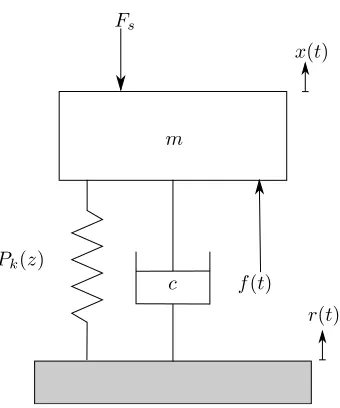
Fig. (1) shows the idealised system to be considered; a mass m subject
to static load Fs is supported by a nonlinear spring with force/displacement
responsePk(z) and linear damper with coefficientc on a base (TypicallyFs=
m
f(t)
c Pk(z)
x(t)
r(t)
[image:6.612.221.391.119.323.2]Fs
Figure 1: Massm with static loadFs supported on movable base by nonlinear spring with linear damper with damping constantc.r(t) denotes base motion,x(t) denotes displacement
response of the mass,z ≡x−rdenotes relative displacement response, f(t) denotes force
excitation, nonlinear spring has force/displacement functionPk(z).
It may be excited by forcing signalf(t) or base excitation signalr(t), resulting
in an absolute displacement from the static equilibrium positionx. This may
also be expressed in terms of a relative displacement response given by:
z≡x−r (1)
We specify that z = 0 at static equilibrium. The nonlinear spring will resist
displacements from its static equilibrium position with a forceP(z) =Fs−Pk(z).
Viscous damping force will also be determined by relative response, however
inertial forces will be due to absolute acceleration ¨x = ¨r+ ¨z. Referring to
Fig. (1), and substituting Eq. (1) forx, gives the following equation of motion:
mz¨+cz˙+P(z) =f(t) +m¨r (2)
2.2. Equivalent linear system
To assess the performance of the nonlinear mount, it is compared to a linear
zs
−zs
P(z)
Fs
−Fs
ksz
[image:7.612.219.398.120.261.2]p(z) Displacement Force
Figure 2: Relationship between different force/displacement functions used in analysis.
Fs. This linear mount, with equal damping coefficientc, is referred to as the
equivalent linear system. It will have stiffness equal to the static stiffness of the
system given byks≡Fs/zs. It is often useful to consider the distortions of the
nonlinear force-deflection function from those of the equivalent linear mount,
hence we define:
p(z)≡P(z)−ksz (3)
It is assumed that this distortion is odd about the static equilibrium z = 0,
hencep(±zs) = 0. The relationship betweenP(z),p(z) and the linear restoring
functionksz are illustrated in Fig. (2).
2.3. Nondimensionalisation of system
Recalling that static load bearing and static displacement are key to the
motivation for an HSLDS, we treat them as design constraints, and therefore
nondimensionalise forces byFsand displacements by zs. Using ωe≡p ks/m,
λ≡c/(2√ksm), ˆr≡r/zs, ˆz≡z/zsand substituting Eq. (3) into Eq. (2) gives:
¨ˆ
z+ 2λωez˙ˆ+ω2ezˆ+ p(ˆzzs)
mzs =
f(t)
mzs + ¨ˆr (4)
Note that ωe is the natural frequency of the equivalent linear system, not the
more commonly seenωn which is the natural frequency of the linearised system
which is used later on. Similarlyλis used instead of the usual damping ratioζ
this way, our damping is not affected by changes to stiffness nonlinearities. We
can also scale time by the natural frequency of the equivalent linear system by
defining:
τ≡tωe (5)
If the prime′is now used to denote differentiation w.r.tτ, we can write:
ˆ
z′′+ 2λzˆ′+ ˆz+ ˆp(ˆz) = ˆf(τ) + ˆr′′ (6)
where ˆp(ˆz)≡ p(ˆzzs)
Fs and ˆf(τ)≡ f(t/ωe)
Fs . We can also create a nondimensional
form of the originalP(z):
ˆ
P(ˆz)≡P(ˆFszzs) = ˆp(ˆz) + ˆz (7)
such that ˆP(1) = 1. For completeness, we also define a nondimensionalised
absolute response ˆx=x/zs.
We can see that results occurring for the nondimensional system can be
applied to any dimensional system by simple scaling operations. Note that
nondimensional displacements of unity are equal in magnitude to the static
displacement.
3. Nonlinear force displacement response
3.1. General characteristics of HSLDS force-displacement response
We propose two parameters that give a good overall characterisation of the
response. The first is equilibrium stiffness ˆke, defined as the non-dimensional
stiffness at the equilibrium point:
ˆ
ke≡ddPzˆˆ
ˆ
z=0
(8)
This will have a value between zero and one, with one indicating no softening
effect relative to the equivalent linear system. The second parameter is the
reduced stiffness range ˆzr. This is the range of displacement over which the
stiffness is less than that of the equivalent linear system:
dPˆ dzˆ
|ˆz|<zˆr
ˆ
P(ˆz)
ˆ zr 1 −1 1 −1 ˆ ke ˆ
p(ˆz)
ˆ
z
−1 1
ˆ
zr
ˆ
ke−1
a) b)
ˆ
[image:9.612.135.444.117.267.2]z
Figure 3: Illustration of properties ˆzrand ˆke. (a) Nondimensional force displacement function ˆ
P(ˆz) (solid) showing equilibrium stiffness ˆke(fine dash) and nondimensional equivalent linear system (large dash) (b) Nondimensional distortions from equivalent linear response ˆp(ˆz) (solid)
with zero gradient (dashed)
Therefore a system with a greater ˆzr will retain low dynamic stiffness over a
greater range of displacement relative to its static deflection. Fig. (3) illustrates
these properties in relation to ˆP(ˆz) and ˆp(ˆz). We find ˆzr by considering the
minimum of ˆp(ˆz) i.e. by solving:
dpˆ
dzˆ
ˆ
z=ˆzr
= 0, d
2pˆ
dzˆ2
ˆ
z=ˆzr
>0 (10)
We would like the shape of the designed response to be relatively simple
so we place some additional restrictions upon it. Firstly we stipulate that the
minimum stiffness is located at the equilibrium point (ˆz= 0), expressed
math-ematically as:
d2Pˆ dzˆ2
ˆ z=0
= 0, d
3Pˆ
dzˆ3
ˆ
z→0
>0 (11)
with the first part of this automatically satisfied by the use of an odd function
for ˆp(ˆz). Secondly we stipulate that there are no positive regions of ˆp(ˆz) between
zero and one (hence no roots of ˆp(ˆz) in this region); this implies that the
mag-nitude of restoring force is always less than that of the equivalent linear system
when|zˆ|<1. For completeness, we reiterate that ˆP(ˆz) is an odd function such
that:
ˆ
3.2. Constrained 5th order polynomial form
Polynomial response forms are of interest because they may be used to
ap-proximate many other functions. We use a 5th order polynomial, to allow
greater variation in response than a 3rd order polynomial. We require ˆP(ˆx) to
be odd, so only the odd powers are included in the polynomial. The fifth order
function is therefore given as:
ˆ
P(ˆz) =k1zˆ+k3ˆz3+k5zˆ5 (13)
We satisfy Eq. (8) by setting k1 = ˆke. We choose the other coefficients by
substituting Eq. (13) into the first part of Eq. (10) and Eq. (12) and solving to
get:
k3= (1−ˆke) 5ˆz 4
r−1
5ˆz4
r−3ˆzr2
(14)
k5= (1−ˆke)
1−3ˆz2
r
5ˆz4
r−3ˆzr2
(15)
Our choice of ˆzr is constrained; we find that to satisfy Eq. (11) and ensure no
roots of ˆp(ˆz) less than one, we require thatp
1/5≤zrˆ ≤p4
1/5. We find that
at these limiting values of ˆzr, we can obtain simpler formulas fork3andk5:
k3(ˆ
zr=√1/5) = 2(1− ˆ
ke), k5(ˆ
zr=√1/5) = ˆke−1 (16)
k3(ˆ
zr= 4√1/5)= 0, k5(ˆzr= 4√1/5) = 1− ˆ
ke (17)
Furthermore, we note that by choosing ˆzr=p
1/3 we obtain:
k3(ˆ
zr=√1/3)= 1− ˆ
ke, k5(ˆ
zr=√1/3) = 0 (18)
which is the Duffing oscillator. Also note that the expression for minimal xr
gives k3 as twice that of the Duffing oscillator, and that the expression for
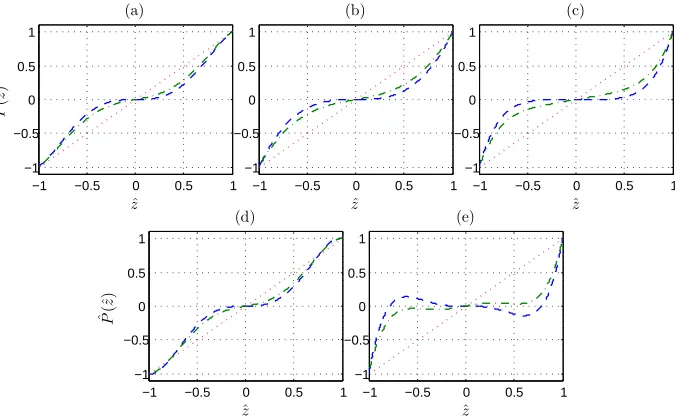
maximal ˆzr gives a purely 5th order response. Fig. (4) shows the range of
response profiles achievable with the constrained 5th order polynomial (parts
(a) to (c)), and examples of choosing ˆzr outside the appropriate limits (parts
(d) and (e)). Despite the constraints, we see that the 5th order form allows
−1 −0.5 0 0.5 1 −1
−0.5 0 0.5 1
ˆ
z ˆP(ˆz
)
(a)
−1 −0.5 0 0.5 1
−1 −0.5 0 0.5 1
ˆ
z
(b)
−1 −0.5 0 0.5 1
−1 −0.5 0 0.5 1
ˆ
z
(c)
−1 −0.5 0 0.5 1
−1 −0.5 0 0.5 1
ˆ
z ˆP(ˆz
)
(d)
−1 −0.5 0 0.5 1
−1 −0.5 0 0.5 1
ˆ
z
(e)
Figure 4: Effect of ˆzron 5th order polynomial response profile. (a) ˆzr=
p
1/5 (b) ˆzr=
p
1/3
(Duffing response) (c) ˆzr = 4
p
1/5 (d) Effect of ˆzr <
p
1/5, which gives positive regions of
ˆ
p(ˆz) between zero and one (e) Effect of ˆzr> 4
p
1/5 which fails to meet Eq. (11) and can show
regions of negative stiffness. Dashed line: ˆke= 0.01 Dot-dashed line: ˆke= 0.25. Dotted line: ˆ
[image:11.612.140.479.253.463.2]3.3. Comparison to real HSLDS mechanisms
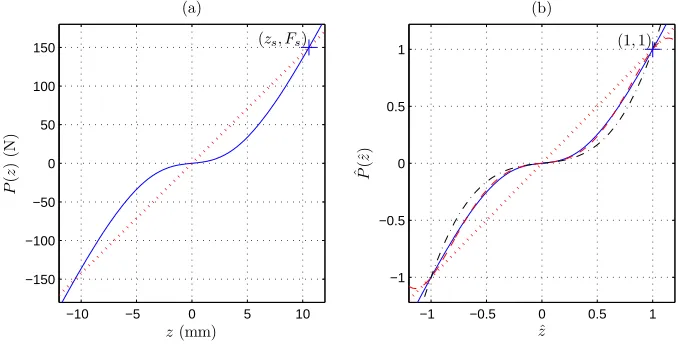
Fig. (5) gives an example of this nondimensionalisation fitted to a
non-polynomial response, given by a system using a vertical spring coupled to
pre-compressed lateral springs to provide geometric nonlinearity, analysed by
Car-rella [11]. This response is given by:
P(z) =kvz+ 2kh(1−√ ℓ0
z2+ℓ2)z (19)
wherekv and kh are the vertical and lateral spring constants respectively, and
ℓ0andℓare the original and compressed lengths of the horizontal springs. The
left hand graph shows this response with kv = kh = 10 N mm−1, ℓ0 = 10
mm, andℓ= 7 mm. If we assume that static loadFs= 150N, implying static
displacementzs= 10.6mm, Eq. (8) gives ˆke= 0.101 and ˆzr= 0.462. The right
hand graph shows the effect of nondimensionalising this system, along with a
Duffing approximation that matches ˆke, and a 5th order function that matches
both ˆke and ˆzr. It can be seen that the constrained 5th order response follows
the original function more accurately than the Duffing over the range of fitting.
4. Normal form analysis of polynomial HSLDS
A Normal Form analysis is used, based on the technique described by Neild
and Wagg [16, 17], which provides results in terms of a transformed variable ˆu
representing the response at the forcing frequency, and a transformation function
h(ˆu) which contain information on harmonic responses. A slight modification
to the method is made to improve accuracy of harmonics at forcing frequencies
below resonance; the full derivation is supplied in Appendix A, whilst the main
results are shown here.
4.1. Fundamental response solution
To solve Eq. (6) we transform ˆras follows:
ˆ
−10 −5 0 5 10 −150
−100 −50 0 50 100 150
z(mm)
P
(
z
)
(N)
(a)
(zs, Fs)
−1 −0.5 0 0.5 1
−1 −0.5 0 0.5 1
(b)
ˆ z
ˆP(ˆz
)
(1,1)
Figure 5: (a) Solid line shows response of oblique spring HSLDS mount withkv=kh= 10 N mm−1,ℓ0 = 10 mm,ℓ= 7 mm. Red dots show linear mount implied by chosen static load
Fs= 150 N, giving static displacementxs= 10.6 mm. (b) Consequent nondimensionalisation to ˆP(ˆz) (solid) with Duffing (dot-dashed) and 5th order (dashed) models fitted, ˆke = 0.101, ˆ
zr= 0.462.
where ˆurepresents the displacement response at forcing frequency and h(ˆu) is
a near identity transformation that effectively represents harmonic responses.
The Normal Form analysis allows the definition of response functions relating
fundamental response amplitude ˆU, harmonic excitation amplitude and
funda-mental response angular frequency ˆωr. For base excitation the equation that
must be solved is :
ˆ
ωr4( ˆU2−Rˆ2) + 2ˆωr2Uˆ2 h
2λ2−K( ˆU)i+K( ˆU)2Uˆ2= 0 (21)
where ˆR is the amplitude of base excitation, whereas for forced excitation the
response function is:
ˆ
ω4rUˆ2+ 2ˆω2rUˆ2
h
2λ2−K( ˆU)i+K( ˆU)2Uˆ2−Fˆ2= 0 (22)
where ˆF is the amplitude of forcing. These may be solved for ˆω2
r with any
trial value of response amplitude at forcing frequency ˆU, yielding up to 2 real
[image:13.612.137.476.128.302.2]polynomial is:
K( ˆU) = ˆke+3k3Uˆ
2
4 +
10k5Uˆ4
16 (23)
4.2. Backbone and limit curves
A curve along which all solutions of peak fundamental response amplitude
and the excitation frequencies at which they occur, known as the backbone
curve [18], may be obtained for both base motion and forced excitation as:
ˆ
ωr=
q
K( ˆU) (24)
There is also a relationship between response amplitude, forcing frequency,
forc-ing amplitude and dampforc-ing that applies to all systems when at peak amplitude,
regardless of stiffness function, known as the limit curve [18]. For base motion
excitation it is:
ˆ
U =Ω ˆˆR
2λ (25)
whereas for forcing excitation it is:
ˆ
U = Fˆ
2λΩˆ (26)
We note that in the base excitation case, peak amplitude is proportional to peak
forcing frequency, whereas for forced excitation it is inversely proportional.
4.3. Absolute response
For base excitation it is often necessary to know the absolute displacement
response in addition to the relative displacement response. In this case it is
necessary to know the phase difference between the base excitation and the
response, given by:
φ= cos−1 −ωˆ
2
rUˆ +K( ˆU) ˆU
ˆ
ω2
rRˆ
!
(27)
We can then calculate ˆX, the amplitude of absolute response at the forcing
frequency, as:
ˆ
X =
q
4.4. Estimation of Harmonics
This process is the same for both forced and base motion excitation, and is
shown in more detail in Appendix A.3. We use the magnitude of the
funda-mental response ˆU to find the magnitude of the 3rd and 5th harmonics using:
h3( ˆU) = k3
ˆ
U3
4 + 5k5Uˆ5
16
!
1
p
(9ˆω2
r−ωˆ2n)2+ (6ˆωrλ)2
(29)
and
h5( ˆU) =
k5Uˆ5
16
1
p
(25ˆω2
r−ωˆ2n)2+ (10ˆωrλ)2
(30)
where ˆω2
n= ˆke.
5. Backbone and limit curve maps
In Section 4.2 we saw that when the back bone curve, as given by Equation
(24), intersects a limit curve, given by either Eq. (25) for base motion excitation
or Eq. (26) for forced excitation, a solution for peak response occurs. We also
noted that limit curves were independent of the stiffness properties of the mount.
In this section we display this graphically to gain insight into the effects of
the system parameters. We plot limit curves for a range of excitation amplitudes
and damping levels, then superimpose backbone curves for a range of nonlinear
springs upon them. These diagrams therefore constitute a ‘map’ showing the
peak response for any combination of backbone curve, excitation amplitude and
damping; to find a peak response, simply inspect where the backbone curve
concerned intersects the relevant limit curve.
The systems presented here have equilibrium stiffnesseske of 0.25 and 0.01
(recalling that linearised natural frequency is proportional to the square root of
stiffness, we see that these lead to reductions in the linearised natural frequency
to one half and one tenth of that of the equivalent linear system respectively).
Referring to Fig. (4), we show ˆzr values of 0.447, 0.577 and 0.669 representing
the minimal, Duffing and maximal values respectively for each stiffness.
From Eqs. (23) and (24), we see that all back bone curves cut the ˆωraxis at
ˆ
0 0.2 0.4 0.6 0.8 1 1.2 0 0.2 0.4 0.6 0.8 1 1.2 ˆ R/λ= 0.50
ˆ
R/λ= 1 .00 ˆ R/λ= 1
.50 ˆ R/λ
=2.00 ˆ R/λ
=2. 50
ˆ ωr
ˆU
ˆ ke=
0.01
ˆ ke=
0.25 ˆ
ke=
0.01
ˆ ke=
0.25 ˆ
ke=
0.01
ˆ ke=
0.25 ˆke= 1
(linear)
ˆ
zr=
0.669
ˆ
zr=
0.577
ˆ
zr=
0.447
ˆ
zr=
0.669
ˆ zr=
0.57 7
ˆ zr=
[image:16.612.140.474.132.345.2]0.44 7
Figure 6: Limit (dashed) and backbone (solid) curves for resonant relative displacement
re-sponse to harmonic base excitation.
predicted by linearised analysis, due to nonlinear polynomial terms becoming
insignificant as amplitude tends to zero. Hence at small amplitude, ˆkedominates
response. However, as amplitude increases, the curves take different shapes
depending on ˆzr, leading to the different responses as described in the following
sections.
5.1. Base Motion Excitation
We see from Fig. (6) that under base excitation with any given excitation
amplitude and damping, a backbone that achieves a lower peak frequency will
also achieve a lower peak amplitude, because all limit curves are straight lines
from the origin. This effect occurs regardless of whether the peak frequency
reduction is due to changes in equilibrium stiffness or reduced stiffness range,
and is highly beneficial as it means that both peak frequency and peak amplitude
reduction are achieved.
0 0.2 0.4 0.6 0.8 1 1.2 0 0.2 0.4 0.6 0.8 1 1.2
λ= 0.200
λ= 0.100
λ=0 .067 λ=
0.05 0 λ=
0.04 0
ˆ ke=
0.01
ˆ ke=
0.25 ˆ
ke=
0.01
ˆ ke=
0.25 ˆ
ke=
0.01
ˆ ke=
0.25
ωr
ˆX
ˆ
zr=
0.669
ˆ
zr=
0.577
ˆ
zr=
0.447
ˆ
zr=
0.669
ˆ zr=
0.57 7
ˆ zr=
[image:17.612.140.474.131.344.2]0.44 7
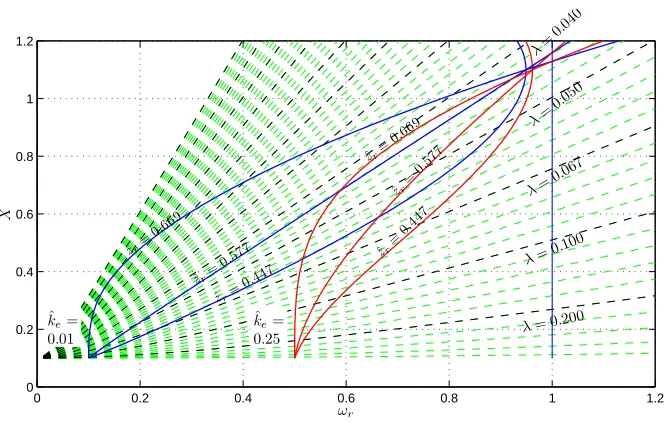
Figure 7: Limit (dashed) and backbone (solid) curves for resonant absolute displacement
response to harmonic base excitation. ˆR= 0.1
the shape of the backbone curve become dramatic. If we consider the line ˆ
R/λ= 2.00, and equilibrium stiffness ˆke= 0.01, choosing ˆzr= 0.447 leads to a
far greater peak amplitude and frequency than ˆzr = 0.577 or ˆzr= 0.669. This
pattern is repeated for ˆke= 0.25, albeit less dramatically.
We note that in several places, the backbone curves run almost parallel to
adjacent limit curves. For example when ˆke = 0.01, the ˆzr = 0.447 backbone
curve is almost parallel to the limit curve for ˆR/λ= 2.00 and other adjacent limit
curves for 0.3 <ωrˆ <0.8. This implies that systems in this region are highly
sensitive to changes in parameters, because a small increase in excitation (or
reduction in damping) will lead to a large increase in frequency and amplitude
before the backbone and limit curves intersect. Indeed, we have already seen
how the ˆkr = 0.447 back bone curve has a far greater peak amplitude and
frequency than the other choices of ˆzr when ˆke= 0.01.
We note from the values of the ratio ˆR/λ in Fig. (6) that ˆR must be of
of light damping. Therefore, in the cases shown here there is no possibility of
secondary resonances occurring, as these require hard excitation [19].
Fig. (6) also suggests the possibility of unbounded response; the backbone
curve for ˆke= 0.25 and ˆzr= 0.669 never intersects the limit curve for ˆR/λ= 2.5.
This situation is clearly undesirable for an isolator, as there is no isolation
region. This response is similar to the analytical prediction of unbounded motion
transmissibility for a Duffing oscillator made by Carrella in [11]
We note that all curves intersect the limit line ˆZ/λ = 2.00, hence for this
level of excitation or less there is no risk of unbounded response, and peak
frequency and amplitude will both be reduced by the HSLDS mount relative to
the equivalent linear system in all cases shown.
For absolute response, we recall that at resonance phase φ = π/2, hence
Eq. (28) becomes:
ˆ
X=
q
ˆ
U2+ ˆR2 (31)
We use this result to transform Fig. (6) for any given value of ˆR; this has been
done in Fig. (7) for ˆR = 0.1. We note that absolute displacement response
cannot be less than ˆR at resonance, but as the relative response increases due
to decreasing damping ratio, ˆU becomes dominant over ˆR, and the upper half
of Fig. (7) is highly similar to Fig. (6). We see that the base motion amplitude
dominates when the damping is relatively high (λ >0.2), or for low frequencies
for backbone curves that have very low ˆke. The former case is unlikely to
be relevant, because as discussed previously we seek light damping to reduce
high frequency response. The latter case merely reflects that a mount with
very low ˆke reduces the resonant relative response so that it is much smaller
than the excitation amplitude. Note also that as the excitation amplitude gets
smaller, Fig. (7) becomes increasingly similar to Fig. (6) as the minimum ˆX
value reduces.
Finally, we emphasise the importance that the shape of the backbone curve
has on response; we have demonstrated significant differences in response for
5.2. Forcing Excitation
Fig. (8) shows that the forcing case will have a significantly different
char-acter to the base motion excitation case shown in Fig. (6), due to the different
shape of the limit curves. Firstly, we see that for any given forcing excitation
amplitude and damping, denoted by a single limit curve, a reduction in peak
frequency will always be accompanied by an increase in peak amplitude, causing
a trade off between frequency reduction and peak amplitude if the displacement
response is of concern. This effect is greater where the limit curves are steeper;
we see that further frequency reduction for the mount with ke = 0.01 would
lead to dramatic increases in peak amplitude. (Note that the increase in peak
displacement response does not necessarily imply increased peak force
transmis-sion to the base—Carrella has shown that an HSLDS mount can reduce both
peak frequency and amplitude for force transmissibility [2]).
We note from the values of the ratio ˆF/λ in Fig. (8) that ˆF must be of
a similar order of magnitude toλ, and therefore small due to our assumption
of light damping. Therefore, in the cases shown here there is no possibility of
secondary resonances occurring, as these require hard forcing [19].
We notice that there is no danger of a backbone curve running parallel to
a limit curve causing high parameter sensitivity, as seen for the base motion
excitation case in Section 5.1. In addition, there is no danger of unbounded
response.
6. Results and Comparison to Simulation
Sections 6.2 and 6.1 show the predicted and simulated frequency responses
of a range of 5th order polynomial systems subject to forcing and base motion
excitation respectively. Section 6.3 then presents a comparison of predicted and
simulated results for the non-polynomial response function described in Section
3.3.
Markers show the results of simulations of forced response and absolute
0 0.2 0.4 0.6 0.8 1 1.2 0 0.2 0.4 0.6 0.8 1 1.2 ˆ F /λ= 0.50
ˆ F /λ= 1.00
ˆ F /λ= 1
.50 ˆ F /λ= 2
.00 ˆ F /λ
= 2.50
ˆ ke=
0.01
ˆ ke=
0.25 ˆ
ke=
0.01
ˆ ke=
0.25 ˆ
ke=
0.01
ˆ ke=
0.25 ˆke= 1
(linear)
ˆ ωr
ˆU
ˆ
zr=
0.669
ˆ
zr=
0.577
ˆ
zr=
0.447
ˆ
zr=
0.669
ˆ zr=
0.57 7
ˆ zr=
[image:20.612.140.473.144.345.2]0.44 7
Figure 8: Limit (dashed) and backbone (solid) curves for resonant displacement response to
harmonic forcing excitation.
sampling frequency set to 100 times per forcing period. The scheme steps both
upwards (∗) and downwards (◦) through the frequency range to ensure each
side of the nonlinear peak is captured. 100 forcing cycles are completed at each
frequency, with the final cycle used for the calculation of Fourier series terms
for the calculation of fundamental and harmonic responses.
6.1. Base Motion Excitation Frequency Response Functions
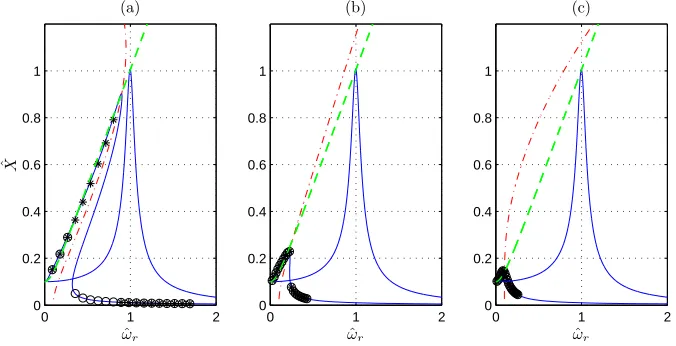
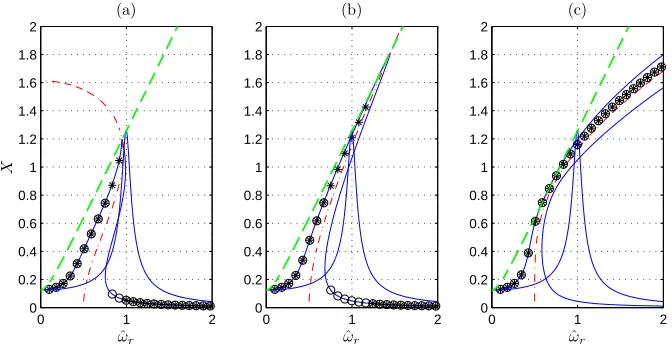
Fig. (9) to Fig. (11) show that the predictions of Sections 4.1 and 4.2 show
close agreement with simulation, with some differences becoming visible in
Fig. (11) as the response amplitude becomes large. The case of unbounded
response discussed in Section 4.2 is also clearly reproduced.
Fig. (9) and Fig. (10) show that increasing ˆzr reduces both the frequency
and amplitude of the peak response, and that the base motion case is highly
sensitive to this parameter. We also see that reducing ˆkegives significant benefit
ˆ
zr= 0.447, where both choices of ˆkegive an approximately similar peak response
that is close to that of the equivalent linear system.
In Fig. (11) we increase the base motion amplitude further, and see that
the lowest ˆzr has the lowest peak amplitude and frequency, ˆzr = 0.577 has a
peak response that exceeds the equivalent linear system in both frequency and
amplitude, and the highest ˆzrhas a peak response that is seemingly unbounded
in both frequency and amplitude.
We see from Fig. (12) and Fig. (13) that the magnitudes of harmonic
re-sponses are at least an order of magnitude below that of the fundamental in
the cases shown, suggesting that harmonics are unlikely to be limiting design
issues. Fig. (12) and Fig. (13) show that predictions are reasonable for the
third harmonic. Accuracy of the 5th harmonic magnitude is poor in both cases
when ˆzr= 0.447. This is because the Normal Form method effectively sums the
contributions of different polynomial terms, as if they were linear terms which
could be combined by superposition. The error that this introduces is clearly
significant in relation to the size of the 5th harmonic. Referring to Eq. (16) to
Eq. (18), we see that the case when ˆzr= 0.447 is the only case where both k3
andk5 are nonzero, hence this is the only case afflicted by this problem.
6.2. Forced Excitation Frequency Response Functions
In the case of forced excitation, we see similar agreement between Fig. (8)
and simulated results, confirming that peak frequency reduction is gained at the
expense of increased peak amplitude.
6.3. Approximation of non-polynomial HSLDS response
Finally, Fig. (14) (a) shows simulated results for the non-polynomial HSLDS
system shown in Fig. (5), superimposed on a Normal Form prediction for the 5th
order polynomial approximation that matches ˆkeand ˆzras described in Section
3.2. We see generally good agreement between the Normal Form prediction
for the 5th order polynomial and the non-polynomial simulation. Fig. (14)
0 1 2 0 0.2 0.4 0.6 0.8 1 ˆX ˆ ωr (a)
0 1 2
0 0.2 0.4 0.6 0.8 1 ˆ ωr (b)
0 1 2
[image:22.612.136.471.133.309.2]0 0.2 0.4 0.6 0.8 1 ˆ ωr (c)
Figure 9: Predicted displacement FRF at forcing frequency for base motion excitation (solid)
(a) ˆzr = 0.447 (b) ˆzr = 0.577 (c) ˆzr= 0.669. Right hand peak shows response of equivalent linear system for comparison. Markers show simulation results; (∗) denotes upwards frequency
stepping, (◦) denotes downwards frequency stepping. Dashed line shows limit curve,
dot-dashed line shows backbone curve. ˆke= 0.25,λ= 0.05, ˆR= 0.1
0 1 2
0 0.2 0.4 0.6 0.8 1 ˆX ˆ ωr (a)
0 1 2
0 0.2 0.4 0.6 0.8 1 ˆ ωr (b)
0 1 2
0 0.2 0.4 0.6 0.8 1 ˆ ωr (c)
Figure 10: Predicted displacement FRF at forcing frequency for base motion excitation (solid)
(a) ˆzr = 0.447 (b) ˆzr = 0.577 (c) ˆzr= 0.669. Right hand peak shows response of equivalent linear system for comparison. Markers show simulation results; (∗) denotes upwards frequency
stepping, (◦) denotes downwards frequency stepping. Dashed line shows limit curve,
[image:22.612.135.473.414.587.2]0 1 2 0
0.2 0.4 0.6 0.8 1 1.2 1.4 1.6 1.8 2
ˆX
ˆ ωr (a)
0 1 2
0 0.2 0.4 0.6 0.8 1 1.2 1.4 1.6 1.8 2
ˆ ωr (b)
0 1 2
0 0.2 0.4 0.6 0.8 1 1.2 1.4 1.6 1.8 2
[image:23.612.137.473.129.303.2]ˆ ωr (c)
Figure 11: Predicted displacement FRF at forcing frequency for base motion excitation (solid)
(a) ˆzr = 0.447 (b) ˆzr = 0.577 (c) ˆzr= 0.669. Right hand peak shows response of equivalent linear system for comparison. Markers show simulation results; (∗) denotes upwards frequency
stepping, (◦) denotes downwards frequency stepping. ˆke= 0.25,λ= 0.05, ˆR= 0.125
mount properties; the backbone curve for the 5th order approximation is shown,
alongside curves that modify its properties. We see that reducing ˆkeby 20% has
some benefit at low amplitude forcing, with significant peak frequency reduction
and slight peak amplitude reduction. However as excitation amplitude increases
such that 1.2 >R >ˆ 2.40λ, we see that increasing ˆzr by 20% has a far more
beneficial effect, in terms of both peak amplitude and peak frequency. We aso
see that as nondimensional fundamental response amplitude exceeds 1.0, the
systems begin to converge, although in all cases the peak frequency reduction
is mostly lost, and amplitude is approaching levels such that our polynomial
fit may now becoming invalid and assumptions of small harmonics may also be
becoming invalid. So the best strategy to optimise the system will depend on
the anticipated excitation levels, and if ˆR/λcannot be restricted sufficiently, a
10−1 100 10−5
100
(a)
10−1 100
10−5 100
(b)
Ab
sol
u
te
re
sp
on
se
am
p
li
tu
d
e
10−1 100
10−5 100
(c)
ˆ
[image:24.612.138.478.201.502.2]ωr
Figure 12: Predicted displacement amplitude FRF including harmonics for base motion
ex-citation (a) ˆzr = 0.447 (b) ˆzr = 0.577 (c) ˆzr = 0.669. Solid line shows fundamental, right hand peak shows response of equivalent linear system for comparison. Dashed line shows
3rd harmonic, dotted line shows 5th harmonic. Markers show simulation results; (∗) denotes
upwards frequency stepping, (◦) denotes downwards frequency stepping. ke= 0.25,λ= 0.05, ˆ
10−1 100 10−5
100
(a)
10−1 100
10−5 100
(b)
Ab
sol
u
te
re
sp
on
se
am
p
li
tu
d
e
10−1 100
10−5 100
(c)
ˆ
[image:25.612.137.479.200.502.2]ωr
Figure 13: Predicted displacement amplitude FRF including harmonics for base motion
ex-citation (a) ˆzr = 0.447 (b) ˆzr = 0.577 (c) ˆzr = 0.669. Solid line shows fundamental, right hand peak shows response of equivalent linear system for comparison. Dashed line shows
3rd harmonic, dotted line shows 5th harmonic. Markers show simulation results; (∗) denotes
upwards frequency stepping, (◦) denotes downwards frequency stepping. ke= 0.01,λ= 0.05, ˆ
10−1 100 10−6
10−4 10−2 100
Ab
sol
u
te
d
is
p
lac
em
en
t
re
sp
on
se
am
p
li
tu
d
e
ˆ
ωr
(a)
0 0.2 0.4 0.6 0.8 1 1.2
0 0.2 0.4 0.6 0.8 1 1.2
ˆ
R/λ= 0.50
ˆ
R/λ= 1
.00 ˆ
R/λ= 1
.50
ˆ R/λ
=2.00
ˆ R/λ
=2. 50
ˆ
ωr ˆU
(b)
Figure 14: (a) Comparison of simulated response of nondimensional function in Fig. (5) based
on Eq. (19) with Normal Form prediction based on 5th order polynomial approximation.
Markers show simulation results; (∗) denotes upwards frequency stepping, (◦) denotes
down-wards frequency stepping. Rˆ = 0.1,λ = 0.05, ˆke = 0.1005, ˆzr = 0.4618 (b) Example of how a limit curve map could be used to consider design changes to a given mount; Solid
line shows backbone curve for above system, alongside curves for ˆzr+20% (dot-dashed) and ˆ
[image:26.612.145.472.170.518.2]7. Conclusions
In this paper, we have provided a nondimensional analysis that shows the
response of HSLDS mounts subject to harmonic excitation, relative to an
equiv-alent linear system to demonstrate the effects of nonlinearity.
We have introduced two parameters, equilibrium stiffness and reduced
stiff-ness range that give an accurate characterisation of HSLDS mounts’ static force
displacement curves, and shown that they have important effects on response.
Using these parameters we have shown that a 5th order polynomial response
can accurately represent much of the design space for mounts that have
non-polynomial responses, and that this can give much greater realism at higher
amplitudes than a Duffing response.
We have seen that at small response amplitudes the equilibrium stiffness
dominates the peak response frequency of the mount, whilst at higher
ampli-tudes the reduced stiffness range becomes important. We have shown how
plotting a backbone curve on a limit curve map is a simple graphical means of
understanding these effects.
We have shown that in the case of displacement response to harmonic base
excitation, the HSDLS mount will always reduce both peak amplitude and peak
frequency within limits of excitation amplitude. However, the base excitation
case can experience sudden increases in peak response amplitude and frequency
in response to small changes in system parameters, or even lead to unbounded
response. The shape of the force displacement curve, as characterised by
equilib-rium stiffness and reduced stiffness range, is critical in predicting these effects.
We provide a limiting ratio of excitation to damping below which the unbounded
response cannot occur.
In the case where the mount is excited by a harmonic force signal acting
upon the mass, we show that reducing the peak frequency will always lead
to an increase in peak displacement response amplitude for any forcing level,
meaning that there is less advantage to using the HSLDS when the amplitude
not suffer from the same high parameter sensitivity and possible unbounded
response that can affect the base motion case.
The analysis also provides estimates of harmonic responses of the HSLDS
mount. Harmonics are small in the cases studied, suggesting that harmonics
are seldom the limiting design factor for an HSLDS mount. We have shown
with numerical simulation that the analysis is accurate at the fundamental
fre-quency and third harmonics (providing assumptions are adhered to), although
5th harmonic predictions often have poor accuracy.
Overall the work provides useful insight into the design of HSLDS mounts,
and demonstrates the effectiveness of the HSLDS strategy for vibration isolation.
Acknowledgements
The authors would like to thank Dr Alessandro Carrella for his ongoing
contribution to this project. This work is funded by the EPSRC.
Appendix A. Normal Forms Solutions
A Normal Form analysis is used, based on the technique desribed by Neild
and Wagg [16], which provides results in terms of a transformed variable ˆu
representing the response at forcing frequency, and a transformation function
h(ˆu) which contain information on harmonic responses. This method is modified
for this purpose to allow the damping to be applied to harmonics as described
later, which improves accuracy at certain frequencies.
Appendix A.1. Normal forms transformation
We assume either a harmonic base motion or harmonic forcing excitation,
and rearrange the equation of motion Eq. (6) to:
ˆ
z′′+ 2λzˆ′+ ˆωn2zˆ+ ˆNz(ˆz) =Prr (A.1)
where linearised natural frequency ˆω2n= ˆke (due to the fact that mass is unity
hence using 5th order polynomial functions will be given by:
ˆ
Nz(ˆz) = ˆP(ˆz)−keˆ zˆ=k3zˆ3+k5ˆz5 (A.2)
Note that the damping term does not include ˆωn on account of our slightly
un-usual nondimensionalisation. In the right hand side of Eq. (A.1),r={rp, rm}T = n
ei( ˆΩτ+φ),e−i( ˆΩτ+φ)oT, hence defining a cosine forcing signal with forcing
fre-quency ˆΩ where the time-shiftφhas been applied so that phase does not appear
in trial solutions, simplifying computations. The remaining term is the
excita-tion vectorPr=
Pr
2 ,
Pr
2
, wherePrgives the amplitude and is given by:
Pr= ˆΩ2Rˆ (A.3)
in the case of base excitation with nondimensional amplitude ˆRand
Pr= ˆF (A.4)
in the case of forcing excitation with nondimensional amplitude ˆF.
The normal forms method seeks to find a near-identity transformation of ˆz
such that it is possible to exactly solve the transformed equation of motion:
ˆ
u′′+ 2λuˆ′+ ˆω2nuˆ+ ˆNu(ˆu) =Pur (A.5)
where
ˆ
u=z−h(ˆu) (A.6)
We therefore seek to chooseh(ˆu) and ˆNu(ˆu) to eliminate nonlinear terms, ideally
so ˆNu(ˆu) = 0 so that equation Eq. (A.5) is linear, although this is not usually
possible. However it is generally possible to create a situation where Eq. (A.5)
can be solved exactly with with a single frequency response. To assist the
anal-ysis we introduce a ‘book keeping’ termǫto indicate small terms, remembering
that our assumptions of weak nonlinearity and near-identity transformation
mean that:
h(ˆu) =ǫh(ˆu) (A.7)
ˆ
Nu(ˆu) =ǫNˆu(ˆu) (A.8)
ˆ
Note that many treatments of this method apply ǫ to the damping term as
well— this is not done here which leads to improved estimation of harmonics
when forcing is below resonance and forcing is light enough to ensure
harmon-ics remain small in comparison to fundamental response even when resonant.
Combining Eq. (A.1) and Eq. (A.5) to Eq. (A.9) we can obtain:
Pur−Prr=ǫNuˆ (ˆu)−ǫh(ˆu)′′−2ǫλh(ˆu)′−ωˆ2nǫh(ˆu)−ǫNzˆ (ˆu+ǫh(ˆu)) (A.10)
The final term of this may be approximated via Taylor series expansion:
ǫNzˆ (ˆu+ǫh(ˆu)) =ǫNzˆ (ˆu) +ǫ
2h(ˆu)
2
dNzˆ
dˆz +ǫ
3h(ˆu)2d2Nzˆ
dzˆ2 . . .
=ǫNzˆ (ˆu) +O(ǫ2) (A.11)
So making this approximation we get:
Pur−Prr=ǫNuˆ (ˆu)−ǫh(ˆu)′′−2ǫλh(ˆu)′−ǫωˆ2nh(ˆu)−ǫNzˆ (ˆu) (A.12)
to order ǫ2. A natural way to achieve this is to balance the large terms and
small terms of the above equation separately giving:
Pu=Pz (A.13)
and
ˆ
Nu(ˆu) =h(ˆu)′′+ 2λh(ˆu)′+ ˆωn2h(ˆu) + ˆNz(ˆu) (A.14)
We now propose a propose a trial solution:
ˆ
u= ˆup+ ˆum (A.15)
where ˆup= Uˆ
2e
iωˆrτ and ˆum=Uˆ
2e−
iωˆrτ, in effect a fundamental response that is
a cosine function (recall phase shift has been applied to the forcing function).
Firstly we substitute this solution into ˆNz(ˆu) to see what terms are generated.
For illustration, let us suppose that ˆNzis just a Duffing/cubic type nonlinearity:
ˆ
which may be written:
ˆ
Nz(ˆu) =h k3 k3 3k3 3k3
i ˆ u3
puˆ0m
ˆ
u0
puˆ3m
ˆ
u2
puˆ1m
ˆ
u1
puˆ2m (A.17)
It can be seen that this can be generalised for any polynomial nonlinearities to
the form:
ˆ
Nz(ˆu) =Nˆzˆu∗ (A.18)
where Nˆz is a row vector of coefficients anduˆ∗ is a column vector where the elements all have the form:
ˆ
u∗
i,j= ˆuipuˆjm (A.19)
We specify thath(ˆu) and ˆNu(ˆu) have a similar form:
ˆ
Nu(ˆu) =Nˆuuˆ∗ (A.20)
h(ˆu) =hˆu∗ (A.21)
For Eq. (A.14) we requireh(ˆu)′ andh(ˆu)′′, so we note that for any element ˆu∗i,j
ofˆu∗ :
ˆ
u∗′i,j=i(i−j) ˆωruˆ∗i,j=iωi,jˆ uˆ∗i,j (A.22)
ˆ
u∗′′
i,j=−(i−j)
2
ˆ
ω2
ruˆ∗i,j=−ωˆi,j2 uˆ∗i,j (A.23)
such that
h(ˆu)′=ih ˆωuˆ∗ (A.24)
h(ˆu)′′=−h ˆω2uˆ∗ (A.25)
where ωˆ is a diagonal matrix of ˆωi,j terms and ωˆ2 is similar with ˆω2
i,j terms.
Putting all of this into Eq. (A.14) gives:
−h ˆω2+ 2λih ˆω+ ˆω2
nh−Nˆu+Nˆz
ˆ
u∗= 0 (A.26)
which for solutions requires that:
h ˆω2−ωˆ2
because each term in ˆu∗ has a unique i and j representing a different time varying function so cannot be set to zero (unless ˆU = 0, which is trivial). We
solve this by solving each term individually:
(i−j)2ωˆr2−ωˆn2−2λi(i−j) ˆωr
hi,j= ˆNzi,j−Nuˆ i,j (A.28)
By default, we seek to eliminate nonlinear terms from Eq. (A.5), so we set ˆNui,j
to zero and write:
hi,j= Nzˆ i,j
(i−j)2ωˆ2
r−ωˆn2−2λi(i−j) ˆωr
(A.29)
However, if the denominator in this equation is small,hi,j would become large
and violate our assumption of near-identity transformation. In these cases we
must sethi,j to zero and let ˆ
Nzi,j = ˆNui,j (A.30)
This is known as a resonant term. If we assume response frequency is similar to
forcing frequency and that the forcing frequency is near resonance, it is evident
from Eq. (A.29) that a resonant term will occur whenever|i−j|= 1, because
this will cancel all terms except the damping term, which is assumed to be light.
Note that at different response frequencies, different terms become resonant.
For example, if response frequency is at 1/3 of the natural frequency, terms
will become resonant when |i−j| = 3 (i.e. the third harmonic is resonant).
However, we find that even when resonant, harmonic terms seldom become
sufficiently large to be treated as the primary response in the light excitation
cases considered.
Appendix A.2. Solving resonant dynamics equation to obtainUˆ
To show how Normal forms can now be used to solve the transformed
equa-tion of moequa-tion Eq. (A.5), refer to the example of a cubic power term, with
resonant in this case, so ˆNubecomes:
ˆ
Nu(ˆu) =h 0 0 3k3 3k3
i ˆ u3
puˆ0m
ˆ
u0
puˆ3m
ˆ
u2
puˆ1m
ˆ
u1
puˆ2m
= 3k3Uˆ
3
4 cos(ˆωrτ) (A.31) where the cosine term has been derived using De Moivre’s theorem. It can be
seen that each powernterm will contribute in a similar manner. We can sum all
these contributions along with the linearised stiffness ˆω2
n= ˆke in an amplitude
dependant stiffness functionK( ˆU), which can be written:
K( ˆU) = ˆke+X
n kn p n ˆ
Un−1
2n−1 (A.32)
wherep=n/2 for evenn, p= (n−1)/2 for odd n. For a 5th order system we
obtain:
K( ˆU) = ˆke+3k3Uˆ
2
4 +
10k5Uˆ4
16 (A.33)
Substituting this and the assumed solution into the transformed equation of
motion Eq. (A.5), and changing the complex notation to trigonometric terms
gives:
−ωˆr2Uˆcos(ˆωrτ)−2 ˆUωrλˆ sin(ˆωrτ) +K( ˆU) ˆUcos(ˆωrτ)
= ˆPucos( ˆΩτ+φ) (A.34)
We substitute our assumption that ˆωr= ˆΩ and use a trigonometric identity to
expand the right hand term to get:
−ωˆr2Uˆcos(ˆωrτ)−2 ˆUωrλˆ sin(ˆωrτ) +K( ˆU) ˆUcos(ˆωrτ)
= ˆPu[cos(ˆωrτ) cos(φ) + sin(ˆωrτ) sin(φ)] (A.35)
Matching the cos(ˆωr) and sin(ˆωr) terms gives the following two equations:
−ωˆ2
We square and add equations Eq. (A.36) and Eq. (A.37) to eliminateφ:
ˆ
ω4rUˆ2+ 2ˆω2rUˆ2
h
2λ2−K( ˆU)i+K( ˆU)2Uˆ2−Pˆu2= 0 (A.38)
We substitute Eq. (A.3) to get the response equation for base excitation:
ˆ
ω4
r( ˆU2−Rˆ2) + 2ˆωr2Uˆ2 h
2λ2−K( ˆU)i+K( ˆU)2Uˆ2= 0 (A.39)
and similarly we substitute Eq. (A.4) to get the response equation for forced
excitation:
ˆ
ω4rUˆ2+ 2ˆω2rUˆ2
h
2λ2−K( ˆU)i+K( ˆU)2Uˆ2−Fˆ2= 0 (A.40)
These equations are quadratic in ˆω2
rso may be solved for ˆωr2with any trial value
of ˆU, obtaing up to 2 real solutions. Phase may then be determined by using
either Eq. (A.36) or Eq. (A.37).
Appendix A.3. Estimation of Harmonics
We now consider non-resonant terms, which become part of the
transforma-tion h(ˆu) and dictate the harmonic responses of the system. We notice from
the expansion of the Duffing term Eq. (A.17) that there are two non-resonant
termsk3uˆ30 andk3uˆ03, where the indices i and j are swapped. For illustration
consider the combined contribution of the non-resonant terms from the Duffing
equation, calculated using equation Eq. (A.29):
h3,0+h0,3=
k3(ˆu3puˆ0m)
(3−0)2ωˆ2
r−ωˆ2n−i(3−0)ˆωr(2λ)
+ k3(ˆu
0
puˆ3m)
(0−3)2ωˆ2
r−ωˆn2−i(0−3)ˆωr(2λ)
= 3k3( ˆU
3/4)
(9ˆω2
r−ωˆn2)2+ (6ˆωrλ)2
(9ˆωr2−ωˆn2) cos(3ˆωrτ) +i(6ˆωrλ) sin(3ˆωrτ)
(A.41)
which is a sinusoidal signal that can be resolved into a phase and magnitude.
The magnitude is:
h3=
k3( ˆU3/4)
p
(9ˆω2
r−ωˆ2n)2+ (6ˆωrλ)2
For a 5th order polynomial system, we apply a similar procedure to obtain
the following magnitudes of the 3rd and 5th harmonics:
h3(ˆu) =
k3Uˆ3
4 + 5k5Uˆ5
16
!
1
p
(9ˆω2
r−ωˆn2)2+ (6ˆωrλ)2
(A.43)
and
h5(ˆu) = k5
ˆ
U5
16
1
p
(25ˆω2
r−ωˆ2n)2+ (10ˆωrλ)2
(A.44)
Appendix A.4. Backbone and Limit Curves
If we consider an undamped and unexcited solution, Eq. (A.37) disappears,
and Eq. (A.36) alone defines solutions, becoming:
ˆ
ωr=
q
K( ˆU) (A.45)
Recalling that light damping has very little effect on response frequencies, we
see that all peak responses for lightly damped systems lie somewhere on the
line defined by this equation, which is known as the backbone curve and defines
the amplitude dependant natural frequency. (Note that an HSLDS mount is
in-tended to perform at frequencies above resonance, where response is dominated
by damping. Therefore a lightly damped mount is desirable.) We also note
that backbone curves are identical for both base motion and forced excitation.
Returning to an excited and damped system, we use the intuition that at a
natural frequencyφ= π2 and that the excitation is purely resisted by damping, Eq. (A.36) disappears and Eq. (A.37) defines peak response. Therefore:
2 ˆΩλUˆ =Pr⇒Uˆ = Pr
2λΩˆ (A.46)
This defines the limit curve for a given system. The point where a limit curve and
backbone curve intersect on a frequency/amplitude graph defines peak response
for the system concerned, for a given excitation level. Note that K( ˆU) does
not affect the limit curves, therefore limit curves are common to all systems
with equal damping and forcing, regardless of the stiffness nonlinearities that
ˆ
U
ˆ
R Xˆ
[image:36.612.221.389.128.222.2]φ
Figure A.15: Phase diagram providing geometrical basis of ˆXcalculation.
curve specifically for base excitation is:
ˆ
U =Ω ˆˆR
2λ (A.47)
however if we substitute Eq. (A.4) into Eq. (A.46) we find that the limit curve
for forced excitation is:
ˆ
U = Fˆ
2λΩˆ (A.48)
Therefore the two types of forcing have very different limit trends; base
excita-tion has a limit amplitude proporexcita-tional to peak excitaexcita-tion frequency, whereas
forced excitation has a limit amplitude that is inversely proportional to peak
excitation frequency.
Appendix A.5. Absolute response
For base excitation it is often necessary to know the absolute displacement
response in addition to the relative displacement response (the two responses
are identical for forced excitation). We calculate ˆX, the amplitude of absolute
response at the forcing frequency, using equation Eq. (1) and the phase diagram
in Fig. (A.15) to be:
ˆ
X =
q
( ˆU+ ˆRcos(φ))2+ ( ˆRsin(φ))2 (A.49)
References
[2] A. Carrella, Passive Vibration Isolators with
High-Static-Low-Dynamic-Stiffness, VDM Verlag Dr. Muller, 2010.
[3] R. A. Ibrahim, Recent advances in nonlinear passive vibration isolators,
Journal of Sound and Vibration 314 (3-5) (2008) 371 – 452.
[4] J. Winterflood, D. G. Blair, B. Slagmolen, High performance vibration
isolation using springs in euler column buckling mode, Physics Letters A
300 (2-3) (2002) 122–130.
[5] L. N. Virgin, R. B. Davis, Vibration isolation using buckled struts, Journal
of Sound and Vibration 260 (5) (2003) 965–973.
[6] R. H. Plaut, J. E. Sidbury, L. N. Virgin, Analysis of buckled and
pre-bent fixed-end columns used as vibration isolators, Journal of Sound and
Vibration 283 (3-5) (2005) 1216–1228.
[7] L. N. Virgin, S. T. Santillan, R. H. Plaut, Vibration isolation using extreme
geometric nonlinearity, Journal of Sound and Vibration 315 (3) (2008) 721–
731.
[8] S. T. Santillan, Analysis of the elastica with applications to vibration
iso-lation, Ph.D. thesis, Department of Mechanical Engineering and Materials
Science, Duke University (2007).
[9] R. DeSalvo, Passive, nonlinear, mechanical structures for seismic
atten-uation, Journal of Computational and Nonlinear Dynamics 2 (4) (2007)
290–298.
[10] A. Carrella, M. J. Brennan, T. P. Waters, Static analysis of a passive
vibration isolator with quasi-zero-stiffness characteristic, Journal of Sound
and Vibration 301 (301) (2007) 678 – 689.
[11] A. Carrella, M. J. Brennan, T. P. Waters, V. Lopes Jr., Force and
displace-ment transmissibility of a nonlinear isolator with
high-static-low-dynamic-stiffness, International Journal of Mechanical Sciences 55 (1) (2012) 22 –
[12] I. Kovacic, M. J. Brennan, T. P. Waters, A study of a nonlinear vibration
isolator with a quasi-zero stiffness characteristic, Journal of Sound and
Vibration 315 (3) (2008) 700 – 711.
[13] N. Zhou, K. Liu, A tunable high-static low-dynamic stiffness vibration
isolator, Journal of Sound and Vibration 329 (9) (2010) 1254 – 1273.
[14] W. S. Robertson, M. R. F. Kidner, B. S. Cazzolato, A. C. Zander,
The-oretical design parameters for a quasi-zero stiffness magnetic spring for
vibration isolation, Journal of Sound and Vibration 1-2 (2009) 88–103.
[15] T. D. Le, K. K. Ahn, A vibration isolation system in low frequency
exci-tation region using negative stiffness structure for vehicle seat, Journal of
Sound and Vibration 330 (26) (2011) 6311–6335.
[16] S. A. Neild, D. J. Wagg, Applying the method of normal forms to
second-order nonlinear vibration problems, Proc. R. Soc. A 467 (2128) (2010) 1141
– 1163.
[17] S. A. Neild, Approximate methods for analysing nonlinear structures, in:
L. N. Virgin, D. J. Wagg (Eds.), Exploiting Nonlinear Behaviour in
Struc-tural Dynamics, Springer, 2012, pp. 53 – 109.
[18] D. J. Wagg, S. A. Neild, Nonlinear Vibration with Control, Springer, 2009.
[19] A. H. Nayfeh, D. T. Mook, Nonlinear Oscillations, John Wiley and Sons,
1979.
List of Figures
1 Mass mwith static load Fs supported on movable base by
non-linear spring with non-linear damper with damping constant c. r(t)
denotes base motion, x(t) denotes displacement response of the
mass,z≡x−r denotes relative displacement response,f(t)
de-notes force excitation, nonlinear spring has force/displacement
2 Relationship between different force/displacement functions used
in analysis. . . 6
3 Illustration of properties ˆzr and ˆke. (a) Nondimensional force
displacement function ˆP(ˆz) (solid) showing equilibrium stiffness ˆ
ke(fine dash) and nondimensional equivalent linear system (large
dash) (b) Nondimensional distortions from equivalent linear
re-sponse ˆp(ˆz) (solid) with zero gradient (dashed) . . . 8
4 Effect of ˆzr on 5th order polynomial response profile. (a) ˆzr =
p
1/5 (b) ˆzr=p
1/3 (Duffing response) (c) ˆzr=p4
1/5 (d) Effect
of ˆzr<p
1/5, which gives positive regions of ˆp(ˆz) between zero
and one (e) Effect of ˆzr>p4
1/5 which fails to meet Eq. (11) and
can show regions of negative stiffness. Dashed line: ˆke = 0.01
Dot-dashed line: ˆke = 0.25. Dotted line: ˆke = 1 (Equivalent
linear system). . . 10
5 (a) Solid line shows response of oblique spring HSLDS mount
with kv = kh = 10 N mm−1, ℓ
0 = 10 mm, ℓ = 7 mm. Red
dots show linear mount implied by chosen static load Fs = 150
N, giving static displacement xs = 10.6 mm. (b) Consequent
nondimensionalisation to ˆP(ˆz) (solid) with Duffing (dot-dashed)
and 5th order (dashed) models fitted, ˆke= 0.101, ˆzr= 0.462. . . 12
6 Limit (dashed) and backbone (solid) curves for resonant relative
displacement response to harmonic base excitation. . . 15
7 Limit (dashed) and backbone (solid) curves for resonant absolute
displacement response to harmonic base excitation. ˆR= 0.1 . . 16
8 Limit (dashed) and backbone (solid) curves for resonant
9 Predicted displacement FRF at forcing frequency for base motion
excitation (solid) (a) ˆzr = 0.447 (b) ˆzr = 0.577 (c) ˆzr = 0.669.
Right hand peak shows response of equivalent linear system for
comparison. Markers show simulation results; (∗) denotes
up-wards frequency stepping, (◦) denotes downwards frequency
step-ping. Dashed line shows limit curve, dot-dashed line shows
back-bone curve. ˆke= 0.25,λ= 0.05, ˆR= 0.1 . . . 21
10 Predicted displacement FRF at forcing frequency for base motion
excitation (solid) (a) ˆzr = 0.447 (b) ˆzr = 0.577 (c) ˆzr = 0.669.
Right hand peak shows response of equivalent linear system for
comparison. Markers show simulation results; (∗) denotes
up-wards frequency stepping, (◦) denotes downwards frequency
step-ping. Dashed line shows limit curve, dot-dashed line shows
back-bone curve. ˆke= 0.01,λ= 0.05, ˆR= 0.1 . . . 21
11 Predicted displacement FRF at forcing frequency for base motion
excitation (solid) (a) ˆzr = 0.447 (b) ˆzr = 0.577 (c) ˆzr = 0.669.
Right hand peak shows response of equivalent linear system for
comparison. Markers show simulation results; (∗) denotes
up-wards frequency stepping, (◦) denotes downwards frequency
step-ping. ˆke= 0.25,λ= 0.05, ˆR= 0.125 . . . 22
12 Predicted displacement amplitude FRF including harmonics for
base motion excitation (a) ˆzr = 0.447 (b) ˆzr = 0.577 (c) ˆzr =
0.669. Solid line shows fundamental, right hand peak shows
re-sponse of equivalent linear system for comparison. Dashed line
shows 3rd harmonic, dotted line shows 5th harmonic. Markers
show simulation results; (∗) denotes upwards frequency stepping,
(◦) denotes downwards frequency stepping. ke= 0.25,λ= 0.05, ˆ
13 Predicted displacement amplitude FRF including harmonics for
base motion excitation (a) ˆzr = 0.447 (b) ˆzr = 0.577 (c) ˆzr =
0.669. Solid line shows fundamental, right hand peak shows
re-sponse of equivalent linear system for comparison. Dashed line
shows 3rd harmonic, dotted line shows 5th harmonic. Markers
show simulation results; (∗) denotes upwards frequency stepping,
(◦) denotes downwards frequency stepping. ke= 0.01,λ= 0.05, ˆ
R= 0.1 . . . 24
14 (a) Comparison of simulated response of nondimensional
func-tion in Fig. (5) based on Eq. (19) with Normal Form predicfunc-tion
based on 5th order polynomial approximation. Markers show
simulation results; (∗) denotes upwards frequency stepping, (◦)
denotes downwards frequency stepping. Rˆ = 0.1, λ = 0.05, ˆ
ke= 0.1005, ˆzr = 0.4618 (b) Example of how a limit curve map
could be used to consider design changes to a given mount; Solid
line shows backbone curve for above system, alongside curves for
ˆ
zr+20% (dot-dashed) and ˆke-20% (dashed). Dotted lines show
limit curves. . . 25