This is a repository copy of
From first words to segments : A case study in phonological
development
.
White Rose Research Online URL for this paper:
http://eprints.whiterose.ac.uk/69673/
Version: Published Version
Book Section:
Vihman, Marilyn orcid.org/0000-0001-8912-4840 and Vihman, Virve-Anneli (2011) From
first words to segments : A case study in phonological development. In: Clark, E. V. and
Arnon, I., (eds.) Experience, Variation, and Generalization. Trends in Language Acquisition
Research . John Benjamins , Amsterdam .
[email protected] https://eprints.whiterose.ac.uk/ Reuse
Items deposited in White Rose Research Online are protected by copyright, with all rights reserved unless indicated otherwise. They may be downloaded and/or printed for private study, or other acts as permitted by national copyright laws. The publisher or other rights holders may allow further reproduction and re-use of the full text version. This is indicated by the licence information on the White Rose Research Online record for the item.
Takedown
If you consider content in White Rose Research Online to be in breach of UK law, please notify us by
his is a contribution from Experience, Variation and Generalization. Learning a irst language.
Edited by Inbal Arnon and Eve V. Clark. © 2011. John Benjamins Publishing Company
his electronic ile may not be altered in any way.
he author(s) of this article is/are permitted to use this PDF ile to generate printed copies to be used by way of ofprints, for their personal use only.
Permission is granted by the publishers to post this ile on a closed server which is accessible to members (students and staf) only of the author’s/s’ institute, it is not permitted to post this PDF on the open internet.
For any other use of this material prior written permission should be obtained from the publishers or through the Copyright Clearance Center (for USA: www.copyright.com). Please contact [email protected] or consult our website: www.benjamins.com
part iii
From irst words to segments
A case study in phonological development*
Marilyn Vihman & Virve-Anneli Vihman
University of York/University of Tartu
he emergence and later fading of two phonological templates – a ‘palatal’ template and consonant harmony – are investigated in the irst 500 words produced by a child acquiring Estonian and English. hroughout the period the child’s use of palatal forms, in particular, considerably exceeds their frequency in Estonian, the child’s dominant language. Regression in accuracy is also traced, both overall and in individual word forms. Changes in frequency of use of the template patterns are related to growth in the size of the lexicon, the consonant inventory, and the length in syllables of words attempted. Articulatory diiculty is found to play at best a minor role in motivating pattern use, which is ascribed instead to the challenges of planning and recall.
Keywords: Phonological development; Estonian; template
. Introduction
Children’s very irst words typically target adult words of simple prosodic structure and segmental make-up – that is, one- or two-syllable word forms with open syl-lables, no clusters, core consonants (stops, nasals, glottals and glides) and little (if any) consonant or vowel variegation across the word. Accordingly, the irst words tend to be ‘surprisingly accurate’ (Ferguson & Farwell 1975), with some errors of omission but rarely substitutions and still less oten (if ever) reordering of sequences. Furthermore, contrary to the formulation of Jakobson (1941/68), these early word forms are largely based on what has already become familiar through babbling practice (Vihman et al. 1985). his can be accounted for by assuming that infants respond with heightened attention to adult words that provide an approxi-mate match to their own vocal forms (Vihman 1991, 1993, 1996; for experimental
Marilyn Vihman & Virve-Anneli Vihman
evidence of such ‘iltering’ of the adult input through the child’s own production patterns, see DePaolis, Vihman & Keren-Portnoy in press). his model goes some way toward explaining the further surprising fact that the forms of the irst words difer considerably across individual children even within a single language group, despite the fact that adult input samples show remarkably uniformity (see Vihman et al. 1994, for an analysis of the input to one-year-olds of ive mothers in each of three language groups, English, French and Swedish).
Once identiiable irst words have begun to be produced, it has been docu-mented in both diary studies and observational studies based on home recordings that most (if not all) children pass through a period of regression in accuracy, in which the child’s words are more readily analyzed as matching adult word targets as a whole than in terms of a segment-by-segment match (see especially Menn 1971; Waterson 1971; Ferguson & Farwell 1975; Macken 1979; Menn 1983; more recent studies that support the idea of early words being rooted in holistic rep-resentations include Vihman & Crot 2007 and Fikkert & Levelt 2008). Accord-ing to this model, which has been termed ‘whole-word phonology’, the period of ‘accurate’ item learning is followed by an extension of these well-practiced early word forms to targets that are less similar to the pattern, allowing for an advance in word learning even while production constraints – on word length in syllables, changes in consonants across the form, etc. – remain unchanged. For example, at 10 months the French child Laurent produced the relatively accurate forms [hailo], [ailo] for allo ‘hello’, [d6], [dl6]for donne-le ‘give it’ and [ljoljo] for lolo ‘bottle’ (baby-talk [BT] form) (Vihman 1993; Vihman & Kunnari 2006). Five months later his word forms tended to it an l-medial template, as can be clearly seen in such forms as [k c la] for canard ‘duck’, [b c lo] for chapeau ‘hat’, [b6la] for la brosse ‘the brush’ and [kola] for la cuillère ‘the spoon’, none of which has a medial /l/ in the target. At the same time Laurent produced more accurate forms for target words that conformed to his preferred pattern: [alo] for allo ‘hello’, [d6lo] for dans l’eau, de l’eau ‘in/some water’, [pal c ] for ballon ‘big ball’ and [pala] for pas là ‘not there, all gone’.
First words to segments
a serious challenge to memory as well as to planning and articulation – alongside their more detailed and variable (exemplar-based) memory of speciic tokens, as heard in both the input and the child’s own output.
Despite the long-standing evidence of templates based on production studies, however, only two studies to date have tracked a child’s progress from the use of templates to a more segmentally oriented phonology: Macken’s (1979) case study of a child acquiring Spanish, and Oliveira Guimarães (2008), which follows four children acquiring Brazilian Portuguese.1 Here we describe the use of templates
by one child, Maarja, (a pseudonym) in the simultaneous acquisition of Estonian and English. he goals here are, irst, to sketch changes in the use of two phono-logical templates from the irst ity words (age 12–16 months) to a production vocabulary, across the two languages, of 500 words (by 22 months), well beyond the single-word period. Second, we attempt to relate those changes to changes in the size of the representational units that underlie the child’s productions – whole word forms, initially, but something more like adult sequences of segments by the end of the period in question.
. Methods
Participant. Maarja is being raised bilingually with Estonian and American English as home languages. Estonian is spoken by her father and the community as well as being the primary language spoken between the two parents; English is spoken by Maarja’s mother, with additional input from occasional visits to English-language communities and visits from friends of the family. Estonian rapidly became the dominant language ater Maarja began attending full-time daycare from the age of 17 months, although she continued to produce new English words and to show good comprehension of English.2 he data reported
on here come from diary records kept by the child’s mother, a trained linguist, who was the primary caregiver until Maarja was 17 months old. Each new form
. See also Priestly (1977) for a fully documented case study of the evolution of a child’s CVjVC template, from irst uses at 22 months (e.g. berries [bajas], chocolate [kajak], flannel
[fajan], tiger [tajak]) to segmentally faithful ‘ordinary replacement forms’ at 26 months.
Marilyn Vihman & Virve-Anneli Vihman
was noted as it was heard and later collated into a list of new word forms and combinations.
Analysis. What are Maarja’s templates and how might they have contributed to her word learning? To address these questions we irst identify and trace the rise and fall of template use and then weigh the relative importance of other factors that might have inluenced the nature and rate of vocabulary growth and the accuracy of word production. hese include changes in both (i) the length in syllables of words attempted and produced and (ii) the child’s conso-nant inventory.
In order to carry out these analyses we consider separately 50-word additions to the set of new word types produced (referred to as ‘samples’), until the point when 500 diferent words have been recorded; the set of words considered in each sample includes (unnumbered) new variants of old words added in as they were recorded, for a total word list of 564 words. hese 50-word samples are not ‘stages’ in any sense but are merely an analytic convenience, to allow comparison over time and to map the sources of change against lexical growth. We take as our start-ing point the period in which the irst ity diferent word types were attempted in some recognizable way (Sample I: age 12–16 months). For our initial purpose of observing lexical growth in relation to template use, however, we divide the period of the study into eight one-month periods (combining the words produced at 12, 13 and 14 months as the irst age-point).
We note, inally, that words that irst occurred in combinations are also included in the new-word-forms count; combinations began at 15 months but reached a total of over ive recorded new types per month only at 18 months (20 combinations). We give no separate attention to words used in combinations here, however.
. Results
Figure 1 shows the child’s cumulative vocabulary growth over the period of the study. We note that ater the initial slow start – one word at 12, three more at 13 months – an early ‘lexical spurt’ resulted in 18 new word forms attempted at 14 months (for a total of 22 word forms recorded) and a further 33 at 15 months (for a total of 55 word forms).
. he palatal template
First words to segments
pattern broadly, to include all words in which at least one syllable has as its nucleus a front-rising diphthong <Vi> or the tense vowel [i]; a few of the later child forms take the expanded palatal shape CoVi/jV,3 where intervocalic [i] represents a long
[image:9.454.100.356.174.402.2]palatal glide. Disregarding the question of idelity to the target form, we include in Figure 1 all child forms that match any of those criteria in tracing use of the palatal template over the entire period of the study.
0 40 20 60 80 100 120 140 160
Age in months
12–14 15 16 17 18 19 20 21
% Harmony template N new word forms
% Accurate % Palatal template
Figure 1. Lexical growth and template use.Number of new word forms recorded per month, ages 12–14 through 21 months (collapsing 12–14 months for irst point); proportion of template patterns and accurate word shapes produced
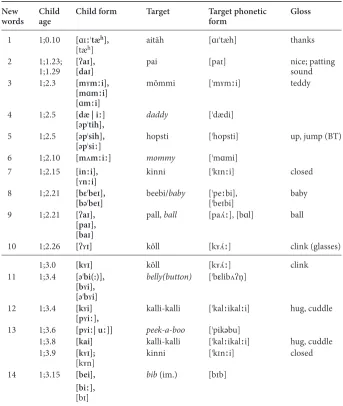
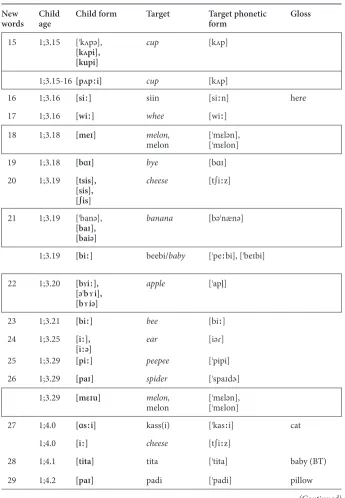
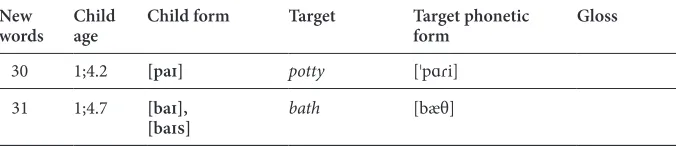
Table 1 shows the 31 diferent words that include any such palatal variants in Sample I (out of the 50 word types targeted), together with all the recorded forms. Out of a total of 111 word forms recorded within this irst lexically deined sample (age 1;0.10–1;4.7), including all variant tokens that meet the criteria, 59 tokens – or 53% – can be termed ‘palatal’ (see the child word forms in bold face in the table).
Marilyn Vihman & Virve-Anneli Vihman
Table 1. Palatal word patterns in child forms: First 50 words (Sample I)4
English word targets are in italics, palatal tokens in bold face. For boxed rows, see text.
New words
Child age
Child form Target Target phonetic
form
Gloss
1 1;0.10 [cI ˜Át5h],
[t5h] aitäh [
cIÁt5h] thanks
2 1;1.23; 1;1.29
[ôai], [dai]
pai [pai] nice; patting
sound 3 1;2.3 [m?m ˜ i],
[mcm ˜ i] [cm ˜ i]
mõmmi [Ám?m ˜ i] teddy
4 1;2.5 [d5 | i ˜ ]
[6pÁtih], daddy
[Ád5di]
5 1;2.5 [6pÁsih], [6pÁsi ˜]
hopsti [Áhopsti] up, jump (BT)
6 1;2.10 [m%m ˜ i ˜ ] mommy [Ámcmi]
7 1;2.15 [in ˜ i], [?n ˜ i]
kinni [Ákin ˜ i] closed
8 1;2.21 [b7Ábei], [b6Ábei]
beebi/baby [Ápe ˜ bi], [Ábeibi]
baby
9 1;2.21 [ôai], [pai], [bai]
pall, ball [paˆ˜ ], [bcl] ball
10 1;2.26 [ô?i] kõll [k?ˆ˜ ] clink (glasses)
1;3.0 [k?i] kõll [k?ˆ˜ ] clink
11 1;3.4 [6Ábi(:)], [b?i], [6Áb?i]
belly(button) [Áb7lib%ôņ]
12 1;3.4 [k?i]
[p?i ˜ ],
kalli-kalli [Ákal ˜ ikal ˜ i] hug, cuddle
13 1;3.6 [p?i ˜ | u ˜ ]] peek-a-boo [Ápik6bu]
1;3.8 [kai] kalli-kalli [Ákal ˜ ikal ˜ i] hug, cuddle
1;3.9 [k?i]; [k?n]
kinni [Ákin ˜ i] closed
14 1;3.15 [bei], bib (im.) [bib]
[bi ˜ ], [bi]
(Continued)
First words to segments
Table 1. (Continued)
New words
Child age
Child form Target Target phonetic
form
Gloss
15 1;3.15 [Ák%p6],
[k%pi], [kupi]
cup [k%p]
1;3.15-16 [p%p ˜ i] cup [k%p]
16 1;3.16 [si ˜ ] siin [si ˜ n] here
17 1;3.16 [wi ˜ ] whee [wi ˜ ]
18 1;3.18 [mei] melon,
melon
[Ám7l6n], [Ám7lon]
19 1;3.18 [bci] bye [bci]
20 1;3.19 [tsis], [sis], [∫is]
cheese [t∫i ˜ z]
21 1;3.19 [Ában6], [bai], [bai6]
banana [b6Án5n6]
1;3.19 [bi ˜ ] beebi/baby [Ápe ˜ bi], [Ábeibi]
22 1;3.20 [b?i ˜ ], [6Áb ? i], [b ? i6]
apple [Áapļ]
23 1;3.21 [bi ˜ ] bee [bi ˜ ]
24 1;3.25 [i ˜ ], [i ˜ 6]
ear [i6n]
25 1;3.29 [pi ˜ ] peepee [Ápipi]
26 1;3.29 [pai] spider [Áspaid]
1;3.29 [m7iu] melon,
melon
[Ám7l6n], [Ám7lon]
27 1;4.0 [cs ˜ i] kass(i) [Ákas ˜ i] cat
1;4.0 [i ˜ ] cheese [t∫i ˜ z]
28 1;4.1 [tita] tita [Átita] baby (BT)
29 1;4.2 [pai] padi [Ápadi] pillow
[image:11.454.56.401.90.588.2] Marilyn Vihman & Virve-Anneli Vihman
Table 1. (Continued) Palatal word patterns in child forms: First 50 words (Sample I) English word targets are in italics, palatal tokens in bold face. For boxed rows, see text.
New words
Child age
Child form Target Target phonetic
form
Gloss
30 1;4.2 [pai] potty [Ápcni]
31 1;4.7 [bai], [bais]
bath [b5θ]
From Table 1 it is evident that the irst forms produced were relatively accu-rate or ‘selected’ (Vihman & Velleman 2000). his suggests that the child has identiied in the input some easily matched word forms that were also sui-ciently frequently occurring and situationally interesting to have let a trace in her memory – speciically, a ‘motor trace’ that could support the form-meaning link that is the primary challenge for early word learning (Stager & Werker 1997; Keren-Portnoy et al. 2010).
A horizontal line divides the table into two separate steps in the formation of the palatal template. Above the line are 10 words whose target forms include either /VI/ or /i/ or, in the case of the last two forms (at age 1;2.21 and 1;2.26), a palatal lateral, which a child could be expected to produce (and perhaps also perceive) as a front glide. hese forms can be considered to have been selected (at least in part) for their phonological form, which lends itself to production by a child who has been focusing much of her vocal output on words whose nuclei end in /i/; note that the child’s errors – generally of omission, as expected for the earliest period – tend here to afect the onset consonant (e.g. pai, mõmmi, kinni, pall, kõll). It is worth observing too that only ten more words had been attempted up to this point, four of them onomatopoeia (aua ‘woof ’, uu-uu ‘hoot’ (owl sound), moo, baa), the remaining words being produced with the simple shape Cc (4) or VCV (2).
[image:12.454.58.396.103.176.2]First words to segments
Table 2. Palatal word patterns in child forms: 50–100 words (Sample II)5
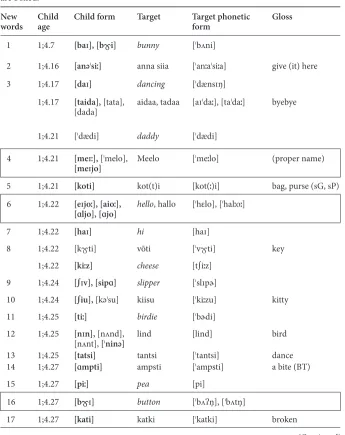
English word targets are in italics, palatal tokens in bold face; clearly adapted forms are boxed.
New words
Child age
Child form Target Target phonetic form
Gloss
1 1;4.7 [baI], [b@i] bunny [Áb%ni]
2 1;4.16 [an6Ási˜] anna siia [Áan˜aÁsi˜a] give (it) here
3 1;4.17 [daI] dancing [Ád5nsI]]
1;4.17 [taida], [tata], [dada]
aidaa, tadaa [aIÁda˜], [taÁda˜] byebye
1;4.21 [Ád5di] daddy [Ád5di]
4 1;4.21 [meI˜], [Ámelo],
[meIjo]
Meelo [Áme˜lo] (proper name)
5 1;4.21 [koti] kot(t)i [kot(˜)i] bag, purse (sG, sP)
6 1;4.22 [eIjo˜], [aio˜], [cljo], [cjo]
hello, hallo [Áh7lo], [Áhal˜o˜]
7 1;4.22 [haI] hi [haI]
8 1;4.22 [k@ti] võti [Áv@ti] key
1;4.22 [ki˜z] cheese [t∫i˜z]
9 1;4.24 [∫Iv], [sipc] slipper [ÁslIp]
10 1;4.24 [∫iu], [k6Ásu] kiisu [Áki˜zu] kitty
11 1;4.25 [ti˜] birdie [Ábdi]
12 1;4.25 [nIn], [n%nd],
[n%nt], [Ánin6]
lind [lind] bird
13 1;4.25 [tatsi] tantsi [Átantsi] dance
14 1;4.27 [cmpti] ampsti [Áampsti] a bite (BT)
15 1;4.27 [pi˜] pea [pi]
16 1;4.27 [b@I] button [Áb%ôņ], [Áb%tņ]
17 1;4.27 [kati] katki [Ákatki] broken
(Continued)
Marilyn Vihman & Virve-Anneli Vihman
Table 2. (Continued) Palatal word patterns in child forms: 50–100 words (Sample II) English word targets are in italics, palatal tokens in bold face; clearly adapted forms are boxed.
New words
Child age
Child form Target Target phonetic form
Gloss
18 1;4;28 [bcI] book [b~k]
19 1;4;28 [∫6baI], [baI],
[bat], [bats]
butterly [Áb%nlaI]
20 1;4;29 [Ánina], [n5n˜] nina [Ánina] nose
21 1;4.30 [kcj6] küünal/
candle
[Áky˜ncl, [Ák5ndļ] candle
22 1;5.0 [dI]], [di]] ding (dong) [ÁdI] dc]]
23 1;5.2 [maI] mitten [ÁmIôņ]
24 1;5;2 [kcja] kala [kclc] ish
25 1;5;5 [ti˜] tree [tpi˜]
In the next sample, Sample III (17–18 mos., words 101–150), we ind only a few adapted palatal patterns. At 1;5.7 guy provides a good model for a ‘selected’ diphthongal palatal form, for example, while koala is produced on that same day as [kc] or [kala]. However, a few weeks later (1;6.20) koala is produced both as [kwal6] and as [kwaj6]. he last two examples of new words adapted to it the diphthongal palatal template are [sui:] for swim at 1;6.11 and [koi] for koolis ‘at school’ at 1;7.2, although words appropriately produced as palatal forms continue to appear throughout the period, as either English or Estonian targets allow (e.g.
side, bless you,ai-ai ‘ouch, ow’, välja ‘to-outside’).
[image:14.454.57.400.113.299.2]First words to segments
To obtain more direct information as to the input frequency of palatal pat-terns in Estonian input in the absence of transcribed recordings for this child, we made use of an earlier study of a monolingual irst-born child whose one-hour recordings made by the parents in the home began at age two (for more detail, see Vihman & Vija 2006).6 We analysed all child-directed speech, by either parent,
over the course of the irst such recording, counting as ‘palatal pattern’ all words including one or more instances of /j/ or /(V)i/, in any word position, and dividing that count by total words produced.
Out of 1723 words produced in a total of 381 maternal utterances directed to the child (MLU 4.5), 758 were palatal forms (44%). Out of the 225 words produced in 56 paternal utterances directed to the child (MLU 4.0), 103 were palatal forms (46%). Combining the parents’ data, the mean incidence of palatal forms for this Estonian input is 45% – which is also the level of Maarja’s use in the periods of highest accuracy (her irst and inal months). his input analysis included onset /j/, however, which is common in Estonian but which did not feature as part of Maarja’s template. If we exclude onset /j/, the overall use of palatal forms in the combined parental data falls to 36%, which indicates that Maarja’s palatal pattern is most likely supported but not determined by its level of input use.
We also lack data for Maarja’s English input. Note, however, that at least one other American child has been reported as having a palatal pattern, including both Vi diphthongs, especially in monosyllables, and medial palatalized consonants (Vihman, Velleman & McCune 1994), and high occurrence of inal /i/ in English has also been reported previously (Davis & MacNeilage 1990). Nevertheless, use of a palatal pattern is by no means universal among English-speaking children (see Vihman 2010). Maarja’s proile of palatal pattern use, then, together with our anal-ysis of input to another Estonian child, gives good reason to think that Maarja was, for the entire period of the study, responding with a degree of enhanced (implicit) attention to palatal patterns at least as much as to the sheer overall frequency of occurrence of the pattern in the two input languages.
A second question we may ask is whether recurrent use of the pattern is primarily a response to articulatory diiculty, or whether memory also plays a role. Note that the irst palatal forms produced involve the syllable nucleus [aI], which appears to be articulatorily congenial to Maarja, and that in general the palatal pattern afects syllable nuclei, not onsets. his focus on syllable nuclei may account for the omission, in so many of the irst few words, of the onset consonant, the least salient aspect of these words if matching to an internal
Marilyn Vihman & Virve-Anneli Vihman
palatal-nucleus template was operative from early on.7 As was the case in earlier studies such as Waterson (1971), we take these forms to be whole-word-based because no segment-by- segment alignment with their adult models would yield an interpretable phonological analysis: see, for example, peek-a-boo [p@i˜], kinni [k@I], banana, book, bath, all produced as[bcI]. his interpretation is supported by the fact that some of these words were irst produced more accurately and only later replaced by a palatal pattern. For example, kinni ‘closed’ irst appears at 1;2.15 as [in˜i] and [@n˜i], and only almost a month later, at 1;3.9, as [k@I]. he last such example in this data set is pasta, irst produced in a nearly accurate form at 1;5.17 as [pat6], but recorded a month later, at 1;6.9, as [pcj6]. We return to the question of the role of articulation, planning and memory as sources of templatic representations in the Discussion.
We take such late-appearing expressions of the template to be based not so much on incomplete perception of the adult form (or a ‘vague representation’: Swingley 2005) as on a mnemonic ‘short-cut’ or on-the-ly phonological catego-rization of a heard word form as an exponent of the by now well-established tem-platic pattern (cf. the imitation of bib as [bi˜], [bI], [bei]). he phenomenon of misremembering (a kind of miscategorization, not misperception) based on more familiar names or words can also be seen in adult errors: cf. Chase for Chafe or spasmodic for sporadic (the latter noted several times on BBC radio 4 in the 1990s, suggesting a meaning shit in progress, supported by phonological similarity as well as misremembering); the literature on malapropisms (e.g. Fay & Cutler 1977) provides many more instances.
. Consonant harmony
Consonant harmony is the most widely occurring ‘whole-word’ phonological pat-tern in development – but (contra Smith 1973) it is not a ‘universal’ but varies widely from one child to the next (see Vihman 1978, where the three English chil-dren included in the study ranged in harmony use – counting ‘adapted’ forms only – from 5 to 32%, the two Estonian children from 9 to 25%). In Maarja’s case it accounts for a third of all forms produced at its highest period of use (16 months:
First words to segments
see Figure 1) but only 18%, on average, over the entire time of the study (as com-pared with 52% in the case of the palatal template), and with only 6% of all the word forms produced being adapted to arrive at a harmony form.
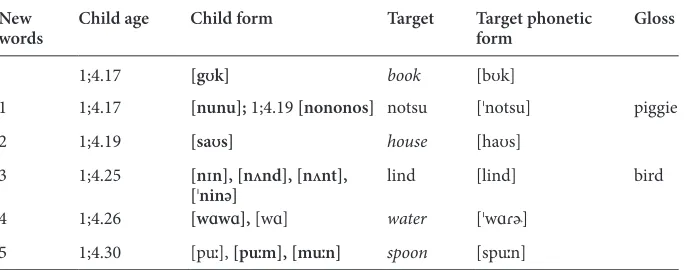
[image:17.454.58.402.357.492.2]he use of harmony is seen as a dynamic force for the irst time at 1;3.16, when cup is produced as [p%p˜i] (note the addition of the diminutive -ie/y, not used with this lexical item in the input speech, which creates a form that its the palatal tem-plate as well as showing consonant harmony); the few previous forms counted as showing harmony had a single consonant across syllables or word positions in the target as well as in the child form (i.e. they were selected for harmony, not adapted to it). Note that although in Table 1 eight target words show harmony in their adult form (as well as most of them having a palatal form, as we deine it) – mõmmi ‘teddy’, daddy, mommy, baby (twice), bib, peepee and tita ‘baby’ – only four are actu-ally produced as harmony forms by the child ([m@m˜i], [m%m˜i˜], [b7ÁbeI], [tita]). It is only the latter that we count as harmony use by the child (whether selected or adapted). Even the period of highest use of harmony includes only a few adapted forms (Sample II: see Table 3).
Table 3. Harmony word patterns in child forms: 51–100 words (Sample II). English word targets are in italics, harmony tokens in bold face.Onlyadapted forms are included here.
New words
Child age Child form Target Target phonetic
form
Gloss
1;4.17 [g~k] book [b~k]
1 1;4.17 [nunu]; 1;4.19 [nononos] notsu [Ánotsu] piggie
2 1;4.19 [sa~s] house [ha~s]
3 1;4.25 [nIn], [n%nd], [n%nt], [Ánin6]
lind [lind] bird
4 1;4.26 [wcwc], [wc] water [Áwcn]
5 1;4.30 [pu˜], [pu˜m], [mu˜n] spoon [spu˜n]
Marilyn Vihman & Virve-Anneli Vihman
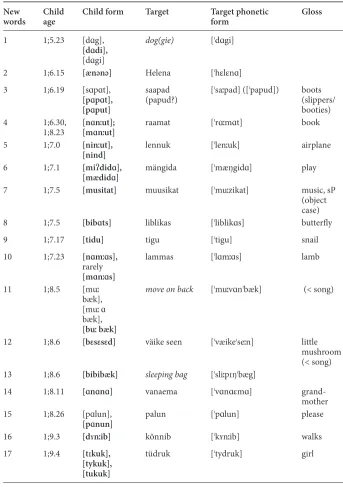
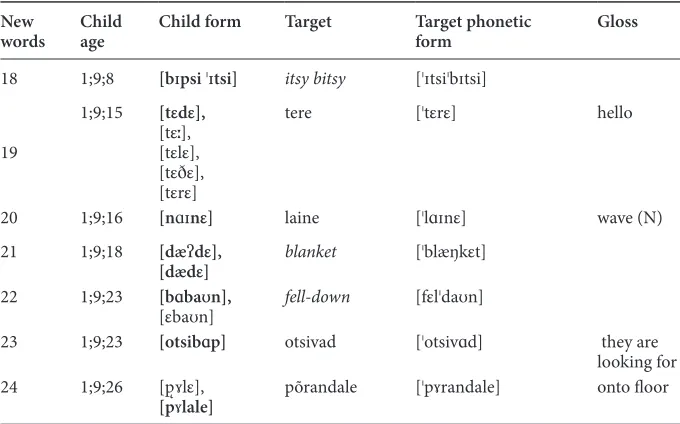
Table 4. Adapted harmony word patterns in child forms in Samples III–X:
101–500 words. English word targets are in italics, harmony tokens in bold face. Only adapted forms are listed here.
New words
Child age
Child form Target Target phonetic
form
Gloss
1 1;5.23 [dcg],
[dcdi],
[dcgi]
dog(gie) [Ádcgi]
2 1;6.15 [5n6n6] Helena [Áh7l7nc]
3 1;6.19 [scpct], [pcpct], [pcput]
saapad (papud?)
[Ása˜pad] ([Ápapud]) boots (slippers/ booties)
4 1;6.30,
1;8.23
[ncn˜ut]; [mcn˜ut]
raamat [Árc˜mct] book
5 1;7.0 [nin˜ut],
[nind]
lennuk [Álen˜uk] airplane
6 1;7.1 [miôdidc],
[m5didc]
mängida [Ám5]gidc] play
7 1;7.5 [musitat] muusikat [Ámu˜zikat] music, sP
(object case)
8 1;7.5 [bibcts] liblikas [Áliblikcs] butterly
9 1;7.17 [tidu] tigu [Átigu] snail
10 1;7.23 [ncm˜cs], rarely [mcn˜cs]
lammas [Álcm˜cs] lamb
11 1;8.5 [mu˜
b5k], [mu˜c
b5k], [bu˜ b5k]
move on back [Ámu˜vcnÁb5k] (< song)
12 1;8.6 [b7s7s7d] väike seen [Áv5ikeÁse˜n] little mushroom (< song)
13 1;8.6 [bibib5k] sleeping bag [Ásli˜pI]Áb5g]
14 1;8.11 [cncnc] vanaema [Ávcnc7mc]
grand-mother
15 1;8.26 [pclun],
[pcnun]
palun [Ápclun] please
16 1;9.3 [d?n˜ib] kõnnib [Ák?n˜ib] walks
17 1;9.4 [tIkuk],
[tykuk], [tukuk]
tüdruk [Átydruk] girl
First words to segments
Table 4. (Continued)
New words
Child age
Child form Target Target phonetic
form
Gloss
18 1;9;8 [bIpsi ÁItsi] itsy bitsy [ÁItsiÁbItsi]
19
1;9;15 [t7d7], [t7˜], [t7l7], [t7ş7], [t7r7]
tere [Át7r7] hello
20 1;9;16 [ncIn7] laine [ÁlcIn7] wave (N)
21 1;9;18 [d5ôd7],
[d5d7] blanket
[Ábl5]k7t]
22 1;9;23 [bcba~n], [7ba~n]
fell-down [f7lÁda~n]
23 1;9;23 [otsibcp] otsivad [Áotsivcd] they are
looking for 24 1;9;26 [p˛?l7],
[p?lale]
põrandale [Áp?randale] onto loor
he use of consonant harmony to support the long-word production required by Estonian semi-agglutinative morphology is illustrated in the month follow-ing the 500-word point by two forms that extend the Estonian verb form otsivad seen at 1;9: keerutab ‘s/he is twirling’ [k7˜dcbcb], joonistavad ‘they are drawing’ [jonsib"b]. hese forms give the impression of a iller syllable, [-bap/b], being used to complete verb forms without the child having any clear understanding of the meaning or function of the morphemes it replaces (compare the use of a inal sibilant in English before the functions of plural/possessive/3sg present tense have been understood: Peters & Menn 1993).
. he move to segmental representation
[image:19.454.57.397.92.304.2] Marilyn Vihman & Virve-Anneli Vihman
of errors afecting voicing and either vowel or consonant length could not be inde-pendently established (although, impressionistically, relatively few errors in length were noted); we disregarded those errors as well as some minor vowel errors, such as production of [%] for [c], for the same reason. (To illustrate our use of the term, we consider only seven of the child forms given in Table 1 to count as fully ‘accurate’: aitäh [cI˜Át5h], mõmmi [m@m˜i], mommy [m%m˜i˜], whee [wi˜], bye [baI], bee [bi˜] and tita [tita].)
Here we see that the child’s forms were at their most accurate in the irst period of word production (50% of the 22 words produced at 12–14 months). hereater, accuracy falls to half that level and then rises again, to close to the overall mean of 33%, where it remains for most of the period studied, with the exception of a sharp dip, to 11%, at 19 months. Recall that at 15 months the pala-tal template had its strongest inluence (67%, against the overall average of 52%), which could help to account for the initial dip in accuracy, while the continued relatively low level of accuracy throughout most of this period could relect the use of whole-word patterning more generally. However, there is no increase in template use that might explain the second, more dramatic dip at 19 months. What other factors could be responsible? To understand the child’s advances beyond the early period of template use we will consider two additional mea-sures: word length in syllables (in both targets and child word forms) and the child’s consonant inventory.
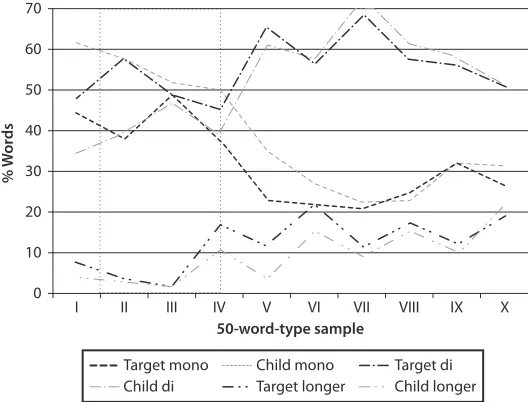
2. Word length in syllables. Might a shit in the kinds of words attempted be responsible for the 19-month dip in accuracy that we see in Figure 1? To evalu-ate this hypothesis, we chart in Figure 2 changes in word length in syllables for both target and child forms (including more than one variant only where length in syllables difers), across the period of the irst 500 words (based on percentage occurrence).
First words to segments
3. Consonant inventory changes over time. We consider changes in the inven-tory of consonants only here, rather than in all segments, as this has proved the best predictor of later phonological advance in earlier studies of typically developing children acquiring English (Vihman & Greenlee 1987; Stoel- Gammon 1992) as well as in a large study of both typically developing children and late talkers (Vihman et al. in revision). Criteria for inclusion in the inventory – namely, occurrence in at least two child forms, for distinct word targets – have to be met independently in each sample(i.e., no credit is given for use in earlier samples). Match to target form is not a consideration; that is, consonant sub-stitutions are given full credit, in order to obtain as full a picture as possible of the vocal resources the child is able to draw on for production (although uses as substitutes for the target consonant are so marked). Onsets and codas are considered separately, based on position in the syllable, not the word (although most codas, especially in the early samples, are word-inal, not internal). Sin-gle uses of consonants are also noted but are not included in the total inven-tory counts. he total inveninven-tory for each sample is shown in Table 5 and in Figure 3; totals are based on uses in two diferent word types in a sample, regard-less of syllable position.
0
I II III IV 20
10 30 40 50 60 70
50-word-type sample
%
W
or
ds
Target mono Child di
Child mono Target longer
[image:21.454.95.359.76.277.2]Target di Child longer V VI VII VIII IX X
Marilyn Vihman & Virve-Anneli Vihman
Table 5. Consonant use by 50-word-type samples. Segments occurring in only one word type in a given sample are in parentheses; segments occurring only incorrectly, in substitution for the correct target sound, are in square brackets. Ater Sample I, consonants are indicated in bold face when they irst appear in two word types in a single sample, taking onsets and codas separately and disregarding target language.
Sample (N wds) Onset C Coda C Total
I (0–50) p t ([ts]) k p (k) 11
b d ([g])
s ∫ s
m n m n
w j
II (51–100) p t k p t [ts] (k) 14
b d [g] (d)
s [∫] (h) s
(v) z
m n m n (])
(w) l [j]
III (101–150) p t ([ts]) k p t k 12
b d g (g)
s ∫ s
([v])
m n m n ]
l (j)
IV (151–200) p t k (ps) t ts k 10
b d (g) (d) (dz)
s (f) s
([v])([z])
m n n
(w) j (l)
V (201–250) p t (ts) k p t ts (t∫) 10
b d (d) (g)
s (h) s
v
m n n
First words to segments
Table 5. (Continued)
Sample (N wds) Onset C Coda C Total
VI (251–300) p t k p (ts) k 12
b d g (dŠ)
s h (f) s ([h])
v (z) (z)
m n (m) n (])
(w) (l) (j)
VII (301–350) p t k (p) t k 11
b d d (g)
(f) s (∫) h s
(v) z
m n (m) (])
(l) j
VIII (351–400) p t (ts) k (p) t k 13
b d ([g]) b d
(f)(θ) s h
(z) z
m n (m) n ]
l j
IX (401–450) p t k p t (k) 14
b d (g) (b) (d)
(f) s h s (h)
v z
m n n (])
w l j l
X (451–500) p t k [p] t k 16
b d g b d
(f) s h (f) s (h)
v z
m n (m) n ]
(w) l (j) l
[image:23.454.55.399.90.581.2] Marilyn Vihman & Virve-Anneli Vihman
0 2 4 6 8 10 12 14 16 18
[image:24.454.103.355.78.236.2]I II III IV V VI VII VIII IX X onset coda total
Figure 3. Size of consonant inventory, plotted by 50-word-type samples
Maarja shows substantial diversity of consonant types already by the end of Sample I: 11 consonants altogether, all of them occurring at word onset but only [p], [s] and the nasals [m] and [n] also in coda position. he inventory of onsets includes ive stops, both voiced and voiceless, but with [g] occurring only once (for target /k/: sock [gc]). Both [s] and [∫] occur twice, although one use of the palatal [∫] occurs in lieu of the africate onset to cheese. he two anterior nasals and the glides [w] and [j] complete this extensive core inventory.
In Sample II we see a rise in both onset and coda use. his is the most diverse inventory expressed in a single sample until the penultimate sample, when Maarja has begun to produce inlectional endings in both her languages; these morpho-logical markers include the voiced (or, more precisely, lenis voiceless) stops /-b/ and /-d/ (3rd and 2nd person markers on verbs, resp., and noun plural) in Estonian and /-z/ (noun plural) in English. Frequency in one or the other of Maarja’s two languages afects her usage: he palatal sibilant [∫], which occurs only in loan words in Estonian, is used twice per sample only in the irst three (up to 18 mos.), before she begins full-time attendance at Estonian daycare. Onset [v], far more fre-quent in Estonian than in English adult speech, and coda [z] occur in words from both languages. Estonian [h], irst fully included in the inventory only in Sample VI (20 mos.), is established at onset and is also used appropriately in coda position in Samples VIII–X, both word-internally and inally: kahvel ‘fork’, päh ‘yuck’. he only addition to the inventory in the inal sample is the English approximant /p/, used in coda position (tractor, hair).
First words to segments
onsets and codas until Sample VI, when onsets begin to increase, followed by an increase in coda use at Sample VII. We note that the low point in coda use cor-responds to the onset of longer word production. hus the dip in accuracy seen at 19 months is best accounted for by the change in the length of words targeted (in Sample V) and then produced (in Sample VI); the changes in consonant use simply relect that development.
. Discussion and conclusion
he data presented here support the idea that the early word forms are based on a mix of perception (of ambient language input, the child’s own output, and matches between the two) and, ater the earliest period of production, phonologi-cal (template-based) categorization of whole-word patterns in the input, resulting in what we hypothesize to be whole-word representations. We cannot identify the speciic origin of Maarja’s favored palatal template with any conidence, although (like Priestly 1977) we note that some target words produced relatively accurately by the child early on could have been an important source or prototype for the template (cf. aitäh, pai, pall and kõll: Table 1). A still earlier possible inluence is the child’s own real name: It has a medial /l/, which the child produced as [j] in her early words (for experimental evidence that the child’s name may be the irst word to be recognized without speciic training, see Mandel, Juszcyk, & Pisoni 1995; Bortfeld et al. 2005).
What we have documented is the child’s remarkable perseverance in her use of the palatal template throughout the period of the study. In the early months of word production we see her apparent reliance on the front-rising diphthong, in particu-lar, as a kind of ‘bootstrap’ into word use: his provided the child with the possibil-ity of repeatedly using minor variants on the highly familiar motor routine [VI] as a basis for irst remembering and then planning and articulating an increasing number of new words. he support ofered by words including palatal vowels, diph-thongs or glides declines somewhat in importance only in the inal month of the study (samples VII–X). In that same month, when the child was producing many combinations as well as a more substantial number of words of more than two syl-lables, harmony came to be used to support long word production in particular, although this did not afect a major proportion of the child’s words at that point.8
Marilyn Vihman & Virve-Anneli Vihman
To address the broader question of units of representation, can we say that at some particular point Maarja shited from ‘whole-word’ to ‘segmental’ phono-logy? It is unclear just what evidence would be suicient to make the claim – nor is it beyond dispute that even adults are entirely ‘segment oriented’ in their phonol-ogy (Ferguson & Farwell 1975; Beckman & Edwards 2000). However, by tracing the growth in word length in syllables we have been able to make some guesses at the likely constraints, both articulatory and mnemonic, that underlay (i) the child’s narrow focus on palatal patterns in the second month of the study and (ii) her renewed departure from accurate production as late as 19 months, when her ‘ambition’ to produce longer words (notably, her new sensitivity to morpho-logical marking) apparently exceeded either her planning or her representational capacities, or both.
Alongside the nonlinearity apparent in the proile traced here for Maarja’s accuracy in reproducing adult models we also ind nonlinearity in the diversity of consonants she produces in a given sample. Recall that accuracy is actually highest in the irst month of regular word use (14 mos.: 9/18, or 50%), with a return to as much as 40% accuracy only in the last month covered here (19 mos.: 65/163). Yet in Sample II (15–16 mos.) Maarja produced 14 diferent consonants to criterion and succeeded in producing in close to their adult form even such challenging words as English clap [kcp], slipper [sipc]and toes [to˜z], Estonian ampsti ‘a bite’ [cmpti], kala ‘ish’ [kal6], konn ‘frog’ [kon˜], [kun˜], kott ‘bag’ [kot], [k6t] and tantsi ‘dance’ [tatsi]. (Each of these includes consonants that difer in place or manner, or both, yet only the clusters fail to be accurately matched.) his makes it unlikely that articulatory ability per se was a major factor in Maarja’s failure to match target words in that and subsequent samples.
Instead, we take template use to serve as unconscious support for word learn-ing as regards both the long-term representation and the plannlearn-ing needed for pro-duction; accordingly, we assume that as word knowledge grows, the need to rely on such support will decline. Experimental work is required to test the role of templates in word learning. (Such a study is underway with two-year-olds, most of whom show some trace of template use: Bidgood et al. 2010.) It is unlikely to be possible, especially in a diary study, to pinpoint a speciic moment at which a shit to segmental representation is completed; however, the decline in use of the two templates identiied here over the course of learning the irst 500 words strongly suggests at least the beginning of such a shit.
First words to segments
Sample II, but then regresses to lower levels of use (at least in new word forms) right up until the penultimate sample, when she resumes use of (not quite the same) 14 consonants. At the same time, however, she has moved from predomi-nantly monosyllabic production to a dominant use of disyllables alongside nearly equal use of monosyllables and words of 3–5 syllables. And her overall level of accuracy, ater an initial decline over the irst few months of word use, has returned to something closer to the initial level – despite the far more diicult words now being attempted, the added complexity of emergent morphological marking in both languages and the planning needed to produce word forms in combination. Finally, we ind, in the last samples, very few instances of child forms adapted to a whole-word template; that is, at this point the child forms can generally be aligned with the target forms, leaving speciic segmental substitutions as the only errors. hus phonological knowledge must necessarily have increased over the period of the study and, more speciically, there is evidence of emergent segmental knowledge. Just how best to characterize the child’s phonological knowledge will difer according to one’s understanding of adult phonology (for whole-word and usage-based approaches, see Ferguson & Farwell 1975; Beckman & Edwards 2000; Bybee 2001; Pierrehumbert 2003). It seems clear, however, that the emergence and decline in template use that we have traced here provide an insight into phonologi-cal advance that could not be obtained from direct measures of consonant inven-tory or overall phonological process use alone.
References
Beckman, M.E. & Edwards, J. 2000. he ontogeny of phonological categories and the primacy of lexical learning in linguistic development. Child Development 71: 240–249.
Bidgood, A., McGillion, M., Keren-Portnoy, T. & Vihman, M. 2010. Testing the psychological signiicance of templates. Talk presented at Alston Hall conference on child language. Bortfeld, H., Morgan, J.L., Golinkof, R. & Rathbun, K. 2005. Mommy and Me. Familiar names
help launch babies into speech-stream segmentation. Psychological Science 16: 298–304. Bybee, J. 2001. Phonology and Language Use. Cambridge: CUP.
Davis, B.L. & MacNeilage, P.F. 1990. Acquisition of correct vowel production: A quantitative case study. Journal of Speech and Hearing Research 33: 16–27.
DePaolis, R.A., Vihman, M.M. & Keren-Portnoy, T. Under review. Do production patterns inluence the processing of speech in prelinguistic infants?
Fay, D. & Cutler, A. 1977. Malapropisms and the structure of the mental lexicon. Linguistic Inquiry 8: 505–520.
Ferguson, C.A. & Farwell, C.B. 1975. Words and sounds in early language acquisition. Language
51: 419–439.
Marilyn Vihman & Virve-Anneli Vihman
Jakobson, R. 1941/1968. Child Language, Aphasia, and Phonological Universals. he Hague: Mouton. (Eng. tr. of Kindersprache, Aphasie und allgemeine Lautgesetze. Uppsala, 1941). Kager, R., Pater, J. & Zonneveld, W. 2004. Introduction. In Constraints in Phonological
Acquisi-tion, R. Kager, J. Pater & W. Zonneveld (eds), 1–53. Cambridge: CUP.
Keren-Portnoy, T., Vihman, M.M., DePaolis, R.A., Whitaker, C.J. & Williams, N.M. 2010. he role of vocal practice in constructing phonological working memory. Journal of Speech, Language and Hearing Research 53: 1280–1293.
Macken, M.A. 1979. Developmental reorganization of phonology: A hierarchy of basic units of acquisition. Lingua 49: 11–49.
Mandel, D.R., Jusczyk, P.W. & Pisoni, D.B. 1995. Infants’ recognition of the sound patterns of their own names. Psychological Science 6:314–317.
Menn, L. 1971. Phonotactic rules in beginning speech: A study in the development of English discourse. Lingua 26: 225–251.
Menn, L. 1983. Development of articulatory, phonetic, and phonological capabilities. In Lan-guage Production, Vol. 2, B. Butterworth (ed.), 3–50. London: Academic Press.
Oliveira Guimarães, D.M.L. 2008. Percurso de construção da fonoloiga pela criança: Uma abor-dagem dinâmica. Ph.D. dissertation, Federal University of Minas Gerais.
Peters, A. & Menn, L. 1993. False starts and iller syllables. Language 69:742–777.
Pierrehumbert, J. 2003. Phonetic diversity, statistical learning, and acquisition of phonology.
Language and Speech 46: 115–154.
Priestly, T.M.S. 1977. One idiosyncratic strategy in the acquisition of phonology. Journal of Child Language 4: 45–66.
Smith, N.V. 1973. he Acquisition of Phonology: A Case Study. Cambridge: CUP.
Stager, C.L. & Werker, J.F. 1997. Infants listen for more phonetic detail in speech perception than in word-learning tasks. Nature 388: 381–382.
Stoel-Gammon, C. 1992. Prelinguistic vocal development: Measurement and predictions. In Phonological Development: Models, research, implications, C.A. Ferguson, L. Menn & C. Stoel-Gammon (eds), 439–456. Timonium MD: York Press.
Swingley, D. 2005. Eleven-month-olds’ knowledge of how familiar words sound. Developmental Science 8:432–443.
Vihman, M.M. 1978. Consonant harmony: Its scope and function in child language. In Uni-versals of Human Language, Vol 2, J.H. Greenberg (ed.), 281–334. Stanford CA: Stanford University Press.
Vihman, M.M. 1991. Ontogeny of phonetic gestures: Speech production. In Modularity and the Motor heory of Speech Perception: Proceedings of a Conference to Honor Alvin M. Liberman, I.G. Mattingly & M. Studdert-Kennedy (eds), 69–84. Hillsdale NJ: Lawrence Erlbaum Associates.
Vihman, M.M. 1993. Variable paths to early word production. Journal of Phonetics 21: 61–82. Vihman, M.M. 1996. Phonological Development: he Origins of Language in the Child. Oxford:
Blackwell.
Vihman, M.M. 2002. Getting started without a system: From phonetics to phonology in bilin-gual development. International Journal of Bilingualism 6:239–254.
Vihman, M.M. 2010. Phonological templates in early words: A cross-linguistic study. In Lab Phon 10: Variation, Detail and Representation, C. Fougeron & N. Nguyen (eds), 261–284. Berlin:Mouton de Gruyter.
First words to segments
Vihman, M.M. & Greenlee, M. 1987. Individual diferences in phonological development: Ages one and three years. Journal of Speech & Hearing Research 30: 503–521.
Vihman, M.M., Keren-Portnoy, T., Bidgood, A., McGillion, M. & Szreder, M. In revision. Late talkers: Predicting later linguistic advance.
Vihman, M.M. & Kunnari, S. 2006. he sources of phonological knowledge: A cross-linguistic perspective. Recherches Linguistiques de Vincennes 35:133–164.
Vihman, M.M., Macken, M.A., Miller, R., Simmons, H. & Miller, J. 1985. From babbling to speech: A re-assessment of the continuity issue. Language 61: 397–445.
Vihman, M.M. & Velleman, S.L. 2000. Phonetics and the origins of phonology. In Phonological Knowledge: Its Nature and Status, N. Burton-Roberts, P. Carr & G. Docherty (eds), 305–339.
Oxford: OUP.
Vihman, M.M., Velleman, S.L. & McCune, L. 1994. How abstract is child phonology? Towards an integration of linguistic and psychological approaches. In First and Second Language Phonology, M. Yavas (ed.), 9–44. San Diego CA: Singular g.
Vihman, M.M. & Vija, M. 2006. he acquisition of verbal inlection in Estonian. In he Acqui-sition of Verbs and their Grammar: he Efect of Particular Languages, N. Gagarina & I. Gülzow (eds), 269–295. Dordrecht: Springer.