View Table of Contents: http://pof.aip.org/resource/1/PHFLE6/v25/i11 Published by the AIP Publishing LLC.
Additional information on Phys. Fluids
Journal Homepage: http://pof.aip.org/
Nonsnaking doubly diffusive convectons
and the twist instability
C ´edric Beaume,1,a)Edgar Knobloch,1,b)and Alain Bergeon2,c) 1Department of Physics, University of California, Berkeley, California 94720, USA
2Universit´e de Toulouse, INPT, UPS, IMFT (Institut de M´ecanique des Fluides de Toulouse), All´ee Camille Soula, F-31400 Toulouse, France and CNRS, IMFT, F-31400 Toulouse, France
(Received 10 July 2013; accepted 10 October 2013; published online 5 November 2013)
Doubly diffusive convection in a three-dimensional horizontally extended domain with a square cross section in the vertical is considered. The fluid motion is driven by horizontal temperature and concentration differences in the transverse direction. When the buoyancy ratioN= −1 and the Rayleigh number is increased the conduction state loses stability to a subcritical, almost two-dimensional roll structure localized in the longitudinal direction. This structure exhibits abrupt growth in length near a particular value of the Rayleigh number but does not snake. Prior to this filling transition the structure becomes unstable to a secondary twist instability generating a pair of stationary, spatially localized zigzag states. In contrast to the primary branch these states snake as they grow in extent and eventually fill the whole domain. The origin of the twist instability and the properties of the resulting localized structures are investigated for both periodic and no-slip boundary conditions in the extended direction.C 2013 AIP Publishing LLC. [http://dx.doi.org/10.1063/1.4826978]
I. INTRODUCTION
The term doubly diffusive is used to refer to fluid systems where two competing fields diffuse at different rates. As examples we mention the three-component fluid mixture studied by Welander1 and two-component convection in a horizontal layer with competing temperature and concentration fields driven by imposed temperature and concentration differences.2In such configurations doubly diffusive effects may generate instabilities even when the mixture is stably stratified. When the temperature is stabilizing (i.e., a hot fluid overlies a cold fluid) while the concentration is destabilizing (i.e., the heavier component overlies the lighter one) the instability leads to a fingering instability in which the sinking (respectively, rising) fingers carry the heavier (respectively, lighter) component of the mixture. This instability plays an important role in ocean dynamics, particularly in equatorial regions,3,4 as well as in astrophysics.5,6 On the other hand, when the concentration is stabilizing while the temperature gradient is destabilizing, oscillatory or overstable dynamics are typically observed, and these may lead to the formation of well-mixed diffusive layers. This type of instability is also found in astrophysics7 and in oceanography,8 albeit at higher latitudes. Doubly diffusive instabilities with misaligned gradients are common in solidification processes9 and the case of horizontal gradients is considered representative.10–12 In the oceans the presence of icebergs may incline dramatically both the temperature and concentration gradients, a situation that may be idealized in the form of a vertical interface between the cold and pure water of the iceberg and the warm and salty water of the ocean.13The flow that results is referred to as natural doubly diffusive convection.
Doubly diffusive convection is known to exhibit a great variety of behavior. A number of stud-ies have examined the standing and traveling waves characteristic of the overstable regime and the
-0.8 -0.7 -0.6 -0.5
||u||2
r a b 1 2
[image:3.612.168.445.87.238.2]a b
FIG. 1. Bifurcation diagram based on Ref.24showing theL2norm of stationary localized solutionsu(x) of Eq.(1)in a
periodic domain of period 20πas a function ofrwhenν=2. The localized structures are homoclinic orbits to the trivial stateu=0 passing near a periodic state and lie on a pair of snaking branches.
associated chaotic oscillations.14–16Recent work has focused on spatially localized convection first observed by Ghorayeb and Mojtabi17in natural doubly diffusive convection. Since then stationary localized convection has been extensively studied in two-dimensional (2D) doubly diffusive con-vection in a horizontal layer, both with Soret effect18–20 and without.21,22 Solutions of this type, hereafter referred to as convectons, may be viewed as homoclinic orbits in space connecting the conduction state to itself and are associated with heteroclinic orbits or fronts connecting the con-duction state to a periodic roll state and back again. These solutions have recently been computed in natural three-dimensional (3D) doubly diffusive convection in a vertically extended cavity23and are accompanied by secondary instabilities leading to the twisting of some of the convection rolls, an instability only allowed by the additional freedom provided by the third dimension. The present paper examines the same system, but this time focusing on a horizontally extended cavity. The study identifies both similarities and key differences between these two systems.
Localization phenomena are easier to apprehend using the cubic-quintic Swift–Hohenberg (SH35) equation on the real line24
∂tu=r u−(1+∂x x2 )2u+νu3−u5. (1)
Hereu(x,t) is a scalar field,ris a bifurcation parameter, andνis a real coefficient. With periodic boundary conditions the equation is translation-invariant inxand spatially reversible with respect tox→ −x,u→ ±u, and admits a trivial solutionu≡0. The equation has, moreover, variational dynamics,
∂u ∂t = −
δF
δu, (2)
with the free energy
F≡ 1 L
L
0
−1
2r u
2+1
2[(1+∂
2
x x)u]2− 1 4νu
4+1
6u
6
d x, (3)
The symmetryu→ −uplays an important role in the behavior of SH3524 and corresponds to the reflection symmetrySof the fluid equations as discussed below. To interpret the solutions of SH35 in a fluid dynamical context the order parameteru is to be identified with the temperature fluctuation or vertical velocity in the layer midplane.
The paper is organized as follows. In Sec. IIwe present the mathematical formulation of the problem, followed in Sec.IIIby the results in the case of closed container boundary conditions. SectionIVreports on the differences observed when periodic boundary conditions are imposed in the extended direction. The paper concludes with a brief discussion in Sec.V.
II. MATHEMATICAL FORMULATION
We consider a binary fluid placed within horizontal gradients of temperature and concentration. These gradients are introduced via Dirichlet boundary conditions applied on opposite vertical walls aty=0,l. The rear wall aty=0 is maintained at fixed temperatureT∗=Trand concentration in the heavier componentC∗=Crwhile the front wall aty=lis maintained at temperatureT∗=Tr+ T and concentrationC∗=Cr+ C, withT>0 andC>0. We nondimensionalize the equations usinglfor lengths,Tfor the temperature,Cfor the concentration, andl2/κfor the time, where l2is the area of the square cross-section andκis the thermal diffusivity. Cross-diffusion effects are
neglected. The Boussinesq approximation allows us to expand the fluid density about the reference valuesTrandCr,
ρ(T∗,C∗)=ρ0+ρT(T∗−Tr)+ρC(C∗−Cr), (4) where ρ0 is the fluid density at the reference temperature Tr and concentration Cr, and ρT < 0 andρC > 0 denote the thermal and solutal “expansion” coefficients atTr andCr. De-partures of the temperature and concentration fromTr andCr generate buoyancy forces given by FT = −ρTg(T∗−Tr)ˆzand FC = −ρCg(C∗−Cr)ˆz, respectively. Here g is the gravitational ac-celeration and ˆzdenotes the unit vector in the vertical direction. We define the buoyancy ratioN, quantifying the ratio of the two contributions to the buoyancy force, according to
N = ρCC ρTT
. (5)
In the following we restrict our attention to the caseN= −1, for which the thermal and solutal forces compete but balance. This assumption yields a system with a trivial solution in which the fluid is motionless and the temperature and concentration fields are linear. For other values ofNthe trivial state is replaced by a large scale convection flow.
We describe the system using the Navier–Stokes equation for an incompressible flow u≡uxˆ+vyˆ+wzˆ coupled to equations describing advection and diffusion of the temperature and concentration fields. The nondimensionalized equations read
Pr−1[∂tu+(u· ∇)u]= −∇p+Ra(T −C)ˆz+ ∇2u, (6)
∇ ·u=0, (7)
∂tT +(u· ∇)T = ∇2T, (8)
∂tC+(u· ∇)C=τ∇2C, (9)
wherep is the pressure and we have written T =(T∗ −Tr)/T,C=(C∗ −Cr)/C. Owing to our choice of nondimensionalization, three nondimensional parameters are introduced, namely, the Rayleigh numberRa, the Prandtl numberPr, and the (inverse) Lewis numberτ:
Ra= g|ρT|T l
3
νκ , Pr =
ν
κ, τ =
D
κ, (10)
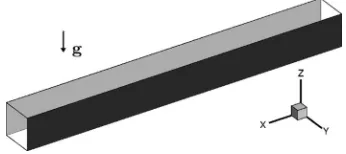
FIG. 2. Sketch of the horizontally extended domain. The boundary conditions on the square cross-section are no-slip, with no-flux conditions for the temperature and concentration on thez-walls,T=C=0 aty=0 (section represented in light gray) andT=C=1 aty=1 (section represented in dark gray). The boundary conditions on thex-walls may be either periodic or no-slip/no-flux.
The fluid is confined within a domain of square cross-section, extended in the ˆx direction as sketched in Fig.2, and subject to the boundary conditions
aty=0 : u=v=w=T =C=0, (11)
aty=1 : u=v=w=T −1=C−1=0, (12)
atz= {0,1}: u=v=w=∂zT =∂zC=0. (13)
We use two sets of boundary conditions atx=0,L, whereL1 is the nondimensional length of the enclosure in the horizontal direction, closed container boundary conditions (CCBC),
atx= {0,L}: u=v=w=∂xT =∂xC=0, (14)
and periodic boundary conditions (PBC) atx=0,L. In both cases, Eqs.(6)–(9)with the corresponding boundary conditions admit a conduction solution (u, v, w,T,C)=(0,0,0,y,y). The symmetry properties of the flow that results from the loss of stability of this state are found by setting =T
−yand=C−y. Since the buoyancy force lies in the vertical direction the system is equivariant under the following reflections:
Sx : (x,y,z)→(L−x,y,z), (u, v, w, , )→(−u, v, w, , ), (15)
S: (x,y,z)→(x,1−y,1−z), (u, v, w, , )→ −(−u, v, w, , ). (16)
It follows that with closed container boundary conditions, the equations areD2-equivariant,27 with
D2 = {I,Sx,S,Sc}, where I is the identity operator and Sc = Sx ◦ S = S ◦ Sx represents centro-symmetry. With periodic boundary conditions, the system is also equivariant with respect to continuous translationsTx inxmodulo the periodL. The system is now equivariant with respect to a different symmetry group: O(2) × Z2, where O(2)= {I,Sx,Tx}and Z2= {I,S}.27 The
consequences of this change in symmetry are substantial and are discussed below.
The equations are solved for the same parameters as used in Ref.23, viz.,Pr=1 andτ=1/11. To allow localized solutions to develop in the domain we choose a large aspect ratio domain,L=21. We compute bifurcation diagrams by finding stationary solutions of Eqs.(6)–(9)with the corresponding boundary conditions using a continuation method based on a Newton solver as described in Mamun and Tuckerman.28,29 The time-stepping scheme used is described in Karniadakiset al.30 and the spatial discretisation employs a spectral element method. Further details of the numerical method can be found in Ref. 31. The calculations are carried out using 21 spectral elements each with 13×17×17 Gauss–Lobatto–Legendre nodes.
III. CLOSED CONTAINER
0 0.002 0.004 0.006 0.008 0.01
1500 1700 1900
E
Ra L0
y z
[image:6.612.159.455.91.204.2]y z
FIG. 3. Bifurcation diagram for CCBC showing the vicinity of the primary bifurcation from the conduction state, Ra≈1719, in terms of the kinetic energy Eas a function of the Rayleigh numberRa. The bifurcation is transcritical and generates two branches of solutions. Of these, the subcritical branchL0contains localized states while the supercritical
branch consists of spatially extended states. The left (Ra≈1649) and right (Ra≈1771) panels show, respectively, the isovalues of the vertical velocitywin the central cross-section on the subcritical and supercritical parts of theL0branch, dark
(light) shading indicating positive (negative) velocity.
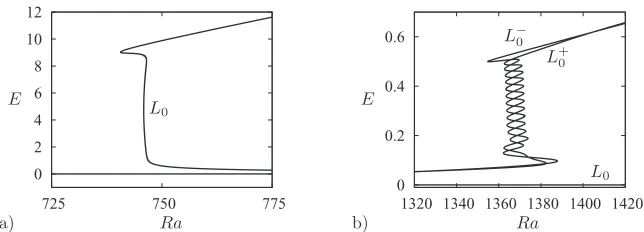
vertically extended domains.32Thus the first bifurcation from the conduction state occurs at a larger Rayleigh number,Ra≈1719, a value similar to the 2D resultRa≈1717.24.33 This bifurcation, shown in Fig.3, is transcritical and generates the (subcritical) branchL0of localized solutions shown
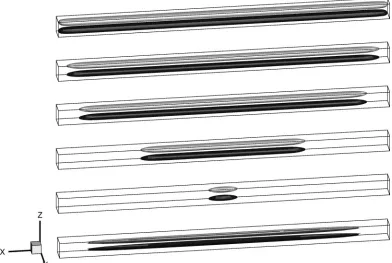
in Fig.4(a). Snapshots taken alongL0are shown in Fig.5. The figure shows that the growth of the
instability leads to a single roll localized at the center of the domain. The no-slip boundary conditions suppress the growth nearx=0,Land the resulting modulation increases rapidly with decreasingRa leading to a strongly localized state by the timeRareachesRa≈746. By this point, the amplitude of the convection has reached saturation and the structure begins to lengthen again. As a result, its energy undergoes a rapid increase but no snaking takes place. This is because the structure between the fronts on either side is spatially homogeneous – fronts cannot pin to a homogeneous state. Once the structure almost fills the enclosure the growth phase terminates and the branch turns towards larger values ofRa. Thus the localized states turn continuously into a spatially extended structure of almost uniform amplitude except for the vicinity of the endwalls atx =0, L. As described by Mercaderet al.18 this is a consequence of the no-slip boundary conditions imposed at the end walls.
Supercritical secondary instabilities occur along the lower part of L0 at Ra ≈ 1224 and
Ra≈1226 (bifurcations not shown). The marginal modes responsible for these instabilities both breakSand hence create pitchforks. The resulting branches are labeled L−0 andL+0 in Fig.4(b). The former branch breaksScbut remainsSx-symmetric while the latter breaksSxbut preservesSc.
0 2 4 6 8 10 12
725 750 775
0 0.2 0.4 0.6
1320 1340 1360 1380 1400 1420 L0
L0 L−
0 L+
0
a) b)
E
Ra E
Ra
[image:6.612.144.466.584.700.2]FIG. 5. Snapshots of localized states on theL0branch. From bottom to top: representation of the marginal eigenmode and
of the solution atRa≈752, followed by the solutions at each of the three saddle-nodes, ending with the solution atRa≈851 along the upper part of the branch. The flow is represented using two isovalues of theyvelocity,v= ±V, withV chosen appropriately (light indicatesv= −V <0 while dark indicatesv=V >0). A different value ofVis used for the marginal eigenmode in the lowest panel.
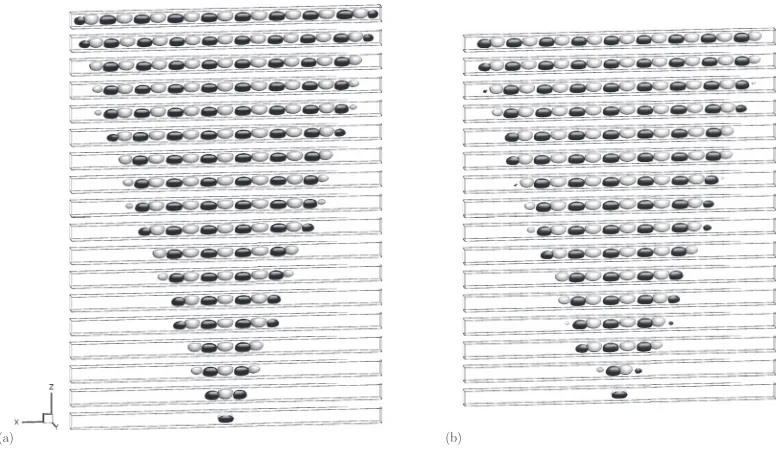
BothL−0 andL+0 undergo snaking betweenRa≈1363 andRa≈1374 before turning supercritical and hence are similar to the secondary snaking branches described in Ref.23. Figure6shows theL0
solution at bifurcation (lowest panels) followed by the solutionsL∓0 at successive saddle-nodes in the snaking region. Since the secondary instability takes place on the lower part of theL0branch the
bi-furcating solutions take the form of a strongly localized but weak convective structure. This structure consists of a single roll with upflow near they=1 wall and downflow neary=0. With increasing Ra, this roll splits. AlongL−0 the upflow region splits into two upflow regions separated by a region of weak upflow while the downflow region remains essentially unchanged. At the same time theu velocity builds up inside the virtually two-dimensional convective structure whilev oscillates inx (compare the middle panel of Fig.7with Fig.5). The combination of these effects twists the primary roll around the vertical axis by a finite angle by the time the system reaches the first saddle-node (Fig. 4(b)) as represented in the second panel from bottom in Fig. 6(a). Thereafter the structure nucleates twisted rolls on either side in the usual fashion and the structure grows until the enclosure is filled (Fig.6(a)). Thus allL−0 states contain an even number of twisted rolls (Fig.7) and the growth of the structure is associated with front pinning and hence snaking. During this growth process the axes of the cells remain horizontal but rotate about the vertical axis and this rotation alternates from one roll to the next, generating a zigzag array of convection cells. Figure7reveals the twisted character of theL−0 solution in terms of the three velocity fieldsu,v,andw.
In contrast, the break-up process along theL+0 branch leads instead to states with an odd number of convection cells (Fig.6(b)) but with a similar zigzag structure. Once the enclosure is filled (this occurs with 18 cells onL−0 and 17 cells onL+0) both branches exit the snaking region and transform continuously into larger amplitude branches of almost periodic states. However, all of these states have very small energy relative to the corresponding states on the upper part of theL0branch. Both
(a) (b)
FIG. 6. Snapshots of the localized states lying on (a) theL−0 branch and (b) theL+0 branch. From bottom to top: representation of the solution at the branching point onL0followed by the solutions at each subsequent saddle-node along the branch and
ending with a solution taken on the upper part of the snaking branch atRa≈1380. The flow is represented by two isovalues of thezvelocity,w= ±W, withWchosen appropriately (light indicatesw= −W<0 while dark indicatesw=W>0).
IV. PERIODIC DOMAIN
It is of interest to compare the above results with the corresponding results for periodic boundary conditions in the ˆxdirection. The change in the boundary condition preserves the conduction solution but the corresponding primary instability now creates a strictly two-dimensional convection roll that is invariant in the ˆxdirection. ThisTx-invariant solution does not break any of the symmetries of the system and is, therefore, created through a transcritical bifurcation atRa≈1716.2. The bifurcation generates a stable supercritical branch and a once unstable subcritical branch. We focus here on the latter.
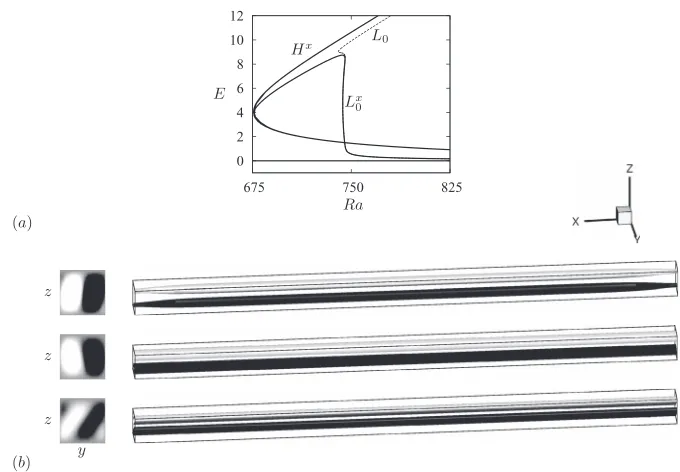
Figure8 represents the bifurcation diagram for the subcritical branch and compares it to the results from Sec.III. The subcritical branch ofx-invariant states, calledHx, turns around at a saddle-node atRa≈676 before extending to large energy at high Rayleigh numbers. Along this branch, a Tx-breaking bifurcation occurs at small amplitude creating a branchLx
0of spatially modulated states.
As one moves away from the bifurcation point, the modulation strengthens, forming a pair of fronts that localize the solution in space. The branchLx
0follows the same evolution as its analogueL0in the
closed container case, growing in energy in the vicinity ofRa≈746 (Fig.8). At the lower end the solutions consist of a single roll localized in the center of the domain. This roll expands continuously
[image:8.612.123.485.609.690.2]u v w
0 2 4
675 750 825 Ra
(a)
z
z
z y
(b)
FIG. 8. (a) Bifurcation diagram representing the kinetic energyEas a function of the Rayleigh numberRaalong branchL0
(dashed line) for a closed container, andHxandLx0(solid lines) for a periodic container. The branchHxbifurcates from the
conduction solutionE=0 and consists of solutions invariant in thexdirection. The branchLx
0of localized states bifurcates
fromHxand is similar to the branchL
0in the closed container, but unlikeL0it terminates onHxclose to its saddle-node
instead of extending towards higher Rayleigh numbers. (b) From bottom to top: snapshot alongHxatRa≈1485 (lower part ofHx
0), atRa≈1462 (upper part ofHx) and alongLx0atRa≈685. Left slices represent isovalues of the vertical velocityw
in the planex=L/2 while the right snapshots represent isosurfaces of opposite values of they-velocity (dark:v >0, light:
v <0).
in thexdirection as the branch grows in energy, much as the corresponding solutions in Fig.5. Near the top of the branch, the roll state has expanded to fill the domain and subsequent evolution depends on the boundary conditions atx=0,L. With no-slip boundary conditions, defects are present at either boundary (Fig.5) andL0turns towards larger Rayleigh numbers and larger amplitudes. In contrast,
with periodic boundary conditions no defects are created (after all, the domain is translation-invariant in thexdirection) andL0 instead turns towards smaller Rayleigh numbers and terminates on the
two-dimensional stateHxclose to its saddle-node. This is as expected since it is known that a branch of spatially modulated states bifurcates from folds of spatially homogeneous states.34
It is noteworthy that the branchLx
0followsL0very closely during its abrupt growth phase, i.e.,
while the solutions remain localized away from the boundaries (Fig.8). With PBC the first tertiary bifurcations fromLx0are located atRa≈1218 (L0x−) andRa≈1220 (Lx0+) and these create branches Lx0∓of twisted rolls (Fig.9(a)). Like the corresponding bifurcations fromL0(atRa≈1224 (L−0) and
[image:9.612.132.472.87.323.2]0 0.2 0.4 0.6
1320 1340 1360 1380 1400 1420
0 0.2 0.4 0.6
1150 1200 1250 1300 1350 1400 L±
0
Lx± 0
Lx
0 Hx
Px
Lx± 0
(a) (b)
E
Ra E
Ra
FIG. 9. (a) Bifurcation diagram representing the kinetic energyEas a function of the Rayleigh numberRafor the branches of twisted localized states with no-slip (L±0, dashed lines) and periodic (Lx0±, full lines) boundary conditions. (b) Bifurcation diagram for the twisted localized statesLx0±with PBC:Lx0±emerge from a branch of homogeneous localized statesLx
0and
terminate on a branch of periodic twisted statesPx. The latter bifurcates from the branchHxof 2D states connectingPx andLx0.
bifurcation of thePxstate leading to spatial modulation of thePxstate on the scale of the domain and agrees with the results of linear stability analysis of thePxstate, viz.,Ra≈1269. However, the Pxstate is unstable on either side of this termination point, owing to the presence of other unstable eigenvalues.
V. DISCUSSION
We have computed in this paper two new types of convectons in natural doubly diffusive convection. These solutions are present in a horizontally extended domain with a square cross-section driven by imposed temperature and concentration differences in the horizontal. The first type is a localized, almost two-dimensional structure bounded by a pair of fronts connecting the structure to the conduction state, resembling a two-dimensional roll state with axis along the extended direction. Since both states are spatially homogeneous in the extended direction no front pinning takes place and snaking is, therefore, absent. States of this type expand abruptly in the extended direction near a special point in parameter space corresponding to the formation of a pair of heteroclinic connections between two different fixed points in a spatial dynamics view of the system.26This point, variously referred to as the nonsnaking35or protosnaking36point plays the role of a Maxwell point in systems, like the Swift-Hohenberg equation(1), with gradient dynamics. If the spatial eigenvalues of one of the fixed points are complex the resulting behavior may be termed collapsed snaking.37 Figure11 shows an example of this type of behavior. The figure reveals the presence of a parameter value at which the two coexisting homogeneous states have the same free energyF. As neither state is associated with an intrinsic wavelength fronts between them can be placed in arbitrary positions without changing the value of the functionalF. Thus states of arbitrarily large size are all present at a single value of the bifurcation parameter. The two-dimensional roll state computed here follows the same behavior despite the absence of a free energy for the governing equations, and does so until it reaches a size comparable to the domain size. When the boundaries are no-slip the localized
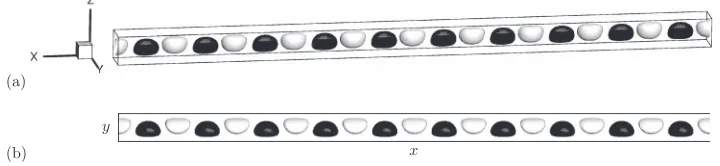
(b) (a)
[image:10.612.146.468.90.206.2]x y
[image:10.612.125.485.610.693.2]-2.5 -2 -1.5 -1
||u||2
r a b
[image:11.612.168.445.88.236.2]a b c
FIG. 11. Same as Fig.1but showing collapsed snaking in a 40πdomain whenν=3.75. The localized structures are fronts connecting two distinct homogeneous states and lie on a branch that grows vertically as the nontrivial stateu=0 invades the domain.
state turns continuously into an extended domain-filling state with defect-like structure at the walls; when periodic boundary conditions are used the defects are absent and the localized states instead terminate on the branch of two-dimensional states. This is as expected since the no-slip boundaries destroy the two-dimensional state.18,20
The same process is repeated for the second type of convecton, the localized twisted states that are produced in tertiary bifurcations from the two-dimensional localized states. Once again, with no-slip boundary conditions the localized states change continuously into extended domain-filling states once they reach the size of the domain, again with defects at the walls. In contrast, with periodic boundary conditions these states instead turn towards smaller Rayleigh numbers and terminate on a periodic state, this time the zigzag twisted roll state. Thus the main difference between these two convecton types is the nonsnaking behavior of the first type and the snaking behavior of the second type. Of course, the latter is the result of pinning of the fronts that bound the convecton to the spatial structure in between and is a direct consequence of the twist instability – without a finite angle twist no pinning would be present and no snaking would take place.
The presence of the tertiary twist instability should come as no surprise. Similar bifurcations are present in a vertically extended domain23and reflect the presence of a related three-dimensional instability present in small domains with no-slip boundary conditions, as described in Ref. 31. Figure12summarizes our results for periodic boundary conditions. The figure highlights an impor-tant fact: the secondary twist bifurcation generating the periodic branchPxdestabilizes the branch Hxat lower Rayleigh numbers. As a result theHxbranch is (at least) three times unstable below this bifurcation and since only two eigenvalues restabilize (one at the termination ofLx
0and the other at
the fold) theHxbranch remains unstable to the twist mode even above the fold. In Ref.31this fact was found to be responsible for the presence of temporal oscillations in a small aspect ratio domain with no-slip boundaries everywhere. These oscillations may be chaotic and appear in the system as a result of a global bifurcation. We have looked for similar behavior in the present system, using direct numerical integration of the governing equations with periodic boundary conditions in the extended dimension, but found none. We believe this to be the consequence of the small extent in the vertical direction that constrains the dynamics and forces the solutions to evolve towards the stable solution lying on the supercritical branch created at the primary instability. To our knowledge this is the first example of a system exhibiting subcritical branches in which the trivial (conduction) solution appears to be a global attractor all the way until the onset of the primary instability – although other systems come close.38
Hx
Px
Lx0
[image:12.612.193.419.96.206.2]Lx0±
FIG. 12. Sketch of the bifurcation scenario for periodic boundary conditions in the extended direction. A typical integral quantity such as the kinetic energy is represented against the Rayleigh number. The bifurcation diagram has been stretched for convenience and is not to scale. Representative solutions alongHx,Px, andLx±
0 are shown in Figs.8(b)and10, and6,
respectively, while those alongLx
0resemble those in Fig.5.
excluding boundary effects as a possible explanation. We believe instead that it is a consequence of the weakly three-dimensional structure of the fronts at either end of the structure associated with weak outward expulsion of concentration gradients. The flow in this region moves the concentration around the axis of the domain alternately sampling fixed flux and fixed concentration boundary conditions. The former enhances concentration pumping39 while the latter suppresses pumping.22 Residual concentration pumping is, therefore, likely to be present and its presence willreducethe background concentration gradient sensed by the convecton. We expect this effect to be proportional to the square of the amplitude of convection and hence linear in the Rayleigh number. In other words, we predict a linear slant of the snaking structure towards lower Rayleigh numbers, independent of the boundary conditions, as observed in the numerically generated bifurcation diagrams.
The physical parameters used in the present study are the same as in Ref.23and it is therefore of interest to compare the two systems. The domain used in Ref.23has a square cross-section in the horizontal and is extended in the vertical direction. In the aforementioned paper the authors found convectons consisting of rolls with horizontal axes exhibiting localization in the vertical direction. In some of these the roll axes are perpendicular to the lateral walls, but in others the axes are rotated in the horizontal direction with the direction of rotation switching from roll to roll, forming a zigzag structure. Solutions of the former type are organized into primary snaking branches while the latter form secondary snaking branches. Thus the vertically extended system exhibits similar states to those found here in the horizontally extended system. In both cases the novel localized structures are present in a Rayleigh number interval straddlingRa≈750 although the primary snake is replaced here by a collapsed snake, a consequence of the near two-dimensionality of the convectons in this regime. Of course, once fully three-dimensional instabilities set in, snaking occurs in the latter case as well although it does so at larger values of the Rayleigh number. Based on these results we anticipate a yet richer variety of localized structures in a horizontally extended cavity with a square cross-section in the horizontal. This geometry will be the subject of future work.40
ACKNOWLEDGMENTS
This work was supported in part by a Chaire d’Excellence Pierre de Fermat de la r´egion Midi-Pyr´en´ees (E.K.) and by the National Science Foundation under Grant No. DMS-1211953 (C.B. and E.K.).
1P. Welander, “A new type of double-diffusive instability?”Tellus41A, 66–72 (1989).
2R. W. Schmitt, “Double diffusion in oceanography,”Annu. Rev. Fluid Mech.26, 255–285 (1994). 3M. E. Stern, “Collective instability of salt fingers,”J. Fluid Mech.35, 209–218 (1969).
4T. Radko, “What determines the thickness of layers in a thermohaline staircase?,”J. Fluid Mech.523, 79–98 (2005). 5E. Knobloch, “Nonlinear diffusive instabilities in differentially rotating stars,”Geophys. Astrophys. Fluid Dyn.22, 133–158
(1982).
6J. M. Brown, P. Garaud, and S. Stellmach, “Chemical transport and spontaneous layer formation in fingering convection
10N. Tsitverblit and E. Kit, “The multiplicity of steady flows in confined double-diffusive convection with lateral heating,”
Phys. Fluids A5, 1062–1064 (1993).
11N. Tsitverblit, “Bifurcation phenomena in confined thermosolutal convection with lateral heating: Commencement of the
double-diffusive region,”Phys. Fluids7, 718–736 (1995).
12S. Xin, P. Le Qu´er´e, and L. S. Tuckerman, “Bifurcation analysis of double-diffusive convection with opposing horizontal
thermal and solutal gradients,”Phys. Fluids10, 850–858 (1998).
13H. E. Huppert and J. S. Turner, “Ice blocks melting into a salinity gradient,”J. Fluid Mech.100, 367–384 (1980). 14D. R. Moore, J. Toomre, E. Knobloch, and N. O. Weiss, “Period doubling and chaos in partial differential equations for
thermosolutal convection,”Nature (London)303, 663–667 (1983).
15E. Knobloch, D. R. Moore, J. Toomre, and N. O. Weiss, “Transition to chaos in two-dimensional double-diffusive
convection,”J. Fluid Mech.166, 409–448 (1986).
16A. E. Deane, E. Knobloch, and J. Toomre, “Traveling waves and chaos in thermosolutal convection,”Phys. Rev. A36,
2862–2869 (1987).
17K. Ghorayeb and A. Mojtabi, “Double diffusive convection in a vertical rectangular cavity,”Phys. Fluids9, 2339–2348
(1997).
18I. Mercader, O. Batiste, A. Alonso, and E. Knobloch, “Localized pinning states in closed containers: Homoclinic snaking
without bistability,”Phys. Rev. E80, 025201 (2009).
19I. Mercader, O. Batiste, A. Alonso, and E. Knobloch, “Convectons in periodic and bounded domains,”Fluid Dyn. Res.42,
025505 (2010).
20I. Mercader, O. Batiste, A. Alonso, and E. Knobloch, “Convectons, anticonvectons and multiconvectons in binary fluid
convection,”J. Fluid Mech.667, 586–606 (2011).
21A. Bergeon and E. Knobloch, “Spatially localized states in natural doubly diffusive convection,”Phys. Fluids20, 034102
(2008).
22C. Beaume, A. Bergeon, and E. Knobloch, “Homoclinic snaking of localized states in doubly diffusive convection,”Phys.
Fluids23, 094102 (2011).
23C. Beaume, A. Bergeon, and E. Knobloch, “Convectons and secondary snaking in three-dimensional natural doubly
diffusive convection,”Phys. Fluids25, 024105 (2013).
24J. Burke and E. Knobloch, “Snakes and ladders: Localized states in the Swift–Hohenberg equation,”Phys. Lett. A360,
681–688 (2007).
25J. Burke and E. Knobloch, “Homoclinic snaking: Structure and stability,”Chaos17, 037102 (2007).
26D. Avitabile, D. J. B. Lloyd, J. Burke, E. Knobloch, and B. Sandstede, “To snake or not to snake in the planar Swift–
Hohenberg equation,”SIAM J. App. Dyn. Syst.9, 704–733 (2010).
27J. D. Crawford and E. Knobloch, “Symmetry and symmetry-breaking bifurcations in fluid mechanics,”Annu. Rev. Fluid
Mech.23, 341–387 (1991).
28L. S. Tuckerman, “Steady-state solving via Stokes preconditioning: Recursion relations for elliptic operators,” in11th
International Conference on Numerical Methods in Fluid Dynamics, Lecture Notes in Physics Vol. 323, edited by D. Dwoyer, M. Hussaini, and R. Voigt (Springer, Berlin, 1989), pp. 573–577.
29C. K. Mamun and L. S. Tuckerman, “Asymmetry and Hopf bifurcation in spherical Couette flow,”Phys. Fluids7, 80–91
(1995).
30G. E. Karniadakis, M. Israeli, and S. A. Orszag, “High-order splitting methods for the incompressible Navier–Stokes
equations,”J. Comput. Phys.97, 414–443 (1991).
31A. Bergeon and E. Knobloch, “Natural doubly diffusive convection in three-dimensional enclosures,”Phys. Fluids14,
3233–3250 (2002).
32D. Henry and H. Ben Hadid, “Multiple flow transitions in a box heated from the side in low-Prandtl-number fluids,”Phys.
Rev. E76, 016314 (2007).
33A. Bergeon, K. Ghorayeb, and A. Mojtabi, “Double diffusive instability in an inclined cavity,”Phys. Fluids11, 549–559
(1999).
34J. Burke, A. Yochelis, and E. Knobloch, “Spatially localized oscillating states in periodically forced dissipative systems,”
SIAM J. Appl. Dyn. Syst.7, 651–711 (2008).
35J. Knobloch and T. Wagenknecht, “Homoclinic snaking near a heteroclinic cycle in reversible systems,”Physica D206,
82–93 (2005).
36H.-C. Kao and E. Knobloch, “Weakly subcritical stationary patterns: Eckhaus instability and homoclinic snaking,”Phys.
Rev. E85, 026211 (2012).
37Y.-P. Ma, J. Burke, and E. Knobloch, “Defect-mediated snaking: A new growth mechanism for localized structures,”
Physica D239, 1867–1883 (2010).
38O. Batiste, E. Knobloch, I. Mercader, and M. Net, “Simulations of oscillatory binary fluid convection in large aspect ratio
containers,”Phys. Rev. E65, 016303 (2001).
39O. Batiste, E. Knobloch, A. Alonso, and I. Mercader, “Spatially localized binary-fluid convection,”J. Fluid Mech.560,
149–156 (2006).
40Z.-W. Chen, J.-M. Zhan, Y.-S. Li, Y.-Y. Luo, and S. Cai, “Double-diffusive buoyancy convection in a square cuboid with