Institute (PCORI).
.
White Rose Research Online URL for this paper:
http://eprints.whiterose.ac.uk/136305/
Version: Published Version
Monograph:
Claxton, Karl Philip orcid.org/0000-0003-2002-4694, Griffin, Susan
orcid.org/0000-0003-2188-8400, Koffijberg, H et al. (1 more author) (2013) Expected
health benefits of additional evidence : Principles, methods and applications. A white paper
for the Patient-Centered Outcomes Research Institute (PCORI). Research Report. CHE
Research Paper . Centre for Health Economics, University of York , York, UK.
[email protected] https://eprints.whiterose.ac.uk/
Reuse
Items deposited in White Rose Research Online are protected by copyright, with all rights reserved unless indicated otherwise. They may be downloaded and/or printed for private study, or other acts as permitted by national copyright laws. The publisher or other rights holders may allow further reproduction and re-use of the full text version. This is indicated by the licence information on the White Rose Research Online record for the item.
Takedown
If you consider content in White Rose Research Online to be in breach of UK law, please notify us by
E
xpected Health Benefits of Additional Evidence:
Principles, Methods and Applications
Expected health benefits of additional evidence:
Principles, methods and applications
1,2
Karl Claxton
2
Susan Griffin
3
Hendrik Koffijberg
2
Claire McKenna
1
Department of Economics and Related Studies, University of York, UK
2
Centre for Health Economics, University of York, UK
3
Julius Centre for Health Sciences and Primary Care, University Medical Centre Utrecht, The Netherlands
research material more widely available to health economists and other potential users. So as to speed up the dissemination process, papers were originally published by CHE and distributed by post to a worldwide readership.
The CHE Research Paper series takes over that function and provides access to current research output via web-based publication, although hard copy will continue to be available (but subject to charge).
Acknowledgements
The research presented in this report was funded by the Patient-Centered Outcomes Research Institute (PCORI) in the United States. We are very grateful to PCORI for the opportunity to develop this work and present it at the PCORI Methodology Workshop for Prioritizing Specific Research Topics, which took place in Washington in December 2012. Hendrik Koffijberg was also supported by the Netherlands Organization for Scientific Research (NWO, VENI grant # 916.11.126). We would especially like to thank Iain Chalmers who over very many years has patiently encouraged us to try and make value of information analysis more easily accessible, with concepts expressed and analysis presented in ways that can engage with a wider audience and remain relevant and useful even in contexts where formal cost-effectiveness analysis may not be accepted as an important starting point for decision about health care technologies. We would also like to thank Ian Roberts for his generous advice when we started to develop our analysis of the CRASH trial prior to this research for PCORI. This initial work was supported by Medical Research Council Programme Grant as part of the Health Services Research Collaboration.
Disclaimer
Papers published in the CHE Research Paper (RP) series are intended as a contribution to current research. Work and ideas reported in RPs may not always represent the final position and as such may sometimes need to be treated as work in progress. The material and views expressed in RPs are solely those of the authors and should not be interpreted as representing the collective views of CHE research staff or their research funders. Specifically, the views expressed in this Research Report do not necessarily represent those of the Patient-Centered Outcomes Research Institute (PCORI).
Further copies
Copies of this paper are freely available to download from the CHE website
www.york.ac.uk/che/publications/ Access to downloaded material is provided on the
understanding that it is intended for personal use. Copies of downloaded papers may be distributed to third-parties subject to the proviso that the CHE publication source is properly acknowledged and that such distribution is not subject to any payment.
Printed copies are available on request at a charge of £5.00 per copy. Please contact the CHE Publications Office, email [email protected], telephone 01904 321405 for further details.
Centre for Health Economics Alcuin College, University of York York, UK
www.york.ac.uk/che
Contents
Abstract... ii
Executive summary... iii
1. Introduction... 1
2. Background... 2
3. What assessments are needed?... 3
3.1 Value of evidence and the value of implementation... 3
3.2 Minimum clinical difference ... 4
3.3 Assessments in different contexts ... 5
3.4 Variability in patient outcomes and individualized care... 5
4. How might these assessments be informed?... 7
4.1 Primary endpoint captures key aspects of outcome ... 7
4.1.1 Value of additional evidence... 8
4.1.2 Value of implementation ... 12
4.1.3 Minimum clinical difference ... 15
4.2 Primary endpoint linked to other aspects of outcome... 16
4.2.1 Value of additional evidence about mortality ... 17
4.2.2 Value of additional evidence about survival and disability ... 18
4.2.3 Assessing the value and priority of proposed research ... 19
4.2.4 Informing research design ... 22
4.2.5 Impact of commissioned research... 22
4.3 Different weights to reflect the relevance of evidence ... 23
4.3.1 Reflecting the relevance of evidence in meta-analysis... 24
4.3.2 Implications for the value of additional evidence ... 25
4.4 More than two alternative interventions need to be compared ... 26
4.4.1 Synthesis of evidence with multiple comparisons... 27
4.4.2 Implications for the value of additional evidence ... 30
Abstract
The purpose of this research is to illustrate: i) the principles of what assessments are required when considering the need for additional evidence and the priority of proposed research; and ii) how these assessments might be informed by quantitative analysis based on standard methods of systematic review and meta-analysis.
We briefly outline the principles of what type of assessments are needed when considering research prioritization and commissioning. These are more fully examined through the integration of the principles of value of information analysis with the type of meta-analysis commonly conducted in systematic review and its application to four topics or case studies. The case studies were selected to cover a number of contexts in which these assessments are likely to be required and include: where the primary endpoint in existing studies capture key aspects of outcome; where it can be linked to other important aspects of outcome; when different ‘weights’ might be used to reflect the relevance and quality of different studies and when more than two alternative interventions need to be compared. Throughout, we distinguish the value of additional evidence and the value of implementing the findings from existing research. We also show how the value of additional evidence and the need for further research depends on the clinical difference in key aspects of outcome that would need to be demonstrated before clinical practice ‘should’ or is likely to change. We also consider whether the expected health benefits of additional evidence are sufficient to regard a particular research proposal as potentially worthwhile and whether it should it be prioritized over other research topics that could have been commissioned with the same resources. We also set out the implications of this type of analysis for research design, including whether randomised design is likely to be needed, the most appropriate scale of future research and the sequence in which different types of study might be undertaken.
Executive summary
This report presents a paper commissioned by PCORI which was presented and discussed at Methodology Workshop for Prioritizing Specific Research Topics in December 2012. As such it is intended to be accessible to a non specialist and non technical audience. It is not intended to be an academic review of value of information or research prioritization methods nor the experiences of its application in health. For this reason and to avoid any appearance of partiality in citation, the referencing is restricted to the sources of evidence and meta-analytic methods required in the Technical Appendices.
We show through application to four case studies how the assessments needed are reflected in the quantitative analysis, so judgement and deliberation can be informed through a relatively simple extension of standard methods of meta-analysis. We have taken it for granted that any topic suggestion or specific research proposal will include a systematic review of existing evidence and, where appropriate, a meta-analysis; since funding additional research without knowledge of existing evidence would seem inappropriate and potentially unethical if an experimental research design is required. Although extending meta-analysis in the way described above is not technically challenging, nor does it pose particular computational problems, there may be an issue of familiarity with the principle that it is the consequences of uncertainty that matters, rather than the precision with which quantities can be estimated.
The following principles of what assessments are required when considering the need for additional evidence and the priority of proposed research, help inform whether the expected health benefits of additional evidence are sufficient to regard a particular research proposal as potentially worthwhile and whether it should it be prioritized over other research topics that could have been commissioned with the same resources. These principles are more practically illustrated and explained in each of the case studies presented in Section 4.
Value of evidence and the value of implementation
Additional evidence is valuable because it can improve patient outcomes by resolving existing uncertainty about the effectiveness of the interventions available, thereby informing treatment choice for subsequent patients. The scale of uncertainty is indicated by the results of systematic review and meta-analysis, so when this is combined with information about baseline risk and incidence, the expected consequences of uncertainty can be expressed in terms of health outcomes. These expected consequences can be interpreted as an estimate of the health benefits that could potentially be gained each year if the uncertainty surrounding treatment choice could be resolved, i.e., it indicates an expected upper bound on the health benefits of further research which would confirm whether or not an intervention is actually more effective than the others currently available.
Health outcomes can also be improved by ensuring that the accumulating findings of research are implemented and has an impact on clinical practice. Indeed, the potential improvements in health outcome by encouraging the implementation of what existing evidence suggests is the most effective intervention may well exceed the potential improvements in health outcomes through conducting further research.
importance of implementing the findings of proposed research might influence consideration of its priority and research design in a number of ways. If it is very unlikely that findings will be implemented and other mechanisms are unlikely to be effective, then other areas of research where smaller potential benefits are more likely to be realized might be prioritized. If the impact of research on clinical practice is likely to require highly statistically significant results this will influence the design, cost and time taken for research to report and therefore its relative priority (see Section 4.2.4). It maybe that a larger clinical difference in effectiveness would need to be demonstrated before research would have impact on practice (see Section 4.1.3, 4.3.2 and 4.4.2). This will tend to reduce the potential benefits of further research because larger differences are less likely to be found than smaller ones.
Minimum clinical difference
The concept of a minimum clinical difference (MCD) required to change practice (effect size) is used throughout the analysis in Section 4, where estimates of the expected health benefits of additional evidence are calculated for a range of MCD. It shows how the value of additional evidence and the need for further research depends on the clinical difference in key aspects of outcome that would be need to be demonstrated before clinical practice ‘should’ or is likely to change (see Sections 4.1.3, 4.3.2 and 4.4.2. Although any improvement in health outcomes is valuable (i.e., a minimum clinical difference close to zero) there are a number of reasons why a larger difference might be required:
i. Where the quantitative analysis is restricted to the primary endpoint reported in existing clinical trials but there other important aspects of outcome that are not captured in this endpoint (e.g., adverse events or quality of life impacts).
ii. When there may be an adverse impact on heath system performance; for example, an intervention may increase need for other services or increase out of pocket expenses for patients.
iii. It maybe that in some topics a larger clinical difference in effectiveness would need to be demonstrated before research would have an impact on practice and the findings of proposed research would be widely implemented.
Specifying an MCD implicitly accounts for the other unquantified aspects of outcome and impacts on system performance through a deliberative process which would need to consider whether proposed research is still a priority at an MCD that is regarded as sufficient to account for these other effects.
Variability in patient outcomes and individualized care
We make a clear distinction between uncertainty, variability and heterogeneity at the outset. Uncertainty refers to the fact that we do not know what the expected effects will be of using an intervention in a particular population of patients (i.e., the effects of an intervention on average). Variability refers to the fact that individual responses to an intervention will differ within the population or even in a sub population of patients with the same observed characteristics. Heterogeneity refers to those individual differences in response that can be associated with differences in observed characteristics, i.e., where the sources of natural variability can be identified and understood.
of effect is necessarily reduced (the same amount of evidence offers fewer observations in each subgroup) but the uncertainty about which intervention is most effective may be reduced in some (e.g., where it is particularly effective or positively harmful) but increase in others.
We don’t include an examination of subgroups in Section 4, but in principle same type of analysis can be applied within each subgroup identified based on existing evidence. Nor do we directly address the potential value of research which might reveal the reasons for variability in outcome; informing which subgroups could benefit most from an intervention, or the choice of the physician patient dyad in selecting care given their symptoms, history and preferences (i.e., individualized care). This type of research may be very different from the type of evaluative research that reduces uncertainty about estimates of effect. For example, it might include: diagnostic procedures and technologies; pharmacogenetics; analysis of observational data and treatment selection; as well as novel trial designs which can reveal something of the joint distribution of effects.
Assessments in different contexts
How these key assessments might be informed by quantitative analysis is examined though application to case studies in the following four contexts that are likely to arise in a body responsible for research prioritisation, considers suggested topics and specific research proposals.
i. Primary endpoint in the meta analysis captures key aspects of outcome (see Section 4.1 and Appendix A)
ii. Primary endpoint in the meta analysis needs to be linked to other aspects of outcome (see Section 4.2 and Appendix B)
iii. Different weights to reflect the relevance and potential bias of existing evidence (see Section 4.3 and Appendix C)
iv. More than two alternative interventions need to be compared (see Section 4.4 and Appendix D)
Four case studies were selected to cover these four different contexts:
i. Early thrombolysis using streptokinase for the treatment of acute myocardial infarction (see Section 4.1 and Appendix A)
ii. Corticosteroids following traumatic head injury (see Section 4.2 and Appendix B)
iii. Probiotics in patients with severe acute pancreatitis (SAP) (see Section 4.3 and Appendix C) iv. Topotecan, PLDH and paclitaxxel for second-line treatment of advanced ovarian cancer (see
Section 4.4 and Appendix D)
Each case study is used to illustrate methods of analysis and appropriate interpretation of the results, including the type of scientific value judgments that are required, in one of these four contexts. The case studies were also selected to cover the different types of meta-analysis that are likely to be required and highlight some of the dangers of: focusing only on a single primary endpoint (see Section 4.2); inappropriate use of a random effect analysis (see Section 4.2 and 4.3); and failing to include the whole network of evidence (see Section 4.4).
Considerations
quite reasonably disputed. The more relevant question is whether they offer a practical and useful starting point for deliberation and add to the transparency and accountability of the decision making process. It is on this basis that the usefulness of more explicit and quantitative analysis ought to be judged. We believe their potential usefulness in a range of decision making context has been demonstrated, so long as the results are appropriately interpreted and the limitations of the analysis are understood and explored.
1.
Introduction
The purpose of this paper is to illustrate:
i. the principles of what assessments are required when considering the need for additional evidence and the priority of proposed research; and
ii. how these assessments might be informed by quantitative analysis based on standard methods of systematic review and meta-analysis.
We briefly outline the principles of what type of assessments are needed when considering research prioritization and commissioning (see Section 3). These principles are more fully examined through the integration of the principles of value of information analysis with the type of meta-analysis commonly conducted in systematic review and its application to four topics or case studies (see Section 4). The case studies were selected to cover a number of contexts in which these assessments are likely to be required and include: where the primary endpoint in existing studies capture key aspects of outcome (see Section 4.1); where it can be linked to other important aspects of outcome (see Section 4.2); when different ‘weights’ might be used to reflect the relevance and quality of different studies (see Section 4.3) and when more than two alternative interventions need to be compared (see Section 4.4).
Throughout, we distinguish the value of additional evidence and the value of implementing the findings from existing research. We also show how the value of additional evidence and the need for further research depends on the clinical difference in key aspects of outcome that would need to be demonstrated before clinical practice ‘should’ or is likely to change. In section 4.2.3 we consider in more detail whether the expected health benefits of additional evidence are sufficient to regard a particular research proposal as potentially worthwhile and whether it should it be prioritized over other research topics that could have been commissioned with the same resources. We also set out the implications of this type of analysis for research design, including whether randomised design is likely to be needed, the most appropriate scale of future research and the sequence in which different types of study might be undertaken.
2.
Background
This paper is intended to be accessible to a non specialist and non technical audience. It is not intended to be an academic review of value of information or research prioritization methods nor the experiences of its application in health.1 Nonetheless it draws on a well developed and diverse methodological literature published in journals that cover related disciplines, such as: medical statistics, health economics, epidemiology; and operations research, as well as risk and decision science. The principles have a firm foundation in statistical decision theory with closely related concepts and methods in mathematics and financial economics with diverse applications in business decisions, engineering, environmental risk analysis and financial and environmental economics. There are now many applications in health, some commissioned to directly inform policy and others published in specialist as well as general medical and health policy journals.
We show through application to four case studies how each of the types of assessment required can be reflected in quantitative analysis, so judgement and deliberation can be informed through a relatively simple extension of standard methods of meta-analysis. We have taken it for granted that any topic suggestion or specific research proposal will include a systematic review of existing evidence and, where appropriate, a meta-analysis; since funding additional research without knowledge of existing evidence would seem inappropriate and potentially unethical if an experimental research design is required. Although extending meta-analysis in the way described above is not technically challenging, nor does it pose particular computational problems, there may be an issue of familiarity with the principle that it is the consequences of uncertainty that matters, rather than the precision with which quantities can be estimated (and possibly methods of simulation), amongst some of those who commonly conduct systemic reviews. Some of the contexts that are examined in Section 4 also required more sophisticated forms of meta-analysis, e.g., Bayesian meta-analysis in Section 4.2 and a mixed treatment comparison evidence synthesis in Section 4.4. These methods were not made necessary because of the need to consider the expected benefits of additional evidence, but would be required in any event to provide an appropriate estimate of effectiveness based on all the evidence then available.
1
3.
What assessments are needed?
The following principles of what assessments are required when considering the need for additional evidence and the priority of proposed research, help inform whether the expected health benefits of additional evidence are sufficient to regard a particular research proposal as potentially worthwhile and whether it should it be prioritized over other research topics that could have been commissioned with the same resources. We only briefly outline these principles here as they are more practically illustrated and explained in each of the case studies presented in Section 4.
3.1
Value of evidence and the value of implementation
Additional evidence is valuable because it can improve patient outcomes by resolving existing uncertainty about the effectiveness of the interventions available, thereby informing treatment choice for subsequent patients. For example, the balance of existing evidence might suggest that a particular intervention is expected to be the most effective, but there will be a chance that others are in fact more effective. If treatment choice is based on existing evidence then there will be a chance that other interventions would have improved health outcomes to a greater extent, i.e., there are adverse health consequences associated with uncertainty. The scale of uncertainty is indicated by the results of systematic review and meta-analysis, so when this is combined with information about baseline risk and incidence, the expected consequences of uncertainty can be expressed in terms of health outcomes. These expected consequences can be interpreted as an estimate of the health benefits that could potentially be gained each year if the uncertainty surrounding treatment choice could be resolved, i.e., it indicates an expected upper bound on the health benefits of further research which would confirm whether or not this intervention was actually more effective than the others currently available. These potential expected benefits increase with the size of the patient population whose treatment choice can be informed by additional evidence and the time over which evidence about the effectiveness of these interventions is expected to be useful (see Section 4.2.3).
Health outcomes can also be improved by ensuring that the accumulating finding of research is implemented and has an impact on clinical practice. Indeed, the potential improvements in health outcome by encouraging the implementation of what existing evidence suggests is the most effective intervention may well exceed the potential improvements in health outcomes through conducting further research.
The distinction between these two very different ways to improve patient outcomes is important because, although the results of additional research may influence clinical practice and may contribute to the implementation of research finding, it is certainly not the only, or necessarily the most effective, way to do so. Insofar as there are other mechanisms (e.g., more effective dissemination of existing evidence) or policies which fall within the remit of other bodies (e.g., incentives and sanctions),2then continuing to conduct research to influence implementation rather than because there is real value in acquiring additional evidence itself would seem inappropriate, because research capacity could have been used elsewhere to acquire additional evidence in areas where it would have offered greater potential health benefits and such a policy will have negative health effects for those patients enrolled in research who will receive interventions which are expected to be less effective.
Clearly, the potential health benefits of conducting further research will only be realized (patient outcomes actually improve) if the findings of the research do indeed have an impact on clinical
2
practice. Again, recognition that there are very many ways to influence the implementation of evidence, other than by conducting more research, is important. However, the importance of implementing the findings of proposed research might influence consideration of its priority and research design in a number of ways. If it is very unlikely that findings will be implemented and other mechanisms are unlikely to be effective, then other areas of research where smaller potential benefits are more likely to be realized might be prioritized. If the impact of research on clinical practice is likely to require highly statistically significant results this will influence the design, cost and time taken for research to report and therefore its relative priority (see Section 4.2.4). It maybe that a larger clinical difference in effectiveness would need to be demonstrated before research would have impact on practice (see Section 4.1.3, 4.3.2 and 4.4.2). This will tend to reduce the potential benefits of further research as well (a large difference is less likely to be found than a small one).
3.2
Minimum clinical difference
The concept of an effect size has been central to the design of clinical research and determines the sample size in most clinical trials. The effect size does not represent what is expected to be found by the research, but the difference in outcomes that would need to be detected for the results to be clinically significant and have an impact on clinical practice. The same concept is used throughout the analysis in Section 4, where estimates of the expected heath benefits of additional evidence are calculated for a range of minimum clinical differences (MCD) in outcomes. It shows how the value of additional evidence and the need for further research depends on the clinical difference in key aspects of outcome that would be need to be demonstrated before clinical practice ‘should’ or is likely to change (see Sections 4.1.3, 4.3.2 and 4.4.2 and the Technical Appendix). Although any improvement in health outcomes is valuable (i.e., a minimum clinical difference close to zero) there are a number of reasons why a non zero MCD might be appropriate.3 For example larger differences might be required in the following circumstances:
i. Where the quantitative analysis is restricted to the primary endpoint reported in existing clinical trials but there other important aspects of outcome that are not captured in this endpoint (e.g., adverse events or quality of life impacts4). In Section 4.2.2 we illustrate how other important aspects of outcome might be more explicitly incorporated into quantitative analysis.
ii. When there may be an adverse impact on heath system performance; for example, an intervention may increase need for other services or increase out of pocket expenses for patients.
iii. It maybe that in some topics a larger clinical difference in effectiveness would need to be demonstrated before research would have an impact on practice and the findings of proposed research would be widely implemented.
Requiring that further research must demonstrate larger differences in effect will tend to reduce its expected potential benefits because large differences are less likely to be found than smaller ones. Specifying an MCD implicitly accounts for the other unquantified aspects of outcome and impacts on system performance through a deliberative process which would need to consider whether proposed research is still a priority at an MCD that is regarded as sufficient to account for these other effects.
3
A minimum clinical difference less than zero is possible. It would imply that reduced effectiveness on the primary endpoint would be acceptable because it would be compensated for by other types of benefits (e.g., reductions in adverse events, improvement in quality of life, reduced need of other service or a reduction in out of pocket costs for patients. 4
3.3
Assessments in different contexts
How these key assessments might be informed by quantitative analysis is examined though application to case studies in the following four contexts that are likely to arise as funding agencies consider suggested topics and specific research proposals.
i. Primary endpoint in the meta analysis captures key aspects of outcome (see Section 4.1 and Appendix A)
ii. Primary endpoint in the meta analysis needs to be linked to other aspects of outcome (see Section 4.2 and Appendix B)
iii. Different weights to reflect the relevance and potential bias of existing evidence (see Section 4.3 and Appendix C)
iv. More than two alternative interventions need to be compared (see Section 4.4 and Appendix D)
Each case study is used to illustrate methods of analysis and appropriate interpretation of the results, including the type of scientific value judgments that are required, in one of these four contexts. The case studies were selected to cover these different contexts as well as the different types of meta-analysis that are likely to be required.
3.4
Variability in patient outcomes and individualized care
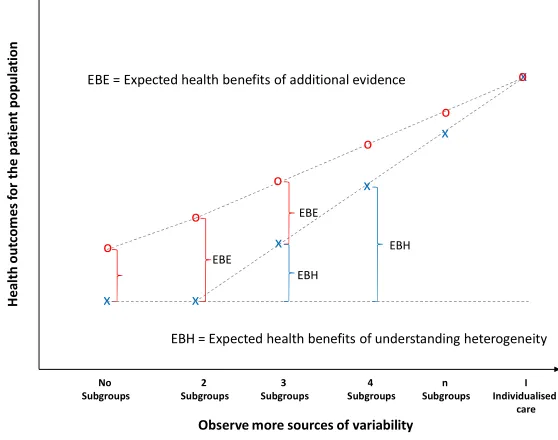
It is useful to make a clear distinction between uncertainty, variability and heterogeneity at the outset. Uncertainty refers to the fact that we do not know what the expected effects will be of using an intervention in a particular population of patients (i.e., the effects of an intervention on average). This remains the case even if all patients within this population have the same observed characteristics. Additional evidence can reduce uncertainty and provide a more precise estimate of the expected effects in the whole population or within subpopulations that might be defined based on observed characteristics. Variability refers to the fact that individual responses to an intervention will differ within the population or even in a sub population of patients with the same observed characteristics. Therefore, this natural variation in responses cannot be reduced by acquiring additional evidence about the expected or average effect. Heterogeneity refers to those individual differences in response that can be associated with differences in observed characteristics, i.e., where the sources of natural variability can be identified and understood. As more becomes known about the sources of variability (as variability is turned into heterogeneity) the patient population can be partitioned into sub populations or subgroups, each with a different estimate of the expected effect of the intervention and the uncertainty associated with it. Ultimately, as more sources of variability become known the sub populations become individual patients, i.e., individualized care.
subgroups of the population) may rise or fall.5 However, in the limit as more sources of variability are observed the value of additional evidence will fall. Indeed, if all sources of variability could be observed then there would be no uncertainty at all.6
Figure 3.1 The value of resolving uncertainty and the value of understanding heterogeneity
We don’t include examination of subgroups in Section 4, but in principle same type of analysis can be applied within each subgroup identified based on existing evidence. However, in these circumstances evidence synthesis might be extended if evidence of effect in one subgroup might inform effects in others and/or if some trials report some subgroup effects but others only report effects for the whole population. Conducting an analysis of the expected health benefits of additional evidence by subgroups is useful because it can indicate which types of patient need to be included in any future research design and others that could be excluded.
In this paper we do not directly address the potential value of research which might not resolve uncertainty but instead reveal the reasons for variability in outcome; informing which subgroups could benefit most from an intervention, or the choice of the physician patient dyad in selecting care given their symptoms, history and preferences (i.e., individualized care). This type of research may be very different from the type of evaluative research that reduces uncertainty about estimates of effect. For example, it might include: diagnostic procedures and technologies, pharmacogenetics; analysis of observational data and treatment selection as well as novel trial designs which can reveal something of the joint distribution of effects. Much methodological and applied work has been conducted in this rapidly developing area. There is an opportunity to explore ways of estimating the potential value of such research (the expected benefits of heterogeneity) based only on existing evidence and the results of standard meta-analysis. At present the upper bound that could, in principle, be specified (the expectation over all permutations of the joint distribution consistent with existing evidence) is computationally expensive and may be so high as to be relatively uninformative. However, should this be possible it would provide a very useful complement to the methods illustrated in Section 4.
5
This is true for the overall value of additional evidence that could resolve all sources of uncertainty for all subgroups. However, insofar as resolving uncertainty for one subgroup might provide information relevant to others, a subgroup specific estimate of value will underestimate the true value of evidence about effectiveness in that subgroup. 6
For illustration Figure 3.1 is drawn as if all sources of variability could be observed at an individual level – at which point there would be no uncertainty. However, there are fundamental limits to how much of natural variability can be observed and turned into heterogeneity no matter how much effort might be made.
x H e a lt h o u tc o m e s fo r th e p a ti e n t p o p u la ti o n
Observe more sources of variability No Subgroups 2 Subgroups 3 Subgroups x o n Subgroups I Individualised care x o x o x o x o 4 Subgroups o
EBE = Expected health benefits of additional evidence
EBE
EBE
EBH
EBH
4.
How might these assessments be informed?
How the assessments required might be usefully informed is explored through the simple application of the principles of value of information analysis to the type of random or fixed effects meta-analysis commonly conducted as part of a systematic review. This type of analysis, the interpretation of the results and the other considerations that are relevant to research prioritization decisions are illustrated through application to four case studies:
i. Early thrombolysis using streptokinase for the treatment of acute myocardial infarction (see Appendix A)
ii. Corticosteroids following traumatic head injury (Appendix B)
iii. Probiotics in patients with severe acute pancreatitis (SAP) (see Appendix C)
iv. Topotecan, PLDH and paclitaxxel for second-line treatment of advanced ovarian cancer (see Appendix D)
The case studies were selected to cover the different contexts likely to arise for funding agencies (see Section 3.3). As made clear previously, we take it for granted that any topic suggestion or specific research proposal will include a systematic review of existing evidence and, where appropriate, a meta-analysis, before it is prioritized and further research commissioned.
4.1
Primary endpoint captures key aspects of outcome
The purpose of this and the following sections is to illustrate:
i. the principles of what assessments are required when considering the need for additional evidence and the priority of proposed research;
ii. how these assessments might be informed by quantitative analysis based on standard methods of systematic review and meta-analysis.
In this section we also show how evidence accumulates as a sequence of clinical trials, addressing a particular clinical question, reported over time. As a consequence, the need for additional evidence ultimately declines but the benefits of implementing the research findings of the cumulating evidence grow. Eventually the potential benefits of conducting more research is exceeded, not only by the benefits of implementing what existing evidence suggests is the most effective intervention, but also by the negative health consequences of continuing to enroll more patients to less effective interventions in subsequent trials.
A classic example is the sequence of trials that investigated early thrombolysis using streptokinase (SK) for the treatment of acute myocardial infarction (MI). Although many of the later trials in this sequence also informed the choice between other interventions to deliver early thrombolysis, for ease of exposition this re-analysis focuses on the choice between SK and control (no thrombolysis).7. We also restrict attention to the primary endpoint reported in the trials and initially assume that this captures the key aspects of health effects associated with the intervention. We also recognize that although mortality following acute MI maybe the appropriate primary outcome, it is not necessarily the only relevant outcome and certainly stroke and its consequences are also very relevant, especially when considering the later interventions for early thrombolysis. Specifying a minimum clinical difference required to change clinical practice is one way to incorporate such concerns about potential adverse events and other consequences of recommending a more effective intervention (e.g., adverse impacts on health system performance), albeit implicitly. In Section 4.2 we illustrate
7
how important aspects of outcome which are not captured by the primary endpoint in the trials might be more explicitly incorporated into quantitative analysis.
The sequence of trials can be represented by a standard Forest plot reported in Figure 4.1 (a). The nature and context of these trials, as well as formal tests for heterogeneity, suggest that a random rather than fixed effect meta-analysis would appear to be more appropriate (see Appendix A for details).8 Of course, the combined evidence of all these trials now strongly favors SK compared to control, whether or not this evidence is synthesized using random or a fixed effect meta-analysis. The more interesting questions, however, include:
i. How did the estimated effectiveness of SK and the uncertainty associated with it change as this body of evidence evolved?
ii. When might it have been reasonable to conclude that the evidence was sufficient to recommend SK over control?
iii. At what point was it unlikely that the additional research that was conducted would be worthwhile?
iv. Could health outcomes have been improved most by acquiring additional evidence or by encouraging the implementation what existing evidence suggests is the most effective intervention?
v. How might the value of additional evidence about this topic have been judged relative to the need for additional evidence in other clinical areas?
Importantly, we do not use hindsight to address these questions but ask how quantitative analysis might have informed these assessments at the time, with the evidence that was then available.
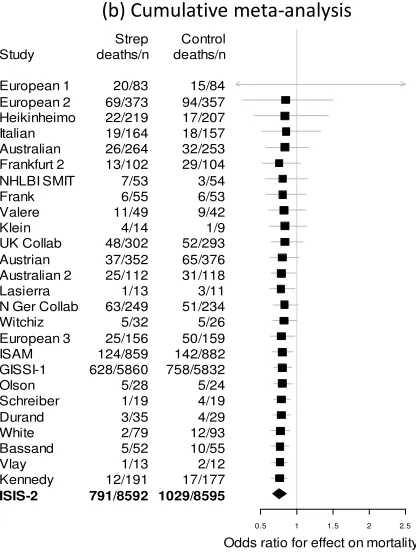
This sequence of trials can also be re-analyzed as a cumulative meta-analysis, where the estimate of the effect on mortality and the uncertainty associated with it is updated as each subsequent trial reports. This cumulative meta-analysis is also illustrated in Figure 4.1(b) and shows that the balance of evidence very quickly favored SK. The uncertainty associated with whether SK is more effective than control ultimately declined and once ISIS 2 reported it was entirely resolved. However, it was not until the European 3 trial in 1979 that a single trial reported a statistically significant result that favored SK and the cumulated evidence also suggested a statistically significant result, i.e., the probability that SK was more effective than control exceeded 0.95 in the trial and the random effect meta-analysis.9
Value of additional evidence
4.1.1
Restricting attention to whether or not a result of a trial or a meta-analysis is statistically significant provides only a partial summary of the uncertainty associated with the effectiveness of an intervention, nor does it indicate the importance of the uncertainty for patient outcomes or the potential gains in health outcomes that might be expected from acquiring additional evidence that could resolve it.
8
The assumption underlying the fixed effect model is that each trial result is estimating a common unknown pooled effect, while any variation in the estimated effect sizes across studies is due to sampling error. If this assumption is considered to be too restrictive, a random effects model can be used, which allows the unknown pooled effect to vary between studies. There are particular dangers of inappropriately using random effect to take account of what are believed to be differences in the relevance and potential for bias. This is especially acute if the smaller trials are believed to be more vulnerable to bias and less relevant to the target population.
9
Random effects meta-analysis
Intravenous streptokinase for acute myocardial infarction Odds ratio for effect on mortality
S tu d y R e fe re n c e
0.03 0.10 0.32 1.00 3.16 10.00
Fletcher 1959 Dewar 1963 European 1 1969 European 2 1971 Heikinheimo 1971 Italian 1971 Australian 1973 Frankfurt 2 1973 NHLBI SMIT 1974 Frank 1975 Valere 1975 Klein 1976 UK Collab 1976 Austrian 1977 Australian 2 1977 Lasierra 1977 N Ger Collab 1977 Witchiz 1977 European 3 1979 ISAM 1986 GISSI-1 1986 Olson 1986 Schreiber 1986 Durand 1987 White 1987 Bassand 1987 Vlay 1988 Kennedy 1988 ISIS-2 1988 Summary
(a) Forest plot
Study European 1 European 2 Heikinheimo Italian Australian Frankfurt 2 NHLBI SMIT Frank Valere Klein UK Collab Austrian Australian 2 Lasierra N Ger Collab Witchiz European 3 ISAM GISSI-1 Olson Schreiber Durand White Bassand Vlay Kennedy ISIS-2 Strep deaths/n 20/83 69/373 22/219 19/164 26/264 13/102 7/53 6/55 11/49 4/14 48/302 37/352 25/112 1/13 63/249 5/32 25/156 124/859 628/5860 5/28 1/19 3/35 2/79 5/52 1/13 12/191 791/8592 Control deaths/n 15/84 94/357 17/207 18/157 32/253 29/104 3/54 6/53 9/42 1/9 52/293 65/376 31/118 3/11 51/234 5/26 50/159 142/882 758/5832 5/24 4/19 4/29 12/93 10/55 2/12 17/177 1029/8595
0.5 1 1.5 2 2.5
Odds ratio for effect on mortality
Cumulative random effects meta-analysis
[image:20.595.157.365.397.673.2](b) Cumulative meta-analysis
Figure 4.1 The sequence of trials of early thrombolysis using streptokinase
use SK for MI will be ‘wrong’ and, if it is, there will be consequences in terms of higher mortality in the patient population.
Translating the chance of error at different points in this sequence of trials into a distribution of the scale of consequences associated with the uncertainty in patient outcomes requires applying the uncertain estimate of the relative effect of SK (the odds ratios reported in Figure 4.1(b)) to an estimate of baseline mortality risk following acute MI, which will also be estimated with uncertainty. In addition an estimate of the incidence of patients who face a choice between SK or control following acute MI is also required.10 The combined effect of uncertainty in relative effect and baseline risk can be characterized by taking repeated random samples from their distributions, which are already estimated in the meta-analysis. Each random sample, or simulated value, can be interpreted as one possible realization of uncertainty, i.e., one possible ‘true’ value or way things might turn out given the information that was then available.11
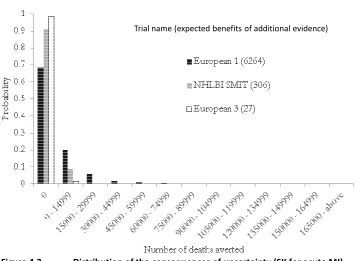
This analysis can provide a distribution of the health consequences of uncertainty, which is illustrated in Figure 4.2. Commonly in this case there are no consequences, because the use of SK is most likely to be the correct decision, i.e., the balance of evidence favors SK (e.g., following European 1, 69% of the simulated values from the meta-analysis favor SK and are associated with zero consequences). However, there is a real possibility that SK is not effective (error probability of 0.31) so there are consequences, if SK is used for acute MI, in terms of deaths that could have otherwise been averted. There is a greater chance of more limited consequences (e.g., a 20% chance of consequences between zero and 15,000 deaths per year) and a smaller chance of larger consequences (e.g., a 11% chance of consequences greater than 15,000 deaths per year). The average over this distribution provides an estimate of the expected consequences of uncertainty, which is 6,264 deaths per year following European 1.
These expected consequences can be interpreted as an estimate of the health benefits that could potentially be gained each year if the uncertainty surrounding this decision could have been resolved at that time, i.e., it indicates an expected upper bound on the health benefits of further research which would confirm whether or not SK was actually more effective than control. These potential expected benefits increase with the size of the patient population whose treatment choice can be informed by additional evidence and the time over which evidence about the effectiveness of SK was expected to be useful (see Section 4.2).
Importantly, Figure 4.2 also illustrates that both uncertainty and its potential consequences declines as evidence accumulates. For example, following NHLBI SMIT in 1974 the chance that SK is more effective than control has risen to 91% (there is 91% chance of zero adverse MI mortality consequences of using SK). The chance of more limited consequences is lower (8.77% chance of consequences between zero and 15,000 deaths per year) and the chance of greater consequences is almost eliminated (0.21% chance of consequences greater than 15,000 deaths per year). As a result the expected consequences of the uncertainty surrounding the effectiveness of SK (the average over this distribution) fall to 306 deaths per year. By the time European 3 reports there is much less uncertainty about the effectiveness of SK (98% chance that SK is more effective with zero adverse consequences). The chance of more limited consequences is lower (1.58% chance of consequences between zero and 15,000 deaths per year) and there is no measureable chance of consequences
10
An estimate of the size of the patient population whose treatment choice can benefit from the information provided by further research is required. Therefore, in a chronic condition an estimate of prevalence as well as incidence would be required.
11
greater than 15,000 deaths per year. As a result the expected consequences or the upper bound of the expected value of additional evidence falls to 27 deaths per year. At this point the potential health benefits of subsequent research appear modest compared to the potential benefits of research that might have been conducted using the same resources in other clinical areas.
[image:22.595.71.428.140.401.2]Trial name (expected benefits of additional evidence)
Figure 4.2 Distribution of the consequences of uncertainty (SK for acute MI)
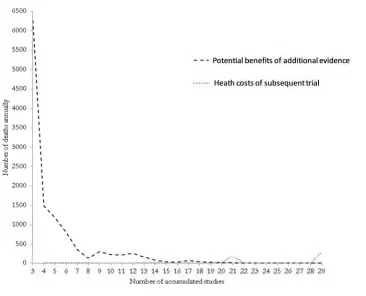
This decline in the potential value of additional evidence is also illustrated in Figure 4.3. The steep decline in potential health benefits of additional evidence suggests that the later trials in the sequence may not have been necessary to inform the question of whether SK was more effective than control in acute MI, although they may have been valuable in informing the choice between other interventions. It also illustrates the negative health impact of subsequent trials which randomly allocated patients to a control arm that was expected to be less effective on the balance of the then existing evidence.
After European 3 (the 19thstudy) the health costs of the next trial exceeds the upper bound on the expected health benefits they offered each year. Of course, in coming to a view about when the evidence was sufficient and when further research in this area should not have been regarded as a priority some consideration needs to be given to:
i. The period over which evidence might be valuable, i.e., relevant to and able to inform clinical practice (see Section 4.2).
ii. The potential benefits of research in other areas that could have been conducted using these resources (see Section 4.2.3).
iii. Whether health outcomes could be improved most by acquiring additional evidence or by encouraging the implementation of what existing evidence suggests is the most effective intervention (see Section 4.1.2).
Figure 4.3 Expected health benefits of additional evidence (SK for acute MI)
Value of implementation
4.1.2
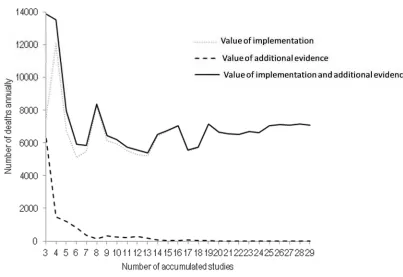
The cumulating evidence in Figure 4.1(b) very quickly suggested that, on balance, the use of SK in acute MI would be expected to reduce mortality (the expected or mean odds ratio in Figure 4.1(b) is less than 1). Therefore, health outcomes can be improved by ensuring that the accumulating findings of research are implemented and have an impact on clinical practice. Indeed, the potential improvements in health outcome by encouraging the implementation of what existing evidence suggests is the most effective intervention may well exceed the potential improvements in health outcomes through conducting further research. This is illustrated in Figure 4.4 where, from European 1 onwards the value (in terms of deaths that could be averted each year), through the use of SK exceed the potential health benefits of acquiring additional evidence about its effectiveness. Of course, over time as evidence accumulated, and especially after European 3 (the first trial that reported a statistically significant resultanda random effect analysis of the cumulated evidence also suggested a statistically significant result in favor of SK), clinical practice did respond to this evidence with widespread use of SK for early thrombolysis. Therefore, the value of implementation efforts by other bodies declines as much of clinical practice respond to evidence and has already implemented the findings.12
12
Figure 4.4 The value of implementation and the value of additional evidence (SK for acute MI)
Figure 4.4 illustrates the important distinction between these two very different ways to improve patient outcomes, which have two important implications:
i. Although the results of additional research may influence clinical practice and may itself contribute to the implementation of research finding, it is certainly not the only or necessarily the most effective way to do so. Insofar as there are other mechanisms (e.g., more effective dissemination of existing evidence) or policies which fall within the remit of other bodies (e.g., incentives and sanctions),13 then continuing to conduct research to influence implementation rather than because there is real value in acquiring additional evidence itself (e.g., beyond study 19 in Figure 4.4) would seem inappropriate for two reasons. The limited research capacity and the resources to fund the research could have been used elsewhere to acquire additional evidence in areas where it was genuinely needed and would have offered greater potential health benefits. Secondly, such a policy will have negative health effects for those patients enrolled in research and allocated to interventions which are expected to be less effective.
ii. It also illustrates that the potential health benefits of acquiring additional evidence through conducting further research will only be realized (patient outcomes actually improve) if the findings of the research do indeed have an impact on clinical practice. Again, recognition that there are very many ways to influence the implementation of existing evidence, other than by conducting more research, is important. However, implementation of the findings of proposed research might influence consideration of its priority and research design in a number of ways. For example, if it is very unlikely that the findings will be implemented and other mechanisms and policies are unlikely to be used or be effective, then other areas of research which might offer lower potential benefits but where these benefits are more likely to be realized might be prioritized. If the impact of research on clinical practice is likely to require highly statistically significant results this will influence the design, cost and time
13
taken for research to report and therefore its relative priority. It maybe that a large clinical difference would also need to be demonstrated before research would have impact on practice. This also tends to reduce the potential benefits of further research as well (see Section 4.1.3).
The analysis illustrated in Figure 4.1 and 4.4 starts to suggest that always waiting to implement research findings until the traditional rules of statistical significance are achieved may well come at some considerable cost to patient outcomes. For example, it was not until 1979 that a single trial reported a statistically significant result that favored SK and a random effect analysis of the cumulated evidence also suggested a statistically significant result (the 19th study, European 3). However, prior to this trial reporting the expected benefits of implementing SK for acute MI were already substantial (5,696 deaths averted per year) and the balance of previous evidence had already suggested similar positive benefits for many years.
However, there are a number of issues that need to be considered before implementation based on the balance of accumulated evidence, rather than the need for additional evidence, should be the focus of policy:
i. If earlier implementation means that the type of research required to generate the evidence needed is impossible or more difficult to conduct14 then the uncertainty and need for additional evidence needs to be considered alongside the expected benefits of early implementation.
ii. Insofar as widespread use of an intervention will be very difficult to reverse if subsequent research demonstrates that it is not effective, then account must be taken of the consequences of this possibility (the possibility of research finding that SK is not effective is represented by the error probabilities reported in Section 4.1.1 and the consequences are the realized differences in mortality which are also available from this analysis).
iii. If an intervention needs to offer a substantial improvement in effectiveness (a minimum clinical difference – see Section 4.1.3) to justify implementation and if there remains uncertainty about whether such an improvement in effectiveness will be realized, then there are circumstances (e.g., in chronic and stable conditions) were it might be better to the delay the use of the intervention until additional evidence is available.
iv. There is a common and quite natural aversion to iatrogenic effects, i.e., health lost through adopting an intervention not in widespread use tends to be regarded as of greater concern than the same health lost through continuing to use existing interventions that are less effective than others available. However, it should be noted that the consequences for patients are symmetrical and this ‘aversion’ also depends entirely on which intervention just happened to have diffused into common clinical practice first.
These considerations can inform an assessment of whether more health might be gained through efforts to implement the findings of existing research or by acquiring more evidence to inform which intervention is most effective. It should be noted that these considerations are likely to differ between topic areas and certainly do not necessarily lead to a single ‘rule’ based on the statistical significance of the results of a particular study or a meta-analysis of existing studies.
14
Minimum clinical difference
4.1.3
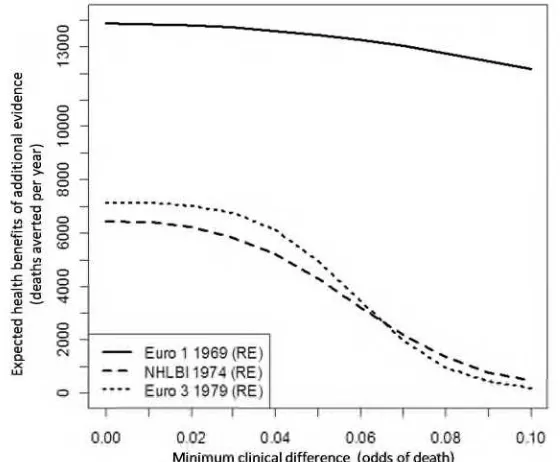
We have restricted attention to the mortality endpoint reported in the trials and implicitly assumed that this captures the key aspects of health effects associated with early thrombolysis. Although mortality following acute MI maybe the appropriate primary outcome, it is not necessarily the only relevant outcome, for example stroke and its consequences are also very relevant as well as survival and the type of health experienced in the additional years of life associated with mortality effects. Specifying a minimum clinical difference required to change clinical practice is one way to incorporate concerns about potential adverse events and other consequences of recommending a more effective intervention (e.g., adverse impacts on health system performance), albeit implicitly (see Section 4.2.2 for an analysis which does so quantitatively.15 A larger clinical difference in effectiveness may also be needed to be demonstrated before research will have an impact and the finding of proposed research will be widely implemented and the potential benefits of additional evidence realized.
[image:26.595.75.355.465.696.2]The expected benefits of additional evidence for a range of minimum clinical differences (MCD) are illustrated in Figure 4.5 for the same three points in the sequence as were illustrated in Figure 4.2. When the MCD is close to zero the expected health benefits of additional evidence are the same as those reported in Figure 4.2, i.e. higher at points earlier in the sequence of these trials. Requiring that further research must demonstrate larger differences in effect reduces these expected health benefits because large differences are less likely to be found than smaller ones, therefore, the potential benefits of further research decline as a greater MCD is required. The rate of decline depends on the distribution of effects estimated from the meta-analysis (combining uncertainty in relative effect and baseline risk). This explains why at a MCD of a 0.07 reduction in odds of death, the expected benefits of additional evidence appears to be higher following European 3 than NHLBI. The same analysis can be reported when MCD is measured on a relative scale (e.g., odds ratio) or on an absolute scale (odds or proportionate change in deaths) or as the absolute number of deaths per year (see Appendix A), depending on which scale is more useful when considering what differences are likely to be required.
Figure 4.5 Value of additional evidence and minimum clinical difference required (SK for MI)
15
4.2
Primary endpoint linked to other aspects of outcome
Prior to the CRASH trial (Corticosteroid Randomisation After Significant Head injury) the effects of corticosteroids (CS) on death and disability following traumatic head injury was unclear, despite 19 trials conducted between 1972 and 1995. The CRASH trial, which first reported in 2004, was stopped early after enrolling 10,008 adults with traumatic head injury (THI). It reported a higher risk of death or severe disability associated with the use of corticosteroids (CS). As a consequence of this definitive, and to some extent, unexpected result clinical practice changed dramatically, resulting in many thousands of iatrogenic deaths averted around the world (prior to CRASH CS was used in 64% of patients with THI in the US and 12% in the UK). The global value of the CRASH trial appears, with hindsight, self evident. A more interesting question, however, is whether the type of analysis described in Section 4.1 would have identified this topic as of particular value and would have supported the UK Medical Research Council’s (MRC) decision to fund one of the largest clinical trials it has commissioned.
The trials comparing the use of corticosteroids to placebo or no treatment in acute THI available prior to CRASH are illustrated as a standard Forest plot in Figure 4.6.
[image:27.595.90.441.407.649.2]These trials were of varying study quality, length of follow-up, steroids administered, doses and time to administration. A standard meta-analysis of these trials suggests substantial uncertainty about the effectiveness of CS in THI, whether or not a fixed or random effects analysis is used.16 For example, the random effect analysis of the mortality endpoint favors CS with an expected odds ratio for death of 0.93, but there is a 26% chance that the use of CS is in fact harmful (an odds ratio greater than 1).
Figure 4.6 The trials of corticosteroids for traumatic head injury
16
Value of additional evidence about mortality
4.2.1
Just as in Section 4.1, translating the chance that decisions about the use of CS in THI based on existing evidence will be ‘wrong’ into the consequences for patient outcomes requires applying the uncertain estimate of the relative effect of CS (the odds ratios reported in Figure 4.6) to an estimate of base line mortality risk in THI, which will also be estimated with uncertainty. An estimate of the incidence of severe THI is also required.17 The combined effect of uncertainty in relative effect and baseline risk is characterized in the same way as in Section 4.1, by taking repeated random samples from the distributions estimated in the meta-analysis.18
The distribution of the health consequences of uncertainty is illustrated in Figure 4.7 based on the random effect meta-analysis. If the use of CS in the UK prior to CRASH had been based on the random effect analysis of evidence that favors their use, then there is a 74% chance of no adverse mortality consequences (the probability that CS is effective is 0.74). There is, however, a chance (26%) that using CS in THI will not be effective and causes iatrogenic deaths, including: a greater chance of more limited iatrogenic consequences (19% chance of greater than zero and 200 deaths per year); and a smaller chance of larger consequences (7% chance of greater than 200 deaths per year). The expected iatrogenic deaths due to this uncertainty is 40 per year (the average over the distribution illustrated in Figure 4.7), which is also an estimate of the expected health benefits that could potentially be gained each year if the uncertainty surrounding the use of CS could have been resolved at that time. It represents an estimate of the upper bound on the expected health benefits of additional evidence that would confirm whether or not CS reduces or increases mortality.
Figure4.7 Distribution of the consequences of uncertainty (CS for severe THI)
17
An estimate of the size of the patient population whose treatment choice can benefit from the information provided by further research is required. Therefore, in a chronic condition an estimate of prevalence as well as incidence would be required.
18
In this analysis we use the control arms of the trials as an estimate of baseline risk, directly from the output of the meta-analysis; preserving the correlation in their estimation. However, an estimate of baseline risk could be based only on the control arms of those trials regarded as most relevant to the target population (see Section 4.3) or from external evidence. The estimates reported here are also based on estimates of UK incidence - see Appendix B for details.
0.00 0.10 0.20 0.30 0.40 0.50 0.60 0.70 0.80 0.90 1.00
0 [1,50] [51,100] [101,150] [151,200] [201,250] [251,300] [301,350] [351,400] [401,450] [451,500] [501,550] [551,600] [601,650] [651,700] [701,750]
Pr
ob
ab
ili
ty
Consequences (number of deaths averted per annum)
0.07 0.74
0.02 0.04
0.05
0.02 0.01
These expected benefits might appear relatively modest compared to the value of additional evidence early in the sequence of trials of SK for acute MI in Section 4.1.19 However, when assessing the potential value of CRASH based on this analysis it is important to consider that:
i. The subsequent trials that confirmed the effectiveness of SK for acute MI provided very valuable information that ultimately avoided many thousands of deaths, i.e., CRASH may have been less valuable than the trials of SK following European 1 but is nonetheless still valuable and was correctly regarded as a priority by the UK MRC.
ii. The value of the information that CRASH provided extends beyond the UK so the global value of this, and also the sequence of SK trials, is much greater than estimates restricted to expected benefits to UK patients.
iii. Mortality is only one aspect of outcome. Combining the impact of CS on disability and mortality changes both the estimate of its effectiveness and the uncertainty associated with its use (see Section 4.2.2)
Prior to CRASH clinical practice in the UK did not reflect the balance of evidence that favors the use of CS (based on random effect analysis), partly due to the substantial uncertainty about its effectiveness. At the time approximately 12% of patients with THI received CS. Therefore, the value of both implementing the uncertain findings of existing researchand acquiring additional evidence that would resolve this uncertainty is greater (180 deaths per year – see Appendix B for details of this analysis which incorporates evidence about utilization).
Value of additional evidence about survival and disability
4.2.2
Mortality is only one aspect of outcome in THI because the impact on disability and subsequent survival is also important. Since most of the trials also report effects on vegetative and severely disabled states, described in the Glasgow Outcomes Scale (GOS), the meta-analysis can be extended to include effects on both mortality and disability. This analysis also exploits other evidence about the distribution of GOS states following THI, movements between them (i.e. the possibility of recovery or deterioration over time) and life expectancies given survival in a particular GOS state, as well as estimates of the quality of life associated with different levels of disability described in the GOS (see Appendix B for details of this extension to standard meta-analysis). This allows the different aspects of health outcomes in THI to be combined into the equivalent years of full health, i.e., the impact on life years expected to be lived due to the effects on mortality risk adjusted for the quality in which they are likely to be lived.
Interestingly, linking the primary mortality endpoint to these other important aspects of outcome changes both the estimate of the effectiveness of CS and the uncertainty associated with it. Based on a random effect analysis, the existing evidence no longer favors CS. This is because the evidence from the trials suggested that the use of CS was also associated with greater proportion of patients surviving in a vegetative or severely disabled state, i.e., on balance CS appeared to increase the risk of severe disability.
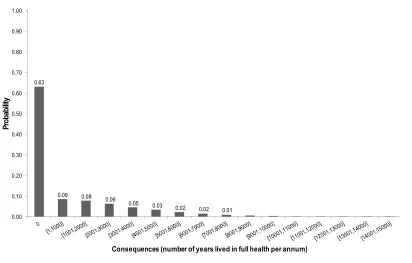
The distribution of the health consequences of the uncertainty associated with a more complete picture of the effectiveness of CS is illustrated in Figure 4.8.
This analysis of the effects of CS on a more complete measure of important aspects of health outcome suggests that on balance CS was not expected to be effective and its effects were more uncertain. If the use of CS in the UK had been based on this evidence (no CS use for THI) then there
19
would be a 63% chance of no avoidable lost years lived in full health (probability CS is not effective is 0.63). There is, however, a chance (37%) that using CS in THI would have been effective and improve health outcomes, including: a greater chance of more limited potential gains from the use of CS (23% chance of between zero and 3000 equivalent years of full health gained per year) and a smaller chance of larger potential benefits (14% chance of more than 3000 equivalent years of full health gained per year). The expected consequences of this uncertainty or the potential health gains of resolving it through additional evidence is 1,067 equivalent years of full health gained each year in the UK.
[image:30.595.76.488.258.521.2]At the time 12% of patients with THI received CS in the UK. Therefore, the value of both implementing the uncertain findings of existing research (not to use CS for THI) and acquiring additional evidence that would resolve this uncertainty is greater (1,264 equivalent years of full health gained each year – see Appendix B).
Figure 4.8 Distribution of the consequences of uncertainty (CS for severe THI)
Assessing the value and priority of proposed research
4.2.3
Two questions are posed when considering whether the decision to prioritize and commission CRASH was appropriate:
i. Are the expected health benefits of additional evidence of 1,067 equivalent years of full health each year sufficient to regard CRASH as potentially worthwhile?
ii. Should it be prioritized over other research topics that could have been commissioned with the same resources?
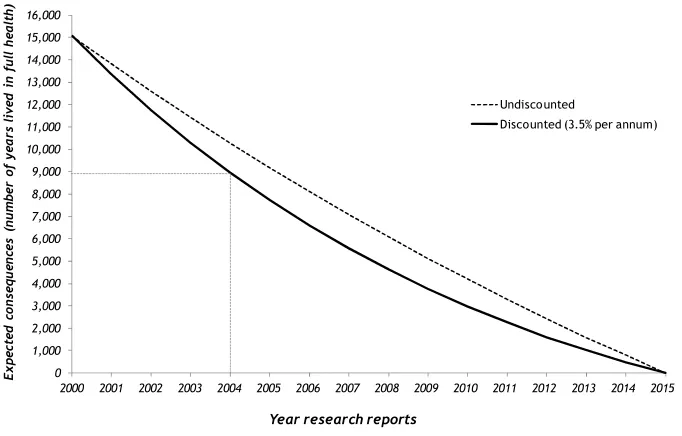
These assessments require some consideration of the period of time over which the additional evidence generated by research is likely to be relevant and can inform clinical practice; as well as the time likely to be taken for proposed research to be commissioned, conducted and report.
0.00 0.10 0.20 0.30 0.40 0.50 0.60 0.70 0.80 0.90 1.00
P
ro
b
ab
ili
ty
Consequences (number of years lived in full health per annum)
0.02 0.63
0.02 0.06
0.08
0.03
0.01 0.05