Migration Management and Development Policy
Issue-Linkage in European Union External Relations
By Emily Venturi
Senior Honors Thesis Department of Political Science University of North Carolina at Chapel Hill
March 19, 2018
Approved by ____________________________ Dr Liesbet Hooghe, Adviser
____________________________ Dr Eunice Sahle, Reader
Acknowledgements
This undergraduate thesis would not have been possible without the continuous support and teaching from the mentors who have guided me throughout my undergraduate education at UNC-Chapel Hill. First of all, I would like to very much thank my mentor and thesis advisor, Dr. Liesbet Hooghe, who over the course of my time at UNC has encouraged me to follow my love for the disciplines of political science and international relations, to believe in myself and my projects, and to always prioritize personal well being and shorter sentences. Thank you also to my mentor Dr. Eunice Sahle for being a source of inspiration and for introducing me to the critical study of development, human rights, and gender in the Department of African and African American Diaspora Studies. I would like to also thank Dr. Gary Marks who first introduced me to the academic study and the research work within European Union politics and who has remained an important mentor since the early stages of my UNC journey.
My summer fieldwork research would not have been possible without the financial support of the Morehead Cain Foundation. I would also like to thank Dr. Mamarame Seck and the West African Research Center for their kind hospitality during my time in Dakar in summer 2017. Thank you to Dr. Niklaus Steiner, Dr. John Pickles, and Dr. Barbara Anderson for providing valuable insights during the design of the research fieldwork.
Table of Contents
1. Introduction . . . 5
2. Background . . . 7
2.1. The Rise of Migration as a Subject of Political Contestation and as a Foreign Policy Priority in the European Union . . . 7
2.2. Senegal as a non-EU Partner Country Case Study . . . 12
3. Literature Review . . . 15
3.1. Issue-Linkage and EU External Governance . . . . 15
3.2. The Migration-Development Nexus . . . 21
3.3. The Securitization of Development . . . 23
4. Research Design . . . 26
5. Section A: Migration and Development Issue-Linkage within EU Governance . 28 5.1. The EU’s Soft Law Framework for Migration Management . . 28
5.2. Divergence Among EU Institutions on the Issue-Linkage of Migration and Development . . . 32
5.3. Parliamentary Scrutiny . . . 34
6. Section B: The Impact of Issue-Linkage on Development Objectives . . 37
6.1. Introduction . . . 37
6.2. Funding Allocation, Project Design and Implementation . . 39
6.3. Evaluating Conditionality and Securitization in the Migration- Development Nexus . . . 46
6.4. Evaluating the Role of the EU as a Development Actor and Alternatives to Foreign Aid within Issue-Linkage . . . 50
7. Section C: The Impact of Issue-Linkage on Migration Management Objectives 52 7.1. Legal Migration . . . 53
7.2. Human Rights . . . 55
7.3. Identification and Readmission . . . 57
8. Conclusion . . . 60
9. Bibliography . . . 63
“La migration bouleverse les grands principes de l’État.”
“Migration uproots the fundamental principles of the State.”
1. Introduction
Federica Mogherini, High Representative and Vice-President of the EU Commission, in November 2015 summarized the European Union’s approach to the migration management negotiations taking place in Valletta (Malta) between European and African leaders as:
“The only way of managing this phenomenon is by doing this together, building cooperation and building common instruments.”1
The African-European 2015 Valletta Summit on Migration consolidated migration as a priority for EU-African cooperation on trade, security, and development. The Summit announced new cooperation instruments to formally link the management of migration flows with development policy, in an effort to delineate a comprehensive approach to migration aimed at reducing irregular flows and tackling the “root causes” of displacement through development initiatives. Mogherini’s remarks (above) encapsulate the shift in rhetoric within EU institutions to discuss the European Union’s supranational approach to migration in its external relations. European leaders set out to establish a “more for more” approach to migration management and development policy issue-linkage within the EU’s growing network of partnerships with its neighboring countries in Asia, Africa and the Middle East, which include new development funding instruments, political platforms, and diplomatic visits.
After the increase in the European Union’s interest in working with non-EU countries of migrant origin and transit to jointly tackle migration and development challenges, disagreements however persist with regards to the underlying premises and preliminary outcomes of the new issue-linkage instruments. During an interview at the Open Society Initiative for West Africa in Dakar (Senegal), the NGO’s staff members working on EU-Senegal cooperation were skeptical as to the EU’s commitment to interlacing migration management and development goals: “Our priorities are not the same ones.”2
This study will examine the extent to which African and European goals diverge with respect to the use of migration as an instrument for development and economic growth. I use Senegal as a case study, which is one of the European Union’s 16 priority partner countries for migration management cooperation.3
I bring to bear expert interviews at EU institutions and in Senegalese institutions to examine the increase in the EU’s externalization of migration management and its linkage to development policy.
The objectives of this investigation are the following. First, I will aim to establish to what extent the issue-linkage of migration and development in EU external relations is the result of existing EU governance structures and policy path dependence. Section A will therefore analyze the self-reinforcing relationship between EU supranational governance limitations and the choice of issue-linkage as a policy instrument for the externalization of migration management. Secondly, Section B and Section C will evaluate the impacts of issue-linkage on development cooperation and migration management. To what extent has the interlacing of EU development policy with migration management led to goal displacement within the two linked policy
2 Interview, Open Society Initiative for West Africa, Dakar, 30.05.2017
spheres? Section B will evaluate to what extent development cooperation goals have been displaced for the European Union and for non-EU partner countries. Section C will evaluate to what extent issue-linkage has led to the displacement of migration management objectives for the European Union and for non-EU partner countries. This research contributes to the newly emerging discussion on the long-term consequences of the EU’s current short-term security priority of reducing irregular migration.
2. Background
2.1 The Rise of Migration as a Subject of Political Contestation and as a Foreign Policy
Priority in the European Union
In conjunction with the onset of the Syrian civil war and the destabilization of Libya in 2011, migration flows towards Europe started to increase on the Eastern Mediterranean route through Turkey and Greece and on the Central Mediterranean route through Libya and Italy. Between 2012 and 2015, EU member states collectively observed a 294.53% increase in asylum applications.4
Moreover, migration flows across the Mediterranean have been of mixed nature and include political refugees5
as well as people commonly defined as “economic migrants.” 6
4 Europol, (2017). Dataset: “Asylum and first time asylum applicants by citizenship, age and sex”, Annual aggregated data (rounded) [migr_asyappctza] (accessed 18.01.2018)
When considering the increase in migration flows across the Mediterranean, we must note that the European Union currently hosts only 6% of the world’s displaced population. The European migration crisis should therefore be contextualized within the global economic and political pressures generated by the worldwide increase in forced displacement and economic migration. Also, consider that migration is not a unidirectional flow towards Europe as often presented in these studies and in EU documents and rhetoric – it goes in all directions and occurs at national, regional and continental levels. Despite the comparative contextualization of the EU’s migration pressures, the percentage change in asylum applications and economic migration towards EU Member States is still generally regarded as a pertinent exogenous shock to EU policy-making, and will therefore be considered as such for the purposes of this study.
Graph 1: Asylum Application in EU-28 Member States
Source: Europol, Asylum and First Time Asylum Applicants Dataset, 2017.
In addition to the rise in asylum applications to EU Member States, the politicization of migration and the electoral successes of right-wing populist parties in national elections have rendered migration a key subject of political contestation in domestic politics, and this has spilled over into the EU intergovernmental arena. As an official at the DG of International Migration and Italians Abroad at the Italian Ministry of Foreign Affairs stated: “Elections are won and elections are lost over these issues.”7
As migration became a salient issue of political contestation in EU member states’ domestic politics, the demand for a response from the European Union increased. A press coverage report prepared for the United Nations High Commission of Refugees confirmed that newspapers in continental Europe overwhelmingly reported that the European Union’s response to the migrant crisis was widely seen as inadequate, yet it was still considered the primary institution responsible for solving the crisis.8
The divergence between electorate expectations and the EU’s response to the migrant crisis highlights the difficulty of achieving domestic migration reform. Three factors hinder EU internal reform on migration and asylum: (1) the incomplete integration of migration management competences at an EU supranational level, (2) the persistence of intergovernmental bargaining for national security interests, and (3) the politicization of migration in domestic and continental political discourse. Efforts to reform the Dublin Regulation and the Common European Asylum System so far have therefore stagnated, even while the EU’s pursuit of its foreign policy agenda has overall seemed to advance. In an interview at the DG for European Union External Relations at the Italian Ministry of Foreign Affairs, when asked about Italy’s role
7 Interview, Italian Ministry of Foreign Affairs and International Cooperation, DG for International Migration and Italians Abroad, Rome, 13.07.2017
in advancing EU migration legislation that focused on foreign policy rather than domestic reform for relocation9
and resettlement,10
Italian authorities answered: “The more we ask for internally, the more they give us externally.”11
As domestic reform efforts continue to be a challenge for EU policy-makers, migration has become a key factor in structuring EU foreign relations. In 2015, with the publishing of the European Agenda on Migration,12
migration was permanently introduced as a stated priority in EU foreign policy. In a 2016 memo entitled EU Migration Policy at a Glance, the European External Action Service, the diplomatic service and foreign and defense ministry of the European Union, outlined the centralization of migration in EU foreign policy:
“Migration management will become an important dimension in the EU’s foreign policies and instruments, ranging from diplomacy and Common Security and Defence Policy, to development and climate.”13
At the African-European Valletta Summit on Migration in 2015, cooperation instruments to tackle the “root causes” of migration were established. The Valletta Action Plan outlined five common pillars among African and European leaders to jointly tackle migration management
9 Relocation: the distribution among Member States of persons in clear need of international protection. (European Agenda on Migration, EU Commission,
http://eur-lex.europa.eu/legal-content/EN/ALL/?uri=celex:52015DC0240)
10 Resettlement: the transfer of individual displaced persons in clear need of international protection, on submission of the United Nations High Commissioner for Refugees and in agreement with the country of resettlement, from a third country to a Member State, where they will be admitted and granted the right to stay and any other rights comparable to those granted to a beneficiary of international protection.
(European Agenda on Migration, EU Commission http://eur-lex.europa.eu/legal-content/EN/ALL/?uri=celex:52015DC0240)
11 Interview, Italian Ministry of Foreign Affairs and International Cooperation, DG for European Union External Relations, Rome, 07.07.2017
12 EU Commission, (2015). European Agenda on Migration,
https://ec.europa.eu/home-
affairs/sites/homeaffairs/files/what-we-do/policies/european-agenda-migration/background-information/docs/communication_on_the_european_agenda_on_migration_en.pdf (Accessed 21.08.2017) 13 European External Action Service, (2016). EU Migration Policy at a Glance,
and development cooperation (see associated footnote).14
Within development and migration issue-linkage, the EU Emergency Trust Fund for Africa was inaugurated as a financial instrument for the allocation of development funding to address the “root causes” of migration flows. Lastly, a year after the conclusion of the Valletta Summit, the EU Migration Partnership Framework was launched in 2016 to enhance bilateral cooperation with five African partner countries (Senegal, Mali, Niger, Nigeria and Ethiopia). The bilateral framework “proposes to frame the relations with partner countries through compacts, tailor-made to the specific circumstances of the partner countries and making full use of the broad range of policies at the European Union’s disposal.”15
This study examines these cooperation instruments in terms of their implications for development policy and migration management relations.
In addition to the formal centralization of migration in the EU’s external relations and the introduction of new issue-linkage instruments, the increased salience of migration is also reflected in the daily operations within EU institutions, as confirmed during an interview at the EU Commission DG for Development and International Cooperation:
“With the new partnership framework, [migration] became one of the central aspects in EU external policy and also in the development work that we are doing. Before it was one of many sectors. Now, it is always taken into account where a country stands in terms of migration management and where the EU is meeting that country. This is something that is now systematically looked at.”16
The introduction and subsequent centralization migration in EU foreign policy and external relations can therefore be understood as well established.
14 The Five Pillars of the Valletta Action Plan: 1. Development benefits of migration and addressing root causes of irregular migration and forced displacement // 2. Legal migration and mobility // 3. Protection and asylum // 4. Prevention of and fight against irregular migration, migrant smuggling and trafficking in human beings // 5. Return, readmission and reintegration
15 European External Action Service, (2016). EU Migration Policy at a Glance.
https://eeas.europa.eu/sites/eeas/files/1_eu_migration_policy_at_glance_-_fact_sheet_2016.pdf (accessed 18.01.2018)
2.2 Senegal as a Non-EU Partner Country Case Study
Within the EU’s external relations for migration management, Senegal is one the sixteen countries of priority focus and one of the five countries that signed the Migration Partnership Framework with the EU in 2016. Senegal serves as this investigation’s partner country case study because of its cooperation history with the EU, its heterogeneity in migration flows, and its recent national migration policy developments.
As for their cooperation history, the EU and Senegal have been working jointly on development policy for approximately 50 years, in what officials at the EU Delegation to Senegal currently consider “an excellent relationship with Senegalese authorities.”17
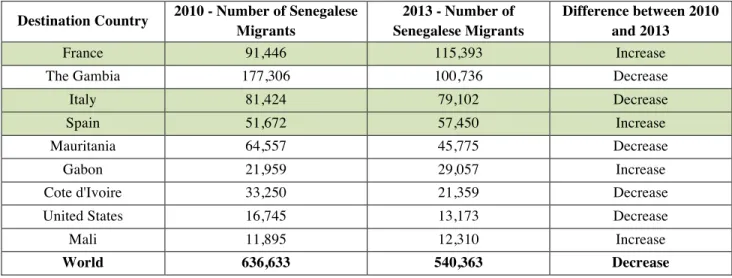
Specifically with regards to joint migration management, Senegal has a close working relationship with Spain and the European Union due to the 2005 surge in Senegalese migration flows towards Spain’s Canary Islands. The EU’s renewed interest in cooperating with Senegal for migration management as a result of the Libyan and Central Mediterranean crisis, but in the absence of a significant spike in Senegalese migration numbers (see Table 1), is noteworthy. With a budget of €161.8 million, Senegal is the largest beneficiary of development funding from the EU Emergency Trust Fund for Africa. Under the Migration Partnership Framework, EU funding finances nine development projects across Senegal ranging from employment creation and food security in regions of high emigration potential, to diaspora investment facilitation and the setup of a national biometric identification system (See Appendix A for the full list of projects, funding allocation, and implementation partners).
Senegal is known for the heterogeneity of its migration flows. A country of migration origin, transit, and destination, Senegalese authorities work to tackle migration from a variety of perspectives and interested parties, among which the EU is also included. Beauchemin, Sakho, Schoumaker, and Flahaux (2014) summarize survey data collected by the MAFE project (Migration between Africa and Europe) and show that, between 1975 and 2008, there was neither an emigration surge from Senegal (despite the widespread belief in an African invasion in Europe in the early 2000s) nor the decline that should have been expected if restrictions had been effective.18
Table 1 summarizes data from the World Bank Bilateral Migration Matrix for the top nine countries of destination for Senegalese emigration (countries are ranked based on the 2013 data) and highlights the relative position of the top three European destinations, France, Italy, and Spain. While no time series data was available, the data from the 2010 and the 2013 Bilateral Migration Matrices are compared, showing that there was no discernable pattern in Senegalese emigration trends between 2010 and 2013. With its mixed nature of immigration and emigration flows, Senegal is therefore a provocative case study when evaluating the premises and outcomes of the EU’s increased action for migration management with non-EU partner countries.
Table 1. Senegalese Emigration - Bilateral Estimates of Migrant Stocks in 2010 and 2013
Destination Country 2010 - Number of Senegalese Migrants
2013 - Number of Senegalese Migrants
Difference between 2010 and 2013
France 91,446 115,393 Increase
The Gambia 177,306 100,736 Decrease
Italy 81,424 79,102 Decrease
Spain 51,672 57,450 Increase
Mauritania 64,557 45,775 Decrease
Gabon 21,959 29,057 Increase
Cote d'Ivoire 33,250 21,359 Decrease
United States 16,745 13,173 Decrease
Mali 11,895 12,310 Increase
World 636,633 540,363 Decrease
Lastly, in terms of domestic migration policy and developments, the Senegalese government is currently strengthening its national approach to migration management. Migration is already incorporated in the Plan Sénégal Émergent (PES), President Macky Sall’s policy framework aimed at getting Senegal on the road to development by 2035.19
Senegal’s migration agenda has therefore taken a strong orientation towards the migration-development nexus. For example, an official at the Senegalese Embassy to Belgium underscored the role of Senegalese youth in the country’s development and the subsequent “priority of Senegalese authorities to maintain young people at home.”20
Furthermore, the Senegalese Ministry of the Economy, Finance and Planning is currently heading a shared institutional effort to draft the Politique Nationale de Migration du Sénégal, Senegal’s national policy framework for migration management. Senegal’s domestic migration policy developments are relevant when evaluating its foreign policy relations, its state agency, and its national interests when working with the EU for migration management. Van Criekinge (2010) in fact argues that the EU’s need for strategic cooperation in migration
19 Presidency of the Republic of Senegal, Plan Sénégal Émergent, http://www.presidence.sn/en/pse (accessed 14.03.2018)
management has increased Senegal’s negotiation leverage to direct policies and development programming closer to its own national interests.21
Overall, Senegal therefore presents a case study for the issue-linkage migration and development in EU external relations that is historically, demographically, and strategically complex.
3. Literature Review
In order to analyze EU-Senegal migration management relations, I firstly draw from EU external governance and policy issue-linkage literature. Secondly, the study situates EU migration governance within the two international relations debates on the linkage of migration to the policy areas of development and security: the migration-development nexus for the former, and the securitization of development cooperation for the latter.
3.1 Issue-Linkage and EU External Governance
Issue linkage characterizes the practice whereby decision-makers tie one foreign policy area to another.22
Poast (2013) defines issue linkage as “the simultaneous discussion of two or more issues for joint settlement” and “a bargaining tactic that (1) increases the probability of states reaching a negotiated agreement and (2) motivates states to remain committed to an agreement.” While issue-linkage can be used as an incentive or disincentive for cooperation and short-term
21 Van Criekinge, T. (2010). The EU-Africa migration partnership: a case study of the EU's migration dialogue with Ghana and Senegal.In: EUIMigration Working Group, March 2010, European University Institute, Florence, Italy.
22 Buchanan P., 2012. “Analytic Brief: Issue Linkage in Foreign Policy”, Posted in Analysis Assessment,
Geopolitics, Politics, Rotate, Weekly Assessment, December 19th, 2012. Link:
agreements, it also informs long-term strategy for policy formation and implementation. Issue-linkage is often observed in security and trade: preferential trade agreements will regularly contain human-rights clauses (Hafner-Burton, 2005), while many security alliances are accompanied by trade concessions (Poast, 2013).
The concept of issue-linkage has been introduced in EU external governance to examine the interdependence of policy spheres and agendas. In order to understand the choice and the use of issue-linkage in the EU’s external relations, we firstly consider the contrasting theories framing the EU’s pursuit of external governance relations.
Lavenex and Schimmelfennig (2009) conceptualize EU external governance as the expansion of the scope of EU rules beyond EU borders. They claim that differing theories can shed light on how the EU is able to expand its rules to the external environment. Institutionalist theories emphasize the role of policy legacies in shaping future policy, and power-based theories emphasize the bargaining position of the European Union within the international system and in relation to the partner country that it seeks to cooperate with.23
The notion of policy legacies is central in historical institutionalism. Paul Pierson (2000) argues that political scientists must think critically about the role of time and history in policy analysis. Models of path dependency identify positive feedback loops as responsible for ensuring the consistency of institutional arrangements. The large set-up and fixed costs that are required for new policy paths, the learning and coordination effects, as well as the principle of adaptive expectations, all contribute to the persistency of institutional set-up and outcomes. Pierson therefore argues that “bounded change” takes place until shock episodes, called critical junctures,
are able to spur a policy break.24
North (1990) explains that while path dependence should not be considered as an inevitability principle, it can be used to conceptually narrow choice sets and link decision making over time.25
Pierson’s path dependency framework provides a useful hook to understand how migration might be linked to other foreign policy areas. Migration’s new role at the forefront of EU foreign policy engagement in Africa and the Middle East enters a pre-existing framework of historical colonial legacies, development aid models within the international financial system shaped by the International Monetary Fund and the World Bank, and well-rooted international cooperation mechanisms within EU external relations. The issue-linkage of migration to other policy spheres would therefore be considered a path dependent insertion of migration in EU external relations.
Power-based theories instead focus on the position of the European Union within international frameworks and bargaining regimes. In this view, external governance responds to external structures of power and interdependence. The bargaining power of the EU determines whether EU rules (rather than other rules) are selected, and whether these rules will be adopted and applied.26 On the other hand, Van Criekinge (2010) argues that the EU’s need for strategic cooperation in migration management has given some African governments, including Senegal, a new scope for influencing the EU and getting their demands met. The increased importance of migration in Senegal’s relations with Europe has allowed the government to use migration as a
24 Pierson, P. (2000). “Increasing Returns, Path Dependence, and the Study of Politics.” American
Political Science Review, 94(2), 251-267. Doi:10.2307/2586011
25 North, D. (1990). Institutions, Institutional Change and Economic Performance. Cambridge: Cambridge University Press.
negotiation “instrument” by soliciting closer cooperation in exchange for shifting policies closer to its own national interests.27
Whether informed by policy legacies or induced by power, we now consider how the European Union has come to embrace issue-linkage as its primary approach to international cooperation for migration management.
A key point of departure is that the EU cannot be considered a unitary and hierarchical actor. As Sandra Lavenex (2014) puts it, the EU operates as a “conglomerate of loosely coupled sectoral regimes” that leverage transgovernmental networks and international organizations to catalyze new mechanisms of regulatory extension.28
One implication is that the EU is often compelled to resort to softer approaches that rely on socialization and transgovernmental networking. Issue-linkage is often applied when policy conditionality mechanisms are weak or absent and cannot therefore facilitate effective policy transfer. Lavenex (2014) shows that the EU’s leverage is reduced when it finds itself in a demander position. For example, the EU suffered limits to its bargaining power when negotiating migration policy with Morocco because it depended on non-EU partner countries for the implementation of migration controls.29
When attempts to devise traditional conditionality strategies fail, Lavenex (2014) argues that the EU Commission turns towards socialization and transgovernmental networking with partner countries. Within the realm transgovernmental networking, issue-linkage figures as an increasingly utilized strategy.
27 Van Criekinge, T. (2010). The EU-Africa migration partnership: a case study of the EU's migration dialogue with Ghana and Senegal.In: EUIMigration Working Group, March 2010, European University Institute, Florence, Italy.
28 Lavenex, S. (2014). The power of functionalist extension: How EU rules travel. Journal of European
Public Policy,21(6), 885-903. doi:10.1080/13501763.2014.910818
29 Wunderlich , D. (2010). Differentiation and Policy Convergence against Long Odds: Lessons from Implementing EU Migration Policy in Morocco, Mediterranean Politics, 15:2,
Ramona Coman (2015) points out another limitation to hierarchical EU policymaking: politicization. Coman argues that when politicization raises the pressure for a supranational EU policy response but EU member states do not delegate more hierarchical powers, the European Commission applies a network approach to seek new policy methods and solutions.30
When institutional legitimacy is questioned in times of crisis, new policy tools and modes of governance emerge to overcome the structural limitations of incomplete supranational authority. Migration policy is an example of the EU’s supranational deficiencies, since member states prefer to maintain sovereignty over legal migration and visa approvals. In Coman’s framework, the incomplete integration of migration policy sovereignty at a supranational level in a context of high politicization is a contributive factor to the EU Commission’s network approach to external negotiations, explaining the increase in the use of issue-linkage strategies.
Thirdly, the absence of an international framework for the management of migration further explains the EU’s utilization of issue-linkage in external governance. Internationally, there is no coherent legal framework, no hard rule of law on migration, no single authoritative actor, but rather a patchwork of soft law developed by diverse international organizations. In 2010, the International Labour Organization (ILO) highlighted the need for an international regime for migration management based on the rule of law in order to establish accountability, shared parameters, reporting and monitoring mechanisms.31
The ILO states “While many elements of migration policy will certainly remain in the domain of individual states, there is a clear need for more multilateral efforts in governing migration”.32
30 Coman, R. (2015). Strengthening the Rule of Law at the Supranational Level: The Rise and
Consolidation of a European Network. Journal of Contemporary European Studies,24(1), 171-188. doi:10.1080/14782804.2015.1057482
31 International Labour Organization, (2010). International Labour Migration: A Rights-Based Approach. Geneva, International Labour Office. Page 193.
Alexander Betts (2011) defines global migration governance as a “fragmented tapestry” of institutions at the bilateral, regional, inter-regional, and multilateral levels. Rather than a “top-down” multilateral framework, a variety of international organizations, states, and non-state actors are building a “bottom-up” global migration governance framework.33
Within this tapestry, the 1951 UNHCR Convention on the Status of Refugees establishes the global refugee protection regime and is arguably the strongest instrument for cooperation on migration. Secondly, treaties promoted by the International Labor Organization underpin a range of labor standards regulating international labor migration. Additionally, the International Organization for Migration, despite not being a UN agency, has grown rapidly since the 1990s into the most prominent international organization dealing with migration issues. Lastly, state actors such as the United States, EU member states, as well as the supranational European Union often exhibit agenda-setting power with regards to international migration and visa policy.
The lack of a unitary international legal regime for migration management, alongside the previously discussed increase in technocratic and loosely associated methods for EU external governance, help illuminate why the EU has turned to issue-linkage as a strategy for managing the politicized issue of migration. Migration policy overlaps with trade, security and development policy in EU external relations. Our focus here is on the migration-development nexus.
3.2 The Migration-Development Nexus
First coined in 2002, the term “migration-development nexus” explores the positive dimensions of linking migration and development. Nyberg-Sørensen, Van Hear and Engberg-Pedersen (2002) argue that migration can be a “development resource” by highlighting the significance of remittances, labour movements, and human capital development for the domestic economic growth of a country of migrant origin. The authors therefore argue in favor of migration and development issue-linkage because migration can be utilized to catalyze development. Within issue-linkage, they also address the risk of policy divergence between migration and development: “Can long-term goals of global poverty reduction be achieved if short-term migration policy interests are to be met? Can partnership with developing countries be real if tackling illegal migration is the principal European policy goal?”34
According to Nyberg-Sørensen, Van Hear and Engberg-Pedersen, cooperation efforts should place the human rights of individual migrants and the development of countries of migrant origin at the center of newly negotiated agreements. This, according to the authors, is essential to successfully link migration and development policy. The United Nations also sets guidelines that connect development to other policy fields. In its 2002 report, the United Nations Conference on Trade and Development accepted that development assistance could be useful in reducing extreme poverty and attaining sustainable human development in Less Developed Countries (LDCs), but only if it is combined with other external inputs like increased policy autonomy, development-oriented poverty reduction strategies, and improved governance.35
34 Nyberg-Sorensen, N., Engberg-Pedersen, P., & Hear, N. V. (2002). The Migration-Development Nexus. IOM Migration Research Series. doi:10.18356/e48ad218-en
However, when evaluating the role of external actors such as the EU in the migration-development nexus, it is important to interrogate the premises of “migration-development agendas”. Extensive literature disputes the overall effectiveness of foreign aid and the historically produced discourse of “development”. Anthropologist Arturo Escobar (2012) argues that in the post-World War II period, Western economic and governance models were presented as the long-term goals of development programming and that “development has achieved the status of certainty in the social imaginary”.36
Kenyan-American human rights scholar Makau Mutua (2013) interrogates the interests of foreign donor governments in Less Developed Countries (LDCs). When evaluating the international funding for human rights NGOs in Kenya during the country’s precarious wave of democratization, he notes “donor funding is essentially the story of the historically managed development of the African state.”37
With a specific focus on the role of development in migration policy, authors Delgado Wise, Márquez Covarrubias, and Puentes (2013) argue that when the issue-linkage of migration and development is realized primarily through aid programs, these also overlook the realm of neoliberal globalization and unequal development in which contemporary migration is embedded. They suggest that the current development aid packages aimed at tackling migration’s root causes conceptually involve a one-way flow between two variables: development (seen as an independent variable) and migration (seen as a dependent variable). 38 The goal of stemming migration flows by realizing an external development agenda in countries of migrant origin is therefore argued as flawed.
36 Escobar, A. (2012). Encountering development: The making and unmaking of the third world. Princeton, NJ: Princeton University Press. Page 5.
37 Mutua, M. (2013). Human Rights NGOs in East Africa Political and Normative Tensions. Philadelphia: University of Pennsylvania Press. Page 158.
3.3 The Securitization of Development
The concept of “securitization” was introduced in the study of international relations by Barry Buzan, Ole Wœver and Jaap de Wilde at the Copenhagen School. “Securitization” delineates a process through which policy choices unrelated to security become “securitized” when actors attach a national security value to them and can therefore treat them through exceptional means. Thierry Balzacq (2005) defines securitization as: “a rule-governed practice, the success of which does not necessarily depend on the existence of a real threat, but on the discursive ability to effectively endow a development with such a specific complexion.”39
Since the Cold War, securitization has affected the allocation and implementation of official development assistance (ODA), giving rise to the notion of “securitization of development”. Brown and Grävingholt (2016) define ODA “a major arena in the emerging global governance architecture.”40
The issue of ODA instrumentalization was brought to the wider public attention in Western countries after the covert militarization of development in Afghanistan.41 Furthermore, concerns as to the securitization of ODA exist not only for the intentions of donor governments, but also in regard to the agendas of the governments that are receiving development aid. Fisher and Anderson (2010) problematized the role of governments in Africa that have embraced the securitization agenda and actively promoted its practice, citing
39 Balzacq, T. (2005). "The Three Faces of Securitization: Political Agency, Audience and Context",
European Journal of International Relations, Vol 11, Issue 2, pp. 171 – 201, https://doi.org/10.1177/1354066105052960
40 Brown, S. and Grävingholt, J. (2016). The Securitization of Foreign Aid. Basingstoke, Hampshire ; New York, NY: Palgrave Macmillan. Page 4.
the Ethiopian and Ugandan regimes’ use of Western security initiatives since the 1990s to build militarized and strongly authoritarian states.42
A security lens is therefore necessary to inform our analysis of the EU’s issue-linkage of development and migration in its relations with Senegal and other countries of priority focus. In line with the Copenhagen School’s securitization critique, Lavenex and Kunz (2008) introduce the persistence of security priorities as a limitation to the EU’s stated objective of promoting the migration-development nexus in its foreign relations. The authors argue that while the EU has changed its rhetoric and is now embracing the linkage of migration and development programs, it has not yet implemented concrete policies that are consistent with the stated shift in outlook. For example, in analyzing the EU’s policy response to the Ceuta and Melilla migration tensions between Spain and Morocco in 2005 and 2006, Lavenex and Kunz (2008) argue that the EU’s approach was motivated primarily by security concerns instead of development objectives.43
EU migration management therefore remains centered on the security priorities of the European migrant-receiving countries, resulting in the utilization of development instruments to supplement migration policy objectives in EU external relations.
Indeed, Europe’s concerns with security seem to displace Europe’s concerns with development. Baggio and Zanfrini (2006) also identify the securitization of migration as an impediment to constructive migration and development issue-linkage in international cooperation efforts. They argue that this is because the primary stated goal of migration policy in almost all developed countries is fighting irregular migration.44
The European Agenda for
42 Fisher, J. and Anderson, D. M. (2015).
43 Lavenex, S. and Kunz R. (2008) The Migration–Development Nexus in EU External Relations, Journal
of European Integration, 30:3, 439-457, DOI: 10.1080/07036330802142152
44 Baggio, F. and Zanfrini, L. (2006). Migration management and ethics: Envisioning a different
Migration, published by the EU Commission in 2015, also states the control of irregular migration as its central objective.
In a cooperative project across universities in Paris, Brussels, and Dakar analyzing African and European migration trends, Beauchemin, Kabbanji, Sakho and Schoumaker (2013) identify the primacy of security in European border management and control objectives, and accordingly argue that diplomacy between African and European leaders is centered on European readmission demands. 45
The external focalization of EU diplomatic efforts is aimed at formalizing new migration control policies. While the link between migration and development was introduced only recently in the Euro-African political agenda, the authors believe that the European historical priority for the securitization of migration policy remains central and prevents the effective issue-linkage of migration to other governance areas. Lastly, authors Keukeleire and Raube (2013) take the securitization debate one step further by identifying the concept of “security-development nexus”, arguing that the EU also uses development money to improve security structures in third countries and to fund security activities through other actors.46
45 Beauchemin, C., Kabbanji, L., Sakho, P., and Schoumaker, B. (2013). Migrations africaines: Le
codéveloppement en questions; essai de démographie politique. Paris: Colin. Page 10.
46 Keukeleire, S. and Raube K. (2013) The security–development nexus and securitization in the EU's policies towards developing countries. Cambridge Review of InternationalAffairs, 26:3,
4. Research Design
The study draws evidence from expert interviews conducted between May and July 2017. I use qualitative data from interviews with EU policy officials in Brussels (Belgium) and Dakar (Senegal) representing the following EU institutions: the EU Commission Directorate General for International Cooperation and Development (DG DEVCO), the EU Commission Directorate General for Migration and Home Affairs (DG HOME), the EU Parliament’s Committee on Development, the European External Action Service, the EU Delegation to Senegal and HRVP Federica Mogherini’s Cabinet. At the national level, interviews were conducted in Italian institutions, including the Italian Ministry of Foreign Affairs, the Italian Agency for Development Cooperation and at the Italian Embassy to Senegal. Italy serves as the EU-member state of reference because of its significant involvement on the frontline of Europe’s migrant crisis and because of its policy-driving role within the EU for the set-up of migration instruments, such as the drafting of the Migration Partnership Framework. On the Senegalese side, interviews concerning the non-EU partner country case study included the Senegalese Ministry of Foreign Affairs and Senegalese Abroad, the Senegalese Ministry of the Economy, Finances and of Planning, the Senegalese Embassies to Belgium and to Italy, and the African Union Delegation to the European Union. Interview data also draws from non-governmental actors and the civil society sector, encompassing NGOs, think tanks, foundations, and academics.
in approach, for example between national government headquarters and embassies on foreign soil, are highlighted.
5. Section A - Migration and Development Issue-Linkage within European Union
Governance
Migration has emerged as an issue capable of influencing the structural nature of EU governance and institutional relations. Within the rise of migration as a factor of political salience, this section evaluates the self-reinforcing relationship between EU governance limitations and the choice of issue-linkage as a policy instrument for the externalization of migration management. I argue that migration and development issue-linkage within EU policymaking occurs within a patchwork of (1) soft law instruments and (2) priority divergences across EU institutions and partner countries, within which EU Parliamentary oversight is identified as an example. These divergences affect the initial premise as well as the conclusive effectiveness of issue-linkage programs.
5.1 The EU’s Soft Law Framework for Migration Management
The realm of “soft law” begins once legal arrangements are weakened along one or more of the dimensions of obligation, precision, and delegation. 47
Soft law agreements often occur because legally binding “hard law” obligations for the delegation of authority entail contested restrictions of actors’ behavior and sovereignty. Consequently, while criticized by some as “window dressing” for its lack of enforcement powers or as “destabilizing” for its decreased accountability, soft law can also be a preferable institutional arrangement within incomplete global frameworks or issues of significant international tension, such as migration.48
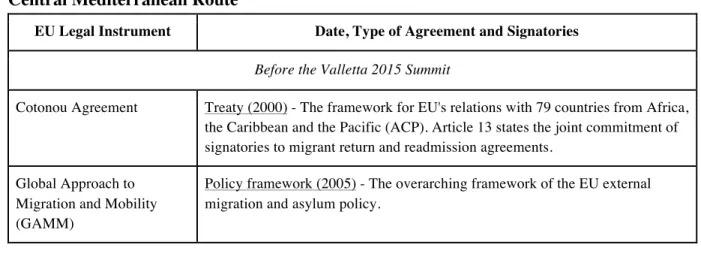
Table 2 categorizes the EU’s migration management instruments for the Central Mediterranean Route discerning between treaties (hard law instruments), policy frameworks, intergovernmental dialogue platforms, financial instruments, and political platforms signed before, during, or after the Europe-Africa Valletta Summit on Migration in 2015. The categorization highlights the heterogeneity in instruments by type, geographical groupings, and actors and shows the prevalence of a soft law approach to migration in EU external relations.
Table 2. Categorization and signatories of EU migration management instruments for the Central Mediterranean Route
EU Legal Instrument Date, Type of Agreement and Signatories
Before the Valletta 2015 Summit
Cotonou Agreement Treaty (2000) - The framework for EU's relations with 79 countries from Africa, the Caribbean and the Pacific (ACP). Article 13 states the joint commitment of signatories to migrant return and readmission agreements.
Global Approach to Migration and Mobility (GAMM)
Policy framework (2005) - The overarching framework of the EU external migration and asylum policy.
47 Abbott, K. and Snidal, D. (2000). Hard and Soft Law in International Governance. International
European Neighborhood Policy
Intergovernmental dialogue platform and financial instrument (2014) between EU and partner countries: Algeria, Armenia, Azerbaijan, Belarus, Egypt, Georgia, Israel, Jordan, Lebanon, Libya, Republic of Moldova, Morocco, Syria, Palestine, Tunisia, Ukraine.
Rabat Process Intergovernmental dialogue platform and financial instrument (2006) for the Western Mediterranean migration route: Belgium, Burkina Faso, Equatorial Guinea, France, Italy, Mali, Morocco, Portugal Senegal, Spain, the EU Commission and and the ECOWAS.
Khartoum Process Intergovernmental dialogue platform and financial instrument (2014) - led by a Steering Committee comprised of five EU Member States (Italy, France, Germany, UK, Malta), five partner countries (Egypt, Eritrea, Ethiopia, South Sudan, Sudan) as well as the EU Commission, the EEAS and the AU Commission.
European Agenda on Migration
Political platform (2015)
European Commission, 13th May 2015.
Valletta 2015 Summit Results
Valletta Action Plan Political platform (2015)
Signed by Valletta Summit Participants, 11-12 November 2015.
EU Emergency Trust Fund for Africa
Financial instrument (2015)
Followed the Valletta Summit on Migration to “provide additional funding and will contribute to a flexible, speedy and efficient delivery of support to foster stability and to contribute to better migration management. [...] to help address the root causes of destabilization, forced displacement and irregular migration”
After the Valletta 2015 Summit
Migration Partnership Framework
Political platform (2016) with third countries of origin and transit using all policies and instruments at the EU's disposal to achieve concrete results.
2016 Partners: Senegal, Mali, Niger, Nigeria, Ethiopia 2017 New Partners: Ghana, Guinea, Cote d’Ivoire
European External Investment Plan
Financial instrument (2016)
Encourages investment in partner countries in Africa and the EU Neighborhood region
representatives at the negotiating table for migration instruments. An official at the African Union Delegation to the EU highlighted the AU’s commitment to pursuing a continental policy framework based on the principle of mobility rather than migration.49
Instead, as highlighted in Table 2, the EU often opts for a tapestry of bilateral or regionally focused instruments. The Senegalese Embassy to Belgium also criticized “The tendency of the EU to separate African countries for cooperation efforts.”50
An official at the AU Delegation to the EU described his surprise at the EU’s bilateral approach in the Migration Partnership Framework in 2016 with five African countries (including Senegal), after the instruments at Valletta Summit on Migration had not forseen bilateral action.
“When Valletta came up, the AU’s position was: we already have the continental framework. If Valletta is very much important to you, let us make sure all AU countries are involved, because for now your rationale is that you are focusing on hotspot countries, but what about us involving everybody before countries become hotspots tomorrow. But if you have been dealing with the EU, you realize that the EU as an institution is not a proactive institution. Mostly all EU policies are reactive.” 51
In response, Italian and EU officials cited the difficulty of negotiating with some African governments as a reason for their preference to cultivate bilateral structured relationships.52
Overall, the tapestry of soft law instruments renders the externalization of EU migration policy fragmented and affects its working relationships with partner countries and institutions such as Senegal and the African Union. However, the pursuit of a soft law approach is contextualized by Betts’s framework for global migration governance and Lavenex’s research on the EU’s socialization networking approach to external governance.
49 Interview, African Union Delegation to the European Union, Brussels, 18.06.2017 50 Interview, Senegalese Embassy to Belgium, Brussels, 28.06.2017
51 Interview, AU Delegation to the EU, Brussels, 19.06.2017
5.2 Divergence Among EU Institutions on the Issue-Linkage of Migration and Development
When zooming in from the EU’s larger international soft law framework to analyze intra-institutional dynamics, the fragmentation of mandates and instruments is replicated. An official at DG DEVCO summarized the EU’s new institutional cooperation landscape as:
“There is indeed much more coordination and you feel like it is more embedded in external policy, which was not the case before. DG HOME is a lot more associated with DG DEVCO. Even within the Commission you have new actors like the Secretary General that became also quite active in coordinating, and of course with member states as well. In the past we have coordinated with them as well but never to this extent.”53
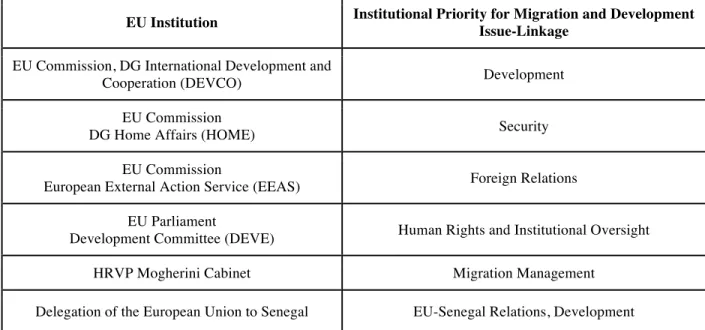
While coordination among EU institutions on migration issues was reported as increased, the convergence of institutional priorities did not necessarily follow suit. Table 3 summarizes the interview outcomes across EU institutions with regards to institutional priorities within the linkage of migration management objectives to development policy instruments.
Table 3. Interview outcomes at EU institutions
EU Institution Institutional Priority for Migration and Development Issue-Linkage
EU Commission, DG International Development and
Cooperation (DEVCO) Development
EU Commission
DG Home Affairs (HOME) Security
EU Commission
European External Action Service (EEAS) Foreign Relations
EU Parliament
Development Committee (DEVE) Human Rights and Institutional Oversight
HRVP Mogherini Cabinet Migration Management
Delegation of the European Union to Senegal EU-Senegal Relations, Development
Even though migration policy is being directed at the highest levels of the EU Commission,54
Table 3 shows the divergence in institutional mandates as pronounced. While officials at DG DEVCO expressed concern over the use of development funding for migration projects, officials at DG HOME instead focused on the role of issue-linkage instruments in facilitating the EU’s negotiations for the increase in the identification and readmission of migrants in irregular status. The European External Action Service embraced a broader approach based on the importance of long-term foreign policy relations with partner countries, relations that the EU Delegation to Senegal was building and maintaining on the ground in Dakar. At the EU Delegation to Senegal, the new appointment in February 2017 of a Migration Liaison Officer as prescribed in the Migration Partnership Framework marked the increase in the externalization of EU migration policy.
At a national level, institutional discrepancies also complicate the position of EU member states on issues of migration and development issue-linkage. At the Italian Embassy to Senegal in Dakar, public officials stated that “There is not a unitary position within the Italian Government” with regards to the revision of development instruments for the pursuit of migration management objectives such as returns, readmissions, and border patrol. 55 Inconsistencies within EU member states also contribute to the network of interests at play within the European Union.
5.3 Parliamentary Scrutiny
Within the fragmentation of EU institutional priorities and operations, one implication of the divergent technocratic nature of migration-development governance is that parliamentary oversight is severely hampered. Since the Migration Partnership Framework and the EU Emergency Trust Fund for Africa are not binding legal instruments, governments are not required to present these texts for parliamentary approval. As a consequence, the European Parliament lacks oversight on the implementation of the Migration Partnership Framework and on the allocation of funds via the EU Emergency Trust Fund For Africa, which is managed by the EU Commission. This has stoked discontent in the European Parliament.
In a January 2017 press release, the EU Parliament Development Committee called for better oversight over the EU’s Trust Funds and External Investment Plan and stated “Funding to tackle the root causes of migration is meant to help social development, not to stop refugees.”56 As a follow-up to the initial press release, the Development Committee proposed the resolution “Addressing Refugee and Migrant Movements: the Role of EU External Action”, which was officially adopted by the Parliament on April 5th
, 2017. In the resolution, the Parliament: “Deeply regrets than in the EU migration policy framework and refugee movements response, the EU and its Members States have opted for the conclusion of agreements with third countries, which avoid the parliamentary scrutiny attached to the Community method.”57
56 European Parliament Development Committee Press Release, (2017). 25 January 2017.
http://www.europarl.europa.eu/news/en/press-room/20170124IPR59772/meps-set-priorities-for-a-new-impetus-in-development (accessed 05.02.2018)
57 European Parliament, (2015). European Parliament resolution of 5 April 2017 on addressing refugee
and migrant movements: the role of EU External Action, Article 70.
The resolution specifically addressed the lack of scrutiny afforded to the Parliament by the Commission over the linkage of migration management to development cooperation programming. The European Parliament:
“Draws attention to the intention to revise development cooperation programming documents to deliver on the new migration compacts; stresses that this revision needs to be carried out in line with development effectiveness principles and in dialogue with partner countries, European and local civil society organisations and the private sector; calls for Parliament to be fully involved at all stages of the revision, including programming documents under the European Development Fund (EDF).”58
The European Parliament also expressed concern over migration instruments being negotiated outside of the Valletta Summit framework with other third countries, such as the Joint Way Forward on Migration political platform, signed by Afghanistan and the European Union in 2016 (Article 69, see associated footnote).59
Overall, as a result, the European Parliament:
“Urges the Commission and the EEAS to provide Parliament and the public, at the earliest opportunity, with a detailed overview of the various funding instruments and programmes – and how they fit together with Member State programs – in the 16 priority countries with which the EU engages in high-level dialogues on migration.”
The Open Society European Policy Institute also highlighted reduced parliamentary scrutiny as an issue of democratic deficit with regards to the European Union’s external response to the migration crisis and noted the similarity of the situation in the Italian National Parliament,
58 European Parliament, (2017). Article 63.
which has also not been granted oversight over Italy’s border policing agreements with non-EU partner countries.60
The European Parliament’s oversight concerns underscore the friction among EU institutions with regards to the management of migration and development policy. Furthermore, the restriction of parliamentary scrutiny should also be interpreted as a securitization pattern. When actors attach a national security value to an issue, exceptional operational means are often justified. Consequently, the decrease in parliamentary oversight over the EU Commission’s actions on migration management could be considered as a manifestation of the securitization of development policy through issue-linkage.
6. Section B: The Impacts of Issue-Linkage on Development Objectives
6.1 Introduction
Described as “an instrument that helps to better target development aid towards countries of priority cooperation in the Migration Partnership Framework”,61
the EU Emergency Trust Fund for Africa was launched at the 2015 Valletta Summit on Migration as one of the primary tools for the linkage of migration management to development policy and funding sources. The Fund is officially aimed at addressing the “root causes” of destabilization, displacement and irregular migration by promoting economic opportunity, security, and development.62
An increase in development funding allocation for migration management purposes is one of the five goals outlined in the Valletta Action Plan. However, during the initial stages of cooperation, the increase in financial instruments has been the most utilized and cited of the five goals by EU leaders.63
When asked about the EU’s increased focus on the instrumentalization of development funding within the five pillars of the Valletta Action Plan, officials in DG DEVCO observed that:
“I think that it has been the easiest, especially in the eyes of members. It's just been the easiest to pour more money, whether that's good or bad, whether it's useful or not. One year after we see the limitations.”64
Officials at the Senegalese Embassy to Belgium also noted the “obsession with numbers as a solution” exhibited by EU officials when discussing migration-development cooperation
61 Interview, EU Delegation to Senegal, Dakar, 22.05.2017
62 EU Commission, DG for International Development and Cooperation. (2018).
https://ec.europa.eu/europeaid/regions/africa/eu-emergency-trust-fund-africa_en (accessed 12.02.2018) 63 The Five Pillars of the Valletta Action Plan: 1. Development benefits of migration and addressing root causes of irregular migration and forced displacement // 2. Legal migration and mobility // 3. Protection and asylum // 4. Prevention of and fight against irregular migration, migrant smuggling and trafficking in human beings // 5. Return, readmission and reintegration
efforts with African partners, both in relation to repatriation and migration flows, as well as to development aid allocation.65
During an interview at the African Union Delegation to the European Union, an AU official expressed his reservations with regards to the strategy of tackling migration flows through development programming: “Root causes is the buzz word.”66
The following section uses evidence from the expert interviews to evaluate the effects of issue-linkage on development cooperation. I will analyze the EU’s push to interlace migration and development cooperation in terms of funding allocation, project design, and project implementation. At the micro-level of project outcome, the implications of issue-linkage on development goals are that (1) resources are mostly displaced from development programs rather than increased, (2) committed resources are too small to make a difference, and (3) the financial instruments are not embedded in a long-term shared political vision. In the subsequent sections, I will show that the broader development goals of the migration-development nexus are undermined by two structural factors: the securitization of development and the disputed role of the EU as a development actor within non-EU partner countries. While European officials in interviews repeatedly denied the existence of strict conditionality, the effects of security-driven priorities are apparent.
65 Interview, Senegalese Embassy to Belgium, Brussels, 28.06.2017
6.2 Evaluating Funding Allocation, Project Design and Implementation
Several developments seem to indicate goal displacement at the micro-level of development projects. For one, funding for the new EU Emergency Trust Fund for Africa has been diverted from pre-existing development funding sources, primarily the European Development Fund. Created in 1957 by the Treaty of Rome and launched in 1959, the European Development Fund (EDF) is the EU's main instrument for providing development aid to African, Caribbean and Pacific (ACP) countries and to overseas countries and territories (OCTs). Out of the 2.6 billion euros pledged for the EU Emergency Trust Fund for Africa at the 2015 Valletta Summit, 2.3 billion euros came from the 2015-2020 European Development Fund.67
Effectively, most of the EU Emergency Trust Fund for Africa therefore re-packages pre-existing development funding in a new issue-linkage instrument. The European Union External Action Service underscored this trend: “It has changed the way it is sold, not the substance.”68 Understanding the EU Emergency Trust Fund for Africa in terms funding diversion presents the Fund not as a new development cooperation instrument, but rather a re-packaged funding source subject to increased EU directional control for its linkage to migration goals.
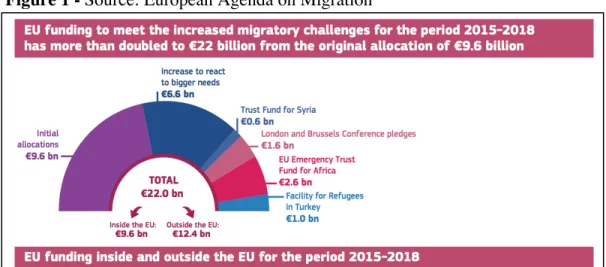
The EU Emergency Trust Fund for Africa is part of a broader financial envelope, which is visualized in the chart below. The chart shows higher resource allocation for action outside the EU (12.4 billion euros) compared to inside the EU (9.6 billion euros), confirming the EU’s strong externalization outlook of migration management in terms of its financial instruments.
67 EU Commission, DG International Cooperation and Development, (2018). EU Emergency Trust Fund
for Africa Factsheet, https://ec.europa.eu/europeaid/sites/devco/files/eu-emergency-trust-fund-africa-20180226_en.pdf (accessed 19.03.2018)
Figure 1 - Source: European Agenda on Migration
Allocation of EU overseas development assistance (ODA) for the relief of migration’s root causes must also be understood in relation to other sources of income and capital flow. In a 2017 discussion paper, the European Policy Center (EPC) challenged the effectiveness of using development funding for migration flow management. It claims that the EU’s foreign aid commitment dwarfs with other investment sources linked to migration flows, such as foreign direct investment, remittances, and private debt and portfolio equity. Similarly, staff at the Open Society Initiative for West Africa stated, “the amounts are derisory”, in relation to the EU’s focus on project-based development assistance to tackle migration flows.69
The EPC graph below shows the lower magnitude of ODA with respect to other sources of income and questions the effectiveness of the EU’s use of ODA as the primary economic mechanism for the relief of root causes of displacement.70
69 Interview, Open Society Initiative West Africa, Dakar, 30.05.2017
70 Funk, M., Namara F., Pardo R., and Rose N. (2017). Tackling Irregular Migration Through Development – A Flawed Approach?, European Policy Center
Graph 2: European Policy Center, Remittances to developing countries compared to ODA and private capital flow
Officials within Senegalese institutions also highlighted the importance of remittances. Personal remittances comprise all personal transfers in cash or in kind made or received by residents to or from nonresident households or individuals.71
At the Senegalese Ministry of the Economy, Planning and Human Development, the interviewed official focused on the domestic development catalyzed by remittances in terms of education and healthcare investment.72
In relation to remittance flows, the Senegalese Ambassador to Italy stated in an interview: “Italy has now become a factor of stability in Senegal”.73
The research therefore not only supports the case that the EU’s cooperation efforts with countries of priority focus should increase their focus
71 World Bank, (2018). Metadata, Long Definition, Personal remittances, paid (current US$).
http://databank.worldbank.org/data/Views/Metadata/MetadataWidget.aspx?Name=Personal%20remittanc es,%20paid%20(current%20US$)&Code=BM.TRF.PWKR.CD.DT&Type=S&ReqType=Metadata&ddlS electedValue=TUN&ReportID=4001&ReportType=Table (accessed 19.03.2018)
on other forms of investment and capital flow in order to work towards the migration-development nexus, but also that there is significant potential and openness to cooperation within partner countries for this avenue. Graphs 3 and 4 underscore the relevance of remittances as a % of national GDP in the 16 countries of priority focus of EU externalization efforts, with a particular focus on the evolution of Senegalese remittance percentages from 1980 to 2016 in conjunction with migration flow fluctuation and the shift in the economic conditions of the Senegalese diaspora. In Senegal, remittances from the diaspora are said to be the first source of foreign currency in the country.74
Graph 3: Personal remittances received (% of GDP)
Data was drawn from World Bank staff estimates based on IMF balance of payments data, and World Bank and OECD GDP estimates.75 The 16 countries of priority focus within EU migration management efforts were considered, although no data was available for Eritrea, Somalia and Niger.