This is a repository copy of Effect of steam exploded treatment on the reactivity of pine wood.
White Rose Research Online URL for this paper: http://eprints.whiterose.ac.uk/89060/
Version: Accepted Version
Proceedings Paper:
Saeed, MA, Andrews, GE, Phylaktou, HN et al. (1 more author) (2015) Effect of steam exploded treatment on the reactivity of pine wood. In: Proceedings of SEEP2015. International Conference on Sustainable Energy and Environmental Protection (SEEP, 2015), 11-14 Aug 2015, University of the West of Scotland (UWS), Glasgow, UK. .
[email protected] https://eprints.whiterose.ac.uk/ Reuse
Unless indicated otherwise, fulltext items are protected by copyright with all rights reserved. The copyright exception in section 29 of the Copyright, Designs and Patents Act 1988 allows the making of a single copy solely for the purpose of non-commercial research or private study within the limits of fair dealing. The publisher or other rights-holder may allow further reproduction and re-use of this version - refer to the White Rose Research Online record for this item. Where records identify the publisher as the copyright holder, users can verify any specific terms of use on the publisher’s website.
Takedown
If you consider content in White Rose Research Online to be in breach of UK law, please notify us by
EFFECT OF STEAM EXPLODED TREATMENT
ON THE REACTIVITY OF PINE WOOD
Muhammad Azam Saeed, Gordon E. Andrews, Herodotos N. Phylaktou, Bernard M. Gibbs Energy Research Institute, School of Chemical and Process Engineering, University of Leeds, Leeds LS2 9JT, UK; email: [email protected] or [email protected]
Abstract
A commercial thermally treated biomass process known as ‘steam exploded biomass’ provided the treated biomass samples for this project together with the original yellow pine wood. The aim was to investigate the change in pulverised biomass reactivity. The steam exploded biomass is processed into pellets in the normal way and are known as black pellets (BP). The material was investigated using the Hartmann dust explosibility equipment. This enables the minimum explosion concentration (MEC) to be determined together with the initial rate of pressure rise and the flame speed and these latter parameters are measures of the mixture reactivity. BP was found to have a higher reactivity than the raw biomass with a much leaner MEC. A good correlation was found between the initial rate of pressure rise and the flame speed for the raw wood sample. Surface morphology was performed to investigate the effects of the steam exploded treatment. This showed the enhancement of the proportion of fines. The particle size distribution was determined and this confirmed the enhancement of the fineness of the treated sample. The enhanced reactivity of BP was found to be due to the greater proportion of fine particles which had a higher heating rate and a greater release of volatiles. The steam explosion treatment was found to be an effective pre-treatment in facilitating the combustion of renewable fuel and the main effect was that it was more easily milled, changes in the biomass chemistry was of secondary importance.
Keywords: Pulverised, Torrefaction, Renewable, Explosibility
1 INTRODUCTION
Concerns over global warming and the high CO2
emissions from pulverised coal fired power plants are discouraging the use of coal as a fuel for electric power generation. Sustainable renewable pulverised biomass can be employed as a substitute for coal in these power plants. Thus, pulverised wood is increasingly being used for electric power generation as one way of meeting the mandated European renewable energy proportions of electricity supply. In 2014 5.8% of the UK’s supplied electricity was generated from pulverised biomass mainly used in existing coal fired power stations. This was a 25.7% increase on 2013 and in 2014 was 19.69 mtoe. It was the fastest growing renewable electricity source between 2013 and 2014.
Currently most wood used for power generation is raw wood, pulverised at source, dried and compressed into pellets. This pelletisation increases the density of the fuel and the drying improves its energy density so that more biomass can be shipped in a ship fixed volume. The palletisation also enables the pulverised fuel to be transported with minimum dust generation and hence with lower explosion risk. At the power station the pellets are stored in silos from
which they are fed to the coal mills, which break up the pellets into the pulverised biomass. The mills are not intended to pulverise the biomass further, all the pulverisation is done at the pellitisation plant in the country which the biomass originated.
Thermal treatment processes such as torrefaction aim to break up the fibrous nature of woody biomass and make it more brittle so that it can be more easily milled alongside coal or on its own in the same mills as used for coal. The intention would be for these thermal treatment processes to be based at the source of the biomass alongside the palletisation plant. They have the advantage of nearly zero water in the biomass, a higher pellet density and less tendency for the pellet to fracture and form dust clouds in transport. The net result will be a higher energy carrying capacity for ships of fixed volume capacity and hence cheaper transport costs of the fuel. At present it is not clear whether the potential advantages of torrefied biomass outweighs the increased cost of manufacture, for power generation.
is too high. Thermal pre-treatment of the biomass potentially can reduce these transport costs. Torrefaction is one of the advanced and attractive pre-treatment that gives the following benefits [3, 4]. Torrefied biomass are more compact (Higher bulk density), have a higher heating value and are more easily pulverised as the biomass fibres are broken up by the thermal treatment. Torrefaction results in a significant loss of volatiles from the biomass depending on the torrefaction conditions; these are usually recycled to provide the heat for the torrefaction process. Thermally treated biomass are often referred to as bio coal as they are closer in properties to coal than to the original biomass. An alternative thermal treatment to torrefaction is ‘steam exploded biomass’. This is a commercial process at the pilot plant stage, that treats the woody biomass with pressurised hot water (1.2-1.7MPa, 170-250oC) for a short time (up to 10 mins.) and then releases the pressure to flash vaporise the water and this process inside the woody biomass structure shatters the particles into finer fractions [5, 6]. These steam exploded biomass materials are transformed into pellets known as ‘Steam exploded pellets’ for the easiness of transportation. They are often referred to as ‘black pellets’ due to their black colour.
The new structure of biomass has similar properties to that of torrefied biomass. The steam exploded biomass process has potentially a lower energy consumption that for torrefied biomass with a lower loss of volatiles. The steam exploded process is intended to have a lower tar formation and less cracking of the raw biomass material. The resultant pellets potentially have a higher proportion of the original biomass energy than for torrefied biomass. The steam exploded biomass treatment and palletisation process produces a pellet with an externally sealed outer surface due to the treatment process. This leaves them less sensitive to absorbed water than for torrefied biomass. The biomass fibres in the pellets are destroyed and the pellets are easily pulverised, which are similar to the benefits of torrefied biomass. Steam exploded biomass is potentially a lower cost product than torrefied biomass and is potentially a better product in terms of energy content as a proportion of the original biomass energy on a daf. basis.
This work investigates the combustion properties of a steam exploded biomass sample from one of the pilot plants for this material. There is scarce data for the combustion properties and none at all for steam exploded biomass. In terms of the safe use of the product there is no fire and explosibility characteristics of pulverised steam exploded biomass. Evaluations of these properties before their application in power stations is necessary to determine any additional safety measures that may be required.
Pulverised biomass, when mixed with air, has an explosion hazard and the flame propagation is the same as that which occurs in pulverised biomass burners. The high volatile content of biomass and thermally treated biomass and the oxygen bound into the structure of the biomass fibres make pulverised biomass very reactive [7-10]. Pulverised biomass are more sensitive to ignition and explosions than pulverised coal [11-13].
At least one dust fire or explosion is reported every day in biomass plants [14]. Some recent incidents related to biomass dust explosions are given below as examples.
Fire and then explosion at Jaffrey, N.H., manufacturing plant, New England Wood Pellet LLC [October, 2011 ]. It took 100 fire
fighters and 15 hours to put down the fire. The company had to pay fine of $100,000 [15]. Explosion at the RWE's 750,000 ton wood
pellet factory, Georgia, USA [June, 2011]. An
overheated roller/bearing assembly in a pelletizer sparked the blast at the factory [16]. Krabi biomass power plant [April 8, 2015] Two
workers were injured due to massive fire. Damage was estimated at about Bt 100 million (Source: The Nation News, 2015 [17]).
Biomass power plant managed by Eco Sustainable Solution Ltd. at Southampton dock [January 03, 2015 ]. No injury. 6m flame and
thick clouds of billowing smoke due to the woodchip pile fire was seen. (Source: Southern Daily Echo, 2015 [17]).
flames, which in extreme circumstances can result in the boiler enclosed space undergoing a biomass dust air explosion. All industrial boiler flames of this type are turbulent, irrespective of the fuel, but pulverized biomass requires turbulent flow for the particles to remain suspended. This also applies to the basic laboratory investigation techniques, which differ in the way that turbulent clouds of dust and air are formed. In addition there are explosion hazards in biomass storage areas such as silos and on the conveyor belts that transfer biomass to mills and from mills to burners.
2 EXPERIMENTAL TECHINIQUES
Raw biomass and steam treated samples were milled to a size fraction of less than 63µm prior to chemical characterisation. The elemental analysis of the samples was carried out using a Flash 2000 Thermo Scientific Analyser. It consists of a single reactor with temperature of 1800°C for the detection of Carbon, Hydrogen, Nitrogen and Sulphur (CHNS) with O found by subtracting the mass of CHNS from the original mass. At this extreme temperature, the material is converted into gas comprising carbon dioxide, water, nitric oxides and sulphur oxides. These combustion products are separated on a chromatographic column and detected using a Thermal Conductivity Detector (TCD).
Proximate analysis was carried out using a Shimadzu TGA-50 thermo gravimetric analyzer. It consisted of a mass balance attached to a ceramic sample pan in a furnace. It records the weight loss with time and temperature from which may be determined the moisture, volatiles, fixed carbon and ash contents. The sample was heated in nitrogen from ambient temperature to 110oC at a rate of 10oC/min and maintained at 110oC for 10 minutes so as to completely dry the sample. The temperature was then increased to 910oC at a rate of 25oC/min and held for 10 min to stabilise the weight after the volatile loss. Then air was introduced at 910oC to react with any fixed carbon. The mass loss was the fixed carbon content. The remaining material left after this was inert ash.
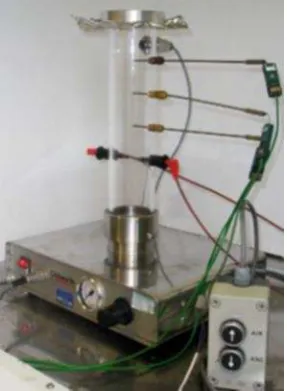
The minimum explosion concentration (MEC) or lean flammability was to use the modified Hartmann explosion tube, shown in Fig. 1 The modification to the original Hartmann tube were developed by Huéscar-Medina et al. (2012, 2013a,b) and Slatter et al. (2013). The Hartmann explosion tube is the most appropriate approach
for biomass dust MEC measurement, as the dust is placed inside the vessel and dispersed with a blast of air. The standard ISO 1m3 dust explosion vessel cannot easily measure the explosion properties of biomass, due to the difficulties in injecting pulverized woody biomass through the delivery tubes and the injector.
The Hartmann Perspex tube has 1 litre volume with 61mm internal diameter and is 322mm long. The continuous 4J spark arc was located 110mm above the dust injector. This was activated prior to the initiation of the dust injection and there was no ignition delay between the start of injection and the spark. A pressure transducer was added at the top of the tube just below the aluminium foil exit vent cover. Confinement of the initial explosion was provided by covering the top end of the tube with Aluminium foil of 0.020mm thickness, fixed with a locking ring. With the air blast injection into the Hartmann tube the aluminium foil does not break until there is an overpressure in excess of 0.55 bar, as shown in Fig. 2. The air injection was from a 0.06 litre external container pressurized to 7 bar, which gives consistent repeatable MEC measurements [18].
The air injection generates a pressure rise of 0.35 bar as shown in Fig. 2. The dust is placed inside the vessel at the bottom of the tube so that the incoming compressed air is directed onto the dust where a cloud of dust/air forms. The pressure transducer records the pressure rise as shown in Fig. 2. Three Type K mineral insulated exposed junction thermocouples were placed above the spark at 50, 100 and 150mm to detect the arrival of flame propagation and to determine the flame speed. The flame arrival time at the three thermocouples is shown in Fig. 3 to demonstrate a uniform flame movement up the tube.
Figure 1. Modified Hartmann tube
[image:5.595.104.248.45.241.2]the test requirements do not determine the MEC reliably as only mixtures of 750, 500, 250, 125, 60, 30 and 15 g/m3 are required to be tested. If 60 g/m3 explodes and 30 does not then the MEC is set at 30g/m3 and there is no requirement to determine the actual MEC. This is considered to be an inappropriate measurement procedure and the lean limit procedures used for gas explosions were followed in this work.
Figure 2. An explosion pressure record
3 EXPERIMENTAL RESULTS
Fig. 4 shows that the present biomass have a very variable O/C and H/C ratios and are quite different to coal. Biomass is similar to food related dusts such as cornflour and natural plant material such as the lycopodium. In the present work the influence on the MEC of steam exploded biomass was compared with the original raw wood sample (yellow pine wood). The effect of the thermal treatment was to produce slightly higher O/C and H/C ratio as compared to the steam treated sample, as shown in Fig. 4.
Figure 3. Example of Flame speed measurement
Figure 4. H/C vs. O/C in comparison to other biomass
Figure 5. Volatile release vs. temperature of selected samples in comparison to others
0 20 40 60 80 100
0 200 400 600 800 1000
%
V
o
la
ti
le
's
y
ie
ld
Temperature (oC)
Kellingley Coal
Steam Exploded Pine
[image:5.595.324.545.54.506.2] [image:5.595.319.547.333.739.2] [image:5.595.65.273.388.600.2]summarised in Table 1. The steam exploded thermal treatment reduced the biomass volatiles by 4.5% compared with the original biomass. The fixed carbon increased after the steam explosion treatment. The steam exploded sample showed a small increase in the C-content and a small reduction in the H content. Fig. 5 shows the variation of the volatile mass with temperature, normalised to the total volatile mass. The steam exploded biomass released more volatiles than the raw biomass at lower temperatures. At about 400-500oC, the rate of release of volatiles from the raw biomass was greater than the steam exploded biomass.
Table 1. Chemical characterisation of raw wood in comparison to thermally treated
Biomass Raw
yellow pinewo
od (YPW)
Steam explode d wood
(BP)
C daf. (%) 51.0 52.8
H daf. (%) 6.1 5.8
N daf. (%) 0 0.4
S daf. (%) 0 0
O daf. (%) 42.9 41.0
H2O (%) 5.4 4.4
VM (%) 77.5 73.0
FC (%) 15.3 19.9
Ash (%) 1.7 2.7
CV
(MJ/Kg) 19.9 19.5
Stoich. A/F
daf. (g/g) 6.1 6.3
Stoich. Actual Conc. (g/m3)
211.2 205.7
[image:6.595.318.550.199.339.2]The steam exploded sample is shown in Fig. 6 to have an MEC leaner than its raw material making it more reactive. The lean limits in term of equivalence ratio for steam exploded and raw sample were found to be 0.20 and 0.39 respectively. However, the most reactive concentration for both of these materials was found to be at same equivalence ratio 1.32 based on both rate of pressure rise and flame speed, as shown in Fig. 6. The maximum flame speeds
Figure 6. Comparison of reactivity of steam explosion wood in comparison to raw wood
Figure 7. SEM images of steam exploded wood in comparison to raw wood
was determined to be about 2.5m/s for both of these materials reflecting the same rate of flame propagation.
It was concluded that steam exploded biomass, in spite of losing some volatiles in the thermal process, was more reactive due to opening of active sites as a result of transformation of the structure by the volatile outgassing and the breakup of the fibrous structure of the biomass . The surface morphology was investigated using SEM imaging, as shown in Fig. 7. The raw biomass had fibrous particles with wide variation in the particle size distribution, whereas the steam exploded sample had less variation in the particle size distribution. Both samples were milled and sieved to less than 63 µm, but the steam exploded biomass showed a greater fine fraction than the raw biomass. The leaner MEC for the steam exploded sample was due to the increase in the exposed surface area that resulted from the thermal treatment and the reduction in particle size, which increased the rate of heating of the biomass particles. This gave a faster release of volatiles which was responsible for the leaner MEC.
4 CONCLUSIONS
[image:6.595.80.269.269.632.2]biomass in pulverised form had a leaner MEC than the raw biomass, which showed that it was more reactive. The maximum flame speed was determined to be 2.5m/s at a Ø of 1.3 for both the raw and treated biomass. However, for leaner mixtures the steam exploded biomass was significantly more reactive than the raw yellow pine wood. SEM analysis showed that the steam exploded sample generated much smaller particles than the raw sample. This indicated that the thermally treated biomass was more easily milled and this, rather than any changes in the biomass chemistry, was responsible for its higher reactivity.
ACKNOWLEDGEMENTS
The authors would like to acknowledge the financial support to MAS provided by the University of Engineering and Technology, Lahore, Pakistan. Also the authors would like to thank to Zilkha Biomass Energy for providing black pellets and original raw material for this research.
REFERENCES
[1] Vassilev SV, Baxter D, Andersen LK, Vassileva CG, Morgan TJ. 2012 An overview of the organic and inorganic phase composition of biomass. Fuel.94:1-33.
[2] Jenkins BM, Baxter LL, Miles Jr TR, Miles TR. 1998 Combustion properties of biomass. Fuel Processing Technology.54:17-46.
[3] Huéscar Medina C, Phylaktou HN, Sattar H, Andrews GE, Gibbs BM. 2013. Torrefaction effects on the reactivity and explosibility of woody biomass. Proc of the 7th International Seminar on Fire and Explosion Hazards. Providence, RI, USA.
[4] Bergman PC, Kiel JH. 2005. Torrefaction for biomass upgrading. Proc 14th European Biomass Conference, Paris, France17-21.
[5] Nicolas Cuervo CM, Olivier Dufaud, Nathalie Bardin, Monnier SS-L, Jean-François Rémy, Pierre Auzolle,, Perrin L. 2014 Combining CFD simulations and PIV Measurements to
Optimize the Conditions for Dust Explosion Tests. AIDIC.
[6] Carlos Murillo OD, Omar López, Laurent Perrin, Alexis Vignes,, Muñoz F. 2013 CFD Modelling of Nanoparticles Dispersion in a Dust Explosion Apparatus. AIDIC
[7] Andrews GE, Phylaktou HN. 2010. Explosion Safety. Handbook of Combustion377-413.
[8] Eckhoff RK. 2003. Dust Explosions in the Process Industries: Identification, Assessment and Control of Dust Hazards. 3rd ed. Amsterdam: Gulf Professional Publishing. [9] Ministry-of-Finance. 2013.
[10] Palmer KN. 1973. Dust explosions and fires: Chapman and Hall London;.
[11] Slatter. DJF, Huéscar Medina C, Sattar H, Andrews GE, Phylaktou HN, Gibbs BM. 2013. The Influence of Particle Size and Volatile Content on the Reactivity of CH and CHO Chemical and Biomass Dusts. Proc of the 7th International Seminar on Fire and Explosion Hazards. Providence, RI, USA.
[12] Huéscar Medina C, Phylaktou HN, Andrews GE, Gibbs BM. 2012. Determination of the minimum explosible and most reactive concentrations for pulverised biomass using a modified Hartmann apparatus. Proc of the IX International Seminar on Hazardous Process Materials and Industrial Explosions (IX ISHPMIE). Cracow.
[13] Sattar H, Slatter DJF, Andrews GE, Gibbs BM, Phylaktou HN. 2012. Pulverised Biomass Explosions: Investigation of the Ultra Rich Mixtures that give Peak Reactivity. Proc of the IX International Seminar on Hazardous Process Materials and Industrial Explosions (IX ISHPMIE). Cracow.
[14] Abbasi T, Abbasi S. 2007 Dust explosions– Cases, causes, consequences, and control. Journal of Hazardous Materials.140:7-44.
[15] Fitzgerald T, Bowser AJ. 2011. New England Wood Pellet agress to correct explosion and fire hazards at New Hampshire facility following US Labor Department actions OHSA- United States Department of Labor; p.
[16] Renewables-International-Magazine. 2011. Following explosion, world's largest pellet plant resumes operation.
[17] Industrial-Fire-World. 2013. Incident logs. [18] Huéscar Medina C, Phylaktou HN, Sattar H, Andrews GE, Gibbs BM. 2013 The development of an experimental method for the determination of the minimum explosible concentration of biomass powders. Biomass and Bioenergy.53:95-104.