urostat
ROHSTOFFE
Versorgung der EG
RAW MATERIALS
EC Supply
Energie und Industrie Energy and industry
eurostat
DE EUROPÆISKE FÆLLESSKABERS STATISTISKE KONTOR STATISTISCHES A M T DER EUROPÄISCHEN GEMEINSCHAFTEN ΣΤΑΤΙΣΤΙΚΗ ΥΠΗΡΕΣΙΑ Τ Ω Ν ΕΥΡΩΠΑΪΚΩΝ ΚΟΙΝΟΤΗΤΩΝ STATISTICAL OFFICE OF THE EUROPEAN COMMUNITIES OFICINA ESTADÍSTICA DE LAS COMUNIDADES EUROPEAS OFFICE STATISTIQUE DES C O M M U N A U T É S EUROPÉENNES ISTITUTO STATISTICO DELLE COMUNITÀ EUROPEE
BUREAU VOOR DE STATISTIEK DER EUROPESE GEMEENSCHAPPEN SERVIÇO DE ESTATÍSTICA DAS COMUNIDADES EUROPEIAS
L 2 9 2 0 Luxembourg Tél. 4 3 0 1 1 Télex : Comeur Lu 3 4 2 3
B 1 0 4 9 Bruxelles, Bâtiment Berlaymont, Rue de la Loi 2 0 0 (Bureau de liaison) Tél. 2 3 5 1 1 1 1
Denne publikation kan fås gennem de salgssteder, som er nævnt på omslagets tredje side i dette hæfte. Diese Veröffentlichung ist bei den auf der dritten Umschlagseite aufgeführten Vertriebsbüros erhältlich.
Την έκόοση αυτή μπορ€ίτε να την προμηθ€υτ€ίτ€ από τα γραφ€ία πωλήσΕων τα οποία αναφέρονται στην τρίτη σΕλίόα του €ξωφύλλου. This publication is obtainable from the sales offices mentioned on the inside back cover.
Para obtener esta publicación se ruega dirigirse a las oficinas de venta que figuran en la tercera página de cubierta.
Pour obtenir cette publication, prière de s'adresser aux bureaux de vente dont les adresses sont indiquées à la page 3 de la couverture. Per ottenere questa pubblicazione, si prega di rivolgersi agli uffici di vendita i cui indirizzi sono indicati nella 3a pagina della copertina. Deze publikatie is verkrijgbaar bij de verkoopkantoren waarvan de adressen op blz. 3 van het omslag vermeld zijn.
ROHSTOFFE
Versorgung der EGRAW MATERIALS
EC SupplyMATIERES PREMIERES
Approvisionnement de la CEBibliographische Daten befinden sich am Ende der Veröffentlichung Cataloguing data can be found at the end of this publication Une fiche bibliographique figure à la fin de l'ouvrage
Manuskript abgeschlossen im November 1985 Manuscript completed in November 1985 Manuscrit terminé en novembre 1985
Luxembourg: Office des publications officielles des Communautés européennes, 1986
ISBN 92-825-5837-1
Kat./cat.: CA-44-85-573-3A-C
% EGKS-EWG-EAG, Brussel - Luxemburg, 1986
Nachdruck — ausgenommen zu kommerziellen Zwecken — mit Quellenangabe gestattet % ECSC-EEC-EAEC, Brussels - Luxembourg, 1986
Reproduction is authorized, except for commercial purposes, provided the source is acknowledged. % CECA-CEE-CEEA, Bruxelles - Luxembourg, 1986
Reproduction autorisée, sauf á des fins commerciales, moyennant mention de la source
V O R W O R T
Mit dieser Veröffentlichung wird ein Gesamtüberblick über die bisher vom Statistischen Amt der Europäischen Gemeinschaften veröffentlichten RohstoffStatistiken gegeben. Die Darstellung betrifft einmal historische Reihen ab 1975 der konsolidierten EG-Bilanzen, die Gegenüberstellung detaillierter EG-Bilanzen 1983 und 1975 bzw. 1976 sowie Tabellen über die Entwicklung der Rohstoff importe 1975 bis 1983. Während in den früheren Veröffentlichungen des SAEG über Rohstoffbilanzen die methodische Beschreibung im Vordergrund stand, wird mit dieser Veröffentlichung erstmals eine analytische Betrachtung des vorliegenden Zahlenmaterials in sehr zusammengefasster Form vermittelt. Ferner werden die seit 1975 zu beobachtenden Entwicklungstendenzen je Rohstoff aufgezeigt. Der hiermit vorgelegte längerfristige Vergleich machte einige Berichtigungen der Zahlenreihen notwendig. Methodische Erläuterungen: siehe "EG-Rohstoffbilanzen 1979-1982" SAEG Veröffentlichung, Januar 1985.
Diese Veröffentlichung wurde von EUROSTAT, Abteilung Eisen und Stahl, erstellt (Tel. 4301-3452 oder 3201).
F O R E M O R D
This publication gives a general overview of the statistics on raw materials hitherto published by the Statistical Office of the European Communities. It contains historical series of the consolidated EC balance sheets from 1975 onwards, a comparison of detailed EC balance sheets for 1983 and 1975 or 1976 and tables showing raw materials imports from 1975 to 1983. Whereas earlier publications by the SOEC on raw materials balance sheets emphasized the methodological aspects, the present publication breaks new ground in providing a very brief analysis of the figures available. The trends apparent from 1975 onwards are also described for each raw material. Since this involves
longer-term comparisons, some adjustments have had to be made to the series. For methodological explanations see the SOEC publication "EC Raw Materials Balance Sheets 1979-1982", January 1985.
This publication was compiled by the Iron and Steel Division of EUROSTAT (Tel. 4301-3452 or 3201).
P R E F A C E
Cette publication donne un aperçu général des statistiques sur les matières premières publiées à ce jour par l'Office statistique des Communautés européennes. Elle contient les séries historiques des bilans consolidés de la CE à partir de 1975, une confrontation des bilans détaillés de 1983 et 1975 resp. 1976 ainsi que des tableaux sur l'évolution des importations de matières premières de 1975 à 1983. Alors que dans les publications antérieures de
l'OSCE sur les bilans de matières premières, la priorité avait été donnée à la description des méthodes utilisées, nous présentons ici pour la première fois une observation analytique des chiffres disponibles sous une forme très condensée. En outre, les tendances de l'évolution observées depuis 1975 par matière première sont indiquées. La comparaison à long terme proposée dans cette publication a imposé quelques réajustements des séries chronologiques. Explications méthodologique: voir "Bilans CE de matières premières 1979-1982", publication OSCE, janvier 1985.
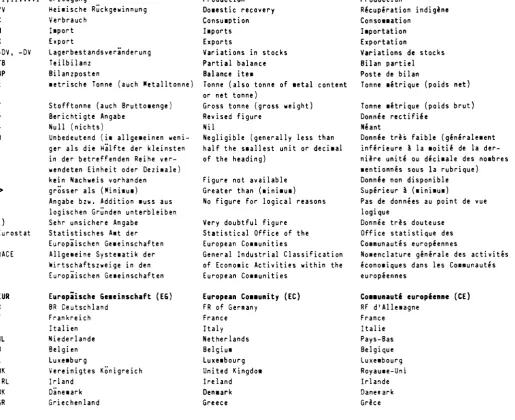
Zeichen und Abkürzungen Abbreviations and signs used Abréviations et signes employés P I , I I . . . V I Erzeugung
PV
c
»χ
♦DV,
TB
RP
t •
·■
CV
Heimische R ü c k g e w i n n u n g Verbrauch
Iiport Export
L a g e r b e s t a n d s v e r ä n d e r u n g Teilbilanz
Bilanzposten
■etrische Tonne (auch M e t a l l t o n n e ) Stofftonne (auch B r u t t o m e n g e ) Berichtigte Angabe
0
Eurostat NACE
Null (nichts)
Unbedeutend (i* allgemeinen weni ger als die Hälfte der kleinsten in der b e t r e f f e n d e n Reihe v e r wendeten Einheit oder D e z i m a l e ) kein Nachweis vorhanden
grösser als (Minimum) Angabe bzw. Addition muss aus logischen Grunden unterbleiben Sehr unsichere Angabe
S t a t i s t i s c h e s Amt der Europaischen Gemeinschaften Allgemeine Systematik der W i r t s c h a f t s z w e i g e in den Europäischen Gemeinschaften
Production Domestic recovery Consumption Imports Exports
Variations in Stocks Partial balance Balance item
Tonne (also tonne of metal content or net tonne)
Gross tonne (gross w e i g h t ) Revised figure
Nil
Negligible (generally less than half the smallest unit or decimal of the h e a d i n g )
Figure not available Greater than (minimum) No figure for logical reasons Very doubtful figure
Statistical Office of the European Communities
General Industrial Classification of Economic Activities within the European Communities
Production
Récupération indigène Consommation
Importation Exportation
Variations de stocks Bilan partiel Poste de bilan
Tonne métrique (poids net) Tonne métrique (poids b r u t ) Donnée rectifiée
Néant
Donnée très faible (généralement inférieure à la moitié de la der nière unité ou décimale des nombres mentionnés sous la r u b r i q u e ) Donnée non disponible Supérieur à (minimum)
Pas de données au point de vue logique
Donnée très douteuse Office statistique des Communautés européennes
Nomenclature générale des activités économiques dans les Communautés européennes
EUR E u r o p ä i s c h e G e m e i n s c h a f t (ES) D BR Deutschland
F Frankreich
I Italien
NL N i e d e r l a n d e
B Belgien
L Luxemburg
UK Vereinigtes Königreich
IRL Irland
DK Dänemark
GR Griechenland
European Community (EC) FR of Germany
France Italy Netherlands Belgium Luxembourg United Kingdom Ireland Denmark Greece
Communauté européenne (CE) RF d'Allemagne
[image:6.595.50.566.63.483.2]INHALT CONTENTS SOMMAIRE
EG-Rohstoffversorgung 1975-83
TABELLEN
Konsolidierte EG-Bilanzen
Detaillierte EG-Bilanzen
- NE-Grundmetalle Aluminium (Al) Kupfer (Cu) Blei (Pb) Zinn (Sn) Zink (Zn)
- Eisen und Fe-Legierungs-metalle (Stahlveredler)
Eisen Mangan Kobalt Chrom Molybdän Niob Tantal Nickel Vanadium Wolfram
(Fe) (Mn) (Co) (Cr) (Mo) (Nb) (Ta) (Ni)
(v)
(M)
- Sonstige Metalle
Quecksilber (Hg) Antimon (Sb) Titan (Ti) Zirkonium (Zr)
- Nicht-Metalle
Fluor (F) Phosphat (P205)
EG-Rohstoffimporte
Fussnoten
SCHAUBILDER
Entwicklung des Rohstoffverbrauchs
Raw materials supplies 1975-83
TABLES
Consolidated EC balance sheets
Detailed EC balances
- Major non-ferrous metals Aluminium (Al) Copper (Cu) Lead (Pb) Tin (Sn) Zinc (Zn)
- Iron and major alloying metals
Iron Manganese Cobalt Chromium Molybdenum Niobium Tantalum Nickel Vanadium Tungsten
- Other metals
Mercury Antimony Titanium Zirconium
- Non-metals
Fluorine Phosphates
EC raw materials
Footnotes
DIAGRAMS
(Fe) (Mn) (Co) (Cr) (Mo) (Nb) (Ta) (Ni)
(V)
W
(Hg) (Sb) (Ti) (Zr)
(F)
(P205)
imports
Approvisionnement de la CE en matières premières 1975-83
TABLEAUX
Bilans consolidés CE
Bilans détaillés CE
- Métaux de base non ferreux Aluminium (Al) Cuivre (Cu) Plomb (Pb) Etain (Sn) Zinc (Zn)
- Fer et métaux d'alliages de Fe
Fer
Manganèse Cobalt Chrome Molybdène Niobium Tantale Nickel Vanadium Tungstène
(Fe) (Mn) (Co) (Cr) (Mo) (Nb) (Ta) (Ni)
(V) (W)
- Autres métaux
Mercure Antimoine Titane Zirconium
Métalloïdes
Fluor Phosphate
(Hg) (Sb) (Ti) (Zr)
(F)
(P205)
Evolution of the raw materials consumption
Importations CE de matières premières
Renvois
GRAPHIQUES
Evolution de la consommation de matières premières
Seite Page
7-18
21
26 26 30 32 34
36 38 40 42 44 46 48 49 51 53
55 56 58 60
62 63
64
67
EG-Rohstoffversorgung 1975-1983
Aufgrund der im allgemeinen niedrigen Eigenversorgung der EG werden die Importe aus Drittländern zu Hauptkomponenten des Rohstoffverbrauchs. Im folgenden wird die Verbrauchsentwicklung ab 1975 nach Massgabe der EG-Bilanzen sowie der Importzahlen näher beschrieben.
Al (Aluminium)
Der Al-Verbrauch in der EG ist gemäss konsolidierter Rohstoffbilanz von 1975 bis 1979 stark gestiegen und war danach bis 1982 wieder rückläufig. Erst 1983 ist wieder ein Anstieg festzustellen. Insgesamt gesehen zeigt sich eine leicht ansteigende Tendenz. Guinea und Australien sind die bedeutendsten Lieferanten (1983 zusammen 3 7 % ) , gefolgt von Norwegen mit 17%, dessen Lieferungen jedoch vor allem Rohaluminium betreffen, das wiederum aus Tonerdeimporten stammt (Australien, Surinam, Jamaika und USA).
Cu (Kupfer)
Der Kupfer-Verbrauch in der EG unterlag ab 1975 gewissen Schwankungen, die insgesamt gesehen einen stagnierenden Trend aufweisen. Fast ein Drittel des Aufkommens stammt aus der Rückgewinnung und der Rest aus Einfuhren aus Drittländern. Die Importstruktur hat sich kaum geändert: Hauptlieferant ist nach wie vor Chile, gefolgt von Zaire (1975 an dritter Stelle) und Sambia.
Pb (Blei)
Der Blei verbrauch ist bis 1979 angestiegen und anschliessend wieder auf das Niveau von 1975 zurückgefallen. Als Versorgungsquellen halten sich heimische Rückgewinnung und Importmengen ungefähr die Waage. Die metallische Verwendung des Rohstoffes bestimmt hier den Verbrauch. Hauptlieferant ist Australien, dessen Anteil zugunsten Südafrikas jedoch von 26% (1975) auf 18% (1983) geschrumpft ist.
Sn (Zinn)
Zn (Zink)
Der Verbrauch von Zink zeigt eine leicht ansteigende Entwicklung, was nicht ohne Rückwirkung auf die heimische Erzgewinnung geblieben ist, die von 283 000 t in 1975 auf 402 000 t in 1983 angestiegen ist. Wichtigste Lieferanten sind Kanada (41%) und Peru (16%).
Fe (Eisen)
Die Verbrauchsentwicklung in diesem Bereich hängt entscheidend von der Eisen- und Stahlmarktentwicklung ab, daher Rückgang von 127,9 Mio t in 1975 auf 98,9 Mio t in 1983. Dementsprechend bewegen sich die Importmengen. Brasilien (23%), Kanada (11%), Australien (11%) und Schweden (10%) decken allein zwei Drittel des EG-Bedarfes.
Mn (Mangan)
Die Stahlkrise hat die Entwicklung des Mn-Verbrauchs nachhaltig beeinflusst, so dass der Mn-Verbrauch in 1983 um 33% niedriger war als in 1975. Die Entwicklung spiegelt sich auch in den Importzahlen wider:
1975: 1,6 Mio t, 1983: 1,1 Mio t, wovon zwei Fünftel aus Südafrika und ein Fünftel aus Gabun stammen.
Co (Kobalt)
Trotz grosser statistischer Unsicherheit lässt sich sagen, dass die Entwicklung des Co-Verbrauchs leicht rückläufig ist. Was die Importe betrifft, so ist Zaire nach wie vor bedeutendster Lieferant der Gemeinschaft.
Cr (Chrom)
Ein grosser Teil der Erzimporte geht in die Herstellung von Ferrochrom und von rostfreien Stählen. Die Importe kommen überwiegend aus Südafrika (47%) und neuerdings aus Albanien (13%).
Mo (Molybdän)
Der Verbrauch von Molybdän zeigt im grossen und ganzen leicht ansteigende Tendenz. Grösstes Lieferland der EG sind die USA mit rückläufigem Anteil
(1975: 58% - 1983: 38%). Es folgen Kanada mit 21% und Chile mit 17%. Nb (Niob)
Der grösste Teil der Importangaben unterliegt der statistischen Geheimhaltung. Es ist anzunehmen, dass Brasilien nach wie vor der Hauptlieferant ist. Ferner spielen die Einfuhren aus Kanada eine gewisse Rolle, haben allerdings im Laufe der Jahre anteilmässig verloren. Der Anstieg der Importe ohne Herkunftsnachweis ist dagegen beträchtlich
Ta (Tantal)
Der Tantalverbrauch war seit 1975 trotz vorübergehender Aufwärtsbewegungen über den gesamten Zeitraum gesehen nur leicht ansteigend. Die Bundesrepublik Deutschland ist der grösste Konsument von Tantal (zwischen 65% bis 75% des EG-Bedarfs). Den Rest beanspruchen die Länder Frankreich und Grossbritannien. Ähnlich wie bei Niob bleiben für Tantal grosse Importmengen ohne Herkunftsnachweis. Ab 1981 müssen neue Lieferanten neben dem bisherigen Hauptlieferanten (USA) aufgetaucht sein, die nicht genannt werden sollen.
Ni (Nickel)
Die Tendenz des Verbrauchs ist leicht fallend. Bei den Importen haben vermehrte Lieferungen aus Australien, den USA und der Sowjetunion die stark dominierende Rolle Kanadas von 43% auf 18% und Neukaledonien von 28% auf 16% EG-Importanteile zurückgedrängt.
V (Vanadium)
Der Verbrauch an Vanadium hat sich bis 1982 allgemein günstig entwickelt: Erst 1983 macht sich wieder eine Verlangsamung bemerkbar. Eine hinlängliche Kenntnis der Herkunftsstruktur ist wegen teilweiser Geheimhaltung nicht möglich. Der Anteil der importierten Mengen ohne Herkunftsnachweis bewegt sich zwischen 40 und 65% und betrifft Vanadiumpentoxid sowie Aschen und Rückstände.
W (Wolfram)
m
Die Entwicklung des Wolframverbrauchs seit 1975 zeigt keine nennenswerten Veränderungen. Eine besondere Bedeutung spielt die heimische Rückgewinnung mit etwa einem Viertel des Verbrauches. Österreich ist Hauptlieferant, und zwar dank seiner Exporte an Ferrowolfram, Rohwolfram und verarbeitetem Wolfram, wogegen die an 2. Stelle stehenden Importe aus China vor allem Wolframerz und Wolframoxid betreffen. Ferner spielen eine Rolle die Erzimporte aus Kanada (1982: 9,5%), die Importe an Rohwolfram und Rückständen aus Schweden, die Erzimporte aus Portugal und die Metallimporte aus den USA. Die Schwerpunktverlagerung vom Erz auf das Rohmetall ist unverkennbar.Hg (QuecksiIber)
Sb (Antimon)
Der Verbrauch hat seit 1975 deutlich abgenommen (1983: 31% weniger als 1975). In Italien gibt es die einzige nennenswerte Erzgewinnung in der EG (4% des EG-Verbrauchs). Der überwiegende Teil stammt aus heimischer Rückgewinnung und aus Importen. Bolivien steht mit 29% Importanteil unter den bekannten Lieferländern an 1. Stelle. Es folgen mit Abstand China, Thailand und Südafrika, über grössere Mengen importierter Antimonerze gibt es keinen statistischen Herkunftsnachweis (40 bis 69%). Wenn auch die Bedeutung der Rohmetallimporte ständig zugenommen hat, so bleiben die Erzeinfuhren weiterhin mit über 80% ausschlaggebend.
Ti (Titan)
Der Titanverbrauch war im allgemeinen gleichbleibend bis leicht sinkend. Hier hat in den letzten Jahren folgende Bewegung stattgefunden (Stand 1983): Kanada ist nach vorne gerückt (29%), während Australien (17%) und Norwegen (19%) gegenüber früher deutlich an Boden verloren haben (1975: 40% bzw. 38%). Es ist gleichzeitig eine Umorientierung vom Erz auf Aschen und Rückstände festzustellen.
Zr (Zirkonium)
Die Verbrauchsentwicklung weist leicht ansteigende Tendenz auf. Es gibt keine heimische Erzeugung, so dass der Verbrauch fast ausschliesslich durch Importe gedeckt wird. Ein Grossteil geht unmittelbar -in die nichtmetallische Verwendung als Formsand in die Giessereiindustrie, in die Feuerfest- und Keramikindustrie. Australien ist trotz Rückgang mit über 58% Importanteil grösster Lieferant an Zirkoniumerz, das 99% der Zirkoniumeinfuhren ausmacht. Der Rest von 1% betrifft Zirkonsand, Zirkonoxid und -salze.
(Fluor)
Der Verbrauch zeigt seit 1981 ansteigende Tendenz. Die Importe decken rd. 30% des Bedarfs. Südafrika hatte ab 1980 Spanien als Haupt lieferland abgelöst, das aber 1983 wieder an die erste Stelle rückte. Zweitwichtigster Lieferant ist also Südafrika, gefolgt von Grönland. Etwa 90% der Importe fallen auf Flussspat, der Rest betrifft vor allem Aluminiumfluorid aus Skandinavien.
Pp05 (Phosphat)
Die Verbrauchsentwicklung ist leicht ansteigend. Aufgrund sinkender heimischer Rückgewinnung (Thomasschlacke) hat die Importabhängigkeit zugenommen. Mit 32% bleibt Marokko nach wie vor wichtigster Versorger der Gemeinschaft (vor den USA mit 20%). Drei Viertel der Importe beziehen sich auf Naturphosphat, ein Sechstel auf Phosphatdünger und ein Zehntel auf chemische Verbindungen.
EC Raw »ateríais supplies 1975-1983
Owing to the EC's generally low domestic supply imports from third countries form the main components of raw material consumption. In the following the development of consumption from 1975 is more precisely described in terms of the EC balance sheets as well as the import figures.
Al (Aluminium)
The consolidated balance sheet shows that Community consumption of aluminium increased rapidly from 1975 to 1979 and then declined until 1982. A recovery became apparent only in 1983. Overall, there is a slightly rising trend. The main suppliers are Guinea and Australia (which together accounted for 37% in 1983), followed by Norway with 17%. The latter, however, mainly supplies crude aluminium which in turn is derived from imports of alumina (Australia, Surinam, Jamaica and the USA).
Cu (Copper)
From 1975 onwards, copper consumption in the Community has fluctuated, while the underlying trend has remained stagnant. Almost a third of supplies are obtained by recovery and the rest consists of imports from third countries. The import structure is virtually unchanged: Chile remains the main supplier , followed by Zaire (which in 1975 was in third place) and Zambia.
Pb (Lead)
Lead consumption rose until 1979 and then fell back to the 1975 level. Recovery within the Community and imports are more or less equally important sources of supply. Consumption of the raw material is determined by use in the metallic form. The main supplier is Australia, whose share, has however, declined from 26% (1975) to 18% (1983) in favour of South Afri ca.
Sn (Tin)
Tin consumption exhibited a slight downward trend from 1975 to 1983. Recovery within the Community has replaced imports as the main source of supply. Large quantities are accounted for by use in non-metallic form, direct use in tin processing or final consumption (galvanization in the
iron and steel industry). Bolivia is the Community's main supplier, its share remaining unchanged at a quarter of imports. A sharp drop in imports from Malaysia was partly offset by increased supplies from Indonesia.
Zn (Zinc)
There has been a slight rise in zinc consumption and this in turn has had an effect on domestic ore mining, which increased from 283 000 t in 1975 to 402 000 t in 1983. The main suppliers are Canada (41%) and Peru (16%).
Fe (Iron)
Consumption in this area is entirely dependent on developments in the iron and steel market and consequently fell from 127.9 Mio t in 1975 to 98.9 Mio t in 1983. There was a corresponding drop in import quantities. Brazil (23%), Canada (11%), Australia (11%) and Sweden (10%) alone cover two thirds of the Community's requirements.
Mn (Manganese)
The crisis in the steel industry adversely affected manganese consumption, which was 33% lower in 1983 than in 1975. This development is also reflected in the import figures: 1.6 Mio t in 1975 and 1.1 Mio t in 1983, of which two fifths come from South Africa and one fifth from Gabon.
Co (Cobalt)
Although there is great uncertainty with regard to the statistics, it may be stated that cobalt consumption has slightly declined. Zaire remains the Community's main source of supply.
Cr (Chromium)
A large proportion of ore imports is used for the production of ferrochrome and stainless steels. Imports come primarily from South Africa (47%) and in recent years, Albania (13%).
Mo (Molybdenum)
The overall trend of molybdenum consumption is slightly rising. The Community's main supplier is the USA, though its share is decreasing (58% in 1975 - 38% in 1983). Next come Canada with 21% and Chile with 17%.
Nb (Niobium)
Most of the import data are subject to statistical confidentiality. It may be assumed that Brazil remains the principal supplier. Imports form Canada also have a certain importance, but their share has declined over the years. At the same time there has been a substantial increase in imports of unspecified origin (17% in 1975 - 78% in 1984).
Ta (Tantalum)
Despite transient peaks, consumption of tantalum has risen only slightly over the entire period from 1975 onwards. The Federal Republic of Germany
is the largest consumer of tantalum (between 65 and 75% of Community requirements), while the rest is used by France and Britain. As in the case of niobium, large quantities of tantalum imports are of unspecified origin. Since 1981 the USA, which has previously been the main supplier, must have been joined by other suppliers which cannot be named.
Ni (Nickel)
There is a slight downward trend in consumption. Increased imports from Australia, the USA and the Soviet Union have reduced the dominant role of Canada from 43% to 18% and that of New Caledonia from 28% to 16% of Community imports.
V (Vanadium)
Until 1982 consumption of vanadium was generally increasing and this growth did not slacken until 1983. Since certain data are confidential, it is not possible to obtain an adequate breakdown by country of origin. The proportion of imports of unspecified origin lies between 40 and 65% and
includes vanadium pentoxide as well as ash and residues.
W (Tungsten)
Since 1975 there have been no significant changes in tungsten consumption. Particular importance attaches to recovery within the Community, which accounts for about a quarter of consumption. The main supplier is Austria, which exports ferrotungsten, crude tungsten and processed tungsten, whereas imports from China, which is the second largest supplier, consist mainly of tungsten ore and tungsten oxide. Other imports are ore from Canada (9.5% in 1982), crude tungsten and residues from Sweden, ore from Portugal and metal from the USA. There has been an undoubted shift in emphasis from ore to crude metal.
Hg (Mercury)
Mercury consumption in the Community has fallen since 1976. The only producer is Italy, whose level of activity fluctuates widely and is also declining. The main consumers in the Community are the Federal Republic of Germany, Britain and Belgium/Luxembourg. Since 1978 Spain has replaced Algeria as the main source of imports. Imports from Turkey also increased sharply in 1983. About 80 to 90% of the quantities imported are in metallic form and 10 to 20% chemical compounds.
Sb (Antimony)
Consumption has declined appreciably since 1975 (31% less in 1983 than in 1975). The only significant ore mining operations in the Community are in Italy (4% of Community consumption). The main sources of supply are
recovery within the Community and imports. Bolivia is the largest of the
known suppliers, accounting for 29% of imports, followed by China, Thailand and South Africa, which are much less important. There is no statistical indication of origin for substantial quantities of imported antimony ores (40 to 69%). Although the importance of crude metal imports has increased steadily, ore imports are still predominant at over 80%.
Ti (Titanium)
The overall trend of titanium consumption has been constant or slightly downward. The following changes have taken place in recent years (as illustrated by the 1983 figures): Canada has improved its position (29%) while Australia (17%) and Norway (19%) have seen their market shares shrink appreciably (from 40% and 38% respectively in 1975). A shift from ore to ash and residues is also apparent.
Zr (Zi rconium)
There is a gently rising trend in consumption. There is no domestic production, with the result that consumption is covered almost entirely by imports. A large proportion is used directly for non-metallic applications as moulding sand in the foundry, refractory and ceramics industries. While Australia's position has deteriorated, it remains the largest supplier, at over 58%, of zirconium ore, which represents 99% of zirconium imports. The remaining 1% consists of zirconsand, zirconium oxide and zirconium salts.
F (Fluorine)
There has been an upward trend in consumption since 1981. About 30% of requirements are covered by imports. Spain was replaced by South Africa as the main supplier in 1980 but recovered its position in 1983. The second largest supplier is thus South Africa, followed by Greenland. About 90% of imports consist of fluorspar, while the rest is largely aluminium fluoride from Scandinavia.
P20_ (Phosphates)
Consumption is expanding slightly. Dependence on imports has increased as recovery within the Community (Thomas slag) has declined. Morocco remains the main supplier of the Community at 32% (followed by the USA at 20%). Three quarters of imports consists of natural phosphates, one sixth of phosphate fertilizers and one tenth of chemical compounds.
Approvi sionneaent de La CE en Batieres premières 1975-1983
La production intérieure de la CE étant généralement faible, les importations en provenance de pays tiers constituent les composantes principales de la consommation de matières premières. L'évolution de la consommation depuis 1975, selon les indications des bilans consolidés CE et les données sur les importations, est décrite ci-dessous.
Al (Aluminium)
La consommation d'aluminium dans la CE a augmenté fortement entre 1975 et 1979, ainsi que l'indique le bilan consolidé des matières premières, et a ensuite baissé jusqu'à 1982. Ce n'est qu'en 1983 que l'on a à nouveau constaté une hausse. Dans l'ensemble, on remarque une légère tendance à la hausse. La Guinée et l'Australie sont les deux plus importants fournisseurs (37% au total en 1983), suivies de la Norvège avec 17% qui a toutefois livré essentiellement de l'aluminium brut provenant quant à lui d'importations d'alumine (Australie, Surinam, Jamaïque et Etats-Unis).
Cu (Cuivre)
Depuis 1975, la consommation de cuivre dans la CE a connu certaines fluctuations, la tendance générale étant à la stagnation. Près d'un tiers provient de la récupération, et le reste d'importations en provenance de pays tiers. La structure des importations a à peine changé: le fournisseur principal reste le Chili, suivi du Zaire (troisième place en 1975) et de la Zambie.
Pb (Plomb)
La consommation de plomb a augmenté jusqu'en 1979 pour retomber ensuite au niveau de 1975. Pour ce qui est des sources d'approvisionnement, la récupération intérieure et les importations y contribuent pour une part à peu près égale. L'utilisation métallique de la matière première détermine ici la consommation. Le fournisseur principal est l'Australie dont la part est cependant passée de 26% en 1975 à 18% en 1983, au profit de l'Afrique du Sud.
Sn (Etain)
L'évolution de la consommation d'étain entre 1975 et 1983 indique une tendance légèrement à la baisse. L'essentiel de l'approvisionnement est passé des importations à la récupération intérieure. De grandes quantités sont consacrées à une utilisation non-métallique, traitement de l'étain (utilisation directe) ou consommation finale (étamage dans la sidérurgie). Le plus important fournisseur de la Communauté reste la Bolivie, avec toujours un quart des importations. La forte diminution des importations en provenance de Malaisie est partiellement compensée par un accroissement des
livraisons en provenance d'Indonésie.
Zn (Zinc)
La consommation de zinc est en légère hausse, ce qui n'est pas sans influer sur la production intérieure qui est passée de 283 000 tonnes en 1975 à 402 000 tonnes en 1983. Les principaux fournisseurs sont le Canada (41%) et
le Pérou (16%).
Fe (Fer)
L'évolution de la consommation dans ce secteur dépend fortement de l'évolution du marché de la sidérurgie: voilà pourquoi on a enregistré une régression de 127,9 millions de tonnes en 1975 à 98,9 millions de tonnes en 1983. Les importations évoluent en conséquence. Le Brésil (23%), le Canada (11%), l'Australie (11%) et la Suède (10%) couvrent à eux seuls 2/3 des besoins de la CE.
Mn (Manganèse)
La crise de la sidérurgie a influé de façon constante sur la consommation de manganèse qui a été, en 1983, inférieure de 33% à ce qu'elle était en 1975. Cette évolution se reflète également dans les importations: 1975: 1,6 million de tonnes; 1983: 1,1 million de tonnes, dont 2/5e proviennent d'Afrique du Sud et 1/5e du Gabon.
Co (Cobalt)
Malgré une grande incertitude statistique, on peut dire que l'évolution de la consommation de cobalt est en légère régression. En ce qui concerne les importations, le Zaire demeure le plus important fournisseur de la Communauté.
Cr (Chrome)
Une grande partie des importations de minerai est consacrée à la fabrication de ferrochrome et d'acier inoxydable. Les importations proviennent essentiellement d'Afrique du Sud (47%) et, depuis peu, d'Albanie (13%).
Nb (Niobium)
La plus grande partie des chiffres relatifs à l'importation sont soumis au secret statistique. On peut supposer que le Brésil reste le principal fournisseur. Les importations en provenance du Canada jouent également un certain rôle, mais elles ont néanmoins diminué au cours des années. En revanche, l'augmentation des importations sans indication de provenance est importante (1975: 17%; 1984: 78%).
Ta (Tantale)
Depuis 1975, la consommation de tantale n'a que faiblement augmenté, en dépit de hausses passagères. La République Fédérale d'Allemagne est le plus grand consommateur de tantale (de 65 à 75% de la consommation communautaire). Le reste va à la France et à la Grande-Bretagne. Comme pour le niobium, de grandes quantités de tantale sont importées sans indication de provenance. Depuis 1981, de nouveaux fournisseurs, qui ne doivent pas être nommés, ont dû apparaître à côté des Etats-Unis qui étaient jusqu'alors le principal fournisseur.
Ni (Nickel)
La tendance de la consommation est légèrement à la baisse. En ce qui concerne les importations, des livraisons accrues en provenance d'Australie, des Etats-Unis et de l'Union Soviétique ont fait régresser la position fortement dominante du Canada de 43% à 18% et de la Nouvelle-Calédonie de 28% à 16%.
V (Vanadium)
La consommation de vanadium a dans l'ensemble évolué de façon favorable jusqu'à 1982. Ce n'est qu'à partir de 1983 que l'on a à nouveau constaté un ralentissement. Il est impossible de se faire une image précise de la provenance des importations en raison du secret partiel auquel elles sont soumises. La proportion des quantités importées sans indication de provenance se situe entre 40 et 65% et concerne le pentoxyde de vanadium ainsi que les cendres et les résidus.
W (Tungstène)
On ne constate aucune modification notoire de l'évolution de la consommation de tungstène depuis 1975. La récupération intérieure joue un rôle important puisqu'elle représente environ 1/4 de la consommation. L'Autriche est le principal fournisseur grâce à ses exportations de ferrotungstène, de tungstène brut et de tungstène ouvré, la deuxième place étant occupée par la Chine, avant tout avec le minerai de tungstène et l'oxyde de tungstène. On peut également citer les importations de minerai en provenance du Canada (1982: 9,5%), les importations de tungstène brut et résidus en provenance de Suède, les importations de minerai en provenance du Portugal ainsi que les importations de métal en provenance des Etats-Unis. Une réorientation du minerai vers le métal est évidente.
Hg (Mercure)
La consommation de mercure diminue dans la CE depuis 1976. Le seul producteur est l'Italie, avec une activité très fluctuante et également en régression. Les plus gros consommateurs de la CE sont la République Fédérale d'Allemagne, la Grande-Bretagne, la Belgique et le Luxembourg. Depuis 1978, le fournisseur le plus important n'est plus l'Algérie, mais l'Espagne. En outre, les importations en provenance de Turquie ont fortement augmenté en 1983. De 80 à 90% des quantités importées sont du métal et de 10 à 20% des composés chimiques.
Sb (Antimoine)
La consommation a considérablement baissé depuis 1975 (1983: 31% de moins
qu'en 1975). C'est en Italie que se situe le seul gisement notable de la CE (4% de la consommation communautaire). La plus grande partie provient de la récupération intérieure et des importations. Parmi les fournisseurs connus, c'est la Bolivie qui occupe la première place avec 29% des importations. A une certaine distance, on trouve la Chine, la Thailande et l'Afrique du Sud. On ne possède aucune indication de provenance sur 40 à 69% des quantités de minerai d'antimoine importées. Bien que les importations de métal brut n'aient cessé d'augmenter, c'est le minerai qui continue à occuper de loin la première place avec plus de 80%.
Ti (Titane)
La consommation de titane a, d'une manière générale, été constante avec une légère tendance à la baisse. Dans ce secteur, on a constaté au cours des dernières années les mouvements suivants (référence 1983): le Canada a avancé (29%), tandis que l'Australie (17%) et la Norvège (19%) perdaient beaucoup de terrain (1975: respectivement 40% et 38%). On a également constaté une réorientation des importations du minerai vers les cendres et les résidus.
Zr (Zirconium)
La consommation est en légère hausse. Il n'y a pas de production intérieure, de telle sorte que la consommation est presque exclusivement couverte par des importations. Une grande partie de celles-ci connaît une utilisation non-métallique, sous forme de sable de moulage dans la sidérurgie ainsi que dans les industries des produits réfractaires et de la céramique. L'Australie reste, malgré une régression, le plus gros fournisseur de minerai de zirconium (58%) qui représente 99% des importations de zirconium. Le 1% restant concerne le sable de zirconium ainsi que l'oxyde et les sels de zirconium.
(Fluor)
La tendance de la consommation est à la hausse depuis 1981. Les importations couvrent très exactement 30% des besoins. Depuis 1980, l'Afrique du Sud avait remplacé l'Espagne en tant que principal fournisseur, mais celle-ci reprenait la première place en 1983. Le second fournisseur est l'Afrique du Sud, suivie du Groenland. Le fluorure de calcium représente environ 90% des importations, le reste concernant le fuorure d'aluminium en provenance de Scandinavie.
P205 (Phosphate)
La consommation est en légère hausse. En raison d'une baisse de la récupération intérieure (scories-. Thomas), la dépendance par rapport aux importations a augmenté. Le Maroc reste, avec 32%, le principal fournisseur de la Communauté (devant les Etats-Unis avec 20%). Les 3/4 des importations concernent le phosphate naturel, 1/6e les engrais phosphatés et 1/10e les composés chimiques.
KONSOLIDIERTE EGBILANZEN (1) HETALLINHALT 1975 1976 1977 1978 1979 1980 1981 1982 1983 1975 1976 1977 1978 1979 1980 1981 1982 1983 1975 1976 1977 1978 1979 1980 1981 1982 1983 1975 1976 1977 1978 1979 ■ 1980 ' 1981 ! 1982 ! 1983 !
1975 ! 1976 : 1977 : 1978 ! 1979 : 1980 ! 1981 : 1982 ! 1983 !
CONSOLIDATED EC BALANCE SHEETS (1) METAL CONTENT
Î ftUFKOHHEN / AVAILABILITY / DISPONIBILITES ¡ PI
! 785 ! 661 ! 586 ! 571 ! 567 ! 549 ! 1313 ! I K I ! 1031
14
! 8
7
! 6
! 6
! 6
! 7
4
! 4
127 129 141 147 158 138 122 111 111 4150 4015 4113 3132 2708 3291 3729 4208 4025 283 315 359 414 413 425 331 375 402 PV 774 946 940 959 1028 1021 1011 898 1223 836 962 903 832 944 1010 1100 1125 1137 511 579 606 450 708 635 643 574 603 16174 9772 16134 12217 13783 15207 19016 15355 20027 363 448 563 434 545 515 453 473 453 H 3578 3990 4041 3876 4126 4450 3715 3534 3704 2118 2244 2305 2188 2185 2336 2066 2163 1934 451 711 674 451 724 782 435 499 452 55654 65256 60661 60749 58873 64614 49799 42628 48926 1178 1255 IUI 1028 1170 1129 1084 1164 1170 DV I I , 195 165 , , ! 21? TOTAL
ALUMINIUH ( 5137 5597 5567 5601 5886 6020 6039 5573 6177
BILANS CONSOLIDES CE (1) TENEUR EN METAL
! VERWENDUNG / UTILISATION / EMPLOIS
! C
lOOOt ) ! 3764 I 4515 ! 4381 ! 4584 ! 4957 ! 4873 ! 4580 ! 4204 I 4823 KUPFER / COPPER / CUIMRE ( 1000t
, , , 82 100 12 120 , 55 2968 3214 3215 3108 3235 3364 3293 3292 3130 BLEI / LEAD / PLOÌ
, 5 9 , , , 30 66 15 1289 1424 1430 1448 1590 1555 1450 1450 1380 ZINN / TIN / ETAIr 1416 , , 2919 650 , , , ' , , 33 33 81 23 , 100 77394 79043 80908 79017 ! 76014 ! 83112 ! 72544 ! 62191 ! 72978 ! ZINK / ZINC (
1824 : 2038 : 2033 ! 1909 : 2161 !
2150 ί
1891 ! 2012 ! 2125 ! ! 2436 2724 2678 2514 2694 2807 2631 2611 2516 <B ( lOOOt )
1126 1247 1251 1163 1365 1256 1251 1245 1177 ! ( t )
66664 70964 72261 68301 64781 68323 59005 53549 56581 lOOOt ) 1375 1606 1576 1631 1883 1811 1491 1525 1638 X 744 832 858 1017 929 980 1323 1227 1354 ) 390 394 488 594 541 557 442 648 615 136 177 179 211 207 228 199 205 203 10730 8039 8570 10716 11233 12610 10902 5293 6933 216 347 370 278 278 339 400 432 488 +DV 627 250 328 , . 147 134 142 ■ 142 94 4« , , | , 33 • 27 , , 74 18 71 | .. ' , 40 77 , , 2179 2637 3349 9464 233 85 87 55 TOTAL 5137 5597 5567 5601 5886 6020 6039 5573 6177 2968 3214 3215 3108 3235 3364 3293 3292 3130 1289 1424 1430 1448 1590 1555 1450 1450 1380 77394 79043 80908 79017 76014 83112 72544 62191 72978 1824 2038 2033 1909 2161 2150 1891 2012 2125
FUSSNOTEN SIEHE S,67 FOOTNOTES SEE P.67 RENVOIS VOIR P.67
KONSOLIDIERTE EGBILANZEN (1) METALLINHALT
CONSOLIDATED EC BALANCE SHEETS (1) METAL CONTENT
BILANS CONSOLIDES CE (1) TENEUR EN METAL
1975 1976 1977 1978 1979 1980 1981 1982 1983 1975 1976 1977 1978 1979 1980 1981 1982 1983 1975 1976 1977 1973 1979 1980 1981 1982 1983 1975 1976 1977 1978 1979 1980 1981 1982 1983 1975 r 1976 ' 1977 1978 1979 ! 1980 ! 1981 : 1982r ! 1983 !
! AUFKOMMEN / AVAILABILITY / DISPONIBILITES ! PI
! 17798 ! 17437 ! 14343 ! 12360 ! 11702 ! 10165 ! 8159 ! 6893 ! 5535
!
! 1
! 3
Γ*
: 3
! 3
! 5
6 5 5 6 4 5314
PV M
5956 5823!
l 74679
! 83684
55816 75562 56626 79381 57876 93153 53146 85651 54309 79192 49559 75012 50238 69207
1
so;
584 55£ 45¿m
517 47¿ 46! 42 45 49 5C 7C 7: 65 71 65 1841 2191 1998 2137 2686 2592 2785 2314 2921 1572 1607 1310 1440 1902 1445 1299 1171 1145 17707 17507 21455 14745 13449 11362 6011 7087 522 597 532 500 633 600 409 488 526 33103 33523 36240 34975 38915 37411 37064 37303 37081-W TOTAL
EISEN / IRON / FER 3741 , 4232 4264 , 1474 5843 1591 3414 155779 159353 149953 152631 162731 150436 147503 133055 128394 MANGAN / MANGANESE
, 11 199 44 , ; % 18 10 1000 2000
( 3500 ) ( 694 )
,
( 3259 ) ( 1391 ) CHROM 1« , 7 MOLYBDAEN . 847 , , 206 480 891 2476 8998 1572 1619 1512 1486 1905 1448 1399 1195 1160 (OBALT / COBALT
19210 20091 22013 18701 14512 11879 9746 8943 / CHROMIUM / CHF
564 646 581 550 703 672 498 565 604 / MOLYBDENUM / Ì
34944 36561 38238 37112 41807 40483 40740 42093 54314 !
! VERWENDUNG / UTILISATION / EMPLOIS
! C
( 1000t ) ! 127915 ! 129705 ! 123549 ! 117614 1 125728 1 118715 ! 112934 ■ 105407 ! 98935
( lOOOt ) (2) ! 1431 ! 1475 1352 ! 1318
1520 1256 1152 1083 962 ( t ) (3)
5907 7060 7575 6440 6144 4140 4491 5317 ÌOME ( lOOOt )
476 574 551 511 684 652 475 534 569 IOLYBDENE ( t
25160 25284 24838 28040 31475 26799 31754 29355 34745 X 27864 22605 26404 35017 34301 31721 34569 27648 29459 125 144 160 148 230 187 247 112 198 13303 13031 14438 12261 8368 5873 5255 3626 (3) 25 37 24 IV 19 17 23 28 36 ) (3)
8886 11277 13112 8577 10332 13684 8986 12738 19569 +DV , 7043 , , 2702 , , , ■ 16 , , , 155 5 , , 1
( 1866 )
63 35 4 20 0 3 , 3 1 898 , 288 495 TOTAL 155779 159353 149953 152631 162731 150436 147503 133055 128394 1572 1619 1512 1486 1905 1448 1399 1195 1160 19210 20091 22013 18701 14512 11879 9746 8943 564 646 581 550 703 672 498 565 604 34944 36561 38238 37112 41807 40483 40740 42093 54314
FUSSNOTEN SIEHE S.67
2 2
KONSOLIDIERTE EGBILANZEN (1) METALLINHALT 1975 1976 1977 1978 1979 1980 1981 1982 1983 1975 1976 1977 1978 1979 1980 1981 1982 1983 1975 1976 1977 1978 1979 1980 1981 1982 1983 1975 1976 1977 1978 1979 1980 ! 1981 ! 1982r ! 1983 :
1975 ! 1976 ! 1977 ! 1978 ! 1979 : 1980 ! 1981 ! 1982 ! 1983 !
CONSOLIDATED EC BALANCE SHEETS (1) METAL CONTENT
! AUFKOMMEN / AVAILABILITY / DISPONIBILITES I PI
! ! ! ! ! ¡ ¡ ! ! ¡ ! ! ! ¡ ! ¡ ' 12 6 13 877 640 729 930 546 553 788 859 893 PV 51 67 51 45 32 22 26 28 23 17 20 90 γι 20 22 25 28 21 27 29 32 33 39 41 37 31 35 271 223 416 305 404 408 373 221 1758 1957 1478 1552 1380 1250 1205 1231 1241 M 3858 4940 3589 3149 3919 3228 2595 3265 2270 186 167 314 335 308 252 439 269 220 200 197 187 180 207 211 177 149 152 4538 7309 9705 9358 11040 10350 10082 8152 6263 7112 5010 6493 5686 5256 5657 5245 5487 DV 427 221 , 206 72 , 905 387 356 TANTAL 45 10 7 5 8 9 59 311 231 , , 9 10 29 18 4 0 : 80 103 , 278 106 187 102 WOLFRAM 504 59 289 404 289 439 34 551 301 TOTAL
NIOB / NIOBIUM 4336 5228 3640 3400 4023 3250 3526 3680 2649
BILANS CONSOLIDES CE (1) TENEUR EN METAL
! VERWENDUNG / UTILISATION / EMPLOIS
! C
( t ) (3) (4) ! 3380 ! 3931 ! 2590 ! 2875 ! 3526 ! 2668 ! 2696 ! 3183 ! 2215 / TANTALUM / TANTALE ( t )
248 197 343 363 336 283 523 608 472
! 156 157 277 301 256 238 310 169 190
NICKEL ( lOOOt ) (3) 227 226 228 223 275 270 230 186 201 VANADIUM ( t
6889 1 7635 ! 10121 ! 9941 : 11464 ! 10864 : 10642 ! 8475 ! ' TUNGSTEN / TUN 9402 1 9768 ! 7706 ! 9381 ! 7921 : 7498 ! 7684 ! 7886 ! 7942 !
178 180 185 183 225 227 181 151 143 ) (3)
4231 4525 5462 7098 10096 7890 8807 6177 GSTENE < t )
6555 7540 5897 6802 5793 6111 5479 5170 4939 Χ 956 1297 935 525 497 321 830 497 434 (3) (5) 92 40 46 62 80 45 213 439 282 42 37 43 40 50 43 49 36 52 2658 3110 4650 2843 1334 2974 1835 2298 (3) 2847 O O O Q
1809 2579 2128 1387 2205 2716 3003 +DV , , 115 , 241 , , ■ 7 9 6 , , 9 34 , , '■ TOTAL 4336 5228 3640 3400 4023 3250 3526 3680 2649 248 197 343 363 336 283 523 608 472 22? 226 228 223 275 270 230 18c 201 6889 7635 10121 9941 11464 10864 10642 8475 9402 9768 7706 9381 7921 7498 7684 7886 7942
FUSSNOTEN SIEHE S,67 FOOTNOTES SEE Ρ,67 RENVOIS VOIR P.67
KONSOLIDIERTE EG-BILANZEN (1)
METALLINHALT METAL CONTENT CONSOLIDATED EC BALANCE SHEETS (1) BILANS CONSOLIDES CE (1) TENEUR EN METAL
AUFKOMMEN / AVAILABILITY / DISPONIBILITES VERWENDUNG / UTILISATION / EMPLOIS
PI PV -DV TOTAL +DV TOTAL
1975 1976 1977 1978 1979 1980 1981 1982 1983 743 203 128 36 31 35 18 34 39 51 51 713 883 838 925 1079 811 747 850 QUECKSILBER 972 527 870 400 200 , 238 ?42 / MERC 2464 1441 1743 1343 1313 1053 1164 1643
/ MERCURE ( t ) (3)
1708 756 1118 323 1204 539 1039 304 963 350 818 210 907 257 973 670 25 2464 1441 1743 1343 1313 1053 1164 1643
ANTIMON / ANTIMONY / ANTIMOINE ( t ) (3) 1975 1976 1977 1978 1979 1980 1981 1982r 1983 1008 808 1096 949 713 696 647 110 13383 9499 10217 10598 9507 8251 8407 8415 28943 20126 20817 21749 13571 19248 16085 21193 379 321 , , , , 348 76 43713 30754 32130 33296 23791 28195 25487 29794 35010 23756 24456 26483 18346 21198 20488 24014 8703 6998 7667 6025 5313 6502 4999 5780 , , 7 788 132 495 , , 43713 30754 32130 33296 23791 28195 25487 29794
TITAN / TITANIUM / TITANE ( lOOOt ) (3) 1975 !
1976 r ! 1977 r ! 1978 r ! 1979 ! 1980 ! 1981 1 1982 ! 1983 I 570 541 486 555 561 590 565 564 572 543 491 557 563 594 569 566 439 387 341 397 379 400 391 350 130 146 150 160 180 194 173
01 o
3 10 O 4 572 543 491 557 563 594 569 564
ZIRKONIUM / ZIRCONIUM ( 1000t ) (3) 1975 1974 1977 1978 1979 1980 1981 1982 1983 71 73 85 108 115 107 104 112 71 73 85 108 115 107 108 112 44 67 79 101 104 98 98 102 3 6 6 7 10 7 10 10 71 73 85 108 115 107 108 112
FUSSNOTEN SIEHE 5.47 FOOTNOTES SEE Ρ,67 RENVOIS VOIR P.67
KONSOLIDIERTE EG-BILANZEN (1) CONSOLIDATED EC BALANCE SHEETS (1) BILANS CONSOLIDES CE (1)
F-INHALT F CONTENT
AUFKOMMEN / AVAILABILITY / DISPONIBILITES
TENEUR EN F
VERWENDUNG / UTILISATION / EMPLOIS
C X +DV TOTAL
PI PV -DV TOTAL
FLUOR / FLUORINE / FLUOR ( lOOOt ) 1975
1976(6) 1977(6) 1978 1979 1980 1981 1982 1983
341 337 319 291 277 328 341 355
107 100 95 149 170 125 114 141
455 437 419 442 447 453 455 497
390 392 357 392 367 399 410 448
65 43 62 50 80 51 42 49
: 2 , , , 3 3 0
455 437 419 442 447 453 455 497
P205-INHALT P205 CONTENT
AUFKOMMEN / AVAILABILITY / DISPONIBILITES
TENEUR EN P205 VERWENDUNG / UTILISATION / EMPLOIS
C X +DV TOTAL
PI PV -DV TOTAL
1975 1976 1977 1978 1979 1980 1981 1982 1983
18 -2 1
C
1 1 0
943 907 850 814 857 774 603 408 406
5034 5569 6238 6621 7035 7040 6292 6009 6913
PHOSPHAT / PHOSPHATES / PHOSPHATE (
47 80
25 19
6042 6556 7088 7437 7893 7816 6896 6443 7338
5301 5873 6286 6569 7112 6688 6209 5860 6687
1000t >
741 683 779 852 775 765 485 583 451
, ,
07
14 6 343
n
,
4042 6556 7088 7437 7893 7816 6896 6443 7338
FUSSNOTEN SIEHE 5,67 FOOTNOTES SEE P.67 RENVOIS VOIR P.67
DETAILLIERTE EGBILANZ (1)
DETAILED EC BALANCE (1)
ALUMINIUM
BILAN
CE DETAILLE (1)
TB Aufkoiien Availability Disponibilités Verwendung Utilization Eiplois BP
1975 1983
BP
ÏOOOT 1000t ÏOOOT lOOOt
1975 1983
ÏOOOT lOOOt ! ÏOOOT lOOOt
I. ERZE / ORES Ρ !
ι I
M !
DV !
MINERAIS (NIMEXE 26.0173) 2628 785 ! 4123
8135 2034 ! 5938
1031 ! C I 9161 :NACE 251 : 6631
1519 ! X ! 43
I 1
1 I
. : +DV ! 1559
2467 ! 1658 ! 11 ! ι 391 ! 8880 5870 1132 49 10061 2254 1753 283 12 2550 TOTAL ! 10763 2869 ! 10061 2550 ! TOTAL ! 10763 2869 !
II. OXID UND HYDROXID / OXIDE AND HYDROXIDE / OXYDE ET HYDROXYDE (NIMEXE 28,2011,28,2015) ρ :
t
M ! DV ! TOTAL !
3206 1290 ■ 4496 1627 : t 665 ! 1 ; : ! τ ι η π ι CÍ.7C ! 3810 1278 237 5375 1923 ! I 663 ! 1 149 : 2734 !
C !
1 1
X !
1 Ì
+DV !
TOTAL !
3892 466 138 4496 1988 ! 1 235 ! 1 ι 69 ! t i n i ι
¿¿.7 i. I
4876 500 ■ 5375 2511 223 • 2734 III, FERROLEGIERUNGEN / FERROALLOYS / FERROALLIAGES (NIMEXE 73,0220)
Ρ
M
DV
3 C
tDl'
ι :
TOTAL ! 4 ! TOTAL : ! 9 4
IV, ROHMETALL LEGIERT UND NICHT LEGIERT / UNWROUGHT METAL ALLOYED AND NOT ALLOYED / METAL BRUT ALLIE ET NON ALLIE (NIMEXE 76,0111,76,0115)
Ρ Ρ second, M DV TOTAL 2508 688 598 3106 2490 1 680 ! t 595 : ι ; 1 I 1
3085 ! 2895 1062 1121 102 4118 2857 ! 1025 ! ι 1105 : 98 ¡ 4060 :
c ;
ι Iχ : +DV : TOTAL !
2721 20° 176 3106 2701 : 208 ! 176 !
3085 !
3868 250 4118 3820 240 ■ 4060 V A, BEARBEITUNGSABFAELLE UND SCHROTT / WASTE AND SCRAP / DECHETS ET DEBRIS (NIMEXE 76.0131,76
DV TOTAL Ì 908 103 1011 769 : 857 ! 1410 140 23 1573 1157 ; !r
112 ! X
ι ι
19 ! +DV
1004 854
851 ! inn ι
/c¿. ι
0133,76.0135) 1511 1238 1050 820
62 50
128 TOTAL 1011 857 ì 1573 128
Fortsetzung Continued 5uite
TB
Aufkommen Availability Disponibilités
Verwendung Utilization
Espieis
BP
1975 1983
BP
ÏOOOT ! 1000t ! 1000T lOOOt
1975 1983
1000T lOOOt ! ÏOOOT lOOOt
V B, A5CHEN UND RUECKSTAENDE / ASH AND RESIDUES / CENDRES ET RESIDUS (NIMEXE 26,0345)
(7) 14
48
6 !
23
DV
122
106
1
66 !
39
62
O
991
8
101
1 ! +DV
TOTAL ! 29 ! 105 ! TOTAL ! 62 090 105
TOT.A+B ! 886 I 1393 ! TOT.A+B ! 886 ! 1393
VI. VERARBEITETES METALL / WORKED METAL / METAL OUVRE (NIMEXE 76,0212...76.0700,76,1511,76,1651,76.1458) ! Ρ Ì
!l/2prod, ! !Quv,coul.! ¡ou «ouies!
! M !
DV !
■ TOTAL !
2468
126
14
2608
2437 !
124 !
14 !
2575 !
3903 3013
902
274
■
4176
3737 ! 2896 !
855 !
265 !
• !
4002 !
C !
Χ !
+DV !
TOTAL !
0710
294
•
2608
2284 !
291 !
■ >
2575 !
3570
571
35
4176
3414
554
35
4002
FUSSNOTEN SIEHE 5.67 FOOTNOTES SEE Ρ,67 RENVOIS VOIR Ρ,67
Bemerkungen:
Verminderung der I«portabhaengigkeit dank des Beitritts Griechenlands zur Gemeinschaft,Anhaltende Schwerpunkt1 Verlagerung voi Erz auf den Rohaluminiumimport,
Reearks:
Diminution of degree of dependence on imports owing to the entry of Greece into the Community.Continuing shift of emphasis from ores to crude metal imports,
Observations:
Diminution du degré de dependance d'importation grace a l'entree de la Grece dans la Communauté,Glissement con= tinu de la predominance des importations de minerais vers le metal brut.
DETAILLIERTE EGBILANZ (1)
DETAILED EC BALANCE (1) KUPFER / COPPER / CUIVRE
BILAN
CE DETAILLE (1)
TB
Aufkommen Availability Disponibilités
Verwendung Utilization
Emplois
BP
1975 1983
BP
ÏOOOT 1000t ÏOOOT 1000t
1975 1983
ÏOOOT ! 1000t ! ÏOOOT 1000t I. ERZE / ORES / MINERAIS (NIMEXE 26,0171)
DV
65 607 135
14
152
34
14 511 77
4 !
153
23 ! +DV
763 44
190
10
595 6
178
TOTAL 807 200 ! 601 180 ! TOTAL 807 200 ! 601 180
II. OXIDE,HYDROXIDE UND SULFATE / OXIDES,HYDROXIDES AND SULPHATES / OXYDES,HYDROXYDES ET SULFATES (NIMEXE 28,2883,28,2885,28,3827)
Ρ ! 37 !
DV
81 19
C Χ
m
18
34
5 !
94 7
30 3
TOTAL ! 39 ! 100 33 ! TOTAL ! 39 ! 100 33
III, MATTE / MATTES (NIMEXE 74,0101)
Ρ ! 1 O !
M DV TOTAL
1 1 !
O 20 O 20
O !
O ! +DV
17 3
1 ! 8 ! TOTAL 1 ! 20 8
IV A, ROHMETALL ZUM RAFFINIEREN BESTIMMT,EINSCHL. BLISTERKUPFER(SCHWARZKUPFER) U, ZEMENTKUPFER / UNWROUGHT METAL REFINED OR NOT,BLISTER COPPERfBLACK COPPER) AND CEMENT COPPER / METAL BRUT POUR AFFINAGE.CUIVRE BLISTER
(CUIVRE NOIR) ET CUIVRE DE CEMENT (NIMEXE 74,0111)
Z39
393
236 !
382
264
334
261 ! 332 !
DV
C
+DV
624 610 ! 3 ! 5 !
576
10
13
570
10
13
TOTAL 632 618 ! 599 593 ! TOTAL ! 632 618 ! 599 593
IV Β, ROHMETALL RAFFINIERT LEGIERT,NICHT LEGIERT U, KUPFERVORLEGIERUNGEN/ UNWROUGHT METAL REFINED ALLOYED,NOT ALLOYED AND MASTER ALLOYS / METAL BRUT AFFINE ALLIE,NON ALLIE ET CUPROALLIAGES
(NIMEXE 74,0130,74,0141,74,0145,74,0148,74,0200)
Ρ ! 997 996 ! 1037 1018 ! C !
1465 1457 !
DV
1233
27
1226 ! 25 ! +DV
2233
101
128
2227
100
2184
113
2162
108
126 !
TOTAL 2462 2453 ! 2296 2269 ! TOTAL ! 2462 2453
—,— 3071
2296 2269
TOT.A+B ! 3071 ! 2862 ! TOT.A+B ! 2862
Fortsetzung Continued Suite
TE
Aufkommen Availability Disponibilités
Verwendung Utilization
Emplois
BP
1975 1983
BP
1000T 1000t ! 1000T 1000t
1975 1983
1000T 1000t 1000T 1000t
V A. BEARBEITUNG5ABFAELLE U. SCHROTT LEGIERT U, NICHT LEGIERT / WA5TE AND SCRAP ALLOYED AND NOT ALLOYED / DECHET5 ET DEBRIS ALLIES ET NON ALLIES (NIHEXE 74,01-91,74,01-98)
1067
85
814
72 !
1385
101
-DV 17
1111
76 17
C
+v
1087
17
48
831 !
15 !
1471
32
1175
40
TOTAL 1152 886 ! 1503 1152 836 1503 1203
V B, A5CHEN UND RUECK5TAENDE / ASH AND RE5IDUE5 / CENDRES ET RESIDUS (NIMEXE 26,03-41)
(7) Ρ
-DV
58
38 10
66
63
4
26
25 Χ
+V
86
10
29 109
24
44
10
TOTAL ! 96 133 53 ! TOTAL ! 96 70 ι
■JL. i 133 53
TOT.A+B 918 ! 1256 ! TOT.A+B ! 913 1256
VI, VERARBEITETES METALL LEGIERT U, NICHT LEGIERT / WORKED METAL ALLOYED AND NOT ALLOYED / METAL OUVRE ALLIE ET
2605
452 NON ALLIE (NIMEXE 74,03-01,,,74.08-90,74,19-71,74,19-79)
Ρ ! 2827 2469 ! 3316 2948 ! C
49 41 120 108
-DV
Χ
+v
2582
289
5
2253 !
252 ! ι
5 !
2931
506
TOTAL ! 2876 2510 ! 3438 3057 ! TOTAL ! 2876 2510 ! 3438 3057
FUSSNOTEN SIEHE S.67 FOOTNOTES SEE P.67 RENVOIS VOIR P.67
Bemerkungen :
Der Versorgungsschwerpunkt liegt unveraendert auf Rohkupfer,
Remarks:
The principal supply flow is still based on unwrought copper,
Observations:
L'approvisionnement principal est toujours fonde sur le cuivre brut.
DETAILLIERTE EGBILANZ (1)
DETAILED EC BALANCE (1)
BILAN
CE DETAILLE (1)
BLEI / LEAD / PLOMB
! TB
! I.
¡II+II ¡IV ft, ¡IV B, V ft, Aufkommen Availability
' Disponibilités
1975 ÏOOOT ! ERZE / ORES / MINERAIS
Ρ ! 208
I M ! DV ! TOTAL !
402
■
610
1 1983
lOOOt ! 1000T ! (NIMEXE 26.01
127 ! 1 11 1 1
¿1/ ι
ι 1
344 ! [, OXIDE,NITRATE,KARBONATE(BLEIWEI55)
CARBONATES,CHROMATES (NIMEXE 28,27
Ρ ! 287 267 !
ι ι
t
M ! DV ¡ TOTAL i
5
■
0 0 0
! 5 !
1 1 ι 1 272 !
lOOOt 50,ex 26,0160)
175 111
424 45 643 305 28 444 Verwendung Utilization Emplois
Dp 1
C ! 1 1 X !
1 1 +DV