DOI: 10.30954/0974-1712.04.2018.20
©2018New Delhi Publishers. All rights reserved
Production and Optimization of an Alkaline Protease from
Acinetobacter variabilis
Isolated from Soil Samples
Krishna Ash
1, Sushma
1, Alok Milton Lall
1,
K.P. Rao
2and Pramod W. Ramteke
2aDepartment of Biochemistry & Biochemical Engineering, JSBB, Sam Higginbottom University of Agriculture, Technology and Sciences (SHUATS), Allahabad, Uttar Pradesh, India
2Department of Biological Sciences, Sam Higginbottom University of Agriculture, Technology and Sciences (SHUATS), Allahabad, Uttar Pradesh, India
Corresponding author: [email protected] (ORCID ID: 0000-0002-8936-6433)
Paper No. 691 Received: 17-11-2017 Accepted: 14-03-2018
ABSTRACT
Protease enzymes have immense commercial value and play a pivotal role in application of various industrial sectors. Microbial proteases are one of the important groups of industrially and commercially produced enzymes which have several applications. In this study 148 bacterial strains were isolated from 50 different soil samples of slaughter house, fish market and sewage wastes of Lucknow, Uttar Pradesh, India. Out of which thirty eight strains competent of secreting extracellular alkaline protease. In preliminary screening the isolate SSB2 showed highest ability to hydrolyzed casein and skimmed milk which was done on skim milk agar media. Based on biochemical test the isolate showed positive for casein, starch, catalase and negative for gram staining, indole, methyl red, voges proskauer, gelatin, urea, oxidase, hemolysis and triple sugar iron test and found to be non motile. Strain SSB2 with the maximum yield alkaline protease was identified as Acinetobacter variabilis based on nucleotide homology and phylogenetic analysis (16S rDNA sequencing). Protease production was enhanced by optimizing the culture conditions. Many physical parameters were studied to optimize the maximum yield of alkaline protease. The maximum enzyme activity were observed with optimum incubation time, temperature, pH, carbon, nitrogen sources, NaCl and metallic ions were determined as 36 h, 37°C, pH 11.0, 1% glucose, 1% yeast extract, 1M NaCl, and 1mM Zn2+, respectively for protease production. The study revealed that the strain of A. variabilis is a potent source of alkaline protease. In consequence, such additions can supplement alkaline protease production and their application in various industries.
Highlights
mA new potent alkaline protease producing strain Acinetobacter variabilis was isolated from the soil sample of slaughter house, Lucknow region, Uttar Pradesh, India
mThe study concluded that A. variabilis has a wide scope for the industrial production of alkaline protease. Further studies needed to ascertain the potential applications
Keywords: Alkaline protease enzyme, 16S rDNA, Acinetobacter variabilis, soil samples
Proteases (EC 3.4.21) are a large group of hydrolytic enzymes that catalyze the hydrolysis of the proteins by cleavage of the peptide bonds between the amino acid residues in other proteins (Shankar et al., 2011). These enzymes are very important in the world market where they account for about 59% (Deng et al., 2010). The microbial proteases constitute approximately 40% of the total worldwide
are active in a neutral to alkaline pH range (Jisha
et al., 2013). They also have a serine center or are of metal- type and the alkaline serine proteases are the most considerable group of enzymes so far exploited (Gupta et al., 2002). Microbial proteases are advantageous in that they can be produced easily at lower cost and in large quantities in industrial scale. Genetic engineering techniques are readily applicable to microbial strains; they improve the efficiency of enzyme production.Bacterial species are the main producers of extracellular proteases, and industrial sectors frequently use these bacteria for the production of proteases. Proteases are the main enzymes produced from microbial sources, of which only a few are recommended as commercial producers. There are plenty of literature available in worldwide on the production, optimization and applications of alkaline protease (Anwar and Saleemuddin 2000; Banerjee et al., 1999; Kuddus and Ramteke 2008, 2009, 2011; Shankar et al., 2011; Kuddus et al., 2013. Sawant and Nagendrans 2014; Abdelnasser et al., 2015. Shine et al., 2016; Patil and Jadhav 2017). But scanty literature is available on the Acinetobacter spp. Salwan and Kasana (2013) first reported the purification and biochemical characterization of extracellular peptidase from genus Acinetobacter and also revealed that this is a novel extracellular peptidase showing optimum activity at 40 °C and potential for detergent formulations. In this backdrop, the present study was conducted to isolate the bacterial strain with alkaline protease activity from the soil samples and to characterize alkaline protease from Acinetobacter variabilis with an optimization for maximum production.
MATERIALS AND METHODS
Sample collection and isolation of bacterial strain
Soil samples from slaughter house (30), fish markets (15), sewage wastes (05) were collected at Lucknow, Uttar Pradesh, India and brought to the laboratory in sterile containers. The collected samples were serially diluted in sterile physiological saline (0.85% NaCl) and the diluted sample were plated on nutrient agar plates (pH 8) and incubated at 37°C for 48h. Colonies from the agar plates were selected based on divergence in morphology, size and color and were stored at -20 °C for further processing.
Screening of protease producing bacteria
Primary screening was done on nutrient agar plates supplemented with 1% casein by spot inoculation. The plates were incubated at 37°C for 48 h. The protease producing strains were selected based on the zone of clearance and after that individual colonies were further screened onto skim milk agar plates (Chu 2007). A clear zone of skim milk hydrolysis was considered as an indication of the protease producing organism.
Proteolytic activity assay
Protease assay was performed by a modification of the casein digestion method of Kunitz (1947). The assay was performed at alkaline range of 8-10 pH. Protease production was assayed in terms of protease activity exhibited by the culture supernatant in the enzyme assay. Proteolytic activity with azocasein used as substrate was assayed by the modification method of Secades and Guijarro (1999). In briefly, 120 µl of the enzyme solution or cell-free supernatant was added to 480 µl azocasein (1% wt/ vol) in reaction buffer (0.1 M Tris buffer, pH 9) and the mixture was incubated at 30°C for 30 min. The reaction was terminated by adding 600 µl of 10% (wt/vol) trichloroacetic acid and resulting precipitate was allowed to settle for 30 min on ice, followed by centrifugation at 15000 x g at 4 °C for 10 min. A suitable control was run simultaneously, in which trichloroacetic acid was added into the incubation mixture at zero time used as a blank. For the neutralization 200 µl of 1.8 N NaOH was added to 800 µl of supernatant solutions. The final absorbance was measured at 420nm (A420) using the 20 UV-Visible spectrophotometers. The protease activity is expressed in the unit as one unit of enzyme activity was defined as the yielded an increase in A420 of 0.01 in 30 min at 30 ° C. Protein was determined by the method of Folin Lowry method (Lowry et al., 1951).
Identification of the bacterial strain
For identification of SSB2 isolate, both physiological and biochemical tests were performed as per Holt
Kits (Qiagen, USA) according to the manufacturer’s instructions. Gene-specific forward primer: 16s27F (5′-AGA GTT TGA TCC TGG CTC AG-3′), and reverse primer: 16s1115R (5′-AAG GAG GTG ATC CAG CCG CA-3′) were used to amplify 16S rDNA gene. The purified 16S-rDNA was sequenced using an ABI 3730xl Genetic Analyzer (Eurofins Genomics India Pvt Ltd. Bangalore), and the obtained sequence was aligned with reference 16S rDNA sequences available in NCBI homepage (National Center for Biotechnology Information) using the BLAST algorithm.
Enzyme production
The basal culture medium for the protease production broth medium contained (g-1): glucose 0.5, yeast
extract 0.5, peptone 0.5, KH2pO4 0.1, MgSO47H2O 0.01, pH 11. Desired pH was obtained by adding sterile 10% Na2CO3 solution after autoclaving. The medium (100ml) was inoculated with 1 ml of a 24 h old culture in 500 ml conical flask, and incubated at 37 °C with shaking at 250 rpm for 48h. The cell
free supernatant was recovered by centrifugation at 10,000Xg for 15 min at 4 °C and used for determining
the protease activity.
Optimization of incubation time, temperature, pH for protease production
To determine the various physical parameters for maximum production of protease, the 24h grown culture were subcultures (@1:100) in 250 ml flask contain 100 ml protease production broth. For optimizing pH, the medium was prepared by varying the pH from 4.0 to 13.0 at 1.0 unit interval incubate in shaker (150 rpm) at 30 to 50°C for 24-120 hours. Then 10 ml of the culture samples withdrawn from the medium were collected every 24 hours after incubation. The sample cultures were filtered, followed by centrifugation at 7000 rpm for 30 min. The culture filtrate solutions obtained were used to determine protease activity. All the experiments were conducted in triplicates.
Optimization of carbon, nitrogen sources, NaCl and metallic ions for protease production The effect of various chemical parameters on protease production was studied by varying the carbon sources (glucose, fructose, maltose, sucrose, and lactose (1% w/v)) and nitrogen sources
(peptone, yeast extract, beef extract, ammonium sulphate and sodium nitrate (1% w/v)). The NaCl salt concentrations various from 0 to 2 M was supplemented. Divalent metal ions such as Zn2+,
Co2+, Cu2+, Hg2+, Mn2+,, Fe2+, Mg2+ and Ca2+ each
1mM were used to evaluate the impact on alkaline protease production. After 48 hours incubation at 37°C, 150 rpm, the cell-free supernatants were quantified for protease production.
Statistical analysis
All the experiments, enzyme assay, and cells growth measurement were carried out in triplicate, and the standard deviation for each test was calculated using SPSS 20. The standard deviations are indicated as error bars.
RESULTS AND DISCUSSION
Isolation, Screening and identification of the
bacterial strain
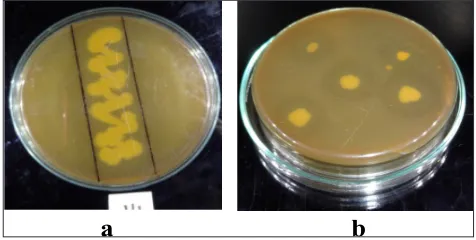
One hundred forty eight bacterial strains were isolated from 50 different soil samples of slaughter house, fish market and sewage wastes of Lucknow, Uttar Pradesh, India. Out of which thirty eight strains competent of secreting extracellular alkaline protease at pH 11. The isolates were then purified, preserved and tested for their proteolytic ability. In preliminary screening the isolate SSB2 showed highest ability to hydrolyzed casein and skimmed milk (Fig. 1) and was finally selected for further optimization of the extracellular alkaline proteases production.
a
b
Fig. 1: Proteolytic activity of SSB2 (a) Spread inoculation (b) Spot inoculation
to be non motile. Based on nucleotide homology and phylogenetic analysis, SSB2 was identified as
Acinetobacter variabilis. (Fig. 2-5).
MDNA
Genomic DNA from SSB2
Fig. 2: Agarose gel electrophoresis of A.variabilis (SSB2) genomic DNA. Lane M: is 1 kb DNA ladder. Lane DNA: is bacterial genomic DNA marked by an arrow
MPCR product
16S PCR amplicon SSB2
Fig. 3: Agarose gel electrophoresis of PCR amplicon A.variabilis (SSB2) Lane M: is 1 kb DNA ladder. Lane DNA: is PCR amplicon marked by an arrow
Fig. 4: Sequences producing significant alignments A. variabilis ( SSB2) carry out BLAST with the nrdatabase of NCBI GenBank database
Optimization of parameters for maximum enzyme production
Incubation time: Enzyme production is connected
to cell growth and therefore there is a co-relation between incubation period and enzyme production. The enzyme production varies with incubation time. Maximum enzyme production was obtained after 36 h of incubation (Fig. 6). These results are in accordance with observations made by Durhams et al. (1987), Gashaw and Gessesse (1997) and Qadar et al. (2009), where maximum enzyme production was observed during continuous growth of the culture at the late exponential phase and early stationary phase of the growth. The number of viable cells decreased due to depletion of readily available carbon source and other nutrients.
1
Fig. 5: Phylogenetic tree A. variabilis (SSB2) was constructed using MEGA 4
1
0 10 20 30 40 50 60 70 80
12 24 36 48 60 72
Pr
ot
ea
se
a
ct
iv
ity
(U
/m
L
)
Time intervals (h)
Fig. 6: Incubation periods for protease production in A. variabilis isolated. The bars indicate the standard deviation (± S.D) of three replicates (n = 3).
Temperature: Every organism possesses a minimal
temperature, optimum temperature and maximum temperature for the growth and metabolism. Temperature below optimum is bacteriostatic and above optimum is bactericidal. Enzyme activity recorded at different temperatures revealed that the isolate yielded maximum protease production at 37°C (Fig. 7). El-Safey et al. (2004) reported the same findings in production, purification, and characterization of protease enzyme from Bacillus
sp. Related studies also reported that protease production by B. laterosporous was best at 37°C (Usharani and Muthuraj 2010).
inducing morphological changes in microbes and in enzyme secretion. The pH changes were observed throughout the growth of microbes also affects product stability in the medium. The optimal pH varies with different microorganisms and enzymes. The isolate was allowed to grow in media of different pH ranging from 4.0 to 13.0. Maximum enzyme production was observed in the medium of pH 11.0 in A. variabilis (Fig. 8). Thangam and Rajkumar (2002) also reported the optimum pH for protease production by Alcaligenes faecalis as 8. pH optima for protease production in various Bacillus sp. were in the range 7 and 10 (Kaur et al., 2001; Singh et al., 2001; Puri et al., 2002; Kumar 2002).
1
0 20 40 60
30 37 40 45 50
Prot
ease activity (U/m
L)
Temperature0C
Fig. 7: Effect of incubation temperature on protease production in A. variabilis. The bars indicate the standard deviation (± S.D) of three replicates (n = 3)
1 0 10 20 30 40 50 60 70
4 5 7 9 10 11 12 13
Pr ot ea se a ct iv ity (U /m L )
Different pH range
Fig. 8: Effect of pH on protease production in A. variabilis. The bars indicate the standard deviation (± S.D) of three replicates (n = 3)
Carbon: Various sources of carbon such as glucose,
fructose, maltose, sucrose, and lactose were used to the original carbon source in growth media. Results obtained were showed that Glucose brought the highest protease production compared to other carbon sources at 36 h of incubation in A. variabilis (Fig. 9). Similar findings were observed by Bhatiya and Jedeja (2010) in the optimization of environmental and nutritional factors for alkaline protease production. Analogous findings were also reported by Pastor et al. (2001) and Santhi (2014), where glucose and starch gave maximum protease production, respectively. These results are
in good accordance with previous studies showing maximum protease production when glucose was used as carbon source in the culture broth.
1 0 10 20 30 40 50 60
Glucose Fructose Maltose Sucrose Lactose
Protease activity(U/m
L)
Carbon sources
Fig. 9: Effect of carbon sources on protease production in A.variabilis isolated. The bars indicate the standard deviation (± S.D) of three replicates (n = 3)
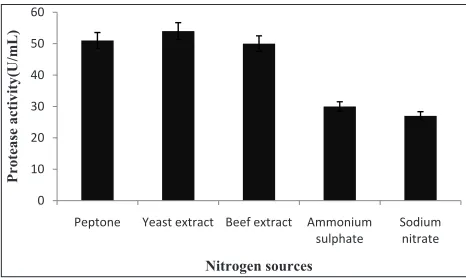
Nitrogen sources: The nitrogen sources like peptone,
yeast extract, beef extract, ammonium sulphate and sodium nitrate were used. Protease production is believed to be affected by the presence of complex nitrogen sources in the growth medium and each organism varies from the other in terms of its requirement for a specific nitrogen source. The result revealed that the best nitrogen source was yeast extract for A. variabilis (Fig. 10). Respectively this showed the highest level of protease activity compared to other sources of organic nitrogen. Ashour et al. (1996) also suggest that yeast extract and peptone is a suitable nitrogen source, which stimulates protease production by using various microbial species. 1 0 10 20 30 40 50 60
Peptone Yeast extract Beef extract Ammonium
sulphate Sodium nitrate
Pr ot ea se a ct iv ity (U /m L ) Nitrogen sources
Fig. 10: Effect of nitrogen source on protease production in A.variabilis. The bars indicate the standard deviation (± S.D) of three replicates (n = 3)
NaCl: Various NaCl concentrations (i.e. 0, 0.2, 0.4,
the maximum activity in A. variabilis (Fig. 11). The bacterium was showed NaCl tolerance up to 2 M. In a previous report, a similar NaCl concentration was found to be optimum for the production of protease (Shivanand and Jayaraman 2009).
1
0 10 20 30 40 50 60 70 80
0 0.2 0.4 0.6 0.8 1 1.5 2
Pr
ot
ea
se
a
ct
iv
ity
(U
/m
L
)
NaCl
Fig. 11: Effect of NaCl concentration on the production of protease in A. variabilis. The bars indicate the standard deviation (± S.D) of three replicates (n = 3)
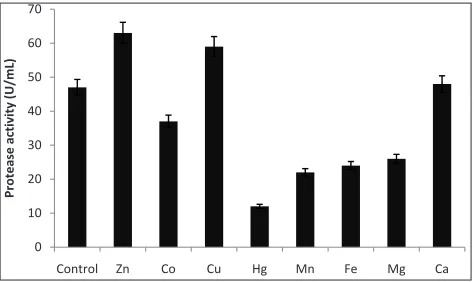
Metallic ions: Divalent metal ions such as Zn2+, Co2+,
Cu2+, Hg2+, Mn2+, Fe2+, Mg2+ and Ca2+ are required in
the fermentation medium for growth and optimum production of alkaline proteases. The influence of various metal ions on cell growth and alkaline protease production was evaluated, and the results are demonstrated in Fig.12. Among the cations tested Zn2+ and Cu2+ ions significantly enhanced
the protease production compared to the control, respectively. However, most of the other tested ions caused a significant reduction of the enzyme yield, particularly at high concentration. These results corroborate the earlier findings of metal ions such as Zn2+ enhancing the activity of protease in Bacillus
subtilis. Mcconn et al. (1964) and Cu2+ enhancing the
activity of protease in Bacillus cereus. Doddapaneni and Mangamoori (2009).
1
0 10 20 30 40 50 60 70
Control Zn Co Cu Hg Mn Fe Mg Ca
Protease
activity
(U/mL)
Fig. 12: Effect of metallic ions on the production of protease in A.variabilis. The bars indicate the standard deviation (± S.D) of three replicates (n = 3)
CONCLUSION
A new potent alkaline protease producing strain
A. variabilis was isolated from the soil sample of slaughter house, Lucknow region, Uttar Pradesh, India. The organism was affiliated to A. variabilis
based on biochemical tests and 16S rDNA gene analysis. The characterization of A. variabilis
indicated that this bacterium is alkaliphilic in nature. Optimization of various fermentation parameters resulted in an increase of enzyme production, that indicating the significance of optimization of the process to obtain a commercial yield of the enzyme. Alkaline protease secretion was consistent with the growth pattern, showing maximum enzyme production in a growth phase. The optimum incubation time, temperature, pH, carbon, nitrogen, sources, NaCl and metallic ions for protease production were determined as 36 h, 37°C, pH 11.0, 1% glucose, 1% yeast extract, 1M NaCl, and 1mM Zn2+, respectively. Based on the
present study, it is concluded that A. variabilis has a wide scope for the industrial production of alkaline protease. Further studies are necessary to ascertain the potential applications of the protease obtained from this study.
ACKNOWLEDGEMENTS
This paper is the part of PhD research work. The authors are thankful to the Director, MRD Life Sciences, Lucknow and Eurofins Genomics India Pvt. Ltd. Bangalore. Authors also express their gratitude to the Vice Chancellor, Sam Higginbottom University of Agriculture, Technology and Sciences, for his guidance and the necessary facilities provided.
REFERENCES
Abdelnasser, S.S., Ali, I., Al-Salamah, A., Elbadawi, Y. B., Tayeb, M.A. and Ibrahim, S.S. 2015. Production of extracellular alkaline protease by new halotolerant alkaliphilic Bacillus sp. NPST-AK15 isolated from hyper saline soda lakes. Electronic Journal of Biotechnology,18: 236–243.
Anwar, A. and Saleemuddin, M. 2000. Alkaline protease from Spilosoma obliqua: potential applications in bioformulation. Biotechnol.Appl. Biochem., 31: 85-89.
Banerjee, U.C., Sani, R.K., Azmi, W. and Soni, R. 1999. Thermostable alkaline protease from Bacillus brevis and its characterization as a laundry detergent additive. Proces Biochemistry,35: 213-219.
Bhatiya, R. and Jadeja, G.R. 2010. Optimization of environmental and nutritional factors for alkaline protease production. Electronic Journal of Environmental, Agricultural & Food Chemistry, 9(3): 594-599.
Deng, A., Wu, J., Zhang, Y., Zhang, G. and Wen, T. 2010. Purification and characterization of a surfactant-stable high-alkaline protease from Bacillus sp. B001. Bioresour Technol.,101: 7111-7117.
Doddapaneni, K.K. and Mangamoori, L.N. 2009. Purification and characterization of a solvent and detergent-stable novel protease from Bacillus cereus.Microbial Research, 164(4): 383-380.
Durham, D.R., Stewart, D.B. and Stellwag, E.J. 1987. Novel alkaline-and heat-stable serine proteases from alkalophilic Bacillus sp. strain GX6638. Journal of Bacteriology, 169(6): 2762-2768.
El-Safey, E.M. and Abdul-Raouf, U.M. 2004. Production, purification and characterization of protease enzyme from Bacillus subtilis. In International Conferences for Development and the Environment in the Arab World (p. 14). Assiut University.
Gashaw, M. and Gessesse, A. 1997. Thermostable amylase production by immobilized thermophilc Baccillus sp. Biotechnology Techniques,11(6): 447-450.
Gupta, R., Beg, Q.K. and Lorenz, P. 2002. Bacterial alkaline proteases: molecular approaches and industrial applications. Applied Microbiology and Biotechnology, 59: 15-32.
Haddar, A., Agrebi, R., Bougatef, A., Hmidet, N., Sellami-Kamoun, A. and Nasri, M. 2009. Two detergent stable alkaline serine-proteases from Bacillus mojavensis A21: Purification, characterization and potential application as a laundry detergent additive. Bioresour Techno., 100: 3366–73.
Holt, J.G., Krieg, N.R., Sneth, P.H.A., Stately, J.T. and Williams, S.T. 1994. Bergeys manual of Determinative Bacteriology, 9th
Ed., Williams and Wilkins, Baltimore.
Jisha, V.N., Smitha, R.B., Pradeep, S., Sreedevi, S., Unni, K. N., Sajith, S., Priji, P., Josh, M.S. and Benjamin, S. 2013. Versatility of microbial proteases. Adv. Enz. Res., 1: 39-51. Kaur, S., Vohra, R.M., Kapoor, M., Beg, Q.K. and Hoondal,
G.S. 2001. Enhanced production and characterization of a highly thermostable alkaline protease from Bacillus sp. P-2. World Journal of Microbiology and Biotechnology, 17(2): 125-129.
Kuddus, M. and Ramteke, P.W. 2008. A cold active- extracellular metalloprotease from Curtobacterium luteum (MTCC 7529): enzyme production and characterization. J. Gen. Appl. Microbiol., 54: 393-398.
Kuddus, M. and Ramteke, P.W. 2009. A cold active- extracellular alkaline protease from an alkaliphic
Stenotrophomonas maltophilla: production of enzyme and its industrial applications. Can. J. Microbiol., 55: 1-8. Kuddus, M. and Ramteke, P.W. 2011. Production optimization
of an extracellular cold active alkaline protease from Stenotrophomonas maltophilia MTCC 7528 and its application in detergent industry. African Journal of Microbiology,5(7): 809-816.
Kuddus, M., Joseph, B. and Ramteke, P. W. 2013. Production of laccase from newly isolated Pseudomonas putida and its application in bioremediation of synthetic dyes and industrial effluents. Biocatalysis and Agriculture Biotechnology,2: 333-338.
Kunitz, M.J. 1947. Crystalline soybean trypsin inhibitor: II. General properties. Gen. Physiol., 48: 456-466.
Kumar, C.G. 2002. Purification and characterization of a thermostable alkaline protease from alkalophilic Bacillus pumilus. Letters in Applied Microbiology,34(1): 13-17. Lowry, O.H., Rosebrough, N.J., Farr, A.L. and Randal, R.J.
1951. Protein measurement with the folin phenol reagent. J. Biol. Chem., 193: 265-275.
Mcconn, J.D., Tsuru, D. and Yasunobu, K.T. 1964. Bacillus subtilis Neutral proteinase A zinc enzyme of high specific activity. The J Biological Chemistry,239(11): 3706-3711. Pastor, M.D., Lorda. G.S. and Balatti. A. 2001. Protease
obtention using Bacillus subtilis 3411 and amaranth seed meal medium at different aeration rates. Brazilian Journal of Microbiology, 32(1): 6
Patil, R.C. and Jadhav, B.L. 2017. Isolation and Characterization of Protease Producing Bacillus Species from Soil of Dairy Industry. Int. J. Curr. Microbiol. App. Sci., 6(6): 853-860. Puri, S., Beg, Q.K. and Gupta, R. 2002. Optimization of alkaline
protease production from Bacillus sp. by response surface methodology. Current Microbiology,44(4): 286-290. Qadar, S.A.U., Shireen, E, Iqbal, S. and Anwar, A. 2009.
Optimization of protease production from newly isolated strain of Bacillus sp. PCSIR EA-3. Indian Journal of Biotech., 8: 286-290.
Raval, V.R., Pillai, S, Rawal, C.M. and Singh, S.P. 2014. Biochemical and structural characterization of a detergent-stable serine alkaline protease from seawater haloalkaliphilic bacteria. Process Biochem., 49: 955–62. Salwan, R. and Kasana, R.C. 2013. Purification and
Characterization of an Extracellular Low Temperature-Active and Alkaline Stable Peptidase from Psychrotrophic Acinetobacter sp. MN 12 MTCC (10786). Indian J. Microbiol., 53(1): 63–69.
Santhi, R. 2014. Microbial production of protease by Bacillus cereus using cassava waste water. Eur. J. Exp. Biol., 4(2): 19-24.
Sawant, R. and Nagendrans. 2014. Proteaase: An Enzyme with multiple industrial applications. World Journals of Pharmacy and Pharmaceutical Sciences,3(6): 568-579. Secades, P. and Guijarro, J.A. 1999. Purification and
pathogen Yersinia ruckeri and effect of culture conditions on production. Appl. Environ. Microbiol., 65(9): 3969-3975. Shankar, S., Rao, M. and Laxman, R.S. 2011. Purification and
characterization of an alkaline protease by a new strain of Beauveria sp. Process Biochem., 46: 579–85.
Shine, K., Kanimozhi, K., Panneerselvam, A., Muthukumar, C. and Thajuddin, N. 2016. Production and optimization of alkaline protease by Bacillus cereus RS3 isolated from desert soil. Int. J. Adv. Res. Biol. Sci., 3(7): 193-202. Shivanand, P. and Jayaraman, G. 2009. Production of
extracellular protease from halotolerant bacterium, Bacillus aquimaris strain VITP4 isolated from Kumta coast. Process Biochemistry,44(10): 1088-1094.
Singh, J., Batra, N. and Sobti, R.C. 2001. Serine alkaline protease from a newly isolated Bacillus sp. SSR1. Process Biochemistry, 36(8): 781-785.
Thangam, E.B. and Rajkumar, G.S. 2002. Purification and characterization of alkaline protease from Alcaligenes faecalis. Biotechnology and Applied Biochemistry, 35(2): 149-154.
Usharani, B. and Muthuraj, M. 2010. Production and characterization of protease enzyme from Bacillus laterosporus. African Journal of Microbiology Research, 4(11): 1057-1063.