A comparative study of simulated and experimental
results for an extruding elastomeric component
Stephen Connolly*, Yevgen Gorash, Alan Bickley
Weir Advanced Research Centre, Department of Mechanical & Aerospace Engineering, University of Strathclyde, James Weir Building, 75 Montrose Street, Glasgow G1 1XJ, UK
ABSTRACT
Note: At time of writing - this work is incomplete
With ever advancing simulation techniques and algorithms being introduced to commercial software, the importance of validation remains a priority. An experimental rig was designed to study the effects of rubber extrusion consisting of a compression testing system and a transparent extrusion barrel, of similar geometry to that used in a forming process. Through visual and numerical comparison, the experimental results would be compared to those obtained through Finite Element Analysis (FEA). To remedy the convergence difficulties of the complexity of the simulation, due to large deformations, a recent Nonlinear Adaptive Remeshing boundary condition was applied to the model
1. INTRODUCTION
The ability to accurately simulate an engineering scenario is usually preferable over physical experimentation for a number of reasons; which include cost, time and improved autonomy. In order to gain greater confidence in simulated results, a comparison the physical phenomena can be performed. This study aimed to create a comparison between a simulation utilising the Finite Element Method and a physical experiment for an extruding rubber specimen. A focus of this work was to implement friction which in parallel work was not identified as a significant factor [1].
This report will also briefly detail the design process of the experimental rig. This will include the material selection process, design development with simulation and features of the final submitted design.
2. BACKGROUND AND INITIAL ATTEMPTS 2.1. PREVIOUS WORK
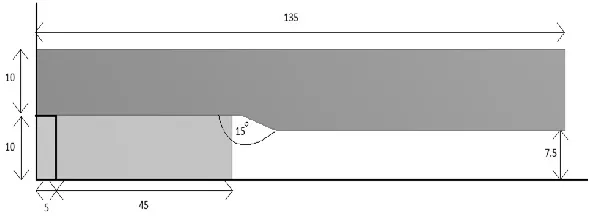
This work is a continuation of an undergraduate Dissertation study into the Simulation of the Extrusion of Rubber O-Rings though the Gaps in Flanges. The previous work initially involved a 3D model of the O-Ring Flange Seal, using geometry from Bauman [2], which incorporated a Fluid Pressure Penetration boundary condition and had attempted to also include an adaptive remeshing boundary condition also. Upon discovery of the incompatibility of remeshing with pressure loading, a simpler Benchmark model was created, based on Wriggers’ Press-Fit Problem [3] shown below.
Using the simpler model, which consisted of a rigid ‘extrusion die’-like component, a rigid ‘pusher’ and an extruding rubber rectangle, on a 3D plane, the adaptive remeshing boundary condition was successfully implemented. Beyond this, the geometry of the ‘extrusion die’-like component was altered in order to make the problem more similar to O-Ring extrusion. The remeshing boundary condition was successfully implemented onto models up to a compression ratio of 3 and a sharper intersecting angle of 45°, shown in figure 2. The figure shows the comparison between remeshed (top) and standard (bottom) models, where it is clear how large an improvement the remeshing boundary condition makes. The method of implementing remeshing was developed in the previous study along with independent study of meshing techniques, contact parameters and hyperelastic material modelling, all within ANSYS Workbench 16.
[image:2.454.77.369.199.306.2]Since remeshing was an effective tool in gaining increased convergence for an extruding model, validating this boundary condition became a priority for continued work. This
Figure 2: Remeshing successfully applied to 3d planar models (remeshed: top, standard: bottom)
[image:2.454.66.382.453.551.2]validation work forms the foundation of the current study. The model presented by Wrigger’s would be revolved into a cylindrical geometry in order to realistically recreate the simulated model as an experimental rig, discussed further in section 4. The experimental rig would be designed to allow for interchangeable ‘extrusion dies’ of different geometries in order to increase the quality of validation. Also, data for the experimented rubber would require collection and implementation into the Finite Element model.
2.2. Virtually-frictionless simulation attempts
The stages in simulating a rubber component are more complex than the process for a linear simulation. Firstly, data for the material under different loading conditions should be gathered. This typically consists of uniaxial, biaxial and planar (pure) shear tests in order to simulate the different responses of the rubber to the loading, as all three loading conditions can occur simultaneously throughout a rubber component. If incompressibility is not to be assumed then data for a Volumetric Compression experiment is also required.
The next necessary step for simulation is the application of a hyperelastic material model. Some ranking studies have consistently found the Extended Tube model to be the most efficient and accurate at correlating the test data [4, 5, 6], however, the quality of available data may dictate the model which produces the best correlation. Therefore, it is often necessary to apply the collected data and the user make his own comparison and assessment.
Along with material nonlinearity, rubber components have additional nonlinearity from large deformations, expected in most applications. In the configuration of this experiment, further complexity is introduced by contact nonlinearity also. The complexity of nonlinear contact is furthermore increased through the introduction of friction. For this reason, the original strategy was to simulate using very low friction and minimise friction for the experimental rig also. However, a study of the literature found the very low estimations of static friction to be highly improbably in practice, discussed further in section 2.3.
2.2.1. 3D planar simulation (using ANSYS)
[image:3.454.79.374.441.551.2]In a 3D model, the remeshing algorithm used a skewness criterion to determine when a new mesh was required. This criterion was coupled with a user-defined parameter which informs the solver how many times per load-step the criterion would be checked. By setting the skewness criterion to a small value, tending to 0, complete control was gained over the frequency of applying a new mesh.
As convergence was already known to be possible using 3D planar models, a theory that these 3D results could in some way be ‘revolved’ was investigated. To find the method of making these results analogous with a revolved model, a comparison to such a model was required. The comparison was made between a fully converged 2D axisymmetric model and a converged 3D planar model. The preference of a 2D axisymmetric model to a full 3D model was largely determined by time and computational resource constraints. Since each model required full convergence, a simple geometry was used for each, shown in figure 3.
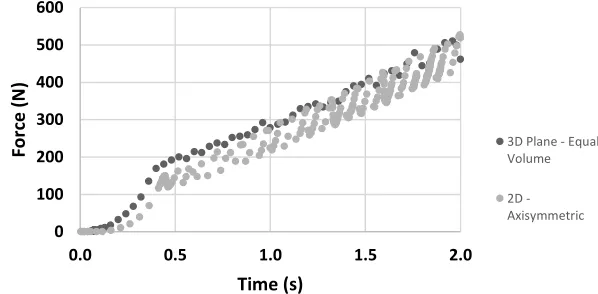
Using this model, convergence was achieved for each variation upon the geometry. The original 3D model used a volume equal to that of a quarter of the full cylindrical model. This was found to produce approximately equal results for the force required to produce the extrusion, with the 3D planar model scaled up four times, shown in figure 4. It was clear from these results that the axisymmetric model may have stability issues, shown by the fluctuation of the results. Each fluctuation was found to correspond exactly to the moment when an element ‘snapped’ across the intersection, which is a phenomena of the simulation and not representative of true behaviour.
Although the force reactions were found to be analogous, this was not the case within their stress or strain behaviours. These parameters are important for material selection in the design of the experimental rig and also used as an indicator of rubber component failure [2]. Therefore, the 3D planar models would not be viable for use in the comparison.
2.2.2. 3D angled section
Since the planar model did not provide the desired results, a 3D angled section of the cylindrical geometry was attempted, a 90 degree angled section model is shown in figure 5. It was predicted that the remeshing method developed on the planar models would also be capable of surpassing the standard results on an angled section model. Prior to this, however, it was important to assess whether the results from such a model would be analogous to the 2D axisymmetric results.
0 100 200 300 400 500 600
0.0 0.5 1.0 1.5 2.0
Fo
rc
e
(N
)
Time (s)
3D Plane - Equal Volume
[image:4.454.81.380.149.296.2]2D -Axisymmetric
For the 3D angled section model, it was found that the force reaction, when scaled up, compared approximately to the median value of the axisymmetric model’s fluctuating values. This suggests that the boundary conditions applied to the quartered model were set up appropriately. The force reactions for these models are plotted in figure 6.
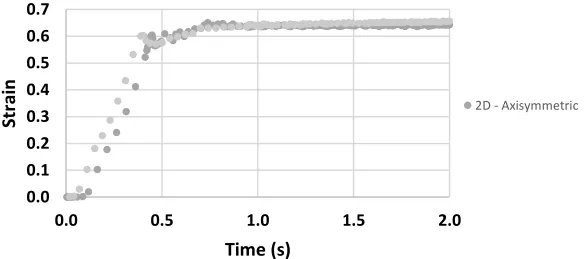
[image:5.454.86.382.61.160.2]Following the comparison of the force reactions, the stress and strain results within the rubber were compared between models. These values also correlated well, with some difference between the models as they extruded beyond the intersection but plateauing at a very similar value, shown in figure 7.
Figure 6: Quartered section of full cylindrical geometry for 3d simulation
0 100 200 300 400 500 600
0.0 0.5 1.0 1.5 2.0
Fo
rc
e
(N
)
Time (s)
[image:5.454.69.363.231.376.2]2D -Axisymmetric 3D Angular - 90 Degree
Figure 5: Comparison of force reaction on rigid ‘pusher’
0.0 0.1 0.2 0.3 0.4 0.5 0.6 0.7
0.0 0.5 1.0 1.5 2.0
Str
ai
n
Time (s)
2D - Axisymmetric
[image:5.454.93.387.450.580.2]The final comparison to be made was between the stresses being placed upon the ‘extrusion die’, shown in figure 8 above. In this instance it was found that the 3D angled section was more likely to be producing the more reliable results. This was due to the axisymmetric model’s stresses being inundated by singular stresses. These singular stresses occur at the point where the elements were found to ‘snap’ across the intersection, shown in figure 9. This behaviour is likely due to the quadratic meshing of both interacting bodies and the corners of these elements creating a small area for large stresses to emerge from the simulation.
Since this model was determined to be a valid simplification of a full cylindrical model, an attempt was made to implement remeshing within the model. It was discovered, for unknown reasons, that implementing remeshing with the same method as previously did not improve the amount of convergence, for any of the variations of the model. In fact, the implementation of remeshing decreased the convergence achieved through standard means. This meant that the final attempt of implementing remeshing within ANSYS would be on the 2D axisymmetric model.
2.2.3. 2D Axisymmetric
The remeshing technique developed in ANSYS for the 3D planar models was known to be non-transferable to the 2D axisymmetric models. This was due to the skewness criterion, discussed previously, being omitted from the 2D solver. As a result, new methods would require study and development to implement the boundary condition successfully.
The available criterion for remeshing in the 2D axisymmetric model were ‘box’ and
[image:6.454.92.385.57.176.2]‘energy’. Unlike the 3D remeshing algorithm, which uses a combination of creating a new mesh, with mapped results, and edge-splitting existing elements, the 2D remeshing applied
Figure 9: Axisymmetric model displayed singular stresses
0.0 2.0 4.0 6.0 8.0 10.0 12.0
0.0 0.5 1.0 1.5 2.0
Str
e
ss (M
Pa)
Time (s)
2D -Axisymmetric
[image:6.454.77.374.447.549.2]3D Angular - 90 Degree
edge-splitting only. This meant that elements determined to meet the criterion for remeshing would be split into smaller, seeded elements, not necessarily improving upon the quality of the elements. As a result of this, the remeshed results never managed to surpass the standard simulated results. However, some methods were developed for the ‘box’ and ‘energy’ criteria which may be useful in an improved version of the 2D remeshing code.
It was found that the ‘box’ criterion allows the user to specify a rectangular area over which the new mesh should be created, for a selected body. For an extruding component, such as the one in this study, the use of the box criterion allows for continuous efficient remeshing of the ‘extrudate’ as it moves through the ‘die’. This process can be refined by calculating the time, in terms of load steps, for the material to move through the given ‘box’ area and synchronising this with the user-defined parameter for the frequency of remeshing. This method is detailed further through images in Appendix A.
The energy criterion was also investigated but it seemed that it produced a global edge-splitting remesh, regardless of the chosen energy coefficient. The energy coefficient is intended to supply a nominal user-defined value of which remeshing will be applied if the strain energy exceeds this value. It was hypothesised that this energy coefficient is of little use in an extruding rubber specimen since most of the component stores a considerable amount of strain energy.
2.3. Friction
Frictional interaction between bodies is usually dictated by the pairing of the materials, however, in the case of rubber friction, the material properties of both the rubber and the contacting body are also significant. Friction is often separated into static and kinetic coefficients, in the case of the Amontons-Coulomb model, but the friction of a rubber component is known as either adhesion or sliding friction. The need for these different terms derives from the theory that rubber friction is due to inter and intra molecular Van der Waals forces within the rubber and between rubber and surface [7].
The previous work had not given much consideration to friction and used it primarily as a tool to gain stability in the quasi-static simulations. However, if an accurate comparison was to be made then implementing a realistic form of friction was essential. The literature study primarily aimed to find a suitable coefficient for a pressurised and lubricated rubber sliding over an acrylic material. However, the literature suggested that such a coefficient was a considerable over-simplification of the true frictional behaviour of rubber [8]. An instantaneous coefficient of friction is dependent on normal pressure, sliding velocity and the temperature [9], as well as a consideration to the macroscopic effect of surface roughness [10]. Since temperature and velocity effects were to be negligible in this quasi-static study, the implemented frictional model required consideration to the effect of normal pressure and surface roughness.
2.3.1. Velocity Dependence
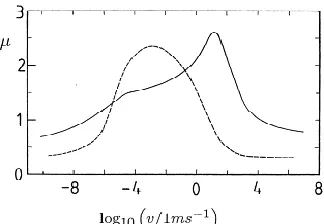
In studies by Persson [7], experiments were performed to find the coefficients of friction over a large range of velocities. The graph in figure 10 shown that from velocities as low as a billionth of a meter per second, the frictional coefficient is still subject to changes. However, it is also stated in this study that at low velocities with a smooth surface, the frictional behaviour is not yet fully understood. There are also said to be deviations between the behaviour of a soft rubber and a hard rubber as the frictional contact is hypothesised to be a
result of thermal excitation [8] or stress from the elongation of the adhesive bond to the surface [13].
2.3.2. Effect of Lubrication
As previously stated, an objective of the experiment was to minimise friction as this would minimise the tangential contact forces and stress on the extrusion die. A theory of reducing friction was to apply a layer of lubrication to both bodies prior to experimentation. In most cases this would capably reduce the frictional coefficient, however, in the case of a low velocity, high pressure experiment, the lubrication has very little effect. This is illustrated in figure 11, where S is linearly increasing velocity and µ is the frictional coefficient. The reason for boundary lubrication’s limited effect is due to the low speed and normal pressures between the contacting bodies causing the lubricant to be ’squeezed’ out [14]. At high speeds, even a high pressure cannot ensure complete contact, reducing friction, but high speed experimentation would likely be dangerous.
2.3.3. Conclusions on the topic of Rubber Friction
Axel Products [15] provide a range of material characterisation services for use in Finite Element Modelling. Interestingly, in the case of rubber friction [16], they recommended that determining frictional behaviour should be completed with full consideration of the applications environment. This would imply that finding the frictional behaviour would require the experimental data, therefore, completion of the experiment prior to simulation may be a more successful practise.
2.4. Frictional Simulation
[image:8.454.224.386.50.162.2]Despite the complex and ambiguous nature of applying a frictional model to the model, the traditional Amontons-Coulomb was experimented with. As in the previous simulation
[image:8.454.80.370.356.474.2]Figure 11: Frictional coefficient vs speed and the effects of lubrication
Figure 10: Frictional coefficient vs speed for smooth surface (dotted) and rough surface
attempts, the most simple extrusion geometry was used, being the 1. 3 ratio die with a 15° intersection. Using both ANSYS and ABAQUS solvers, no significant amount of friction achieved a converged solution. The maximum friction achieved, excluding the irrelevant 3D planar model, was for the 3D angled section model but with only a coefficient of 0.1, which as the literature would suggest is much too low [17]. When a greater value for friction was attempted, the convergence failure seemed to be strongly correlated with the contact elements being in a ‘sticking’ status. It was at this stage determined that either a specialised software should be used or the experiment should proceed in order to learn the expected behaviour and then try to simulate this through application of the observed behaviours.
3. EXPERIMENTAL RIG DESIGN
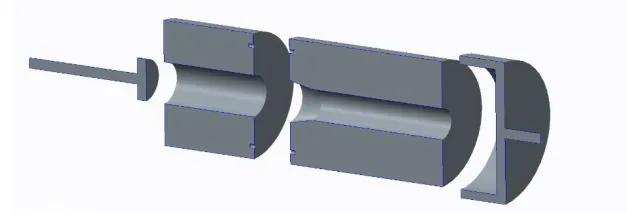
The final design for the extrusion die was similar to that of the original benchmark model but certain changes were required to allow for manufacture to be completed as desired. The final design is shown in figure 12. The die is to be made from Perspex which should provide the required rigidity as well as the desired transparency. A feature of the design was that the entry side of the die was made to be interchangeable with the narrowing section. This decision meant that the same ‘entry’ could be used for all variants of the narrowing section. As for the connection between these components, only dowels are required to minimise slip between the bodies since they will be compressed together during testing, providing the required stability.
As for the rigid ‘pusher’ and rigid base, these components are to be constructed from any rigid metal. Since the rest of the rig is constructed from less stiff materials, and the test itself should not be under extreme forces, any steel or similar metal would suffice for the construction of these components. The main feature of both of these components is their compatibility with the Instron 5969 Dual Column machine.
The remaining component of the experiment is the rubber which was purchased as 20mm diameter tubing. The only requirement for the preparation of the rubber cylinders is for the tubing to be cut into 45mm segments. (All components are awaiting manufacture)
4. DISCUSSION AND CONCLUSIONS
[image:9.454.76.389.380.487.2]As the study is ongoing, it is difficult to draw conclusions other than those from the attempted and completed work. In terms of the simulation work, it would seem that ANSYS and ABAQUS were not capable of achieving convergence for the highly nonlinear problem, at present. Marc by MSC has been highly praised for its ability to simulate contact, large deformations and nonlinear materials. With the added functionality of remeshing also, this is promising but still has a possibility of failing to achieve the desired results. As for the experimental work, there is a certain amount of risk involved in experimenting without a simulation utilising a realistic frictional model, though this may
be the more effective method of gaining a comparison. Also, the slightly ambiguous nature of stick-slip friction may even be significant enough to prevent the anticipated extrusion.
The work that has been completed, being the material characterising experiments, were relatively successful. This work would largely benefit from the inclusion of biaxial experimentation. A current undergraduate study within the University of Strathclyde has investigated the ability of creating biaxial loading through the twin pillar tensile machine and the use of pulleys. Another study, which shows promising results for obtaining data for all loading states within the same experiment, was performed by Guélon et al [20]. This experiment used sophisticated DIC technology on a 3-way loaded specimen to find uniaxial, biaxial and pure shear results simultaneously. This may be an effective and less costly method than a biaxial testing machine.
5. / REFERENCES
[1] Y. Gorash, T. Comlekci and R. Hamilton, “CAE-based application for identification and verification of hyperelastic parameters,” Proceedings of the Institution of Mechanical Engineers, Part L: Journal of Materials, 2015.
[2] J. T. Bauman, Fatigue, Stress, and Strain of Rubber Components, Munich: Carl Hanser Verlag, 2008.
[3] P. Wriggers, Computational Contact Mechanics, Berlin: Springer, 2006.
[4] M. C. Boyce and E. M. Arruda, “Constitutive models of rubber elasticity: A review,” Rubber Chemistry and Technology, vol. 73, no. 3, pp. 504-523, 2000.
[5] G. Marckmann and E. Verron, “Comparison of Hyperelastic Models for Rubber-like Materials,” Rubber Chemistry and Technology, vol. 79, no. 5, p. 853, 2006. [6] M. J. G. Ruiz and L. Y. S. Gonzalez, “Comparison of hyperelastic material models
in the analysis of fabrics,” International Journal of Clothing Science and Technology, vol. 18, no. 5, pp. 314 - 325, 2006.
[7] B. Persson, “On the theory of rubber friction,” Surface Science, vol. 401, no. 3, pp. 445-454, 1998.
[8] Y. B. Chernyak and A. I. Leonov, “ON THE THEORY OF THE ADHESIVE FRICTION OF ELASTOMERS,” Wear, vol. 108, no. 2, pp. 105-138, 1986. [9] R. v. d. Steen, “Tyre/road friction modelling Literature Survey,” Eindhoven
University of Technology, Eindhoven, 2007.
[10] R. Pinnington, “Rubber friction on rough and smooth surfaces,” Wear, vol. 267, no. 9-10, pp. 1653-1664, 2009.
[11] J. G. Niemczura, “On the Response of Rubbers at High Strain Rates,” Sandia National Labratories, Albuquerque, 2010.
[12] O. A. Shergold, F. A. Norman and D. Radford, “The uniaxial stress versus strain response of pig skin and silicone rubber at low and high strain rates,” International Journal of Impact Engineering, vol. 32, no. 9, p. 1384–1402, 2006.
[13] A. Schallamach, “A theory of dynamic rubber friction,” Wear, vol. 6, no. 5, pp. 375-382, 1963.
[14] J. Williams, “Advances in the Modelling of Boundary Lubrication,” in Boundary and mixed lubrication: science and application, Leeds, 2002.
[16] “Measuring Rubber and Plastic Friction for Analysis,” Axel Physical Testing
Services, [Online]. Available:
http://www.axelproducts.com/downloads/Friction.pdf. [Accessed 04 09 2015]. [17] R. Flitney, Seals and Sealing Handbook - Sixth Edition, Oxford: Elsevier, 2014. [18] A. N. Gent, Engineering with Rubber, Munich: Carl Hanser Verlag, 2012. [19] C. Eberl, R. Thompson, D. Gianola and S. Bundschuh, “Digital Image Correlation
and Tracking with Matlab,” Berlin, 2012.
[20] T. Guelon, E. Toussaint, J. Le Cam, N. Promma and M. Grediac, “A new characterisation method for rubber,” Polymer Testing, vol. 28, pp. 715-723, 2009.
/
![Figure 1: Wrigger’s press-fit problem [3]](https://thumb-us.123doks.com/thumbv2/123dok_us/1516760.104287/2.454.77.369.199.306/figure-wrigger-s-press-fit-problem.webp)