Running Head: IMPLEMENTATION INTENTIONS
Conditional or unconditional? The effects of implementation intentions on driver behavior. Sarah E. Brewster, Mark A. Elliott, Rebecca McCartan, Bruce McGregor and Steve W. Kelly
School of Psychological Sciences and Health, University of Strathclyde
Correspondence concerning this article should be addressed to Sarah Brewster, School of Psychological Sciences and Health, University of Strathclyde, 40 George Street, Glasgow,
Abstract
Implementation intentions (IF-THEN plans) exert conditional effects on behavior, meaning that their ability to change behavior is conditional upon encountering the critical situation specified in the IF component of the plan. In the present study, we tested whether implementation intentions can exert unconditional effects on behavior. Consistent with the process of operant generalization, we hypothesized that implementation intentions would change behavior, not only in situations that are contextually identical to those specified in the IF component but also in contextually similar situations. Implementation intentions were not expected to generate behavior-change in contextually different situations to those specified. Participants (N = 139) completed questionnaires measuring speeding behavior and motivation to speed. Experimental participants then specified implementation intentions to avoid
speeding in critical situations that were either contextually identical, similar or different to those subsequently encountered on a driving simulator. Control participants received
educational information about the risks of speeding. All participants then drove on a driving simulator. Consistent with the hypotheses, participants in both the contextually identical and similar conditions exceeded the speed limit less frequently than did controls. There was no difference in speeding behavior between the contextually different and control conditions. Implications of the findings for behavior-change are discussed.
Introduction
Implementation intentions (Gollwitzer, 1990) are IF-THEN plans that change behavior by helping people to convert their existing motivation (e.g., goal intentions) into action (Gollwitzer & Sheeran, 2006). In the ‘IF’ component of an implementation intention, people are required to specify a critical situation in which they will perform an intended behavior (e.g., a driver with a goal intention to avoid speeding might specify: “IF I am tempted to speed when being tailgated…”). This creates a mental representation of the specified critical situation, which is then ‘activated’ when the situation is subsequently encountered. In the ‘THEN’ component of an implementation intention, people are required to link the specified critical situation with a goal-directed response that helps ensure the performance of the intended behavior (e.g., “…THEN I will ignore the pressure to speed”). This link is also represented mentally and serves to initiate the specified goal-directed response when the mental representation of the specified critical situation has been activated (Webb & Sheeran, 2004; Webb & Sheeran, 2008 [study 2]). Theoretically, therefore,
implementation intentions exert conditional effects on behavior (i.e., it is proposed that the initiation of the specified goal-directed response is conditional upon the specified critical situation being encountered; Gollwitzer, 1999). In the present article, we propose that implementation intentions can, to an extent, exert unconditional effects on behavior (i.e., we propose that a goal-directed response can also be initiated by a critical situation that is not specified in the IF component of an implementation intention). We present a study that was designed to test the effects of implementation intentions on behavior in both specified and unspecified critical situations.
implementation intentions (i.e., to change their behavior in other situations) once they discover that this constitutes a useful behavior-change strategy (e.g., Foxx, Martella & Marchand-Martella, 1989; Tisdelle & St. Lawrence, 1988). However, many real-world behaviors (e.g., speeding) are conducted within the context of highly demanding tasks (e.g., driving) and become largely automated (e.g., Ouelette & Wood, 1998). For these behaviors, therefore, it is questionable whether people consciously process information relating to the successful deployment of behavior-change strategies. In this paper, we therefore focus on the second process for expecting implementation intentions to exert unconditional effects on behavior that has been suggested in the literature – operant generalization.
(conditioned) response. Conversely, a situation that is contextually different to the one specified in an implementation intention will not contain enough salient features to activate the mental representation of the specified critical situation and, as a result, will not be able to initiate the associated goal-directed response. Implementation intentions are therefore likely to exert unconditional effects on behavior in-so-far as they generalize to situations that are contextually similar to those specified in the IF component of the plan.
findings do not reveal anything about the specific situations in which compliance increased (i.e., whether it was only in the situations that participants specified in their implementation intentions or whether it was also in other situations).
It is acknowledged that previous laboratory experiments have tested the effects of implementation intentions in both specified and unspecified situations. For example, Webb and Sheeran (2007) gave participants an implementation intention to respond especially quickly to the non-word ‘avenda’ in subsequently presented word search puzzles (“If I see ‘avenda’, I will press the key especially quickly”). These participants were subsequently faster in responding to word search puzzles that contained ‘avenda’ than were the control participants, who simply familiarized themselves with this non-word by looking at it on a computer screen and repeating it under their breath for 30 seconds. Additionally, Webb and Sheeran (2007) found no difference between experimental and control participants in their response times to puzzles that contained words other than ‘avenda’. These findings show, therefore, that participants enacted the required behavior when they encountered the situation that they specified in the IF components of their implementation intentions but not when they encountered situations that they did not specify (also see Aarts, Dijksterhuis & Midden, 1999; Brandstatter, Lengfelder & Gollwitzer, 2001; Parks-Stamm, Gollwitzer & Oettingen, 2007, study 1; Webb & Sheeran, 2004, 2008).
used (e.g., ‘avenga’), then the experimental participants might have responded quicker than the control participants, consistent with the operant generalization argument presented above. Therefore, the question still arises as to whether implementation intentions generate behavior change when people encounter situations that are similar to the ones specified in the IF components of their plans.
In this study, we aimed to provide a test of the conditional and unconditional effects of implementation intentions. We tested these effects with regards to a real-world problem behavior, namely speeding. Speeding was the target behavior for three reasons. First, it is one of the main contributing factors to road traffic crashes (Department for Transport, 2014), meaning that effective strategies for reducing speeding need to be found from an applied perspective. Second, speeding is largely habitual (e.g., Elliott, Armitage & Baughan, 2003; Elliott, Lee, Robertson, & Innes, 2015; Elliott & Thomson, 2010; Pelsmacker & Janssens, 2007) and difficult to change (e.g., Stead, Tagg, MacKintosh & Eadie, 2005). It is therefore a behavior that is likely to provide a stringent test of implementation intentions. Third, there are only two previous studies in which implementation intentions have been tested in the context of driving (Brewster, Elliott & Kelly, 2015; Elliott & Armitage, 2006). It has been found in both studies that implementation intentions can generate reductions in speeding. However, self-reported behavior measures have been used in both studies. This is potentially
problematic because self-reports are susceptible to cognitive biases such as the
were therefore used in the present research.
In line with previous laboratory research in other domains (e.g., Webb & Sheeran, 2007), it was hypothesized in this study that experimental participants would subsequently exceed the speed limit less frequently than would control participants when they encounter critical situations that are contextually identical to those specified in the IF components of their implementation intentions (hypothesis 1). Consistent with the process of operant generalization, it was also hypothesized that experimental participants would subsequently exceed the speed limit less frequently than would control participants when they encounter situations that are contextually similar to those specified in the IF components of their implementation intentions (hypothesis 2). However, no difference in speeding behavior was expected between experimental and control participants when they encounter contextually different situations (hypothesis 3).
Method Participants
The participants were N = 139 active drivers (UK driving license holders who drove at least once a week). They were recruited from a university campus in Glasgow (a large city in the West of Scotland, UK), through advertisements on virtual learning environments and notice boards around campus, or from residential areas in the city, through advertisements sent to households. The mean age of the sample was 27.03 years old (SD = 13.21; range = 18 to 74 years) and 30% was male (N = 41)1. The mean weekly mileage was 90.64 (SD = 89.21; range = 5 to 500 miles) and the mean number of years licensed to drive was 8.71 (SD = 12.14; range = 1 month to 52 years).
Design & Procedure
1 Given that males comprise 54%of driving license holders in the UK, the ANOVA analyses presented in the
A randomized controlled design was used. Two hundred and twenty eight UK driving license holders initially volunteered to participate after being told that the study was a general purpose investigation into drivers’ attitudes and speeding behavior and that participation would involve the completion of one questionnaire, which would take approximately 15 minutes, and a simulator drive, which would last approximately 25 minutes. All 228 participants visited the Driving Research Laboratory within the University’s School of Psychological Sciences and Health where they were tested individually. Prior to arriving at the laboratory, the participants were randomized to one of three experimental conditions or a control condition using a random number generator. When they arrived at the laboratory, the participants in each condition completed a questionnaire that requested information about their demography (age, gender, weekly mileage, and number of years licensed to drive) and contained standard items that were used to derive baseline (pre-implementation intention manipulation) measures of speeding behavior. Goal intentions to speed and the motivational pre-cursors of goal intention that are specified in the theory of planned behavior (i.e.,
attitudes, subjective norms and perceived control; Ajzen, 1991) were also measured because they have been shown to reliably predict a range of behaviors (e.g., Armitage & Conner, 2001) including speeding (e.g., Conner, Lawton, Parker, Chorlton, Manstead & Stradling, 2007; Elliott et al., 2003 and 2012; Elliott, Thomson, Robertson, Stephenson & Wicks, 2013).
The questionnaires were identical across all conditions, except for the final page. The participants randomized to the experimental conditions were presented with a manipulation of implementation intentions on the final pages of their questionnaires. These participants were asked to specify implementation intentions to avoid speeding in three critical situations that were contextually identical, similar or different to those they would subsequently
questionnaires. This helped to guard against the potential effects ofgeneral experimenter demand (e.g., Rosenthal, 1966). Following a recent study by Brewster et al. (2015), the control group messages warned participants about the risks of speeding and were taken from the UK Department for Transport’s THINK! (national road safety education) Campaign (Department for Transport, n.d.).
After completing the questionnaires, follow-up (post-implementation intention
manipulation) measures of speeding behavior were obtained objectively from each participant using a driving simulator. The driving simulator was a STISIM Drive Model 400W. It was a fixed-based driving simulator with a three-screen, high resolution display, providing a 135 degree driver field-of-view. It had auditory and steering wheel feedback, and fully
operational driving controls (steering wheel, brake, clutch, accelerator, gear stick, horn, speedometer, and tachometer). The rear view mirrors were displayed on the front and side screens. The simulator allowed driving speed to be measured in a controlled environment (i.e., where all participants are exposed to the same environmental stimuli), which would not be possible in the real world.
All participants first drove through a 5 minute practice route, which served to
familiarize them with the simulator and its controls. Before the practice drive, the participants were told that the simulator operated in the same way as a normal car and shown all the controls. The participants were also instructed to use all of the gears and test the brakes. After the practice drive, the participants drove through the trial route. The trial route comprised an urban distributor road with a 30mph speed limit. An urban traffic environment was selected because most traffic accidents occur on built up roads (Department for Transport, 2013). The participants drove on the simulator for approximately 7.39 miles. Before driving on the trial route, all participants were informed that the speed limit was 30mph and were told to treat the simulation as if it were a real road, in the real world.
to increase the likelihood of speeding (e.g., Stradling, 2005; Walker, Murdoch, Bryant, Barnes & Johnson, 2009). In critical situation 1 (‘driving whilst being followed
closely/tailgated’), the participants drove along a straight section of road. No vehicles were modelled in the participants’ carriageway to ensure that speed choices were unrestricted. A car approached the participants’ ‘vehicle’ from behind and was visible in the rear view and side mirrors. The car remained approximately 0.5 seconds behind the participants’ vehicle for a distance of 0.76 miles regardless of the speed at which the participants chose to drive. The participants’ speeding behavior was measured for the duration of the tailgating incident. In critical situation 2 (‘driving after being stuck behind a slow moving vehicle’), the participants approached a vehicle travelling at 18mph along a straight section of road. A constant stream of oncoming traffic was modelled to ensure no overtaking opportunities. After 0.51 miles, the slow moving vehicle pulled into the side of the road. The participants’ speeding behavior was measured for the next 0.76 miles. In critical situation 3 (‘driving whilst being overtaken’), a series of six vehicles overtook the participants whilst they drove along a straight section of road for approximately 0.38 miles. The vehicles were programmed to overtake regardless of the participants’ travelling speeds. The participants’ speeding behavior was measured from the moment the first vehicle overtook until the moment the last vehicle finished overtaking. After driving on the simulator, the participants were fully debriefed and thanked for their time.
with most studies in other areas of psychology (e.g., Thomson, Tolmie, Foot, Whelan, Sarvary & Morrison, 2005) or other disciplines (e.g., van Riet-Nales, Schobben, Egberts & Rademaker, 2010) in which the effectiveness of an intervention (e.g., chemotherapy) is judged only by its ability to affect the outcomes of participants for whom the intervention is appropriate (e.g., people with cancer). Consequently, the true effect size of implementation intentions on behavior-change is likely to have been under-estimated in most previous studies. As demonstrated recently by Brewster et al. (2015), implementation intentions only reduce speeding for participants who exceed the speed limit more than they intend to. Therefore, only those participants who reported speeding more than they intended to were included in the final sample in this study. The participants who reported speeding as much as, or less than, they intended (n = 89) were excluded from the final sample2. This left a final sample of N = 139 participants (n = 32 in the contextually identical condition; n = 34 in the contextually similar condition; n = 40 in the contextually different condition; n = 33 in the control condition). All of these participants completed the study in full.
The implementation intention manipulations
The participants randomized to the experimental conditions were asked to specify implementation intentions to reduce speeding using ‘volitional help sheets’ that were based on the recent work of Brewster et al. (2015). Consistent with volitional help sheets that have been developed for other social behaviors (e.g., Armitage, 2008, 2015), Brewster et al.’s (2015) volitional help sheet provides participants with a list of 20 separate critical situations in which drivers are known to regularly exceed the speed limit (e.g., Stradling, 2005) and 20 goal-directed responses (strategies for avoiding speeding) that are theoretically derived from Prochaska and DiClemente’s (1983) processes of behavior-change. Each critical situation is
2 Consistent with Brewster et al., (2015), an ANOVA focusing only on the participants who were deemed
presented as an IF statement (e.g., ‘If I am tempted to speed when being overtaken by other vehicles…’). Each goal-directed response is presented as a THEN statement (e.g., ‘…Then I will drive in a lower gear to help me drive slower’). The participants’ task is to form
implementation intentions by selecting the critical situations in which they know they have the most difficulty complying with the speed limit and linking them with goal-directed responses that they believe will help them avoid the temptation to speed.
In the present study, the participants randomized to the experimental conditions received volitional help sheets that included three of the critical situations used by Brewster et al. (2015). These participants were instructed to link each of the three critical situations with one of the 20 goal directed responses. The participants randomized to the first experimental condition were given a volitional help sheet that included the three critical situations that were contextually identical to those modelled on the simulator. The
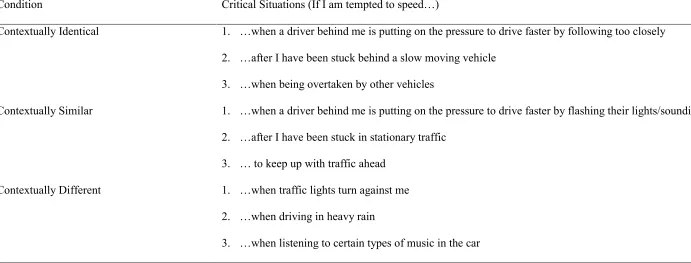
participants randomized to the second experimental condition were given a volitional help sheet that included the three critical situations that were judged to be the most contextually similar to those modelled on the driving simulator. The participants randomized to the third experimental condition were given a volitional help sheet that included the three critical situations that were judged to be the most contextually different to those modelled on the driving simulator (see table 1 for a description of the critical situations used in each experimental condition).
behaviors, such as speeding, are not readily quantifiable. We return to this point in the discussion.
Measures
Baseline (pre-implementation intention manipulation) measures. Standard items, commonly used in previous research, were included in the questionnaires to measure baseline levels of speeding behavior, goal intention, and the motivational pre-cursors that are specified by the theory of planned behavior (e.g., Conner et al., 2007; Elliott et al., 2003 and 2013; Elliott, Armitage & Baughan, 2007). The participants were asked to respond to each item on a 9-point scale. A single item measure of each construct was used to reduce the risk of participant fatigue (e.g., Hart, Rennison & Gibson, 2005). The following items were
presented in a pseudo-random order within the questionnaire and the response scales for half the items were reversed in order to reduce the risk of response set biases (Coolican, 2004).
Speeding behavior was measured by asking the participants to respond to the statement “I often drive faster than the speed limit” using a unipolar scale ranging from ‘strongly disagree’ (scored 1) to ‘strongly agree’ (scored 9). Goal intention to speed was measured by asking participants to respond to the statement “I want to drive faster than the speed limit in my future driving”, again using a unipolar scale that ranged from ‘strongly disagree’ (scored 1) to ‘strongly agree’ (scored 9). Attitude was measured by presenting participants with the item stem “For me, driving faster than the speed limit is…” Participants were asked to complete this sentence using a bipolar, semantic differential scale with the end points labelled ‘extremely negative’ (scored 1) and ‘extremely positive’ (scored 9).
Subjective norm was measured by asking participants to respond to the following item “Most people who are important to me want me to drive faster than the speed limit”. The
influence whether or not you drive faster than the speed limit?” The participants responded to this item using a unipolar response scale with the end points labelled ‘not at all’ (scored 1) and ‘a lot’ (scored 9).
Follow-up (post-implementation intention) measures.An objective measure of subsequent speeding behavior was obtained for each participant using data that was collected from the driving simulator. Speed in miles per hour was recorded every 5ft of the simulator drive. These speed recordings were used to calculate the proportion of the distance that participants were travelling faster than 10% above the speed limit (i.e., faster than 33 mph) in the three critical situations.Speeding was defined as driving faster than 10% above the posted speed limit in line with UK police enforcement guidelines (see Stephenson, Wicks, Elliott & Thomson, 2010).
Results Power Analysis
A power analysis was performed to ensure that the sample (N = 139) was sufficient to detect a meaningful sized effect. This analysis revealed that the power of the study to detect an effect size of f² = 0.25 at α = 0.05 was .83. Given that this power was greater than 0.80, it was concluded that the present analyses had sufficient power to detect a meaningful sized effect (cf. Cohen, 1988, 1992).
Randomization checks
ANOVAs were conducted in which age, weekly mileage and number of years licensed to drive were the dependent variables and condition was the independent variable. No
significant differences were found between the conditions in age, F (3, 135) = 0.66, p = .58, weekly mileage F (3, 135) = 0.31, p = .82, or number of years licensed to drive F (3, 135) = 0.87, p = .46. In addition, a chi-square revealed no gender differences between the conditions,
χ² (3, N = 139) = 0.62, ns. The random allocation of the participants to the conditions was
therefore successful. Descriptive Statistics
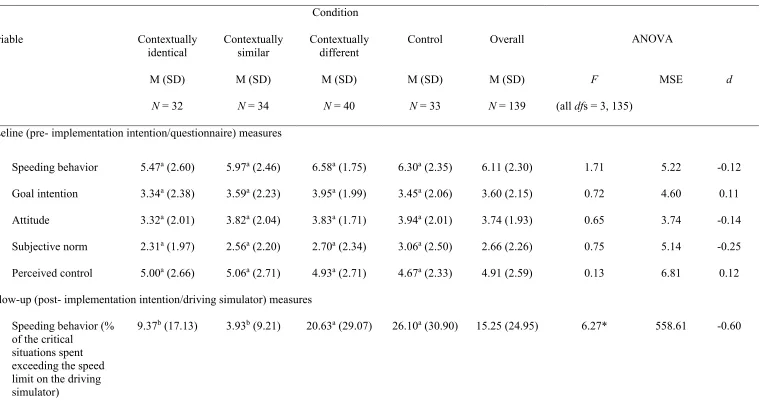
The sample means and standard deviations for both the baseline and follow-up measures are shown in table 2. The means on the baseline measures show that the
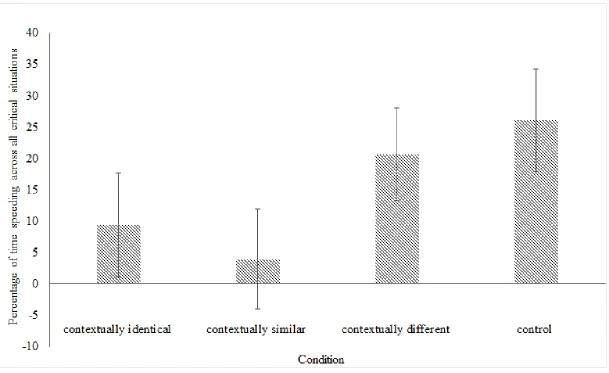
participants, on average, reported exceeding the speed limit reasonably often (i.e., the mean score on the behavior measure was around the scale mid-point, 5). However, they did not have strong goal intentions to speed and they reported having negative attitudes towards speeding, not feeling social pressure to speed and perceiving a moderate amount of control over their speeding behavior. In line with the hypotheses, table 2 also shows that the participants in the contextually identical and contextually similar conditions exceeded the speed limit less frequently on the driving simulator than did the control participants (also see figure 1). However, the contextually different condition and the control condition displayed similar levels of speeding behavior in the simulator.
Testing the conditional and unconditional effects of implementation intentions
exceeded the speed limit less frequently on the driving simulator than did the control participants (p < .05, d = -0.72). In support of hypothesis 2, the participants in the
contextually similar condition also exceeded the speed limit less frequently on the driving simulator than did the control participants (p < .001, d = -0.95). Also, as expected
(hypothesis 3), there was no difference in speeding behavior between the contextually different and the control conditions (p = .76, d = -0.23).3 In addition, the difference in speeding behavior between the participants in the contextually identical and similar conditions was not statistically significant (p = .79, d = 0.23).
Discussion
The aim of this study was to provide the first controlled test of whether
implementation intentions exert unconditional effects on behavior. Speeding was the target behavior because it is highly habitual (e.g., Elliott et al., 2003; Elliott & Thomson, 2010) and therefore difficult to change, meaning that this study provides a rigorous test of
implementation intentions. It was hypothesised that experimental participants would
subsequently exceed the speed limit less frequently than would control participants when they encountered contextually identical situations to those specified in the IF components of their implementation intentions (hypothesis 1). It was also hypothesized that experimental
3 While the control participants in this study were given educational messages to help control for general
experimenter demand (see method section), it is possible that the hypothesized findings reflect a specific demand characteristic whereby the participants in the contextually identical and similar conditions felt greater pressure to reduce their driving speeds than did the participants in the contextually different and control conditions when they encountered the critical situations on the driving simulator (i.e., because they recognized that they were driving in situations that were the same as or similar to those for which they had specified implementation intentions). We did, however, collect supplementary measures of perceived difficulty
participants would subsequently exceed the speed limit less frequently than would control participants when they encountered contextually similar situations to those specified in the IF components of their implementation intentions (hypothesis 2). However, no difference in speeding behavior was expected between experimental and control participants in
contextually different situations (hypothesis 3).
In support of hypothesis 1, it was found that participants who specified
implementation intentions to avoid speeding in critical situations that were contextually identical to those they subsequently encountered on a driving simulator exceeded the speed limit less often, when they encountered those situations, than did the control participants. This difference was approaching a large-sized effect (d = -0.72), which is a testament to the capacity of implementation intentions to change behavior (Gollwitzer & Sheeran, 2006). This finding is consistent with previous laboratory research (e.g., Aarts et al., 1999; Parks-Stamm et al. [2007; study 1]; Webb & Sheeran, 2004, 2007 and 2008) which has also shown that implementation intentions produce large-sized changes in behavior when participants encounter the situations they specify in the IF components of their plans (Gollwitzer & Sheeran, 2006). It is also consistent with previous field research showing that implementation intentions have the capacity to bring about changes in health behaviors generally (e.g.,
Andersson & Moss, 2011; Arden & Armitage, 2012; Armitage, 2004; Armitage, 2008; Conner & Higgins, 2010; Luszczynska et al., 2007).
that implementation intentions have just as much capacity to change behavior in situations that are contextually similar to those specified in the IF components of people’s plans as they do in situations that are contextually identical. Additionally, in line with hypothesis 3, the results showed that there was no difference in subsequent speeding behavior between the experimental participants who specified implementation intentions to avoid speeding in contextually different situations to those they encountered on the driving simulator and the control participants. Overall, therefore, the findings are consistent with an operant
generalization effect (Skinner, 1969) whereby a situation that is contextually similar to the one specified in the IF component of an implementation intention can activate the mental representation of the specified critical situation and, consequently, initiate the specified goal-directed response with which it has been mentally linked (e.g., Webb & Sheeran, 2007). A contextually different situation, however, that does not share enough salient features with the specified critical situation is unable to activate the mental representation of the specified critical situation. As a result, the goal-directed response that serves to change behavior is not initiated.
More generally, the lack of difference in subsequent behavior between the
contextually different and control conditions means it is unlikely that the observed reductions in speeding (i.e., in the contextually identical and contextually similar conditions) were attributable to a general demand effect, whereby specifying any kind of implementation intention is sufficient to change behavior. It is also difficult to conclude that the findings were attributable to a specific demand experienced by the participants in the contextually identical and similar conditions when they encountered the critical situations on the driving simulator. This is because there were no differences between the conditions in post-simulator measures of perceived difficulty to avoid speeding in the specific situations that were tested in this study (see footnote 3).
control conditions also helps rule out a motivational explanation (e.g., Sniehotta, 2009) for the observed unconditional effects of implementation intentions on behavior. In other words, it is unlikely that the observed difference in speeding behavior between the contextually similar and control conditions is due to the participants in the contextually similar condition spontaneously generating implementation intentions for new situations after finding that their specified implementation intentions were effective at helping them to change their behavior. If that were the case, then a difference between the contextually different and control
conditions would also have been found. Additionally, a motivational explanation for the results can be ruled out on the basis that participants in this study drove on the simulator immediately following implementation intention formation, meaning they had little opportunity to find out whether their implementation intentions were goal serving.
In addition to showing for the first time that implementation intentions can have unconditional effects on behavior, this study extends the literature by showing that
implementation intentions can change objectively measured speeding behavior. This study therefore advances previous research by Elliott and Armitage (2006) and Brewster et al. (2015) in which implementation intentions have been shown to change self-reported measures of speeding behavior, which are susceptible to cognitive (e.g., Fulcher, 2003), affective (e.g., Watkins et al., 1996) and self-presentational biases (e.g., Paulhus, 2002). On the basis of this study, it can be concluded with greater confidence that implementation intentions represent an effective strategy for reducing drivers’ speeding behavior. Given that implementation intentions change behavior by helping people to translate desirable goal intentions into action, interventions encouraging the formation of implementation intentions could be usefully incorporated into existing road safety countermeasures, in particular those that aim to motivate the development of desirable goal intentions (e.g., McKenna, 2007; Stephenson et al., 2010).
conditions under which implementation intentions change behavior and practical implications for road safety interventions, there are three key methodological features that need to be taken into account when interpreting the results. First, a driving simulator was used to derive the objective measure of speeding behavior and driving simulators do not measure behavior in the real-world. However, measures of speeding behavior that are derived from driving simulators have previously been shown to be good proxies for on-road speeding behavior in the real-world (e.g., Conner et al., 2007; Elliott et al., 2007; Helman & Reed, 2015;
Lockwood, 1997). In addition, driving simulators provide optimal experimental control. In this study, this means that the observed reductions in speeding behavior can be attributed to implementation intentions rather than other confounding factors (e.g., road, weather and traffic conditions) that can influence real-world driving speeds. Finally, implementation intentions have been found to change objective measures of real-world behavior in many field studies of other social behaviors (e.g., Holland, Aarts & Langendam, 2006; Luszczynska et al., 2007; Sheeran & Orbell, 2000). Overall, we are confident in the validity of the present findings.
The second methodological feature of this study that needs taking into account when interpreting the findings is that an immediate post-implementation intention measure of speeding behavior was used as the dependent variable. The potential concern is that the observed changes in behavior may not persist. However, numerous studies have shown that implementation intentions can change both self-reported and objectively measured behavior, even when behavior has been measured over months (e.g., Brewster et al., 2015; Elliott & Armitage, 2006; Luszczynska et al., 2007; Murray, Rodgers & Fraser, 2009) or years (e.g., Conner & Higgins, 2010) after implementation intention specification. This implies the reductions in speeding behavior observed in this study might also persist over a longer period of time. However, further research might usefully test the effects of implementation
would also help alleviate further the potential problems associated with experimenter demand, described earlier.
Third, we did not provide any test of the extent to which critical situations need to be contextually similar (or different) to those specified in participants’ implementation
intentions before they initiate (or fail to initiate) the process of behavior-change. As mentioned in the method section, the contextual similarities and differences between the situations in which people typically perform real-world behaviors (e.g., speeding) tend to be inherently qualitative in nature and are therefore difficult to objectively quantify. As a result, we tested the degree of behavior-change that can be achieved in critical situations that were deemed by the first two authors of this article to be qualitatively similar and different to those specified in participants’ implementation intentions. Traditional laboratory-based behaviors (e.g., performance on cognitive tasks) would provide greater opportunity to quantify the effects of contextual similarity on the relationship between implementation intentions and behavior-change. For instance, performance in a target detection task (e.g., requiring participants to detect an N sided shape) by participants who have specified prior
implementation intentions to respond especially quickly when they see the target could be compared with the performance of participants who have specified prior implementation intentions to respond especially quickly when they see objects that incrementally differ from the target by a known constant (e.g., an N+1, N+2, or N+3 sided shape). A study of this kind would provide information about the number of contextual cues that a stimulus (critical situation) needs to share with the one specified in an implementation intention in order to initiate the specified goal-directed response (e.g., fast response latencies). That said, performance on cognitive tasks in laboratory settings has low ecological validity, which is clearly undesirable in applied studies such as this one.
To conclude, this study supports previous research in which implementation
it extends previous research by showing that implementation intentions can produce unconditional effects on behavior in so far as they change behavior in situations that are similar, but not very different, to the ones that people specify in the IF components of their plans. The findings are consistent with an operant generalization process whereby the mental representation of a specified critical situation in which to perform an intended behavior (the IF component of an implementation intention) can be activated by a contextually similar situation. As a result, the goal-directed response, which has been linked with the specified critical situation (in the THEN component of an implementation intention) is initiated and serves to change behavior. Future theoretical research is needed to test the extent to which critical situations need to be contextually similar (or different) to those specified in
References
Aarts, H., Dijksterhuis, A., & Midden, C. (1999). To plan or not to plan? Goal achievement Psychology, 29, 971-979.
Ajzen, I. (1991). The theory of planned behavior. Organizational Behavior and Human Decision Processes, 50, 179–211.
Andersson, E., & Moss, T. (2011). Imagery and implementation intention: A randomized controlled trial of interventions to increase exercise behaviour in the general population. Psychology of Sport and Exercise, 12, 63-70.
Arden, M.A., & Armitage, C.J. (2012). A volitional help sheet to reduce binge drinking in students: a randomized exploratory trial. Alcohol and Alcoholism, 47, 156–159. Armitage, C.J. (2004). Evidence that implementation intentions reduce dietary fat intake: a
randomized trial. Health Psychology, 23, 319–323.
Armitage, C.J. (2008). A volitional help sheet to encourage smoking cessation: a randomized exploratory trial. Health Psychology, 27, 557–566.
Armitage, C.J. (2015). Evidence that a volitional help sheet reduces alcohol consumption among smokers: A pilot randomized controlled trial. Behavior Therapy, 46, 342-349. Armitage, C.J., & Arden, M.A. (2012). A volitional help sheet to reduce alcohol consumption
in the general population: a field experiment. Prevention Science, 13, 635–643. Armitage, C.J., & Conner, M. (2001). Efficacy of the theory of planned behaviour: a
analytic review. British Journal of Social Psychology, 40, 471–499.
Bargh, J. A. (1994). The four horsemen of automaticity: Awareness, intention, efficiency, and control in social cognition. In R.S.Wyer & T.K. Srull (Eds.), Handbook of social cognition (pp. 1-40). Hillsdale, NJ: Lawrence Erlbaum.
Brandstatter, V., Lengfelder, A., & Gollwitzer, P.M. (2001). Implementation intentions and efficient action initiation. Journal of Personality and Social Psychology, 81, 946-960. Brewster, S.E., Elliott, M.A., & Kelly, S.W. (2015). Evidence that implementation intentions
reduce drivers’ speeding behavior: Testing a new intervention to change driver behavior. Accident Analysis and Prevention, 74, 229-242.
Cohen, J. (1988). Statistical power analysis for the behavioral sciences. Hillsdale, NJ: Erlbaum.
Cohen, J. (1992). A power primer. Psychological Bulletin, 112, 155-159.
Conner, M., & Higgins, A.R. (2010). Long term effects of implementation intentions on prevention of smoking uptake among adolescents: a cluster randomized controlled trial. Health Psychology, 29, 529–533.
Conner, M., Lawton, R., Parker, D., Chorlton, K., Manstead, A.S.R., & Stradling, S. (2007). Application of the theory of planned behaviour to the prediction of objectively
assessed breaking of posted speed limits. British Journal of Psychology, 98, 429-453. Coolican, H. (2004). Research Methods and Statistics in Psychology, Hodder Arnold,
London.
Department for Transport, n.d. Speed: It’s 30 for a reason. Speed: THINK!: Direct Gov. Retrieved October 15, 2013. from http://think.direct.gov.uk/speed.html Department for Transport’s THINK! Campaign
Department for Transport. (2013). Vehicles involved in reported accidents by vehicle type, built-up and non-built-up roads, road class and accident severity, Great Britain, 2013. London: TSO.
Department for Transport. (2014). Reported road casualties, Great Britain: 2013, Annual Report. London: TSO.
897, 228-237.
Elliott, M.A. (2012). Testing the capacity within an extended theory of planned behaviour to reduce the commission of driving violations. Transportmetrica, 8, 321-343.
Elliott, M.A., & Armitage, C.J. (2006). Effects of implementation intentions on the self- reported frequency of drivers’ compliance with speed limits. Journal of Experimental Psychology: Applied, 12, 108–117.
Elliott, M.A., Armitage, C.J., & Baughan, C.J. (2003). Drivers’ compliance with speed limits: an application of the theory of planned behavior. Journal of Applied Psychology, 88, 964–972.
Elliott, M.A., Armitage, C.J., & Baughan, C.J. (2007). Using the theory of planned behaviour to predict observed driving behaviour. British Journal of Social Psychology, 46, 69– 90.
Elliott, M. A., Lee, E., Robertson, J.S., & Innes, R. (2015). Evidence that attitude accessibility augments the relationship between speeding attitudes and speeding behavior: A test of the MODE model in the context of driving. Accident Analysis and Prevention, 74, 49-59.
Elliott, M.A., & Thomson, J.A. (2010). The social cognitive determinants of offending drivers’ speeding behaviour. Accident Analysis and Prevention, 42, 1595–1605. Elliott, M.A., Thomson, J.A., Robertson, K., Stephenson, C., & Wicks, J. (2013). Evidence
that changes in social cognitions predict changes in self-reported driver behavior: causal analyses of two-wave panel data. Accident Analysis and Prevention, 50, 905– 916.
Foxx, R.M., Martella, R.C., & Marchand-Martella, N.E. (1989). The acquisition,
maintenance, and generalization of problem-solving skills by closed head-injured adults. Behavior Therapy, 20, 61-76.
Gollwitzer, P.M. (1990). Action phases and mind sets. In: Higgins, E.T., Sorrentino, J.R.M. (Eds.), The Handbook of Motivation and Cognition. Guilford Press, New York, NY, pp. 53–92.
Gollwitzer, P.M. (1999). Implementation intentions: Strong effects of simple plans. American Psychologist, 54, 493-503.
Gollwitzer, P.M., & Sheeran, P. (2006). Implementation intentions and goal achievement: a meta-analysis of effects and processes. Advances in Experimental Social Psychology, 38, 69–119.
Hart, T.C., Rennison, C.M., & Gibson, C. (2005). Revisiting respondent “fatigue bias” in the National Crime Victimization Survey. Journal of Quantitative Criminology, 21, 345-363.
Helman, S., & Reed, N. (2015). Validation of the driver behaviour questionnaire using behavioural data from an instrumented vehicle and high-fidelity driving simulator. Accient Analysis and Prevention, 75, 245-251.
Holland, R.W., Aarts, H., & Langendam, D. (2006). Breaking and creating habits on the working floor: A field experiment on the power of implementation intentions. Journal of Experimental Social Psychology, 42, 776-783.
Lockwood, C. R. (1997). Using the TRL driving simulator to evaluate traffic calming measures. TRL Report 245, Crowthorne: Transport Research Laboratory.
Luszczynska, A., Sobczyk, A., Abraham, C. (2007). Planning to lose weight: randomized controlled trial of an implementation intention prompt to enhance weight reduction among overweight and obese women. Health Psychology, 26, 507–512.
McKenna, F.P. (2007). Do attitudes and intentions change across a speed awareness workshop? Paper presented at the Behavioural Research in Road Safety 17 downloaded 14th May 2015 from
%20to%20Safety/FrankMcKenna.pdf
Murray, T.C., Rodgers, W.M., & Fraser, S.N. (2009). Examining implementation intentions in an exercise intervention: the effects on adherence and self-efficacy in a naturalistic setting. Journal of Applied Social Psychology, 39, 2303-2320.
Orbell, S. & Sheeran, P. (1998). ‘Inclined abstainers’: A problem for predicting health-related behaviour. British Journal of Social Psychology, 37, 151-165.
Ouelette, J.A. & Wood, W. (1998). Habit and intention in everyday life: the multiple processes by which past behavior predicts future behavior. Psychological Bulletin, 124, 54-74.
Parks-Stamm, E.J., Gollwitzer, P.M., & Oettingen, G. (2007). Action control by
implementation intentions: effective cue detection and efficient response initiation. Social Cognition, 25, 248–266.
Paulhus, D. L. (2002). Socially desirable responding: The evolution of a construct. In H. Braun,
D.N. Jackson, & D.E. Wiley (Eds.), The role of constructs in psychological and
educational measurement (pp. 67-88). Hillsdale, NJ: Lawrence Erlbaum Associates.
Pelsmacker, P.D., & Janssens, W. (2007). The effect of norms, attitudes and habits on speeding
behaviour: Scale development and model building and estimation. Accident Analysis &
Prevention, 39, 6-15.
Prochaska, J.O., & DiClemente, C.C. (1983). Stages and processes of self-change of
smoking: toward an integrative model of change. Journal of Consulting and Clinical Psychology, 51, 390–395.
Rosenthal, R. (1966). Experimenter Effects in Behavioural Research. New York, Century-Crofts.
Sheeran, P., & Orbell, S. (2000). Using implementation intentions to increase attendance for cervical cancer screening. Health Psychology, 18, 283-289.
Appleton-Century, Oxford, England.
Skinner, B.F. (1953). Science and Human Behavior. New York: Macmillan
Skinner, B.F. (1969). Contingencies of Reinforcement. Englewood Cliffs, N.J.: Prentice-Hall. Sniehotta, F.F. (2009). Towards a theory of intentional behaviour change: plans: planning and
self-regulation. British Journal of Health Psychology, 14, 261–273.
Stead, M., Tagg, S., MacKintosh, M., & Eadie, D.R. (2005). Development and evaluation of a mass media theory of planned behaviour intervention to reduce speeding. Health Education Research: Theory and Practice, 20, 36–50.
Stephenson, C., Wicks, J., Elliott, M.A., & Thomson, J. (2010). Monitoring speed awareness courses: baseline data collection. London.
Stradling, S.G. (2005). Speeding behaviour and collision involvement in Scottish car drivers. In D.A. Hennessy & D.L. Wiesenthal (Eds.), Current Trends in Driver Behaviour and Traffic Safety Research (pp. 111-121). New York: Nova Science Publishers, Inc. Thomson, J.A., Tolmie, A.K., Foot, H.C., Whelan, K.M., Sarvary, P. & Morrison, S. (2005).
Influence of virtual reality training on the roadside crossing judgements of child pedestrians. Journal of Experimental Psychology: Applied, 11, 175-186.
Tisdelle, D.A., & St. Lawrence, J.S. (1988). Adolescent interpersonal problem-solving skill training: Social validation and generalization. Behavior Therapy, 19, 171-182. van Riet-Nales, D.A., Schobben, A.F., Egberts, T.C. & Rademaker, C.M. (2010). Effects of
the pharmaceutical technologic aspects of oral pediatric drugs on patient-related outcomes: A systematic literature review. Clinical Therapeutics, 32, 924-938. Walker, E., Murdoch, C., Bryant, P., Barnes, B., Johnson, B. (2009). Quantitative study of
mood-congruent memory bias in depression. Journal of Abnormal Psychology, 105, 34-41. Webb, T.L., & Sheeran, P. (2004). Identifying good opportunities to act: Implementation
intentions and cue discrimination. European Journal of Social Psychology, 34, 407-419.
Webb, T.L., & Sheeran, P. (2007). How do implementation intentions promote goal attainment? A test of component processes. Journal of Experimental Social Psychology, 43, 295-302.
Table 1. Critical situations specified in participants’ implementation intentions by condition
Condition Critical Situations (If I am tempted to speed…)
Contextually Identical 1. …when a driver behind me is putting on the pressure to drive faster by following too closely
2. …after I have been stuck behind a slow moving vehicle
3. …when being overtaken by other vehicles
Contextually Similar 1. …when a driver behind me is putting on the pressure to drive faster by flashing their lights/sounding their horn
2. …after I have been stuck in stationary traffic
3. …to keep up with traffic ahead
Contextually Different 1. …when traffic lights turn against me
2. …when driving in heavy rain
Table 2. Means, standard deviations and ANOVAs testing the differences between conditions on the measures. Condition
ANOVA
Variable Contextually
identical
Contextually similar
Contextually different
Control Overall
M (SD)
N = 32
M (SD)
N = 34
M (SD)
N = 40
M (SD)
N = 33
M (SD)
N = 139
F
(all dfs = 3, 135)
MSE d
Baseline (pre- implementation intention/questionnaire) measures
Speeding behavior 5.47a (2.60) 5.97a (2.46) 6.58a (1.75) 6.30a (2.35) 6.11 (2.30) 1.71 5.22 -0.12
Goal intention 3.34a (2.38) 3.59a (2.23) 3.95a (1.99) 3.45a (2.06) 3.60 (2.15) 0.72 4.60 0.11
Attitude 3.32a (2.01) 3.82a (2.04) 3.83a (1.71) 3.94a (2.01) 3.74 (1.93) 0.65 3.74 -0.14
Subjective norm 2.31a (1.97) 2.56a (2.20) 2.70a (2.34) 3.06a (2.50) 2.66 (2.26) 0.75 5.14 -0.25
Perceived control 5.00a (2.66) 5.06a (2.71) 4.93a (2.71) 4.67a (2.33) 4.91 (2.59) 0.13 6.81 0.12
Follow-up (post- implementation intention/driving simulator) measures
Speeding behavior (% of the critical
situations spent exceeding the speed limit on the driving simulator)
9.37b (17.13) 3.93b (9.21) 20.63a (29.07) 26.10a (30.90) 15.25 (24.95) 6.27* 558.61 -0.60