This is a peer-reviewed, accepted author manuscript of the following research output Valverde Armas, P. E., Green, T., & Roy, S. (2017). Copper electrodeposition from a water-containing choline chloride based deep eutectic solvent. ECS Transactions. (in press)
Copper Electrodeposition from a Water-Containing Choline Chloride Based Deep Eutectic Solvent
P. Valverde, T.A. Green and S. Roy
Department of Chemical and Process Engineering, Strathclyde University, Glasgow, Scotland G1 1XJ, UK
This study investigated the effect of water on the physical and electrochemical properties of a choline chloride deep eutectic solvent (DES). Physical and electrochemical measurements were performed on the DES containing varying amounts of water. When the water content was increased from 1% to 15 wt%, the viscosity and density declined while the conductivity increased significantly. Similarly, the limiting current for Cu reduction at 15 wt% of water was also found to be three times greater than the limiting current at 1 wt% of water. This latter effect could be mostly attributed to viscosity changes, but there was evidence of deviations from ideal Stokes-Einstein behaviour. These experimental results show that inclusion of water facilitates ion mobility, and generally results in improved electrochemical characteristics.
Introduction
Due to growing environmental regulations, alternatives to aqueous systems such as Ionic Liquids (ILs) are being examined for the electrodeposition of metals and alloys (1). In this work we have studied Cu deposition, a model electroplating system. Earlier studies have used chloroaluminates or hydrophobic anions to deposit this metal (2-8). Although these melts are useful for establishing reaction mechanisms or speciation of Cu, they are not suitable for industrial plating applications due to their moisture sensitivity (9). Deep Eutectic Solvents (DESs) are a promising category of ILs since they are tolerant to water, stable under ambient conditions, and reasonably inexpensive (10, 11). However, they are hygroscopic and take up water unless special precautions are taken (1). Thus, in a real process, it is likely that the electroplating will proceed from water-containing electrolytes. However, for DESs to become exploitable, metal deposition from hydrated electrolytes requires further investigation. This study endeavours to establish a quantitative correlation between the physical properties and the electrochemical behaviour of Cu in a water-containing DES.
Experimental
Water Uptake by DESs
‘Ethaline’ was prepared by mixing choline chloride (C5H14NOCl) and ethylene glycol
(C2H6O2) in a 1:2 molar ratio at 60°C until a transparent melt was formed. Both the choline
[Type here]
Kyoto Electronics). Similarly, after dissolving the cupric chloride salt (0.2 M CuCl2∙2H2O)
in the electrolyte, the water content was measured by KF titration. Thereafter, in order to establish the absorption of water by the DES with time, the liquid was exposed to the air for over a month. From this electrolyte, samples were collected each week to be analysed.
Physical Properties of Water-Containing Electrolytes
In the next stage, the effect of water on physical properties such as density, viscosity and conductivity was performed. For these trials, samples were prepared containing 1, 3, 6, 10 and 15 wt% water. The viscosity measurements of the water-containing samples were carried out using a DHR-2 Rheometer (TA Instruments) at 25 °C. Sample density was determined using a specific gravity bottle (Fischer Scientific). Finally, the conductivity of the deep eutectic solvents was measured at room temperature using a calibrated InLab730 conductivity probe (Mettler Toledo).
Electrochemical Behaviour Using Linear Polarization Scans
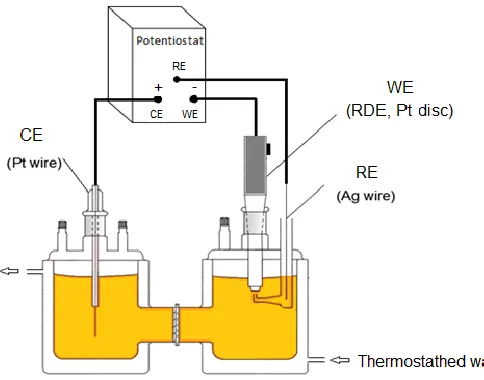
Linear polarization scans were carried out to study the effect of water on the limiting current of Cu deposition. The voltammetric scans were carried out using a rotating disc electrode (RDE) controlled with PGSTAT101 potentiostat (Metrohm). The RDE was placed in a divided electrochemical cell separated by a sintered disk (Figure 1). Additionally, the cell had a jacket to maintain the temperature at 25 °C with a thermostatic bath. A standard three electrode configuration was used. The working electrode was a Pt disc, the counter electrode was a Pt wire and the reference electrode was an Ag wire inserted in a fritted glass tube containing ethaline. This reference electrode was inserted inside a movable Luggin capillary so that the distance between the working and the reference electrode was maintained at 3 mm. The potential was swept from the open circuit potential +0.60 V and terminated at -0.85 V with a scan rate of 5 mV/s. The experiments were carried out at a rotation speed of 700 rpm.
[Type here]
Results
The intrinsic water content of the ethaline melt was 1.00 ± 0.09 wt%. However, when CuCl2∙2H2O was dissolved in ethaline, the water content increased to 1.80 ± 0.02 wt%.
This shows that 0.62 wt% of H2O is introduced from the waters of hydration of the metal
salt. The uptake of water continued beyond this period and equilibrated at 28 wt% at the end of four months.
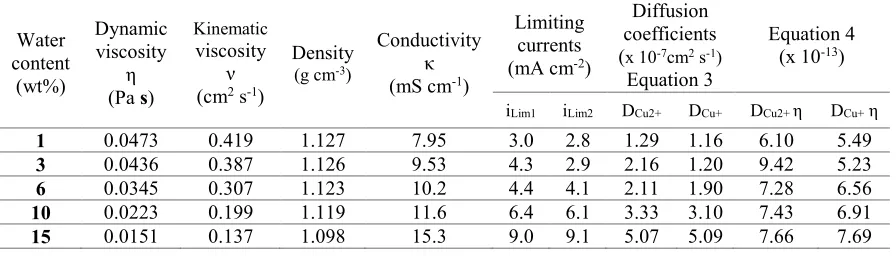
Table I summarizes the change in density, viscosity and conductivity of ethaline containing 0.20 M CuCl2∙2H2O with increasing water concentration. As shown in this table,
the viscosity and density of the electrolyte decreased and the conductivity increased with increasing water content. Similar findings have been reported in earlier publications using a choline chloride/urea (reline) and choline chloride/chromium(III) chloride (12,13).
Table I. Effect of water on the viscosity, conductivity, density, and limiting currents for Cu reduction in 0.2 M CuCl2∙2H2O dissolved in ethaline.
Water content (wt%) Dynamic viscosity η (Pa s)
Kinematic
viscosity ν (cm2 s-1)
Density
(g cm-3)
Conductivity κ (mS cm-1)
Limiting currents (mA cm-2)
Diffusion coefficients (x 10-7cm2 s-1)
Equation 3
Equation 4 (x 10-13)
iLim1 iLim2 DCu2+ DCu+ DCu2+ η DCu+ η
1 0.0473 0.419 1.127 7.95 3.0 2.8 1.29 1.16 6.10 5.49
3 0.0436 0.387 1.126 9.53 4.3 2.9 2.16 1.20 9.42 5.23
6 0.0345 0.307 1.123 10.2 4.4 4.1 2.11 1.90 7.28 6.56
10 0.0223 0.199 1.119 11.6 6.4 6.1 3.33 3.10 7.43 6.91
15 0.0151 0.137 1.098 15.3 9.0 9.1 5.07 5.09 7.66 7.69
Fig. 2 shows the polarisation data for pure ethaline at a Pt electrode containing various amounts of water. These results show that the anodic decomposition potential of ethaline is hardly changed by the addition of water, but the cathodic process shows a more significant change. Increasing the water content from 1 – 15 wt% reduces the overall potential window by approximately 0.2 V. While many ionic liquids can have their electrochemical window reduced significantly by the presence of even small amounts of water, this data shows that ethaline DES is tolerant to relatively high water contents.
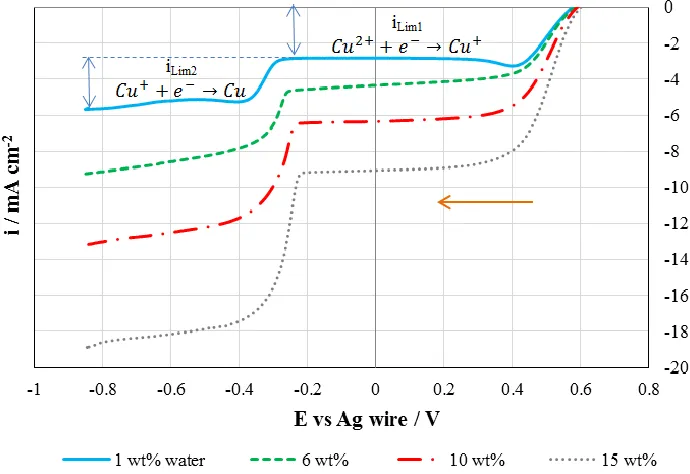
Fig. 3 shows the polarization plot for Cu deposition at Pt electrode, at 25 °C and at a rotation speed of 700 rpm. The voltammograms showed two reduction waves: the first one corresponded to the reduction of Cu(II) to Cu(I) species (Equation 1), while the second wave resulted from the reduction of Cu(I)to Cu(0) (Equation 2). This type of behavior is common in a chloride-containing media (14) and it is due to the stabilisation of the Cu(I) oxidation state (15).
CuCl42- + e- → CuCl2- + 2Cl- [1]
CuCl2- + e- → Cu + 2Cl- [2]
The effect of water upon the electrochemical reduction of Cu was a significant increase of both limiting currents (iLim1 and iLim2) for the two reduction steps. These results show
[Type here]
voltammetric studies (16) of the CuCl2-ethaline system also show an enhancement of peak
currents with water content which is also consistent with enhanced mass transport.
Figure 2. Voltammetry of pure ethaline with 1 - 15 wt% water. All the experiments were carried out on Pt electrode at 25 °C, a scan rate of 5 mV/s and with = 700 rpm.
Figure 3. Polarisation data of 0.20 M CuCl2∙2H2O in ethaline at a Pt electrode at 25 °C.
The scan rate was 5 mV s-1 and = 700 rpm. The amber arrow shows the direction of scan
[Type here]
Discussion
The limiting current density, iLim, of an electrochemical reaction at a RDE is given by
the Levich equation:
iLim = 0.62nFAD2/3ν-1/6Cω1/2 [3]
where n is the number of transferred electrons, F is the Faraday constant (95485 C mol-1),
A is the area of electrode (cm2), D is the diffusion coefficient (cm2 s-1), ν is the kinematic
viscosity (cm2 s-1), C is the concentration of bulk electrolyte (mol cm-3), and ω represents
the rotation speed (rad s-1). The values for diffusivity of the cuprous and cupric species
calculated from the experimental data are presented in Table I.
The simplest explanation for the observed increase in diffusivity relates to the corresponding reduction in viscosity at higher water content. Applying the Stokes-Einstein relationship to the data in Table I, it can be seen that approximately 80% of the observed enhancement in diffusivity could be attributed to viscosity changes. The remaining effect may arise from other phenomena but there is also a possibility that the Stokes-Einstein equation is not valid for these particular ionic liquids (17). Normally, at constant temperature and constant ionic radii:
Dη = constant [4]
where Dis the diffusion coefficient of the Cu(II) and Cu(I) species and η is dynamic viscosity. The data in Table I indicates that the product of D and η is not constant over the range of water contents studies, indicating some significant deviations. Such deviations might arise if the ionic radius of the diffusing species was also varying, but previous studies (16) of the speciation of copper species remains unchanged until water content is 40 wt%.
The effect of water content on DES properties has been studied previously (18-20). Reports of improved conductivity and reduced viscosity with water content have been rationalised in terms of conventional hole theory (18). With increasing water content, the hole size was found to increase resulting in higher ionic mobility and this is reflected in changes in both the viscosity and conductivity. An alternative explanation (19,20) is that increasing water content causes ion pairs in the ionic liquid to dissociate further. This enhanced dissociation arises because water can form strong hydrogen bonds with anions in the melt. The overall effect of increased dissociation of ion pairs is an increase in conductivity and a reduction in viscosity. However, the current results do not allow any discrimination between the two models.
Conclusions
[Type here]
viscosity and conductivity may be attributable to an increased hole size or enhanced dissociation with increasing water content. Electrochemical polarization measurements showed that the electrochemical window on platinum electrodes was relatively insensitive to water content. Diffusion coefficients of Cu(II)and Cu(I) species, as determined from limiting current measurements also increased with water content. This enhanced diffusivity can be mostly attributed to viscosity changes in the deep eutectic solvent but there was also evidence for deviations from ideal Stokes-Einstein behaviour.
Acknowledgments
The authors would like to thank Secretariat of Higher Education, Science, Technology, and Innovation of Ecuador (SENESCYT) for funding this work. The European Cooperation in Science and Technology action (COST) MP1407 is acknowledged for providing training and networking opportunities.
References
1. F. Endres, D. MacFarlane and A. Abbott, Electrodeposition from Ionic Liquids, p. 83-103, Wiley-VCH, Weinheim (2008).
2. K. Murase, K. Nitta, T. Hirato and Y. Awakura, J. Appl. Electrochem.,31, 1089 (2001). 3. H. Liu, Y. Liu and J. Li, Phys. Chem. Chem. Phys., 12, 1685 (2009).
4. H. Ohno, Electrochemical Aspects of Ionic Liquids, p. 129-150, John Wiley and Sons Inc., New Jersey (2011).
5. S. Kazemiabnavi, Z. Zhang, K. Thornton and S. Banerjee, J. Phys. Chem. B, 120, 5691 (2016).
6. Q. Li, J. Jiang, G. Li, W. Zhao, X. Zhao and T. Mu, Sci. China Chem., 59, 571 (2016). 7. Wu. X, E. Cooper and C. Angell, J. Phys. Chem. B, 107, 6170 (2003).
8. S. Abedin, M. Polleth, S. Meiss, J. Janek and F. Endres, Green Chem., 9, 549 (2007). 9. B. Tierney, W. Pitner, J. Mitchell, C. Hussey and G. Stafford. J. Electrochem. Soc., 145,
3110 (1998).
10. E. Smith, A.Abbott and K. Ryder, Chem. Rev., 114, 11060 (2014). 11. S. Ghosh and S.Roy Surf. Coat. Technol., 238, 165 (2014).
12. D. Shah and F. Mjalli, Phys. Chem. Chem. Phys., 16, 23900 (2014).
13. V. Protsenko, A. Kityk, D. Shaiderov and F. Danilov, J. Mol. Liq., 212, 716 (2015). 14. P. Sebastian, E. Valles and E. Gomez, Electrochim. Acta, 123,285 (2014).
15. C. Leon and F. Walsh, Trans. Inst. Met. Fin., 81, 95 (2003).
16. P. De Vreese, N.R. Brooks, K. Hecke, L. Meervelt, E. Matthijs, K. Binnemans, and R. Deun, Inorg. Chem., 51, 4972 (2012).
17. J. O’M. Bockris and A.K.N. Reddy, Modern Electrochemistry, Vol 1., Plenum, New York (1970)
18. V. Protsenko, L. Bobrova, and F. Danilov, Ionics, 23, 637 (2017).
19. C. Du, B. Zhao, X. Chen, N. Birbilis, and H. Yang, Scientific Reports, 6, 1 (2016). 20. W. Li, Z. Zhang, B. Han, S. Hu, Y. Xie and G. Yang, J. Phys. Chem. B, 111, 6452