SIMULATION APPROACH
by
Sinniah Mahendrarajah
A dissertation submitted in partial fulfilment of the requirements for the degree of Master of
Agricultural Development Economics in The Australian National University
Except where otherwise indicated in the text, this dissertation is my own work.
.M
j
J
^
S. Mahendrarajah
September, 1981
I am grateful to Professor P.C. Young for his guidance,
encouragement and generous allocation of time towards the development
of this dissertation. I am also grateful to Drs D.M. Etherington
and A.J. Jakeman for sharing supervision. Dr Etherington helped to
refine my thinking on the economic aspects and also offered valuable
criticisms on the manuscript. Dr Jakeman unselfishly allocated his
time and responded to my frequent requests for help at all stages,
and enthusiastically contributed towards my mathematical and computing
skills. I greatly appreciate the time he spent towards the
improvement of the presentation of this dissertation.
I greatly benefited through interaction and help from many
friends and teachers from both the Development Studies Centre and the
Centre for Resource and Environmental Studies. My special thanks are
due to Mr Tony Bayes for initially coaching me in computer programming;
and to Drs S. Chandra, D.P. Chaudhri and D. Evans for suggestions and
information. Thanks are also due to Mrs Bridget Boucher for her help
with figures, proof-reading and compilation; and to Ms Christina
Sirakoff for help with CAPTAIN plots. I am also thankful to
Dr J. Angus of CSIRO for allowing access to his personal library.
I wish to express my deep sense of gratitude to the
International Development Research Centre (IDRC) of Ottawa for the
generous Scholarship Award which enabled me to take up the MADE
training leading to the research and preparation of this dissertation.
Last, but by no means least, I wish to thank my wife, Punitha
for her love and understanding; and our lovely little daughters,
Sangitha and Sathya for sharing the difficult life of a student-father.
I dedicate this dissertation to my mother and, in memoriam,
Small dams constitute the centres of traditional settlements and a predominant source of water supply in the Dry Zone of Sri Lanka. Many of the dams do not have connections with perennial supplies and hence are solely dependent upon their own catchments' rainfall for replenishment. Typically, the water resource provides for in situ
domestic uses and for the irrigation of crops, mainly rice, particularly during the dry season.
With these two uses somewhat in conflict, a definition of community welfare is proposed. Taking the case of early maturing rice crops, it is seen that welfare can be maximised by matching the cropping calendar of the wet and dry season with the rainfall
distribution. In this framework withdrawal is minimised. A major consideration in the formulation of this water resource optimisation problem involves the justification of a 'level of water application-yield' production function for rice.
Direct solution of the optimisation problem is complicated by the temporal nature of allocation and the stochastic dynamic nature of water supply in the dam. The approach adopted is to first build a simple transfer function model of water storage using rainfall and other major causal variables as inputs and allowing for the effects of uncertainty and measurement noise. Then by applying the recursive instrumental variable - approximate maximum likelihood method for identification of the appropriate model structure and identification of the parameters and their distributions therein, a statistically based time series model is made available for performing Monte Carlo simulations. Thus, the effects on storage can be observed by
rainfall years into the simulations. Further, these effects are produced in the form of probability distributions because the model parameters are sampled over their entire range of possible variation
as supplied by the method of estimation.
Empirically, the approach is demonstrated using weekly data for a specific dam site in the Dry Zone of Sri Lanka. Non-linearities are introduced into the model by a modification of the rainfall, which explicitly compensates for soil moisture and evapotranspiration
effects. Attention is focused on the probabilistic forecasts of the simulation model at the beginning and end of the dry season.
Different cropping calendars and their associated withdrawals are examined individually in the stochastic simulation framework to determine the one that best supplements the rainfall. Commencement of the dry season's rice cultivation in the fourth week and the third week of February were observed as optimal and second best time,
respectively. It is also seen that these times are different from that practised at present.
CONTENTS
Page
ACKNOWLEDGEMENTS 111
ABSTRACT 1V
LIST OF TABLES x
LIST OF FIGURES X1
CHAPTER
1 INTRODUCTION 1
1.1 Dry Zone: Climate and Agriculture 1 1.2 Small Dam Irrigation Settlements 3 1.3 Water Storage-Depletion in Small Dams 8 1.4 The New Approach to the Management of
the Water Resource 10
1.5 Aims and Scope of the Dissertation 11 1.6 Organization of the Dissertation 12
2 THE OPTIMISATION PROBLEM 14
2.1 Optimisation: A Definition 14
2.2 Welfare Criteria for Small Dam Water
Resources 15
2.2.1 The Concept of Community Welfare 15
2.2.2 The Water Good 17
2.2.3 Operational Welfare Criteria for
Conservation 18
2.3 The Rice-Water Relationships 20 2.3.1 Growth Stages and Yield Components
of the Rice Plant 20
2.3.2 Water Duty for Rice 22
2.3.3 Importance of Water in the Growth
Phases 25
2.3.4 Irrigation Scheduling 27
2.4 Water Input in the Production Process:
A Review 28
CHAPTER Page 2.4.3 Moisture Stress - Yield Functions 31 2.4.4 Optimal Dam-Water Management 33 2.4.5 Minimal Supplementary Irrigation
Policy 34
2.5 Water Resource Optimisation Model for Small
Dams 37
2.5.1 Hypothetical Trade-Off Functions 37 2.5.2 The Specific Optimisation Problem 40 2.6 Specific Objectives of the Study 43 3 METHODOLOGY: TIME SERIES ANALYSIS AND STOCHASTIC
SIMULATION 45
3.1 Parameterisation: Transfer Function Model 45
3.1.1 System Concepts 47
3.1.2 The Impulse Response Function (IRF)
of Hydrologic Systems 49
3.1.3 Impulse Response Function (IRF) and Transfer Function (TF): the
Mathematical Basis ' 51
3.1.4 Specification of Transfer Function
(TF) Model for Water Storage 55 3.2 Recursive Time Series Analysis 58 3.2.1 Recursive Least Squares (RLS) 59 3.2.2 The Instrumental Variable
-Approximate Maximum Likelihood
(IV-AML) Technique 63
3.2.3 Theoretical Assumptions 70
3.2.4 Computer Aided Program for Time Series Analysis and Identification
of Noisy Systems (CAPTAIN) Package 71
3.2.5 Model Statistics 72
3.3 Stochastic Dynamic Water Supply Model 74 3.3.1 Stochastic - Monte Carlo Simulation 75 3.3.2 Relevant Statistical Properties of TF
Model Parameter Estimates for
Simulation 76
3.3.3 Monte Carlo Generation of TF Model
Parameters 77
3.3.4 Simulation Output 81
CHAPTER Page 3.3.6 Incorporation and Evaluation of
Irrigation Strategies 82
4 MODELS FOR WATER STORAGE: RESULTS AND DISCUSSION 84 4.1 Rainfall to Storage Process: Sampling of
Data and Preliminary Model Structure 85 4.2 Linearisation of the Data and Effective
Rainfall Series 87
4.2.1 Sources of Non-Linearity 87 4.2.2 Modification of Rainfall for Soil
Moisture Effects 88
4.2.3 Compensation for the Effects of
Temperature 92
4.3 IV-AML Estimation of TF Model for Storage 95 4.3.1 Model Structure Identification 95 4.3.2 Model Estimation: Basic IV-AML and
Refined IV-AML Results 97
4.3.3 Some Implications 100
4.4 Stochastic - Monte Carlo Simulation Model
for Storage 102
4.4.1 Simulated Water Storage Distribution 103 4.4.2 Probabilistic Forecasts of Storage
and Rainfall Extremes 109
4.4.3 An Analysis of Forecast Mean Storages at the Beginning and at
the End of the Dry Season 111
4.5 Summary of Results 121
5 WITHDRAWAL POLICY, STRATEGIES AND EVALUATION 124
5.1 Withdrawal Policy 124
5.2 Decision Rules for Irrigation of Rice 125 5.3 Strategies: Implementation and Evaluation 129 5.4 Optimal Strategy in a Variable Rainfall
Environment 136
5.5 Assessment of the Prevalent Practice 139
5.6 Summary of Results 141
6 SUMMARY AND CONCLUSIONS 143
CHAPTER Page 6.2 Implications of the Research 147
6.2.1 Applicability of the General
Approach 147
6.2.2 Applicability of the Results for
the Case Study 149
6.3 Directions for Future Research 150
* ** *
BIBLIOGRAPHY 152
APPENDICES 161
APPENDIX A Case Study Dam Site: Characteristics
and Data Sources 161
APPENDIX B CAPTAIN - Interactive Modelling 176
LIST OF TABLES
Table Title Page
2.1 Approximate Durations of Growth Phases of the
Rice Plant 22
2.2 On-Field Water Duties of Rice and Irrigation Requirements in an Average Rainfall Year in the
Dry Zone of Sri Lanka 24
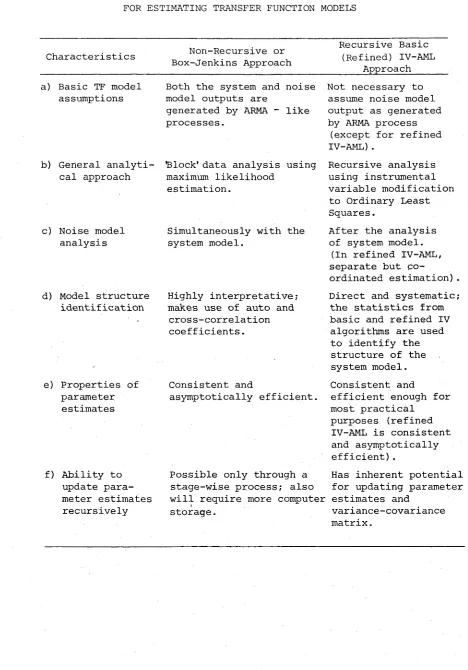
3.1 Comparison of Two Time Series Analysis Techniques
for Estimating Transfer Function Models 69 4.1 Model Orders and Related Statistics for Effective
Rainfall - Water Storage Transfer Function 96 4.2 Estimates of Transfer Function Model Parameters
and Related Statistics 98
4.3 Actual and Simulated Weekly Water Storage, and
Related Statistics, 1976/77 107
4.4 Some Statistical Properties of the Simulated Water Storage at the Beginning (A) and at the End (B) of the Dry Season for Three Different
Rainfall Years H O
4.5 Rainfall and Simulated Water Storage at the
Beginning and at the End of the Dry Season H 6 5.1 Performance of the Different Strategies of
Withdrawal for 1976/77. 121
5.2 Cumulative Probabilities of Storage at the End of the Dry Season for Various Strategies of
Withdrawal 124
5.3 Optimal Irrigation Strategy and Its Performance
in Different Rainfall Years 127
5.4 The Distribution of Optimal and Second-Best
LIST OF FIGURES
Figure Title Page
1.1 Dams, Lakes and Major Climatic Boundaries of
Sri Lanka 5
1.2 One Dam - One Village Nucleated Settlements and
Agricultural System in the Dry Zone 6 1.3 A Schematic Representation of Rainfall Distribution,
Dam Water Levels and Traditional Cropping Pattern
in the Dry Zone 9
2.1 A Schematic Representation of Levels of Water Application and a Conceptual 'Water Application Level - Yield Response' Function for Early
Maturing Rice 36
2.2 A Hypothetical Benefit Transformation Function for Rice Production and In Situ Objectives 39 2.3 An Illustration of Level of Water Application,
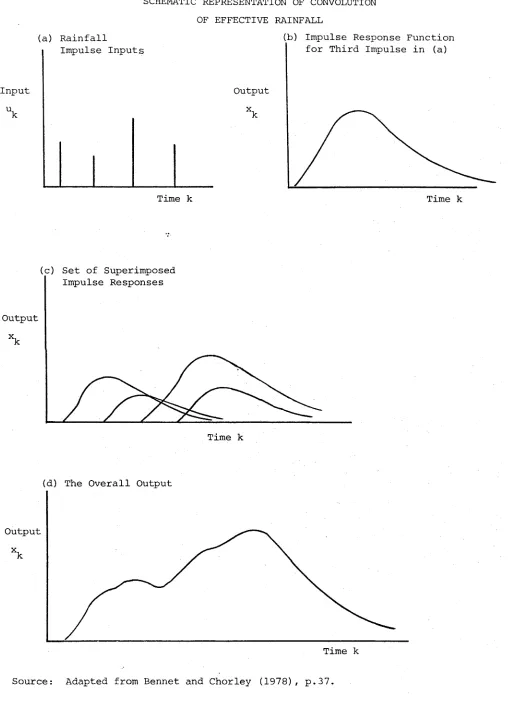
Rainfall Distribution and Cropping Calendar 41 3.1 Schematic Representation of Convolution of
Effective Rainfall 52
3.2 Effective Rainfall - Water Storage Time Series
Model 56
3.3 The IV-AML Approach to Time Series Analysis of
Transfer Function Models 56
3.4 The Approach to Efficient Parameter Estimation
in Refined IV-AML Algorithm 68
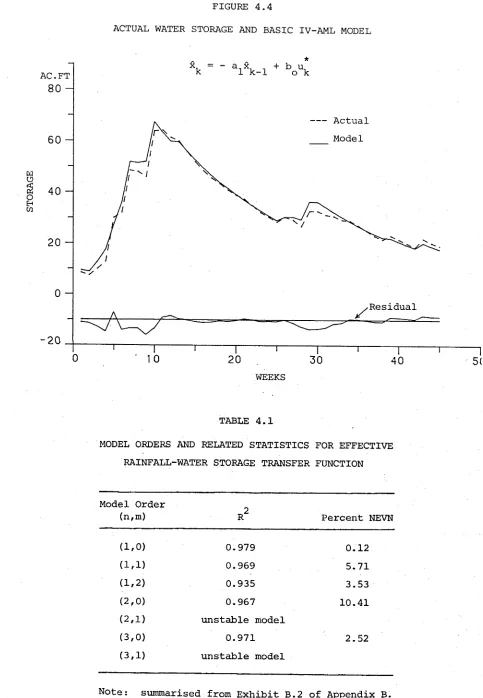
4.1 Actual Water Storage and Basic IV-AML Model
Without Temperature Incorporation on Input 90 4.2 Variation of bQ Parameter Against a Temperature
Function (4.4) 91
4.3 The Actual and Effective Rainfall Series, 1976/77 94 4.4 Actual Water Storage and Basic IV-AML Model 96 4.5 Actual Water Storage and Refined IV-AML Model 99 4.6 Simulated Water Storage Distribution and
Probability Densities for 1976/77 106 4.7 A Comparison of Actual Storage for 1976/77 and
the Forecast Mean of Simulation Output After
2055 Repetitions 108
4.8 Simulated Mean Storage and 67 Percent Confidence
Figure Title Page 4.9 Probability Distribution of Storage at the
Beginning (A) and at the End (B) of the
Dry Season for Dry (1972/73) and Wet (1959/60)
Years 113
4.10 Dispersion of Forecast Mean Storage at the End (B) Against that at the Beginning (A) of the
Dry Season 117
4.11 Histograms of Forecast Mean Water Storage 119 5.1 Comparison of Simulated Water Storage Behaviour
With and Without Withdrawal (Strategy F4) 133 5.2 Cumulative Probability Distributions of
Simulated Water Storage at the End of the Dry
1.1 Dry Zone: Climate and Agriculture
Water resource-development'123' activities in Sri Lanka are concentrated mainly in the climatic region generally termed the Dry Zone. This also appears to have been the case in ancient times. For instance, Rhoads Murphey (1957, p.190) indicates:
"...ancient irrigation works are all over the modern dry zone, and absent from the wet zone;
the present wet-dry zone line coincides almost exactly with the line between the ancient irrigated and unirrigated areas".
Demarcation of the Dry Zone is primarily based on rainfall 2
characteristics. The 1900mm (75 inch) mean annual rainfall isohyet is generally accepted as a working boundary between the Wet Zone and
3
-the Dry Zone. In the whole region, which covers about seventy per cent of the total land area of the Island, the greater part
receives a rainfall of twelve hundred to nineteen hundred millimeters. The rainfall is distributed in two well marked seasons, with a pronounced drought during the months from June to August. Approximately eighty per cent of the rainfall is experienced during the months from September to January. Roughly, the latter half of this period is under the sway of the North East Monsoon. In general, 1 In contrast, flood control, interbasin water transfers and related
activities are of chief concern in the Wet Zone. See, for example, Cook (1951), pp.76-8; Mahawali Development Board (1977).
2 See, for instance, Farmer (1954); Thambyahpillay (1965).
$
3 Considered broadly, the Dry Zone then includes the ecological
this period is cool and wet, and also corresponds with the major agricultural season1 23 that can be referred to as the wet season. Although short dry spells are not uncommon, rainfall during the wet season is evenly distributed and results in extensive run-off.
Following this period a short dry spell occurs from February to mid-March which coincides with the harvesting activities of the wet
season rice.
The second and smaller mode of the bimodal rainfall pattern occurs from mid-March to mid-May. This usually corresponds with
2
the cropping activities of the second or dry season. The ensuing three months are under the full dominance of the South West Monsoon. After having precipitated all its moisture in the hilly Wet Zone, the South West Monsoon crosses the Dry Zone as a dessicating wind. The drying wind accompanied by continual high temperatures imposes an aridity on the Dry Zone.
In general, temperature is stable and ranges from about 76°F in December to 86°F in June. Reliable uniform temperatures, with the associated solar radiation, are among the Dry Zone's greatest
assets, and approach the optimum for the growth of rice (Farmer, 1954) Quite appropriately, rice production is the major agricultural
3 pursuit of the Dry Zone, one exception being the Jaffna Peninsula.
1 Locally referred to as Maha and Perumpokam in Sinhala and Tamil respectively.
bwever, the major problem for the intensive cultivation of rice is he shortage of water during the dry season. Water for irrigated ice production is supplied by a network of surface irrigation systems hat includes dams and lakes which are also centres of human
ettlements.
.2 Small Dam Irrigation Settlements
Descriptions of life centred on small dams form part of he literary heritage of Sri Lanka. An English language classic is eonard Woolf's Hhe Village in the Jungle.
"The village consisted of ten scattered houses, mean huts made by mud plastered upon rough jungle sticks. Only one of the huts had a roof of tiles, that of the village headman Babehami; the others were covered with a thatch of cadjans, the dried leaves of the coconut-palm. Below the huts to the east of the village lay the tank, a large shallow depression in the Jungle. Where the depression was deepest the villagers had raised a
long narrow bund or mound of earth, so that when the rain fell the tank served as a large pond in which to store the water. Below the bund lay the stretch of rice-fields, about thirty acres, which the villagers cultivated, if the tank filled with water, by cutting a hole in the bund, through
which the water from the tank ran into the fields." (Woolf, 1913; 1974 Edition, p.6).
The complex and sophisticated maze of hydraulic works in he Dry Zone of today is considered to be a 'grafting' on to such mall-dam based systems of Medieval times. Consensus seems to exist n ascribing this system to the inhabitants of the pre-Christian era Murphey, 1957; Farmer, 1954). These early hydraulic works seem to e simple community-level attempts at water conservation. Possibly, hey could have been developed on the lines of the neighbouring
society based on a one dam-one village ecological pattern
(Codrington, 1938: pp.1-5). Indeed, it is estimated that there are today around 3,000 such small dam settlements"*“ (Panabokke,
1976). Ohrling (1977) refers to them as ‘Nucleated Tank Settlements’. Very often the dam and the village in each unit share the same name; and the accepted boundary between villages seems to be the watershed (Abeyratne, 1956). Figure 1.1 is a recent mapping of the dams and lakes (or tanks and reservoirs) of the Island. The circle in the middle of the 'galaxy' of dams in the northern Dry Zone indicates the location of the dam that is the special concern of this study.
Small dams have been constructed by throwing earth in the form of a bund across seasonal streams that arise in small catchments in the undulating landscape. Capacity of dams varies, generally within 50 to 150 acre feet. Each dam is the centre of one small village settlement of about fifty families. Houses are clustered
on either or both sides of the dam on relatively high ground. The highland that adjoins the housing serves as a home-garden to grow
2
a mixture of annual and perennial crops. A slash and burn system of rainfed agriculture is also practiced in the upper slopes of the landscape, mainly to grow millets and gourds. The home-gardens
slash and b u m system and irrigated rice together constitute an
agriculture that is unique to the small dam settlements, as schematically represented in Figure 1.2.
1 Agricultural statistical sources include small dams under 'Minor Irrigation Schemes' that account for 36.7 per cent (or approximately 188,000 acres) of the irrigated rice during the wet season in the Dry (and Intermediate) Zone (Department of Census and Statistics,
1977, p . 144).
2 Popularly known as 'chena' (anglicized version of the local terms
FIGURE 1.1
DAMS, LAKES AND MAJOR CLIMATIC BOUNDARIES OF SRI LANKA
Intermediate Zone Boundary Wet Zone Boundary
WALAGAMBAHUWA ^ Case Study
' *. *• Maha
DRY f, ZONE
INTERMEDIATE > ZONE WET ZONE
Colombo /a
Settlement Pattern
CENTRAL SRI LANKA
0 8 '0 0 ° N o rth 8 0 '4 5 ° East
R e f e r e n c e s :
H H PADDY FIELD rr^ m VILLAGE GARDEN OR
V///A SETTLEMENT AREA
^ ) TANK
'X^CART TRACK
/ / P A T H
' ^ T E M P L E OR SHRINE
N
A
Agricultural System
irrigation canal
5 0 0 M J Cart tra c k
garden
Forest or re c o v e ri ng chena land
Paddy
References:
Home garden Slash and b u rr -7111 I > O c u ltiv a tio n
Paddy
S ettlem ent are
Stream
E-y Chena ~
r Chena ^
' / u m
The rice land of the village is a small block located just below the dam. It varies in size from thirty to fifty acres in
1
which each family holds an inherited share. The dam water is conveyed to the rice fields by way of a sluice and then by ditches or channels. Maintenance of the field channels as well as the management of the dam water is the joint responsibility of the villagers. A remarkable symbol of solidarity among the villagers is the institution of Bethma. This is an arrangement whereby the villagers agree in times of water shortage to cultivate only a
portion of the rice land and share out the proceeds among themselves. Farmer (1957) describes this admirable system as:
'one under which, if the whole extent of the paddy field cannot be cultivated for lack of water, as many of the tracts as can be irrigated are divided, regardless of their ownership, between the peasants in proportion to their several holdings, and thus cultivated as a compact block with minimum waste of water' (Quoted in Leach (1961): p.170).
In addition to supporting the cultivation of rice, the dam serves as an invaluable community-asset. Its main value is as the community water supply for washing and as drinking water for the few
2
head of cattle owned by the villagers. These type of uses, the former, in particular, can be referred to as the in situ uses. Apart from the occasional catch of fish that the community usually
shares, it is not used for any planned fish culture. Thus multiple uses of the water resource is a notable feature in small-dam
settlements. Constraints to uses arise mainly because of the 1 Greater part of the rice land is considered as 'pavaveni' or
ancestral property. Social-Anthropological Studies of Leach (1961) and Obeyesekere (1970) discuss in considerable detail the rice land tenure and inheritance.
variability in the amount of water that becomes available in the dam through the year.
1.3 Water Storage-Depletion in Small Dams
The majority of small dams are isolated and not reached by the modern hydraulic network. They are completely dependent upon their own catchments for replenishment. It is these dams with which this dissertation is concerned.
In such dams, water storage at a particular point in time is highly variable. However, the storage through the year
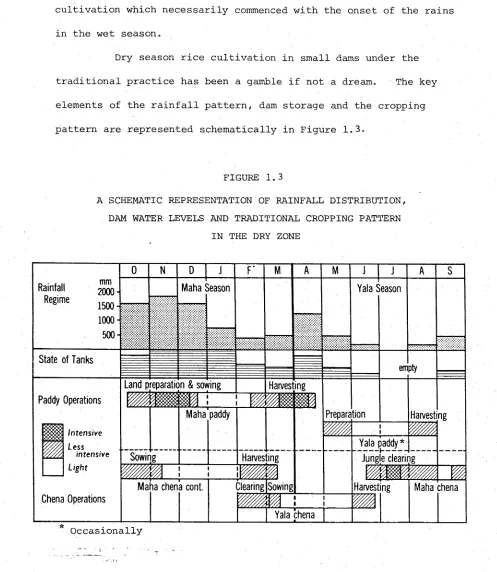
generally exhibits a bimodal pattern very much similar to that of the rainfall. Water level builds up during the wet season and reaches its highest magnitude by the end of December. During the subsequent months it gradually recedes until April. From April until the end of May, there is a significant addition to storage levels caused by the dry season rainfall. This second peak is followed by an accelerated pace of depletion evidently as a consequence of the prolonged drought from June to August. The lowest level of water storage is approximately 10-20 acre feet by the end of August. However, there are years when the dams become completely dry.
The above natural storage-depletion behaviour seems to have received explicit consideration in the established irrigation
practices of the villages.
advantage only for land preparation. This delay seems to have been motivated by a custom of waiting to ascertain the water storage. Judgements regarding the extent of cultivation appear to have been
largely based on the water level in December. The delayed planting of rice also gave time for the 'rainfed' slash and burn or chena cultivation which necessarily commenced with the onset of the rains in the wet season.
Dry season rice cultivation in small dams under the traditional practice has been a gamble if not a dream. The key elements of the rainfall pattern, dam storage and the cropping pattern are represented schematically in Figure 1.3.
FIGURE 1.3
A SCHEMATIC REPRESENTATION OF RAINFALL DISTRIBUTION, DAM WATER LEVELS AND TRADITIONAL CROPPING PATTERN
IN THE DRY ZONE
R a in fa ll
R e§ IT O 1 500 ■
1 000
5 0 0
-0 N D J F * M A M J J A S
M a h a ^Reason Y a la S eason
S ta te o f T a n k s
— err pty
P ad d y O p eratio n s
I n t e n s i v e
L e s s
/%
///,
i n t e n s i v eL i g h t
C h e n a O p e ra tio n s
L an d p rep arat o n & sovving Harves in g
Prepara tio n Harvest ng
*
mt
i\ y
mWM
M a h a 'p a d d y
1 « 11
Y a la p a d d y *
S o w in g Harves tin g Ju n g le clearin g
y
MW/,
1 :\WM.
1 I Äi
M a la c h e n a co nt. C learin g Sow ing H arvesting M a h a chena
m m
• ii i
Ü
Y a la c h e n a
---1________
Occasionally
[image:21.536.22.519.210.782.2]1.4 The New Approach to the Management of the Water Resource Sustaining production levels in slash and burn or chena cultivation with increasingly shorter rotation and poor fertility maintenance is of concern and practical approaches to attain increases in productivity of the rice land are being sought as a way of raising incomes. Particular emphasis is being placed on the need to raise cropping intensity. This involves early sowing of the wet season rice and the accommodation in the cropping calendar of a dry season cultivation. The aim essentially is to raise the wet season rice crop without irrigation as far as possible, and
thereby conserve dam storage for irrigation of the dry season crop. This constitutes the most recent approach to water resource
management of small dams.^
The practicability of this management approach has already been demonstrated for a few dams in the Anuradhapura district.
Moreover, the farmers using these dams have continued to follow the new practice. Adoption of the practice in adjoining villages has also been observed providing some evidence for the acceptability of the approach. The economics of such new management have been documented by, for example, Mahendrarajah (1978) and Sivapatham
(1979). Though useful, these studies fail to give adequate
consideration to the crucial role of the water resource. In fact, the latter study is confined to the analysis of resource inputs other than water, although it implicitly recognizes the vital role and value of the water resource in the dry season.
1 This formed the main theme of the Cropping Systems Workshop of the Department of Agriculture in 1976. See the Proc. Cropping
Thus the problem of water resource management in small dams arises in the dry season and concerns efficient use of the natural storage that has built up by the end of the wet season. However, the efficient allocation of dam water for the dry season crop is not straightforward for two reasons:
(i) the temporal or dynamic behaviour of the storage levels (dependent on factors like the changing rainfall and weather) and the temporal nature of water allocation; and
(ii) the existence of multiple uses for the water resource of the dam.
Therefore this management problem is chosen as a worthwhile and appropriate topic for investigation.
1.5 Aims and Scope of the Dissertation
The research in this dissertation concerns the effective temporal allocation of the water supply to the irrigation of a single crop, namely rice. However, the approach extends so that guidelines can be provided for optimal irrigation decisions with respect to other possible dry season crops in the rice land.
The main focus is upon the welfare of the small dam community when it has multiple goals such as rice production and
i-n si-tu
uses. An important component of the work consists of the discussion and derivation of the optimal allocation mechanism. Our solutions require consideration of the changing nature of the water supply in the dam. The development of an appropriateEfficiency in the use of scarce and often inaccurate data is a prime consideration. The procedure developed requires only a modest amount of data and allows for measurement of errors on them. It also appears to have long-term value as an aid for irrigation
decisions and potential accessibility on a mini computer. Finally, this dissertation undertakes empirical application of the procedure for water resource optimisation using data for a selected small dam.
The specific objectives of the study are spelt out at the end of the formulation of the optimisation problem in Chapter 2. The broader aims of this research can be stated as follows:
(i) to develop a conceptual model for water resource optimisation in small dams; (ii) to develop an analytical model to assess
allocation decisions; and finally
(iii) to empirically demonstrate the approach in a real small dam situation.
1.6 Organization of the Dissertation
This dissertation is presented in six chapters. Chapter 1 has introduced the topic, raising the issue of allocation of water
for the dry season. It has also stated the broader aims and scope of the research.
Chapter 2 undertakes the discussion and formulation of the optimisation problem. The nature of the issue of maximising
community welfare under conflicting goals of water use is outlined.
This chapter also deals with the temporal demand for irrigation
water for rice, with the more fundamental choice of treating water as a variable input in the production process. The review and
adoption of a 'level of water application - crop yield' production function leads to the definition of the optimisation as a
constrained linear programming problem. Methodological pre requisites for solution are dealt with in Chapter 3. Emphasis is placed on a system analysis approach to parameterise water storage as a 'linear dynamic system'. For parameter estimation, useful techniques of recursive time series analysis are also reviewed. Estimates and statistics emerging from the estimation provide the input for the development of a stochastic simulation model for storage.
In Chapter 4, by explicitly compensating for hydrologic elements that contribute to 'nonlinearity', an effective rainfall-storage system is obtained which simplifies the methodology. Results of the empirical application are also presented in this chapter, highlighting the sensitivity of storage at the beginning and at the end of the dry season. Chapter 5 is devoted to the formulation
of an irrigation policy, definition of strategies and their evaluation using the framework provided in Chapter 4. Results also include findings that relate to different rainfall years. Chapter 6
CHAPTER 2
THE OPTIMISATION PROBLEM
The issue of optimisation of water use in small community-dams is discussed in this chapter and it constitutes the basis for the identification and definition of the specific objectives of this dissertation. The text is divided into five sections. Sections 2.1 and 2.2 identify the requirements for an explicit welfare
consideration. The physiological rice-water relationships constitute the foundation for the technical water - crop yield response. These are dealt with in Sections 2.3 and 2.4 and provide the essential preliminaries for the identification of the appropriate optimisation model presented in Section 2.5. In the light of the requirements of the latter, specific objectives are set out in Section 2.6 to obtain solutions for a selected dam.
2.1 Optimisation: A Definition
Economics is concerned with rational choices. Optimising is finding a 'best' choice among possible alternative choices in relation to a set goal or goals. A formal 'optimisation model' consists of a 'choice space' which is the set of comparable
the management of water resources. Furthermore, in the process, a
set of standards emerges, with which it is necessary to evaluate the
relative merits of alternative strategies.
The ultimate goal in the management of natural resources
is well recognized. A consensus seems to exist that the resources
be utilized efficiently to make maximum contribution to the
community welfare. But the concept of community welfare is truly
nebulous. The insusceptibility of welfare to quantification renders
it impotent as an operational criterion for economic analysis.
Therefore, criteria involving measurable magnitudes must be
substituted for such an ultimate but non-operational goal.
2.2 Welfare Criteria for Small Dam Water Resources
The choice of criteria is conditioned by the nature•of the
resource under consideration. Also, the search for appropriate welfare
criteria for water resources will be facilitated by an understanding
of the welfare concept and this is treated first here.
2.2.1 The Concept of Community Welfare
The concept of community or social welfare is usually
related to the satisfaction or well-being of individuals who make up
that community. The general postulates are:
(i) that the social welfare depends solely on
the utility level of each person in the
community; and
(ii) that the individual alone is the best judge
of his utility or satisfaction (Mishan, 1960).
could be seen as making one 'better off1 in one's own estimation
(Mishan, 1969). In practice, however, this is difficult to establish. In the operational context, there is a need for an index of choice expansion (Mishan, 1969).
The components of such an index of choice expansion may include specific economic objectives to which an individual might aspire. The scope of such an index will very much depend upon how complete its specification is. However, there is always a hierarchy of goals in which the goal of one action becomes the means to achieve further goals. In so far as the attainment of a reasonable level of income is a means of accomplishing other goals, then the level of income could be treated as an index of a person's welfare.
However, the transition from individual to community income requires further assumptions.
One possible operational criterion or objective for the community is the income via production. However, accepting this as the index of welfare implies that a desirable distribution of income is also achieved. Fortunately, the equity in distribution of rice lands is remarkable within the community in small dam based villages.^ The production of the largest 'social pie' in terms of production with the available water could, therefore, be adopted as a welfare goal.
However, the production criterion alone is inadequate for small dams, as they provide alternative benefits via conservation as well.
2.2.2 The Water 'Good'
The water in the small dams is unique in that the type of use to which it is put determines its nature as a resource. It has two dimensions as a 'good'. First, the water resource exists as a
\IpV'Lvate good. Water utilization in crop production is such that
the initial use reduces the total supply available for subsequent uses by the entire amount of the original use. On the other hand, the water resource, when used for other bn sbtu community purposes, has the characteristics of a pubtbc good, since the initial use
does not result in the reduction of supply (Davis and Winston, 1967). However, it must be noted that in either use the water is free to the community and contributes to its welfare.
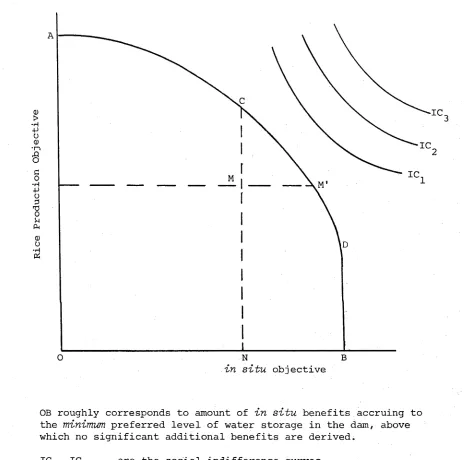
An obvious conflict, nevertheless, does exist among the two welfare goals. The increment to welfare via the use of water as a private good leads to a reduction of storage. The reduction in the level of water in the dam in turn is likely to affect the welfare through its subsequent constraints on bn situ uses. On the other hand, a preoccupation with conservation benefits precludes high benefits from crop income. Clearly, there is a need for a trade-off between these two welfare goals.
One final consideration of the small dam water resource as a private good should be mentioned. That is, the resource may be expected to have the so called common-pool problem"*" which arises due to the 'fugitive' nature of the supply: the water is no-one's
property until it is appropriated and actually used. Since the
rights to the dam-water can only be obtained by actual use, the users are induced to withdraw at a rate greater than would otherwise be rational. This is very likely due to the fear that the withdrawals of others will lower the water level in the dam. This would mean a divergence of private and community costs of use and implies that private decision making is not desirable in dam-water management.
In actual fact, the community that depends on the dam avoids this problem by making withdrawals of water subject to a decision of the Cultivation Committee,'*' a democratically elected community body.
2.2.3 Operational Welfare Criteria for Conservation The benefits accruable via crop production and income are obtained only at the end of a period of water use. On the other hand, the benefits from in situ uses or conservation are derived day-to-day in a continuous fashion. In order to bring the conservation
benefits into parity with crop income, they have to be valued in comparable metrics and be aggregated over a period of time which is the crop duration. These aspects add to the difficulty of choice of appropriate operational welfare criteria for conservation.
Available methods of valuation of non-commensurables are discussed, for example, by Thampapillai (1976) and Sinden and Worrell (1979). Generally, these methods value the conservation benefits in monetary terms using, for instance, a 'willingness-to-pay' criterion. But such valuations are cumbersome and unrealistic in the present context. Two aspects of the in situ uses are important
to note in this regard:
(i) the vital nature of the uses, in contrast to a recreational service which is amenable for a straightforward pricing; and,
(ii) no water market exists in general for water resources and for associated services, including recreation, in Sri Lanka.
Non-monetary criteria are therefore favoured for measuring conservation benefits of small dam water resources.
An obvious index for welfare is the level of water storage itself. Water storage below a certain level is likely to affect
the in situ uses to which it is put. In other words, it is
reasonable to assume that the conservation benefits are an increasing function of the level of storage up to a ceiling (or a minimum storage requirement). Beyond such a ceiling the community will be
indifferent to the level of storage as far as the conservation benefits are concerned. The minimum storage requirement is the
revealed preference of the community and could be obtained by inquiry. The probability of the storage receding below the 'minimum' community requirement is strongest towards the end of the agricultural year. This is due to the rainfall pattern and the unique storage behaviour of the dams. So the 'end of the year' storage can be used as a surrogate for the overall conservation benefits to the community. An irrigation (or withdrawal) strategy for crop
production is not likely to affect the conservation welfare so long as it does not drive the storage below the 'minimum' level.
higher amount of storage at the end of the year can be treated as superior to one that results in lower storage.
From the foregoing it could be surmised that crop-income and 'year-end storage' level provide two operational welfare criteria for the optimisation of water resources of small dams. With this established, a discussion of the role of water in rice production is in order.
2.3 The Rice-Water Relationship
The demand for water for crop production in the community is not a direct but a devolved demand. It is also temporal in nature and naturally has a vital biological and physiological basis
(see, Kramer, 1969), which obviously is crop specific.
The crop under consideration in this dissertation is an early maturing variety of rice.''" As discussed earlier, the issue of allocation of water concerns the cultivation of rice during the
dry season and encompasses the problem of distribution within its
growing season. Since efficient allocation of water requires a knowledge about the growth of the rice plant and water requirements, the rest of this section is devoted to briefly
aspects.
2.3.1 Growth Stages and Yield Components of the Rice Plant
In the growth cycle of the rice plant three distinct phases may be discerned, namely:
(i) the Vegetative Phase, which extends from the germination of seed to the initiation of the panicle (or PI);
(ii) the Reproductive Phase, extending from PI to flowering; and
(iii) the Ripening Phase which extends from flowering to full maturity of grains.
Normally, the duration of both the reproductive and ripening phases are more or less constant regardless of the age class to which the variety belongs. In contrast, the vegetative phase is
variable among varieties; shorter in early maturing varieties and longer in late maturing ones.
In the vegetative phase, the rice plant gains the
vegetative mass and tillers“'' required before it will initiate the panicle primodia. The panicle initiation (PI) marks the commencement of the reproductive phase. However, the PI may begin before the maximum tiller number is reached. The reproductive phase ends with the flowering which also marks the commencement of the ripening phase. The latter covers all the stages through which the grains
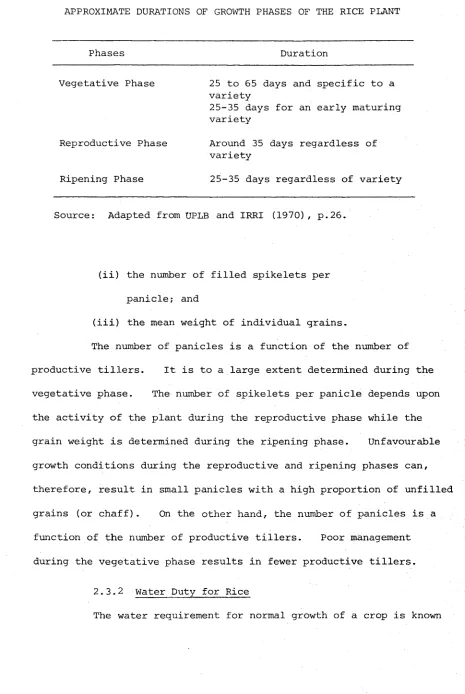
develop. Critical among the stages are the milky stage, where the content of the grains is milky in consistency, and the dough stage, just before the maturity of the grains. However, as a whole, all these three growth phases, whose durations are shown in Table 2.1, have important bearings on grain production.
The grain yield of the rice plant is a function of three components:
(i) the number of panicles per plant;
TABLE 2.1
APPROXIMATE DURATIONS OF GROWTH PHASES OF THE RICE PLANT
Phases Duration
Vegetative Phase 25 to 65 days and specific to a variety
25-35 days for an early maturing variety
Reproductive Phase Around 35 days regardless of variety
Ripening Phase 25-35 days regardless of variety
Source: Adapted from UPLB and IRRI (1970), p.26.
(ii) the number of filled spikelets per panicle; and
(iii) the mean weight of individual grains.
The number of panicles is a function of the number of productive tillers. It is to a large extent determined during the
vegetative phase. The number of spikelets per panicle depends upon the activity of the plant during the reproductive phase while the grain weight is determined during the ripening phase. Unfavourable growth conditions during the reproductive and ripening phases can, therefore, result in small panicles with a high proportion of unfilled grains (or chaff). On the other hand, the number of panicles is a function of the number of productive tillers. Poor management during the vegetative phase results in fewer productive tillers.
2.3.2 Water Duty for Rice
[image:34.536.48.513.113.807.2]as the consumptive use. Of the consumptive use, around 99 per cent is utilized by the crop to satisfy the needs of evapotranspiration. The evapotranspiration is a vital process and also keeps the plant cool. It is not only dependent on the crop but is also a function of other environmental and soil factors. In the Dry Zone of Sri Lanka, the evapotranspiration demand of rice during the dry season is approximately 6-8mm/day (Alles, 1967). This works out to a total of 600-800mm for a rice crop of 100 days duration.
The total infield water requirement has to include not only the consumptive use but also allowances for other losses such as seepage and percolation. Seepage and percolation refer to losses into the soil via lateral flows and vertical flows respectively. In addition to such losses, wet land cultivation of rice requires substantial amounts of water for land preparation. The total
amount of water required per unit area for the cultivation of a rice crop is known as the Water duty of rice.
The water duty is obtained from the irrigation and the rainfall that the crop receives. More specifically, the on-fteZd
water duty is expressed as a ratio of the quantity of water received to the area of the crop. The unit used for water duty in Sri Lanka is acre-inch or acre-foot. Sometimes an ex-sZutce water duty is also used in irrigation systems in order to incorporate the
conveyance losses. However, such a concept is not very useful in the context of small dam rice lands. The rice lands in small dams are not only relatively small in extent but also adjacent to the dam. In the present context then, the term water duty refers to the
The estimates of water duty of rice in the second season range from 4.1 to 6.3 acre-feet as shown in Table 2.2. Allowing
TABLE 2.2
ON-FIELD WATER DUTIES OF RICE AND IRRIGATION REQUIREMENTS IN AN AVERAGE RAINFALL YEAR
IN THE DRY ZONE OF SRI LANKA
(in acre-feet per acre)
Source
On-field
Water Duty Rainfall
Irrigation Requirement Wet
Season
Dry Season
Wet Season
Dry Season
Wet Season
Dry Season Murakami and
Vignarajah
(1967) 4.9 6. 3 3.1 0.9 1.8 5.4
Alles (1967) 3.6 4. 1 3.1 0.9 0.5 3.2
Note: Also quoted by Chambers (1978, p.,28) .
for the rainfall during the season, the requirement via irrigation is estimated at between 3.2 and 5.4 acre-feet. These estimates are derived from large irrigation systems. Experimental estimates of water duty for rice crops below small dams are not available. The author's experience of a small dam dry season cultivation indicates a very much lower water duty figure of the order of lh to 2 acre-feet. In one particularly stringent management situation, around 30 acres of rice land required a total irrigation of 8-10 acre-feet.
Two reasons can be advanced for the much lower water duty for rice under small irrigation dams.
influence from the dams which are generally nearby. Such an influence is likely to
keep the ground water level relatively close to the surface in the rice land.
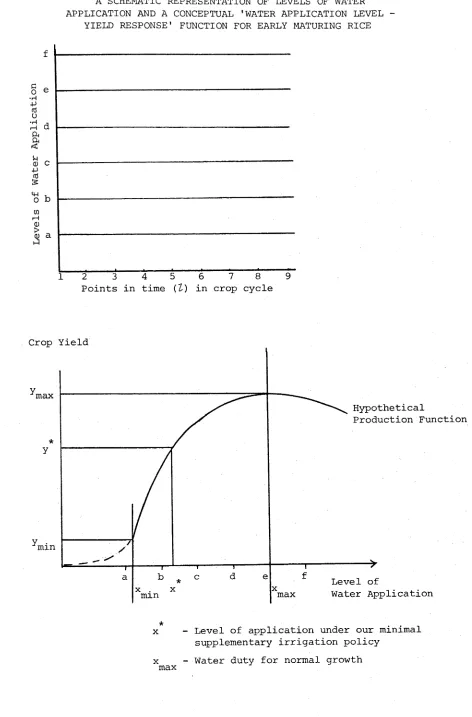
(ii) the stringent water management itself: the strategy of irrigation of dry season rice in small dams does not aim to provide water sufficient for maximum and normal growth. Rather, it supplements the incident rainfall with an amount of irrigation just enough for moderate rice yields.
2.3.3 Importance of Water in the Growth Phases
The provision of a lower 'water duty' to the rice crop is lifcly to affect the growth and yield performance of rice. These reactions in yield could be manifested in one or more of the yield coiponents. When the water 'level' provided in the soil is
indequate for the plant to freely meet the evaporative demand, the pint is said to be under 'moisture stress'. As yet, the specific efects of moisture stress on the physiology of the rice plant are no well established. Nevertheless, Kramer (1969), for example, dos discuss the effects on many of the vital aspects related to grwth. Such a broad understanding is sufficient for our purposes.
In the rice crop, moisture stress during the early
make up its growth deficiency particularly with additional fertilizer application. However, the maturity of the crop is likely to be delayed. On the other hand, if the water stress is experienced in the reproductive and ripening phases, a further reduction in yield takes place because of its effects on the other yield components. Specifically, it leads to a reduction in the grains per panicle, percentage of filled grains and the mean weight of grains (De Datta
et a l , 1973).
The effects of water stress are believed to be more
pronounced at certain 'critical' growth stages than at other stages. Such critical stages also seem to coincide with the periods in which the plant uses most water. Salter and Goode (1967) conclude that cereal crops show a marked sensitivity to water stress during the formation of reproductive organs and during flowering.
Matsushima (1962) reported that the rice plants are more sensitive to water stress from 20 days before heading to 10 days after heading.'*' Rice crop susceptibility to water shortage during the reproductive and ripening phases has been reported by Hiler et al (1971) to be around two times that during the vegetative phase. However, there is evidence that for many high yielding varieties of rice no growth stage is more critical to moisture stress than others (De Dutta et al, 1973). The same study also concludes that the susceptibility is dependent on the age class of the variety.
In early maturing varieties of rice, it seems difficult to single out one or two stages of growth as 'critical1 to moisture
stress. For example, De Dutta et al (1973) conclude that in these varieties all the growth stages are equally susceptible to moisture stress; they have observed that moisture stress affects yield
equally adversely even when it occurs during the vegetative phase. This could be attributed to the fact that the vegetative phase in these varieties, unlike other age classes, is short and it is more
'valuable' to build up the essential vegetative mass.
An important observation that emerges from the above discussions is that the soil moisture level must be adequately maintained during the whole crop duration, particularly for early maturing rice varieties which are of importance in the present study. This has implications for water application. Since, the
evapotranspiration in the field is relatively constant, the logical approach is to distribute the 'water duty' in equal amounts in a number of applications through the crop duration. This strategy is especially relevant when the supply is not adequate enough to provide the full 'water duty' requirements.
2.3.4 Irrigation Scheduling
The non-rainfall component of the 'water duty' is applied in the form of irrigation water. The scheme of applying the
irrigation water to the crop is known as 'Irrigation Scheduling'. The irrigation schedule sets out the amount and time of irrigation throughout the cropping duration.
discussed, for example, by Pruit and Jensen (1955), and Van Bavel and Wilson (1952). They make use of soil and climatological information. But they also utilize many measuring devices.
A judicious supplementation of the rainfall for rice from water in small dams needs to be based on a climatological approach with the primary variable of interest being the record of rainfall. The scheduling could also be aided by such visual observations of the soil moisture status as the presence of standing water, or the dryness or cracking of the soil. Although it has already been decided here that the 'water duty' or demand should be at a constant
level within a season, the random nature of the primary supply, rainfall, means that the supplementary supply, irrigation,has to be provided in variable doses.
Clearly then, the issue of optimum use of the water resource must address some form of optimum scheduling. This also must take into account the productivity of water. Before turning to the optimum management of dam-water, therefore, further
discussion is needed on the empirical work of economists in considering water as an input in rice production.
2.4 Water Input in the Production Process: A Review
In the treatment of water as an input to agricultural production, economists have adhered to one of two schools of
thought, as discussed, for example, by Flinn (1968). One group n seems to be dominated by the idea that water is a vital necessity to crops and that each crop has a unique water requirement.
input has substitution possibilities and has a production response function.
These two strands of 'thought' have greatly influenced the literature in irrigation economics and its concepts. An explicit distinction is crucial in the evolution of any management strategy. In particular, it will be seen that the concept of
'variable input' is more relevant for small dam situations.
2.4.1 Water: Complementary Input
The concept of 'unique water requirement' has received frequent attention and dominates the literature of irrigation economics. Very often it is a basic assumption in irrigation
development planning and water resource investments. Steiner (1964) assumes unique water requirements for crops in water resource
investment evaluations.
In the economics of irrigation of agricultural production, it has been a convenient concept. Clark (1970) reviewed the
economics of irrigation of alternative crops with 'unique water requirement' estimates. However, this concept becomes sterile when it confronts the economics of irrigation of a single crop.
increase in the cropping intensity of the land already in cultivation, or both. Chambers (1976; 1978) adopted this kind of reasoning for optimal management of water resources for rice production in the Dry Zone of Sri Lanka.
The complementary role of water becomes evident in the discussions of a rainfed production system. Additional benefits accruing to the application of irrigation water to hitherto purely rainfed systems is very often viewed in terms of increases of
marginal value products (MVPs) or productivity of the other inputs. Such a postulate implies an upward shift in the production function on the provision of irrigation. Notably water is not a variable input in such a production function. Yet, this constitutes the core for many studies which attempt to assess the impact of irrigation. The framework for such an analysis is either a 'cost-benefit'
approach or a production function. A production function is adopted by Desai (1973) and Sadeghi (1978). The same approach has also been used, for example, by Levine (1966) to highlight the higher impact of irrigation in the dry season in comparison to that in the wet season in a selected region. However, a fundamental point to bear in mind is that these analyses are not concerned about the supply of the water resource. At best it is assumed as 'free and plenty'.
2.4.2 Water Response Functions
made available. This provides the necessary physical basis for analysis within the conventional production function framework.
Empirical studies to estimate the productivity of water simply use planned experiments to vary the quantity of water applied to a crop. At the farm level, there have been many attempts to make such estimates. Two of the noteworthy examples are Hopper (1965) and Naik (1965). These studies have made use of quantity measures of water at the farm 'headgate' of sample farms to specify whole-farm production functions. Such a technique is not relevant in the context of a small dam which concerns only a single
'community farm'. Furthermore, the objective in such dams is not simply to maximise productivity of water in rice production but to ensure the sustenance of a crop of rice.
For the small dam situation, a relevant set of concepts seems to exist in moisture stress-yield functions.
2.4.3 Moisture Stress - Yield Functions
There has been a distinct group of studies which infers the importance of water to crops indirectly. Instead of quantity measures of water, they incorporate a drought index or an index of