Implementation
evaluation of Doncaster
Children’s Services
Trust
Final Report
July 2017
Contents
Figures 4
Acknowledgements 5
Glossary of terms 6
Foreword 9
Doncaster Children’s Services Trust 9
Executive Summary 10
Introduction 10
Key findings 11
Recommendations for policy and practice 17
Introduction 19
Research objectives 19
Methodology 20
Online staff survey 21
On-going internal reporting 22
Logic model 22
Changes to methodology 22
Limitations of methodology 23
Context in which the Trust was established 24
Design and set-up of a new Trust in Doncaster 26
Remit and governance of the Trust 27
Contractual management 28
Developing a Commissioner–Provider relationship 30
Financial arrangements 32
Structure of the Trust for social care delivery 35
Establishing a business 35
Early Help 37
Assessment and Child Protection 40
Locality model 41
Social care practice and workforce 44
Capacity and effectiveness of social care services 44
Work culture and staff morale 47
Development of tools and guidance 50
Staff development 52
Performance monitoring 54
Staff supervision 55
Essential performance monitoring infrastructure in place 56
Auditing to understand performance 57
Voice of the child 58
Direct work with families 59
Working innovatively 60
Working in partnership 63
Strategic-level multi-agency partners 64
Operational-level multi-agency partners 67
Change management 68
Leadership 68
Operational communication 70
Conclusions 73
Key improvements 73
The Trust is working in Doncaster 75
Added value of the Trust in Doncaster 75
Conditions necessary for consolidating improvements in the Trust 76
Recommendations for policy and practice 77
References 82
Appendix 1: Scoping stage logic model 84
Appendix 2: DCST organograms 86
Appendix 3: Service delivery model 88
Figures
Figure 1 Summary of the methodology used for each evaluation stage……….11
Figure 2 Enablers of improved quality of practice ... 12
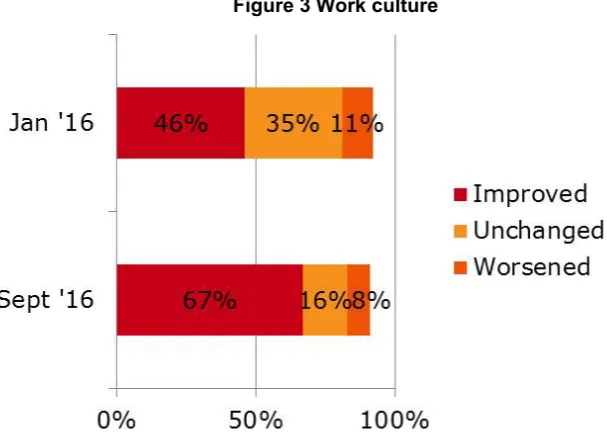
Figure 3 Work culture ... 48
Figure 4 Ability to attend training ... 54
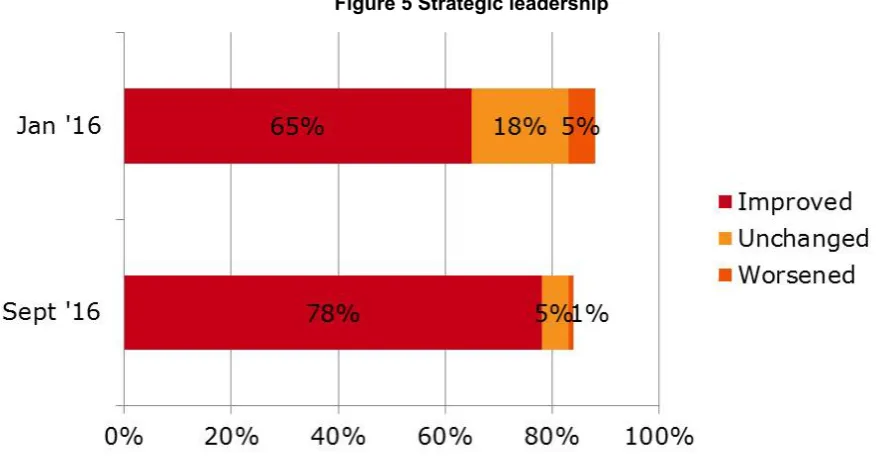
Figure 5 Strategic leadership ... 69
Figure 6 Strategic vision ... 70
Figure 7 Clarity in roles and responsibilities ... 72
Figure 8 Enablers of improved quality of practice ... 73
Acknowledgements
This research was commissioned by the Department for Education (DfE). The research team at Kantar Public (formerly TNS BMRB) would like to thank the team at the
Department who have led this research and overseen the production of this report, especially Richard White and Rachel Jones. We would also like to thank those
stakeholders in the Trust and Council who regularly engaged with the design and delivery of the evaluation, and provided the research team with access to staff in the Trust and Council, especially Jackie Wilson, Paul Moffat and Riana Nelson. A special thanks to the members of the advisory group who provided their expertise to the evaluation. Our
Glossary of terms
ACPS Assessment and Child Protection Service is a service in the Trust responsible for assessment of child referrals to Children’s Services, focusing on establishing whether the child is in need or whether there is reasonable cause to suspect that the child is suffering, or is likely to suffer significant harm.
18+ Service A service in the Trust providing support and resources to young people aged 18–21 who have been in local authority care. CAF Common Assessment Framework; a process of gathering and
recording information about a concerned child in the form of a shared assessment, in order to ensure a child's needs are met.
CAFCASS Children and Family Court Advisory and Support Service; promotes the welfare of children and families involved in a family court.
CCG Clinical Commissioning Group
CAMHS Child and Adolescent Mental Health Services are the NHS services for young people who have difficulties with their emotional or
behavioural well-being. CAMHS are multi-agency partners working closely with Early Help and children’s social care services.
Children’s centres Children’s centres in Doncaster are overseen by the Council and provide different activities to meet the needs of the local community. Services include Family Support, Health Services, Adult Education and Training, Social Care Services, Childcare and Toy Libraries plus many more for all families in their geographical area.
CIC Children In Care Service is a service in the Trust responsible for working with children and young people up to the age of 16. In most cases these children and young people will be living separately from their parents in foster care, children's homes, or sometimes with family members.
CMARAS Children’s Multi Agency Referral and Assessment Service, precursor to Referral and Response Service.
Corporate
Parenting Board The Council has a duty to provide a similar standard of care for children and young people in care to that which would be expected of a reasonable parent. It is led by the Council and aims to provide better and improved outcomes for children and young people in care.
CSE Child Sexual Exploitation. The sexual exploitation of children and young people under 18 involves exploitative situations, contexts and relationships where young people (or a third person or persons) receive ‘something’ (e.g. food, accommodation, drugs, alcohol, cigarettes, affection, gifts, money) as a result of performing, and/or others performing on them, sexual activities.
CTSIG Council and Trust Strategic Inspection Group is in charge of the inspection of certain bodies responsible for children's plans for future improvements, according to a set of standards and expectations. DCST Doncaster Children's Service Trust.
DfE Department for Education.
DMBC Early
eCAF Electronic Common Assessment Framework. The system involves the recording and management of the whole Common Assessment
Framework process, including the requisite consent and security. Education
Welfare A service or officers employed in individual schools or by the Local Authority to address welfare issues of children at school, with particular reference to school attendance.
EHH Early Help Hub; the newly established central point of access for Council and community-based health Early Help services for children, young people and families, providing advice and support.
ESST Emergency Social Services Team is a service based in the Trust responsible for responding to cases requiring immediate attention, outside normal working hours if necessary. It is part of the Referral and Response Service.
IFSS Integrated Family Support Service was based in the Council. Doncaster Children's Centres formed part of the Integrated Family Support Service which brings together Children's Centres, Youth Services and Family Support Services.
IFST Intensive Family Support Team is based in the Trust and is responsible for supporting families who require a named worker alongside them to help them work out a plan for keeping children and young people 0–19 safe, healthy enough to thrive and eventually achieve their potential in education, training and employment. Innovation
Projects The Department for Education’s children’s social care innovation programme provides funding for social work agencies to explore ways of supporting children who need help from children’s social care services. The Trust has received funding for four innovation projects. IRO Independent Reviewing Officers are based in the Trust and monitor
the well-being and plans for children in care.
JSNA Joint Strategic Needs Assessment. A Joint Strategic Needs
Assessment (JSNA) looks at the current and future health and care needs of local populations to inform and guide the planning and commissioning (buying) of health, well-being and social care services within a local authority area.
LA Local Authority.
LAC Looked after children is both a term referring to a child or young person who, for whatever reason, is cared for by a local authority, and a service in the Trust, responsible for children involved in fostering and adoption.
LCSB Local Children's Safeguarding Board, known in Doncaster as the Doncaster Safeguarding Children Board (DSCB). The DSCB is a statutory body which is independently chaired and consists of senior representatives of all the partner agencies and organisations working together to safeguard and promote the welfare of children and young people in Doncaster.
Liquid Logic A social care case management system used by practitioners in the Council and Trust to ensure optimum case management and record keeping for children in need.
MASH Multi Agency Safeguarding Hub.
Performance Accountability Board (PAB)
This new Board acts to ensures that all partners involved in children’s services are held to account for their performance and the outcomes they achieve for children.
RDaSH Rotherham Doncaster and South Humber NHS Foundation Trust (RDaSH) operates services in 200 locations across Rotherham, Doncaster, North Lincolnshire, North-East Lincolnshire and Manchester.
R&R Referral and Response is a service in the Trust responsible for working with children and their families and the relevant agencies, to assess whether children are in need or are at risk of harm. If further assessment and support is required the team will contact the
appropriate service, for example Assessment and Child Protection Services, Child Sexual Exploitation Team or the Integrated Family Support Service.
Safeguarding, Standards and Policy
A service in the Trust responsible for the arrangements around child protection conferences, the Independent Reviewing Officer Service, Quality Assurance and social worker learning and development. St Leger Homes A provider of housing services across Doncaster in the social and
private sectors.
Signs of Safety Signs of Safety is a strengths-based, safety-organised approach to child protection casework.
Stronger Families An approach led by DMBC which delivers the functions of the national ‘Troubled Families’ programme.
TAC Team around the child is a shared assessment and planning
framework which is in use by a variety of agencies across the borough and is employed in similar format throughout the country. It aims to help with the early identification of additional needs of children and young people and promote a co-ordinated multi agency response to meet these.
TUPE TUPE refers to the "Transfer of Undertakings (Protection of
Employment) Regulations 2006" and protect employees' rights when the organisation or service they work for transfers to a new employer.
Targeted Youth
Support Targeted Youth Support Service is a service in the Trust responsible for working with young people and their families who are at risk of becoming involved in anti-social behaviour and/or offending.
Team Doncaster The Local Strategic Partnership, Team Doncaster is chaired by the elected Mayor and comprises the chairs and key members of the Children and Families Board, the Enterprising Doncaster Board, the Health and Well-being Board and the Safer and Stronger Doncaster Board.
Virtual school The virtual school is based in the Council and gives educational support to all Doncaster children in care. It works with looked after children, and with the foster carers, social workers and designated teachers of children in care, wherever a child may live or go to school. YOT Youth Offending Team is a service in the Trust responsible for
Foreword
Doncaster Children’s Services Trust
‘All of us in the Trust have appreciated our involvement in the evaluation process. Over the three phases the evaluation activity and interim reports have provided us with clear points of progression which have acted as markers for our progress. The iterative process has allowed us to reflect upon this ‘external eye’ and to use each phase as an anchor point in our learning journey.
The Board and the executive are especially pleased to see the experiences, views and achievements of our staff clearly mapped across the evaluation. We are very proud indeed of them. The report makes many references to leadership, and we hope that readers will consider these in the context of our Trust values, which are that we are all leaders. We have set out this distributed leadership model from the outset, and our staff have risen magnificently to the challenge of stepping into this approach.
Alongside the evaluation team, we have spent two years considering what makes a Trust so different. That has been the most popular question posed to us both locally and
nationally. The report captures the key factors well; building quality of practice, workforce stability, performance and quality arrangements, staff development, communication, leadership, partnerships and culture. For us, culture is at the heart of the Trust; it drives our values, our management of change and our cycle of improvement. It has been the single biggest factor in establishing our ‘new start’, and this new identity has freed our staff up to think and act differently. This in turn has improved our staff offer and the way we have marketed our brand, thus further strengthening our recruitment and retention. For us, this is the key to ‘what makes a Trust so different?’ Our staff tell us that they feel safer and more confident and that they like the focus and the agility of the Trust which allows us to act quickly to bring about change. Most importantly, our children and young people feel better – one recently referred to our ‘big Trust family’ and others have spoken of having ‘trust in the Trust’. We don’t suggest that our model is a panacea for all
challenges in the sector; challenges come about for a wide range of reasons and the sector needs a broad menu of responses, but for our circumstances this model has given the fresh start and radical shift which has galvanized practice and partnership and has changed the lives of our most vulnerable children and young people for the better. Each and every one of us in the Trust has been delighted to have played our part in that.’
Paul Moffat Chief Executive
Executive Summary
Introduction
The Doncaster Children’s Services Trust (DCST) is the first of its kind in the country and represents an innovative approach to delivering children’s social care services. It was established in the context of ‘long-term historic failure of corporate and service
management’1 in Doncaster, with cycles of improvement and regression that were
characterised by deep-rooted issues with leadership and strategy, management and oversight, and core social work practice. Continual attempts to bring about improvements from 2005 were unsuccessful and it was in this context that the Trust was established on 30 September 2014. Through working closely with the Doncaster Metropolitan Borough Council (DMBC) and multi-agency partners, the Trust has since implemented processes and systems to respond to issues identified and documented by the Department for Education (DfE), Ofsted and external evaluators throughout its implementation journey.
DfE commissioned Kantar Public (formerly TNS BMRB) to carry out an independent evaluation of the implementation of the Trust, between May 2014 and November 2016.2
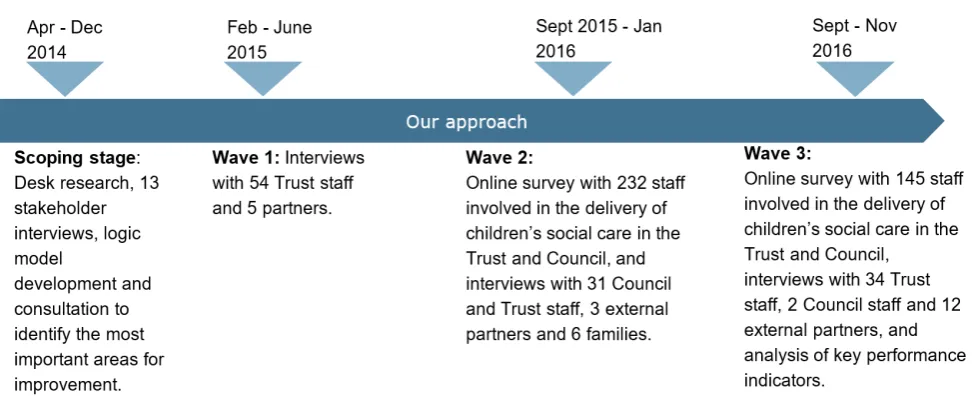
The findings captured in this report captures the developments between these time points; additional developments may have occurred which are not captured here. An iterative, phased evaluation approach was undertaken, in order to support Trust development at regular intervals. Following an initial scoping stage, three waves of fieldwork were conducted from February 2015 to November 2016. A combination of methods was used to evaluate the Trust, reflecting the developing needs of the Trust and aims of the evaluation. Methods included desk research, interviews with a wide range of staff, partners and families, online surveys of staff and analysis of key performance indicators. Figure 1 illustrates an overview of the methodology used for each evaluation stage.
1 Le Grand, J., et al. 2013 “Report to the Secretary of State for Education on ways forward for children’s
services in Doncaster.” https://www.gov.uk/government/publications/report-to-the-secretary-of-state-for-education-on-ways-forward-for-childrens-services-in-doncaster
2 An evaluation of the Slough Children’s Services Trust was also commissioned, in 2016. Interim findings
Figure 1 Summary of the methodology used for each evaluation stage
Key findings
As the first of its kind in the country, there was no template to draw upon in setting up a new organisation to deliver children’s social care services in Doncaster. DfE were heavily involved in the design of the Trust, in collaboration with professional advisors such as Deloitte. The challenge of undertaking such an exercise should not be underestimated. Deloitte were working within a context which was highly politicised (with tensions in the relationship between DMBC and DCST), with incomplete information (due to the way in which the Council pools and records budgets), and with an untested commissioning approach.
A range of lessons relating to the set-up of the Trust were identified throughout the evaluation which impacted the Trust’s operations. These findings are summarised below, and are discussed in detail in the following sections:
• the legal and contractual arrangements, including ensuring that interdependent children’s social care services between the Council and Trust were not split up, allowing sufficient time and expertise to work out the legalities of setting up an independent adoption and fostering service, and establishing a proportionate reporting plan for contractual management
• the financial arrangements, including developing funding arrangements for costs required to operate children’s social care services as well as ensuring the Trust has cash flow to support in the operation of a new business
• the strategic relationship between the Council and the Trust, including clarifying and streamlining the Commissioner–Provider role of the Council, agreeing the mechanisms (e.g. Boards, meetings) for supporting effective division of
See Design and set-up of a new Trust in Doncaster for more details.
This evaluation explored the journey of change of children’s social care in Doncaster since the establishment of the Trust and provides early evidence on the impact and added value of the Trust’s work3 in respect to the organisation, management and delivery
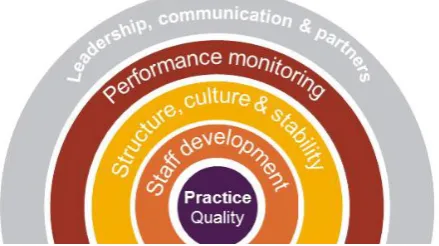
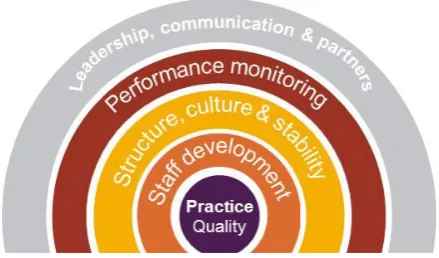
of services. Key improvements underpinning effective implementation of the Trust identified by the research relate to leadership, communication, partnership working, performance monitoring and quality assurance, Trust structure, culture and workforce stability, and staff development. These core improvements have brought about the necessary conditions to enable practice improvements and are visualised in Figure 2. The order of the improvements was conceptually driven, showing the necessary
[image:12.595.185.405.422.545.2]conditions for achieving each improvement. For example, leadership, communication and partnership working were identified as necessary pre-conditions to drive improvements to performance monitoring, and so on. The implementation of the Trust, and the identified improvements, have in turn been influenced by three key factors: the engagement and effectiveness of support available from universal and preventative services, the capacity of staff and partners to buy into and participate in the improvement journey, and the financial stability of the Trust. These key findings are summarised below.
Figure 2 Enablers of improved quality of practice
Leadership - The skill and commitment of the people involved in the set-up and delivery of services, especially the senior leadership, was identified by staff and partners as being critical for driving forward the transformation of children’s social care. Strong and
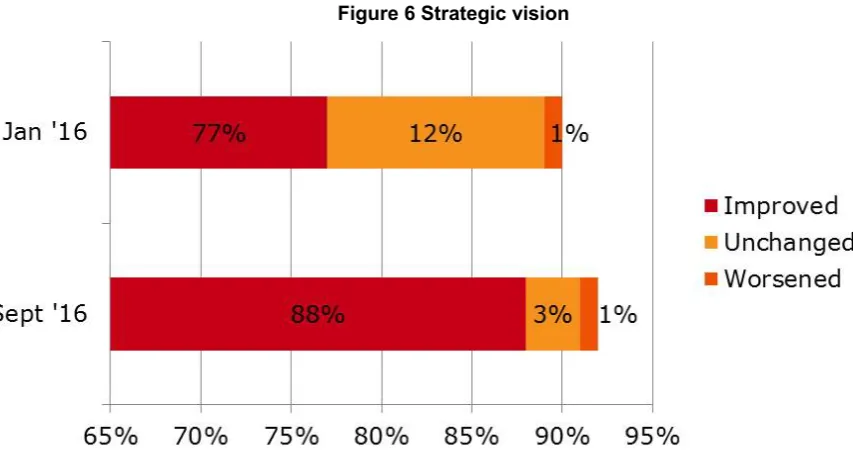
consistent qualitative feedback from staff and partners was that stable, committed, ambitious and accountable leadership was necessary for facilitating the range of improvements seen within Doncaster since the Trust was established. Of Trust staff surveyed in January 2016, 65% agree senior strategic leadership of children’s services has improved since the introduction of the Trust, while 77% agree the strategic vision of children’s services has improved. Improvements to responses to both measures were
seen in September 2016; 78% agree leadership had improved, while 88% agree the vision had improved See Change management for more details.
Communication - More frequent internal and external communication has been key for managing anxiety amongst those delivering children’s social care, for improving
understanding of the aims of the Trust, and for instilling belief in the strategic direction of the organisation. Trust staff have described feeling ‘enthused’, ‘enabled’ and ‘motivated’ by the aims and ambitions for the Trust, as communicated by the senior leadership team – a stark difference to the circumstances pre-Trust. Of Trust staff surveyed in January 2016, 64% agree that the Trust keeps them well informed about changes affecting their work, this increased to 76% of staff in September 2016.See Change management for more details.
Partnership working - Qualitative feedback from staff and partners suggests greater strategic communication, an improved approach to quality assurance, delivery of multi-agency training and support, and follow-through on commitments have improved relationships with partner agencies. Together, these improvements have instilled a growing trust from partners in the Trust’s ability to deliver high quality services that promote the safety of children and families. Improvements to relationships and working practices with the Doncaster Safeguarding Children’s Board (itself much improved as assessed by Ofsted), police and NHS were identified within stakeholder interviews. In January 2016 59% of Trust staff surveyed agreed partnerships in the delivery of
children’s services had improved under the Trust, and this increased in the September 2016 survey when 75% of staff agreed with this statement. The foundations for
addressing some historically fragmented relations (See Context in which the Trust was established for more details) between statutory and voluntary partners and children’s services in Doncaster were established early on by the Trust. These foundations included running a skills audit to identify staff strengths and opportunities for development, then delivering an intensive training programme to support continuity of skills across the organisation. Progress has been made, especially at the strategic level. There still remains scope to effectively and consistently collaborate with all partners, drawing upon local knowledge and resource, to respond to need in Doncaster. See Working in
partnership for more details.
Performance monitoring and quality assurance - There was strong and consistent qualitative feedback from staff and partners on the improved ability to capture and use Trust-wide intelligence to inform service and practice decisions, and the Trust is seen to have the capacity and commitment for undertaking effective self-assessment. Essential performance monitoring infrastructure and tools have been established (e.g. an auditing programme, performance and quality assurance framework, and centralised performance monitoring system with designated performance leads for each locality, delivering
and team level. In January 2016 77% of Trust staff agreed they receive regular supervision, compared to 88% in September 2016. Together, developments to
monitoring and quality assurance were reported by staff and partners as having led to improvements to practice and increased confidence from staff and partners in the Trust’s ability to support and protect children. See Performance monitoring for more details.
Activities to improve capturing the voice of the child to inform how performance could be strengthened have been put in place (e.g. business plan puts the voice of the child as its first priority, Young Advisors introduced to advise senior management, new care leaver’s council launches, vacant Independent Reviewing Officer posts filled). Trust staff
recognise this, reporting improvements in the Trusts’ ability to capture the voice of service users; 67% agreed they could see improvements in January 2016, compared to 85% agreeing improvements to capturing the voice of service users can be seen as of September 2016. See Performance monitoring for more details.
Trust structure - The introduction of a locality model, and changes to the structure of Early Help led by DMBC, were seen by Trust staff and partners to have changed the organisational landscape of children’s social care services for the better. The locality model means Heads of Services for each area are now located with their team, leading to greater senior management visibility and involvement in case decisions (resulting in examples reported by staff and managers in interviews of better case handling and quicker decision-making on cases). Improved team working was reported by staff as resulting from the Intensive Family Support service, Assessment and Child Protection service and Children in Care service teams being located in the same building across locations, and therefore being more able to share information about cases. Since the implementation of the Early Help Partnership Strategy, a range of improvements have been identified through qualitative interviews and indicator analysis: increasingly clearer referral thresholds, examples of more appropriate referrals into social care, and stronger management structure and oversight. However, the Early Help Strategy Group have identified that further work is needed to consolidate the changes to Early Help and
ensure demand is effectively planned for and responded to. See Structure of the Trust for social care delivery for more details.
Trust culture and workforce stability - Prior to establishing the Trust, there was low morale and high turnover of staff within children’s social care. This was reported by staff and partners with experience of children’s social care before the establishment of the Trust, and evidenced by workforce statistics. The vacancy rate the year up to 30 September 2014 was 32%; the rate had reduced to 22.7% in the year up to 30
September 2016.4 Similar reductions can be seen in the use of agency staff: The agency
4 Department for Education. “Statistics: Children's social work workforce 2016.” 16 February 2017.
worker rate in the year up to 30 September 2014 was 30%5. This rate reduced to 21.4%
in the year up to 30 September 2016.6
The establishment of the Trust presented the leadership team with an opportunity for a ‘fresh start’ which they have fully embraced; an opportunity seen as unique to the Trust. From their investment in staff, to quality assurance, to the way in which the Trust
communicates about their work, there has been a large shift in culture. Quality practice is expected and celebrated, and the Trust is seen to be an exciting place to work. In turn, this was seen by staff and partners as having positively influenced staff morale and workforce stability, and improving continuity of care to families as a result of reduced staff turnover. The transition to the Trust was also viewed by Trust staff to have stimulated – and even necessitated – innovations in the management and delivery of support
services. One concrete example of this has been the range of projects undertaken within the DfE Social Care Innovation programme. Though staff are encouraged to work
differently, caseloads and practitioner capacity can limit opportunities to engage in more innovative practice. See Social care practice and workforce for more details.
Staff development - Supporting staff development is fundamental to improving the quality of practice in the Trust, and substantial time and resource has been invested to
strengthen workforce capabilities. A baseline assessment of staff strengths and areas for improvement prompted the launch of an intensive practice improvement programme, as well as greater choice and regularity of training opportunities. The development of practice standards and new systems to facilitate efficient and effective working helped staff understand what is expected of them. The Trust also took responsibility for delivering a staff development programme for both IFST and Family Support workers employed by DMBC. Qualitative interviews with practitioners found that, for many practitioners, this was the first time they had formal guidance on policies and practices, and staff valued the clarity they brought in informing expectations and practice. See
Social care practice and workforce for more details.
Quality of practice - Collectively, the improvements above have been necessary to enable the right conditions for practice improvements to emerge, and to improve outcomes for children. There was strong and consistent qualitative feedback from staff and partners, on improvements to quality of practice seen across services. A reduction in re-referrals involving Domestic Abuse Navigators from the Growing Futures innovation was reported by senior staff. Evidence of staff spending more time with families, and improvements to family and child engagement, can be seen. Seventy-eight per cent of Trust staff surveyed greatly or somewhat agreed they are spending more time with families under the Trust. Indicator analysis strengthens the view social workers are
5 Department for Education. “Statistics: Children's social work workforce 2014.” 25 February 2015.
https://www.gov.uk/government/statistics/childrens-social-work-workforce-2013-to-2014
6 Department for Education. “Statistics: Children's social work workforce 2016.” 16 February 2017.
spending more time with families: from 3,155 contacts with families in 2014 to 3,874 contacts in 2016 (up to August). Family engagement in children in need meetings was substantial, with 95% of mothers, 77% of fathers and all grandparents invited to CIN meetings having attended. Comparison data from before the Trust was established was unavailable. The quality of assessments has also improved. Performance data on monthly audits conducted by the Trust identified examples what Ofsted would rate as ‘outstanding’ cases in August and September 2016, and in September there were no inadequate cases in those sampled. See Social care practice and workforce for more details.
The Trust is clearly still on a transformation journey, and improvements to many of the outcomes for children and families will take a number of years to become evident. Nonetheless, the improvements identified through this evaluation demonstrate the Trust is having a positive impact on children’s social care in Doncaster. From a low base, it has made tangible improvements to the organisation, management and delivery of services to the children and families it supports, and can already demonstrate some
improvements to outcomes for children. Improved outcomes include inspections finding that no children had been left at risk of significant harm7 and a reduction in re-referral rate
from 37% in 2014 to 23% in 2016. An increase in the percentage of children in care in the same placement for two or more years is also evidenced: 56% of children in care in the year up to September 2015 are in a stable placement, compared to 54% in 2014.8
The pace and scale of change to children’s services under the Trust’s leadership is seen by staff, partners, and stakeholders as having been unachievable prior to children’s social care services transferring to the Trust. A combination of features viewed by staff and partners as essential for supporting the positive changes to children’s social care services seen in Doncaster under the Trust include:
• A stable, committed, transparent and accountable leadership, attracted by the challenges and opportunities presented by the Trust model
• The single focus on children, enabling senior staff to focus attention on children’s social care services without the distractions faced by their counterparts in local authorities was described by senior strategic Trust leadership and partners (qualitative evidence reference above)
• The fresh start of a new organisation, breaking with the past context and experiences of children’s social care services in the Council
• The appetite and freedom to work differently
7 Ofsted. “Monitoring visit of Doncaster Metropolitan Borough Council children’s services.” 2016.
https://reports.ofsted.gov.uk/local-authorities/doncaster
8Local Authority Interactive Tool
• The investment of time and resources
While there is clear evidence to suggest that the necessary conditions are in place for the Trust’s achievements to be sustained and embedded within Doncaster, there are also factors that could undermine the performance of the Trust model, as implemented in Doncaster, and its potential impact on children and families:
• the single contract the Trust holds with the Council limits its financial stability and ability to develop and grow as an independent organisation. Securing additional revenue streams and new opportunities related to joint commissioning and joint budgets would bring financial security for the Trust, greater freedom in service delivery, and greater responsiveness to child and family needs.
• engagement and effectiveness of support available from universal and
preventative services – further engagement of partners including schools and health services, and the joining up of the Early Help Hub, Referral and Response service and MASH were reportedly needed to embed a single point of access into social care. This would bring about greater efficiencies in ways of working, and more effectively manage the inflow of referrals into social care. Like children’s services in other authorities, unless services involved in preventative support have the capacity and motivation to regularly and directly engage with social care
services, the Trust’s ability to respond to demand at the front door, initiate change and achieve improved outcomes for children may be limited.
• ability of staff and partners to maintain the pace of change, engaging with
developments and applying changes in practice. The pace of activity in the Trust has been quick, and the scope of work varied and complex. Staff and partners have been required to work differently, efficiently and effectively in the high
pressured and demanding context of children’s social care, while also keeping up with strategic and cross-service developments. By regularly supporting staff and partners to keep up with this progress – through engagement activities, clear and regular communication, ongoing consultation and vigilance to caseloads for staff – the Trust may be able to ensure continued and consolidated progress.
Recommendations for policy and practice
With no blueprint to follow in the establishment and operation of the Trust in Doncaster, lessons learned by the Trust may be useful for other organisations involved in alternative delivery models. Three types of lessons emerged:
• operational lessons – putting in place key business support staff and a permanent leadership structure prior to the launch of the Trust and establishing a
performance baseline at the point of transfer.
to work out the legalities of setting up an independent adoption and fostering service and developing funding arrangements that support the effective delivery of a demand led system.
Introduction
The Department for Education (DfE) commissioned Kantar Public (formerly TNS BMRB) to undertake an evaluation of the implementation of the Doncaster Children’s Services Trust (DCST) to ensure that lessons are learned to inform future policy and practice in Doncaster and elsewhere.
The Trust represents an innovative approach to delivering children’s social care services, which is the first of its kind in the country. It was established in the context of ‘long-term historic failure of corporate and service management’9 in Doncaster, with cycles of improvement and regression that were characterised by deep-rooted issues with leadership and strategy, management and oversight, and core social work practice. Since late 2014, the Trust has examined these complex and interconnected issues, and designed and implemented a suite of systems and activities to respond to them, through a detailed change management programme. At the same time, it has put in place
business support services such as HR, Finance and Communications, to aid delivery, and established new approaches to the management and delivery of services to the area’s most vulnerable children, young people and families.
This report documents the journey of change of children’s social care in Doncaster since the establishment of the Trust, and provides early evidence on the impact and added value of the Trust’s work10 in respect to the organisation, management and delivery of
services. This includes identification of key conditions underpinning effective implementation relating to structure and culture, staff development and quality assurance, partnership working, communication, and leadership.
Research objectives
The overarching objectives of this evaluation were to explore:
• how services are managed and organised under the Trust
• whether and how the Trust model delivers higher quality services for children, young people and families
• whether and how the Trust model influences staff morale/satisfaction and recruitment/retention, and whether it helps develop a higher quality workforce
• whether and how the Trust model develops stronger partner relationships
9 Le Grand, J., et al. “Report to the Secretary of State for Education on ways forward for children’s services
in Doncaster.” 2013. https://www.gov.uk/government/publications/report-to-the-secretary-of-state-for-education-on-ways-forward-for-childrens-services-in-doncaster
• how the Trust’s business support and infrastructure sustains the delivery of high-quality services
• factors that have facilitated or hindered implementation, and the response to these
• how, if at all, the Trust model facilitates innovative practice
• lessons learned for the future implementation of Trust arrangements and delivery During the latter stages of the evaluation, the emphasis shifted away from the process of implementing a Trust in Doncaster, and towards providing measurable evidence on the added value of the Trust. For the final phase of fieldwork, the evaluation focused on two additional research questions:
1. Is the Trust viewed as having worked in Doncaster?
a. Is there evidence of improvements to: outcomes for children, bureaucracy, decision-making speed, staff freedom to influence change, practitioners’ time with families, ability to safeguard children, quality of practice, working in
partnership with the Council and with statutory and voluntary sector agencies? 2. Could the progress under the Trust have been achieved under the Council as it
was at the point of transferring children’s social care services to the Trust? Specific research aims and objectives for each phase of research are included in the accompanying Technical Report.
Methodology
An iterative, phased evaluation approach was undertaken, in order to support Trust development at regular intervals. Following an initial scoping stage, three waves of fieldwork were conducted from February 2015 to November 2016, to capture changes to practice on the ground in two of Doncaster’s four boroughs, Central and East11. A
combination of methods was used to evaluate the Trust, reflecting the developing needs of the Trust and aims of the evaluation. Methods included desk research, interviews with a wide range of staff, partners and families, online surveys of staff and analysis of key performance indicators. Figure 1 illustrates an overview of the methodology used for each evaluation stage.
11 Selecting two areas enabled the team to build a detailed picture of all services, and these areas were
Figure 1 Summary of the methodology used for each evaluation stage
Online staff survey
Two online surveys were conducted with Trust and Council staff at Waves 2 and 3 with the purpose of providing an indicative picture of trends between two time points. The first took place in January 2016 (Wave 2), and achieved 232 completed interviews (response: 40%; 186 Trust staff and 46 Council staff). A second survey was conducted in September 2016 (Wave 3), and achieved 145 completed interviews using the same survey with minor amends (response: 19%; 127 Trust staff and 18 Council staff).
To ensure the representativeness of the research findings, weights were applied to the Wave 2 and Wave 3 survey data. The weights were designed to ensure that the structure of the responding sample reflects the structure of the actual population of interest. More specifically, the weighting scheme that was applied ensured that:
(a) The ratio of Doncaster Metropolitan Borough Council employees to
Doncaster Children’s Services Trust employees in the responding sample matches the ratio that is observed in the actual population of interest, as provided by the Trust and Council in sample files; and that
(b) The distribution of service areas where Trust employees in the responding sample work matches the distribution observed in the actual population of interest.
Due to the low response rate from the Council survey findings presented in this report reflect Trust staff responses only. Statistically significant survey findings at the
organisational level of the Trust are given in this report; analysis at the level of job role or service was not included because of low base sizes. Staff responses have been
amalgamated, and responses to whether staff agree or disagree, rather than the strength of those views, are presented.
On-going internal reporting
Key learnings from each stage of research activities, the implications of these on how the Trust works, and the wider implications of the Trusts’ journey for DfE to consider in its work with other local authorities considering the Trust model, were shared with the Trust, Council and DfE at each stage of fieldwork:
• Summary reports drafted and shared, and revised for accuracy following discussions with stakeholders from both organisations;
• Early findings presentations delivered, and discussions facilitated about the implications of findings for the design and operation of children’s services; and
• Short summaries of findings tailored for staff, documenting the key findings most relevant to staff.
Logic model
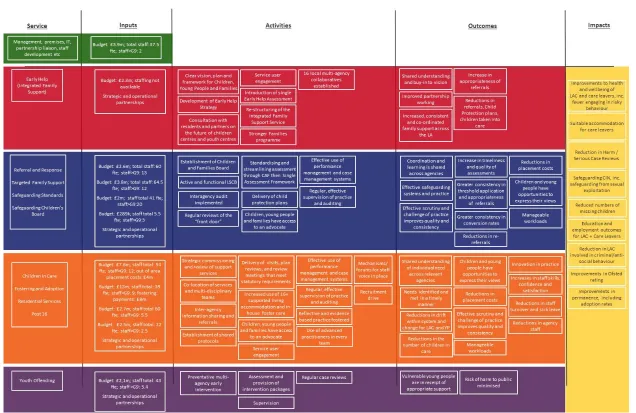
A logic model was developed during the scoping stage for the delivery of children’s social care services at the point of services transitioning to the Trust. The intention was for the model to serve as a baseline for comparing and contrasting activities undertaken before the Trust with those undertaken under the Trust. It was not possible to engage strategic Council staff involved in delivering children’s social care at setup so a pre-Trust model to compare to the Trust was not feasible. The logic model was therefore used to ensure the evaluation approach (including topic guides, survey questionnaires and sample selection) was structured against the key ouputs and outcomes originally envisaged. Over the course of the evaluation our approach altered iteratively to address the changing context, needs, strategy and structure within the Trust.
See the appendix for the logic model, organograms for the Council and Trust at the point of transfer and as of January 2016, following the restructure of the Trust to a locality-based model, and a comparison of the services, budgets and staffing for children’s services at the point of transfer, following Trust baseline activity and as of November 2016.
Changes to methodology
Changes to structures, processes and services within Doncaster over the course of the evaluation made it necessary to take an iterative approach to the evaluation methodology to account for changing relationships, service developments and the needs of DfE, DCST and the Council. In summary, these changes included:
• conducting an online staff survey, available to both Trust and Council staff, in Waves 2 and 3
• producing draft documents illustrating the main findings following each wave of fieldwork, and holding validation calls with strategic stakeholders in both the Trust and Council before interim reports were drafted. These calls covered emerging findings, documentary evidence, and implications for service planning and delivery
• following Wave 2, moving the focus away from the process of implementing a Trust in Doncaster and towards providing more evidence on the added value of the Trust. The evaluation at Wave 3 therefore focussed on the following:
1. Is the Trust viewed as having worked in Doncaster? Is there evidence of improvements to: outcomes for children, bureaucracy, decision making speed, staff freedom to influence change, practitioner’s time with families, ability to safeguard children, working in partnership with the Council and with statutory and voluntary sector agencies?
2. Could the progress under the Trust have been achieved under the Council as it was at the point of transferring children’s social care services to the Trust?
• including the review of key Trust indicators to measure staff and partner perceptions around impact.
See the accompanying Technical Report for further details on the methodology.
Limitations of methodology
The original methodology was employed to deliver a process evaluation that could inform implementation and deliver lessons for other authorities engaged in similar alternative delivery models. Though changes to the methodology were made to explore the added value and impact of the Trust, an experimental design to robustly evaluate the Trust was not feasible to undertake for a wide variety of reasons, not least that it was unrealistic to implement. Conclusions on impact are also made challenging by the quality and
availability of pre-Trust and early-Trust data on outcome measures. It is more realistic that the true impact of the Trust on children and families in Doncaster will be evident in the years to come – these are long-term outcomes that require long-term monitoring and evaluation. It is important that the findings presented in this report should be reviewed with these limitations in mind.
Context in which the Trust was established
Concerns about the service to children in need provided by Doncaster Metropolitan Borough Council (DMBC) can be traced back to 2005, when the Joint Area Review rated the service as 'adequate'.12 Despite concerted efforts to bring about improvement in
2009, the quality of work to safeguard children was considered poor and the Department for Children, Schools and Families (now the Department for Education) issued an
improvement notice. Again, the political and professional leadership within Doncaster were committed to driving change and working in partnership with an Improvement Board. An unannounced inspection by Ofsted in 201213 considered that the service was
inadequate and they could have no confidence that children known to Doncaster children's social care services were safe. A number of Serious Case Reviews where children had been harmed – seven children died from abuse or neglect between 2004 and 2008 – further revealed systemic weaknesses in the services designed to protect them. The problems were fundamental and wide-ranging: large numbers of unallocated cases; children not being seen or spoken to; poor quality assessments and plans; lack of management oversight; and limited engagement with multi-agency partners. As well as weaknesses in practice, the report identified weaknesses in strategic management.
This links to a second theme that runs throughout the many reports on Doncaster’s children's social care services prior to the establishment of the Trust: criticism of the way that the Council had been run. Doncaster is in the minority of councils that has an elected mayor, and relationships between politicians and senior managers have at times been fraught. In 2010 the Audit Commission14 found that leadership and governance within the
Council were inadequate and that there was a culture of political rivalry, bullying and intimidation. As a result, the Department for Communities and Local Government (DCLG) required three Commissioners and a Recovery Board to oversee the Council. A later report by Lord Carlisle15 provided additional confirmation that ongoing weaknesses within
the Council were having a negative impact on their ability to keep children safe.
In early 2013, the Secretary of State for Education commissioned an investigation into the most appropriate structure and governance arrangements for delivering
improvements to children's social care in Doncaster. While the investigation was underway, the Council appointed an improvement partner, iMPOWER, to drive
12 Ofsted. “Doncaster Children’s Services Authority Area: Review of Services for Children and Young
People.” 2006.
13 Ofsted. “Inspection of local authority arrangements for the protection of children: Doncaster Metropolitan
Borough Council.” 2012. https://reports.ofsted.gov.uk/local-authorities/doncaster
14 Audit Commission. “Corporate Governance Inspection Doncaster Metropolitan Borough Council.” April
2010.
15 DfE. “The Edlington Case: A Review by Lord Carlile at the request of The Rt Hon Michael Gove MP,
improvements in practice and management immediately. The resulting report16 from the
investigation stated that a culture of failure had become embedded within the Council and that a radical change was therefore needed: one that marked ‘a decisive break with the past'. The authors proposed appointing an external organisation to provide children's social care services, either through tenders from an existing organisation or the creation of a new independent trust. This recommendation was accepted and a Direction was issued to the Council by DfE and DCLG stating their intention to appoint a Commissioner for Children's Social Care who would set up such a trust.
The newly elected Mayor of Doncaster responded to the Direction, expressing frustration that recent improvements within the service had not been recognised, and challenging the legality and viability of the proposed model. She did, however, propose an alternative that would still see the creation of an Independent Children's Trust, but commissioned by the Council. In effect, this would be a partnership arrangement that would allow the service to be delivered by an independent body but would not strip the Council of its statutory functions entirely. The Council would retain its statutory duties and
responsibilities, and manage the arrangement through a contract with the Trust. This proposal was accepted and took the form of the Doncaster Children’s Services Trust. The Secretary of State’s Direction required the Trust to assume operational control of prescribed social care and youth offending services from 30 September 2014 for a period of up to ten years. The next section details the remit and governance of the Trust.
As the first of its kind, the Trust has generated much interest within the children’s social care sector. The Trust’s establishment and first couple years in operation have been closely monitored, for local and national learning: in addition to this independent
evaluation, 13 visits by external organisations to review and comment on the work of the Trust were carried out in 2015,17 and eight such visits were carried out in 2016.18 Trust Directors have also spoken at 27 regional and national events to share their experiences of establishing the Trust.
16 Le Grand, J., et al. “Report to the Secretary of State for Education on ways forward for children’s
services in Doncaster.” 2013.
17 Doncaster Metropolitan Borough Council and Doncaster Children’s Services Trust. “Annual Report of the
Doncaster Children’s Services Trust (1 October 2014 – 30 September 2015).” 2016.
18 Doncaster Metropolitan Borough Council and Doncaster Children’s Services Trust. “Annual Report of the
Design and set-up of a new Trust in Doncaster
As the first of its kind in the country, there was no template for the Trust, Council and its partners to draw upon in setting up a new organisation to deliver children’s social care services in Doncaster. DfE were heavily involved in the design of the Trust, in
collaboration with professional advisors such as Deloitte. The editing of the initial contract between the Council and the Trust was led by Deloitte in mid-2014 to oversee the design and establishment of the Trust, including:
• establishing the Trust’s operating budget
• facilitating the services contract and third-party services agreements
• determining the legal framework of the Trust (e.g. whether to register with Ofsted as provider of children’s services, whether to register as a Voluntary Adoption Agency)
• advising on the TUPE process for staff transitioning to the Trust
• advising on establishment of support systems (e.g. HR, Finance, Legal, Performance, Commissioning and Communications).
The challenge of undertaking such an exercise should not be underestimated. Deloitte were working within a context which was highly politicised (with tensions in the
relationship between DMBC and DCST), with incomplete information (due to the way in which the Council pools and records budgets), and with an untested commissioning approach.
A range of lessons relating to the set-up of the Trust were identified throughout the evaluation which impacted the Trust’s operations. These findings are summarised below, and are discussed in detail in the following sections:
• the legal and contractual arrangements, including ensuring that interdependent children’s social care services between the Council and Trust were not split up, allowing sufficient time and expertise to work out the legalities of setting up an independent adoption and fostering service, and establishing a proportionate reporting plan for contractual management
• the financial arrangements, including developing funding arrangements for costs required to operate children’s social care services as well as ensuring the Trust has cash flow to support in the operation of a new business
• the strategic relationship between the Council and the Trust, including clarifying and streamlining the Commissioner–Provider role of the Council, agreeing the mechanisms (e.g. Boards, meetings) for supporting effective division of
Remit and governance of the Trust
The overarching aim for the Trust is to improve the quality of practice and deliver ‘good or better’ services by October 2017 and ‘outstanding’ services by October 2019.19
Underpinning this are strategic priorities to provide a high-quality service, to listen and respond to customer needs and to ensure financial sustainability. The operational
priorities are, in turn, to safeguard the most vulnerable children, reduce domestic abuse, support children in care and care leavers, reduce child sexual exploitation and ensure families get support when problems start (Early Help). As of 30 September 2014, the Trust became responsible for:
• the delivery of support to around 1,235 children in need, 506 children in care and 531 children with a Child Protection Plan
• supporting 124 foster carers, along with 200 children who were in foster care
• 57 children accommodated by 5 children’s homes
• 150 young people involved with the youth offending service.20
The Trust is an independent, not-for-profit company led by a Chair and supported by the Chief Executive and a Board of local and professional people with expertise within and outside of the borough21. The Board, as a distinct legal entity, is responsible for the sustainability and legality of the Trust. The Trust Board Chair is accountable to the Secretary of State while DMBC acts as the local commissioner of the services the Trust delivers with the responsibility of contract management. Funded primarily through its contract with DMBC, the Trust also received £1.684m central government funds for set-up costs to establish the Trust. The DfE will continue to fund ‘reasonable costs’
associated with the delivery of Trust operations that are additional to what the Council would have paid if services remained with the Council according to the memorandum of understanding, subject to an annual review.22
A phased transfer of select services from the Council to the Trust was decided, because the Trust was a new organisation still establishing the systems, structures and processes to support delivery, and certain children’s services – notably children’s social care – were in priority need for transfer into the Trust. The services that moved into the Trust
immediately included the Youth Offending Service, Referral and Response Service, Intensive Family Support Serivce, Assessment and Child Protection Service,
Safeguarding, Standrads and Policy Service, Children in Care, 18+ Service, Placements’ Fostering team, and Placements Adoption team. The appendix includes a comparison of
19 Doncaster Children’s Services Trust. “Business Plan: 2016–2019.”
http://www.doncasterchildrenstrust.co.uk/Publications-and-Reports
20 Doncaster Children’s Services Trust. “Initial Business Plan 1 October 2014 to 31 March 2016.” 2015. 21 Articles of Association, Doncaster Children’s Services Trust.
service delivery at the point of transfer and as of November 2016, capturing the services that transferred immediately, and those that moved over at different times after the launch of the Trust.
In theory, it was believed the splitting of services between the two organisations would allow the Trust to focus initially on improving the weakest part of children’s services: children’s social care. In practice, this decision to split interdependent services introduced new challenges that continue to influence service delivery under both the Council and the Trust (e.g. in relation to family support services and the wider Early Help Strategy which is a partnership approach). One key lesson from these arrangements, should a similar approach be undertaken in another authority, is the need to clearly map the long-term plan for the management of all children’s services (whether initially earmarked for the Trust or not), even if adopting a phased approach (as was the case in Doncaster).
In determining the remit of the Trust, there was uncertainty about the legal implications of the Fostering Panel, the Adoption Panel and children’s homes following discussions with Ofsted. Does the Trust constitute a statutory adoption service, or by virtue of its non-profit status has the Trust become a voluntary adoption agency? Are these services part of the local authority, are they private or are they voluntary? The Adoption service was
ultimately characterised as a voluntary adoption agency and the Fostering service was characterised as an independent fostering agency. For both, their status requires by regulation to be inspected by Ofsted under the Care Standards Act 200023; the adoption service is inspected through the voluntary adoption agency framework and the fostering service is inspected within a single inspection for children's services. The Trust would have benefited from a more detailed discussion with Ofsted before the Trust was launched, to mitigate the amount of senior management time involved in unpacking the associated legal and governance issues, while simultaneously overseeing service delivery.
“The fostering service is now an Independent Fostering Agency [IFA] which caused anxiety amongst other IFAs. They thought we would be in direct competition. We reached out to say we weren't offering placements to other local authorities. According to legislation, a Voluntary Adoption Agency can't be a recruitment process and a matching process. The legal implications were a minefield. We sent our forms to Ofsted three or four times.”(Senior Management, Trust)
Contractual management
The initial contract for the Trust outlined the expectations for monitoring the contract, with monthly performance reports for agreed contract and operational measures, and a yearly
23 The Care Standards Act 2000.
review to assess and revise the terms of the contract to ensure it was operating satisfactorily. Contractual measures covered five thematic areas:
1. The social care journey/pathway (7 measures) 2. Children in care (5 measures)
3. Workforce (3 measures) 4. Finance (4 measures)
5. 11 categories of volumetric measures (38 measures).
Issues relating to the application of the contractual agreement emerged early on. The Trust had reporting requirements that went beyond the contract, including monthly performance and finance review meetings, quarterly monitoring meetings with finance and performance as the focus, and attendance by the Trust Chief Executive at a scrutiny committee that met four times a year to discuss the Trust’s performance. The Trust was also required to demonstrate progress with operational/volume measures ‘for information and not for contract management’ (e.g. number of single assessments completed, open, and overdue 45 days, number of contacts in a month).
Legislation holds that the Lead Member for Children is politically accountable and the Director of Children’s services is operationally accountable for securing the provision of services which address the needs of all children and young people, and their families and carers. Some partners and management felt that it was unclear how these legal
responsibilities would work under the Trust when it was established. An example described was how disputes between the Trust and Council would be resolved if
discussions reached a stalemate. Does the Trust, as the body operationally responsible for the delivery of children’s services, retain the right to make the final decision, or does the Council as the Lead Member for Children hold this ultimate decision-making
responsibility?
Managing the contract of the Trust took up considerable time for senior staff, in particular the Chief Executive, Head of Transformation, and the Performance and Business
Intelligence team. Council monitoring of the Trust’s performance was noted by Ofsted in September 2015 as extensive and far-reaching. Through negotiations, a revised
framework was agreed from the first annual review in November 2015, with fewer contractual indicators (18 operational and 4 finance) to report on less frequently, and supported the Trust to remain independent while removing unnecessary and
moving from compliance-focused indicators towards improving quality and outcomes, to ensure they were fit for purpose24.
As of early 2017, more proportionate monitoring arrangements are to be discussed, given the stage the Trust is at in the improvement journey. This ongoing review of the
monitoring arrangements, in and beyond the contract, and the willingness to
proportionately adjust and adapt the approach, is an example of the maturing relationship between the Trust and Council.
Developing a Commissioner–Provider relationship
A tenuous Council and Trust relationship at the establishment of the Trust was expected given the direction to transfer children’s services to a new organisation while requiring the Council to deliver remaining services, as well as for both to work in partnership and
oversee the Trust. The relationship has matured since then, having become more open and collaborative. The commissioner–provider role is clearer, as the Council is itself clearer and more comfortable with the parameters of its own commissioning role with the Trust.
While the Trust’s governance arrangements were clearly outlined, the management of the Trusts’ contract at its establishment was less well understood by strategic staff and stakeholders. DMBC acts as the local commissioner with the responsibility of contract management. However, the relationship with DMBC was seen as more complex than that in practice, because DMBC was the Trust’s only contract, therefore the Council have influence over how the Trust operates beyond the parameters of the contract. Due to the provider relationship, where both the Trust and Council provide services within a wider system of children’s services, the day-to-day relationship was not as straightforward as a traditional commissioner–provider relationship.
The Council led on key aspects such as the Early Help Strategy and wider
commissioning infrastructure which meant strategic and operational-level negotiations with the Trust were needed. The Council also retained responsibility of some other
services, including four family hubs and the Family Support Service. So while the Council was monitoring the contractual performance of the Trust, it was also collaborating with the Trust on service delivery developments, thereby blurring the boundaries between their relationships. Partners and staff found this relationship dynamic fuelled tensions between the Trust and Council.
“[The Trust and Council’s] relationship is contractual but because [the Council] is the Trust’s only contract they have power over them.” (Partner)
24 Doncaster Metropolitan Borough Council and Doncaster Children’s Services Trust. “Annual Report of the
“That [Commissioner–Provider] relationship isn’t novel, you see it in health and local authorities, but aspects of the Trust and Council make it challenging. The
developmental sessions [involving senior management in the Council and Trust] help…I sometimes think we have a better relationship with the Trust then the Council – it is difficult to be a commissioner while also delivering.” (Partner)
For example, areas that led to tensions included the annual review process, separation of the Family Support function and differences in opinion about where services are best located to provide a joined-up service (e.g. whether the virtual school for looked after children and the children with disabilities team should move into the Trust after the Trust was in operation).
“I wouldn’t have necessarily split that service [IFSS] in half. Half went to the Trust and half stayed within the Council. I think there should have been a definite role definition, clarification, a line in the sand – this is what goes over to the Trust, you know.” (Senior management, Council)
There was also some evidence in the first year of the Trust operating that ‘politics’ and ‘reputation management’ can influence the extent to which either the Trust or the Council felt it appropriate to be held accountable for issues identified in reviews of current activity. One example provided early on was in respect of the Child Sexual Exploitation
assurance report produced by the Doncaster Safeguarding Children’s Board (DSCB) which reflected on both historical and current practices. The challenge identified by senior staff was that the Trust was looking to address relatively longstanding issues that audits or reviews of practice uncovered as being currently present.
“There is a strong element of reputation management within the Trust, [which] believe [s it has] inherited particular issues and [is] conscious of how things may look if attributed to the Trust.” (Partner)
The impact of these overlapping identities and responsibilities were tensions between Trust and DMBC leadership, and the Trust identifying potential conflicts to its
independence. Balancing the commissioner–provider relationship has been a challenge for senior leaders in both organisations throughout the Trust’s implementation journey; however both the Trust and Council worked hard on how best to work together in delivering children’s social care services.
Progress in resolving these tensions was made, including the Trust holding joint management meetings with the NHS Foundation Trust RDaSH and the housing
association St Leger Homes, inviting Council officers and members to Trust events and setting up a leadership coaching and action learning approach for twelve leaders across children’s services in Doncaster, through a DfE-funded Innovation Project.25 The
beneficial impact of strengthening strategic staff relationships and a clearer partnership framework can be seen in how the organisations responded jointly to weaknesses in the Early Help offer, in collaborative working on the Children and Families Board, and on supporting a strategic summit meeting which reviewed performance across partner organisations. Other examples noted elsewhere include the Council making an
investment to refurbish Doncaster’s children’s homes and the Council’s consideration of how it could support foster carer recruitment.26
The DSCB and strategic staff in both organisations agree that the relationship between elected members, officers in the Council and senior staff in the Trust has matured in the Trust’s first year; the relationship is more collaborative.
“So in terms of the maturing relationship, I think massive strides have been actually made, because of the Early Help stuff it kind of put us in a room together where we had to start sorting things out” (Senior management, Council)
Financial arrangements
The initial annual value of the 2015/2016 Trust contract with the Council was
£42,274,390, which reflected adjustments related to grants and inflation.27 The final
position for the year was £43,270,490 which reflected contract variations in relation to demand. Taken together with DfE funding to cover set-up costs and funding secured through DfE’s Social Care Innovation Fund Programme, the Trust’s operating budget was £46.8m in the 2016 financial year. The Trust is a separate legal body and as such had no financial history or reserves to support its operations. In order to mitigate risk, a risk share agreement was agreed with the Council. The contract also allows access to an interest free loan of £1m for cash flow and risk share purposes, and a contract payment schedule was agreed to further aid cash flow.28 The Council also agreed to provide
central support for costs related to redundancies and restructuring, and a protocol for the submission of business cases whereby the Trust can seek further funding and access to the Council’s invest to save funding.
The availability and quality of performance and spend data from the Council made it difficult for Deloitte to provide a clear and accurate picture of the costs of children’s social care delivery that informed the operating budget for the Trust at the point of
establishment.29 Baselining conducted by the Trust after 30 September 2014 revealed
legacy issues. This included historical cases of neglect that had not been captured in the
26 Ofsted. 27 Nov 2015.
27 Doncaster Children’s Services Trust. “Annual Report 1 October 2015 – 30 September 2016.” 28 Doncaster Children’s Services Trust. “Initial Business Plan 1 October 2014 to 31 March 2016.” 2015 29 Bottom up cost analysis is not typically undertaken in respect of specific children’s services to identify the
unit cost of delivering care to a chi