Staying in Work:
Policy Overview
Robert Walker and Karen Kellard
Centre for Research in Social Policy
Research Report No 265
Staying in Work:
Policy Overview
Robert Walker and Karen Kellard Centre for Research in Social Policy
Loughborough University
The Views expressed in this report are the authors' and do not necessarily reflect those of the Department for Education and Employment.
© Crown Copyright 2001. Published with the permission of DfEE on behalf of the Controller of Her Majesty's Stationery Office. Applications for reproduction should be made in writing to The Crown Copyright Unit, Her Majesty's Stationery Office, St Clements House, 2-16 Colegate, Norwich NR3 1BQ.
CONTENTS
ACKNOWLEDGEMENTS i
SUMMARY ii
1 DEFINING EMPLOYMENT SUSTAINABILITY 1
2 MEASURING EMPLOYMENT SUSTAINABILITY 3
2.1 Duration 3
2.2 Employment Progress and Trajectories 5
3 FACTORS ASSOCIATED WITH EMPLOYMENT
SUSTAINABILITY 7
4 ISSUES IN THE DESIGN OF POLICY 9
4.1 Policy Objectives 9
4.2 Targeting 10
4.3 Timing 12
4.4 Constraints on Take-up 13 4.5 Labour Market Constraints 14 4.6 Agency and Implementation 15 4.7 Measuring Outcomes 17
5 POLICIES TO PROMOTE EMPLOYMENT SUSTAINABILITY 18 5.1 Pre- and Post Employment Services 18 5.2 Post Employment Measures 20 5.3 Measures Aimed at Employers 21
6 POLICY OPPORTUNITIES AND LIMITATIONS 24
ACKNOWLEDGEMENTS
The authors wish to acknowledge the advice and support received from the project steering group, in particular Iain Noble, Chris Anderson and Declan McLaughlin at the Department for Education and Employment.
Gratitude is also extended to the respondents who agreed to be interviewed for this research.
We are, as ever, grateful to our colleagues at CRSP for their support, particularly Suella Harriman and Angela Waite for production of the report.
SUMMARY
The UK Government wishes to ensure that people leaving benefit can ‘move up the employment ladder, seeing their earnings increase as they do so’. To further this aim, the Department for Education and Employment commissioned a review of the concept of ‘employment sustainability’ to help to inform the development of policy. This report summarises the policy implications of the review.
‘Employment sustainability’ is best defined as ‘the maintenance of a stable or upward employment trajectory in the longer term’ (Section 1). It is the dynamic counterpart of ‘employability’ (individual skills and assets, and how they are deployed) and encompasses ideas of job retention (holding onto a job when circumstances change), job stability (the duration of jobs) and career advancement (progression to better jobs). A goal of employment sustainability is self-sufficiency, defined alternatively as income above poverty or benefit levels, or the ability to prosper in the labour market without government intervention. The policy focus therefore extends beyond the short-term job stability to employment
sustainability.
Measuring a multifaceted concept such as employment sustainability is complex. A measure needs to take account of the duration of periods of employment and the length of intervening spells of unemployment over some pre-determined period (Section 2.1). It also needs to assess progress within the labour market – trajectories towards self-sufficiency (Section 2.2). A simple measure, recording periods of employment lasting at least nine months without any fall in real earnings, suggests that 58 per cent of job engagements result in sustainable
employment.
Employment sustainability results from the interplay of structural factors and individual characteristics and circumstances (Section 3). The former probably include the trend towards more labour market flexibility, increased non-standard employment and the limited emphasis placed by employers on retaining employees. Salient individual characteristics include gender, age, health, qualifications and hard and soft labour market skills. More research is required to determine the balance of structural causes of unsustained employment and those relating to individual circumstances.
Issues in the design of policy include:
• Objectives: eight are suggested - promoting stability, retention, progression and/or self
sufficiency, each being either (short-term) job-based or (long-term) employment-based (Section 4.1);
• Targeting: considered to be essential since those who require assistance probably require
intensive help (Section 4.2);
• Timing: best offered before and after people start employment, being most intensive
during the first weeks of employment (Section 4.3);
• Take-up: stigma needs to be avoided and services made easily accessible to people in
work (Section 4.4);
• Labour demand: employers confront a trade-off, which can be influenced by public
policy, between flexibility of employment practices and the advantages of a skilled committed workforce (Section 4.5);
emptive interventions, flexibility and comprehensiveness in service provision, and good team-working and co-ordination (Section 4.6).
• Measuring outcomes: policy evaluation requires the measurement of specified outcome
variables. US experience suggests the use of a number of variables, such as wage progression, hours worked and benefit receipt, to measure employment retention and advancement (Section 4.7).
There are many policies that could aid employment sustainability though few evaluations have examined in detail their effect on sustainable employment. Those aimed at jobseekers include: training; job-search and placement assistance; career mediation; counselling; career and life-planning tuition; benefits advice and advocacy, and services relating to health matters and substance abuse (Section 5.1).
Those polices for people moving into work embrace: earnings supplementation; financial bonuses; transitional provision and services; emergency employment support services; mentoring; employer mediation; childcare and assistance with transport (Section 5.2).
Measures aimed at employers include: financial incentives; peripatetic human resource management; job retention guidance; employer awareness campaigns and sectoral brokerage services (Section 5.3).
CRSP389
STAYING IN WORK: POLICY OVERVIEW
About half of people leaving claimant unemployment sign on again within a year and there
has been little change in this fraction over a number of years (Teasdale, 1998). However, the
Government, in the context of the New Deal welfare to work schemes, wants people who
leave benefit to ‘move up the employment ladder, seeing their earnings increase as they do
so’ (HM Treasury, 1997). The importance of retaining work is recognised in the Social
Exclusion Unit report on jobs (SEU, 1999).
This report seeks to help the development of policies designed to achieve this goal. It distils
policy relevant findings from a study undertaken by the Centre for Research in Social Policy
(Loughborough University) that comprised a literature review and policy analysis of the
concept of employment sustainability, interviews with a range of experts and an initial data
analysis (Kellard et al., 2000). This material is organised to address the following questions
in turn:
1. How should the concept of employment sustainability be defined?
2. How can employment sustainability be measured?
3. What factors affect employment sustainability?
4. What considerations should guide the development of policy?
5. What policies can be implemented to promote employment sustainability?
6. What are the policy boundaries and limitations?
1 DEFINING EMPLOYMENT SUSTAINABILITY
The term employment sustainability has not hitherto been explicitly defined or widely used.
Nevertheless there was widespread acceptance among the policy actors interviewed that some
such concept was useful and readily understood, even if ‘the sustainability of employment’
was preferred by some to the term ‘employment sustainability’. It may be defined as:
Employment sustainability will generally be determined by the interaction of personal
characteristics and circumstances with labour market opportunities and may potentially be
influenced by targeted labour market policies, although such evidence as there is in the US
(Fishman et al., 1999) indicates limited success to date.
Employment sustainability is related to the concept of employability and embraces other
concepts such as job stability, job retention, career or employment advancement and
self-sufficiency. Employability refers to the characteristics that individuals may have, such as
their skills and human and social capital resources, which enable them to operate successfully
in the labour market. However, the presence or absence of such characteristics does not
necessarily dictate whether individuals, or groups of individuals, will achieve sustainable
employment. This is because a variety of other factors are important, including the behaviour
of employers, local labour market characteristics and economic and technological trends, all
of which help to determine the nature of the jobs available.
Thus the concept of employment sustainability has individualistic and structural dimensions
that might need to be tackled by different packages of policies focused both on labour supply
and labour demand. The former would seek to equip individuals with the skills and support
systems necessary to prosper in the modern labour market. The latter would aim to
encourage employers to recognise the commercial advantages that accrue from promoting
career progression and stable employment, and to assist them in implementing practices that
foster employment sustainability.
Employment sustainability is an inherently dynamic concept. It encompasses the ideas of:
• job retention – holding on to a job when circumstances change,
• job stability - the duration of jobs, and
• career advancement – the progression to better jobs.
It also typically places the focus not on jobs per se but on periods of employment and
employment trajectories over the longer term.
In the US debate self-sufficiency is presented as a goal of employment sustainability or as an
important threshold at which public policy might no longer have a legitimate role to play.
oneself financially (in employment) without having to resort to out of work and certain
in-work benefits. It may thus be considered the inverse of benefit or welfare dependency.
A wider interpretation of self-sufficiency embraces the ability of people to develop
themselves, their abilities, skills and opportunities to enable movement within the labour
market, without requiring the intervention of government initiatives or assistance. The role
of policy, therefore, would be to encourage individuals to develop ‘career’ management skills
and an employment strategy. This could be available both to those seeking employment, and
to those already in (entry level) work who are seeking to progress or advance in the labour
market.
2 MEASURING EMPLOYMENT SUSTAINABILITY
Employment sustainability is a multifaceted, composite term that does not lend itself to
measurement by means of a single indicator. However, in principle at least, many of its
constituent elements are likely to be readily measurable and taken together may provide an
adequate basis for measurement.
The constituent elements of sustainability include job and employment duration, duration of
periods spent in ‘unproductive activity’ and a set of other indicators relating to measures of
employment quality that define career development. The definition of ‘longer-term’, the time
frame over which sustainability is assessed, is likely to be partly determined by the
availability of longitudinal data.
2.1 Duration
Measures of duration relate to single periods or spells of labour market activity, such as a
continuous period of employment. The total duration of spells of the same activity within a
given observation period can be obtained by simple addition. Therefore, the total duration of
employment can be obtained by adding the job tenure of successive jobs.
Measures of duration are already widely used in policy terms as monitoring criteria, as targets
purposes of the New Deal programmes employment is considered ‘sustained’ if it has lasted
at least 13 weeks1.
While it is relatively straightforward to measure the duration of unemployment and
employment (the latter is marginally more difficult)2, more problems are apparent in measuring spells of unproductive activity. ‘Unproductive’ activities are defined as those
which do not enhance employment sustainability through their effects on, for example, an
individual’s human and social capital. Unfortunately, there is little evidence relating to the
work-related activities of people who are defined as being economically inactive or which
activities contribute significantly to employment sustainability.
Summary measures of duration might comprise a series of ratios expressing the proportion of
time spent in particular employment states. For example, the total time spent in employment
during the observation period or the proportion of non-employment time spent in training or
educational activities.
Decisions would need to be taken about how best to take account of part-time activities
during an observation period, recognising that three months’ part-time work might not equate
with three months of full-time work in terms of sustainability. Measuring employment in
terms of the total hours worked is one commonly adopted strategy to address this issue.
1 The retention measure actually refers to the proportion not returning to Jobseeker’s Allowance within the
given time period and thus is not strictly speaking a retention measure. However, the design of New Deal ensures that participants who return to JSA are able to re-enter the New Deal programme.
2
2.2 Employment Progress and Trajectories
Neither simple nor additive measures of duration take account of job quality, career
progression or the degree of self-sufficiency attained. To be able to incorporate these
components into an index of employment sustainability requires both the specification of
appropriate measures of employment quality and more complex sequence analysis to
determine trajectories.
Quality measures such as earnings are, in theory, relatively simple to assess. So, too, is the
threshold level for self-sufficiency if this is defined as the absence of means-tested income
(but it becomes much more complex if the threshold is instead defined as having no need to
apply for means-tested assistance and has to account for non-take-up).
Nevertheless, in practice, matters are less straightforward. Few surveys carry evidence of
earnings measured over time periods of less than one year. The British Household Panel
Survey includes monthly estimates of income and a monthly record of the kind of income
received but not the specific amounts. Also self-sufficiency requires income data to be
collected not only for the individual in question but also for other members of their
household: the British Household Panel Survey does this but the Labour Force Survey, for
example, does not.
Simple measures of change, comparing the absolute values of measures from panel survey
data or longitudinal administrative data, can provide very useful indicators of the direction of
employment trajectories. The longer the data series the larger the measurement time-frame
that is possible, the more robust are measures of sustained change and the greater the ability
to assess the long-term consequences of policy intervention. The greater the frequency of
measurement, the better the ability to measure rapid changes and the short-term impact of
policy interventions.
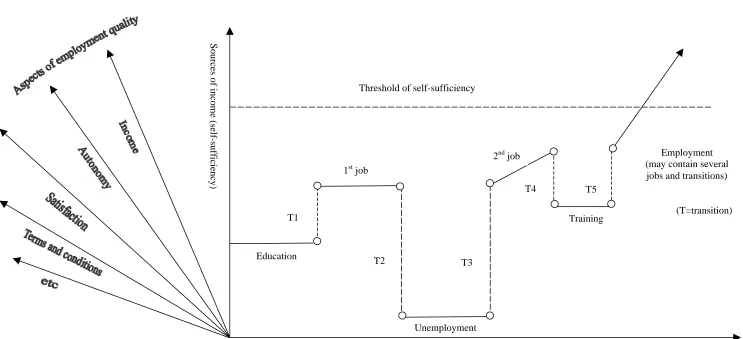
When measurement frequency is high it becomes possible to plot employment trajectories
such as the one presented schematically in Figure 1. The technical challenge presented by
trajectories is to develop methods by which typologies of similar trajectories can be
Figure 1 An employment trajectory
Education
1st job T1
T2 T3
2nd job
T4 T5
Employment (may contain several jobs and transitions)
(T=transition) Threshold of self-sufficiency
Sources of income (self-sufficiency)
Time Training
In the meantime simpler devices can be used. One four-way measure combines earnings
growth and employment stability. Employment is defined as sustainable if:
a) it lasts for three months (short-term sustainability) or nine months (longer-term
sustainability); and
b) earnings grow or remain constant in real terms during the period.
Using this measure with six years of data from the British Household Panel Study suggests
that, in the early 1990s, 27 per cent of job engagements resulted in employment that was not
sustained under the short-term definition. This proportion rose to 42 per cent under the more
rigorous longer-term formulation (Kellard et al., 2000).
3 FACTORS ASSOCIATED WITH EMPLOYMENT SUSTAINABILITY
The level of sustainable employment results from the interplay of individual and structural
factors. Taking the latter first, there has been a shift in employment away from
manufacturing towards the service sector and an associated growth in low paid and
non-standard and ‘flexible’ employment including temporary work.
It is important not to exaggerate the scale of these changes and there is little evidence that the
core-periphery model of the flexible firm with a large number of casual workers in relation to
permanent staff is widespread (Meadows, 1999; Walker et al., 1999). However, non-standard
employment tends to be concentrated in particular industrial sectors, some of which have
been growing comparatively quickly. Moreover, the entry-level jobs available to people
moving off benefit are disproportionately likely to be temporary and/or non-standard.
Indeed, sectors with high levels of staff turnover will necessarily generate disproportionate
numbers of job openings although again, by definition, disproportionate numbers of
engagements will be temporary or otherwise result in involuntary separations.
Shorter-term employment is concentrated in industrial sectors such as distribution, hotels and
catering, and agriculture and disproportionately affects retail and service workers, machine
operators and other so called ‘elementary’ occupations. Likewise, experts interviewed for
Over the last twenty years or so, employers in the UK may have found it relatively easy to fill
unskilled or low level jobs, and accordingly may have placed limited emphasis on strategies
to retain employees at these levels.
As unstable employment is concentrated in certain industrial sectors, and therefore also in
certain geographic regions, it is also concentrated among certain types of workers: the young;
women; those with limited education and qualifications; and those with a history of
unemployment and casual employment. Women, for example, are more likely than men to
take short-term or part-time jobs (Tremlett and Collins, 1999; Cully et al., 1999). This may,
in part, be due to their juggling the demands of caring for dependants. Equally it might mean
that, perhaps as a consequence of their caring responsibilities, they can only access precarious
or low skilled employment. Indeed, there is an inherent reflexivity between the
characteristics of jobs and jobholders. Research in the USA, for example, suggests that
although younger workers with low skill levels experience high levels of job instability, this
has more to do with the types of jobs that are available to them than with their individual
attributes, preferences or aspirations (Holzer and LaLonde, 1999). In this example, it is
labour market deficiencies rather than individual ones that make it difficult to achieve
sustained employment.
There is little reason to suppose that changes in labour supply have been the major
determinants eroding employment sustainability. On the one hand, there has been a sustained
growth in the proportion of women working and, as noted above, women are more prone to
be in casual or short-term employment. Equally, the recessions of the 1980s, which affected
manufacturing more than the service sector, released large numbers of people onto the labour
market with redundant skills who may have found it difficult to secure sustained
employment. On the other hand, the proportion of young workers, a group renowned for
their propensity to change jobs quickly, has fallen over the last 20 years both for demographic
reasons and because more have stayed on in education. Correspondingly, the proportion of
workers with vocational and (especially) academic qualifications has risen which should
enhance employment sustainability. Whether employers’ demand for qualifications has
outstripped the increasing supply is uncertain, although the early evidence from the New Deal
Further research is required to establish whether there has been a fall in sustainable
employment and the balance between structural causes and those relating to individual
circumstances. What is evident is that entry-level jobs often fail to foster sustained
employment. The next section lists some of the considerations that will need to be taken into
account in designing policies designed to overcome this obstacle.
4 ISSUES IN THE DESIGN OF POLICY
Designing policy to enhance employment sustainability, to enable people to make better, or
more successful transitions from unemployment to work and to advance within employment
towards self-sufficiency is new territory. There are few working models, little evidence as to
what (if anything) works and more experience of failure than of success. There is consensus
in the USA that it is vital to try to develop policy to foster sustainability (or employment
retention and advancement) despite previous disappointments, but a paucity of ideas as to
what form policy should take. However, while the research evidence offers no clear-cut
policy answers, it points to a number of factors that will need to be taken into account in the
design of policy. These are grouped below into those appertaining to the:
• objectives of policy;
• targeting of intervention;
• timing of intervention;
• constraints on take-up;
• labour market constraints;
• agency and implementation; and
• measuring outcomes.
4.1 Policy Objectives
Policies could be designed to advance one or more of the component elements of
employment sustainability over varying periods of time. Likewise, policies could focus on
supply and/or demand side factors. Table 1 lists eight separate policy objectives based on the
four primary objectives of promoting stability, retention, progression and self-sufficiency,
differentiated according to whether the emphasis is job-focused (and generally short-term) or
promoting employment stability and progression. This reflected a realisation that entry level
jobs often do not facilitate promotion or wage progression and that the latter might only be
achieved through job mobility (Fishman et al., 1999). With employment focused objectives,
it is important to ensure that spells of unemployment between jobs are minimised, or ideally
avoided, so as to ensure overall income growth and avoid any negative effects of
unemployment on human capital resources.
Table 1 Policy Objectives
Objective Job centred Employment focused Stability Maximise duration of job Minimise periods without
work (or in
non-developmental activity
Retention Minimise impact on job
tenure of changes in
circumstances
Maximise adaptability
Progression Foster promotion within the
workplace/enterprise
Promote employment
advancement and career
development
Self-sufficiency Maximise wage and
post-transfer income
Maximise individual wage
growth
4.2 Targeting
A key lesson drawn by respondents from the US Post Employment Services Demonstration
was that targeting is essential if services are to prove effective (Rangarajan and Novak,
1999). Many welfare recipients returning to work in the USA required little or no support,
others required intensive service provision; serving a large, heterogeneous population
frustrated attempts to deliver effective services to those who most needed them.
Targeting can be categorical, based on prior criteria, or discretionary. While the
characteristics of those prone to long spells of unemployment are well known, few studies
have sought to predict employment stability on the basis of individual characteristics and
employment were characteristic of people in bad health with limited prior work experience
and poor numeracy. In the USA, predictive models have taken account of age, health status,
prior work experience, school graduation, age of youngest child, and a set of job
characteristics including hourly wage rate and the availability of paid holidays (Rangarajan et
al., 1998). Such multivariate models can be computerised or simplified for administrative use
but the balance of opinion in the US is that they should be used as indicative or supportive
aids to targeting rather than the sole or principal method.
In the absence of definitive targeting criteria, allocative decisions are likely to fall to
case-workers who, with sufficient time and contact, may be able to build up a rounded
understanding of people’s circumstances and make informed judgements as to what level of
support should be offered. However, even such a preliminary evaluation is likely to prove
time-consuming.
It is at least arguable that some of the softer attributes needed to perform well in today’s
labour market, such as ‘identity capital’ (Bynner, 1998) - the individual’s view of who they
are and how they present themselves to others - are not amenable to formal measurement.
This may encompass ‘soft skills’ including communication, adaptability and amenability.
The Personal Advisor model may well be successful in identifying and addressing these kind
of deficiencies, given the discretion to assemble appropriate packages of support and
development and, if appropriate, seek assistance from intermediary organisations with
particular specialisms or experience of certain groups.
It is often the presence of multiple barriers that hinder the transition into employment, rather
than any one particular disadvantage. Key agent respondents in this research believed that
people who are most disadvantaged in the labour market, and therefore warrant policy
intervention, typically suffer from a variety of disadvantages, such as poor housing, low skill
levels, poor social skills, family breakdown, drug or alcohol dependency, low self-esteem and
ill-health. The existence of multiple disadvantages could thereby be used as a criteria for
offering services (the aim of which might also be to address the variety of problems rather
recent ex-benefit recipients occupy entry-level jobs with little prospect of advancement, many
others would seem to face equally limited opportunities for betterment.
A final aspect of targeting relates to whether resources should be focused on changing the
behaviour of workers and potential workers, or that of employers, or a mixture of both. This
will reflect political considerations as well as analysis of the nature of the problem.
4.3 Timing
Evidence from the USA suggests that the timing of intervention is likely to be critically
important to the success of policies designed to foster job retention. There, promoting
services only after welfare mothers had moved into employment was found to be
counter-productive, since clients in work had to be re-recruited to the post-employment scheme. The
prevailing wisdom is that services should be offered in a joined-up fashion beginning before
clients take-up, or return to, employment. This is seen as likely to substantiate the legitimacy
of employment advisers having a post-employment role – both in the eyes of clients and
especially from the viewpoint of employers to whom they can offer a comprehensive service
spanning recruitment and retention. It may also act as a work incentive since prospective
employees know that help is at hand should difficulties arise during the first weeks of
employment.
A focus on retention and progression means that traditional, pre-employment services, such
as classes to boost self-esteem and teach soft skills, have to be re-orientated. In addition to
imparting advice and skills that allow clients to perform well at interview, the aim becomes to
equip prospective employees with the techniques necessary to hold down employment and to
develop and follow a ‘career’ plan.
Timing is also an aspect of the targeting decision. The longer someone remains in a job, the
more likely it is that they will continue in employment. The first six months in a job are
particularly precarious, and it is during this period that individuals are most at risk of
returning to unemployment. Families have to make significant adjustments in their way of
life and pattern of budgeting (Ford et al., 1995). Workers have to adapt to the work
environment and the job-match may well be imperfect. The period to receipt of the first
in-work benefits. Strategies need to be developed for coping with the breakdown of childcare
or transport.
The evidence suggests that post-employment support needs to be at its most intensive during
the first few weeks of employment, and substantial for a period of perhaps six months.
However, if the objective is employment progression rather than simple job-retention,
services are required to be accessible for much longer.
4.4 Constraints on Take-Up
Uptake of some of the voluntary New Deal programmes in Britain and of the Post
Employment Services Demonstration in the USA has been low. In part, this may simply
reflect the time it takes for people to adjust to the provision of a new service where one did
not exist before. Integrating new services within the fabric of well-established and socially
accepted ones can serve simultaneously to dispel ignorance and engender positive support for
innovation. In this regard, post employment measures follow naturally from existing
pre-employment and job placement schemes.
Nevertheless, there may be specific obstacles to the high take-up of post-employment
measures. One is the possible stigma attached to receipt of state welfare and a desire to
conceal this from employers and work colleagues. The provision of a seamless job
placement and retention service for employers may partially neutralise this concern to the
extent that the continuing role of employment advisers or their counterparts becomes widely
accepted in the work-setting.
Another consideration is the availability of post-employment support outside working hours.
Access to services after work or at weekends is essential since many employers do not allow
employees to take time off during the working day. Provision of services, such as training on
work premises, and perhaps during lunch hours, may also be an option.
A further brake on the use of post-employment services are the time pressures that
employment itself creates. The uptake of further education classes provided for former
GAIN in California) has been to provide family centres providing learning and other
experiences for all family members.
4.5 Labour Market Constraints
It is important to remember that supply side policies designed to enhance employment
sustainability are constrained by the characteristics of labour demand. New entrants are
likely to be the first to be made redundant in a recession. Also, as noted in Section 3, there
have been trends in some sectors of the British labour market towards increased flexibility
which may reduce job security and erode employment sustainability.
British employers have, over the last twenty years or so, found it relatively easy to fill
unskilled or low level jobs, and accordingly may have placed limited emphasis on strategies
to retain employees at these levels. Where there is a tighter labour market, as currently in the
US, employers may find it difficult to fill even their low level vacancies. In such
circumstances employers may be more receptive to incorporating employee retention and
development strategies into their recruitment practices. There is some evidence of this
happening in the US even in a context where there are increasing numbers of welfare
recipients seeking work (as a consequence of time limited entitlement to welfare and a
‘work-first’ approach to labour market attachment). Employers are finding that potential employees
do not have the basic or ‘soft’ skills that the workplace needs.
In fostering sustainable employment, employers face a trade-off. It is one between the
short-term savings that accrue from low investment in the skill-base of their workforce and the
flexibility to be able to downsize cheaply in the face of contracting demand on the one hand,
and on the other hand competitive and financial advantages that accompany highly
committed employees. Public policies to promote employment sustainability serve to
subsidise employers either indirectly or directly. Indirectly they gain from public action to
enable and encourage workers to adopt behaviours that reduce involuntary separations and
staff turnover and create a larger pool of skilled personnel from which to recruit. They stand
to gain directly from such services as job placement and mentoring and also from subsidies
4.6 Agency and Implementation
Although employment advice and job placement assistance have traditionally been the
preserve of the Employment Service and commercial recruitment agencies, many of the New
Deal schemes are seeking to engage with a wide range of partners, including employers.
Indeed, a strong case can be made that employers are major beneficiaries of policies that
encourage employment retention and progression.
It is relatively easy to define the qualities to which post-employment measures should aspire
but, as the US experience demonstrates, less easy to deliver them.
• Continuity – seamless provision across the employment divide so that expectations of
post-employment support can be established early and confidence developed in the ability
of named personnel to deliver. This aspiration can breakdown when pre-employment
job-placement and other services have a poor reputation or are perceived to be highly
stigmatising. When different agencies (and/or personnel) deliver pre and
post-employment services, continuity may be compromised unless inter-agency
communications are excellent.
• Case-working – named case-workers can offer continuity, follow-through and, given a
detailed understanding of clients’ needs, employer demands, service options and labour
market opportunities, gain the respect of their clients and effectively allocate resources.
However, effective case-working can be frustrated if caseloads are too large. This can
prevent detailed assessment and matching, particularly if staff are inadequately trained or
if staff turnover is high. It has been suggested in the USA that case-workers should have
a practical problem solving orientation rather than a counselling or therapeutic focus
(Strawn and Martinson, 1999).
• Quality job placement – US evidence suggests that people who enter better quality, better
paid jobs enjoy more sustained employment and progress more quickly, although it is
sometimes difficult to isolate the impact of ‘quality jobs’ from ‘quality workers’ (Strawn
• Selective proactive and pre-emptive strategies – policy intervention and implementation
needs to be selective – to maximise the impact of scarce resources – and focused on the
avoidance of unsustainable crises through foresight and early action. It is preferable to
strive for prevention in the workplace than to rely on ameliorative action after the event.
This will typically mean initiating frequent contact with clients in the early weeks of
work, seeking feedback from employers and focusing on resolving the immediate causes
of impending problems.
• Flexibility – policy design and implementation has to be flexible because employees are
very heterogeneous in their characteristics and employment situations vary markedly.
This generally denies the possibility of detailed prescription.
• Comprehensiveness – because of clients’ heterogeneous needs, services have to be
wide-ranging. They also need to be designed simultaneously to tackle the multiple obstacles to
sustainable employment that some people face, rather than addressing problems in a
one-off, ad hoc fashion. This, in turn, will typically mean that services need to be offered
through a range of specialist suppliers and intermediaries, and that caseworkers act
principally as brokers rather than the suppliers of services.
• Co-ordination and team working – the involvement of multiple suppliers required by the
demands of flexibility and comprehensiveness in turn imposes the need for effective
co-ordination and a common commitment to meeting the needs of clients. It was evident in
the Post Employment Services Demonstrations that there was sometimes a failing in
communication that left clients and their advisers unaware of the full range of services
that could be deployed. It is also the case that suppliers of services are sometimes
competitors and find it difficult to move quickly into a partnership relationship. Equally,
styles of operation often differ markedly across the public/private and profit/not-for-profit
divides. While there is no legitimate reason why these obstacles should not be overcome,
they need to be recognised in the design and implementation of post-employment
services.
If the above list serves to define good practice, albeit based on aspiration rather than
voluntary schemes or what is the most appropriate basis for setting targets and monitoring
performance.
Compulsion versus voluntary provision – it is difficult to argue that all people should be
compelled to advance in employment or even to seek to do so. However, compulsory
engagement in post-employment measures might be justified for people receiving in-work
benefits by reference to a personal responsibility pact: this could emphasise that individuals
have a personal responsibility to pursue self-sufficiency and to avoid reliance on welfare.
Compulsion might help to address problems of low uptake and high unit costs but could
reduce effectiveness if clients were reluctant participants, trust between caseworker and client
was undermined or caseloads became too large.
Performance monitoring – the literature on performance monitoring has not been reviewed in
this research. However, respondents warned of some of the perverse effects that can result
from setting performance targets. Many welfare to work contracts with commercial and
voluntary sector organisations in the USA now include payment bonuses linked to job
retention, partly to avoid the off-loading of welfare recipients into temporary employment.
Even so, there was talk of unscrupulous agencies fixing employment contracts in relation to
the period of employment required to generate bonuses. Some respondents were impressed
by arguments that incentives should be linked to the achievement of intermediate outcomes
rather than ‘final’ outcomes such as job retention rates. The view was expressed that small
steps towards sustainable employment, such as the demonstrable acquisition of soft skills,
constituted large leaps for some more disadvantaged clients.
4.7 Measuring outcomes
An evaluation of the impact or effect of policy interventions designed to enhance
employment sustainability requires the measurement of outcome variables, such as length of
time in employment or wage progression. Recent work in the US on employment retention
and advancement has suggested the following possible measures (The Lewin Group, 1999):
• continuous quarters of employment;
• changes in wages;
• quarterly benefit receipt;
• type of job;
• length of time between jobs;
• hours worked (part-time, full-time, seasonal);
• length of employment;
• number of returns to ‘welfare’; and
• number of persons in jobs with benefits (such as health care or transport assistance).
These measures are clearly not comprehensive or complete, nor do they satisfactorily capture
all aspects of the concept employment sustainability identified in this report. Moreover, they
are defined with respect to data readily available in the USA. Nevertheless, they provide a
battery of measures that have already been used to some effect.
5 POLICIES TO PROMOTE EMPLOYMENT SUSTAINABILITY
The more obvious forms of intervention that could be implemented with a view to increasing
employment sustainability are listed in Table 2 (Fishman et al., 1999; Rangarajan, 1998;
Strawn and Martinson, 1999). The table differentiates between interventions directed at
jobseekers and employees and those aimed at employers. For the former group it also
distinguished between measures that would only be applicable after a person had secured
employment from those that could be applied either before or after a person enters work. It
also relates each intervention to the eight sub-objectives introduced in Section 4.1. It is
important to recognise that very few of the measures have been effectively evaluated.
5.1 Pre- and Post Employment Services
Measures that can be implemented both before and after a person finds work include the
following:
• Upgrading skills through providing training in job specific (hard), workplace (soft) and
life skills and remedial education. Much of the content of the various New Deals is
directed to this goal, and to the extent that it is successful, this should enhance
employment sustainability. In Britain, in-work training has largely been left to employers
initiative in the case of out of work-time training. Policies to stimulate the provision of
in-work, developmental training (as opposed to job specific training) by employers, either
individually or as industrial sectors, could help to promote employment progression.
• Job-search and placement assistance is traditionally restricted to unemployed people and
selected groups wishing to enter the labour force. Employment advancement and career
development objectives point to expanding employment services to employed workers
and making them more accessible (by, for example, extending Jobcentre opening hours
and offering more web-based services).
• Career mediation, a new term, refers to sectoral initiatives which seek to offer structured
career advancement (‘job ladders’) by facilitating movement between firms and
enterprises, with moves initiated and/or managed by employment advisers/case-workers
(Bernhardt and Bailey, 1998).
• Counselling can include support for money management and budgeting, contingency
planning, guidance to improve workplace behaviour and help with personal problems
judged likely to impede sustained employment. The New Deal family of policies include
counselling but this is not extensively available to people who have taken up
employment.
• Career and life-planning tuition assists clients to take a longer-term perspective on their
employment prospects and career opportunities and provides advice and support in
developing strategies. The careers advisory companies provide elements of such a
service for young people in Britain.
• Benefits advice and advocacy is an essential service for people especially, but not only, at
the point when they begin work. The network of Citizens Advice Bureaux and welfare
rights offices offers benefits advice in a responsive mode while the various New Deals
proactively offer advice to jobseekers. A proactive service might need to be offered to
• Service referrals are required to assist people assess the employment implications of their
health conditions and impairment and to identify and tackle substance abuse. The New
Deal for Disabled People Personal Advisor Service is an example of such a scheme that
focuses on job retention as well as job placement.
5.2 Post-Employment Measures
The following set of measures are appropriate for people once in work:
• Earnings supplementation through the Working Families’ Tax Credit and the Disabled
Person’s Tax Credit and other in-work benefits enhance employment sustainability by
protecting people against the most immediate consequences of downward fluctuating
earnings. There is some concern, however, that such benefits may inhibit wage
progression leading to suggestions that work-focused interviews should accompany
benefit renewals (Bennett and Walker, 1998).
• Financial bonuses and other incentives can be paid to individual clients or intermediary
organisations linked to job retention, job advancement or to other measurable
intermediate outcomes such as attendance at training or education sessions.
• Transitional provision and services are particularly important to smooth the transition
into employment during the early weeks which, as noted earlier, is the time when
employment separations are most likely to occur. Many provisions are already in place
within the benefit system, which are designed to facilitate this transition and, in the case
of some groups, such as disabled people, to limit loss of benefit entitlement should
employment prove to be unsustainable. Proactive counselling/case-management would
also be most intensive during the early weeks of employment.
• Emergency support services are an important feature of post-employment provision in the
US. Often they take the form of cash payments to cover such contingencies as car repairs
or insurance. They also include initial employment expenses such as tools and work
• Mentoring and support groups provide a typically low cost method of boosting morale
and providing assistance at times of crisis. Support groups comprise cohorts of people
returning to work, while mentoring involves the pairing of less and more experienced or
skilled workers. Mentoring schemes can be sponsored by employers or provided through
voluntary organisations. Support groups tend to be co-ordinated by caseworkers.
• Employer mediation allows for the caseworker to mediate in disputes that may place the
prospect of continuing employment in jeopardy. Mediation by its very nature entails the
agreement of both employer and employee. In the Post-Employment Services
Demonstration in the USA many of the employees did not want the caseworkers to
mediate for fear of their employers learning that they had been on welfare or needed
external help dealing with their problems.
• Provision of in-work support services covering childcare, transport and housing is
recognised in the USA to be essential for some people if their employment is to be
sustained. In Britain, the National Childcare Strategy, together with Childcare Tax
Credit, covers registered childcare but does not benefit those reliant on informal
childcare. Emergency provision in the event of child sickness might be particularly
beneficial for lone parents and two worker couples. Poor housing may be less of a
concern in Britain (with the obvious exception of homeless people) but unreliable
transport to work is probably more important as a factor contributing to job-loss than is
typically recognised.
5.3 Measures Aimed at Employers
Employers stand to benefit directly and indirectly from all the policy measures discussed
above in so far as they succeed in fostering employment retention and progression, thereby
enabling them to retain productive staff. Indeed, employers are direct customers for job
placement, emergency support and mediation services. However, there are specific demand
side measures, in addition to the supply side ones discussed so far, that could be aimed
directly at employers. These include:
offered to employers to recruit staff from some of the New Deal programmes, bonuses
could be offered based on the length of employment served by former benefit recipients.
Alternatively, as in some continental European countries, taxes and social insurance
levies could be used to penalise redundancies or involuntary separations. Tax incentives
could be used to encourage staff training which would foster the progression of staff but
which might also encourage employers to retain their staff.
• Peripatetic human resource management offers small firms specialist personnel functions
to which they do not normally have access for reasons of cost. This would not only
enhance their efficiency but might sensitise employers and managers to the financial
advantages that accrue from investing in developmental staff training, and the real costs
incurred as a result of casual employment practices.
• Job retention guidance may be viewed as a sub-category of peripatetic human resource
management, designed to provide employers with specific advice in the event that an
employee suffers a chronic health problem or develops an impairment that puts their job
in jeopardy. The New Deal for Disabled People programme includes job retention
guidance as an element.
• Employment awareness campaigns would seek to draw the attention of employers to the
advantages of prioritising job retention and human resource policies and alert them to
public polices to support such activity.
• Sectoral brokerage services provide an infrastructure to encourage firms within industrial
sectors to act in partnership to implement policies that promote developmental training
Table 2 Policies to Promote Employment Sustainability
Objectives
Job centred Employment focused
Stability Retention Progression Self- sufficiency Stability Retention Progression Self- sufficiency
Pre and post-employment services
Upgrading skills ✔ ✔ ✔ ✔ ✔ ✔ ✔ ✔
Job-search and placement assistance ✔ ✔ ✔? ✔ ✔ ✔?
Career mediation ✔ ✔ ✔ ✔? ✔ ✔ ✔ ✔?
Counselling ✔ ✔ ✔? ✔ ✔?
Career and life-planning tuition ✔ ✔ ✔ ✔? ✔ ✔ ✔ ✔?
Benefits advice and advocacy ✔ ✔?
Service referrals
• Health related ✔ ✔ ✔? ✔
• Substance abuse ✔ ✔ ✔? ✔
Post-employment measures
Earnings supplementation ✔ ✔ ✔ ✔
Financial bonuses ✔ ✔ ✔
Transitional provision and services ✔ ✔ ✔
Emergency support services ✔ ✔ ✔
Mentoring ✔ ✔?
Employer mediation ✔ ✔
Provision of in-work support services
• Childcare ✔ ✔ ✔? ✔?
• Transport ✔ ✔ ✔? ✔?
Measures aimed at employers
Financial incentives ✔ ✔ ✔?
Peripatetic human resource
management ✔ ✔ ✔
Job retention guidance ✔
Sectoral brokerage services ✔ ✔
6 POLICY OPPORTUNITIES AND LIMITATIONS
The attraction of polices that foster employment sustainability is that they offer the possibility
of a ‘win-win-win’ situation: individual and family welfare is enhanced, the skill-base of the
economy is increased with positive benefits for international competitiveness, and public
expenditure on welfare benefits is reduced. It is not surprising, therefore, that with seemingly
successful welfare to work policies in place, attention in Britain should expand to policies
that help people to stay in work. Similarly, it is understandable that policy makers in the
USA are keen to pursue such policies even in the absence of encouraging results from their
first generation of employment retention and advancement programmes.
The causes of unsustainable employment must reside in the abilities, aptitudes and aspirations
of workers and in the structural factors that shape both labour demand and the behaviour and
attitudes of employers. Evidence does not indicate which is the most important set of factors.
It follows that public policies to foster sustainable employment can address either supply or
demand side factors and, since it is not apparent which is the most important, may need to
tackle both. The kinds of policy that might be introduced have been discussed above. None
has yet been proven to work in situ, although information gleaned from analogous welfare to
work schemes can be brought to bear in choosing between policy options, along with
evidence of what has been tried, especially in the US, and found lacking.
Employment sustainability, best defined as ‘the maintenance of a stable, or upward
employment trajectory in the longer term’, requires policy objectives that extend beyond the
promotion of job stability to embrace aspirations for employment stability, progression and
the attainment of self-sufficiency. Policies limited to job stability3 in the USA have been found to trap people in low-quality, entry level jobs that offer little earnings growth, and fail
to assist people to move out of poverty and off in-work benefits.
Individual policies, and the flexible packages of policies that are needed in response to the
heterogeneous and multiple barriers that some potential and current employees face, should
offer seamless provision across the employment divide. The seeds of sustainability should be
planted while a person is still unemployed (or even when they are economically inactive).
This means the acquisition of life-skills, hard and soft workplace skills, career planning skills
and the provision of support and counselling. These services and provisions need to continue
to be available at various times and for varying periods when people are, or become,
employed. Provision needs to be proactive and most intense during the first weeks and
months of employment. It also needs to be conveniently accessible to people in full-time
employment, a group not traditionally served by the Employment Service.
Provision needs to be comprehensive in scope but focused in its targeting. Intensive
provision is required for people most at risk of experiencing unsustainable employment. This
requires case-management or casework by appropriately and well-trained staff; it is likely to
be ineffectual if staff have to divide their time among an overly large caseload. Other people
returning to work probably require little or no support during their transition into work or
while in employment. In the virtual absence of detailed statistical evidence about who is
prone to experience unstable employment – beyond a knowledge of broad at-risk groups and
general precipitant characteristics – eligibility assessments and resource allocation are
perhaps best handled by case-workers.
Most policies implemented to date have focused on enhancing the skills and resilience of
prospective and existing workers. Therefore, there is little evidence about the effectiveness
of policies directed at employers: either low cost awareness campaigns or more expensive
incentives and subsidies and human resource management services. However, it is apparent
that employers have a stake in the effectiveness of all policies to enhance employment
sustainability and stand to gain financially and in other ways from their success. It is also
apparent that, under specific circumstances, certain employers are prepared to engage
proactively in policies to reduce staff turnover and to promote career advancement. Equally,
however, significant numbers of employers appear to have given little priority to fostering job
retention or developmental training, because they have either been unwilling or unable to do
Policy development is further hindered by a lack of statistical information about the true
extent of unsustainable employment and the limited value of the traditional data sets for
monitoring trends or establishing the impact of new policies. The British Household Panel
Study contains more relevant information than most surveys but the sample size is relatively
small. What the panel element of the Labour Force Survey offers in terms of large sample
size is offset by the restricted number of variables, its individual rather than household focus
and the limited time window that it provides. Nevertheless, further analysis of existing data
is both necessary and possible.
Furthermore, the evidence available to date does not guarantee that policies to foster
employment sustainability will meet with success. Schemes introduced in the USA aimed at
workers and potential workers have generally proved lacking – uptake has been limited and
net outcomes in terms of employment and earnings have been disappointing. Moreover,
while certain employer-based schemes in the USA claim a considerable degree of success,
they have not been independently evaluated. In addition, some of the potential causes of
unsustainable employment probably lie outside labour market policy in the primary education
system, in management training and in the dynamics of the global economy. Nevertheless,
the US policy community remain committed to the revision, development and further testing
of policies in this area.
Given the potential gains that would accrue from the success of polices to foster employment
sustainability for individual families, individual firms and for the long-term well being of
society, there is a clear imperative for action. As there is no proven model of delivery or any
surety of success, action should take the form of small scale, carefully evaluated pilots.
These should be accompanied by further analysis of existing data to inform understanding of
the underlying relationships, and a strategy to improve the basis for the statistical monitoring
References
Bennett, F. and Walker, R., (1998), Working with Work, York: YPS for the Joseph Rowntree Foundation.
Bernhardt, A. and Bailey, T., (1998), Making Careers out of Jobs: Policies to address the new employment relationship, New York: Institute on Education and the Economy, Columbia University.
Bynner, J., (1998), ‘Education and Family Components of Identity in the Transition from School to Work’, International Journal of Behavioural Development, 22 (1), pp. 29-53.
Cully, M., Woodland, S., O’Reilly, A. and Dix, G., (1999),Britain at Work: as depicted by the 1998 Workplace Employee Relations Survey, London: Routledge.
Fishman, M. et al., (1999), Job Retention and Advancement Among Welfare Recipients: Challenges and opportunities, Baltimore: Lewin Group and Johns Hopkins University.
Ford, J. et al., (1995), Into work? The impact of housing costs and the benefits system on people's decision to work, York: Joseph Rowntree Foundation.
HM Treasury, (1997), Equipping Britain for our long term future, Financial Statement and Budget Report, July 1997, HC 85.
Holzer, H. and LaLonde, R., (1999),Job Change and Job Stability among Less-Skilled Young Workers, Institute for Research on Poverty.
Keep, E. (2000), ‘Employers’ Attitudes to Training’. Skills Taskforce Research Paper 20, DfEE, Sudbury.
Kellard, K., Walker, R., Ashworth, K., Howard, M. and Liu, W C. (2000) Staying in Work: Thinking about a new policy agenda, Loughborough: CRSP Working Paper CRSP 388.
Leisering, L. and Walker, R., (eds.), (1998), The Dynamics of Modern Society: Poverty, policy and welfare, Bristol: Policy Press.
Meadows, P., (1999), The flexible labour market: implications for pension provision, London: National Association of Pension Funds.
Rangarajan, A., (1998), Keeping Welfare Recipients Employed: A guide for states designing job retention services, Princeton: Mathematica.
Rangarajan, A. and Novak, T., (1999), The Struggle to Sustain Employment: The effectiveness of the post-employment demonstration, Princeton, NJ: Mathematica.
Strawn, J. and Martinson, K., (1999), Steady Work and Better Jobs: How to help low-income parents sustain employment and advance in the workforce, New York: Manpower
Demonstration Research Corporation.
Teasdale, P., (1998), ‘The incidence of unemployment and repeat spells using claimant unemployment data’ in Labour Market Trends, November.
Tremlett, N. and Collins, D., (1999), Temporary Employment in Great Britain, DfEE Research Report no 100.
Trickey, H., Kellard, K., Walker, R., Ashworth, K. and Smith, A., (1998), Unemployment and Jobseeking: Two years on. London: The Stationery Office, DSS Research Report 87.