
Open Access
D E B A T E
Bio
Med
Central
© 2010 Delnoij et al; licensee BioMed Central Ltd. This is an Open Access article distributed under the terms of the Creative CommonsAttribution License (http://creativecommons.org/licenses/by/2.0), which permits unrestricted use, distribution, and reproduction in any medium, provided the original work is properly cited.Debate
The Dutch Consumer Quality Index: an example of
stakeholder involvement in indicator development
Diana MJ Delnoij*
1,2, Jany JDJM Rademakers
3and Peter P Groenewegen
3,4Abstract
Background: Like in several other Western countries, in the Dutch health care system regulated competition has been introduced. In order to make this work, comparable information is required about the performance of health care providers in terms of effectiveness, safety and patient experiences. Without further coordination, external actors will all try to force health care providers to be transparent. For health care providers this might result in a situation in which they have to deliver data for several sets of indicators, defined by different actors. Therefore, in the Netherlands an effort is made to define national sets of performance indicators and related measuring instruments. In this article, the following questions are addressed, using patient experiences as an example:
- When and how are stakeholders involved in the development of indicators and instruments that measure the patients' experiences with health care providers?
- Does this involvement lead to indicators and instruments that match stakeholders' information needs?
Discussion: The Dutch experiences show that it is possible to implement national indicator sets and to reach consensus about what needs to be measured. Preliminary evaluations show that for health care providers and health insurers the benefits of standardization outweigh the possible loss of tailor-made information. However, it has also become clear that particular attention should be given to the participation of patient/consumer organisations. Summary: Stakeholder involvement is complex and time-consuming. However, it is the only way to balance the information needs of all the parties that ask for and benefit from transparency, without frustrating the health care system.
Background
Introduction
Several other Western countries, for example the United States, look at the Dutch healthcare system as an example [1,2]. In the Netherlands, regulated competition has been introduced in healthcare. In order to make this competi-tion work, transparency is required [3]. Consumers and health insurers or other purchasing agencies need com-parable information about the performance of health care providers in terms of effectiveness, safety and patient experiences. Apart from that, transparency is also required from the point of view of public accountability [4,5].
In centralised, state-oriented systems like the English National Health Service (NHS), government or govern-ment agencies impose national sets of performance indi-cators with which health care providers have to comply. The English Care Quality Commission asks "all NHS organisations to assess their performance against the Government's 24 core Standards for Better Health" [6]. However, in pluralistic systems like the United States, or in social insurance systems like the Netherlands, quality standards are not likely to be imposed by government, and the definition of indicator sets requires much more coordination and negotiation among the actors in the health care system.
In the United States, standardized indicator sets are developed by private not-for-profit organizations, such as the Joint Commission [7] and the National Committee for Quality Assurance (NCQA). The NCQA, for example, aims to build consensus among large employers,
policy-* Correspondence: [email protected]
1 Centre for Consumer Experience in Healthcare (Centrum Klantervaring Zorg).
PO Box 1568, 3500 BN Utrecht, the Netherlands
makers, medical professionals, patients and health insur-ers to decide how to measure important aspects of quality of care. The NCQA is responsible for the management of the Healthcare Effectiveness Data and Information Set (HEDIS), a set of standardized performance indicators. HEDIS is used by more than 90% of health plans through-out the United States [8]. According to the American NCQA, consensus about indicators and measurement instruments is necessary, because transformation of the health care system requires the collective will and resources of all the actors involved: employers (in the American context), policymakers, professionals, patients and health insurers [9].
In the Dutch system, private, mostly not-for-profit organisations and self-employed private practitioners, provide health care. In a system of regulated markets, these organisations and practitioners are theoretically assumed to compete with each other for health insurance contracts and for individual patients. As such, they have an incentive to advertise and to give potential consumers information about specific products or services. How-ever, market forces do not generate comparative informa-tion without external pressure. In the Netherlands, this external pressure can theoretically be exercised by several actors: the Ministry of Health, the Inspectorate for Health Care, the Dutch Healthcare Authority ("Neder-landse Zorgautoriteit"), health insurers, and/or patient/ consumer organisations.
Without further coordination, all these external actors will try to force health care providers to be transparent. For health care providers this might result in a situation in which they have to deliver data for several sets of indi-cators, defined by different actors. To avoid this situation, the main challenge for the Dutch health care system cur-rently is to stimulate health care providers to be transpar-ent about those indicators that are relevant for the Inspectorate for Health Care, health insurers and patients/consumers alike. However, at the same time the amount of data and the number of indicators that provid-ers have to deliver, should be limited.
In the Netherlands, the performance of health care pro-viders is measured in terms of effectiveness and safety (in the Dutch context these are called 'professional indica-tors'), and patient experiences with quality aspects such as access, timeliness, information and communication, respectful treatment etc. A strong effort is made to define national sets of performance indicators and related mea-suring instruments. In the Dutch setting, these national indicator sets are agreed upon by all the stakeholders involved in the transparency debate. This should decrease the administrative burden on health care providers. Col-lecting information on performance indicators is time-consuming, costly and generally requires the cooperation of health care providers. However, by using national
indi-cator sets, information has to be collected once and can then be used for multiple purposes.
Because of the desire to define indicator sets, not from the perspective of one dominant actor (such as the Gov-ernment in England), but from the shared perspective of all parties involved, stakeholder participation and con-sensus building is a key aspect of defining national indica-tor sets in the Netherlands. In this article, we shall address the following questions, using patient experi-ences as an example:
- When and how are stakeholders involved in the devel-opment of indicators and instruments that measure the patients' experiences with health care providers?
- Does this involvement lead to indicators and instru-ments that match stakeholders' information needs?
In other words: is it possible to reach consensus about what needs to be measured and still cover enough of the information needs of various stakeholders to prevent them from developing their own, tailor-made indicator sets? The answer to this question is relevant for research-ers and policy makresearch-ers involved in indicator development. This article is based on desk research and observations by the authors. It should be noted that the authors are also personally involved in the transparency debate and the development of indicators and instruments namely as director (DD) of the Dutch Centre for Consumer Experi-ence in Health Care ("Centrum Klantervaring Zorg"), as head of the NIVEL research department involved in developing measuring instruments for patient experi-ences (JR), and as director of NIVEL (PG).
Indicators in the Dutch health care system
Patient experiences are measured using patient surveys. As part of the policy effort aimed at defining national indicator sets, a standardized method for measuring patient experiences using patient surveys is being pro-moted by the Ministry of Health, the Inspectorate for Health Care ("Inspectie voor de Gezondheidszorg"), patient/consumer organisations and by insurance compa-nies. This standardized method is called the Consumer Quality Index (CQI). Before describing stakeholder involvement in CQI development, in this section, back-ground information is provided on:
• the reforms in the Dutch health care system; • the CQI, as a standardized method for measuring patient experiences
• the information needs of stakeholders.
on the website of the Ministry of Health, Welfare and Sport [10]. Here we shall give a brief overview.
The health insurance market has been introduced nationwide in 2006 with the introduction of a new insur-ance system [11,12]. Health insurers offer a uniform, basic benefits package that includes primary care, hospi-tal care, prescription medication, and allied health ser-vices such as speech therapy, or physiotherapy for people with chronic diseases. In addition to that, enrolees can take out supplementary insurance, for example for addi-tional physiotherapy (the provision of which is limited under the basic benefits package), dental care, etc. Con-sumers have free choice of health insurer and can switch once a year. Health insurers are obliged to accept every-one for the basic benefits package. The premium for the basic benefits package must be based on community rat-ing, that is, different health insurers charge different pre-miums, but health insurers must charge the same premium for all their insured with a specific insurance policy. In other words, insurers are not allowed to differ-entiate premiums according to the risks of individuals or subgroups. However, they are allowed to offer different insurance policies that may be tuned to the needs of spe-cific subgroups of consumers. The most important differ-ence in insurance policies is between those based on direct payment (guaranteeing the enrolee access to health care providers who are contracted by the health insurer), and those based on restitution (guaranteeing full or par-tial reimbursement of health care costs incurred by the enrolee).
On the purchasing market, the system aims to provide health insurers with incentives to contract high quality, low-priced health services [13]. This is particularly the case for insurance policies based on direct payment. As a result, it also confronts health insurers with a need for comparative information about the performance of health care providers. They can use this information for selective contracting with preferred providers, and for pay-for-performance contracts aimed at stimulating spe-cific professional behaviour.
On the health care market, consumers with a restitu-tion policy have free choice of providers. Those with a policy based on direct payment can choose from an -usu-ally- comprehensive list of contracted providers. In such a system, patients/consumers too need comparative infor-mation about the price and quality of care, in terms of the effectiveness and safety of health services, and patient experiences with access and availability, timeliness, infor-mation etc [14].
Consumer Quality Index
In 2006, the CQI has been proposed by the Ministry of Health, Welfare and Sports as the national standard for measuring patient experiences with health care providers and health plans. CQI is a registered trademark that is
owned by the Centre for Consumer Experience in Health Care ("Centrum Klantervaring Zorg"). This Centre is a private foundation with a tripartite board (with members from patient/consumer organisations, health insurers, and health care providers), funded by the Ministry of Health, Welfare and Sports. The CQI trademark is used to certify that information about the performance of health care providers is valid, reliable, and comparable. The trademark indicates that the information has been collected with an official CQI patient survey, by a certi-fied 'survey vendor' according to rules and instructions described in the CQI Manual [15]. The Centre for Con-sumer Experience in Health Care coordinates the devel-opment of CQI surveys and it coordinates data collection with those questionnaires. CQI surveys are developed with both public and private funding. Public funding is used to develop surveys with a high public priority, e.g. in terms of quantity (incidence, prevalence and burden of disease), costs of illness, or in terms of market conditions (based on the extent to which the type of care addressed in the survey is subject to regulated competition). How-ever, data collection is mostly privately funded by health insurers or health care providers who are willing to par-ticipate in development projects.
The CQI is based on two principles: the CAHPS [16] method and the QUOTE [17] method. Both instruments measure patient experiences rather than patient satisfac-tion. Patient experience questionnaires ask whether cer-tain processes and events occurred. In the CQI, this inventory of experiences is combined with questions about values and expectations with regard to health care. For example: patients are asked to report how often in the past 12 months doctors explained things in a way they could understand (never, sometimes, usually or always). In addition, they are asked how important it is to them, that doctors explain things in a way they could under-stand (on a 4-point scale from 'not important' to 'of the utmost importance'). Combining questions about experi-ences as well as importance makes it possible to weigh negative experiences. This is helpful in determining pri-orities for quality improvement by providers. Improve-ment strategies should target those areas that are very important to patients, but with which they have relatively bad experiences. For informed patient choice, the impor-tance items are irrelevant. Individual patients seeking information about providers or treatments weight experi-ences of others against their own priorities. Insurance organisations might use information about the impor-tance people attach to aspects of care or service in their purchasing policies.
long-term nursing care, and for ambulatory mental health care. In addition to those, another 20 questionnaires are being developed for future use. These include emergency care, care for people with disabilities, inpatient mental health care, veteran health care, cancer care etc. The pro-cess of developing a CQI is described in detail in the CQI Manual of the Centre for Consumer Experience in Health Care.
CQI questionnaires are developed in public-private partnerships. The research part of the development proj-ect is usually commissioned and funded by public actors, mainly the Ministry of Health, Welfare and Sports and/or the Netherlands organisation for health research and development ("ZonMw"). However, the data collection necessary for the empirical testing of the questionnaires under construction is financed from private sources, i.e. by health care insurers or by health care providers. The data are owned by these private financiers, but the researchers are granted access to the data in order to con-duct psychometric and other statistical analyses that are required to validate the instruments. Because large data sets are required to test the discriminative power of CQI instruments, i.e. to test whether an instrument is able to detect differences in the performance of health care pro-viders, the costs of data collection are considerable and generally constitute about half of the total development costs. Total development costs of one CQI instrument can amount up to € 200,000.
Who wants to know what and why?
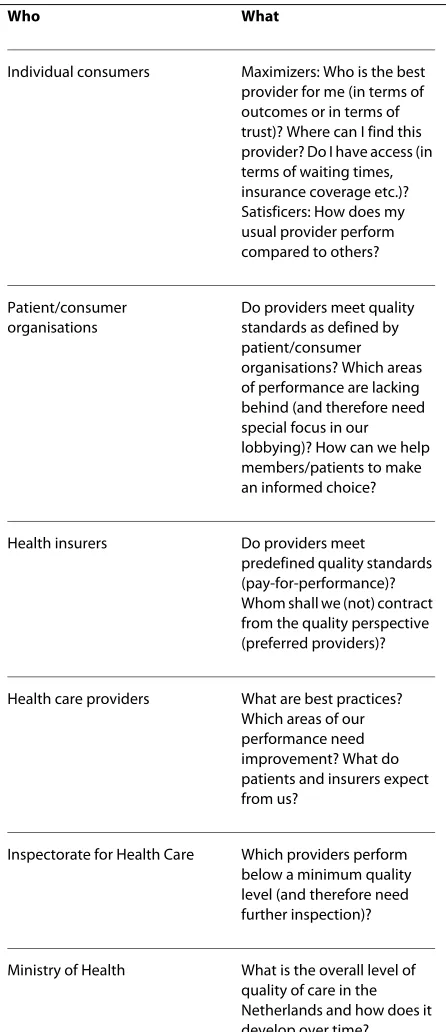
In health services research in general, and particularly in areas such as indicator development it is important to define from the start what the purpose of an indicator is. In other words, the question to be kept in mind is "Who wants to know what and why?" If we apply this question to the quality of care of health care providers, different stakeholders have different information needs. As we explained earlier, the performance of health care provid-ers is measured in terms of effectiveness, safety, and patient experiences.
As long as information needs are discussed in such highly abstract terms, parties can quite easily agree on sets of indicators. If stakeholders disagree, they usually do so about the best operationalisation of certain indicators. Take the simple example of an indicator such as "avail-ability of hospital beds". Described as such, this indicator of access and availability may be relevant for several stakeholders, including individual consumers, patient organisations, health insurers, and the Ministry of Health. However, when it comes to operationalising it, the Ministry of Health might ask for the number of beds per 1,000 of the population and perhaps for regional dif-ferences in this number. Health insurers may be inter-ested in bed occupancy rates per provider, because they want to know where they can buy additional services.
Moreover, for an individual consumer, it is very irrelevant how many beds a certain hospital has. He or she needs only one bed and all that matters is when that bed becomes available.
Also within one group of stakeholders, information needs may differ profoundly. For example, 'the' health care consumer does not exist. People have different pref-erences and not everyone is keen on making deliberate choices when it comes to health care. Choice is exercised more often by younger, healthier and better-educated patients than by the older, sicker and less well educated [21]. Health literacy and patient activation are important factors that are related to patients' intentions and possi-bilities to act as an informed consumer [22,23]. However, even among those who do choose, different groups can be identified. Schwartz [24] distinguishes between consum-ers who are satisficconsum-ers and maximizconsum-ers. Satisficconsum-ers settle for something that is good enough and do not worry about the possibility that there might be a better option. Maximizers seek and accept only the best. It is feasible to assume that the two stereotypes have different informa-tion needs. Maximizers are interested in finding out who is the best provider. Satisficers will be more inclined to stick with their usual, local provider but may want to know how this provider performs compared to others. Consumers looking for the 'best provider' may apply dif-ferent criteria to determine what the 'best' is. Groe-newoud [25] for example, found empirical evidence for the existence of two types of consumers: those who focus on outcomes, and those who focus on trust.
Another example of different information needs within one group of stakeholders is between insurance compa-nies who engage in selective contracts and insurance companies who strive for pay-for-performance contracts. Selective contracting requires comparative information, because health insurers want to contract the best and/or the cheapest providers. Pay-for-performance contracts may require information about current performance in relation to external norms or past performance, depend-ing on the type of incentives used [26]. In general, differ-ent incdiffer-entives used call for the application of differdiffer-ent statistical techniques, but also for different accents in the measuring instruments used. From the point of view of selective contracting, an indicator on which all providers score equally bad is not interesting. Nevertheless, in a pay-for-performance scheme this indicator might well be the focus of attention, because there is much room for improvement.
stake-holders, their involvement in indicator development is necessary to make sure that their information needs are met as efficiently and appropriately as possible.
Stakeholder involvement: when and how
In developmental health services research, such as the development of indicators and the related measuring instruments, it is recommended that researchers and
stakeholders meet, debate and cooperate throughout the different phases of a study [27]. Through this process, the results are a co-production. This ensures that informa-tion needs are met, which enhances the utilizainforma-tion of the findings. In the development of CQI patient experience questionnaires, there are three phases in which a dialogue between researchers and stakeholders is vital:
- the preparatory phase in which the initial policy prob-lem is transformed or translated into a 'researchable' question;
- the construction phase in which abstract information needs are operationalised in the form of questionnaire items with specific answering categories;
- and the reporting phase in which crude data are being presented in the form of report cards, quality information or policy reports.
These phases are visualised in Figure 1. In the remain-der of this section, we shall describe the dialogue between researchers and stakeholders in these three phases with respect to the measurement of patient experiences in the Netherlands.
Preparatory phase (transformation)
Although the publication of comparative information about consumer experiences with health care providers is a vital condition for the functioning of the health care market, the Dutch Ministry of Health, Welfare and Sports has refrained from a central policy concerning the prod-ucts or providers that should be covered by CQI patient surveys. This is deliberately left to the responsibility of the main actors in health care. The Ministry has mainly determined the process along which decisions about sur-vey development should be taken, namely through tripar-tite so-called national Steering Committees in which national representatives of patient/consumer organisa-tions, of health care providers and of health insurers should participate. These Steering Committees are installed by the Ministry and are supported by a secretar-iat resorting under the Inspectorate for Health Care (an autonomous department of the Ministry). The Steering Committees' objectives are to negotiate and implement national agreements per health sector about indicators for external accountability.
[image:5.595.63.286.127.643.2]Steering Committees have been installed with respect to care for the disabled, long-term nursing care (nursing homes, homes for the elderly, home care), mental health care, hospital care, general practice, physiotherapy and pharmaceutical care. Steering Committees do not only determine which indicators are to be made public by every health care provider, but also how and how often these indicators should be measured. In doing so, Steer-ing Committees can commission and use research on indicator and survey development. CQI patient surveys that have been commissioned by Steering Committees Table 1: Information needs of different stakeholders: Who
wants to know what?
Who What
Individual consumers Maximizers: Who is the best provider for me (in terms of outcomes or in terms of trust)? Where can I find this provider? Do I have access (in terms of waiting times, insurance coverage etc.)? Satisficers: How does my usual provider perform compared to others?
Patient/consumer organisations
Do providers meet quality standards as defined by patient/consumer organisations? Which areas of performance are lacking behind (and therefore need special focus in our lobbying)? How can we help members/patients to make an informed choice?
Health insurers Do providers meet predefined quality standards (pay-for-performance)? Whom shall we (not) contract from the quality perspective (preferred providers)?
Health care providers What are best practices? Which areas of our performance need improvement? What do patients and insurers expect from us?
Inspectorate for Health Care Which providers perform below a minimum quality level (and therefore need further inspection)?
are the CQI Care for the disabled, the CQI Long-term Nursing Care, and the CQI Mental health care.
However, questionnaire development is also initiated by parties outside Steering Committees, particularly in sectors for which Steering Committees have only recently
been installed (the CQI pharmaceutical care, the CQI general practice, and the CQI physiotherapy), for chroni-cally ill who use care across various sectors (the CQI Dia-betes, the CQI Rheumatoid Arthritis, the CQI Asthma, the CQI COPD), and for particular services that are
sub-Figure 1 The research cycle in indicator development (source: adapted from Bensing et al 2001 [41]).
QDFLRQ HHU
QVDFKV
DQGVDKROGV
UEH
HHUHW
Transformation:
Determine scope and
purpose of indicator
development
HW
!
"
#
$H UHW
UWHH
%
#
#
,
Operationalisation:
Input of stakeholders in
operationalisation and
instrument construction
HUW
%
&
&
Presentation:
[image:6.595.58.540.99.660.2]ject to selective contracting by health insurers (the CQI Cataract, the CQI THA/TKA, the CQI Breast Cancer Care). The initiators of these CQI surveys that are not commissioned by Steering Committees are often health insurers who use the information about patient experi-ences in their strategic purchasing, but also patient/con-sumer organisations who need this information for their lobbying and advocacy.
Construction phase (operationalisation)
CQI surveys are aimed at measuring the quality of care as experienced by health care users. For that reason, the development of every CQI instrument starts with at least two focus group discussions with 8 to 12 patients recruited from the specific target group. Ideally, partici-pants in these focus groups are more or less representa-tive for the target group. In these groups, discussions take place about how patients define good quality of care, and about their concrete experiences with distinct aspects of health care quality. The focus group discussions lead to an operationalisation of quality of care from the patients' perspective and are aimed at ensuring the content validity of the questionnaires.
Typically, the first focus group discussions result in long lists of possible questionnaire items. These long lists contain mostly process aspects of health care quality (e.g. information, communication and interpersonal contact). It is not altogether clear why so few aspects of technical quality and outcomes are mentioned. One of the reasons might be that patients are not necessarily aware of the fact that the technical quality of care varies between doc-tors and between hospitals. They might take effectiveness and safety of care for granted and, therefore, they are not inclined to mention these aspects explicitly. Furthermore, although they are the ones who experience the outcomes of health care interventions, for patients it is difficult to
evaluate the technical quality of these interventions. For this reason too, technical aspects may not be mentioned in focus group discussions.
In subsequent group discussions, the long lists of items are reduced to short lists that form the basis of the first draft of a questionnaire. Through these qualitative research methods, individual patients are involved in the construction phase of a new CQI questionnaire.
Apart from that involvement, the development of a CQI questionnaire is guided by tripartite working groups meeting 4 to 6 times during the project. If a CQI is devel-oped on the initiative of a Steering Committee, usually, this Steering Committee also installs the working group. In other cases, the Centre for Consumer Experience in Health Care or the research institute responsible for the development of the questionnaire installs the working group.
Members of the working groups are recruited from health insurers, health care providers and patient or con-sumer organisations. Typically, a working group consists of about ten members: at least two representatives from each party (patient or consumer organisations, providers, and insurers), two or three researchers, and a representa-tive of the Centre for Consumer Experience in Health Care. Working groups are tripartite in the sense that members are recruited from the three parties in health care. However, those parties do not necessarily have equal numbers of representatives in the working group. The number of representatives per party depends on practical issues and on the topic of the CQI question-naire. If the questionnaire is about one specific type of provider, then the number of providers participating in the working group is relatively small. For example, in the working group for the CQI Physiotherapy there were only two physiotherapists. However, if the questionnaire addresses episodes of care for a certain chronic condition, the number of providers involved is usually much larger. The working group may then include professionals from different disciplines (e.g. general practitioners, special-ists, nurses, or allied health professionals).
As a rule, working group members have practical knowledge of the health care sector or the disease under study. For example, the working group for the develop-ment of the CQI Rheumatoid Arthritis included:
- the medical advisors of a few large health insurance companies;
- a rheumatologist involved in guideline development within the scientific association of rheumatologists;
- two representatives of the rheumatoid arthritis patient organisation (one staff member of the central bureau of this organisation, and one patient who was active as a vol-unteer within the organisation).
Although working group members are recruited from insurers, providers and patient organisations, they do not always act as delegates or representatives. They are invited to join the working group for instance because of their involvement in earlier, similar efforts e.g. in the field of indicator development. Particularly medical doctors have often participated in a working group without a for-mal mandate and feedback from their respective scien-tific associations.
Generally, the working groups meet at least four times: - At the start of a development project, when the pre-cise scope of the questionnaire is being discussed and decisions are taken about defining the population, sam-pling strategy and in-/exclusion criteria. In some cases, an additional meeting is necessary to define the technical details of the sampling strategy.
formula-tion of quesformula-tions, the translaformula-tion of complicated medical terms in to lay language etc.
- After the empirical test, to evaluate the outcomes and the reliability and validity of the questionnaire, and to dis-cuss adaptation of the questionnaire in order to improve the psychometric properties and shorten it by discarding superfluous questions, questions with a high item non-response etc.
- At the end of the project, to discuss and approve the research report about the development process, possible other information products (e.g. quality reports or con-sumer information) and the final version of the question-naire.
Sometimes, a questionnaire needs to be revised so fun-damentally that it takes two extra meetings to address all the changes. This is also the case if parties within a work-ing group have different opinions of the scope and pur-pose of a questionnaire. In those cases, it takes longer to come to agreement within the working group. This con-sensus building is crucial in the construction phase of a questionnaire. Working groups do not apply formal methods for consensus building, but rather follow some general principles. The empirical test results serve as guidance in this process. Items that are extremely skewed, have a high item non-response, do not discriminate between health care providers or do not belong to a reli-able scale are 'candidates' for deletion. However, working group members may argue to keep some of these items, if they can convince the other parties that these items pro-vide actionable results, are vital to their information need or may become relevant in the near future. In decision about single items, the patient perspective has a certain primacy in the sense that items that result from focus group discussions with patients may not be deleted on the request of health care providers or health insurers.
Presentation
Whereas in the phase of 'transformation' and 'operation-alisation' consensus between the various stakeholders is required, this consensus is not essential when it comes to decisions about the presentation format of CQI data. In the CQI Manuals, three types of information products are described: consumer report cards, purchasing infor-mation for insurers and quality reports for health care managers and professionals. These products can be adapted to the information needs of the different stake-holders. In the Netherlands, several studies are currently being conducted around the question how performance information should be presented to various stakeholders in order to best support their decision-making.
The studies with respect to consumer report cards build on earlier work done in the United States by the research group of Hibbard and colleagues [28-31]. Con-cerning consumer report cards, the Centre for Consumer
Experience in Health Care has issued elaborate guidelines for presentation formats. These guidelines are based on the examples of CAHPS consumer reports [32], on stud-ies by Hibbard and on empirical research in the Nether-lands, testing various formats in consumer panels [33]. Consumer report cards present information about the relative performance of healthcare providers in the form of stars (* = below average, ** = average, *** = above aver-age). Performance is generally measured on the level of so-called themes (scales consisting of a number of under-lying questionnaire items). For consumers who wish to see more in-depth information, additional bar charts can be presented.
As long as parties agree that information is valid and reliable, stakeholders do not necessarily have to agree on the exact content, presentation format and mode of release of CQI data [cf. [34]]. However, consensus is nec-essary about the timing of publicity. Often, this is decided in Steering Committees. Decisions may be prepared by the CQI working group. However, in sectors where Steer-ing Committees are active, these Committees ultimately decide on the indicators to be measured, the measuring instruments to be used and the frequency of measure-ment. They also decide on the indicators that are to be made public. However, Steering Committees differ in the degree to which they take responsibility for the presenta-tion format of public performance indicators. For exam-ple, the Steering Committee on mental health care has chosen to ensure that data become publicly available, but not to decide on the presentation format of indicators. In contrast, the Steering Committee on long-term nursing care went so far as to determine which indicators were to be made public, on which level of aggregation, and in which format. On the basis of a study [35] commissioned by the Inspectorate for Health Care (one of the partici-pants in the Steering Committee) they chose to present the consumer information in the form of report cards using 1 to 5 stars, representing performance below or far below average to above or far above average. For feedback reports to providers, the Steering Committee chose to present performance scores that reflected actual versus expected performance.
Care and the Miletus Foundation have formally agreed that:
• Performance data from nationwide Miletus CQI surveys are published as consumer information no later than 6 months after the health insurers have received the internal reports on which they base their contracting decisions;
• Consumer information is prepared according to the guidelines issued in the CQI Manuals.
Discussion
The questions addressed in this article were: When and how are stakeholders involved in the development of indicators and instruments that measure patient experi-ences with health care providers? Does this involvement lead to indicators and instruments that match stakehold-ers' information needs?
With respect to the first question, it can be concluded that the involvement takes the form of tripartite stake-holder representation both on the policy level (Steering Committees) and on the operational level (working groups participating in questionnaire development). With respect to the second question, we argue that this involvement is a prerequisite for collecting information once and using it for multiple purposes. However, a potential risk is that it leads to the development of extremely long questionnaires. We will elaborate on this topic in the next subsection about the operational level. First, we shall address stakeholder involvement on the policy level.
Policy level
The Steering Committees decide on the indicators to be published, the measuring instruments to be used and the frequency of measurement. Although Steering Commit-tees are assisted by a secretariat and although they have budgets at their disposal for research, advice, instrument development and data processing, there is no legal basis for Steering Committees' decisions. Therefore, the authority of a Steering Committee depends heavily on the mandate of the participants in the committee. This sys-tem of obligatory voluntarism works (so far), because the Dutch health care system has a long tradition of central negotiations by national representatives who have a man-date to make binding decisions. However, it is somewhat at odds with a system of regulated competition and prog-ress is often slow, particularly in the curative care sector (hospitals, GPs).
Although Steering Committees are a promising route towards transparency in the Dutch health care system, this strategy has certain inherent disadvantages. One dis-advantage is that Steering Committees operate per health care sector, e.g. long-term care, hospital care, or mental health care. The result is that indicators are being
devel-oped within the traditional boundaries of health care pro-vision. Moreover, they are being developed first in those sectors where Steering Committees have been installed first, for example in long-term care. These are not neces-sarily the same areas of health care that matter most from a public health or an economic perspective.
For example, coronary heart diseases, heart failure and stroke are in the Dutch top-10 diseases with the highest burden of disease [36]. Yet, for those patient groups there is no CQI instrument available.
Similarly, the provider-specific CQI questionnaires that are developed on the initiative of Steering Committees do not necessarily cover those areas that are of interest to health insurers. From the point of view of providers, accounting for the quality of care they have delivered in exchange for public funding, the natural unit of analysis is the level of the hospital, or the mental health institution, or the home care provider. However, from the point of view of health insurers, data segmented along the tradi-tional boundaries of health care sectors are often not informative. For example, health insurers can purchase mental health care from hospitals, from mental health institutions, or from self-employed private psychiatrists and psychotherapists. From that point of view, it is much more interesting to know which one of these providers performs best in treating e.g. depression or anxiety disor-ders. The unit of analysis in that case is not the organisa-tion, but a specific patient group within several organisational settings, and ultimately the performance of an individual medical specialist.
researchers during questionnaire development and test-ing, thus adding to the burden of representation demands. This overload of representation demands is experienced by the various scientific associations of spe-cialists, but particularly by patient/consumer organisa-tions, whose staff members and volunteers do not only simply lack the time to attend all the meetings, but often also lack the scientific and managerial competences that are essential for fruitful participation [37].
Operational level
When a CQI instrument is being developed, a working group is installed in which 'representatives' of health insurers, health care providers and patients/consumers participate. It is our observation in these working groups, that representatives of health insurers are often interested in:
- comparatively global information; - disease-specific or intervention-specific;
- aggregated to the level of contractual partners (e.g. a hospital group, or a chain of diabetes providers);
- on a variety of domains, not only patients' experiences with the quality of the process of care (the items emerg-ing from focus group discussions), but also patients' expe-riences with the outcome of care ('has your THA/TKA had the expected result?').
Compared to insurers, health care providers want more detailed information on a lower level of aggregation (e.g. the hospital ward instead of the hospital at large). More-over, contrary to insurers, health care providers usually resent the use of retrospectively measured patient reported outcomes, as invalid measures of the quality of care. In response to this, the Centre for Consumer Expe-rience in Health Care and researchers involved in devel-oping CQI instruments are currently investigating this research domain, looking particularly at recent develop-ments in this area in the English NHS [38]. However, the problem might be conceptual rather than technical. In one CQI development project surgeons argued that the word "quality of care" should consistently be deleted in the research report, because patient experiences -in their opinion- measure something completely different than quality of care. Even after the researchers insisted that the CQI measures quality of care "from the patient's perspec-tive", this remained a topic of debate. The notion that patient experiences are an integral part of the quality of care is apparently not accepted throughout the medical profession.
In general, working group members provide valuable input in all the phases of the process and they are an indispensable source of information for researchers. However, for the acceptation and implementation of a CQI instrument, the fact that working group members are not always official 'representatives' of their group, can be a drawback. The CQI instruments about diabetes,
cat-aract surgery, THA/TKA, breast cancer care, and rheu-matoid arthritis have all been developed together with medical doctors, but have not been officially approved or adopted by their scientific associations.
This means that there is a missing link between the operational level and the policy level. At present, this missing link is both a blessing and a curse. It is a blessing, because it makes it possible to continue the development of questionnaires together with specialists, although at the same time on the policy level in the national steering committee, the umbrella organisation of medical special-ists is -at best- neutral towards measuring patient experi-ences and is certainly not one of its frontline advocates.
However, in the end this lack of formal commitment is probably a curse. The whole idea behind introducing a national standard for measuring patient experiences was that we would collect this information once and then use it for multiple purposes. In other words, not only for external accountability, but also for internal quality assur-ance. The latter use implies that professionals should have a sense of ownership with respect to the CQI instru-ment. This sense of ownership would improve if the ques-tionnaires were formally adopted by the professional organisations.
Recognition of CQI instruments by the medical profes-sion implies that these profesprofes-sionals accept the notion that patient experiences are an independent but integral part of the quality of care, alongside the technical quality that is captured by indicators of effectiveness and safety. Patient experiences and patient-centred care are not only important in long-term nursing care, where respectful and sensitive interpersonal contact should be core busi-ness. This is also important in curative care, where good clinical decision making implies that patients' values and preferences are taken into account and that patients are adequately informed about treatment options and their pros and cons. Partly, the hesitation of medical doctors to acknowledge the value of patient experience surveys stems from their conviction that patients are unable to evaluate the technical quality of care. However, Coulter [39] argues that well designed questionnaires for patients can contribute usefully to an assessment of both the tech-nical competence and interpersonal skills of doctors.
negotiate with working group members about a core set until consensus has been reached.
This is one of the paradoxes of standardisation. One aims to make one questionnaire that everybody can use, and ends up with something the size of two or more ques-tionnaires. In the CQI, this development is now followed by an effort to make both short and longer versions of the same questionnaire, where the short version can be used for example to make comparative consumer information and the long version can be used for internal quality improvement. However, essentially, this is one-step away from the original purpose.
So, is it possible in performance measurement to reach consensus about what needs to be measured, and still cover enough of the information needs of various stake-holders to prevent them from developing their own, tai-lor-made indicator sets? Although the Dutch process of developing national indicator sets is still in full swing, we can draw some preliminary conclusions with respect to measuring patient experiences. In our opinion, the sheer number of CQI instruments that has been and still is being developed shows that it is possible to reach consen-sus about what needs to be measured. Increasingly, CQI instruments are being used instead of a variety of other surveys that were previously used to measure patient experiences or patient satisfaction. Often, this happens to the detriment of the researchers and survey vendors working with these surveys. Preliminary evaluations show that for health care providers and health insurers the benefits of standardization outweigh the possible loss of tailor-made information [40]. However, our observa-tions could be biased by the fact that opponents of the standardized CQI method might not share their views with us. As we stated in the beginning of this paper, we are personally involved -as researchers- in the develop-ment of indicators and instrudevelop-ments.
Conclusion
Consensus about what needs to be measured in perfor-mance assessment, is necessary to prevent that health care providers have to deliver data for several sets of indi-cators, defined by different actors. Consensus can be build through stakeholder involvement in the definition of indicators and measuring instruments.
Our experiences so far show that in this process, partic-ular attention should be given to the participation of medical professionals and of patient/consumer organisa-tions. In the case of medical professionals, a link must be established between the working group member and his or her scientific association. Moreover, in development projects the time schedule must leave room for formal feedback of scientific associations on draft instruments. Currently, research projects are carried out under too many time constraints. In the case of patient/consumer
organisations, an extensive programme of support should be implemented, to allow these organisations to not only attend meetings, but to also participate in the scientific discussions and to imprint the "patient's perspective" in every CQI questionnaire.
Stakeholder involvement is complex and time-consum-ing. However, it is the only way to balance the informa-tion needs of all the parties that ask for and benefit from transparency, without frustrating the health care system. The resulting standardization enables contract partners (health care providers and health insurers) to move away from discussions about the validity of indicators and instruments towards discussions about the quality of care.
Summary
In the Dutch health care system regulated competition has been introduced. In such a system, several actors need comparable information about the performance of health care providers. Without further coordination, these actors will force health care providers to be trans-parent. For health care providers this might result in a sit-uation in which they have to deliver data for several sets of indicators, defined by different actors: patient or con-sumer organisations, health insurers, policy makers, or 'watchdogs' such as the Inspectorate for Health Care. To prevent this, an effort is made to define national sets of performance indicators and related measuring instru-ments. In this article, we have described how are stake-holders involved in the development of indicators and instruments that measure the patients' experiences with health care providers. The question is whether this involvement leads to indicators and instruments that match stakeholders' information needs. The Dutch expe-riences show that it is possible to implement national indicator sets and to reach consensus about what needs to be measured. Preliminary evaluations show that although stakeholder involvement is complex and time-consuming, the benefits of standardization outweigh the possible loss of tailor-made information.
Competing interests
The authors declare that they have no competing interests.
Authors' contributions
DD drafted this manuscript. JR and PP have revised it critically and have given final approval to this version. All authors have read and approved the final manuscript.
Author Details
1Centre for Consumer Experience in Healthcare (Centrum Klantervaring Zorg).
PO Box 1568, 3500 BN Utrecht, the Netherlands, 2TRANZO (Scientific Centre for
Care and Welfare), Faculty of Social and Behavioural Sciences, Tilburg University, PO Box 90153, 5000 LE Tilburg, the Netherlands, 3NIVEL
(Netherlands Institute for Health Services Research), PO Box 1568, 3500 BN Utrecht, the Netherlands and 4Utrecht University, Department of Human
References
1. Van de Ven WPMM, Schut FT: Universal Mandatory Health Insurance in The Netherlands: A Model for the United States? Health Affairs 2008,
27(3):771-81.
2. Rosenau PV, Lako CJ: An Experiment with Regulated Competition and Individual Mandates for Universal Health Care: The New Dutch Health Insurance System. J Health Polit Policy Law 2008, 33(6):1031-55. 3. Schut FT, van Doorslaer EK: Towards a reinforced agency role of health
insurers in Belgium and The Netherlands. Health Policy 1999,
48(1):47-67.
4. Carter N, Day P, Klein R: How organisations measure success: The use of performance indicators in government. London: Routledge; 1995. 5. Bouckaert G, Halligan J: Managing performance: international
comparisons. London: Routledge; 2008.
6. Care Quality Commission 2008 [http://www.cqc.org.uk/ guidanceforprofessionals/nhstrusts/annualassessments/ periodicreview2009/10.cfm]. accessed March 10, 2010 7. The Joint Commission 2008 [http://www.jointcommission.org/
PerformanceMeasurement/PerformanceMeasurement/]. accessed January 7, 2009
8. NCQA 2008 [http://www.ncqa.org/tabid/59/Default.aspx]. accessed Januari 7, 2009
9. NCQA 2008 [http://www.ncqa.org/tabid/675/Default.aspx]. accessed January 7, 2009
10. Ministry of Health, Welfare and Sport 2008 [http://www.minvws.nl/en/ themes/health-insurance-system/the-new-health-care-system-in-the-Netherlands-video/]. click Health insurance system under popular items (accessed January 8, 2010)
11. Van de Ven WP, Schut FT: Universal mandatory health insurance in the Netherlands: a model for the United States? Health Affairs 2008,
27(3):771-81.
12. Maarse H, Bartholomée Y: A public-private analysis of the new Dutch health insurance system. Eur J Health Econ 2007, 8:77-82.
13. Custers T, Arah OA, Klazinga NS: Is there a business case for quality in The Netherlands? A critical analysis of the recent reforms of the health care system. Health Policy 2007, 82(2):226-39.
14. de Silva A: A framework for measuring responsiveness. Global Programme on Evidence for Health Policy Discussion Paper Series: No. 32. Geneva: World Health Organization; 2000.
15. Sixma HJ, Delnoij DMJ, (eds): Handboek CQI Meetinstrumenten. Een handleiding voor de ontwikkeling en het gebruik van Consumer Quality Index (CQI) meetinstrumenten. Utrecht: Centrum KlantervaringZorg; 2007.
16. Consumer Assessment of Healthcare Providers and Systems (CAHPS), see: AHRQ Agency for Healthcare Research and Quality [https:// www.cahps.ahrq.gov/default.asp].
17. Quality Of care Through the patients' Eyes (QUOTE), see: NIVEL [http:/ /www.nivel.nl/oc2/page.asp?PageID=8838&path=/Startpunt/NIVEL%]. 18. Stubbe JH, Brouwer W, Delnoij DMJ: Patients' experiences with quality of
hospital care: the Consumer Quality Index Cataract Questionnaire.
BMC Ophthalmol 2007, 7:14.
19. Stubbe JH, Gelsema T, Delnoij DMJ: The Consumer Quality Index Hip Knee Questionnaire measuring patients' experiences with quality of care after a total hip or knee arthroplasty. BMC Health Serv Res 2007,
7:60.
20. Rupp I, Smulders A, Klazinga NS, Delnoij DMJ, Spreeuwenberg P:
Ervaringenvragenlijst diabetes: onderzoek naar het discriminerend vermogen. AMC Afdeling Sociale Geneeskunde 2006.
21. Schee E van der, Friele RD, Delnoij DMJ: Weinig mensen veranderen van ziekenfonds. Utrecht: NIVEL; 2005.
22. Hibbard JH, Peters E, Dixon A, Tusler M: Consumer Competencies and the Use of Comparative Quality Information: It Isn't Just about Literacy.
Med Care Res Rev 2007, 64:379.
23. Peters E, Hibbard JH, Slovic P, Dieckmann N: Numeracy skill and the communication, comprehension, and use of risk-benefit information.
Health Affairs 2007, 26(3):741-748.
24. Schwartz B: The Paradox of Choice: Why more is less. New York: Harper Collins Publishers Inc; 2004.
25. Groenewoud S: It's your choice! A study of search and selection processes, and the use of performance indicators in different patient groups (thesis). Rotterdam: Erasmus University; 2008.
26. Custers T, Hurley J, Klazinga NS, Brown AD: Selecting effective incentive structures in health care: A decision framework to support health care purchasers in finding the right incentives to drive performance. BMC Health Services Research 2008, 8:66.
27. ten Asbroek AHA: Health Services Research at work for National Health Policy (thesis). Amsterdam: Universityof Amsterdam; 2006.
28. Hibbard JH, Peters E, Slovic P, Finucane ML, Tusler M: Making health care quality reports easier to use. The Joint Commission Journal on Quality Improvement 2001, 27:591-604.
29. Hibbard JH, Slovic P, Peters E, Finucane ML: Strategies for reporting health plan performance information to consumers: evidence from controlled studies. Health Services Research 2002, 37:291-313. 30. Hibbard JH, Peters E: Supporting informed consumer health care
decisions: data presentation approaches that facilitate the use of information in choice. Annual Review of Public Health 2003, 24:413-433. 31. Peters E, Dieckman N, Dixon A, Hibbard JH, Mertz CK: Less is more in
presenting quality information to consumers. Medical Care Research and Review 2007, 64(2):169-190.
32. AHRQ Agency for Healthcare Research and Quality 2007 [https:// www.cahps.ahrq.gov/content/resources/report/
RES_REPORT_PrintedGuide.asp?p=103&s=32]. accessed on March 10, 2010
33. Damman OC, Hendriks M, Rademakers JJDJM, Delnoij DMJ, Groenewegen PP: Presenting comparative information on the quality of health care to consumers. Abstract: ISQUA "Healthcare Quality and Safety: Meeting the Next Challenges" oktober Copenhagen, Denmark 2008:19-22.
34. Marshall MN, Shekelle PG, Leatherman S, Brook RH: The public release of performance data: what do we expect to gain? A review of
theevidence. JAMA 2000, 283(14):1866-74.
35. Van Nie NC, Hollands LJM, Hamers JPH: Consumenteninformatie en transparantie van zorg in verpleeg- en verzorgingshuizen in opdracht van de Inspectie voor de Gezondheidszorg. Maastricht: Universiteitvan Maastricht; 2007.
36. Hoeymans N, Gommer AM, Poos MJJC: Wat is de ziektelast in Nederland? Volksgezondheid Toekomst Verkenning, Nationaal Kompas Volksgezondheid [http://www.nationaalkompas.nl]. Bilthoven: RIVM Gezondheid en ziekte\Sterfte, levensverwachting en DALY's\Ziektelast in DALY's accessed December 7, 2006
37. Trappenburg M: Genoeg is genoeg. Amsterdam: Amsterdam University Press; 2008.
38. Brown J, et al.: Patient Reported Outcome Measures (PROMs) in Elective Surgery. Report to the Department of Health. Health Services Research Unit, London School of Hygiene & Tropical Medicine & Clinical Effectiveness Unit, Royal College of Surgeons of England; 2007. 39. Coulter A: Can patients assess the quality of care? BMJ 2006, 333:1-2. 40. van Oers H, Verkleij H, (eds): Spectrum: De CQ-index, bruikbaar voor
aanbieder en verzekeraar [The CQ-index, useful for healthcare-providers and health-insurance companies]. Tijdschrift Sociale Gezondheidszorg 2008, 86(8):426-430.
41. Bensing JM, Caris-Verhallen WM, Dekker J, Delnoij DM, Groenewegen PP:
Doing the right thing and doing it right: toward a framework for assessing the policy relevance of health services research. Int J Technol Assess Health Care 2003, 19(4):604-12.
Pre-publication history
The pre-publication history for this paper can be accessed here: http://www.biomedcentral.com/1472-6963/10/88/prepub
doi: 10.1186/1472-6963-10-88
Cite this article as: Delnoij et al., The Dutch Consumer Quality Index: an example of stakeholder involvement in indicator development BMC Health
Services Research 2010, 10:88
Received: 30 October 2009 Accepted: 6 April 2010 Published: 6 April 2010
This article is available from: http://www.biomedcentral.com/1472-6963/10/88 © 2010 Delnoij et al; licensee BioMed Central Ltd.
This is an Open Access article distributed under the terms of the Creative Commons Attribution License (http://creativecommons.org/licenses/by/2.0), which permits unrestricted use, distribution, and reproduction in any medium, provided the original work is properly cited.
![Figure 1 The research cycle in indicator development (source: adapted from Bensing et al 2001 [41]).](https://thumb-us.123doks.com/thumbv2/123dok_us/8272278.280985/6.595.58.540.99.660/figure-research-cycle-indicator-development-source-adapted-bensing.webp)
