T E C H N I C A L N O T E
Open Access
A simple method for construction of
pir
+
Enterobacterial hosts for maintenance of R6K
replicon plasmids
Brian H Kvitko
1†, Steven Bruckbauer
1†, John Prucha
1, Ian McMillan
1, Erin J Breland
1, Stephanie Lehman
1,
Katie Mladinich
1, Kyoung-Hee Choi
2, RoxAnn Karkhoff-Schweizer
1and Herbert P Schweizer
1*Abstract
Background:The R6K replicon is one of the best studied bacterial plasmid replicons. Replication of the R6K plasmid and derivatives harboring itsgorigin of replication (oriR6Kg) is dependent on thepirgene-encodedπ
protein. Originally encoded by R6K, this protein is usually providedin transin hosts engineered to support replication of plasmids harboringoriR6Kg. InEscherichia coli this is commonly achieved by chromosomal integration
ofpireither via lysogenization with a lpirphage or homologous recombination at a pre-determined locus. Findings:Current methods for construction of host strains for oriR6Kg-containing plasmids involve procedures that
do not allow selection for presence of thepirgene and require cumbersome and time-consuming screening steps. In this study, we established a mini-Tn7-based method for rapid and reliable construction ofpir+host strains. Using a curable mini-Tn7delivery plasmid,pirexpressing derivatives of several commonly usedE. colicloning and mobilizer strains were isolated using both the wild-typepir+gene as well as the copy-uppir-116allele. In addition, we isolatedpir+andpir-116expressing derivatives of a clinical isolate of Salmonella entericaserovar Typhimurium. In bothE. coliandS. entericaserovar Typhimurium, the presence of thepir+wild-type orpir-116alleles allowed the replication oforiR6Kg-containing plasmids.
Conclusions:A mini-Tn7system was employed for rapid and reliable engineering ofE. coliandS. entericaserovar Typhimurium host strains for plasmids containingoriR6Kg. Since mini-Tn7 elements transpose in most, if not all,
Gram negative bacteria, we anticipate that with relatively minor modifications this newly established method will for the first time allow engineering of other bacterial species to enable replication of plasmids withoriR6Kg.
Background
Thegorigin of replication of the broad-host-range plas-mid R6K (oriR6Kg) has been used to construct condition-ally replicative cloning and transposon delivery vectors too numerous to cite them all, with some of the most well-known vectors described in the late 1980s and early 1990s [1-6]. Replication of these vectors requires theπ protein encoded by the pir gene which on R6K is located next to the g origin of replication [7,8]. For maintenance of conditionally replicative plasmids that
contain oriR6Kg but lack pir, the π protein is expressed in transfrom pir located on a compatible plasmid or, most frequently, on a lphage or a gene inserted into the chromosome via homologous recombination at a predetermined locus [9]. In cells harboring a wild-type pir+gene,oriR6Kgcontaining plasmids are maintained at 15 copies or less depending on size of the oriR6Kg plas-mid and pir gene source. A number of pir mutations have been identified that alter plasmid copy number, for example the pir-116allele [10]. In cells harboring this allele integrated into the chromosome, oriR6Kgplasmids are maintained at a copy number of about 250 per cell which compares to 15 copies per cell when the pir+ allele is integrated at the same chromosomal locus [9]. The host range fororiR6Kg-containing plasmids is limited because construction of strains supporting their
* Correspondence: [email protected]
†Contributed equally
1Department of Microbiology, Immunology and Pathology, Colorado State
University, IDRC at Foothills Campus, 0922 Campus Delivery, Fort Collins, CO 80523, USA
Full list of author information is available at the end of the article
replication involves methods that do not allow selection for presence of thepir gene and require cumbersome and time-consuming screening steps. To allow expan-sion of plasmid host range to customized genetic strain backgrounds we therefore developed a mini-Tn7-based method for rapid and reliable construction of enterobac-terialpir+host strains.
Results and discussion
Development of a mini-Tn7basedoriR6Kgchromosomal
insertion system
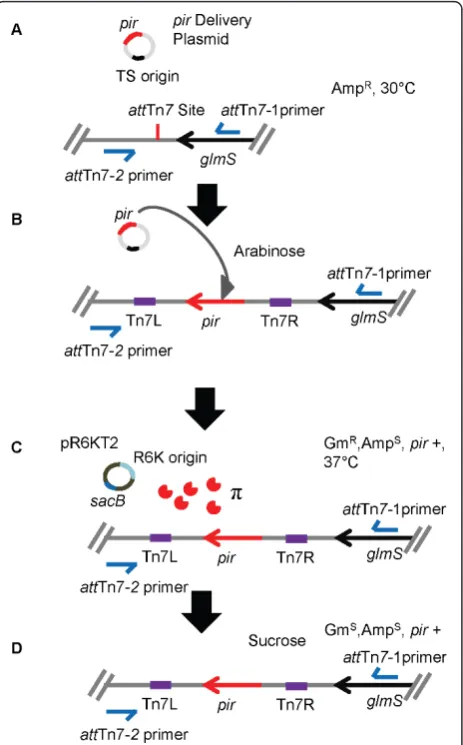
We sought to employ the mini-Tn7 method described by McKenzie and Craig [11] for chromosomal insertion of piralleles in the absence of selection. For this pur-pose, the pir+ and pir-116 genes were cloned into the mini-Tn7 delivery vector pGRG36 (Figure 1) and pub-lished procedures [11] followed in an attempt to trans-pose the cloned pir genes into the chromosomes of variousE. colistrains. However, in some strains, despite repetition and exhaustive PCR screening, this method proved ineffective for this purpose as the majority of colonies obtained after completion of the procedure did not contain the desired mini-Tn7insertions or did not result in any insertions, for unexplained reasons. We therefore designed a method that allows positive selec-tion of strains containing chromosomally inserted pir alleles (Figure 2). The rationale for this method is to establish the delivery vector with a temperature-sensitive replicon (ts), here pSC101orits, at permissive tempera-ture (30°C), then introduce anoriR6Kg reporter plasmid at 37°C, creating conditions at which the mini-Tn7 delivery vector is cured and replication of the reporter plasmid is dependent on the presence of a chromoso-mally-integrated pir gene. After verification of the desired mini-Tn7-pirinsertions the reporter plasmid is then cured using sucrose counter-selection.
Mini-Tn7insertion of pir genes inE. coliandS. enterica
serovar Typhimurium
Following the procedure outlined in Figure 2, we readily obtained mini-Tn7-pirinsertions in several commonly usedE. colilaboratory cloning and mobilizer strains– DH5a, JM108, MC4100, SM10, RHO3–and a clinicalS. entericaserovar Typhimurium isolate. Exconjugants examined by PCR contained the desired insertion, either mini-Tn7-pir+ or mini-Tn7-pir-116(Figure 3A). The plasmid copy number of pR6KT2 was greatly elevated in pir-116-containingE. coliDH5aandS. entericaserovar Typhimurium 14028S host strains when compared to the same strains containing chromosomally inserted wild-type pir+ (Figure 3B). An alternative to employing an oriR6Kgreporter plasmid is to use mini-Tn7-pirelements that contain a Kmrselection marker that after verification of desired inserts can be removed usingSaccharomyces
cerevisiaeFlp recombinase-mediated site-specific exci-sion, followed by curing of the Flp recombinase expres-sion plasmid. We have successfully used this strategy in E. coli. Both strategies require equal time and effort.
Conclusions
We have developed simple and effective strategies for engineering ofpirexpressing strains of Enterobacteriaceae.
pir+
L
R
tnsA
tnsB
tnsC
tnsD bla
oriT
pSC101ori ts
B1
B2 araC
pGRG36pir
13,905 bp
FRT FRT nptII
pR6KT2
sacB oriR6KJ
aacC1
uidA 5,953 bp
oriT PBAD
A)
[image:2.595.304.538.86.439.2]B)
Figure 1Maps of mini-Tn7delivery vector andoriR6Kgreporter plasmid.A)Map ofpir+delivery vector pGRG36pir. Other versions
include pGRG36pir-116which containspir-116in place ofpir+and
pGRG36pir-116-FKm contains aFRT-flanked Kmrmarker adjacent to
pir-116as illustrated in the inset.B)Map of theoriR6Kgreporter
plasmid pR6KT2. Abbreviations:aacC1, aminoglycoside
acetyltransferase conferring gentamicin resistance;araC, encoding the AraC regulator of expression from theE. coliarabinose operon promoterPBAD; B1 and B2,attB1andattB2Gateway recombination
sites;bla,b-lactamase gene conferring ampicillin resistance;FRT, Flp recombinase target site; L and R, Tn7left and right ends;nptII, neomycin phosphotransferase gene conferring kanamycin resistance;oriR6Kg, R6K plasmidgreplication origin;oriT, RP4 conjugal transfer origin; pSC101ori ts, temperature-sensitive pSC101
These strategies allow extension of the host range of oriR6Kgcontaining plasmids to virtually any enterobacterial strain, something that was, to date, only possible using relatively cumbersome and time-consuming methods, e.g. isolation oflpirlysogens or chromosomal insertion of
[image:3.595.306.538.88.333.2]clonedpiralleles via site-specific recombination at a pre-determined locus [9]. Mini-Tn7elements insert at natu-rally evolvedattTn7sites that are usually located in inter-genic regions downstream of conserved glmS genes [12-16]. This alleviates the need for selecting potential insertion sites not affecting bacterial fitness when choosing recombinant DNA strategies forpirallele insertion into a bacterial genome. Since mini-Tn7elements transpose in most, if not all, Gram negative bacteria, we anticipate that with relatively minor modifications this newly established method will for the first time allow engineering of other bacterial species to enable replication of plasmids with oriR6Kg. As described, the procedure relies on availability of ts replicons which may limit its applicability to bacteria that can tolerate the non-permissive temperatures needed
Figure 2Overview of steps involved in chromosomal mini-Tn7
-pirinsertion.A)Introduce the mini-Tn7-pir+delivery vector by
conjugation. Select ampicillin resistant (Ampr) colonies at 30°C to
establish the delivery vector.B)Grow Amprcells at 30°C in presence
of arabinose to induce the genes encoding the Tn7site-specific transposition pathway.C)Introduce theoriR6Kgreporter pR6KT2 by
conjugation and grow at 37°C in the presence of gentamicin (Gm) to cure the mini-Tn7-pir+delivery vector and report integrants based onpir-dependent replication of pR6KT2. Establish Gmrand Amp susceptible (Amps) phenotype.D)Cure pR6KT2 reporter plasmid by plating on sucrose-containing medium. Verify Gmsand Ampsphenotype, and confirmpir+integrants by PCR (using primer pair 2372 and 2373 forE. colior 2374 and 2375 forS. enterica serovar Typhimurium). It must be noted that PCR-based insertion site verification strategies are limited to bacteria for which sequence information about theglmSflanking sequences is available. Methods for identifying Tn7insertion sites in bacteria for which genome sequences are unknown have been described [12].
DH5
Į
::
mini-Tn
7
DH5
Į
14028S
-
pir
+pir-116
M
M
E. coli
S. enterica
M
kb
3-
2-
0.75-kb
6-
3-
2-A)
B)
Figure 3PCR verification of mini-Tn7-pirinsertion and plasmid copy number.A)PCR verification ofpir+andpir-116mini-Tn7
insertions intoattTn7ofE. coliDH5a. Colony PCR with primers 2372 and 2373 (see Figure 2 for relative priming site locations) was conducted to confirm presence or absence of the mini-Tn7-pir+and mini-Tn7-pir-116insertions. The PCR reactions were analyzed by agarose gel electrophoresis. Expected fragment sizes are 678 bp for DH5awithout a mini-Tn7insertion and 2,539 bp for derivatives containing mini-Tn7-pir+or mini-Tn7-pir-116insertions. Lane M, Hi-Lo molecular size ladder from Minnesota Molecular (Minneapolis, MN) with the sizes of selected fragments indicated; Lane -, DH5anegative control (no insertion).B)Demonstration of pR6KT2 copy number in pir+andpir-116containingE. coliandS. entericaserovar Typhimurium strains. Plasmid DNA was purified from overnight cultures ofE. coli DH5aandS. entericaserovar Typhiumurium 14028S containing either mini-Tn7-pir+or mini-Tn7-pir-116. A 20
[image:3.595.59.291.89.462.2]for plasmid curing. The methods described here were developed forEnterobacteriaceaewhich, like most bac-teria, can tolerate 37°C, a temperature at which most plas-mids with ts replicons, including pSC101orits, are readily cured. For bacteria with growth temperature optima less than 37°C, the described strategy will not work and require appropriate modifications, i.e. inclusion of different coun-ter-selection markers, for example sacB [17]. Lastly, though many manipulations described in this paper use conjugations as means for introduction of plasmids into cells, some them could also be done by plasmid transfor-mation which would alleviate the need for counter-selec-tion strategies required for bacterial matings. We, however, consistently find that conjugations are equally convenient and more efficient means of plasmid transfer than transformation.
Methods
Bacterial strains, media and growth conditions
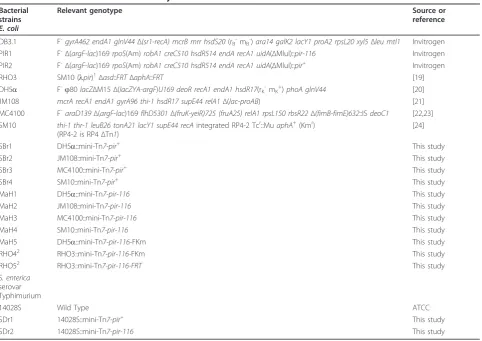
Bacterial strains used in this study are listed in Table 1. Bacteria were routinely grown at 37°C in Luria Bertani
[image:4.595.58.541.364.705.2]broth Lennox (LB) [18] or on LB agar purchased from MO BIO Laboratories, Carlsbad, CA. ThesacB -contain-ing oriR6Kg reporter pR6KT2 was cured by plating plas-mid-containing cells on yeast extract-tryptone (YT) sucrose medium containing 10 g/l yeast extract (Difco, Detroit, MI), 16 g/l tryptone (Fisher Scientific, Fairlawn, NJ), 16 g/l Bacto agar (Becton, Dickinson and Company, Sparks, MD) and 15% sucrose (w/v)[19]. Strains contain-ing temperature-sensitive (TS) plasmid derivatives were grown at 30°C (permissive temperature) for plasmid maintenance and 37°C or 42°C (non-permissive tem-perature) for plasmid curing. Antibiotics were added at the following concentrations: 100 μg/ml ampicillin (Amp), 10-15 μg/ml gentamicin (Gm) and 35 μg/ml kanamycin (Km) for E. coli and S. enterica serovar Typhimurium harboring plasmids or for selection of chromosomally-integrated mini-Tn7elements. Antibio-tics were purchased from EMD Biosciences, San Diego, CA (Gm) and Sigma, St. Louis, MO (Amp and Km). For E. coli strain RHO3, media were supplemented with dia-minopimelic acid (DAP; LL-, DD-, and meso-isomers;
Table 1 Bacterial strains used in this study
Bacterial strains
E. coli
Relevant genotype Source or
reference
DB3.1 F-gyrA462 endA1 glnV44Δ(sr1-recA) mcrB mrr hsdS20(rB
-mB
-)ara14 galK2 lacY1 proA2 rpsL20 xyl5Δleu mtl1 Invitrogen PIR1 F-Δ(argF-lac)169rpoS(Am)robA1 creC510 hsdR514 endA recA1 uidA(ΔMluI)::pir-116 Invitrogen PIR2 F-Δ(argF-lac)169rpoS(Am)robA1 creC510 hsdR514 endA recA1 uidA(ΔMluI)::pir+ Invitrogen
RHO3 SM10 (lpir)1Δasd::FRTΔaphA::FRT [19]
DH5a F-j80lacZ
ΔM15Δ(lacZYA-argF)U169 deoR recA1 endA1 hsdR17(rK-mK+)phoA glnV44 [20]
JM108 mcrA recA1 endA1 gyrA96 thi-1 hsdR17 supE44 relA1Δ(lac-proAB) [21]
MC4100 F-araD139
Δ(argF-lac)169flhD5301Δ(fruK-yeiR)725 (fruA25) relA1 rpsL150 rbsR22Δ(fimB-fimE)632::ISdeoC1 [22,23] SM10 thi-1 thr-1 leuB26 tonA21 lacY1 supE44 recAintegrated RP4-2 Tcr::MuaphA+(Kmr)
(RP4-2 is RP4ΔTn1)
[24]
SBr1 DH5a::mini-Tn7-pir+ This study
SBr2 JM108::mini-Tn7-pir+ This study
SBr3 MC4100::mini-Tn7-pir+ This study
SBr4 SM10::mini-Tn7-pir+ This study
MaH1 DH5a::mini-Tn7-pir-116 This study
MaH2 JM108::mini-Tn7-pir-116 This study
MaH3 MC4100::mini-Tn7-pir-116 This study
MaH4 SM10::mini-Tn7-pir-116 This study
MaH5 DH5a::mini-Tn7-pir-116-FKm This study
RHO42 RHO3::mini-Tn7-pir-116-FKm This study
RHO52 RHO3::mini-Tn7-pir-116-FRT This study
S. enterica serovar Typhimurium
14028S Wild Type ATCC
SDr1 14028S::mini-Tn7-pir+ This study
SDr2 14028S::mini-Tn7-pir-116 This study
1
Thepirgene carried bylpirhas a truncation that removes the coding region for the carboxy-terminal 30 amino acids of theπprotein. Despite this truncation a
lpirlysogen maintains plasmids with at the same copy number as cells carrying a wild-typepir+ gene [9]. 2
Sigma) which was added at a final concentration of 400
μg/ml for agar plates and 200μg/ml for broth cultures. 5-bromo-4-chloro-3-indolyl-b-D-glucuronic acid (XGluc; Gold Biotechnology, St. Louis, MO) was added to media at a final concentration of 40μg/ml. Induction of gene expression from the arabinose operon promoter (PBAD) was achieved by addition of L-arabinose to media
at a final concentration of 0.5% (w/v).
DNA and genetic methods
Isolation of plasmid DNA
Plasmid DNAs were isolated fromE. coliand S. enterica serovar Typhimurium by using a Fermentas GeneJET Plasmid MiniPrep Kit (Fermentas, Glen Burnie, MD).
Transposition of mini-Tn7
The respective mini-Tn7 delivery vectors were trans-formed intoE. colimobilizer strain RHO3 [19]. Conju-gation of delivery plasmid into E. coli and S. enterica serovar Typhimurium strains was achieved by biparental mating using previously described methods [19] with some minor modifications. Briefly, RHO3 donor andE. coli andS. entericaserovar Typhimurium recipient cul-tures were grown overnight at 30°C (pGRG36-based donor strains) or 37°C (recipient strains) in LB medium with the appropriate nutritional (DAP) and antibiotic (Amp) supplements for RHO3 with the mini-Tn7 deliv-ery vector. One ml of donor and recipient were placed into separate 1.7 ml microcentrifuge tubes and harvested by centrifugation in a microcentrifuge for 30 s at 13,400×g and room temperature. Cells were washed twice in 1 ml LB medium and then re-suspended in 200
μl of LB medium. Equal volumes (25 μl) of each cell suspension were transferred to a cellulose acetate mem-brane (13 mm diameter; 0.45 μM pore size; Sartorius Stedim, Bohemia, NY) sitting on an LB agar plate con-taining 400 μg/ml DAP and 0.5% arabinose. After over-night incubation at 30°C, the membrane was transferred to a microcentrifuge tube containing 1 ml of LB and cells dislodged by centrifugation in a microfuge for 30 s at 13,400×g and room temperature. After removing the membrane, cells were washed twice in 1 mL LB and then re-suspended in 200μl of LB medium. The entire sample was placed on an LB-agar plate with 100 μg/ml Amp and 0.5% arabinose, and a portion streaked for sin-gle colonies with an inoculating loop. The plates were incubated at 30°C overnight or until single colonies were clearly discernable.
A single purified colony was then used as recipient for the oriR6Kg reporter pR6KT2. This plasmid was intro-duced via biparental mating from RHO3 as described above, except that recipient cells were grown in the pre-sence of Amp and arabinose and RHO3/pR6KT2 cul-tures were grown in the presence of Gm and DAP.
After overnight incubation at 30°C mating mixtures were recovered and plated on LB with 15 μg/ml Gm at 37°C to cure the temperature-sensitive mini-Tn7 deliv-ery vector and select for pR6KT2. Purified colonies were patched on LB, LB + Gm and LB + Amp to confirm the loss of the mini-Tn7delivery vector (Amp susceptibility) and presence of pR6KT2 (Gm resistance). After verifica-tion of mini-Tn7insertions by PCR, pR6KT2 was cured by streaking a single colony on YT medium with sucrose and XGluc, and incubating overnight at 37°C. Single colonies were patched on LB and LB + Gm plates to confirm the loss of the plasmid. Thepirgene inser-tions in the resulting strains were then re-confirmed by PCR and sequencing of the resulting DNA fragments.
When using the mini-Tn7-pir-FKm vectors, the proto-col for conjugation was as described above for mini-Tn7 delivery without antibiotic selection. Exconjugants were grown overnight in LB + DAP and arabinose at 30°C, and Kmr transposon insertions were selected by plating conjugation mixtures on LB plates with 35 μg/ml Km followed by incubation at 42°C to cure the delivery plas-mid. The Kmr marker can optionally be deleted from the strain with the mini-Tn7-pir-FKm insertion by transformation with pFLP2 (or any other Flp recombi-nase-expressing plasmid such as pCP20 [25]), testing transformants for Km susceptibility and then curing pFLP2 by plating on sucrose-containing media following previously described protocols [17].
Confirmation of mini-Tn7-pirinsertions
Plasmid construction
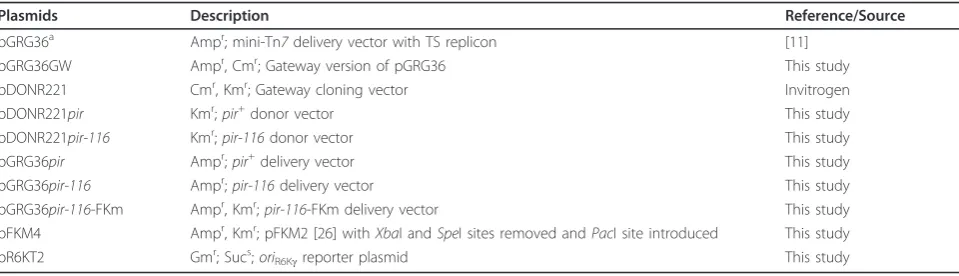
Plasmids used in this study are listed in Table 2. The Gate-way-compatible mini-Tn7delivery vector pGRG36GW was constructed by cloning of a 1,770-bpStuI-XhoI frag-ment from pUC18-mini-Tn7T-Gm-GW [16] between the SmaI andXhoI sites of pGRG36 [11], followed by transfor-mation into thegyrA462strain DB3.1.
Thepir+and pir-116Gateway donor clones were con-structed as follows. First, the pir+ andpir-116 genes were PCR-amplified from E. colistrain PIR2 (pir+) and PIR1 (pir-116) chromosomal DNA templates using HiFi Taq polymerase (Invitrogen) and primers 1333 (5’-TGAGCGTCGCAGAACATTACA) & 1334 (5’-ACC TGGGTGGACGATATCAC). The resulting 1,264-bp PCR fragments were cloned into the TA cloning vector pCR2.1 (Invitrogen) to create pCR2.1pir and pCR2.1 pir-116. Next,attBsequences were attached to the respec-tive pir gene segments using PCR with primers 1558 (5’-GGGGACAAGTTTGTACAAAAAAGCAGGCTTGA GCGTCGCAGAACATTACA; the attB1 sequence is underlined) & 1559 (5’-GGGGACCACTTTGTACAA GAAAGCTGGGTACCTGGGTGGACGATATCAC; the attB2 sequence is underlined), and pCR2.1-pir and pCR2.1-pir-116 DNA as templates. This generated 1,323-bp DNA fragments that were recombined into pDONR221 using Gateway BP clonase reactions which created pDONR221pirand pDONR221pir-116, respec-tively. Finally, the inserts from pDONR221pir and pDONR221pir-116 were transferred to pGRG36GW using LR Gateway recombination to yield pGRG36pir and pGRG36pir-116. The pGRG36pir-116-FKm plasmid was constructed by cloning a 1,470-bp SalI fragment from pFKM4 containing a Kmr gene flanked by Flp recombinase target (FRT) sites into the XhoI site of pGRG36pir-116.
TheoriR6Kgreporter pR6KT2 was constructed as fol-lows. First, the oriR6Kg and oriT regions were
PCR-amplified from pUC18R6KT-mini-Tn7T [16] usingTaq polymerase (NEB) and primers 2298 (5’-ATTCCCGG GAGGCCACCACTTCAAGAACTC) & 2299 (5’-TAAT CCCGGGCTTCCGCTTCCTCGCTCA). The resulting 824-bp amplicon was cloned into
pCR2.1 to create pCR2.1-R6KoriT. Second, the 901-bp XbaI fragment from non-methylated pPS856 [17] DNA obtained by isolating the plasmid from dam dcm E. coli JM110 [21] was ligated with the 6.5-kb SpeI andXbaI digested backbone of pEXKm5 [19] to construct pEXGm5B. Third, the 915-bporiR6Kgand oriT XbaI and Eco53K1 fragment was released from pCR2.1::R6KoriT and ligated with the 6.2-kb XbaI and SmaI digested pEXGm5B backbone to create pR6KTSCE. Finally, pR6KTSCE was digested withBmgB1 andFspI and the 5.9-kb backbone was re-circularized to construct the reporter vector pR6KT2.
All plasmid constructions were verified by restriction digest and DNA sequence analysis.
Acknowledgements
HPS is supported by several NIH grants and this research was made possible by Indirect Cost Recovery funds. The authors acknowledge the contributions of Dr. Takehiko Mima to this work.
Author details
1Department of Microbiology, Immunology and Pathology, Colorado State
University, IDRC at Foothills Campus, 0922 Campus Delivery, Fort Collins, CO 80523, USA.2Department of Oral Microbiology, College of Dentistry,
Wonkwang University, Iksan 570-749, South Korea.
Authors’contributions
BK and SB performed most of the experiments, JP, IM, EB, SL, KM and KHC contributed to plasmid construction and performed pilot experiments, BK and RKS designed and supervised experiments, and BK, RKS and HPS drafted the final manuscript. All authors read and approved the final manuscript.
Competing interests
The authors declare that they have no competing interests.
[image:6.595.58.538.99.237.2]Received: 5 December 2011 Accepted: 20 March 2012 Published: 20 March 2012
Table 2 Plasmids used in this study
Plasmids Description Reference/Source
pGRG36a Ampr; mini-Tn7delivery vector with TS replicon [11]
pGRG36GW Ampr, Cmr; Gateway version of pGRG36 This study
pDONR221 Cmr, Kmr; Gateway cloning vector Invitrogen
pDONR221pir Kmr;pir+donor vector This study
pDONR221pir-116 Kmr;pir-116donor vector This study
pGRG36pir Ampr;pir+delivery vector This study
pGRG36pir-116 Ampr;pir-116delivery vector This study
pGRG36pir-116-FKm Ampr, Kmr;pir-116-FKm delivery vector This study
pFKM4 Ampr, Kmr; pFKM2 [26] withXbaI andSpeI sites removed andPacI site introduced This study
pR6KT2 Gmr; Sucs;oriR6Kgreporter plasmid This study
a
References
1. Miller VL, Mekalanos JJ:A novel suicide vector and its use in construction of insertion mutations: osmoregulation of outer membrane proteins and virulence determinants inVibrio choleraerequirestoxR.J Bacteriol1988,
170:2575-2583.
2. Taylor RK, Manoil C, Mekalanos JJ:Broad-host-range vectors for delivery of TnphoA: Use in genetic analysis of secreted virulence determinants of
Vibrio cholerae.J Bacteriol1989,171:1870-1878.
3. Herrero M, De Lorenzo V, Timmis KN:Transposon vectors containing non-antibiotic resistance selection markers for cloning and stable
chromosomal insertion of foreign genes in Gram-negative bacteria.J Bacteriol1990,172:6557-6567.
4. Donnenberg MS, Kaper JB:Construction of aneaedeletion mutant of enteropathogenicEscherichia coliby using a positive-selection suicide vector.Infect Immun1991,59:4310-4317.
5. Metcalf WW, Wanner BL:Mutational analysis of an Escherichia coli fourteen-gene operon for phosphonate degradation, using TnphoA’ elements.J Bacteriol1993,175:3430-3442.
6. Skrzypek E, Haddix PL, Plano GV, Straley SC:New suicide vector for gene replacement inYersiniaand other gram-negative bacteria.Plasmid1993,
29:160-163.
7. Kolter R, Inuzuka M, Helinski DR:Trans-complementation-dependent replication of a low molecular weight origin fragment from plasmid R6K.
Cell1978,15:1199-1208.
8. Stalker DM, Kolter R, Helinski DR:Nucleotide sequence of the region of an origin of replication of the antibiotic resistance plasmid R6K.Proc Natl Acad Sci USA1979,76:1150-1154.
9. Metcalf WW, Jiang W, Wanner BL:Use of the rep technique for allele replacement to construct newEscherichia colihosts for maintenance of R6Kγorigin plasmids at different copy numbers.Gene1994,138:1-7. 10. Filutowicz M, McEachern MJ, Mukhopadhyay P, Greener A, Yang SL,
Helinski DR:DNA and protein interactions in the regulation of plasmid replication.J Cell Science Supplement1987,7:15-31.
11. McKenzie GJ, Craig NL:Fast, easy and efficient: site-specific insertion of transgenes into enterobacterial chromosomes using Tn7without need for selection of the insertion event.BMC Microbiol2006,6:39. 12. Choi K-H, DeShazer D, Schweizer HP:mini-Tn7insertion in bacteria with
multipleglmS-linkedattTn7sites: exampleBurkholderia malleiATCC 23344.Nat Protocols2006,1:162-169.
13. Peters JE, Craig NL:Tn7: smarter than we thought.Nat Rev Mol Cell Biol 2001,2:806-814.
14. Choi K-H, Gaynor JB, White KG, Lopez C, Bosio CM, Karkhoff-Schweizer RR, Schweizer HP:A Tn7-based broad-range bacterial cloning and expression system.Nat Methods2005,2:443-448.
15. Choi K-H, Schweizer HP:mini-Tn7insertion in bacteria with secondary, non-glmS-linkedattTn7sites: exampleProteus mirabilisHI4320.Nat Protocols2006,1:170-178.
16. Choi K-H, Schweizer HP:mini-Tn7insertion in bacteria with singleattTn7
sites: examplePseudomonas aeruginosa.Nat Protocols2006,1:153-161. 17. Hoang TT, Karkhoff-Schweizer RR, Kutchma AJ, Schweizer HP:A
broad-host-range Flp-FRTrecombination system for site-specific excision of chromosomally-located DNA sequences: application for isolation of unmarkedPseudomonas aeruginosamutants.Gene1998,212:77-86. 18. Sezonov G, Joseleau-Petit D, D’Ari R:Escherichia coliphysiology in
Luria-Bertani broth.J Bacteriol2007,189:8746-8749.
19. Lopez CM, Rholl DA, Trunck LA, Schweizer HP:Versatile dual-technology system for markerless allele replacement inBurkholderia pseudomallei.
Appl Environ Microbiol2009,75:6496-6503.
20. Liss L:New M13 host: DH5αF’competent cells.Focus1987,9:13. 21. Yanisch-Perron C, Vieira J, Messing J:Improved M13 cloning vectors and
host strains: nucleotide sequences of the M13mp18 and pUC19 vectors.
Gene1985,33:103-119.
22. Casadaban MJ:Transposition and fusion of the lac genes to selected promoters inEscherichia coliusing bacteriophage lambda and Mu.J Mol Biol1976,104:541-555.
23. Peters JE, Thate DE, Craig NL:Definition of theEscherichia coliMC4100 genome by use of a DNA array.J Bacteriol2003,185:2017-2021. 24. Simon R, Priefer U, Pühler A:A broad-host-range mobilization system for
in vivogenetic engineering: transposon mutagenesis in gram negative bacteria.Bio/Technology1983,1:784-791.
25. Cherepanov PP, Wackernagel W:Gene disruption inEscherichia coli: TcR
and KmRcassettes with the option of Flp-catalyzed excision of the
antibiotic-resistance determinant.Gene1995,158:9-14.
26. Choi K-H, Mima T, Casart Y, Rholl D, Kumar A, Beacham IR, Schweizer HP:
Genetic tools for select agent compliant manipulation ofBurkholderia pseudomallei.Appl Env Microbiol2008,74:1064-1075.
doi:10.1186/1756-0500-5-157
Cite this article as:Kvitkoet al.:A simple method for construction ofpir
+
Enterobacterial hosts for maintenance of R6K replicon plasmids.BMC Research Notes20125:157.
Submit your next manuscript to BioMed Central and take full advantage of:
• Convenient online submission
• Thorough peer review
• No space constraints or color figure charges
• Immediate publication on acceptance
• Inclusion in PubMed, CAS, Scopus and Google Scholar
• Research which is freely available for redistribution