University of Windsor University of Windsor
Scholarship at UWindsor
Scholarship at UWindsor
Electronic Theses and Dissertations Theses, Dissertations, and Major Papers
1-1-2006
Extending the lifetime of sensor networks using the game theory.
Extending the lifetime of sensor networks using the game theory.
Amr Elkholy
University of Windsor
Follow this and additional works at: https://scholar.uwindsor.ca/etd
Recommended Citation Recommended Citation
Elkholy, Amr, "Extending the lifetime of sensor networks using the game theory." (2006). Electronic Theses and Dissertations. 7074.
https://scholar.uwindsor.ca/etd/7074
EXTENDING THE LIFETIME OF SENSOR NETWORKS USING THE GAME THEORY
by
Amr Elkholy
A Thesis
Submitted to the Faculty of Graduate Studies and Research through
Electrical and Computer Engineering in Partial Fulfillment of the Requirements for the Degree of Master of Applied Science at the
University of Windsor
Library and Archives Canada
Bibliotheque et Archives Canada Published Heritage
Branch
395 Wellington Street Ottawa ON K1A 0N4 Canada
Your file Votre reference ISBN: 978-0-494-35935-8 Our file Notre reference ISBN: 978-0-494-35935-8 Direction du
Patrimoine de I'edition
395, rue Wellington Ottawa ON K1A 0N4 Canada
NOTICE:
The author has granted a non exclusive license allowing Library and Archives Canada to reproduce, publish, archive, preserve, conserve, communicate to the public by
telecommunication or on the Internet, loan, distribute and sell theses
worldwide, for commercial or non commercial purposes, in microform, paper, electronic and/or any other formats.
AVIS:
L'auteur a accorde une licence non exclusive permettant a la Bibliotheque et Archives Canada de reproduire, publier, archiver,
sauvegarder, conserver, transmettre au public par telecommunication ou par I'lnternet, preter, distribuer et vendre des theses partout dans le monde, a des fins commerciales ou autres, sur support microforme, papier, electronique et/ou autres formats.
The author retains copyright ownership and moral rights in this thesis. Neither the thesis nor substantial extracts from it may be printed or otherwise reproduced without the author's permission.
L'auteur conserve la propriete du droit d'auteur et des droits moraux qui protege cette these. Ni la these ni des extraits substantiels de celle-ci ne doivent etre imprimes ou autrement reproduits sans son autorisation.
In compliance with the Canadian Privacy Act some supporting forms may have been removed from this thesis.
While these forms may be included in the document page count,
Conformement a la loi canadienne sur la protection de la vie privee, quelques formulaires secondaires ont ete enleves de cette these.
ABSTRACT
In this thesis, the problem of limited sensor network lifetime due to limited energy
resources is addressed. Lifetime is defined as the duration of packet transmissions that
can be performed before one node, or a percentage of the nodes, dies.
Network deployment in rough environments makes it very difficult to reach the
nodes in order to repair or recharge. It is therefore economically and practically crucial to
maximize their operating lifetimes.
Nodes, by nature, will avoid relaying data for two main reasons. First of all, to
save energy which they can use for transferring their own data and second, to reduce
latency. An economic model based on the game theory is developed to persuade the
cooperation between nodes in sensor networks to extend the lifetime of the network.
The model is simulated using MATLAB. It is then compared to two conventional
protocols; minimum hop routing and minimum energy routing and the proposed scheme
DEDICATION
I dedicate this thesis to my family, whom I feel blessed to be part of. Their never-
ending support, encouragement and continuous feel of security were the greatest gifts I
ACKNOWLEDGEMENTS
I am deeply grateful to Dr. Kemal Tepe for his patient guiding and continuous
supervision. His enthusiastic attitude and innovative suggestions and comments always
took my work to a higher level. Without him, I would have not been able to complete my
work.
I owe deep gratitude to Dr. Jonathon Wu, who gave me motivation from the very
beginning. His continuous encouragement and support were always an incentive to keep
going.
I am also greatly thankful to my committee members; Dr. Huapeng Wu and Dr.
Arunita Jaekel. Without their remarks and advice, my work would have not been
completed and brought to perfection. I am grateful for their advice and patience.
I am also extremely thankful to all faculty members who formed such a
comfortable environment to work in.
Finally, I would like to thank my fellow friends in Windsor for their continuous
TABLE OF CONTENTS
ABSTRACT...iv
DEDICATION...v
ACKNOWLEDGEMENTS... vi
LIST OF TABLES... ix
LIST OF FIGURES... viii
CHAPTER L INTRODUCTION 1.1 Sensor Networks and the Main Challenges... 1
1.2 The Game Theory...3
1.3 Thesis Organization...7
H. REVIEW OF LITERATURE 2.1 Energy Efficient Studies...8
2.2 Lifetime Efficient Studies... 11
HI. DESIGN AND METHODOLOGY 3.1 Introduction...16
3.2 Model Development...17
3.3 A Numerical Example... 20
3.4 F ormulation... 24
3.4.1 The governing formula... 25
3.4.2 Algorithms... 25
3.5 Minimum Hop and Minimum Energy Routing... 27
3.5.1 Minimum Hop Routing Protocol...28
3.5.2 Minimum Energy Routing Protocol... 29
IV. ANALYSIS OF RESULTS 4.1 The Sample Model... 31
4.2 The Network Model and Results... 35
V. CONCLUSIONS AND FUTURE WORK 5.1 Conclusions... 43
APPENDICES
A: The Proposed Simulation Code...45
REFERENCES... 75
LIST OF TABLES
Table 1. Utility table for the Prisoners’ dilemma... 5
Table 2. Companies’ utility table... 6
Table 3. Utility table for the 4-node network... 24
Table 4. Case where nodes have different initial energies... 34
LIST OF FIGURES
Figure 1. Algorithm Goal... 17
Figure 2. The approach of the proposed model in Game Theory...19
Figure 3. The 4-node network...20
Figure 4. Scenario 1: Basic operation, no co-operation...20
Figure 5. Node A co-operates...21
Figure 6. Node B co-operates... 21
Figure 7. Both nodes co-operate...22
Figure 8. Algorithm with global scenario... 26
Figure 9. Algorithm with local scenario... 27
Figure 10. Minimum hop estimation...28
Figure 11. Minimum energy estimation... 29
Figure 12. The sample Network analyzed... 31
Figure 13. Final energies of nodes in scenario where nodes have different initial energies... 33
Figure 14. Final energies of nodes in scenario where nodes have same initial energies... 33
Figure 15. A randomly allocated network... 35
Figure 16. Algorithm steps... 36
Figure 17. Network snapshots when a) one node dies, b) 25% of nodes dies 37 Figure 18. Both a)Inefficient path and b) efficient path...37
Figure 19. Hops vs. nodes for ME, MH and proposed...38
Figure 20. Packets sent; for different lifetime definitions...39
Figure 21. EP vs. nodes for MH, ME and proposed... 40
Figure 23. Hops extended, up to 2800 nodes... 41
CHAPTER I
INTRODUCTION
1.1 Sensor Networks and the Main Challenges
Recently, the desire for data gathering and event monitoring has been rapidly
increasing. That led to an increase in demand on wireless communication systems and
sensor networks. Many of those networks employ short-range links without a pre-existing
infrastructure. Examples include health monitoring of patients, agricultural land
conditions, military applications, security, and home automation. The advances in micro
electronics and micro-mechanical systems (MEMS) and system on chip (SoC)
technologies allow sensor nodes to be fabricated at low costs and small sizes.
A wireless sensor network will consist of hundreds of sensor nodes that are
mostly deployed randomly. After the deployment, the sensor nodes will self-organize and
form a viable network to disseminate their data to control (observation) stations. In most
of the applications, those sensors are battery operated. Like many battery operated
systems or devices, energy efficiency and node lifetime maximization and eventually the
network lifetime are primary goals in the self-organization process. That is why most of
the research in the sensor networks focuses on energy efficiency, energy efficient data
transmission, energy aware multiple access (MAC) techniques, and energy efficient
routing.
In sensor nodes, agents that need to be sensed may not be uniformly distributed,
i.e. nodes may be utilized differently during the course of the network. That’s why most
network in timely manner. In addition to these, global optimization algorithms require
knowledge from all the nodes in the network, collecting and distributing that knowledge
that is necessary for the optimization techniques is a monumental task. Repeating such
tasks after topology and node changes creates unnecessary data traffic, and eventually
further drains the network resources.
Due to above reasons, there is a need for a protocol that must work in a
distributed fashion, and utilize local information rather than global information. In order
to meet those requirements, some researchers started using theories that govern the micro
economics. In those theories, the game theory is the most prominent one because game
theory creates a situation where instead of agents making decisions as reactions to dead
variables, the decisions are made dynamically and strategically with reactions to other
agents’ actions ("live variables"). The decision that an agent makes will be a choice from
a set of moves, which it is allowed to make, in an attempt to form a strategy which will
be his best response to the surrounding environment. A “Nash Equilibrium" will be
reached when the best responses of all players are in accordance with each other, and no
player can improve his performance without degrading some other player’s performance.
So far, research in that area has mainly targeted three areas: 1) power control as in [1] and
[2], 2) channel access as in [3], [4] and [5], and finally 3) routing costs such as [6].
In this work we will provide algorithms that utilize the game theory. In our
algorithm, the objective of the network is to maximize the lifetime of the network.
We will introduce our system model and pricing (cost) function that takes into
account both the remaining energy on the node and the energy spent in transferring data
uniform degradation in the sensors’ energies and hence their lifetimes, therefore overall
extending the network’s lifetime.
1.2 The Game Theory
Adam Smith once said in his book “The Wealth of Nations”: “It is not from the
benevolence of the butcher, the brewer, or the baker that we expect our dinner, but from
their regard to their own interest. We address ourselves, not to their humanity but to their
self-love, and never talk to them of our own necessities but of their advantages.” While
Adam Smith believed that every individual’s conflicting selfish action creates some sort
of harmony, therefore resulting in an overall advantage for the system, John Nash then
corrected Smith by stating that the overall optimum results come from everyone doing
what’s best for him self and the group as a whole.
Game Theory is regarded as a multi-agent decision problem. This means that
there are two or more agents competing for limited rewards. Based on the situation, each
agent will respond with a certain action, in an attempt to maximize his outcome.
Reactions are made following certain rules and all players are assumed to behave
rationally.
Game Theory is classified in two branches:
1) Non co-operative Game Theory, where the players play independently and
selfishly without assuming considering what the other players are doing. Here, usually,
the gain of one player is the loss of the others. This theory was mainly adopted by Von
Neumann and Morgenstem and discussed in many of their research papers such as in [7],
2) Co-operative Game Theory, where players co-operate with each other to reach
an optimum solution. This came as an extension to non co-operative game and was
introduced by John F. Nash in 1950 [10].
Components of the game:
1. A set of players: 1= (1, 2, 3 ,..., 1}
2. A set of actions for each player, Ai where i e I
3. A set of rules R
4. An outcome O
5. A payoff, or utility, for each player u*
These are defined in J. Nash’s first 2-page article [10]. Points 1 and 2 are defined
in the following definition:
Definition'. “One may define a concept of an n-person game in which each player
has a finite set of pure strategies and in which a definite set of payments to the n players
corresponds to each n-tuple of pure strategies, one strategy taken by each player.”
And point 5 is defined in the following:
Definition'. “For mixed strategies, which are probability distributions over the
pure strategies, the pay-off functions are the expectations of the players, thus becoming
poly-linear forms in the probabilities with which the various players play their various
pure strategies.”
Later in his paper, the idea of Nash equilibrium is defined as:
Definition'. “Any n-tuple of strategies, one for each player, may be regarded as a
point in the product space obtained by multiplying the n strategy spaces of the players.
yields the highest obtainable expectation for its player against the n - 1 strategies of the
other players in the countered n-tuple. A self-countering n-tuple is called an equilibrium
point.”
All this basically means that the system will be stable if it is at a point where there
is no incentive for any player to deviate from his action. In other words, all players gave
their best reaction to all the other n-1 players’ actions and are satisfied with the outcome.
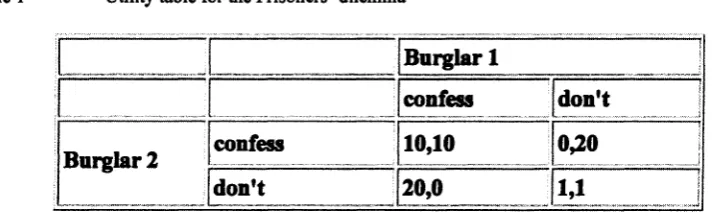
A matrix form representation, called the utility table, is used to present the
possible actions and outcomes in a game. A very popular example is the Prisoners'
Dilemma. Here, two burglars are captured and interrogated separately. They are given a
choice of either confessing or remaining silent. If both confess, they get 10 years of
prison each. If both remain silent, they get only 1 year or prison each. Finally if one
confesses while the other remains silent, the one that confesses goes free while the other
gets 20 years of prison. The results are summarized in table 1.
Table 1 Utility table for the Prisoners’ dilemma
Burglar 1
confess don't
Burglar 2 confess 10,10 0,20
don't 20,0
u____.J
The way to solve this game is to consider how burglar 1 will think: “If burglar 2
confesses, I will get 10 years if I confess, and 20 if I don’t, so it’s better to confess. But,
on the other hand, if he remains silent, I will go free if I confess or get 1 year if I remain
This means that if both prisoners act rationally, they will choose to confess.
Although this is not the optimum solution, it’s the safest, and it is what economists call
“dominant strategy equilibrium”.
The previous example does not represent the Nash equilibrium, since outcome can
be improved if players change their decisions. A Nash Equilibrium problem will be
presented in the following example.
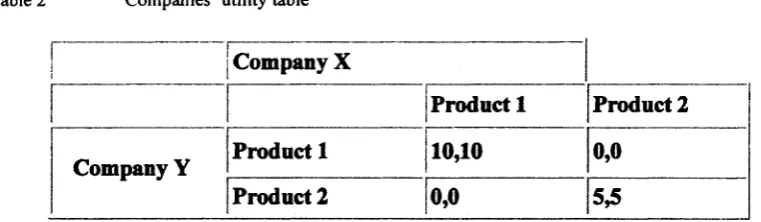
Suppose two companies, X and Y, are producing two products. If both produce
product 1, they get a payoff of 10. If both produce product 2, they get a payoff of 5.
Finally, if both produce different products, they get no payoff. The results are
summarized in table 2.
Table 2 Companies’ utility table
Company X
Product 1 Product 2
Company Y Product 1 10,10 0,0
Product 2 0,0 5,5
In this case, the best strategy is chosen when one player chooses his move. The
other then responds using his best strategy. This is an example of a co-operative game,
and the chosen outcome is a Nash Equilibrium. It is obvious here that we have two Nash
Equilibrium points: the (product 1, product 1) point and the (product 2, product 2) point
The best overall solution will be (product 1, product 1) but the players may agree to stick
1.3 Thesis Organization
The rest of the paper is organized as follows. Section II provides a survey of the
sensor network lifetime related studies. Section III explains how the network lifetime
problem is tackled from a game theory point of view, and how this develops into
effective model that can be used to extend the lifetime of sensor networks. Section IV
then presents the simulation results along with an analysis of the results. Finally, section
CHAPTER II
REVIEW OF LITERATURE
The aim of this chapter is to give an overview of the state of the art in tackling the
energy related problems with sensor networks.
The main problem with sensor networks is limited energy availability. This is
because sensors work on batteries and stop functioning when the batteries die. Energy is
consumed when a sensor transmits data and also as it receives data. Sensor networks are
usually deployed in rough environments where it is difficult to reach the nodes for
repairing or even recharging them. It is therefore economically advantageous to
maximize the network’s lifetime. To do so, many protocols have been suggested. Some
focus on energy efficient routing while others focus directly on sensor network lifetime
optimization. On the other hand, for event detection networks, media access control
(MAC) and sleep-wake synchronization are the main issues to be considered.
2.1 Energy Efficient Studies
In [11], the authors presented five different power metrics for choosing routes in
wireless ad hoc networks. Those are: 1) Minimizing the energy consumption per packet
for all packets, which does not necessarily mean optimizing the network lifetime since
more pressure is put on certain nodes. 2) Maximizing time to network partition, which is
not very feasible when delay and throughput are a concern. 3) Minimizing variance in
node power levels, which leads to an optimization in network lifetime if the length of the
packets are carefully treated. 4) Minimizing the cost per packet for all nodes, where a
remaining energy in the nodes. A careful selection of the cost function is very crucial. 5)
Minimizing maximum node cost, which also ensures an optimization in the lifetime of
the network. The authors also introduced a MAC layer protocol which introduced large
power savings. The metrics do not necessarily have to be applied as soon as the network
starts running, instead they can be applied after the defined time threshold or energy
threshold of the network is used. The metrics introduced in this paper give an excellent
guideline to the techniques that can be used in sensor networks. However, these metrics
will optimize the network lifetime if all the nodes have the same initial energy, or if all
the nodes same similar energy levels in any given time. They do not consider the case
when the nodes do not have the same initial energies.
Later in [12], Rodoplu and Meng proposed a position-based protocol that will
guarantee the network connectivity and minimize the energy consumption of the network.
Each node is capable of transmission, reception, processing data and has a low-power
GPS (Global Positioning System) receiver. The proposed algorithm runs almost
exclusively on local information and therefore requires transmission over short distances
only. This conserves the total power required for transmission and also reduces the
interference levels. The protocol is divided into two parts. First, finding the minimum
power paths from each node to the destination by identifying its enclosure graph, and
second, finding the cost (here, defined as the total power required) of sending data from a
node to the destination along the directed path. The enclosure graph of each node defines
the maximum area for which it is power-efficient for the node to search for more
neighbours. The cost is calculated by using the Bellman-Ford algorithm where power
to work for both stationary and mobile nodes and reflects the importance of utilizing local
information.
LEACH was then introduced in [13]. This technique randomly utilizes cluster-
heads in an attempt to distribute the energy load evenly among the nodes, which in effect
extends the useful lifetime of the sensor network. To do so, three main features are
implemented. First of all, localized coordination for cluster set-up and operation is
employed. This reduces the overhead in the network, along with the transmission energy
required as opposed to global functionality. Secondly, a random choice of clusters along
with their cluster heads is used. Randomness, over a long period of time, will lead to a
uniform utilization of all the nodes in the network, and therefore an even distribution in
the energy levels of the nodes. Finally, local compression is used. This means that
computation is done on a local basis, in the clusters, reducing the amount of data
transmitted in the network. Sensors select themselves to become cluster-heads based on a
certain probability and then announce their status. Other nodes then join the cluster
according to minimum communication energy. The cluster-head node receives all the
messages for nodes that would like to be included in the cluster. Based on the number of
nodes in the cluster, the cluster-head node creates a TDMA (Time division multiple
access) schedule telling each node when it can transmit. This schedule is broadcast back
to the nodes in the cluster.
The number of clusters in the system can be pre-determined by the network
depending on different parameters. In addition to reducing energy dissipation, LEACH
successfully distributes energy-usage among the nodes in the network such that the nodes
communication and minimum-transmission energy routing (MTE) and show four to eight
times lifetime extension.
The previous methods introduce an excellent guide to the path which can be
followed to conserve energy in sensor networks. Random node assignment in LEACH
improves the network performance over the long run, but not in the short run. It shows
the importance of role rotation among nodes. An improvement to the node selection
method should be introduced to guarantee that low energy nodes will be avoided. Using
GPS and finding enclosure graphs in [12] is by its self energy consuming and expensive.
Therefore a more reliable method should be introduced. A good insight to methods that
can be used is presented in [11], and can be optimized to work for sensor network
scenarios.
2.2 Lifetime Efficient Studies
In [14], Shah and Rabaey addressed the problem of lifetime maximization by
picking the next hop nodes in a probabilistic fashion. They use the fact that optimizing
energy of a network does not necessarily mean that the lifetime of the network is
maximized. Therefore, they do not utilize the minimum energy paths. Instead, they
occasionally utilize sub-optimal paths in hope to introduce some gains. Their approach
tries to achieve an equitable degradation of the nodes’ energy. They defined a set of
“good” paths and the paths are given weights depending on some energy metric. This
paper’s significance lays in the fact that it links lifetime maximization to uniform energy
depletion. The probabilistic method also proves to work on the long run, but it is not
In [15], the authors concentrated on the problem of traffic quality and energy
efficiency in ad hoc networks. They associated a utility function with each of the
network’s nodes and develop an algorithm, ORSA, aimed at maximizing the source rate
allocation and flow control strategy given a required network lifetime. There are multiple
destination nodes, and each node has a utility function based on the route between it to
the associated destination. The aim is to maximize the sum of the utility functions. The
authors do not focus on optimizing the network’s lifetime, although their proposed
algorithm proves to improve the network’s lifetime as opposed to an earlier algorithm,
minimum transmission energy (MTE) [16]. The ORSA algorithm performs better under
the condition that the source density is less than 0.5. The idea of a personal utility
function for each node is very useful here. This means that the lifetime can be extended
based on node’s performance rather than on a probabilistic method.
The authors in [17] extended their work in [18] to include the effect of different
network topologies and the work is done on aggregating networks (i.e. where fusion of
several data streams into a single stream occurs). They assigned roles to nodes which are
composed of one or more of the following: sensing, relaying or aggregating. The role
assignment technique proves to be a powerful tool that converts the problem into a linear
one. However the computations are complicated and not all role assignments can be
solved in a similar fashion.
In [19], Dasgupta and Namjoshi presented an approximate scheme to solve the
problem of maximum lifetime data aggregation problem in sensor networks. Their goal is
not to propose a new collaborative protocol that leads to greater network lifetime. Rather,
achieve. This is an improvement to their work done in [20], where they introduced the
notion of aggregation trees which are trees that indicate how values from various sensors
are gathered, aggregated, and then transmitted to the base station. The main problem was
the complexity of the calculations for large networks. The basic operation in such
systems is the systematic collection of sensed data and eventually transmitting it to the
base station for processing. The main goal behind data aggregation is to eliminate
redundant transmissions and thus save energy. In [19], they presented two algorithms for
intelligent selection of data aggregation trees. The first one, referred to as the A-LRS
algorithm, is based on the work done in [27] by Lindsey, Raghavendra, and Sivalingam.
Here some nodes are classified as leaders, and they have the job of collecting the data,
aggregating it, and then passing it on to the next level. The second algorithm, A-R-LRS,
relies on greedy clustering of the sensors into chains, such that each sensor transmits to a
close neighbour. Using P permutations in the sensors, where P is a small constant, adds
an additional number of P*n aggregation trees. This introduced an improvement in the
lifetime of the network.
The authors in [21] focused on energy efficient routing protocols for smart badges
used in disaster situations. Their work is the same as Chang and Tassiulas in [22], except
that they added the constraint of limited bandwidth and low node energy. They
introduced metrics that balance energy consumption rates along a path in proportion to
the energy reserves of the nodes but they do not consider remaining energies of the
neighbouring nodes. Those metrics were applied on the traditional protocols and
improved the lifetime of the network by up to 60% compared to conventional minimum
lifetime. Linking node utility directly to nodes’ energy levels is an inspiring technique
which I used in my proposed protocol.
In [23], Rai and Mahapatra attempted to obtain a mathematical formulation for
the lifetime of a network. They assume that the amount of data generated by a node is
proportional to the area it covers and data generation at any individual node is a random
process. An approximate CDF is obtained that matches the simulation results. Their
mathematical result for expected lifetime and its probability distribution closely validates
the simulations results.
The authors in [24] attempted to combine concepts presented in trajectory-based
forwarding with the information provided by energy maps to determine routes in a
dynamic fashion. Data dissemination is the data communication from the monitoring
node to a set of sensing nodes that need that information. The results reveal that the
energy spent with data dissemination activity can be concentrated on nodes with high
energy reserves, whereas low-energy nodes can use their energy only to perform sensing
activity. In this work we study the problem of energy-efficient data dissemination. The
authors tiy to determine energy efficient routes based on available energy maps. They
generate trajectories that pass through regions with higher energy reserves and avoid low-
energy nodes. They then introduce a packet forwarding mechanism that eliminates the
need for neighbour table maintenance and presents a more robust behaviour in a dynamic
topology scenario, where nodes can periodically go into sleeping mode. The utilization of
energy maps for role assignment proves to be another useful method for energy
conservation. However, in my proposed algorithm, I will use energy maps in a reversed
When using Bluetooth in applications where multihop routing is required, groups
of Bluetooth piconets combine together to form a scattemet. The authors in [25] proposed
an energy-aware forwarding scheme, based on local information only, that results in an
even network resource utilization and hence an extension in the network lifetime.
Another important result is preventing critical nodes from depleting their energies. Nodes
with more energy are preferred over nodes with less energy. It has been observed that the
sensor battery life linearly declines with current consumption. Therefore, the decision of
whether to forward or not be based on the current level of the node’s battery. The
protocol succeeds in improving the network lifetime, and also in controlling the traffic
along overloaded paths.
The two main techniques used for lifetime maximization schemes are: 1) node
role assignment, through assigning more energy consuming tasks to nodes with higher
energy levels and 2) degrading energy levels at a constant rate. I will use these two points
as a guideline to my proposed protocol.
On the other hand, the main problem is that no specific criteria are presented for
the nodes to follow and base their decisions; i.e. random operation is usually
implemented. In my proposition, I will overcome this problem by introducing a cost
function that depends on each node’s status in the network. There will therefore be no
probabilistic or general approaches. Instead, a node low on resources will be avoided and
CHAPTER III
DESIGN AND METHODOLOGY
In this chapter, we present the development of the life-extending protocol through
detailed game theory analysis. By the end of this chapter, we will gain an understanding
of the basics upon which the protocol runs.
3.1 Introduction
Network lifetime is defined as the number of packet transmissions a network can
perform before one node, or a percentage of the nodes, dies. Node lifetime is defined as
the number of packet transmissions the node can perform before it runs out of energy and
can be estimated using the following equation:
L t : Node lifetime,
e i : Node’s remaining energy,
&txi : Energy required per transmission.
Since sensor networks usually operate in rough conditions, such as battlefields or
under the ocean, repairing or recharging nodes becomes a very difficult task. The only
feasible solution is usually to replace the network. This means that as soon as the network
lifetime expires, new nodes are thrown into the area to form a new network and the old
network is disregarded. Therefore, it is economically and practically essential to
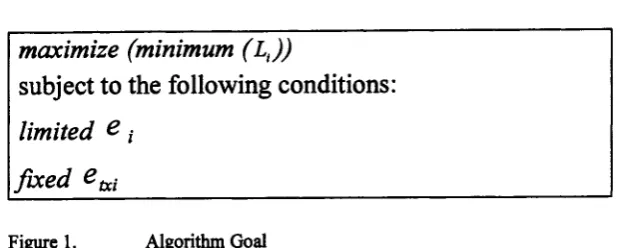
The main goal is to achieve the following:
maximize (minimum ( L j )
subject to the following conditions:
limited e ,•
fix ed e M_________________________________________
Figure 1. Algorithm Goal
According to Nash, the best result is achieved if each player (node) does what is
best for him self and the entire group (the network). It is therefore our goal to come up
with a protocol where all the nodes co-operate in order to maximize both their own
lifetime while considering the lifetimes of the other nodes, i.e. the network lifetime.
The development of the model will be presented in the following section.
3.2 Model Development
From formula (1), it is obvious that a node’s lifetime is directly proportional to
the amount of energy it carries and inversely proportional to the energy it spends per
transmission:
L t a e
L t a 1 i e ui
It is therefore logical to use nodes with higher energies and avoid nodes which use
more energy per transmission in order to increase the network lifetime.
Now let’s assume that we have to choose between two neighbours to relay the
data. One of them has a much higher energy reserve but will consume much more energy
and die. In terms of energy conservation, it is better for the whole network, and for the
first node, to use the second node. But in terms of network lifetime, it is better to use the
first node since this will leave us with no dead nodes and the network can continue to
function. This draws our attention to another important point. The nodes’ energies should
be degraded at a constant rate in order for all the nodes to enjoy a higher network
lifetime. Therefore, the nodes should co-operate together to maximize their utility. This
example shows the difference between focusing on energy conservation and life time
extension.
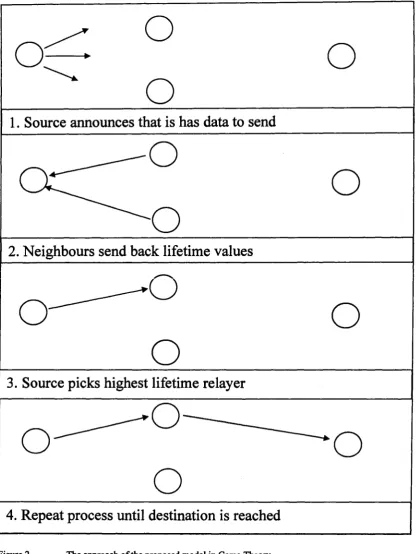
Therefore, tackling the situation from a game theoretic approach can be visualized
as follows. Each node calculates its average expected lifetime as in formula (1). When a
source announces that it wants to send some data, all the neighbours send their lifetime
values to the source and the source picks the node with the highest lifetime value. The
o
°^r
o
o
1. Source announces that is has data to send
o
2. Neighbours send back lifetime values
O
""'*0
o
o
3. Source picks highest lifetime relayer
-o
o
4. Repeat process until destination is reached
3.3 A Numerical Example
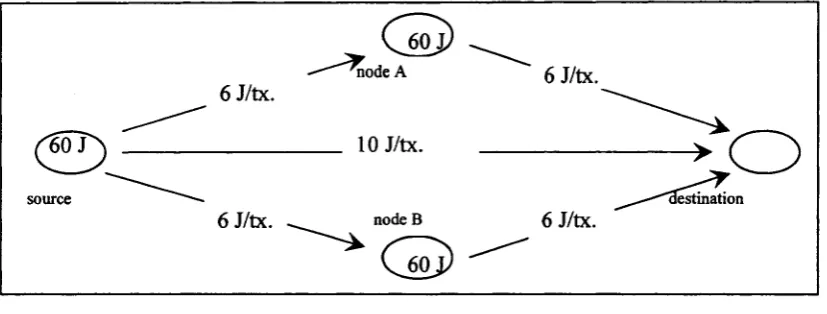
We will analyze a simple 4-node network in a Game Theoretic approach to
illustrate the validity of the model. Let us assume that we have a source attempting to
send data to the destination, with two possible relayers in between. There are four
possible scenarios. The first one is the basic operation, where both possible relayers act
selfishly and decide not to co-operate. The second and third scenarios occur when only
one of the nodes co-operates and finally in the final scenario, both nodes co-operate. We
assume that all nodes have an initial energy of 60 J, and the energy required per
transmission is proportional to the distance between the nodes.
node A 6 J/tX.
6 J/tx.
10 J/tx. 60 J
lestination source
6 J/tx. 6 J/tx. node B
The 4-node network Figure 3.
o
node A
o--->o
source destination
nodeB
As we can see in Figure 4, with an initial energy of 60 J and a required 10
J/transmission, source is able to perform 60/10=6 transmissions. Therefore the lifetime of
the network in this case is 6.
node A
destination source
nodeB
Figure 5. Node A co-operates.
In this case, node A decides to relay data. Although node A now spends energy, it
is better off because the lifetime of the network becomes 60/6= 10. We also realize that
node B has benefited the extended lifetime without spending any energy.
node A
destination source
nodeB
CD
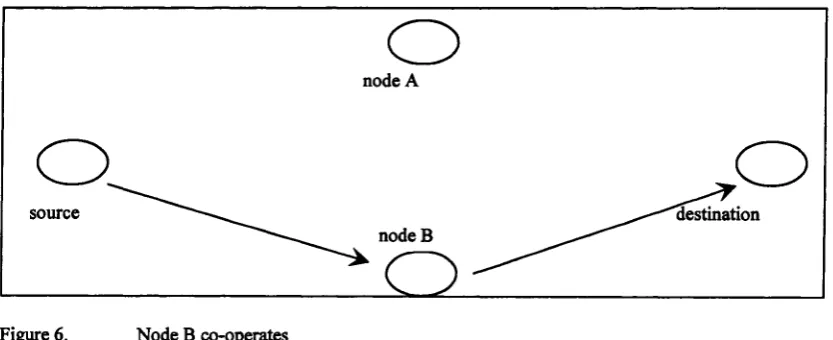
Figure 6. Node B co-operates
In this case, node B decided to relay. The situation is inversed. Here node B
spends energy to extend the network lifetime to 10 transmissions, while node A benefits
node A
o.
destination source
node B
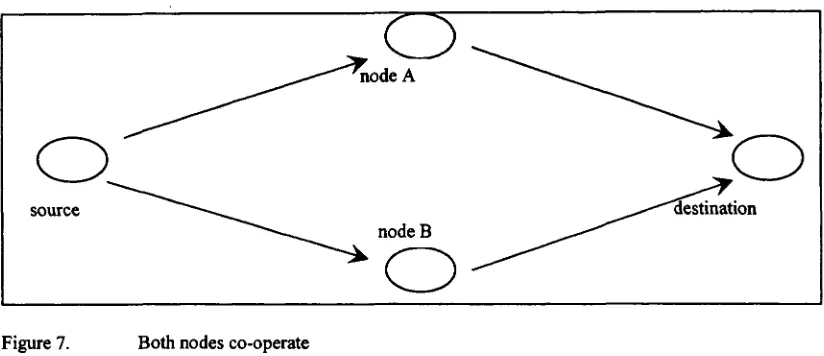
Both nodes co-operate Figure 7.
Finally, both nodes decide to co-operate. Half the data is relayed through node A
while the other half is relayed through node B. Each of them achieves 5 transmissions,
and therefore the overall lifetime is still 10. The advantage here is that both nodes co
operated and shared the effort in extending the lifetime.
Now, we will analyze all four scenarios in a Game theoretic approach.
Scenario 1: No co-operation
This is the basic operation of the network, and all others will be compared to this
one. Here we have a network lifetime of 6 transmissions. Nodes A and B do not spend
any energy and the source depletes all its energy in the transmissions.
Now defining the utility function as lifetime extended per unit energy spent as
opposed to the basic operation, we obtain the following.
Scenario 2: Node A co-operates
All data is relayed through node A. Lifetime is extended from 6 to 10
transmissions with an expenditure of 60 J from both node A and the source. Node B does
Lifetime: 10
Lifetime extension: 10-6=4
u(S): 4/60=0.0667
u(A): 4/60=0.0667
u(B): 4 /0 = o o
Scenario 3: Node B co-operates
All data is relayed through node B. Lifetime is extended from 6 to 10
transmissions with an expenditure of 60 J from both node B and the source. Node A does
not spend any energy.
Lifetime: 10
Lifetime extension: 10-6=4
u(S): 4/60=0.0667
u(A): 4 /0 = o o
u(B): 4/60=0.0667
Scenario 4: Both nodes co-operate
Half the data is relayed through node A and the other half is relayed through node
B. Lifetime is 10 transmissions. Nodes A and B spend 30 J each while the source depletes
all its 60 J.
Lifetime: 10
Lifetime extension: 10-6=4
u(S): 4/60=0.0667
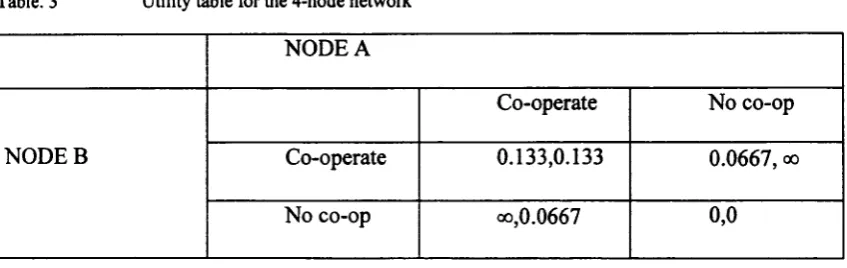
And representing the previous results in a utility table, we get:
Table. 3 Utility table for the 4-node network
NODE A
NODEB
Co-operate No co-op
Co-operate 0.133,0.133 0.0667, oo
No co-op oo,0.0667 0,0
As shown, (co-operate, co-operate) represents the Nash equilibrium point, since
no node can improve his performance without degrading the other node’s performance.
Therefore, co-operation of all nodes in the network, works out to be the best.
3.4 Formulation
3.4.1 The governing formula
We now need a cost function that will reflect the previous behavior. The function
should govern the behavior of the data transmissions and have the following properties:
1) Encourage use of nodes with more energy reserves
2) Discourage high power transmission links
3) Function with different node energy scenarios, whether the nodes have same
initial energies or variable energy values
4) Scalable, which means that the protocol should function well with increasing
network size
5) Degrades the energy values of the nodes at a uniform rate
exj + 1 / pii
p ij: energy of transmission,
c ij: cost of transmission, and
exj: difference between neighbour node’s energy and average energy of nodes:
6 X j = € j — 6 average ( 3 )
The significance of introducing exj is to compare a node’s energy with its
neighbours’ energy values. This will achieve uniform energy degradation throughout the
network.
The decision to be made is to choose a relayer from the neighbouring nodes. In
doing so, the source will consider two criteria: (i) difference between the remaining
energy in the nodes and their neighbours and (ii) transmission energy, used in sending a
packet from one node to the other. By introducing the first criterion, we intend to keep
relaying nodes alive as long as possible by using nodes whose energy level is relatively
higher than others. The cost function encourages the use of a relayer that is better in
terms of remaining energy as opposed to neighbours at each packet transfer. This will
alternate use of relaying nodes and allow them to improve network lifetime. The second
criterion is to pick a relaying node that uses minimum transmit power.
3.4.2 Algorithms
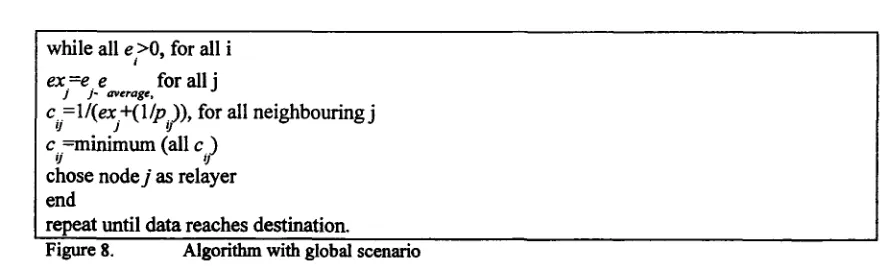
We provide two algorithms to implement our approach. One is based on global
knowledge, and the other is based on local knowledge. In global knowledge, every node
knows the expected lifetime of all other nodes. We assume that that information is
node to other nodes is complex and requires additional protocols, which can consume
large network resources, such as bandwidth and energy. But that approach will provide us
with better understanding on how the algorithms behave.
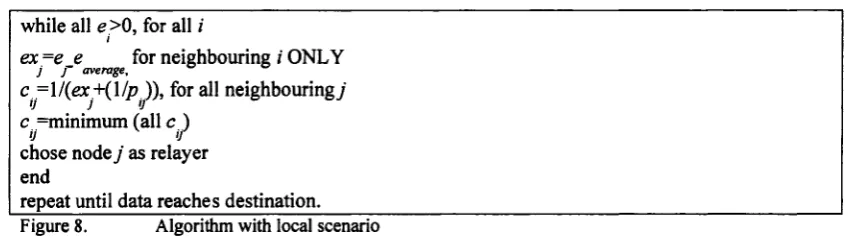
The second approach is based on local knowledge. How the information is
disseminated is not an issue in the design here. But disseminating local information to
neighbours is a much easier and manageable task than disseminating all information to all
the network nodes. Information can travel through the network simply by nodes listening
to their neighbours, without increasing the network overhead. We now discuss those two
approaches.
The Global Knowledge based approach is given by Figure 8. When node / has a
data packet to send out, it calculates the cost of sending that packet to the next hop node j,
c . Node j then picks the next hop, and so on.
w hile all e >0, for all i
t 9
ex~e e for all j
j j - a v e ra g e,
c = \l(e x + {\lp .)), for all neighbouring j
c = m inim um (all c )
'] <J
chose n ode j as relayer end
repeat until d a ta reaches destination.
Figure 8. Algorithm with global scenario
The Local Knowledge based approach is given by Figure 9. It is similar to global
knowledge approach, but in the local approach, only the information obtained by
while all e >0, for all i i
ex=e e for neighbouring i ONLY
j f average,
c=\l(ex+(\lp^)), for all neighbouringy
c =minimum (all c )
ij 'J
chose node j as relayer end
repeat until data reaches destination.____________________________________________
Figure 8. Algorithm with local scenario
We would like to emphasize one more time that the local knowledge based
approach is more feasible than global knowledge based approach. When we consider that
the nodes only forward packets to next hop, which is a neighbouring node, the local
knowledge based approach should not deviate much from the global approach but
operates with much less overhead [28].
The energy model used to calculatepy is based on the work done in [13] where:
■Ee/ec=50nJ/bit is the energy required to run a transmitter or receiver circuit,
Eamp= 100pJ/bit/mA2 for the transmitter amplifier, receive and transmit powers
become functions of k bits:
3.5 Minimum Hop and Minimum Energy Routing
The proposed algorithm will be compared to the two most common routing
protocols; the minimum hop (MH) and minimum energy (ME) routing protocols. In order
to obtain fair results in the long run, an estimation technique is introduced. The results are
an average of at least 1000 simulations. The approach used to simulate both algorithms is
explained in the following two subsections.
rx,—Eelec*k (4)
3.5.1 Minimum Hod Routine Protocol
The minimum hop protocol will be simulated using an estimation formula that
will implement the best case scenario. The data packet will be assumed to travel in a
straight line, therefore when a node has data to send, the number of hops required to
reach the sink is the distance between the source and the sink divided by the node range
[26]
h = d(source, sin k) (6)
h: Number o f hops
d ( ij) : D istance between nodes i and j
r: N ode range
[jtJ: Operation rounds the elem ent to the nearest integer greater than or equal
to it
sink 1
sink
source
Figure 10. Minimum hop estimation
Procedure:
1. find distance between source and all sinks: d(s,l) and d(s,2)
2. choose sink of minimum distance: sink 1
3.5.2 Minimum Energy Routing Protocol
The minimum energy protocol will be estimated using a more complicated
technique. Using the facts that the node distribution is random and the results are
repeated and averaged over at least 1000 simulations, we assume the node distribution to
be uniform in the long run. Minimum energy protocol searches for the route with
intermediate hops where the total distance traveled is smallest per hop. This is because
the received power at on node is proportional to dfl where d is the distance between the
source and the sink and B is the path loss exponent, which in my simulations is assumed
to be 2.
According to the previous assumptions, we work on a uniformly aligned network
as shown below.
o o M
|sink^o o o o
o
o o o o o o o
o o o o o o o o o
Figure 11. Minimum energy estimation
Procedure:
1. find distance between source and sink
2. find number of hops according to previous assumptions
The distance between each two nodes, horizontally or vertically, is Ju where u is
the uniform node density. And the diagonal distance is V“2 + «2 . The transmission
powers are then calculated accordingly.
In this chapter, the basics of the protocol were explained. An example was used to
verify the validity of the method in terms of game theory. Finally, the technique used to
estimate the performance of the networks using the minimum hop routing and the
minimum energy routing protocols is introduced. In the following chapter, the protocol is
put into practice and its performance is tested and analyzed. Modifications will be
CHAPTER IV
ANALYSIS OF RESULTS
4.1 The Sample Model
This model was introduced in the first stages of the model development to test the
cost function on a small scale before extending the work. Figure 12 presents the
simulation topology. In that topology, there are 11 nodes, including source and
destination, and 4 tiers (i.e., 4 hops). The selection of a relayer will be within the tier. For
example, the source has to select one of the following nodes: 2, 3 or 4 to be its relaying
node. The selected node (2, 3, or 4) then has to select a relayer between node 5 and node
6, and so on.
The simulations were performed using MATLAB. We ran several different
scenarios with this topology. First, node energies are distributed randomly, to mimic the
scenario where utilization of the nodes is not uniform. Then we assume that the initial
energies are equal.
200 150 100 50 sou ce
c
o
n2 tier 1o
n3 n4o
tier 2o
n5o
n6o
n7 tier 3o
n8o
n9 tier 4o
destinationo
nlOIn the simulations, we compared the proposed “global knowledge based”
approach, the proposed “local knowledge based” approach, “minimum energy route”,
“maximum available energy approach” and an “arbitrary (i.e., random)” relayer selection
approach. In all approaches, the transmitting node consumes energy based on distance
between the nodes. It is also assumed that each node consumes fixed amount of energy
when it receives a packet regardless of the separation.
Figure 13 shows the final energy levels of the nodes after the simulation ends with
each approach. In that scenario the initial node energies are distributed randomly.
Simulation ends when any of the nodes dissipates all of its energy. In that figure,
proposed global and proposed local leave nodes with energies that are more uniformly
distributed. Although some of the node energies are more in other approaches, since
some nodes depleted their batteries earlier, the network lifetime is relatively short
compared to the proposed approaches. The proposed approach is better, since lower final
energies in the nodes indicate that the nodes were utilized to their maximum capacity to
extend the lifetime of the network. A node with energy when the network stop
Different initial energy nodes
3
- • - g l o b a l
lo ca l
■ m in im u m e n e r g y
>K m ax . a v a ila b le e n e r g y
e a rb itra ry
Figure 13 Final energies o f nodes in scenario where nodes have different initial energies
Figure 14 shows the final energy levels of the nodes after the simulation
ends. In that simulation, the nodes’ initial energies are equal. That Figure shows
that the proposed algorithm’s approaches leaves nodes with relatively uniformly
distributed energies, in other words, network nodes dissipates their energies more
evenly. That allows network to survive longer.
Same Initial energy nodes
1 2 0
1 0 0 - global
local
minimum energy
arbitrary
node
Tables 4 and 5 present comparisons of the number of packets sent in each
approach. As the table reveals, the proposed approaches have the longest lifetimes. It is
interesting to note that the proposed local algorithm is almost 25% better than the
proposed global algorithm and nearly 50% better than others. That can be explained by
each node’s lifetime is degraded as opposed to its neighbours only.
Table 4. Case where nodes have different initial energies
Protocol Proposed (global) Max. available energy route Minimum energy route Arbitrary Proposed (local)
Packets sent
(lifetime)
68 60 50 53 85
Table 5. Case where nodes have same initial energies
Protocol Proposed
(global)
Max. available
energy
Minimum
energy route
Arbitrary Proposed
(local)
Packets sent
(lifetime)
77 67 64 95
Here we presented a trial model that improves lifetime of a sensor network by
allowing nodes to alternate during packet forwarding. In that algorithm, nodes select a
relaying node that has the longest expected life time. Our simulation results show that
this algorithm (approach) maximizes lifetime compared to other approaches, namely
“minimum energy routing”, “maximum available energy routing”, and “random routing”
by almost 50% on average.
As the primary results seem promising, the next step becomes extending the
4.2 The Network Model and Results
A uniform node density of 4000 m2/node will be assumed throughout the
simulations. Nodes will be assumed stationary, and will expend energy upon transmitting
and receiving energy according to the energy model from [13]. Fifty percent of the nodes
will be assumed possible sources and ten percent as sinks. All nodes will be randomly
allocated; nodes within the simulation area and sinks around the network boarder as
shown in Figure 15. Overhead energy is ignored, as this is a small percentage compared
to the overall spent energy [6],
X X
r X _ X X
* • X
800
m
m
X
X
100
X
100 800 800
Figure IS. A randomly allocated network
The MATLAB code written will be able to perform a variety of functions, and
collect a vast amount of data by implementing the techniques used in Network Simulator,
NS2. These include overhead, next hop, number of hops, number of data packets sent and
network lifetime.
The code will implement the local scenario, where each node uses only its
the next node until the destination is reached. The results are presented in the next
section. As shown in Figure 16, a source will send out a request, and its neighbours will
respond by sending back their energy level values. Based on the energy level values, and
the distance between the source and the neighbours, calculated by measuring the power
loss, the source will calculate the cost to each neighbour. The source will then pick the
cheapest neighbour to send the data packet to and the process is repeated until the
destination is reached.
nw ' r
««■*
v i Q
-1. S ource requests neighbors' inform ation
0.0
2. N eighbors send back th e ir energy levels
X....’h
■ - T © ,
oo
3. Source calculates cost and sends data to cheapest node
. m w - f
■;
4. P ro ce ss re p eated u n til sink is in rcnch
Figure 16. Algorithm steps
The protocol is run on different size networks using MATLAB. The maximum
number of nodes simulated was 2800, but the number can be extended. Two different
cases where studied. The first of which lifetime is defined as the time when the first node
dies, and the second is when 25 percent of the nodes die. Snapshots of a 200 nodes
network where taken to represent the network condition when one node dies, and then
when 25 percent of the nodes die. These are presented in Figure 17. This shows the
energy, and the dead nodes are marked with Xs. Destinations are randomly distributed
around the edge of the network and represented as red stars.
• n • • I
* j
•
* - ? • • * •«
x
*
$ S '
i
• s .
f*
x A •• ' • • . f* X A •*
/V
JC
'* I*' i* >
?
V
.*
&
*
>
*
%
• *
£ • •* 2 1 '*
I*
x«£*x
4 % ? , • • • * . , . « . s % x V
% •
• J
X•
9
X X - X X
X x x
X
Figure 17. Network snapshots when a) one node dies, b) 25% o f nodes dies
Since the protocol is allowed to run without any sense of direction, i.e. it is
entirely based on the cost function, sometimes unnecessary paths will be taken and the
packet will end up traveling a much longer distance. This case is represented in Figure 18
along with another scenario where the packet takes an efficient path.
JL
• •
» •
M l
• •
•
• •
M.
Figure 18.
150 200 290 300 350 w 400 0 90 100
Both a)Inefficient path and b) efficient path
200 290 300
When simulated, the minimum hop protocol is assumed to perform at its best
Nhops = d,to sink (6)
threshold
Where
[J
operation rounds the element to the nearest integer greater than orequal to it.
The number of hops required for the proposed algorithm reflects the latency. It is
plotted, as shown in Figure 19, as opposed to the ME and MH protocols, which are
obtained as explained in the previous chapter.
Due to the absolute dependence of the proposed cost function on the transmission
energy and the nodes’ energy levels, the number of hops increases with the number of
nodes, since unnecessary paths become more common as networks grow in size.
22
o 100 200 300 400 500
N odes
The number of packets sent, which represent the lifetime, is next plotted for both
lifetime definitions in Figure 20. The figure demonstrates the advantage of defining the
lifetime as when 25% of the nodes die over when lifetime is defined as one node dead.
This is because the probability of one node dieing is independent of the network size.
Therefore, better network utilization is achieved when terminating the network as soon as
25% of the nodes die.
350
300
jjs 250
U-200 25 % DEAD
LU
%
150100 1 NODE DEAD
50
50 100 150 200
NODES
250 300 350 4 00
Figure 20 Packets sent; for different lifetime definitions
As a means of comparison, the energy per packet metric is introduced. This
metric measures the utility of the network. It will be denoted as EP for short, and
measured in J/packet. It is used as a means of comparing the performance of the
introduced protocol to both the MH and ME protocols. Its value is measured by dividing
MH
0.8
CJ
0.6
PR O PO SED
CD Q£
Z 0.4
■O
ME
0.2
200 600 800 1000
NODES
Figure 2 1 EP vs. nodes for MH, ME and proposed
As observed from Figure 21, the proposed protocol performs much better than the
MH up to around 700 nodes and better than the ME up to around 180 nodes. This is
mainly due to the higher rate of increase in hop count for the proposed protocol as
opposed to the other two. This triggers the need for an optimization of the cost function.
The modification we introduce will be considering the distance of the node from the
closest sink. This should help direct the data packet into a straight line towards the sink,
thus reducing the number of hops, and hence the EP value. The cost function will be
modified as follows:
=--- — ---v Kd * d( j,closest _destination)
«*0') + —tttt (7)
P i h j )
kd is a constant that balances the weight of both terms of the modified cost
function. The previous results will be re-plotted to test the modified cost function, and are
25 r
20
P R O P O S E D 15
1 0
MODIFIED ME
5
MH
O.
O 100 200 300 400 500
NODES
Figure 22 Hops vs. nodes; MH, ME, proposed and modified version
Figure 22 shows how the modified protocol introduces a great improvement in the
network’s latency over the original proposed protocol. Also, the number of hops for the
proposed algorithm is slightly larger than that of the MH and ME. The results will be
extended to 2800 nodes to check the performance of the modified protocol at such
network size, as shown in Figure 23.
1*1
10
C O
Next, we will show the impact of the modification on the EP value.
x 10 1.2 Id o . MH 0.8 az
u j 0.6
s -o or 0.4 PRO POSED U J z U J ME MODIFIED 0.2
200 400 600 800 1000
NODES
Figure 24 EP vs. nodes; M H, M E, proposed and modified version
Once again, it is obvious how the modified cost function improves the
performance of the network and extends its lifetime.
It is important to bear in mind that the protocols do not consider the overhead
energy, and also the GPS energy needed in the modified case is ignored.
In this chapter, we proved the validity of the proposed protocol by applying it to a
small sample network. Since the results seemed promising, a network model was created
and the protocol was allowed to run on bigger networks. The proposed protocol works
fine in terms of lifetime extension, but caused an increase in latency as the network got
bigger and bigger. Optimization of die protocol was then suggested, and the optimized
protocol works a lot better in terms of lifetime and latency. A more comprehensive
CHAPTER V
CONCLUSIONS AND FUTURE WORK
5.1 Conclusions
The game theory proved to be a strong and effective tool for optimizing the
performance of wireless networks. In this thesis, the game theory was used as a guideline
by which the nodes in a network will base their decisions to extend the overall lifetime.
Nodes cooperated and exchanged information with their neighbours in order to achieve
uniform energy degradation across the network. This, in effect, resulted in lifetime
extension.
The network, using the proposed algorithm, depleted its energy in an inside-out
fashion. This means that the nodes closer to the center of the network tend to loose their
energy faster than the nodes closer to the border. This is because border nodes are usually
closer to sinks, and therefore will be used much less.
The introduced cost function was a major key in the success of the protocol. It
eliminated the randomness, which was usually applied in previous research, and
introduced guidelines to relayer selection.
The proposed protocol is advantageous over both the minimum hop routing
protocol and the minimum energy routing protocol in terms of energy per packet, i.e.
lifetime, up to 700 nodes for the first case and 180 nodes for the latter case. It should be
taken into consideration that the ME and MH protocols were simulated using estimation
techniques that give advantage to their results.
The modified proposed protocol introduced a huge improvement in terms of both
enhanced nodes. This means an increase in the network cost which might not be feasible
in some cases.
5.2 Future Work
The results obtained using MATLAB confidently indicate an improvement in
performance over conventional communication protocols. Yet, it still remains necessary
to verify the results using network simulator tool NS and also to include the overhead
energy, which was ignored in MATLAB.
Also, a number of factors used in the simulation can be examined and optimized.
These include the metric, the node density, and different lifetime definitions.
I expect the protocol performance to resemble that of the minimum hop protocol
as the metric is bigger, i.e. more weight is given to the distance between the node and
the sink. Node density and source density, which was assumed to be 50% in my
simulations, should also have an impact on the protocol performance. I predict that a
higher node density should increase the latency of the network when using the proposed
protocol and possibly also increase the lifetime. The value of the node density should be
optimized according to the desired specifications.
Finally, different lifetime definitions will affect the utilization of the nodes.
Various values should be examined to study the effect on node utilization and success
rate. In my thesis, I studied the network for two lifetime definitions only: when one node
dies and when 25 % of the nodes die. A larger definition means that the protocol will
continue to run until more nodes die. This might cause some nodes to be isolated and
therefore unable to send out data packets. This will increase the failure rate. Therefore, an