I
mmuno
s
core
Naples, Italy Graz, Austria
Erlangen, Germany
Stockholm, Sweden Paris, France
Umea, Sweden
Nijmegen, Netherlands Madrid, Spain
Doha, Qatar
Milan, Italy Bern, Switzerland
Siena, Italy Melbourne, Australia
Sapporo, Japan
Xi'an, China
Dorchester, UK Toronto, ON, Canada
Houston, TX, USA Rochester, MN, USA
Portland, OR, USA
Tokyo, Japan Ahmedabad, India
Cancer classification using the Immunoscore: a
worldwide task force
Galon
et al.
R E V I E W
Open Access
Cancer classification using the Immunoscore: a
worldwide task force
Jérôme Galon
1,2,3,4,5*, Franck Pagès
1,2,3,4, Francesco M Marincola
5,6, Helen K Angell
1,2,3, Magdalena Thurin
7,
Alessandro Lugli
8, Inti Zlobec
8, Anne Berger
4, Carlo Bifulco
9, Gerardo Botti
10, Fabiana Tatangelo
10,
Cedrik M Britten
11, Sebastian Kreiter
11, Lotfi Chouchane
12, Paolo Delrio
13, Hartmann Arndt
14, Martin Asslaber
15,
Michele Maio
16, Giuseppe V Masucci
17, Martin Mihm
18, Fernando Vidal-Vanaclocha
19, James P Allison
20,
Sacha Gnjatic
20, Leif Hakansson
21, Christoph Huber
11, Harpreet Singh-Jasuja
22, Christian Ottensmeier
23,
Heinz Zwierzina
24, Luigi Laghi
25, Fabio Grizzi
25, Pamela S Ohashi
26, Patricia A Shaw
27, Blaise A Clarke
27,
Bradly G Wouters
27, Yutaka Kawakami
28, Shoichi Hazama
29, Kiyotaka Okuno
30, Ena Wang
6, Jill O'Donnell-Tormey
31,
Christine Lagorce
32, Graham Pawelec
33, Michael I Nishimura
34, Robert Hawkins
35, Réjean Lapointe
36,
Andreas Lundqvist
37, Samir N Khleif
38, Shuji Ogino
39, Peter Gibbs
40, Paul Waring
41, Noriyuki Sato
42,
Toshihiko Torigoe
42, Kyogo Itoh
43, Prabhu S Patel
44, Shilin N Shukla
44, Richard Palmqvist
45, Iris D Nagtegaal
46,
Yili Wang
47, Corrado D'Arrigo
48, Scott Kopetz
49, Frank A Sinicrope
50, Giorgio Trinchieri
51, Thomas F Gajewski
5,52,
Paolo A Ascierto
53,54and Bernard A Fox
5,55,56Abstract
Prediction of clinical outcome in cancer is usually achieved by histopathological evaluation of tissue samples obtained during surgical resection of the primary tumor. Traditional tumor staging (AJCC/UICC-TNM classification) summarizes data on tumor burden (T), presence of cancer cells in draining and regional lymph nodes (N) and evidence for metastases (M). However, it is now recognized that clinical outcome can significantly vary among patients within the same stage. The current classification provides limited prognostic information, and does not predict response to therapy. Recent literature has alluded to the importance of the host immune system in controlling tumor progression. Thus, evidence supports the notion to include immunological biomarkers,
implemented as a tool for the prediction of prognosis and response to therapy. Accumulating data, collected from large cohorts of human cancers, has demonstrated the impact of immune-classification, which has a prognostic value that may add to the significance of the AJCC/UICC TNM-classification. It is therefore imperative to begin to incorporate the‘Immunoscore’into traditional classification, thus providing an essential prognostic and potentially predictive tool. Introduction of this parameter as a biomarker to classify cancers, as part of routine diagnostic and prognostic assessment of tumors, will facilitate clinical decision-making including rational stratification of patient treatment. Equally, the inherent complexity of quantitative immunohistochemistry, in conjunction with protocol variation across laboratories, analysis of different immune cell types, inconsistent region selection criteria, and variable ways to quantify immune infiltration, all underline the urgent requirement to reach assay harmonization. In an effort to promote the Immunoscore in routine clinical settings, an international task force was initiated. This review represents a follow-up of the announcement of this initiative, and of the J Transl Med. editorial from January
(Continued on next page)
* Correspondence:[email protected]
1INSERM, U872, Laboratory of Integrative Cancer Immunology, Paris F-75006,
France
2Université Paris Descartes, Paris, France
Full list of author information is available at the end of the article
(Continued from previous page)
2012. Immunophenotyping of tumors may provide crucial novel prognostic information. The results of this international validation may result in the implementation of the Immunoscore as a new component for the classification of cancer, designated TNM-I (TNM-Immune).
Background
Conventional clinical and pathological risk prediction in cancer patients is usually achieved by histopathological evaluation of tissue samples obtained during surgical re-moval of the primary tumor. The histopathological char-acteristics used can include: the size of the tumor; tissue integrity; atypical cell morphology; histological grade; ab-errant expression of protein and genetic markers; evi-dence of malignant transformation, senescence and proliferation; characteristics of the invasive margin (IM); depth of invasion; and the extent of vascularization. In addition, histological or radiological analyzes of tumor-draining and regional lymph nodes, as well as of distant organs, are carried out looking to identify evidence of metastases. In accordance with this classification system, the evaluation of cancer progression is performed longi-tudinally and then applied to estimate patient prognosis. The parameters used to predict disease-free (DFS), disease-specific (DSS) and overall (OS) survival are taken from statistical analysis of patients with similar disease progression characteristics and corresponding clinical outcome. Tumor staging (AJCC/UICC-TNM classifica-tion) summarizes data on the extent of the tumor bur-den (T), presence of cancer cells in draining and regional lymph nodes (N) and evidence of metastases (M). This classification, based only on tumor invasion parameters, has been shown to be valuable in estimating the outcome of patients with a variety of cancers [1-3].
However, these traditional classification tools provide limited information in estimating patient post-operative outcome. It is well known that clinical outcome can sig-nificantly vary among patients within the same histo-logical tumor stage [4]. In some patients, advanced stage cancer can remain stable for years, and although rare, partial or full regression of metastatic tumors can occur spontaneously [5]. In contrast, relapse, rapid tumor pro-gression and patient death is associated with approxi-mately 20-25% of TNM I/II stage patients, despite complete surgical resection and no evidence of residual tumor burden or distant metastasis [5].
The predictive accuracy of this traditional staging sys-tem relies on the assumption that tumor progression is largely a cell-autonomous process. The focus of this classification is solely on the tumor cells and fails to consider and incorporate the effects of the host immune response [6]. Histopathological analysis of tumors has revealed the infiltration of inflammatory and lympho-cytic cells [7]. Detailed intra-tumor analysis illustrates
that these immune infiltrates are not randomly distribu-ted. Tumor-infiltrating immune cells appear to be loca-lized and organized within dense infiltrates in the center of the tumor (CT), at the IM of tumoral nests and in ad-jacent tertiary lymphoid structures (TLS). The presence of immune cells may reflect a distinct underlying biology of the tumor, as gene expression profiling and other assays have revealed the presence of a broad signature of inflammation. This signature includes evidence for in-nate immune activation, chemokines for inin-nate and adaptive cell recruitment, immune effector molecules, and expression of immunoregulatory factors [8-10]. Im-mune infiltrates are heterogeneous between tumor types, and are diverse from patient to patient. All immune cell types may be found in a tumor, including macrophages, dendritic cells (DC), mast cells, natural killer (NK) cells, naïve and memory lymphocytes, B cells and T lympho-cytes (which include various subsets of T cell: TH1, TH2, TH17, regulatory T cells (TREGS), T follicular helper cells (TFH) and cytotoxic T cells). The analysis of the location, density and functional orientation of different immune cell populations (termed the immune contexture [11,12]) in large collections of annotated human tumors has allowed the identification of components that are benefi-cial for patients and those that are deleterious [6,9,12-14]. Nonetheless, to implement any new tumor biomarker in-cluding immune infiltrates for routine clinical use, careful evaluation of its laboratory validity and clinical utility is essential [15].
Since tumor molecular features and immune reactions are inter-related, a comprehensive assessment of these factors is critical [16]. Examining the effects of tumor-host interactions on clinical outcome and prognosis clearly represents an evolving interdisciplinary field of molecular pathological epidemiology, the paradigm of which has recently been established [6,11,17,18]. Patho-logical immunity evaluation may provide novel informa-tion on prognosis and help identify patient cohorts more likely to benefit from immunotherapy.
A new classification of cancer based on the tumor microenvironment
Increasing literature [9,11,13,14,19] and meeting reports [20-22] support the hypothesis that cancer development is influenced by the host immune system. A common theme has emerged, emphasizing the critical need to evaluate systemic and local immunological biomarkers. It is in agreement that this may offer powerful
Galonet al. Journal of Translational Medicine2012,10:205 Page 2 of 9
prognostic information and facilitate clinical decision-making regarding the need for systemic therapy [6,23]. Numerous data collected from large cohorts of human cancers (with sample sizes n = 415, 599 and 602, [9,13,14], respectively) demonstrated that the number, type and location of tumor immune infiltrates in primary tumors, are prognostic for DFS and OS. Altogether these immune parameters are designated as the immune con-texture [11,12]. Notably, two large studies (with sample sizes n = 843 and 768, [24,25], respectively) have shown that tumor immune infiltrate patterns and subsets in colorectal cancer are significant prognostic biomarkers, even after adjusting for stage, lymph node count, and well-established prognostic tumor molecular biomarkers including microsatellite instability (MSI), BRAF muta-tion, and LINE- hypomethylation.
A potential clinical translation of these observations is the establishment of an Immunoscore, based on the nu-meration of two lymphocyte populations (CD3/CD45RO, CD3/CD8 or CD8/CD45RO), both in the CT and in the IM of tumors, as a clinically useful prognostic marker [14]. For instance, colorectal cancer (CRC) patients with local tumor, no detectable lymph node or distant metasta-sis are usually treated by surgery alone. However, 20-25% of these patients will have recurrence of their disease indi-cating that occult metastases were already present at the time of curative surgery. No tumor-associated marker pre-dicts recurrence in these patients. The Immunoscore (“I”) utilizes the numeration of CD8 and CD45RO cells in the CT and the IM of resected tumors to provide a score ran-ging from Immunoscore 0 (“I”0), when low densities of both cell types are found in both regions, to Immunoscore 4 (“I”4), when high densities are found in both regions. This Immunoscore approach was applied to 2 large in-dependent cohorts (n = 602). Only 4.8% of patients with a high “I”4, relapsed after 5 years and 86.2% were alive. In comparison, 72% of patients with a low score (“I”0 and “I”1) experience tumor recurrence and only 27.5% were alive at five years. These “I”0 and “I”1 patients potentially could have benefited from adjuvant therapy, had the Immunoscore been incorporated into the tumor staging [14].
The Immunoscore classification, demonstrating the prevalence of immune infiltrates, potentially has a prog-nostic significance superior to that of the AJCC/UICC TNM-classification system. For all patients with CRC stages I/II/III, multivariate Cox analysis revealed that the immune criteria remained highly significantly associated with prognosis. In contrast, the histopathologic staging system (T stage, N stage, and tumor differentiation) was no longer significant [13]. Tumor invasion was shown to be statistically dependent on the nature of the host-immune reaction. Indeed, the host-immune pattern remained the only significant criteria over the classical AJCC/
UICC TNM-classification for DFS and OS, and led to an editorial entitled“TNM staging in colorectal cancer: T is for T cell and M is for memory”accompanying the pub-lication by Mlecnik and Broussard et al. in the Journal of Clinical Oncology [13,26]. It has thus been suggested that the prevalence of post-surgical immune infiltrates, and not tumor status, is the key indicator for reoccur-rence, metastasis and therefore clinical outcome.
These results suggest that once human cancer be-comes clinically detectable, the adaptive immune re-sponse may play a critical role in preventing tumor recurrence. The ability of effector-memory T cells to re-call previously encountered antigens leads to a protect-ive response. Following primary exposure to antigen, memory T cells disseminate and are maintained for long periods of time [27]. The trafficking properties and the long-lasting antitumor capacity of memory T cells could result in long-term immunity in human cancer.
Although first described in CRC, the impact of the im-mune cytotoxic and memory T cell phenotype has been demonstrated in many other human tumors and appears to be a general phenomenon [23,28]. It is interesting to note that the implications of this immune phenotype apply not only to various organs of cancer origin (such as breast, colon, lung, head and neck, kidney, bladder, ovary, prostate), but also to various cancer cell types (adenocarcinoma, squamous cell carcinoma, large cell cancer, melanoma, etc).
A recent Nature Cancer Review meta-analysis [12] summarizes the impact of immune cells including B cells, NK cells, myeloid derived suppressor clls MDSC, macrophages, and all subsets of T cells on clinical outcome from more than 120 published arti-cles. Beyond colorectal cancer, a strong T cell infiltra-tion associated with good clinical outcome has been reported in many different tumours, including melan-oma, head and neck, breast, bladder, urothelial, ovar-ian, esophageal, renal, prostatic, pancreatic, cervical, medulloblastoma, merkel cell carcinoma, hepatocellu-lar, gastric, and lung cancers [12]. Thus, high densities of T cells (CD3+), of cytotoxic T cells (CD8+), and of memory T cells (CD45RO+) were clearly associated with a longer DFS (after surgical resection of the pri-mary tumour) and/or OS.
The Immunoscore as a new approach for the classification of cancer
Considering the important role of the host immune signa-ture in controlling tumor progression, it is now imperative to initiate the incorporation of the Immunoscore as a component of cancer classification [13,14] and a prognos-tic tool [23]. This strategy has a dual advantage: firstly, it appears to be the strongest prognostic factor for DFS and OS, particularly in early stage cancers and secondly, it could allude to potential targets for novel therapeutic approaches, including immunotherapy. Current immuno-histochemical technologies allow the application of such analyses by laboratories concerned with routine diagnostic and prognostic assessment of tumors.
The inherent complexity of immunohistochemistry, in conjunction with protocol variability, analysis of differ-ent immune cell types, inconsistdiffer-ent tissue region selec-tion criteria, combined with differences in conjuncselec-tion with qualitative and semi-quantitative criteria to meas-ure immune infiltration, all contribute to the variability of the results obtained, and raise the concern that spe-cialized protocols and training may be required. It is therefore essential to pursue assay uniformity to reduce these limitations. Many markers, signatures, and meth-ods have been described to evaluate the prognosis of cancer patients. Yet, very few such markers and labora-tory assays are used in clinical practice. Thus, we believe that harmonization of an assay evaluating the “ inflam-mation”, i.e. the Immunoscore of the tumor is essential. Analytical and clinical validation of the assay is required before the Immunoscore will reach clinical applicability for individual patients. However, current immunohisto-chemical technologies allow the application and cross-validation of such analysis in laboratories performing routine diagnostic and prognostic assessment of tumors. In order to be able to compare results in the future, and for the development of more effective prognostic and predictive markers to improve clinical decision-making, it is important to perform a standardized set of experi-ments. Assay harmonization should minimize data vari-ability and allow worldwide correlations of Immunoscore results with clinical outcomes. Harmonization guidelines resulting from this process are expected to be simple to implement and will improve assay performance. Effective large-scale assay harmonization efforts have already been conducted for commonly used immunological assays of peripheral blood immune cell populations [29,30].
A fundamental parameter to determine the Immuno-score will include the immune cell density, calculated by numerical quantification of two lymphocyte populations, cytotoxic and memory T cells at the CT and the IM of tumors. This core criterion will establish prognosis of patient clinical outcome, regardless of the absence of other cancer associated prognostic markers, such as in
early tumor stage (I/II) patients [14]. In human cancers, a high density of TH1/cytotoxic memory T lymphocytes, located both in the CT and IM of the primary tumor, is associated with long DFS and OS, in addition to low risk of relapse and metastasis. This was particularly illu-strated in CRC [5,9,13,14,19], and should be applicable to most human tumors [23]. Thus, this Immunoscore classification may help identify the high-risk patients who would benefit the most from adjuvant therapy.
Impact on response to cancer therapies
Whether the immune contexture of the primary tumor predicts therapeutic responses is of paramount import-ance for patient clinical management. Data based on im-mune signatures have established that a strong imim-mune component is predictive of good response to chemother-apy in breast cancer [31-33], a tumor in which a high lymphocyte infiltrate is associated with higher response rate in neo-adjuvant therapy [34,35]. In hepatic metastases of CRC, high CD8 infiltrates in the IM predicts better re-sponse to chemotherapy and prolonged survival [36]. In melanoma, an immune signature displaying high expres-sion of TH1 and cytotoxicity-associated genes, correlates with favorable clinical outcome to several different thera-peutic vaccines [8]. In addition, high numbers of CD8 T cell infiltrates within metastatic melanoma correlated with prolonged survival [37]. However, the high TH1 and cyto-toxic immune response associated with prolonged survival in patients receiving adjuvant therapies may not be a pre-diction of response to the therapy, but rather the fact that the host-immune response within the tumor protects the patient and prolongs patient life. To assess the impact of the Immunoscore as a predictive marker, it should be evaluated prospectively in randomized clinical trials.
An open access call for a broad participation to the development of a task force dedicated to the evaluation of the Immunoscore in cancer patients
Over the past few years, the area of immune regulation at the level of the tumor microenvironment has gained a forefront position in cancer research, in CRC [9,12-14], in melanoma [38] and all other cancer types [6]. The Immu-noscore was initially described several years ago [9], and more recently advances have been made in the develop-ment of the Immunoscore as a prognostic factor [13,14] that could be used in routine testing [39]. In an effort to promote the utilization of such Immunoscore in routine clinical settings worldwide, the Society for Immunother-apy of Cancer (SITC), the European Academy of Tumor
Immunology (EATI), and “La Fondazione Melanoma
Onlus”, initiated a task force on “Immunoscoring as a New Possible Approach for the Classification of Cancer” that took place in Naples, Italy, February 13th, 2012 [39]. This perspective represents a follow-up on this initiative,
Galonet al. Journal of Translational Medicine2012,10:205 Page 4 of 9
originally announced in a J Transl Med. editorial in Janu-ary 2012 [39]. The working group, composed of inter-national expert pathologists and immunologists, identified a strategy for the organization of worldwide participation by various groups for the validation of the Immunoscore. The objectives of the meeting included discussing: the role of immune system in cancer; a review of the AJCC/UICC-TNM classification of CRC; the role of the microenviron-ment in melanoma biology; the review of the AJCC classification of melanoma; the relevance of HLA-A2 in cancer prognosis and tumor malignancy; data utilizing the Immunoscore and a proposal for standardizing the operat-ing procedures for the Immunoscore quantification. Fur-thermore, the international working group evaluated the feasibility of using the Immunoscore for the classification of cancer. Evidence-based selection of specific markers and their combinations for the Immunoscore was dis-cussed including biological rationale, clinical use, synthetic meta-analysis of the Immunoscore, analytical perform-ance, reagents availability and testing, metrics for decision making, cross-laboratory validation of methodology and identification of potential problems during development of other markers. Practical aspects of the validation of the assay by participating centers were proposed including consideration of cancer types, cancer stages, and the def-inition of a working group of pathologists for the valid-ation phase.
CRC has been most comprehensively studied and the prognostic significance of immunologic parameters has been best validated, thus special emphasis will be placed in this disease for this formal validation. As neo-adjuvant treatments are nowadays recommended for rectal cancer, it may be advisable to separate the validation of colon cancers and rectal cancers. Other cancer types, including melanoma and breast cancers were additionally discussed and their validation will follow. An independent international con-sensus panel of expert laboratories discussed cross-laboratory assay validation for the development of an Immunoscore prognostic method. As evaluation of cyto-toxic memory CD8+T cells (CD3+, CD8+, CD45RO+,
Gran-zyme B+ (GZMB)) provides the best method to
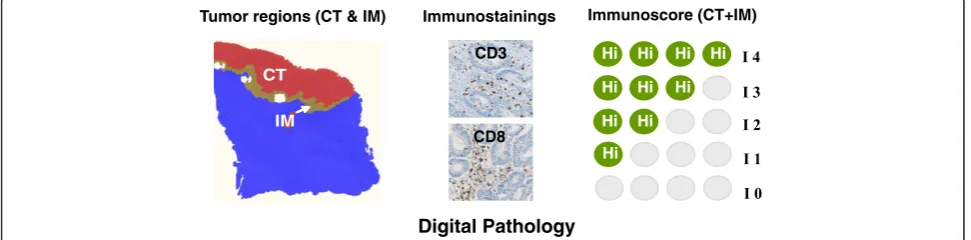
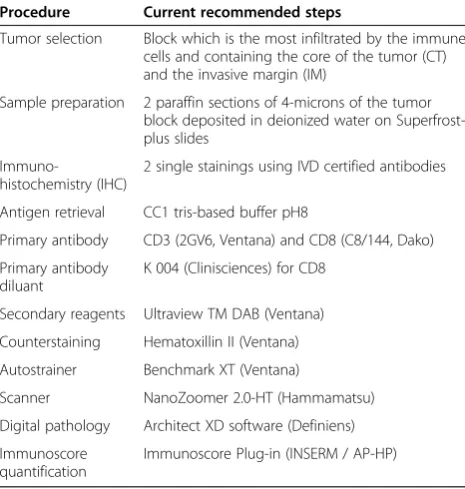
discriminate patient outcome, any combination of two of these aforementioned markers should have similar statis-tical power. Because of technical difficulties including back-ground noise (CD45RO) and granular staining (GZMB), it was decided to employ the two easiest membrane stains, CD3 and CD8. Thus, the combination of two markers (CD3+and CD8+) in two regions (CT and IM) was agreed for validation in standard clinical practice. Precise quantifi-cation will be performed on whole slide sections (Figure 1). For harmonization of the assay and reproducibility of the method, all laboratories agreed to test the prognostic value of specific immune cell infiltration following the recom-mended initial guidelines. The inherent complexity of quantitative immunohistochemistry underscored the urgent need to reach assay harmonization. The components of the Immunoscore are listed in Table 1. Additional markers could be added subsequently to refine the methodology even further if required. After worldwide validation, a con-sensus detailed protocol will be available.
To be used globally in a routine manner, evaluation of a novel marker should have the following characteristics: pathology-based, feasible in routine settings, simple, in-expensive, rapid, robust, reproducible, quantitative, stan-dardized, and powerful. The Immunoscore fulfills all these keys aspects summarized in Table 2.
The purpose of the Immunoscore worldwide task force is to validate these points.
The goals of the first ongoing initiative are the following:
1) to demonstrate the feasibility and reproducibility of the Immunoscore.
2) to validate the major prognostic power of the Immunoscore in routine settings for patients with colon cancer stage I/II/III.
3) to demonstrate the utility of the Immunoscore to predict stage II colon cancer patients with high risk of recurrence.
Thus, the benefit of the Immunoscore worldwide study would be to validate the feasibility, reproducibility,
CD3
CD8
Immunoscore (CT+IM)
Hi Hi Hi Hi Hi Hi Hi Hi Hi Hi CT
IM
Tumor regions (CT & IM) Immunostainings
[image:6.595.56.542.596.716.2]Digital Pathology
and prognostic value of the routine Immunoscore on colon cancer patients.
The goals of the next initiatives will be the following:
1) promote the worldwide use of the Immunoscore as a routine testing for cancer classification.
2) to validate the major prognostic power of the Immunoscore for patients with other cancer types (melanoma, breast, ovarian, endometrial, etc. . .). 3) to demonstrate the utility of the Immunoscore to
predict response to treatments in clinical trials.
In the inaugural World Immunotherapy Council meet-ing (February 21st- 24th2012, Curacao), the Immunoscore task force, led by the Society for Immunotherapy of
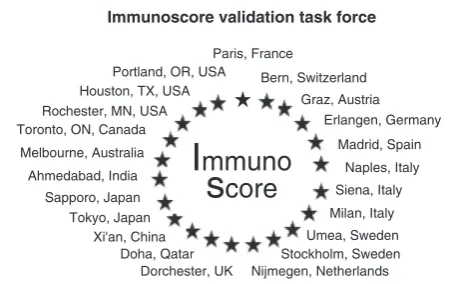
Cancer (SITC), received the support from several add-itional cancer immunology societies including; Biotherapy Development Association (BDA); Canadian Cancer Im-munotherapy Consortium (CCIC); Cancer Immunother-apy Consortium (CIC) of the Cancer Research Institute (CRI); Association for Cancer Immunotherapy (CIMT); Committee for Tumor Immunology and Bio-therapy (TIBT); European Academy of Tumor Immunology (EATI); European Society for Cancer Immunology and Immunotherapy (ESCII); Italian Network for Tumor Biotherapy (NIBIT); Japanese Association of Cancer Im-munology (JACI); Nordic Center for Development of Antitumor Vaccines (NCV-network); Progress in Vaccin-ation Against Cancer (PIVAC); Adoptive engineered T cell Targeting to Activate Cancer Killing (ATTACK) and the Tumor Vaccine and Cell Therapy Working Group (TVACT). These groups share a clinical or basic interest in the immunobiology of the tumor microenvironment and will collaborate with worldwide expert pathologists to assess the validity of this new approach. Following the Immunoscore Workshop and the World Immunotherapy Council meeting, 22 international expert centers agreed to participate in this visionary enterprise. These participants represent 22 Centers Worldwide from 16 countries in-cluding Asia, India, Europe, North America, Australia, and Middle East (Figure 2). Additionally, pathologist asso-ciations and other medical specialty groups have been invited to participate.
[image:7.595.57.290.101.346.2]A preliminary summary of this effort will be pre-sented during the “Workshop on Tumor Microenvir-onment” prior to the SITC annual meeting (October 24th - 25th 2012, Maryland, USA). Finally a “ Work-shop on Immunoscore” (December 5th 2012, Naples, Italy), will lead to the preparation of a summary document providing recommendations for the har-monization and implementation of the Immunoscore as a new component for the classification of cancer TNM-I (Immune).
Table 1 Current Immunoscore procedure and reagents
Procedure Current recommended steps
Tumor selection Block which is the most infiltrated by the immune cells and containing the core of the tumor (CT) and the invasive margin (IM)
Sample preparation 2 paraffin sections of 4-microns of the tumor block deposited in deionized water on Superfrost-plus slides
Immuno-histochemistry (IHC)
2 single stainings using IVD certified antibodies Antigen retrieval CC1 tris-based buffer pH8
Primary antibody CD3 (2GV6, Ventana) and CD8 (C8/144, Dako) Primary antibody
diluant
K 004 (Clinisciences) for CD8 Secondary reagents Ultraview TM DAB (Ventana) Counterstaining Hematoxillin II (Ventana) Autostrainer Benchmark XT (Ventana)
Scanner NanoZoomer 2.0-HT (Hammamatsu) Digital pathology Architect XD software (Definiens) Immunoscore
quantification
Immunoscore Plug-in (INSERM / AP-HP)
Table 2 Characteristics of a good marker and of the Immunoscore
Must be Immunoscore Characteristics
Routine YES Technic to be performed by pathologist using bright field and precise cell evaluation Feasible YES Established pathology technics, using 2 regular whole slide FFPE section
Inexpensive YES Automatized immunohistochemistry
Rapid YES 2 simple staining less costly than complicated molecular techniccs
Robust YES Autostainers, scanner, and digital pathology reduce the time to perform an Immunoscore Reproducible YES Two strong membrane staining, with no background, allowing the numeration of individual cells
Quantitative YES Inter-observers variability is removed by the use of digital pathology, taking into account cell location and counts Standardized YES Standardized operating procedure should be performed to insure reproducibility and worldwide comparisons Pathology-base YES Necessity of pathologist expertise to validate cell type, cell location, and cell counts performed by digital pathology Powerful YES The immunoscore has a prognostic value highly significant even in Cox multivariate including TNM classification13
Galonet al. Journal of Translational Medicine2012,10:205 Page 6 of 9
[image:7.595.57.542.579.733.2]Conclusion
Prediction of clinical outcome in cancer is usually achieved by histopathological evaluation (AJCC/UICC-TNM classification) of tissue samples obtained during surgical resection of the primary tumor. However, it is now recognized that clinical outcome can significantly vary among patients within the same stage. The current classification provides limited prognostic information, and does not predict response to therapy. Recent litera-ture demonstrated the importance of the host immune system in controlling tumor progression. Accumulating data, collected from large cohorts of human cancers, has demonstrated the impact of immune-classification, which has a prognostic value that may add to the signifi-cance of the current classification, and that has been demonstrated to be superior to the AJCC/UICC TNM-classification in colorectal cancer. It is therefore impera-tive to begin to incorporate the‘Immunoscore’into trad-itional classification, thus providing an essential prognostic and potentially predictive tool. Given the power of a proper immune evaluation of cancer patients, the Immunoscore is likely to be important for the field of cancer, beyond the field of tumor-immunology. In an effort to promote the Immunoscore in routine clinical settings, an international task force was initiated. The results of this international validation may result in the implementation of the Immunoscore as a new compo-nent for the classification of cancer, designated TNM-I (TNM-Immune). It is hoped that this effort will better define the prognosis of cancer patients, better identify patients at high-risk of tumor recurrence, to improve the quality of life by predicting and stratifying patients who will benefit from adjuvant therapies and, ultimately, to help save the lives of patients with cancer.
Competing interests
The authors declare that they have no competing interests.
Authors’contributions
JG is coordinating this Immunoscore initiative, conceived the study, and wrote the manuscript. JG, FP initiated the Immunoscore project. FP, CL, AB, JG performed the initial experiments related to the Immunoscore. HKA participated in the drafting of the manuscript. FMM, TAG, BAF, JG from the SITC, initiated a task force and organized meetings on Immunoscore. PAA, from La Fondazione Melanoma Onlus organized initial meetings on Immunoscore. AL, CB, GB, FT, PD, AH, MA, LL, MM, FG, FP, FMM, BAF, JG were experts involved in the design of the immunoscore study, and expert pathologists participating to the inaugural Immunoscore workshop. MT, JPA, SO, GT, with their expertise, supported the Immunoscore initiative. GVM, SG, LH, CH, HSJ, CO, HZ, PSO, JODT, GP, MIN, RH, RL, AL, SNK, TF, BAF, JG, were experts participating to the WIC meeting and supporting the Immunoscore initiative. FP, AL, IZ, AB, CB, GB, FT, LC, PD, AH, MA, MM, FVV, LL, FG, PSO, PAS, BAC, BGW, YK, SH, CL, PG, PW, NS, TT, KI, RP, IDN, YW, CDA, SK, FAS, PAA, BAF, JG are expert participants of the initial worldwide Immunoscore task force study. All authors read and approved the final manuscript.
Acknowledgements
The authors wish to acknowledge the following organizations, whose representatives contributed to this manuscript: Society for Immunotherapy of Cancer (SITC); European Academy of Tumor Immunology (EATI); La Fondazione Melanoma Onlus; National Cancer Institute, USA (NCI); Institut National du Cancer, France (INCa); Biotherapy Development Association (BDA); Canadian Cancer Immunotherapy Consortium (CCIC); Cancer Immunotherapy Consortium (CIC); Cancer Research Institute (CRI); Association for Cancer Immunotherapy (CIMT); Committee for Tumor Immunology and Bio-therapy (TIBT); European Society for Cancer Immunology and Immunotherapy (ESCII); Italian Network for Tumor Biotherapy (NIBIT); Japanese Association of Cancer Immunology (JACI); Nordic Center for Development of Antitumor Vaccines (NCV-network); Progress in Vaccination Against Cancer (PIVAC); Adoptive engineered T cell Targeting to Activate Cancer Killing (ATTACK); Tumor Vaccine and Cell Therapy Working Group (TVACT).
Author details
1INSERM, U872, Laboratory of Integrative Cancer Immunology, Paris F-75006,
France.2Université Paris Descartes, Paris, France.3Centre de Recherche des Cordeliers, Université Pierre et Marie Curie Paris 6, Paris, France.4Assistance
Publique-Hopitaux de Paris, HEGP, Paris, France.5Society for Immunotherapy of Cancer, Milwaukee, WI, USA.6Infectious Disease and Immunogenetics
Section (IDIS), Clinical Center and trans-NIH Center for Human Immunology (CHI), National Institutes of Health, Bethesda, Maryland, USA.7Cancer
Diagnosis Program, National Cancer Institute, National Institutes of Health, Rockville, Maryland, USA.8Institute of Pathology, University of Bern, Bern
3010, Switzerland.9Department of Pathology, Providence Portland Medical Center, Portland, OR, USA.10Department of Pathology, Istituto Nazionale per
lo Studio e la Cura dei Tumori "Fondazione G.Pascale", Naples, Italy.11TRON -Translational Oncology at the University Medical Center of the Johannes Gutenberg University Mainz, Mainz, Germany.12Weill Cornell Medical College, Doha, Qatar.13Colorectal Surgery Department, Istituto Nazionale per lo
Studio e la Cura dei Tumori, "Fondazione G.Pascale", Naples, Italy.
14Department of Pathology, University of Erlangen, Erlangen, Germany. 15
Institute of Pathology, Medical University of Graz, Graz, Austria.16Division of Medical Oncology and Immunotherapy, University Hospital of Siena, Istituto Toscano Tumori, Siena, Italy.17Department of Oncology-Pathology, Karolinska Institutet, Karolinska University, Stockholm, Sweden.18Harvard Medical
School and Massachusetts General Hospital, Boston, MA 02114-2696, USA.
19CEU-San Pablo University School of Medicine and HM-Hospital of Madrid
Scientific Foundation, Institute of Applied Molecular Medicine (IMMA), Madrid, Spain.20Ludwig Institute for Cancer Research, Memorial
Sloan-Kettering Cancer Center, New York, NY, USA.21University of Lund, Lund, Sweden.22Immatics Biotechnologies GmbH, Tübingen, Germany. 23
Experimental Cancer Medicine Centre, University of Southampton Faculty of Medicine, Southampton, United Kingdom.24Department Haematology
and Oncology, Innsbruck Medical University, Innsbruck, Austria.25Molecular Gastroenterology and Department of Gastroenterology, Humanitas Clinical and Research Center, Rozzano, Milan, Italy.26Ontario Cancer Institute and Campbell Family Institute for Cancer Research, Princess Margaret Hospital, University Health Network, Toronto, ON, Canada.27Departments of Laboratory Medicine, Pathobiology & Radiation Oncology, Ontario Cancer
Immunoscore validation task force
I
mmuno
s
core
Naples, Italy Graz, Austria
Erlangen, Germany
Stockholm, Sweden Paris, France
Umea, Sweden
Nijmegen, Netherlands Madrid, Spain
Doha, Qatar
Milan, Italy Bern, Switzerland
Siena, Italy Melbourne, Australia
Sapporo, Japan
Xi'an, China
Dorchester, UK Toronto, ON, Canada
Houston, TX, USA Rochester, MN, USA
Portland, OR, USA
[image:8.595.58.287.92.234.2]Tokyo, Japan Ahmedabad, India
Institute/Princess Margaret Cancer Centre, Toronto, ON, Canada.28Division of
Cellular Signaling, Institute for Advanced Medical Research, Keio University School of Medicine, Tokyo, Japan.29Department of Digestive Surgery and
Surgical Oncology, Yamaguchi University, Graduate School of Medicine, Yamaguchi, Japan.30Department of Surgery, Kinki University, School of
Medicine, Osaka-sayama, Japan.31Cancer Research Institute, New York, NY, USA.32Department of Pathology, Avicenne Hospital, AP-HP, Bobigny, France. 33
Center for Medical Research, University of Tuebingen, Tuebingen, Germany.
34Oncology Institute, Loyola University Medical Center, Cardinal Bernardin
Cancer Center, Maywood, IL, USA.35School of Cancer and Imaging Sciences, University of Manchester, Christie Hospital NHS Trust, Manchester, UK.
36
Research Center, University Hospital, Université de Montréal (CRCHUM), Montréal, Québec, Canada ; Institut du Cancer de Montréal, Montréal, Québec, Canada.37Karolinska Institutet Department of Oncology-Pathology, Stockholm, Sweden.38Georgia Health Sciences University Cancer Center,
Augusta, GA, USA.39Department of Pathology, Brigham and Women's Hospital and Harvard Medical School, Boston, MA, USA; Department of Medical Oncology, Dana-Farber Cancer Institute, Boston, MA, USA.
40Department of Medical Oncology, Royal Melbourne Hospital, Melbourne,
Australia.41Department of Pathology, The University of Melbourne, Melbourne, Australia.42Department of Pathology, Sapporo Medical University
School of Medicine, Sapporo, Japan.43Department of Immunology and Immunotherapy, Kurume University School of Medicine, Kurume, Japan.
44
The Gujarat Cancer & Research Institute, Asarwa, Ahmedabad, India.
45Department of Medical Biosciences, Pathology, Umea University, Umea,
Sweden.46Pathology Department, Radboud University Nijmegen Medical Center, Nijmegen, The Netherlands.47Institute for Cancer Research, Center of
Translational medicine, Xi’an Jiaotong university, Xian, China.48Department of Histopathology, Dorset County Hospital, DCHFT, NHS, Dorchester, UK.
49
MD Anderson Cancer Center, Houston, TX, USA.50Mayo Clinic and Mayo College of Medicine, Rochester, MN 55905, USA.51Cancer Inflammation
Program, Center for Cancer Research, National Cancer Institute and Trans-NIH Center for Human Immunology (CHI), National Institutes of Health, Frederick and Bethesda, Maryland, USA.52University of Chicago, Chicago, IL, USA.
53Medical Oncology and Innovative Therapies Unit, Istituto Nazionale per lo
Studio e la Cura dei Tumori, "Fondazione G. Pascale", Napoli, Italy.
54Fondazione Melanoma Onlus, Napoli, Italy.55Laboratory of Molecular and
Tumor Immunology, Earle A. Chiles Research Institute, Robert W. Franz Cancer Center, Providence Portland Medical Center, Portland, OR, USA.
56
Department of Molecular Microbiology and Immunology, Oregon Health and Science University, Portland, OR, USA.
Received: 6 July 2012 Accepted: 19 September 2012 Published: 3 October 2012
References
1. Locker GY, Hamilton S, Harris J, Jessup JM, Kemeny N, Macdonald JS, Somerfield MR, Hayes DF, Bast RC Jr:ASCO 2006 update of recommendations for the use of tumor markers in gastrointestinal cancer.J Clin Oncol2006,24:5313–5327.
2. Sobin L, Wittekind C:TNM classification of malignant tumors. New York: Wiley-Liss; 2002.
3. Weitz J, Koch M, Debus J, Hohler T, Galle PR, Buchler MW:Colorectal cancer.Lancet2005,365:153–165.
4. Nagtegaal ID, Quirke P, Schmoll HJ:Has the new TNM classification for colorectal cancer improved care?Nat Rev Clin Oncol2011,9:119–123. 5. Mlecnik B, Bindea G, Pages F, Galon J:Tumor immunosurveillance in
human cancers.Cancer Metastasis Rev2011,30:5–12.
6. Bindea G, Mlecnik B, Fridman WH, Pages F, Galon J:Natural immunity to cancer in humans.Curr Opin Immunol2010,22:215–222.
7. Finn OJ:Cancer immunology.N Engl J Med2008,358:2704–2715. 8. Gajewski TF, Louahed J, Brichard VG:Gene signature in melanoma
associated with clinical activity: a potential clue to unlock cancer immunotherapy.Cancer J2010,16:399–403.
9. Galon J, Costes A, Sanchez-Cabo F, Kirilovsky A, Mlecnik B, Lagorce-Pages C, Tosolini M, Camus M, Berger A, Wind P,et al:Type, density, and location of immune cells within human colorectal tumors predict clinical outcome.
Science2006,313:1960–1964.
10. Wang E, Miller LD, Ohnmacht GA, Mocellin S, Perez-Diez A, Petersen D, Zhao Y, Simon R, Powell JI, Asaki E,et al:Prospective molecular profiling of
melanoma metastases suggests classifiers of immune responsiveness.
Cancer Res2002,62:3581–3586.
11. Galon J, Fridman WH, Pages F:The adaptive immunologic
microenvironment in colorectal cancer: a novel perspective.Cancer Res
2007,67:1883–1886.
12. Fridman WH, Pages F, Sautes-Fridman C, Galon J:The immune contexture in human tumours: impact on clinical outcome.Nat Rev Cancer2012, 12:298–306.
13. Mlecnik B, Tosolini M, Kirilovsky A, Berger A, Bindea G, Meatchi T, Bruneval P, Trajanoski Z, Fridman WH, Pages F, Galon J:Histopathologic-based prognostic factors of colorectal cancers are associated with the state of the local immune reaction.J Clin Oncol2011,29:610–618.
14. Pages F, Kirilovsky A, Mlecnik B, Asslaber M, Tosolini M, Bindea G, Lagorce C, Wind P, Marliot F, Bruneval P,et al:In situ cytotoxic and memory T cells predict outcome in patients with early-stage colorectal cancer.J Clin Oncol2009,27:5944–5951.
15. Febbo PG, Ladanyi M, Aldape KD, De Marzo AM, Hammond ME, Hayes DF, Iafrate AJ, Kelley RK, Marcucci G, Ogino S,et al:NCCN Task Force report: evaluating the clinical utility of tumor markers in oncology.J Natl Compr Canc Netw2011,9(Suppl 5):S1–S32. quiz S33.
16. Ogino S, Galon J, Fuchs CS, Dranoff G:Cancer immunology–analysis of host and tumor factors for personalized medicine.Nat Rev Clin Oncol
2011,8:711–719.
17. Ogino S, Chan AT, Fuchs CS, Giovannucci E:Molecular pathological epidemiology of colorectal neoplasia: an emerging transdisciplinary and interdisciplinary field.Gut2011,60:397–411.
18. Ogino S, Stampfer M:Lifestyle factors and microsatellite instability in colorectal cancer: the evolving field of molecular pathological epidemiology.J Natl Cancer Inst2010,102:365–367.
19. Pages F, Berger A, Camus M, Sanchez-Cabo F, Costes A, Molidor R, Mlecnik B, Kirilovsky A, Nilsson M, Damotte D,et al:Effector memory T cells, early metastasis, and survival in colorectal cancer.N Engl J Med2005, 353:2654–2666.
20. Butterfield LH, Disis ML, Fox BA, Lee PP, Khleif SN, Thurin M, Trinchieri G, Wang E, Wigginton J, Chaussabel D,et al:A systematic approach to biomarker discovery; preamble to "the iSBTc-FDA taskforce on immunotherapy biomarkers".J Transl Med2008,6:81.
21. Butterfield LH, Palucka AK, Britten CM, Dhodapkar MV, Hakansson L, Janetzki S, Kawakami Y, Kleen TO, Lee PP, Maccalli C,et al:Recommendations from the iSBTc-SITC/FDA/NCI Workshop on Immunotherapy Biomarkers.Clin Cancer Res2011,17:3064–3076.
22. Tahara H, Sato M, Thurin M, Wang E, Butterfield LH, Disis ML, Fox BA, Lee PP, Khleif SN, Wigginton JM,et al:Emerging concepts in biomarker discovery; the US-Japan Workshop on Immunological Molecular Markers in Oncology.J Transl Med2009,7:45.
23. Pages F, Galon J, Dieu-Nosjean MC, Tartour E, Sautes-Fridman C, Fridman WH:Immune infiltration in human tumors: a prognostic factor that should not be ignored.Oncogene2010,29:1093–1102.
24. Nosho K, Baba Y, Tanaka N, Shima K, Hayashi M, Meyerhardt JA, Giovannucci E, Dranoff G, Fuchs CS, Ogino S:Tumour-infiltrating T-cell subsets, molecular changes in colorectal cancer and prognosis: cohort study and literature review.J Pathol2010,222:350–366.
25. Ogino S, Nosho K, Irahara N, Meyerhardt JA, Baba Y, Shima K, Glickman JN, Ferrone CR, Mino-Kenudson M, Tanaka N,et al:Lymphocytic reaction to colorectal cancer is associated with longer survival, independent of lymph node count, microsatellite instability, and CpG island methylator phenotype.Clin Cancer Res2009,15:6412–6420.
26. Broussard EK, Disis ML:TNM staging in colorectal cancer: T is for T cell and M is for memory.J Clin Oncol2011,29:601–603.
27. Sallusto F, Geginat J, Lanzavecchia A:Central memory and effector memory T cell subsets: function, generation, and maintenance.Annu Rev Immunol2004,22:745–763.
28. Ascierto ML, De Giorgi V, Liu Q, Bedognetti D, Spivey TL, Murtas D, Uccellini L, Ayotte BD, Stroncek DF, Chouchane L,et al:An immunologic portrait of cancer.J Transl Med2011,9:146.
29. Fox BA, Schendel DJ, Butterfield LH, Aamdal S, Allison JP, Ascierto PA, Atkins MB, Bartunkova J, Bergmann L, Berinstein N,et al:Defining the Critical Hurdles in Cancer Immunotherapy.J Transl Med2011,9:214. 30. van der Burg SH, Kalos M, Gouttefangeas C, Janetzki S, Ottensmeier C,
Welters MJ, Romero P, Britten CM, Hoos A:Harmonization of immune biomarker assays for clinical studies.Sci Transl Med2011,3:108–ps144.
Galonet al. Journal of Translational Medicine2012,10:205 Page 8 of 9
31. Desmedt C, Haibe-Kains B, Wirapati P, Buyse M, Larsimont D, Bontempi G, Delorenzi M, Piccart M, Sotiriou C:Biological processes associated with breast cancer clinical outcome depend on the molecular subtypes.Clin Cancer Res2008,14:5158–5165.
32. Iwamoto T, Bianchini G, Booser D, Qi Y, Coutant C, Shiang CY, Santarpia L, Matsuoka J, Hortobagyi GN, Symmans WF,et al:Gene pathways associated with prognosis and chemotherapy sensitivity in molecular subtypes of breast cancer.J Natl Cancer Inst2011,103:264–272.
33. Sotiriou C, Pusztai L:Gene-expression signatures in breast cancer.N Engl J Med2009,360:790–800.
34. Andre F, Berrada N, Desmedt C:Implication of tumor microenvironment in the resistance to chemotherapy in breast cancer patients.Curr Opin Oncol2010,22:547–551.
35. Denkert C, Loibl S, Noske A, Roller M, Muller BM, Komor M, Budczies J, Darb-Esfahani S, Kronenwett R, Hanusch C,et al:Tumor-associated lymphocytes as an independent predictor of response to neoadjuvant chemotherapy in breast cancer.J Clin Oncol2010,28:105–113.
36. Halama N, Michel S, Kloor M, Zoernig I, Benner A, Spille A, Pommerencke T, von Knebel DM, Folprecht G, Luber B,et al:Localization and density of immune cells in the invasive margin of human colorectal cancer liver metastases are prognostic for response to chemotherapy.Cancer Res
2011,71:5670–5677.
37. Erdag G, Schaefer JT, Smolkin ME, Deacon DH, Shea SM, Dengel LT, Patterson JW, Slingluff CL Jr:Immunotype and immunohistologic characteristics of tumor-infiltrating immune cells are associated with clinical outcome in metastatic melanoma.Cancer Res2012,72:1070–1080. 38. Ascierto PA, De Maio E, Bertuzzi S, Palmieri G, Halaban R, Hendrix M,
Kashani-sabet M, Ferrone S, Wang E, Cochran A,et al:Future perspectives in melanoma research. Meeting report from the "Melanoma Research: a bridge Naples-USA. Naples, December 6th-7th 2010".J Transl Med2011, 9:32.
39. Galon J, Pages F, Marincola FM, Thurin M, Trinchieri G, Fox BA, Gajewski TF, Ascierto PA:The immune score as a new possible approach for the classification of cancer.J Transl Med2012,10:1.
doi:10.1186/1479-5876-10-205
Cite this article as:Galonet al.:Cancer classification using the Immunoscore: a worldwide task force.Journal of Translational Medicine
201210:205.
Submit your next manuscript to BioMed Central and take full advantage of:
• Convenient online submission
• Thorough peer review
• No space constraints or color figure charges
• Immediate publication on acceptance
• Inclusion in PubMed, CAS, Scopus and Google Scholar
• Research which is freely available for redistribution