SIMON SINGH aND The Code Book
"Singh spins tales of cryptic intrigue in every chapter." -The
Wall Street Journal
"Brings together . . . the geniuses who have secured communications,
saved lives, and influenced the fate of nations. A pleasure to read."
-Chicago Tribune
"Singh pursues the fascinating story [of codes] through the centuries,
always providing plenty of detailed examples of ciphers for those who
appreciate the intricacies of the medium." -Los Angeles Times
"Especially effective at putting the reader in the codebreaker's shoes, facing
each new, apparently unbreakable code Singh does a fine job."
-The New York Times Book Review
"Entertaining Singh has a flair for narrative." -San Francisco Chronicle
Singh is an interesting mix of scientist and storyteller, and this subject is
the perfect mix of true fact and tall tales." -1"be San Diego Union-Tribune
"Where would we Information Age ignoramuses be without smart guys
like Stephen Jay Gould, the late Carl Sagan, or Simon Singh? They are
the troubadours of our time, making complicated subjects understandable
and entertaining." -The Plain Dealer
is driven by the
ongoing struggle between code-makers and codebreakers." -The New Yorker
"[Singh] is well-equipped to describe all the arcane mathematics in layman's
language." Forbes
"Wonderful stories .... Close reading is rewarded with the flash of logical
insight that the codebreakers must enjoy." -Hartford Advocate
"An illuminating and entertaining account .... From the first page,
Singh shows his knack both for explaining complex areas of science and
telling rip-roaring stories." -New York Law Journal
"My only regret is that this great book has come far too late. If only someone
had given it to me when I was 10, my secret plans for world playground
domination might never have been foiled." -James Flint, The Observer (London)
"Full of fascinating case histories covering the development and practical
use of cryptography." -Mail on Sunday (London)
"Singh has created an authoritative and engrossing read which both
explains and humanizes the subject .... This intelligent, exciting book
takes its drive from a simple premise-that nothing is as exciting as a
SIMON SINGH The Code Book
Simon Singh received his Ph.D. in physics from Cambridge University. A former BBC producer, he directed an
award-winning
documentary film on Fermat's Last Theorem that
aired on PBS's Nova series and wrote the bestselling book, Fermat's Enigma. He lives in London, England.
Also by Simon Singh ermat s Entgrna LIL
The Code Book The Code
The Science of Secrecy from Ancient Egypt
to .Quantum Cryptograph3
Anchor Books
A Division of Random House, Inc. New York
Book
' Si gh lmon n
FIRST ANCHOR BOOKS EDITION, SEPTEMBER 2000
All rights reserved under International and Pan-American Copyright Conventions. Published in the United States by Anchor Books, a division of Random House, Inc., New York, and simultaneously in Canada by Random House of Canada Limited, Toronto. Originally published in hardcover in the United States by Doubleday, a division of Random House, Inc.,
New York, and in the United Kingdom by the Fourth Estate, London, in 1999.
Anchor Books and colophon are registered trademarks of Random House, Inc.
The Library of Congress has cataloged the Doubleday edition as
follows:
Singh, Simon.
The code book : the evolution of secrecy from Mary Qeen of Scots to quantum cryptography / Simon Singh. -1st ed.
p. cm.
Includes bibliographical references and index.
1. Cryptography-History. 2:Data encryption (Computer science)-History. I. Title.
Z103.$56 1999
652'.8'09-dc21 99-35261 CIP
Anchor ISBN: 0-385-49532-3
www.anchorbooks.com
Printed in the United States of America 20 19 18 17 16 15 14 13 12
For my mother and father, Sawaran Kaur and Mehnga Singh
The urge to discover secrets is deeply ingrained in human nature; even the least curious mind is roused by the
promise
of sharing knowledge withheld from others. Some are fortunate
enough to find a job which consists in the solution of mysteries, but most of us are driven to sublimate this urge by
the solving of artificial puzzles devised for our entertainment.
Detective stories or crossword puzzles cater for the majority;
the solution of secret codes may be the pursuit of a few.
John Chadwick
The Decipherment of Linear B Contents
Introduction
1
The Cipher of Mary Qeen of Scots
2
Le Chiffre Ind4chiffrable
The Mechanization of Secrecy
4
Cracking the Enigma
5
The Language Barrier
6
Alice and Bob Go Public
7
Pretty Good Privacy
8
A Qantum Leap into the Future
The Cipher Challenge Appendices
Glossary
Acknowledgments Further Reading Index
Picture Credits Introduction
For thousands of years, kings, queens and generals have relied on efficient
communication in order to govern their countries and command
their armies. At the same time, they have all been aware of the consequences
information to opposing
forces. It was the threat of enemy interception that motivated the
development of codes and ciphers: techniques for disguising a message so
that only the intended recipient can read it.
The desire for secrecy has meant that nations have operated code-making
departments, responsible for ensuring the security of communications
by inventing and implementing the best possible codes. At the
same time, enemy codebreakers have attempted to break these codes, and
steal secrets. Codebreakers are linguistic alchemists, a mystical tribe attempting
to conjure sensible words out of meaningless symbols. The history
of codes and ciphers is the story of the centuries-old battle between
codemakers and codebreakers, an intellectual arms race that has had a
dramatic impact on the course of history.
In writing The Code Book, I have had two main objectives. The first is to
chart the evolution of codes. Evolution is a wholly appropriate term,
because the development of codes can be viewed as an evolutionary struggle.
A code is constantly under attack from codebreakers. When the code-breakers
have developed a new weapon that reveals a code's weakness,
then the code is no longer useful. It either becomes extinct or it evolves
into a new, stronger code. In turn, this new code thrives only until the
codebreakers identify its weakness, and so on. This is analogous to the situation
facing, for example, a strain of infectious bacteria. The bacteria
antibiotic that exposes a
weakness in the bacteria and kills them. The bacteria are forced to evolve
xiv The Code Book
and outwit the antibiotic, and, if successful, they will thrive once again
and reestablish themselves. The bacteria are continually forced to evolve
in order to survive the onslaught of new antibiotics.
The ongoing battle between codemakers and codebreakers has inspired
a whole series of remarkable scientific breakthroughs. The codemakers
have continually striven to construct ever-stronger codes for defending
communications, while codebreakers have continually invented
more powerful methods for attacking them. In their efforts to destroy
and preserve secrecy, both sides have drawn upon a diverse range of disciplines
and technologies, from mathematics to linguistics, from information
theory to quantum theory. In return, codemakers and
codebreakers have enriched these subjects, and their work has accelerated
technological development, most notably in the case of the modern
computer.
History is punctuated with codes. They have decided the outcomes of
battles and led to the deaths of kings and queens. I have therefore been
able to call upon stories of political intrigue and tales of life and death to
illustrate the key turning points in the evolutionary development of
to leave out many fascinating stories, which in turn means that my
account is not definitive. If you would like to find out more about your
favorite tale or your favorite codebreaker then I would refer you to the list
of further reading, which should help those readers who would like to
study the subject in more detail.
Having discussed the evolution of codes and their impact on history,
the book's second objective is to demonstrate how the subject is more
relevant today than ever before. As information becomes an increasingly
valuable commodity, and as the communications revolution changes
society, so the process of encoding messages, known as encryption, will
play an increasing role in everyday life. Nowadays our phone calls bounce
off satellites and our e-mails pass through various computers, and both
forms of communication can be intercepted with ease, so jeopardizing
our privacy. Similarly, as more and more business is conducted over the
Internet, safeguards must be put in place to protect companies and their
clients. Encryption is the only way to protect our privacy and guarantee
the success of the digital marketplace. The art of secret communication,
Introduction xv
otherwise known as cryptography, will provide the locks and keys of the
Information Age.
the needs of law enforcement and national security. For decades, the
police and the intelligence services have used wire-taps to gather evidence
against terrorists and organized crime syndicates, but the recent development
of ultra-strong codes threatens to undermine the value of wiretaps.
As we enter the twenty-first century, civil libertarians are pressing for the
widespread use of cryptography in order to protect the privacy of the
individual. Arguing alongside them are businesses, who require strong
cryptography in order to guarantee the security of transactions within the
fast-growing world of Internet commerce. At the same time, the forces of
law and order are lobbying governments to restrict the use of
cryptography. The question is, which do we value more-our privacy or an
effective police force? Or is there a compromise? Although cryptography is now having a major impact on civilian
activities, it should be noted that military cryptography remains an important
subject. It has been said that the First World War was the chemists' war, because mustard gas and chlorine were
employed for the
first time, and that the Second World War was the physicists' war, because the atom bomb was detonated. Similarly, it has been argued that the
Third World War would be the mathematicians' war, because mathematicians
will have control over the next great weapon of war--information.
Mathematicians have been responsible for developing the codes
that are currently used to protect military information. Not surprisingly,
While describing the evolution of codes and their impact on history, I
have allowed myself a minor detour. Chapter 5 describes the decipherment
of various ancient scripts, including Linear B and Egyptian hieroglyphics.
Technically, cryptography concerns communications that are deliberately designed to keep secrets from an enemy,
whereas the writings
of ancient civilizations were not intended to be indecipherable: it is
merely that we have lost the ability to interpret them. However, the skills
required to uncover the meaning of archaeological texts are closely related
to the art of codebreaking. Ever since reading The
Decipherment of Linear B, John Chadwick's description of how an ancient Mediterranean text
xvi The Code Book
was unraveled, I have been struck by the astounding intellectual
achievements of those men and women who have been able to decipher
the scripts of our ancestors, thereby allowing us to read about their
civilizations, religions and everyday lives.
Turning to the purists, I should apologize for the title of this book. The
Code Book is about more than just codes. The word "code" refers to a very
particular type of secret communication, one that has declined in use
over the centuries. In a code, a word or phrase is replaced with a word,
number or symbol. For example, secret agents have codenames, words
that are used instead of their real names in order to mask their identities.
the codeword
Jupiter, and this word could be sent to a commander in the battlefield as
a way of baffling the enemy. If headquarters and the commander have
previously agreed on the code, then the meaning of Jupiter will be clear
to the intended recipient, but it will mean nothing to an enemy who
intercepts it. The alternative to a code is a cipher, a technique that acts at
a more fundamental level, by replacing letters rather than whole words.
For example, each letter in a phrase could be replaced by the next letter in
the alphabet, so that A is replaced by B, B by C, and so on. Attack at
dawn thus becomes Buubdl bu ebxo. Ciphers play an integral role in
cryptography, and so this book should really have been called The Code
and Cipher Book. I have, however, forsaken accuracy for snappiness.
As the need arises, I have defined the various technical terms used
within cryptography. Although I have generally adhered to these definitions,
there will be occasions when I use a term that is perhaps not
technically accurate, but which I feel is more familiar to the non-specialist.
For example, when describing a person attempting to break a
cipher, I have often used codebreaker rather than the more accurate dpherbreaker. I have .done this only when the meaning of the word is
obvious from the context. There is a glossary of terms at the end of the
book. More often than not, though, crypto-jargon is quite transparent: for
example, plaintext is the message before encryption, and ciphertext is the
Before concluding this introduction, I must mention a problem that
faces any author who tackles the subject of cryptography: the science of
secrecy is largely a secret science. Many of the heroes in this book never
Introduction xvii
gained recognition for their work during their lifetimes because their
contribution could not be publicly acknowledged while their invention
was still of diplomatic or military value. While
researching this book, I was able to talk to experts at Britain's Government Communications
Headquarters (GCHQ), who revealed details of extraordinary research
done in the 1970s which has only just been declassified. As a result of
this declassification, three of the world's greatest cryptographers can
now receive the credit they deserve. However, this recent revelation has
merely served to remind me that there is a great deal more going on, of
which neither I nor any other science writer is aware. Organizations
such as GCHQ^and America's National Security Agency continue to
conduct classified research into cryptography, which means that their
breakthroughs remain secret and the individuals who make them remain
anonymous.
Despite the problems of government secrecy and classified research, I
have spent the final chapter of this book speculating about the future of
predict who will win the evolutionary struggle between codemaker and
codebreaker. Will codemakers ever design a truly unbreakable code and
succeed in their quest for absolute secrecy? Or will codebreakers build a
machine that can decipher any message? Bearing in mind that some of
the greatest minds work in classified laboratories, and that they receive
the bulk of research funds, it is clear that some of the statements in my
final chapter may be inaccurate. For example, I state that quantum
computers-machines potentially capable of breaking all today's ciphers-are
at a very primitive stage, but it is possible that somebody has already
built one. The only people who are in a. position to point out my errors
are also those who are not at liberty to reveal them. 1 The Cipher of Mary Queen of Scots
On the morning of Saturday, October 15, 1586, Queen Mary entered the crowded courtroom at Fotheringhay Castle. Years of imprisonment
and the onset of rheumatism had taken their toll, yet she remained
dignified, composed and indisputably regal. Assisted by her physician,
she made her way past the judges, officials and spectators, and
approached the throne that stood halfway along the long, narrow chamber.
Mary had assumed that the throne was a gesture of respect toward
her, but she was mistaken. The throne symbolized the absent Queen
Elizabeth, Mary's enemy and prosecutor. Mary was gently guided away
seat, a crimson velvet chair.
Mary Queen of Scots was on trial for treason. She had been accused of
plotting to assassinate Queen Elizabeth in order to take the English crown
for herself. Sir Francis Walsingham, Elizabeth's Principal Secretary, had
already arrested the other conspirators, extracted
confessions, and executed them. Now he planned to prove that Mary was at the heart of
the plot, and was therefore equally culpable and equally deserving of death.
Walsingham knew that before he could have Mary executed, he would
have to convince Queen Elizabeth of her guilt. Although Elizabeth
despised Mary, she had several reasons for being reluctant to see her put
to death. First, Mary was a Scottish queen, and many questioned whether
an English court had the authority to execute a foreign head of state.
Second, executing Mary might establish an awkward precedent-if the
state is allowed to kill one queen, then perhaps rebels might have fewer
reservations about killing another, namely Elizabeth. Third, Elizabeth
and Mary were cousins, and their blood tie made Elizabeth all the more
squeamish about ordering her execution. In short, Elizabeth would
Figure 1 Mary Queen of Scots.
The Cipher of Mary Queen of Scots3
sanction Mary's execution only if Walsingham could prove beyond any
The conspirators were a group of young English Catholic noblemen
intent on removing Elizabeth, a Protestant, and replacing her with Mary,
a fellow Catholic. It was apparent to the court that Mary was a figurehead
for the conspirators, but it was not clear that she had actually given her
blessing to the conspiracy. In fact, Mary had authorized the plot. The
challenge for Walsingham was to demonstrate a palpable link between
Mary and the plotters.
On the morning of her trial, Mary sat alone in the dock, dressed in
sorrowful black velvet. In cases of treason, the accused was forbidden counsel
and was not permitted to call witnesses. Mary was not even allowed
secretaries to help her prepare her case. However, her plight was not hopeless
because she had been careful to ensure that all her correspondence with the
conspirators had been written in cipher. The cipher turned her words into a
meaningless series of symbols, and Mary believed that even if Walsingham
had captured the letters, then he could have no idea of the meaning of the
words within them. If their contents were a mystery, then the letters could not
be used as evidence against her. However, this all depended on the
assumption that her cipher had not been broken. Unfortunately for Mary, Walsingham was not merely Principal
Secretary, he was also England's spymaster. He had intercepted Mary's
letters to the plotters, and he knew exactly who might be capable of
foremost expert on
breaking codes, and for years he had been deciphering the messages of
those who plotted against Queen Elizabeth, thereby providing the
evidence needed to condemn them. If he could decipher the incriminating
letters between Mary and the conspirators, then her death would be
inevitable. On the other hand, if Mary's cipher was strong enough to
conceal her secrets, then there was a chance that she might survive. Not
for the first time, a life hung on the strength of a cipher.
The Evolution of Secret Writing
Some of the earliest accounts of secret writing date back to Herodotus,
"the father of history" according to the Roman philosopher and
The Code Book
The Cipher of Mary Queen of Scots
ounce of alum and a pint of vinegar, and then using it to write on the
shell. The solution penetrates the porous shell, and leaves a message on
the surface of the hardened egg albumen, which can be read only when
the shell is removed. Steganography also includes the practice of writing
Pliny the Elder
explained how the "milk" of the thithymallus plant could be used as an
invisible ink. Although transparent after drying, gentle heating chars the
ink and turns it brown. Many organic fluids behave in a similar way,
because they are rich in carbon and therefore char easily. Indeed, it is not
unknown for modern spies who have run out of standard-issue invisible
ink to improvise by using their own urine.
The longevity of Steganography illustrates that it certainly offers a
modicum of security, but it suffers from a fundamental weakness. If the
messenger is searched and the message is discovered, then the contents of
the secret communication are revealed at once. Interception of the message
immediately compromises all security. A thorough guard might routinely
search any person crossing a border, scraping any wax tablets, heating blank
sheets of paper, shelling boiled eggs, shaving people's heads, and so on, and
inevitably there will be occasions when the message is uncovered.
Hence, in parallel with the development of Steganography, there was
the evolution of cryptography, derived from the Greek word kryptos, meaning "hidden." The aim of cryptography is not to hide the existence
of a message, but rather to hide its meaning, a process known as encryption. To render a message unintelligible, it is scrambled according to
a particular protocol which is agreed beforehand between the sender and
the intended recipient. Thus the recipient can reverse the scrambling
cryptography is that if the enemy intercepts an encrypted message, then
the message is unreadable. Without knowing the scrambling protocol, the
enemy should find it difficult, if not impossible, to recreate the original
message from the encrypted text.
Although cryptography and Steganography are independent, it is
possible to both scramble and hide a message to maximize security. For
example, the microdot is a form of Steganography that became popular
during the Second World War. German agents in Latin America would
photographically shrink a page of text down to a dot less than 1 millimeter
in diameter, and then hide this microdot on top of a full stop in an
apparently innocuous letter. The first microdot to be spotted by the FBI
was in 1941, following a tip-off that the Americans should look for a tiny
gleam from the surface of a letter, indicative of smooth film. Thereafter,
the Americans could read the contents of most intercepted microdots,
except when the German agents had taken the extra precaution of
scrambling their message before reducing it. In such cases of cryptography
combined with Steganography, the Americans were sometimes able to
intercept and block communications, but they were prevented from
gaining any new information about German spying activity. Of the two
branches of secret communication, cryptography is the more powerful
In turn, cryptography itself can be divided into two branches, known as transposition and substitution. In transposition, the letters of the message
are simply rearranged, effectively generating an anagram. For very short
messages, such as a single word, this method is relatively insecure because
there are only a limited number of ways of rearranging a handful of
letters. For example, three letters can be arranged in only six different
ways, e.g., cow, cwo, ocw, owe, wco, woe. However, as the number of
letters gradually increases, the number of possible arrangements rapidly
explodes, making it impossible to get back to the original message unless
the exact scrambling process is known. For example, consider this
short sentence. It contains just 35 letters, and yet there are more than
50,000,000,000,000,000,000,000,000,000,000 distinct arrangements of
them. If one person could check one arrangement per second, and if all
the people in the world worked night and day, it would still take more
than a thousand times the lifetime of the universe to check all the
arrangements.
A random transposition of letters seems to offer a very high level of
security, because it would be impractical for an enemy interceptor to
unscramble even a short sentence. But there is a drawback. Transposition
effectively generates an incredibly difficult anagram, and if the letters are
randomly jumbled, with neither rhyme nor reason, then unscrambling
the anagram is impossible for the intended recipient, as well as an enemy
the rearrangement
of letters needs to follow a straightforward system, one that has been
The Code Book
previously agreed by sender and receiver, but kept secret from the enemy.
For example, schoolchildren sometimes send messages using the "rail
fence" transposition, in which the message is written with alternate letters
on separate upper and lower lines. The sequence of letters on the lower
line is then tagged on at the end of the sequence on the upper line to
create the final encrypted message. For example:
THY SECRET IS THY PRISONER; IF THOU LET IT GO, THOU ART A PRISONER TO IT
1
TYERTSHPIO EITO LTTOH URARS NROT HSCEITYRS NRFH UEIGTOATPIO ETI I
TYERTSHPIOEITOLTTOHURARSNROTHSCEITYRSNRFHUEIGTOATPIOETI
The receiver can recover the message by simply reversing the process.
There are various other forms of systematic transposition, including the
three-line rail fence cipher, in which the message is first written on three
separate lines instead of two. Alternatively, one could swap each pair of
letters, so that the first and second letters switch places, the third and
Another form of transposition is embodied in the first ever military
cryptographic device, the Spartan scytale, dating back to the fifth century
b.c. The scytale is a wooden staff around which a strip of leather or
parchment is wound, as shown in Figure 2. The sender writes the message
along the length of the scytale, and then unwinds the strip, which now
Figure 2 When it is unwound from the sender's scytale (wooden staff), the leather strip
appears to carry a list of random letters; S, T, S, F, . . . . Only by rewinding the strip
around another scytale of the correct diameter will the message reappear.
The Cipher of Mary Queen of Scots 9
appears to carry a list of meaningless letters. The message has been
scrambled. The messenger would take the leather strip, and, as a
steganographic twist, he would sometimes disguise it as a belt with the
letters hidden on the inside. To recover the message, the receiver simply
wraps the leather strip around a scytale of the same diameter as the one used
by the sender. In 404 b.c. Lysander of Sparta was confronted by a messenger,
bloody and battered, one of only five to have survived the arduous
journey from Persia. The messenger handed his belt to Lysander, who
wound it around his scytale to learn that Pharnabazus of Persia was
planning to attack him. Thanks to the scytale, Lysander was prepared for the
The alternative to transposition is substitution. One of the earliest
descriptions of encryption by substitution appears in the Kama-Sutra, a
text written in the fourth century a.d. by the Brahmin scholar Vatsyayana,
but based on manuscripts dating back to the fourth century b.c. The Kama-Sutra recommends that women should study 64 arts, such as
cooking, dressing, massage and the preparation of perfumes. The list also
includes some less obvious arts, namely conjuring, chess, bookbinding
and carpentry. Number 45 on the list is mkcchita-vikalpd, the art of secret
writing, advocated in order to help women conceal the details of their
liaisons. One of the recommended techniques is to pair letters of the
alphabet at random, and then substitute each letter in the original
message with its partner. If we apply the principle to the Roman alphabet,
we could pair letters as follows:
1 C O I Q R t L S I N U t E W I F Y I t t P T
Then, instead of meet at midnight, the sender would write CUUZ VZ
CGXSGIBZ. This form of secret writing is called a substitution cipher
because each letter in the plaintext is substituted for a different letter, thus
acting in a complementary way to the transposition cipher. In transposition
whereas in
substitution each letter changes its identity but retains its position.
The first documented use of a substitution cipher for military purposes
appears in Julius Caesar's Gallic Wars. Caesar describes how he sent a
10 The Code Book
message to Cicero, who was besieged and on the verge of surrendering.
The substitution replaced Roman letters with Greek letters, rendering the
message unintelligible to the enemy. Caesar described the dramatic
delivery of the message:
The messenger was instructed, if he could not approach, to hurl a spear,
with the letter fastened to the thong, inside the entrenchment of the camp.
Fearing danger, the Gaul discharged the spear, as he had been instructed.
By chance it stuck fast in the tower, and for two days was not sighted by
our troops; on the third day it was sighted by a soldier, taken down, and
delivered to Cicero. He read it through and then recited it at a parade of
the troops, bringing the greatest rejoicing to all.
Caesar used secret writing so frequently that Valerius Probus wrote an
entire treatise on his ciphers, which unfortunately has not survived.
However, thanks to Suetonius' Lives of the Caesars LVI, written in the
of substitution cipher used by Julius Caesar. He simply replaced each
letter in the message with the letter that is three places further down the
alphabet. Cryptographers often think in terms of the plain alphabet, the
alphabet used to write the original message, and the cipher alphabet, the
letters that are substituted in place of the plain letters. When the plain
alphabet is placed above the cipher alphabet, as shown in Figure 3, it is
clear that the cipher alphabet has been shifted by three places, and hence
this form of substitution is often called the Caesar shift cipher, or simply
the Caesar cipher. A cipher is the name given to any form of
cryp-Plain
alphabet abcdefghi jklmnopqrstuvwxyz
Cipher alphabet DEFGHI JKLMNOPQRSTUVWXYZABC
Plaintextveni, vidi, vici
CiphertextYHQL, YLGL, YLFL
Figure 3 The Caesar cipher applied to a short message. The Caesar cipher is based on a
cipher alphabet that is shifted a certain number of places (in this case three), relative to the
plain alphabet. The convention in cryptography is to write the plain alphabet in lowercase letters, and the cipher alphabet in capitals. Similarly, the original message, the plaintext, is
written in lower case, and the encrypted message, the ciphertext, is written in capitals.
tographic substitution in which each letter is replaced by another letter or
symbol.
Although Suetonius mentions only a Caesar shift of three places, it is
clear that by using any shift between 1 and 25 places it is possible to
generate 25 distinct ciphers. In fact, if we do not restrict ourselves to
shirting the alphabet and permit the cipher alphabet to be any rearrangement
of the plain alphabet, then we can generate an even greater number
of distinct ciphers. There are over 400,000,000,000,000,000,000,000,000
such rearrangements, and therefore the same number of distinct ciphers.
Each distinct cipher can be considered in terms of a general encrypting
method, known as the algorithm, and a key, which specifies the exact
details of a particular encryption. In this case, the algorithm involves
substituting each letter in the plain alphabet with a letter from a cipher
alphabet, and the cipher alphabet is allowed to consist of any
rearrangement of the plain alphabet. The key defines the exact cipher
alphabet to be used for a particular encryption. The relationship between
the algorithm and the key is illustrated in Figure 4. An enemy studying an intercepted scrambled message may have a
strong suspicion of the algorithm, but would not know the exact key. For
Sender Receiver
algorithn ciphertext algorithm
plaintext plaintext
Figure 4 To encrypt a plaintext message, the sender passes it through an encryption
algorithm. The algorithm is a general system for encryption, and needs to be specified
exactly by selecting a key. Applying the key and algorithm together to a plaintext
generates the encrypted message, or ciphertext. The ciphertext may be intercepted by an
enemy while it is being transmitted to the receiver, but the enemy should not be able to
decipher the message. However, the receiver, who knows both the key and the algorithm
12 The Code Book
replaced by a different letter according to a particular cipher alphabet, but
they are unlikely to know which cipher alphabet has been used. If the
cipher alphabet, the key, is kept a closely guarded secret between the
sender and the receiver, then the enemy cannot decipher the intercepted
message. The significance of the key, as opposed to the algorithm, is an
enduring principle of cryptography. It was definitively stated in 1883 by
the Dutch linguist Auguste Kerckhoffs von Nieuwenhof in his book La
Cryptographic militaire: "Kerckhoffs' Principle: The security of a cryptosystem
must not depend on keeping secret the crypto-algorithm. The
security depends only on keeping secret the key."
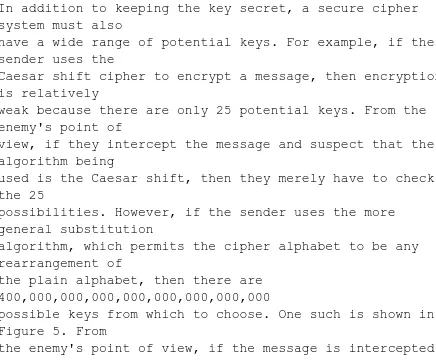
In addition to keeping the key secret, a secure cipher system must also
have a wide range of potential keys. For example, if the sender uses the
Caesar shift cipher to encrypt a message, then encryption is relatively
weak because there are only 25 potential keys. From the enemy's point of
view, if they intercept the message and suspect that the algorithm being
used is the Caesar shift, then they merely have to check the 25
possibilities. However, if the sender uses the more general substitution
algorithm, which permits the cipher alphabet to be any rearrangement of
the plain alphabet, then there are 400,000,000,000,000,000,000,000,000
[image:29.594.59.495.436.798.2]possible keys from which to choose. One such is shown in Figure 5. From
and the
algorithm is known, there is still the horrendous task of checking all
possible keys. If an enemy agent were able to check one of the
400,000,000,000,000,000,000,000,000 possible keys every second, it
would take roughly a billion times the lifetime of the universe to check all
of them and decipher the message.
Plain alphabet abcdefghi j klmnopqrstuvwxyz Cipher alphabet J LPAWIQBCTRZYDSKEG FXHUONVM
Plaintextet to, brute?
CiphertextWX XH, LGHXW?
Figure 5 An example of the general substitution algorithm, in which each letter in the
plaintext is substituted with another letter according to a key. The key is defined by the
cipher alphabet, which can be any rearrangement of the plain alphabet.
I
The Cipher of Mary Queen of Scots 13
The beauty of this type of cipher is that it is easy to implement, but
provides a high level of security. It is easy for the sender to define the key,
which consists merely of stating the order of the 26 letters in the rearranged
all possible keys by the so-called brute-force attack. The simplicity of the key
is important, because the sender and receiver have to share knowledge of
the key, and the simpler the key, the less the chance of a misunderstanding.
In fact, an even simpler key is possible if the sender is prepared to
accept a slight reduction in the number of potential keys. Instead of
randomly rearranging the plain alphabet to achieve the cipher alphabet,
the sender chooses a keyword or keyphrase. For example, to use JULIUS
CAESAR as a keyphrase, begin by removing any spaces and repeated
letters (JULISCAER), and then use this as the beginning of the jumbled
cipher alphabet. The remainder of the cipher alphabet is merely the
remaining letters of the alphabet, in their correct order, starting where the
keyphrase ends. Hence, the cipher alphabet would read as follows.
Plain alphabet abcdefgh i j k Imnopqrstuvwxyz Cipher alphabet J UL I SCAERTVWXYZBDF GHKMNOPQ
The advantage of building a cipher alphabet in this way is that it is easy to
memorize the keyword or keyphrase, and hence the cipher alphabet. This
is important, because if the sender has to keep the cipher alphabet on a
piece of paper, the enemy can capture the paper, discover the key, and
read any communications that have been encrypted with it. However, if
fall into enemy
hands. Clearly the number of cipher alphabets generated by keyphrases is
smaller than the number of cipher alphabets generated without restriction,
but the number is still immense, and it would be effectively
impossible for the enemy to unscramble a captured message by testing all
possible keyphrases.
This simplicity and strength meant that the substitution cipher
dominated the art of secret writing throughout the first millennium a.d.
Codemakers had evolved a system for guaranteeing secure communication,
so there was no need for further development-without necessity,
there was no need for further invention. The onus had fallen upon the
14
The Code Book
codebreakers, those who were attempting to crack the substitution ciphel r: Was there any way for an enemy interceptor to unravel an encryptely
message? Many ancient scholars considered that the substitution ciphejtt
was unbreakable, thanks to the gigantic number of possible keys, and fop'
centuries this seemed to be true. However, codebreakers would eventualities
find a shortcut to the process of exhaustively searching all keys. Instead oils
taking billions of years to crack a cipher, the shortcut could reveal the
message in a matter of minutes. The breakthrough occurred in the East)
statistics and religious devotion.li
The Arab Cryptanalysts
At the age of about forty, Muhammad began regularly visiting an isolated
cave on Mount Him just outside Mecca. This was a retreat, a place for
prayer, meditation and contemplation. It was during a period of deep
reflection, around a.d. 610, that he was visited by the archangel Gabriel,
who proclaimed that Muhammad was to be the messenger of God. This was
the first of a series of revelations which continued until Muhammad died
some twenty years later. The revelations were recorded by various scribes
during the Prophet's life, but only as fragments, and it was left to Abu Bakr,
the first caliph of Islam, to gather them together into a single text. The work
was continued by Umar, the second caliph, and his daughter Hafsa, and was
eventually completed by Uthman, the third caliph. Each revelation became
one of the 114 chapters of the Koran.
The ruling caliph was responsible for carrying on the work of the
Prophet, upholding his teachings and spreading his word. Between the
appointment of Abu Bakr in 632 to the death of the fourth caliph, All, in
661, Islam spread until half of the known world was under Muslim rule.
Then in 750, after a century of consolidation, the start of the Abbasid
caliphate (or dynasty) heralded the golden age of Islamic civilization. The
craftsmen bequeathed
us magnificent paintings, ornate carvings, and the most elaborate textiles in history, while the legacy of Islamic scientists is
evident from the number of Arabic words that pepper the lexicon of
modern science such as algebra, alkaline and zenith. The Cipher oj w'j
--a
larse part the result of a ots 19
is a sub-ext is P,
hnique, ;ach of >ntents :harac alysis only very here 1 to ire, ire 'K It.
^*^^^*#*rz£^
andpeacefalsoc^.^ t> and mstead ^fged ieir predecessors -J^uent ^ ^^
rung an organized ancominerce and^
,ses to grow and gave ns^ g^ cmzen.Al °s
IWS reduced c-nflj^^on. «^ to ^^ otncrypnon-effete ^cm^n -ducvcd through he us,^ ^
rns=ir-i ^:^:tdi^
^e adnnmstrators usu&^, s d en ^ ^^^ ply a rearrangement^ ^d Oth r typ# ^
:y also used apher ^ betmlght be replaced^habetic ---^^S^^
^^S^^Ucome"ubm
3th.MHhesubsUtuUoncp. , the use of the mono-,1S
general category^faffllliar ^th the^ ^^ Had the Arabs «^ they would not waa^ ^ lphabetlc «*«^^P»^-"::::;
destroylngaphers.
aenuon in any h^w£r£ also capable& message ^ts^c^^^sr=
P,Hou, tao**^ ^ *« 'W"tyit o-S
---tUod8 °f n rSo* .» -*' » *££* for b-*«. ^ «r*^^~ >"
^tr^r^--r^^:
^sris^itss*-*-*-" Deluding mathematics, ^
1
I16 The Code Book1W Islam demands justice 1,, for cryptanaly^, because Wowledge!OI ded an ideal cradle for oyping thls requi^ ^ §3?§3?g££=
^^^^^***~r
Wisdom"), a 1W and ce^edgM«£malung 6om
At the same tune » a£procured the « ^ profes of ^^-r;^^::^^
s
Of cryv""'"' . , schools were «-- . f ^uham»^ - . ,ue
Ma,o, *'*9t t™.^*"™1 i",et«d to «t*l*»
.toed-eotof.""^ ,08UOS .«« '^;,co»»,i»8thefaq«;i(k »the ^Jtd^.***^t^«»tl>"CMBS»*
of »o* conned n ,^,f, « ^.(^, ^ hrfwolt^™ «'«*'thTa t h^' ** "t^"1 ^^^sr-^
r^^^r=t*rp."-%
«"»*8' ° " co-ten--'V^S no ' ^ 4* «»'>» ^^^iTJSSr^-1--"'
level of words. They
rf CIVP,anal»«» -^ «re es,,*h«^J^^ -«" „«
,,-._, Geological scno _,evelations 01p<;tablishms . _ than others. me
. --" ~£2^~>Stf£Z2:> zsg^zxtt'-''*:
^js^TTjr*^* r^"~tiS2^*tt£»
st too«n ^'Tju.Mqibn^AW'*". «">was ^
...s.Ab«stfV».**hteot)he, of ,he ^linguis,ics irf, too." » *e PdlclK, asuonomv, ".»*^ 1987 in Of 290 books on m ^ «d,scov^^ >(
;S^^r:-«^» 'tt^zzzz^ ;s^,rr^--w
o^^is^'ss.^^.rrr:
^^riisr^S^-- tt^xz3Z*r:&.**»
s^"
M^«^V^l^^rf^^-
^S^S^--.^ri--^^-"*"1""
J^W/V^uiV-j>y>JW&'«~»'v?')1»>L "^i"1^ t^^;^U,OvL*M*y V* ~->}*>;W."
^^^^^^^^^^fl^J^^}^'-^'
^u/te$> ^i^uii^sjJdM^^'^/^1 X^J^f.^^l*<l^«^i^;1'^f-'^'^'' *
<%^J&jU^A*3w ^li^^A^,-'^,-'-' 1 -p^i^^^^jlX&^M'^' ? <4^~. M^.M*.-*'^ -wlf {»^,«wlLwv _>!--^Qr--^il ^J^1 ^.Uy^ £^lj^lt£3jl£^>isZA^ljL*
*>^^^«^ ^^^^xi^y%^^i^*JLV^"^ ^V^PiU^r^^> ^,y^M ^**
/^M^^t^^y^^^
j»lJ^>iK^?%l)tf!«f^W»^^<^'' -jULJ! "% ^^^^^i^^lJ)*^^^1^1^^
i^^^^y^fyAtf^^^ ^^
' ^~^)J^^\^^^^f^k^1 W3H>~"J' A^J^W^ilj«>U^^^/U^
^>^ .^U^^^^^^H;/'''^'^-jjpyi^^.U^uJ^,^l^*^^V.^Wjli-'»-^4'^ ^^^ij^^^^^^^^^^J^^3'l^.l^U
^biu, IxrVJUjuj.r'M1 ^» .M^^^i^.r^fWurt1 ^e/^M^-'^' rc^^^1^*''^-^^'^ ,LJ.y^t»^A!!s'Ak
J?y^faUffi&&& $s*&X'>*&*x£Sto' ^.-VX. ~<^j( S*'(. -^ L*^._I/ Jl^^^kJ^-^
li _i»i.
-j5»
Vr/L-^.^,
Figure 6 The first page of al-Kindi's manuscript On
Deciphering Cryptographic Messages, containing the oldest known description of cryptanalysis by frequency analysis.
^^^t^.te^'1^^1^'''''^1^^ ' iWJ^l,^y>Dfc \^^^>^
pp
The Cipher of Mary Queen of Scots 19
the ciphertext is, for example, J then it would seem likely that this is a substitute
for e. And if the second most common letter in the ciphertext is P,
then this is probably a substitute for t, and so on. Al-Kindfs technique,
known as frequency analysis, shows that it is unnecessary to check each of
the billions of potential keys. Instead, it is possible to reveal the contents
of a scrambled message simply by analyzing the frequency of the characters
in the ciphertext.
cryptanalysis
unconditionally, because the standard list of frequencies in Table 1 is only
an average, and it will not correspond exactly to the frequencies of every
text. For example, a brief message discussing the effect of the atmosphere
on the movement of striped quadrupeds in Africa would not yield to
straightforward frequency analysis: "From Zanzibar to Zambia and Zaire,
ozone zones make zebras run zany zigzags." In general, short texts are
likely to deviate significantly from the standard frequencies, and if there
are less than a hundred letters, then decipherment will be very difficult.
On the other hand, longer texts are more likely to follow the standard frequencies,
although this is not always the case. In 1969, the French author
Table 1 This table of relative frequencies is based on passages taken from newspapers
and novels, and the total sample was 100,362 alphabetic characters. The table was
compiled by H. Beker and F. Piper, and originally published in Cipher Systems: The
Protection Of Communication.
Letter Percentage a
12.7 f 2.2 g 2.0 h 6.1 i 7.0 J 0.2 k 0.8 1 4.0 m 2.4 Letter Percentage n
z 0.1 20
The Code Book
Georges Perec wrote La Disparition, a 200-page novel that did not use
words that contain the letter e. Doubly remarkable is the fact that the
English novelist and critic Gilbert Adair succeeded in translating La Disparition into English, while still following Perec's shunning of the letter e.
Entitled A Void, Adair's translation is surprisingly readable (see Appendix
A). If the entire book were encrypted via a monoalphabetic substitution
cipher, then a naive attempt to decipher it might be stymied by the complete
lack of the most frequently occurring letter in the English alphabet.
Having described the first tool of cryptanalysis, I shall continue by giving
an example of how frequency analysis is used to decipher a ciphertext.
I have avoided peppering the whole book with examples of cryptanalysis,
but with frequency analysis I make an exception. This is partly because
frequency analysis is not as difficult as it sounds, and partly because it is
the primary cryptanalytic tool. Furthermore, the example that follows
provides insight into the modus operandi of the cryptanalyst. Although
frequency analysis requires logical thinking, you will see that it also
demands guile, intuition, flexibility and guesswork.
PCQ VMJYPD LBYK LYSO KBXBJXWXV BXV ZCJPO EYPD
KBXBJYUXJ LBJOO KCPK. CP LBO LBCMKXPV XPV IYJKL PYDBL, QBOP KBO BXV OPVOV LBO LXRO Cl SX'XJMI, KBO JCKO XPV EYKKOV LBO DJCMPV ZOICJO BYS, KXUYPD: "DJOXL EYPD, ICJ X LBCMKXPV XPV CPO PYDBLK Y BXNO ZOOP JOACMPLYPD LC UCM LBO IXZROK Cl FXKL XDOK XPV LBO RODOPVK Cl XPAYOPL EYPDK. SXU Y SXEO KC ZCRV XK LC AJXNO X IXNCMJ Cl UCMJ SXGOKLU?"
OFYRCDMO, LXROK IJCS LBO LBCMKXPV XPV CPO PYDBLK
Imagine that we have intercepted this scrambled message. The challenge
is to decipher it. We know that the text is in English, and that it has been
scrambled according to a monoalphabetic substitution cipher, but we
have no idea of the key. Searching all possible keys is impractical, so we
must apply frequency analysis. What follows is a step-by-step guide to
cryptanalyzing the ciphertext, but if you feel confident then you might
prefer to ignore this and attempt your own independent cryptanalysis.
The Cipher of Mary Queen of Scots 21
The immediate reaction of any cryptanalyst upon seeing such a ciphertext
is to analyze the frequency of all the letters, which results in Table 2.
Not surprisingly, the letters vary in their frequency. The question is, can
vre identify what any of them represent, based on their frequencies? The
ciphertext is relatively short, so we cannot slavishly apply frequency
ciphertext, O, represents the commonest letter in English, e, or that the
eighth most frequent letter in the ciphertext, Y, represents the eighth most
frequent letter in English, h. An unquestioning application of frequency
analysis would lead to gibberish. For example, the first word PCQ would
be deciphered as aov.
However, we can begin by focusing attention on the only three letters
that appear more than thirty times in the ciphertext, namely 0, X and P.
It is fairly safe to assume that the commonest letters in the ciphertext
probably represent the commonest letters in the English alphabet, but
not necessarily in the right order. In other words, we cannot be sure that
0 = e, X = t, and P = a, but we can make the tentative assumption that:
0 = e, tor a, X = e, t or a, P = e, tor a.
Table 2 Frequency analysis of enciphered message.
Occurrences Percentage A
Occurrences Percentage N 3
0.9 O 38 11.2 P 31 9.2 Q 2 0.6 R 6 1.8 S 7 2.1 T 0 0.0 U 6 1.8 V 18 5.3 w 1 0.3 X 34 10.1 Y 19 5.6 z 5 1.5 22
In order to proceed with confidence, and pin down the identity of the
three most common letters, 0, X and P, we need a more subtle form of
frequency analysis. Instead of simply counting the frequency of the three
letters, we can focus on how often they appear next to all the other letters.
For example, does the letter O appear before or after several other letters,
or does it tend to neighbor just a few special letters? Answering this
question will be a good indication of whether O represents a vowel or a
consonant. If O represents a vowel it should appear before and after most of the other letters, whereas if it represents a consonant, it will tend to
avoid many of the other letters. For example, the letter e can appear
before and after virtually every other letter, but the letter t is rarely seen
before or after b, d, g, j, k, m, q or v.
The table below takes the three most common letters in the ciphertext,
O, X and P, and lists how frequently each appears before or after every
letter. For example, 0 appears before A on 1 occasion, but never appears
immediately after it, giving a total of 1 in the first box. The letter 0
neighbors the majority of letters, and there are only 7 that it avoids
completely, represented by the 7 zeros in the O row. The letter X is equally
sociable, because it too neighbors most of the letters, and avoids only 8 of
them. However, the letter P is much less friendly. It tends to lurk around
suggests that O
and X represent vowels, while P represents a consonant.
ABCDEFGHIJKLMNOPQRSTUVWXYZ O 19031110146012280410030112 X 07011110246303190240332001 P 105600000112208000000 11 0990
Now we must ask ourselves which vowels are represented by O and X.
They are probably e and a, the two most popular vowels in the English
language, but does O = e and X = a, or does 0 = a and X = e? An
interesting feature in the ciphertext is that the combination OO appears
twice, whereas XX does not appear at all. Since the letters ee appear far
more often than a a in plaintext English, it is likely that 0 = e and X = a.
At this point, we have confidently identified two of the letters in the
The Cipher of Mary Queen of Scots 23
fciphertext. Our conclusion that X = a is supported by the fact that X
appears on its own in the ciphertext, and a is one of only two English
words that consist of a single letter. The only other letter that appears on
its own in the ciphertext is Y, and it seems highly likely that this
represents the only other one-letter English word, which is i. Focusing on
words with only one letter is a standard cryptanalytic trick, and I have
included it among a list of cryptanalytic tips in Appendix B. This
has spaces between
the words. Often, a cryptographer will remove all the spaces to make it
harder for an enemy interceptor to unscramble the message. Although we have spaces between words, the following trick would
also work where the ciphertext has been merged into a single string of
characters. The trick allows us to spot the letter h, once we have already
identified the letter e. In the English language, the letter h frequently goes
before the letter e (as in the, then, they, etc.), but rarely after e. The table
below shows how frequently the 0, which we think represents e, goes
before and after all the other letters in the ciphertext. The table suggests
that B represents h, because it appears before O on 9 occasions, but it
never goes after it. No other letter in the table has such an asymmetric
relationship with O.
ABCDEFCHI J KLMNOPQRSTUVWXYZ
after O 10010100104000250000020100 before 0 09021010042012230410010012
Each letter in the English language has its own unique personality, which
includes its frequency and its relation to other letters. It is this personality
that allows us to establish the true identity of a letter, even when it has
been disguised by monoalphabetic substitution.
We have now confidently established four letters, O = e, X = a, Y = i
and B = h, and we can begin to replace some of the letters in the
to the convention
of keeping ciphertext letters in upper case, while putting plaintext letters
in lower case. This will help to distinguish between those letters we still
have to identify, and those that have already been established.
24 The Code Book
PCQ VMJiPD LhiK LiSe KhahJaWaV have ZCJPe EiPD
KhahJiUaJ LhJee KCPK. CP The LhCMKaPV aPV MJKL PiDhL, QheP Khe have ePVeV The LaRe Cl Sa'aJMI, Khe JCKe aPV EiKKev The DJCMPV ZelCJe his, KaUiPD: "DJeaL EiPD, ICJ a LhCMKaPV aPV CPe PiDhLK i haNe ZeeP JeACMPLiPD LC UCM The laZReK Cl FaKL aDeK aPV The ReDePVK Cl aPAiePL EiPDK. SaU i SaEe KC ZCRV aK LC AJaNe a laNCMJ Cl UCMJ SaGeKLU?"
eFiRCDMe, LaReK IJCS The LhCMKaPV aPV CPe PiDhLK
This simple step helps us to identify several other letters, because we can
guess some of the words in the ciphertext. For example, the most
common three-letter words in English are the and and, and these are
relatively easy to spot-Lhe, which appears six times, and aPV, which
appears five times. Hence, L probably represents t, P probably represents
n, and V probably represents d. We can now replace these letters in the
ciphertext with their true values:
nCQ dMJinD thiK tiSe KhahJaWad had ZCJne EinD
SaU i SaEe KC ZCRd aK to AJaNe a laNCMJ Cl UCMJ SaGeKtU?"
eFiRCDMe, taReK IJCS the thCMKand and Cne niDhtK
Once a few letters have been established, cryptanalysis progresses very
rapidly. For example, the word at the beginning of the second sentence is
Cn. Every word has a vowel in it, so C must be a vowel. There are only
two vowels that remain to be identified, u and o; u does not fit, so C must
represent o. We also have the word Khe, which implies that K represents
either t or s. But we already know that L = t, so it becomes clear that K = s.
Having identified these two letters, we insert them into the ciphertext, and
there appears the phrase thoMsand and one niDhts. A sensible guess for
this would be thousand and one nights, and it seems likely that the
final line is telling us that this is a passage from Tales from the Thousand and
One Nights. This implies that M = u, I = f, J = r, D = g, R = I, and S = m.
The Cipher of Mary Queen of Scots 25
We could continue trying to establish other letters by guessing other
words, but instead let us have a look at what we know about the plain
alphabet and cipher alphabet. These two alphabets form the key, and they
were used by the cryptographer in order to perform the substitution that
scrambled the message. Already, by identifying the true values of letters in
details of the
cipher alphabet. A summary of our achievements, so far, is given in the
plain and cipher alphabets below.
Plain alphabet abcdefghi j klmnopqrstuvwxyz Cipher alphabet X--VOIDBY--RSPC--JKLM
By examining the partial cipher alphabet, we can complete the
cryptanalysis. The sequence VOID BY in the cipher alphabet suggests that
the cryptographer has chosen a keyphrase as the basis for the key. Some
guesswork is enough to suggest the keyphrase might be A VOID BY
GEORGES PEREC, which is reduced to AVOIDBYGERSPC after removing
spaces and repetitions. Thereafter, the letters continue in alphabetical
order, omitting any that have already appeared in the keyphrase. In this
particular case, the cryptographer took the unusual step of not starting the
keyphrase at the beginning of the cipher alphabet, but rather starting it
three letters in. This is possibly because the keyphrase begins with the
letter A, and the cryptographer wanted to avoid encrypting a as A. At last,
having established the complete cipher alphabet, we can unscramble the
entire ciphertext, and the cryptanalysis is complete.
Plain alphabet abcdefghi j klmnopqrstuvwxyz Cipher alphabet XZAVOIDBYGERSPCFHJKLMNQTUW
Now during this time Shahrazad had borne King
kissed the ground before him, saying: "Great King, for a thousand and one nights I have been recounting to you the fables of past ages and the legends of ancient kings. May I make so bold as to crave a favor of your majesty?"
Epilogue, Tales from the Thousand and One Nights
26 The Code Book
Renaissance in the West
Between a.d. 800 and 1200, Arab scholars enjoyed a vigorous period of
intellectual achievement. At the same time, Europe was firmly stuck in
the Dark Ages. While al-Kindi was describing the invention of
cryptanalysis, Europeans were still struggling with the basics of
cryptography. The only European institutions to encourage the study of
secret writing were the monasteries, where monks would study the Bible
in search of hidden meanings, a fascination that has persisted through to
modern times (see Appendix C).
Medieval monks were intrigued by the fact that the Old Testament
contained deliberate and obvious examples of cryptography. For example,
the Old Testament includes pieces of text encrypted with atbash, a
traditional form of Hebrew substitution cipher. Atbash involves taking
each letter, noting the number of places it is from the beginning of the
alphabet, and replacing it with a letter that is an equal number of places
that a, at the
beginning of the alphabet, is replaced by Z, at the end of the alphabet, b
is replaced by Y, and so on. The term atbash itself hints at the substitution
it describes, because it consists of the first letter of the Hebrew alphabet, akph, followed by the last letter taw, and then there is the second letter, beth, followed by the second to last letter shin. An example of atbash
appears in Jeremiah 25: 26 and 51: 41, where "Babel" is replaced by the
word "Sheshach"; the first letter of Babel is beth, the second letter of the
Hebrew alphabet, and this is replaced by shin, the second-to-last letter; the
second letter of Babel is also beth, and so it too is replaced by shin; and the
last letter of Babel is lamed, the twelfth letter of the Hebrew alphabet, and
this is replaced by kaph, the twelfth-to-last letter. Atbash and other similar biblical ciphers were probably intended only
to add mystery, rather than to conceal meaning, but they were enough to
spark an interest in serious cryptography. European monks began to
rediscover old substitution ciphers, they invented new ones, and, in due
course, they helped to reintroduce cryptography into Western
civilization. The first known European book to describe the use of
cryptography was written in the thirteenth century by the English
Franciscan monk and polymath Roger Bacon. Epistle on the Secret Works of
The Cipher of Mary Queen of Scots 27
Art and the Nullity of Magic included seven methods for keeping messages
in any other way than one which will conceal it from the vulgar."
By the fourteenth century the use of cryptography had become
increasingly widespread, with alchemists and scientists using it to keep
their discoveries secret. Although better known for his literary
achievements, Geoffrey Chaucer was also an astronomer and a
cryptographer, and he is responsible for one of the most famous examples
of early European encryption. In his Treatise on the Astrolabe he provided
some additional notes entitled "The Equatorie of the Planetis," which
included several encrypted paragraphs. Chaucer's encryption replaced
plaintext letters with symbols, for example b with 5. A ciphertext
consisting of strange symbols rather than letters may at first sight seem
more complicated, but it is essentially equivalent to the traditional letter-for-letter
substitution. The process of encryption and the level of security
are exactly the same.
By the fifteenth century, European cryptography was a burgeoning
industry. The revival in the arts, sciences and scholarship during the
Renaissance nurtured the capacity for cryptography, while an explosion in
political machinations offered ample motivation for secret communication.
Italy, in particular, provided the ideal environment for cryptography.
As well as being at the heart of the Renaissance, it consisted of
independent city states, each trying to outmaneuver the others.
ambassadors to the
courts of the others. Each ambassador received messages from his
respective head of state, describing details of the foreign policy he was to
implement. In response, each ambassador would send back any
information that he had gleaned. Clearly there was a great incentive to
encrypt communications in both directions, so each state established a
cipher office, and each ambassador had a cipher secretary. At the same time that cryptography was becoming a routine diplomatic
tool, the science of cryptanalysis was beginning to emerge in the West.
Diplomats had only just familiarized themselves with the skills required
to establish secure communications, and already there were individuals
attempting to destroy this security. It is quite probable that cryptanalysis
was independently discovered in Europe, but there is also the possibility
28
The Code Book
that it was introduced from the Arab world. Islamic discoveries in science
and mathematics strongly influenced the rebirth of science in Europe,
and cryptanalysis might have been among the imported knowledge.
Arguably the first great European cryptanalyst was Giovanni Soro,
appointed as Venetian cipher secretary in 1506. Soro's reputation was
intercepted
messages to Venice for cryptanalysis. Even the Vatican, probably the
second most active center of cryptanalysis, would send Soro seemingly
impenetrable messages that had fallen into its hands. In 1526, Pope
Clement VII sent him two encrypted messages, and both were returned
having been successfully cryptanalyzed. And when one of the Pope's own
encrypted messages was captured by the Florentines, the Pope sent a copy
to Soro in the hope that he would be reassured that it was unbreakable.
Soro claimed that he could not break the Pope's cipher, implying that the
Florentines would also be unable to decipher it. However, this may have
been a ploy to lull the Vatican cryptographers into a false sense of
security--Soro might have been reluctant to point out the weaknesses of
the Papal cipher, because this would only have encouraged the Vatican to
switch to a more secure cipher, one that Soro might not have been able to
break.
Elsewhere in Europe, other courts were also beginning to employ
skilled cryptanalysts, such as Philibert Babou, cryptanalyst to King
Francis I of France. Babou gained a reputation for being incredibly
persistent, working day and night and persevering for weeks on end in
order to crack an intercepted message. Unfortunately for Babou, this gave
the king ample opportunity to carry on a long-term affair with his wife.
Toward the end of the sixteenth century the French consolidated their
who took
particular pleasure in cracking Spanish ciphers. Spain's cryptographers,
who appear to have been naive compared with their rivals elsewhere in
Europe, could not believe it when they discovered that their messages
were transparent to the French. King Philip II of Spain went as far as
petitioning the Vatican, claiming that the only explanation for Viete's
cryptanalysis was that he was an "archfiend in league with the devil."
Philip argued that Viete should be tried before a Cardinal's Court for his
demonic deeds; but the Pope, who was aware that his own cryptanalysts
The Cipher of Mary Queen of Scots 29
bad been reading Spanish ciphers for years, rejected the Spanish petition.
Mews of the petition soon reached cipher experts in various countries, and
Spanish cryptographers became the laughingstock of Europe. The Spanish embarrassment was symptomatic of the state of the battle
between cryptographers and cryptanalysts. This was a period of transition,
with cryptographers still relying on the monoalphabetic substitution
cipher, while cryptanalysts were beginning to use frequency analysis to
break it. Those yet to discover the power of frequency analysis continued
to trust monoalphabetic substitution, ignorant of the extent to which
cryptanalysts such as Soro, Babou and Viete were able to read their messages.
monoalphabetic substitution cipher were anxious to develop a
better cipher, something that would protect their own nation's messages
from being unscrambled by enemy cryptanalysts. One of the simplest
improvements to the security of the monoalphabetic substitution cipher
was the introduction of nulls, symbols or letters that were not substitutes
for actual letters, merely blanks that represented nothing. For example,
one could substitute each plain letter with a number between 1 and 99,
which would leave 73 numbers that represent nothing, and these could be
randomly sprinkled throughout the ciphertext with varying frequencies.
The nulls would pose no problem to the intended recipient, who would
know that they were to be ignored. However, the nulls would baffle an
enemy interceptor because they would confuse an attack by frequency
analysis. An equally simple development was that cryptographers would
sometimes deliberately misspell words before encrypting the message.
Thys haz thi ifekkt off diztaughting thi ballans off
frikwenseas-- making it harder for the cryptanalyst to apply frequency analysis.
However, the intended recipient, who knows the key, can unscramble the
message and then deal with the bad, but not unintelligible, spelling.
Another attempt to shore up the monoalphabetic substitution cipher
involved the introduction of codewords. The term code has a very broad
meaning in everyday language, and it is often used to describe any
Introduction, it actually has a very specific meaning, and applies only to a
certain form of substitution. So far we have concentrated on the idea of a
substitution cipher, whereby each letter is replaced by a different letter,
30
The Code Book
number or symbol. However, it is also possible to have substitution at a
much higher level, whereby each word is represented by another word or
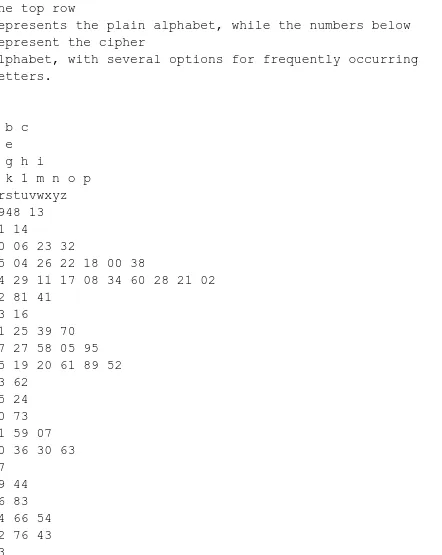
symbol-this would be a code. For example, _ -j
assassinate = D blackmail = P capture= J protect
Plain message Encoded message general =I
king =O
minister =ip prince =9
![Figure 16 The L] distribution shifted back four letters(top), compared with the standardfrequency distribution (bottom)](https://thumb-us.123doks.com/thumbv2/123dok_us/8100340.234002/138.594.55.205.100.381/figure-l-distribution-shifted-letters-compared-standardfrequency-distribution.webp)