THESES SIS/LIBRARY TELEPHONE: +61 2 6125 4631 R.G. MENZIES LIBRARY BUILDING NO:2 FACSIMILE: +61 2 6125 4063
THE AUSTRALIAN NATIONAL UNIVERSITY EMAIL: [email protected] CANBERRA ACT 0200 AUSTRALIA
USE OF THESES
This copy is supplied for purposes
of private study and research only.
Passages from the thesis may not be
copied or closely paraphrased without the
Knowledge and Innovation
in
Intellectual
Property:
The
Case of Computer Program Copyright
Gillian Catherine Dempsey LLB (Hons)
A thesis submitted for the degree of Doctor of Philosophy of The Australian National University.
Sub-rule
15(2) Statement
I certify that this thesis is my own work and all sources used have been acknowledged.
Acknowledgements
This thesis is dedicated to Andrew Greinke, my husband, for the love and assistance which has seen the work through to completion.
Thanks to my supervisory panel: Dr Roger Clarke, Dr Peter Drahos, Prof. Don Lamberton and Dr Gregory E.P. Shailer for their organisation,
co-operation and above all, for their patience in reading and commenting on this work through its evolutionary stages.
Abstract
Information economics 1s used to develop a model of technological innovation which is applied to the case of computer program copyright. A critical outline of the neo-classical economic perspective of innovation and Arrow's concerns regarding appropriability of information is provided. This perspective justifies intellectual property institutions as a correction of market failure and as a "reward for invention". The same literature marginalises countervailing arguments including monopoly distortions, alternative sources of innovator reward and the potential for anti-competitive strategies.
Information economics provides a distinct and preferred perspective in the analysis of technological development and in the role of intellectual property in the promotion of innovat~on. The conception of information as a resource, rather than as a commodity, implies that information is part of a shared technological capital, whose indivisibilities should be exploited for social benefit. The information perspective conceives innovation as a messy, evolutionary and interactive process involving many participants, and a cycle of innovation characterised by incremental improvements, imitation and learning strategies, and technological trajectories influenced by bounded rationality. These environments will also generate powerful network externalities.
Contents
CHAPTER ONE
INTRODUCTION ... 1
1.1 OVERVIEW ... " ... " .. "" .... """ ... "" ... " ... " .. " ... 1
1.2 MOTIVATION AND SCOPE ... 2
1.3 STRUCTURE ... 5
CHAPTER TWO INFORMATION AS A COMMODITY ... 10
2.1 INTRODUCTION ... 10
2.2 ARROW'S MODEL OF INFORMATION ... 12
2.3 REWARD FOR INVENTION ... 16
2.4 MONOPOLY EFFECTS ... 20
2.5 UNDER-REWARD AND OVER-REWARD ... 25
2.6 SUMMARY ... 32
CHAPTER THREE INFORMATION AS A RESOURCE ... 34
3.1 INTRODUCTION ... 34
3.2 INFORMATION PROPERTIES ... 36
3.2.1 Information is capital ... 37
3.2.2 Information is shared ... 38
3.2.3 Innovation is imitation ... .40
3.3 lNFORMA TION AND MARKETS ... 43
3.3.1 Lead time ... 44
3.3.2 Bounded rationality ...
3.4 SUMMARY ... 53
CHAPTER FOUR AN INFORMATIONAL MODEL OF TECHNOLOGICAL INNOVATION ... 55
4.1 INTRODUCTION ... .55
4.2 TACIT AND CODIFIED KNOWLEDGE ... 56
4.3 A MODEL OF IT INNOVATION ... 61
4.4 IT INNOVATION AND INTELLECTUAL PROPERTY ... 66
4.4.l Confidential information ... 68
4.4.2 Patent. ... 71
4.4.3 Copyright. ... 74
4.5 SUMMARY ... 81
CHAPTER FIVE SOFTWARE AS AN IT ARTEFACT ... 84
5.1 INTRODUCTION ... 84
5.2 COMPUTERS AND PROGRAMS ... 85
5.3 PROGRAMMING LANGUAGES ... 88
5.4 SOF1WARE DEVELOPMENT ... 97
5.5 THE ISSUE OF ACCESS ... 102
5.5.1 Access to Source Code ... 104
5.5.2 Access to Machine Code ... 105
5.5.3 Access by Decompilation ... 108
5.6 A SOF1WARE INNOVATION MODEL. ... 114
5.6.1 Explanation of the model.. ... 114
5.6.2 The role of copyright. ... 115
5.6.3 Imitative competition and lead time ... 118
CHAPTER SIX
IMPLICATIONS FOR COPYRIGHT ... 125
6.1 lNTRODUCTION ... 125
6.2 ECONOMIC ARGUMENTS ... 127
6.3 CREATfVI1Y ARGUMENTS ... 132
6.4 COMPATIBILI1Y AND lNTERFACES ... 140
6.4.l Economic justification ... 142
6.4.2 Standards competition ... 143
6.4.3 Standardisation ... 145
6.4.4 Implications ... 149
6.5 SUMMARY ... 151
CHAPTER SEVEN EVALUATION OF INTERNATIONAL COPYRIGHT LA
ws ...
...
...
.
...
1547.1 INTRODUCTION ... 154
7 .2 LEGISLATION ... 156
7.2.1 United States ... 156
7.2.2 Europe ... 157
7.2.3 Australia ... 158
7.3 THE IDEA-EXPRESSION DISTINCTION ... 159
7.3.1 Synercom ... 161
7.3.2 Whelan ... 163
7.3.3 Computer Associations v Altai... ... 166
7.4 NON-LITERAL COPYING ... 173
7.5 FAIR USE EXCEPTION ... 179
7.5.1 United States ... 181
7.5.2 Europe ... 183
7.6 CURRENT CASE LAW ... 188
7.6.l United States ... 189
7.6.2 Europe ... 198
7.6.3 Australia ... 200
7 .7 POLITICAL CONS ID ERA TIO NS ... 207
7.8 S~ARY ... 215
CHAPTER EIGHT CONCLUSIONS ... 220
8.1 REVIEW ... 220
8.2 CONTRIBUTIONS ... 225
APPENDIX ONE-THE COMPILATION PROCESS ... 229
APPENDIX TWO-COMMENTED SOURCE CODE ... 236
APPENDIX THREE- DECOMPILATION ... 238
APPENDIX FOUR - APPLICATION FRAMEWORKS ... 240
Chapter One - Introduction
Chapter One
Introduction
1.1 Overview
Economic activity is increasingly dominated by the production, distribution and consumption of information. Developments in the literature herald a new age of rapidly expanding "knowledge industries" and "information economies") Computer programs are increasingly important facilitators of the use of technology, in applications as diverse as word processing, robot-based manufacturing and medical science.
A key issue in this information economy is the role of intellectual property in promoting technological innovation. A tension exists between offering a reward of a "limited monopoly" as an incentive to innovators, and preventing that limited monopoly from both exacting excessive profits and discouraging or impeding the production of information by limiting later author's access to the public domain. The policy question is where to strike the proper balance between these objectives in the interests of innovation and technological advancement. This thesis uses an information economics perspective to develop a
1 Machlup, F. (1962) The Production and Distribution of Knowledge in the United
Chapter One - Introduction
model of technological innovation which is the applied to the case of computer program copyright to suggest where this balance should be found.
1.2 Motivation and scope
Much of the legal literature in the area of copyright and computer programs is concerned with the extent to which the law does or does not apply to program code, to its "structure, sequence and organisation", and to other "non-literal" elements such as user interfaces. Few articles have engaged in a normative evaluation of desirable characteristics for an intellectual property regime for computer programs.2 This thesis seeks to provide such a contribution through the development of a model of innovation grounded in information economics. Statements by legislators, the judiciary and commentators in respect of contentious issues of the practical interpretation of software copyright legislation demonstrate an attachment to neo-classical economic theory and faith in the application of legal semantics such as the idea-expression dichotomy. This thesis challenges both these approaches.
Legal systems derived from English jurisprudence have traditionally been seen as reluctant to extend property protection to the products of
2 A notable exception is Samuelson, P., Davis, R., Kapor, M.D. and Reichman, J.H. (1994) /1
Chapter One - Introduction "ingenuity, knowledge, skill or labour".3 The granting of intellectual property rights has rested largely on the economic argument that they provide stimulation to innovation, thereby promoting national economic advancement and consumer and social welfare.4 Economics is, therefore, used as a benchmark against which the policy recommendations developed in this thesis, and those submitted by others in the literature, can be assessed. Like Machlup5, the thesis assumes that:
While economic analysis does not yet provide a basis for choosing between "all or nothing", it does provide a sufficiently firm basis for decisions about "a little more or a little less" of various ingredients [of intellectual property].
More particularly, however, an information economics approach is adopted. Information economics is the area of economics which analyses the "processes by which information and knowledge is produced, diffused, stored and used".6 The information perspective assumes that information capacities of economic actors are imperfect due to information asymmetries, arising from literacy, geographical location and technical proficiency, as well as degrees of cognition, based on language, innate intellectual ability and education. The analysis presented within
3
4 5
6
e.g. Victoria Park Racing and Recreation Grounds Co. Ltd v Taylor (1937) 58 CLR 479 at p.509 per Dixon J.
Ricketson, S., The Law of Intellectual Property (1984) pp. 425-426.
Sub-Committee on Patents, Trade-marks and Copyrights of the Committee on the Judiciary, United States Senate (1958) An Economic Review of the Patent System
(USGPO: Washington) p. 80. .
Lamberton, D.M. (ed.) (1971) Economics of Information and Knowledge (Penguin:
Chapter One - Introduction
this thesis falls within the fourth strand of Machlup's list of areas comprising information economics?
... analysing the creation and utilisation of new technology, and the incentives for research, development, invention, innovation and diffusion of knowledge.
Computer programs are themselves special forms of technology and it has been characteristics such as ease of replication which has driven legislative action to include computer programs as "literary works"
within copyright laws internationally. Some assertions within the literature, however, of easy access to the knowledge underlying a computer program require reappraisal. Close attention to the nature of computer programs and the software development process is, therefore, essential to challenge these assumptions.
Likewise, it is empty to argue about the economic value of an intellectual property system without specifying and evaluating that system's criteria.8 Legal analysis is, therefore, required of the copyright regimes in place internationally to assess whether the current state of the law is consistent with the policy recommendations developed from the innovation model.
The scope of the thesis includes three major foci for discussion: an economic analysis and development of the model of innovation; the
7
8
Machlup, F. (1984) Knowledge: Its Creation, Distribution and Economic Significance, Vol. III: The Economics of Information and Human Capital (Princeton University Press: Princeton) p. 6.
Chapter One - Introduction
application of this model to software through a consideration of computer program qualities; and finally an assessment of the state of copyright law internationally.
1
.3 Structure
Chapter Two notes that the foundation on which arguments for broader protection of intellectual property and computer programs copyright in particular, are based within a "reward for invention" argument. This argument has its origins in work by Arrow and concerns about the appropriability of information. Limiting access to information through the imposition of intellectual property rights seeks to mimic the excludable and tradeable qualities of physical goods. The chapter also demonstrates that later literature has extrapolated this argument to the point where the "balance" issue public domain access to information -is marginal-ised. Most particularly this is seen in downplaying the potential distortions from monopoly rights, the avenues for rewarding innovators other than through royalties, and the potential use of intellectual property for anti-competitive strategies.
Chapter One - Introduction
typically involving a single firm. The information economics view 1s that progress is an evolutionary and interactive learning process involving many participants. This process suggests a cumulative and incremental cycle of innovation driven by bounded rationality and displaying powerful network externalities. Such an environment implies significant lead times providing rewards to innovation.
Chapter One - Introduction
Chapter Five applies the IT artefact model of innovation to computer
programs. This involves a demonstration of the central quality of an IT artefact (program in executable form) - lack of access to underlying knowledge (source code and materials) - thereby1 a rejection of a widely held assumption within the legal literature. This is based on an examination of the nature of computer programs and the development process, supplemented by the Appendices. In particular the chapter argues that third and higher generation languages bear no isomorphic identity with their compiled machine code and that decompilation (more accurately disassembly) is of limited use in understanding the source code of a program of any size or sophistication. It is argued that a closer analogy exists between the IT artefact model of computer program innovation and the regime of confidential information than to the regime of copyright, which assumes a high degree of access to codified knowledge from possession of the product. This implies that progress is by imitative competition and reverse engineering, with a limited role for copyright in prohibiting replication or "piracy" of machine code programs.
Chapter Six critically reviews the legal and economic literature favouring
Chapter One - Introduction
returns to innovators and protection of investment as the overriding
objective. Creativity arguments misconceive the nature of the computer
programming as akin to a literary or artistic endeavour. The realisation
of network externalities (and avoidance of their anti-competitive
exploitation) dictates that interfaces, including user interfacesi and
standard programming techniques should not be the subject of
proprietary claims in copyright. Policy recommendations are summarised
at the conclusion of this chapter.
Chapter Seven examines the United States, Europe and Australia to assess the state of the legislative and judicial interpretations of copyright over
computer programs against the policy prescriptions suggested by the
information perspective. The focus of discussion is whether the
idea-expression distinction and the doctrine of fair use (or "fair dealing") are
effective mechanisms in drawing the line between protected and
unprotected elements of programs, and in providing a "bright-line" test
for infringement. Extensions of the concept of "expression" to include
"non-literal" aspects of programs - at odds with these prescriptions - can
be reconciled as a confusion between evidentiary and doctrinal issues. In
particular, the approach of the United States Second Circuit in Altai9,
involving a complex factual determination, reflects a methodology based
on circumstantial evidence of copying of source code. The preferred
approach whe.re there is no evidence of misappropriation in access to
Chapter One -Introduction source code or related materials is articulated in the appeal judgments in
Borland1D (United States, First Circuit) and Powerflex11 (Australia, Full
Federal Court). This approach is based on whether the non-literal
element is itself protectable under copyright. The state of the law will,
however, remain uncertain until the US Supreme Court is able to rule on
a new appeal12 and the Australian High Court hears the pending appeal
in Powerflex. The political considerations surrounding intellectual
property policy are also discussed, with particular emphasis on coalitions
of vested interests, international mechanisms such as the Berne
Convention and Trade Related Aspects of Intellectual Property Rights
(TRIPS), and unilateral trade actions by the United States Government in
driving change in the direction of broader and longer protection.
Chapter Eight provides a overview of the discussion and its major
findings, outlines the contributions made by this thesis, and concludes
with a reflection related future issues.
10 Lotus Development Corporation v Borland International Inc. 49 F. 3d 807 (1st Cir. 1995).
11 Powerflex Services Pty Ltd v Data Access Corporation [1997] FCA 490.
Chapter Two - Information as a Commodity
Chapter Two
Information as a Commodity
2.1 Introduction
The major objective of this thesis is to examine innovation from an
information economics perspective and to examine computer program
copyright in that context. This chapter provides a review of the orthodox
economics literature against which such an information economics
perspective can be juxtaposed. Many policy arguments in respect of
copyright, and protection of computer programs in particular, rely on the
economic orthodoxy critically examined in this chapter. The review
begins with the seminal work of Arrow and demonstrates its extension to
more general propositions about intellectual property policy. The central
feature of the orthodox economic argument is the maximisation of
reward to the inventor. A the same time other opportunities for reward,
the distorting effects of monopoly, and avenues for market power have
been marginalised within the literature.
The policy objective of intellectual property is, in broad terms, the
encouragement of technological progress.13 Conventional economic
analyses suggest that imposition of "commodity" characteristics upon
information will overcome a perceived lack of appropriability of the
Chapter Two - Information as a Commodity
information thereby securing to the creator the chance of a return which encourages investment. The traditionally accepted model of invention within the economics literature has been one where information is seen as the result of a process analogous to industrial output. Nonexcludable and nonrivalrous characteristics of this "invention-product" are said to justify enforcement of property rights on the basis of "market failure". The key propositions, elaborated below, of the conventional model are as follows:
• without regulation, information has "public good" characteristics; • lack of appropriability associated with public goods leads to market
failure and underinvestment in inventive activity;
• through artificial scarcity imposed by intellectual property laws, the value of information in the hands of users becomes appropriable; • investment in the creation of information is directly related to the
degree to which this value can be appropriated by the investor
I
owner.The above propositions form the basis for much of the economic literature concerned with intellectual property policy. As later discussion demonstrates14 such economic arguments are widespread within the computer program copyright debate. From an information perspective, however, such arguments may justify inappropriate public policy choices.
Chapter Two - Information as a Commodity
The role of this chapter is to provide a critical overview of the foundations of this literature against which the information perspective is a counterpoint.
2.2
Arrow's
model
of
information
The pedigree of most of the neo-classical economic literature on intellectual property can be traced from Arrow's 1962 paper15 on the allocation of resources for invention. At this point it is appropriate to distinguish two terms used in this thesis. The term "invention" is used in this chapter since it is found in most the economic literature. The remainder of this thesis uses the term "innovation" to describe the process of technological progress in abstract.16 The concept of invention as a "product" and connotations of intra-firm technological development are consistent with the orthodox literature presented in this chapter. The term "innovation" is based on an information perspective which emphasises the incremental nature of the process and is chosen deliberately in contrast to the term "invention" which suggests an isolated event of inspiration. While the connotations differ, the denotation of both "invention" and "innovation" is technological progress in general. The terms appear to be used interchangeably within
15 Arrow, K.J. (1962) "Economic Welfare and the Allocation of Resources for Invention" in National Bureau of Economic Research, The Rate and Direction of Inventive Activity: Economic and Social Factors (Princeton University Press: Princeton) pp. 609
-625.
16 Analogous to Mandeville's concept of "innovative process": Mandeville, T. D. (1996)
Chapter Two - Information as a Commodity
the legal literature.
Arrow discussed information problems in respect of agents within a market. The three key propositions that neo-classical economic theory has borrowed from Arrow are that:
• uncertainty leads to underinvestment in risky activities (such as invention);
• information is nonexcludable, which leads to market failurei and • information is indivisible: the cost of producing information is
unrelated to its value to users.
Arrow found that uncertainty creates risk and that devices for shifting risks are limited and imperfect (including, but not limited to, moral hazard effects).17 According to his analysis, there is an expectation of underinvestment in risky activities relative to a Pareto optimal allocation of resources to such projects. Arrow argued that, within a context of market uncertainty, information itself "becomes a commodity" since it is valuable to economic agents in overcoming uncertainty.IS Arrow characterised invention as the production of this information-commodity. Inherent uncertainties in production also suggest an underinvestment in inventive activities.
He identified a "fundamental paradox" of demand for information: that
Chapter Two - Information as a Commodity
the value to the purchaser is not known until the content is revealed, at
which point the potential purchaser has acquired the information to
some degree. Information is said to be "nonexcludable". Sale on an open
market, therefore, may result in a purchaser reproducing the information
at little or no cost. This is the origin of the frequently cited
"appropriability" problem; the second important factor leading to an
underinvestment in invention and research. This has also been described
as the "public good" problem. A product is said to be a public good if
those who consume. the good might not pay for it (nonexcludability) and
its benefit in consumption by one person does not unequivocally reduce
its benefit in consumption by another (nonrivalrous competition).19
Arrow's third element was "indivisibility": that the cost of producing
information is unrelated to the extent of its use and value in the hands of
others. He noted that the cost involved in transmitting information is
frequently very low. An efficient (Pareto optimal) market outcome would
imply distribution of the information at marginal cost, which may be
zero. Social welfare would, therefore, be maximised by diffusion of
information throughout society at little cost. Pareto optimality is typically
used as a benchmark for maximisation of economic welfare. It is the
point at which no individual can be made better off without making
another individual worse off. Arrow's analysis suggests that free
19 For the classic exposition of public goods theory, see Samuelson, P.A. (1954) "The Pure Theory of Public Expenditure" Review of Economics and Statistics Vol. 36 p. 387;
Baurnol, W.J. & Ordover, J.A. (1988) "Antitrust Policy for High Technology
Chapter Two - Information as a Commodity
diffusion of information and knowledge throughout society promotes
economic welfare.
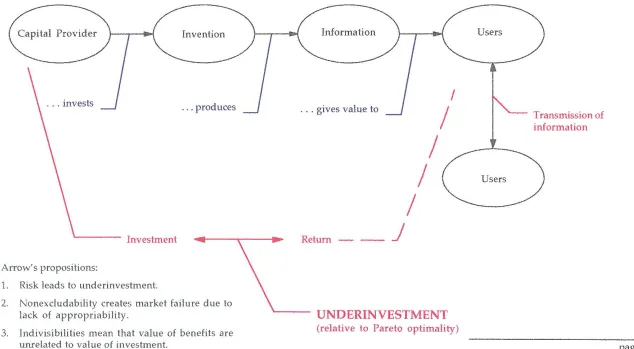
A graphical representation of the Arrow model is provided in Figure 2-1.
The purpose of the representation is to act as a prelude to the model
implied by the conventional analysis (Figure 2-2) and the contrasting
informational model of innovation (presented in Chapter Four). In the
Arrow model the capital provider invests in a process of invention.
Invention is a process which produces information (an intangible
commodity). Information is valuable to users in managing risk, yet its
full value is not appropriable to the capital provider since information
may be (almost) costlessly transmitted to other users who do not provide
a return ("free riders"). In evaluating the cost of investment to the
benefits of returns, Arrow's model implies that there will be
underinvestment relative to a measure of Pareto optimal efficiency. This
proposition is the major focus of subsequent literature. The other
proposition relating to indivisibilities, however, suggested that the value
of the benefits of information production are unrelated to the val.ue of
investment. That is, some types of information may be produced at little
cost that are of enormous benefit to society. The intellectual property
literature has instead assumed a significant level of investment in
research and development and limited avenues for extracting a return.
Figure
2-1
-
The Arrow
Model
Invention
... invests ... produces
Jnvestment
Arrow's propositions:
1. Risk leads to underinvestment.
2. Nonexcludabi.lity creates market failure due to
lack of appropriability.
3. Indivisibilities mean that value of benefits are
... gives value to
Return - - -
J
I
I
I
I
I
UNDERINVESTMENT (relative to Pareto optimality)
Chapter Two - Information as a Commodity
Users
Users
Chapter Two -Information as a Commodity
2.3
Reward for
Invention
It is axiomatic within the orthodox literature that, once an
information-good has passed beyond the inventor and any immediate contracting
parties, it is difficult or impossible to recover from third parties a share of
the benefits which flow to them from use of the information-good. The
argument follows that, in the private market, there will be
underproduction, relative to a "socially optimal" quantity and quality of
information-goods, unless there is some government intervention to
create an incentive to invest.
From this simple proposition comes the principal justification for
intellectual property rights - the hypothesis that both risk and
appropriability can be addressed (imperfectly according to Arrow) by
creating "legally imposed property rights".20 Demsetz21, in commenting
directly on Arrow's paper, argued:
The degree to .which knowledge is privately appropriable can be increased by raising the penalties for patent violations and by increasing resources for policing patent violations . .. Given the appropriate legal apparatus and schedule of penalties it may be no more difficult to police property rights in many kinds of knowledge than it is to prevent the theft of automobiles and cash.
This argument by Demsetz was central to much of the policy literature
and political arguments surrounding intellectual property. His assertion
20 Arrow, K.J. (1962) "Economic Welfare and the Allocation of Resources for Invention" in National Bureau of Economic Research, The Rate and Direction of Inventive Activity (Princeton University Press) pp. 609-626 at p. 615.
Chapter Two -Information as a Commodity
was that maximisation of private appropriability through intervention of
legal institutions (such as copyright) would facilitate market mechanisms and provide social benefit.
Much subsequent literature from this tradition - particularly that
originating from the Chicago school22 - has accepted the "reward for
invention" argument as flowing naturally from Arrow's paper. Private property rights are said to provide an incentive for the production of
intellectual property because, if successfully marketed, there is a chance of
obtaining a return in the form of income which creators can obtain
through royalties and licensing.23 The role of intellectual property laws,
therefore, can be seen as to ensure the appropriability of the value of the works when in the hands of users. Failure to provide for appropriability
in this fashion leads to a less than socially optimal amount of investment in invention.24
The "reward for invention" thesis assumes that market failure is corrected only if intangibles are forced, through legal institutions, to exhibit the same economic characteristics as tangibles. The conception of
information creation as a production chain is a necessary incident of the
22 e.g. Dam, KW. (1994) "The Economic Underpinnings of Patent Law" Journal of Legal Studies, Vol. 23, pp. 247-271.
23 Arrow, K., (1962) "Economic Welfare and the Allocation of Resources for Invention" in
National Bureau of Economic Research, The Rate and Direction of Inventive Activity:
Economic and Social Factors p.619.
Chapter Two - Information as a Commodity
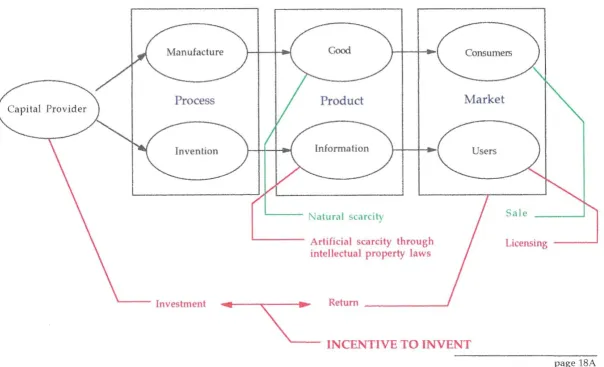
conception of information as a commodity.25 The consequences of this commodity approach are portrayed in Figure 2-2. The purpose of this figure, prepared by the author, is to show the conceptual extension from Arrow's model which the orthodox literature reflects. In particular a commodity model of information is analogous to the standard economic model of the market, with the process of "manufacture" replaced by "invention". The product is not a physical good but an intangible, "information", which is made artificially scarce due to the applications of intellectual property laws. Importantly, the perception is that invention is a single, isolated process which takes place within the "black box" of the firm.26 Due to legal sanctions and policing, the information can be marketed and its value in the hands of users appropriated through normal market mechanisms. The incentive to invent in such a model is directly related to the size of the potential return on investment.
Arguments which base their assumptions upon the concept of information as a commodity have typically made an implicit assumption of a direct relationship between the scope of the property right, the returns to inventors and the level of investment in research and development. This direct relationship drives the conclusion that the objectives of intellectual property can be promoted by maximisation of potential
25 Braman, S. (1989) "Defining Information: An Approach for Policymakers" Telecommunications Policy, Vol. 13, pp. 233-242 at p. 237.
Chapter Two - Information as a Commodity
Figure 2-2 - The Commodity Model
Invention
l'\aturnl scarcity
Artificial scarcity through
intellectual property laws
Return
---..J
Market
Users
Investment ,.,..._ _
__,..'\----ti••
INCENTIVE TO INVENT
Licensing _ _ _ _,
Chapter Two -Information as a Commodity
returns to inventors. It follows that activities such as price discrimination
through licensing between individual and "site" software licences;
hardback and paperback books; and individual and library subscription
rates for journals, will serve to assure returns to investors by increasing
the market power inherent in the property right.27
This reasoning leads to the conclusion that broadening the scope of
monopoly rights granted by intellectual property laws is always desirable,
as is the limitation or abolition of measures such as compulsory licensing;
reinforcing government policing and imposing higher penalties for
infringement.
As an example, consider how the optimal life of an intellectual property
right should be determined. The classic economic test in the area of
determining a property right length was stated by Nordhaus:28
As the life is increased, two opposite forces affect the level of
economic welfare. First, a longer life increases invention and thus
gives on balance a larger amount of output for a given level of
inputs. This is a positive effect. Second, a longer life means that
the monopoly on information lasts longer and thus there are more
losses from inefficiencies associated with the monopoly. The
optimal life of the patent is that point at which the two forces balance at the margin.
Many papers, however, appear to focus on Nordhaus's positive effect and
(MIT Press; Cambridge).
27 Besen, S.M. and Raskind, L.J. (1991), "An Introduction to the Law and Economics of Intellectual Property" journal of Economic Perspectives, Vol. 5, p. 3 at p. 5.
Chapter Two - Information as a Commodity marginalise the negative effect. Kitch29 rhetorically noted that, viewed in
isolation, the reward function of intellectual property suggested a
p
e
rp
etual
term for patents:If the purpose is to reward the inventor for his invention, then why shouldn't he be awarded all of the present value of his invention?
Kitch also conceded, however, that the "simplicity" of the argument
breaks down once the view is taken that the inventor's contribution is
not the invention itself, which eventually would have been made by
someone else, but the time of the invention: 30
The patent should reward not for the whole value of the invention, but for the value of being first.
2.4 Monopoly effects
The focus on the "reward for invention" argument within the debate on
duration is illustrative of the wider copyright literature which emphasises
the incentive to invest yet downplays the potential market distortions
associated with exclusive rights. This section examines the narrow
approach taken to questions of monopoly within the intellectual property
context.
There is a perception within the literature that there is small chance of
intellectual property having undesirable economic effects. This relies to
29 Kitch, E.W. (1977) "The Nature and Function of the Patent System" Journal of Law and Economics Vol. 20 p. 265 at p. 285.
Chapter Two - Information as a Commodity some degree on the "paradox" of intellectual property protection: that the imposition of a monopoly privilege over the use or reproduction of an invention or work is alleged to correct market failure.31 Under the paradox, reconciling competition policy and protection of intellectual property appears to rest on a trade-off between short-run static inefficiency and long-term dynamic efficiency. Dynamic efficiency includes the invention and commercial introduction of new products and processes which enhance welfare both by increasing the utility of goods and by promoting growth through increased productive efficiency.32
At one level, the negative impact of intellectual property can be collapsed into an investigation of whether the creation of a right has led to effects which would be noticeable as "monopoly" effects. Actions such as directly restricting supply and raising prices are the usual considerations for determining the presence of monopolies, consistent with Nordhaus's concept of "losses from inefficiencies"33. This can be observed in comments by Easterbrook34 who appears to rely on domination of the production market when he. argues that patents do not necessarily create
31 Braunstein, Y.M., Baumol, W.J. and Mansfield, E. (1980) "The Economics of R&D" in Dean, B.V. and Goldhar, J.C. (eds), Management of Research and Innovation
(North-Holland: Amsterdam) pp. 19-32 at p. 28.
32 Ordover, J.A. (1984) "Economic Foundations and Considerations in Protecting Industrial and Intellectual Property" Antitrust Law Journal, Vol. 53, p. 503 at p. 505; Scherer, F.M. (1984) Innovation and Growth pp. 257-263.
33 Nordhaus, W. (1969) Invention, Growth and Welfare (MIT Press: Cambridge) p. 76; quoted above.
Chapter Two - Information as a Commodity
any monopoly:
A patent may create a monopoly - just as an auto manufacturer
may own all of the auto production facilities - but property and
monopoly usually differ.
Such an approach is narrowly conceived and fails to address wider
questions of market power associated with an intellectual property right.
Kitch35 relies on this narrow approach in arguing that as competitive
pressures are exerted on patent holders, any suggestion of monopoly in its
strict sense is false. The argument follows that competition exists in the
form of close substitutes. Also, obsolete technology would still be
competitive as substantial investments are committed to existing
technology and additional investments were required in many cases to
shift to new technologies. Hence, near the end of the life of the right, the
potential for entry of additional firms would force the patent holder to set
prices to a competitive level to discourage entry. Kitch cited Xerox as an
example of behaviour where patents did not result in monopoly power,
based on evidence that after the introduction of xerography, other forms
of document reproduction continued to share the marketplace. This
example was criticised by Scherer,36 who noted that the allegation of
competition was incorrect when the facts were closely examined. Xerox
had in fact been engaging in price discrimination in its exercise of market
35 Kitch, E.W. (1986) "Patents: Monopolies or Property Rights" Research in Law and
Economics, Vol. 8, p. 31.
36 Scherer, F.M. (1986) "Comment on Edmund Kitch" Research in Law and Economics,
Chapter Two - Information as a Commodity
power.37
Confusion exists in the literature as to whether "monopoly" should be
taken to mean the market-distorting effects intended to cure the market
failure or in its strict economic sense. Rather than recognising the
semantic nature of the argument, authors, particularly those adopting a
conventional economics view, suggest that the existence of competitors
precludes a finding a monopoly. Chicago writers such as Dam38 have
noted that unlike monopolies "economic rents" represent an advantage
relative to competitors which results in a higher return on investment.
Economic rents can be justified in a policy sense as an element of the
incentive for invention, and the efficiency question, so far as neo-classical
economics is concerned, is whether the existence of rents leads to socially
wasteful "rent seeking".39 The difficulty is that arguments such as Dam's,
in placing such a heavy emphasis on efficiency often marginalise the
issue of rents as a problem of equity or allocation. This marginalises the
negative impacts of intellectual property rights by assuming that the
37 In terms of machine and supplies cost, clerical labour costs and quality, operating a new Xerox machine easily dominated over existing diffusion transfer or Thermofax copiers. The only serious competitor was Electrofax coated paper processes, but for any monthly volume of 1852 copies or above, Xerox was superior. So, Xerox charged 5 cents per copy in the 2000 copies per month range, and 3.5 cents per copy in higher volumes allowing it to dominate the market at the lower prices. Scherer, F.M. (1986)
"Comment on Edmund Kitch" Research in Law and Economics, Vol. 8, p. 51 at pp. 53 -54.
38 Dam, K.W. (1994) "The Economic Underpinnings of Patent Law" Journal of Legal
Studies, Vol. 23, pp. 247-271 at pp. 250-251.
39 Drawing m another strand of economic literature: Boss, H.H. (1990) Theories of
Surplus and Transfer: Parasites and Producers in Economic Thought (Unwin Hyman:
Chapter Two - Information as a Commodity
absence of a monopoly, strictu sensu, and equating the existence of
competitors with "competition", implies an absence of other undesirable
effects. Inevitably the question of "monopoly" effects as against "rents" or
"distortions" is essentially one of definitional semantics and rejecting the
existence of undesirable economic effects by relying on nee-classical
assumptions and definitions detracts significantly from forming a true
understanding of the problem. The real issue is not one of a technical
monopoly, but rather one of market power.
Scherer's observations above indicate the potential for welfare problems
from monopoly which are not captured within a simple demand and
supply analysis. Typical welfare losses that can arise are:
• losses due to underutilisation;
• losses due to wasteful/ duplicative research; and
• losses due to restriction on invention by acquiring and not using
rights.
Underutilisation of the new technology is where consumers willing to
purchase the good at its marginal cost of production do not purchase the
good, due to the price being raised above that level. The problem is not
limited to patent: such a cost has been hypothesised where copyright
protection is imposed or increased in scope.40 For example, Novos and
Waldman model copyright protection without price discrimination as to
-Chapter Two - Information as a Commodity
quality on the basis that consumers do not vary in their valuations on the
quality of the good. In an analytical model this leads them to conclude
that copyright protection does result in an underutilisation social welfare
loss.41 Where intellectual property rights are stronger, there can be a
stimulus to socially wasteful research and development spending to
develop technology which is inferior to that protected yet superior to
current processes.42
2.5
Under-reward
and over-reward
As well as downplaying the significance of monopoly and its direct effects,
the "reward for invention" literature appears to marginalise two further
issues. One is that the literature assumes an extreme form of competition
with costless information flows. This highly competitive market
under-rewards invention since competitors will too quickly have imitating
products to market at little cost. It has been suggested, however, that
natural imitation lags do exist and are sufficient to provide a reward to
stimulate invention. Competition itself can be seen as an impetus for
invention. The other issue is that intellectual property rights can
over-reward invention since it the legal privilege provides the opportunity for
anti-competitive behaviour. These issues are discussed below.
an Expository Survey" Journal of Economic Literature, Vol. 17, p. 1375.
41 Novos, I.E. and Waldman, M. (1984) "The Effects of Increased Copyright Protection:
An Analytic Approach" Journal of Political Economy, Vol. 92, p. 236 at p. 240.
42 Nelson, R.R. (1981) "Assessing Private Enterprise: An Exegesis of Tangled Doctrine"
Chapter Two - Information as a Commodity
Neo-classical economics assesses underinvestment against the benchmark
of Pareto optimality. Although Pareto optimality can be a useful tool for
the identification of potential problems, it is not useful, at least in terms
of intellectual property, for determining their solutions. The
underinvestment model relies on an assumption of perfect competition
in the market, of numerous buyers and sellers, of homogeneous products,
easy entry and perfect knowledge. The assumptions can be explained as
arguing that:
• all information is interchangeable;
• all information is communicable;
• all agents are competent in the reception and understanding of
information;
• information transfer is costless;
• information transfer is simultaneous (market lead-time provides
no advantage);
• no one requires other resources with which the given piece of
information must be combined; and
• if there is a requirement of combining pieces of information, the
sources of complementarity and potential gain are known.
These assumptions all relate to the process and transmission of
information in the context of the nature of invention. They drive the
Chapter Two -Information as a Commodity to entry into the market are so weak that they offer little assistance to aid appropriability. Sometimes despite the restrictions placed upon it by intellectual property protection, the market is still perceived to fail. Where market power is perceived to be threatened by some exacerbation of the appropriability problem - such as fears of widespread "piracy" across the internet - there follows a perceived need for broadening the scope of the property rights or otherwise strengthening the legal institutions.
This theme within the literature is of under-reward for invention, yet much of this underinvestment literature assumes that within current market institutions little incentive exists to invent except by returns through the exercise of market power contained in intellectual property rights. Indeed, very little is said of benefits otherwise than by royalties. The following statement by Nelson43 is axiomatic to this literature:
Innovation takes R&D resources and involves risks. To motivate the effort under private enterprise requires that the innovator (or those who finance him) can make a profit. Under the ground rules
of private enterprise, the only way that this can be done is by having at least a temporary period where the innovating firm and not its competitors can produce the new product or use the new process, or receive compensation from other firms that do.
It has been suggested both conceptually and empirically, however, that competition is one of the most influential factors stimulating research
43 Nelson, R.R. (1981) "Assessing Private Enterprise: An Exegesis of Tangled Doctrine"
Chapter Two - Information as a Commodity
investment.44 Indeed, several authors have noted that technological
improvements might be just as likely to occur if many manufacturers are
competing in the marketplace45 and that competition may operate as a
more effective stimulant to invention than the prospect of monopolistic
reward.46 Scherer47, for example, argued that the presence of oligopolistic
industry structures, natural imitation lags and the advantages of
competitive product leadership, characteristics widespread in the
information economy suggest that investment in research and
development is wholly rational in the absence of intellectual property
protection. This theme has been echoed by Braunstein, Baumol and
Mansfield.48
Intellectual property may also serve to over-reward invention (and
impede later inventors) as it is a means to engage in anti-competitive
practices. Examples would include:
• acquisition of related patents so as to control a particular industry or
industrial process;
44 Firestone, O.J. (1971) Economic Implications of Patents (University of Ottawa Press: Ottawa) p. 169.
45 Emerson, J.M. (1984) "Computer Software: Detailed Inquiry Needed Before Legislation" Law Institute Journal p. 514; also note Copyright Law Review Committee (1990) lssites Paper: Computer Software Protection (AGPS; Canberra) p. 14.
46 Macdonald, S. (1989) "Human Qualities Necessary for Invention: Independent Inventors and the Stimulus of Adversity" Prometheus, Vol. 7, p. 333.
47 Scherer, F.M. (1980) lndustrial Market Structure and Economic Performance (2nd Edition) (Rand McNally: Chicago) pp. 444 - 447.
Chapter Two -Information as a Commodity
• applying financial pressure to smaller firms through litigation;
• accumulation of patents through time so as to perpetuate
exclusivity after the expiry of original patents49; and
• application of restrictive licensing conditions50.
These factors are of concern given there is a growing dominance of
corporate ownership of intellectual properties and anti-competitive
behaviour through exploitation of the rights vested in the ownership of
intellectual property.51 The economic literature explains this behaviour
in terms of cost raising strategies, switching costs, and product
differentiation.
Strategies designed to raise rivals' costs have a number of advantages in
enhancing market power. Rival's costs may be raised through several
means, by:
• raising input prices;
• imposing switching costs;
• increasing expenditure on research and development;
• increasing advertising or promotional expenses;
49 Silberston, A. (1967) "The Patent System" Lloyds Bank Review, Vol. 84, pp. 32-44 at
pp. 41-42.
50 Mandeville, T.D, Lamberton, D.M. and Bishop, E.J. (1982) Economic Effects of the Australian Patent System (Australian Government Publishing Service: Canberra) at
p.213
Chapter Two - Information as a Commodity
• imposing a "regulatory parameter" - such as intellectual property
protection or de facto or de
jure
standardsSalop and Scheffman52 found that cost-raising strategies may result in a
decrease in price if the firm seeking to raise rival's costs has market power
in the output market. This result runs counter to those who insist that
market power is only reflected in extraction of rents through increase of
prices. They found that if the price falls as a result of the action of the
dominant firm, the output of the fringe firm falls. Further to this, Salop
and Scheffman found that vertical integration can be anti-competitive
even where the integration does not monopolise the relevant factor
market. A cost-raising strategy linked to product differentiation is that of
imposition of switching costs through risk-averse consumption. Time
and effort are consumed in learning how to use products. A consumer
will usually, therefore, demand that the features of any new product be
similar to those features in which the consumer's learning effort has been
expended. For example, features dealing with the interface between the
user and a computer program will be valued not only on actual and
perceived need, but also on associated costs of obtaining the necessary
knowledge to operate the program. These associated costs are switching
costs.
Switching costs place fringe firms and new entrants at a cost disadvantage,
since to compete they would need to supply additional functionality or
Chapter Two - Information as a Commodity
usability to overcome the heavy weight given by the users to interface
factors. Switching costs are particularly effective barriers to entry where
the extent of vertical integration is asymmetric to the rest of the industry.
Established firms with little need to adapt technology from others have a
clear cost-incentive to broaden the scope of protection. The
implementation of standards, both de facto and de
j
ur
e
,
therefore, are akey cost-raising strategy.
Allied to switching costs is the concept of product differentiation. One
common method for product differentiation is to direct attention towards
the features of the artefact. An equally powerful method is to cultivate a
favourable brand image among customers and distributors. The resulting
brand loyalty can create a dominant position by raising entry costs for
rivals who will have to overcome such loyalty to compete. Brand loyalty
may be increased through forward integration (such as buying into the
distribution networks), post-sales service, and training of purchasing
agents. Incentives exist against ensuring perfection in a product where
imperfections allow for a demonstration of support services and a
deepening of the personal relationship with the consumer - potentially
increasing brand loyalty.
2.6
Summary
This chapter has critically outlined the conventional view of the
economic justifications for intellectual property protection. The policy
Chapter Two -Information as a Commodity recommendation - an imposition of a commodity form to information through intellectual property protection - is open to criticism. The dominant perspective is that of a production chain model of invention which generates information as its output.53 Intellectual property aims to promote investment in invention through restrictions on the use of the information by others.
Conventional economic analysis assumes that a direct relationship exists between the scope of the monopoly privilege afforded, returns to investors and the level of investment in research and development. Intellectual property is seen as an appropriate intervention to address a market failure which arises from lack of appropriability of information in
the hands of users. It is important to note that the perceived appropriability problem is derived from the work of Arrow in dealing with information in a pure sense. Market failure is (allegedly) solved by affording a monopoly privilege: a right to extract rents over the use of information. The argument surrounding the scope of the right is centred on the pursuit of "socially optimal output" in terms of "efficiency".
A narrow conception of "monopoly" marginalises the effect of welfare losses resulting from underutilisation and wasteful research. The focus on the intellectual property right as the source of return on invention also marginalises other forms of reward and the potential for over-reward
through anti-competitive exploitation of intellectual property rights.
Chapter Two - Information as a Commodity
The following chapter will outline an alternative and, in the author's
opinion, preferable perspective, based in information economics. The
alternative perspective is that information, in the context of intellectual
property regulation, is better conceived as a resource. This information
perspective is drawn ·upon to develop the model of invention
(technological innovation) presented in Chapter Four, based on the
assumption that the information or knowledge underlying the creation of
a product is not readily appropriable. Such an approach has profound
consequences for the process of innovation and role of intellectual
Chapter Three - Information as a Resource
Chapter
Three
Information as a Resource
3.1 Introduction
The previous chapter discussed the conventional view of the economics
of technological development, which was based on the notion of
information as a commodity. This chapter explores the alternative
assessment of information - as a resource. Viewing information as a
resource facilitates viewing the process of "innovation"54 as cumulative
and dynamic. The main distinction between the resource and commodity
views is that a resource has value in use, whilst a commodity has a value
in exchange.55 Information as a resource is better suited than information
as a commodity to an analysis of intellectual property regulation, as the
aim of intellectual property is to ensure that information is disseminated
throughout society. When information is viewed as a commodity, the
issue of dissemination of information becomes secondary to a concept of
information being traded. This means that considerations of information
as an input are effectively disregarded. When viewed as a resource, the
role of information in facilitating technological progress is a principal
consideration.
54 As stated in Chapter Two, the term "innovation" is used to· describe the process of
Chapter Three - Information as a Resource
In Chapter Two, intellectual property was justified in terms of providing
"inventors" with financial incentives to invest in the creation of
information products. This incentive to "invent", however, is not the
pivotal focus of affording intellectual property rights within
English-derived legal systems. Intellectual property protection's primary aim has
been to maximise the welfare of the community by ensuring "the end" of
diffusion of information through "the means" of providing incentives
for innovation.56 A vast quantity of legislative and juridical comment,
as well as other literature - by far the majority, has commented that the
means through which this aim is to be achieved is by weighing the
advantages gained by the granting of incentives against the disadvantages
flowing to the public from the recognition of property rights.57.
This chapter adopts an information economic perspective to examine the
nature of information as a resource for technological innovation.
Neo-classical economists have been criticised for failing to account for the role
of technology in the economy, and in the dynamics of technological
change.58 Recent literature suggests that technology is best viewed as
55 Monk, P. (1989) Technological Change in the Information Economy (Pinter Publishers) pp. 87 -92.
56 Kreiss, R.A. (1995) "Accessibility and Commercialization in Copyright Theory"
U.C.L.A. Law Review, Vol. 43, p. l.
57 Baxter, W.F., (1966) "Legal Restrictions en Exploitation of the Patent Monopoly: An Economic Analysis" Yale Law Journal, Vol. 76, p. 267 at p.271.
58 Jewkes, J. Swayers, D. and Stillerman, J. (1956) The Sources of Invention (Macmillan:
Chapter Three - Information as a Resource
information as it is composed of information resources of various types.59
One purpose of this chapter is to outline the properties of information6()
from the perspective of information economics, in contrast to the
orthodox economics presented in the previous chapter. Another is to
discuss the implications for the market of an information perspective,
with particular focus on network externalities. Both provide a framework
for the development of a model of technological innovation in Chapter
Four, and its application to computer programs in Chapter Five.
3.2
Information properties
This section discusses some of the properties of information from an
information perspective. This provides a useful contrast with the
assumed properties of information from an orthodox perspective, as
outlined in Chapter Two. Under the orthodox perspective, information
was treated as a form of output from a process of "invention", and that
lack of appropriability suggests that information should be made
exclusive by imposition of property rights. The process of information
creation was itself seen as an isolated act of inspiration, research and/ or
development. Under the information perspective, information is seen as
a capital resource. Indivisibilities suggest that information should be
59 Monk, P. (1992) "Innovation in the Information Economy" in Antonelli, C. (ed.) The
Economics of Infonnation Networks (Elsevier Science Publishers: New York) pp. 35-50
at p. 38.
60 It is not possible, however, to define information in a precise manner due to the
interdisciplinary nature of the literature, much of which is be based in sociology,
technical science and psychology: Braman, S. (1989) "Defining Information: An
Chapter Three - Information as a Resource
shared to maximise social benefits. The process of information creation is
"innovation" which suggests a process which is interactive between firms and based on imitative competition.
3.2.1 Information is capital
A better conception of information is as a capital resource, since it is used
to facilitate production. An assumption of information economics is the
rejection of the concept of information as a static commodity (an output)
and instead adopting the concept of information as dynamic resource (an
input). One observation made by Arrow, and largely ignored by later
neo-classical authors was that information is not only the product of
innovative activity, it is also an input to innovation and prior
information is required for the creation of subsequent information.61
Information may be said to be synthesised and innovated rather than
created, building on sources already in the public domain.62
Technological progress, therefore, must necessarily build on a foundation
provided by earlier inventors.63 Ricketson64 noted that future creative
activity depends upon the public domain and that "copying,
61 Arrow, K.J. (1962) "Economic Welfare and the Allocation of Resources for Invention" in National Bureau of Economic Research, The Rate and Direction of Inventive Activity (Princeton University Press) pp. 609-626 at p. 618. This theme is not pursued, however, and Arrow disposes of it as simply compounding the appropriability problem.
62 Pendleton, M., (1985) "Intellectual Property, Information-based Society and a New International Economic Order - the Policy Options?" European Intellectual Property Review, Vol. 2, p. 31.
63 Scotchmer, S. (1991) "Standing on the Shoulders of Giants: Cumulative Research and the Patent Law" Journal of Economic Perspectives, Vol. 5, p. 29.