This is a repository copy of
Isolation of 39 polymorphic microsatellite loci and the
development of a fluorescently labelled marker set for the Eurasian badger
.
White Rose Research Online URL for this paper:
http://eprints.whiterose.ac.uk/366/
Article:
Carpenter, P.J., Dawson, D.A., Greig, C. et al. (3 more authors) (2003) Isolation of 39
polymorphic microsatellite loci and the development of a fluorescently labelled marker set
for the Eurasian badger. Molecular Ecology Notes, 3 (4). pp. 610-615. ISSN 1471-8278
https://doi.org/10.1046/j.1471-8286.2003.00529.x
[email protected]
https://eprints.whiterose.ac.uk/
Reuse
Unless indicated otherwise, fulltext items are protected by copyright with all rights reserved. The copyright
exception in section 29 of the Copyright, Designs and Patents Act 1988 allows the making of a single copy
solely for the purpose of non-commercial research or private study within the limits of fair dealing. The
publisher or other rights-holder may allow further reproduction and re-use of this version - refer to the White
Rose Research Online record for this item. Where records identify the publisher as the copyright holder,
users can verify any specific terms of use on the publisher’s website.
Takedown
If you consider content in White Rose Research Online to be in breach of UK law, please notify us by
Molecular Ecology Notes (2003) 3, 610–615 doi: 10.1046/j.1471-8286.2003.00529.x
© 2003 Blackwell Publishing Ltd
Blackwell Science, Ltd
P R I M E R N O T E
Isolation of 39 polymorphic microsatellite loci and the
development of a fluorescently labelled marker set for
the Eurasian badger (
Meles meles
) (Carnivora: Mustelidae)
P E T R A J . C A R P E N T E R ,* D E B O R A H A . D A W S O N ,*† C A R O L Y N G R E I G ,† A N D R E W P A R H A M ,† C H R I S L . C H E E S E M A N ‡ and T E R R Y B U R K E *†
*Department of Animal and Plant Sciences, University of Sheffield, Sheffield, S10 2TN, UK, †Department of Biology, University of
Leicester, Leicester LE1 7RH, UK, ‡Central Science Laboratory, Sand Hutton, York, YO41 1LZ, UK
Abstract
We have isolated 78 microsatellite loci from the Eurasian badger (
Meles meles
). Of the 52
loci characterized, 39 were found to be polymorphic. A fluorescently labelled primer set
was developed to enable individual-specific 17-locus genotypes to be obtained efficiently.
Keywords: badger, DNA profile, fluorescent set, Meles, microsatellite, Mustelidae
Received 2 February 2003; revision received 14 May 2003; accepted 27 August 2003
British badgers (Meles meles) form stable social groups
(Neal & Cheeseman 1996). As badgers occupy underground setts during the day and forage alone nocturnally, studying their breeding behaviour is extremely difficult. To enable investigation of relatedness, maternity and paternity, and so understand the social structure and mating system in this species, we have characterized 39 polymorphic micro-satellite loci and developed a 17-locus fluorescently labelled primer set.
Blood was collected from individual badgers inhabiting Woodchester Park, Gloucestershire, England. Genomic DNA was extracted from blood using proteinase K and
phenol:chloroform:isoamyl alcohol (Sambrook et al. 1989).
Badgers have been implicated in the transmission of bovine tuberculosis. Therefore to reduce the possibility of human infection, the transfer of blood tissue was handled in a Level 3 containment laboratory (Advisory Committee on Dangerous Pathogens 1995) and blood samples were
incubated at 95 °C for 30 min (Rubin 1991), after the
protei-nase K digestion had been performed.
Two unenriched microsatellite libraries were constructed. For the first library (A), genomic DNA from one male badger
was digested with RsaI, AluI and HaeIII (Advanced
Bio-technologies, Abgene) and the 300–600-bp fraction was
ligated to SmaI-digested CIP-dephosphorylated pUC18
(Stratagene, La Jolly, CA, USA). For the second library (B),
genomic DNA (pooled from three male badgers, from
three different social groups) was digested with MboI
(Advanced Biotechnologies) and the 250–1150-bp fragments
were ligated to BamHI-digested SAP-dephosphorylated
pBluescript II (Stratagene).
For both libraries, transformant colonies were screened
with (CAGT)n, (GACT)n (Amersham Pharmacia Biotech)
and (TTTC.AAAG)n oligonucleotides [prepared as for
(CATG.GTAC)n in Armour et al. 1994] radiolabelled with
[α32P]-dCTP.
In total, 238 positive clones were sequenced using an ABI 373 DNA Sequencer (Applied Biosystems). Seventy-eight clones were sequenced in both directions to create consen-sus sequence files. Sequences were found to be unique within
each separate library (A or B) using genejockey software
(Biosoft). After submission to the EMBL database (acces-sion numbers: AJ230687–97, AJ230699–725, AJ293349–85, AJ293387–89), all 78 sequences were checked for duplicates within and between libraries A and B, and confirmed to be
unique using blastn 2.2.4 software (Altschul et al. 1997).
We designed primer pairs for the 78 loci using primer3
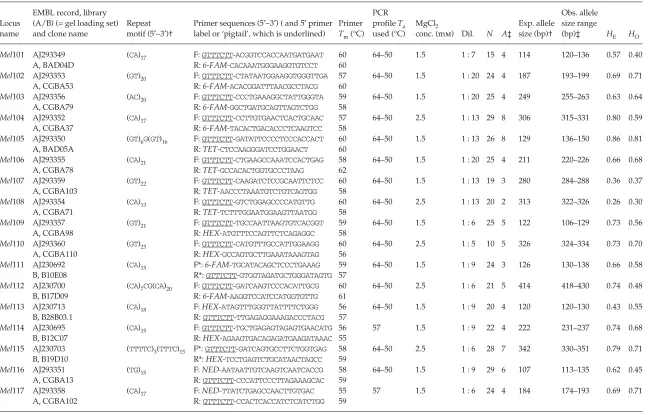
software (Rozen & Skaletsky 2000). Each primer pair was used to polymerase chain reaction (PCR)-amplify a panel of 10–33 unrelated badgers, with each individual belong-ing to a different social group (Table 1). PCR profiles are provided in Table 1. PCR amplification was performed in a Hybaid Touchdown thermal cycler (Thermo Hybaid).
The 17 loci displaying the highest number of alleles with complementary size ranges were selected for the creation Correspondence: Deborah Dawson. Fax: + 44 (0)114 2220002;
PRIMER NOTE
611
© 2003 Blackwell Publishing Ltd,
Molecular Ecology Notes
, 3, 610
–
[image:3.782.80.732.97.512.2]615
Table 1 Polymorphic microsatellite loci in the Eurasian badger, Meles meles
(a) Seventeen loci for which primers were fluorescently labelled and optimized for use on an ABI 377 DNA Sequencer in two gel-loading sets‡
Locus name
EMBL record, library (A/B) (= gel loading set) and clone name
Repeat motif (5′−3′)†
Primer sequences (5′–3′) ( and 5′ primer label or ‘pigtail’, which is underlined)
Primer Tm (°C)
PCR profile Ta used (°C)
MgCl2
conc. (mm) Dil. N A‡
Exp. allele size (bp)†
Obs. allele size range
(bp)‡ HE HO
Mel101 AJ293349 (CA)
17 F: GTTTCTT-ACGGTCCACCAATGATGAAT 60 64–50 1.5 1 : 7 15 4 114 120–136 0.57 0.40
A, BAD04D R: 6-FAM-CACAAATGGGAAGGTGTCCT 60
Mel102 AJ293353 (GT)
20 F: GTTTCTT-CTATAATGGAAGGTGGGTTGA 57 64–50 1.5 1 : 20 24 4 187 193–199 0.69 0.71
A, CGBA53 R: 6-FAM-ACACGGATTTAACGCCTACG 60
Mel103 AJ293356 (AC)
20 F: GTTTCTT-CCCTGAAAGGCTATTGGGTA 59 64–50 1.5 1 : 20 25 4 249 255–263 0.63 0.64
A, CGBA79 R: 6-FAM-GGCTGATGCAGTTAGTCTGG 58
Mel104 AJ293352 (CA)
17 F: GTTTCTT-CCTTGTGAACTCACTGCAAC 57 64–50 2.5 1 : 13 29 8 306 315–331 0.80 0.59
A, CGBA37 R: 6-FAM-TACACTGACACCCTCAAGTCC 58
Mel105 AJ293350 (GT)
6G(GT)16 F: GTTTCTT-GATATTCCCCTCCCACCACT 60 64–50 1.5 1 : 13 26 8 129 136–150 0.86 0.81
A, BAD05A R: TET-CTCCAAGGGATCCTGGAACT 60
Mel106 AJ293355 (CA)
21 F: GTTTCTT-CTGAAGCCAAATCCACTGAG 58 64–50 1.5 1 : 20 25 4 211 220–226 0.66 0.68
A, CGBA78 R: TET-GCCACACTGGTGCCCTAAG 62
Mel107 AJ293359 (GT)
22 F: GTTTCTT-CAAGATCTCCGCAATTCTCC 60 64–50 1.5 1 : 13 19 3 280 284–288 0.36 0.37
A, CGBA103 R: TET-AACCCTAAATGTCTGTCAGTGG 58
Mel108 AJ293354 (CA)
13 F: GTTTCTT-GTCTGGAGCCCCATGTTG 60 64–50 2.5 1 : 13 20 2 313 322–326 0.26 0.30
A, CGBA71 R: TET-TCTTTGGAATGGAAGTTAATGG 58
Mel109 AJ293357 (GT)
21 F: GTTTCTT-TGCCAATTAAGTGTCACGGT 59 64–50 1.5 1 : 6 25 5 122 106–129 0.73 0.56
A, CGBA98 R: HEX-ATGTTTCCAGTTCTCAGAGGC 58
Mel110 AJ293360 (GT)
25 F: GTTTCTT-CATGTTTGCCATTGGAAGG 60 64–50 2.5 1 : 5 10 5 326 324–334 0.73 0.70
A, CGBA110 R: HEX-GCCAGTGCTTGAAATAAAGTAG 56
Mel111 AJ230692 (CA)
15 F*: 6-FAM-TGCATACAGCTCCCTGAAAG 59 64–50 1.5 1 : 9 24 3 126 130–138 0.66 0.58
B, B10E08 R*: GTTTCTT-GTGGTAGATGCTGGGATAGTG 57 Mel112 AJ230700 (CA)
7CG(CA)20 F: GTTTCTT-GATCAAGTCCCACATTGCG 60 64–50 2.5 1 : 6 21 5 414 418–430 0.74 0.48
B, B17D09 R: 6-FAM-AAGGTCCATCCATGGTGTTG 61
Mel113 AJ230713 (CA)
18 F: HEX-ATAGTTTGGGTTATTTTCTGGG 56 64–50 1.5 1 : 9 20 4 120 120–130 0.43 0.55
B, B28B03.1 R: GTTTCTT-TTGAGAGGAAAGACCCTACG 57 Mel114 AJ230695 (CA)
15 F: GTTTCTT-TGCTGAGAGTAGAGTGAACATG 56 57 1.5 1 : 9 22 4 222 231–237 0.74 0.68
B, B12C07 R: HEX-AGAAGTGACAGAGATGAAGATAAAC 55
Mel115 AJ230703 (TTTTC)
3(TTTC)15 F*: GTTTCTT-GATCAGTGCCTTCTGGTGAG 58 64–50 2.5 1 : 6 28 7 342 330–351 0.79 0.71
B, B19D10 R*: HEX-TCCTGAGTCTGCATAACTAGCC 59
Mel116 AJ293351 (TG)
15 F: NED-AATAATTGTCAAGTCAATCACCG 58 64–50 1.5 1 : 9 29 6 107 113–135 0.62 0.45
A, CGBA13 R: GTTTCTT-CCCATTCCCTTAGAAAGCAC 59
Mel117 AJ293358 (CA)
17 F: NED-TTATCTGAGCCAACTTGTGAC 55 57 1.5 1 : 6 24 4 184 174–193 0.69 0.71
PRIMER NOTE
© 2003 Blackwell Publishing Ltd,
Molecular Ecology
Notes
, 3, 610
–
615
(b) Characteristics of an additional 22 loci
Locus name
EMBL record, library (A/B)
and clone name Repeat motif (5′−3′)† Primer sequences (5′–3′)
Primer Tm (°C)
Ta used (°C)
MgCl2
conc. (mm) n A§
Exp. allele
size (bp)† HE HO
Mel118 AJ230706 (CA)
14 F*: ATGTCACTGAGAGTCAAATGC 55 55 1.0 9 3 238 0.50 0.44
B, B21C08 R*: CAAGTTCCATGTTGGGC 56
Mel119 AJ230714 (TG)
4(TA)2(CA)14CG(CA)3C(CA)2 F: AACACCCTCTAGCTCCATCC 58 58 1.0 10 3 179 0.59 0.50
B, B28G05 R: GAAAGAGCCCACATGTCCAC 61
Mel120 AJ230701 (GA)
15 F: ATGGCTTCTCTCACATCAGC 58 58 1.0 10 4 197 0.68 0.80
B, B17D12 R: GACACCTAACCAACTGAGCC 57
Mel121 AJ230688 (CA)
13 F*: TGATGATGACCAAGAACTTAATG 57 57 1.0 7 2 245 0.50 0.43
B, B04B07 R*: AACCCTATGGAATTAGGAAGC 56
Mel122 AJ230691 (CA)
14 F: ACTCCCCAAGGAGGTCTAAG 57 56 1.0 7 2 260 0.14 0.14
B, B08H04 R: ACACCTCTCCCTGTTCCTAG 56
Mel123 AJ230697 (CA)
14 F: AGTGGAAGCAGGGGCTTG 61 60 1.0 9 2 232 0.21 0.00
B, B12F03 R: TCCTTCTGAACGGATGATTTC 59
Mel124 AJ230712 (CA)
16 F*: TGGACATTTACCAGAGCACATC 60 60 1.0 9 2 138 0.29 0.33
B, B27B04.2 R*: CTCCACCACATGTGTCCAAC 60
Mel125 AJ230702 (CT)
8 and (CA)15 F*: CCATTTTACTTGAGAGTTGATTCC 58 58 1.0 2 2 195 0.50 0.50
B, B17H02 R*: ACCACGAGGATTGACATGAG 59
Mel126 AJ293370 (TG)
21 F: GTGATGTCAATAGCAAGGTTCA 58 55 1.5 10 3 158 0.64 0.50
A, CGBA99 R: ACACTACCAGAATACCCTAAGCG 59
Mel127 AJ293368 (TG)
15TC(TG)7 F: GCATACCCTCTGGGTCCATC 62 55 1.5 10 3 184 0.63 0.70
A, CGBA45 R: CAAATGATCTGTATTCCCACTG 57
Mel128 AJ293369 (CA)
23 F: ATCCAAACATGAAGCCCG 59 55 1.5 9 2 206 0.37 0.22
A, CGBA47 R: TTACAGGTAGGCTCTGAGAAGG 58
Mel129 AJ293366 (GC)
6(AC)17 F: TTCACATAAAGGAGCACGCA 60 55 1.5 10 5 213 0.72 1.00
A, CGBA28 R: GAATGGGACGTCTTGAGGTT 59
Mel130 AJ293364 (CA)
18 F: GAGGACCACACGACTGCG 62 55 1.5 10 4 296 0.70 0.50
A, CGBA17 R: AAAGCGCCAGAGCACCTAGA 62
Mel131 AJ293367 (TCCC)
5(TC)4 and (GT)14 F: AAAATCCTGCCTACGTGTGG 60 55 1.5 10 3 116 0.20 0.20
A, CGBA35 R: GATACAGCATGAAATAGCACTAGG 57
Mel132 AJ293361 (CA)
17 F: TGATGCAATGCCCACAAC 60 55 1.5 10 2 139 0.40 0.30
A, BAD06A R: GGGGGATGCATGTAATCTTG 60
Mel133 AJ293363 (GA)
16 F: AATGGAATCAAGTGCCTCCT 59 55 1.5 10 2 196 0.27 0.30
A, CGBA6 R: GAAATTCAAACTCATGTCAGGT 56
Mel134 AJ293365 (AC)
19 F: GGCTCATCTCATGCTCCTTC 60 55 1.5 10 2 266 0.52 0.30
A, CGBA19 R: CCATGGGCTGTGGATGATT 62
Mel135 AJ293371 (GT)
16 F: TCCCTGTTGTCAAACATTGC 60 55 1.5 10 2 131 0.27 0.10
A, CGBA100 R: TGGGCAGAGGATCTGAGTAG 58
Mel136 AJ293372 (CA)
19 F: CCCAAACTGAACTGACAAGA 56 55 1.5 8 2 234 0.40 0.50
[image:4.782.71.725.93.533.2]PRIMER NOTE
613
© 2003 Blackwell Publishing Ltd,
Molecular Ecology Notes
, 3, 610
–
615
Mel137 AJ293373 (GT)
18 F: AGGCTCGGTTCTATTCACCA 60 55 1.5 10 2 120 0.48 0.50
A, CGBA111 R: AACTAGGGCAAGAAGAAAGG 55
Mel138 AJ293375 (AC)
19 F: AAGTAGAAATGTAATGTGAGGCA 56 55 1.5 10 3 243 0.42 0.50
A, CGBA115 R: GCTTAACCAAATGAGGCACC 60
Mel139 AJ230694 (CA)
19 F: TGAATGGATAAAGAAGATGTGGTG 60 58 1.0 7 2 200 0.44 0.57
B, B11H08 R: CTCTGCTCAGTGGAGAGCCTG 63
*Primers designed from reverse complement of sequence on EMBL database. †From original sequenced clone.
‡Scored on an ABI 377 DNA Sequencer after running in two gel loading groups: Group 1, Mel101–110 (from library A) was run as an ABI-C-set and group 2, Mel111–117 (from library B) was run as an ABI-D-set.
§PCR products were scored on (40-cm long) 4 or 6% denaturing polyacrylamide gels by end-labelling one primer with [α33P]-dCTP using polynucleotide kinase (Amersham Pharmacia
Biotech) (library A) or by staining with silver (Promega; Bassam et al. 1991) (library B). PCR profiles.
Library A loci: 95 °C 1 min; 55 °C, 1 min; 72 °C, 1 min for 30 cycles.
Library B loci: 96 °C for 2 min for 1 cycle then 96 °C, 1 min; Ta°C, 30 s; 72 °C, 30 s for 30 cycles.
Fluorescent-labelled loci Mel101–Mel117: Touchdown PCR program, 94 °C for 3 min; then 94 °C for 15 s, 64–50 °C (dropping 2 °C every 2 cycles) for 20 s, 72 °C for 30 s; 35 cycles; followed by 72 °C for 10 min, except for Mel114 and Mel117, which were amplified as previously but with an annealing temperature of 57 °C. The 5′ end of one primer in each pair was labelled with a fluorescent phosphoramidite and the ‘pigtail’ sequence GTTTCTT was added to the other primer, to reduce noise from variable adenylation during the PCR (Brownstein et al. 1996). Tm, melting temperature of primer (without modifications) as calculated using primer version 3 (Rozen & Skaletsky 2000); Ta, annealing temperature for unlabelled and labelled primers; MgCl2 conc., magnesium chloride concentration for unlabelled and labelled primers; Dil., dilution of individual fluorescent PCR product:total multiplexed gel load; n, number of unrelated individuals tested; A, number of alleles; HE, expected heterozygosity; HO, observed heterozygosity.
Locus name
EMBL record, library (A/B)
and clone name Repeat motif (5′−3′)† Primer sequences (5′–3′)
Primer Tm (°C)
Ta used (°C)
MgCl2
conc. (mm) n A§
Exp. allele
[image:5.782.80.741.175.287.2]size (bp)† HE HO
© 2003 Blackwell Publishing Ltd, Molecular EcologyNotes, 3, 610–615 of a fluorescently labelled primer set (Mel101–Mel117,
Table 1).
Each 10-µL PCR reaction contained 50 ng of genomic
DNA, 0.25 µm primers, 0.15 mm of each dNTP, 1.5–2.5 mm
MgCl2 (Table 1) and 0.25 units of Taq DNA polymerase
(ThermoprimePlus, Advanced Biotechnologies) in the
man-ufacturer’s buffer [final concentrations: 20 mm (NH4)2SO4,
75 mm Tris-HCl pH 9.0, 0.01% (w/v) Tween]. PCR
prod-ucts were separated on an ABI 377 DNA Sequencer and
analysed using genescan version 3.1 and genotyper
ver-sion 2.5 software (Table 1).
Of the 52 loci tested, 39 were polymorphic (Table 1) and 13 were monomorphic. Primers were designed for an addi-tional 26 loci but these require further testing. Primer sequences for all 78 loci, including the uncharacterized and monomorphic loci are available from our website http:// www.shef.ac.uk/misc/groups/molecol/badgers.html or (for most) from the individual EMBL records (AJ230687– 97, AJ230699–725, AJ293349–85, AJ293387–89).
Observed (HO) and expected heterozygosities (HE)
were calculated using cervus version 2.0 (Marshall et al.
1998; Table 1). An exact test performed using genepop 3.3
(Raymond & Rousset 1995) found none of the 17 loci (Mel101–117) to be in linkage disequilibrium after correct-ing for multiple tests (Rice 1989).
The low levels of polymorphism, may in part be due to the small number of individuals tested (2–10 individuals for 35 of the 52 loci tested) or alternatively due to a low level of genetic variation in the Woodchester badger population. However, preliminary results from badger
populations elsewhere in Britain and continental Europe (unpublished data) suggest that the overall number of alleles may not be significantly greater than shown here.
Despite the low variability of individual markers, we have isolated sufficient loci to develop a set that has suc-cessfully provided individual-specific genotypes for the Woodchester Park population. The seven most polymor-phic loci were sufficient to distinguish, with 99% certainty, between full siblings in a group of 36 badgers from three Woodchester Park social groups (unpublished data). Seventeen loci (Mel101–117) were found to be necessary to determine parentage.
Previous studies have found mustelid microsatellite loci to be of utility in other mustelid species (see web-based appendix: http://www.shef.ac.uk/misc/groups/molecol/ badgers.html). Our badger loci have been found to be polymorphic in Eurasian otter (Lutra lutra), Stoat, (Mustela erminea) and American mink (Mustela vision) (Table 2); and we expect them to be polymorphic in other mustelids.
Acknowledgements
[image:6.595.60.544.75.315.2]The team at Woodchester Park kindly obtained the badger blood samples and Knud Christensen, Stephen O’Brien, Jan Martenson, Kerstin Wilhelm and Alison Ruhe kindly provided the American mink, cat, hyena, dog and wolf DNA. We thank Rob Buckland, John Dallas, Kristien Erven, Alain Frantz, Lisa Pope and Elena Rafart-Plaza for providing data on the utility of these markers. This work was supported by the Natural Environment Research Council, UK and the Department for Environment, Food and Rural Affairs, UK.
Table 2 Cross-utility of our Eurasian badger Meles meles microsatellite loci in other carnivores
Family Species
Number of loci amplifying/ loci tested
Number of loci polymorphic/ loci amplifying
Number of alleles/ number of unrelated
individuals tested (n) Reference
Mustelidae Eurasian otter, Lutra lutra 5/12 2/5 Mel101 = 2/9 Mel104 = 1/9 Mel108 = 2/9 Mel109 = 1/9 Mel110 = 2/9
J.F. Dallas (personal communication)
Mustelidae Stoat, Mustela erminea 11/17 2/11 (n = 1) — This study
Mustelidae American mink, Mustela vision 9/17 6/9 — This study
Herpestidae Meerkat, Suricata suricata 0/21 0/0 — Griffin et al. 2001
Felidae Cat, Felis catus 2/17 2/2 Mel106 = 4/6
Mel110 = 2/6
This study
Canidae Dog, Canis familiaris 4/17 0/4 Mel110 = 1/6
Mel112 = 1/6 Mel114 = 1/6 Mel117 = 1/6
This study
Canidae Wolf, Canis lupus 3/17 1/3 (n = 1) Mel112 = 2/1 Mel114 = 1/1 Mel117 = 1/1
This study
P R I M E R N O T E 615
© 2003 Blackwell Publishing Ltd, Molecular Ecology Notes, 3, 610–615
References
Advisory Committee on Dangerous Pathogens (1995) Categorisation of Biology Agents According to Hazard and Categories of Contain-ment, 4th edn. HSE Books, Sudbury, Suffolk, UK.
Altschul SF, Madden TL, Schäffer AA et al. (1997) Gapped blast and psi-blast: a new generation of protein database search pro-grams. Nucleic Acids Research, 25, 3389–3402.
Armour JAL, Neumann R, Gobert S, Jeffreys AJ (1994) Isolation of human simple repeat loci by hybridization selection. Human Molecular Genetics, 3, 599–605.
Bassam BJ, Caetano-Anolles G, Gresshoff PM (1991) Fast and sensit-ive silver staining of polyacrylamide gels. Analytical Biochemistry, 196, 80.
Brownstein MJ, Carpten JD, Smith JR (1996) Modulation of non-templated nucleotide addition by Taq DNA polymerase: Primer modifications that facilitate genotyping. Biotechniques, 20, 1004– 1010.
Griffin AS, Nürnberger B, Pemberton J (2001) A panel of micro-satellites developed for meerkats (Suricata suricata) by
cross-species amplification and cross-species specific cloning. Molecular Ecology Notes, 1, 83–85.
Marshall TC, Slate J, Kruuk LEB, Pemberton JM (1998) Statistical confidence for likelihood-based paternity inference in natural populations. Molecular Ecology, 7, 639–655.
Neal E, Cheeseman CL (1996) Badgers, pp. 141–143. Poyser, London. Raymond M, Rousset F (1995) genepop (version 1.2): a population genetics software for exact tests and ecumenicism. Journal of Heredity, 86, 248–249.
Rice WR (1989) Analysing tables of statistical tests. Evolution, 43, 223–225.
Rozen S, Skaletsky HJ (2000) primer3 on the WWW for general users and for biologist programmers. In: Bioinformatics Methods
and Protocols: Methods in Molecular Biology (eds Krawetz S,
Misener S), pp. 365–386. Humana Press, Totowa, NJ.
Rubin J (1991) Mycobacterial disinfection and control. In:
Dis-infection, Sterilization and Preservation, 4th edn. (ed. Block SS),
pp. 377–384. Lea & Febiger, Malvern, PA.
Sambrook J, Fritsch EF, Maniatis T (1989) Molecular Cloning: A Laboratory