This is a repository copy of
Using correlation matrix memories for inferencing in expert
systems
.
White Rose Research Online URL for this paper:
http://eprints.whiterose.ac.uk/1875/
Book Section:
Austin, J orcid.org/0000-0001-5762-8614 and Filer, R (1996) Using correlation matrix
memories for inferencing in expert systems. In: Taylor, JG, (ed.) NEURAL NETWORKS
AND THEIR APPLICATIONS. John Wiley & Sons , UXBRIDGE , pp. 229-244.
[email protected] https://eprints.whiterose.ac.uk/
Reuse
Items deposited in White Rose Research Online are protected by copyright, with all rights reserved unless indicated otherwise. They may be downloaded and/or printed for private study, or other acts as permitted by national copyright laws. The publisher or other rights holders may allow further reproduction and re-use of the full text version. This is indicated by the licence information on the White Rose Research Online record for the item.
Takedown
If you consider content in White Rose Research Online to be in breach of UK law, please notify us by
White Rose Consortium ePrints Repository
http://eprints.whiterose.ac.uk/
This is an author produced version of a chapter published in Neural Networks
and their Applications.
White Rose Repository URL for this paper:
http://eprints.whiterose.ac.uk/1875/
Published chapter
Austin, J. and Filer, R. (1996) Using correlation matrix memories for inferencing
in expert systems. In: Taylor, J.G. (ed), Neural Networks and their Applications.
John Wiley and Sons Ltd., Chichester, UK, 229-244. ISBN 0471962821
Using Correlation Matrix
Memories for Inferencing
in
Expert Systems
J.
Austin,
R.
Filer
16.1
Introduction
Rulebased reasoning has been the subject of a great deal of work in AI, and the work has resulted in a number of expert systems. Some expert systems have proved very useful, e.g. PROSPECTOR [7] and DENDRAL [loll but it is clear that the usefulness of an expert system is not necessarily the result of a particular architecture. Usefulness is much more likely to be related to the ability of an expert system to access relevant information, indeed a sys- tem that appears intelligent may simply be one that is able to access a great deal of information that is relevant to solving a particular problem. Although systems l i e PROSPECTOR and DENDRAL are useful, the nature of real world problems is such that systems tend to be brittle (brittleness is an in- ability to deal with partial or uncertain information, or to generalize). Despite having a knowledge base representing 15 person-years work, INTERNIST-I [ll], an expert system for medical diagnosis, was "unable to synthesize a gen- eral overview in complicated multi-system disordersn (by the authors' own admission).
erally less brittle. Whether or not this is the case, Touretsky and Hinton usefully demonstrated that connectionist networks are capable of symbolic reasoning. The systems due to Lange and Dyer (ROBIN: [g]) and Shastri and Ajjanagadde (SHRUTI: [15]) came later, and have knowledge bases more rem- iniscent of the real world. ROBIN uses "signatures", while SHRUTI relies on a more elegant, "temporal synchrony" to propagate variable bindings. These later models can loosely be described as "connectionist", but both are highly constrained networks. In both systems, knowledge is basically hand-encoded and no learning is possible. Knowledge is not distributed in any sense, in either model, which means that properties that might otherwise result from a distributed representation are lost ( e . g . an ability to deal with partial in- formation). Implementation in the software or hardware of a conventional computer would also be difficult.
Sun [l71 devised a dual representational scheme, with both localist rep- resentation (of concepts) and distributed representation of what amount to sub-concepts. The localist level also uses a fuzzy evidential logic. The sys- tem is consequently better able t o deal with partial information and in-exact matching. What is still needed is a connectionist solution that maintains a
truly distributed knowledge representation. This chapter describes Correla- tion Matrix Memory (CMM) and the use of CMM as an infdrence engine (21. This chapter is concerned with particular aspects of using- CMM in a n ex- pert system, and shows that CMM is a valuable tool with some very useful properties.
Outline of The Chapter
Section 16.2 describes CMM and the Dynamic Variable Binding Problem. Section 16.3 deals with how CMM is used as part of an inferencing engine (21. Section 16.4 details the important performance characteristics of CMM.
16.2
Correlation Matrix Memory
CMM is a binary associative memory. For the purposes of our work, the remit of CMM is the fast, parallel matching of rules following predicate calculus,
e.g.:
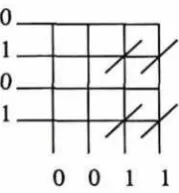
Figure 16.1:
C M M
Binary Associative Memory.not a new idea (see [19]), which allows the association of binary vectors using a matrix of binary weights. Pairs of binary vectors are associated by setting weights as shown in Figure 16.1. As such,
C M M
can be seen as a single layer neural network with binary weights, which uses a Hebbian learning rule.Figure 16.1 is an example of training, in which the vectors 0101 and 0011 have become associated. The subsequent presentation of 0101 to the network will retrieve 0011 if set weights in rows identified by set bits in the input vector contribute to column sums. The result is 0022, which is then thresholded appropriately to give 0011. For similar work, see Austin and Jackson [3]. Here,
C M M
is augmented by the use of Tensor Products (TP: [16]) to solve the dynamic variable binding problem.1
T h e
Dynamic Variable Binding Problem
This is a problem in connectionist implementations of rule-based systems. It is best explained using an example: If a rule has the form A h B
+
C, it may be important to be able attribute values thus:When a distributed rule representation is to be used, it is important that both the A:z and the B: k bindings can be represented unambiguously. It is clearly useless if, having trained such a rule, the system is subsequently unable to "remember" which variable had the value z. Furthermore, a rule may also specify inheritance:
(A= 2) A (B = k) 3 (C = k).
16.3
CMM
Inference Engine
The system, proposed by Austin (21, consists of units that fall into two sub- categories:
1.
C M M
units (associative memory units);2. Support units (not associative memory).
The support units perform the relatively simple processing necessary to support the CMM units, and exploit the technology to the full. This simple processing is all that is necessary to achieve a powerful reasoning capability.
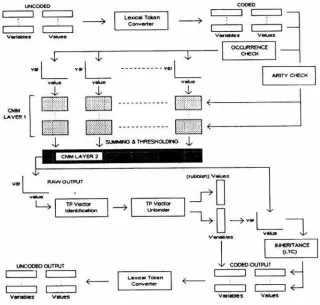
Figure 16.2 illustrates the system. Processing occurs both a t the input to the CMM units and at the output; processing fulfils the following functions, a description of which will serve to introduce the system.
16.3.1
Lexical Token Converter
Each lexical input item is converted to a binary token for manipulation by the system. Tokens are generated that consist of randomly allocated patterns of N set bits out of a total of M bits (there is an optimal ratio of
N
:M
that gives best error rate vs. storage). Random patterns may be allocated easily using a random number generator. Each token should be unique, however, which means a method of ensuring uniqueness is required. For few tokens it may be feasible to check a list of tokens each time a token is allocated; for many tokens there are better methods available, like "Test-and-Train" [4j.This method involves using the system itself to identify whether a pattern is already known. The values of M and N depend upon the overall size of the CMM units and the usual arity of rules being stored (see Section 16.3.3).
16.3.2
Binding Variable and Value Tokens
Binary tensor products (TP, [16]) are used to bind variables to values, T P vectors being obtained from a pair of tokens in two stages. The first stage is in fact analogous to storing a pair of tokens in a binary associative memory: with reference to Figure 16.1, the T P of 0101 and 001 l is the matrix of binary weights. The T P vector is obtained by concatenating rows, hence:
This is a binary vector of length
M Z
containingN 2
set bits. It begs the question, whether to allow both tokens and TP vectors as representations in the CMM units. Clearly, if N is chosen such thatN Z
is optimal for error rate us. storage in the CMM unit, N itself cannot at the same time be optimalCODED
r
_
I
l
J
- - - vat
L
[image:7.596.134.454.209.514.2]V&. *.*a *.Lm
Figure 16.2: The CMM Inference Engine.
variables not assigned a value. Such variables can be assigned either a "null"
16.3.3
Superimposing Inputs
The T P vector(s) are superimposed (OR-ed on top of one another) prior to being applied to the CMM units. This makes dealing with commutativity of rule antecedents an automatic feature of ihe s y s t e m , and is a key factor in providing an efficient partial match. Superimposing k vectors with N 2 set bits gives rise to a vector with up t o kN2 set bits. It might therefore be more appropriate t o optimize s N 2 for error rate us. storage rather than N 2 , where s
is chosen depending on the predominant arity of rules in the knowledge base.
16.3.4
Identifying
CMM
Units of Appropriate Arity
This is necessary to enable the appropriate processing of rules with mixed arity antecedents. For example, if the system has learned these two rules:
If the antecedents were trained in a single CMM unit, subsequent ap- plication of the token for A and thresholding appropriate for a single arity rule would allow both rules to fire (incorrectly). To avoid this, the first layer of CMM units must consist of a CMM unit for each arity rule that will be encountered. Input can then be targeted to the appropriate arity CMM unit.
16.3.5
Occurrence Checking
Very simple rules, such as the example in Section 16.3.6 (see Section 16.3.6), may involve repeated variables. For the correct processing of such rules, it is insufficient for the input simply t o be superimposed and sent to the appro- priate arity CMM unit, because the fact that a variable is repeated cannot be represented in this way. The solution is to extend further the first CMM layer, such that each arity CMM unit is duplicated, or triplicated even, de- pending on the application and the likely number of occurrences of the same variable in rules. This allows multiple occurrences of the same variable to be represented and, if summed appropriately, t o count in thresholding.
16.3.6
Providing Separator Tokens (Training)
The support units provide a unique, randomly allocated separator token for each rule (the generation of tokens may be done off-line). The separator token is an M2-bit word with a pattern of set bits, the number of set bits being optimized as before.
16.3.7 Thresholding (Retrieval)
Two sorts of thresholding are used: L-max [l, 51 and Willshaw [19]. L-max thresholding selects a specified number of columns in the output to represent set bits, columns being selected in order of decreasing sum magnitude; Will- shaw thresholding takes any column sums in the output above a specified value
as being set bits. It can be useful to apply both thresholds simultaneously.
16.3.8 Decoding the Output
The output of the system consists of all rule consequent(s) which match the given input, in the form of overlapped TPs. Decoding the output involves identifying explicitly which tokens may be present in the output in T P vector form. It is then possible to extract these TP(s) and use each token that has been identified to retrieve the other half of the pair of tokens represented in each TP. To th% end, the T P is used itself like a binary associative memory (input retrieving output). With few rules matching, it is usually a simple task to identify unambiguously each component of the output. The more complex the output is, however, the more likely it is that spurious identifications are made. It is conceivable that a network approach will ultimately be used to decode the output. However, as this step of the processing is quite straight- forward, the nature of the implementation is not crucial. An example of an ambiguous output is:
Assume the T P vectors:
A 1000000001000001100000001000000000000100 B 0000010100000000001000000100000000001100
C 0000000000010000011000010000010000000001 D 1000001000000000010000000001000000000101 E 0000000110000000010000010000000100000010 F 0000000000110000000000100100110000000000
The system would deduce that the thresholded output is due to three rules matching. Suppose that this output was obtained after training only two rules, however. One of the identifications would therefore have been spurious.
16.4
System
Characteristics
The next section describes how the CMM compares with a conventional stor- age method when used in a rule matching context. Some new work on storage and partial matching is presented (taken from Filer, [6]).
16.4.1
Storage
The storage of sparsely coded associative networks was investigated by Nadal and Toulouse [12]. In this paper, Information Theory was applied to the problem of predicting the maximumnumber of associations (TP vector pairs) that can be trained before a certain error rate is reached. The error rate is expressed in terms of the likely number of bits that are retriped in error fol- lowing a Willshaw threshold. With a single layer, square, binary associative network, Nadal and Toulouse showed that the maximum number of associk tions, for an error rate of 1.0 bits per retrieval, can be expressed in terms of the dimensions of the network alone:
s t ~ r a g e , , ~ = (ln 2 ) = ~ ~ / ( l n M ) ~
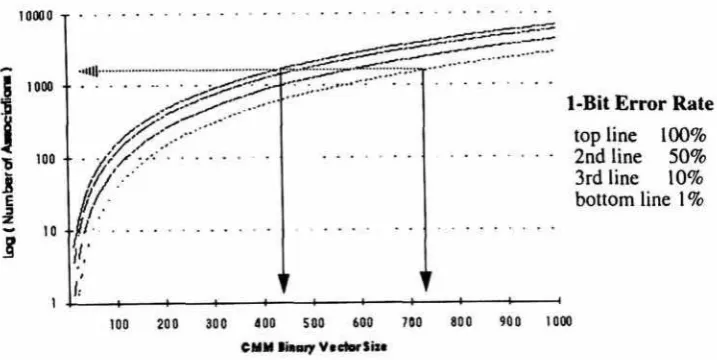
It is also possible to predict storage for specific error rates ([6]; see graph, Figure 16.3), and the results are encouraging. For instance, if an error rate of one erroneous set bit per output is accepted (which is the same as saying a 100% 1-bit error rate), a lOOObit X lOOObit CMM can store 7000 associations1.
With a 50% l-bit error rate, 86% of this storage can still be used (6000 associations); with a 10% l-bit error rate, 63% of the storage can still be used. Perhaps the most important point is that storage in the network is greater ihan would be expected of a list storage sysiem using ihe same amouni of memory.
The storage obtained is a compromise between the number of associations stored and the error rate, and depends on a certain coding rate, with optimal storage arising when there are logz M set bits out of M bits. A lower coding rate gives rise to a greater error rate (but greater storage), whilst a higher coding rate leads to reduced storage (but less errors). In the current system, which supports multi-arity rules, the optimal value of N is required (see also Section 16.3.3). If there is a choice, the largest N should be chosen, as it is better to sacrifice storage than to incur a greater error rate.
I O W 0 . . .
. . .
---
."W
.-
...-
"."
. . .
l-Bit Error Rate
top line 100%
. . .
2nd line 50% 3rd line 10%bottom line 1 %
I:
I
..
I [image:11.600.126.485.163.343.2]l00 200 300 400 500 600 700 800 900 IOW
Figure 16.3: Storage capacity vs. CMM size (M) for various l-bit error rates. This graph shows the fact that M need increase by only a small amount, to lessen the error rate dramatically.
16.4.2
~ d t i a l
Matching Capability
CMM can perform partial matching. The ability to perform inferencing based on partial information is a significant feature of human intelligence and, in many applications, the usefulness of an expert system might depend upon emulating this ability. Partial match is already implemented in standard database systems, and so a comparison between CMM and a database access method is possibly valid. In particular, the Superimposed Coding method (SIC;
[a]),
which is used in databases for partial matching, is very similar to the methods used here. Sacks-Davis and Ramarnohanarao (SkR; [14])suggested a superimposed coding scheme, called T w o Level Superimposed Coding", which I will now describe.
that is set in the query descriptor code is also set in a record descriptor code, then it is likely that there is a match. The system accept a false positive rate, which is also a feature of CMM. Importantly, however, no true matches are missed (which would clearly be unacceptable in a database retrieval system).
Two Level SIC is an improvement (rather like two level memory hierarchies in conventional computer systems), whereby a primary file and a secondary file are stored. The additional file stores sc-called "segment descriptor codes". The file of record descriptor codes is subdivided into segments, and each seg- ment is characterized by a segment descriptor code. Each segment descriptor code is computed from the records represented by that segment, but using a different hash function. The segment descriptor codes are then used t o nar- row down the search of record descriptor codes. Depending on the choice of segment size and how well similar record descriptor codes can be grouped to- gether in the same segment, Two Level SIC performs well. Even in the worst case, which would be when all segments have t o be examined, this scheme performs no worse than the one level scheme described by Knuth
[a].
Usually with Two LevelSIC
though, the number of disk accesses (and hence speed of matching) is related more t o the actual number of records that match than to the total number of records.The above property is extremely desirable, and is not found with other techniques. Rivest [l31 looked a t several approaches: hash coding methods and tree search algorithms. Performance was considered in terms of retrieving nk-bit words that match a query specifying s bits, and it was found that the best these approaches could offer was a performance= O ( n ' ~ g ( ~ - ~ / ~ ) ) . CMM is capable of more efficient partial match, similar to Two Level SIC. To demonstrate this fact, the remainder of this subsection is devoted to a consideration of the theoretical performance of CMM. CMM can be used to associate a SIC-type coding of attribute values with a separator code fulfilling a pointer function. This is analogous to the role of the first CMM layer in the inference engiie already described.
16.4.2.1 Attribute Value C o d i n g
16.4.2.2 S e p a r a t o r C o d i n g
The output of the CMM may well contain overlapped separator codes. The separator codes must therefore be held in a separate structure, such that the individual separator codes represented can be identified in the output (as in Section 16.3.8). It is only necessary to store the N numbers that describe the positions of the set bits, however, allowing a considerable memory saving. For the fastest possible access, a method is needed to process the output efficiently. To this end, the file of separator codes is subdivided and organized into buckets according to where the middle 1 appears in the code. To decode the output, i t is then only necessary to download all codes that could be represented in the output, starting with the bucket corresponding to the position of the first
i that could be the middle l of a separator code; the next area downloaded corresponds to the position of the second possible middle 1, etc..
16.4.2.3 T h r e s h o l d i n g
It is appropriate to perform a Willshaw threshold (191, and a t a level equal to the number of set bits in the query descriptor code. Such a threshold will not exclude false matches, but equally does not exclude any true matches (this being the desirable compromise). False matches arise from two sources: from false matches due to error bits; also from false matches due to spurious separator codes in the output. The number of false matches therefore depends upon the saturation of the memory and on the number of set bits in the query descriptor code.
16.4.2.4 ~ h b o r e t i c a l P e r f o r m a n c e
We now calculate the amount of data that would need to be retrieved from a secondary store, directly related to the speed of the proposed partial matching system. There are two components:
1. The amount of data needed to compute the CMM output (i.e. that constitutes the CMM):
1
-zM bytes
8 (16.1)
(z =no. of set bits in-the query descriptor code).
2. The amount of data constituting all separator codes that could be rep- resented in the output:
This depends upon being able to specify the number of true matches, A. If there are AM-bit patterns, then the likely number of bits not
set will be set bits will therefore number (l
-
( v ) A ) ~ .
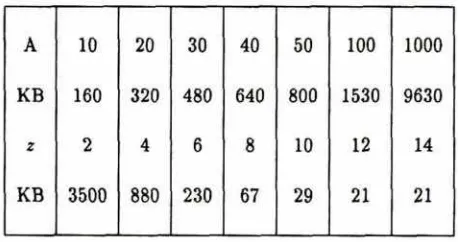
Subtracting (N - 1) gives the number of separator code buckets (seeTable 16.1: This table gives the amount of data to be retrieved for various values of A and z. Having chosen A and z, read off the two associated amounts of data, then sum to give the total amount of data which a CMM database index would require to answer a particular partial match query.
each requiring 2N bytes storage2. Note that separator code buckets will not be uniform in size (although i t is possible to make them uniform). It is therefore necessary to have some form of look-up table.
Error bits in the output also occur due to interactions in the CMM. These number (M
-
N ) q Z , where q is the proportion of weights set in the CMM (see [IQ]) and storagel,oe
(p=
0.5). In summary:s t ~ r a g e ~ , ~
[
(M;
N ) AM
2N (1--
)M-
( N-
1)+
(M-
N)p2 bytesl
(16.2)
.
, The total amount of data ((1)+
(2)), given M and g, depends only uponA and z. To enable a comparison between the two methods, Table 16.1 summarizes CMM performance on an example case given in S&R, the example case being:
Total number of records = 219 Number of segments = 64
Number of records per segment = 8192
Number of error bits a t the segment level
=
1/4 (per retrieval) Number of error bits a t the descriptor level = 1 (per retrieval) Disk Page Size = 1 KBFrom Table 16.1, it can be seen that with a medium-highly specified query
(i.e. 6
<
z<
141, the amount of datais closely related to A, the number of true [image:14.607.184.413.189.310.2]matches (our desirable property). In comparison with SIC, CMM performs well: the worst case performance of SIC (when every segment is examined) is bettered by CMM (4MB for CMM vs. lOMB for SIC); in the unlikely event that only one segment descriptor matches, SIC does do better (CMM 800KB vs. SIC 80KB). The storage that would be required to implement this CMM database index is 28MB, compared with 15MB for Two Level SIC (as the size of the database increases, however, the relative storage for the two methods becomes less disparate, e.g. 1.6GB vs. 1.4GB for records).
16.4.3
Implementing a Predicate Calculus
Thresholding the output of the first
CMM
layer, coupled with the appropriate use of arity- and occurrence CMM units in this layer, can achieve a power- ful reasoning behaviour. Both L-max and Willshaw thresholds (see Section 16.3.7) are used simultaneously: first, column sums are selected using an L- max criterion; next, a Willshaw threshold is applied to the selected column sums. The L-max criterion would normally be chosen to be the same as the number of bits in a separator token, but it may be the case that there are many more high column sums than expected. This would suggest that the output contained overlapped separator tokens (and it would then be possible to check a list of separator tokens and pass each in turn through the second layer).16.4.3.1 A N D , OR and p a r t i a l - A N D
The level of ~ i l l s h a w thresholding allows any of the operators AND, OR and
p a r t i a l - A m (see below) t o be enforced in rule retrieval. For example, if the
system has learned two rules:
And the tokens are as follows:
would be 0 i i i i i l 0 , and the rule trained in the arity 3 CMM unit. In re- trieving an output from the first layer, O i l l l l l O (6 set bits) would retrieve 00600060 from the arity 3 unit. If this is thresholded at 6 then the result is 00100010, the token for j. Thresholding a t 6 therefore achieves an AND. Ap- plying instead just O i l O O O O O would retrieve 00200020, which gives 00000000, thresholding a t 6; thresholding a t 2, however, does result in the token for j.
Using such a threshold is equivalent in this case to selecting any arity 3 rules that have A in one variable position, and this is an OR. Thresholding a t a n intermediate level (in this case 4) would allow inputs that represent any two
of {A, B, C) to retrieve j, a function that we call p a r t i a l - A N D . Importantly,
all these functions are completed in a single pass through the system.
16.4.3.2 Rules with Disjunctions
For example:
A V (B A c ) + D .
To achieve training such a rule (as opposed to enforcing the OR function in retrieval), it is necessary to process the rule into two components before teaching:
Each component is trained appropriately for for its new arity, the whole training process therefore possibly requiring as many passes as there are disjunctions. The application of O i i O O O O O (which is only the token for A)
to the arity l CMM unit, with appropriate thresholding, can now retrieve D
(ignoring the separator stage for the sake of this example); similarly, applying
O O O i i l i O (our representation of B h C) to the arity 2 unit also retrieves the correct output.
16.4.3.3 Additional Features
The system can, in addition, support many other features that there is not space t o detail here (such as negation and deletion, also detailed examples of dynamic variable binding).
16.5
Conclusions
supports predicate calculus. A realistic goal with the present system archi- tecture, is to achieve massively parallel processing. In addition, the present system architecture is being extended to enable soft rule processing (by using the dimension of time in our representation).
References
[l] Austin J. (1987) The Design and Application of Associative Memories for Scene Analysis. Unpublished doctoral dissertation, Brunel University.
[2] Austin J. (1995) Distributed Associative Memories for High Speed Sym- bolic Reasoning. Invited paper to the International Journal on Fuzzy Sets and Systems.
[3] Austin J . and Jackson T. (1994) The Representation of Knowledge and Rules in Hierarchical Neural Networks. In Neural Networks for Knowl- edge Representation and Inference. Hillsdale, N.J.: Lawrence Erlbaum Associates.
[4] Austin J. and Turner A. (1994) A Novel Method for Producing Near Orthogonal Codes. ACAG Internal Research Report 2734. University of York Computer Science Dept., York. Y 0 1 5DD.
[5] Casasent D. and Telfer B. (1992) High Capacity Pattern Recognition and Associative Processors. Neural Neiworks (4) 5: 687-98.
[6] Filer R.J.H. (1994) ACAG Internal Research Report 2771. University of York Computer Science Dept.
[7] Gaschnig J. (1980) An Application of The PROSPECTOR System to The DOE'S National Uranium Resource Evaluation. AAA1 1, 295-97.
[B] Knuth D.E. (1973) The Ari of Computer Programming (3), Reading, Massachusetts: Addison Wesley.
[g] Lange T.E. and Dyer M.G. (1989) High Level Inferencing in a Connec- tionist Network. Connection Science (1) 2: 181-217.
[l01 Lindsay R.K., Buchanan B.G., Feigenbaum E.A. and Lederberg J. (1980)
Applications of Ariificial Intelligence for Organic Chemistry: The DEN- DRAL Project. New York: McGraw-Hill.
[l11 Miller R.A., Pople H.E. and Myers J.D. (1982) INTERIST-I, an Ex- perimental Computer-Based Diagnostic Consultant for General Internal
Medicine. N. Eng. J. Medicine (307) 8: 468-76.
[l31 Rivest R.L. (1976) Partial Match Retrieval Algorithms. SIAM J. Com- puting 5: 19-50.
[l41 Sacks-Davis
R.
and Ramarnohanarao K. (1983) A Two Level Superim- posed Coding Scheme for Partial Match Retrieval. Information Systems(8) 4: 273-80.
[l51 Shastri L. and Ajjanagadde V. (1993) From Simple Associations to Sys- tematic Reasoning. Behaviourul
d
Brain Sciences (16)3:
417-93.[l61 Smolensky P. (1990) Tensor Product Variable Binding and The Rep- resentation of Symbolic Structure in Connectionist Systems. Artificial Intelligence 46: 159-216.
[l71 Sun R. (1994) Connectionist Models of Commonsense Reasoning. In Neu- ral Networks for Knowldege Representation and Inference. Hillsdale, N.J.: Lawrence Erlbaum Associates.
[l81 Touretsky D.S. and Hinton G.E. (1988) A Distributed Connectionist Pro- duction System. Cognitive Science 12: 423466.