This is a repository copy of Information Technology and Transport: Seminar Papers and Supporting Documents..
White Rose Research Online URL for this paper: http://eprints.whiterose.ac.uk/2371/
Monograph:
Wigan, M.R. (1983) Information Technology and Transport: Seminar Papers and Supporting Documents. Working Paper. Institute of Transport Studies, University of Leeds , Leeds, UK.
Working Paper 169
[email protected] https://eprints.whiterose.ac.uk/
Reuse
Unless indicated otherwise, fulltext items are protected by copyright with all rights reserved. The copyright exception in section 29 of the Copyright, Designs and Patents Act 1988 allows the making of a single copy solely for the purpose of non-commercial research or private study within the limits of fair dealing. The publisher or other rights-holder may allow further reproduction and re-use of this version - refer to the White Rose Research Online record for this item. Where records identify the publisher as the copyright holder, users can verify any specific terms of use on the publisher’s website.
Takedown
If you consider content in White Rose Research Online to be in breach of UK law, please notify us by
White Rose Research Online
http://eprints.whiterose.ac.uk/
Institute of Transport Studies
University of Leeds
This is an ITS Working Paper produced and published by the University of Leeds. ITS Working Papers are intended to provide information and encourage discussion on a topic in advance of formal publication. They represent only the views of the authors, and do not necessarily reflect the views or approval of the sponsors.
White Rose Repository URL for this paper: http://eprints.whiterose.ac.uk/2371/
Published paper
Wigan, M.R. (1983) Information Technology and Transport: Seminar Papers and Supporting Documents. Institute of Transport Studies, University of Leeds, Working Paper 169
Working Paper I69
July 1983
INFORMATION TECHNOLOGY AND TRANSPORT: SEMINAR PAPERS AND SUPPORTING DOCUMENTS
M.R. Wigan
(Australian Road Research Board) SERC Visiting Fellow
ITS
Working Papers are intended to provide information andencourage discussion on a topic in advance of formal
publication. They represent only the views of the authors and do not necessarily reflect the views or approval of sponsors.
Page ABSTRACT
Ch. 1. INTRODUCTION 1
Ch. 2. THE SEMINARS PRESENTED AND THE CORRESPONDING NOTES 2
Ch. 3. Technical Note TN 130: THE FUTURE IMPACT OF COMPUTER
BASED TECHNOLOGY IN ENGINEERING 5
Ch. 4. Technical Note TN 125: COMMUNICATIONS DEVICES AND
INFORMATION TECHNOLOGY 15
Ch.
5.
Technical Note TN 104.1: ACCESS TO ELECTRONIC CONFERENCINGAND MAIL SYSTEMS 21
Ch. 6. Technical Note TN 127 Ptl: INFORMATION SYSTEMS ACCESS;
DELIVERY AND TRANSPORT RESEARCH 49
Ch. 7. Technical Note TN 127 Pt2: PRODUCTIVITY AND INFORMATION
SYSTEMS: TEXT TO TYPESETTING: DATA ACQUISITION TO
NETWORKING 5 9
Ch; 8. Technical Note TN 128: TRANSPORT AND COMMUNICATIONS:
INFORMATION TECHNOLOGY AND HOUSEHOLD BUDGET
INTERACTIONS 61
Ch. 9. Technical Note 129: INFORMATION TECHNOLOGY AND INTEGRATED
REGIONAL DEVELOPMENT 8 3
The following report contains a section that was originally contained in the drafts of this document; and is now available only as an Annex to the main Working Paper 172 on this study:
WIGAN; M.R. (1983).Information technology and transport:
ABSTRACT
WIGAN; M.R. (1983). Information technoloav and transwort:
- -
seminar papers and supporting documents. working-paper WP
169. Institute for Transport Studies, University of Leeds, Leeds, UK.
For three months of the academic year of 1982-3; the author held an SERC Visiting Fellowship at the Institute for Transport
Studies at Leeds University; UK. This was supported by the UK
Science and Engineering Research Council; Oxford Systematics
(Australia); and the Australian Road Research Board. The
objectives of this fellowship were to identify effective
researchable projects in the overlapping fields of Information Technology; Transpork and Communications.
This document comprises background notes or drafts of conference papers; based on seminars given at the Institute in the early stages of the fellowship. Each of the papers is also separately available as an ITS Technical Note. The chapters cover the following themes: the future impact of computer based technology in engineering: communication devices and information technology; access to electronic conferencing and mail systems: information systems and their role in transport research; from the point of view of research productivity; both for individual researchers; and for research organisations: the application of time use and activity analysis to information technology issues: and the role of information technology in regional development.
A number of research proposals were generated and discussed with members of the ITS staff and others during the period. Detailed discussion of the areas covered is given in the companion ITS document (WP172). More details of some of the research ideas are given in an Annex to that report; as ITS Technical Note 126.
KEYWORDS: TRANSPORT/ COMMUNICATIONS/ TIME USE/ VIEWDATA/ ELECTRONIC
CONFERENCING/ DATA BASES/ KNOWLEDGE BASED SYSTEMS/ FAMILY
EXPENDITURE/ MICROCOMPUTERS/ UK/ AUSTRALIA/ INFORMATION
1. INTRODUCTfON
For three months of 1982-3; the author held an SERC Visiting
Fellowship at the Institute for Transport Studies (ITS)
University of Leeds; UK. This Fellowship was sponsored by the UK
Science and Engineering Research Council (SERC) and the
Australian Road Research Board (?.ARB); with additional support
from Oxford Systematics. The objectives of this Fellowship were to identify researchable projects in the overlapping fields of information technology; transport and communications; and to help to focus and accelerate the ideas within ITS on the establishment of a broader basis of work on the interaction between transport and communications. The tenure of the Fellowship was in two segments; the first; of two months; being in the Autumn of 1982 and the second; of one month; in Summer 1983.
During the first segment of the Fellowship; a number of
seminars were held, and research proposals generated and
discussed with members of the ITS staff and others. Most of the projects suggested were designed with the extant skills of Institute staff in mind, to form a basis for further research proposals in these areas. Detailed discussion of the areas covered is given in the companion ITS document; Working Paper 172 (entitled "Information technology and transport: what research needs to be started now?").
2; THE SEMINARS PRESENTED; AND THE CORRESPONDING NOTES
This section records the seminars given at or on behalf of ITS during the first phase of the Fellowship; and other conference papers. The ways these relate to the various Chapters of this Working Paper; to other Technical Notes (TNs) produced by the Institute for Transport Studies; and to the Australian Road Research Board's series of ARRB Internal Reports (AIRS); are as follows.
(1) Time use and activity participation: application of time use and activity analysis to IT issues.
(November 11th 1982) There were several versions of the notes produced for this
seminar: that reproduced here; at Chapter 8 (and as ITS Technical
Note TN 128) was a preprint of a paper for the World Conference on Transport research held in Hamburg in April 1983. A previous version was issued as AIR 1118-2.
(2) Tools of the trade: the position of the microcomputer
in IT impacts. (November 17th 1982)
This was an informal seminar; in two parts. The first covered the
key role for microcomputers as devices for accessing IT
facilities; and the second gave details of microcomputer
performance. Chapter
4
(and TN 125) provides summary notes of thefirst part; and a reference for the second part.
(3) New media provided through IT: computer conferencing
and electronic mail. (November 19th 1982)
This seminar led to a paper on "Access to electronic conferencing and mail systems at Leeds ITS"; which was subsequently presented
by H.R. Kirby at the 1983 Annual Conference of the Universities
Transport Studies Group in January 1983. The paper covers details
of packet switching services; electronic conferencing and
electronic mail systems; with detailed specifications of the means of access to and facilities provided by each of a number of such systems in Austria; UK; and USA. The first version; TN 104; issued in December 1982; was also available as AIR 1118-1. The revised version (also available as TN 104.1) is included here as Chapter 5.
(4) Information and its role in transport research:
database access and IT developments on research
productivity. (December 3rd 1982)
This seminar covered the role of information systems and their relationships with transport research; and the facilities now commercially available with advanced IT support. It is reproduced
here as Chapter 6 (and as part of TN 127).
(5) Communications; transport and teleconnnunications interactions: research requirements and applied
research needs. (December 8th 1982)
This seminar concluded the first phase of the Visiting
172.
Other notes reproduced here are conference papers presented elsewhere arising out of the time spent on the Fellowship. These are:
(6) The future impact of computer based technology in
engineering.
This paper records an address made to a Plenary Session of the 1983 Institution of Engineers Australia National Conference in Newcastle; New South Wales. Although this was the last paper to be prepared of those collated here; it makes a good introductory theme for the whole series; so is reproduced here as Chapter 3
(and as TN 130). It is also available as AIR 1118-3.
(7) Productivity and information systems: text to typesetting: data acquisition to networking.
This paper was an extended version of a document previously prepared by the author; and was made available at ITS'S request to help in the discussion of such systems at Leeds. It forms
Chapter 7 of this document; and is also available with Chapter 6
as Technical Note 127 (on "Information systems and the transport researcher".)
(8) Information technology and integrated regional development.
During the period of the Fellowship the author made
a
contribution to the December 1982 IIASA Working Group meeting on
Integrated Information Systems for Regional Development. A draft
record of that contribution is included at Chapter 9 (and as TN
129): the final version is Chapter 17 of the book "Information
T e c h n i c a l Note 1 3 0 J u l y 1 9 8 3
TEE FUTURE IMPACT OF COMPUTER BASED TECENOLOGY I N ENGINEERING
M.R. Wigan ( A u s t r a l i a n Road R e s e a r c h B o a r d ) SERC V i s i t i n g F e l l o w
( A l s o i s s u e d a s C h a p t e r 3 o f ITS Working P a p e r 1 6 9 , a n d a s ARRB I n t e r n a l R e p o r t A I R 1118-3)
ITS T e c h n i c a l N o t e s a r e u n p u b l i s h e d r e p o r t s w h i c h h a v e
l i m i t e d c i r c u l a t i o n . They a r e p r o d u c e d o n t h e r e s p o n s i b i l i t y o f t h e a u t h o r s a l o n e , a n d d o n o t n e c e s s a r i l y r e f l e c t t h e v i e w o r a p p r o v a l o f t h e s p o n s o r s . I f c i t e d i n a n y d o c u m e n t , i t would b e a p p r e c i a t e d i f t h e a u t h o r s w e r e i n f o r m e d .
T h i s work was s p o n s o r e d b y t h e S c i e n c e a n d E n g i n e e r i n g R e s e a r c h C o u n c i l and -. t h e A u s t r a l i a n Road R e s e a r c h Board
ABSTRACT
1. INTRODUCTION
2. COMMUNICATIONS
3 . S K I L L S TRANSFER
4. E F F E C T S ON T R A I N I N G AND EDUCATION
5. REFERENCES
6. S L I D E S
Page
1
1
2
3
5
ABSTRACT
W I G A N , M.R. (1983) The f u t u r e i m p a c t o f computer b a s e d t e c h n o l o q v
The i m p a c t o f c o m p u t e r s and computer based t e c h n o l o g y h a s a l r e a d y had a p e r v a s i v e i n f l u e n c e o n e n g i n e e r i n g , and o n s o c i e t y a s a w h o l e . The e n g i n e e r i n g p r o f e s s i o n h a s made g o o d u s e o f t h e o p p o r t u n i t i e s f o r c o s t r e d u c t i o n o f f e r e d by t h i s t e c h n o l o g y t o d a t e , a n d w i l l make more. The i m p a c t s o n q u a l i t y , t h e e c o n o m i c s o f s m a l l b a t c h p r o d u c t i o n and s m a l l m a r k e t s a r e c o n s i d e r e d h e r e .
The major i m p a c t s on e n g i n e e r i n g a r e l i k e l y t o be o u t s i d e t h e s e t r a d i t i o n a l a r e a s o f e n g i n e e r i n g r e s p o n s i b i l i t y , and r e f l e c t t h e c o m m u n i c a t i o n s and s k i l l s t r a n s f e r a s p e c t s o f t h e new r o u n d o f c o n v e r g e n t computer and t e l e c o m m u n i c a t i o n s t e c h n o l o g i e s . T h e s e
i m p a c t s and t h e i r l i k e l y i m p o r t a n c e a r e c o v e r e d i n g r e a t e r d e t a i l h e r e , and t h e u r g e n t q u e s t i o n s r a i s e d b y t h e s h e e r s p e e d o f t h e s o c i a l c h a n g e s induced by computing t e c h n o l o g y a r e g i v e n c e n t r a l p l a c e .
KEYWORDS : C o m m u n i c a t i o n s / i n f o r m a t i o n t e c h n o l o g y / t r a n s p o r t t r a i n i n g * / d i g i t a l c o m p u t e r / E n g i n e e r i n g /
M. R. Wigan ( A u s t r a l i a n Road R e s e a r c h Board) SERC V i s i t i n g F e l l o w
1. INTRODUCTION
The s u b j e c t s c o v e r e d i n t h i s a d d r e s s a r e m a t t e r s o f p u b l i c c o n c e r n , and a g r e a t d e a l o f l i p s e r v i c e h a s b e e n p a i d t o t h e i m p a c t s and t h e r a t e s o f c h a n g e o f s o c i e t y a n d p r o f e s s i o n s i n a d a p t i n g t o them. T h e r e h a s n o t y e t b e e n a n y r e a l e v i d e n c e t h a t t h e p r o f e s s i o n s h a v e y e t g r a s p e d t h e s h e e r s p e e d w i t h w h i c h c h a n g e s i n t h e s o c i a l , e c o n o m i c , a n d p r o f e s s i o n a l e n v i r o n m e n t s a r e now t a k i n g e f f e c t .
I s h a l l c o n c e n t r a t e on t h e s e f a c t o r s .
The o u t l i n e of my theme is a s f o l l o w s :
1) T h e n a t u r e o f t h e c o m p u t e r t e c h n o l o g y c h a n g e s o n communications.
2 1 The n a t u r e o f t h e c h a n g e s i n a u t o m a t i o n o f s k i l l s
t r a n s f e r .
3 ) The e f f e c t s on e n g i n e e r i n g t r a i n i n g and e x e c u t i o n .
I n e s s e n c e t h e e f f e c t s o f c o m p u t e r b a s e d t e c h n o l o g y c h a n g e s ON
e n g i n e e r i n g i s my t h e m e , r a t h e r t h a n t h e e f f e c t s w i t h I N t h e e n g i n e e r i n g p r o f e s s i o n .
2. COMMUNICATIONS
The a b i l i t y t o c o m m u n i c a t e r e a d i l y w i t h c o m p u t e r s h a s a l r e a d y become a r e a l i t y a s a r e s u l t o f t h e s p r e a d o f p e r s o n a l c o m p u t e r s , and t h e c o n s e q u e n t p r e s s u r e s o n t e l e c o m m u n i c a t i o n c a r r i e r s t o a c c o m o d a t e them. T h i s h a s now r a i s e d t h e s i z e o f t h e m a r k e t f o r i n f o r m a t i o n , a n a l y s i s , a n d c o m m u n i c a t i o n w i t h c o m p u t e r s by s e v e r a l o r d e r s of m a g n i t u d e .
The k e y d e v e l o p m e n t t o p u r s u e i s a c c e s s t o p a c k e t s w i t c h e d n e t w o r k s , where t h e p r o b l e m s o f i n t e r c o m m u n i c a t i o n a r e e a s e d f o r u s e r s , and t h e i s s u e s o f n a t i o n a l , l o c a l o r i n t e r n a t i o n a l t r a n s m i s s i o n s b e t w e e n d i f f e r e n t s y s t e m s become e a s i e r f o r e v e r y o n e .
TN130
/
C h a p t e r 3 of WP 1 6 9a l e v e l o f i n t e r c o n n e c t i o n . E l e c t r o n i c m a i l a n d c o m p u t e r c o n f e r e n c e s e r v i c e s a r e t w o o f t h e s e ( s e e , f o r e x a m p l e Wigan, 1 9 8 2 ) . When i n t e r c o n t i n e n t a l l i n k s t h r o u g h t o p r i v a t e o r b u s i n e s s p h o n e p o i n t s c a n b e e x p e c t e d t o o f f e r v i d e o b a n d w i d t h (5MHz a s o p p o s e d t o 4kHz f o r v o i c e ) , t h e n o t h e r f o r m s o f c o m m u n i c a t i o n s a l s o become a mass m a r k e t r e a l i t y - - p r i c e p e r m i t t i n g .
The i m p l i c a t i o n s f o r t h e o r d i n a r y e n g i n e e r a r e t h a t t h e a c c e s s t o t h e t o o l s , t h e d a t a , o r t h e h e l p t h a t h e n e e d s f o r management o r d e s i g n p u r p o s e s no l o n g e r r e q u i r e s much c a p i t a l e x p e n d i t u r e , n o r d o e s i t d i s a d v a n t a g e t h o s e i n p l a c e s i n a c c e s s i b l e t o a l l b u t e l e c t r o n i c media.
A s t h e m a r k e t f r o m w h i c h h e o r s h e c a n t h e n d r a w i s w o r l d w i d e , t h e m a r k e t s f o r s p e c i a l i s e d s e r v i c e s w i l l grow w i t h t h e a c c e s s t o t h e d a t a networks. I n many c a s e s t h e p r o d u c t c a n b e d e l i v e r e d by e l e c t r o n i c m e a n s a s w e l l . Some m a n a g e m e n t and o t h e r f o r m s o f t r a i n i n g a r e a l r e a d y o p e r a t i n g i n t h i s manner.
3 . SKILLS TRANSFER
The s o f t w a r e s i d e o f c o m p u t i n g t e c h n o l o g y a d v a n c e s h a s n o t a l w a y s b e e n a s k e e n l y f o l l o w e d u p b y t h e e n g i n e e r i n g p r o f e s s i o n a s t h e h a r d w a r e ( t h e c o m p u t e r s , d a t a l o g g e r s , i n s t r u m e n t s e t c . ) . The main e n g i n e e r i n g c o m p u t e r l a n g u a g e i s s t i l l FORTRAN---a l a n g u a g e w h i c h h a s p r o v e d t o b e r e s i l i e n t t o c h a n g e , a n d i n s p i t e o f i t s a c k n o w l e d g e d d e f i c i e n c i e s , i s s t i l l t h e m a j o r e n g i n e e r i n g programming l a n g u a g e a f t e r t w e n t y y e a r s .
Many e n g i n e e r s h a v e a s a r e s u l t n o t y e t come t o t e r m s w i t h t h e s t r u c t u r e d and s t r o n g l y - t y p e d l a n g u a g e s s u c h a s P a s c a l , ADA and M o d u l a , w h i c h i n t r o d u c e a new o r d e r o f t h o u g h t t o t h e s t r a i g h t f o r w a r d a u t o m a t i o n o f c a l c u l a t i o n s f o r which FORTRAN i s ( i n my v i e w ) s t i l l t h e b e s t a v a i l a b l e t o o l . The r e v o l u t i o n i n t e x t a n d l o g i c a l p r o c e s s i n g w h i c h h a s t a k e n p l a c e o v e r t h e l a s t t e n y e a r s h a s b e e n c a r r i e d f o r w a r d o n t h e s e c o n c e p t s , a n d t h e n e w
wave o f l o g i c a l a n d e x p e r t s y s t e m s t h i n k i n g i s a c o m p a r a t i v e l y e a s y s t e p f o r t h e P a s c a l u s e r t o t a k e . I t i s a v e r y l a r g e jump f o r m o s t c o m m i t t e d FORTRAN u s e r s .
The "new" wave of l o g i c a l programming t o o l s ( t y p i f i e d by PROLOG,
which was f i r s t produced a t M a r s e i l l e s i n 1972) h a s now converged w i t h t h e a p p l i e d t o o l s o f a r t i f i c i a l i n t e l l i g e n c e t h i n k i n g : t h e " e x p e r t " s y s t e m . T h e s e t o o l s a r e s t i l l a t a v e r y c r u d e s t a g e o f development i n a p p l i c a t i o n , and o n l y a few d e m o n s t r a t i o n s y s t e m s h a v e y e t become w i d e l y a v a i l a b l e . The r e a l i m p a c t i s y e t t o c o m e , a s t h e l e v e l o f p e r s o n a l c o m p u t e r u s a g e r i s e s , a n d t h e i n v e s t m e n t s i n s o f t w a r e grow.
T h i s opens t h e way f o r a c o n s i d e r a b l e improvement i n t h e manner i n w h i c h d e c i s i o n s k i l l s c a n b e c o d i f i e d , c a p t u r e d , a n d r e p r o d u c e d f o r w i d e r u s e . T h i s i s a t a s k w h i c h c o m p u t e r s h a v e b e e n d o i n g f o r many y e a r s t h r o u g h a p p l i c a t i o n p a c k a g e s s u c h a s SPSS, and is s i m p l y t h i s same f a m i l i a r t a s k ---moved t o t h e n e x t l e v e l o f t h e p r o f e s s i o n a l d o m a i n . The d i f f e r e n c e t h i s t i m e i s t h a t t h e s k i l l b e i n g c a p t u r e d i n t h e c o m p u t e r f o r s u b s e q u e n t i n t e r r o g a t i o n i s t h a t o f judgement
....
a q u a l i t a t i v e jump, and one w i t h major i m p l i c a t i o n s f o r many e n g i n e e r s .The d e v e l o p m e n t o f s m a l l g r a p h i c s s y s t e m s s u c h a s microPLATO h a v e now made t h e huge i n v e s t m e n t made i n i n t e r a c t i v e Computer Aided I n s t r u c t i o n ( C A I ) b o t h a c c e s s i b l e and e c o n o m i c . T h i s a s p e c t o f s k i l l s t r a n s f e r i s m o r e o n e o f t h e f l o w e r i n g o f a l o n g s t a n d i n g i n v e s t m e n t i n C A I m a t e r i a l s t h a n one o f computer technology--but i t i s computer t e c h n o l o g y t h a t i s c r e a t i n g t h e d e l i v e r y s y s t e m !
I t i s no c o i n c i d e n c e t h a t e a c h o f t h e s e i s s u e s ( a n d t h e VLSI i n f r a s t r u c t u r e f o r them) a r e t h e p r i o r i t y a r e a s s o u r g e n t l y b e i n g p r e s s e d i n t h e U K a s a r e s u l t o f t h e A l v e y ( 1 9 8 2 ) r e p o r t
.
T h i s r e p o r t a l s o p r e s s e s t h e n e e d f o r r a p i d l y e x p a n d i n g t h e p o o l o f manpower i n t h e s e a r e a s , by i n v e s t m e n t i n e d u c a t i o n and t r a i n i n g i n I n t e l l i g e n t K n o w l e d g e B a s e d S y s t e m s (IKBS), VLSI a n d man- machine i n t e r f a c i n g a s t h e t o p p r i o r i t y a r e a s on which t h e o t h e r s w i l l b e b u i l t . T h e r e i s n o e q u i v a l e n t o f f i c i a l p r o g r a m h e r e a s y e t .4 . EFFECTS ON T R A I N I N G AND EDUCATION
The s p e e d w i t h w h i c h a l l o f t h e i n n o v a t i o n s o f t h e l a s t d e c a d e o r more a r e a r r i v i n g i n t h e m a r k e t p l a c e i s o n l y i n p a r t due t o t h e r e c e n t a c c e l e r a t i o n i n c o m p u t e r t e c h n o l o g y . I t i s m a i n l y d u e t o t h e a c c e s s t o t h e t e c h n o l o g y , a n d t h e d e l i v e r y s y s t e m f o r t h e s e p r o d u c t s t h a t have b o t h emerged i n t h e l a s t few y e a r s .
Those who m i g h t t h i n k t h a t t h i s would mean a t a p e r i n g o f f i n t h e momentum i n a s h o r t t i m e , a s t h e s e p e n t u p d e v e l o p m e n t s r e a c h t h e i r f u l l m a r k e t p l a c e , w i l l b e m i s t a k e n . The p a c e o f c h a n g e w i l l a c c e l e r a t e , a s t h e m a r k e t s i z e h a s s o d r a m a t i c a l l y i n c r e a s e d a n d t h e e l e c t r o n i c d e l i v e r y s y s t e m s a r e s o e f f e c t i v e . L o o k i n g o n l y a f e w y e a r s a h e a d , i t w i l l b e p r a c t i c a l t o s e r v i c e s m a l l m a r k e t s f o r many t y p e s o f p r o d u c t s w i t h a world m a r k e t c o v e r a g e i n view.
TN130
/
Chapter 3 of WP 169T h e s y s t e m a t i c a l l y d i f f e r e n t a t t i t u d e s a n d v a l u e s y s t e m s i d e n t i f i e d f o r t h e A u s t r a l i a n e n g i n e e r i n g s t u d e n t s i n t h e work o f A n d e r s o n and W e s t e r n w e r e c o n s i s t e n t b e t w e e n U n i v e r s i t i e s . U n f o r t u n a t e l y s p e c i f i c i n v e s t i g a t i o n s o f t h e v a l u e s y s t e m s and a t t i t u d e s of e n g i n e e r s a s m a t u r e p r o f e s s i o n a l s h a v e n o t y e t made i n A u s t r a l i a , and s o t h e e s s e n t i a l l y u n d e r g r a d u a t e r e s u l t s o f A n d e r s o n and W e s t e r n a r e t h e b e s t we have. T h e s e c a n o f c o u r s e be t a k e n o n l y a s s t r o n g l y i n d i c a t i v e .
A m a t t e r o f k e y c o n c e r n i s t h e s t r o n g o b s e r v e d a s s o c i a t i o n between t h e a t t i t u d e s o f e n g i n e e r s t o w a r d s t h e f u t u r e and t h e i r
r e p o r t e d p r e v a i l i n g o r i e n t a t i o n t o w a r d s c o n v e r g e n t t h i n k i n g p r o c e s s e s . Computer t e c h n o l o g y i s m a k i n g t h e r a t e o f c h a n g e o f p r o f e s s i o n a l k n o w l e d g e a m a t t e r o f c o n t i n u o u s r e v i s i o n . The s t r o n g a s s o c i a t i o n s i d e n t i f i e d by Hudson (1963) from s u b s e q u e n t h i g h a c h i e v e r s
-
a s e a r l y a s t h e l a t e s c h o o l s t a g e-
was t h e b r e a d t h o f i n t e r e s t s OUTSIDE t h e c u r r i c u l u m . T h i s was a f a r b e t t e r p r e d i c t o r o f s u b s e q u e n t a c h i e v e m e n t t h a n i n t e l l i g e n c e l e v e l , and t h e e x p e c t a t i o n o f young e n g i n e e r s o f t h e r a t e o f changes t o be e x p e c t e d i n our s o c i a l f u t u r e h a s been shown t o be f a r more c o n v e r v a t i v e t h a n f o r o t h e r p r o f e s s i o n s . Yet t h e c l o c k moves on apace.The c u m u l a t i v e e f f e c t o f t h e h i s t o r i c a l s o u r c e s o f a t t i t u d e s and i n f o r m a t i o n f o r e n g i n e e r s s h o w s a n i n c r e a s i n g d i v e r g e n c e f r o m b o t h t h e p h y s i c a l s c i e n c e s and t h e s o c i e t y i n which t h e e n g i n e e r o p e r a t e s . The a c t u a l s o u r c e s p r e d o m i n a n t l y used by e n g i n e e r s a r e v e r y d i f f e r e n t f r o m t h o s e u s e d by t h e p h y s i c a l s c i e n c e s ( A l l e n , 1 9 7 7 : Lay, 1 9 8 2 ) , and t h e r e l i a n c e on p e r s o n a l s o u r c e s o f i n f o r m a t i o n r a t h e r t h a n r e c o u r s e t o r e c e n t o r i g i n a l s o u r c e s may w e l l s l o w down t h e a d a p t i o n p r o c e s s t o i n c r e a s e d r a t e s o f change.
One i r o n y o f t h e r a p i d a d v a n c e o f c o m p u t e r t e c h n o l o g y i s t h a t t h e a c c e s s t o p r i m a r y and o r i g i n a l s o u r c e s h a s a l r e a d y t u r n e d u p s i d e down t h e h i s t o r i c a l l e v e l o f d i f f i c u l t y i n i d e n t i f y i n g and a c q u i r i n g s o l i d and v e r y r e c e n t m a t e r i a l a t t h e f r o n t i e r s o f b o t h p r a c t i s e and i n v e s t i g a t i o n , a s a g a i n s t t h e p e r s o n a l c o l l e c t i o n s and r e f e r e n c e t e x t b o o k s s o h e a v i l y r e l i e d upon by t h e p r o f e s s i o n ( D a v i d , 1 9 7 9 ) . Computer t e c h n o l o g y i n t h e f o r m o f p e r s o n a l c o m p u t e r s now c o m b i n e s t h e a b i l i t y t o a c c u m u l a t e ' p e r s o n a l ' c o l l e c t i o n s i n t h e t r a d i t i o n a l manner w i t h t h e a b i l i t y t o r e a c h o u t t o make u s e o f t h e w i d e r d a t a b a s e s and c o m m u n i c a t i o n p o s s i b i l i t i e s now t o hand.
S o c i o l o g i c a l s t u d y o f e n g i n e e r s ( H o l z n e r , 1 9 7 2 ) e m p h a s i s e s t h e p r i m a r y t h r u s t s of :
a ) Expected a p p l i c a t i o n
b) Prompt communication t o t h e u s e r
C u t l e r , 1 9 7 6 ) w e r e i n p o t e n t i a l l y a l a r m i n g c o n t r a s t w i t h t h e n e g a t i v e e x p e c t a t i o n s o f s o c i a l c h a n g e s i n w o r k , l e i s u r e a n d t r a v e l b e h a v i o u r t h a t t h e y r e p o r t e d .
I t i s t h e wide r a n g i n g and r a p i d r a t e o f change i n t h e s e f a c t o r s i n t h e s o c i a l e n v i r o n m e n t t h a t a r e becoming t h e key d e t e r m i n a n t s o f t h e i m p a c t o f c o m p u t i n g t e c h n o l o g y o n e n g i n e e r i n g . The t e c h n i c a l c o s t - r e d u c t i o n s i n h e r e n t i n t h e t e c h n i c a l a p p l i c a t i o n s a r e c r u c i a l t o t h e p r o d u c t i v e c a p a c i t y o f t h e c o u n t r y , a n d a r e i n c r e a s i n g l y r e c o g n i s e d by t h e e n g i n e e r i n g p r o f e s s i o n who m u s t t a k e t h e l e a d i n t h i s e s s e n t i a l t e c h n o l o g y t r a n s f e r t o o u r a g i n g i n d u s t r i e s .
I t i s , h o w e v e r , t h e s o c i a l c h a n g e s b r o u g h t o n t h e wave o f i n n o v a t i o n t h a t w i l l i n c r e a s i n g l y c i r c u m s c r i b e t h e a b i l i t y t o employ computer t e c h n o l o g y , and d e t e r m i n e t h e p l a c e o f A u s t r a l i a i n t h e a l t e r e d w o r l d e n v i r o n m e n t b e i n g p r o d u c e d by t h e c u r r e n t q u a n t u m jump i n i n d u s t r i a l p r o d u c t i v i t y now b e i n g g r a s p e d i n o t h e r c o u n t r i e s .
T h e r e i s a c r u c i a l n e e d t o t r a i n e n g i n e e r s t o i d e n t i f y t h e numerous o p p o r t u n i t i e s which a r e a r i s i n g d a i l y a s more and more f i e l d s c o n v e r g e and o v e r l a p , and t h e i n f o r m a t i o n t o o l s t o g r a s p t h e s e o p p o r t u n i t i e s improve. A heavy e m p h a s i s on problem s o l v i n g a t a h i g h t e c h n i c a l l e v e l w i l l become more and more t h e p r o v i n c e o f t h e few r a t h e r t h a n t h e many.
The e n g i n e e r h a s a l w a y s b e e n
-
p e r f o r c e-
a u s e r o f t h e r e s u l t s o f many f i e l d s : h e ( o r s h e ) i s now on a t r e a d m i l l o f a p e r s o n a l n e e d t o b e c o m e a " m u l t i p l e s p e c i a l i s t " , r a t h e r t h a n a " m u l t i d i s c i p l i n a r y " l i a s o n man i n t h e d e s i g n and i m p l e m e n t a t i o n p r o c e s s . T h i s w i l l b e t h e g r e a t e s t i m p a c t o n e n g i n e e r i n g o f c o m p u t e r t e c h n o l o g y a d v a n c e s : n o t t h e s i m p l e ( e v e n d r a m a t i c ) p r o d u c t i v i t y g a i n s o f CAD/CAM and f l e x i b l e m a n u f a c t u r i n g . These w i l l b u t b r i n g t h e t o o l s t o hand.They must be a p p l i e d c r e a t i v e l y .
5. REFERENCES
ALBERTSON, L. ( 1 9 8 1 ) . R e f l e c t i o n s i n a c r y s t a l b a l l . A u s t r a l i a n Telecommunications Review 1 5 ( 2 ) 33-42.
ALLEN, T.J. ( 1 9 7 7 ) . M a n a g i n g t h e f l o w o f t e c h n o l o g y . M I T P r e s s , Cambridge, Mass:
ALVEY (1982). Advanced I n f o r m a t i o n Technology. HMSO, London, UK.
(78PP.l.
ANDERSON, D.S. a n d W E S T E R N , J.S. ( 1 9 6 9 ) . A t t i t u d e s o f s t u d e n t s e n t e r i n g p r o f e s s i o n a l f a c u l t i e s . Aust. J. Psych. 2 1 0 291-299.
TN130
/
C h a p t e r 3 of WP 169t o 1990-91. AGPS, C a n b e r r a . ( 3 8 0 p p ) .
COX, P.R. and BROUGHTON, R.K. (1982). Micro E x p e r t Users Manual
V 2.21. I S I S S y s t e m s , R e d h i l l , UK. ( 4 9 p p ) .
D A V I D , A.(Ed.). ( 1 9 7 9 ) . E n g i n e e r s n e e d s f o r s c i e n t i f i c a n d t e c h n i c a l i n f o r m a t i o n . W o r l d F e d . E n g n g . O r g a n . ( L o n d o n ) , Committee on Engrg. Educ., Par i s , France.
HOLZNER, B. ( 1 9 7 2 ) . R e a l i t y c o n s t r u c t i o n i n s o c i e t y . S c h e n k m a n , Cambridge, Mass. USA.
HUDSON L . ( 1 9 7 4 ) . C o n t r a r y i m a g i n a t i o n s . P e n g u i n , Harmondsworth, UK.
LAY, M.G. ( 1 9 8 2 ) . E n g i n e e r i n g u s e o f b i b l i o g r a p h i c d a t a b a s e s . T r a n s . I E A U S t , GE 6 ( 2 ) 39-48.
MCCABE, F.G. ( 1 9 8 1 ) .Micro-PROL0GUsersManual.Logic P r o g r a m m i n g A s s o c i a t e s , London. UK (65pp).
6. SLIDES
A ) S l i d e 1: COMPUTER TECHNOLOGY CHANGES ON COMMUNICATIONS
-
p a c k e t s w i t c h e d n e t w o r k s a s highways-
t h e m a r k e t s i z e i s r a p i d l y becoming g l o b a l i n s c o p e-
computer c o n f e r e n c i n g i s a q u a l i t a t i v e improvement-
l o c a t i o n i s l e s s o f a b a r t o m a r k e t p a r t i c i p a t i o nB) S l i d e 2: COMPUTER TECHNOLOGY AND SKILLS TRANSFER
-
t h e i n f l u e n c e o f s t r u c t u r e d l a n g u a g e s-
t h e a r r i v a l o f small s c a l e E x p e r t Systems t o o l s-
M i c r o p l a t o and d i s t r i b u t e d Computer Aided I n s t r u c t i o n-
time l a g s i n t e c h n o l o g y t r a n s f e r o f 3 y r s widenst h e c o m p e t i t i v e m a r k e t i n c r e a s i n g l y t o t h e d e v e l o p i n g world
C ) S l i d e 3 : E N G I N E E R I N G EDUCATION AND COMPUTER TECHNOLOGY
-
a p p l i c a t i o n p a c k a g e s a r e i n c r e a s i n g i n i n t e l l i g e n c e-
t h e r a t e o f c h a n g e i s a c c e l e r a t i n g-
a t t i t u d e s o f e n g i n e e r i n g s t u d e n t s have n o t been well s t r u c t u r e d t o a c c e p t r a p i d i n n o v a t i o n-
i n f o r m a t i o n s e a r c h , a c q u i s i t i o n and a p p l i c a t i o n is a d i s t i n c t i v e , t r a i n a b l e s k i l l-
a d a p t i v e,
m u l t i s p e c i a l i s t s may b e t h e o n l y o n e s a b l e t o m a i n t a i n a s i n g l e c a r e e r p a t h b e f o r e t h e d e c a d e i s o u t .D ) S l i d e 4: TOOLS AND MARKETS
THE TOOLS ARE TO HAND
-
THE MARKETS ARE ACCESSIBLETechnical Note 125
July 1983
COMMUNICATION DEVICES AND INFORMATION TECENOLOGY
Seminar notes.
M.R. Wigan (Australian Road Research Board)
SERC Visiting Fellow
(Also issued as Chapter 4 of ITS Working Paper 169)
ITS Technical Notes are unpublished reports which have
limited circulation. They are produced on the responsibility of the authors alone, and do not necessarily reflect the view
or approval of the sponsors.
If
cited in any document, itwould be appreciated if the authors were informed.
WIGAN, M.R. (1983) Communication devices and information
technology. Seminar notes. Technical Note 125 (or
This paper provides notes to a seminar, covering the key role for microcomputers as devices for accessing IT facilities, and microcomputer performance.
COMMUNICATION DEVICES AND INFORMATION TECHNOLOGY. Seminar Notes.
M.R. Wigan (Australian Road Research Board) SERC Visiting Fellow
1. INTRODUCTION
During the author's SERC Visiting Fellowship, a seminar was given in the ITS on 17th November 1982, entitled: "Tools of the trade:
the position of the microcomputer in IT impacts. "
This seminar was in two parts; the first covered the key role for microcomputers as devices for accessing IT facilities, and the second gave details of microcomputer performance. This TN provides, in section 2, the slides used for the first part, and, in section 3, notes and a reference for the second part.
2. PERSONAL COMPUTERS AND COMMUNICATIONS
Viewgraphs of the first half of this seminar are given at (A-D).
A) Conununication devices and information technology
1)Personal computer users are a self selected avant guard for Information Technology impacts o n individual behaviour.
2) Once personal computer users become experienced, a strong demand for computer aided communication arises.
3) This has led to Remote Bulletin Boards and program transfer services as well as public networks.
4)
Computer aided two-way communications are a key areain assessing the impacts of Information Technology.
...
B) Access devices for remote computer communications
1) TeleText reception
2) ViewData for interaction (uses 1200/75 half duplex modems)
3)Simple printing terminals with modems/acoustic couplers
$)Glass teletypes with modems/ couplers (NO local records after screen has been displayed)
5) Personal computers with local memory, processing
c )
Personal computers as multifunction communication devices 1) As part of a Local Network2) As a ViewData terminal
3 ) As an editing input terminal for ViewData
4) As an automatic message reception device (vide:
Telex)
.
5) As a smart te;minal
6)
As a local computer7)
As a local printing/ plotting station8) As a local data entry station (bitpaas, digitising,
analogue devices, data logging, local monitoring)
D Applications of personal computers in asychronous and
synchronous communication
1)
-
Text processing---this accounts for
66%-75%
of small computer time---wordprocessingis an input deviceforElectronic mail
---storage of text is a key part of program development
2) Intelligent communication
---clock timers and autodial modems provide the ability to send and receive messages, or establish remote access to a system without further intervention.
---storage of the results of on-line data base searches becomes normal.
---similarly for ViewData retrieval
3 ) Local processing
---data acquisition and reduction before uplink to major systems.
!CN 125
/
Chapter 4 of WP 1693, MICROCOMPUTER COMPUTING PERFORMANCE
The second half of this seminar covered an extensive series of benchmark tests of numerous small and large computers and language implementations. The implications for portability of software, of overall effectiveness for specific applications of small and large machines were covered, and the gains in problem solving performance to be had by adding an Arithmetic Processor chip in support of an 8-bit CPU were given close attention. For
details, see Wigan (1982). -
The overall conclusion of the report cited is that major tasks can be carried out on 8-bit systems, and that the performance of APU supported 8-bit systems generally exceeds that of almost all 16 bit systems presently available, as long as 32 bit precision is sufficient for the application in hand.
The other
-
major-
conclusion is that the philosophy ofmanintaining software unchanged and accelerating the hardware to suit problem application and budget is not only desirable but practical. The examples of EBASIC, Structured Algol, and the UCSD P-system were illustrated in specific detail with performance results on small standard problems.
The results confirm that a P-system based approach to software can be made a workable basis for machine independence over quite a wide range of performance levels, within the limitations of the p-system architecture itself.
3.1 REFERENCE
WIGAN, M.R. (1982). BASIC, FORTRAN, S-ALGOL AND Pascal benchmarks on microcomputers, including the effects of floating point
processor support. Proc.
at,
-
Conf. Microcomputing, MI'CSIG,-
-
J u l y 1983 ( f i r s t e d i t i o n d a t e d December 1982)
ACCESS TO ELECTRONIC CONFERENCING AND MAIL SYSTEMS
M.R. Wigan ( A u s t r a l i a n Road R e s e a r c h Board) SERC V i s i t i n g F e l l o w
(Also i s s u e d a s C h a p t e r 5 of ITS Working Paper 169, and a s
ARRB I n t e r n a l R e p o r t A I R 1118-1)
ITS ~ e c h n i c a l N o t e s a r e u n p u b l i s h e d r e p o r t s which have
l i m i t e d c i r c u l a t i o n . They a r e produced on t h e r e s p o n s i b i l i t y of t h e a u t h o r s a l o n e , and d o n o t n e c e s s a r i l y r e f l e c t t h e view o r a p p r o v a l o f t h e s p o n s o r s . I f c i t e d i n any document, i t would be a p p r e c i a t e d i f t h e a u t h o r s were informed.
ABSTRACT
WIGAN, M.R. (1983). Access to electronic conferencinq and mail
systkms. 2nd ed. Technical
-
Note 104.1 (or chapter - 5-
ofWorking Paper
-
169), Institute-
for Transport Studies,university
-
of Leeds, Leeds, UK. Zlpp, £1.00This report covers the means of using national and international packet switched data communications services, and the supporting software for electronic mail and computer conferencing services. The information required to set up an initial connection between two computer systems through a combination of digital networks is described. Specification sheets are provided outlining the nature of various electronic mail/computer conferencing facilities, with details of how to access these from the UK and Australia, and particular reference to accessing such facilities at Leeds University. Facilities covered include: SSDA (ESRC Data Archive);
TELEMAIL (GTE Telenet); SOURCEMAIL
/
PARTICIPATE (SOURCETelecomputing Co); EIES (New Jersey Institute of Technology);
TELECENTER (IIASA) ; CONFER/ MERIT (Wayne State University) ;
BTGOLD (British Telecom) ; OUMAIL
/
OPTEL (Open University) ; POST(Leeds University) ; PRESTEL (British Telecom) ; MAIL (ACI) ;
MAILBOX (Sharp) ; NOTEPAD (Infomedia) ; COM/PORTACOM (Swedish
National Defense Institute) ; MATRIX/MTX (Cross Information
Systems).
M.R. Wigan (Australian Road Research Board) SERC Visiting Fellow
1. INTRODUCTION
The University of Leeds has a direct connection to national and international packet switched data communications services through British Telecom's Packet Switchstream (PSS) network. (For the meaning of the term 'packet switched', see p2.) The PRIME 750 computer accessible o n the TAC (Terminal Access Controller) service on the campus has a direct connection with PSS.
T h i s note covers the m e a n s of using this system and the supporting software, and gives specific background on a number of the electronic communications systems which have been used at Leeds as part of a Science and Engineering Research Council
(SERC) Fellowship held by the author.
The means used for international communications by computer are to use either a telephone line and a modem or a packet switched network. The conventional m o d e m works by converting the characters transmitted from the computer into two tones of sound, which are then decoded at the other end back into characters. An ordinary telephone l i n e is used, and the usual rate o f
transmission is 300 baud (about 30 characters per second). It is possible to use 1200 baud with some modems, but the acoustic couplers most commonly available (e-g. built into Texas Silent 700 series portable terminals) are almost invariably set to 300 baud. Improvements in communication quality can often be obtained by using a directly connected modem, without relying on the telephone handset and an acoustic coupler. Such modems are often more expensive, and in many countries are only available from the public telephony/telegraphy (PTT) service of that country.
The pressure from users, particularly of personal microcomputers, has caused a steady shift in position of the PTTs in several countries, and a general move towards deregulation has begun to open up the communications market in UK and in Australia. Recently the largest bulk market consumer electronics and component supplies chain in Australia (Dick Smith Electronics) released a 300 baud direct connect modem with full Telecom approval. This first direct connect modem on the Australian market costs $169 (under 100 pounds) retail including all sales taxes. An even cheaper Prestel adaptor [i-e. 1200/75 baud] for the Sinclair 2x81 was retailing in the UK at 49 pounds from Lion Computers, by December 1982.
TN 104.1
/
Chapter 5of
WP 169Electronics offers an electronic mail shopping service in conjunction with Bankcard in Australia. There are larger networks linked by dedicated lines, so that users can access their services by means of a telephone call to the closest access point. The Open University in the UK offers such a service, and
is conducting trials of an electronic mail service with the UK arm of an international computer operating system special interest user group (USUS-UCSD P Systems user group) through such dial-up access points.
This means of access is far from satisfactory for many purposes, and a number of common carrier data communications services have grown up. The best known of such international carriers are TeleNet and TymNet. These services offer numerous dial up access ports all around the world, and thereby link together local users and remote computer services. Their charges are usually much cheaper than those levied by PTTs for telephone lines over such distances.
This saving in cost comes from the means by which the common carrier data services transfer their data. They do it by means of the technique of breaking up the data into a series of packets of
information, encapsulated in full information about the routing
,
content, and coding of the data in the packet. This enables the common carrier services to pack a great deal of information into the available bandwidth of the communications links available to them.
A number of international data services (such as DIALOG, SOURCE,
ORBIT etc) have been built up using these networks as carriers. Once the networks cross borders, problems arise and PTTs tend to
wish to operate their own packet switched networks. A series of
increasingly compatible standards have been developed under the
aegis of the IS0 (International Standards Association), of ten
referred to under the generic title of "X25". This standard is actually a family of standards for communication at a large number of layers. The degrees of freedom still left in the communication protocols actually in use by different networks CAN still give rise to some problems in practice, and the various levels of the IS0 7-layer protocol still have a number of agreements to be reached. Tanenbaum (1981) provides an effective specification in an accessible format on the IS0 model and its implications. The highest levels in the IS0 protocol are being
addressed by a group of nations under the EEC-sponsored GLIM (Get
Interconnected Local Text Systems) program (Sztajnkrycer and Karmouch, 1982) for linking heterogeneous computer based message systems.
An increasing number of such national networks are now operating, and offer very high data rate lines for intercomputer communications. The North West Universities Computer Group in the UK makes heavy use of 48kbit lines from the BT data service for example,and nearlyhalf o f t h e Universities in the group are now connected to the BT PSS general packet switched data network
One of these computers is the Leeds University PRIME 750. This is connected directly to the PSS system with software designed to make the PRIME look exactly like a node of the TeleNet network.
This computer can be used to communicate with other systems in the UK, Europe, across the world, and the details required to do this, and the specifications of a number of communications services in use from ITS by this means are now covered.
2. ADDRESSES ON THE DIGITAL NETWORK SYSTEM
Setting up an initial connection between two computer systems through the network of digital networks requires a substantial amount of information from the the remote site. This is not only the necessary network identification codes and addresses, but also a number of other details such as the various known reliable routes through the interconnected systems which have been found to work to that site to date. There are different site identifiers on different networks, and as there are still quite a number of minor (but sometimes crucial) differences in the implementation of default options between different systems, it is of material assistance to the computer centre to have as much information on these questions as possible when asked to set up the connection initially.
Anyone wishing to use a service at a remote site must obtain authorisation to d o so, a username, password and an account number. When making these arrangements a manual for the service in question is required, and it is also helpful to request any available information about the communications software and settings used by the remote site.
The terms required to obtain addresses are not uniform, but can be expressed in the following UK BT-specified pattern.
The Network User Identifier (NUI), is an identification which is
required for a user who is NOT directly connected to
a
PSSSystem, and who enters PSS through a BT public access point
(referred to as a PAD
-
a Packet Assembler and Dissassembler) viaa dial up or leased line to use to gain access to PSS.
For any system which resides on the network as a node on PSS, there is a unique address, the Network User Address (NUA). The NUA is the identity by which other users can identify and direct
packets toyour system, and is thecode against which charges are
TN 104.1
/
Chapter 5of
WP 169(DNIC), which specifies the network to which the system is connected. This may be a national network (e.g. Austria has a DNIC of 232 and the BT PSS network has a DNIC of 2342), or an international common carrier network (e-g. TeleNet has a DNIC of 3110). A system can reside on more than one network. This numbering scheme is referred to as the X131 proposal of the Consultative Committee on International Telephony and Telegraphy (CCITT), and this and other points of this nature are fully described in Tanenbaum (1981), to which the reader is referred for further details on the CCITT proposals.
The other half of the address is the Network User Address (NUA). This is the most important item of information to obtain, and uniquely identifies the computer concerned. This code is needed whether access is via dial up line to a network service or if a direct connection to a packet switched network is available. For example, once a connection has been made to TeleNet, TeleNet will
expect a response to a prompt of " @ ' I of a string of the form
"C201025". This string is a "C" followed by the Network User Address on TeleNet of the Perkin-Elmer 30/32 at the New Jersey Institute of Technology which runs the EIES Computer Conferencing system. The Leeds University PRIME has an NUA of 53265165.
Unfortunately, the combination of DNIC and NUA is not always
enough to ensure
a
full connection. If the routing is throughintermediate s y s t e m s these systems may stop and request identification and passwords from a user trying to route through
them. There are often ~ t h e r , qualifying, strings of information
which have to be appended to the network address to permit a final connection to be made. This is particularly the case for the systems reached only through the TymNet system: Lockheed DIALOG is a typical case where such additional information is essential.
It is not clear who is responsible, or even who is able to advise, on routings which involve several systems and especially when the additional strings prove to be needed. It should therefore be understood that even if all of the information required appears to be available, that it may still be impossible to make the connection work. It is for this reason that the fullest possible connection information should be requested in the manner described, as i t a l l h e l p s t o e n a b l e computer staff to set up a connection. Once set up, the reliability of such packet switched connections is excellent. They are also substantially cheaper than anything other than a local telephone connection in conjunction with a modem for direct dialup access to the remote system. The full advantages arise when international links are needed.
3. USE OF DIGITAL NETWORK COMMUNICATIONS VIA THE LEEDS PRIME 750
The details of the connection information needed by computer
services to set up a connection are
-
mercifully-
disguised fromthe PRIME user a t Leeds University by a program by C. Boulton called CALL.
This program uses mnemonic names to access a file containing all
o f the d e t a i l s e s t a b l i s h e d a s required for
a
s u c c e s s f u lconnection, through as many networks and stages as has proved be be neccessary. It is invoked by typing /CALL <name> where <name>
is specified for each facility in section 5.
The names described in this note and now accessible by /CALL are:
TELEMAIL SOURCE EIES SSDA MERIT
POST (LEEDS UNIVERSITY) IIASA
BTGOLD
Other facilities described in this note are:
MATRIX OUMAIL COMPUSERVE
INFOMEDIA
and others which one might come across but for which details are not included in this edition are:
HUB CON KOMEX
In brief, these services are:
-TeleMail: Electronic mail offerred by GTE-TeleNet
-Source: Information utility offerred by STC Ltd (Readers Digest)
-EIES : Computer conferencing system offerred by NJIT,USA
-SSDA: A simple direct access to Essex University via PSS
-MERIT: Access to CONFER I1 at Wayne State on the Michigan net
-BLEND: Access to Infomedia's NOTEBOOK system by British Library
-1IASA: Access toTeleCtr conferencing SystematIIASA, Austria
-BT GOLD: BT's Electronic mail service ,licenced from DIALCOM
-MATRIX:Conferencing system promoted for DEC 20 etc. installation -0UMail:Electronic mail service offerred by Open University DEC2O -CompUServe: Information utility, once called MICRONET. Ohio,USA
-POST: A Leeds University utility, access to PRIME PSS PAD
-COM: the teleconferencing service based on the Swedish Centre QZ
-1NFOMEDIA: an added value service offerred as result of PLANET.
TN 104.1
/
Chapter 5of
WP 169The Leeds University Library makes regular use of several services for information retrieval through /CALL:
BLAISE DIALOG SDC ORBIT DATASTAR DIALTECH
Naturally, the passwords and user identifiers are held only by the library, but typing /CALL DIALOG would place you at the point where DIALOG was expecting a username to be typed in. (Note: if this is done, the CALL may be aborted by typing an "at" symbol (and return); the system then gives an "atn prompt, to which one
types "D", for disconnect; or, if this does not work, "Q" for
quit.)
The CALL program also contains an authorisation procedure for particular users to be connected to particular services. This is
a
local replacement for the NU1 PSS access control facilities.The Australian OTC MIDAS network facilities provide direct routings through TymNet to the required host system. The OTC sets up the full access procedures on their o w n node computer, and provides a unique identifier and password for each account and each host. The operation is then reduced to a simple login task.
3.1 Specific systems
---
in use for communications investigations.Several names of systems have been given above, each of which
offer services relevant to the ITS program of research. Section 5
of this note is a series of specification sheets of the nature of some of these services, with special reference to electronic mail and computer conferencing facilities.
Further details of the information retrieval. services usually
accessed by the Library are covered in another note on
"Information systems and the transport researcher" (Wigan, 1983).
4. REFERENCES
SZTAJNKRPCER, F, and KARMOUCH, A. (1982). A proposal for interconnecting heterogeneous CBMSs in the GILT project. IN
NAFFAH,N. [Ed.] Office Information Systems, North Holland,
Amsterdam, Netherlands. pp 317-337.
TANENBAUM, A. (1981). Computer Networks. Prentice Hall, NJ, USA. (5l7pp-1.
WIGAN, M.R. (1983) Information systems and the transport
researcher. Technical Note 127, Inst. Transp. Stud., Univ. Leeds,
5. SPECIFIC DATA NETWORK FACILITIES ACCESSIBLE UNDER PACKET SWITCHING SERVICES.
5.1 SSDA (ESRC Social Science Data Archive)
"CALL" NAME: SSDA
PROVIDER : Essex university
HOST SYSTEM: Essex University DEC-10
NETWORK: PSS (UK)
SPECIFICATION: This relies on a notepad program on the Essex DEC- 10 to provide a one-way electronic message service solely to the members of the Social Science Data Archive. Only messages TO the Archive may be left.
FACILITIES: Message deposition to SSDA Archive staff only. No
provision for responses to such messages.
SPECIAL NOTES: Access details given in the Data Archive Bulletin Number 23, September 1982.
ACCESS: (Austral ia) : MIDAS routing to PSS available. Individual
routing codes provided on demand within Australia by OTC.
ACCESS:(UK): Via PSS network DNIC 2342 : NUA 20641141
Via telephone 300 baud line on 0206-864534
REFERENCE: SSDA (1982) S S R C Data Archive Bulletin NO. 23, pll. SSDA, Essex University. UK.
DETAILS: Essex comes up with a prompt of : PSS(3) CMD
>
respond with : set ho 1
back c o m e s :NODE ON LINE..
type : .log 1762,1762
back comes : JOB XX.. ..at ESSEX..
PASSWORD :
respond with : survey
back comes : MESSAGE OF THE DAY
respond with :
.r
memoback comes : TO:
respond with : survey archive
back comes : FROM:
respond with : <your name+address>
back comes : SUBJECT:
respond with : <your message>
to end it :s Control-c
: .k/f
TN 104.1
/
Chapter 5 of WP 1695.2 TELEMAIL (GTE Telenet)
"CALL" NAME: TELEMAIL
PROVIDER : GTE TeleNet, Vienna, Virginia, USA.
HOST SYSTEM: GTE TeleNet
NETWORK: TeleNet (International)
SPECIFICATION:T~~S is a fully implemented electronic mail
system, with local storage and a very large number of access points and of users. TeleMail is the electronic mail service operated by TeleNet, the international common carrier packet switched data service.
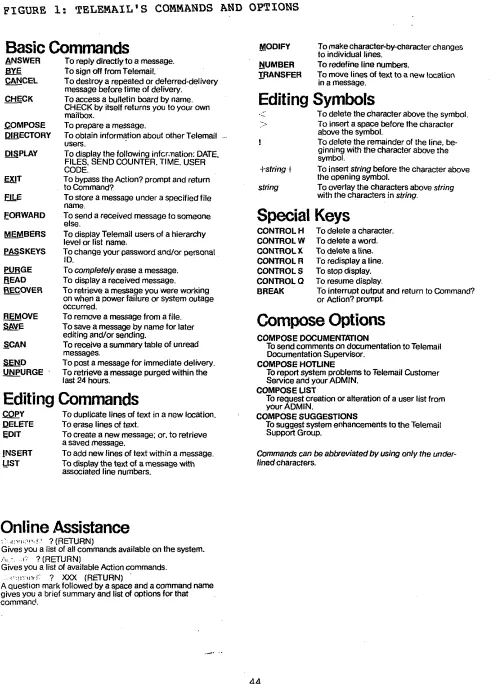
FACILITIES: TeleMail supports individual mailing, mailing
list, bulletin board, editing and secure distribution systems. It does NOT include a synchronous "Chat" facility, nor does it offer
live interaction with helpers online. See Fig. 1 for commands.
SPECIAL NOTES: The normal monthly charge for a Telemail mailbox is $25US, inconjunction with anhourly connect charge and a few cents a message. This mailbox fee is not applicable to members of the UCSD P-Systems User Group, which offers a mailbox to members at no additional charge, as a specialised information exchange service.
ACCESS: (Australia) : MIDAS routing to GTE TeleNet, then respond
to the " @ " prompt with "212141".
ACCESS: (U.K.) : IPSS routing is to DNIC 3110, NUA 2020014100
COMMENTS: TeleMail has proved to be a highly effective means of
communication between UK, Australia and the USA. USUS has a large number of professional users accessing TeleMail on their own account as personal users of electronic mail, which is also used for debates on UCSD matters and for the collation of Newsletter articles.
USEFUL ID CODES: MWigan
-
the author at ARRB, and ITS.MHarper -the Vice Chairman of USUS UK-PRG, Oxford.
SQuinn
-
Librarian at ARRB, contact for ARRB.ADMIN
-
KShillington of TeleSoft in this role.
JBondy
-
USUS Software library coordinatorATate
-
USUS Chairman, Edinburgh University C.C.HKirby- AssistantDirector, ITS,Leeds Univ.UK.
KCox
-
Canberra CAE.WBonham
-
SAGE Computers Liason with USUSSOFTECH
-
SofTech Microsystems Liason with USUSTWoteki
-
Membership Secretary USUS, 814 D StWashington DC 20002,USA.
5.3 SOURCEMAIL and PARTICIPATE (SOURCE)
"CALL' NAME : SOURCE10
PROVIDER: Source Telecomputing Co., MacLean, Virginia, USA
HOST SYSTEM: Multiple PRIME computers at STC.
NETWORK: TeleNet. TymNet available, but no succesful connection.
SPECIFICATION: Probably the largest common user broad function information utility. Now owned by Readers Digest. Recently grew to such a scale that STC has moved from DIALCOM's system to their own computer complex. Supports users in many countries, using credit card billings.
FACILITIES: Messaging, mailing list and data file filing,
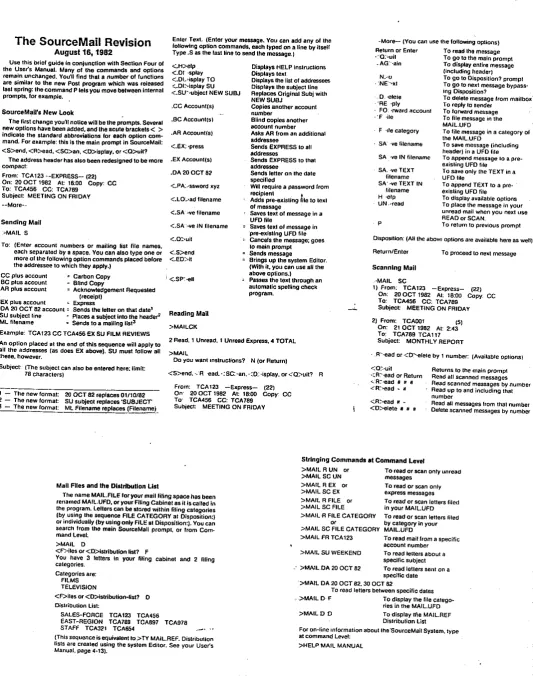
bulletin boards, gateway to shopping, stockbroking and other services. general computing facilities, common carrier for added value information providers. Of special interest as a host to PARTICIPATE, a powerful conferencing and interest networking system licenced to DIALCOM and STC by Participation Systems Inc. Draws heavily from the TOPICS system developed on EIES at New
Jersey. (PSI is "700" on EIES). See Fig. 2 for commands.
SPECIAL NOTES: This system claims to have over 28,000 members world wide and adopts an agressive marketing policy. Its main competitors are CompuServe (which does not operate outside the US), and I.P. Sharp. Used by suppliers and purchasers of software and hardware products as a trading medium.
ACCESS: (Australia): TeleNet via MIDAS, then NUA of 30124.
TymNet via MIDAS direct to STC.
ACCESS : (UK) : TeleNet DNIC 3110, NUA 30124.
TymNet connections unsuccessful via PSS.
NOTES : This large user c o m m u n i t y has now reached a size
sufficient to sustain direct marketing review. Access to specific data sources is given priority by potential users, in preference to messaging services.
USEFUL ID'S : TCY396
-
W. Bolton, Software Tools RBBS, Sydney.STC3160
-
M. Wigan.STC304
-
Direct marketing Manager, STC, MacLean.STC301
-
User and PR Manager, statistics of ops.TCA175
-
PARTICIPATE specialist, STC, MacLean.STF004
-
PSI Inc.REFERENCES : STC (1982). SOURCE Users manual. STC, MacLean, Va.
USA. (Unpaginated)
.
PSI (1982) PARTICIPATE Users manual. PSI, Boston,
TN 104.1
/
Chapter
5 of WP 1695.4 EXES {ELECTRONIC INFORMATION EXCHANGE SERVICE) (New Jersey
Institute of Technology)
"CALL" NAME: EIES
PROVIDER: Computer aided communications centre, New Jersey
Institute of Technology, NJ.,USA.
HOST SYSTEM: Perkin
-
Elmer 30/32NETWORKS : TeleNet, UNINET
SPECIFICATION: One of the first of ,the computer conferencing systems. Provides electronic mail, computer conferencing, i n t e r a c t i v e s u b s y s t e m d e v e l o p m e n t and user interface customisation and monitoring services. Heavily supported at the development stage by the US National Science Foundation, up to 1980. Now operating effectively on user fees alone. Extensively used as a research tool in education, and as a vehicle for standards and other groups to execute practical tasks.
FACILITIES: As this system is one of the most heavily used conferencing systems, and has a n extremely large battery of
development, monitoring and support tools, EIES has
a
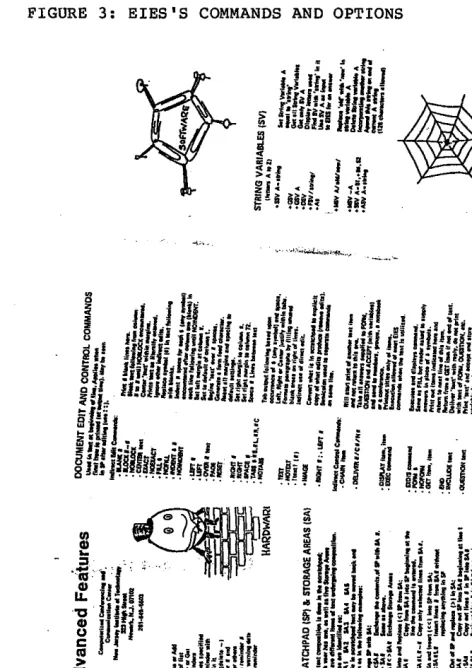
hugeinventory of facilities. There are over 1000 individual commands, accessible from any point and at any level in the use of EIES, and a complete user-interface customisation and interactive development application language. Significant minor points include the acknowledgement of the receipt of all communications, and an on line directory giving background details of the participants, available for free text searching. See Fig. 3.
SPECIAL NOTES: Hiltz
,
Kerr and Turoff have carried out extensivework on the EVALUATION of computer aided communication using EIES itself. As EIE5 has been used a great deal for application tasks for outside bodies, this is a unique resource in that sociological and psychological assessment tools are in continual use. The friendliness to the users is exemplified by the availability of on-line personal aid, and a direct "chat" style of communication. It must also be conceded that the system is not always very user-friendly, and many facilities are hard to use.
I
ACCESS: (Austra1ia):MIDAS routing toTeleMail,C201025at promptACCESS : (UK) : Via PSS network, the DNIC of TeleNet is 3110,
and the NUA for EIES is 201025
RERERENCES: KERR, E., TUROFF, M., JOHNSON-LENZ, P&T. (1982).
Users Manual for the Electronic Information Exchange System. Computerised Conference and Communications Center, New Jersey Institute of Technology, 323 High St, Newark, N.J.,USA. (80pp).
HILTZ, S.R. and TUROFF, M. (1978). T h e network
5.5 TELECENTER (IIASA)
"CALLn NAME :
PROVIDER: International Institute for Applied Systems
Analysis, Schloss Laxenburg, Vienna, Austria.
HOST SYSTEM: PDP 11/70 UNIX
NETWORK: TymNe t
SPECIFICATION: - A full computer conferencing system modelled
loosely on EIES. The whole system is a series of UNIX "C-Shell" small routines, leading to a swiftly modified system.
FACILITIES: Supports messaging, conferences, acknowledgement of
receipt of communications
.
No directory files are explicitlysupported by the s y s t e m , but the moderator concept is implemented.
SPECIAL NOTES: This system is in use within IIASA by about 25 scientists, and by a similar number in the USA, to maintain collaboration and contact in paper production and continuing work.
ACCESS: (Australia): MIDAS system can access TymNet. The DNIC for Austria is 232, and the NUA is 2. DATEXP (the West German Network) also has an X25 link through the Austrian Radio X25 network to IIASA.
ACCESS: (UK): Not yet confirmed
REFERENCE: LATHROP, C.L. and PEARSON, M.L. (1981). TELECTR Users
Manual. IIASA, 2361 Laxenburg, Austria. (48pp.I