Genotypic and Mechanistic Characterization of
Subtype-Specific HIV Adaptation to Host Cellular Immunity
Natalie N. Kinloch,
aGuinevere Q. Lee,
b,cJonathan M. Carlson,
dSteven W. Jin,
aChanson J. Brumme,
cHelen Byakwaga,
e,fConrad Muzoora,
eMwebesa B. Bwana,
eKyle D. Cobarrubias,
aPeter W. Hunt,
fJeff N. Martin,
fMary Carrington,
gDavid R. Bangsberg,
hP. Richard Harrigan,
iMark A. Brockman,
a,cZabrina L. Brumme
a,caFaculty of Health Sciences, Simon Fraser University, Burnaby, British Columbia, Canada
bRagon Institute of Massachusetts General Hospital, MIT and Harvard, Cambridge, Massachusetts, USA
cBritish Columbia Centre for Excellence in HIV/AIDS, Vancouver, British Columbia, Canada
dMicrosoft Research, Seattle, Washington, USA
eMbarara University of Science and Technology, Mbarara, Uganda
fUniversity of California, San Francisco, San Francisco, California, USA
gCancer and Inflammation Program, Frederick National Laboratory for Cancer Research, Frederick, Maryland, USA
hOregon Health and Science University-Portland State University School of Public Health, Portland, Oregon, USA
iDepartment of Medicine, University of British Columbia, Vancouver, British Columbia, Canada
ABSTRACT
The extent to which viral genetic context influences HIV adaptation to
human leukocyte antigen (HLA) class I-restricted immune pressures remains
incom-pletely understood. The Ugandan HIV epidemic, where major pandemic group M
subtypes A1 and D cocirculate in a single host population, provides an opportunity
to investigate this question. We characterized plasma HIV RNA
gag
,
pol
, and
nef
se-quences, along with host HLA genotypes, in 464 antiretroviral-naive individuals
chronically infected with HIV subtype A1 or D. Using phylogenetically informed
sta-tistical approaches, we identified HLA-associated polymorphisms and formally
com-pared their strengths of selection between viral subtypes. A substantial number
(32%) of HLA-associated polymorphisms identified in subtype A1 and/or D had
pre-viously been reported in subtype B, C, and/or circulating recombinant form 01_AE
(CRF01_AE), confirming the shared nature of many HLA-driven escape pathways
re-gardless of viral genetic context. Nevertheless, 34% of the identified HLA-associated
polymorphisms were significantly differentially selected between subtypes A1 and D.
Experimental investigation of select examples of subtype-specific escape revealed
distinct underlying mechanisms with important implications for vaccine design:
whereas some were attributable to subtype-specific sequence variation that
influ-enced epitope-HLA binding, others were attributable to differential mutational
barri-ers to immune escape. Overall, our results confirm that HIV genetic context is a key
modulator of viral adaptation to host cellular immunity and highlight the power of
combined bioinformatic and mechanistic studies, paired with knowledge of epitope
immunogenicity, to identify appropriate viral regions for inclusion in subtype-specific
and universal HIV vaccine strategies.
IMPORTANCE
The identification of HIV polymorphisms reproducibly selected under
pressure by specific HLA alleles and the elucidation of their impact on viral function
can help identify immunogenic viral regions where immune escape incurs a fitness
cost. However, our knowledge of HLA-driven escape pathways and their functional
costs is largely limited to HIV subtype B and, to a lesser extent, subtype C. Our study
represents the first characterization of HLA-driven adaptation pathways in HIV
sub-types A1 and D, which dominate in East Africa, and the first statistically rigorous
characterization of differential HLA-driven escape across viral subtypes. The results
support a considerable impact of viral genetic context on HIV adaptation to host
CitationKinloch NN, Lee GQ, Carlson JM, Jin
SW, Brumme CJ, Byakwaga H, Muzoora C, Bwana MB, Cobarrubias KD, Hunt PW, Martin JN, Carrington M, Bangsberg DR, Harrigan PR, Brockman MA, Brumme ZL. 2019. Genotypic and mechanistic characterization of subtype-specific HIV adaptation to host cellular immunity. J Virol 93:e01502-18.https://doi.org/ 10.1128/JVI.01502-18.
EditorFrank Kirchhoff, Ulm University Medical
Center
Copyright© 2018 American Society for
Microbiology.All Rights Reserved.
Address correspondence to Zabrina L. Brumme, [email protected].
Received30 August 2018
Accepted28 September 2018
Accepted manuscript posted online10
October 2018
Published
GENETIC DIVERSITY AND EVOLUTION
crossm
10 December 2018
on November 6, 2019 by guest
http://jvi.asm.org/
HLA, where HIV subtype-specific sequence variation influences both epitope-HLA
binding and the fitness costs of escape. Integrated bioinformatic and mechanistic
characterization of these and other instances of differential escape could aid rational
cytotoxic T-lymphocyte-based vaccine immunogen selection for both
subtype-specific and universal HIV vaccines.
KEYWORDS
CTL, HLA, Uganda, adaptation, epitope, evolution, human
immunodeficiency virus, immune escape, subtype
H
uman leukocyte antigen (HLA) class I-restricted CD8
⫹cytotoxic T-lymphocyte
(CTL) responses exert evolutionary pressure on an HIV-infected individual’s viral
quasispecies, driving the selection of immune escape variants along reproducible
mutational pathways (1–4). Using population-based approaches, HLA-associated
poly-morphisms in HIV, many of which have been experimentally confirmed to be immune
escape mutations, have been comprehensively mapped across subtype B (5–9) and, to
a lesser extent, subtype C and circulating recombinant form (CRF) 01_AE (CRF01_AE)
(10–13). However, our knowledge of HLA-driven escape in other major HIV subtypes, as
well as the extent to which viral genetic context modulates these pathways, remains
limited.
It is also well established that the immune evasion benefits of some escape
mutations are offset by costs to viral replication and/or protein function (14–23). A
leading CTL-based HIV vaccine strategy aims to focus immune responses against such
constrained regions (24); novel approaches to identify them within the diverse HIV
subtypes (25) would thus be useful. Characterization of HLA-driven adaptation
path-ways across HIV subtypes is even more relevant, given the accumulating evidence that
HIV subtype modulates viral evolution (26–29), pathogenesis (30–34), and immunity
(35–40). Notably, the infecting HIV subtype influences the rate of clinical progression in
untreated infection (30–37). Though the mechanisms underlying these effects are
incompletely known, differential HLA-mediated viremia control as a result of sequence
variation in key HIV CTL epitopes contributes at least in part (35–37). HLA-B*35
expression, for example, is associated with faster progression in subtype B, but not
subtype C, infection in part because the subtype B consensus sequence of the key NY10
epitope (Gag codons 253 to 262) has a reduced affinity for B*35 (37). Instances of
differential HLA-driven escape mutations across viral subtypes, attributable to viral
backbone-specific fitness constraints (38–40), have also been described. For example,
HLA-B*57/58:01-driven escape in KF11 (Gag codons 162 to 172) occurs via A163G in
subtype C but S173T in subtype B, as the former compromises viral replication in a
subtype B backbone (38, 39); similarly, M250I, located one codon downstream of TW10
(Gag codons 240 to 249), is readily selected in subtype C but only rarely in subtype B,
where it attenuates viral replication (40). Differential HLA-B*57-associated escape within
the KF11, IW9 (Gag 147 to 155), and TW10 epitopes has also been described between
subtypes A1 and D, though the underlying mechanisms remain to be elucidated (41,
42). A framework to identify viral regions that differ in immunogenicity between HIV
subtypes or where the functional costs of immune escape differ between HIV subtypes
could thus aid in vaccine design.
We developed and applied such a framework here. We begin by characterizing the
pathways of HLA-mediated adaptation in HIV subtypes A1 and D, two understudied
viral subtypes that cocirculate in East Africa for which HLA-driven escape pathways
have not yet been elucidated. Next, using a novel phylogenetically informed
compar-ative statistical approach, we demonstrate that more than one-third of identified
HLA-driven escape pathways are differentially selected between these subtypes. Finally,
we mechanistically investigate two instances of statistically significant differential
escape between subtypes and identify subtype-specific epitope-HLA binding and
mutational constraints on immune escape as their likely causes. Our results confirm that
viral genetic context modulates HIV adaptation to host cellular immunity and highlight
on November 6, 2019 by guest
http://jvi.asm.org/
the utility of integrated bioinformatic and molecular approaches to identify candidate
epitopes for inclusion in subtype-specific and universal CTL-based HIV vaccines.
RESULTS
Subtype A1 and D cohort subsets exhibit distinct HIV, but concordant host,
genetic profiles.
Host population HLA class I allele frequencies influence the
preva-lence of HLA-associated polymorphisms in circulating HIV strains (10, 43–45). To avoid
confounding by this and other host population-related factors, studies attempting to
identify differences in HLA-driven evolution across HIV subtypes must be undertaken in
a single host population where two or more viral subtypes cocirculate at substantial
frequencies. Uganda, where HIV subtypes A1 and D cocirculate, represents such a
locale. We began by amplifying and bulk sequencing plasma HIV RNA
gag
,
polymerase
(
pol
), and
nef
from 513 chronically HIV-infected antiretroviral-naive participants in two
established cohort studies (46–48).
pol
was amplified in two segments:
protease-reverse
transcriptase
(
RT
) and
integrase
. Overall, 464 (90.4%) participants harbored a
gag
,
pol
,
and/or
nef
sequence that could be classified as pure subtype A1 or D. This included 257
(50%) subtype A1-infected participants, 185 (36%) subtype D-infected participants, and
22 (4%) participants who were likely infected with a subtype A1/D recombinant but
whose individual HIV genes could be classified as a single subtype (e.g., a participant
infected with a virus whose 5
=
and 3
=
halves were A1 and D, respectively, would be
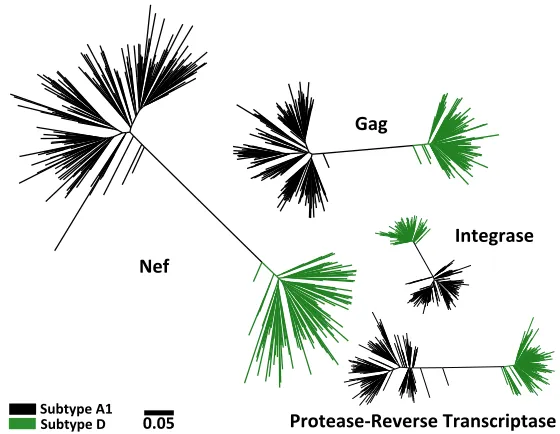
classified as subtype A1 for Gag and subtype D for Nef) (Fig. 1). The remaining 49 (10%)
participants were excluded because they harbored other viral subtypes and/or
inter-subtype recombinants where breakpoints occurred within the studied genes. In total,
our analysis included 203
gag
, 222
protease-RT
, 200
integrase
, and 210
nef
subtype A1
sequences, as well as 134
gag
, 154
protease-RT
, 140
integrase
, and 127
nef
subtype D
sequences.
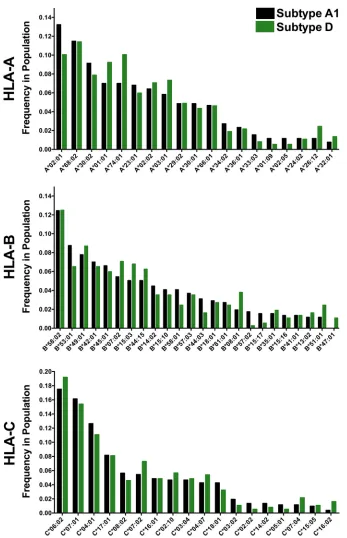
Critically, the HLA class I frequencies of the subtype A1 and D cohort subsets were
highly comparable. Of the 106 total HLA-A, -B, and -C alleles observed, none differed
significantly in frequency between cohort subsets at the predefined false discovery rate
(FDR) threshold of a
q
value of
⬍
0.2 (
P
values for all comparisons were
⬎
0.05, except
for HLA-B*47:01, for which
P
was 0.03) (Fig. 2). Cohort subsets were also generally well
matched for sociodemographic and clinical characteristics (Table 1). They did not differ
FIG 1Maximum likelihood phylogenies inferred from subtype A1 and Dgag,protease-RT,integrase, and nefsequence data sets. For subtype A1, 203gag, 222protease-RT, 200integrase, and 210nefsequences were collected. For subtype D, 134gag, 154protease-RT, 140integrase, and 127nefsequences were collected. All sequences cluster according to their classified subtype. All phylogenies are drawn on the same distance scale; units are in estimated numbers of nucleotide substitutions per site.Subtype-Specific Adaptation to HLA Journal of Virology
on November 6, 2019 by guest
http://jvi.asm.org/
[image:3.585.65.345.72.289.2]significantly with respect to plasma viral load (pVL) (median for subtype A1-infected
participants, 5.2 log
10HIV RNA copies/ml [interquartile range {IQR}, 4.6 to 5.7 log
10HIV
RNA copies/ml]; median for subtype D-infected participants, 5.1 log
10HIV RNA
cop-ies/ml [IQR, 4.6 to 5.5 log
10HIV RNA copies/ml];
P
⫽
0.13), CD4
⫹T-lymphocyte count
(median for subtype A1-infected participants, 135 cells/mm
3[IQR, 72 to 201 cells/mm
3];
FIG 2HLA class I allele frequencies in subtype A1 and D cohort subsets. HLA alleles present at a⬎1% frequency in either cohort subset are shown. Cohort subsets did not differ in the frequency of any HLA allele at aqvalue of⬍0.2. The 22 (4%) individuals who were likely infected with recombinant subtype A1/D viruses but for whom individual HIV gene fragments could nevertheless be classified as pure subtypes were excluded from this analysis.
on November 6, 2019 by guest
http://jvi.asm.org/
[image:4.585.38.385.66.604.2]median for subtype D-infected participants, 120 cells/mm
3[IQR, 54 to 200 cells/mm
3];
P
⫽
0.17), or gender (proportion of females among subtype A1-infected participants,
67%; proportion of females among subtype D-infected participants, 75%;
P
⫽
0.15),
though a modest age difference was noted (median age for subtype A1-infected
participants, 35 years [IQR, 30 to 41 years]; median age for subtype D-infected
partic-ipants, 34 years [IQR, 28 to 38 years];
P
⫽
0.02). Together, these results are consistent
with HIV subtypes A1 and D cocirculating in a single host population, thereby
mini-mizing the potential for confounding by host-related differences between cohort
subsets.
Identification of HLA-associated polymorphisms in HIV subtypes A1 and D.
Using phylogenetically informed approaches (9, 49) (see also Materials and Methods),
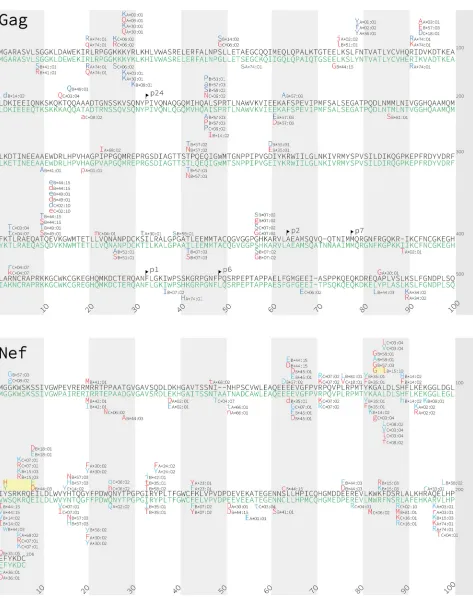
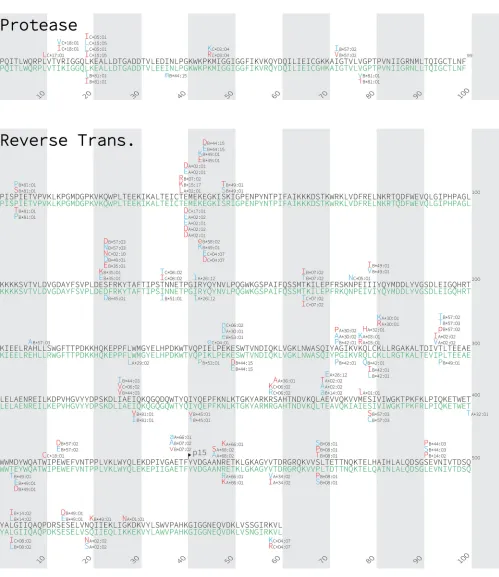
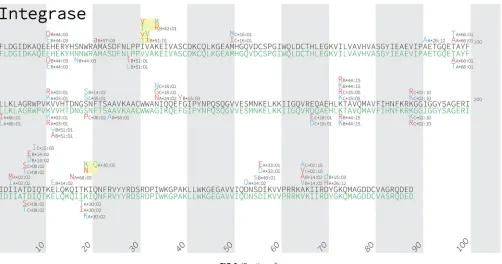
we identified a total of 385 unique HLA-associated polymorphisms occurring at 183
unique HIV codons in subtype A1 and D Gag, protease-RT, integrase, and Nef at a
q
value of
⬍
0.2 (corresponding to
P
⬍
9
⫻
10
⫺4for subtype A1 and
P
⬍
8
⫻
10
⫺4for
subtype D) (Fig. 3; see also Table S1 in the supplemental material). Specifically, 251
associations were identified at 123 codons in subtype A1 (55 [22%] in Gag, 11 [4%] in
protease, 78 [31%] in RT, 52 [21%] in integrase, and 55 [22%] in Nef), while 180
HLA-associated polymorphisms were identified at 105 codons in subtype D (36 [20%]
in Gag, 5 [3%] in protease, 47 [26%] in RT, 26 [14%] in integrase, and 66 [37%] in Nef).
Consistent with previous observations in subtypes B, C, and CRF01_AE (8–13), Nef
exhibited the highest density of HLA-associated polymorphisms. In subtype A1, 13% of
Nef codons compared to 5% of Gag, 5% of protease, 7% of RT, and 10% of integrase
codons harbored at least one HLA-associated polymorphism, while in subtype D, 17%
of Nef codons compared to
ⱕ
5% of codons in other viral proteins harbored an
HLA-associated polymorphism.
In total, 32% of the 385 unique HLA-associated polymorphisms had been previously
described in at least one other HIV subtype (9, 10, 12, 13, 45) (Table S1).
HLA-A*03:01-associated Gag K28Q, for example, which is located within the HLA-A*03:01-restricted
RY10 epitope (50), which ranks among the strongest HLA associations identified in
subtype B (9) and which has also been described in subtype C (12), was among the
strongest associations in subtype A1. We also observed numerous examples where the
same HIV polymorphism was selected by more than one HLA allele. Gag K28Q in
subtype A1, for example, is also strongly selected by HLA-A*30:01; this association has
also been reported in subtypes B and C (9, 12). We also observed cases where HLA
alleles exert opposing selection on HIV. S123D in RT in subtype A1, for example,
represents the adapted (inferred escaped) form for HLA-B*57:03 but the nonadapted
(inferred susceptible) form for HLA-B*49:01. Clusters of mutations selected by the same
HLA allele, which often denote the presence of novel CTL epitopes (7), were also
observed. Nef Y102H and E108D in subtype A1, for example, were selected by
HLA-B*44:03, supporting the existence of a novel B*44:03-restricted epitope here.
[image:5.585.39.546.84.162.2]Numerous HIV polymorphisms were selected by the same HLA in both subtypes A1
and D; this included, for example, HLA-C*07:01-associated Nef K105R, which is also
selected by this allele in subtypes B, C, and CRF01_AE (9, 12, 13). Other HLA-associated
polymorphisms were identified in only one subtype. Gag E161D, for example, located
TABLE 1Sociodemographic and clinical characteristics of subtype A1- and D-infected cohort subsetsb
Characteristic
Value(s) for patients infected with the following HIV subtype:
Pvalue
A1 (nⴝ257) D (nⴝ185)
% female 67 75 0.15
Median (IQR) age (yr) 35 (30–41) 34 (28–38) 0.02
Median (IQR) pVLa(log
10copies/ml) 5.2 (4.6–5.7) 5.1 (4.6–5.5) 0.13
Median (IQR) CD4⫹T-cell count (no. of cells/mm3) 135 (72–201) 120 (54–200) 0.17
apVL, plasma viral load.
bData for the 22 participants likely infected with a subtype A1/D recombinant but whose individual HIV genes could be classified as a single subtype are excluded
from this table.
Subtype-Specific Adaptation to HLA Journal of Virology
on November 6, 2019 by guest
http://jvi.asm.org/
FIG 3Gag, Nef, protease, reverse transcriptase, and integrase immune escape maps of HLA-associated polymorphisms identified in subtypes A1 and D. HLA-associated polymorphisms identified in HIV subtype A1 (black consensus sequence) are displayed above; those identified in subtype D (green consensus sequence) are shown below. HIV subtype consensus sequences were obtained from the Los Alamos National Laboratory HIV sequence database, aligned to the HXB2 reference strain, and gap stripped to preserve HXB2 codon numbering. HIV residues that were overrepresented among individuals expressing the given HLA allele are shown in red; these represent the HLA adapted (inferred escaped) form. In contrast, HIV residues that are underrepresented in individuals expressing the given HLA allele are shown in blue; these represent the nonadapted (inferred susceptible) form for that HLA allele. Groups of polymorphisms in close proximity that are selected by the same HLA allele are boxed in yellow. HLA-associated HIV polymorphisms that do not survive correction for HIV codon covariation are shown in lowercase letters. Polymorphisms identified at aqvalue of⬍0.2 are shown.
on November 6, 2019 by guest
http://jvi.asm.org/
[image:6.585.44.517.64.662.2]1 residue upstream of the HLA-B*57-restricted Gag KF11 epitope, was associated with
HLA-B*57:03 in subtype D, whereas no HLA associations were identified at a
q
value of
⬍
0.2 in subtype A1 at this site.
Substantial HIV subtype-specific adaptation to host HLA.
Though immune
escape maps provide a convenient way to visualize HLA-associated HIV polymorphisms,
they cannot be used to definitively identify viral sites under differential HLA-mediated
FIG 3(Continued)
Subtype-Specific Adaptation to HLA Journal of Virology
on November 6, 2019 by guest
http://jvi.asm.org/
[image:7.585.42.541.60.637.2]selection between HIV subtypes. Even if the same association appears on multiple
escape maps, its strength of selection may still differ between subtypes; conversely, the
absence of a particular polymorphism on a given escape map may simply be because
it narrowly missed the predefined statistical cutoff. We therefore employed a novel
modification of a phylogenetically corrected logistic regression approach (9, 10, 49, 51)
(see also Materials and Methods) to identify instances of statistically significant
differ-ential HLA-mediated selection between HIV subtypes A1 and D. Briefly, we took the
union of all polymorphisms identified in either subtype where
ⱖ
3 individuals in both
cohort subsets carried the relevant HLA allele, which, in total, was 289 HLA-associated
polymorphisms. We then assessed whether, after controlling for other covariates, the
viral subtype represented a significant independent predictor of each HLA-associated
viral polymorphism. If so, it was classified as differentially selected between subtypes.
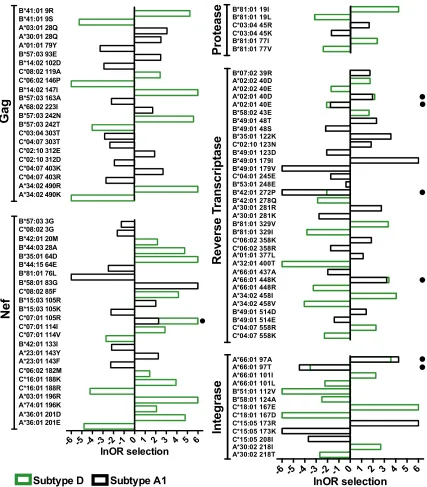
Overall, 34% (99 of 289) of polymorphisms were differentially selected between
subtypes A1 and D at a
q
value of
⬍
0.1 and a
P
value of
⬍
0.05 (Fig. 4; Table S1). The
proportion of HLA-associated polymorphisms that were differentially selected across
subtypes A1 and D was not significantly different across all viral proteins investigated
(
P
⬎
0.05 for all by Fisher’s exact test). In descending order these were protease, where
60% (6/10) of polymorphisms were differentially selected between subtypes, RT (37%,
34/92), integrase (37%, 13/35), Gag (34%, 22/64), and Nef (27%, 24/88).
The vast majority of differentially selected viral polymorphisms (92 of 99; 93%)
occurred because they were selected by the relevant HLA allele in one subtype but not
the other (46 were selected in subtype A1 but not D, and 46 vice versa) (Fig. 4). Notably,
HLA-B*57:03-associated Gag T242N, located within the immunodominant TW10
epitope (codons 240 to 249), was among the strongest instances of differential
selec-tion identified. In subtype D, the odds ratio (OR) of selecselec-tion of Gag T242N by
HLA-B*57:03 was 268 (corresponding to 5.6 when expressed as a natural logarithm
[lnOR]), whereas in subtype A1, the OR of this association was not significantly different
from 1. Applying our test for differential escape between HIV subtypes A1 and D for
HLA-B*57:03-associated T242N thus yielded a highly statistically significant
P
value
(
P
⫽
8
⫻
10
⫺6,
q
⫽
3
⫻
10
⫺4). HLA-A*03:01-associated 196R in Nef (intersubtype
comparison,
P
⫽
7.3
⫻
10
⫺6,
q
⫽
3
⫻
10
⫺4), HLA-B*81:01-associated V77I in
pro-FIG 3(Continued)
on November 6, 2019 by guest
http://jvi.asm.org/
[image:8.585.43.545.69.333.2]tease (
P
⫽
0.005,
q
⫽
0.02), and HLA-A*30:02-associated T218I in integrase
(
P
⫽
1
⫻
10
⫺4,
q
⫽
0.001), all of which were selected in subtype D but not subtype
A1, represented the most significant instances of differential selection in these
proteins, while HLA-A*30:01-associated K281R in RT, selected in subtype A1 alone,
was the most significant instance of differential selection in this protein
(
P
⫽
1.6
⫻
10
⫺5;
q
⫽
4
⫻
10
⫺4).
FIG 4HLA-associated polymorphisms exhibiting differential selection between subtypes A1 and D. The natural logarithm of the odds ratio (lnOR) of selection of HLA-associated polymorphisms in Gag, Nef, protease, reverse transcriptase, and integrase that were differentially selected between subtypes A1 and D are shown. The lnOR of a specific association is shown only if it was independently statistically significant in a given HIV subtype; otherwise, it was set to 0. In most cases, differential selection of an HLA-associated polymorphism occurred because the polymorphism was selected in one subtype but not the other (e.g., B*57:03-Gag T242N was significantly selected in subtype D with an lnOR of 5.6 but not in subtype A1). A small filled circle denotes cases where the same HIV polymorphism was selected at significantly different strengths in the two subtypes. For example, HLA-C*07:01 selects for Nef K105R in subtype A1 (lnOR⫽2.3) but more strongly in subtype D (lnOR⫽6). Polymorphisms differentially selected at a false discovery rate threshold of aqvalue of⬍0.1 and aPvalue of⬍0.05 are shown. Infinite positive or negative lnORs were set to 6 or⫺6, respectively, for visualization purposes.
Subtype-Specific Adaptation to HLA Journal of Virology
on November 6, 2019 by guest
http://jvi.asm.org/
[image:9.585.45.472.71.558.2]The remaining 7 instances of differential selection occurred when the same HLA
allele selected the same polymorphism in both subtypes at significantly different
strengths (3 were more strongly selected in subtype A1 than in subtype D, and 4 vice
versa) (Fig. 4). For example, HLA-C*07:01 selected Nef K105R with an lnOR of ∞ in
subtype D, whereas lnOR was only 2.3 in subtype A1 (intersubtype comparison,
P
⫽
0.02,
q
⫽
0.05). Similarly, HLA-A*66:01 selected alanine at integrase codon 97 with
an lnOR of 4.2 in subtype A1 but an lnOR of 3.6 in subtype D (
P
⫽
0.03,
q
⫽
0.07). Our
results therefore indicate that while HIV subtypes A1 and D display substantial overlap
in their preferred mutational pathways for adaptation to host HLA (66% of identified
polymorphisms were not differentially selected between the two subtypes), viral
genetic context nevertheless plays a key role in defining these pathways.
Mechanisms underlying differential HLA-associated adaptation between HIV
subtypes.
Understanding the mechanisms underlying differential escape is critical if we
are to leverage this information for vaccine design. In particular, instances of differential
escape attributable to epitope immunogenicity (e.g., because a particular epitope
poorly binds its cognate HLA in a given subtype) might identify less useful vaccine
epitopes for a given viral subtype, while those attributable to higher mutational barriers
to escape in a particular HIV subtype might identify more useful vaccine epitopes. We
thus interpreted our list of differentially selected viral polymorphisms (Fig. 4) in the
context of subtype-specific HIV genetic variation, published CTL epitope
immunoge-nicity data, protein domain structural predictions, and epitope/HLA binding predictions
to identify candidates for mechanistic characterization. We identified
HLA-B*57:03-associated Gag T242N to be a candidate for differential escape due to subtype-specific
fitness costs and HLA-B*15:03-associated Nef K105R to be a candidate for differential
escape due to subtype-specific differences in epitope/HLA binding.
HIV subtype-specific functional constraints underlie some instances of
differ-ential escape: B
*
57:03-Gag T242N.
Gag TW10 is strongly and frequently recognized
by B*57-expressing individuals infected with various HIV subtypes (15, 50, 52), including
A1 and D (41, 53). However, whereas Gag T242N is reproducibly selected by B*57:03 in
subtype D (and others [9, 45]), it is not selected by this allele in subtype A1 (Fig. 4),
despite our cohort being sufficiently powered to detect it (see Discussion). Notably, the
subtype A1 consensus differs from that of all other major subtypes and CRFs at Gag
codon 243, the residue immediately downstream of the mutation site: 75% of subtype
A1 sequences harbor proline, whereas
⬎
97% of sequences belonging to subtypes B, C,
D, G, and H as well as CRF01_AE and CRF02_AG harbor leucine (http://www.hiv.lanl
.gov/). In fact, the TW10 consensus sequence in subtypes D and A1 differ only at
this residue (indicated in boldface):
240TSTLQEQIGW
249in subtype D compared to
240
TSTPQEQIGW
249in subtype A1.
Gag T242N can, however, occur in subtype A1 under some circumstances. We
observed 8 instances of this mutation in subtype A1-infected individuals, 7 of whom
expressed B*57:02 or B*58:01, alleles that belong to the same HLA supertype as B*57:03.
In subtype A1, however, T242N never occurred in conjunction with the subtype
consensus proline at position 243; rather, the adjacent residue was the HIV group M
consensus L243 (3/8), V243 (2/8), T243 (1/8), I243 (1/8), or a mixture of the last two (1/8).
We therefore hypothesized that consensus P243 prevents the selection of T242N in
subtype A1 (41).
In silico
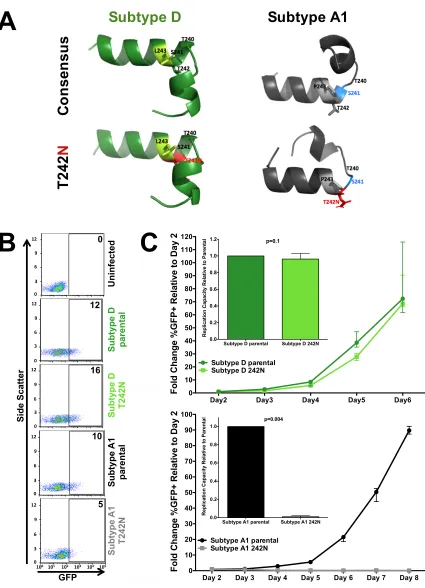
structural models of Gag codons 232 to 254 in subtypes A1 and D, which
encompass helix 6 of p24
Gagand the region immediately upstream, supported this
hypothesis (Fig. 5A). Atomic distances between aligned structures were expressed in
terms of the root mean square deviation (RMSD) (54), where values greater than 2.5 to
3 Å
in silico
indicate substantial structural differences (55–57). The subtype A1
consen-sus proline at Gag codon 243 already notably alters the peptide structure compared to
that of subtype D. Furthermore, whereas T242N is predicted to only minimally impact
the helix 6 structure in subtype D (RMSD between predicted structures, 0.77 Å), T242N
in subtype A1 is predicted to prevent helix 6 formation and to disrupt upstream protein
folding (RMSD between predicted structures, 4.3 Å).
on November 6, 2019 by guest
http://jvi.asm.org/
FIG 5Subtype-specific mutational constraints drive differential B*57:03-mediated selection of Gag T242N between subtypes A1 and D. (A)In silicomodeling of the effect of Gag T242N (red, bottom models) on the structure of subtype D (green, left) and A1 (gray, right) consensus p24Gagcodons 232 to 254 (top models). Differences in the subtype D and A1 consensus sequence at codon 243 are highlighted
(light green, subtype D leucine; light gray, subtype A1 proline). While T242N is predicted to have minimal impact in subtype D (green, left, top versus bottom), its introduction into subtype A1 p24Gagis predicted to substantially alter the peptide structure (gray, right, top
versus bottom) by disrupting helix formation (i.e., codon 241, blue) and upstream folding. (B) Representative flow cytometry plots confirming the infectivity (GFP) of VSVg-pseudotyped recombinant virus stocks generated from participant-derived plasma HIV RNA sequences in a CEM-derived LTR-driven GFP reporter T-cell line during experiments to determine the viral titer. Numbers indicate the
(Continued on next page)
Subtype-Specific Adaptation to HLA Journal of Virology
on November 6, 2019 by guest
http://jvi.asm.org/
[image:11.585.44.469.64.652.2]To confirm mutational antagonism between T242N and P243, we engineered the
former into a recombinant virus that harbored a participant-derived subtype A1
Gag-protease sequence and another that harbored a participant-derived subtype D
Gag-protease sequence in an HIV
NL4.3reference strain backbone and generated virus
stocks pseudotyped with the vesicular stomatitis virus G (VSVg) envelope (58). The titers
of the virus stocks were determined by infecting a long-terminal repeat (LTR)-driven
green fluorescent protein (GFP) reporter CD4
⫹T-cell line and measuring the
percent-age of GFP-expressing (i.e., infected) cells 48 h later. All viral stocks were confirmed to
be infectious, though the titers of the T242N-containing subtype A1 mutant were lower
than those of the others (Fig. 5B). We then assessed the ability of these viruses to
replicate in the same GFP reporter T-cell line (59). Cells were infected with a standard
viral inoculum (multiplicity of infection, 0.003), and viral spread was monitored by flow
cytometry over up to 8 days postinfection. Dramatic differences in the impact of T242N
on viral replication were observed between the two subtypes (Fig. 5C). Consistent with
previous observations in subtypes B and C (19, 60), which also harbor leucine at codon
243, T242N conferred a modest impact on the viral replication capacity in subtype D
(0.96 relative to parental subtype D;
P
⫽
0.1) but completely abrogated viral replication
in subtype A1 (
P
⫽
0.004). Complete abrogation of T242N-containing subtype A1 viral
replication continued to be observed even when cultures were infected at multiplicities
of infection of up to 0.05 (data not shown). Viral replication was similarly abolished
when T242N was engineered into a recombinant HIV
NL4.3strain harboring the
consen-sus subtype A1 Gag-protease (Fig. 6).
Subtype-specific epitope presentation underlies some instances of differential
escape: B
*
15:03-Nef K105R.
While the result presented above confirms that
subtype-specific mutational barriers underlie some instances of differential escape, other cases
likely reflect a lack of immune pressure in a given subtype because the relevant CTL
epitope is not efficiently presented by the restricting HLA in that viral genetic context.
Nef K105R, which is selected by B*15:03 in subtype A1 but not subtype D (intersubtype
comparison,
P
⫽
0.005,
q
⫽
0.02) (Fig. 4), represented a candidate for the latter
mech-anism. Of note, K105R is reproducibly selected by another allele, HLA-C*07:01, in both
subtypes and, in fact, is more strongly selected in D than A1 (Fig. 4). This suggests that
differential selection of K105R by B*15:03 is not due to subtype-specific fitness costs
but, rather, is because B*15:03 exerts a greater selective pressure on this region of Nef
in subtype A1 than in subtype D due to the higher-affinity binding of a putative viral
epitope to this allele in subtype A1.
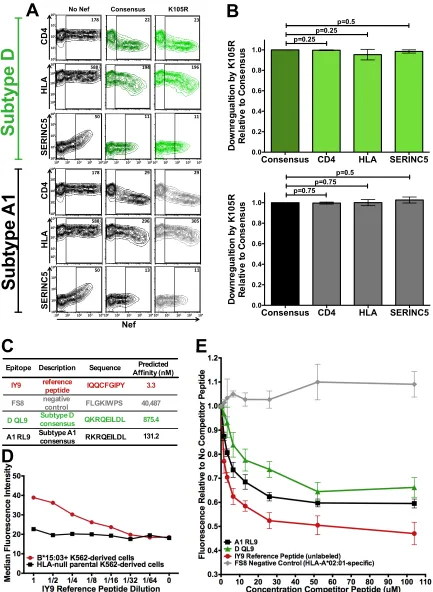
We first confirmed that K105R did not substantially impact Nef’s three most
well-characterized functions— cell surface CD4, HLA class I, and SERINC5 downregulation
(61–64)—in either subtype backbone (Fig. 7A). As hypothesized, K105R did not impact
Nef-mediated CD4 downregulation capacity in subtype D (mean function of K105R
relative to the subtype consensus, 0.99 [standard deviation
⫽
0.004];
P
⫽
0.25), nor did
it majorly impair HLA class I (mean, 0.95 [standard deviation
⫽
0.05];
P
⫽
0.25) or
SERINC5 (mean, 0.98 [standard deviation
⫽
0.02];
P
⫽
0.5) downregulation (Fig. 7B).
Likewise, K105R had no impact on subtype A1 Nef function, where the CD4 (mean, 1.0
[standard deviation
⫽
0.009];
P
⫽
0.75), HLA (mean, 1.0 [standard deviation
⫽
0.03];
P
⫽
0.75), and SERINC5 (mean, 1.0 [standard deviation
⫽
0.03];
P
⫽
0.5) downregulation
functions were not significantly different from the consensus downregulation function
(Fig. 7B).
FIG 5Legend (Continued)
percentage of GFP-positive (i.e., HIV-infected) cells. (C) Representative curves depicting the rate of spread of VSVg-pseudotyped subtype D (green, top) and subtype A1 (black, bottom) parental (circles; dark green, subtype D; black, subtype A1) and T242N mutant (squares; light green, subtype D; gray, subtype A1) viruses over multiple days in culture. The median and standard error of the percentage of GFP⫹
(infected) cells relative to that on day 2 are shown. Three independent experiments were performed. (Insets) Replication capacity of parental and T242N mutant viruses (where the value for the latter is normalized to that for the former) calculated over the exponential phase of viral replication. T242N had a modest, though not statistically significant, impact on viral replication in subtype D (median, 0.96 relative to parental subtype D;P⫽0.1) but completely abrogated subtype A1 viral replication (P⫽0.004).
on November 6, 2019 by guest
http://jvi.asm.org/
We then investigated whether differential B*15:03-mediated selection of Nef K105R
is due to the presence of a B*15:03-restricted epitope in subtype A1 but not D. As no
B*15:03 epitopes have been mapped in this region, we used netMHC (version 4.0)
software (65) to identify a putative B*15:03-restricted epitope spanning Nef codons 104
to 112, where K105R sits at position 2. Consistent with our hypothesis, the subtype A1
consensus sequence (RL9;
104RKRQEILDL
112; epitope amino acid differences are
indi-cated in boldface) was predicted to bind nearly 7-fold more strongly to B*15:03
(predicted binding affinity, 131.2 nM) than the subtype D consensus (QL9;
104QKRKEIL
DL
112; predicted binding affinity, 875.4 nM) (Fig. 7C).
Epitope binding to B*15:03 was experimentally confirmed using a competitive
binding assay where a titration of the epitope of interest competes with a fixed dose
of a fluorescently labeled reference peptide for B*15:03 binding on the surface of cells
(66–68) (Fig. 7E). The reference peptide used was IY9 (IQQCFGIPY [IY9]), which was
modified (as indicated in boldface) from the published B*15:03-restricted IQQEFGIPY
epitope spanning HIV integrase codons 135 to 143 (69) to contain cysteine at position
4, on which the fluorophore was conjugated. The IY9 reference peptide, predicted to
retain a high affinity for B*15:03 (3.3 nM; Fig. 7C), selectively bound K562-derived cells
engineered to stably express B*15:03 across a 64-fold dilution range (Fig. 7D). It also
behaved as expected in competition experiments, where titration of unlabeled IY9
consistently reduced the median fluorescence of target cells by up to 53% in a
dose-dependent manner, while titration of the negative-control HLA-A*02:01-specific
FS8 epitope, which spans Gag codons 433 to 440 (70) and which has a predicted
B*15:03 binding affinity of 40,487 nM (Fig. 7C), did not reduce the fluorescence at any
concentration tested (Fig. 7E).
FIG 6Gag T242N abrogates viral replication in the subtype A1 consensus backbone. (A) Representative flow cytometry plots demonstrating the infectivity (GFP) of subtype A1 consensus and T242N mutant recombinant viruses during experiments to determine the viral titer. The numbers indicate the percentage of GFP-positive (i.e., infected) cells. (B) Representative curves depicting the rate of spread of VSVg-pseudotyped subtype A1 consensus (black, circles) and T242N mutant (gray, squares) viruses over multiple days in culture. The median and standard error of the percentage of GFP⫹(infected) cells relative to that on day 2 is shown. Two
independent experiments were performed.
Subtype-Specific Adaptation to HLA Journal of Virology
on November 6, 2019 by guest
http://jvi.asm.org/
[image:13.585.58.458.70.357.2]FIG 7Subtype-specific epitope presentation drives differential B*15:03-mediated selection of Nef K105R between subtypes A1 and D. (A) Representative flow cytometry plots depicting the ability of consensus and K105R Nef subtype D (top) and A1 (bottom) sequences to downregulate CD4, HLA class I, and SERINC5 in a transfection-based assay (dark green, consensus subtype D; black, consensus subtype A1; light green, K105R subtype D; gray, K105R subtype A1). The negative control (No Nef) corresponds to the empty pSelect-GFP vector. The numbers in the Nef-positive (GFP⫹) gate denote the median fluorescence intensity (MFI) of the cell surface molecule under investigation. (B) Histograms
depicting the ability of the Nef K105R subtype D (top) and subtype A1 (bottom) mutant to downregulate CD4, HLA class I, and SERINC5, shown
(Continued on next page)
on November 6, 2019 by guest
http://jvi.asm.org/
[image:14.585.41.474.70.662.2]Having validated our assay to be B*15:03 and peptide specific, we tested the
predicted subtype A1 and D RL9/QL9 epitopes for their ability to compete with labeled
IY9 for B*15:03 binding (Fig. 7E). While both RL9 and QL9 were able to compete with
IY9 for binding to B*15:03 in a dose-dependent manner, subtype A1 RL9 consistently
reduced the median fluorescence relative to that for no competitor peptide to a greater
extent than subtype D QL9 over all concentrations tested (mean, 9% [standard
devia-tion
⫽
2.7%] greater reduction in subtype A1 than in subtype D). These results are
consistent with netMHC binding predictions (Fig. 7C) for these epitopes and support
the notion that the subtype A1 epitope sequence is more immunogenic. Therefore, the
absence of the B*15:03-restricted K105R polymorphism in the context of subtype D
infection is likely attributable to reduced or absent B*15:03-mediated selective pressure
on this region of Nef
in vivo
.
DISCUSSION
This study represents the first systematic characterization of HLA-driven
polymor-phisms in major HIV group M subtypes A1 and D and the first rigorous statistical
investigation of the extent to which mutational immune escape pathways differ across
HIV subtypes in a cohort that was carefully selected to minimize confounding by host
immunogenetic, sociodemographic, and other factors. Overall, our results indicate that
while many immune escape pathways are shared across HIV subtypes—32% of
HLA-associated polymorphisms identified in the present study had been previously
de-scribed in at least one other HIV subtype—a substantial proportion are not. In
partic-ular, our observation that 34% of HLA-associated polymorphisms are statistically
significantly differentially selected between subtypes A1 and D identifies the viral
genetic backbone to be a key modulator of immune-driven HIV evolution.
The HLA-associated polymorphisms identified in the present study generally
cor-roborate previous observations in subtypes A1 and D (41, 42), though some differences
are noted. Gag T242N had previously been observed among individuals expressing B58
supertype alleles in subtype D, but not subtype A1, in a Kenyan cohort (41); our study,
performed at subtype-level HLA resolution, further identifies B*57:03 to be the specific
allele responsible for these differential effects. However, the Kenyan study also
identi-fied other B58 supertype-associated escape mutations in Gag that were not observed
in the present study, at least not at the stringent cutoff of a
q
value of
⬍
0.2: these
included P243T and I247X in the TW10 epitope in subtype A1, A163G/S165N in the
KF11 epitope in both subtypes A1 and D, and A162X in subtype A1 (41).
B*57-associated Gag I147L in the IW9 epitope, previously described in subtype D (41), was
also not observed in the present study. While confounding by regional differences in
HLA frequencies cannot be ruled out and issues relating to statistical power must be
acknowledged, the observation that the Ugandan and Kenyan subtype A1 and D Gag
consensus sequences differ at 10 and 7 codons, respectively, suggests that the
influ-ence of HIV genetic context on HLA-mediated adaptation may be even more nuanced,
with differences possibly occurring at the sub-subtype or regional levels. The
observa-tion that 13% of polymorphisms restricted by a given HLA allele (where the frequency
of each allele was verified to be comparable between cohorts) in subtype B were
FIG 7Legend (Continued)
as the mean⫾standard deviation from a minimum of three independent experiments, relative to that of their corresponding parental consensus sequences (shown as having a function of 1.0). The K105R polymorphism had no significant impact on either subtype D (P⬎0.25 for all comparisons) or subtype A1 (P⫽0.75 for all comparisons) CD4, HLA, or SERINC5 downregulation relative to that of the corresponding subtype consensus. (C) Epitopes used in the competitive binding assay, along with their predicted binding affinities to HLA-B*15:03 (derived from netMHC [version 4.0] software). (D) Titration (64-fold dilution) of the fluorescently labeled IY9 reference peptide over parental HLA-null K562-derived immortalized T cells and those retrovirally transduced to stably express HLA-B*15:03. The dose-dependent loss of fluorescence was observed only on B*15:03-expressing cells, indicating that the IY9 reference peptide is B*15:03 specific. (E) Epitope cellular competitive binding assay results. The median fluorescence relative to that with no competitor peptide is shown. As expected, the unlabeled reference peptide is able to compete with the labeled version of itself for B*15:03 binding in a dose-dependent manner. By comparison, the HLA-A*02-specific FS8 negative-control epitope was unable to compete with labeled IY9 for binding to B*15:03 at any concentration. Subtype A1 consensus epitope RL9 displaced more labeled reference peptide than the subtype D consensus epitope QL9 over all concentrations tested, confirming that RL9 (subtype A1) had the higher affinity of the two.
Subtype-Specific Adaptation to HLA Journal of Virology
on November 6, 2019 by guest
http://jvi.asm.org/
differentially selected in Japan compared to Canada, the United States, and Australia
also supports regional HIV strain variation as a determinant of immune escape
path-ways, though the possibility of confounding by other host population factors, in
particular, T-cell repertoire genetics, cannot be ruled out (10).
While our study supports a role of viral genetics in modulating immune-driven HIV
evolution, our estimate that 34% of HLA-associated polymorphisms differ between viral
subtypes is nevertheless lower than earlier estimates. In particular, a study comparing
HLA-associated polymorphisms identified in subtype B-infected individuals in Canada
and subtype C-infected individuals in South Africa estimated that HLA-mediated
selec-tion differed in 86% of shared epitopes, defined at the HLA allele level, between these
HIV subtypes (11). This study, however, did not formally test for differential escape and
was also likely confounded by differences in HLA subtype frequencies between cohorts
(e.g., with B*57:01 versus B*57:03 being the most common B*57 allele in Canada and
South Africa, respectively [39, 71]). Our observations that 32% of identified
polymor-phisms represented canonical escape mutations described in other subtypes and,
furthermore, that 66% of identified HLA-associated polymorphisms did not significantly
differ in the strength of selection across subtypes A1 and D underscore that, despite
substantial differences, many immune escape pathways are nonetheless shared across
HIV subtypes.
We further confirm that distinct mechanisms, namely, HIV subtype-specific fitness
costs of escape and differential epitope binding, explain specific instances of
differen-tial HLA-driven adaptation. This is important, as the underlying mechanism has vaccine
design implications. Gag TW10, for example, is highly immunogenic in multiple HIV
subtypes (14, 15, 41, 52), and escape via T242N confers modest
in vitro
yet likely
substantial
in vivo
fitness costs in most viral subtypes, as evidenced by its rapid and
frequent reversion upon transmission to an HLA-mismatched host (15, 72). Here we
demonstrate, through site-directed mutagenesis of one participant-derived sequence
and one consensus sequence, that the T242N-P243 combination completely abrogates
viral replication in subtype A1. Though we cannot completely rule out the possibility
that compensatory mutational pathways could exist in some subtype A1 contexts, the
severity of this defect demonstrated here and the lack of observation of T242N-P243 in
natural sequences in this and other (41, 42) studies render this somewhat unlikely. We
hypothesize that T242N reduces fitness by destabilizing the HIV capsid structure in the
subtype A1 consensus viral backbone, a conclusion that is supported by our peptide
modeling experiments and our observation that T242N/P243-containing subtype A1
viruses display lower infectivity, even when VSVg pseudotyped. While Gag T242N is
reported to increase HIV capsid sensitivity to the cellular restriction factor TRIM5
␣
(73)
and we cannot rule out the contribution of TRIM5
␣
to our results, the capsid of subtype
A1 is less sensitive to TRIM5
␣
than that of other subtypes (73) and the CEM-derived
T-cell line used in our viral spread assay expresses relatively high levels of cyclophilin
A (74), which counteracts the effect of TRIM5
␣
on capsid stability (75). Regardless of the
specific mechanism underlying the fitness cost, these observations support inclusion of
this epitope in pan-subtype HIV vaccines and further identify it as a particularly useful
immunogen in subtype A1.
Other cases of differential adaptation identify epitopes that are likely to
repre-sent poor immunogens. The putative B*15:03-restricted epitope RL9/QL9 (Nef
codons 104 to 112), discovered via differential B*15:03-mediated escape via Nef
K105R, is unlikely to be immunogenic in subtype D due to the weaker binding of its
cognate sequence to this allele. Further evaluation of RL9’s immunogenicity in subtype
A1 and other subtypes is merited, though K105R’s lack of an
in vitro
functional cost
suggests a relatively low barrier to escape. Integrated bioinformatic and molecular
approaches like those described in the present study, combined with information on
epitope immunogenicity and HLA-mediated viremia control, could thus aid the rational
selection of CTL-based vaccine immunogens.
The present study is not without limitations. Our subtype A1 and D cohort subsets
were smaller and, thus, lower powered than those normally used to identify
on November 6, 2019 by guest
http://jvi.asm.org/
associated polymorphisms (9, 10, 12, 13, 45), and as such, these immune escape maps
should not be considered comprehensive. Power limitations also precluded us from
investigating certain associations more fully. Our observation that HLA-B*57:02 was
significantly associated with Gag T242N in subtype A1 (
P
⫽
1.9
⫻
10
⫺6,
q
⫽
0.006)
(Fig. 3; see also Table S1 in the supplemental material) was particularly intriguing;
however, we could not assess whether this association is differentially selected
be-tween subtypes A1 and D because only two individuals in the latter group expressed
B*57:02. Our ability to determine why Gag T242N is selected by B*57:02 but not by the
more common HLA-B*57:03 in subtype A1 was similarly limited, though it is worth
noting that the absence of selection by the latter is not attributable to a lack of
statistical power: whereas 4 of 6 subtype A1-infected individuals expressing B*57:02
harbored T242N, leading to a statistically significant association after phylogenetic
correction, T242N was observed in only 1 of 15 B*57:03-expressing subtype A1-infected
individuals, who also expressed B*57:02. Even more intriguingly, all 8 instances of
T242N in subtype A1, of which 4 occurred in B*57:02-expressing individuals, never
occurred with the subtype consensus proline at the adjacent codon 243, suggesting
that B*57:02 was pressuring HIV to escape via P243X in subtype A1. Indeed, B*57:02
carriage was negatively associated with Gag P243 in subtype A1 with an lnOR of
⫺
∞
(
P
⫽
0.007), but this association did not survive our stringent multiple-comparison
correction and, thus, is not featured on our immune escape map. Nevertheless, this
suggests that differences in TW10 epitope presentation between B*57:02 and B*57:03
in subtype A1 may alter immune selection pressures on this epitope. This notion is
supported by descriptions of B*57-mediated selection of P243T in subtype A1 (41), as
well as the fact that B*57:03 and B*57:02 differ by a single residue in their
peptide-binding groove that likely interacts with this region of TW10 (76). Indeed, selection of
distinct escape mutations by closely related HLA alleles presenting the same viral
epitope has previously been described (77–79).
The well-matched clinical profiles of our cohort subsets are also worth mentioning,
given the accumulating evidence that HIV subtype D is associated with more rapid
progression than subtype A1 (30–34). We did not deliberately select cohort subsets
with comparable clinical profiles. Rather, the comparable clinical profiles likely reflect
the fact that we studied the baseline (pretherapy) cross section of two HIV treatment
cohorts (see Materials and Methods), and treatment eligibility is guided in part by
immunological (CD4
⫹T-cell count) criteria. Though it is possible that cohort subsets
differ in terms of infection duration (this information was not known for the study
participants), the majority of HLA-driven escape and reversion events occur well before
CD4
⫹T-cell counts reach the levels observed in the present study (51). In fact,
HLA-associated polymorphisms in other HIV subtypes have been determined using the
baseline (treatment-naive) cross section of a HIV treatment cohort(s) with CD4 and pVL
profiles comparable to those of the present cohort (7–10, 12, 13, 45, 80).
The value of integrated bioinformatic and molecular studies like the present one is
worth stating directly. While techniques such as gamma interferon enzyme-linked
immunosorbent spot (ELISpot) assays can identify HIV epitopes recognized
in vitro
in
one or more viral subtypes, these may not necessarily be relevant
in vivo
. In contrast,
HLA-associated polymorphisms identified at the population level identify specific HIV
regions under strong and reproducible selection (that is, immunogenic viral regions)
in
vivo
. Integrated bioinformatic and molecular studies thus offer a complementary
approach to rational immunogen selection that begins with an
in vivo
-relevant
obser-vation (i.e., the identification of viral sites under differential HLA-mediated selective
pressure) and subsequently proceeds to mechanistic characterization to inform
im-munogen selection. While only two examples of differential escape were investigated
in the present study, in many cases a putative mechanism could be proposed for future
validation. For example, epitope binding predictions and subtype-specific sequence
conservation data suggest that the lack of selection of both RT 514D and RT 179I by
HLA-B*49:01 in subtype D may be attributable to subtype-specific fitness costs, while
Subtype-Specific Adaptation to HLA Journal of Virology
on November 6, 2019 by guest
http://jvi.asm.org/
the lack of B*42:01-mediated selection of Nef 20M in subtype A1 is likely attributable
to suboptimal epitope binding.
In conclusion, our study represents the first characterization of HLA-driven
adapta-tion pathways in HIV subtypes A1 and D and the first statistically rigorous
character-ization of differential HLA-driven escape across viral subtypes. The results support a
considerable impact of viral genetic context on HIV adaptation to host HLA, where
differences are attributable to subtype-specific sequence variations that influence
epitope-HLA binding or determine the mutational barrier to immune escape. A
frame-work to identify viral regions that differ in terms of epitope binding and the functional
costs of immune escape across HIV subtypes could aid in vaccine design. The present
study highlights the power of combined bioinformatic and mechanistic studies, paired
with knowledge of epitope immunogenicity, toward this goal.
MATERIALS AND METHODS
Participants and ethics statement.Participants comprised a subset of the 513 individuals originally recruited to two established Ugandan HIV treatment cohorts, the Adherence Monitoring Uganda (AMU) cohort and the Uganda AIDS Rural Treatment Outcomes (UARTO) cohort (46–48). All participants were antiretroviral naive at the baseline (cohort entry), which is when HIV genotyping was performed for the present analysis. While the duration of infection was unknown, the CD4 count and viral load distributions indicate that the majority of participants were likely to be in chronic infection (Table 1), which is appropriate for identifying HLA-associated polymorphisms statistically, as by this stage a majority of HLA-driven escape (and reversion) will have occurred, thereby increasing the statistical power to identify such associations (51). All participants were enrolled under Research Ethics Board (REB)-approved protocols and provided written informed consent. Ethics approval to conduct this study was obtained from the institutional review boards of Providence Health Care/University of British Columbia, Simon Fraser University, and the Mbarara University of Science and Technology.
Host and viral genotyping.Total nucleic acids were extracted from a 500-l blood plasma sample using standard methods. HIVgag,protease-reverse transcriptase(amplified together),integrase, andnef were amplified via reverse transcriptase (RT)-PCR (using a SuperScript III one-step RT-PCR system with PlatinumTaqhigh-fidelity DNA polymerase; Invitrogen), followed by a nested round of PCR (using an Expand high-fidelity PCR system; Roche) using gene-specific primers optimized for pan-HIV group M binding. Amplicons were bulk (directly) sequenced using a 3730xl or 3130xl automated DNA sequencer (Applied Biosystems). Chromatograms were analyzed using the Sequencher (version 5.0.1) (Gene Codes) or RECall (81) program, with nucleotide mixtures being called if the height of the secondary peak exceeded 25% of the dominant peak height (Sequencher) or 20% of the dominant peak area (RECall). Analysis was restricted togag,protease-RT,integrase, andnefsequences identified as pure subtype A1 or D sequences, determined by first screening sequences with the Recombinant Identification Program (RIP; version 3.0) at a window size of 100 (https://www.hiv.lanl.gov/content/sequence/RIP/RIP.html) and then inferring and visualizing gene-specific maximum likelihood phylogenies as follows. HIV gene-specific sequence data sets were aligned using the HIValign program (options, MAFFT; codon alignment) (82–84) and inspected using the AliView program (85). Maximum likelihood phylogenies were constructed using the PhyML program (https://www.hiv.lanl.gov/content/sequence/PHYML/interface.html) and visualized using the FigTree program (version 1.3.1).
High-level resolution HLA class I typing was performed using sequence-based methods (86). Inter-cohort differences in HLA allele frequency were assessed using the Los Alamos HIV Immunology Database’s HLA comparison tool (http://www.hiv.lanl.gov/content/immunology/hla/hla_compare.html). Multiple comparisons were addressed usingqvalues, thePvalue analogue of the false discovery rate (FDR). The FDR is the expected proportion of false-positive results among results deemed significant at a givenPvalue threshold (e.g., at aqvalue ofⱕ0.2, we expect 20% of identified associations to be false positive).
Identification of HLA-associated polymorphisms.Established phylogenetically corrected statistical methods were used to identify HLA-associated polymorphisms in subtypes A1 and D separately (9, 49). To preserve universal HIV codon numbering conventions, the HIV subtype B reference strain HXB2 sequence was added to each HIV data set and aligned as described above, and all columns where HXB2 was gapped were stripped out. Evidence for selection by HLA class I and/or covarying amino acids in HIV Gag, protease-RT, integrase, and Nef was assessed using a weighted logistic regression approach. In this model, the amino acid is assumed to evolve independently down the tree until it reaches the tips, which represent the studied HIV sequences. On each tree tip, the selection pressure arising from HLA alleles expressed by the participant is directly modeled using a stochastic additive process that treats each HLA allele as a binary variable (i.e., the presence or absence of the allele in question). Covarying HIV amino acids are also included as model variables. To identify the factors that contribute to the observed HIV sequence at the tree tips, a forward selection approach is employed. By this approach, the most significant HLA-HIV amino acid (or HIV amino acid-HIV amino acid) association is iteratively added. Here, the null hypothesis that the observed HIV amino acid at the tree tips can be explained by neutral evolution along the phylogeny is tested against the alternative hypothesis that its presence is better explained by the presence of an HLA class I allele(s) and/or a covarying HIV amino acid(s).Pvalues were computed using the likelihood ratio test, and aqvalue of⬍0.2 was used to define statistical significance,
on November 6, 2019 by guest
http://jvi.asm.org/
as in previous studies (7–9, 12, 13, 45). HLA-associated polymorphisms were grouped into two categories: adapted (inferred escaped) forms, which represent HIV amino acids significantly overrepresented in the presence of the HLA allele, and nonadapted (inferred susceptible) forms, which represent HIV amino acids significantly underrepresented in the presence of the allele in question.
A novel modification to an existing weighted logistic regression approach was used to identify instances of differential selection of HLA-associated polymorphisms across HIV subtypes (9, 10, 49, 51). This test was applied to all polymorphisms identified in subtype A1 and/or D where at least three individuals in both cohorts harbored the restricting HLA allele. Briefly, the null model treats each HIV polymorphism as the outcome variable and the single restricting HLA allele as the predictor. This model is then compared to a more expressive one that includes an interaction term for subtype using a likelihood ratio test. To increase the stringency of the test, polymorphisms differentially selected at the more conservative threshold of aPvalue of⬍0.05 and aqvalue of⬍0.1 were considered significant.
Peptide conformational modeling.In silico-predicted peptide structures were generated using the PEP-FOLD (version 2.0) program (87–89) and visualized using the PyMOL molecular graphics system (version 2.0.7; Schrödinger, LLC). The root mean square deviation (RMSD), calculated as the square root of the mean of the square of the distances between the matched atoms, between structures was determined using the Visual Molecular Dynamics program (version 1.9.4) (54) to assess the similarity of the structures.
Recombinant virus generation and replicative assessment.The Gag T242N mutation was engi-neered into one arbitrarily selected subtype A1 and one subtype D participant-derived Gag-protease sequence using overlap extension PCR, where the resulting amplicons were designed to have an approximately 20-bp overlap with a pNL4.3 (subtype B) reference strain plasmid lacking Gag-protease (ΔGag-protease), which has been described previously (90). The consensus (Los Alamos National Labo-ratory HIV sequence database) and T242N mutant HIV subtype A1 Gag-protease sequences were synthesized as three roughly equally sized gBlocks (Integrated DNA Technologies) with approximately 20 bp of overlap between fragments as well as with the ΔGag-protease pNL4.3 reference strain plasmid. Inserts were fused into the ΔGag-protease pNL4.3 plasmid using the Gibson enzymatic assembly (91) (NEBuilder; New England BioLabs) at a 3:1 insert/backbone molar ratio. The entire HIV coding region of the resulting recombinant plasmids was sequenced to confirm carriage of only the mutations of interest. Viral stocks pseudotyped with the vesicular stomatitis virus G (VSVg) envelope (58) were obtained by cotransfecting 13g of recombinant plasmid into 2.8 million HEK 293T cells along with 1.3g of a VSVg plasmid (which originated from the study described in reference 92) (Lipofectamine LTX; Thermo Fisher Scientific). VSVg pseudotyping was done in order to ensure that all recombinant viruses were capable of at least a first round of infection. Culture supernatants containing recombinant virions were harvested at 48 h posttransfection and frozen prior to use. The titers of the recombinant viral stocks were determined by infecting a CEM-derived reporter CD4⫹T-cell line harboring an HIV LTR-driven green fluorescent protein (GFP) expression cassette (the CEM-GXR cell line) (59) with serially diluted viral inocula and measuring the percentage of GFP-expressing (i.e., infected) cells at 48 h postinfection (day 2). The volume of viral stock required to achieve 0.3% GFP-positive (GFP⫹) cells on day 2 was then determined by linear
extrapolation.
Viral replication was assessed using a published multicycle reporter assay (59). Briefly, the CEM-GXR GFP reporter T-cell line was infected at a multiplicity of infection of 0.003, that is, to achieve 0.3% GFP-positive (i.e., infected) cells on day 2. To quantify subsequent viral spread, the percentage of infected cells was measured via flow cytometry (Guava 8HT; Millipore) daily for up to 8 days. The replication capacity was then calculated as the natural log of the slope of viral spread during the exponential phase. The replication capacities of viruses harboring T242N were compared to those of their subtype parental or consensus control. The replication of each participant-derived recombinant virus was assessed in a minimum of three independent experiments; consensus-derived recombinant viruses were assessed in duplicate.
Nef-mediated CD4, HLA, and SERINC5 downregulation.K105R was engineered into subtype A1 or D consensus Nef (Los Alamos National Laboratory HIV sequence database) gBlocks (Integrated DNA Technologies) via overlap extension PCR. Amplicons were cloned into pSELECT-GFPzeo, which contains dual promoters driving the expression of GFP as well as the gene of interest, and the sequences were confirmed. The ability of each Nef clone to downregulate cell surface CD4 and HLA class I was determined as previously described (93). Briefly, a CEM CD4⫹T-cell line engineered to express high levels of HLA-A*02 (CEM-A*02) was transfected with consensus or mutant Nef clones by electroporation. Cells were stained at 20 to 24 h posttransfection with allophycocyanin (APC)-conjugated mouse anti-human CD4 antibody and phycoerythrin-conjugated mouse anti-human HLA-A*02 antibody (BD Biosciences). The median fluorescence intensity (MFI) of GFP⫹(Nef-expressing) cells was determined by flow
cytom-etry (Guava 8HT; Millipore) and analyzed using FlowJo (version 9.9.5) software. The CD4 or HLA downregulation function of each Nef mutant was normalized to that of its subtype consensus control using the following equation: (MFInegative control⫺MFImutant)/(MFInegative control⫺MFIsubtype consensus). The
function of each mutant and consensus Nef sequence was assessed in a minimum of three independent experiments.
To assess SERINC5 downregulation function, CEM-A*02 cells were cotransfected with 1g of the Nef plasmid and 5g of a plasmid expressing an internally hemagglutinin (HA)-tagged SERINC5 by electro-poration (94). Cells were stained at 20 to 22 h posttransfection with APC-conjugated mouse anti-HA antibody (BioLegend). The MFI of SERINC5⫹GFP⫹cells was determined by flow cytometry (Guava 8HT;
Millipore) and analyzed using FlowJo (version 9.9.5) software. The Nef-mediated SERINC5 downregulation function of each mutant was normalized to that of its corresponding subtype consensus control using
Subtype-Specific Adaptation to HLA Journal of Virology
on November 6, 2019 by guest
http://jvi.asm.org/
the same equation presented above. The function of each Nef mutant and consensus sequence was assessed in a minimum of three independent experiments.
Epitope competitive binding assay.Subtype-specific epitope binding to HLA-B*15:03 was assessed using a competition-based cellular binding assay (66–68). Candidate subtype A1 and D epitopes spanning Nef residue 105 that displayed the highest affinity for HLA-B*15:03 were identified using netMHC (version 4.0) software (65). To generate a B*15:03-specific reference peptide, the B* 15:03-restricted epitope IQQEFGIPY (HIV integrase codons 135 to 143 [69]) sequence was modified to contain a cysteine at position 4 to yield IQQCGFIPY (IY9) and synthesized (GenScript), and the fluorophore 5-(iodoacetamido)fluorescein (5-IAF; Thermo Fisher) was conjugated to the cysteine. Fluorescently labeled IY9 was titrated on acid-stripped (pH 2.9) parental HLA-null derived cells (95) and K562-derived cells retrovirally transduced to stably express HLA-B*15:03 to confirm HLA specificity and to determine the optimal concentration of the reference peptide for use in competitive binding assays. In the competitive binding assay, a fixed concentration of fluorescently labeled IY9 was mixed with a titration of the candidate or control epitope (0 to 104M) and then incubated with acid-stripped B*15:03-positive K562-derived cells at 4°C for 24 h in the dark. The median fluorescence intensity was then determined by flow cytometry (Guava 8HT; Millipore) and analyzed using FlowJo (version 9.9.5) software. Three independent experiments were performed.
Accession number(s).Subtype A1 and D HIVgag,integrase, andnefsequences have been deposited into GenBank under accession numbers MH971615 to MH971951, MH925338 to MH925677, and
MH971287toMH971614, respectively. Partialprotease-reverse transcriptasesequences for a subset of participants were previously submitted as part of another study (96) and have been updated to include the entireproteaseandreverse transcriptasesequences under accession numbersKJ906625,KJ906627,
KJ906631, KJ906635toKJ906637, KJ906641,KJ906642, KJ906646, KJ906649, KJ906650, KJ906653to
KJ906655, KJ906658, KJ906660, KJ906661, KJ906665, KJ906666, KJ906670 to KJ906672, KJ906676,
KJ906678, KJ906679,KJ906681, KJ906682, KJ906685toKJ906692, KJ906694toKJ906698, KJ906701,
KJ906706, KJ906708, KJ906711 to KJ906714, KJ906716, KJ906717, KJ906720, KJ906721, KJ906724,
KJ906725, KJ906728,KJ906730, KJ906731, KJ906733, KJ906735to KJ906738, KJ906740to KJ906746,
KJ906749, KJ906751 to KJ906755, KJ906758, KJ906759, KJ906761, KJ906763, KJ906766, KJ906767,
KJ906769to KJ906771,KJ906774, KJ906775,KJ906777, KJ906778, KJ906780, KJ906781to KJ906785,
KJ906787,KJ906788,KJ906790toKJ906792,KJ906796toKJ906803,KJ906805toKJ906808,KJ906810,
KJ906813toKJ906819,KJ906823, toKJ906832,KJ906834toKJ906838,KJ906840toKJ906844,KJ906846
toKJ906850,KJ906852toKJ906854,KJ906856toKJ906860,KJ906862,KJ906864toKJ906873,KJ906875,
KJ906876, KJ906878, KJ906880, KJ906881, KJ906884, KJ906891 to KJ906896, KJ906899, KJ906900,
KJ906903,KJ906907,KJ906908,KJ906910toKJ906917,KJ906919toKJ906928,KJ906930toKJ906942,
KJ906944toKJ906950,KJ906952toKJ906954,KJ906956toKJ906958,KJ906960toKJ906965,KJ906967
toKJ906976,KJ906978toKJ906983,KJ906985,KJ906987,KJ906989,KJ906990,KJ906992toKJ906999,
KJ907001to KJ907006,KJ907008, KJ907010,KJ907011, KJ907013, KJ907015, KJ907018, KJ907021to
KJ907024,KJ907026toKJ907028,KJ907030,KJ907032toKJ907035,KJ907037toKJ907039,KJ907041to
KJ907044,KJ907048toKJ907052,KJ907055toKJ907057,KJ907060toKJ907065,KJ907067,KJ907070,
KJ907071, KJ907073, KJ907075, KJ907077, KJ907079, KJ907080, KJ907083, KJ907086, KJ907088,
KJ907089, KJ907091, KJ907093, KJ907094, KJ907096, KJ907097, KJ