TEMPERATURE EFFECT ON CARBONIZATION OF WATER HYACINTH AS A SOLID BIOFUEL
MOHD ZUBIR BIN OTHMAN
HMA
N B
ACHELO
R
OF M
ECHAN
ICAL
ENG
. (
P
LAN
T & MAI
NTE
NA
NCE
)
(HONS
) 2015
UTe
SUPERVISOR DECLARATION
“I hereby declare that I have read this thesis and in my opinion this thesis is sufficient in
terms of scope and quality for the award of the degree of
Bachelor of Mechanical Engineering (Plant and Maintenance)”
Signature : ...
Supervisor : Dr Nona Merry Merpati Mitan
TEMPERATURE EFFECT ON CARBONIZATION OF WATER HYACINTH AS
A SOLID BIOFUEL
MOHD ZUBIR BIN OTHMAN
This thesis is partial fulfilment of the award of Bachelor of Mechanical Engineering
(Plant and Maintenance) with Honurs
Faculty of Mechanical Engineering
Universiti Teknikal Malaysia, Melaka (UTeM)
DECLARATION
“I hereby declare that the work in this thesis is my own except for summaries and quotations which have been duly acknowledged.”
Signature : ...
Author : Mohd Zubir Bin Othman
ACKNOWLEDGEMENT
First of all, praise to the Almighty God that I was able to complete the final year projectwith successful and could be done properly. We would like to take this opportunity to thanks all organization or individuall who have helped me in finished my final year project Universiti Teknikal Malaysia Melaka (UteM). In addition, I would like to said thank you so much to my supervisor Dr. Nona Merry Merpati Mitan on her effort to supervise and cooperate in any phase of the project. All knowledge and guidance that has been provided is really appreciated. Alhamdulilah, Bachelor’s degree project report finally reached at the end. I would like to said thank tou to my parent, my family who gives a full support on me all the time with love and care. Not forgetting my gratitude to the Universiti Teknikal Malaysia Melaka (UteM) and Jabatan Alam Sekitar Negeri Melaka for provided a comfortable atmosphere, data and equipment in the laboratary during the session and allows me to complete my project without any problems. Finally, I would like to give greatest thanks to my friend who have been supportive, understanding, motivation, patience and good cooperation in preparing this report.
ABSTRACT
Water hyacinth is one of the pest plants that live on the surface of water, river and lake where it is able to remove the oxygen and nutrient in the water. Water hyacinth consists of 10 % of lignin, 25 % of cellulose and 35 % of hemicelluloses. Therefore, the components exist in water hyacinth have a potential to become a solid biofuel. Water hyacinth can be converted into high quality fuel by carbonization process. Carbonization is a treatment method for upgrading biomass feedstock into solid biofuels. The purpose of this research is to investigate the temperature effect of water hyacinth briquette which
carbonized at temperature 300, 400, 500 and 600 oC at heating rate 5 °C per minutes for
ABSTRAK
Keladi bunting adalah salah satu tumbuhan perosak yang hidup di permukaan air,
TABLE OF CONTENT
CHAPTER TITLE PAGE
SUPERVISOR DECLARATION
PROJECT TITLE
DECLARATION ii
DEDICATION iii
ACKNOWLEDGEMENT iv
ABSTRACT v
ABSTRAK vi
TABLE OF CONTENT vii
LIST OF TABLES x
LIST OF FIGURES xi
LIST OF EQUATIONS xiii
LIST OF APPENDICES xiv
CHAPTER I INTRODUCTION 1.1 Background 1
1.2 Problem Statement 2
1.3 Objectives 3
1.4 Scope 3
CHAPTER II LITERATURE REVIEW 2.0 Overview 4
2.1.1 Biomass Components 8
2.2 Biomass Conversion 9
2.2.1 Carbonization 10
2.4 Biofuel 12
2.5 Water Hyacinth 12
2.6 Sample Analysis 15
2.7 Past Studies 16
CHAPTER III METHODOLOGY
3.0 Overview 22
3.1 Sample Preparation 24
3.1.1 Collection of Raw Material 24
3.1.2 Drying of Raw Material 25
3.1.3 Crushing Process 26
3.1.4 Milling Process 26
3.1.5 Carbonization Process 27
3.1.6 Densification Process 27
3.2 Briquette Analysis 28
3.2.1 Proximate Analysis 28
3.2.1.1 Moisture Content 28
3.2.1.2 Ash Content 29
3.2.1.3 Volatile Matter 30
3.2.1.4 Fixed Carbon 30
3.2.2 Calorific Value 31
3.2.3 Compressive Test 32
3.2.4 Fourier Transformation Infrared 32
Spectroscopy (FTIR)
CHAPTER IV RESULTS AND ANALYSIS
4.1 Introduction 33
4.2.4 Fixed Carbon 37
4.3 Calorific value 38
4.4 Compressive Test 39
4.5 FTIR 40
CHAPTER V DISCUSSION
5.1 Proximate Analysis 42
5.1.1 Moisture content 43
5.1.2 Ash Content 43
5.1.3 Volatile Matter 44
5.1.4 Fixed Carbon 44
5.2 Calorific Value 45
5.3 Compressive Strength 45
5.4 FTIR Analysis 46
CHAPTER V I CONCLUSION AND RECOMMENDATION
6.1 Conclusion 48
6.2 Recommendation 50
REFERENCES 51
LIST OF TABLES
NO TITLE PAGE
2.1 Lignocelluloses constituent in biomass material 8
2.2 Element of fresh water hyacinth 13
2.3 Biomass composition of water hyacinth 13
2.4 Composition of shoot and root of water hyacinth 15
2.5 Durability rating 17
2.6 Past studies of water hyacinth 18
4.1 Analysis data on water hyacinth briquette 33
LIST OF FIGURES
NO. TITLE PAGE
2.1 World primary energy production and consumption in November 2010 5
2.2 Carbon cycle, photosynthesis and biomass technologies 7
2.3 Main biomass conversion process 9
2.4 Stage of degasification concept 11
2.5 Water hyacinth shoot and root diagram 14
3.1 Project flow chart of briquetting water hyacinth and analysis 23
3.2 The water hyacinth in the riverside 24
3.3 The digital analytical balance, circulating oven and dried water hyacinth 25
3.4 Crusher machines 26
3.5 Centrifugal mill (Retsch ZM 200) 26
3.6 Electrical furnaces (Carbolyte Type 201) for carbonization 27
3.7 Mold for densification process and briquette product 28
3.8 Decomposition vessels and bomb calorimeter 31
4.1 Moisture content of water hyacinth briquette 34
4.2 Ash content of water hyacinth briquette 35
4.3 Volatile matter of water hyacinth briquette 36
4.4 Fixed carbon of water hyacinth briquette 37
4.5 Calorific value of water hyacinth briquette 38
4.6 Compressive graph of water hyacinth briquette 39
4.7 FTIR spectra of water hyacinth briquette for every briquette produced 40
5.2 The result of FTIR spectra between NC and C600 sample 46
LIST OF EQUATIONS
NO TITLE PAGE
3.1 Percentage of moisture content, % 28
3.2 Percentage of ash content, % 28
3.3 Weight loss, % 29
3.4 Percentage of volatile matter, % 29
3.5 Percentage of fixed carbon, % 29
LIST OFAPPENDICES
NO TITLE PAGE
1 Appendix 1 (a) Proximate analysis non-carbonization of briquette 56
2 Appendix 1 (b) Proximate analysis carbonization of briquette (T= 300°C) 57
3 Appendix 1 (c) Proximate analysis carbonization of briquette (T= 400°C) 58
4 Appendix 1 (d) Proximate analysis carbonization of briquette (T= 500°C) 59
5 Appendix 1 (e) Proximate analysis carbonization of briquette (T= 600°C) 60
6 Appendix 2 (a) Compressive test for non-carbonization briquette 61
7 Appendix 2 (b) Compressive test carbonization of 300 °C briquette 61
8 Appendix 2 (c) Compressive test carbonization of 400 °C briquette 62
9 Appendix 2 (d) Compressive test carbonization of 500 °C briquette 63
10 Appendix 2 (e) Compressive test carbonization of 600 °C briquette 63
11 Appendix 3 Data for calorific value of briquette sample 64
12 Appendix 4 Water quality index of Sungai Putat 65
13 Appendix 5 (a) Gantt chart for final year project I 66
14 Appendix 5 (b) Gantt chart for final year project II 66
CHAPTER I
INTRODUCTION
1.1 BACKGROUND
The rising of oil prices and global warming is a major problem in this world. Therefore, the Government of Malaysia implemented various initiatives to expand environmentally
practices and the application of green technology in an effort to preserve the country’s
ecosystem while ensuring the conducive environment for life. One of the government’s initiatives is the sustainable development.
Renewable energy is one of the most efficient government initiatives to meet the sustainable development advocated by the government. Hence, the government of Malaysia has introduced a number of policies like National Green Technology Policies 2009 and Nation Renewable Energy 2010 where the aimed is to encourage the use of renewable energy. According to Asia Pacific Economic Cooperation (APEC) 2014which held at Beijing, a new goal was announced by President of United States which need to double renewable energy used by 2030 (Schroeder, 2014). There are many renewable energy sources such as biomass.
many biomass resources that has in our country such as water hyacinth, cow manure, durian peel and others which has a potential for renewable energy.
1.2 PROBLEM STATEMENT
The consumption of fossil fuel is tremendously increasing and causing fossil fuel resources dwindling every year. By then, the world was introduced biomass as a source of sustainable energy to meet the needs in the future.
Water hyacinth in scientific name Eichornia crassipes is one of pest that live on the surface of the water, rivers and lakes. As the one of the most productive plants on earth, they can growth up in two times from its normal size in a few weeks then spread rapidly, where it is able to form mats on the water surface along a river or lake. In addition, the low oxygen condition below the surface of the water hyacinth will block the flow of water will affect the ecosystem in which to make a river or lake as a breeding ground for mosquitoes. Besides that, water hyacinth causes the loss of water and obstruction of boat traffic. Water hyacinth also can block the suction lines of irrigation and drainage pump where it can reduce the efficiency of pump and increase the cost of maintenance if the pump failure or defect (Ndimele et., 2011).
a) To produce briquette from water hyacinth.
b) To identify the effect of temperature on the calorific value of briquette.
c) To perform proximate analysis (moisture content, ash content, volatile matter and
fixed carbon) and mechanical properties (compressive test) of briquette product.
d) To determine the functional group of water hyacinth by using Fourier Transform
Infrared Spectroscopy (FTIR).
1.3 SCOPES
This project involves the preparation of water hyacinth as a raw material to produce briquette as a solid biofuel by drying, pulverization (crushing and milling), carbonization and densification process. The main focus of this project is to study the effect of temperature on carbonization of water hyacinth as a solid biofuel. Water hyacinth have been went through the carbonization process with different kind level of temperature.
Besides that, the proximate analysis of water hyacinth briquette was performed to
CHAPTER II
LITERATURE REVIEW
2.0 Overview
The uses of fossil fuel are tremendously increasing and causing fossil fuel resources dwindling every year. Nasir et al. (2013) stated the recent production of fossil fuels like natural gas, coal, crude oil and natural gas plant liquid (NGPL) has increased up to 79 % than to another energy sources as shown in the figure below. Figure 2.1 shows the world primary energy production and consumption in November 2010. Based on the world primary energy, natural gas shows the highest consumption compared to other energy
and this problem closely related to the increasing of the world’s population every year.
become solid biofuel
Figure 2.1 World primary energy production and consumption in November 2010
(Source: Nasir (2013))
2.1 Biomass
carbon from fossil fuel combustion. The increase of greenhouse gases (CO2, CH4, NOx) can cause global warming which can lead to dangerous phenomenon such as tornadoes and unexpected flood (Ciubota-Rosie et al., 2008). Therefore, one of the solutions is by using the biomass as sustainable energy.
According to Demirbas (2009) biomass is refers to biodegradable organic material from living such as plants, animal which derived from biological sources. Agbor et al. (2014) in their study, stated biomass is a renewable energy sources where it is derived from organic matters which are friendly to environment (carbon neutral). The example of organic matter is agricultural crops, harvest residue, seaweed and organic waste. In addition, biomass is consisting of living organism or biological material from living (Piech, 2012).
Biomass resources can be categorized into four which is waste, forest product, energy crop and aquatic plant. The example of waste stock is mill wood waste, agricultural production waste and others. The forest product is like wood and trees that comes from forest clearings. The energy crops are like short-cycle crops such as wheat, sugarcane and other while aquatic plant likes algae and water hyacinth (Ciubota-Rosie et al., 2008).
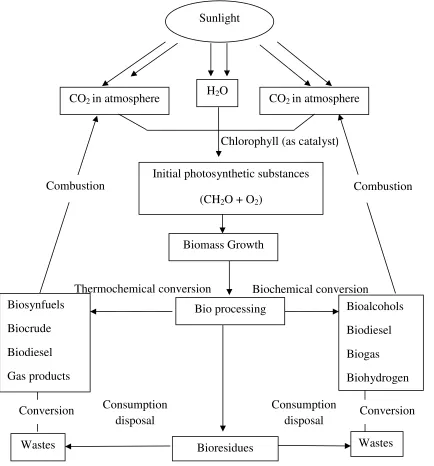
Figure 2.2 Carbon cycle, photosynthesis and biomass technologies
(Source: Demirbas, (2009))
Consumption disposal
Wastes
Wastes Bioresidues
Conversion
Conversion Consumption
disposal
Thermochemical conversion Biochemical conversion
Bioalcohols Biodiesel Biogas Biohydrogen Biosynfuels Biocrude Biodiesel Gas products Bio processing Biomass Growth
Initial photosynthetic substances
(CH2O + O2)
Chlorophyll (as catalyst) Sunlight
CO2 in atmosphere H2O CO2 in atmosphere