
City, University of London Institutional Repository
Citation
:
MacFarlane, A., McCann, J. A. and Robertson, S. E. (2007). Parallel methodsfor the update of partitioned inverted files. Aslib Proceedings; New Information Perspectives, 59(4-5), pp. 367-396. doi: 10.1108/00012530710817582
This is the accepted version of the paper.
This version of the publication may differ from the final published
version.
Permanent repository link:
http://openaccess.city.ac.uk/4456/Link to published version
:
http://dx.doi.org/10.1108/00012530710817582Copyright and reuse:
City Research Online aims to make research
outputs of City, University of London available to a wider audience.
Copyright and Moral Rights remain with the author(s) and/or copyright
holders. URLs from City Research Online may be freely distributed and
linked to.
City Research Online: http://openaccess.city.ac.uk/ [email protected]
Parallel methods for the update of partitioned inverted files
A. MacFarlane
School of Informatics, City University London, UK
J.A. McCann
Department of Computing, Imperial College London, UK
S.E. Robertson
Microsoft Research Ltd, Cambridge, UK
Abstract
Purpose – An issue which tends to be ignored in information retrieval is the issue of updating inverted files. This is largely because inverted files were devised to provide fast query service, and much work has been done with the emphasis strongly on queries. In this paper we study the effect of using parallel methods for the update of inverted files in order to reduce costs, by looking at two types of partitioning for inverted files: document identifier and term identifier.
Design/methodology/approach – Raw update service and update with query service are studied with these partitioning schemes using an incremental update strategy. We use standard measures used in parallel computing such as speedup to examine the computing results and also the costs of reorganising indexes while servicing transactions.
Findings – Empirical results show that for both transaction processing and index reorganisation the document identifier method is superior. However, there is evidence that the term identifier partitioning method could be useful in a concurrent transaction processing context.
Practical implications – There is an increasing need to service updates which is now becoming a requirement of inverted files (for dynamic collections such as the Web), demonstrating that a shift in requirements of inverted file maintenance is needed from the past.
Originality/value – The paper is of value to database administrators who manage large-scale and dynamic text collections, and who need to use parallel computing to implement their text retrieval services.
Keywords Information retrieval, Parallel programming, Inverted files
Paper type Research paper
1. Introduction
database. It is therefore becoming increasingly important to examine the impact of update and query services on inverted files. In this paper we describe the update mechanism for a Parallel text retrieval system, PLIERS, on two different types of partitioning methods: term identifier partitioning (TermId) where each term, with all its associated postings is assigned to a single fragment (and therefore information about any document is distributed among fragments); and document identifier partitioning (DocId) where the reverse is the case.
2. Experimental methodology
Much of the previous work in the area of inverted file maintenance (Reddaway, 1991; Shoens et al., 1994; Clark and Cormack, 1995; Brown et al., 1994) has advocated the use of buffering updates to save on Input/Output. Some argue that to update the index for each individual arriving document is inefficient (Shoens, et al., 1994) but use a synthetic workload performance analysis to support their arguments. We attempt to simulate a persistent service for updates without coding a complete transaction service, accepting that it is better to wait a little before updating an index. To do this we keep an in-core buffer to which updates are added when they are received. When this buffer is full, we initiate an index reorganisation merging the in-core update index with the index kept on disk. In order to do this we use the following strategy:
1. Read in inverted list from disk. 2. Add new postings to inverted list.
3. Save the new postings to disk to a temporary postings file.
As we are unlikely to be able to keep the dictionary in-core, we keep a subset of the keywords in memory, with each element of the subset a header of a keyword block held on disk. All hit keyword blocks are saved to a temporary Keyword file for realism. The advantage of this method is that we can do a realistic disk re-organisation simulation without the need for expensive rollbacks in order to conduct repeated experiments on the same data set. We do not attempt to reorganise the whole index as we assume that a large chunk of the database will never be referenced by incoming updates. The transaction we refer to as updates are collection updates or document insertions: we do not address the issue of document removals or document changes. Our assumption is that text collections are in the main archival. Our priority is to try and keep the index in a state that would allow us to service fast query processing. We do, however, allow the service of transactions while the reorganisation of the index is being done: there is a strict interleaving between the reorganisation of a term and transaction service to prevent concurrency problems. There may therefore be some delays to transactions while a reorganisation of the index is going on.
3. Transaction topologies
Given that we want to service search and updates simultaneously, the transaction topology cannot differ too much from the search topology described elsewhere (MacFarlane et al., 2000). We therefore define top and leaf nodes which can handle both search operations and the update operations implemented. We describe the additional functionality needed by the nodes to support update operations above. Figure 1 shows an example of transaction topology with the service of updates.
Take in Figure 1. Example of transaction topology configuration
3.1 Top node
The top node being the interface to the topology, accepts new documents, breaks them down into their constituent words, and sends the index information to the relevant inverted file fragment. The main issue here is that the top node must know what type of partitioning method being used in order to send data to fragments accordingly. For example, in TermId partitioning a bucket of words will be formed for each fragment of the inverted file. These can be sent directly to the fragments. However, with DocId partitioning, a decision must be made as to how new documents are allocated to the fragments. We make the assumption that over a given period of time incoming documents that are distributed in a “round robin” fashion will give each fragment roughly the same amount of data, although it is unlikely to be evenly distributed. We therefore assign new document to fragments using a “round robin” distribution method when document identifier partitioning is used. For both types of partitioning method a confirmation of update completion must be received before a commit notice is sent to the client.
3.2 Leaf node
The leaf node receives index data and merges it with the fragment index data handled by that particular leaf node. This sequential process is identical to that described in another paper by MacFarlane and colleagues (2005). Some collection statistics and document data must be shared amongst leaf nodes (e.g., collection size and document length). Each leaf has a document map structure which records such information. When a search transaction is received by the leaf, both the index and the in-core buffer are searched. If a reorganisation of the index is initiated new updates are added to a separate temporary buffer: this is searched as well if new queries are received by the leaf. When the reorganisation is complete this temporary buffer becomes the main buffer.
4. Software and hardware used
shared nothing architecture (DeWitt and Gray, 1992) is used by PLIERS. The Fujistsu AP3000 is a distributed memory parallel Computer using Ultra 1 processors running Solaris 2.5.1. Each node has a speed of 167Mhz. The torus network has a top bandwidth of 200 Mbytes/s per second.
5. Data and settings used
The data used in the experiments was the BASE1 and BASE10 collections, both sub-sets of the official 100 Gigabyte VLC2 collection (Hawking et al., 1999). The BASE1 is 1 Gigabyte in size, while BASE10 is approximately 10 Gigabytes in size. We use two types of builds for indexes: distributed builds where text is kept centrally and distributed to index nodes and local builds where text is physically distributed to nodes and indexed locally (MacFarlane et al., 2005). For the distributed build method we use the BASE1 collection only, creating indexes on 1 to 7 processors and servicing transactions on all of those indexes. Two types of index were built for these experiments: one set using TermId partitioning and one using DocId partitioning. The BASE1 and BASE10 collections were used for the local build method, running queries on 8 nodes: the client and top node had to be placed on the same node as one leaf. The DocId partition method is used on these experiments. We built one set of indexes which contained position data and one set without position data for both types of build methods and both types of partitioning methods (runs with position data are marked ‘position data’, while those without such data are marked ‘postings only’).
Take in Table I. Details of transaction sets used in experiments
6. Experimental results on transaction processing
We have a number of aspects which we wish to examine by looking at the empirical results produced. The first of these is the issue of update performance (see section 6.1). Is there a big performance penalty in only allowing one update at a time in the system? We also need to examine the transactions as a whole looking at aspects such as the interaction between queries and updates and its impact on performance (see section 6.2). Both updates and transactions are examined in the presence and absence of index reorganisation. The performance of index reorganisation is examined in section 6.3, together with a discussion on a good buffer size for the collections being examined. A summary of the experimental results is given in section 6.4.
Take in Figure 2. BASE1 [DocId]: average elapsed time in ms for update transactions (postings only)
Take in Figure 3. BASE1 [TermId]: average elapsed time in ms for update transactions (postings only)
Take in Figure 4. BASE1 [DocId]: average elapsed time in ms for update transactions (position data)
Take in Figure 5. BASE1 [TermId]: average elapsed time in ms for update transactions (position data
6.1 Performance of update transactions
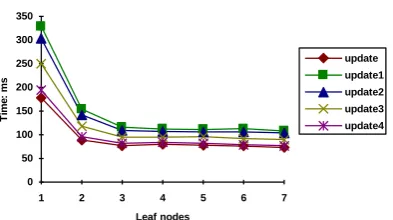
As there is no general criterion for response time for update transactions as there is for query transactions (Frakes, 1992) we need to define one here. The criterion we use is that updates should be done within 1/10th of a second (or 100 milliseconds). This strict criterion is chosen because we want to ensure that queries are not delayed much, although users who submit documents for update would prefer a fast response. The elapsed time for update transactions is quite small for most runs (see Figures 2 to 5). All times are under 100 milliseconds and times do reduce with increasing numbers of leaf nodes. There are two main observations from this. The first is that update transaction elapsed times meet our criterion and are therefore acceptable in our terms. Any delays by blocking other transactions while an update is done are therefore small. The second is that speedup is found in systems using parallelism, which is surprising given the restrictions on parallelism with the type of update transaction processing implemented (see Figures 6 to 9).
Take in Figure 6. BASE1 [DocId]: speedup for update transactions (postings only)
Take in Figure 7. BASE1 [TermId]: speedup for update transactions (postings only)
Take in Figure 8. BASE1 [DocId]: speedup for update transactions (position data)
Take in Figure 9. BASE1 [TermId]: speedup for update transactions (position data)
nodes is superior with DocId. The reasons for these effects are twofold: memory and communication. With DocId the increase in memory affects elapsed time positively, and communication is done with one leaf node only. This memory advantage is offset with extra communication with TermId as document data must be communicated to all leaf nodes. It should be noted that most of the conclusions drawn here apply to updates which record position data. The exception is that TermId partitioning in many cases does not meet the 100 millisecond criterion together with the single leaf nodes run (see Figure 5).
Take in Figure 10. BASE1 [DocId]: average elapsed time in ms for update transactions during index reorganisation (postings only)
Take in Figure 11. BASE1 [TermId]: average elapsed time in ms for update transactions during index reorganisation (postings only)
Take in Figure 12. BASE1 [DocId]: average elapsed time in ms for update transactions during index reorganisation (position data)
Take in Figure 13. BASE1 [TermId]: average elapsed time in ms for update transactions during index reorganisation (position data)
Figures 10 to 13 show the effect of initiating an index reorganisation while serving update transactions. Elapsed times on both types of partitioning method are increased, but DocId partitioning is much better able to handle the resource contention than TermId. In terms of our 100 millisecond criterion, DocId meets our requirement while TermId partitioning does not. While DocId runs show reduction in elapsed time over multiple leaf nodes, TermId runs actually record a reduction in performance. The reason for this is simple: index reorganisation on DocId partitioned inverted file is done on much shorter lists. Therefore a request for transaction service on TermId partitioning is more likely to be delayed, hence the increase in percentage terms for elapsed time over DocId as shown in Figures 14 to 17. With respect to indexes which contain position data, most runs, apart from a few on DocId partitioning, exceed the 100 millisecond criterion. TermId partitioning runs are particularly badly affected with some runs registering an increase of around three hundred per cent over elapsed times when index reorganisation is done.
Take in Figure 14. BASE1 [DocId]: % increase in average elapsed time for update transactions during index reorganisation (postings only)
Take in Figure 15. BASE 1 [Termld]: % increase in average elapsed time for update transactions during index reorganisation (postings only)
Take in Figure 16. BASE 1 [Docld] % increase in average elapsed time for update transactions during index reorganisation (position data)
Take in Figure 17. BASE 1 [Termld]: % increase in average elapsed time for update transactions during index reorganisation (position data)
Table II shows the details of comparable BASE1 and BASE10 runs using the DocId partitioning method. It should be noted that BASE10 runs are slightly higher than our criterion for elapsed times for update. It may not therefore be possible to set such a strict criterion for larger databases, and we may have to relax our requirements to, say, a second. All BASE10 elapsed times are under a second, even updates done on indexes with position data while an index reorganisation is being done. The scalability for update transactions on the BASE10 collection is very good indeed, particularly for indexes with postings only data. The scalability reduces while index reorganisation is being done, but is still good.
6.2 Performance of transactions as a whole
The average elapsed time for transactions as a whole is very good with all times under a second, including BASE10 experiments. Figures 18 to 21 show average elapsed times for transactions on the BASE1 collection using all types of indexes and partitioning methods.
Take in Figure 18. BASE1 [DocId]: transaction average elapsed times in ms (postings only)
Take in Figure 19. BASE1 [TermId]: transaction average elapsed times in ms (postings only)
Take in Figure 20. BASE1 [DocId]: transaction average elapsed times in ms (position data)
Take in Figure 21. BASE1 [TermId]: transaction average elapsed times in ms (position data)
From these elapsed times it can be seen that there is a reduction in average time when the number of update transactions is increased and when DocId partitioning is used. The reduction due to increased level of updates is because updates are smaller in average time and will reduce the average transaction time. The DocId partitioning method outperforms TermId quite considerably on any of the transaction sets used. The performance problem found with runs on TermId partitioning in previous experiments (MacFarlane et al., 2000) severely affect the overall performance of those runs. No real speed advantage by the use of parallelism is demonstrated in any of the TermId partitioning experiments. In fact slowdown is registered for all parallel runs on indexes with postings only data (see Figure 23). Speed advantage on indexes containing position data is recorded, but is very slight (see Figure 25). With DocId partitioning we do gain speed advantage using parallelism (see Figures 22 and 24), but the proportion of updates in the transaction set may actually increase the average elapsed time when more leaf nodes are used (see Figures 18 and 20). The level of parallelism which can be successfully deployed depends on the balance in time between updates and queries, at the point where gain in parallelism is outweighed by loss in servicing updates.
Take in Figure 23. BASE 1 [Termld]: speedup for all transactions (postings only)
Take in Figure 24. BASE 1 [Docld]: speedup for all transactions (position data)
Take in Figure 25. BASE 1 [Termld]: speedup for all transactions (position data)
Figures 26 to 29 show the effect of index reorganisation on transactions serviced over BASE1 collection. The results show that DocId partitioning outperforms TermId if an elapsed time criterion is used. While runs on DocId partitioning using parallelism reduce run times over the client/server runs, TermId runs actually increase in time. This evidence is consistent with the update transaction results described above. However, it is clear that DocId partitioning after a certain parallel machine size holds the run times constant, and the ability to cope with resource contention is far superior to that of TermId. There is some doubt as to the wisdom of deploying parallelism after a given point, but other factors such as the total time for an index reorganisation are important. Our choice of either parallelism or the actual level of parallelism will depend on the balance between normal transaction processing and transaction processing during an index update. A further interesting observation is that transaction sets with more update transactions are less affected by resource contention than others with more query transactions, which is particularly noticeable in TermId results (see Figures 27 and 29). The reason for this is that update transactions are faster than query transactions and are therefore much less affected when the index is being updated.
Take in Figure 26. BASE1 [DocId]: average elapsed time in ms for all transactions during index reorganisation (postings only)
Take in Figure 27. BASE1 [TermId]: average elapsed time in ms for all transactions during index reorganisation (postings only)
Take in Figure 28. BASE1 [DocId]: average elapsed time in ms for all transactions during index reorganisation (position data)
Take in Figure 29. BASE1 [TermId]: average elapsed time in ms for all transactions during index reorganisation (position data)
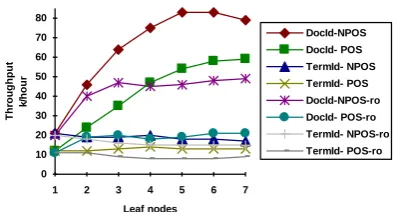
What effect do these results have on throughput? In Figures 30 to 34 the throughput figures are declared, with the data separated into transaction sets. The suffix "ro" in the diagrams signifies that the run was done in the presence of an index reorganisation. The throughput measure is thousands of transactions per hour.
Take in Figure 30. BASE1: combined transactions throughput for UPDATE1 transaction set
Take in Figure 31. BASE1: combined transactions throughput for UPDATE2 transaction set
Take in Figure 32. BASE1: combined transactions throughput for UPDATE3 transaction set
Take in Figure 33. BASE1: combined transactions throughput for UPDATE4 transaction set
The main conclusion from these throughput results is that DocId partitioning outperforms TermId using any type of index (as would be expected from the elapsed time data). Using this measure demonstrates how disappointing the performance of TermId actually is: throughput is not improved by the addition of extra leaf nodes. Many runs are limited to a throughput of 20k transactions per hour. The best performing index type/partitioning pair is DocId with postings only indexes on any of the transaction sets. It can be seen in the diagrams through DocId with postings only data that the transaction set has an impact on trends in throughput. For example, on the UPDATE1 set there is a clear increase in throughput for increasing numbers of leaf nodes, while throughput on the UPDATE set shows a clear tailing off effect with larger numbers of leaf nodes (see Figures 30 and 34). Throughput on the index type/partitioning method relative to each other is consistent irrespective of the transaction set under scrutiny.
Take in Figure 35. BASE1 [DocId]: load imbalance for all transactions (postings only)
Take in Figure 36. BASE1 [DocId]: load imbalance for all transactions (position data)
Take in Figure 37. BASE1 [TermId]: load imbalance for all transactions (postings only)
Take in Figure 38. BASE1 [TermId]: load imbalance for all transactions (position data)
How does load imbalance affect the results given above? Load imbalance does not appear to be a significant problem: Figures 35 to 38 show the overall level of load imbalance for all transactions. It can be seen that imbalance is higher in DocId than it is in TermId, for both types of indexes. The imbalance figures for all results are relatively small, but clearly there is an increase in imbalance with increasing parallel machine size on DocId, while imbalance on TermId remains fairly constant. The key result here is that document updates do not harm overall load imbalance significantly. The “round robin” method of distributing document updates to nodes when DocId partitioning is used is a reasonable method. The results also show that it may be possible to offer better concurrent transaction service on TermId partitioning than DocId partitioning (this is consistent with imbalance results found in probabilistic search (MacFarlane et al., 2000)).
Take in Table III. BASE1/BASE10 [DocId]: index update results for all transactions
viable to use the index update method for this task, particularly if queries are delayed beyond the 10 second elapsed time recommendation (Frakes, 1992) during an index reorganisation on much larger collections. Scalability is very good and increases with the number of updates in a transaction: as would be expected since updates provide much better scalability than queries (see Table II). Elapsed times trends are inverse to that of scalability and for the same reason.
It is clear that within our experimental framework the best partitioning method for transaction processing is DocId. Both the experiments discussed here and work discussed throughout this paper show that DocId partitioning provides better performance both in normal transaction processing and when an index reorganisation is initiated for all types of transactions. However, the imbalance figures demonstrate that concurrent transaction processing might work well on TermId partitioning, a conclusion which reinforces our previous experience with search (MacFarlane et al., 2000). Scalability of transactions using DocId partitioning is good, but results demonstrate that the index update task defined here may not be a viable solution for much larger collections than ones considered here.
6.3 Performance of index reorganisation
The results found in our index reorganisation performance confirm that it is better to wait for a given period and do the reorganisation collectively than do it on a one document basis (Shoens et al., 1994). Figures 39 to 42 show the index reorganisation results using elapsed time in seconds.
Take in Figure 39. BASE1 [DocId]: index reorganisation elapsed time in seconds (postings only)
Take in Figure 40. BASE1 [DocId]: index reorganisation elapsed time in seconds (position data)
Take in Figure 41. BASE1 [TermId]: index reorganisation elapsed time in seconds (postings only)
Take in Figure 42. BASE1 [TermId]: index reorganisation elapsed time in seconds (position data)
Take in Figure 43. BASE1 [DocId]: index reorganisation speedup (postings only)
Take in Figure 44. . BASE1 [DocId]: index reorganisation speedup (position data)
Take in Figure 45. BASE1 [TermId]: index reorganisation speedup (postings only)
Take in Figure 46. BASE1 [TermId]: index reorganisation speedup (position data)
Good speed advantage is shown by any number of leaf nodes using any type of partitioning method. Super-linear speedup is shown on both partitioning methods, apart from TermId, on any run using 6 leaf nodes with any type of index. The run on 6 leaf nodes on an 80 document buffer is particularly disappointing considering the other results. We will return to this factor when discussing load imbalance below. Why does this super-linear speedup occur? If we examine the total time needed for an index reorganisation we find that all parallel runs reduce the total time for an index reorganisation. Figures 47 and 48 show the underlying reason why the super-linear speedup occurs.
Take in Figure 47. BASE1 [DocId]: millions of postings handled during index reorganisation
Take in Figure 48. BASE1 [TermId]: millions of postings handled during index reorganisation
The total number of posting records handled for DocId actually reduces with increasing numbers of leaf nodes, but TermId runs move much the same amount of data. The reason for this effect in DocId partitioning is that as the number of leaf nodes is increased, the more frequent terms which both the buffer and index shared are spread over more blocks which have fewer records associated with them. The more frequent occurring terms are interspersed among less frequent terms as more blocks are handled. This effect does not happen on TermId partitioning as much the same blocks will be handled by parallel runs of any leaf node size. There is some variation in TermId but the effect is minimal. Note that the number of postings moved for a 500 document buffer is always slightly more than those for a 400 document buffer. The total number of postings in BASE1 collection is 22.6 million: just over half the index is reorganised for just 500 documents, reducing with increasing numbers of leaf nodes. The evidence suggests that a good buffer size for this data is 500 documents.
Take in Figure 49. BASE1 [DocId]: index reorganisation load imbalance (postings only)
Take in Figure 50. BASE1 [TermId]: index reorganisation load imbalance (postings only)
Take in Figure 51. BASE1 [DocId]: index reorganisation load imbalance (position data
Take in Figure 52. BASE1 [TermId]: index reorganisation load imbalance (position data)
The imbalance figures for DocId partitioning show that initiating index reorganisations with a 40 document buffer does not yield good load balance. Increasing the leaf nodes set size also has a tendency to increase imbalance. The TermId partitioning method is generally more consistent, but imbalance on six leaf nodes for any buffer size is noticeably worse than for other leaf nodes. This is a failure of the distribution process which relies on a heuristic to distribute data to leaf nodes. This has a direct and significant impact on speedup for TermId partitioning runs for 6 leaf nodes (see figs 45 and 46).
6.4 Summary of experimental results
In all aspects of transaction processing and index reorganisation, DocId partitioning is shown to be superior to TermId partitioning. For update transactions both methods are quick when data is added to the buffer, but DocId provides better transaction performance when an index reorganisation is being executed. Many update transactions meet our 100 millisecond requirement for elapsed times for document insertions. For transactions with both updates and queries, DocId is superior largely because of the performance improvement which is obtained with that method, shown in previous experiments with probabilistic search (MacFarlane et al., 2000). The total number of records moved during index reorganisation is reduced with increasing numbers of leaf nodes when DocId partitioning is used. There is, however, an offset between the buffer size for incoming updates and increasing the leaf nodes set in order to reduce the amount of data moved. Overall our empirical results demonstrate that DocId partitioning is the preferred method for servicing the inverted file index maintenance techniques outlined in this paper. One might question the viability of the method of index update, if queries are delayed beyond the 10 second response time recommended by Frakes (1992) or updates are delayed more than the 100 millisecond or 1 second requirement recommended in this paper. This issue will be examined further in the conclusion.
Conclusion
moved reduces with increasing leaf node set size due to the qualities of the keyword set for each element of the leaf nodes set (the assumption made in the synthetic model was correct). Providing the same term block strategy was used, this effect will be a generic one. We have found evidence, however, that TermId might be useful in a concurrent transaction processing context, and this would have to be the focus for any future research.
It may be the case that the methods outlined in this paper for dealing with new documents may not be viable in a realistic situation: we could consider a scenario where the update rate was so high buffer space would run out, thereby crashing the system or cause a denial of service. Such a problem would occur when there are more updates being submitted to the system than it can handle, so that the time to re-organise an index with these new updates is greater than the actual time available on the system. There are limits to a method of storage such as inverted file which is designed for fast search and which is expensive to maintain: therefore, for these high update applications some other method of transaction processing and storage method is required. Where our methods are not useable we would recommend the use of a two phase signature search (Cringean et al., 1990) which allow for cheap updates, but also allow for a high degree of parallelism.
Acknowledgements
This research is supported by the British Academy under grant number IS96/4203. We are also grateful to ACSys for awarding the first author a visiting student fellowship at the Australian National University in order to complete this research and the use of their equipment. We are particularly grateful to David Hawking for making the arrangements for the visit to the ANU.
References
Brown, E.W., Callan, J.P., Croft, W.B. and Moss, J.E.B. (1994), “Suporting full-text information retrieval with a persistent object store, in Jarke, M., Bubenko, J. and Jeffery, K. (Eds), Proceedings of EDBT'94, March 1994, LNCS 779, Springer-Verlag, pp. 365-377.
Clarke, C.L.A. and Cormack, G.V. (1995), Dynamic Inverted Indexes for a Distributed Full-Text Retrieval System, MultiText Project Technical Report MT-95-01, Department of Computer Science, University of Waterloo, Ontario. Cringean, J.K., England, R., Manson, G.A. and Willett, P. (1990), “Parallel text
searching in serial files using a processor farm”, in Vidick, J.L. (Ed), Proceedings of the 13th International Conference on Research and Development in Information Retrieval, ACM Press, pp. 429-453.
DeWitt D. and Gray, J. (1992), “Parallel database systems: the future of high performance database systems”, Communications of the ACM, Vol. 35, No. 6. Frakes, W.B. (1992), “Introduction to information storage and retrieval systems”, in
Frakes, W.B, and Baeza-Yates, R. (Eds), Information Retrieval, Data Structures and Algorithms, Prentice-Hall, pp. 1-12.
Proceedings of the Seventh Text Retrieval Conference, Gaithersburg, U.S.A, November 1998, NIST Special publication 500-242, pp. 91-104.
Lewis, D. (2006), The Reuters 21578 test collection, available at: http://www.daviddlewis.com/resources/testcollections/reuters21578/ (accessed 22 August 2006).
MacFarlane, A., McCann J.A. and Robertson S.E. (2005), “Parallel methods for the generation of partitioned inverted files”, Aslib Proceedings, Vol. 57 No. 5, pp. 434-459.
MacFarlane, A., Robertson S.E. and McCann J.A. (1996), “On concurrency control for inverted files”, in Johnson, F.C. (Ed.), Proceedings of the 18th BCS IRSG Annual Colloquium on Information Retrieval Research, March 26-27 1996, Manchester, BCS IRSG, pp. 67-79.
MacFarlane, A., Robertson S.E. and McCann J.A. (1999), “PLIERS at TREC8”, in Voorhees, E. and Harman, D.K. (Eds), Proceedings of the Eight Text Retrieval Conference, Gaithersburg, U.S.A, November 1999, Gaithersburg, SP 500-246, NIST, Gaithersburg, pp. 241-252.
MacFarlane, A., Robertson S.E. and McCann J.A. (2000), “Parallel methods for the search of partitioned inverted files, in, De La Fuente, P. (Ed.), Proceedings of String Processing and Information Retrieval - SPIRE 2000, September 2000, A Coruna, Spain, IEEE Computer Society Press, pp. 209-220.
Shoens, K., Tomasic, A. and Garcia-Molina, H. (1994), “Synthetic workload performance analysis of incremental updates”, in Croft, W.B. and Van Rijsbergen, C.J. (Eds), Proceedings of the 17th annual international ACM-SIGIR conference on research and development in Information Retrieval. SIGIR94, Springer-Verlag, London, pp. 329-338.
Reddaway, S.F. (1991), “High speed text retrieval from large databases on a massively parallel processor”, Information Processing & Management, Vol. 27 No. 4, pp. 311-316.
Thomson Dialog (2005), Dialog Database Catalog, Thomson Dialog Ltd, http://www.dialog.com [visited 29th May 2007]
Glossary
Distributed Build Method of building indexes where text is distributed from a single node. DocId Parititioning method which assigns all document data for a given document
to one index partition
Efficiency Measure of the effective use of processors. Definition: Speedup on n processors/n processors
LI A measure of the amount of load imbalance on n processors: max time on n processors/average time on n processors
Local Build Method of indexing where all processing is kept local to the node. Mhz Megahertz: processor clock speed.
Partition Fragment of inverted file on a nodes disk.
Scalability A measure of how well the algorithm scales on the same equipment. Definition:
Time on small collection Size of large collection --- * --- Time on large collection Size of small collection
Speedup Measure of speed advantage of parallelism. Definition: Time on 1 processors / Time on n processors.
TermId Parititioning method which assigns all term data for a given term to one partition
TREC Annual Text Retrieval Conference run by the National Institute of Standards and Technology in the United States.
Figure 1. Example of transaction topology configuration 0 20 40 60 80 100
1 2 3 4 5 6 7
Leaf nodes Ti m e : m s update update1 update2 update3 update4
Figure 2. BASE1 [DocId]: average elapsed
time in ms for update transactions (postings only) Leaf nodes T im e : m s 0 10 20 30 40 50 60 70 80 90 100
1 2 3 4 5 6 7
update update1 update2 update3 update4
Figure 3. BASE1 [TermId]: average elapsed
time in ms for update transactions (postings only) Leaf nodes T im e : m s 0 20 40 60 80 100 120 140 160 180 200
1 2 3 4 5 6 7
update
update1
update2 update3
update4
Figure 4. BASE1 [DocId]: average elapsed
time in ms for update transactions (position data) Leaf nodes T im e : m s 0 20 40 60 80 100 120 140 160 180 200
1 2 3 4 5 6 7
update
update1
update2 update3
update4
Figure 5. BASE1 [TermId]: average elapsed
time in ms for update transactions (position data)
commit
Top Node Client document
commit analysed document
Leaf Node1 Leaf Node2 Leaf Noden
Leaf nodes
S
p
e
e
d
u
p
1 1.5 2 2.5 3 3.5
2 3 4 5 6 7
update update1
update2
[image:18.595.87.515.75.354.2]update3 update4
Figure 6. BASE1 [DocId]: speedup for
update transactions (postings only)
Leaf nodes
S
p
e
e
d
u
p
1 1.5 2 2.5 3 3.5
2 3 4 5 6 7
update update1
update2
update3 update4
Figure 7. BASE1 [TermId]: speedup for
update transactions (postings only)
Leaf nodes
S
p
e
e
d
u
p
1 1.5 2 2.5 3 3.5 4 4.5
2 3 4 5 6 7
update
update1
update2 update3
update4
Figure 8. BASE1 [DocId]: speedup for
update transactions (position data)
Leaf nodes
S
p
e
e
d
u
p
1 1.5 2 2.5 3 3.5 4 4.5
2 3 4 5 6 7
update
update1 update2
update3 update4
Figure 9. BASE1 [TermId]: speedup for
Leaf nodes T im e : m s 0 10 20 30 40 50 60 70 80 90 100
1 2 3 4 5 6 7
update
update1 update2
update3
update4
Figure 10. BASE1 [DocId]: average elapsed
time in ms for update transactions during index reorganisation (postings only)
Leaf nodes T im e : m s 0 20 40 60 80 100 120 140 160 180 200
1 2 3 4 5 6 7
update
update1
update2 update3
update4
Figure 11. BASE1 [TermId]: average
elapsed time in ms for update transactions during index reorganisation (postings only)
Leaf nodes T im e : m s 0 20 40 60 80 100 120 140 160 180 200
1 2 3 4 5 6 7
update
update1 update2
update3
update4
Figure 12. BASE1 [DocId]: average elapsed
time in ms for update transactions during index reorganisation (position data)
Leaf nodes T im e : m s 0 50 100 150 200 250 300 350 400 450
1 2 3 4 5 6 7
update
update1
update2 update3
update4
Figure 13. BASE1 [TermId]: average
Leaf nodes % i n c re a s e 0 10 20 30 40 50 60 70 80 90 100
1 2 3 4 5 6 7
update update1
update2 update3
[image:20.595.311.505.103.210.2]update4
Figure 14. BASE1 [DocId]: % increase in
average elapsed time for update transactions during index reorganisation (postings only)
Leaf nodes % i n c re a s e 0 50 100 150 200 250
1 2 3 4 5 6 7
update update1
update2
[image:20.595.94.292.104.213.2]update3 update4
Figure 15. BASE1 [TermId]: % increase in
average elapsed time for update transactions during index reorganisation (postings
only) Leaf nodes % i n c re a s e 0 20 40 60 80 100 120 140 160 180 200
1 2 3 4 5 6 7
update update1
update2 update3
[image:20.595.309.505.261.369.2]update4
Figure 16. BASE1 [DocId]: % increase in
average elapsed time for update transactions during index reorganisation (position data)
Leaf nodes % i n c re a s e 0 50 100 150 200 250 300 350
1 2 3 4 5 6 7
update update1
update2
update3 update4
Figure 17. BASE1 [TermId]: % increase in
[image:20.595.94.293.273.379.2]Leaf nodes
ms
0 50 100 150 200 250 300 350 400
1 2 3 4 5 6 7
update
update1 update2
update3
update4
Figure 18. BASE1 [DocId]: transaction
average elapsed times in ms (postings only)
Leaf nodes
ms
0 50 100 150 200 250 300 350 400
1 2 3 4 5 6 7
update
update1 update2
[image:21.595.309.500.89.198.2]update3 update4
Figure 19. BASE1 [TermId]: transaction
average elapsed times in ms (postings only)
Leaf nodes
ms
0 100 200 300 400 500 600
1 2 3 4 5 6 7
update
update1
update2 update3
[image:21.595.95.290.89.199.2]update4
Figure 20. BASE1 [DocId]: transaction
average elapsed times in ms (position data)
Leaf nodes
ms
0 100 200 300 400 500 600
1 2 3 4 5 6 7
update
update1 update2
update3 update4
Figure 21. BASE1 [TermId]: transaction
[image:21.595.311.504.261.369.2]Leaf nodes
S
p
e
e
d
u
p
0 1 2 3 4 5 6 7
2 3 4 5 6 7
UPDATE1
UPDATE2 UPDATE3
UPDATE4
UPDATE
Figure 22. BASE1 [DocId]: speedup for all
transactions (postings only)
Leaf nodes
S
p
e
e
d
u
p
0 0.2 0.4 0.6 0.8 1 1.2 1.4 1.6 1.8 2
2 3 4 5 6 7
[image:22.595.89.508.89.415.2]UPDATE1 UPDATE2 UPDATE3 UPDATE4 UPDATE
Figure 23. BASE1 [TermId]: speedup for all
transactions (postings only)
Leaf nodes
S
p
e
e
d
u
p
0 1 2 3 4 5 6 7
2 3 4 5 6 7
UPDATE1
UPDATE2 UPDATE3
UPDATE4
UPDATE
Figure 24. BASE1 [DocId]: speedup for all
transactions (position data)
Leaf nodes
S
p
e
e
d
u
p
0 0.2 0.4 0.6 0.8 1 1.2 1.4 1.6 1.8 2
2 3 4 5 6 7
UPDATE1 UPDATE2 UPDATE3 UPDATE4 UPDATE
Figure 25. BASE1 [TermId]: speedup for all
Leaf nodes T im e : m s 0 50 100 150 200 250 300 350
1 2 3 4 5 6 7
update
update1 update2
update3
update4
Figure 26. BASE1 [DocId]: average elapsed
time in ms for all transactions during index reorganisation (postings only)
Leaf nodes T im e : m s 0 50 100 150 200 250 300 350 400 450 500
1 2 3 4 5 6 7
update update1
update2
update3 update4
Figure 27. BASE1 [TermId]: average
elapsed time in ms for all transactions during index reorganisation (postings only)
Leaf nodes T im e : m s 0 100 200 300 400 500 600
1 2 3 4 5 6 7
update
update1 update2
update3
[image:23.595.95.292.87.197.2]update4
Figure 28. BASE1 [DocId]: average elapsed
time in ms for all transactions during index reorganisation (position data)
Leaf nodes T im e : m s 0 100 200 300 400 500 600 700 800
1 2 3 4 5 6 7
update update1
update2
update3 update4
Figure 29. BASE1 [TermId]: average
elapsed time in ms for all transactions during index reorganisation (position data)
0 10 20 30 40 50 60 70 80
1 2 3 4 5 6 7
[image:23.595.307.505.91.197.2]Leaf nodes Th ro ug hp ut k /ho ur DocId- NPOS DocId- POS TermId- NPOS TermId- POS DocId-NPOS-ro DocId-POS-ro TermId- NPOS-ro TermId- POS-ro
Figure 30. BASE1: combined transactions
throughput for UPDATE1 transaction set
Leaf nodes T h ro u g h p u t k /h o u r 0 10 20 30 40 50 60 70 80
1 2 3 4 5 6 7
DocId-NPOS DocId- POS TermId- NPOS TermId- POS DocId- NPOS-ro DocId- POS-ro TermId-NPOS-ro TermId- POS-ro
Figure 31. BASE1: combined transactions
throughput for UPDATE2 transaction set
Leaf nodes T h ro u g h p u t k /h o u r 0 10 20 30 40 50 60 70 80
1 2 3 4 5 6 7
[image:23.595.307.507.248.368.2]DocId-NPOS DocId-POS TermId-NPOS TermId-POS DocId-NPOS-ro DocId-POS-ro TermId-NPOS-ro TermId-POS-ro
Figure 32. BASE1: combined transactions
throughput for UPDATE3 transaction set
Leaf nodes T h ro u g h p u t k /h o u r 0 10 20 30 40 50 60 70 80
1 2 3 4 5 6 7
DocId-NPOS DocId- POS TermId- NPOS TermId- POS DocId-NPOS-ro DocId- POS-ro TermId- NPOS-ro TermId- POS-ro
Figure 33. BASE1: combined transactions
[image:23.595.93.292.258.369.2] [image:23.595.93.290.583.688.2]Leaf nodes
T
h
ro
u
g
h
p
u
t
k
/h
o
u
r
0 10 20 30 40 50 60 70 80
1 2 3 4 5 6 7
DocId-NPOS DocId- POS
TermId- NPOS
TermId- POS DocId-NPOS-ro
DocId- POS-ro
[image:24.595.199.398.78.184.2]TermId- NPOS-ro TermId- POS-ro
Figure 34. BASE1: combined transactions throughput
Leaf nodes
LI
1 1.1 1.2 1.3 1.4 1.5
2 3 4 5 6 7
UPDATE1
UPDATE2 UPDATE3
UPDATE4
[image:25.595.305.500.87.210.2]UPDATE
Figure 35. BASE1 [DocId]: load imbalance
for all transactions (postings only)
Leaf nodes
LI
1 1.1 1.2 1.3 1.4 1.5
2 3 4 5 6 7
UPDATE1
UPDATE2 UPDATE3
UPDATE4
UPDATE
Figure 36. BASE1 [DocId]: load imbalance
for all transactions (position data)
Leaf nodes
LI
1 1.1 1.2 1.3 1.4 1.5
2 3 4 5 6 7
UPDATE1
UPDATE2
UPDATE3 UPDATE4
[image:25.595.96.295.260.370.2]UPDATE
Figure 37. BASE1 [TermId]: load imbalance
for all transactions (postings only)
Leaf nodes
LI
1 1.1 1.2 1.3 1.4 1.5
2 3 4 5 6 7
UPDATE1
UPDATE2 UPDATE3
UPDATE4 UPDATE
Figure 38. BASE1 [TermId]: load imbalance
[image:25.595.309.504.262.369.2]0 50 100 150 200
1 2 3 4 5 6 7
[image:26.595.93.513.76.502.2]Leaf nodes E la pse d Ti m e : s e c s 40 docs 80 docs 200 docs 400 docs 500 docs
Figure 39. BASE1 [DocId]: index
reorganisation elapsed time in seconds (postings only) Leaf nodes E la p s e d T im e : s e c s 0 50 100 150 200 250 300 350 400 450 500
1 2 3 4 5 6 7
40 docs
80 docs
200 docs 400 docs
500 docs
Figure 40. BASE1 [DocId]: index
reorganisation elapsed time in seconds (position data) Leaf nodes E la p s e d T im e : s e c s 0 20 40 60 80 100 120 140 160 180 200
1 2 3 4 5 6 7
40 docs 80 docs
200 docs
400 docs 500 docs
Figure 41. BASE1 [TermId]: index
reorganisation elapsed time in seconds (postings only) Leaf nodes E la p s e d T im e : s e c s 0 50 100 150 200 250 300 350 400 450 500
1 2 3 4 5 6 7
40 docs 80 docs
200 docs
400 docs 500 docs
Figure 42. BASE1 [TermId]: index
[image:26.595.308.503.88.201.2]1 6 11 16
2 3 4 5 6 7
Leaf nodes
S
pee
du
p
[image:27.595.308.504.104.224.2]40 docs 80 docs 200 docs 400 docs 500 docs
Figure 43. BASE1 [DocId]: index
reorganisation speedup (postings only)
1 6 11 16
2 3 4 5 6 7
Leaf nodes
S
pee
du
p
[image:27.595.101.290.109.203.2]40 docs 80 docs 200 docs 400 docs 500 docs
Figure 44. BASE1 [DocId]: index
reorganisation speedup (position data)
Leaf nodes
S
p
e
e
d
u
p
1 2 3 4 5 6 7 8 9 10
2 3 4 5 6 7
40 docs
80 docs
200 docs 400 docs
[image:27.595.100.289.261.353.2]500 docs
Figure 45. BASE1 [TermId]: index
reorganisation speedup (postings only)
Leaf nodes
S
p
e
e
d
u
p
1 2 3 4 5 6 7 8 9 10
2 3 4 5 6 7
40 docs 80 docs
200 docs
400 docs 500 docs
Figure 46. BASE1 [TermId]: index
[image:27.595.312.506.271.381.2]Leaf nodes
R
e
c
o
rd
s
:
m
il
li
o
n
s
0 2 4 6 8 10 12 14
1 2 3 4 5 6 7
40 docs 80 docs
200 docs 400 docs
[image:28.595.93.293.107.211.2]500 docs
Figure 47. BASE1 [DocId]: millions of
postings handled during index reorganisation
Leaf nodes
R
e
c
o
rd
s
:
m
il
li
o
n
s
0 2 4 6 8 10 12 14
1 2 3 4 5 6 7
40 docs 80 docs
200 docs 400 docs
500 docs
Figure 48. BASE1 [TermId]: millions of
[image:28.595.307.506.109.210.2]Leaf nodes
LI
1 1.1 1.2 1.3 1.4 1.5 1.6 1.7 1.8 1.9 2
2 3 4 5 6 7
40 Docs
80 Docs 200 Docs
400 Docs 500 Docs
Figure 49. BASE1 [DocId]: index
reorganisation load imbalance (postings only)
Leaf nodes
LI
1 1.1 1.2 1.3 1.4 1.5 1.6 1.7 1.8 1.9 2
2 3 4 5 6 7
40 Docs
80 Docs 200 Docs
400 Docs
500 Docs
Figure 50. BASE1 [TermId]: index
reorganisation load imbalance (postings only)
Leaf nodes
LI
1 1.1 1.2 1.3 1.4 1.5 1.6 1.7 1.8 1.9 2
2 3 4 5 6 7
40 Docs
80 Docs 200 Docs
400 Docs
[image:29.595.87.507.94.432.2]500 Docs
Figure 51. BASE1 [DocId]: index
reorganisation load imbalance (position data)
Leaf nodes
LI
1 1.1 1.2 1.3 1.4 1.5 1.6 1.7 1.8 1.9 2
2 3 4 5 6 7
40 Docs 80 Docs
200 Docs
400 Docs 500 Docs
Figure 52. BASE1 [TermId]: index
Table I. Details of transaction sets used in experiments Transaction set Name No of Updates No of Queries No of Transactions
UPDATE1 40 400 440
UPDATE2 80 400 480
UPDATE3 200 400 600
UPDATE4 400 400 800
UPDATE 500 400 900
Table II. BASE1/BASE10 [DocId]: index update results for update transactions
Metric Collection UP UP1 UP2 UP3 UP4
Postings Only (No Positions)
Elapsed Time (ms) BASE1 BASE10 43 109 43 124 46 124 40 121 43 123 Scalability BASE10 3.97 3.46 3.72 3.33 3.51 Elapsed Time (ms)
during index update
BASE1 BASE10 55 268 64 380 62 359 60 310 57 299 Scalability during index update
BASE10 2.07 1.67 1.73 1.95 1.91
Position Data
Elapsed Time (ms) BASE1 BASE10 52 202 48 265 51 261 48 243 51 246 Scalability BASE10 2.55 1.83 1.97 1.98 2.06 Elapsed Time (ms)
during index update
BASE1 BASE10 103 621 130 971 131 975 125 892 115 817 Scalability during index update
BASE10 1.66 1.34 1.34 1.40 1.40
Table III. BASE1/BASE10 [DocId]: index update results for all transactions
Metric Collection UP UP1 UP2 UP3 UP4
Postings Only (No Positions)
Elapsed Time (ms) BASE1 BASE10 60 257 75 479 73 440 66 363 60 280 Scalability BASE10 2.35 1.56 1.66 1.83 2.14 Elapsed Time (ms)
during index update
BASE1 BASE10 80 551 118 1021 112 949 98 776 82 604 Scalability during index update
BASE10 1.46 1.15 1.18 1.26 1.36
Position Data
Elapsed Time (ms) BASE1 BASE10 72 448 103 891 97 818 84 660 73 505 Scalability BASE10 1.61 1.15 1.18 1.27 1.45 Elapsed Time (ms)
during index update
BASE1 BASE10 159 1368 265 2562 246 2364 205 1924 167 1517 Scalability during index update
[image:30.595.141.453.484.675.2]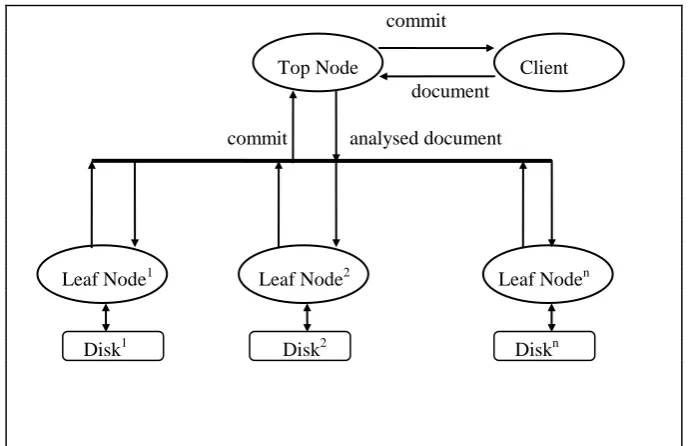
![Figure 6. BASE1 [DocId]: speedup for update transactions (postings only)](https://thumb-us.123doks.com/thumbv2/123dok_us/1641265.117568/18.595.87.515.75.354/figure-base-docid-speedup-update-transactions-postings.webp)
![Figure 16. BASE1 [average elapsed time for update transactions DocId]: % increase in during index reorganisation (position data)](https://thumb-us.123doks.com/thumbv2/123dok_us/1641265.117568/20.595.309.505.261.369/figure-average-elapsed-update-transactions-increase-reorganisation-position.webp)
![Figure 21. BASE1 [TermId]: transaction average elapsed times in ms (position data)](https://thumb-us.123doks.com/thumbv2/123dok_us/1641265.117568/21.595.309.500.89.198/figure-base-termid-transaction-average-elapsed-times-position.webp)
![Figure 23. BASE1 [TermId]: speedup for all transactions (postings only)](https://thumb-us.123doks.com/thumbv2/123dok_us/1641265.117568/22.595.89.508.89.415/figure-base-termid-speedup-transactions-postings.webp)
![Figure 38. BASE1 [TermId]: load imbalance for all transactions (position data)](https://thumb-us.123doks.com/thumbv2/123dok_us/1641265.117568/25.595.305.500.87.210/figure-base-termid-load-imbalance-transactions-position-data.webp)
![Figure 39. BASE1 [DocId]: index reorganisation elapsed time in seconds](https://thumb-us.123doks.com/thumbv2/123dok_us/1641265.117568/26.595.308.503.88.201/figure-base-docid-index-reorganisation-elapsed-time-seconds.webp)
![Figure 46. BASE1 [TermId]: index reorganisation speedup (position data)](https://thumb-us.123doks.com/thumbv2/123dok_us/1641265.117568/27.595.308.504.104.224/figure-base-termid-index-reorganisation-speedup-position-data.webp)
