Methodology for Integrated Socio-Economic Assessment of
Offshore Platforms: Towards Facilitation of the Implementation
of the Marine Strategy Framework Directive
P. Koundouri,1,2,3 O.G. Dávila,2 M. Stithou,2 V. Babalos,2 A. Xepapadeas,2 I. Anastasiou,2 A. Antypas,2 N. Kourogenis,2 A. Mousoulides,2 M. Mousoulidou,2 N. Ahrensberg,4 B. Zanuttigh,5 F. Zagonari,5 M.A. Lange,6 C. Jimenez,6 E. Charalambous,6 L. Rosen,7 A. Lindhe,7 J. Norrman,7 T. Norberg,8 T. Söderqvist9 A. Pedersen,10 D. Troianos,11 A. Frentzos,11 Y. Krontira,11 I.J. Losada,12 P. Diaz-Simal,12 R. Guanche,12 M. de Bel,13 W. He,14 S. Kabdasli,15 N. Elginöz,15 E. Oguz,15 T. Bagci,15 B. Bas,16 M. Cantu’,17 M. Masotti, 17 R. Suffredini,17 M. Stuiver18
Abstract. In this paper a Methodology for Integrated Socio-Economic Assessment (MISEA) of the viability and sustainability of different designs of Multi-Use Offshore Platforms (MUOPs) is presented. MUOPs are designed for multi-use of ocean space for energy extraction (wind power production and wave energy), aquaculture and transport maritime services. The developed methodology allows identification, valuation and assessment of: the potential range of impacts of a number of feasible designs of MUOP investments, and the likely responses of those impacted by the investment project. This methodology provides decision-makers with a valuable decision tool to assess whether a MUOP project increases the overall social welfare and hence should be undertaken, under alternative specifications regarding its design, the discount rate and the stream of net benefits, if a Cost-Benefit Analysis (CBA) is to be followed or sensitivity analysis of selected criteria in a Multi-Criteria Decision Analysis (MCDA) framework. Such a methodology is also crucial for facilitating of the implementation of the Marine Strategy Framework Directive (MSFD adopted in June 2008) that aims to achieve good environmental status of the EU's marine waters by 2020 and to protect the resource base upon which marine-related economic and social activities depend. According to the MSFD each member state must draw up a program of cost-effective measures, while prior to any new measure an impact assessment which contains a detailed cost-benefit analysis of the proposed measures is required.
Keywords: Multi-Use Offshore Platforms, Integrated Socio-Economic Assessment, Marine Strategy Framework Directive, Program of Measures, Cost-Benefit Analysis.
1
Contact Author E-mail address: [email protected], Phone: +30-(0)693-95 87 871
2
Athens University of Economics and Business-Research Centre, 76, Patission Str. 10434, Athens, Greece
3
Grantham Research Institute on Climate Change and the Environment, London School of Economics and Political Science (LSE), Houghton Street, London WC2A 2AE, UK
4
DHI, Agern Allé 5 2970, Hörsholm, Denmark
5Alma Mater Studiorum - Università di Bologna, Via Zamboni n.33, 40126 Bologna, Italy 6
Energy, Environment and Water Research Center (EEWRC), The Cyprus Institute. 20 Konstantinou Kavafi, 2121 Aglanzia, Nicosia. P.O. Box 27456, CY-1645 Nicosia, Cyprus.
7
Department of Civil and Environmental Engineering, Chalmers University of Technology, SE-412 96 Gothenburg, Sweden.
8
Department of Mathematical Sciences, Chalmers University of Technology and University of Gothenburg, SE-412 96 Gothenburg, Sweden.
9
Enveco Environmental Economics Consultancy Ltd., Måsholmstorget 3, SE-12748 Skärholmen, Sweden.
10
DONG Energy Power AS*, AC Meyers Vænge 9, 2450 Copenhagen SV, Denmark
11
Kefalonia Fisheries Industrial and Commercial Company, Livadi, Lixouri Kefalonia 28200, Greece
12Instituto de Hidráulica Ambiental "IH Cantabria" Universidad de Cantabria, Avda de los Castros s/n, Santander
39005,Spain
13
Deltares, P.O. Box 177, 2600 MH Delft, Netherlands
14
Statoil Petroleum AS, Forusbeen 50, 4035 Stavanger, Norway
15 Civil Engineering Dep., Istanbul Technical University, Istanbul, 34469, Turkey 16
Shipbuilding and Ocean Engineering Dep., Istanbul Technical University, Istanbul, 34469, Turkey
17 Enel Ingegneria e Ricerca SpA, Viale Regina Margherita 137, 00198 Rome, Italy 18
2
Introduction
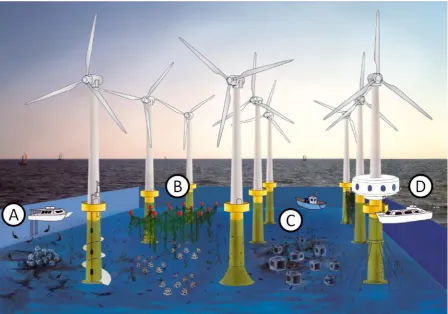
Acknowledging the pressures on the use of the seashore and also of the fact that the open sea space offers a large potential for development, due to the possibility that innovative synergies can be created between socio-technical and ecological uses, a new vision for multi-use green infrastructure is foreseen as shown in the Figure 1 (Lacroix and Pioch, 2011).
Figure 1: Example of multi-use management of a wind farm. The wind turbine density is artificially high to facilitate the presentation of the concept. Activities: A) diving, B) scientific studies, C) aquaculture and D) fishing and tourism. © Denis Lacroix, Ifremer and Malo Lacroix (Source: Lacroix and Pioch, 2011, p.133).
[image:2.595.75.524.207.521.2]3 available ocean space at specific sites. Within this framework, a socio-economic analysis is performed to identify and quantify the impact on human welfare of such an activity. This not only focusses on financial feasibility, but includes social and ecological aspects, including consideration of the distribution of all impacts across the different stakeholders. In this manner, this analysis can help by giving consideration to social/cultural values within ecosystem services frameworks and includes as well a comprehensive ecological and socio-economic analysis.
In the following sections a Methodology for Integrated Socio-Economic Assessment (MISEA) to assess the viability and sustainability of Multi-Use Offshore Platforms (MUOPs) is presented. The economic, social and environmental effects of the proposed structures are identified, quantified and combined. The relevance of this methodology lies in the fact that it can be used to facilitate the implementation of the EU water framework directive as defined in the guidance document of the Marine Strategy Framework Directive (MSFD-Directive 2008/56/EC). The MSFD was adopted in June 2008 and aims to achieve good environmental status of the EU's marine waters by 2020and to protect the resource base upon which marine-related economic and social activities depend. In the MSFD, a thematic strategy for the protection and conservation of the marine environment has been developed with the aim of promoting sustainable use of the seas while protecting marine ecosystems.
4 The objective of this paper is to develop a methodology for assessment of MUOPs in accordance to the MSFD. The development of MISEA entails the following general steps. First, the socio-economic characterisation of each of the four selected MERMAID sites (North Sea, Mediterranean, Baltic Sea and the Atlantic Coast of France and Spain) in terms of wind power production, aquaculture and transport maritime services is made. Second, the production and demand structures of the proposed MUOPs are investigated. This is done by the identification and quantification of costs and benefits of suggested MUOPs by using market and non-market methods in order to capture private, social/public and ecological effects. At a final stage, policy recommendations are based on economic tools such as Cost-Effectiveness Analysis (CEA), Cost-Benefit Analysis (CBA) and other approaches to socio-economic analysis such as Multi-Criteria Decision Analysis (MCDA).
The suggested methodology for socio-economic analysis consists of a baseline profiling of case and socio-economic characterisation with regard to future economic activities (wind/wave production, aquaculture and transport maritime services). Then, production and demand functions of the MUOPs are identified. A decision on whether full or limited data should be collected for an impact assessment is taken. Thereafter data on the site is collected and costs and benefits are quantified. The assessment of impacts and evaluation of the assessment based on CBA/CEA/MCDA or limited data approach, integrating results on Impact Assessment Analysis are conducted. Finally, policy recommendations based on impact assessment results and sensitivity analysis are provided.
5
1
Scoping the assessment
The ‘scoping’ phase of the socio economic impact assessment (SEIA) establishes the goals and boundaries of the assessment and focuses the SEIA on key impacts. In this context, it is important to focus on the significant impacts in order of priority and identify all significant effects on all impacted groups. Therefore, it is essential that all stakeholders are adequately involved throughout the SEIA, and complemented with surveys, secondary data, literature review and consultation with professional experts.
1.1 Key impacts of MUOPs
In this part of the framework, potential key impacts of MUOPs are identified. Note that on-going consultation is expected to fine tune the key impacts while these are dependent on the nature of the designs (floating, offshore, large size, combined activities, etc.). Considering that the suggested methodology extends financial analysis to consider also social and ecological parameters it is foreseen that impacts are related not only to private agents, firms and individuals but also to the society as a whole and to the environment. The following potential risks associated with MUOPs have been identified: effects on the seabed; properties of the water column; faunal composition and spread of invasive species and/or diseases. It is considered that the MUOPs have socio-economic and environmental impacts on commercial shipping and fishing, recreational fishing, yachting and boating and other water-based activities. They also have an impact on land-based activities, regional tourism, processing transport, regional employment (direct and indirect) and training opportunities (Social Sciences Program et al., 2005).
1.1.1 Impacts on environment and ecosystem services
6 on specific ecosystem services. Finally, the ESA assesses the effects on human welfare and values the changes in ecosystem services (DEFRA 2007). When assessing the impact of ecosystem services on human welfare, it is critical to focus on the benefits generated by these services, as this is what affects human welfare directly. It is, therefore, the benefits rather than the services per se that are valued.
1.2 Extent of appropriate information for undertaking the assessment
Due to the multidimensional character of the impacts leading to welfare gains and sometimes losses, a range of different information is needed in order to assess them. Thus, market data, secondary data for the performance of simulations, survey based primary data, data provided from literature review, consultation with experts and stakeholders and information coming from environmental impact assessments are all deemed as very important in the framework of integrated environmental and socio-economic assessment. The MISEA of the viability/sustainability of MUOPs is developed using a general framework of analysis and a method of analysis depending on whether the data is available or not. The method of analysis under sufficient/insufficient data availability or maximum/limited data approach is described in Section 4. Under sufficient data availability all steps of MISEA can be fully applied. Under limited data availability a parsimonious, generic approach to multi-dimensional impact assessment can be employed.
2
Profiling baseline conditions and characterisation of production and
demand of MUOPs
This part of the framework focuses on gathering information about the socio-economic environment and context of the proposed development with regard to energy production, aquaculture and maritime services. Hence, before achieving the evaluation of the socio-economic impact it is necessary to start with the baseline profiling of the case study areas in order to identify who is going to be impacted. Thus, this approach is expected to enable the identification of the production and demand functions of the MUOPs.
2.1 Description of case studies and socio-economic characterisation
7 Adriatic Sea. The activities related to the following subsections are about gathering information on baseline conditions of the wind power production, aquaculture, transport maritime services and wave energy activities. In order to assess indirect and induced impacts a regional profiling is necessary. The information typically gathered as part of a regional profile includes the population characteristics, the political and social resources, a description of historical factors, identification of the relationships with the biophysical environment, culture, attitudes and social-psychological conditions, the current status of operations (aquaculture, energy production, maritime services) and the identification of the people who will be impacted by the project (Social Sciences Program et al. 2005). The initial (base-line) assessment must include economic and social analysis of the use of those waters under current use and future autonomous developments. This base-line assessment should include both market and non-market costs and benefits (Eftec and Enveco, 2010). The scope is the profiling of all current uses and identifying businesses, households and individuals that may be impacted by the future installation of MUOPs. Furthermore, broader social and environmental issues related to current and future operations should be highlighted.
2.2 Production and demand structures of the proposed MUOPs
The following subsections identify economic issues, environmental issues and social issues concerning level of employment, regional development and overall attitude of the population towards the technologies and specific options proposed. The production and demand analysis is based on economic data, environmental valuation surveys (if deemed necessary) and Benefit Transfer (BT) techniques. The suggested methods are presented in more detail in the relevant sections.
2.2.1Production-Side Analysis of Proposed MUOPs
This analysis is based on proposed financial costs of offshore structures as well as social and environmental costs.
2.2.1.1 Identification of private/financial costs of suggested MUOPs
8 it is expected to consider the capital costs which are the upfront costs to construct, install the project hardware and major maintenance work that needs to be carried out during the lifetime of the platform beyond typical operating expenses. Platform development costs may include: technical, legal and planning consultants’ fees, and the developer’s own time, in negotiations with legal and statutory bodies, financing and legal costs, including the costs of arranging finance and others. Running and operation and maintenance costs per year which may include: fuel costs, if applicable, direct costs, staff costs, insurance fees, transport costs, annual fees for licenses and pollution control measures, general maintenance and operating costs of plant, equipment, site, etc. Finally, training costs are expected to cover the training of people who will run the platforms with regard to the safety, financial and environmental implications of the project.
2.2.1.2 Identification of social and environmental costs of suggested MUOPs
Since the scope of the developed methodology is to integrate private and social/environmental costs of the suggested MUOPs it is equally important to consider the latter in the suggested framework of analysis. It is considered that offshore renewable energy installations (e.g., wind farms, energy wave devices) all have local environmental impacts (e.g., to local submarine habitats and seabird populations). Especially in the case of wind farms a regional scale ‘displacement’ impact e.g., displacement of fishing by marine protected areas around wind turbine sites and consequent increase on the fishing pressure in ‘unprotected’ areas or a boost in jelly fish populations may be expected. Aquaculture is associated with local environmental consequences and potential impacts on the marine food web via fish food provision and accidental releases of fish with a low genetic diversity (Turner et al., 2010).
2.2.2 Demand-side analysis of potential production of goods and services of proposed MUOPs
9 income (macro scale). Direct and indirect employment is among the social benefits from MUOPs. Environmental benefits include: mitigated global warming, avoided emissions-compared to non-existent wind farms of current status, improved water quality near the coast or seabed life through less use of pharmaceuticals. The marine and coastal zone interventions and their benefits can be linked to four environmental impacts/effects categories (relevant for human welfare): direct and indirect productivity effects, human health effects, amenity effects (congestion), and existence effects such as loss of marine biodiversity and/or cultural assets (Turner et al., 2011).
3
Data availability and approaches for socio-economic impact assessment
of MUOPs
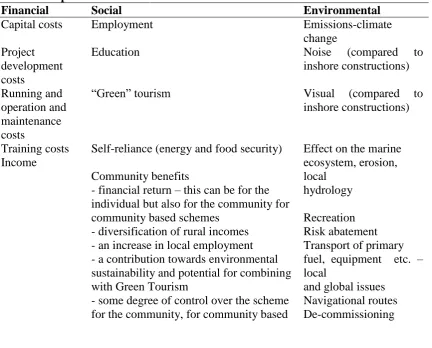
[image:9.595.71.504.441.789.2]In order to proceed to the socio-economic impact of MUOPs it is important to construct a list of impact indicators based on the previous section. It is noted again that while the economic figures can be more easily identified, the social and environmental indicators are generally hidden impacts and may be viewed as positive or negative externalities. Table 1 presents a suggestion of impact indicators and data to be collected.
Table 1: Impact Indicators
Financial Social Environmental
Capital costs Employment Emissions-climate
change Project
development costs
Education Noise (compared to
inshore constructions) Running and
operation and maintenance costs
“Green” tourism Visual (compared to
inshore constructions)
Training costs Income
Self-reliance (energy and food security) Effect on the marine ecosystem, erosion, local
hydrology Community benefits
- financial return – this can be for the individual but also for the community for community based schemes
- diversification of rural incomes - an increase in local employment - a contribution towards environmental sustainability and potential for combining with Green Tourism
- some degree of control over the scheme for the community, for community based
Recreation Risk abatement Transport of primary fuel, equipment etc. – local
10 schemes
- a sense of satisfaction for those involved, and building capacity and strength of community
Product/by product Disposal
Health
- Health hazards related to the operation of the platform and associated equipment - All interrelated factors – such as air quality
3.1 Methods for quantification of costs and benefits
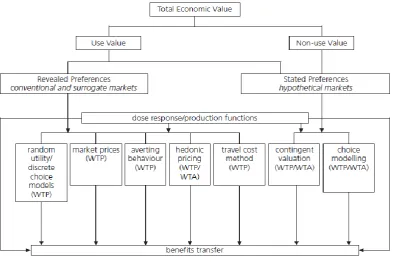
11 Figure 2: Techniques for monetary valuation of non-market services (Source: Eftec, 1999).
CE is another stated preference method. In a CE framework, the good in question is broken down into its component attributes, which are presented to respondents normally as a set of combinations of the attributes. Respondents are then presented with a sequence of choice sets differentiated by its attributes and levels (Bennett and Adamowicz, 2001; Birol and Koundouri, 2008).
The fact that gathering primary site-specific data is costly has made BT a popular alternative for the valuation of ecosystem goods and services. BT is about applying existing economic value estimates from one location where data are collected to another similar site in another location with little or no data (Rosenberger and Loomis, 2000, p.1097). Bergland et al.
(1995) discussed three main approaches to BT: (i) the transfer of the mean household WTP (ii) the transfer of an adjusted mean household WTP and, (iii) the transfer of the demand function.
3.2 A maximum data approach for socio-economic impact assessment
12 objectives. MCDA takes into account project impacts that are not easily given monetary values. It involves a structured approach to differentiating between a range of options, based on a set of objectives or criteria, against which each option is assessed. As argued in Turner et al. (2010, p.33): “The choice between CBA and CEA is determined by the nature of the policy problem under scrutiny. If the problem is one of meeting some environmental standard, complying with a law or achieving a target then finding the least cost way of achieving this by completing a CEA is the appropriate action. If the problem is one of choosing between a number of different possible policy or project options which do not involve compliance with standards or targets then CBA is the most appropriate assessment tool. If the situation is one where monetary valuation is not possible then CEA and CBA should be replaced with a multi-criteria assessment process.” The following subsections present the different versions (CEA, CBA, and MCDA) of the full data approach which depends on specific data availability.
3.2.1 Cost-Effectiveness Analysis (CEA)
CEA is a type of economic evaluation that compares the cost of the investment to its effectiveness. Hence, CEA is a form of economic analysis that enables comparison between different kinds of interventions with similar effects (outcomes) on the basis of the cost per unit achieved. CEA is distinct from CBA, which assigns a monetary value to the measure of effect. Hence, this approach may be deemed more practical for selecting between investment options when the budgets are fixed and/or benefits are hard to attribute monetary values to while it only requires marginal economic data on costs.
3.2.2 Cost-Benefit Analysis (CBA)
13 using different discount rate schemes (Birol et al., 2010). The NPV results reveal whether the net benefit generated by the investment project of MUOPs is positive and significant well into the future. A general calculation of the NPV is the following:
0 (1 ) 0 (1 )
N N
t t t
t t
t t
K B C
NPV
r r
Where Kt is the construction cost, Bt is the stream of benefits, Ct is the stream of maintenance
costs and r is the discount rate. The Internal Rate of Return (IRR) is another important aspect of a CBA. It is the discount rate for which the NPV is zero. Since a CBA of long-term investments is enormously sensitive to the discount rate the use of the classical NPV in the long term is problematic. Recent economic literature (Koundouri, 2009; Gollier et al., 2008) proposes the use of a Declining Discount Rate (DDR). The use of DDR in long–run cost– benefit analysis can replace traditionally employed constant discount rates. The policy implications aligned with the project’s nature and EU’s policy aspirations, are that it implies that the policy-maker will put relatively more effort into improving social welfare in the far distant future than in the short term.
3.2.3 Multi-Criteria Decision Analysis (MCDA)
14 3.3 A limited data approach for socio-economic impact assessment
The “minimum-data Trade-off Analysis” (TOA-MD) is well-suited to address the uncertainty in impact assessments. This approach relies on form of a generic TOA-MD model that can be employed to assess impacts in agricultural, social and economic data populations (Antle and Valdivia 2010). The TOA-MD model is a prominent simulation tool that employs a statistical description of a heterogeneous population of decision making units (DMUs) to simulate the proportion of DMUs that utilizes a baseline system and the proportion of DMUs that would adopt an alternative system within defined strata of the population. The critical decision for adopting limiting data approach is made in terms of acquiring the most robust and informative results under the constraint of available list of data for each case study.
4
Risk analysis approach
It should be clear that all results should be subjected to a rigorous uncertainty/sensitivity analysis since uncertainty is present at all stages of the assessment process. A way to explore uncertainty is through sensitivity analysis. This approach can be used to identify the parameters of the system which are particularly subject to uncertainty and have a significant impact on the outcome of the assessment. A sensitivity analysis can be included within a CBA, to assess the impact on the benefit cost ratio and/or net present value of changes in the values of central parameters (Turner et al., 2010). In a CBA framework it may be relevant to perform an uncertainty analysis rather than just sensitivity analysis, e.g. by assigning parameter uncertainty in the CBA and performing Monte Carlo simulations as described below.
4.1 Risk analysis
15 analysis. Within the context of the project, two types of risk assessment are studied: (i) Sensitivity analysis, and (ii) Monte Carlo simulations.
4.1.1 Sensitivity Analysis
Sensitivity analysis is a technique that determines the values for the NPV or the IRR which correspond to proportional deviations of variables that affect the cash flow of the project from a base case. Sensitivity analysis involves the following steps:
1. Define a base-case or benchmark estimation of the NPV and the IRR, which is developed using the expected values for each variable involved in the cash flow. 2. Identify sensitive or critical variables. These are cash flow variables (e.g., unit
labour cost, average wind velocity, fish output, fish price) with the property that a small deviation of their values from the benchmark value will change the NPV or the IRR a lot.
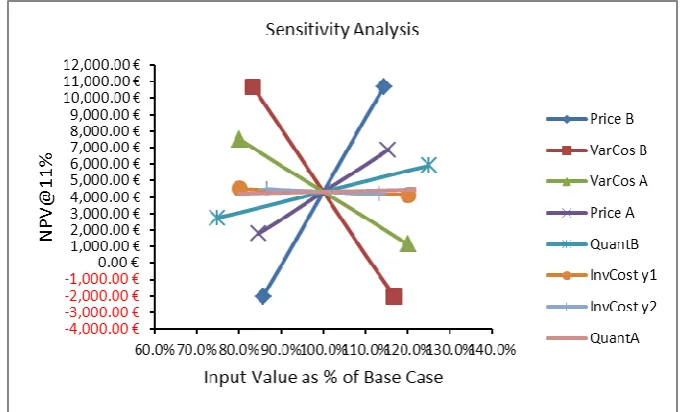
[image:15.595.144.486.424.630.2]3. Construct a sensitivity diagram (Figure 3) that relates proportional changes in the critical variable to NPV or IRR values. The graph below depicts a ‘spider diagram’ for sensitivity analysis
Figure 3. Spider Diagram for sensitivity analysis. NPV: net present value.
16 4. Identify switching values for important cash flow variables. A switching value is the value of the variable at which the NPV becomes zero or falls below a cut-off level. For example the switching value for ‘Price B’ is approximately 92 per cent of the base case.
4.1.2 Monte Carlo Method
The Monte Carlo method is a computational algorithm which is based on random sampling. To use the method the analyst needs to assign specific subjective probability distributions to important cash flow variables. The method proceeds in the following steps:
1. A value for a variable of interest is selected from its assumed distribution using a random number generator.
2. A vector of specific values is defined for these variables (e.g. unit labour cost, average wind velocity, fish output, fish price), and these values are used to calculate an NPV and an IRR.
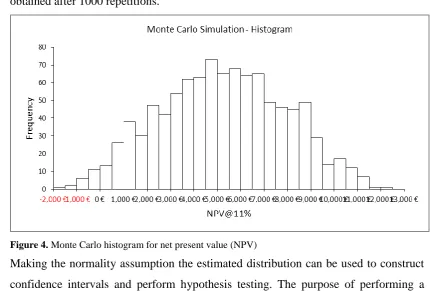
[image:16.595.98.529.430.721.2]3. After a large number of replications a frequency distribution is estimated for the NPV and/or the IRR. The Figure 4 provides a Monte Carlo histogram for NPV, which was obtained after 1000 repetitions.
Figure 4. Monte Carlo histogram for net present value (NPV)
17 4.2 Application
The purpose of risk analysis for the specific project is to apply sensitivity analysis – and potentially, depending on the availability of disaggregated data that will allow the meaningful approximation of probability distributions for important variables, Monte Carlo simulations – in order to assess the stand alone risk of the project. The methodology is applied to provide a risk assessment of the economic viability/sustainability of MUOPs in the specific areas. To perform an adequate risk analysis the cash flow of the project should be provided in a suitably disaggregated form so that critical variables and their uncertainty in terms of probability distributions can be determined.
5
Life Cycle Assessment of Multi-Use Offshore Platforms
Life Cycle Assessment (LCA) aims to determine environmental effects of a product/function of a product based on a “from cradle to grave” view. LCA can be used to make a strengths and weaknesses analysis, product improvement and product comparison. It may contribute to remedies in design stage and provide environmental and economic benefits. LCA has mainly three stages which is (i) identifying and quantifying the environmental loads involved (energy and raw materials used, emissions, wastes), (ii) assessing and evaluating potential environmental impacts of the loads, and (iii) assessing the opportunities available to bring about environmental improvements (UNEP, 1996). This stage continues to the end of the study because LCA is an iterative process. In this study, LCA will be used as a comparison tool between single use and MUOPs to evaluate feasibility of MUOPS by means of environmental impacts. In previous studies on LCA of wind power and wave energy devices, function of a product is defined as 1 kWh electricity (Sørensen and Naef, 2008; VESTAS, 2006) and a functional unit is an amount of fish fillet for fish farms (Silvenius and Grönroos, 2003). Cradle to grave timeline of a MUOP will be analyzed by dividing the lifetime into four phases: manufacturing process, transport and on-site erection, operation & maintenance and dismantling and recycling.
6
Conclusions and Policy Recommendations
18 the project should be undertaken under alternative specifications regarding the discount rate, and the stream of benefits if a CBA is to be followed or sensitivity analysis of selected criteria in an MCDA framework. This outcome will provide a rationale to policy makers for the project appraisal and will provide evidence on whether MUOPs result in an increase of the overall social welfare. In addition, the SEIA provides insight on the determinants of public attitudes toward MUOPs that national and European policy makers should take into consideration when selecting policy responses for efficient energy management. Another important contribution of any methodology as MISEA derives from the increase in the transparency of decisions that emerges from a visible analysis of benefits gained by some agents; costs borne by others and the limits on transfers justified by the projects.
19 use. This means that the MSFD does not prohibit the use of the marine environment, but requires the use to be sustainable.
7
Acknowledgements
20
8
References
Antle, J.M. and R.O. Valdivia. 2010. TOA-MD Version 4: Minimum-Data Tradeoff Analysis Model. www.tradeoffs.oregonstate.edu.
Bennett, J. and Adamowicz, V., 2001. Some Fundamentals of Environmental Choice Modelling, In Bennett, J and R. Blamey (eds.): The Choice Modelling Approach to Environmental Valuation. Edward Elgar Publishing Limited, Cheltenham, (2001) pp. 37-69.
Bergland, O., Magnussen, K., Navrud, S., 1995. Benefit transfer: testing for accuracy and reliability. Discussion Paper#D-03/1995, Department of Economics and Social Sciences, The Agricultural University of Norway.
Birol, E., Koundouri, P. and Kountouris, Y., 2010. Assessing the economic viability of alternative water resources in water-scarce regions: Combining economic valuation, cost-benefit analysis and discounting, Ecological Economics, Elsevier, vol. 69(4), pages 839-847, February.
Birol, E., and P. Koundouri, 2008. Choice Experiments in Europe: Economic Theory and Applications, Edward-Elgar Publishing, Wally Oates and Henk Folmer's 'New Horizons in Environmental Economics' Series, ISBN: 9781845427252 (337pages).
Brigham E. and J. Houston, 2003. Fundamentals of Financial Management. 10th Edition,
Cengage Learning, ISBN: 0324664559
Communities and Local Government, 2009. Multi-criteria analysis: A manual. Department for Communities and Local Government, London.
COM (Communication from the Commission), 2006. A European Strategy for Sustainable, Competitive and Secure Energy, 105, Brussels, 8.3.2006.
21 Eftec and Enveco, 2010. OSPAR Regional Economic and Social Assessment for the Marine Strategy Framework Directive – FINAL REPORT for DEFRA
Eftec, 1999. Review of Technical Guidance on Environmental Appraisal. Report for the Department of the Environment, Transport and the Regions: www.defra.gov.uk/environment/economics/rtgea/index.htm
Gollier, C., Koundouri, P. and T. Pantelides, 2008. Decreasing Discount Rates: Economic Justifications and Implications for Long-Run Policy. Economic Policy, 56: 758-795.
Koundouri, P, 2009. Editor’s Introduction, Special Issue on: Discounting the Long-Run Future and Sustainable Development. Economics-ejournal, Vol.3, July 16.
Lacroix,D.and Pioch, S. 2011. The multi-use in wind farm projects: more conflicts or a
win-win opportunity? Aquat. Living Resour. 24, 129–135.
Marine Strategy Framework Directive (MSFD) Directive 2008/56/EC of the European Parliament and of the Council of 17 June 2008 establishing a framework for community action in the field of marine environmental policy.
Rosenberger, R.S. and Loomis, J.B., 2000. Using meta-analysis for benefit transfer: in-sample convergent validity tests of an outdoor recreation database. Water Resources Research, 36, 1097-1107.
Silvenius, F. and Grönroos, J. 2003.Fish farming and the environment: Results and inventory analysis. Finnish Environment Institute, Helsinki.
22 Sørensen, H.C. and Naef, S., 2008, Report on technical specification of reference technologies (wave and tidal power plant), NEEDS New Energy Externalities Developments for Sustainability, Deliverable n° 16.1 - RS Ia.
Turner, R. K., Hadley, D., Luisetti, T., Lam V. W. Y. and W. W. L. Cheung, 2010. An Introduction to Socio-economic Assessment Within a Marine Strategy Framework. CSERGE, UEA, Published by the Department for Environment, Food and Rural Affairs.
UNEP, 1996, Life Cycle Assessment and How to Do It, United Nations Publication.
VESTAS, 2006, Life Cycle Assessment of offshore and onshore sited wind power plants based on V90-3.0 MW turbines.
Vitae
Phoebe Koundouri holds a PhD from the University of Cambridge and is Associate Professor at the Athens University of Economics and Business and Director of RESEES (http://www.aueb.gr/users/koundouri/resees/). She is also Senior Research Fellow at the London School of Economics and Political Science. Her research interests are: Environmental and Natural Resources Economics and Econometrics. She has published 10 books and more than 200 papers. She is a highly cited author and editorial board member in 12 journals. She is elected Board Member of the European Association of Environmental and Resource Economists. She has coordinated various research projects.
Mavra Stithou is an environmental economist. She holds a PhD from the University of Stirling and an MSc from the University of York. She specialises in water and marine policy, integrated socio-economic assessment of marine planning, the application of environmental valuation techniques (non-market valuation methods), cost-benefit analysis, and the use of benefits transfer.