FORMULATION, OPTIMIZATION AND EVALUATION
OF CLARITHROMYCIN IMMEDIATE RELEASE FILM
COATED TABLET
A dissertation submitted to
THE TAMILNADU Dr.M.G.R MEDICAL UNIVERSITY
CHENNAI- 600 032.In partial fulfillment of the requirements for the award of Degree of
MASTER OF PHARMACY
IN
PHARMACEUTICS
Submitted By V.VAISHNAVI Reg.No: 261311158
DEPARTMENT OF PHARMACEUTICS
EDAYATHANGUDY.G.S PILLAY COLLEGE OF PHARMACY
NAGAPATTINAM-611002
FORMULATION, OPTIMIZATION AND
EVALUATION OF CLARITHROMYCIN IMMEDIATE
RELEASE FILM COATED TABLET
A dissertation submitted to
THE TAMILNADU Dr.M.G.R MEDICAL UNIVERSITY
CHENNAI- 600 032.In partial fulfillment of the requirements for the award of Degree of
MASTER OF PHARMACY
IN
PHARMACEUTICS
SubmittedBy
V.VAISHNAVI
(Reg. No: 261311158 ) Under the guidance of
Prof.Dr. M.MURUGAN,M.Pharm.,Ph.D.,
DEPARTMENT OF PHARMACEUTICS
EDAYATHANGUDY.G.S PILLAY COLLEGE OF PHARMACY
NAGAPATTINAM-611002
Prof., Dr.M.MURUGAN, M.Pharm.,Ph.D.,
Director cum Professor,
Edayathangudy.G.S.Pillay College of Pharmacy,
Nagapattinam
–
611 002.
CERTIFICATE
This
is
to
certify
that
the
dissertation
entitled
“
FORMULATION,
OPTIMIZATION AND EVALUATION OF CLARITHROMYCIN IMMEDIATE
RELEASE FILM COATED TABLET”
submitted by
V.VAISHNAVI (Reg. No:
261311158
) in partial fulfillment for the award of degree of Master of Pharmacy to the
Tamilnadu Dr. M.G.R Medical University, Chennai is an independent bonafide work of the
candidate carried out under my guidance in the Department of Pharmaceutics,
Edayathangudy.G.S Pillay College of Pharmacy during the academic year 2013-2015.
Prof, Dr. D. BABU ANANTH,M.Pharm.,Ph.D.
Principal,
Edayathangudy.G.S.Pillay College of Pharmacy,
Nagapattinam
–
611 002.
CERTIFICATE
This is to certify that the dissertation
“
FORMULATION, OPTIMIZATION AND
EVALUATION OF CLARITHROMYCIN IMMEDIATE RELEASE FILM
COATED TABLET
”
submitted by
V.VAISHNAVI
(Reg. No:
261311158) in partial
fulfillment for the award of degree of Master of Pharmacy to the Tamilnadu Dr. M.G.R
Medical University, Chennai is an independent bonafide work of the candidate carried out
under the guidance of
Prof
.Dr.M.MURUGAN,M. Pharm.,Ph.D.,
Director cum Professor,
Edayathangudy.G.S Pillay College of Pharmacy during the academic year 2013-2015.
ACKNOWLEDGEMENT
I would like to express profound gratitude to
Mrs.Jothimani G.S.Pillay,
Chairman,
E.G.S.Pillay College of Pharmacy, and
Thiru. S.Paramesvaran, M.Com., FCCA.,
Secretary, E.G.S.Pillay College of Pharmacy.
I express my sincere and deep sense of gratitude to my guide
Prof. Dr.M.Murugan,M.Pharm.,Ph.D.
,Director cum Professor Head, Department of
Pharmaceutics, E.G.S.Pillay College of Pharmacy, for his invaluable and extreme support,
encouragement, and co-operation throughout the course of my work.
It is my privilege to express my heartfelt thanks to
Prof. Dr.D.Babu Ananth,
M.Pharm,Ph.D.,
Principal, E.G.S.Pillay College of Pharmacy, for providing me all
facilities and encouragement throughout the research work.
I express my sincere gratitude to
Prof.K.Shahul Hameed Maraicar, M.Pharm.,
(Ph.D).
,Director cum Professor, Department of Pharmaceutics. E.G.S.Pillay College of
Pharmacy, for his encouragement throughout the course of my work.
I would like to extend my thanks to all the
Teaching Staff
and
Non Teaching
Staff
, who are all supported me for the successful completion of my project work.
INDEX
CHAPTER CONTENTS PAGE NO.
I INTRODUCTION 1
II AIM,OBJECTIVE AND PLAN OF WORK 19
III LITERATURE REVIEW 22
IV MATERIALS AND METHODS 33
1 List of materials 33
2 Drug profile 34
3 Excipients profile 42
4 Innovator product specification 58
5 List of instruments and equipments 59
6 Methodology 67
V RESULTS AND DISCUSSIONS 89
VI SUMMARY 115
VII CONCLUSION 118
VIII FUTURE STUDY 119
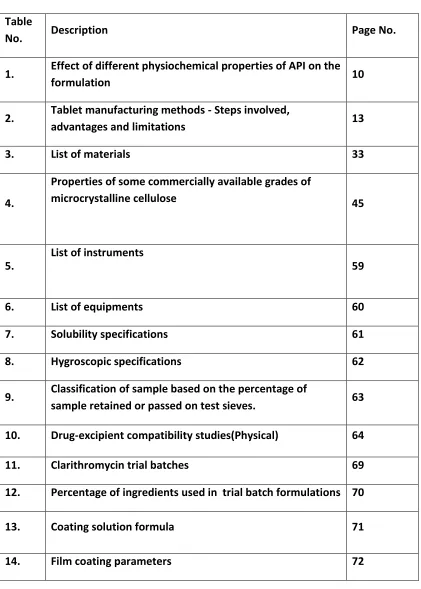
LIST OF TABLES
Table
No. Description Page No.
1. Effect of different physiochemical properties of API on the
formulation 10
2. Tablet manufacturing methods - Steps involved,
advantages and limitations 13
3. List of materials 33
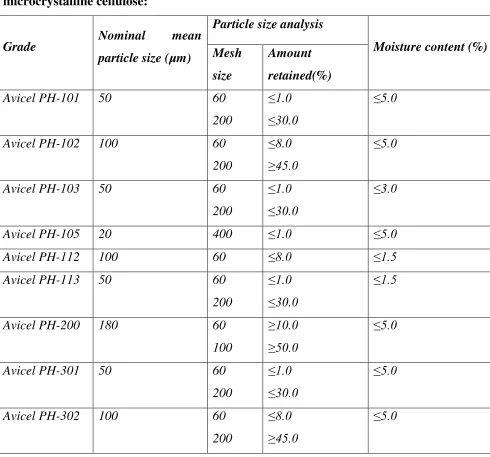
4.
Properties of some commercially available grades of
microcrystalline cellulose 45
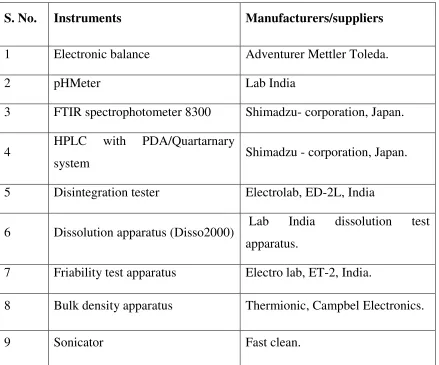
5.
List of instruments
59
6. List of equipments 60
7. Solubility specifications 61
8. Hygroscopic specifications 62
9. Classification of sample based on the percentage of
sample retained or passed on test sieves. 63
10. Drug-excipient compatibility studies(Physical) 64
11. Clarithromycin trial batches 69
12. Percentage of ingredients used in trial batch formulations 70
13. Coating solution formula 71
[image:7.612.97.518.118.707.2]15. Full factorial design (Formulation trials as per
experimental design) 74
16. Formula for optimized batches of F8 75
17. Compressibility index 78
18. Hausner’s ratio 79
19. Flow properties and corresponding angle of repose 80
20. Percentage deviation for weight variation test 82
21. Stability conditions according to ICH guidelines 84
22. Evaluation of API (Raw material analysis) 90
23. Evaluation of Drug-Excipient compatibility studies
(Physical observation) 91
24. FT-IR spectra of clarithromycin USP- Raw material 92
25 FT-IR spectra of clarithromycin USP- Excipients 94
26. Evaluation of precompression parameters for trial batch 97
27. Precompression parameters for optimized batch 98
28. Evaluation of post compression parameters for uncoated
tablets 100
29 Evaluation of post compression parameters for coated
tablets 101
30. Post compression parameters for optimized batch 102
31. Evaluation specifications for Innovator product 103
32. Comparative dissolution profile study of clarithromycin
coated tablets with innovator product 104
33. Comparative dissolution profile study of clarithromycin
34. Comparative dissolution profile for OF7 and innovator
product. 107
35. Stability studies for post compression parameters of OF7 108
36. Stability study of invitro dissolution profile for OF7 109
37. Stability studies for assay of OF7. 110
38. Chromatogram of clarithromycin and their related
substance 111
39. Clarithromycin stability batch chromatograms
(dissolution profile) 112
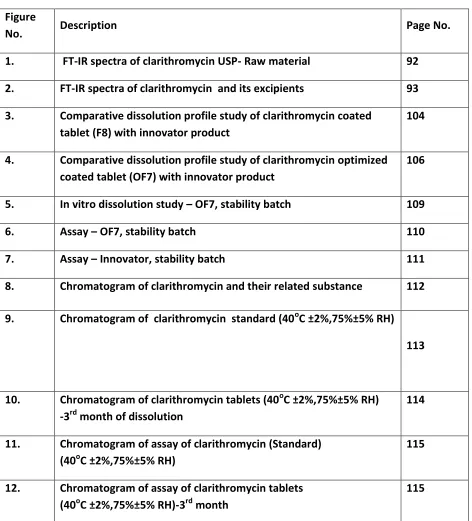
LIST OF FIGURES
Figure
No. Description Page No.
1. FT-IR spectra of clarithromycin USP- Raw material 92
2. FT-IR spectra of clarithromycin and its excipients 93
3. Comparative dissolution profile study of clarithromycin coated tablet (F8) with innovator product
104
4. Comparative dissolution profile study of clarithromycin optimized coated tablet (OF7) with innovator product
106
5. In vitro dissolution study – OF7, stability batch 109
6. Assay – OF7, stability batch 110
7. Assay – Innovator, stability batch 111
8. Chromatogram of clarithromycin and their related substance 112
9. Chromatogram of clarithromycin standard (40oC ±2%,75%±5% RH)
113
10. Chromatogram of clarithromycin tablets (40oC ±2%,75%±5% RH) -3rd month of dissolution
114
11. Chromatogram of assay of clarithromycin (Standard) (40oC ±2%,75%±5% RH)
115
12. Chromatogram of assay of clarithromycin tablets (40oC ±2%,75%±5% RH)-3rd month
115
ABBREVATION
USP United state of pharmacopeia
IR Immediate Release
Ml Millilitre
Mg Milligram
G Gram
µm Micrometer
µg Microgram
MCC Microcrystalline Cellulose
Rpm Rotations Per Minute
API Active Pharmaceutical Ingredients
BD Bulk Density
TD Tapped Density
CI Compressibility Index
DT Disintegration Time
HR Hausner’s Ratio
o
C Degree Celsius
CCS Croscarmellose Sodium
AUC Area Under Curve
DT Disintegration Time
Cmax Maximum plasma concentration
Vd Volume of Distribution
t1/2 Half Life
1.INTRODUCTION
A drug is, in the broadest of terms a chemical substance that has known biological effect on humans or other animals. In pharmacology, a drug is a chemical substance used in the treatment, cure, prevention, or diagnosis of disease or used to otherwise enhance physical or mental well being . Pharmaceutical drugs may be used for a limited duration, or on a regular basis for chronic disorders.
Pharmaceutical industry, the discovery, development and manufacture of drugs and medications by public and private organizations. The modernera of the pharmaceutical industry of isolation and purification of compounds, chemical synthesis and computer- aided drug design is considered to have begun in the 19th century thousands of years after intuition and trial and error led humans to believe that plants, animals, and minerals contained medicinal properties. The unification of research in the 20th century in fields such as chemistry and physiology increased the understanding of basic drug discovery processes. Identifying new drug targets, attaining regulatory approval from governments agencies and refining techniques in drug discovery and development are among the challenges that face the pharmaceutical evoluation and advancement of the control and elimination of disease around the world.
In the preparation of dosages, many pharmaceuticals are ground to varying degrees of fineness. Many medicinal substances are added to water , alcohol, or another solvent so that they can be used in solution form. These may include spirits, elixers and tinctures. Ointments are one of many semisolid preparations, which also include creams, pastes and jellies. Solid pharmaceuticals include pills, tablets, lozenges and suppositories. In this form the compounds are more stables, with less risk of chemical reaction, and the dosage is easier to determine. Storage and packaging also is made simpler, and solid forms are more efficient produce.
ADMINISTERING DRUGS:
Drugs, both medicinal and recreational can be administered in a number of ways or routes. Many drugs can be administered via more than one route.
*Inhaled,( breathed into the lungs) as an aerosol or dry powder.
*Injected as a solution, suspension or emulsion either : Intramuscular, intravenous, intraperitoneal, intraosseous.
*Insufflation or snorted into the nose.
*Orally as a liquid or solid, that is absorbed through the intestines.
*Rectally as a suppository, that is absorbed to the rectum or colon.
*Sublingually, diffusing into the blood through tissues under the tongue.
*Topically, usually as a cream or ointment. A drug administered in this manner may be given to act locally or systematically.
*Vaginally as a suppository, primarily to treat vaginal infections.
Any drug delivery system is based on the nature of disease and its causing agent as well as the anatomy andphysiology of affected organ.
RESPIRATORY PROBLEMS:
In humans the anatomical features of the respiratory system include airways, lungs and the respiratory muscles. Molecules of oxygen and carbon-di-oxide are passively exchanged, by diffusion, between the gaseous external environment and the blood. This exchange process occur in the alveolar region of the lungs. The respiratory system can be subdivided into an upper respiratory tract and a lower respiratory tract based on the anatomical features. The upper respiratory tract includes the nasal passages, pharynx and larynx, while the lower respiratory tract is comprised of the trachea, the primary bronchi and lungs.
DISORDER OF THE RESPIRATORY SYSTEM CAN BE CLASSIFIED INTO FOUR GENERAL AREAS:
1) OBSTRUCTIVE CONDITIONS: Emphysema, bronchitis, asthma attacks.
3) VASCULAR DISEASE: Pulmonary edema, pulmonary embolism, pulmonary hypertension.
4) INFECTIOUS, ENVIRONMENTAL AND OTHER DISEASES:
Pneumonia, tuberculosis, asbestosis, particulate pollutants.
COMMON RESPIRATORY DISORDERS INCLUDE:
*CHRONIC OBSTRUCTIVE PULMONARY DISEASE(COPD):
Irritation of the lungs can lead to asthma, emphysema and chronic bronchitis and people can develop two or three of these together.
1) CHRONIC BRONCHITIS; Any irritant reaching the bronchi and bronchioles will stimulate an increased secreation of mucus. In chronic bronchitis the air passages become clogged with mucus and this leads to a peristant cough.
2) ACUTE BRONCHITIS: It is a shorter illness that commonly follows a cold or irral infection such as the flu. It I consists of a cough with mucus, chest dis comfort or soreness, fever and sometimes shortness of breath. Acute bronchitis usually lasts a few days on weeks.
SYMPTOMS FOR BOTH ACUTE AND CHRONIC BRONCHITIS:
i)Peristant cough may produce mucus. ii)Wheezing iii)Low fever and chills
iv)Chest tightening v)Sore throat vi)Body ache vii) Breathlessness
viii)Headache ix)Blocked nose and sinuses.
EMPHYSEMA: The delicate walls of the alveoli break down, reducing the gas exchange area of the lungs. The condition develops slowly and is seldom a direct cause of death.
ASTHMA: Periodic constriction of the bronchi and bronchioles makes it more difficult to breathe.
area exposed to air. If enough alveoli are affected, the patient may need supplemental oxygen.
ROLE OF CLARITHROMYCIN:
Immediate release drug delivery system are based on single or multiple unit reservoir or matrix system, which are designed to provide of time. Immediate release drug delivery is desirable for drugs having long biological half life, high bioavailability. Oral drug delivery is the most desirable and preferred method administering therapeutics agent for their systematic effect. In addition, the oral medication is generally considered as the first avenue investigated in the discovery and development of new entities and pharmaceutical formulation, mainly because of patient acceptance, convenience in administration and cost effective manufacturing process.
Clarithromycin is a macrolide antibiotic with broad spectrum of activity. It is given the treatment of respiratory tract infection in the skin and soft tissue infection. Clarithromycin may be given to eradicate H.pylori in treatment
regimen’s for peptic ulcer diseases. Clarithromycin has invitro antibacterial activity against typical ( streptococcus, pneumonia, haemophilus, influenza, Moraxella catarhalis) atypical ( mycoplasma pneumonia, chlamydia pneumonia, legionella pneumophilla ) pathogens commonly associated acquired lower respiratory tract infections.
250mg to 500mg twice daily for 7-14 days of the immediate- release oral formulation of clarithromycin.
MEDICATIONS 6
Therapy addressing specific symptoms is the mainstay for most URIs. Most URIs are self-limited viral infections, which can be resolved without prescription of drugs. Recognizing viral and bacterial diseases for which specific therapy is available is important. Antibacterial therapy is useful for patients with group A streptococcal pharyngitis, bacterial sinusitis, epiglottis’s, pertussis, or diphtheria. Patients with HSVinfection or gonococcal upper airway disease also benefit from specific treatment. In immune compromised patients, infections may be appropriate, especially if lower airway disease is suspected. In general, antiviral do not provide clinical benefits in persons with viral pharyngitis. However, in patients who are immune compromised, antiviral have a role in treating illness that might progress. Acyclovir, famciclovir, and valacyclovir are recommended for patients with severe HSV pharyngitis and for immune compromised patients. Ganciclovir or foscarnet are recommended for the treatment of cytomegalovirus infections in immune compromised patients.
1.2. CHEMOTHERAPY7,8,9,10
Chemotherapy can be defined as the use of chemical in infectious diseases to destroy the microorganisms without damaging the host tissues.
1.2.1. ANTIBIOTICS:
Antibiotics are substances produced by a microorganism that suppresses the growth of or destroy other microorganisms.
1.2.2. CLASSIFICATION:
Antibiotics are classified in many ways based on chemical structure, its spectrum of activity, pharmacological activity.
1.Basedonchemicalstructure7
ANTIBIOTICS
Sulphamethaoxazole+Trimethaprim.
2.QUINOLONES : Nalidixic acid, Ciproflaxacin, oflaxacin, Levoflaxacin
3.B-LACTUM : Penicillin, ampicillin, amoxicillin, cephalosporins
4.TETRACYCLINES : Doxycyclines
5.MACROLIDES : Erythromycin, Azithromycin, Clarithromycin, Telithromycin
6.AMINOGLYCOCIDES : Streptomycin, Neomycin, Gentamycin, kanamycin.s
2. Based on mechanism of action
1. Inhibit cell wall synthesis
• Penicillins, cephalosporins, carbapenems, monobactam, vancomycin,
bacitracin, cycloserine.
2. Damage cell membranes(cause leakage of cell membranes)
• Polymyxins, amphotericin B, nystatin.
3. Bind to ribosomes and inhibit protein synthesis:
• Chloramphenicol, tetracyclines, erythromycin, amino glycosides, clindamycin.
4. Inhibit DNA gyrase
• Flouroquinolones
5. Inhibit DNA function
• Rifampicin
6. Interfere with metabolic steps
• Sulphonamides, sulphones, trimethoprim, pyrimethamine.
Antimicrobials may also be classified as extent of action:
These are the agents that suppress the growth of bacteria.
Eg: Sulphonamides, Tetracyclines, Linezolid, Chloramphenicol, Clindamycin.
2. Bactericidal:
These are the agents that kill the bacteria.
E.g: Penicillins, Cephalosporins, Amino glycosides, Flouroquinolones, Rifampicin, Metronidazole.
However, some drugs may be bacteriostatic at low doses and bactericidal at higher doses. E.g: Erythromycin may be bacteriostatic to some microorganisms and bactericidal to others. Eg: Chloramphenicol is bactericidal to H.influenzae, S.pneumoniae and N.menigitidis, while it is bacteriostatic to other microorganisms.
1.2.3. ANTIBACTERIAL SPECTRUM:
An antimicrobial may have a narrow or broad spectrum of activity.
Narrow spectrum antibiotics:
E.g: penicillin G – gram positive organisms
Amino glycosides –gram negative organisms.
Broad spectrum antibiotics:
E.g: Tetracyclines and Chloramphenicol: gram positive and gram negative organisms, ricketssiae, chlamydiae, mycoplasma.
Broad spectrum antibiotics are so called because in addition to suppression of gram positive and gram negative bacteria, they also inhibit the growth of other microorganisms like ricketssiae, chlamydiae, mycoplasma and some protozoa. But
in practice the term ‘broad spectrum’ is often used to include all antimicrobials
with a wide spectrum of activity i.e., those effective against both gram positive and gram negative organisms.
1.2.4. MACROLIDES7,8 ,9,10,11
Macrolide are group of antibiotics produced by various strains of streptomyces. They have three common chemical characteristics like a large non-planar strain less ring, a keto group, a glycosidically linked amino sugar.Usually the lactone ring has 12, 14 or 16 atoms in it, unsaturated with an olefinic group conjugated with the ketone function. They may have a neutral sugar also, in addition to the amino sugar, which is linked glycosidically to the lactone ring.
The macrolides are a group of antibiotics with a structure to which one or more deoxy sugars are attached. Erythromycin was the first of these drugs to find clinical application, both as a drug of first choice and as an alternative to penicillin in individuals who are allergic to lactam antibiotics. The newer members of this family, clarithromycin (a methylated form of erythromycin) and azithromycin (having a larger lactone ring), have some features in common with, and others that improve on, erythromycin. Telithromycin, a semi synthetic derivative of erythromycin, is the first ketolide• antimicrobial agent that has been approved and is now in clinical use.
Ketolides and macrolides have very similar antimicrobial coverage. However, the ketolides are active against many macrolide-resistant gram-positive strains.
MECHANISM OF ACTION:
Macrolides are protein synthesis inhibitors. The mechanism of action of macrolides is inhibition of bacterial protein biosynthesis, The drugs act by binding to cell membranes and causing changes in protein function and they are thought to do this by preventing peptidyltransferase from adding the peptidyl attached to t-RNA to the next amino acid as well as inhibiting ribosomal translocation. Another potential mechanism is premature dissociation of the peptidyl-tRNA from the ribosome.
to accumulate within leukocytes, and are, therefore, transported into the site of infection.
ERYTHROMYCIN:
It is a fermentation product of the fungus streptomyces erythreus. Its antibacterial spectrum resembles that penicillin. It is mainly effective against gram positive cocci including the streptococci, staphylococci and pneumococci, Neisseria, some strains of H. influenza, C.diphtheriae, Mycoplasma pneumonia, Rickettsiae and Treponemas are also inhibited by low concentration. The drug is effective against penicillin resistant staphylococci can develop resistance to erythromycin. Its activity increases with an increase of pH upto 8.
ROXITHROMYCIN:
It is a newer macrolide (azalides) have a similar spectrum of activity as erythromycin. They are acid stable, longer acting, more potent, better absorbed and has a better tissue penetrability compared to erythromycin. It is rapidly absorbed from the gut with a bioavailability of 50%, food interferes with its absorption. Most of the drug is excreted either through feces, unchanged or as metabolites. The adverse effects are similar to that of erythromycin. It should be taken before 30 min of food. It is used in ear, throat, respiratory tract and non-gonococcal genitourinary infections. It is more expensive.
AZITHROMYCIN:
This azilide antibiotic differs chemically from the macrolide group in that the lactone ring contains a nitrogen atom. It has similar activity as erythromycin but in addition, it act against gram-positive bacilli including H.influenzae. It also act against Mycobacterium avium complex (MAC). It is most active at pH 7.4 and above. It has better tissue penetrability, longer half-life than erythromycin. It can be used in respiratory tract infections, cervicitis and urethritis.
KETOLIDES
1.4. INTRODUCTION FOR TABLETS:
The oral route of drug administration is the most important method of administrating drugs for systemic effects. Oral drug delivery has been known for decades as the most widely utilized route of administered among all the routes that have been employed for the systemic delivery of drug via various pharmaceutical products of different dosage forms. The reasons that the oral route achieved such popularity may be in part attributed to its ease of administration belief that by oral administration of the drug is well absorbed.
All the pharmaceutical products formulated for systemic delivery via the oral route of administration irrespective of the mode of delivery (immediate, sustained or controlled release) and the design of dosage forms (either solid dispersion or liquid), must be developed within the intrinsic characteristics of GI physiology, pharmacokinetics, pharmacodynamics and formulation design is essential to achieve a systemic approach to the successful development of an oral pharmaceutical dosage form.
1.4.1. TABLETS13,15,16,17,18,19.20,21,22.23.24.25.26
Tablets are solid dosage forms containing medicinal substances with or without suitable diluents. They are the most widely preferred form of medication both by pharmaceutical manufacturer as well as physicians and patients. They offer safe and convenient ways of active pharmaceutical ingredients (API) administration with excellent physiochemical stability in comparison to some other dosage forms, and provide accurate dosing.
They can be mass-produced with robust quality controls and other different branding possibilities by means of colored film coating different sizes and shapes. Tablets are usually solid, right circular cylinders, the end surfaces of which are flat or convex and the edges of which may be bevelled.
1.4.2. PROPERTIES OF TABLETS
The attributes of an acceptable tablet are as follows:
• Tablet must be uniform in weight and in drug content of the individual tablet.
• This is measured by the weight variation and content uniformity tests.
• The drug content of the tablet must be bioavailable. This property is measured by the dissolution test. Accurate bioavailability can be obtained from the drug levels of the drug after its administration
• Tablets must be elegant in appearance and must have characteristic shape, color and other markings necessary to identify the product.
• Tablets must retain all these functional attributes, which include drug stability and efficacy.
ADVANTAGES OF TABLETS 15
• They are easy to administer.
• They are a unit dosage form, and they offer the greater capabilities of all oral dosage forms for the greatest dose precision and the least content variability.
• Their cost is lowest of all oral dosage forms.
• They are the lightest and most compact of all oral dosage forms.
• Product identification is potentially the simplest and cheapest, requiring no additional processing steps when employing an embossed or monogrammed punch face.
• They are in general the easiest and cheapest to package and ship of all oral dosage forms.
• They may provide the greatest ease of swallowing with least tendency for
“hang-up” above the stomach. Especially when coated, provided that tablet disintegration is not excessively rapid.
• They tend themselves to certain special release profile products, such as enteric or delayed release products.
They have the best-combined properties of chemical, mechanical and microbiological stability of all the oral forms.
• One of the major advantages of tablet over capsules is that the tablet is
essentially “tamperproof dosage form.”
2. DISADVANTAGE OF TABLETS 15
• Some drugs resist compression into dense compacts, owing to their amorphous nature or flocculent, low-density character.
• Drugs with poor wetting, slow dissolution properties, intermediate to large dosages, optimum absorption high in the gastrointestinal tract, or any combination of these features may be difficult or impossible to formulate and manufacture as a tablet that will still provide adequate or full drug bioavailability.
• Bitter tasting drugs, drugs with objectionable odor or drugs that are sensitive to oxygen or atmospheric moisture may require encapsulation or a special type of coating which may increase the weight of the finished products.
• A major disadvantage of capsules over tablets is their higher cost.
TYPES OF TABLET 16,17
The main reasons behind formulation of different types of tablets are to create a delivery system that is relatively simple, inexpensive to manufacturer,
dosage form that is convenient from patient’s perspective and utilize an approach
that is un-likely to add complexity during regulatory approval process. To understand each dosage form, tablets here are classified by their route of administration, by the type of drug delivery system and by the formulation characterized.
ORAL TABLETS FOR INGESTION
These tablets are meant to be swallowed intact along with a sufficient quantity of water. Exception is chewable tablet. Over 90% of the tablets manufactured today are ingested orally. This shows that this class of formulation is the most popular worldwide and the major attention of the researcher is towards this direction.
1. Standard compressed tablets
2. Multiple compressed tablets
• Compression coated tablet
• Layered tablet
• Inlay tablet
3. Modified Release tablet
4. Delayed action tablet
5. Targeted tablet
• Floating tablet
• Colon targeting tablet
6. Chewable tablet
7. Dispersible tablet
Tablets used in the oral cavity
The tablets under this group release API in oral cavity or to provide local action in this region. The tablets under this category avoids first-pass metabolism, decomposition in gastric environment, nauseatic sensations and gives rapid onset of action. The tablets formulated for this region are designed to fit in proper region of oral cavity. These include:
Lozenges and troches
Sublingual tablet
Buccal tablet
Dental cones
Mouth dissolved tablet
The tablets administered by other route, which avoid from passing through gastro intestinal tract. These tablets may be inserted into other body cavities or directly placed below the skin to be absorbed into systemic circulation from the site of application. These include:
Vaginal tablet
Implants
Formulation characteristics
Tablets are also classified according to their formulation characteristics such as
Immediate release tablets
Effervescent tablets
Melt in mouth or fast dissolving tablets
Delayed release or extended release tablets
1.4.9.MANUFACTURING DEFECTS IN TABLETS18
Processing problems are categorized into following are:
1. Defects during tablet processing :
• Capping
• Lamination
• Cracking
• Picking
• Sticking/filming
• Binding
2. Defects due to other factors :
• Mottling
3. Defects due to machine :
• Poor flow pattern
• Double impression
1.4.10. TABLET COATING15,19,20
Coated tablets are defined as “tablets covered with one or more layers of
mixture of various substances such as natural or synthetic resins, gums, inactive and insoluble filler, sugar, plasticizer, polyhydric alcohol, waxes, authorized coloring material and sometimes flavoring material .
Coating may also contain active ingredient. Substances used for coating are usually applied as solution or suspension under conditions where vehicle evaporates.
A) ASPECTS OF TABLET COATING
I. THERAPY
i) Avoid irritation of oesophagus and stomach
ii) Masks bitterness
iii) Avoid inactivation of drug in the stomach
iv) Improve drug effectiveness
v) Prolong dosing interval
vii) Improve patient compliance
II. TECHNOLOGY
ii) Avoid dust formation
iii) Reduce influence of atmosphere
iv) Improve drug stability
v) Prolong shelf life
III. FORMULATION
i) Withstand mechanical process
ii) Maximum adhesion of the coating to the tablet surface, especially when a logo is present
iii) A smooth film coat with uniform thickness
IV. MARKETING
i) Improve product identity
ii)Improve appearance and acceptability
B) BASIC PRINCIPLE OF TABLET COATING 19,20
The principle of tablet coating is relatively simple. Tablet coating is the application of coating composition to moving bed of tablets with concurrent use of heated air to facilitate evaporation of solvent.
C) TYPES OF TABLET COATING PROCESS
1.SUGAR COATING
Compressed tablets may be coated with colored or uncolored sugar layer. The coating is water soluble and quickly dissolves after swallowing. Sugarcoat protects the enclosed drug from the environment and provides a barrier to objectionable taste or order. The sugar coat also enhances the appearance of the compressed tablet and permit imprinting manufacturer’s information. Sugar coating provides a combination of insulation, taste masking, smoothing the tablet core, coloring and modified.
Sugar coating process involves five separate operations:
I. SEALING/WATER PROOFING: Provides a moisture barrier and harden the tablet surface.
II. SUB COATING: Causes a rapid buildup to round off the tablet edges.
III. GROSSING/SMOOTHING: Smoothes out the sub coated surface and increases the tablet size to predetermine dimension.
IV. COLORING: Gives the tablet its color and finished size.
V. POLISHING: Produces the characteristics gloss.
2. FILM COATING
Film coating is more favored over sugar coating. Now days, sugar coating is replaced with film coating, because the sugar coating process was a skilled manipulative process and could last for even five days. The operator must be highly skilled for such coating. Hence film coating is preferred over sugar coating.19
a.BASIC PRINCIPLES INVOLVED IN FILM COATING
1. Insulation which influences the release pattern as little as possible and does not markedly change the appearance.
2. Modified release with specific requirement and release mechanism adapted to body function in the digestive tract.
3. Color coating which provides insulation or is combined with modified release coating.
b. MATERIALS USED IN FILM COATING
I. Film formers, which may be enteric or non-enteric
II. Solvents
III. Plasticizers
IV. Colorants
VI. Miscellaneous coating solution components
c. FILM DEFECTS
Include sticking and picking, roughness, orange-peel effect, bridging and filling, blistering, hazing/dull film, color variation, cracking.
3. ENTERIC COATING
Enteric coated tablets are tablets with a coating that resist dissolution or disruption in the stomach but not in the intestine, thereby allowing for tablet transit through the stomach in favor of tablet disintegration and dissolution and absorption from the intestine.
The materials used in enteric coating are shellac, hydroxy propyl methyl cellulose phthalate, poly vinyl phthalate and cellulose acetate phthalate.
4. SPECIALIZED COATING : It includes Compression coating, Electrostatic coating, Dip coating, Vacuum film coating.20
1.4.11. EVALUATIONOFTABLET
Tablets when formulated may undergo physical and chemical changes, which may alter their bioavailability. Therefore, the tablets are to be evaluated before dispensing to ensure their stability and bioavailability throughout their shelf life. Evaluation of tablets can be carried out by the following test.
A. CHARACTERISTICS OF GRANULES
Flow Ability
Compressibility
Bulk density
Tapped density
B. COMPRESSED TABLET CHARACTERISTICS
UNOFFICIAL TESTS
• Tablet appearance
• Identification markings on the tablets
• Size and shape of the tablet
• Thickness of the tablet
• Hardness of the tablet
• Friability of the tablet
OFFICIAL TESTS (According to IP)
• Weight variation test
• Content uniformity
• Disintegration test
• Dissolution test
1.5. STABILITY STUDIES AS PER ICH GUIDELINES
Stability is defined as the capacity of a drug substance or drug product to remain within the established specifications to maintain its identity, strength, quality and purity throughout the retest or expiration dating period.
The objective of stability study is to determine the shelf life, namely the time period of storage at a specified condition within which the drug product still meets its established specifications.
II.AIM AND OBJECTIVE OF WORK
The present study aims at developing a clarithromycin immediate release tablet formulation for the effective treatment of respiratory tract infections.
Clarithromycin is macrolide antibiotic produced by various strains of streptomyces. The mechanism of action of clarithromycin is inhibition of bacterial protein biosynthesis. Clarithromycin is acid stable and it is rapidly absorbed from the gastrointestinal tract after oral administration. The plasma half-life of clarithromycin is 2-3 hours. The usual duration of treatment of clarithromycin is 6 to 14 days. Clarithromycin is economically beneficial than all other macrolide antibiotics.
The main objective of this study was to
i) To formulate clarithromycin immediate release film coated tablet.
ii) To evaluate the formulated tablets as per requirements of standards.
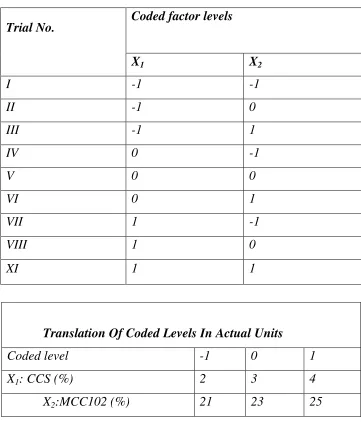
iii)To optimize the trial batch by 32 full factorial design study.
iv)To evaluate the optimized batches.
v) To determine the best batch by dissolution studies.
vi)Drug release profile was compared with innovator product.
vii) To calculate the similarity and dissimilarity factor for both drug release
profile and innovator drug product.
viii) To perform stability studies for the optimized batch for 3 months at
PLAN OF WORK
A) Literature review
B) Drug profile
C) Excipient profile
D) Innovator product specification
E) Preformulation studies
a) Evaluation of API Description Solubility
pH
Melting point Chemical nature Hygroscopicity
Particle size distribution Loss on drying
b) Drug excipient compatibility studies Physical observation
FT-IR studies
F) Selection of excipients by finger print method
G) Formulation of uncoated clarithromycin immediate release tablets by
wet granulation method.
H) Evaluation of the granules.
I) Evaluation of physical parameters for compressed tablet.
i. Weight variation
ii. Thickness
iii. Hardness
v. Disintegration
vi. Determination of drug content
J) In vitro dissolution studies.
K) Coating of the formulated clarithromycin immediate release tablets.
L) Evaluation of the coated tablets.
M)Optimization of the trial batch by full factorial design.
N) Evaluation of the optimized batches.
O) Comparison of the drug release for optimized batch and innovator
product.
III. LITERATURE REVIEW
Saleki-Gerhardt et al., US patent 1999 jul.6/5, 919, 48929 Provided a process for the aqueous granulation of a macrolide antibiotic which comprises mixing a macrolide and a carbomer, wetting the mixture with water and blending the mixture to allow formulation of a macrolide antibiotic-carbomer granule.
Wadhwa et.al., US patent Nov.4,2003/US 6,642,276 B230 Related to an controlled release macrolide pharmaceutical formulation. It gives a information about method of preparation, isolating and characterizing soluble and stable citrate salt of macrolides and use in all solid dosage forms of macrolides.
Margret Chandra, et al.,31 Developed a mucoadhesive tablets of clarithromycin which were designed to prolong the gastric residence time after oral administration. Clarithromycin is in a class of medications called macrolide antibiotics. It works by stopping the growth of bacteria. matrix tablets of clarithromycin were formulated using four mucoadhesive polymers namely carbopol 974P, HPMC K15M and HPMC K4M carried out studies for weight variation, thickness, hardness, content uniformity, swelling index, mucoadhesive force and in vitro drug release. Formulation of F9 and F12 which were formulated by using polymers, HPMC K14M, HPMC K15M and carbopol 974P provided controlled release of clarithromycin over the period of 12 hrs. The cumulative % of drug release of formulation F9 and F12 were 93.16 and 96.82 respectively. The stability studies showed that there was no significant change in adhesive strength, invitro release when stored at room temperature, 40oC, and 2-8oC for a period of 30 days.
Rahul Suture. et al.,32 Developed a drug delivery systems to gastro intestinal tract for treatment of H.pylori induced peptic and duodenal ulcers, in the present study an attempt has been made to develop and evaluate hydro dynamically balanced matrix tablets of
buoyancy lag time due to reduction in porosity of compact mass. The release rate determined on 0.1N HCl (pH1.2) showed controlled release of drug following non-Fickian mechanism
N.B. Santha Sheela. et.al.,33 Formulated a floating sustained release tablets of clarithromycin, by using a combination of hydrophilic polymers (different grades of hydroxypropyl methylcellulose), kollidon SR and an effervescent substance (sodium bicarbonate). The formulation were evaluated to study the effect of sodium bicarbonate concentration on the floating lag time, total duration of floating, invitro dissolution release profile and the effect of different fillers and ethyl cellulose concentration on the release profile of drug. It was found that among all the formulations, formulation F4 (HPMC K15M, Avicel 102 PH and sodium bicarbonate) was found to be the optimum formulation as it had good swelling property, floating time and drug releases. The drug release of optimized formulation was found to follow zero order, Higuchi and Korsemeyer-peppas kinetic models.
Sanjay S. Patel, et.al.,34 Developed a floating matrix tablets designed to prolong the gastric residence time after oral administration, at a particular site and controlling the release of drug especially useful for achieving controlled plasma level as well as improving bioavailability. With this objective, floating dosage form containing clarithromycin as drug was designed for the treatment of Helicobactor pylori. Tablets containing hydroxy propyl methyl cellulose (HPMC), drug and different additives were compressed using wet granulation and D-optimal design technique. The study shows that tablet composition and mechanical strength have great influence on the floating properties and drug release. Incorporation of gas – generating agent together with polymer improved drug release, besides optimal floating (floating lag time <30 seconds; total floating time 10 hours). The drug release was sufficiently sustained (more than 8 hours) and anomalous diffusion as well as zero-order was confirmed. Optimization of the evaluating parameters with
Balkrushna K. Patel. et.al., 35 Described the preparation of Clarithromycin hydrophilic matrix tablets by direct compression technique followed by invitro floating characterization statistically. The floating hydrophilic matrix tablets prepared by using different grades of polymer (HPMC) of varying concentrations, different concentration of sodium bicarbonate and varying ratios of MCC. Floating properties such as FLT, TFT, and Swelling index. Tablet hardness had found to be affecting on floating behavior. Hydrophilic matrix floating tablets of clarithromycin were developed to increase the gastric residence time, which leads to increased bioavailability by giving sufficient time to release the drug in Gastro Intestinal tract.
Shah S.H. et.al.,36 Developed a rate-controlled oral drug delivery systems to overcome physiological adversities, such as short gastric residence times (GRT) and unpredictable gastric emptying times (GET). It is known that differences in gastric physiology, such as, gastric pH, and motility exhibit both intra-as well as inter-subject variability demonstrating significant impact on gastric retention time and drug delivery behavior. This triggered the attention towards formulation of stomach specific (gastro retentive) dosage forms. This dosage forms will be very
much useful to deliver ‘narrow absorption window’ drugs. Several approaches are
currently utilized in the prolongation of the GRT, including floating drug delivery systems (FDDS), swelling and expanding systems, polymeric bioadhesive systems, high-density systems, modified-shape systems and other delayed gastric emptying devices. In this review, current & recent developments of stomach specific FDDS are discussed.
P.K. Gupta. et. al., 38 Summarized the results of in vitro and invivo studies conducted to evaluate the feasibility of developing an intramuscular (i.m.) formulation of clarithromycin by encapsulating in a biodegradable polymer, poly(lactic acid) (PLA).
Drug/PLA microspheres were prepared by solvent evaporation and recovered by filtration or spray-drying. Variations in processing parameters, e.g., polymer concentration in the dispersed phase, type of continuous phase and the recovery process, did not appreciably alter microsphere particle shape, size or drug loading. In 0.05 M phosphate buffer (pH 7.4, at 37°C), compared to the dissolution of bulk drug, the microsphere formulations demonstrated good sustained release properties. In a preliminary in vivo study, 10 mg/kg drug was administered i.m. to groups of three dogs as a suspension of bulk drug or via PLA microspheres. Blood samples were collected over time to monitor drug and creatinine phosphokinase
(CPK) concentrations. Both groups demonstrated drug concentrations ≥ 1 μg/ml for
about 4 days after dosing. Also, the serum CPK concentrations in both groups were low, and compared well with those observed following the i.m. administration of placebo microspheres. The animals receiving drug/PLA microspheres demonstrated minor swelling at the site of injection which lasted for 12–24 h; however, the bulk drug treatment group exhibited much greater swelling lasting for 2–3 days. Since these observations do not correlate with serum CPK levels, alternative quantitative models are required to conclusively evaluate the potentials of microsphere formulations for the i.m. delivery of painful/irritating compounds like clarithromycin.
percentage of cumulative drug release of microspheres after 12h (R12h). The main effect and interaction terms were quantitatively evaluated using a mathematical model. Regression analysis and numerical optimization were performed to identify the best formulation. The predicted values agreed well with the experimental values, and the results demonstrate the feasibility of the model in the development of GRDDS.
and follows zero order kinetics. In vivo radiographic studies suggest that the tablet has increased gastric residence time for the effective localized action of the antibiotic (Clarithromycin) in the treatment of H.pylori mediated peptic ulcer.
Pradeep Kisan Nimase. et.al.,42 Developed a multiple-unit floating beads of clarithromycin from sodium alginate solution containing hydroxyl propyl methylcellulose (K100M) and sunflower oil using the technique of three variables at three levels (33) factorial design and twenty-seven possible batches were prepared. These beads were evaluated for entrapment efficiency, drug loading, buoyancy and in vitro drug release.
All formulations showed floating lag time below 2 minutes and showed total floating duration more than 10 hours. The result of in-vitro dissolution studies revealed that the formulation F14 was showing sustained release pattern of clarithromycin. The release rate, entrapment efficiency, drug loading and buoyancy was greater with formulation containing 2 percent sodium alginate solution and 5 percent calcium chloride solution along with 5 ml sunflower oil.
Nirav s sheth. et.al.,43 Designed a floating drug delivery to prolong the gastric residence time after oral administration at a particular site. It is useful for achieving controlled plasma level as well as improving bioavailability. With this objective, floating dosage form containing clarithromycin as drug was designed for the treatment of Helicobacter pylori infection. Tablets containing hydroxyl propyl methylcellulose (HPMC) drug and different additives were compressed using wet granulation. The study showed that tablet composition and mechanical strength have great influence on the floating properties and drug release. Incorporation of gas-generating agent together with polymer improved drug release, besides optimal floating lag time less than 30 sec, total floating time less than 6 hrs. The optimized formulation was obtained using 150mg of HPMC K4M gave floating lag time less than 30 sec with a total floating time greater than 6 hrs.
polymer concentration and drug concentration influenced the in vitro drug release significantly in simulated gastric fluid (pH. 2.0). The in vivo H. pylori clearance efficiency of prepared FBMC in reference to clarithromycin suspension following repeated oral administration to H. pylori infected Mongolian gerbils was examined by polymerase chain reaction (PCR) technique and by a microbial culture method. The FBMC showed a significant anti-H. pylori effect in the in vivo gerbil model. It was also noted that the required amount of clarithromycin for eradication of H. pylori was significantly less in FBMC than from corresponding clarithromycin suspension. The results further substantiated that FBMC improved the gastric stability of clarithromycin (due to entrapment within the microsphere) and eradicated H. pylori from the sgastrointestinal tract more effectively than clarithromycin suspension because of the prolonged gastrointestinal residence time of the formulation.
Mark A. Jacobson. et. al.,45 Developed a prophylaxis for AIDS-related disseminated Mycobacterium avium complex (dMAC) infection. Immediate-release (IR) clarithromycin tablets are dosed at 500 mg bid for these indications. A new extended-release (ER) tablet of clarithromycin has been developed and approved at a dosing interval of once every 24 hours for treatment of respiratory tract bacterial infections. However, the pharmacokinetics of clarithromycin ER in AIDS patients with or at risk for dMAC has not been previously investigated. They conducted a randomized, crossover trial in which 14 AIDS patients received clarithromycin ER, 1000 mg once daily, and clarithromycin IR, 500 mg bid, each for 1 week, with pharmacokinetic sampling at the end of each week. The mean of the individual AUC ratios for clarithromycin ER vs. IR was 1.09 (90% CI, 0.94– 1.24). Adverse events were no more severe or frequent with clarithromycin ER than IR. Clarithromycin ER is a once-daily regimen that is as well tolerated as standard bid IR clarithromycin dosing and has average bioequivalence to the IR formulation in patients with AIDS.
omeprazole. All the samples were incubated at 37°C and analyzed at intervals by HPLC. Amoxycillin, clarithromycin and metronidazole were stable in aqueous solutions of pH 4.0–7.0, pH 5.0–8.0 and pH 2.0–7.0, respectively. At pH 2.0, the degradation half-lives were 19.0 ± 0.2 h, 1.3 ± 0.05 h and 2200 ± 1100 h, respectively. In gastric juice samples of pH 2.0, the degradation half-lives were 15.2 ± 0.3 h, 1.0 ± 0.04 h and ³800 h, respectively. The half-lives of the drugs in the gastric juice samples of pH 7.0 were all >68 h. The co-administration of omeprazole with amoxycillin or clarithromycin is likely to increase the chemical stability of amoxycillin and clarithromycin in gastric juice. Clarithromycin degrades rapidly at normal gastric pH (1.0–2.0) but amoxicillin and metronidazole are sufficiently stable at this pH to maintain an antibacterial concentration in the stomach.
Liandong Hu. et.al.,47 Developed and validated a method to prepare clarithromycin (CLM) microcapsules to mask the bitter taste and provide effective treatment, and evaluate the quality of microcapsules in detail, especially the in vitro and in vivo pharmacokinetics behavior. CLM microcapsules were prepared using ethyl cellulose as matrix material by an emulsion solvent diffusion method. The physicochemical property, in vitro release study, sensory test and stability test were evaluated. Self-made CLM dry suspension or conventional tablets containing 250 mg of CLM were orally administered with 250 mL of water. The plasma concentration was determined and the pharmacokinetic parameters were calculated by non-compartmental methods. Stable microcapsules could be prepared using ethyl cellulose as matrix material. The quality evaluation of prepared microcapsules was qualified, and the pharmacokinetic parameters of dry suspensions and conventional tablets were as following. Cmax were 1.32±0.62 and
1.40±0.58 μg ml-1;Tmax were 3.51±0.54 and 2.01±0.42 h;AUC were
7.65±2.54 and 7.12±2.10 μg h ml-1. The preparation method is easy and applicable. The self-made CLM dry suspension containing microcapsules sufficiently alleviate the bitterness of commercial CLM dry suspension, but not decrease the bioavailability and have better effect for delaying drug release in healthy volunteers.
Anish Kumar Gupta. et.al., 48 Developed a controlled release system targeting antibiotic delivery to the stomach. The hydrogels were synthesized by using chitosan, poly (acrylic acid) and poly (vinyl pyrrolidone) polymers
crosslinked with glutaraldehyde and N,N'-methylenebisacrylamide.
concentration of crosslinking agent (glutaraldehyde). The amount of chitosan, poly (acrylic acid), poly (vinyl pyrrolidone) and N,N'-methylene bis acrylamide were kept constant in all formulations. The effect of glutaraldehyde concentration on the swelling and release characteristics were evaluated. Modalities used to assess the most optimal hydrogel formulation included high liquid chromatography, FTIR analysis, differential scanning calorimetry, swelling studies, in vitro drug release study, mucoadhesive study and scanning electron microscopy. The result showed that IPN hydrogels were greater in swelling, more mucoadhesive and released more drugs at lower pH values. Thus, it is believed that the antibiotic concentration in the stomach might be sustained through this formulation.
Mark H. Gotfried. et.al.,49 Developed the steady-state concentrations of clarithromycin in plasma were compared with concomitant concentrations in epithelial lining fluid (ELF) and alveolar macrophages (AM) obtained from intrapulmonary samples during bronchoscopy and bronchoalveolar lavage (BAL).Concentrations of the major metabolite, 14 hydroxy clarithromycin, were also determined in plasma and AM. Forty-two healthy, non-smoking adult subjects (age: 18–54 years; 19 females, 23 males) received oral clarithromycin extended-release formulation (1000 mg once daily for five consecutive days). Bronchoscopy and BAL were carried out once in each subject at either 3, 6, 9, 12, 24 or 48 h after the last administered dose of clarithromycin. In addition, three subjects who did not take clarithromycin served as controls and underwent bronchoscopy at 0 hr. Drug concentrations in plasma, ELF, and AM were determined by high-performance liquid chromatography. Clarithromycin was extensively concentrated in ELF [range of mean (±S.D.) concentrations: 6.38 ± 3.92 to 11.50 ± 6.65 mg/L] and AM (127.0 ± 61.5 to 573.8 ± 309.3 mg/L) than simultaneous plasma concentration (0.75 ± 0.31 to 2.22 ± 0.72 mg/L). The ranges of mean (±S.D.) concentrations of 14-hydroxyclarithromycin in plasma and AM were 0.52 ± 0.29 to 0.80 ± 0.31 mg/L and 22.1 ± 13.5 to 49.5 ± 16.2 mg/L, respectively. Conclusions: Once-daily dosing
of extended-release formulation clarithromycin 1000 mg produced significantly (P < 0.05) higher steady-state concentrations of clarithromycin in ELF (2–14 times)
and AM (50–700 times) compared to simultaneous plasma concentrations throughout the 24 h period after drug administration. The 14-hydroxy metabolite of clarithromycin achieved significantly (P < 0.05) higher steady-state concentrations in AM (18–180 times) compared with concurrent plasma concentrations.
Pectin-based oil-entrapped microgel beads were prepared by ionic gelation technique. The gel beads were formed instantly after adding the liquid formulation mixture drop wise into calcium chloride solution. The beads were optimized by coating with ethyl cellulose solution and then evaluated for their diameter, floating lag time, encapsulation efficiency and drug release. Particle size, encapsulation efficiency and buoyancy were significantly affected by the concentration of the polymer and calcium chloride. The formulation exhibited sustained release profile and was best fitted to the Peppas model with n < 0.45. Ethyl cellulose-coated formulation batch, C16, was the most suitable controlled formulation with drug release of 65 ± 2.61 % in 8 h. An ethyl cellulose-coated formulation with potential for sustained delivery of clarithromycin in the acidic region of the gastrointestinal tract was successfully developed.
M. Lohitnavy. et.al., 51 Assessed a average bioequivalence of two immediate released tablet formulations of 500-mg clarithromycin tablets in 24 healthy Thai male volunteers. In a randomized, single dose, fasting state, two-period, crossover study design with a 1-week washout two-period, each subject received a 500-mg clarithromycin tablet. Plasma samples were collected over a 24-hour period after oral administration and were analyzed by using a validated method using high performance liquid chromatography with electrochemical detection. Pharmacokinetic parameters were determined by using noncompartmental analysis. The time to reach the maximal concentration (tmax, h), the peak concentration (Cmax, ng/mL), and the area under the curve (AUC0 − ∞, ng.h/mL) of the Reference and Test formulations were 2.0 ± 0.8 vs. 2.2 ± 0.9, 2793 ± 1338 vs. 2642 ± 1344, and 17912 ± 7360 vs. 17660 ± 7992, respectively. Relative bioavailability was 0.99. The 90% confidence interval of Cmax and AUC0 − ∞ were 82.6–112.1% and 84.7–112.0%. Bioequivalence between the Test and Reference formulation can be concluded.
drug entrapment and % yields. The maximum % drug entrapment and % yield were about 73 and 88%, respectively. The sustained release behavior of gliadin nanoparticles were evaluated both in phosphate buffer saline (pH 7.4) and simulated gastric fluid (pH 1.2), respectively at 37±1oC. Their mucoadhesive properties were determined by in vivo and in vitro methods. The shelf life of prepared nanoparticles was determined by storage at various temperatures while assessed in simulated gastric fluid (pH1.2) with and without enzyme.
Md. Nehal Siddiqui, et.al.,53 Developed the fast dissolving tablet (FDT) with improved patient compliance and convenience. FDTs are solid dosage forms which dissolve rapidly in saliva without chewing and additional water. FDTs overcome the disadvantages of conventional dosage form especially dysphagia (difficulty in swallowing) in pediatric and geriatric patients.
This review includes ideal properties, characteristics, challenges in formulation, suitability of drug candidates, various technologies developed for FDT, patented technologies, evaluation methods and various marketed products.
Pradeep Kisan Nimase. et.al.,54 Developed a Multiple-unit floating beads of clarithromycin from sodium alginate solution containing hydroxypropyl methylcellulose (K100M) and sunflower oil using the technique of three variables at three levels (33) factorial design and twenty-seven possible batches were prepared. These beads were evaluated for entrapment efficiency, drug loading, buoyancy and in vitro drug release. All formulations showed floating lag time below 2 minutes and showed total floating duration more than 10 hours. The result of in-vitro dissolution studies revealed that the formulation F14 was showing sustained release pattern of clarithromycin. The release rate, entrapment efficiency, drug loading and buoyancy was greater with formulation containing 2 percent sodium alginate solution and 5 percent calcium chloride solution along with 5 ml sunflower oil.
12h (Y3) and total floating lag time (Y4) as dependent variables. Tablets containing HPMC K4M and HPMC K100LV, drug and different additives were prepared by wet granulation. The tablet composition and mechanical strength have great influence on the floating properties and drug release. Optimization of the evaluating parameters with Design expert software was employed to generate optimized formulation and criteria of desirability was employed. The optimized formulation was obtained with HPMC K4M: HPMC K100LV in 1:1 ratio (125.428 mg), Na-CMC (40.256 mg) and sodium bicarbonate (34.316 mg). The in vitro release data showed that the drug release follows zero-order release kinetics.
Bathini Sree Tejaswi. et.al.,56 Developed a stomach-specific drug delivery system for controlled release of clarithromycin for eradication of Helicobacter pylori (H. pylori). Floating Microspheres of clarithromycin (FMC) were prepared by Solvent Evaporation Technique using ethyl cellulose as a polymer. The prepared microspheres were subjectedto evaluation for particle size, incorporation efficiency, in vitro buoyancy, in vitro drug release characteristics and stability studies. These microspheres showed good buoyancy. The formulation variables like polymer concentration and drug concentration influenced the in vitro drug release significantly in simulated gastric fluid (pH 2.0). It was also noted that the required amount of clarithromycin for eradication of H. pylori was significantly less in FMC than from corresponding clarithromycin suspension. About 82% of the prepared microspheres floated in hydrochloric acid buffer solution for 12h. 71% of the clarithromycin contained in the microspheres were released within 12 h in a sustained manner. These results suggest that FMC will be a promising drug delivery system for the treatment of H. pylori infection.
IV. MATERIALS AND METHODS
4.1. LIST OF MATERIALS USED Table No. 3: List of materials used
S. No. Materials Manufacturers/Suppliers
1 Clarithromycin Anuh pharma Pvt.Ltd.
2 Croscarmellose sodium Signet chemicals pvt.,Ltd
3 Colloidal silicon dioxide Cabor sanmar Ltd
4 Ethyl cellulose The dow chemical company
5 Ethyl vanillin Firemenich, Switzerland.
6 Hydroxy propyl cellulose Aqualon
7 Pregelatinised starch DMV Fonterra excipients,USA.
8 Microcrystalline cellulose PH 101
Signet chemicals pvt.,Ltd
9 Microcrystalline cellulose PH 102
Weiming Pharmaceuticals
10 Propylene glycol Clariant
11 Povidone IP (K-30) Nanberg India co.
12 Isopropyl alcohol Deepak Fertilizers
13 Magnesium stearate Vijlak Pharma
14 Talc Luzanac pharma
15 Titanium dioxide BASF
4.2. DRUG PROFILE
CLARITHROMYCIN 64 :
Structure :
Molecular formula : C38H69NO13
Molecular weight : 748.95
Chemical name : 6-O-Methyl erythromycin A.
Therapeutic category : Semi synthetic Macrolide Antibiotic.
Active metabolite : Clarithromycin,14-hydroxyclarithromycin.
Description : White to off-white, Non-hygroscopic crystalline powder.
Melting point : 217-220oC
Dos : 250-500 mg BD 7-14 days
Plasma half-life : 2-3 hours
Steady state peak plasma concentrations : Attained within 3-4 days.
Elimination half-life : 3-7 hours for clarithromycin, 5-9 hours for 14-OH clarithromycin.
Absolute bioavailability : Approx.50%
clearance : Approximates normal GFR.
Shelf life : 36 months
Impurities 65 : Clarithromycin N-oxide
N-Desmethyl clarithromycin (EP Impurity D)
N-Desmethyl erythromycin A
N-Formyl clarithromycin (EP Impurity H)
PHARMACOLOGY 9,10,11,12,60,61,62 MECHANISM OF ACTION:
Macrolides are protein synthesis inhibitors. The mechanism of action of
macrolides is inhibition of bacterial protein biosynthesis, the drugs act by binding
to cell membranes and causing changes in protein function and they are thought to
do this by preventing peptidyltransferase from adding the peptidyl attached to
t-RNA to the next amino acidas well as inhibiting ribosomal translocation. Another
potential mechanism is premature dissociation of the peptidyl-tRNA from the
ribosome.
Macrolide antibiotics do so by binding reversibly to the P site on the
subunit 50S of the bacterial ribosome. Macrolides inhibit the translocation of the
growing peptide chain from A site to P site. Hence A site is not available for
bacteriostatic, but can also be bactericidal in high concentrations. Macrolides tend
to accumulate within leukocytes, and are, therefore, transported into the site of
infection.
PHARMACOKINETICS:
ABSORPTION &BIOAVAILABILITY :
Clarithromycin is acid stable drug and it is rapidly absorbed from the gastrointestinal tract after oral administration.
The absolute bioavailability of Clarithromycin was approx. 50% because of hepatic metabolism.
For a single 500 mg dose of clarithromycin, food slightly delays the onset of clarithromycin absorption.
Absorption of clarithromycin was increased by food. It increases the peak time from approx. 2-2.5 hours.
Food also increases the clarithromycin peak plasma concentration by about 24%, but does not affect the extent of clarithromycin bioavailability.
Food does not affect the onset of formation of anti microbial active metabolite,14-hydroxy clarithromycin or peak plasma concentration.
Food slightly decrease the extent of metabolite formation, indicated by an 11% decrease in area under the plasma concentration time-curve (AUC).
Therefore, clarithromycin tablets may be given without regard to food.
In non-fasting healthy human subjects (males and females), peak plasma concentration, were attained within a 2-3 hours after o