INTERNATIONAL JOURNAL OF PHARMACEUTICAL, CHEMICAL AND BIOLOGICAL SCIENCES
Available online at
www.ijpcbs.com
PREFORMULATION, PRCOMPRESSION AND POST COMPRESSION
EVALUATION OF BILAYER TABLET OF ASPIRIN AS IMMEDIATE
RELEASE AND NICOTINIC ACID AS SUSTAINED RELEASE
Vikash Sharma
*, Mithun Bhowmick, Vaishali Rathi and Jagdish Rathi
NRI Institute of Pharmaceutical Sciences, Bhopal, Madhya Pradesh, India.
INTRODUCTION
Bilayer tableting technology has gained popularity in recent times, as bilayer tablets offer several advantages over conventional tablets. Bi-layer tablet is suitable for sequential release of two drugs in combination and/or to incorporate two incompatible substances in same tablet. This approach can be utilized for fabrication of sustained release dosage form (tablet) consisting of outer immediate and inner layer as a maintenance dose. The present investigation is aimed to formulate and evaluate bilayer sustained release floating tablets containing immediate release layer of aspirin and sustained release layer nicotinic acid.1-5 Aspirin also known as acetylsalicylic acid is a salicylate drug, often used as an analgesic to relieve minor aches and pains, as an antipyretic to reduce fever, and as an anti-inflammatory medication. Aspirin also has an antiplatelet effect by inhibiting the production of thromboxane, which under normal circumstances binds platelet molecules together to create a patch over damaged walls of blood vessels. Because the platelet patch can become too large and also block blood flow, locally and
low doses, to help prevent heart attacks, strokes, and blood clot formation in people at high risk of developing blood clots. It has also been established that low doses of aspirin may be given immediately after a heart attack to reduce the risk of another heart attack or of the death of cardiac tissue. Some people take a daily aspirin to reduce their risk of heart attack. New evidence suggests that aspirin may be a powerful tool in cancer prevention as well.6 Nicotinic acid (NA) is a vitamin B3 used in higher concentrations to treat hypercholesterolemia by reducing LDL cholesterol (LDL-C) levels, triglycerides to some extent and increases HDL cholesterol (HDL-C) levels to a large extent. It is a sparingly water soluble drug having short half life of about 25-40 minutes. Niacin bioavailability is approximately 25-30%, though it is rapidly absorbed from the gastrointestinal tract after oral administration. Its absorption takes place mainly in the stomach and upper part of the intestine. Niacin in immediate release formulation shows undesirable effects like flushing of the face parts and the patients are unable to tolerate the conventional
immediate-Research Article
ABSTRACT
Development of a single dosage form (bilayered tablet) containing two or more pharmaceutical active ingredients have been increased in the pharmaceutical industry. This promotes patient compliance and convenience. These are novel drug delivery systems where combination of two or more drugs in a singleunit having different drug release profiles (immediate release and sustained release). This prolongs the drug action with better control of plasma drug levels. The present investigation is aimed to formulate and evaluate bilayer sustained release floating tablets containing immediate release layer of aspirin and sustained release layer nicotinic acid (niacin).In this work Preliminary Preformulation, Pre-compression and Post-compression parameters of tablets were investigated.
was formulated as floating sustained release (SR) layer to sustain the drug release and to increase bioavailability by retaining in the stomach for a prolonged period of time. To formulate sustained release formulations, different polymers were employed along with HPMC to achieve the desired drug release and to float in GI fluids for more than 20 hours.7-8
MATERIALS AND METHODOLOGY MATERIALS
Aspirin was procured from Alchymars ICM SM Pvt. Ltd., India, nicotinic acid obtained as gift sample from obtained as gift sample from cadila Health Care Ltd., India, Crospovidone, Lactose monohydrate, Aerosil and other excipients were procured from S. D Fine Chemicals, Mumbai, India. Other chemicals and solvents used were of Analaytical grade
METHODOLOGY
ANALYTICAL METHODS FOR ESTIMATION OF ASPIRIN(AS)6,9,10
Preparation of standard stock solution of AS pure drug
25mg of pure drug was accurately weighed and transferred to well cleaned and dried 100ml volumetric flask. To this 25ml of methanol was added and agitated well until the drug dissolves completely. The remaining volume was made up to 100ml with different buffers separately in each case (0.1N HCL, and 6.8pH phosphate buffer respectively).
Preparation of different concentrations of standard stock solution of aspirin
The stock solution was suitably diluted with the respective buffers to get the concentrations ranging from 5-25µg/ml.
OBSERVATION
The maximum absorbance was obtained at 235nm wavelength
CONCLUSION
235nm was concluded as ƛmax for the estimation of AS.
(Fig. 1: Calibration curve of aspirin in 6.8pH phosphate buffer at 235nm and
Fig. 2: Calibration curve of aspirin in 0.1N HCl at 235nm).
Analytical method for Nicotinic Acid (NA) using UV spectrophotometer6,7,11
Preparation of standard stock solution of NA pure drug
100mg of pure drug of NA was accurately weighed and transferred to well cleaned and dried 100ml volumetric flask. To this 25ml of
0.1N HCL was added and shaked well until the drug dissolves completely. Then the remaining volume was made up to 100ml with0.1N HCL.
Preparation of different concentrations of standard stock solution
0.5, 1, 1.5, 2.0 and 2.5ml of the above solution was accurately pipetted out and transferred to dried 100ml volumetric flasks individually. The volume was made up to 100ml with 0.1N HCL to get the concentrations 5,10,15,20 and 25µg/ml respectively.
Spectral analysis of the solution
10µg/ml concentration sample was subjected to scan with a wavelength range of 200.0 to 400.0 with fast scan speed. The spectral analysis of nicotinic acid.
OBSERVATION
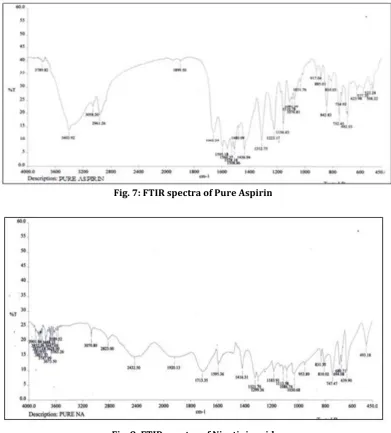
The maximum absorbance was obtained at 261nm wavelength.
CONCLUSION
Hence 261nm was concluded as ƛmax for estimation of NA.
(Fig. 3: Calibration curve of nicotinic acid in 0.1N HCl at 261nm).
Analytical method for estimation of aspirin from dissolution of AS-NA bilayered tablets
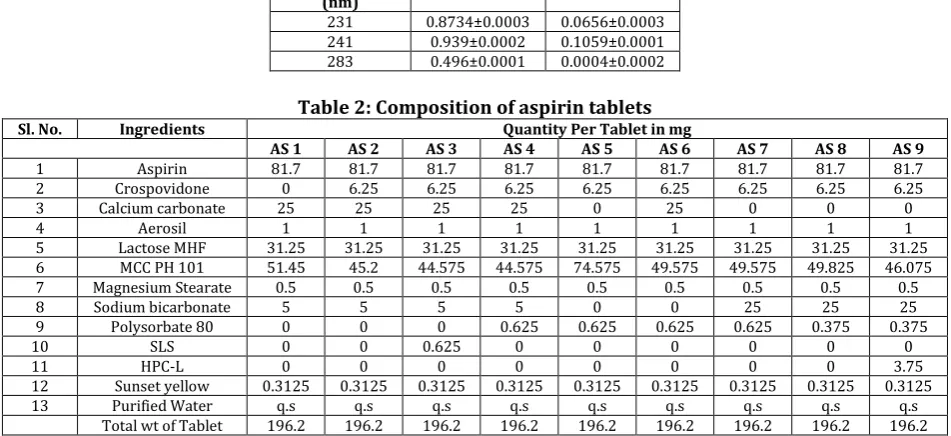
Analysis of the individual AS tablets was done at 265nm, but the analysis of AS and NA from ASNA tablets at their respective wavelengths showed interference with each other. The overlay spectrum of AS and NA showed maximum interference of AS and NA at wavelengths of 265nm and 231nm and negligible interference at 283nm. So for analyzing the AS samples obtained from dissolution studies of ASNA tablets, 283nm was considered as maximum wavelength. The overlay absorbance values of AS and NA observed at different wavelengths is showed in the following table; (Table 1: Overlay absorbance values of AS and NA at different wavelengths)
OBSERVATION
Nicotinic acid showed less interference with aspirin absorbance at 283nm.
CONCLUSION
HPLC method for estimation of nicotinic acid from dissolution of AS-NA tablets
AS shows possible interference with NA absorbance and hence NA cannot be analyzed through UV-spectrophotometer. Hence HPLC method was used to analyze NA from ASNA tablets.
Calibration curve of nicotinic acid analyzed through HPLC
Different concentrations of nicotinic acid were prepared and analyzed with HPLC Technique to determine the linearity.
(Fig. 5: Calibration curve of nicotinic acid in 0.1N HCl at 262nm).
Calculation
The amount of NA dissolved from each tablet at specified sampling interval was calculated in % using the formula;
% Drug Dissolved=
Where,
AS= Peak area due to NA in sample preparation AS= Peak area due to NA in standard preparation
Sw= Weight of NA working standard taken in mg P= % potency of NA working standard used.
PREFORMULATION STUDIES12-18
The preformulation studies like flow properties, solubility and drug-excipient compatibility studies were determined.
Flow properties of aspirin, nicotinic acid pure drug
The following flow properties of the pure drug and granules were evaluated.
Bulk density and Tapped density (g/ml)
The previously weighed pure drug or granules (W) were placed separately into a graduated measuring cylinder and the initial (bulk) volume (VB) was noted. It was placed in the tapped density tester USP and subjected to constant tapping at a rate of 200drops/min until the difference between the initial and final volumes should be less than 2%. It was recorded as the final (tapped) volume (VT) and various flow properties were calculated with the following formulae.
Bulk density
Tapped density,
Compressibility Index
It was calculated by using the following formula
Carr’s Index or Compressibility Index (CI) =
The CI value below 15% indicates good flow of the powder and above 30% indicates poor flow property of the powder.
Hausner’s Ratio
It is calculated by the following formula;
Hausner’s Ratio=
The Hausner’s ratio below 1.25 indicates good flow property and above 1.25 indicates poor flow property of the powder.
Angle of Repose (Ө)
It was determined by using a funnel whose tip was fixed at a constant height (H) of 2.5cm from horizontal surface. The granules and the powder were passed separately through the funnel until the tip of the conical pile touches the tip of the funnel. The radius of the base of the conical pile is measured as R (cm). It is determined with the formula;
Angle of repose (θ) = Tan-1 (height /radius)
Determination of solubility of aspirin
The solubility studies of AS in 0.1N HCl, pH 4.5 acetate buffer, 6.8pH phosphate buffer and distilled water were performed by employing saturation solubility method. It was conducted at a temperature of 37oC. 100ml of the solvent was placed in a 250ml of stoppered conical flask. Known amounts of the drug were added gradually until super saturation. A portion of the resulting saturated solution was collected, centrifuged for 5 minutes at 3500rpm, suitably diluted and analyzed at 235nm by UV spectroscopy.
The quantity of the drug dissolved in % (w/v)
Q= Where,
C= Concentration of Standard solution in mg. A= Response of the test solution
B= Response of the standard solution
WT= Total amount of drug substance added in mg
V1= Volume of the filtered test solution taken in ml
V2= Diluted volume in ml
The actual amount of the drug substance dissolved in mg, m=
The solubility of the drug substance in mg/ml is given by S= m/100
Drug-excipient compatibility studies
Drug-excipient compatibility studies were performed for physical mixtures of AS and NA with various excipients in different ratios such as 1:5 (drug: binder/polymer), 1:0.5 (drug: lubricant/glidant), 1:10 (drug: filler/diluent). These blends were placed in closed glass vials held at 400C/75% RH. These samples were withdrawn at the end of 4th week and subjected to FTIR studies by employing KBr pellet method. The pellets were placed inside the pellet holder and then scanned over a range of 400- 4000cm-1 for 5 times. The threshold value was kept at 0.75 to avoid formation of extra peaks of noise. The peaks of physical mixtures were then correlated with the peaks of pure drug.
Dose calculation of active ingredients
Amount of the pure drug to be taken is given by the formula (1);
Amount (mg) = Equivalent wt of
drug*100*100/Assay value* (100-water by KF)
Dose calculation of aspirin
From the Certificate of Analysis (COA) of aspirin calcium BHA premix, 81mg of AS BHA premix contains 10mg of AS drug. The assay value was 99.1% and the water by KF value was 0.06% w/w. The amount of AS BHA premix to be taken was calculated by using the above formula (1);
Amount of AS to be taken (mg) = 81*100*100/99.1* (100-0.06) = 81.7mg. Dose calculation of nicotinic acid
From the COA of 375mg of nicotinic acid contains 375mg of 375mg of drug. The assay value was 99.83 and the water by KF value was 0.09%. The amount of nicotinic acid to be taken was calculated by using the above formula (1);
Amount of NA to be taken (mg) = 375*100*100/99.83*(100-0.09) =375.9mg PREPARATION OF TABLETS
Preparation of aspirin tablets
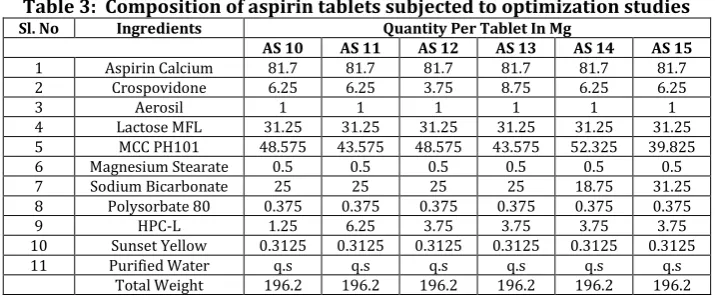
The composition of the tablets is given in Table 6.9 and 6.10 .The required ingredients were weighed accurately and passed through 40 mesh. The sieved materials were then mixed well in a poly bag for about 30 minutes. The surfactants, SLS and polysorbate80 were dissolved in cold and hot water respectively to use as granulating fluid. To moisten the blend, either water or surfactant solution was used as granulating fluid. The wet mass was granulated in RMG granulator. The granules were then dried in a Retsch rapid dryer at 600C for about 60 minutes until the %LOD becomes less than 3%. The dried granules were then passed through 40 mesh and then lubricated by mixing with the lubricant (which was previously passed through 60 mesh) in a polybag for about 15 minutes. The flow properties of the lubricated granules were determined. The lubricated granules were then compressed by using 16 station tablet compression machine (CADMACH) with 7mm plane round shaped punches.
Table 1: Overlay absorbance values of AS and NA at different wavelengths
Wavelength
(nm) AS NA
231 0.8734±0.0003 0.0656±0.0003
241 0.939±0.0002 0.1059±0.0001
283 0.496±0.0001 0.0004±0.0002
Table 2: Composition of aspirin tablets
Sl. No. Ingredients Quantity Per Tablet in mg
AS 1 AS 2 AS 3 AS 4 AS 5 AS 6 AS 7 AS 8 AS 9
1 Aspirin 81.7 81.7 81.7 81.7 81.7 81.7 81.7 81.7 81.7
2 Crospovidone 0 6.25 6.25 6.25 6.25 6.25 6.25 6.25 6.25
3 Calcium carbonate 25 25 25 25 0 25 0 0 0
4 Aerosil 1 1 1 1 1 1 1 1 1
5 Lactose MHF 31.25 31.25 31.25 31.25 31.25 31.25 31.25 31.25 31.25
6 MCC PH 101 51.45 45.2 44.575 44.575 74.575 49.575 49.575 49.825 46.075
7 Magnesium Stearate 0.5 0.5 0.5 0.5 0.5 0.5 0.5 0.5 0.5
8 Sodium bicarbonate 5 5 5 5 0 0 25 25 25
9 Polysorbate 80 0 0 0 0.625 0.625 0.625 0.625 0.375 0.375
10 SLS 0 0 0.625 0 0 0 0 0 0
11 HPC-L 0 0 0 0 0 0 0 0 3.75
12 Sunset yellow 0.3125 0.3125 0.3125 0.3125 0.3125 0.3125 0.3125 0.3125 0.3125
13 Purified Water q.s q.s q.s q.s q.s q.s q.s q.s q.s
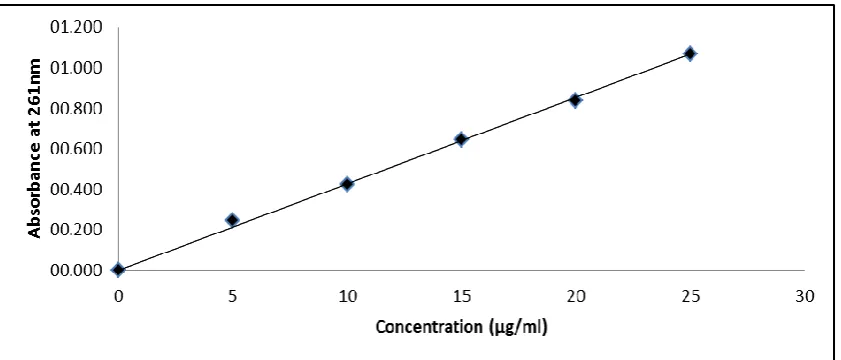
Table 3: Composition of aspirin tablets subjected to optimization studies
Sl. No Ingredients Quantity Per Tablet In Mg
AS 10 AS 11 AS 12 AS 13 AS 14 AS 15
1 Aspirin Calcium 81.7 81.7 81.7 81.7 81.7 81.7
2 Crospovidone 6.25 6.25 3.75 8.75 6.25 6.25
3 Aerosil 1 1 1 1 1 1
4 Lactose MFL 31.25 31.25 31.25 31.25 31.25 31.25
5 MCC PH101 48.575 43.575 48.575 43.575 52.325 39.825
6 Magnesium Stearate 0.5 0.5 0.5 0.5 0.5 0.5
7 Sodium Bicarbonate 25 25 25 25 18.75 31.25
8 Polysorbate 80 0.375 0.375 0.375 0.375 0.375 0.375
9 HPC-L 1.25 6.25 3.75 3.75 3.75 3.75
10 Sunset Yellow 0.3125 0.3125 0.3125 0.3125 0.3125 0.3125
11 Purified Water q.s q.s q.s q.s q.s q.s
Total Weight 196.2 196.2 196.2 196.2 196.2 196.2
Preparation of nicotinic acid tablets
The NA floating SR tablets were prepared by wet granulation method. The drug and polymer which were previously passed through 40 mesh were mixed thoroughly in a polybag for 20 minutes. The blend was moistened with granulating fluid i.e., water and IPA (1:9 parts). The wet mass was passed through 24 mesh and then dried in a tray dryer at 500C for about 50 minutes until the % LOD becomes less than 2%.
The dried granules were passed through 30 mesh and mixed with sodium bicarbonate in a polybag for 10 minutes. To this talc (previously passed through 60mesh) was added and mixed well for 10 minutes. The flow properties of the lubricated granules were evaluated. The lubricated granules were compressed by 16 station tablet compression machine (CADMACH) with 13.1mm round concave punches.
Table 4: Composition of floating SR nicotinic acid tablets
SL.
NO INGREDIENTS
QUANTITY PER TABLET IN MG
F1 F2 F3 F4 F5 F6 F7 F8 F9 F10 F11
1 NICOTINIC ACID 375.9 375.9 375.9 375.9 375.9 375.9 375.9 375.9 375.9 375.9 375.9
2 HPMC K 100M 250 250 250 250 250 250 250 250 250 150 350
3 SBC 75 100 100 100 100 100 100 100 100 100 100
4 AEROSIL 3 3 3 3 3 3 3 3 3 3 3
6 EUDRAGIT RSPO 30 30 - - - 30 30
7 EUDRAGIT RLPO - - 30 - - - -
8 EUDRAGIT RS100 - - 30 - - - -
8 Na CMC - - - - 30 - - - -
9 SODIUM ALGINATE - - - - 30 - - - - -
10 HPC KLUCEL HF - - - 30 - - - -
11 PVPK 90 - - - 30 - - -
12 ETHYL CELLULOSE - - - 30 - -
13 TALC 3 3 3 3 3 3 3 3 3 3 3
14 IPA Q.S Q.S Q.S Q.S Q.S Q.S Q.S Q.S Q.S Q.S Q.S
15 PURIFIED WATER Q.S Q.S Q.S Q.S Q.S Q.S Q.S Q.S Q.S Q.S Q.S
TOTAL WEIGHT 736.9 761.9 761.9 761.9 761.9 761.9 761.9 761.9 761.9 661.9 861.9
Preparation of bilayered tablets of AS-NA
The bilayered tablets of aspirin and nicotinic acid (ASNA) were compressed using 13.1mm round concave punches using a bilayered tablet compression machine. The granules of nicotinic acid were placed first and pre-compressed with
Table 5: Composition of optimized aspirin layer in AS-NA tablets
SL.NO INGREDIENTS OF AS13 QUANTITY PER TABLET in mg
1 ASPIRIN 81.7
2 CROSS POVIDONE 6.25
3 AEROSIL 1
4 LMFL 31.25
5 MCC PH101 46.075
6 SBC 25
7 POLYSORBATE 80 0.375
8 HPC-L 3.75
9 MAGNESIUM STEARATE 0.5
10 SUNSET YELLOW (0.25%) 0.3125
11 PURIFIED WATER q.s
TOTAL WEIGHT 196.2
Table 6: Composition of optimized nicotinic acid layer in AS-NA tablets
SL.NO INGREDIENTS QUANTITY PER TABLET IN MG
1 NICOTINIC ACID 375.9
2 HPMC K 100M 250
3 SBC 100
4 AEROSIL 3
5 EUDRAGIT RSPO 30
6 TALC 3
7 IPA Q.S
8 PURIFIED WATER Q.S
TOTAL WEIGHT 761.9
FLOW PROPERTIES OF LUBRICATED GRANULES
The lubricated granules obtained from wet granulation of aspirin and nicotinic acid with different excipients are evaluated for flow properties like bulk density, tapped density, compressibility index, Hausner’s ratio and angle of repose.
EVALUATION OF TABLETS19-23
The Post compressional parameters like hardness, thickness, % friability, disintegration time were evaluated for all the prepared tablets. The drug content was determined for all the batches. Dissolution studies were conducted for all formulations.
Weight variation
Twenty tablets were collected randomly and the average weight and individual weight was calculated. The % weight variation was calculated with the following formula.
%Weight variation= Average weight-individual weight/individual weight *100
Thickness
The thickness of the ten tablets was measured in mm by using Vernier calipers.
Hardness
The hardness of the ten tablets was measured by using Varian V K200 Tablet Hardness Tester and is given in the units of KP.
% Friability
Ten tablets were carefully dedusted prior to testing and weighed accurately (Wo). The tablets were placed in the drum of Electrolab Friabilator (USP) EF-2. The drum was rotated for 100 times at a speed of 25rpm. The tablets were collected, re-dedusted and accurately weighed (W1). It is calculated form the following formula;
% Friability=
Disintegration Test
Floating lag time (FLT)
The NA tablets were placed in a beaker containing 250ml of 0.1N HCl and the time (sec) required to float the tablet was observed and recorded as FLT.
Total floating time (TFT)
The time (hr) up to which the NA tablet remains buoyant was noted and recorded as TFT.
Determination of swelling index of NA tablets
The previously weighed (W1) tablet was placed in USP apparatus type-I which was immersed in a bowel containing 900ml of 0.1N HCl and maintained at 37±0.20C. The tablets were removed from the basket at regular intervals of time (up to 8hrs with 1 hr interval) and placed on a blotting paper to remove the excess medium. The tablet was reweighed (W2). The studies were repeated for all formulations in triplicate. The swelling index was calculated as follows:
Swelling Index = W2-W1/W1 * 100 (Fig. 6: Swelling phenomenon of nicotinic acid tablets).
Determination of drug content of aspirin tablets
Ten AS tablets were weighed accurately and then crushed well in a clean motor and pestle. The powder equivalent to 25mg of the drug was weighed (Ws) and then transferred to a 100ml volumetric flask. 50ml methanol was added and sonicated for 5 minutes at 270C. Then the volume was made up to 100ml using methanol (V4). From this 4ml (V5) was transferred to a 100ml volumetric flask and the volume was made up to 100ml (V6) with 0.1N HCl (pH 1.2). The flask was agitated for 5 minutes and then the sample was analyzed for drug content at 235nm using UV Spectrophotometer. The drug content was calculated using the following formula.
% Drug Content=
Where,
AS= Test absorbance AS= Standard Absorbance
W= Weight of standard drug (25mg)
V1= Volume of solvent added to standard stock solution (100ml)
V2, V3= Dilution of the standard stock solution (4ml of stock solution diluted to 100ml with solvent)
AW= Average weight of the tablet (mg) L= Label claim of the drug (10mg) P = Potency of aspirin calcium (91.4%).
Determination of drug content of Nicotinic acid tablets
Ten NA tablets were weighed and crushed in a motor with pestle. The crushed powder equivalent to 100mg of NA (WS) was weighed accurately and transferred to a clean, dried 100ml volumetric flask. 50 ml of 0.1N HCl was added and agitated vigorously for 10 minutes and sonicated for 4 hours. The final volume was made up to 100ml (V4) using 0.1N HCl and agitated for 5 minutes. A portion of it was centrifuged at 3000rpm for 10 minutes. The centrifuged sample was filtered through 0.45µm whatmann filter paper. 2 ml (V5) of the filtered sample was pipetted out and transferred to a 100ml volumetric flask and the volume was made up to 100ml (V6) with 0.1N HCl and the flask was shaked for 5 minutes. The sample was then analyzed for the drug content at 261nm using UV Spectrophotometer. The drug content was calculated using the following formula.
% Drug Content=
Where,
AS= Test absorbance AS= Standard Absorbance
W= Weight of standard drug (100mg)
V1= Volume of solvent added to standard stock solution (100ml)
V2, V3= Dilution of the standard stock solution (2ml of stock solution diluted to 100ml with solvent)
RESULTS
Fig. 1: Calibration curve of aspirin in 6.8pH phosphate buffer at 235nm
Fig. 2: Calibration curve of aspirin in 0.1N HCl at 235nm
Fig. 4: Calibration curve of aspirin in 0.1N HCl at 283nm
Fig. 5: Calibration curve of nicotinic acid in 0.1N HCl at 262nm
Fig. 7: FTIR spectra of Pure Aspirin
Fig. 8: FTIR spectra of Nicotinic acid
Fig. 10: FTIR spectra of physical mixtures containing pure nicotinic acid 1-Pure NA; 2- NA+sodiumCMC; 3- NA+HPC; 4- NA+sodium alginate
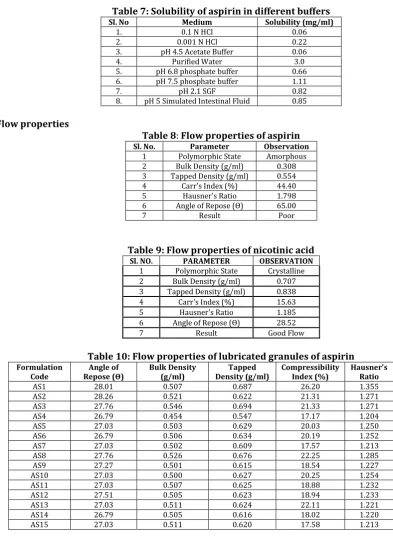
Table 7: Solubility of aspirin in different buffers
Sl. No Medium Solubility (mg/ml)
1. 0.1 N HCl 0.06
2. 0.001 N HCl 0.22
3. pH 4.5 Acetate Buffer 0.06
4. Purified Water 3.0
5. pH 6.8 phosphate buffer 0.66
6. pH 7.5 phosphate buffer 1.11
7. pH 2.1 SGF 0.82
8. pH 5 Simulated Intestinal Fluid 0.85
Flow properties
Table 8: Flow properties of aspirin
Sl. No. Parameter Observation
1 Polymorphic State Amorphous
2 Bulk Density (g/ml) 0.308
3 Tapped Density (g/ml) 0.554
4 Carr's Index (%) 44.40
5 Hausner's Ratio 1.798
6 Angle of Repose (Ѳ) 65.00
7 Result Poor
Table 9: Flow properties of nicotinic acid
Sl. NO. PARAMETER OBSERVATION
1 Polymorphic State Crystalline
2 Bulk Density (g/ml) 0.707
3 Tapped Density (g/ml) 0.838
4 Carr's Index (%) 15.63
5 Hausner's Ratio 1.185
6 Angle of Repose (Ѳ) 28.52
7 Result Good Flow
Table 10:Flow properties of lubricated granules of aspirin
Formulation
Code Repose (Ѳ) Angle of Bulk Density (g/ml) Density (g/ml) Tapped Compressibility Index (%) Hausner's Ratio %LOD
AS1 28.01 0.507 0.687 26.20 1.355 2.09
AS2 28.26 0.521 0.622 21.31 1.271 2.98
AS3 27.76 0.546 0.694 21.33 1.271 2.73
AS4 26.79 0.454 0.547 17.17 1.204 2.16
AS5 27.03 0.503 0.629 20.03 1.250 2.10
AS6 26.79 0.506 0.634 20.19 1.252 2.93
AS7 27.03 0.502 0.609 17.57 1.213 2.83
AS8 27.76 0.526 0.676 22.25 1.285 2.96
AS9 27.27 0.501 0.615 18.54 1.227 2.63
AS10 27.03 0.500 0.627 20.25 1.254 2.86
AS11 27.03 0.507 0.625 18.88 1.232 2.92
AS12 27.51 0.505 0.623 18.94 1.233 2.75
AS13 27.03 0.511 0.624 22.11 1.221 2.62
AS14 26.79 0.505 0.616 18.02 1.220 2.87
AS15 27.03 0.511 0.620 17.58 1.213 2.78
Table 11:Flow properties of lubricated granules of nicotinic acid
Formulation
Code Repose (Ѳ) Angle of Bulk Density (g/ml) Tapped Density (g/ml) Compressibility Index (%) Hausner's Ratio %LOD
F1 32.01 0.399 0.559 28.62 1.401 1.74
F2 33.34 0.336 0.502 33.00 1.494 1.89
F3 33.69 0.353 0.502 29.68 1.422 1.93
F4 33.34 0.335 0.470 28.72 1.404 1.83
F5 32.66 0.338 0.494 31.57 1.463 1.79
F6 33.69 0.350 0.485 27.83 1.387 1.87
F7 33.69 0.346 0.485 28.65 1.401 1.92
F8 33.34 0.351 0.491 28.71 1.403 1.90
F9 34.04 0.354 0.503 29.62 1.421 1.76
F10 33.34 0.323 0.469 31.13 1.452 1.96
Table 12:Post compressional parameters of the formulated aspirin tablets
Formulation
Code Average weight (mg) Thickness (mm) Hardness (KP) Friability % Disintegration Time (min) % Drug Content
AS1 196.2±0.517 3.24±0.010 5.75±0.088 0.239 24.46±0.579 98.88
AS2 196.2±0.632 3.28±0.008 5.87±0.214 0.239 5.21±0.079 99.33
AS3 196.2±0.707 3.04±0.021 5.62±0.370 0.159 14.16±0.497 100.73
AS4 196.2±0.441 3.08±0.024 5.51±0.228 0.398 0.46±0.690 99.57
AS5 196.2±0.601 3.16±0.036 5.68±0.130 0.079 9.28±0.132 98.15
AS6 196.2±0.500 3.26±0.008 5.78±0.116 0.238 6.28±0.043 100.46
AS7 196.2±0.632 3.03±0.06 5.91±0.216 0.318 6.29±0.047 99.95
AS8 196.2±0.440 3.04±0.026 5.87±0.386 0.397 6.56±0.046 99.69
AS9 196.2±0.500 3.06±0.010 5.97±0.179 0.316 1.3±0.066 100.14
AS10 196.2±0.527 3.01±0.021 5.81±0.116 0.396 1.22±0.115 100.56
AS11 196.2±0.737 3.04±0.038 6.15±0.263 0.317 23.96±0.853 100.3
AS12 196.2±0.500 3.06±0.016 5.64±0.357 0.238 8.2±0.123 99.62
AS13 196.2±0.500 3.05±0.012 6.11±0.187 0.079 0.51±0.079 99.15
AS14 196.2±0.440 3.08±0.014 5.28±0.116 0.317 5.23±0.023 100.15
AS15 196.2±0.462 3.07±0.019 5.58±0.203 0.158 2.28±0.016 99.24
Table 13: Post compressional parameters of the formulated NA floating SR tablets
Formulation
Code weight(mg) Average Thickness (mm) Hardness (KP) Friability % % Drug content (SEC) FLT TFT (HR)
F1 736.7±0.500 6.14±0.015 12.75±0.105 0.163 98.58 1821 >20
F2 761.8±0.527 6.28±0.009 12.87±0.138 0.092 101.61 26 >20
F3 761.4±0.707 6.28±0.010 12.77±0.115 0.144 101.87 27 >20
F4 761.3±0.881 6.29±0.010 12.86±0.091 0.145 98.22 30 >20
F5 762.0.±0.500 6.25±0.014 12.86±0.121 0.131 100.65 18 >20
F6 761.9±0.527 6.29±0.007 12.71±0.147 0.197 100.91 28 >20
F7 761.2±0.707 6.28±0.019 12.87±0.150 0.105 100.83 27 >20
F8 761.8±0.527 6.28±0.011 12.87±0.076 0.183 98.65 30 >20
F9 761.4±0.667 6.27±0.030 12.8±0.089 0.105 99.88 53 >20
F10 661.8±0.632 5.64±0.036 12.62±0.179 0.136 99.59 21 >20
F11 861.6±0.666 6.96±0.019 12.81±0.134 0.127 99.60 48 >20
Table 14:Swelling index values observed from NA tablets
TIME (HR) % Swelling
F1 F2 F3 F4 F5 F6 F7 F8 F9 F10 F11
0 0 0.0 0.0 0.0 0.0 0.0 0.0 0.0 0.0 0.0 0.0
1 85.72 96.0 83.5 82.7 105.7 114.2 71.1 110.2 68.9 83.9 97.4
2 92.96 113.7 106.1 108.1 128.0 160.4 100.5 152.7 102.6 111.6 120.4
3 149.2 153.5 147.6 148.4 155.5 187.4 149.2 181.3 129.5 122.0 178.9
4 160.8 165.3 164.7 173.7 178.6 197.0 153.5 199.9 138.4 148.4 189.0
5 171.9 188.6 184.3 188.5 193.3 216.1 164.5 209.9 150.3 176.1 192.2
6 194.3 190.2 190.3 189.7 200.1 226.7 184.2 222.5 171.5 180.4 211.6
7 201.2 203.1 202.0 202.6 209.9 239.8 191.4 237.1 177.5 200.3 218.3
8 214.1 215.0 210.5 209.2 216.4 254.3 211.2 242.7 187.4 208.9 247.0
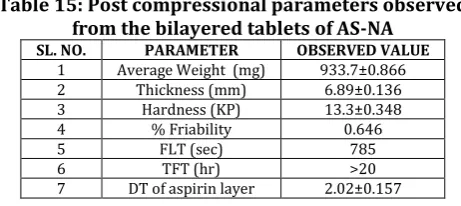
Table 15:Post compressional parameters observed from the bilayered tablets of AS-NA
SL. NO. PARAMETER OBSERVED VALUE
1 Average Weight (mg) 933.7±0.866
2 Thickness (mm) 6.89±0.136
3 Hardness (KP) 13.3±0.348
4 % Friability 0.646
5 FLT (sec) 785
6 TFT (hr) >20
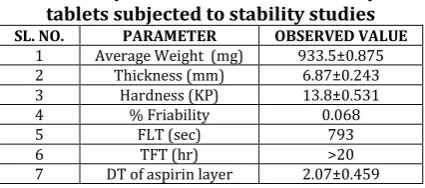
Table 16: Physical characteristics of bilayered tablets subjected to stability studies
SL. NO. PARAMETER OBSERVED VALUE
1 Average Weight (mg) 933.5±0.875
2 Thickness (mm) 6.87±0.243
3 Hardness (KP) 13.8±0.531
4 % Friability 0.068
5 FLT (sec) 793
6 TFT (hr) >20
7 DT of aspirin layer 2.07±0.459
RESULTS AND DISCUSSION
Aspirin is a BCS Class-II drug, whose oral bioavailability mainly depends on its solubility. In the present study, dissolution rate of aspirin was enhanced by using different excipients. Nicotinic acid (VitaminB3) is used in higher concentrations to treat hyperlipidemia. The IR formulation of NA shows flushing of the face and neck parts and limits its use. Many approaches including SR dosage forms have been developed to reduce the side effects of NA. In the present study NA floating SR tablets were prepared to achieve sustained release, to improve its oral bioavailability as it is majorly absorbed from stomach and upper small intestine. Different polymers were used in combination with HPMC K100 to study their influence on release rate of drug.
Drug Excipient Compatibility Studies
The FTIR spectra of aspirin and its blends were found to be identical. The principle FTIR absorption peaks of aspirin at 3403.92cm-1 (alcoholic O-H stretch), 3058.20 cm-1 (C-H stretch aromatic), 1662.24 cm-1 (carbonyl C=O stretch), 1594 cm-1 ( 10 amine N-H bend) and 692.03 cm-1 (C-F) were observed in aspirin as well as the formulations containing aspirin. Thus the FTIR studies indicated that there were no drug-excipient interactions.
The FTIR data of pure nicotinic acid was represented. It was observed that all the peaks of physical mixtures were super-imposible with the peaks of pure drug and showed correlation coefficient greater than 0.9. Thus the FTIR studies confirmed that there were no drug- excipient interactions. The FTIR peaks showed that there were no drug-drug interactions between aspirin calcium and nicotinic acid.
Solubility Study
The solubility of Aspirin was found to be pH dependent and it was more soluble in alkaline conditions. Thus this study indicated that the incorporation of alkalizing agents in the Aspirin formulation enhances the dissolution rate of Aspirin.
Flow Properties of Pure Drugs
The preformulation studies of pure drug of AS showed poor flow properties and hence the pure drug of AS as such cannot be formulated by direct compression method. Aspirin granules were prepared by wet granulation method. Nicotinic acid pure drug showed good flow properties as it is observed from the values of Carr’s index (15.63) and angle of repose (28.52). Nicotinic acid as such can be compressed to formulate the tablets because of its flow properties. However, nicotinic acid floating tablets were prepared by wet granulation method to increase the porosity of the granules and to impart floating property to the tablet.
Flow Properties of Granules
All the formulations of AS were evaluated for various micromeritic properties. The Carr’s Index values of all the formulations were found to be less than 30. The angle of repose was found to be in between 26.0 to 29.0. These values showed that the granules possess good flow properties.
The granules of NA formulations were evaluated for various flow properties like angle of repose, Carr’s Index, Hausner’s Ratio and the results are tabulated in Table 7.5.The Angle of repose values of all the formulations were in the range of 260 - 280 , indicating that the granules possess good flow properties.
Physical Parameters of Tablets
exceeding the concentration of 5% (AS11) and not having superdisintegrant (AS1) failed to meet the disintegration requirement. The drug content of all the batches was within the limits. Post compressional parameters like weight variation, thickness, and hardness were performed for NA tablets and they were found to comply with the compendia requirements. The hardness of all the tablets was found to be in range of 12- 14KP. The % friability of all the formulations was found to be less than 1% and hence these tablets can withstand any external stress that occurs during handling or transportation of tablets.
The in-vitro buoyancy studies of NA tablets
showed that the floating lag time was influenced by the concentration of NaHCO3. The tablets formulated with 11% of NaHCO3 showed a floating lag time more than 30min. Hence the tablets were formulated with higher concentration of NaHCO3 (13%) and these tablets showed a floating lag time of 30sec. Further batches were formulated with 13% NaHCO3. All the formulations showed a total floating time of more than 20 hrs. The drug content of all the formulations was determined and they were in between 98 – 101% that meets the specifications (90-110%).
The swelling index of all the NA formulations was performed and all the tablets showed good swelling property and influenced by the other polymer. The effect of concentration of sodium carbonate on the swelling index of NA tablets was studied. The tablets that are formulated with 13% sodium bicarbonate showed more swelling index compared to tablets with 11% sodium bicarbonate (F1). This may be due to the increased reaction of sodium bicarbonate with the dissolution medium that increases the release of CO2 which increases the number of pores there by increases the swelling index.
CONCLUSION
Studies were undertaken to formulate and evaluate floating bilayered tablets containing a immediate release layer of aspirin and a sustained release layer of nicotinic acid. Aspirin is having poor water solubility and found to be more soluble in alkaline conditions. So in order to improve its dissolution rate, various attempts such as incorporation of alkalizing agents, surfactant, super disintegrating agent, binder and modification of their concentrations were studied.
Floating sustained release formulations of nicotinic acid were made by varying the concentration of alkalizing agent and concentration and type of polymer. The
formulated tablets were evaluated for various official and unofficial quality control tests. The optimized immediate release layer of aspirin and effervescent floating sustained release layer of nicotinic acid were compressed to form a bilayered tablet.
REFERENCES
1. Yie W Chein. Oral Drug Delivery Systems: Novel Drug Delivery Systems”, Marcel Dekker, New York, 2nd edition, 2005;50:139-196.
2. Thomas Wait-Yip Lee and Joseph R Robinson, “Controlled Release Drug Delivery Systems”, In the Science and Practice of Pharmacy, 2001;1:20th edition, 903.
3. Jain NK. Controlled and Novel Drug Delivery. CBS Publishers & Distributors, New Delhi, 3rd edition. 2007;353-380. 4. Hetangi Rathod. Floating Drug Delivery
System: Innovative Approach of Gastroretention. International Journal of Pharmaceutical Sciences Review and Research. 2010;.4(3):183-192.
5. Shweta Arora. Floating Drug Delivery Systems: A Review”, AAPS PharmSciTech. 2005;6(3): E372-E390. 6. Brayfield A. (14 January 2014). Aspirin.
Martindale: The Complete Drug Reference. Pharmaceutical Press. Retrieved 3 April 2014.
7. Cholesterol management with drugs. Available from: http//www.accessdata. fda.gov/scripts/cder/drugs altd/.
8. Available from:
http//www.drugbank.com/nicotinicaci d/htm.
9. Ramdas T Dolas. Novel Sustained Release Gastroretentive Drug Delivery System. A Review International Journal of Pharma Research and Development. 2011;2(11):26-41. Samar EI Samaligy. Floating systems for oral controlled release drug delivery. Dissertation work, Berlin, 2010.
10. Jagadeesh Nadigoti and Shayeda. Floating Drug Delivery Systems. International Journal of Pharmaceutical Sciences and Nanotechnology. 2010;2(3):595-604.
11. Patil JM. Trends in Floating Drug Delivery Systems. Journal of Scientific and Industrial Research. 2006;65:11-21.
of Pharmaceutical Review and Research. 2010;2(2):68.
13. Patel Mehul. Challenges in the Formulation of Bilayered Tablets: A Review. International Journal of Pharm Research and Development. 2005;2(10):30-42.
14. Girish S Sonar, Devendra K Jain and Dhananjay M More. Preparation and In vitro Evaluation of Bilayer Floating-bioadhesive Tablets of Rosiglitazone Maleate. Asian Journal of Pharmaceutical Sciences.
15. Raval JA, Patel JK, Naihong Li and Patel MM. Ranitidine Hydrochloride Floating Matrix Tablets based on Low Density Powder: Effects of Formulation and Processing Parameters on Drug Release. Asian Journal of Pharmaceutical Sciences.
16. FDA Guidance for Industry. Dissolution Testing of Immediate Release Solid Oral Dosage Forms. Dissolution Technology. 1997.
17. Sandip B Tiwari, Krishna Murthy T. Controlled Release Formulation of Tramadol Hydrochloride Using Hydrophilic and Hydrophobic Matrix system. AAPS PharmSciTech.
18. Sandip B Tiwari, Krishna Murthy T, Raveendra Pai M, Pavak R Mehta and Pasula B Chowdary. Controlled release
formulation of tramadol hydrochloride using hydrophilic and hydrophobic matrix System. AAPS Pharmscitech. 19. Yeole PG, Galgatte UC, Babla IB and
Nakhat PD. Design and Evaluation of xanthan gum based sustained release matrix tablets of diclofenac sodium. Indian J Pharm Sci.
20. Derle DV, Kasliwal NH and Chavan N. Development and comparative evaluation of xanthan gum and guar gum based sustained release matrix tablets of tizanidine hydrochloride. Indian drugs. 2008;46(2):485-489. 21. Basak SC, Jayakumar reddy BM and
Lucas Mani KP. Formulation and release behaviour of sustained release ambroxol hydrochloride HPMC matrix tablet. Indian J Pharm Sci.
22. Rekhi GS, Nellore RV, Hussain AS, Tillman LG, Malinowski HJ and Augsburger LL. Identification of critical formulation and processing variables for Metoprolol tartrate extended-release (ER) matrix tablets. J Control Rel.