INTERNATIONAL CONFERENCE ON ENGINEERING DESIGN, ICED’07
28 - 31 AUGUST 2007, CITÉ DES SCIENCES ET DE L'INDUSTRIE, PARIS, FRANCE
DEVELOPING AND APPLYING AN INTEGRATED
MODULAR DESIGN METHODOLOGY WITHIN A SME
X T Yan1, B Stewart1, W Wang1, R Tramsheck2, J Liggat3, A H B Duffy1 and I Whitfield1 1
The University of Strathclyde, Department of Design, Manufacturing and Engineering Management, Glasgow UK.
2
Scottoiler (Scotland) Ltd, Milngavie, Glasgow, UK. 3
The University of Strathclyde, Department of Pure and Applied Chemistry, Glasgow, UK.
ABSTRACT
Modularity within a product can bring advantages to the design process by facilitating enhanced design reuse, reduced lead times, decreased cost and higher levels of quality. While the benefits of modularity are becoming increasingly better known, at present it is usually left to the designers themselves to introduce modularity into products. Studies into modularity have shown that by implementing ‘formal’ methods, further benefits can be made in terms of time, cost, quality and performance. Current approaches that have been proposed for the formal development of modular design methodologies fail to accurately represent knowledge that is inherently produced during design projects and fail to consider design from the different viewpoints of the development process.
This work, built on previous work on modularity and design for reuse, aims to develop an integrated design methodology that will optimise the modules created through the design process and allow for modularity to be ‘built-in’ to product development from the initial stages. The methodology and associated tools have been developed to provide an easy-to-use approach to modularity that has support for design rationales and company knowledge that aid in effective design decision making. The methodology, named GeMoCURE, provides an integrated total solution to modular design based on reuse of proven physical and knowledge modules. Its incremental nature allows for the optimal structure to be maintained as the design progresses. A special focus has been on the application of this approach for Small to Medium Enterprises (SMEs), which are typically challenged by a lack of design human resources and expertise.
Keywords: modular design, design methodology, design rationale, design reuse
1 INTRODUCTION
With the high pace of change of current product markets and the increasingly specific needs of the customer, the process of carrying out design and product development has become increasingly complex. In Small to Medium Enterprises (SMEs) such problems are amplified. The instant introduction of new products for every new customer requirement (more customer focused than market focused) with little regard for compatibility with other products currently in production is common practice [1]. Often the only way to handle such complexity is to break the system up into manageable parts [2].
The heart of research into product modularity is the development of modular products, therefore, methods for developing more modular products are essential [5]. While there is industrial interest in creating modular devices, there is no systematic modular design methodology in place. An example from the electronics industry shows a difference in costs of up to 64 times where formal reuse practises are used compared to designers’ current practises [6]. A further study in the engineering design sector concluded that by using structured, formal methods they could gain benefits that were far greater than the benefits from relying on designers’ natural inclinations [7]. It can therefore be concluded that there is an explicit need within industry to develop methodologies, methods and systems that will allow the perceived benefits of modularity to be transferred into specific gains for industry.
2 MODULAR DESIGN
A product’s architecture is the scheme by which the functional elements of the product are allocated to physical components and how they interact with one another [8]. Conventional product architectures tend to be integral architectures where functional elements of the product are implemented using more than one subassembly and single components can have many functional uses [9]. This is usually the architecture that is used when a one-off product is required or a product requires the highest possible performance. The opposite of an integral architecture is a modular architecture where subassemblies implement one or a few functional elements and the interactions between these subassemblies are well defined and fundamental to the primary functions. Modular design therefore involves designing a product so that its architecture is as modular as possible.
2.1 What is a module?
The term ‘module’ is widely used in many different areas of work and while there are some generic meanings for modules Gershenson et al [10] state that there is no clear agreement on the exact meaning of what a module is. Stone et al [11] say that “Modules are defined as physical structures that have a one-to-one correspondence with functional structures.” This puts forward the notion that modules are defined by the functions that they are capable of carrying out and, more specifically, the authors are stating that each module should be capable of carrying out a single function independently of any outside interaction.
It is possible to summarise, from previous research [5, 10, 11, 12, 13, 14, 15], the key points that a module has to have as; structural independence, functional independence and minimal interfaces or interactions with other modules or outside influences. These points are adequately covered by the definition put forward by Smith and Duffy [13] which states that “Modules are commonly described as a group of ‘functionally’ or ‘structurally’ independent components clustered such that ‘interactions are localized within each module and interactions between modules are minimised’ [15]”. This definition has been the basis for previous research that this work will be based on and build upon.
2.2 Modular design methodologies
Of the methodologies that fall into these categories none still fully meet the needs of an integrated modular design methodology that is able to guide the direction of the whole design process in order to maintain the optimal modular product structure. The current methodologies also fail to accurately represent the different viewpoints that are inherent within any design project and fail to record and reuse the quantities of design knowledge that are generated throughout [17]. As such, a new method -entitled GeMoCURE, has been developed. The method can be used to generalise necessary information from existing products, modularise them, and make use of these modules through customisation and reconfiguration to optimise the product’s modular structure from various design viewpoints. During this process the methodology can also record the knowledge produced.
3 GEMOCURE
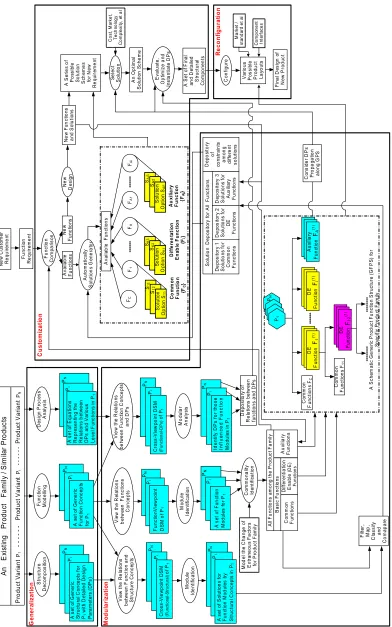
The GeMoCURE methodology is developed as an integrated approach by combining several methods to allow designers to generate design solutions using modular concepts in a systematic manner. This new methodology contains four significant methods that form the integrated methodology; Generalisation, Modularisation, CUstomisation and REconfiguration (GeMoCURE). Figure 1 shows a detailed pictorial representation of the methodology, illustrating all detailed activities and the prescribed sequence of utilising GeMoCURE in a design and manufacturing company. The following sections detail the key process and constituent activities of the GeMoCURE methodology.
3.1 Generalisation
The generalisation process is the initial stage of the methodology and it aims to study existing products or similar products in order to create generalised and generic product development primitives (PDP). This generalisation can be undertaken from three perspectives based on the work reported in [18, 19], namely, function, behaviour and structure. Function describes the physical effect imposed on an energy, material and information flow by a design entity without regard for the working principles or physical solutions used to accomplish this effect. Behaviours are the physical events associated with a physical artefact (or hypothesized concept) over time (or simulated time) as perceived by an observer. Structure is the most tangible concept with various approaches to partitioning structure into meaningful constituents such as features (Brown, 2003) and interfaces in addition to the widely used assemblies and components. Additional perspectives, such as Solution and life-cycle can also be used to generalise modules. The output from this stage is a series of PDP models from three perspectives that provide generic artefact information and knowledge for each PDP (Figure 1).
3.2 Modularisation
Modularisation is the key of GeMoCURE and it aims to generate and structure a family of genetic modules derived from generalisation such that they can be effectively used at a later stage. There are two aspects which have been considered in this approach, namely identification of generic modules and identification of distinctive modules, which focuses more on deriving modules which give unique features and characteristics for the product. In addition to generating the functional, behavioural and structural modules, the approach can also support the consideration of the product life-cycle in deriving modules. The modularisation stage is the key to how an optimal modular product structure can be created. The information that was created in generalisation is used to optimise the models to find the optimal modules within the product. The tool that is used to carryout this process is called a dependency structure matrix (DSM). This tool has been used in previous methods to represent concepts such as: tasks, resources, parameters and inter-concept dependencies. It has the ability to represent a range of different concepts and dependencies which makes it ideal for modelling the product viewpoints. The modularisation is based on the definition of a module by Smith and Duffy
[13] which states that modules should have ‘interactions are localized within each module and interactions between modules are minimised’. By modelling the dependencies between the generalised model concepts the interactions between them can be visualised. The optimisation can then be carried out to cluster the components into groups where the internal dependencies are maximised and the external dependencies minimised.
A S c h e m a ti c G e n e ri c P ro d u c t F u n c tio n S tr u c tu re ( G F P S ) fo r S p e c if ic P ro d u ct F a m ily C o m m o n F u n c ti o n s FC PN P1 D E F u n c ti o n F1 (1 ) C o mmo n F u n c ti o n s F1 1 D E F u n ct io n F1 2 (1 ) D E F u n c ti o n Fi (1 ) A u xi lia ry F u n ct io n FA (1 ) M o d e l th e C h a n g e o f E x tr a n e o u s F a ct o rs fo r P ro d u c t F a mi
ly All
F u n c ti o n s a m o n g t h e P ro d u c t F a m ily Ba si c F u n c ti o n s A u xi lia ry F u n ct io n s C o m m o n F u n c ti o n s D if fe re n ti a ti o n En a b le (D E ) F u n c ti o n s F ilt e r, Ma p , C la s s if y a n d C o m a p a re S o lu ti o n D e p o s it o ry f o r A ll F u n c ti o n s D e p o s it o ry 1 So lu tio n s fo r C o mmo n F u n c tio n s D e p o s it o ry 2 So lu tio n s f o r D E F u n c tio n s D e p o s it o ry 3 So lu ti o n s f o r Au x ili a ry F u n c tio n s D e p o s it o ry o f co n s tr a in ts a m o n g d if fe re n t s o lu ti o n s N e w C u s to m e r R e q u ir e m e n t F u n c ti o n R e q u ir e m e n t St ru c tu re D e c o m p o s iti o n F u n c tio n M o d e lli n g PN Pi A s e t o f G e n e ri c S tr u c tu ra l C o n ce p ts f o r P1 w it h D e ta ile d D e si g n P a ra m e te rs (D P s ) A n E x is ti n g P ro d u c t F a m il y / S im ila r P ro d u c ts P ro d u c t V a ri a n t P1 -P ro d u c t V a ri a n t Pi - --P ro d u c t V a ri a n t PN PN Pi A s e t o f G e n e ri c F u n c tio n C o n c e p ts fo r P1 PN Pi A s e t o f E q u a ti o n s R e p re s e n tin g t h e R e la ti o n s b e tw e e n D P s a n d V a ri o u s L e v e l F u n c ti o n s in P 1 D e s ig n P ro c e s s An a lysi s Mo d u le Id e n ti fic a ti o n PN Pi C ro ss-Vi e w p o in t D S M (F u n ct io na l-S tru ct u ra l) o f P1 V ie w t h e R e la ti o n s b e tw e e n F u n c ti o n a n d S tr u c tu re C o n c e p ts PN Pi F u n c tio n V ie w p o in t D S M o f P1 V ie w t h e R e la ti o n s b e tw e e n F u n c ti o n s C o n c e p ts V ie w t h e R e la tio n s b e tw e e n F u n c tio n C o n c e p ts a n d D P s M o d u la r An a lys is Mo d u le Id e n tif ic a ti o n PN Pi Id e n ti fy D P s f o r th o s e In fl u e n c e d F u n c ti o n M o d u le s i n P 1 PN Pi A se t o f So lu ti o n s fo r F u n ct io n M o d u le s b y S tr u c tu ra l C o n c e p ts in P 1 PN Pi A s e t o f F u n ct io n Mo d u le s f o r
P1 C
[image:4.612.96.488.50.677.2]o mmo n a lit y Id e n ti fi ca ti o n Au to m a ti ca lly S o lu ti o n s G e n e ra to r D e p o s ito ry o f R e la ti o n s b e tw e e n fu n ct io n s a n d D P s A Se ri e s o f Po ss ib le So lu ti o n Sc h e me s fo r N e w R e q u ir e m e n t C o s t, M a rk e t, T e c h n o lo g y C o m p le x it y , e t a l F u n c tio n C o m p a ri s o n Ava ila b le F u n c ti o n s N e w F u n c tio n s N e w F u n c tio n s a n d S o lu ti o n s N e w D e s ig n Se le c t So lu tio n An O p ti ma l S o lu ti o n S c h e m e E v a lu a te , O p ti m iz e a n d In s ta n ti a te D P s A Se t o f F in a l a n d D e ta ile d St ru ct u ra l C o m p o n e n ts C o n s id e r D P s P ro p a g a tio n a lo n g G P S C o n fi g u re Va ri o u s P o s s ib le Pr o d u c t L a y o u ts C o m p o n e n t In te rf a c e s Ma rk e t / s ta n d a rd e t a l F in a l D e s ig n o f N e w P ro d u c t G e n e ra li z a ti o n Mo d u la ri z a ti o n PN Pi C ro s s -V ie w p o in t D S M (F u n ct io n a l-D P s) o f P1 C u s to m iz a ti o n R e c o n fi g u ra ti o n FC FA1 FK F1 FAi S13 S1 2 So lu ti o n O p ti o n S 1 1 S K3 SK2 So lu ti o n O p ti o n S K1 C o m m o n F u n c ti o n {F C } D iff e re n ta ti o n E n a b le F u n c ti o n {F i } A u x il ia ry F u n c ti o n { FA j } S Ai 3 SAi 2 So lu tio n O p ti o n S Ai 1 A v a ila b le F u n c ti o n s
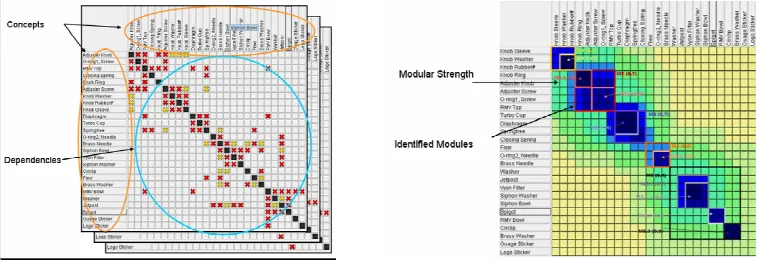
Once clustered by the optimization program it is necessary to have a visualization tool that permits for the module groupings to be observed and the strength of these groupings to be observed. The mechanism shows the modules in colour-coded form (see Figure 2) that provides a method for the designer to choose the optimum module groupings that best suits the product design. Each viewpoint can have its own DSM but there is also a function for cross-viewpoint matrices to be created which provides a means of maintaining the product optimal modular structure over the viewpoints as the design progresses. That provides an output, from this stage, of a final modular structure for the product in terms of concepts that meet the modular objective of the product development.
[image:5.612.117.496.160.290.2]
Figure 2 – A dependency structure matrix (DSM) in dependency mode (left) and module visualization mode (right).
3.3 Customisation
Customisation is a process of utilizing available modules, which are generated in the modularisation stage, to meet new design requirements by firstly identifying relevant modules and then tailoring them to suit a new design solution. For the first stage, design knowledge associated with each module can be used to generate automatically matched modules as candidate partial solutions for a design problem. Functional modules are used to match the required function; behaviour modules are used to assess the product behaviour, whereas the structural modules are used as the customised embodiment or implementation of a function. For the second step, designers need to tailor-make those chosen modules for a particular new requirement if necessary, and the knowledge generated from the modularity analysis of cross-viewpoint DSM (Function-technical parameters) can be utilized to aid this process. In addition, for special functions where there exists no suitable structural modules in the PDP library, the designers need to develop them separately and then add the function, structural module and mapping rules to the corresponding library for future use. The final outcome of this stage is a new design solution for a new design problem by reusing proven modules with different degrees of customisation of modules available to a designer.
3.4 Reconfiguration
Reconfiguring is a process of utilising available modules and investigating the spatial as well as structural configurations by rearranging them in different forms. This may lead to innovative design solutions by utilizing available modules and exploring different configurations of these modules. This process certainly enables designers to address design creativity and innovation issues, which are normally considered to be limited in traditional modular design. This also enables designers to consider optimising a design solution by exploring different layouts or configurations.
there is a high potential for reuse then the design task will be a rapid and efficient process where current modules are reconfigured to meet the new product objective. If the level of reuse is lower, then the process will be a customisation process where current modules are ‘built-in’ to the design to lower design and production costs. When carrying out the new design it will also be necessary to adhere to the module structure defined in the DSM and ensure that the design is built to this modular definition. This will provide further modules to add to the company portfolio and provide greater resource for future reuse.
4 APPLICATION OF METHODOLOGY
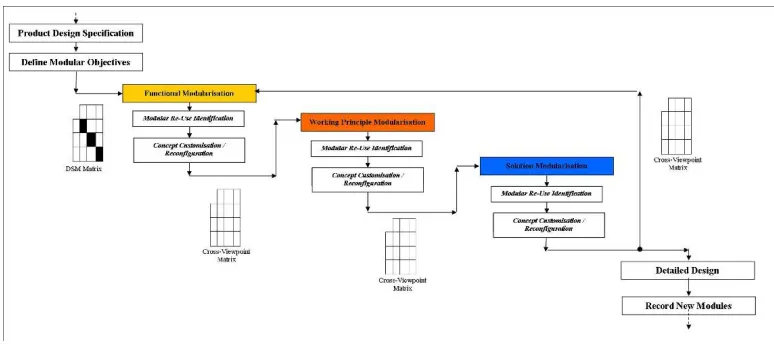
[image:6.612.110.497.266.438.2]The GeMoCURE methodology incorporates a set of tools that allow for the optimisation of products as they are being developed. In order to gain the benefits from these tools they have to be integrated into an overall product development methodology that provides the necessary steps to allow for the system to develop, reuse and encapsulate all of the modular data. A graphical representation of the methodology can be seen in Figure 3. These steps start after the product design specification has been created by ensuring that the modular objectives are properly defined. This step provides the overall focus of the subsequent generalisations and modularisations therefore the design team have to effectively define what they want to achieve from the modularisation process.
Figure 3– GeMoCURE Methodology
The generalisation, modularisation, customisation and reconfiguration stages of the approach happen for each of the viewpoints that are used for the product development. Each generalisation is carried out to represent the product in terms of the current viewpoint and to provide the necessary inputs for the modularisation stage. The modularisation stage then uses these inputs to optimise the product structure in terms of the viewpoint using the DSM software tools. Once this optimised structure has been defined it is then possible to carryout a search of the current modules within the company to see if there is a potential for reuse. Generation of conceptual customisations or reconfigurations can be carried out for the viewpoint based around the modules that are suitable for reuse. Where there are no modules that meet module specification, these should be designed into the product to ensure that the modular structure is met. A cross-viewpoint matrix is then used to map the modular structure from one viewpoint onto the next more detailed viewpoint using casual links between the viewpoint concepts.
that new modules are always being created and stored in the library to allow these to be available to subsequent design projects these have to be accurately recorded and made searchable.
The part of the GeMoCURE methodology has had some limited use within two companies’ design processes and has proven successful [18]. These companies were large multinational companies with complex products which the matrix style of the methodology suited. It is believed that the methodology can be of similar use in Small to Medium Enterprises (SMEs) where the products tend to be simpler with fewer parts. The focus of the previous work [18] was solely in mechanical products but the methodology can be applied to diverse multi-disciplinary products as well. In order to test these assertions, the methodology has been implemented within an SME based in Glasgow, Scotland. This SME has a small range of products but is interested in moving their technology into new fields and disciplines and believe that this methodology can help them do that in the most effective manner. A study of how the methodology has been implemented and used within this SME is outlined and presented here.
4.1 Current modules and knowledge
When implementing a modular design process that aims to increase module reuse, it is necessary to document the portfolio of modules already in use within the company. These have to be defined in the same manner to the modules that are identified during the GeMoCURE process. This can be a time consuming task if the company has a large portfolio of products that have to be recorded but any new products will automatically have the module information created therefore it is a one-off task. Within the company featured in this study, the main product was well founded and evolved having been in production for over twenty years and now on its seventh version. This meant that the design has been optimised over the years to give its current status but has never been designed with modularisation as a goal, resulting in components and subassemblies which have many external interactions. It was therefore found that the product was currently defined in terms of its sub-assemblies which in some cases did not represent the optimised modular structure. In such a situation it is better to simply use the subassemblies as modules as they are well defined and in production therefore there is no scope for reconfiguration of the product to a more modular structure. It is still necessary to define the generalisation of the product though in order to establish functions, working principles, etc to produce accurate searching parameters.
In order to carryout the generalisation on a mature product, the process used to find the optimal product structure can be used in a reverse fashion. The structure of the product is known and can be represented in the most detailed DSM viewpoint with the solution concepts that correspond to the product. Cross-viewpoint matrices can then be used to map this solution back through the viewpoints to establish the concept parameters of each module. This allows for this knowledge to be added to the modules and allows for them to be used as part of a modular reuse policy.
In the company featured in this study their product portfolio of around eight discrete products were defined in such a manner to provide a starting pool of modules for the new development projects. As well as fully produced and marketed products the company also had a series of prototype products and parts that were also included to ensure that all company knowledge was being recorded.
4.2 Recording product modules and knowledge
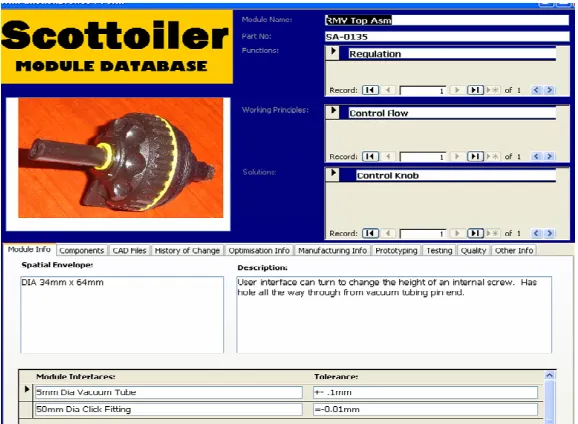
This newly created knowledge needs to be recorded and stored in a place where it is available to all designers and project stakeholders. It is necessary to store all the modules that have been identified from the company’s product portfolio and the knowledge that is associated with them. In order to create a shared area where the modules can be searched and studied a module database was created using Microsoft Access. The modules were stored in the database with their generalised concepts from the relevant viewpoints as the searchable parameters. This means that when a designer has created a generalised viewpoint for a new product, they can then search the database to ascertain if any modules match the functional requirements for a functional module that they are looking for and guide their design accordingly. A screenshot from the database can be seen in Figure 4.
methodology is to simultaneously store any knowledge that is created in the product development process. The database is setup with a series of tabs for each module that allow for the designer to add records of knowledge created that relates to the module. This knowledge can be of many different forms and could be stored in many different places. Therefore the database provides a method of linking in relevant documents and files that are created during the product development process. Tabs are provided on each module page for knowledge such as optimisation, manufacturing, CAD files, history of change documents, assembly work instructions, quality, etc. The purpose of these is to allow a link to each document to be added to the module so that when a user is selecting a suitable module they have all the information and knowledge that exists available to them to help in the decision making process.
Figure 4 – Screenshot of the module database
This recording process is built into the product development methodology so that all new modules and knowledge are recorded accurately. By ensuring that this happens within the design team, at each stage of the process, the knowledge from the company can be made available to all interested parties whenever required.
4.3 Product development optimisation
In order to prove that the GeMoCURE methodology is applicable to product development within a SME, once the methodology has been implemented within the company, two projects will use the tools and methods detailed so far to create modular products. This new design process will be benchmarked against previous projects to establish the benefits that such a methodology can bring to similar companies.
Two diverse projects are studied here – one a chemical product development and the other a mechanical product development – to also show how these tools are applicable over a wide range of disciplines. The company studied produce lubricant dispensers, lubricants and anti-corrosives and are interested in developing this range further into a different product markets. The mechanical product that will be studied is looking at developing a new dispensing system for one of these new market areas. There is also an interest in developing a lubricant for use with this market and a lubricant that is fully biodegradable which would have less of an impact on the environment. Therefore the chemical product development looks at developing two lubricants for the new market; one based on current practices and one looking at a biodegradable alternative.
4.3.1 Chemical product
which could then be reused in subsequent products. The lubricants and anti-corrosives that were already used within the company were generalised - following the procedures detailed in Section 4.1 – and modules recorded and detailed in the database. The first step was to create a product design specification for the lubricants and then decide on the modular objective for the development. It was decided that the objective was to gain maximum reuse of modules already available which led to the decision to generalise the new products using the viewpoint Function, Working Principle and Solution with the perspectives of functional and chemical. These perspectives were chosen to ensure that any modules that were created or reused where both functionally and chemically compatible and interdependent which will increase future reuse possibilities.
The process was then worked through by creating generalised models of each of the viewpoints and then optimising these using DSM matrices and cross-viewpoint matrices. After each viewpoint modularisation stage the database was searched, by the functions that were defined, for suitable modules that meet the module functions. With the identified modules a conceptual design was carried out looking at how these functions can be met. This was then repeated with the working principle viewpoint and the solution viewpoint modularisation with a module search after each modularisation stage and progressively more detailed conceptual design. Table 1 shows that in the case of the new lubrication variant five modules were identified at the functional stage and these matched up to four modules that were present within the database based on their functions. For this product these four modules matched the module definitions for the working principle modularisation and the solution modularisation. Therefore, these four modules were selected to be used in the final formulation.
Candidate Modules after generalisation / modularisation Product
Functional Working Principle
Solution
Reused
Modules Modules New
Variant Lubricant 4 4 4 4 1 Biodegradable
Lubricant
4 4 1 1 4
New Dispensing System
3 2 1 1 4
Table 1 – Chemical products’ candidate modules for reuse after GeMoCURE stages.
The second chemical product was the Biodegradable variation of the lubricant. This product had to have the same performance and functional characteristics as the Variant lubricant but had to be completely biodegradable and environmentally acceptable. This led to the modularisation matching four modules at the functional and working principle stages but this dropped to only one at the solution stage. This drop was due to the modules matching the early criteria but once the biodegradable aspect was brought in at the solution stage the modules were no longer suitable for this product. This meant that the Variant lubricant reused four modules but will require the formulation of one new modules while the Biodegradable lubricant will reuse one module but requires the formulation of four new modules.
Following the GeMoCURE process these two products are now candidates for reconfiguration and customisation. The Variant lubricant is an ideal candidate for reconfiguration as 80% of its modular structure is made up of reused modules. These reused modules can be reconfigured into the new formulation and the new module that is required will be designed to integrate into this new modular structure. The Biodegradable lubricant only reuses one current module therefore its design will be a customisation exercise where the one reusable module will be designed into the formulation that is produced during the detailed design stage. This process must also ensure that the modular integrity is maintained by designing the formulation so that the other modules are created during the process. These modules can then be stored to enable them to be used in the next product development process.
4.3.2 Mechanical product
applied to a typical product produced within a SME. The product was proposed with the aim of using the company’s current lubrication dispensing expertise in a new and innovative field. The GeMoCURE process detailed in Figure 3 was again used during the development of the product to optimise the structure and find suitable modules for reuse within the new product.
In this case the modular emphasis was more on developing new modules that can be reused and less on reusing current company modules. This was due to the target market having a wide range of disciplines that provide the opportunity for a variety of versions of the device. This resulted in the definition of the viewpoints being the standard - Function, Working Principle and Solution - and the perspectives were Energy, Material and Information. These perspectives were chosen as the modular objective called for functionally modular development and these three choices represent the flows through a standard function diagram. These viewpoints and perspectives formed the basis for the generalisation of the viewpoints into suitable product concepts. This allowed the proposed product to be viewed from high level principles and represent the inputs for the DSM to be created. The DSM software was then used to modularise the product concepts into an optimal modular structure for the respective product viewpoints. Table 2 shows the results from the module reuse identification stage where the optimised modules were compared to the modules within the module database to ascertain if there were any suitable candidates for reuse.
Candidate Modules after generalisation / modularisation Product
Functional Working Principle
Solution
Reused
Modules Modules New
New Dispensing System
[image:10.612.91.526.257.337.2]3 2 1 1 4
Table 2 - Mechanical product’s candidate modules for reuse after GeMoCURE stages.
The highest level of modularisation (from the functional viewpoint) showed that there were three potential modules identified in the module database that matched the functional concepts. As the design progressed through more detailed iterations (the working principle and solution viewpoints) the number of potential candidate models reduced until at the end only one module actually met the requirements and was chosen for reuse. With only one of the defined modules available for reuse then the product development would now enter a customisation stage. This will involve carrying out the conceptual generation by customising the design to fully integrate the identified module into the new product and therefore reducing the time required in the detailed design activity.
5 RESULTS & DISCUSSION
Overall, the results from these case studies show that the system can successfully be adapted to smaller scale companies and products. The methodology that was used effectively integrated the major tools from the GeMoCURE process into the company’s design process to allow for an iterative, gradually more detailed conceptual design loop resulting in a modularly optimised product. This allows for all new development projects – of any discipline – to add to the company’s portfolio of modules that provide a pool for reuse in subsequent design projects.
modules as opposed to five have to be developed. This shows that even the customisation process can be reduced by implementing this modular development methodology.
The mechanical product that was developed using the GeMoCURE process also reused only one module from the current product portfolio. This wasn’t unexpected due to the fact that the new market that it is being developed for is significantly different from the company’s core area. The implementation of the process into a product that is significantly less complex than the previous studies has shown that it is possible to create useful module definitions from the product generalisations. This can bee seen from Table 2 where, after the first round of modularisations, three out of five of the identified modules matched modules already in the company portfolio. While this reduced over the next iterations this was mainly due to the diverse market area which was not adequately catered for within the portfolio. The real benefits of this product development should come from the modules that are created, which will be able to be used for the rapid reconfiguration of the system to cope with the varied product versions that will be required. In this case, the development time was still reduced as the reused module constituted a large part of the product and therefore negated the time required to develop, test and prototype this module.
One of the key points related to the GeMoCURE methodology is that the more product development projects that use this process and record their results, the more reuse potential that is created. Each development project will develop a range of new modules which will be recorded in the database and enable designers on future products access to the physical product and knowledge that has been created.
While the results for the product developments were positive the study did highlight some issues with the process that could be improved upon. When carrying out the chemical modularisations it is possible to find some incompatibility with high level concepts. For example, in the Biodegradable lubricant modularisation one of the main concepts is ‘Non-Toxic’ which represents the fact that the lubricant should not be harmful to the environment. While this is an important concept it is difficult to accurately represent it within the DSM as all components in the lubricant should be non-toxic therefore it is difficult to assign it to one particular module. Further work on the methodology will have to be carried out to ensure that such ‘global’ functions can still be represented accurately.
The retro generalisation of current company products can also show some irregularities in the definition of modules based on different uses of the module. Within the company one of the products can be used for two distinct purposes and depending on what purpose is being focused on can lead to different module definitions. This is only a small problem but one that has to be made aware of and one that can lead to two different descriptions of certain modules.
6 CONCLUSION AND FUTURE WORK
This paper studied the integration of a modular design methodology called GeMoCURE within a Small to Medium Enterprise (SME) and recorded the results from two development projects related to different disciplines. It was shown that, even although this system had only been previously used within multinational companies on complex product development, it is equally applicable for use within SMEs. While it was shown that the new products could be optimised into an optimal modular structure the success of the reuse of modules from the company’s product portfolio relies on the accurate definition of current modules and a wide range of modules available. In order to facilitate the recording of new modules and to archive the current company modules a database was created. This database is searchable to allow for easy identification of suitable reuse modules and contains the facility to also store all documental knowledge that is created associated with the modules. The study into the success of the integration of the methodology is ongoing and further indication of the success will be seen if the currently developed modules are suitable for reuse in new product development projects.
REFERENCES
[1] Berti S., Germani M., Mandorli F. and Otto H.E. Design of Product Families – An example within a small and medium sized enterprise. In Proceedings of International Conference on
Engineering Design, ICED ’01, Glasgow, August 2001, pp.507-514 (Professional Engineering
Publishing, Bury St. Edmunds).
[2] Thyssen J. and Hansen P.K. Impacts for Modularisation, In Proceedings of International
Conference on Engineering Design, ICED ’01, Glasgow, August 2001, pp.547-554,
(Professional Engineering Publishing, Bury St. Edmunds).
[3] Pahl G. and Beitz P Engineering Design: A Systematic Approach, 1994 (Springer-Verlag Berlin and Heidelberg GmbH & Co).
[4] Anderson D. and Pine J. Agile Product Development for Mass Customisation, 1997 (Irwin Professional Publishing).
[5] Baldwin C.Y. and Clark K.B. Design Rules: The Power of Modularity Design, 2000 (MIT Press).
[6] Synopsys Inc. Who can Afford a $193 Million Chip?, Synopsys Design Reuse Cost Model, 1999.
[7] Duffy A.H.B. and Ferns A.F. An Analysis of Design Reuse Benefits, In Proceedings of the
International Conference on Engineering Design, ICED ’99, Munich, 1999 (HEURISTA,
Switzerland).
[8] Ulrich K.T and Tung K. Fundamentals of Product Modularity, 1991 (Sloan School of Management).
[9] Ulrich K.T. and Eppinger S.D. Product Design and Development, Third Edition, 2003 (McGraw Hill).
[10] Gershenson J.K., Prasad G.J. and Zhang Y. Product Modularity: definitions and benefits.
Journal of Engineering Design, 2003, Vol. 14 No. 3, 295-313.
[11] Stone R., Wood K. and Crawford R. A Heuristic method for identifying modules for product architectures. Design Studies 21, 2000, pp5-31.
[12] Salhieh S.M. and Kamrani A.K. Macro Level Product Development using design for modularity. Robotics and Computer integrated manufacturing 15, 1999, pp319-329. [13] Smith J.S and Duffy A.H.B. Modularity in Support of Design for Re-Use, In Proceedings of
International Conference on Engineering Design, ICED ’01, Glasgow, pp195-206 (Professional
Engineering Publishing, Bury St. Edmunds).
[14] Ericsson A. and Erixon G. Controlling design variants: Modular product platforms. 1999, pp145 (ASME Press, New York).
[15] Sosale S., Hashiemian M. and Gu P. Product Modularisation for Re-use and Recycling. ASME,
Design Engineering Division, 1997 Vol. 94, pp195-206.
[16] Gershenson J.K., Prasad G.J. and Zhang Y. Product modularity: measures and design methods.
Journal of Engineering Design, 2004, Vol. 15 No.1, pp33-51.
[17] Finger S. Design Reuse and Design Research, Keynote Paper. In Proceedings of Design Reuse –
Engineering Design Conference, 1998, Brunel University, London.
[18] Smith J.S. Multi-Viewpoint Modular Design Methodology,2002, Doctoral Thesis, University of Strathclyde, Glasgow.
[19] Wie, M. V., Bryant, C., Bohm, M. R., Mcadams, D. A. and Stone, R. B., A Model of
Functional-Based Representation. Artificial Intelligence for Engineering Design, Analysis and
Manufacturing, 2005, Vol.19, pp.89-111.
[20] Whitfield R.I., Smith J.S. and Duffy A.H.B. Identifying Component Modules. 7th International
Conference on Artificial Intelligence in Design, AID ’02, Cambridge UK, 2002, pp261-284.
Contact: X. T. Yan
Design, Management & Engineering Management James Weir Building, 75 Montrose Street,
University of Strathclyde Glasgow, G1 1XJ, UK