Int. J. Electrochem. Sci., 12 (2017) 6829 – 6841, doi: 10.20964/2017.07.89
International Journal of
ELECTROCHEMICAL
SCIENCE
www.electrochemsci.org
A Highly Selective and Sensitive Detection of Ellagic Acid by
Using Ethylenediamine Ligand Based Cobalt (II) Complex
Modified Glassy Carbon Electrode
Subramanian Sakthinathan1, Thangavelu Kokulnathan1, Shen-Ming Chen1,*, Tse-Wei Chen1,2, Tien-Wen Tseng2, Xiaoheng Liu3,*, Wei Cheng Liao1
1
Electroanalysis and Bioelectrochemistry Lab, Department of Chemical Engineering and
Biotechnology, National Taipei University of Technology, No.1, Section 3, Chung-Hsiao East Road, Taipei 106, Taiwan (R.O.C).
2
Department of Chemical Engineering and Biotechnology, National Taipei University of Technology, No.1, Section 3, Chung-Hsiao East Road, Taipei 106, Taiwan (R.O.C)
3
Key Laboratory of Education Ministry for Soft Chemistry and Functional Materials, Nanjing University of Science and Technology, Nanjing 210094, China.
*
E-mail: [email protected], [email protected]
Received: 23 March 2017 / Accepted: 24 May 2017 / Published: 12 June 2017
We have successfully prepared simple and sensitive ethylenediamine ligand based cobalt (II) inorganic complex ([Co(en)3]2+) (en = ethylenediamine) modified glassy carbon electrode (GCE) and used for
the electro chemical detection of Ellagic acid (EA). The prepared inorganic complex was characterized by the suitable physical and chemical characterization technique. Moreover, the modified electrode performance was monitored by the cyclic voltammetric (CV) and amperometric technique (it). Besides, the GCE/[Co(en)3]2+ electrode has remarkably enhance the electrocatalytic activity towards the
detection of EA. Using the optimized condition, the sensor exhibited the linear detection response range (0.1µM-929µM) with the limit detection (0.035 nM) and the sensitivity is (0.06709 µA µM cm -2
). Furthermore, the fabricated electrode is an exhibited the acceptable repeatability, reproducibility and stability. On the other hand, the GCE/[Co(en)3]2+ modified electrodes have been applied for the
real sample analysis, which exhibit the acceptable recovery. The practical application of the modified electrode was successfully applied for the determination of EA from the real samples with good recovery.
Keywords: Ellagic acid, Electrochemical sensor, Cobalt complex, Real sample analysis, Limit of detection.
1. INTRODUCTION
strawberries and walnuts [1, 2]. The EA content is used in food preservation, such as juices and jams. Moreover, it is used as food additive causes of antioxidative and antiviral properties. [3] Besides, the EA have more attention for its potential application to protect number of human diseases. It exhibit antioxidant and antimutagenic activity towards vitro and in vivo. Anticancer activities of EA are effective and fighting with various types of cancer such as, lung tumors, breast cancer and pancreatic cancer [4, 5]. Furthermore, this polyphenols react with free radicals via three feasible mechanisms: single-electron transfer-proton transfer, hydrogen atom transfer and sequential proton loss electron transfer. The thermodynamic aspect, the hydrogen atom transfer is the most important mechanism for EA [6] oxidation. Hence, the selective and sensitive detection of EA is more important due to the medical reasoning [7, 8].
Now a day’s various analytical methods have been used for the detection of EA such us, chromatography [9], capillary electrophoresis [10], spectrophotometry [11] and high performance liquid chromatographic (HPLC) [12]. These kinds of techniques are poor accuracy, expensive instrumentation and need large amount of sample. Therefore, we need to find other alternative detection methods for the detection of EA. Among the various analytical techniques, electrochemical technique is the best alternative detection method for high selective and sensitive detection [13]. However, unmodified bare electrodes proposed low sensitivity, high overpotential and electrode fouling in EA detection. Therefore, we need to develop the bare electrode for sensitive and selective detection. In recent years, carbon nano materials and metal complex have been widely used in electrochemical sensor application [13-15].
Schiff bases ligand combined with transition metal complexes have an enormous interest in the field of organometallic chemistry. Besides, the Schiff bases an important role in coordination chemistry for the formation of stable complexes with transition metals.[16-18] The Schiff base inorganic complex has alkyl, aryl, amine, aldehyde and ketone functionalities. The cobalt (II) Schiff base complex exhibit better catalytic activity than that of the other transition metal complexes due to its excellent electrochemical properties. Moreover, it has exhibit enormous interest in supercapacitors, lithium ion batteries and electrochemical sensors device preparation [19, 20]. The cobalt (II) Schiff base complexes are potent antiviral, antibacterial, antitumor agents for axial ligand and more stability. Moreover, the [Co(en)3]2+ complexes have outer-sphere electron transfer and well redox properties.
Hence, the higher activity complex of [Co(en)3]2+ have been used for electrochemical sensor
application. In the present work, we have prepared GCE/[Co(en)3]2+ modified electrode by electrostatic
interaction. This novel electrode used for the highly selective and sensitive electrode for the electrochemical detection of EA.
2. EXPERIMENTAL
2.1 Materials and methods
Ethylenediamine, oxalic acid and cobalt (II) chloride (CoCl2·6H2O) were purchased from
Sigma Aldrich, Taiwan. The buffer solution (PBS) was prepared by using Na2HPO4 and NaH2PO4, the
used in this electrochemical work without further purification. In the electrochemical cell, the electrolyte was deoxygenated with purified N2 for 15 min. All the experimental procedure were carried
out at room temperature and all the reaction solutions were prepared by using double distilled water. Electrochemical performance was carried out at the CHI 410 workstation. The electrochemical cell have glassy carbon electrode as a working electrode, Ag/AgCl as a reference electrode and Pt wire as a counter electrode. The electrochemical experimental studies carried out in N2 purged electrolyte. The
scanning electron microscope (SEM) characterization was carried out by Hitachi S-3000H SEM instrumentation. UV-visible spectra were taken on a Perkin Elmer spectro photometer and EIS spectra were carried out on EIM6EX ZAHNER equipment, Kroanch, Germany. The FT-IR spectra were carried out by Jasco FT-IR 6600 spectrometer and X-ray diffraction (XRD) studies were performed at XPERT-PRO diffractometer.
2.2 Synthesis of GCE/[Co(en)3]2+ inorganic complex modified electrode
The [Co(en)3]2+ inorganic complex was prepared based on previous report. [21-23] An
ethylenediamine (2 ml) was dissolved in ethanol and the solution was added in to the oxalic acid (0.75 g) and cobaltous chloride (CoCl2. 6 H2O) (2.5 g) was refluxed for 3 h in the presence of ammonia in to
water bath. Then, cooling the reaction solution orange color crystal of [Co(en)3]2+ was obtained. After,
the product was filtered, washed with ethanol and dried. The obtained product was stored in desiccators and further used for electrode preparation. Furthermore, the GCE/[Co(en)3]2+ modified
electrode was prepared by the following procedure. The prepared [Co(en)3]2+ inorganic complex (10
mg) was dispersed in methanol (1 mL), then the obtained solution was treated in to ultrasonication for 30 min. After, the pretreated GCE electrode was coated on the 6 µL of prepared [Co(en)3]2+ complex.
The prepared GCE/[Co(en)3]2+ modified electrode was dried and used for the electrochemical detection
of EA (Scheme 1).
Scheme 1. Schematic representation for the preparation of GCE/[Co(en)3]2+ modified electrode for the
3. RESULTS AND DISCUSSION
3.1 Characterization of Cobalt Complex [CO(en)3] 2+
Figure 1. (A&B) SEM images of [Co(en)3]2+ complex (C) IR spectra of [Co(en)3]2+ and (D) XRD
spectra of [Co(en)3]2+ complex.
Scanning electron microscope characterization technique is used to investigate the surface morphology of prepared complex. Figure 1 A & B shows the low and higher magnification SEM image of [Co(en)3]2+ complex. The low magnification SEM image depicted crystalline Co particles
are in rod and spherical shape. Moreover, the higher magnification SEM image of [Co(en)3]2+ shows
individual crystal are randomly aggregated. The FT-IR spectra provide the valuable information about the chemical structure and nature of the prepared nanomaterials. Figure 1C shows the FT-IR spectra of [Co(en)3] 2+ inorganic complex. The inorganic complex exhibits the two bands at 3195 and 3074 cm-1
which represent to the NH2 group in the complex. Moreover, the IR spectra show at 510-600 cm-1
region for CO-N Stretching vibration, which is confirm the formation of [Co(en)3]2+ inorganic
complex. In addition, figure 1D shows, the X-ray diffraction studies of [Co(en)3] 2+ inorganic complex
[24-26]. The XRD pattern of cobalt complex shows well defined peaks were observed. The diffraction peaks shows at 15.52, 17.87, 25.42 and 30.26 which were consistent with the previous literature data of materials characterization. These results confirmed the formation of [Co(en)3]2+ inorganic complex.
[image:4.596.65.535.119.469.2]
inorganic complex. Figure 2A shows the UV visible spectra of [Co(en)3]2+ inorganic complex. The
synthesized [Co(en)3] 2+ shows an absorbance peak at 268 nm due to ligand to metal charge transfer
(LMCT) which confirms the formation of [Co(en)3] 2+ inorganic complex [27-29]. Figure 2B shows the
EIS plots of (a) bare GCE, (b) GCE/[Co(en)3]2+ modified electrode in 5 mM [Fe(CN)6]-3/-4 with KCl
(0.1 M) as a supporting electrolyte medium.
Figure 2. (A) UV-Visible spectra of [Co(en)3]2+ (B) Electrochemical impedance spectrum of (a) bare
GCE, (b) GCE/[Co(en)3]2+ modified electrode in 0.1 M KCl containing 5 mM [Fe(CN) 6]3-/4-
The Randles equivalent circuit model used to fit the experimental data. The modified electrodes GCE and GCE/[Co(en)3]2+ exhibited different diameters semi circles, which is proposed different Rct
value. The Rct value of GCE and GCE/[Co(en)3]2+ modified electrode is 870 Ω and 558 Ω respectively,
which is proposed that the resistance of the GCE/[Co(en)3] 2+ modified electrode decreased due to the
electron transfer behavior between the ligand and metal. Hence, the EIS results proof that the GCE/[Co(en)3]2+ fabricated electrode have higher electron transfer properties with low electron
transfer resistance than that of the bare GCE.
3.2 Electrocatalytic ixidation of EA at GCE/[CO(en)3] 2+ Electrode
3.2.1 Different film and different concentration
Figure 3A exhibit that the electrocatalytic oxidation of EA at different modified electrode such as (a) bare GCE and (b) GCE/[Co(en)3]2+ modified electrode in 10 mM EA in purified nitrogen
saturated PBS (pH7) at the scan rate 50 mVs-1. The bare GCE shows, there is no peak appeared for the oxidation of EA. After the modification of GCE with [Co(en)3]2+ complex, interestingly the
GCE/[Co(en)3]2+ modified electrode shows the oxidation peak around at 0.53 V and the peak current of
17.34 µA. This is the higher oxidation peak current and lover oxidized peak potential than that of the bare GCE. Therefore, the [Co(en)3]2+ complex as a best electrode material for the electrocatalytic
[image:5.596.51.553.180.339.2]
Figure 3. Cyclic voltammetric response of (a) bare GCE and (b) GCE/[Co(en)3]2+ in presence of 200
µM EA at nitrogen purged PBS (pH7) at the scan rate 50 mVs-1
.
Scheme 2. Electro oxidation of ellagic acid (EA)
Moreover, the GCE modified with inorganic complex and the electrode exhibit the higher electrocatalytic activity for oxidation of EA than previously reported modified electrodes. Figure 4A shows, the cyclic voltammogram of GCE/[Co(en)3]2+ modified electrode in 0.1 M PPS (pH7) with
[image:6.596.189.409.69.296.2]
Figure 4. (A) Cyclic voltammetry response for the different concentration of EA from 100 µM to 700 µM, (B) Calibration plot for the different concentration EA vs oxidation peak current (Ipa).
3.2. Effect of different scan rate and pHs
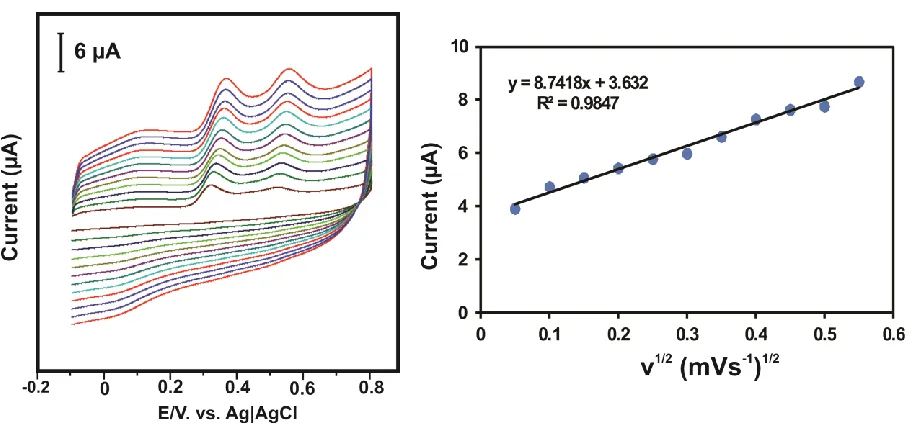
Figure 5. (A) Effect of scan rate at GCE/[Co(en)3]2+ modified electrode towards the oxidation of EA
(200 µM) in PBS (pH 7). (B) Calibration plot between the scan rate vs oxidation peak current of EA.
The effect of the scan rate on the oxidation of EA at the GCE/[Co(en)3]2+ complex modified
electrode was investigated in the presence of 0.1 M PBS (pH7). As can be observed in Figure 5, increase the scan rate the anodic peak current (Ip) increasing and shifted to positive side (50-500 mVs -1
[image:7.596.69.518.70.289.2] [image:7.596.69.523.378.590.2]
modified electrode as a surface controlled process [31,32]. The effect of pH of the electrolyte nature has been investigated towards the detection of EA. Figure 6A shows, the electrocatalytic oxidation of EA was studied in at different pHs from 5 to 11, at GCE/[Co(en)3]2+ inorganic complex modified GCE
electrode. The EA oxidation peak current was not affected by pHs, even though the peak potential (Ep)
was shifted from positive to negative side due to increasing the pH.
Figure 6. Cyclic voltammetry response of EA oxidation at different pHs from 5 to 11. Effects of pH on the EA oxidation peak current Vs pH (6A) and Peak Potential Vs pH (6B).
The Figure 6B shows the linear relationship between pHs and Ep. The Ep shifted from positive
to negative potential when pH changes from 3 to 11. Moreover, the linear plot observed between pHs and Ep (Figure 6c). The slope value is 59 mV/pH, which indicating that an equal number of protons
and electrons transfer in the oxidation of EA. Interestingly, the higher oxidized peak current obtained at pH 7; therefore the modified electrode has the most advantage of working in neutral pH. Hence, we have chosen the neutral pH 7 for the all electrochemical experiments.
3.2.3 Amperometric studies
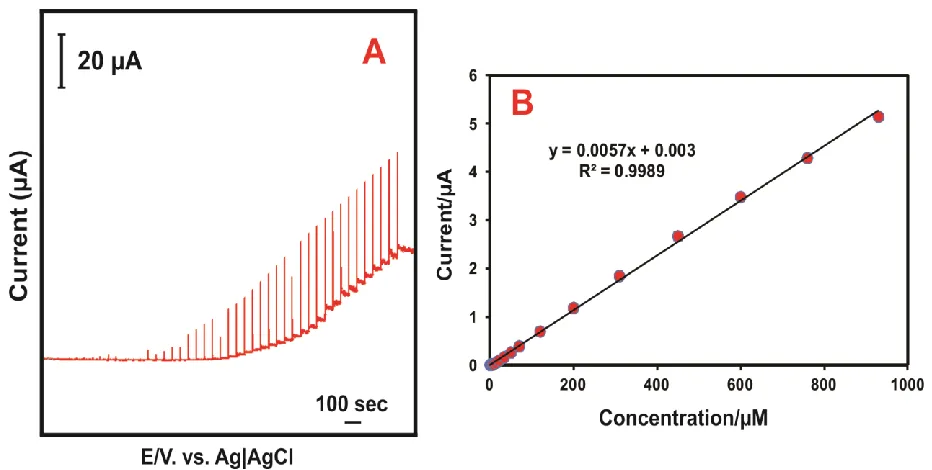
The amperometric (i-t) detection of EA performance of [Co(en)3]2+ modified rotating disc
[image:8.596.61.531.170.437.2]
was Ip (A) = 0.0057 [EA] (µM) + 0.003. Besides, the sensitivity of the modified electrode was
calculated to be 0.0670 µA µM cm-2 and the detection limit (LOD) of 0.035 nM. The prepared EA sensor has been accessed as an acceptable sensitivity, low detection limit and wide linear range. The [Co(en)3]2+ modified electrode was compared with previous EA sensor as can be seen from the table 1.
However, the detection limit of the EA at the GCE/[Co(en)3]2+ modified electrode substantially lower
than that of the other modified electrodes such us, Paraffin impregnated graphite electrode (LOD=1.135 nM), MWCNTs/carbon paste electrode (LOD=21 nM), graphene modified SPCE (LOD=0.05 ppm), SPCE/(Cu-Au) fabricated electrode (LOD=4.1 µgL-1) and GCE (LOD=0.1 µM) [1-5, 30]. Moreover, the GCE/[Co(en)3]2+ modified electrode obtained the EA detection at low level than
other aforementioned sensor. Because, the cobalt complex could be an enhanced electrocatalyst for the oxidation of EA due to the higher electron transfer and well redox properties. Hence, this result demonstrate that the GCE/[Co(en)3]2+ has been used as an prominent electrode towards detection of
EA.
Figure 7. (A) Amperometric response for the oxidation of EA with different concentration in PBS (pH 5). The calibration plot of peak current vs. EA concentration.
3.2.4 Repeatability, reproducibility and stability studies
Repeatability and reproducibility of the [Co(en)3]2+ inorganic complex modified GCE electrode
[image:9.596.63.529.308.543.2]
Table 1. The analytical performance of GCE/[Co(en)3]2+ modified electrode compared with other
reported EA sensor.
Electrode Limit of detection Linear range Reference
Paraffin impregnated/GR 0.135 µM 0.5 µM - 8 µM 1
MWCNTs Paste electrode 21 nM ___ 2
SPE-GPH 0.05 ppm ___ 5
SPCE/(Cu-Au) nano electrode 4.1 µgL-1 0.2-200 mgL-1 3
GCE 0.1 µM 0.1 µM-1.5 µM 30
GCE/[Co(en)3]2+ 0.035 nM 0.1µM-929µM This work
Figure 8. Operational stability studies of GCE/[Co(en)3]2+ inorganic complex modified electrode.
Besides, the storage stability of the [Co(en)3]2+ inorganic complex modified GCE electrode
towards detection of EA, it was monitored by every day regularly. During the storage period, the modified electrode exhibited well catalytic response towards detection of EA without any changes. Notably, 96.42% of the initial response current (Ip) were retained after the thirty days continuous using, it is the evidence of the good storage stability. Moreover, the operational stability of the [Co(en)3]2+ modified electrode was carried out by amperometric technique (Figure 8). The results
exhibit that the well stable amperometric response was obtained only 7 % initial current was loss after continuous rotation. The stability results exhibit that the excellent operational stability of [Co(en)3]2+
inorganic complex modified electrode.
3.2.5 Interference studies
Figure 9 shows, the selectivity studies of the [Co(en)3]2+ inorganic complex modified sensor
[image:10.596.55.548.112.261.2] [image:10.596.97.533.123.478.2] [image:10.596.165.432.285.481.2]
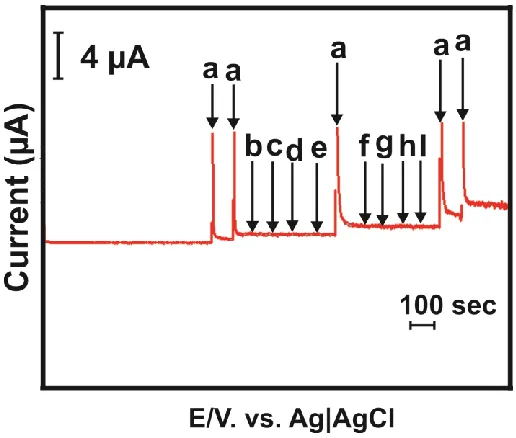
towards determination of EA in the presence of common others interfering ions and molecules like dopamine (a), acetaminophen (b), catechol (c), hydroquinone (d), gallic acid (e), uric acid (f), ascorbic acid (g) and morin (h). Moreover, the [Co(en)3]2+ inorganic complex electrode exhibited well response
towards each addition of EA. However, there is no notable peak appear for the excess addition of other common interfering molecule. Hence, the [Co(en)3]2+ complex has excellent selective materials for the
determination of EA.
Figure 9. Relative error of the interference studies towards detection of 50 µM EA (a) in presence of 5 fold higher concentration of other interfering compounds such as dopamine (b), acetaminophen (c), Catechol (d), Hydroquinone (e), Gallic acid (f), Uric acid (g), ascorbic acid (h) and Morin (i).
[image:11.596.169.427.184.403.2]3.2.6 Real sample analysis
Table 2. Analysis of EA from fruit samples using GCE/[Co(en)3]2+ modified electrode
Samples Added (µM) Found (µM) Recovery (%)
RSDa (%)
Average Recovery (%)
Raspberry 10.2 3.2
101
10 20 99 3.3
Strawberry 10.7 2.9
10 20.1 103 3.1
a
Relative standard deviation for three repetitive measurements.
[image:11.596.57.545.553.662.2]
inorganic complex modified GCE electrode used for the practical applicability of the determination of EA.
4. CONCLUSION
We have successfully prepared [Co(en)3]2+ inorganic complex by facile chemical method and
the prepared complex was confirmed by the SEM, UV, FT-IR and XRD. The electrochemical performance of the complex was characterized by the CV and amperometric methods. The [Co(en)3]2+
complex exhibited superior electrocatalytic activity towards detection of EA. Moreover, the modified electrode exhibited the extraordinary analytical performance, such as a long linear range from 0.1-929 µM, very low detection limits (LOD) 0.035 nM and high sensitivity for the detection of EA. Moreover, the sensor shows the high selectivity and stability in the presence of other interfering molecules. Moreover, the prepared sensors have well electrocatalytic activity, stability, repeatability and reproducibility. Hence, the GCE/[Co(en)3]2+ inorganic complex modified electrode as an excellent
electrode material for the detection of EA.
References
1. S. K. Lovric and I. Novak, Int. J. Electrochem. Sci., 6 (2011) 4638.
2. S. M. Ghoreishi, M. Behpour, M. Khayatkashani and M. H. Motaghedifard, Dig J Nanomater Biostruct., 6 (2011) 625.
3. A. S. Kumar, Y. M. Ji, S. Sornambikai, P. Y. Chen and Y. Shih, Int. J. Electrochem. Sci., 6 (2011) 5344.
4. A. S. Kumar, R. Shanmugam, N. Vishnu, K. C. Pillai and S. Kamaraj, J. Electroanal. Chem., 782, (2016) 215.
5. A. G. Cabanillas, B. G. Cancho, E. Bernalte, M. T. Villares, C. G. Cabanillas and M. A. M. Canas, Electroanalysis., 27 (2015) 177.
6. T. C. Wilson and A. E. Hagerman, J. Agric. Food Chem., 38 (1990) 1678.
7. A. Z. Simic, T. Z. Verbic, M. N. Sentic, M. P. Vojic, I. O. Juranic and D. D. Manojlovic, Monatsh Chem., 114 (2013)121.
8. S. M. Ghoreishi, M. Behpour, M. Khayatkashani and M. H. Motaghedifard, Anal. Methods., 3 (2011) 636.
9. I. Bala, V. Bhardwaj, S. Hariharan and M. N. V. Ravi Kumar, J. Pharm. Biomed. Anal., 40 (2006) 206.
10.Z. Aturki, S. Fanali, G. Dorazio, A. Rocco and C. Rosati, Electrophoresis., 29 (2008) 1643. 11.L. K. Shpigun, N. N. Zamyatina, Y. V. Shushenachev and P. M. Kamilova, J. Anal. Chem., 67
(2012) 801.
12.C. L. Silva, J. Pereira, V. G. Wouter, C. Giro and J. S. Camara, Talanta., 86 (2011) 82. 13.S. Iijima, Nature., 354 (1991) 56.
14.P. M. Ajayan, Chem. Rev., 99 (1999) 1787.
15.A. Salimi, R. G. Compton and R. Hallaj, Anal. Biochem., 333 (2004) 49. 16.T. A. D. Smith, Bioorg. Med. Chem., 13 (2005) 4576.
18.R. Maccari, R. Ottana, B. Bottari, E. Rotondob and M. G. Vigoritaa, Bioorg. Med. Chem. Lett., 14 (2004) 5731.
19.Z. Zhang, X. Li, C. Wang, C. Zhang, P. Liu, T. Fan, Y. Xiong and W. Xu, Dalton Trans, 2012, 41, 1252.
20.S. X. D. Santos and A, E. T. G. Cavalheiro, J. Braz. Chem. Soc,. 25 (2014) 1071. 21.K. Nagaraj, K. S. Murugan and P. Thangamuniyandi, Z. Phys. Chem., 229 (2015) 327.
22.S. J. Kirubavathy, R. Velmurugan, K. Parameswari and S. Chitra, Arabian J. Chem., (2014) http:// dx.doi.org/ 10.1016/j.arabjc.2014.10.013.
23.C. K. Poon, Inorg. Chim. Acta., 15 (1976) 322.
24.S. Ilhan, H. Temel, I. Yilmaz and M. Sekerci, J. Organomet. Chem., 692 (2007) 3855.
25.G. B. Bagihalli, P. G. Avaji, S. A. Patil and P. S. Badami, Eur. J. Med. Chem., 43 (2008) 2639. 26.A. Bo1ttcher, T. Takeuchi, K. I. Hardcastle, T. J. Meade and H. B. Gray, Inorg. Chem., 36 (1997)
2498.
27.N. Raman, L. Mitu, A. Sakthivel and M. S. S. Pandi, 2009, J. Iran. Chem. Soc., 6 (2009) 738. 28.M. B. H. Howlader and M. S. Islam, Indian J. Chem,. 46 (2007) 440.
29.A. B. P. Lever and E. Mantovani, Inorg Chem.,10 (1971) 817.
30.M. Cuartero, J. A. Ortuno, P. Truchado, M. S. Garcıa, F. A. T. Barberan and M. I. Albero, Food Chemistry., 128 (2011) 549.
31.A. Albert and E. P. Serjeant, The determination of ionization constants, 2nd edn. London (1971), ISBN: 978-94-010-8948-7.
32.P. Gans, A. Sabatini and A. Vacca, Talanta., 43 (I996) I739.
![Figure 1. (A&B) SEM images of [Co(en)3]2+ complex (C) IR spectra of [Co(en)3]2+ and (D) XRD spectra of [Co(en)3]2+ complex](https://thumb-us.123doks.com/thumbv2/123dok_us/1816523.137157/4.596.65.535.119.469/figure-sem-images-complex-spectra-xrd-spectra-complex.webp)
![Figure 2. (A) UV-Visible spectra of [Co(en)3]2+ (B) Electrochemical impedance spectrum of (a) bare GCE, (b) GCE/[Co(en)3]2+ modified electrode in 0.1 M KCl containing 5 mM [Fe(CN) 6]3-/4-](https://thumb-us.123doks.com/thumbv2/123dok_us/1816523.137157/5.596.51.553.180.339/figure-visible-electrochemical-impedance-spectrum-modified-electrode-containing.webp)
![Figure 3. Cyclic voltammetric response of (a) bare GCE and (b) GCE/[Co(en)3]2+ in presence of 200 µM EA at nitrogen purged PBS (pH7) at the scan rate 50 mVs-1](https://thumb-us.123doks.com/thumbv2/123dok_us/1816523.137157/6.596.189.409.69.296/figure-cyclic-voltammetric-response-presence-nitrogen-purged-pbs.webp)

![Table 1. The analytical performance of GCE/[Co(en)3]2+ modified electrode compared with other reported EA sensor](https://thumb-us.123doks.com/thumbv2/123dok_us/1816523.137157/10.596.97.533.123.478/table-analytical-performance-modified-electrode-compared-reported-sensor.webp)