City, University of London Institutional Repository
Citation
: Ter-Sarkisov, A., Kelleher, J. D., Earley, B., Keane, M. and Ross, R. J. (2018).
Beef Cattle Instance Segmentation Using Fully Convolutional Neural Network. Paper
presented at the 29th British Machine Vision Conference (BMVC), 3 - 6 September 2018,
Northumbria University, Newcastle.
This is the accepted version of the paper.
This version of the publication may differ from the final published
version.
Permanent repository link:
http://openaccess.city.ac.uk/id/eprint/21362/
Link to published version
:
Copyright and reuse:
City Research Online aims to make research
outputs of City, University of London available to a wider audience.
Copyright and Moral Rights remain with the author(s) and/or copyright
holders. URLs from City Research Online may be freely distributed and
linked to.
City Research Online:
http://openaccess.city.ac.uk/
[email protected]
TER-SARKISOV ET AL.: BEEF CATTLE INSTANCE SEGMENTATION USING FCN
Beef Cattle Instance Segmentation Using
Fully Convolutional Neural Network
Aram Ter-Sarkisov1 [email protected]
John Kelleher1
Bernadette Earley2
Michael Keane2
Robert Ross1
1School of Computing
Dublin Institute of Technology Dublin, Ireland
2TEAGASC
Grange, Dunsany, Co. Meath, Ireland
Abstract
In this paper we present a novel instance segmentation algorithm that extends a fully convolutional network to learn to label objects separately without prediction of regions of interest. We trained the new algorithm on a challenging CCTV recording of beef cattle, as well as benchmark MS COCO and Pascal VOC datasets. Extensive experimentation showed that our approach outperforms the state-of-the-art solutions by up to 8% on our data.
1
Introduction
Recently deep convolutional neural networks have made strong contribution in a number of areas in computer vision. In particular, three areas have seen progress: object detection, class (semantic) segmentation and instance segmentation (mask representation). Object detection algorithms, such as [4,5,15], generate bounding box proposals foreveryobject in the image and classify these proposals. Class (semantic) segmentation algorithms delineateclassesof objects at a pixelwise level without making a distinction between two objects belonging to the same class [14,20]. Instance segmentation algorithms find a mask representationfor every object in the image. Most mask segmentation algorithms, such as [1, 8,11], use a three-stage approach: (a) identify promising regions (bounding box around the object) us-ing a region proposal network (RPN), (b) predict the object class, and (c) extract its mask (often using a fully convolutional network). Recent results on benchmark datasets show the viability of this approach, and currently it is considered to be the state-of-the-art method for extraction of mask representations. The well-regarded Mask R-CNN model uses an RPN to predict bounding box coordinates for the objects in the image and their score, then refines these predictions using a Region of Interest Align (RoI Align) tool, extracts a mask and pre-dicts the class of the object, [8]. Currently, Mask R-CNN is the publicly available model
c
TER-SARKISOV ET AL.: BEEF CATTLE INSTANCE SEGMENTATION USING FCN
with the highest reported overall mean average precision on MS COCO 2017 dataset.
Another approach to instance segmentation that has seen growing interest in the past years is instance embedding, which does not make use of bounding boxes or regional prediction at all. Instead, discriminative loss function, like the ones in [2,10] uses feature clustering to locate the centers of instances.
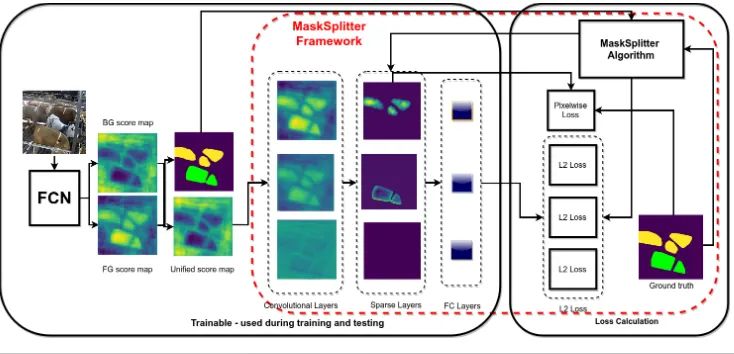
We introduce a new framework that uses the output of the fully convolutional network, [14] and the ground truth mask to refine the mask representation of animals in images without bounding box prediction. Our approach is conceptually simple and does not make use of bounding boxes or RPNs, yet manages to achieve results that compare favourably with all state-of-the-art networks. We show the strength of our approach on Pascal VOC, MS COCO datasets and on a specialized dataset we built from a raw video. The framework, MaskSplit-ter, learns to output three different types of mask representations: twobadand onegood. A goodmask representation the one which overlaps with exactly one animal, abadmask repre-sentation of the first type overlaps with two or more animals, and abadmask representation of the second type occurs when multiple predicted masks overlap with a single animal. The framework consists of the algorithm that determines the type of the mask representations and the number of true objects (cows) that they predict; pixelwise sigmoid and Euclidean loss functions; and a set of convolutional and fully connected layers, one for every type of pre-diction. The overhead of the network on top of FCN8s is very small,∼187000 parameters.
This work is a step towards real-time animal monitoring in farming environments that have different applications, such as early lameness detection, animal welfare improvement and reduction of cattle maintenance costs. For examples of other recent applications of deep learning in animal husbandry and agriculture see, e.g. [6,18]. The rest of the article is struc-tured in the following way: Section2introduces the dataset we created from the video feed at the cattle facility, as well as MS COCO and PASCAL VOC datasets, Section3introduces the MaskSplitter algorithm and the network architecture in which it is embedded, Section4
presents all experimental results, for FCN + MaskSplitter, as well as Mask R-CNN, section
5concludes.
2
Datasets
Pascal VOC 2012 ([3]) and MS COCO 2017 ([12]) are two benchmark datasets that are widely used in the Computer Visions community. As we are developing a cattle segmenter, we are interested in cow images in these datasets. There is a total of 1986 images with cows in the MS COCO training set and 87 in the validation set. In Pascal VOC training set there are 64 images with cows and in the validation set there are 71 images. In the training stage we only used MS COCO images. Testing was done both on Pascal VOC and MS COCO datasets.
The CCTV raw videos that were recorded at a winter finishing feedlot for beef heifers over a two-week period on video cameras pointing at a fixed angle towards enclosures with 10 heifers each, a total of 24 pens were included in the study ([9]). One of the cattle pens was selected for dataset construction. This video sequence is challenging for a number of reasons, each of which poses a particular challenge to segmenter:
TER-SARKISOV ET AL.: BEEF CATTLE INSTANCE SEGMENTATION USING FCN
when standing up and lying down. Unlike static objects, e.g. TV sets or buildings, their shape changes significantly when an animal moves around, lies down, eats, walks and grooms itself or other pen mates. Hence the network needs to have a much higher generalization capacity.
2. Similarity between objects: it is often difficult (or in fact impossible) to distinguish between two particular animals due to the same coat, color and absense of other dis-tinct physical markings. In the case of partial occlusion, it is nearly impossible even for a human eye to tell one from another.
3. Occlusion: animals were allotted to 24 individual pens, each containing 10 heifers, located in the same housing facility. CCTV cameras were positioned over each pen. The pens were evenly distributed in three separate rows, throughout the house. To achieve the respective space allowances, the dimensions of the pens were 4.50 m×
6.66 m (30 m2) for treatment 1, 9.0 m×5.0 m (45 m2) for treatment 2 and 9.0 m×
6.66 m (60 m2) for treatments 3 and 4. The feed face length was the same (4.5 m) for all pens. As a result of this setup, the view of animals from the cameras suffers from a great degree of partial occlusion.
4. Lighting: The house had both artificial and natural lighting through vents positioned in the overhead roof. Overall it is rather dark, but there are gaps in the ceiling which allow light through; this is a standard feature of animal housing design. This type of lighting poses a challenge to machine learning algorithms, as they can erroneously learn that these patches or shadows are animals’ features.
5. Background: the background (enclosure boundaries) in the video is dark and/or noisy and often cannot be distinguished from the segmented object, because heifers have a color pattern (dark/light brown or grey/white) similar to the background. In many cases the segmented animal instance nearly blends with the background making it a challenge to be detected even by the most advanced algorithms.
Considering the substantial challenges, in [19] we developed a separate naive segmentation algorithm that extracts images and ground truth from frames in the video. The algorithm is presented as a flowchart in Figure1. The dataset constructed from this raw video data consists of about 500 frames extracted from one of the feedlots, each frame was cropped to size 250x250 around every animal in the frame and split randomly into the training and validation datasets, of size 4872 and 984. To show that this data is very unique, we tested the state-of-the art networks (Table3) on the validation set. Results for all thresholds of IoU are far lower than those for the benchmark sets. The selected size of the crops, 250x250 was solely due to the restrictions of VRAM for training of the models. Deployment/testing of the models can be done with image input of any size, and is very fast, including the results in Figures3and4.
3
Networks
TER-SARKISOV ET AL.: BEEF CATTLE INSTANCE SEGMENTATION USING FCN
Figure 1: Flowchart of the dataset construction and naive segmentation pipeline. RCF is Richer Convolutional Features CNN from [13], ISODATA is a threshold function from [16]
the most refined of FCN architectures (others being FCN-16s and FCN-32s) as a backbone network (feature and score map extractor). The output of FCN8s consists of twoscore maps (object and background score maps) that have the same dimensionality as the input image and accumulate pixelwise information about the corresponding class (i.e. either animal or background). If we take a pixel-wiseargmaxvalue of the score map layer, this results in a binary outputmaskwith pixels valued at either 0 (background) or 1 (object), depending on the greater score. Each isolated group of pixels in the mask equal to 1 constitutes a predic-tion(mask representation) of the animal’s instance. This binary mask is the main output of the FCN. Our framework is a refinement of this predictive mask that attempts to recover the representation of every animal.
TER-SARKISOV ET AL.: BEEF CATTLE INSTANCE SEGMENTATION USING FCN
Type 1, number of bad predictions Type 2) and three groups of masks of each type. Thus MaskSplitter splits the original binarized map into three classes.
Algorithm 1:Pseudocode for the MaskSplitter Framework
Inputs:
FCN8s output binary maskB, Ground truth maskC, IoU matrix for all predictions inBand cows inC
Number of good predictions = 0, Number of bad predictions (Type 1) = 0, Number of bad predictions (Type 2) = 0
L1:Empty list of seen animals (Type 1),L2: Empty list of seen animals(Type 2)
foreach predictionb∈B do
Rank IoUs of this prediction in the decreasing order
c∗:argmax IoU(b,:)
if this prediction overlaps with only one animalthen foreach ground truth blobc∈C do
Get IoU(b,c)
if|IoU(:,c∗)|==1then
Number of good predictions +=1
Copy the prediction to the mask with good predictions
break
else if|IoU(:,c∗)|>1then if c∗∈/L2then
Number of bad predictions (Type 2) +=1 L2=L2∪c∗
Copy the prediction to the mask with bad predictions (Type 2)
break
else ifthis prediction overlaps with multiple animalsthen foreach overlap with cowc∈C do
if c∈/L1then
Number of bad predictions (Type 1) +=1 L1=L1∪c
Copy the prediction to the mask with bad predictions (Type 1)
Outputs:
Number of good predictions, Number of bad predictions (Type 1), Number of bad predictions (Type 2)
Mask with good predictions, Mask with bad predictions (Type 1), Mask with bad predictions (Type 2)
TER-SARKISOV ET AL.: BEEF CATTLE INSTANCE SEGMENTATION USING FCN
Figure 2: MaskSplitter framework architecture. FCN denotes the Fully Convolutional Net-work, L2 is Euclidean loss layer. The ‘bad’ prediction for two animals in the binary mask is marked green, as well as the corresponding two animals in the ground truth mask. Mask Splitter has six outputs in total: for each type of prediction it outputs one full-image mask with predictions of this types, extracting it from the binary mask and one number, extracting it from the ground truth map based on the overlaps between predictions and true objects. Best viewed in color.
to learn to output the number of each type of predictions and compare it to the true number of predicted animals.
Loss layers These three units are compared to the true number of predicted animals using a Euclidean (L2) loss function. The fourth loss function is pixelwise sigmoid that takes the full ground truth mask and the score map for good predictions. The loss function of the full network is Equation1.
L=Lgs+Lgood+Lbadcows+Lbad preds (1)
hereLgsis a pixelwise cross-entropy loss taken over a sigmoid of the score map of the good
predictions, the rest are Euclidean loss functions: Lgood is for predicted number of good
masks and true number (i.e. all animals),Lbadcows is for one mask representation
overlap-ping with 2 or more animals andLbad predsis for two or more mask representation
overlap-ping with a single animal. Although losses of two types are used to compute the network’s overall loss (Euclidean and Cross-Entropy), we do not normalize them by multiplying one of them by a coefficient determined using cross-validation. Although this practice is standard for many applications in deep learning literature, instance segmentation frameworks, such as [1,8], do not use this approach.
TER-SARKISOV ET AL.: BEEF CATTLE INSTANCE SEGMENTATION USING FCN
[image:8.408.34.388.28.149.2]Image Mask R-CNN FCIS FCN8s+MS
Figure 3: Illustration of Mask R-CNN, FCIS, FCN8s+MaskSplitter performance on MS COCO and Pascal VOC validation datasets
Image Mask R-CNN Mask R-CNN (heads) FCN8s+MS
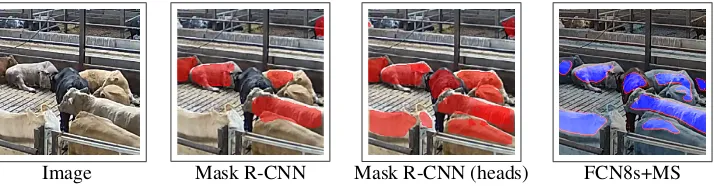
Figure 4: Illustration of Mask R-CNN, Mask R-CNN (heads only) and FCN8s+MaskSplitter performance on cattle facility CCTV test dataset (after finetuning)
4
Results
For experiments on benchmark datasets, we extracted 1986 images with cows from MS COCO 2017 training dataset and augmented them with 800 images of persons, sheep, horses and dogs to provide the networks with a variety of negatively labelled data. We trained the FCN8s + MaskSplitter algorithm on this combined dataset and tested them on MS COCO 2017 and Pascal VOC 2012 validation dataset.
All models were trained with the Adam (Adaptive moment estimation) optimizer with stan-dard parameters: β1=0.9,β2=0.999,ε=10−8 for 20000 iterations, base learning rate
[image:8.408.38.395.193.286.2]TER-SARKISOV ET AL.: BEEF CATTLE INSTANCE SEGMENTATION USING FCN
Backbone Network [email protected] [email protected] [email protected]:0.95 Mask R-CNN ResNet101 0.642 0.538 0.368
FCIS ResNet101 0.633 0.527 0.327
MNC VGG16 0.503 0.334 0.229
FCN8s+MaskSplitter VGG16 0.656 0.559 0.399
Table 1: Results on Pascal VOC 2012 cow validation dataset. Best results are in bold, second best italicized.
Backbone Network [email protected] [email protected] [email protected]:0.95 Mask R-CNN ResNet101 0.549 0.502 0.341
FCIS ResNet101 0.555 0.314 0.229
MNC VGG16 0.312 0.269 0.173
FCN8s+MaskSplitter VGG16 0.443 0.321 0.232
Table 2: Results on MS COCO 2017 cow validation dataset. Best results are in bold, second best italicized.
Backbone Network [email protected] [email protected] [email protected]:0.95 Mask R-CNN ResNet101 0.218 0.01 0.04
FCIS ResNet101 0.232 0.04 0.06
[image:9.408.26.375.139.201.2]MNC VGG16 0.111 0.009 0.02
Table 3: Results on our test dataset (before finetuning)
Backbone Network [email protected] [email protected] [email protected]:0.95
FCN8s-ft VGG16 0.487 0.302 0.232
Mask R-CNN-heads-ft ResNet101 0.637 0.253 0.265 Mask R-CNN-ft ResNet101 0.687 0.259 0.298 FCN8s+MaskSplitter VGG16 0.713 0.505 0.380
Table 4: Results on our test dataset (after finetuning)
additional finetuning. This is due to the fact that these models have been extensively trained on benchmark datasets (e.g. Mask R-CNN for 160K iterations). To compare on our dataset, only Mask R-CNN, as the state-of-the-art model, was finetuned alongside our model, and these results are reported in Table4below.
4.1
Pascal VOC 2012 dataset
TER-SARKISOV ET AL.: BEEF CATTLE INSTANCE SEGMENTATION USING FCN
4.2
MS COCO 2017 dataset
MS COCO is a far more diverse dataset, in terms of the number, scale, distance and angle of the objects in images. Since both Mask R-CNN and FCIS were trained with ResNet101 as the backbone network, much of the gap between our results and theirs can be explained by ResNet’s depth rather than specific strengths of Mask R-CNN and FCIS architecture. Currently fully convolutional versions of ResNet are not available, but we plan to adapt it to our architecture in the future.
4.3
Our Dataset
Before finetuning Mask R-CNN to our data, we tested Mask R-CNN, FCIS and MNC on our test set. Results in Table3 demonstrate that even the most advanced networks do not get good predictions due to the vast difference between the benchmark datasets and our data (see Section2). None of the networks generalized successfully to the CCTV data. Although Mask R-CNN performed slightly worse than FCIS, it showed greater capacity on other datasets, so we chose this network to finetune on our data. ResNet101-FPN (feature pyramid network) weights pre-trained on MS COCO (https://github.com/matterport/ Mask_RCNN/releases, v1.0 from 23/10/2017) were selected as the baseline model, with the starting learning rate of 0.0002 and max/min image size 256x256 (as this is the closest to the 250x250 training images) for 20000 iterations. As the max/min image size was reduced, the maximal RPN anchor scale was also reduced to 256 and the number of train regions of interest (RoIs) to 32. Other configuration parameters were kept the same. To determine the ability of Mask R-CNN to generalize to new problems, we finetuned both the full network and only four layers that are problem-specific. Also, we finetuned the FCN8s model that does not have the capacity to separate objects. This serves as a baseline for all other mod-els. Results of finetuning are presented in Table4: FCN8s with the MaskSplitter framework confidently outperforms both Mask R-CNN models (heads-only and full): mAP is more than 8% higher and [email protected] IoU is more than 2.5% higher than the best Mask R-CNN model. This demonstrates the framework’s ability to perform well on object-vs-background prob-lems without the RPN and RoI frameworks.
The shortcoming of this part of our work was that we were able to train and test only on animals from a single feedlot, which is mainly due to the limitations of the dataset construc-tion pipeline in [19] that fails to capture a lot of features. This is to be rectified in future publications. Another logical extension for working with video-related data that we intend to pursue is adding a temporal, i.e. a recurrent component to the network that is likely to improve the efficiency of the model on homogeneous data.
5
Conclusions
TER-SARKISOV ET AL.: BEEF CATTLE INSTANCE SEGMENTATION USING FCN
image rotation, our network performs well compared with all state-of-the-art instance seg-mentation solutions. This approach is easily generalizable to other backbone networks that produce image-sized score maps and other image-vs-background problems (e.g tumor de-tection). Other possible improvements that we intend to pursue include learning each mask prediction separately, i.e. having a map for every mask; this will allow prediction of fully separated objects and overlaps between masks.
Acknowledgements
Robert Ross and John Kelleher wish to acknowledge the support of the ADAPT Research Centre. The ADAPT Centre for Digital Content Technology is funded under the SFI search Centres Programme (Grant 13/RC/2106) and is co-funded under the European Re-gional Development Funds. Aram Ter-Sarkisov is a recipient of Arnold G. Graves fellow-ship. Bernadette Earley and Michael Keane would like to thank John Horgan and Jonathan Forbes, from Kepak, for access to animals and facilities at Kepak, Co. Meath. Many thanks are due to the farm staff at TEAGASC, Grange beef research centre and at the Kepak feedlot for the care of the animals.
References
[1] Jifeng Dai, Kaiming He, and Jian Sun. Instance-aware semantic segmentation via multi-task network cascades. In Proceedings of the IEEE Conference on Computer Vision and Pattern Recognition, pages 3150–3158, 2016.
[2] Bert De Brabandere, Davy Neven, and Luc Van Gool. Semantic instance segmentation with a discriminative loss function.arXiv preprint arXiv:1708.02551, 2017.
[3] Mark Everingham, Luc Van Gool, Christopher KI Williams, John Winn, and Andrew Zisserman. The pascal visual object classes (voc) challenge. International journal of computer vision, 88(2):303–338, 2010.
[4] Ross Girshick. Fast R-CNN. InThe IEEE International Conference on Computer Vision (ICCV), December 2015.
[5] Ross Girshick, Jeff Donahue, Trevor Darrell, and Jitendra Malik. Rich feature hierar-chies for accurate object detection and semantic segmentation. InThe IEEE Conference on Computer Vision and Pattern Recognition (CVPR), June 2014.
[6] Alexander Gomez, German Diez, Augusto Salazar, and Angelica Diaz. Animal iden-tification in low quality camera-trap images using very deep convolutional neural net-works and confidence thresholds. InInternational Symposium on Visual Computing, pages 747–756. Springer, 2016.
[7] Kaiming He, Xiangyu Zhang, Shaoqing Ren, and Jian Sun. Deep residual learning for image recognition. InProceedings of the IEEE conference on computer vision and pattern recognition, pages 770–778, 2016.
TER-SARKISOV ET AL.: BEEF CATTLE INSTANCE SEGMENTATION USING FCN
[9] MP Keane, Mark McGee, EG O’Riordan, AK Kelly, and Bernadette Earley. Effect of space allowance and floor type on performance, welfare and physiological measure-ments of finishing beef heifers.Animal, 11(12):2285–2294, 2017.
[10] Shu Kong and Charless C. Fowlkes. Recurrent pixel embedding for instance grouping. CoRR, abs/1712.08273, 2017. URLhttp://arxiv.org/abs/1712.08273.
[11] Yi Li, Haozhi Qi, Jifeng Dai, Xiangyang Ji, and Yichen Wei. Fully convolutional instance-aware semantic segmentation.arXiv preprint arXiv:1611.07709, 2016.
[12] Tsung-Yi Lin, Michael Maire, Serge Belongie, James Hays, Pietro Perona, Deva Ra-manan, Piotr Dollár, and C Lawrence Zitnick. Microsoft coco: Common objects in context. InEuropean conference on computer vision, pages 740–755. Springer, 2014.
[13] Yun Liu, Ming-Ming Cheng, Xiaowei Hu, Kai Wang, and Xiang Bai. Richer convolu-tional features for edge detection. 2017.
[14] Jonathan Long, Evan Shelhamer, and Trevor Darrell. Fully convolutional networks for semantic segmentation. InProceedings of the IEEE Conference on Computer Vision and Pattern Recognition, pages 3431–3440, 2015.
[15] Shaoqing Ren, Kaiming He, Ross Girshick, and Jian Sun. Faster R-CNN: Towards real-time object detection with region proposal networks. In C. Cortes, N. D. Lawrence, D. D. Lee, M. Sugiyama, and R. Garnett, editors, Advances in Neural Information Processing Systems 28, pages 91–99. Curran Associates, Inc., 2015.
[16] TW Ridler and S Calvard. Picture thresholding using an iterative selection method. IEEE Trans Syst Man Cybern, 8(8):630–632, 1978.
[17] Karen Simonyan and Andrew Zisserman. Very deep convolutional networks for large-scale image recognition.arXiv preprint arXiv:1409.1556, 2014.
[18] Ulrich Stern, Ruo He, and Chung-Hui Yang. Analyzing animal behavior via classifying each video frame using convolutional neural networks.Scientific reports, 5, 2015.
[19] Aram Ter-Sarkisov, Robert Ross, and John Kelleher. Bootstrapping labelled dataset construction for cow tracking and behavior analysis. In14th Conference on Computer and Robot Vision, pages 277–284. IEEE, 2017.
![Figure 1: Flowchart of the dataset construction and naive segmentation pipeline. RCF isRicher Convolutional Features CNN from [13], ISODATA is a threshold function from [16]](https://thumb-us.123doks.com/thumbv2/123dok_us/1392170.92354/5.408.33.369.31.273/flowchart-construction-segmentation-pipeline-isricher-convolutional-features-threshold.webp)