City, University of London Institutional Repository
Citation
:
Tamanna, N., Crouch, R.S., Kabir, I. R. and Naher, S. (2018). An Analytical Model to Predict and Minimize the Residual Stress of Laser Cladding Process. Applied Physics A: Materials Science & Processing, doi: 10.1007/s00339-018-1585-6This is the published version of the paper.
This version of the publication may differ from the final published
version.
Permanent repository link:
http://openaccess.city.ac.uk/id/eprint/18811/Link to published version
:
http://dx.doi.org/10.1007/s00339-018-1585-6Copyright and reuse:
City Research Online aims to make research
outputs of City, University of London available to a wider audience.
Copyright and Moral Rights remain with the author(s) and/or copyright
holders. URLs from City Research Online may be freely distributed and
linked to.
https://doi.org/10.1007/s00339-018-1585-6
An analytical model to predict and minimize the residual stress
of laser cladding process
N. Tamanna1 · R. Crouch1 · I. R. Kabir1 · S. Naher1
Received: 31 October 2017 / Accepted: 14 January 2018 © The Author(s) 2018. This article is an open access publication
Abstract
Laser cladding is one of the advanced thermal techniques used to repair or modify the surface properties of high-value compo-nents such as tools, military and aerospace parts. Unfortunately, tensile residual stresses are generated in the thermally treated area of this process. This work focuses on to investigate the key factors for the formation of tensile residual stress and how to minimize it in the clad when using dissimilar substrate and clad materials. To predict the tensile residual stress, a one-dimensional analytical model has been adopted. Four cladding materials (Al2O3, TiC, TiO2, ZrO2) on the H13 tool steel substrate and a range of preheating temperatures of the substrate, from 300 to 1200 K, have been investigated. Thermal strain and Young’s modulus are found to be the key factors of formation of tensile residual stresses. Additionally, it is found that using a preheating temperature of the substrate immediately before laser cladding showed the reduction of residual stress.
1 Introduction to the style guide
Laser cladding (LC) is one of the advantageous thermal techniques over thermal spraying, plasma spraying and arc welding [1]. In this process, a laser heat source is used to deposit a thin layer, mostly at micro-scale, of a desired mate-rial on a substrate matemate-rial [2]. One of the challenges of this process is the formation of tensile residual stresses in the thermally treated area [3–5]. Residual stresses are the locked in stress in any engineering components after thermal or mechanical treatment in the absence of any external load [6]. These residual stresses deteriorate the performance of engineering components such as fatigue life [7], corrosion resistance [8] and dimensional accuracy [9] in the finished products. A one-dimensional analytical model was proposed to predict the stress evolution considering elastic, plastic and thermal strain [10]. To predict the tensile residual stress, a
simplified analytical model was established based on the elastic mechanics for dissimilar materials by Wang et al. [3]. Numerical methods are applied to calculate three-dimen-sional state of residual stresses in the treated object. Mainly, tensile residual stresses were predicted on the surface while the quantity of these stresses was different in different direc-tions, along with experimental validation [4]. The funda-mental understanding of the formation of residual stress in dissimilar material is not well established because of the lack of knowledge about materials’ behaviour in the process. Models are focused on the same cladding and the substrate material [11]. In some cases, dissimilar cladding and sub-strate materials have been examined [4]. However, these models and experimental works do not explain the effect of different properties of cladding materials on residual stresses when the same substrate material was used. Doping is a popular method to improve materials properties by inten-tionally introducing impurities in the substrate. It is found from doping mechanism that residual stresses varied when dissimilar doping materials were used [12]. Other thermal cladding process such as thermal spray [13] and plasma spray [14] showed the differences of residual stress for dif-ferent cladding materials on the same substrate. Recently, to minimize residual stresses, deposition of functionally graded material are used. This process can minimize the differences of mismatch of thermal strain between materials [15]. So, it is required to develop an understanding of the influence of materials properties on the formation of residual stresses.
* N. Tamanna
[email protected] R. Crouch
[email protected] I. R. Kabir
[email protected] S. Naher
N. Tamanna et al.
1 3
202 Page 2 of 5The high temperature gradient from the clad to the sub-strate material is one of the main reasons for the formation of cracks. The higher cooling rate generates higher misfit of strain, resulting higher residual stress [13]. Preheating of the substrate reduces the thermal gradient which signifi-cantly minimizes residual stresses and prevents cracks on the surface [16].
In this work, an analytical model is presented to calcu-late the tensile residual stress in dissimilar materials. Four widely used cladding materials have been used to observe the change of residual stresses on the H13 tool steel substrate which is a popular material for tooling application [17]. This technique provides a unique method to compare residual stresses for different cladding materials, with capabilities to integrate material properties. Furthermore, preheating temperature of the substrate was applied to check the effect on residual stresses.
2 Methodology
H13 tool steel was used as a substrate material and Al2O3, TiC, TiO2 and ZrO2 were used for cladding materials. The preheating temperature of substrate was varied from 300 to 1200 K. The material properties are given in Table 1.
A simplified model was adopted to calculate the residual stress as shown in Fig. 1 considering the elastic and the ther-mal strain. 𝜎 is the normal tensile residual stress [3, 22]. 𝛼,E and h are defined as the thermal expansion coefficient, Young’s modulus and thickness, respectively. The subscripts c and s
represent the clad and the substrate, respectively. Tr, To and Tmc
are room temperature, preheating temperature of the substrate and melting temperature or operating temperature of cladding materials, respectively. In the laser cladding process, the oper-ating temperature should be equal or more than the melting temperature of cladding materials. If the clad and the substrate contract freely, the thermal contractions are 𝛼
cl(Tmc−Tr )
and
𝛼sl(T0−Tr) correspondingly. The higher thermal strain of
cladding material was assumed than the substrate material, see Fig. 1. The induced elastic strains are σc/Ec and σs/Es due to
residual stress of clad and the substrate. However, the coating and the substrate are connected with a metallurgical bonding. So the actual contraction at the interface of the clad and the substrate is
The uniform stress distribution is assumed in the clad and the substrate while the height of the clad was lower than the height of the substrate. From the internal force balance,
where hs and hc are the heights of the substrate and the clad,
respectively. 𝜎c and 𝜎s are the tensile residual stresses of the
clad and the substrate. From Eq. 1 and Eq. 2, the generated stress in the clad can be derived,
(1)
𝛼cl(Tmc−Tr)−𝜎cl∕E c=
𝛼sl(T0−Tr)+𝜎sl∕E s.
(2)
h
s𝜎s=hc𝜎c,
(3) 𝜎c=
h
sEsEc[𝛼c
(
T mc−Tr
)
−𝛼 s
(
T 0−Tr
)]
h
sEs+hcEc
.
Table 1 Material properties used to calculate the residual stress
a Substrate material b Cladding materials
Height of the substrate (*) and height of the clad (**) Materials Thermal expansion
coef-ficient × 10−6(K−1) Young’s modulus (GPa) Melting tempera-ture (K) Height (m)
H13 tool steela 10.90 [4] 210 1752 0.005*
Al2O3b 5.40 [18] 380 2338 0.001**
TiCb 7.70 [19] 449 3363 0.001**
TiO2b 11.80 [20] 288 2123 0.001**
ZrO2b 12.20 [21] 250 2973 0.001**
Substrate Clad
, , , ,
, , , ,
( )
( )
[image:3.595.324.527.53.226.2] [image:3.595.180.544.581.676.2]The effect of different materials and preheating tem-perature of the substrate on the generation of residual stresses were theoretically investigated using this model. The results of residual stresses are normalized with the residual stress of TiC clad. Thermal strain of the mate-rial is related with the thermal expansion coefficient of materials and temperature difference of the operating temperature and the room temperature. The mismatch of the thermal strain between the clad and the substrate ( 𝛼c(Tmc−Tr)−𝛼s(T0−Tr) in Eq. 3) was found one of the reasons of formation of residual stresses in the system. Another material property, Young’s modulus ( Ec in Eq. 3), was considered with the mismatch of thermal strain to understand its effect on the formation of residual stress.
3 Results and discussion
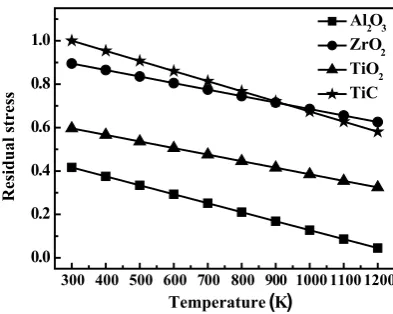
Figure 2 shows the distribution of predicted tensile residual stresses for different cladding materials (Al2O3, TiC, TiO2, ZrO2) on the H13 tool steel substrate at a range of preheat-ing temperature (300 to 1200 K) of the substrate. TiC clad-ding material formed higher residual stress than TiO2 clad-ding material. The minimum residual stress was formed for Al2O3 cladding material. TiC cladding material formed the maximum tensile residual stress below 900 K preheating temperature of the substrate, while ZrO2 cladding material formed the maximum tensile residual stress above 900 K preheating temperature of the substrate, see Fig. 2. The pre-dicted residual stress of four cladding materials at 300 K and at 1200 K preheating temperature of the substrate is shown in Fig. 3a, b, respectively. To understand the variation of residual stresses for different material system, thermal strain and Young’s modulus have been analysed.
T h e m i s m a t c h o f t h e r m a l s t r a i n , 𝛼
c (
T mc−Tr
) −𝛼
s (
T 0−Tr
)
in Eq. 3, between the clad and the substrate material is one of the reasons of the forma-tion of residual stress. The differences of the thermal strain of four cladding materials from the substrate material are shown in Fig. 4a, b at the 300 and 1200 K preheating tem-perature of the substrate, respectively.
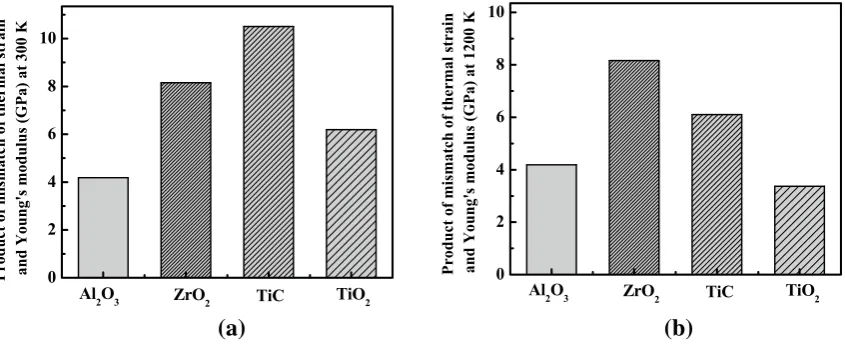
ZrO2 cladding material showed higher mismatch of ther-mal strain with the substrate at any preheating temperature than other clad materials, see Fig. 4a, b. However, below 900 K preheating temperature of the substrate, TiC cladding material generated higher tensile residual stress than ZrO2 cladding material. To clarify this issue, another material property, Young’s modulus, was considered. The Young’s modulus of TiC and ZrO2 cladding materials is 449 GPa and 380 GPa, respectively. From Eq. 3, we have taken the 300 400 500 600 700 800 900 1000 1100 1200
0.0 0.2 0.4 0.6 0.8 1.0
Residual stress
Temperature (K)
Al2O3
ZrO2
TiO2
TiC
Fig. 2 Distribution of the normalized residual stress with preheating temperature of the substrate for four cladding materials
0.0 0.2 0.4 0.6 0.8 1.0
Residual stres
s
Al2O3 ZrO2 TiC TiO2
(b)
0.00.2 0.4 0.6 0.8 1.0
TiC TiO2
ZrO2 Al2O3
Residual stress
(a)
[image:4.595.71.268.299.456.2] [image:4.595.89.511.514.695.2]N. Tamanna et al.
1 3
202 Page 4 of 5part related with mismatch of thermal strain and Young’s modulus of clad material, Ec[𝛼c(Tmc−Tr)−𝛼s(T0−Tr) ,
to explain this trend. The product of mismatch of thermal strain and Young’s modulus was shown in Fig. 5a, b. At 300 K, TiC cladding material showed maximum value shown in Fig. 5a. Moreover, TiC has higher Young’s modu-lus and very small difference between mismatch of thermal strain with ZrO2. However, mismatch of thermal strain was decreased with increasing the preheating temperature of the substrate. The degree of decrement of the mismatch of ther-mal strain between TiC cladding material and the substrate was higher than ZrO2 cladding material above 900 K gen-erating lower residual stress, though the Young’s modulus of TiC was higher.
If we compare between Al2O3 and ZrO2 cladding mate-rials, the Young’s modulus of Al2O3 (380 GPa) cladding
material is higher than ZrO2 (250 GPa) cladding material. However, ZrO2 cladding material produced higher residual stress. Then, it is important to focus on the mismatch of thermal strain. The mismatch of thermal strain of Al2O3 is much lower than ZrO2 which generating lower residual stress in Al2O3 cladding material.
The residual stress decreased with the rise of the pre-heating temperature of the substrate for all types of clad-ding materials. The reason behind the descendant trend of the residual stress is the lower thermal gradient between the clad and the substrate material and relatively slower cooling rate [16, 23]. The slower the cooling rate, the material got longer time to come back to the original dimension. As it takes longer time to come back to room temperature, the mismatch of thermal strain also decreased between two materials.
0.000 0.005 0.010 0.015 0.020 0.025 0.030 0.035
Mi
smatch of thermal strain
at 300
K
Al2O3 ZrO2 TiC TiO2
(a)
0.000 0.005 0.010 0.015 0.020 0.025 0.030 0.035
Mismatch of thermal strain
at 1200
K
Al2O3 ZrO2 TiC TiO2
(b)
Fig. 4 Mismatch of thermal strain between the cladding materials and the substrate a at 300 K and b at 1200 K preheating temperature of the substrate
0 2 4 6 8 10
Product of mismatch of thermal strain and Young's modulus (GPa) at 300
K
Al2O3 ZrO2 TiC TiO2
(a)
0 2 4 6 8 10
Product of mismatch of thermal strain and Young's modulus (GPa) at 1200
K
Al2O3 ZrO2 TiC TiO2
(b)
[image:5.595.78.517.57.225.2] [image:5.595.89.512.511.683.2]4 Conclusions
An analytical model has been used to calculate and compare the stress generation in dissimilar clad and substrate material system with different preheating temperatures of the sub-strate. Four cladding materials, TiO2, TiC, ZrO2 and Al2O3 were used on the H13 tool steel substrate. Below 900 K preheating temperature of the substrate, maximum residual stress was generated in the TiC clad. The maximum residual stress was formed in ZrO2 clad above 900 K. The minimum residual stress was found for Al2O3 clad. Thermal strain and Young’s modulus were found as key factors of the genera-tion of residual stress. The minimum mismatch of thermal strain was found in Al2O3 clad. The reduction of mismatch of thermal strain can reduce the residual stress in the clad. This analysis can be used to find a combination of materials that can generate minimum residual stress. This model is capable to include preheating of the substrate and predicts its effect on the distribution of the residual stress. The incre-ment of preheating temperature of substrate decreased the residual stress.
Acknowledgements Sincere thanks to EU funded Erasmus Mundus project, EM LEADERS reference: 551411-EM-1-2014-1-UK-ERA MUNDUS-EMA21_EM, and School of Mathematics, Computer Sci-ence and Engineering of City, University of London for funding the Project.
Open Access This article is distributed under the terms of the Crea-tive Commons Attribution 4.0 International License (http://creat iveco mmons .org/licen ses/by/4.0/), which permits unrestricted use, distribu-tion, and reproduction in any medium, provided you give appropriate credit to the original author(s) and the source, provide a link to the Creative Commons license, and indicate if changes were made.
References
1. E. Toyserkani, A. Khajepour, S.F. Corbin, Laser Cladding, 1st edn. (CRC Press, New York, 2004)
2. C.S. Chien, C.W. Liu, T.Y. Kuo, C.C. Wu, T.F. Hong, Appl. Phys. A Mater. Sci. Process. 122, 1 (2016)
3. D. Wang, Q. Hu, X. Zeng, Surf. Coatings Technol. 274, 51 (2015) 4. P. Farahmand, R. Kovacevic, Opt. Laser Technol. 63, 154 (2014) 5. N. Tamanna, R. Crouch, S. Naher, 20th Int. ESAFORM Conf.
Mater. Form. 40015, (2017)
6. M. Eslami, R. Hetnarski, J. Ignaczak, N. Noda, N. Sumi, Theory of Elasticity and Thermal Stresses, 1st edn. (Springer, New York, 2013)
7. Y. Chew, J.H.L. Pang, Int. J. Fatigue. 87, 235 (2016)
8. A. Martinez Hurtado, J.A. Francis, N.P.C. Stevens, Mater. Sci. Technol. 32, 1484 (2016)
9. J. Liu, L. Li, Opt. Laser Technol. 36, 477 (2004)
10. F. Brückner, D. Lepski, E. Beyer, J. Therm. Spray Technol. 16, 355 (2007)
11. M. Hao, Y. Sun, Int. J. Heat Mass Transf. 64, 352 (2013) 12. P. Han, F.R. Xiao, W.J. Zou, B. Liao, Ceram. Int. 40, 5007 (2014) 13. T.W. Clyne, S.C. Gill, J. Therm. Spray Technol. 5, 401 (1996) 14. J. Matejicek, S. Sampath, P.C. Brand, H.J. Prask, Acta Mater. 47,
607 (1999)
15. Z. He, J. Ma, G.E.B. Tan, J. Alloys Compd. 486, 815 (2009) 16. Y.-F. Tao, J. Li, Y.-H. Lv, L.-F. Hu, Opt. Laser Technol. 97, 379
(2017)
17. F. Klocke, K. Arntz, M. Teli, K. Winands, M. Wegener, S. Oliari, Procedia CIRP. 63, 58 (2017)
18. P. Auerkari, Mechanical and Physical Properties of Engineering Alumina Ceramics, Technical Research Centre of Finland, VTT Manufacturing Technology, Research Notes 1792, 3–36 (1996) 19. D.Y. Dang, J.L. Fan, H.R. Gong, J. Appl. Phys. 116, 0 (2014) 20. AZoM (2002), https ://www.azom.com/artic le.aspx?Artic
leID=1179. Accessed 31 Oct 2017
21. AZoM (2002), https ://www.azom.com/prope rties .aspx?Artic leID=133. Acessed 31 Oct 2017
22. F.P. Incropera, T.L. Bergman, A.S. Lavine, D.P. DeWitt, Funda-mentals of Heat and Mass Transfer, 7th edn. (Don Fowley, Jef-ferson, 2011)
![Fig. 1 The geometry of residual stress model based on thermo-elastic mechanics [3]](https://thumb-us.123doks.com/thumbv2/123dok_us/1391833.92326/3.595.180.544.581.676/geometry-residual-stress-model-based-thermo-elastic-mechanics.webp)