City, University of London Institutional Repository
Citation
:
Kistner, J. (2017). The use of gestures in the conversations of people with aphasia. (Unpublished Doctoral thesis, City, University of London)This is the accepted version of the paper.
This version of the publication may differ from the final published
version.
Permanent repository link:
http://openaccess.city.ac.uk/18031/Link to published version
:
Copyright and reuse:
City Research Online aims to make research
outputs of City, University of London available to a wider audience.
Copyright and Moral Rights remain with the author(s) and/or copyright
holders. URLs from City Research Online may be freely distributed and
linked to.
The use of gestures in
the conversations of
people with aphasia
Judith Kistner
Thesis submitted for the degree of Doctor of Philosophy in
Language and Communication Science
Division of Language and Communication Science
School of Health Sciences
City University of London
Contents
List of Figures ... 12
List of Tables ... 14
Acknowledgments ... 17
Declaration ... 19
Abstract of the study ... 20
List of acronyms ... 21
Chapter 1 Introduction ... 24
Chapter 2 Background ... 29
2.1 Gesture... 29
2.1.1 Use of gesture. ... 29
2.1.2 Characteristics of gesture. ... 30
2.1.3 Functions of gestures. ... 32
2.1.3.1 Augmentative – gestures accompany speech. ... 33
2.1.3.2 Compensatory – gestures replace speech. ... 34
2.1.3.3 Facilitative – gestures resolve word-finding difficulties. ... 35
2.1.3.4 Summary. ... 36
2.1.4 Gesture processing. ... 37
2.1.4.1 Interface Hypothesis. ... 37
2.1.4.2 Lexical Facilitation Model. ... 39
2.1.4.3 Summary. ... 41
2.2 Conversation ... 42
2.2.1 Conversation topic. ... 42
2.2.2 Conversation partner. ... 43
2.2.3 Influence of conversation topic and partner on gesture production. ... 45
2.2.4 Influence of conversation topic and partner in aphasia. ... 46
2.2.4.1 Conversation topic. ... 46
2.2.4.2 Conversation partner. ... 47
2.3 Aphasia... 49
2.3.1 Different types of aphasia. ... 49
2.3.2 Characteristics of aphasic language. ... 50
2.3.2.1 Fluency of language production and lexical retrieval. ... 51
2.3.2.2 Semantic skills. ... 52
2.4 Gesture in aphasia ... 55
2.4.1 Is gesture production impaired in aphasia? ... 55
2.4.1.1 Formal gesture tasks. ... 55
2.4.1.2 Gesture in spontaneous speech. ... 57
2.4.1.2.1 Differences in gesture production between PWA and NHP. ... 59
2.4.1.2.2 Gesture production and type of aphasia. ... 61
2.4.1.2.3 Gesture production and severity of aphasia. ... 63
2.4.1.3 Relevance for this study. ... 66
2.4.2 Why is gesture production impaired in aphasia? ... 67
2.4.2.1 Central symbolic impairment. ... 67
2.4.2.2 Limb apraxia. ... 69
2.4.2.3 Semantic impairment. ... 73
2.4.2.4 Cognition. ... 78
2.4.2.5 Relevance for this study. ... 81
2.4.3 Word-finding difficulties. ... 81
2.4.4 What functions do gestures play in aphasia? ... 84
2.4.4.1 Augmentative – Gestures accompany speech. ... 84
2.4.4.2 Compensatory – gestures replace speech. ... 87
2.4.4.3 Facilitative – gestures resolve word-finding difficulties. ... 89
2.4.4.4 Summary. ... 91
2.4.5 Gesture processing in aphasia. ... 92
2.5 Summary ... 93
Chapter 3 Systematic literature review ... 94
3.1 Background ... 94
3.2.1 Eligibility criteria. ... 94
3.2.2 Sources of information and search strategy. ... 94
3.2.3 Data collection. ... 95
3.2.4 Data coding. ... 95
3.3 Results ... 96
3.3.1 Results of the search. ... 96
3.3.2 Study characteristics... 97
3.3.3 Questions. ... 103
3.3.3.1 Conversation partner ... 103
3.3.3.2 Type of topic ... 103
3.3.3.3 Types of gestures ... 103
3.3.3.4 Functions of gestures ... 104
3.4 Discussion ... 105
3.4.1 Summary of main findings. ... 105
3.4.2 Quality of the evidence. ... 105
3.4.2.1 Conversation partners ... 106
3.4.2.2 Types of topic ... 106
3.4.2.3 Types of gestures ... 106
3.4.2.4 Functions of gestures ... 107
3.5 Conclusions ... 108
Chapter 4 Research questions and hypotheses ... 109
4.1 RQ 1: Overall number of gestures. ... 109
4.2 RQ 2: Different types of gestures. ... 110
4.3 RQ 3: Word-finding difficulties. ... 111
4.4 RQ 4: Functions of semantically rich gestures. ... 112
4.5 RQ 5: Participant factors. ... 113
Chapter 5 Methodology and design ... 115
5.1 Ethical approval ... 115
5.2 Participants ... 115
5.2.2 Neurologically healthy participants. ... 118
5.2.3 Familiar conversation partners. ... 120
5.2.4 Unfamiliar conversation partners. ... 120
5.3 Materials and procedures ... 120
5.3.1 Assessments. ... 121
5.3.1.1 Screening... 121
5.3.1.1.1 Language skills. ... 121
5.3.1.1.2 Cognitive skills. ... 123
5.3.1.1.3 Motor skills. ... 124
5.3.1.1.4 Analysis. ... 124
5.3.1.1.5 Summary. ... 124
5.3.1.2 Further assessments. ... 125
5.3.1.2.1 Language skills. ... 125
5.3.1.2.2 Motor skills. ... 127
5.3.1.2.3 Summary. ... 127
5.3.1.3 Composite scores. ... 128
5.3.2 Pilot participants. ... 129
5.3.2.1 Demographics. ... 129
5.3.2.1 Assessment data. ... 129
5.3.3 Data collection process. ... 132
5.3.4 Assessment data. ... 133
5.3.5 Conversation data. ... 137
5.3.5.1 Setup/material. ... 137
5.3.5.2 Conversation topics. ... 139
5.3.5.3 Conversation partners. ... 141
5.4 Analyses ... 141
5.4.1 Coding procedure. ... 142
5.4.2 Language coding process. ... 142
5.4.3 Gesture coding process. ... 143
5.4.3.2 Categorising semantically rich gestures. ... 145
5.4.4 Inter-rater agreement. ... 146
5.4.5 Data analysis. ... 147
5.4.5.1 RQ 1: Overall number of gestures. ... 147
5.4.5.1.1 Analysis 1.1. ... 148
5.4.5.1.2 Analysis 1.2. ... 148
5.4.5.1.3 Analysis 1.3. ... 148
5.4.5.2 RQ 2: Different types of gestures. ... 149
5.4.5.2.1 Analysis 2.1. ... 149
5.4.5.2.2 Analysis 2.2. ... 150
5.4.5.3 RQ 3: Word-finding difficulties. ... 150
5.4.5.3.1 Analysis 3.1. ... 150
5.4.5.3.2 Analysis 3.2. ... 151
5.4.5.3.3 Analysis 3.3. ... 151
5.4.5.3.4 Analysis 3.4. ... 151
5.4.5.3.5 Analysis 3.5. ... 152
5.4.5.4 RQ 4: Functions of semantically rich gestures. ... 152
5.4.5.4.1 Analysis 4.1. ... 153
5.4.5.4.2 Analysis 4.2. ... 153
5.4.5.5 RQ 5: Participant factors. ... 153
5.4.5.5.1 Participants with aphasia. ... 154
5.4.5.5.2 Neurologically healthy participants. ... 154
Chapter 6 Results ... 156
6.1 Outlier analysis ... 156
6.2 Global characteristics of the data ... 157
6.3 RQ 1: Overall number of gestures ... 161
6.3.1 Overall number of gestures... 161
6.3.2 Influence of the conversation partner. ... 161
6.3.3 Influence of the conversation topic. ... 162
6.4.1 Different types of gesture. ... 163
6.4.2 Influence of the conversation topic. ... 165
6.5 RQ 3: Word-finding difficulties ... 166
6.5.1 General analysis. ... 166
6.5.2 Correlation analyses. ... 167
6.5.3 Distribution of the different types of WFD. ... 168
6.5.3.1 Participants with aphasia. ... 169
6.5.3.2 Neurologically healthy participants. ... 171
6.5.4 Summary. ... 173
6.6 RQ 4: Functions of semantically rich gestures ... 173
6.6.1 General analysis. ... 173
6.6.2 Participants with aphasia. ... 174
6.6.3 Neurologically healthy participants. ... 175
6.6.4 Summary. ... 177
6.7 RQ 5: Participant factors ... 177
6.7.1 Participants with aphasia. ... 178
6.7.1.1 Correlation table... 178
6.7.1.2 Significant correlations for PWA. ... 180
6.7.1.2.1 Fluency. ... 180
6.7.1.2.2 Lexical production skills. ... 181
6.7.1.2.3 Cognitive skills. ... 181
6.7.1.3 Cognitive skills and gesture production in WFD. ... 182
6.7.2 Neurologically healthy participants. ... 183
6.8 Post-hoc analyses ... 184
6.8.1 RQ 1: Overall number of gestures... 184
6.8.1.1 Influence of speech fluency on the overall number of gestures. ... 184
6.8.1.2 Difference between gestures produced during WFD and gestures produced outside WFD. ... 184
6.8.1.3 Influence of the conversation partner on the overall number of WFD.185 6.8.1.4 Influence of the conversation topic on the overall number of WFD. .. 186
6.8.2.1 Influence of the conversation topic on the production of semantically rich
and semantically empty gestures. ... 186
6.8.2.2 Relationship between semantically rich gestures and the overall number of WFD. ... 187
6.8.2.3 Relationship between semantically rich gestures and the number of resolved WFD. ... 188
6.8.2.4 Relationship between beat gestures and speech fluency. ... 188
6.8.2.5 Relationship between other gestures and motor skills. ... 189
6.8.3 RQ 3: Word-finding difficulties. ... 189
6.8.3.1 Relationship between age and the overall number of WFD. ... 189
6.8.4 RQ 4: Functions of semantically rich gestures. ... 190
6.8.4.1 Relationship between aphasia severity and the overall number of compensatory gestures. ... 190
6.8.5 RQ 5: Participant factors. ... 190
6.8.5.1 Relationship between lexical production skills and the overall number of WFD. ... 190
6.8.5.2 Relationship between lexical production skills and the number of resolved WFD. ... 191
6.9 Summary ... 192
Chapter 7 Discussion ... 194
7.1 Revisiting the research questions ... 194
7.1.1 RQ 1: Overall number of gestures. ... 194
7.1.1.1 Overall number of gestures. ... 194
7.1.1.2 Influence of the conversation partner. ... 198
7.1.1.3 Influence of the conversation topic. ... 200
7.1.1.4 Summary. ... 201
7.1.2 RQ 2: Different types of gestures. ... 201
7.1.2.1 Semantically rich versus semantically empty gestures. ... 201
7.1.2.2 Distribution of gesture subtypes ... 203
7.1.2.2.1 Iconic, metaphoric, pantomime, and emblem gestures. ... 204
7.1.2.2.3 Deictic gestures. ... 205
7.1.2.2.4 Beat gestures. ... 205
7.1.2.2.5 Other gestures. ... 206
7.1.2.3 Summary. ... 207
7.1.3 RQ 3: Word-finding difficulties. ... 208
7.1.4 RQ 4: Functions of semantically rich gestures. ... 213
7.1.4.1 Different functions of semantically rich gestures... 213
7.1.4.2 Communicative gestures. ... 214
7.1.4.3 Compensatory gestures. ... 215
7.1.4.4 Summary. ... 216
7.1.5 RQ 5: Participant factors. ... 216
7.1.5.1 Significant factors. ... 217
7.1.5.1.1 Fluency. ... 217
7.1.5.1.2 Lexical production skills. ... 218
7.1.5.1.3 Cognitive skills. ... 218
7.1.5.2 Non-significant factors... 219
7.1.5.2.1 Aphasia severity. ... 219
7.1.5.2.2 Motor skills. ... 221
7.1.5.2.3 Semantic skills. ... 221
7.1.5.3 Summary. ... 223
7.2 Contributions made by the study ... 223
7.2.1 Theoretical implications. ... 223
7.2.1.1 Gesture processing. ... 223
7.2.1.2 Participant factors. ... 225
7.2.2 Clinical implications. ... 227
7.3 Limitations and further research ... 228
7.4 Summary ... 232
Appendices ... 235
Appendix A: Synonym judgement tasks ... 235
Appendix C: Detailed results of PWA ... 247
Appendix D: Detailed results of NHP ... 255
Appendix E: Detailed results of FCP ... 257
Appendix F: Detailed results of UFCP ... 260
Appendix G: Conversation order ... 261
Appendix H: Gesture coding procedure ... 262
Appendix I: Descriptive statistics ... 263
LIST OF FIGURES
Figure 2.1. Kendon’s continuum according to McNeill (1992, 2000). ... 31
Figure 2.2. The Sketch Model by de Ruiter (2000). ... 38
Figure 2.3. The Lexical Facilitation Model by Krauss et al. (2000). ... 41
Figure 3.1. Flowchart of the review process. ... 97
Figure 5.1. Five steps of data collection, including recruiting, screening, assessing PWA, NHP, FCP, and UFCP, and the conversation sessions. ... 132
Figure 5.2. Setup of the conversation session. ... 138
Figure 5.3. Example of the camera view. ... 139
Figure 5.4. Tiers for coding process in ELAN. ... 142
Figure 5.5. Kendon’s continuum according to McNeill (1992, 2000) in detail. ... 144
Figure 5.6. Kendon’s continuum, modified for the current study. ... 145
Figure 6.1. Influence of the conversation partner on gesture production for PWA and NHP, including error bars of +/-1 SD. Significant differences are marked with *. ... 162
Figure 6.2. Influence of the conversation topic on gesture production for PWA and NHP, including error bars of +/-1 SD. Significant differences are marked with *.163 Figure 6.3. Use of semantically rich and semantically empty gestures for PWA and NHP. ... 164
Figure 6.4. Influence of the conversation topic on the use of semantically rich gestures (in %). ... 166
Figure 6.5. Correlation between the number of gestures and the overall number of WFD for PWA. ... 167
Figure 6.6. Distribution of different types of WFD (in %) for PWA. ... 169
Figure 6.7. Distribution of different types of WFD (in %) for NHP. ... 171
Figure 6.8. Distribution of the different functions of semantically rich gestures (in %) for PWA. ... 174
Figure 6.9. Distribution of the different functions of semantically rich gestures (in %) for NHP. ... 176
Figure 6.10. Correlation between the overall number of gestures and the WAB-R fluency for PWA. ... 180
Figure 6.11. Correlation between the overall use of gesture and lexical production skills (in %) for PWA. ... 181
Figure 6.12. Correlation between the overall use of gesture and non-verbal cognitive skills (in %) for PWA. ... 182
Figure 6.14. Correlation between the number of semantically rich gestures and the
overall number of WFD for PWA. ... 187
Figure 6.15. Correlation between the number of semantically rich gestures and the
number of resolved WFD for PWA. ... 188
Figure 6.16. Correlation between the number of beat gestures and the WAB-R fluency
for PWA. ... 189
Figure 6.17. Correlation between the lexical production skills (in %) and the overall
number of WFD for PWA. ... 191
Figure 6.18. Correlation between the lexical production skills (in %) and the number of
resolved WFD for PWA. ... 192
LIST OF TABLES
Table 3.1. Systematic literature review. ... 99
Table 5.1. Demographics of PWA. ... 117
Table 5.2. Demographics of NHP. ... 119
Table 5.3. Skills assessed in screening process. ... 121
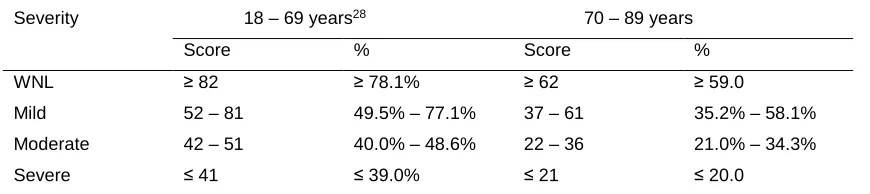
Table 5.4. WAB-R – AQ severity rating. ... 122
Table 5.5. CLQT – visuospatial skills severity rating. ... 123
Table 5.6. Summary of screening cut-offs. ... 125
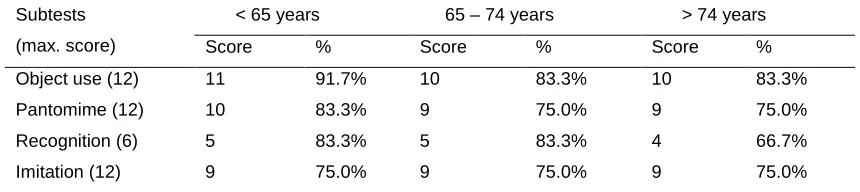
Table 5.7. Cut-offs of the four subtests for the BCoS-Praxis. ... 127
Table 5.8. Summary of further assessment cut-offs. ... 127
Table 5.9. Composite scores... 128
Table 5.10. Demographics of pilot participants. ... 130
Table 5.11. Language and semantic skills scores of PWA pilot participants. ... 130
Table 5.12. Cognition and motor skills scores of pilot participants. ... 131
Table 5.13. Language and semantic skills scores of PWA. ... 135
Table 5.14. Cognition and motor skills scores PWA. ... 136
Table 5.15. Assessments and composite scores. ... 137
Table 5.16. Conversation types, topics, and instructions. ... 140
Table 5.17. Functions of semantically rich gestures. ... 146
Table 5.18. Inter-rater reliability levels for the identification of gestures and WFD. .... 146
Table 5.19. Inter-rater reliability levels for the different types of gesture. ... 147
Table 5.20. Inter-rater reliability levels for the different types of WFD. ... 147
Table 5.21. Overall number of gestures – Analysis 1.1. ... 148
Table 5.22. Overall number of gestures – Analysis 1.2. ... 148
Table 5.23. Overall number of gestures – Analysis 1.3. ... 149
Table 5.24. Different types of gestures – Analysis 2.1. ... 149
Table 5.25. Different types of gestures – Analysis 2.2. ... 150
Table 5.26. Word-finding difficulties – Analysis 3.1. ... 150
Table 5.27. Word-finding difficulties – Analysis 3.2. ... 151
Table 5.28. Word-finding difficulties – Analysis 3.3. ... 151
Table 5.29. Word-finding difficulties – Analysis 3.4a. ... 152
Table 5.30. Word-finding difficulties – Analysis 3.4b. ... 152
Table 5.31. Word-finding difficulties – Analysis 3.5a. ... 152
Table 5.32. Word-finding difficulties – Analysis 3.5b. ... 152
Table 5.33. Semantically rich gestures – Analysis 4.1. ... 153
Table 5.34: Semantically rich gestures – Analysis 4.2a. ... 153
Table 5.36. Participant factors PWA – Analysis 5.1a. ... 154
Table 5.37. Participant factors PWA – Analysis 5.1b. ... 154
Table 5.38. Participant factors NHP – Analysis 5.2. ... 155
Table 6.1. Outliers. ... 157
Table 6.2. Statistical analyses. ... 159
Table 6.3. Overall use of gesture. ... 161
Table 6.4. Different types of gestures. ... 165
Table 6.5. Distribution of different types of WFD (in %). ... 169
Table 6.6. Difference matrix for word-finding difficulties of PWA. ... 170
Table 6.7. Raw scores of the different types of WFD for PWA used for Chi Square analysis. ... 170
Table 6.8. Difference matrix for WFD of NHP. ... 172
Table 6.9. Raw scores of the different types of WFD for NHP used for Chi Square analysis. ... 172
Table 6.10. Distribution of the different functions of semantically rich gestures (in %).174 Table 6.11. Difference matrix for functions of semantically rich gestures of PWA. .... 175
Table 6.12. Difference matrix for functions of semantically rich gestures of NHP. ... 176
Table 6.13. Correlation analyses for participant factors and gesture production of PWA. ... 179
Table 6.14. Correlation matrix for cognition and WFD +gesture for PWA. ... 182
Table 6.15. Correlation analyses for participant factors and gesture production of NHP. ... 183
Table 6.16. Overall use of gesture, comparing fluent and non-fluent aphasia. ... 184
Table 6.17. Difference between gestures produced during WFD and gestures produced outside WFD. ... 185
Table 6.18. Overall number of WFD, comparing conversations with FCP and UFCP.185 Table 6.19. Overall number of WFD, comparing procedural and narrative conversation topics. ... 186
Table 6.20. Distribution of semantically rich and semantically empty gestures, including conversation topic. ... 187
Table 0.1. Stimuli for verb norming study. ... 235
Table 0.2. Stimuli for adjective norming study. ... 236
Table 0.3. Demographics of participants of norming study. ... 237
Table 0.4. Verb synonym pairs and imageability ratings according to Cortese and Fugett (2004) and Schock et al. (2012). ... 240
Table 0.5. Adjective synonym pairs and imageability ratings according to Bird et al. (2001) and Wilson (1987). ... 241
Table 0.7. Synonym judgement task verbs. ... 242
Table 0.8. Synonym judgement task adjectives. ... 243
Table 0.9. Demographics of FCP. ... 244
Table 0.10. Demographics of UFCP... 245
Table 0.11. List of FCP and UFCP who took part in more than one conversation session. ... 246
Table 0.12. WAB-R results of PWA (max. score). ... 247
Table 0.13. Lexical production skills of PWA (max. score). ... 248
Table 0.14. Verbal semantic skills (1) of PWA (max. score). ... 249
Table 0.15. Verbal semantic skills (2) of PWA (max. score). ... 251
Table 0.16. Non-verbal semantic skills of PWA. ... 252
Table 0.17. CLQT – visuospatial skills of PWA (max. score). ... 253
Table 0.18. ARAT results of PWA (max. score)... 254
Table 0.19. CLQT – visuospatial skills of NHP (max. score). ... 255
Table 0.20. ARAT results of NHP (max. score). ... 256
Table 0.21. CLQT – visuospatial skills of FCP (max. score). ... 257
Table 0.22. ARAT results of FCP (max. score). ... 259
Table 0.23. ARAT results of UFCP (max. score). ... 260
Table 0.24. Order of conversation topics of PWA and NHP. ... 261
Acknowledgments
This thesis would not exist without the help and support of many people. I am grateful
for every single one of them and would like to mention the following people in particular.
Thanks to City University for awarding me the doctoral studentship over five years ago.
Without this, I would have not been able to conduct this research, let alone move to
London for three adventurous years.
A very, very big and heartfelt thank you goes to my supervisors Jane Marshall and Lucy
Dipper. Thank you for all your support, wisdom, and inspiration during this journey. It all
started with Jane being interested in my research idea (thank you Beth Armstrong for
initially helping me to develop it) and several skype-sessions between the UK and
Germany to write a research proposal. This was only five years ago and I cannot believe
where it took me! I have learnt so much over the past four years from the best supervisory
team that I can think of. Thank you so much!
Thank you also to Katerina Hilari and Penny Roy who shared their knowledge about
statistics with me and spent many hours helping me to figure out how to best analyse
the data. I am grateful for every minute of advice they have given me.
In the end it all comes down to the participants; in my case 113 people took part as
participants, controls, and conversation partners. Data collection was very intense and
exhausting, but also a special time. Thank you for sharing all these stories with me. I
would not have been able to do all this without you, your time, and your patience.
I would also like to thank Jessica Eucker who spent many hours learning about aphasia
and gesture production whilst re-coding part of the videos for reliability.
The journey of a PhD is full of ups and downs and I do not know what I would have done
without the great support of fellow PhD students and researchers within the department.
In no particular order of importance, I would like to thank Abi Roper, Anna Caute, Becky
Moss, Billie Lowe, Catherine Prior, Celia Woolf, Gabriella Caminotto, Hannah Hockey,
Helen Cain, Ioanna Georgiadou, Jo Piper, Katie Monnelly, Lara Hastie, Line Huck,
Lisa-Maria Müller, Livia Bernardi, Madeleine Pritchard, Madeline Cruice, Niamh Devane, Nick
Behn, Rachael-Anne Knight, Rachel Barnard, Rachel Holland, Richard Talbot, Roberta
Iacovelli, and Sarah Northcott. Thank you for the numerous tea/coffee/lunch breaks, the
motivational dances/speeches, and all the (little) things that made this journey such a
I have no idea how much more sanity I would have sacrificed if it had not been for the
hours I was happy enough to spend playing and crafting with “my” children. It feels really
special to have been part of their life for three years. And of course, thanks to the
wonderful people of the London Philharmonic Choir with whom I have spent many hours
rehearsing and performing at several occasions. It was a great pleasure to have been
part of this group!
And last but not least, I would like to thank my family of course. I would not be here if it
was not for their loving support over all those years and for letting me follow my own
path, even though it may have looked like a detour in the beginning. They always
Declaration
The author grants powers of discretion to the University Librarian to allow the thesis
to be copied in whole or in part without further reference to the author. This
permission covers only single copies made for study purposes, subject to normal
Abstract of the study
Background: Gestures are spontaneous hand and arm movements that frequently
accompany speech and play an important role in everyday communication. When communication is impaired by aphasia, gestures are affected as well. It is important to find out how people with aphasia (PWA) use gesture as an accompaniment to speech, as a compensatory modality, and during lexical retrieval. This novel study examined the use and functions of gesture in conversation and investigated parameters (i.e., conversation partner, topic, and participant factors) that could have an influence on gesture production.
Methodology: Language and conversation data of 20 PWA and 21 neurologically healthy
participants (NHP) were collected. Participants took part in conversations with two conversation partners (familiar and unfamiliar) and two conversation topics (narrative and procedural). Video samples were analysed for gesture production, speech production, and word-finding difficulties (WFD).
Results: The two groups of participants produced a similar number of gestures
(t (37) = -1.060, p = .296). Gesture type was not examined statistically but showed some marginal differences between groups. Unfamiliar conversation partners elicited significantly more gestures than familiar conversation partners (F (1, 37) = 24.358,
p < .001). Additionally, participants produced significantly more gestures in procedural
than in narrative topics (F (1, 37) =44.807, p < .001). While all participants experienced a similar number of WFD, there was a difference between PWA and NHP regarding gesture production and resolution of WFD: NHP resolved the majority of all WFD, independent of a co-occurring gesture. Nevertheless, for PWA and NHP, there was a significant relationship between gesture production and the resolution of the WFD (X2 (1) = 12.356, p < .01 for PWA and X2 (1) = 40.657, p < .01 for NHP), indicating that
WFD that occurred with gestures were more likely to be resolved than WFD that occurred without gesture production. Participants used gestures with different functions, such as facilitative gestures to resolve WFD or augmentative gestures to supplement speech. For PWA, different participant factures, such as fluency of speech (rs (17) = .487,
p = .035), lexical production skills (rs (17) = .584, p = .009), and cognition (rs (17) = .582,
p = .009) were linked to gesture production.
Conclusions: These findings shed light on gesture processing and the different functions
List of acronyms
2
p
η
partial eta squaredA (participant/s with) aphasia
A augmentative gestures (in systematic literature review)
ANOVA analysis of variance
AQ aphasia quotient
ARAT Action Research Arm Test
BCoS Birmingham Cognitive Screen
C control (participant/s)
C compensatory gestures (in systematic literature review)
CA conversation analysis
CAB Cantonese version of the Western Aphasia Battery (WAB)
CLQT Cognitive Linguistic Quick Test
CP conversation partner/s
CVA cerebrovascular accident
ELAN linguistic annotation software
F ANOVA
F familiar (conversation partner/s)
F facilitative gestures (in systematic literature review)
FCP familiar conversation partner/s
GP general practitioner
HF high-frequent
HI high-imageable
κ Cohen’s kappa
KDT Kissing and Dancing Test
LF low-frequent
LG large group design study
LI low-imageable
M mean
MCA middle cerebral artery
MF medium-frequent
MG medium group design study
min minute(s)
ms millisecond(s)
N narrative topic (in systematic literature review)
N1 1st narrative conversation topic (i.e., happy memory)
N/A not applicable
NHP neurologically healthy participant/s
OANB Object and Action Naming Battery
p p-value of statistical significance
P procedural topic (in systematic literature review)
P1 1st procedural conversation topic (i.e., wrapping parcel)
P2 2nd procedural conversation topic (i.e., making scrambled eggs)
PA pilot (participant/s with) aphasia
PF pilot familiar (conversation partner/s)
PG post graduate
PUF pilot unfamiliar (conversation partner/s)
PALPA Psycholinguistic Assessments of Language Processing in Aphasia
PhD philosophical doctorate
PPTT Pyramids and Palm Trees Test
PWA participant/s with aphasia
PWAf participant/s with fluent aphasia
PWAnf participant/s with non-fluent aphasia
PWAD participant/s with Alzheimer’s type dementia
qual. qualitative analysis
quant. quantitative analysis
r Pearson’s r (parametric correlation)
rs Spearman’s rho (non-parametric correlation)
RQ research question
SC single case design study
SD standard deviation
SE standard error
SE semantically empty gestures
sem. semantic(s)
SG small group design study
SLT speech and language therapist
SR semantically rich gestures
t t-test (comparison) TOT tip-of-the-tongue
UF unfamiliar (conversation partner/s)
UFCP unfamiliar conversation partner/s
UG undergraduate
unrel. unrelated
W Shapiro-Wilk test (normality test) & Wilcoxon signed-rank test WAB-R Western Aphasia Battery – Revised
WCST Wisconsin Card Sorting Test
WFD word-finding difficulty/ies
WNL within normal limits
Chapter 1 Introduction
When people talk, they almost always gesture with their hands. Sometimes people
gesture more, sometimes less. Gesturing is a central part of human communication and
plays an important role in everyday conversation (e.g., Beattie & Coughlan, 1999),
although often, people are not aware of their use of their hands when they are speaking.
Gesturing happens both consciously and unconsciously.
Different gesture types can be distinguished. A widely used classification system is
Kendon’s continuum, named by McNeill (1992, 2000) to reflect the researcher who first
described gestures in this way. The continuum distinguishes between gestures that
usually occur with speech (gesticulations) and gestures that usually occur without
speech (pantomimes and emblems). Furthermore, he includes sign languages at the far
end of the classification system, even though they are independent, complex language
systems. Within McNeill’s classification system, one can also distinguish between
gestures based on their semantic richness, that is, whether they reflect or augment the
meaning conveyed in speech.
Those semantically rich gestures that do relate directly to speech are termed
gesticulations and they often carry the same “idea unit” as speech, which suggests a
close link between gesture and language (Kendon, 1980). Imaging study evidence
showing activation in both the language area and the non-speech motor area brain
during speech production appears to confirm the close link (e.g., Corballis, 2003; Erhard
et al., 1996; Fried et al., 1991; Grabowski, Damasio, & Damasio, 1998; Iverson & Thelen,
1999; Krams, Rushworth, Deiber, Frackowiak, & Passingham, 1998; Ojemann, 1984;
Özyüerek, Willems, Kita, & Hagoort, 2007; Pulvermüller, 2005; Pulvermüller, Preissl,
Lutzenberger, & Birbaumer, 1996). According to Rizzolatti and Craighero (2004), such
evidence suggests that there are neurological links between gesture and language
production.
Further evidence has been supplied by studies of the temporal link between gesture and
speech, as gesture onset usually occurs at the same time as the lexical affiliate or
immediately before it (e.g., Butterworth & Beattie, 1978; Morrel-Samuels & Krauss,
1992). An extension of this temporal link was investigated by Mayberry and Jaques
(2000) who analysed gesture and speech in participants with severe stuttering disorders.
They found that when speech stopped, hand and arm gestures would stop as well, and
Many researchers have sought to answer the question of why people gesture, and in
doing so they have illuminated the function of gestures in communication. There is
evidence for gestures augmenting speech, adding information to what is conveyed
verbally (e.g., Alibali, Flevares, & Goldin-Meadow, 1997; Bavelas, Gerwing, Sutton, &
Prevost, 2008; Beattie, 2004; Beattie & Shovelton, 2002; Broaders & Goldin-Meadow,
2010; Cassell, McNeill, & McCullough, 1998; de Ruiter, 2007; Goldin-Meadow, 2003;
Goldin-Meadow, Alibali, & Church, 1993; Kendon, 1997, 2000; McNeill, 1992, 2000;
Melinger & Levelt, 2004; So, Kita, & Goldin-Meadow, 2009). Gestures replacing speech
(i.e., compensatory gestures) were found in healthy language as well, even though
neurologically healthy participants (NHP) convey more information through speech (e.g.,
Bangerter, 2004; de Ruiter, 2006; Melinger & Levelt, 2004; van der Sluis & Krahmer,
2004, 2007). The temporal link and the occurrence of the gesture immediately prior to its
lexical affiliate led researchers to assume a facilitative function of gesture as well, that
is, it was argued that gestures might assist in the process of speech production (e.g.,
Butterworth & Beattie, 1978; de Ruiter, 1998; Kendon, 1972, 1975; McNeill, 1987;
Morrel-Samuels & Krauss, 1992; Schegloff, 1984).
Gesture processing models like the Sketch Model by de Ruiter (2000) or the Lexical
Facilitation Model by Krauss, Chen, and Gottesman (2000) attempt to explain the
relationship between gesture and speech further. Questions relating to gesture can be
illuminated by data from NHP and from participants with language impairment. One such
impairment is aphasia. Aphasia is an acquired neurological language disorder due to
brain damage, for example, caused by stroke. According to the statistics of the Stroke
Association (2015), each year about 152,000 people in the UK have a stroke and it is
estimated that about a third of all stroke survivors have aphasia (Engelter et al., 2006).
Aphasia varies across individuals but in all cases there are impairments to the processes
that produce speech and language. The use of gesture by participants with aphasia
(PWA), therefore, can illuminate the links between gesture and language and its possible
compensatory and facilitative functions.
The aim of this study was to investigate gesture production in different types of
conversation and with different conversation partners in neurologically healthy
participants and participants with aphasia, in order to find out more about the relationship
between gesture and speech. Gesture production was analysed and gestures were
categorised according to their semantic content. Furthermore, word-finding difficulties
(WFD), their co-occurrence with gesture, and their resolution were investigated in order
to shed light on the facilitative function of gesture production. Different functions of
speech or without speech. Gestures occurring with resolved WFD were contrasted with
unresolved WFD. Finally, the influence of the aphasia severity, the fluency of speech
and the impairment of linguistic and non-linguistic skills on the production of gestures
were investigated.
Investigations of gestures have shifted from formal gesture production tasks towards
gesture production in a more natural communication setting, that is, in spontaneous
speech (cf., Glosser, Wiener, & Kaplan, 1986). Conversation was chosen as the focus
of the present study because of its important role in everyday life. According to Davidson,
Worrall, and Hickson (2003), conversation is the most commonly used communicative
action. Based on the features and context of conversation in everyday life, Ventola
(1979) ascribes conversation a fundamental role in establishing and maintaining
interpersonal relationships.
Although conversation is spontaneously constructed by two or more conversation
partners, there are parameters that can be manipulated in research, like conversation
topic and conversation partner. Language analysis has shown that both parameters have
an influence on speech production (e.g., Clark & Marshall, 1981; Clark & Schaefer, 1987;
Fleming & Darley, 1991; Ulatowska, Allard, & Chapman, 1990; Ulatowska,
Macaluso-Haynes, & North, 1981; Ulatowska, North, & Macaluso-Macaluso-Haynes, 1981). With the close
link between gesture and speech it is expected that gestures would be influenced by
these parameters as well. However, this has not been investigated yet.
Studies investigating gesture production in spontaneous speech in aphasia found
evidence that PWA use more (but less complex) gestures than NHP (e.g., Hogrefe,
Ziegler, Weidinger, & Goldenberg, 2012; Hogrefe, Ziegler, Wiesmayer, Weidinger, &
Goldenberg, 2013). Furthermore, different types of aphasia were shown to elicit different
gesture behaviour that mirrored participants’ speech output. For example, participants
with fluent speech production used also more fluent gestures while participants with
non-fluent aphasia were non-non-fluent in their gesture production as well (e.g., Sekine & Rose,
2013; Sekine, Rose, Foster, Attard, & Lanyon, 2013). There is also evidence to suggest
that PWA use gestures in different contexts and with a different function than NHP. Some
research suggests that PWA are particularly likely to gesture when they experience WFD
(e.g., Feyereisen, 1983; Hadar, Wenkert-Olenik, Krauss, & Soroker, 1998; Hadar &
Yadlin-Gedassy, 1994; Le May, David, & Thomas, 1988; Pedelty, 1987). The function of
gesture in this context, however, is disputed (e.g.,Cocks, Dipper, Middleton, & Morgan,
2011; Cocks, Dipper, Pritchard, & Morgan, 2013; Dipper, Pritchard, Morgan, & Cocks,
the production of the blocked word or they may be compensatory, so enabling the
concept to be conveyed by an alternative means.
A number of factors seem to affect gesture production in aphasia. Some relate to fluency
of speech and the type of the aphasia (see above), other participant factors, such as
semantic processing skills and executive functions were found to affect gesture
production as well (e.g., Cocks, Dipper, et al., 2013; Dipper et al., 2015; Hogrefe et al.,
2012; Hogrefe et al., 2013; Purdy, 1992, 2002; Purdy, Duffy, & Coelho, 1994; Purdy &
Koch, 2006; Yoshihata, Watamori, Chujo, & Masuyama, 1998). While studies
investigating gestures by formal tasks found an influence of motor skills, such as limb
apraxia (e.g., J. R. Duffy & Watkins, 1984; Goodglass & Kaplan, 1963; Kadish, 1978;
Pickett, 1974; Wang & Goodglass, 1992), this link was not found in studies investigating
the spontaneous production of gestures (e.g., R. J. Duffy, Duffy, & Mercaitis, 1984;
Macauley & Handley, 2005; Pritchard et al., 2013; Rose & Douglas, 2003).
Following this introduction, Chapter 2 will provide an overview of the theoretical
background on which this study is based. The first part of this literature review (2.1) is
about the use of gestures in spontaneous speech in general, including different gesture
processing models. 2.2 summarises the different parameters that influence spontaneous
speech, such as type of conversation/discourse and the familiarity of the conversation
partner. The following subsection (2.3) gives an overview of aphasia and the different
layers of language that can be impaired in this condition. In 2.4 gesture production in
aphasia is described, starting with a brief overview of gesture research using formal
gesture production tasks before focusing on gesture in spontaneous speech.
Chapter 3 turns towards the studies that analysed gesture production in spontaneous
speech settings with PWA. This systematic literature review was also conducted to
finalise the research questions. These are stated in Chapter 4 together with their
hypotheses.
Details of conducting the study, including the participants (pilot participants and study
participants, both PWA and NHP), the materials and the procedure are given in
Chapter 5, the methodology. Furthermore, details about the different layers of analysis,
that is, language analysis, including WFD, gesture analysis, and data analysis are
provided at the end of this section.
Chapter 6 presents the results of the different analyses and is organised according to
Finally, Chapter 7 is devoted to a general discussion about the findings of this study
Chapter 2 Background
2.1 Gesture
Gestures are spontaneous hand and arm movements that occur alongside or without
speech and play an important role in everyday communication (Beattie & Coughlan,
1999; Kendon, 1997). Gestures that occur with speech, so-called gesticulations, are
closely linked to the flow of speech and often carry the same meanings or idea units as
speech (Kendon, 1980). According to McNeill, Levy, and Pedelty (1990), these meanings
or ideas, however, are expressed in different ways: While speech can be segmented into
phonemes, words, and phrases, gestures are global as they have no inherent language.
Unlike speaking, the decision to gesture is not always conscious and speakers can
gesture to complement and to supplement information that is given in speech (Broaders
& Goldin-Meadow, 2010; Goldin-Meadow et al., 1993; Iverson & Goldin-Meadow, 1998;
McNeill, 1992; Stokoe, 2000; L. A. Thompson & Massaro, 1994). In this way, gestures
can provide additional information to conversation partners about the meaning of verbal
utterances and help to clarify even abstract concepts (Krauss & Hadar, 1999).
2.1.1 Use of gesture.
There is good evidence that conversation partners pay attention to gestures as, for
example, communication suffers when there is a mismatch between speech and gesture
(e.g., Alibali et al., 1997; Beattie, 2004; Broaders & Goldin-Meadow, 2010; Cassell et al.,
1998; de Ruiter, 2007; Goldin-Meadow et al., 1993; Hadar, Wenkert-Olenik, et al., 1998;
McNeill, Cassell, & McCullough, 1994). Speakers vary when and how they use gestures,
with gestures being most frequent when conversation partners have eye contact
(Kendon, 1997). However, speakers use gestures even when they cannot be seen, such
as when talking on the phone (Bavelas et al., 2008) or on the intercom (Hadar &
Butterworth, 1997; E. Williams, 1977). Furthermore, Iverson and Goldin-Meadow (1998)
found that congenitally blind speakers also gesture even though they have never seen
anybody gesturing. The study also showed that the same visually impaired speakers
continued gesturing after they were told that their conversation partner was visually
impaired as well. Such evidence has led to the suggestion that gestures are not produced
simply for the benefit of the listener. They may also support the speaker, for example, by
facilitating lexical access (Krauss, Chen, & Chawla, 1996), facilitating thinking process
(Iverson & Goldin-Meadow, 1998; McNeill, 1992; Rauscher, Krauss, & Chen, 1996), or
improving memory (Cook, Yip, & Goldin-Meadow, 2010). The function of gesture is one
The relationship between speech and gesture is of great theoretical interest. Indeed the
strong ties between speech and gesture have stimulated discussions about the
neurological links between the modalities (Rizzolatti & Craighero, 2004) and the possible
gestural origins of language (Corballis, 2010). For example, the synchronous interruption
of both speech and co-speech gestures in severe stuttering investigated by Mayberry
and Jaques (2000), led to hypotheses about the general coordination of motor systems
(Kelso, Tuller, & Harris, 1983). Another example can be found in language acquisition.
Prior to spoken two-word-phrases, children start to combine single words and gestures
to convey phrasal concepts (Goldin-Meadow, 2007; Goldin-Meadow & Wagner, 2005).
Gesture therefore assists the language system and substitutes for the words the child
has not acquired yet (Goldin-Meadow, 2007).
Not all gestures are the same. Speakers use different types of gestures when producing
speech. Gestures can be distinguished according to different factors, such as their
relationship with speech and language. For example, the gestures of children who
combine single words and gestures into phrasal concepts are produced without speech
(Goldin-Meadow, 2007; Goldin-Meadow & Wagner, 2005). The following section will
focus on these different gesture types alongside with general characteristics of gesture.
2.1.2 Characteristics of gesture.
Several researchers have proposed gesture classification systems (e.g., Butterworth,
Swallow, & Grimston, 1981; de Ruiter, 2000; Efron, 1972; Ekman & Friesen, 1969;
Kendon, 1982; Lausberg, 2007; McNeill, 1985). Depending on their research interest,
the foci of these classification systems differ, for example, classifying according to
gestural form, meaning, or function. Nevertheless, all classification systems agree on
one characteristic: They distinguish hand and arm gestures from body-focused
movements (e.g., scratching, twitching, grooming, and self- touching) as the latter are
neither temporally synchronised with speech nor carry any content information apparent
in speech. Throughout this study, the gesture classification system of McNeill (1992,
2000) will be used and is described in more detail in the following.
Kendon (1982) was one of the first to define different types of gestures. He outlined four
main categories: (1) gesticulation, (2) pantomime, (3) emblem, and (4) sign language.
McNeill (1992, 2000) adopted the same categories and argued that they formed a
continuum which he named Kendon’s continuum (McNeill, 1992, 2000). This is displayed
Figure 2.1. Kendon’s continuum according to McNeill (1992, 2000).
Moving from left to right, the continuum describes how the different types of gestures
behave in relation to (1) linguistic properties present in the gesture, (2) conventions (i.e.
idiosyncratic or socially regulated), (3) semiotic characteristics, and (4) speech (i.e. how
obligatory speech is for the gesture to be meaningful).
Gesticulations occur alongside speech. Many studies refer to gesticulation as co-speech
gestures indicating the temporal relationship with speech. Pantomime and sign
languages usually replace speech1. While gesticulations are idiosyncratic and
spontaneous movements, pantomime gestures often involve more complex and
sequential movements when depicting objects and actions. Gesticulations also differ
from pantomimes in terms of the combination of movements: Pantomimes can be
combined to create sentence-like expressions whereas gesticulations rely on the
co-occurring speech and cannot be combined. Emblems are lexicalised gestures that differ
between cultures. While the sign which consists of thumb and index finger forming a ring
while the other three fingers are extended is perceived as a sign of encouragement often
referred to as OK sign in Western Europe, the sign is offensive in other cultures. These
lexicalised signs are, like pantomime, usually used without speech. Sign languages, for
example, British Sign Language (BSL), American Sign Language (ASL), or German Sign
Language (Deutsche Gebärdensprache, DGS) occupy the far right continuum. They are
elaborated language systems having their own grammar and vocabulary, just like any
spoken language.
McNeill (1992, 2000) distinguishes further between different sub-categories of
gesticulations2:
1 It has to be noted here that one could argue that sign language can be produced concurrently
with speech, or at least with elements of speech (e.g., mouthing). The point of this is, however, the degree to which co-occurring speech is needed for the gestures to convey meaning (see above). While sign language is entirely independent from speech, gesticulation is opaque if speech is absent.
2 Later, McNeill defined an additional fifth category of co-speech gestures, ‘cohesives’, which
connect semantically related gestures that are spread over the conversation. He further describes them to be either of iconic, metaphoric, or deictic nature. To avoid gesture category overlap, these connective gestures are only considered as being iconic, metaphoric, or deictic. The category is not being used in this study.
(1) Iconics reflect the meaning of the speech pictographically, for example, hands
shaped like holding a cup when talking about a cup or drinking. They refer to
concrete entities.
(2) Metaphorics are similar to iconics but depict an abstract concept, for example, a light
bulb for thinking.3
(3) Deictics are indicative or pointing movements usually with the index finger. They
often accompany pronouns like this and that.
(4) Beats are simple, rhythmic, and repetitive movements that do not carry any semantic
information. They are used to mark stress and prosody.
Throughout the study, McNeill’s classification system will be used. Gestures will be
categorised as gesticulations, pantomimes, and emblems. Both pantomime and emblem
gestures do not rely on language structure as they are independent. Nevertheless, they
can be incorporated in speech. As sign language is fully conventionalised and carries all
linguistic properties (i.e., it is a different language), it will not be part of the study.
Gesticulations will be further subcategorised by McNeill’s system. Thus, the gestures of
both NHP and PWA will be delineated to identify differences between these groups as
each type of gesture has a fundamentally different relationship to speech and may be
affected by brain damage in different ways (McNeill et al., 1990).
2.1.3 Functions of gestures.
Researchers agree on gestures serving specific functions in communication. However,
the literature reflects considerable disagreement on the link between gesture and speech
production. Understanding this link is vital for understanding why gestures are produced.
Some researchers argue that gesture and speech go hand in hand (de Ruiter, Bangerter,
& Dings, 2012), that is, speakers use gestures to augment speech and convey a
communicative intention (Kendon, 2000; McNeill, 2000; So et al., 2009). A slightly
different view is captured in the tradeoff hypothesis (de Ruiter et al., 2012) according to
which gesturing increases if speaking gets more difficult and vice versa. Thus, speakers
use gestures to compensate or to replace speech (Bangerter, 2004; de Ruiter, 2006;
Melinger & Levelt, 2004; van der Sluis & Krahmer, 2004, 2007). Another view is that
gestures facilitate speech production, according to which gestures primarily support the
speaker. This is particularly the case in WFD where gestures are produced to facilitate
lexical retrieval (Krauss et al., 2000)4. These three functions of gestures (i.e.,
3 For example, the hand is placed near the head and the fingers open in a sudden movement
from the first to an open hand indicating that something is ‘switched on’.
4 There may be other facilitative gesture functions. Reviewing the literature gave the impression
augmentative, compensatory, and facilitative) in neurologically healthy speech are
reviewed in turn in the following sections.
2.1.3.1 Augmentative – gestures accompany speech.
One explanation for gesture production is that gestures are produced to accompany
speech. They add information to what is said and act communicatively (i.e., they enhance
the conversation). de Ruiter et al. (2012) called this account the hand-in-hand hypothesis
and contrasted it with the tradeoff hypothesis (see 2.1.3.2) according to which the
speaker chooses either gesture or speech in terms of their communicative load
depending on the context. According to the hand-in-hand hypothesis, gestures are
produced parallel to speech (both in terms of timing and content) when talking or
describing scenes to a conversation partner. This account assumes that gestures are
produced not only for the speaker, but also for the listener and is consistent with the
observation that speakers produce more gestures in face-to-face conversations (Bavelas
et al., 2008; Goldin-Meadow, 2003; Kendon, 1997). This view was supported by several
research studies (e.g., Alibali et al., 1997; Bavelas et al., 2008; Beattie, 2004; Beattie &
Shovelton, 2002; Broaders & Goldin-Meadow, 2010; Cassell et al., 1998; de Ruiter,
2007; Goldin-Meadow, 2003; Goldin-Meadow et al., 1993; Kendon, 1997, 2000; McNeill,
1992, 2000; Melinger & Levelt, 2004; So et al., 2009). These and a selection of other
studies and their outcomes will be presented in the following paragraphs.
A number of studies have found evidence that listeners pay attention to the content of
gesture produced alongside speech, particularly when the gesture and speech carry
mismatching information (Beattie, 2004; Beattie & Shovelton, 2002; Broaders &
Goldin-Meadow, 2010; Cassell et al., 1998; McNeill, 1992; McNeill et al., 1994; Melinger &
Levelt, 2004). Adding to this evidence base, gesture-speech mismatches have been
investigated in development (Alibali et al., 1997; Goldin-Meadow et al., 1993), and
findings suggest that latent knowledge that is not fully developed is revealed in gestures,
adding to the idea that gesture and speech work together in communicating a message
and that not everything is expressed through speech.
Gestures can also add different semantic information to a word depending on its exact
meaning. Kendon (2000) analysed the narration of the fairy tale “Little Red Riding Hood”
by a student pretending to be telling it to an audience of children. In two instances, the
narrator was talking about slicing something, but whereas the verb slice was used in both
examples, the co-speech gestures produced alongside the verb phrase depicted two
different actions congruent with the different connotations intended. This adaptation of
Alibali et al., 1997), it also reveals that gesticulations are not lexicalised but spontaneous
movements that are created on the spot.
All these papers provide support for the proposal that gestures can, at least to some
extent, augment speech and add information that is not conveyed verbally (e.g., spatial
information and movement were mainly communicated via gestures not via speech).
Other studies, however, found evidence for gesture serving different roles in
conversation as well. For example, in certain situations, gestures were found to replace
speech even in neurologically healthy speech (e.g., Goldin-Meadow, 2007; Kendon,
1997; Meissner & Philpotts, 1975). In the following subsections, this gesture function will
be reviewed in more detail.
2.1.3.2 Compensatory – gestures replace speech.
According to de Ruiter et al. (2012), an alternative view of the hand-in-hand hypothesis
(see 2.1.3.1) is the so-called tradeoff hypothesis (e.g., Bangerter, 2004; de Ruiter, 2006;
Melinger & Levelt, 2004; van der Sluis & Krahmer, 2004, 2007). Inherent in the
hypothesis is that gesture is compensatory when speech becomes more difficult and vice
versa.
Gesture has been shown to compensate for speech in various contexts including: (1)
situations in which the experimenter manipulates the communicative environment to
make it relatively harder/easier to convey a message in speech (e.g., Bangerter, 2004;
van der Sluis & Krahmer, 2007), (2) naturally occurring situations where speech is
difficult, such as noisy environments (e.g., Kendon, 1997; Meissner & Philpotts, 1975),
and (3) in language development (e.g., Goldin-Meadow, 2007; Tomasello, Carpenter, &
Liszkowski, 2007). Another context in which gesture is compensatory is when language
is compromised by aphasia (see 2.3). Studies of gestural compensation in aphasia will
be reviewed in section 2.4.4.2.
These studies combine to provide evidence about the communicative uses of gesture in
situations in which both speakers had eye-contact. The gesture used in such situations
has been interpreted as supporting the conversation partner. But people continue
gesturing when they cannot be seen, for example, when talking on the phone (cf.,
Bavelas et al., 2008; Hadar & Butterworth, 1997; E. Williams, 1977) suggesting that
gestures are not produced simply for the benefit of the listener but may also support the
speaker. The following subsections will explore the different ways gesture might support
2.1.3.3 Facilitative – gestures resolve word-finding difficulties.
In the beginning of this chapter, several studies were mentioned that explored gesture
production when speakers could not see each other (Bavelas et al., 2008; Hadar &
Butterworth, 1997; E. Williams, 1977). Iverson and Goldin-Meadow (1998) reported that
congenitally visually impaired people gestured even if they knew that their conversation
partner was blind as well. These findings suggest that gestures may not only play an
important role for the conversation partner but also for the speaker, for example, during
WFD (Krauss et al., 1996). It is difficult to directly investigate the influence of gesture
production on WFD. One option is to compare speech production when participants are
allowed to gesture to speech production without gesturing (e.g., Beattie & Coughlan,
1999; Frick-Horbury & Guttentag, 1998; Graham & Heywood, 1975; Morsella & Krauss,
2004; Rauscher et al., 1996; Rimé, 1982; Rimé, Schiaratura, Hupet, & Ghysselinckx,
1984). Most researchers applying this technique came to the conclusion that participants’
speech was more fluent when they were allowed to gesture (especially when it included
spatial information). Two of these studies will be picked out here as they investigated
gesture production in the context of word-finding difficulty, a common symptom in
aphasia.
A TOT state is a type of WFD and is defined as a temporary moment during which the
speaker is not able to retrieve a word. While WFD can occur at different stages of
language processing, a TOT is assumed to occur between lexical and phonological
encoding (cf., Levelt, 1989). There is evidence to suggest that gestures may help to
resolve these difficulties by priming lexical retrieval (e.g., Beattie & Coughlan, 1999;
Frick-Horbury & Guttentag, 1998). In both studies, participants were given a definition
and were asked to come up with the word that was described. Half of the participants
were allowed to gesture, the others were not. The two studies came to rather different
results: While Frick-Horbury and Guttentag (1998) observed that participants who were
allowed to gesture were able to retrieve significantly more words overall than those that
were prevented from gesturing, Beattie and Coughlan (1999) did not find such an effect.
When analysing successfully resolved TOT states, on the other hand, Frick-Horbury and
Guttentag (1998) did not find a significant difference between participants who were
allowed to gesture and those who were not, whereas Beattie and Coughlan (1999) did.
In their study, participants who were allowed to gesture resolved significantly more TOT
states than those who were prevented from gesturing. Although the disagreement on the
specific findings makes it difficult to come to a conclusion about the function of gesture
in lexical retrieval, the evidence points towards an important role for gesture in
word-finding, which has important implications for investigating gesture production in impaired
gestures help to resolve these difficulties, it would support the view that gestures can
play a facilitative role in speech production. This issue will be further discussed 2.4.4.3.
Rather than inhibiting gesture production, an alternative method of investigation explores
the temporal relationship between gesture and speech (e.g., Butterworth & Beattie, 1978;
de Ruiter, 1998; Kendon, 1972, 1975; McNeill, 1987; Morrel-Samuels & Krauss, 1992;
Schegloff, 1984). Researchers analysed spontaneous gesture and speech production.
The study of Morrel-Samuels and Krauss (1992) found evidence of an influence of lexical
familiarity on the speed of gesture production. In a task in which participants were asked
to describe photographs to someone not able to see them, the higher the familiarity of
the lexical affiliate, the closer the distance between the onset of the gesture and the
onset of the word; the lower the familiarity, the earlier the gesture was produced before
the word. These findings suggest that participants attempted to prime the unfamiliar word
by producing a gesture more in advance of its lexical affiliate than would be the case for
familiar words. Thus, it is assumed that gesture production is tied to lexical access (cf.,
Butterworth & Beattie, 1978). Nevertheless, it is questionable whether one can directly
infer from a temporal link between gesture and speech to a link between the two in terms
of content. The synchronicity of gesture and speech production may also be explained
by a general coordination of motor systems introduced by Kelso et al. (1983).
Investigating a facilitative role of gesture production, especially in lexical retrieval, has
been found challenging in neurologically healthy speech. Inhibiting gesture production
was one way to investigate the importance of gesture production for lexical retrieval.
Alternatively, researchers analysed the temporal relationship between gesture and
lexical affiliate. The function of facilitative gestures in the context of comprised language
in aphasia will be reviewed in 2.4.4.3 and may shed light on the complex relationship of
language and gesture.
2.1.3.4 Summary.
The three different functions of gesture production (augmentative, compensatory, and
facilitative) have been explored in many research studies. While studies agree on
gestures serving both to supplement and replace speech, investigating the facilitative
function of gestures has led to conflicting results. Manipulating the production of gestures
to shed light on whether they are needed to make speech more fluent is a conscious
interference with an unconscious process. Alternatively, to make assumptions from
investigating the temporal relationship between gesture and speech may not capture the
facilitative function entirely. The next section looks at the theoretical processing of
2.1.4 Gesture processing.
The previous sections have outlined the characteristics (i.e., different types; see 2.1.2)
and functions of gestures (e.g., augmentative, compensatory, and facilitative; see 2.1.3).
To understand the link between language and gesture production, researchers have
come up with different gesture processing models. These are often based on models of
language production (e.g., architecture for language production by Levelt (1989)) and
have been extended to account for gesture production as well. According to de Ruiter
and de Beer (2013), one can roughly distinguish between two types of
hypotheses/models: (1) the Interface Hypothesis, which is based on the Growth Point
Theory (McNeill, 1992; McNeill & Duncan, 2000), the Sketch Model (de Ruiter, 2000),
and the Interface Model (Kita & Özyürek, 2003) and (2) the Lexical Facilitation Model
(Krauss et al., 2000).
These two processing approaches differ in terms of the primary function of gesture
production. Although this thesis does not aim to adjudicate between these
hypotheses/models, because both might operate at different times in discourse
production, they are outlined briefly in the following sections.
2.1.4.1 Interface Hypothesis.
The Interface Hypothesis was established by de Ruiter and de Beer (2013). It is based
on the Growth Point Theory (McNeill, 1992; McNeill & Duncan, 2000), which was then
implemented into the Sketch Model (de Ruiter, 2000) and further expanded into the
Interface Model (Kita & Özyürek, 2003). According to this hypothesis, gestures are
pre-linguistic and arise during conceptual preparations for speaking. Via feedback from
linguistic processing, they are influenced by language parameters (e.g., clause structure
and lexical semantics). The link between gesture and speech therefore occurs already
at the interface between thinking and speaking.
The Sketch Model by de Ruiter (2000) will be used to exemplify the models combined in
the interface hypothesis and will be reviewed in this section in more detail. The basis of
this model is the architecture for language production proposed by Levelt (1989).
According to de Ruiter (2000), the Sketch Model (see Figure 2.2) focuses on different
types of gestures, that are, iconic, metaphoric, deictic, emblem, and pantomime gestures
while other models (e.g., Krauss et al., 2000 below) only attempt to account for
Figure 2.2. The Sketch Model by de Ruiter (2000).
With this model, de Ruiter (2000) proposed that the production of both gesture and
speech originate pre-linguistically in the conceptualiser. Propositional and imagistic
knowledge stored in working memory are retrieved and the speaker decides which part
of the message is conveyed verbally and which gesturally. For example, ideas that are
difficult to express verbally will be gestured. This assumption could lead to either
augmentative or compensatory gestures. The studies by Beattie and Shovelton (2002)
and Melinger and Levelt (2004), for example, came to the conclusion that gestures
augmented speech, especially by providing spatial information and information about
movement. The compensatory function of gesture production was illustrated by Meissner
and Philpotts (1975) who investigated a gesture system developed by saw mill workers
Long term memory Working memory
other
spatial prop.
Discourse model Situation knowledge
Encyclopedia, etc.
GESTUARY
gesture templates
CONCEPTUALISER
message generation sketch generation
GESTURE PLANNER
FORMULATOR
grammatical encoding
phonological encoding
LEXICON
lemmas
forms
MOTOR CONTROL
ARTICULATOR
Environment
sketch
surface structure
signal message
motor programme phonetic plan (internal speech)
overt