CIOB Construction Conference 2012
1
M
OTIVATING THE
C
ONSTRUCTION
A
CADEMIC
:
A
C
ONCEPTUAL
S
TUDY
Ashoka Abeysekera
*Springfield Campus, University of Southern Queensland, Australia
and
Vasantha Abeysekera
Faculty of Engineering and Surveying, University of Southern Queensland, Australia
CIOB Construction Conference 2012
2
M
OTIVATING THE
C
ONSTRUCTION
A
CADEMIC
:
A
C
ONCEPTUAL
S
TUDY
ABSTRACT
The main purpose of this study is to understand factors that motivate and demotivate a construction academic based on existing literature. An extensive examination of published literature failed to reveal any studies on motivation or demotivation of construction academics but for a few studies on motivation of academics in general. These studies revealed over 25 intrinsic and extrinsic factors which were differentiated between factors cited in conceptual and empirical studies. A further distinction was made between factors cited in studies focussed directly on motivation of academics, and factors cited in studies investigating a different topic. Factors so identified, provide a broad base for understanding ‘what’ factors affect motivation and demotivation of academics However, these studies have not taken into account discipline specific, job level, and other contextual issues or prioritised factors based on importance. Moreover, ‘how’ these factors could be used for improving organisational performance focussing on different disciplines and roles within these disciplines have not been studied either. Nevertheless, an examination of these factors revealed that most fall within the control of the university management. As such, there is a need for understanding what management styles could be used for increasing motivation and minimising demotivation, and this is an area that needs investigation focussing on construction specific issues vis-à-vis context and job roles.
Keywords: construction academic, demotivation, motivation, university management.
1.0
I
NTRODUCTIONThe emergence of construction as an academic discipline can be evidenced by the birth of number of undergraduate and postgraduate courses in universities and associated professional bodies that accredit these programs of study. Some have raised questions on whether such programs should be located within civil engineering schools as in the United States (Chinowsky and Diekmann 2004). Others have housed such programs in faculties other than engineering particularly in commonwealth countries. Some others have raised questions on whether existing knowledge is of high quality (Ofori 1994). Whilst the practices are heterogeneous in nature with a rapidly growing body of knowledge in the area of construction management, construction economics, construction project and production management, sustainable construction, construction business management, and so on all of which could be classed broadly brought under the umbrella of construction education. Those who primarily teach and research in these areas whilst employed in a university may be broadly classified as a „construction academic‟ – at least for the purpose of this study.
2.0
C
HALLENGESF
ACINGC
ONSTRUCTIONA
CADEMICSChallenges could be both motivating and demotivating. Before these topics are explored, it is useful to understand the context within which construction academics operate.
CIOB Construction Conference 2012
3
that was taking place in the western world, the university focussed on research as an integral part of learning and became an institution which was devoted to the pursuit of knowledge and solution of problems as well as training students at a higher level (Bowden & Marton, 1999). Thereafter, in the latter half of the 20th century, when government funding was made available to the universities, the universities were expected to perform a third task, service to the community. Thus, the contemporary university regards teaching, research and service to the community as their primary responsibilities.
The late 20th century universities expanded rapidly and became even more diverse and a lot more complex. The governments started to monitor and to some extent control university activities (Wernick, 2005), even though their funding reduced and universities were asked to be more self-reliant. University management changed from the „collegial model‟ to a „managearilistic model” (Ylijoki 2003) and universities adopted corporate management principles modelled on the private sector (Wernick 2005). The new model emphasised on „accountability, efficiency, cost effectiveness, marketisation, and quality assessment in academic work‟ (Ylijoki 2003, p.2). Corporate reforms such as performance appraisal and financial reporting were introduced (Winter and Sarros 2002) and key performance indicators, explicit targets, outputs and income became common concepts in the contemporary university (Winter and Sarros 2002; Bellamy, Morley et al. 2003).
In this business-like environment, where change is the norm, not the exception, university academics are increasingly exposed to changes in their work practices. For some academics, e.g. construction academics, this appears to be a greater challenge than to others, as they have to at times challenge popularly held beliefs about various disciplines (for example, as to whether engineering is part of construction or whether construction is part of engineering), promote change according to their expertise and experience in environments where others may have little understanding of the discipline and the profession, and to engage with practitioners who have qualifications different to „construction‟ or have no related formal academic qualifications given that „construction‟ is a relatively new field of study though spanning at least three decades.
Academics are known as a professional group (Bess 1998; Aronsson, Bejerot et al. 1999) committed to their profession (McInnis 2000; Houston, Meyer et al. 2006). However, they do not belong to or seek membership of an exclusive professional body for academics as a professional such as an architect or an engineer or for that matter a construction professional. In relation to construction, it is not uncommon for a construction academic in commonwealth countr ies to seek membership of multiple organisations such as the Royal Institute of Chartered Surveyors (RICS) or the Chartered Institute of Building (CIOB) and with memberships with relevant local and international bodies accrediting construction programs but in doing so bear membership fees without any financial assistance from the University which could contribute towards demotivation.
The challenges seem to be far greater when employed in a Faculty where multiple programs are delivered (say architecture or engineering). Raising the profile and esteem of construction graduates and the construction profession in general seems harder unless there is empathy and respect for the construction profession from often powerful academics of the Faculty who belong to other professions. In situations where new programs have been developed with a greater focus on a business-model (than a content driven model), it is never an easy task to change the curriculum to differentiate construction programs with other programs when driven by a desire to deliver discipline specific knowledge and skills. The task of creating a c atalytic environment lies squarely with management which could act as a catalyst for motivation.
CIOB Construction Conference 2012
4
core courses are drawn from Business Schools on topics such as health and safety, law, or project management in preference to „construction health and safety‟, „construction law‟ or „construction project management‟) akin to including non-essential content (at the expense of essential content). The appointment of qualified and competent academics to head such programs may help improve motivation as it will provide opportunities for their voices to be heard. Moreover, with the growth of new programs, delays in appointing new staff may result in high workloads with a commensurate delay in developing a critical mass of academics to foster discipline specific teaching and research, raise esteem of the construction profession as not being second to any other (say architecture, engineering, or project management), develop a vision and strategy for the future harmonising with existing values and visions, and in doing so to inform other academics on discipline specific issues and trends in order to achieve valu e-adding outcomes for construction students and the university. No doubt, all these could be
quite challenging and indeed motivating, but could also be demotivating particularly if the
management does not understand or appreciate the challenges faced by construction academics.
Academics are drawn to the university by the passion for their discipline and scholarship (Meyer and Evans 2003). The values of academic profession are rooted in autonomy (Del Favero 2003). They are committed to the principle of professional autonomy and regard their judgement as authoritative in their area of specialisation (Goodpastor and Montoya 1996). They value the right to engage in scholarly inquiry of their choice without fear of retaliation (Kinser and Fossey 2001). Academic freedom, collegiality, flexibility, high trust and high discretion status, are also very important to them (Coaldrake and Stedman 1999; Hazelkorn 2008). They remain in the university because of the flexibility and autonomy they have in carrying out what they like to do, i.e., teaching, research and service to the community, and their membership of a community of scholars (Bellamy, Morley et al. 2003). When these are compromised as when the university hierarchy fails to create a suitable environment, it may be hypothesised that there is opportunity for demotivation to set in.
Many have noted the commitment of academics towards their primary duties such as teaching and research (Berman and Skeff 1988; Currie 1996; Currie, Harris et al. 2000; Bellamy, Morley et al. 2003; Chinowsky and Diekmann 2004; Houston, Meyer et al. 2006). Currie (1996) for instance asserts that “… academics cannot give enough to their teaching and research. There are always students who need more help. … more books and articles to read. … more research that needs to be published”. Moreover, because of their commitment to the academic profession, Harman (1988) believes that the academic life should be seen as a calling rather than a job, although not in a religious sense (Bellamy, Morley et al. 2003). Understanding such imperatives would be useful in creatin g environments for harnessing the power academics have, to make a substantial and significant difference to the university, students, industry, and community.
3.0
P
URPOSE OF THES
TUDYCIOB Construction Conference 2012
5
In response to the demands in the changing environment as articulat ed earlier, construction and other academics are now called upon to do a variety of complex work in an increasingly demanding environment while responding to traditional academic tasks (Houston, Meyer et al. 2006). Old ideas of teaching, research, and faculty administration changed at a rapid speed as new departments, research institutes, and vast libraries were brought into the university among other things. Academics have to respond to „diverse student expectations, a competitive research environment, community expectations for relevance, declining public funding, and increased administrative and fiscal accountability‟ (Houston, Meyer et al. 2006, p.20). These new and sometimes conflicting demands have had marked effects on academic s‟ motivation as there is an obligation for them „to perform better in all aspects of academic work, and to do it, of course, with fewer resources‟ (Ramsden, 1998, p.351). In other words they are asked to do more with less (Meyer and Evans 2003) which could be demotivating.
Researchers have argued that these changes have deeply affected the core values and basic beliefs of academic work (Smith & Webster; Slaughter & Leslie; Rhodes; Parker & Jary, Smiths & Webster in Ylijoki 2003). Literature illustrates that academics are not happy with the new developments. Rowley (1996) and Ramsden (1998) inform of a growing sense of disillusionment among academics. They have reported high level of personal stress (Gillespie, Walsh et al. 2001), lack of consultation (Winter, Taylor et al. 2000), an increased workload (Paewai, Meyer et al. 2007), and alienation from their organisation (McInnis, 1992 in Ramsden, 1998) all of which may lead to demotivation if not given adequate attention.
Clearly, high performing staff are a key to the development of any organisation and the contemporary university is no exception. The skills, experience and knowledge employees possess have economic value to organisations and represent human capital as they enhance productivity (Snell and Dean 1992). Emphasising the importance of motivated employees in organisational performance, Osteraker (1999) states that if an organisation does not motivate its employees, the knowledge within that organisation will not be used to the fullest.
Researchers note that there are several determinants of job -performance, and motivation is one of these. Baron and Greenberg (1994) propose that “motivation together with a person‟s skill and abilities, role perceptions, and opportunities combine to influence job performance” (p.90).
The general assumption is that employee motivation is complex. There are no set of guidelines to which will assure motivated employees, and different employees may need different approaches to be motivated. However, there is no dispute that having motivated employees is one of the highly worthy goals for any employer. Therefore, the purpose of this study is to undertake a comprehensive literature review to investigate the motivational and demotivational factors of academics as an initial step to fostering an understanding about the motivation and demotivation of construction academics.
4.0
S
TATE OF THEA
RT:
M
OTIVATIONS
TUDIESCIOB Construction Conference 2012
6
4.1 MOTIVATION AND DEMOTIVATION
4.1.1 MOTIVATION
Motivation in general is an area that is well researched. However, there are numerous researcher definitions of motivation with overlapping as well as different features (Grubsic and Goic 2003, p.388). According to Locke and Latham (2004, p.380) motivation refers to “internal factors that impel action and to external factors that can act as inducements to action”. It is a “set of processes that arouse, direct, and maintain human behaviour toward attaining a goal” (Baron and Greenberg 1994, p.75). Motivation arises from a need to achieve better standards (Kiziltepe 2008). There are three aspects of action that motivation can influence i.e., choice, effort, and persistence of a person (Steers, Mowday et al. 2004, p.379).
In an organisational setting, work motivation is the employee keenness to achieve the goals of the organisation (Grubsic and Goic 2003). It is their willingness to work at a certain level of effort (Sullivan 1989). Yan‟s (2009, p.110) describes motivation as “to exert high levels of effort towards organisational goals, conditioned by the effort‟s ability to satisfy some individual need”. Yan‟s description resonates with Sullivan‟s while taking another step higher i.e. from „a certain level of effort” to „a high level of effort‟. Motivation is a “set of internal and external forces that initiate work-related behaviour and determine its form, direction, intensity, and duration” (Ambrose and Kulik 1999, p.231). Myers (1964) explains that a „challenging job which allows a feeling of achievement, responsibility, growth, advancement, enjoyment of work itself, and earned recognition‟ will motivate employees to work effectively (p.71). For the purpose of this study, based on the above explanations, motivation is defined as a force that persistently drives employees to achieve personal and organisational goals (in a complimentary manner, influenced by both intrinsic and extrinsic factors which determine the nature of the effort invested.
4.1.2 DEMOTIVATION
As with „motivation‟, an agreed definition of demotivation does not exist (Kupers 2001), and there are only a few studies that have examined demotivation (Grubsic and Goic 2003; Keblawi 2005; Yan 2009) compared to research on motivation.
Kupers (2001) claims that demotivation is a „reduced force for thinking, feeling, or acting” (p.3). Demotives are negative counterpart of motives; motives increase an action tendency while demotives decrease it (Kiziltepe 2008; Yan 2009). Dornyei (2001) too suggests that demotivation is the flip side of motivation (Keblawi 2005), which consists of “specific external forces that reduce or diminish the motivational basis of a behavioural intention or an ongoing action” (Yan 2009, p.110). Grubsic and Goic (2003) agree stating that it is a “condition of damaged or destroyed motivation” (p.155). However, Kupers (2001) believes that demotivation is just not a reversal of motivation; it may result not in just non -acting or unmotivated behaviour but also in counter-productive behaviour.
Furthermore, Smith (2004) claims that an employee‟s unfulfilled needs may lead to demotivation. Meyer proposes that demotivation has six stages starting with the employee feeling confused, leading to becoming uncooperative, and finally departing the organisation (Meyer 1977; Meyer 1978). Grubsic and Goic (2003) describes areas of influences on demotivation and Spitzer (1995) explains several workplace demotivators. Demotivation is reflected in dysfunctional behaviour (de Treville and Antonakis 2002). Though most employees arrive at work already motivated to carry out their tasks well, usually due to some external reasons they get demotivated and lose interest of continuing the task with the same force (Meyer 1977; Keblawi 2005; Yan 2009).
CIOB Construction Conference 2012
7
perform tasks to achieve complimentary personal and organisational goals, which can also be termed as the reversal of motivation.
4.2 MOTIVATIONAL AND DEMOTIVATIONAL FACTORS OF THE UNIVERSITY ACADEMIC
It should be noted that there were only a handful of studies t hat have investigated the motivational and demotivational factors that affect academics, as the primary focus of the investigation (see Section 4.2.1), though several researchers have noted the importance of a motivated faculty to the growth and sustainability of the university. This drew on the need for a further review of literature to ascertain whether there are studies that have come across motivating or demotivating factors of academics while investigating another subject (see Section 4.2.2).
4.2.1 MOTIVATIONAL AND DEMOTIVATIONAL FACTORS OF ACADEMICS AS THE PRIMARY FOCUS
Rowley (1996) is one of the first researchers on academic motivation. The recommendations in Rowley‟s conceptual study are based on a discussion of motivation theories such as Taylor‟s (1947) rational economic model, Mayo‟s (1975) social model, Maslow‟s (1970) self-actualising model, and Herzberg‟s (1959) two factor theory. Rowley (1996) suggests that financial rewards may not motivate all staff as different staff are motivated by different factors. Appropriate appraisal and development schemes, proper acknowledgement, and autonomy, are other issues impacting motivation of the academics positively. Rowley (1996) does not specifically discuss demotivators, but recommends that managers must eliminate or reduce dissatisfiers such as lack of resources, and insufficient communication. Perhaps it is worthwhile to note that Herzberg‟s (1959) study also uses satisfaction and motivation as interchangeables.
Winter and Sarros‟s (2002) empirical study spanning across four universities was aimed at identifying motivating and demotivating sources of academics. Their study found positive job characteristics such as role clarity or low levels of role ambiguity, and supportive supervisory leadership as motivating factors for academics. Academics are motivated by clear and achievable roles, by “knowing exactly what is expected of them” (p.250). It is established that role ambiguity, which is the flip side of role clarity, leads to job stress (O'Driscoll and Beehr 1994) and also has been noted as a characteristic of job dissatisfaction (Glisson and Durick 1988). Winter and Sarros‟s (2002) also note challenging job tasks are a key source of motivation for the academics. Indeed, according to Fried and Ferris (1987), challenging roles provide opportunities for recognition, responsibility and personal growth at work (Fried and Ferris, 1987 in Winter and Sarros, 2002). Considerate and supportive supervisors are also a motivating factor for the academics (Winter and Sarros 2002); supportive leadership has been established as a strong work motivator in other studies as well (Ramsden, 1988; Brown, 1996).
The demotivating factors for the academics determined by the above named authors, i.e. Winter and Sarros (2002) are role overload, low job feedback, and low levels of participation in decision making. Academic research participants state that “massive teaching and admin responsibilities threaten to overtake their research” (p.251), and they find work overload exhausts them and feel that their “job has taken over their life” (p.252). The academics are also demotivated by low feedback as they do not know “how well they were doing their jobs”, and as a result they do not always know “when and how to change their work performance to increase desired outcomes” (Winter and Sarros 2002p.252). Other studies also have noted that when academics do not receive sufficient feedback, it lowers their commitment to the university (Martin, 1999; Taylor, 1999; Trowler, 1998 in Winter & Sarros, 2002). Additionally, academics resent and are demotivated by the lack of opportunities available to them to participate in decision making, as they wish to be consulted when the university hierarchy makes decisions, especially, when these have an impact on their work (Winter and Sarros 2002).
CIOB Construction Conference 2012
8
environment, there was no opportunity for the academics to freely discuss the factors that motivates and demotivates them. Their research identified the motivators and demotivators by different academic staff levels such as professor, senior lecturer etc. and the survey questionnaires were administered to five academic of disciplines areas. However, construction academics were not included in this survey. Further, the findings were generic to all academics. In other words, results were not categorised by discipline areas.
The conceptual study of Meyer and Evans (2003) proposes that the academics can be motivated with intrinsic rewards (Hertzberg, Mauser et al. 1959), as they desire to advance in their field, value peer recognition, and feel proud when they see their name in print. In order to achieve these, Meyer and Evan‟s (2003) suggest that institutional incentives such as good technical support, study leave, increased lab space or computer facilities, collegial exchange, international conference attendance etc. be given to the academics. Demotivating factors of academics are not discussed by Meyer and Evan (2003) and the main objective of the study was to examine approaches to motivating the professoriate.
Kiziltepe‟s (2008) research aimed to examine the sources of motivation and demotivation of academic staff in a Turkish university: the author carried out an empirical survey requesting the respondents to rank three factors that motivated and demotivated them most. The respondents identified enthusiastic students, social status, and prestige from research publications as motivating factors. The demotivating factors were lack of interest shown by students, low salaries, and lack of opportunity to do research. Unlike the study of Winter and Sarros (2002), Kiziltepe (2008) provided the academics the freedom to put forward the factors as they perceive as motivators or demotivators without being prompted by the researcher. However, Kiziltepe‟s (2008) study does not analyse or explain how and why these factors motivate or demotivate the academics, nor did it differentiate between various disciplines or academic staff levels.
[image:8.595.65.534.511.769.2]Summarised below in Table 1 are the motivational and demotivational factors of the above mentioned studies. For the purpose of this study an „empirical‟ study is termed as a research where the conclusions or the research ends are based on evidence and not just on theory, while a conceptual study is a research based only on theory.
Table 1: Motivational and Demotivational Factors of Academics as the Primary Focus
Author Motivation Factors Demotivation Factors Empirical Study (E)/
Conceptual study (C)
Kiziltepe (2008) enthusiastic students, social status, prestige from research publications
lack of interest shown by students, low salaries, lack of opportunities to do research
E
Winter & Sarros (2002) role clarity, challenging tasks, supportive leadership
role overload, low job feedback, lack of participation in decision making, Administrative tasks
E
Myer & Evans (2003) peer recognition, pride in seeing their name in print, opportunity to advance in their field, study leave, provision of resources, conference attendance
C
Rowley (1996) financial rewards, appropriate appraisal & development schemes, proper acknowledgement, autonomy
lack of resources. insufficient communication
CIOB Construction Conference 2012
9
4.2.2 MOTIVATIONAL AND DEMOTIVATIONAL FACTORS OF ACADEMICS AS A
SECONDARY FOCUS
The study of Tipples, Krivokapic-Skoko, and O'Neill (2007) reviewing the Australasian academics‟ psychological contracts and how they are changing, examined the potential of the psychological contract as a means of understanding and managing contemporary academic workplace relations and performance. These authors found that commitment to teaching and the desire to contribute to the society are powerful motivators for the academics to be attracted to academia.
The study of Winter, Taylor and Sarros (2000), examined the quality of academic work-life (QAWL) issues in an Australian university. These authors invited the academic from across five disciplines and five academic levels to comment on their job environment and large scale changes taken place in the higher education sector. Though the study was not primarily focused on discovering motivational or demotivational factors for the academics, it revealed some positive aspects of QAWL such as high level of task identity, autonomy, skill variety, and job challenge, which are established to be motivating job characteristics (Hackman & Oldham, 1980 in Winter et.al. 2000).
Literature reveals that researchers fall into two categories when considering the roles of intrinsic rewards and extrinsic rewards (Hertzberg, Mauser et al. 1959) play in motivating the academics. One group claims that the academics are motivated intrinsically. Coaldrake and Stedman‟s (1999) report considered the implications of changing policies and practices in higher education governing university staff and mentions that academics remain intrinsically motivated by their work. Berman and Skeff (1988) while assessing the academics attitudes towards teaching and teaching improvement, state that at a time when universities are facing financial constraints, intrinsic motivation may play an important role. While investigating on how to manage an effective university, one study states that the academics who have a high level of intrinsic motivation are twice as productive as the least intrinsically motivated (Ramsden 1998). The academics can be intrinsically motivated by several factors, i.e., flexibility and autonomy (Bellamy, Morley et al. 2003; Houston, Meyer et al. 2006), a co-operatively-managed environment (Ramsden 1998) and the membership of a community of scholars (Bellamy, Morley et al. 2003). Another study also reported that when dissatisfied academics decide to leave the university, they do not put much weight on extrinsic factors such as income, to affect their decision (Lacy and Sheehan 1997).
The other group of researchers feel that extrinsic rewards are also important as these too help to motivate the academics. The extrinsic motivators include expressions of appreciation by students and peer recognition (Houston, Meyer et al. 2006), transparent pay-for-performance appraisal systems (Turk 2008), and financial rewards (Berman and Skeff 1988; Matier 1990). The proposition that academics are motivated by extrinsic awards such as financial rewards contradict the conclusions of some researchers who have noted that the academics are not motivated by such rewards (Bellamy, Morley et al. 2003; Houston, Meyer et al. 2006). In fact, McKeachie (1982) argued that extrinsic rewards such as salary increments “are likely to have undesirable long-term effects on motivation” (Moses 1986).
Exploring the inconsistencies for access and equity to perform research in higher education, Massey and Malcolm (2000) discovered that motivating factors for academics to do research include advancement of knowledge, peer recognition and prestige, personal and professional development, success in grant rounds, acknowledgement of research performance, and the opportunity to do team work. While investigating impacts of changing funding patterns have on university research, Ylijoki (2003) also found that recognition and prestige within the scientific community as an important motivational force for academics. Demotivating factors for research performance include teaching load, lack of appropriate resources, challenge of finding industry or other research partners (Massey and Milsom 2000).
CIOB Construction Conference 2012
10
in research. They were motivated by promotion decisions which recognise teaching as well. Ramsden and Martin (1996) also state that there is a perception in the academia that universities in general recognise good research but not good teaching. A sense of achievement, autonomy, advancement, growth opportunities and status of being a university staff are also factors that motivate academics (Moses 1986).
[image:10.595.68.534.202.479.2]Table 2 illustrates the motivational demotivational factors mentioned in studies where the main purpose was to investigate another issue.
Table 2: Motivational and Demotivational Factors of Academics as a Secondary Focus
Author Motivational Factors Demotivational
Factors
Bellamy et. al (2003) flexibility, autonomy, community of scholars‟ membership
Berman & Skeff (1988) financial rewards
Bess (1998) peer approbation, clear avenue, to higher status and respect,
opportunity to shift intellectual directions on occasion without penalty, trust & good will
Houston et. al., (2006) flexibility and autonomy, student appreciation, peer
recognition
Massey & Milsom (2000)
advancement of knowledge, peer recognition, personal & professional development, success in grant grounds,
acknowledgement of research performance, opportunity to do team work
teaching load, lack of appropriate resources, challenge of finding research partners
Moses (1986) equal recognition for research and teaching, autonomy,
advancement, growth opportunities and status of being a university staff
Ramsden (1988) cooperatively management environment
Tipples et. al., (2007) commitment to teaching, contribution to society
Turk (2008) pay-for-performance appraisal system
Winter et. al., (2000) growth opportunities, status, task identity, autonomy, skill
variety, job challenge
Ylijoki (2003) recognition and prestige within the scientific community lack of opportunity to
do academic research
5.0
R
EFLECTING ONM
OTIVATIONAL&
D
EMOTIVATIONALF
ACTORSIt was surprising to note that there are only a very few studies that investigated the motivating and demotivating factors of academics as the primary focus when many have stressed the importance of motivated academic staff to the growth and sustainability of the contemporary university. Moreover, there are only two empirical studies that ascertained the motivational and demotivational factors of academics. Additionally, the empirical investigations are limited by the lack of opportunity given to the academics to freely express their perceptions about the motivational and demotivational factors that affect their work-life. Further, there is only one study which considered various job levels and discipline areas of academics, however, none of the studies included construction academics. This brings out the need for an in-depth empirical study to ascertain the motivational and demotivational factors affecting construction academics, also taking into consideration different academic levels and contextual factors (such as whether construction taught in a separate school or not, development stage of program, strength of discipline specific staff, etc).
CIOB Construction Conference 2012
11
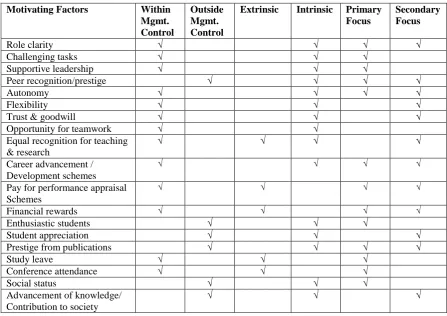
[image:11.595.71.519.168.484.2]On further reflection, as illustrated in Table 3 and 4, it is important and interesting to note that majority of the factors which motivate university academics are within the control of the university management. Further, it is also seen that academics are motivated by both intrinsic and extrinsic factors.
Table 3: Motivational Factors
Motivating Factors Within
Mgmt. Control
Outside Mgmt. Control
Extrinsic Intrinsic Primary
Focus
Secondary Focus
Role clarity √ √ √ √
Challenging tasks √ √ √
Supportive leadership √ √ √
Peer recognition/prestige √ √ √ √
Autonomy √ √ √ √
Flexibility √ √ √
Trust & goodwill √ √ √
Opportunity for teamwork √ √
Equal recognition for teaching & research
√ √ √ √
Career advancement / Development schemes
√ √ √ √
Pay for performance appraisal Schemes
√ √ √ √
Financial rewards √ √ √ √
Enthusiastic students √ √ √
Student appreciation √ √ √
Prestige from publications √ √ √ √
Study leave √ √ √
Conference attendance √ √ √
Social status √ √ √
Advancement of knowledge/ Contribution to society
√ √ √
As noted earlier, Table 4 provides a list of all demotivating factors. Interestingly, except for one factors, all others are within the university management control. Additionally, as before, it is seen that academics are demotivated by both extrinsic and intrinsic factors.
Table 4: Demotivational Factors
Demotivating Factors Within
Mgmt. Control
Outside Mgmt. Control
Extrinsic Intrinsic Primary
Focus
Secondary Focus
Lack of interest by students
√ √ √
Low salaries √ √ √
Lack of opportunity to do research/ resources
√ √ √ √
Role overload √ √ √ √
Low job feedback √ √
Lack of decision making participation
√ √ √
Administrative task √ √ √
Insufficient communication
[image:11.595.72.525.590.771.2]CIOB Construction Conference 2012
12
6.0
C
ONCLUSIONSThe purpose of this study was to investigate the motivational and demotivational factors of construction academics given the unique challenges such academics are faced with. An extensive literature search failed to reveal any studies but for a limited number of studies on motivation and demotivation of academics in general. A review of such literature produced a generic list of factors (over 25) affecting motivation and demotivation of academics despite a paucity of empirical studies on a topic that many consider as important for achieving university goals and objectives. Moreover, given that these studies do not identify which factors are of greater importance depending on discipline and job levels, this study finds that there is a need to investigate this issue further including whether there are additional factors that motivate or demotivate academics.
As majority of the factors referred to above was found to be within the control of university management, it is clear that university senior management has an important role to play in motivating academics. It is important for them not only to know what factors motivate and demotivate academics but also understand what strategies could be adopted to improve motivation and prevent any demotivation. In this regard, understanding how management styles can play a catalytic role vis-à-vis motivating the academics also becomes an important area for investigation.
This study also highlighted some of the challenges faced by construction academi cs, briefly, which could be both motivating and demotivating depending on contextual factors and job levels (and roles) – an area that also needs to be investigated further taking into consideration the above mentioned facts. A study to develop a suitable management model is proposed investigating how the construction academics wish to be motivated, with reference to university management. It is envisaged that the proposed model will assist the university management to provide a stimulating work environment for such academics.
Academics are a key resource in achieving the goals and objectives of a higher educational institution. They are independently-minded, and leading them have been compared to herding cats (Spendlove 2007) illustrating the difficulty in managing them. Understanding factors that motivate and demotivate them including management styles that could harness the power within them is fundamental as universities venture into a more challenging future than in the past.
R
EFERENCESAlexandris, K. and G. Grouios (2002). Perceived constraints on recreational sport participation: Investigating their relationship with intrinsic motivation, extrinsic motivation and amotivation. Journal of Leisure Research 34(3): 233-252.
Ambrose, M. L. and C. T. Kulik (1999). Old friends, new faces: Motivation research in the 1990s. Journal of Management25(3): 231-292.
Aronsson, G., E. Bejerot, et al. (1999). "Healthy work: Ideal and reality among public and private employed academics in Sweden. Public Personnel Management28(2): 197-214.
Baron, R. and J. Greenberg (1994). Behavior in organizations : understanding and managing the human side of work Boston,, Allyn and Bacon.
Bellamy, S., C. Morley, et al. (2003). Why business academics remain in Australian universities despite deteriorating working conditions and reduced job satisfaction: an intellectual puzzle. Journal of Higher Education Policy and Management25(1): 13-28.
Berman, J. and K. M. Skeff (1988). Developing the motivation for improving university teaching." Innovative Higher Education 12(2): 114-125.
CIOB Construction Conference 2012
13
Capelleras, J. (2005). "Attitudes of academic staff towards their job and organisation: An empirical assessment." Tertiary Education and Management 11: 147-166.
Chinowsky, P. S. and J. E. Diekmann (2004). Construction Engineering Management Educators: History and Deteriorating Community. Journal of Construction Engineering & Management130(5): 751-758.
Higher Education Division, Department of Education, Training and Youth Affairs. (1999). Academic work in the twenty-first century Coaldrake, P. and L. Stedman.. Canberra,.
Currie, J. (1996). The effects of globalisation on 1990s academics in greedy institutions: overworked, stressed out and demoralised. Melbourne Studies in Education37(2): 101-128.
Currie, J., P. Harris, et al. (2000). Sacrifices in greedy universities: are they gendered? Gender and Education
12(3): 269-291.
de Treville, S. and J. Antonakis (2002). The Three Cs of motivation in lean production: commitment, compliance or conflict?. Universite de Lausanne.
Deci, E. L. and R. M. Ryan (1985). Intrinsic motivation and self-determinaton in human behaviour. New York, Plenum.
Del Favero, M. (2003). Faculty-administrator relationships as integral to high-performing governance systems. The American Behavioural Scientist46(7): 902-922.
Dornyei, Z. (2001). New themes and approaches in second language motivation research. Annual Review of Applied Linguistics21: 43-59.
Evans, I. (1986). Organisational behaviour: The central role of motivation. Journal of Management12(2): 203-222.
Gillespie, N. A., M. Walsh, et al. (2001). Occupational stress in universities: staff perceptions of the causes, consequences and moderation of stress. Work and Stress15(1): 53-72.
Glisson, C. and M. Durick (1988). Predictors of Job Satisfaction and Organizational Commitment in Human Service Organizations. Administrative Quarterly33: 61-81.
Goodpastor, W. A. and I. D. Montoya (1996). Motivating physician behaviour change: social influence versus financial contingencies. International Journal of Health Care Quality Assurance 9(6): 4-9.
Greenberg, J. and R. Baron (1993). Behaviour in organizations : understanding and managing the human side of work Boston, Allyn and Bacon.
Grubsic, D. and S. Goic (2003). Demotivation factors research study in a manufacturing company in Croatia. South-East Europe Review: 153-178.
Haskins, C. M. (2001). The Rise of Universities. New Jersey, Transaction Publishers.
Hazelkorn, E. (2008). Motivating individuals: growing research from a fragile base. Tertiary Education and Management14(2): 151-171.
Hertzberg, F., B. Mauser, et al. (1959). The Motivation to Work. New York, John Wiley.
Houston, D., L. H. Meyer, et al. (2006). Academic staff workloads and job satisfaction: expectations and values in academe. Journal of Higher Education Policy and Management28(1): 17-30.
Keblawi, F. (2005). Proceedings ofsecond international online conference on second and foreign language teaching and research. Demotivation among Arab learners of English in Israel. United States: The Reading Matrix Inc.
Kinser, K. and R. Fossey (2001). Urofsky v. Gilmore: The Fourth Circuit Takes a Narrow View of Academic Freedom Journal of Personnel Evaluation in Education. 15(1): 51-57.
Kiziltepe, Z. (2008). Motivation and demotivation of university teachers. Teachers and Teaching: theory and practice14(5): 515-530.
Kupers, W. (2001). Proceedings of CMS 2001: A phenomenology of embodied passion and the demotivational realities of organisations. Manchester.
Lacy, F. and B. A. Sheehan (1997). Job satisfaction among academic staff: An international perspective. Higher Education34(3): 305-332.
CIOB Construction Conference 2012
14
Maslow, A. H. (1970). Motivation and Personality. New York, Harper &Row.
Massey, J. and N. Milsom (2000). Research in a market driven environment: Implications for access and gender equity in universities. Journal of Institutional Research. 9(2): 37-53.
Matier, M. W. (1990). Retaining faculty: A tale of two campuses. Research in Higher Education31(1): 39-59.
Mayo, F. (1975). The Social Problems of an Industrial Civilisation. London, Routledge & Kegan Paul.
McInnis, C. (2000). The work roles of academics in Australian universities. Canberra, ACT.
Meyer (1977). Six Stages of Demotivation. International ManagementNovember.
Meyer (1978). Demotivation - Its Cause and Cure. Personnel JournalMay.
Meyer, L. H. and I. M. Evans (2003). Motivating the professoriate: why sticks and carrots are only for donkeys. Higher Education Management and Policy15(3): 151-167.
Moses, I. (1986). Promotion of academic staff: rewards and incentive. Higher Education1986(15): 135-149.
Myers, S. (1964). Who are your motivated workers? Harvard Business ReviewJan/Feb: 73-90.
O'Driscoll, M. P. and T. A. Beehr (1994). Supervisor behaviors, role stressors and uncertainty as predictors of personal outcomes for subordinates. Journal of Organisational Behaviour15(2): 141-155.
Ofori, G. (1994). Establishing construction economics as an academic discipline. Construction Management and Economics 12(4).
Osteraker, M. C. (1999). Measuring motivation in a learning organisation. The Journal of Workplace Learning
11(2): 73-77.
Paewai, R., L. H. Meyer, et al. (2007). Problem solving academic workloads management: a university response. Higher Education Quarterly 61(3): 375-390.
Pringle, C. D. (1986). What really determines job performance? S.A.M. Advanced Management Journal51(4): 9-14.
Ramsden, P. (1998). Managing the effective university. Higher Education Research & Development17(3): 347-370.
Ramsden, P. and E. Martin (1996). Recognition of good university teaching: Policies from an Australian study. Studies in Higher Education 21: 200-315.
Rowley, J. (1996). Motivation and academic staff in higher education. Quality Assurance in Education4(3): 11-16.
Sackett, P., M. Gruys, et al. (1998). Ability-personality interactions when predicting job performance. Journal of Applied Psychology83(4): 545-556.
Sharp, E. H., L. L. Caldwell, et al. (2006). Individual Motivation and Parental Influence on Adolescents‟ Experiences of Interest in Free Time: A Longitudinal Examination. Journal of Youth and Adolescence35(3): 359-372.
Smith, D. (2004). Proceedings of SAICSIT: Motivating Information Systems Project team members: A theoretical perspective. South Africa. University of Cape Town.
Snell, S. A. and J. W. Dean (1992). Integrated Manufacturing and Human Resource Management: A human capital perspective. Academy of Management Journal 36(3): 467- 505.
Spendlove, M. (2007). Competencies for effective leadership in higher education. The International Journal of Educational Management21(5): 407.
Spitzer, D. (1995). The seven deadly demotivators. Management Development Review10(2): 50-52.
Steers, R., R. Mowday, et al. (2004). The future of work motivation theory. Academy of Management Journal
29(3): 379-387.
Sullivan, J. J. (1989). Self theories and employee motivation Journal of Management 15(2): 345-363.
Taylor, F. W. (1947). Scientific Management. New York, Harper & Row.
CIOB Construction Conference 2012
15
Turk, K. (2008). Performance appraisal and the compensation of academic staff in the University of Tartu. Baltic Journal of Management 3(1): 40-54.
Watts, C. (2008). Self-Determination and free time activity participation as predictors of initiative. Journal of Leisure Research 40(1): 156-181.
Wernick, A. (2005). University. Theory, Culture & Society23(2-3).
Winter, R. and J. Sarros (2002). The academic work environment in Australian universities: a motivating place to work? Higher Education Management and Policy21(3): 241-258.
Winter, R., T. Taylor, et al. (2000). Trouble at Mill: quality of academic work-life issues within a comprehensive Australian university. Studies in Higher Education25(3): 279-294.
Yan, H. (2009). Student and teacher demotivation in SLA. Asian Social ScienceJanuary: 110-115.