1
Special Educational Needs and
Disability Pathfinder Programme
Evaluation
Thematic Report: Key working and
workforce development (pt 1)
Research report
January 2014
2
Contents
List of figures 3
List of tables 3
Key learning points 4
1. Introduction 5
Evaluation of the SEND Pathfinder Programme 5
Rationale for the research 5
Research focus 5
Our approach 6
Intended audience 6
2. Models of key working currently in use 7
Definition of key working 7
Models of key working currently in use 8
Workforce development 12
Training 13
Management and other support 15
Differences between the delivery of the EHC planning and SEN Statementing
processes 15
3. Key working and workforce development over the longer term 20
The longer term picture 20
Annex A: Glossary of terms 22
Annex B: Research methods 23
Fieldwork 23
3
List of figures
Figure 1 Four functional areas of key working support related to the EHC assessment
and planning process 7
Figure 2 Summary of two main key working models being used to deliver 20-week EHC
planning process 10
Figure 3 Development needs identified as important for delivering the EHC planning
process 14
List of tables
Table 1 Pros and cons of the two key working models 11
Table 2 Skill-set required for key working 12
Table 3 ‘New’ requirements of EHC planning processes (relative to SEN Statementing
4
Key learning points
This report was produced as part of SQW’s evaluation of the SEND Pathfinder
Programme for the Department for Education. It focuses on key working and workforce development, providing insights from interviews and group discussions in five pathfinder areas. The key learning points, useful to other areas preparing for the SEND reforms were that:
Key working needs to cover four ‘functional areas’: coordination; planning and assessment; information and signposting; and emotional and practical support
The four key working areas can be covered by one single professional, or shared by a group of professionals. Different models have been adopted by the pathfinders
Individuals providing key working support need a broad range of skills, from strong interpersonal skills, to critical thinking and analysis abilities, and knowledge of local Education, Health and Care (EHC) provision
The breadth and depth of knowledge required by those delivering key working varies according to the number of people sharing the
responsibilities. Greater knowledge is required where individuals are undertaking more tasks on their own
Effective key working teams comprise individuals with a mix of knowledge, experience and backgrounds. Understanding of local authority (LA) systems can be useful in ‘navigating the system’, but so too can the creative insights brought by those from ‘non-traditional’ backgrounds (i.e. professionals not typically involved in the conventional SEN Statementing process)
The new EHC planning process can bring important challenges, namely the need for more direct engagement with families and collaboration with a wider range of professionals. While positive, co-producing the EHC Plan with families can be time-consuming and emotionally demanding. Coordinating provision across different professionals and service areas requires strong organisational skills, and the authority and ability to influence
Training and development is required, and should include a mix of formal
courses, informal training (e.g. networking, job shadowing), practical ‘tool-kits’ (e.g. examples of EHC plans, guidance documents) and sharing of good practice
5
1. Introduction
Evaluation of the SEND Pathfinder Programme
SQW was commissioned by the Department for Education to lead a consortium of organisations to undertake the Evaluation of the SEND Pathfinder Programme. A series of reports from the study are available on the government publications website1. During the course of the research, a number of key issues were identified as requiring more in-depth thematic review. This report focuses on one of these issues – key working and workforce development.
Rationale for the research
Evaluation findings from the first 18 months of the programme illustrated that the positive impacts experienced by families appeared to be linked to a range of factors but
especially the input from a ‘key worker’ or group of individuals performing key working functions. It was recognised that the approach, knowledge and skills of this group would be crucial to the programme’s success. Therefore, it was decided to review key working in more detail to inform future practice.
Research focus
This thematic report provides further insight into:
1
6
The report specifically focuses on key working in relation to the 20-week Education, Health and Care (EHC) assessment and planning process, on which the pathfinders have focused most strongly to date in implementing the SEND reforms. We recognise however, that key working is often applied more widely and starts much earlier in many areas (e.g. at birth or pre-school), often based upon the Early Support model.
Our approach
Evidence was gathered from five pathfinder areas – Bromley, Cornwall, East Sussex, Leicester City and Trafford– via discussion groups in each area with those delivering key working and a set of in-depth, face to face interviews with the key individuals involved in developing and delivering key working (see Annex B for more detail on the research methods used). We would like to express our sincere thanks to these five pathfinders, and to the Head of Early Support Programme (based at the Council for Disabled Children), whose helpful insights have informed this report.
Intended audience
7
2. Models of key working currently in use
Definition of key working
Numerous definitions of key working have been developed since the concept was first introduced over two decades ago2. All of the definitions are broadly similar, with the focus being on providing coordinated and personalised support to services users; in this case, children and young people (CYP) with special educational needs and disabilities (SEND), and their families.
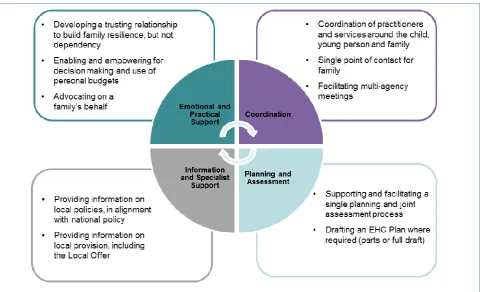
[image:7.595.48.529.322.614.2]The work undertaken to date in developing key working models has focused on the 20-week EHC assessment and planning process and has concentrated on providing support in four main functional areas, summarised in Figure 1.
Figure 1 Four functional areas of key working support related to the EHC assessment and planning process
Source: SQW, based on the key working functions developed by Early Support
These four functional areas are important, as they underwrite the models that have been used in pathfinder areas to deliver key working, and the skill-set of the individuals who
2
8
have provided support. The way in which they have been applied, and the level of weighting placed on each area has differed however, according to the specific needs of the family supported and the local delivery systems in place.
We provide further details about the models being used below. Before doing so however, a note about terminology. Key workers, casework coordinators, EHC
facilitators are a few examples of the terms that have been used in pathfinder areas to describe the individuals performing key working functions. For the purpose of clarity and consistency in this guidance document, we refer to them as simply individuals providing key working support.
Models of key working currently in use
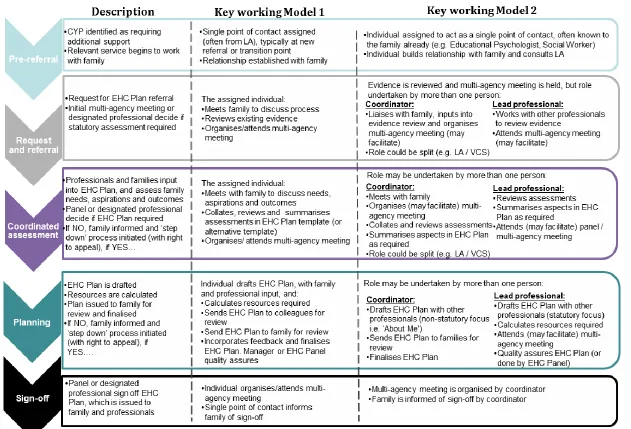
While the nature and scale of the key working models used has varied across the pathfinder areas, our evidence indicates two principal models. These have specifically focused on the 20 week EHC assessment and planning process:
Model 1, single person model - a single professional, who typically sits within the local authority (LA) (but could also sit within a voluntary and community sector (VCS) organisation) is assigned to oversee the 20 week EHC planning process. Supervision and quality assurance (QA) under this model is provided by a senior manager or a multi-agency EHC panel
Model 2, multi-person model – key working functions are undertaken by two or more professionals from within the LA (typically education services) or an external agency (e.g. VCS organisation3). One person coordinates the EHC planning process, and a lead professional (or small group of professionals) ensures it meets the statutory requirements. The family still has a single point of contact, but there is more flexibility over who this is, as a bigger team are involved. It may be the coordinator or a professional already known to, and nominated by the family, e.g. Educational Psychologist, Social Worker). Overall QA is provided by a senior manager or a multi-agency EHC panel.
These two models are summarised in Figure 2. Their application has varied across both different local authority areas, and the child or young person’s level of need (with Model 1 used for higher level needs, and Model 2 used for lower level needs in some localities. In some areas both models are used, with the age of the child being the differentiator. Both models may therefore have been adopted in some areas. While the specifics may
3
The recent announcement by the Department for Education on the provision of a £30m fund to provide Independent Support Workers for families will have a bearing on these models. Local areas will need to carefully think through how this additional support can be best utilised against existing systems and
9
vary, undertaking key working has tended to be the sole remit of the individual in Model 1 (often undertaken on a full-time basis). In contrast, under Model 2 the coordinator
functions and statutory functions have sometimes been undertaken by somebody with other professional responsibilities (on a part-time basis). In terms of drafting the EHC Plan, the division of responsibility under Model 2 varied from case-to-case.
Research participants reported that the most time- consuming aspects of their new responsibilities were:
Co-producing the EHC plan with families. Although this was seen as a very positive change, the increase in face-to-face contact, more direct involvement of families in the EHC planning process and the need to have strong knowledge of the child and young person has been time-consuming
Coordinating inputs from different professionals and service areas. This was identified as an aspect of the reforms that the pathfinders are still grappling with, particularly given that different professions or services may have different statutory frameworks and timelines, which those delivering key working may not be able to influence.
Related to these two aspects and the requirement for the EHC planning process to be completed within 20 weeks, time management was also identified as a challenge by those responsible for coordinating the process.
“The family… found the initial part of the process very abstract as they hadn’t previously been asked about aspirations or outcomes… so I had to really drive them to think about what the EHC Plan should look like, what it should contain and how it could achieve the outcomes”,
10
Figure 2 Summary of two main key working models being used to deliver 20-week EHC planning process
11
Alongside certain aspects being more time-consuming than others, our research indicated a number of pros and cons of the two broad types of key working models, which are detailed in Table 1.
Table 1 Pros and cons of the two key working models
Pros Cons
One single point of contact for family during entire EHC planning process (including assessment)
Ownership of process by one person facilitates coordination
Single person responsible for developing EHC plan may give families a greater sense of being able to hold professionals accountable Model 1 (single person)
Relies on one person having authority and capability to influence other professionals (especially those that ensure statutory requirements)
Requires individual to possess wide skill-set
Requires significant time commitment from one person
May be emotionally demanding for one person, or isolating if sufficient peer support is not in place
Allows individuals providing key working to draw on particular strengths, rather than having to develop a wide range of skills
Use of multi-skilled teams may ease any recruitment
requirements
Builds on any existing
relationships that professionals have with families, given there can be choice in terms of who they engage most directly with
Concerns can be shared with another professional who is involved in the case, which may reduce isolation Model2 (multi-person)
Requires information to be captured and shared efficiently (electronically and verbally)
Requires everybody involved to understand key working theory and practice
Family has one contact point, but may be in touch with other
professionals during EHC planning process, which may cause
confusion
Requires clearly demarcated roles, to prevent professionals from ‘treading on each other’s toes’
Professionals may struggle to manage workloads given other responsibilities
12
Workforce development
Research participants involved in developing and testing key working have helped identify a common set of core skills required for the 20 week EHC planning process, which is summarised in Table 2. It should be noted that not all skills have been required in each case, e.g. when working with young people at the preparing for
adulthood stage (14-25 years), negotiation and conflict mediation skills may be needed to address any differences of opinion or tensions within families; these are less likely to be apparent with younger children.
Table 2 Skill-set required for key working
Coordination Planning and assessment
Ability to “troubleshoot” and provide structure and a clear timescale to families
Time management – given 20 week process and need for greater contact with families Need to be proactive, providing support and
information transparently, and as early as possible
Ability to calculate resources, including using resource allocation systems
Ability to communicate effectively with a wide variety of professionals, both verbally and in writing
Capacity to understand different stakeholder perspectives and identify any ‘hidden
agendas’ Ability to draft EHC plan, coordinating inputs
from different professionals and services, which may require both skill and influence
Ability to critically review and interpret inputs from professionals (except in highly
specialised medical areas)
Ability to define SMART outcomes across education, health and social care, in
collaboration with families and professionals
Information and specialist support Emotional and practical support
Strong knowledge of local education, health and social care provision
Ability to communicate and develop trusted relationship with families
Good knowledge of national policy context Need to be able to empathise and provide emotional support as required
Awareness and knowledge of local offer Ability to encourage aspiration, while managing expectations among families Strong understanding of personal budgets
(PB)
Ability to advocate for families as required Ability to provide fair and impartial advice to
families
Negotiation and conflict mediation skills (including resolving tensions within families) Understanding of legalities of SEND system
13
knowledge (e.g. of personal budgets; education, health and social care provision) have been complimented by those of the other professionals.
In terms of the requirement of those coordinating the EHC planning process to understand
statutory functions, opinions were mixed. For some, strong statutory knowledge across all three service areas was a prerequisite for all those performing key working functions. For others, it has been more important that staff have strong ‘soft’ skills (e.g. interpersonal and communication skills) as the statutory requirements can be learnt, and in the meantime provided by other members of the team.
It also seems that while all of the core skills have been required in the teams delivering key working, not all team members must possess them. Instead, it seems to have been useful to have a balance of people with different knowledge, which can be drawn upon during different scenarios (e.g. for particular types of need, levels of need or age groups) with one individual responsible for liaison with the family. This was particularly the case for those delivering Model 1.
In addition, our research suggests that the background of the individual has been as important in effectively delivering the EHC planning process as the skill-set. On the one hand, staff currently or previously employed by the LA (typically from an education background) may have found it easier to coordinate and influence LA professionals; but on the other, a team member from outside of the LA (e.g. Clinical Commissioning Group, VCS) may have brought new insight, creativity, and a fresh understanding of local provision. As with having a mix of skills within the team, a team with different backgrounds therefore was seen to be advantageous.
Training
The training delivered to those involved in key working has involved:
Person-centred planning and key working functions – delivered either internally or by an agency such as Early Support. Data from Early Support suggests that there has been a large increase in participants in training since June 2013, particularly among professionals from education or VCS backgrounds
Policy context – including the Code of Practice and local offer
Development of EHC assessments and plans
“Key working is about the attitude and relationship with the family and young person, which is much more crucial than technical
knowledge”, Senior Manager
14
Design of SMART Outcomes – across all three service areas. Typically, this training has involved individuals from
across organisations, and has been quite light touch, at approximately 3-4 days per individual. Different reasons were provided for this low level of training. In some areas it has reflected time and capacity
constraints, with a need to condense training into more manageable slots (e.g. half day sessions). In other areas it has reflected the formative nature of the key working
models being developed and/or a belief by managers that a “learning by doing”
approach is the most effective. This view was not always shared by those receiving the training, who felt that a more structured approach to the training could be useful,
involving a clear induction process.
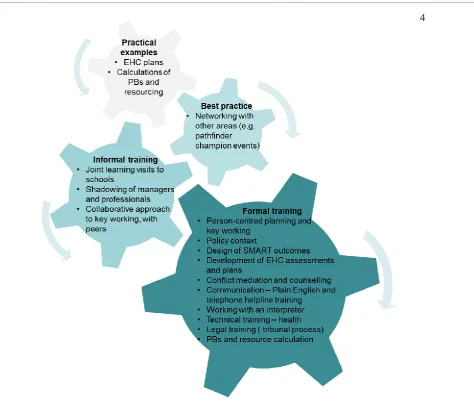
[image:14.595.55.530.340.753.2]While the existing training was highlighted by all those who had participated as useful, a range of additional development needs were identified, as summarised in Figure 3.
Figure 3 Development needs identified as important for delivering the EHC planning process
15
Some of this development activity has been undertaken, but it was clear from our conversations that provision could be strengthened, and that essentially all four
elements needed to be in place for staff to be equipped sufficiently. The development of SMART outcomes, for example, continues to be a challenge, as does the calculation of resource requirements (where not undertaken by a lead professional).
It was also apparent how important it has been to balance internally ‘tailored’ training with opportunities to seek external perspectives (e.g. pathfinder champion events, external training), and to provide practical examples of EHC plans, flowcharts mapping out the planning process, and other resources. The development of strong peer support also appeared to have been critical for those delivering key working. One example provided of effective peer support involved taking a phased approach to staff
development, getting those involved in key working to collaborate on initial cases, with individuals contributing in ways that align most closely to their existing natural skills (e.g. engaging with families, drafting plans). Once capacity is built in the team, individuals can then oversee their own cases.
Management and other support
The role of managers was reported to have been essential to effective key working, particularly in terms of helping to develop a culture of peer support and shared learning. Keeping the team up to speed with the
changing policy landscape, providing advocacy support among the wider workforce, monitoring workloads and performance, providing day-to-day support, and enabling continuing professional development (CPD) were also cited as important functions
provided by managers. To date, these responsibilities have been undertaken by line managers, strategic managers such as the pathfinder lead, or a combination of both.
Differences between the delivery of the EHC planning and
SEN Statementing processes
A number of differences were noted between the EHC planning and SEN Statementing processes:
“If you have had a difficult day, it’s great to have the advice there and then… to have that ongoing contact and support in the team”,
Key worker
16
A greater degree of engagement with families, which has generally been more time-consuming. While positive for the family and the individual concerned (in terms of the opportunity to do less desk-based work), this has been daunting and emotionally challenging for both staff and families. The greater engagement also led to more cases where there was a need to balance the young person’s aspirations and opinions with those of the family (particularly when working with older young people)
The need to work with and influence a more diverse range of professionals. This was outlined as different and on occasion challenging, particularly in the case of health and social care as most individuals involved in key working were from an education background. Ensuring buy-in to key working among middle and senior managers across
services, and providing the person coordinating with sufficient authority were also highlighted as critical.
A shift from a provision-led to an outcomes-based approach. Professionals have struggled to define SMART outcomes, particularly for the older range where outcomes can extend well beyond education provision. More generally, it has proved difficult to shift thinking and mindsets towards an outcomes focus, or as one professional put it, “it isn’t just about what you pump in, it’s what [young
people are] getting out of it”.
In Table 3, further differences are noted, as well as some tips for how to manage them during the transition process, which were informed by recommendations by pathfinder areas and the research team’s knowledge and experience of the SEN reform agenda.
“I’m finding that the message I’m delivering is not always backed up by other professionals working with the same families”…
Professionals are saying “X,Y and Z” and we can’t challenge that”,
17
Table 3 ‘New’ requirements of EHC planning processes (relative to SEN Statementing process)
Description Tips to manage transition
Shift in EHC planning process from provision-led to outcomes-led support
New process oriented around short- and longer-term outcomes
Need to change working culture
Need to balance aspiration with expectations
Training across agencies in how to develop SMART outcomes
Develop a ‘bucket’ of outcomes or ‘standard outcomes’, which can be tailored to individual family needs
Consider training staff in negotiation and conflict mediation
More direct work with families in EHC planning process
More time spent directly with families (including in family homes)
Co-production of EHC plan with families
Provision of practical and emotional support to families
Consider allocating particular schools to staff – allows staff to build a relationship with the school. Early Years Teachers may also provide key working, allowing for early information
Provide training to staff responsible for direct work with families covering the four key skills areas (coordination; planning and assessment; information and specialist support; emotional and practical support)
Consider appointing a training/capacity building coordinator
Ensure that ‘frontline’ staff have adequate day-to-day support
Ensure safeguarding measures are in place for staff visiting family homes
Be realistic with families about what they can expect
18
Description Tips to manage transition
More integrated approach to EHC planning process, across three main services
Coordinated approach to assessment and planning across education, health and social care
Approach typically facilitated in-person (through coordinator)
Ensure a communication and training strategy is in place across agencies, driven by senior management
Ensure buy-in across agencies by identifying ‘champions’
Develop a list of designated professionals across services to act as first contacts for all queries
Ensure systems are in place to enable efficient exchange of information (e.g. online ‘portals’, multi-agency meetings) and quality assurance (QA)
Put in place strong governance and management systems to support staff, including clear job descriptions and line
management responsibility
Changes in paperwork
New EHC Plan template
Template much more personalised, with family perspectives closely integrated
New paperwork must align with electronic systems
Allow sufficient time to modify existing materials/develop new materials
Learn from what is already out there (e.g. pathfinder information packs)
Ensure early assessment templates and other paperwork mirror those required in EHC Plan, to enable easier transfer
Provide guidance and training to staff in how to draft the EHC Plan
Provide training in the use of IT systems
Provide training in Plain English to ensure plans are drafted in a way that engages families and can be easily understood
Calculating resource requirements
Undertaken by some key workers in some areas
Requires calculation based on existing assessments or sometimes new assessments
Provide practical examples of resource plans to staff
19 Shifting policy context
Need for provision to be aligned to changes in policy and legislation at national and local levels
Strong understanding of local provision (including local offer) required
Designate responsibility for maintaining awareness of policy to a named individual (e.g. Director)
Provide bite-size policy bulletins to keep staff up to date with key policy changes
Source: SQW Mixed messages were given when discussing the skills required for the new process. Despite various differences between the processes being highlighted, key working in some areas was seen as a clear extension of SEN Statementing duties, with
relatively little variation in the type and depth of skills required. In others, the new process was seen to require a very different skill-set. This reflected an individual’s motivation for undertaking the role, with a difference observed between those who saw it as an extension of their existing duties, and those motivated to work in a new area of policy.
The degree of difference noted between the existing and new process appeared to relate to the model of key working being used. The broader and more in-depth skill-set required of individuals under Model 1 was recognised, and reflected in salaries of approximately £30k4. Interestingly, one area stated that they had had to increase the salary offered after an initial round of recruitment had failed to attract the calibre of individuals they required. Under Model 2, salaries for those coordinating the EHC planning process (often on a full-time basis) were more in the region of £20-22k, which was similar to the salaries of individuals providing key working support under the existing SEN Statementing systems. The salaries of other individuals involved under Model 2 were not provided, and may differ substantially given the differing levels of expertise and backgrounds of individuals (e.g. specialist teacher, social worker, educational psychologist).
4
3. Key working and workforce development over the
longer term
The longer term picture
To date the majority of work undertaken in developing key working models has focused on the 20 week EHC planning process. Formal structures were still being developed, and key working skills and principles continue to be piloted, meaning that is too early to provide detailed commentary on what the longer-term arrangements are likely to be, both in terms of developing the models and providing key working support beyond the 20 week timescale.
It was clear from our research that participant areas were committed to key working and were already beginning to see the benefits of the ‘new’ approach. It was also clear that when it comes to the longer term, the five areas were seeking to develop a model that sees key working functions being delivered by a much wider share of the workforce as part of their existing professional roles. In practice, this ‘wholesale transformation’ would likely require a core team of ‘EHC plan coordinators’ complemented by key working undertaken by professionals already working with families. A single point of contact would be available to families, but a ‘baton approach’ may be taken, in which this contact person changes at different stages of assessment and provision. Widespread training would be required to ensure that the support provided is consistent and effective across the workforce.
Work still needs to be done in terms of defining how key working will be delivered to families following sign off of the EHC plan. Will those coordinating the EHC planning process be responsible for delivering support at annual reviews, transition points and/or other key
moments? Will this responsibility be undertaken by other LA staff providing key working support on top of their ‘day jobs’; by
professionals in an external delivery organisation (e.g. VCS5); or by those already working with families (e.g. class teachers)? Such questions are still under discussion. What was clear, at least in the five participant areas, was that the longer term picture will have important workforce development implications:
Ensuring an effective balance of skills and experience in teams – potentially made up of professionals from a mix of backgrounds
5
In addition, how will the development of 1,800 Independent Support Workers influence key working support?
“Once people have moved on to college, it’s difficult for key workers to continue providing support given time pressures”,
Knowing how many staff to recruit – including administrative and management support. This is complicated as systems are still being set up, and processes are taking a while to embed. It will be important to ensure that sufficient staff are in place for the more family-focused work, which can be time-consuming
Managing increased caseloads – the need for an assessment and planning manager was expressed in some cases, to manage caseloads during scale-up when it will be necessary to work with new and transitioning cases
Providing sufficient training – both initial and ‘top up’ training
Providing continuity for families once the 20-week planning process has been completed - given that aspects of key working support (e.g. emotional and practical support) do not necessarily stop following completion of the EHC plan
Ensuring those delivering key working have sufficient authority – to influence other professionals and engage effectively with families
Joint working across multiple teams and agencies – requiring clearly demarcated roles, to ensure that EHC plans are completed efficiently and that professionals do not ‘tread on each other toes’ during the planning stage
Coordinating the 20 week EHC planning process while delivering non-statutory support (and the SEN Statementing process in the interim) –
‘coordinators’ in the five areas are largely carrying out the role on a full-time basis, with other members of staff managing SEN Statements. Will this be financially viable in the longer-term? How best should the differing responsibilities be resourced?
Language barriers – in all five areas they were working with fairly small numbers of families and external interpreters were used where families have English as an Additional Language (EAL). The more direct engagement with families may increase the need for language services in some areas
Change management – given there may be resistance to the key working approach, particularly among the most specialist teams, and in some cases restructuring. Leadership, multi-agency training, and strong
communication will be important to facilitate change management.
Going forwards, it will be important that non-pathfinders build on the experience and learning gained by the pathfinders, in terms of key working and other aspects of the SEND reforms. In this respect the knowledge of the pathfinder champions is a key resource.
“The most important factor to successful change is
Annex A: Glossary of terms
CCG Clinical Commissioning Group
CPD Continuing Professional Development DfE Department for Education
EAL English as an Additional Language EHC Education, Health and Social Care LA Local Authority
PB Personal Budget
PST Pathfinder Support Team RAS Resource Allocation System SEN Special Educational Needs
SEND Special Educational Needs and Disabilities
Annex B: Research methods
Research was undertaken in five pathfinder areas, selected in discussion with the DfE and Pathfinder Support Team. The basis for selection of the areas included: areas that had developed a final (or near final) version of their key working model; areas delivering a range of key working models; a mix from across the regions; a mix of rural/urban and large/small areas; and at least one pathfinder champion. A scoping consultation was also undertaken with the Early Support Trust and Key Working Delivery Partner to ensure the feasibility, deliverability and usefulness of the research outputs.
Once the five areas had agreed to participate, a scoping consultation was held with the pathfinder lead in each area to discuss the research focus and objectives, gain a better overview of the delivery of key working locally, and identify staff to participate in fieldwork.
Fieldwork
Fieldwork was conducted between October and November 2013, and consisted of the following elements:
Area-based consultations with the pathfinder lead and manager, the Head of SEN and the operational managers of the professionals who deliver the EHC planning processes. Typically, 4-5 one-to-one consultations were held in each area
1-2 group interviews in each area with professionals delivering the EHC planning process to understand their views of the effectiveness of the new models of working. These were designed to ensure a spread across agencies (where
relevant), including staff from local authorities and VCS organisations, and typically involved 3-4 participants.
The interviews followed two topic guides designed by the research team (one topic guide for the one-to-one consultations; and the second for the group interviews), covering the five broad research questions outlined on page 6 of the report. Participants were asked to set aside approximately 1-2 hours for the consultations, and all interviews were recorded.
Analysis and reporting
The analysis took place in two stages. Firstly, each area ‘case study’ was written up in alignment with the five research questions. Secondly, the research team looked across the five write-ups to explore commononalities and differences in responses across areas and the themes covered by the research questions.
© SQW [2014]
Reference: DFE- RR326A
ISBN: 978-1-78105-291-4
The views expressed in this report are the authors’ and do not necessarily reflect those of the Department for Education.
Any enquiries regarding this publication should be sent to us at:
[email protected] or www.education.gov.uk/contactus