GRANULAR APPROACH TO ADAPTIVITY IN
PROBLEM-BASED LEARNING
Sally Hong
-Abstract
Constructivist approach to learning has been around for quite some time. The constructivist theory has resulted in the development of a wide variety of learning environments, however the problem-based learning (PBL) environment is one of the most ideal and most popular area that implements the constructivism theory. PBL is an attractive approach to foster learner's critical problem solving and self-directed learning skills. However, it is difficult to implement effective PBL environments. A majority of
existing PBL environments suffers from the fact that the students easily get inundated by the fine granularity of the problems and loose focus of overall aims of the learning process.
This project has introduced student adaptivity technology into PBL environments to improve the effectiveness and efficiency of the learning process. To demonstrate the idea of PBL with student adaptivity, a web-based prototype is implemented in Process Costing, within the field of Accounting. Based on the architecture of the web-based
intelligent educational systems, the problem base module is introduced.
The basic architecture of the system is a typical three-tier, client-server structure. The client tier has the presentation interfaces that are implemented as HTML frames and run in a web browser. The application programs for performing adaptation, which were developed using PHP, reside in the middle layer, and communicate directly with the backend database: problem base, knowledge base that is the third tier. The web server as the communication channel also resides in the middle tier.
With the system, students work on the real world costing calculation problems, and the system evaluates students' performance results on the problems to provide adaptation to the students.
-In summary, this project has successfully introduced the student adaptivity into the PBL environment. The strategies used in this thesis can be applied into the pure PBL educational systems to improve their adaptation capability.
-Acknowledgements
I would like to thank my supervisor, Dr. Kinshuk for all the help and guidance given to me during this project. I am especially thankful to Dr. Kinshuk for his patience and
thorough feedback throughout the whole research and the report writing.
Thanks my husband and mother for supporting me as much as they could.
-TABLE OF CONTENTS
CHAPTER 1
INTRODUCTION
1
1.1 Introduction 1
1.2 Constructivism Theory and Problem-based Learning
1
1.3 Student Adaptivity in Computer-based Intelligent Learning
Systems 3
1.4 Objectives of the Research 4
1.5 The Steps in This Research 4
1.6 Organization of the Thesis 6
CHAPTER 2
LITERATURE REVIEW:
OVERVIEW OF
CONSTRUCTIVISM
2.1 Introduction
2.2 Historical Foundations
2.3 Importance of Learning Theory
7
7
7
9
2.4 Definition of Constructivism 11
2.4.1 What is Learning? 11
2.4.2 Features of Constructivism 12 2.4.2.1 Learning Occurrence in Constructivism 12 2.4.2.2 The Factors of Influencing Learning in Constructivism 13 2.4.2.3 The Role of Memory in Constructivism 13 2.4.2.4 Transfer of Knowledge 14 2.4.2.5 The Best Types of Learning Based on Constructivism 15
2.5 Summary 16
CHAPTER 3
LITERATURE REVIEW: OVERVIEW OF
PROBLEM-BASED LEARNING
17
3.1 Introduction 17
3.2 History 17
3.3 Definition of PBL 19 3.4 Features of PBL 20
3.4. l Basing on Real World Problems 20
3.4.2 The Curriculum Based on Problems 20
3.4.3 Learner Self-directed Learning Process 20
3.4.4 The PBL Teachers Work as Tutors 21
3.4.5 Emphasizing on Collaborative Learning Group 21
3.5 Advantages and Disadvantages of PBL 21
3.5.1 Effective and Efficient Information Resources 21
3.5.2 Disadvantages of PBL 22
3.6 Implementation of PBL in Computer Assisted Learning Environment 23
3.6.1 Advantages of PBL 23
3.6.2 Simulation of Real World Problems 25
3.6.3 Support Collaborative Learning 25
3.6.4 The Advanced Distance Education (ADE) Project 26
3.7 Summary 27
CHAPTR4
LITERATURE REVIEW: STUDY ADAPTIVITY
28
4.1 Introduction 28
4.2 Overview of Student Adaptivity 28
4.2.1 What is Student Adaptivity? 28
4.2.2 Mechanism of Student Adaptivity in Intelligent Educational Systems 29 4.2.3 Implementation of Student Adaptivity from Application Level 31
4.3 Student Model
4.3.1 What is Student Model? 4.3.2 Purposes of Student Model
4.4 Summary
VI
33
33 33
CHAPTER 5
STUDENTSYSTEM ANALYSIS AND DESIGN
35
5.1
Introduction35
5.2
Requirements35
5.2.1
Requirements of Problem Base36
5.2.2
Requirements of Knowledge Base37
5.2
.
3
Developing Student Model37
5.3
The System Design38
5.3
.
1
System Conceptual Model38
5.3.2
Database Design41
5.3.2
.
1
Design of Problem Base Database41
5.3.2.2
Design of Knowledge Base Database43
5.4
Summary46
CHAPTER 6
SYSTEM IMPLEMENTATION
48
6.1
Introduction48
6.2
Relevant Technologies48
6.2.1
PHP48
6.2.1.1
The Origins of PHP48
6.2.1.2
Features of PHP50
6
.
2.1.3
Mechanisms of PHP51
6.2.2
HTML -Hypertext Markup Language52
6.2.3
CGI - Common Gateway Interface54
6.2.4
MySQL54
6.2
.
5
Apache55
6.3
System Implementation56
6.3.1
System Working Processes56
6.3.2
Example PHP Code58
6.4
Summary62
CHAPTER 7
STUDENT ADAPTIVITY IN THIS SYSTEM
63
7.1 Introduction 63
7.2 Monitoring Student's Performance 63 7.3 Presenting Proper Guidance 64 7.4 Algorithm in the System 67
7.4.1 Assumptions 67
7.4.2 Algorithm 68
7.5 Summary 69
CHAPTER 8
CONCLUSION
70
8.1 Introduction 70
8.2 Contributions 70
8.2.1 The Architecture and Mechanism 70
8.2.2 The Implementation of Prototype 71
8.2.3 Abstraction of Database Design from the Implementation 71
8.3 Future Work 71
8.3.1 Adding Authoring Tools 72
8.3.2 Adding Student Model 72
8.3.3 Adding Collaborative Learning Facilities 72
·
REFERENCES
73
Figure 1-1
Figure 3-1
Figure 3-2
Figure 4-1
Figure 4-2
LIST OF FIGURES
The research steps of this project 5
Relationship between the problems to the knowledge base 24
Key elements of a typical course module 26
the whole spectrum of the concept of adaptation 29
Structure of student model module and its relationship with other
modules
30
Figure 5-1 The architecture of web-based intelligent educational systems 38
Figure 5-2 The three-tier architecture of the system and the main functions of the
components 39
Figure 5-3 The logic view of problem base database (ER diagram) 41
Figure 5-4 Figure 5-5 Figure 5-6 Figure 6-1 Figure 6-2 Figure 6-3 Figure 6-4 Figure 6-5 Figure 7-1 Figure 7-2 Figure 7-3
Textbook content table view of knowledge base
The content tree of knowledge base
ER diagram of knowledge base database
Related technologies used by the system
The architecture of PHP 4.0
The main flow of the system
Main menu page of the system
Example of one problem for student
The screenshot for the beginning level student
The screenshot for the medium-two level student
44 45 45
49
52 56 57 57 65 66The continuing screen for the student who reaches the advance level in
solving the problem 1 67
Table 5-1
Table 5-2
Table 6-1
LIST OF TABLES
Entities and their attributes of the problem base database
42
The schema and contents of individual table within knowledge base
database 46
Samples of HTML tags 53
Chapter 1
Introduction
1.1
Introduction
The Problem-Based Learning (PBL), as an effective learning environment for
improving students' problem-solving and self-directed learning skills, has been
applied some disciplines successfully. But the potentials of PBL are not exploited yet,
because its limitations, such that students easily loose focus and get frustrated by lack
of adequate guidance. This thesis intends to introduce student adaptivity technologies
into PBL environment that aims to exploit its potentials.
This chapter first briefly discusses the basic concepts and the relationship of
constructivism and problem-based learning environment. Then the main advantages
of problem-based learning and its deficiencies are described, followed by the basic
concepts of student adaptivity.
Finally, the chapter outlines the objectives of the project, and introduce the steps of
this research and the organisation of this thesis.
1.2 Constructivism Theory and Problem-based Learning
Constructivism is not a totally new approach to learning. In recent years, however,
constructivism has become a "hot" issue as it has begun to receive increased attention
in a number of different disciplines, including instructional design.
Like most other learning theories, constructivism has multiple roots in the
philosophical and psychological viewpoints of this century. A number of
contemporary cognitive theorists have adopted the constructivism, which considers:
-knowledge is a function of how the individual creates meaning from his or her own
experiences during learning and understanding. In general, constructivism is a
learning theory about how humans learn and know knowledge. This theory is
characterized by the three following propositions (Savory and Duffy, 1995):
A) Knowledge is in human's interactions with the environment: this is the core
concept of constructivism. What humans understand is a process of the content,
the context, the activity of the learner and the learner's goals.
B) Cognitive conflict is the stimulus for learning and determines the organization and
nature of what is learned: when human being are in a learning environment, there
is some stimulus or goal for learning.
C) Understanding 1s influenced by the processes associated with collaborative
learning: the experiential world includes, most importantly, the social
environment.
The features of constructivism outlined above have founded a wide variety of
learning environments (Duffy et al., 1993), and the problem-based learning
environment is the almost ideal and most popular area that implements the
constructivism theory (Savory and Duffy, 1995):
The PBL model has its roots in the apprenticeship, or learning-by-doing, method. It
emphasizes a "real-world" approach to learning: a student-centered process that is both constructive and collaborative. PBL is a motivating way to learn, as learners are
involved in active learning, working with real problems. PBL intends to foster
learner's problem-solving and self-directed learning skills. The PBL provides a more
stimulating environment for the learner and a more enjoyable environment for
students and teachers.
However, in practice, PBL is difficult to implement, with or without computer-based support. In the traditional face-to-face PBL, teachers must be specially trained as
guides and students often become frustrated by the lack of information. In the
computer assisted intelligent PBL environment, since the PBL does not limit what
-students may choose to learn, and the process may provide little guidance on the best
ways of achieving learning goals, students may be concerned that their learning
strategies are misdirected or inefficient. Thus, it is much harder for student who learn
through the computer-based intelligent learning systems with PBL, and students may
easily loose focus during the learning process and become frustrated by feeling out of
control in their study.
1.3 Student Adaptivity
10Computer-based Intelligent Learning
Systems
Student adaptivity in intelligent learning systems provides the systems ability to adapt
themselves to the goals and tasks of students by monitoring their performance. The
adaptivity is one of core components in intelligent learning environments. The
application of student adaptivity can create better learning environments in intelligent
learning systems.
The mam reasons that student adaptivity 1s so important in intelligent learning
systems are as follows:
• A wide student spectrum: the student spectrum may be from one extreme (na·ive)
to another extreme (advanced), that means that students may have very different
backgrounds, learning styles, individual preferences, and knowledge levels. The
systems with student adaptivity are able to improve the effectiveness and
efficiency of learning.
• The intelligent systems focus more on student centred learning. Theses systems
are usually are used by the students of different places and in different contexts.
The student adaptivity in these systems concerns about individual student's
preference and knowledge level, with aim to make the learning more efficient and
effective.
-1.4
Objectives
of the Research
PBL is an attractive approach to foster learner's problem-solving and self-directed
learning skills, and these skills are crucial in general life and career. However, PBL is
difficult to implement, with or without computer-based support. One of major reason
is that students easily loose focus and get frustrated by lack of adequate guidance and
help available in PBL environments. This project attempts to address this problem by
introducing student adaptivity technologies into computer-based PBL learning
environment.
The main objectives of the project are as follows:
• Investigate PBL and student adaptivity technologies, and design a framework of
student adaptivity function in computer-based PBL learning environment.
• Design and implement a web-based PBL prototype to test and evaluate the student
adaptivity in PBL environment.
1.5 The Steps
in
This
Research
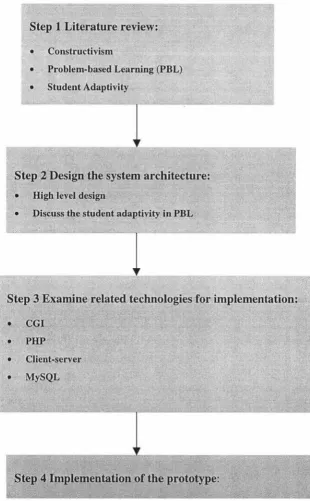
The following steps summarize the plan of this project that 1s used to reach the
objectives described above:
• Step I: Literature review: it covers constructivism, problem-based learning, student
adaptivity in intelligent learning systems.
• Step 2: Design the system architecture: it introduces student adaptivity mechanism
into PBL learning environment, and build up an architecture based on the literature
review.
• Step 3: Exploit some related technologies, such as CGI, Client-server, and so forth.
-• Step 4: Implement the prototype.
The outline of steps is shown in Figure 1.1.
Step 1 Literature re\dew:
• Constructivism
• Problem-based Learning (PBL)
• Student Adaptivity'*
r
--
·
- d -·,,-...---'
§tep 2 Design the system architecture: t•,:;
• High level design
• Discuss the student ad!ptivicy in PBL ;:;;,:71
Step 3 Examine related technologies for implementation:
• CGI
•t CJienVserver
Step
4 ~1mplementaljo1r of'tpe prototype: ,w IAFigure 1.1: The research steps of this project
[image:16.565.115.425.136.637.2]-1.6 Organization of the Thesis
The thesis consists of 8 chapters. They are outlined below:
Chapter 2 reviews the history and features of the constructivism theory.
Chapter 3 moves from constructivism onto problem-based learning area. It overviews
the features of PBL, and discusses its advantages and disadvantages.
Chapter 4 investigates student adaptivity technology and introduces this technology to
address the problem with PBL in theory.
Chapter 5 designs the system architecture based on the above research results, and
describes its mechanism.
Chapter 6 examines the related technologies, such as CGI, PHP, Client-server, and
describes the implementation of the prototype based on the architecture.
Chapter 7 discusses how the student adaptivity works in this prototype.
Chapter 8 concludes the contributions of this project and presents some further
consideration about this project in future.