Classification of
Bartonella
Strains
Associated with Straw-Colored Fruit Bats
(
Eidolon helvum
) across Africa Using a
Multi-locus Sequence Typing Platform
Ying Bai1*, David T. S. Hayman2, Clifton D. McKee1,3, Michael Y. Kosoy1
1Division of Vector-Borne Diseases, Centers for Disease Control and Prevention, Fort Collins, Colorado, United States of America,2Molecular Epidemiology and Public Health Laboratory, Infectious Disease Research Centre, Massey University, Palmerston North, New Zealand,3Department of Biology, Colorado State University, Fort Collins, Colorado, United States of America
Abstract
Bartonellae are facultative intracellular bacteria and are highly adapted to their mammalian host cell niches. Straw-colored fruit bats (Eidolon helvum) are commonly infected with several bartonella strains. To elucidate the genetic diversity of these bartonella strains, we analyzed 79 bartonella isolates from straw-colored fruit bats in seven countries across Af-rica (Cameroon, Annobon island of Equatorial Guinea, Ghana, Kenya, Nigeria, Tanzania, and Uganda) using a multi-locus sequencing typing (MLST) approach based on nucleotide sequences of eight loci (ftsZ, gltA, nuoG, ribC, rpoB, ssrA, ITS, and 16S rRNA). The analy-sis of each locus but ribC demonstrated clustering of the isolates into six genogroups (E1– E5andEw), whileribCwas absent in the isolates belonging to the genogroupEw. In gener-al, grouping of all isolates by each locus was mutually supportive; however,nuoG, gltA, and
rpoBshowed some incongruity with other loci in several strains, suggesting a possibility of recombination events, which were confirmed by network analyses and recombination/muta-tion rate ratio (r/m) estimations. The MLST scheme revealed 45 unique sequence types (ST1–45) among the analyzed bartonella isolates. Phylogenetic analysis of concatenated sequences supported the discrimination of six phylogenetic lineages (E1–E5andEw) cor-responding to separate and uniqueBartonellaspecies. One of the defined lineages,Ew, consisted of only two STs (ST1 and ST2), and comprised more than one-quarter of the ana-lyzed isolates, while other lineages contained higher numbers of STs with a smaller number of isolates belonging to each lineage. The low number of allelic polymorphisms of isolates belonging toEwsuggests a more recent origin for this species. Our findings suggest that at least sixBartonellaspecies are associated with straw-colored fruit bats, and that distinct STs can be found across the distribution of this bat species, including in populations of bats which are genetically distinct.
OPEN ACCESS
Citation:Bai Y, Hayman DTS, McKee CD, Kosoy MY (2015) Classification ofBartonellaStrains Associated with Straw-Colored Fruit Bats (Eidolon helvum) across Africa Using a Multi-locus Sequence Typing Platform. PLoS Negl Trop Dis 9(1): e0003478. doi:10.1371/journal.pntd.0003478
Editor:David H. Walker, University of Texas Medical Branch, UNITED STATES
Received:October 16, 2014
Accepted:December 13, 2014
Published:January 30, 2015
Copyright:This is an open access article, free of all copyright, and may be freely reproduced, distributed, transmitted, modified, built upon, or otherwise used by anyone for any lawful purpose. The work is made available under theCreative Commons CC0public domain dedication.
Data Availability Statement:All relevant data are within the paper and its Supporting Information files.
Funding:The authors received no specific funding for this work.
Author Summary
Bats, with over 1000 recognized species, represent about 20% of all classified mammalian species worldwide. These mammals have a wide range of ecologies and life-history traits, and are now widely recognized as important reservoirs of many pathogens.Bartonella
species have been found distributed in a wide range of mammalian species, including bats. About half of recognizedBartonellaspecies, including one bat-associated species, have been associated with human illness. Previous studies have shown thatBartonellaspecies are extremely diverse, with or without evident specificity to their mammalian hosts. Pos-sessing many unique aspects, bartonellae can serve as a useful biological marker to study how microorganisms have evolved and diversified along with their animal hosts in evolu-tionary history. In this study, we applied multi-locus sequence typing, or MLST, to study the genetic differences of straw-colored fruit bat (Eidolon helvum)-associatedBartonella
species. Our studies suggestBartonellaspecies have both exchanged genetic materials among species through recombination events and lost genes that are perhaps superfluous to their life cycles, which includes an intracellular stage in mammals.
Introduction
Bartonellae are both Gram-negative alpha-proteobacteria and hemotropic bacteria highly adapted to facultative intracellular lifestyle in a wide variety of mammals, such as rodents, bats, insectivores, carnivores, ungulates, and other vertebrates. During the last two decades, progres-sively more bacterial species belonging to the genusBartonellahave been recognized with over 30 species described from different mammalian hosts. A number ofBartonellaspecies were found to be associated with human illnesses and are associated with a growing spectrum of emerging diseases, including life-threatening endocarditis [1–9]. Animal reservoirs have been identified for some of the human pathogens, while remain unknown for others. Knowledge of the transmission of bartonella bacteria between mammalian hosts is incomplete. However, he-matophagous arthropods such as fleas, flies, lice, mites, and ticks have been found naturally infected and are frequently implicated in transmittingBartonellaspecies [10–15].
Increasing recognition of bats as natural reservoirs of many emerging pathogens has drawn considerable attentions to study these mammals [16]. Multiple investigations of bartonella in bats have been conducted in different regions of the world [17–23]. These studies reported that bartonella infections are highly prevalent in many bat species and bartonella communities as-sociated with bats are extremely diverse with co-circulation of numerousBartonellaspecies in the same bat populations. The data on relationships betweenBartonellaspecies and bats are quite contradictive depending on the investigated geographic region. Specifically, in Central and South America, multiple bat species may share the sameBartonellaspecies without an evi-dent host-specificity [19,20], while investigations from Asia and Africa demonstrated that a bat population typically harbors one or fewBartonellaspecies specific for a particular bat species [17–18,21–22].
distant and belonged to four distinct genogroups based on sequence variation in the citrate synthase gene (gltA) [18]. Similar observations were reported in a very recent study conducted in Nigeria [22]. Considering the broad distribution and other ecological characteristics of straw-colored fruit bats, it was expected that additionalBartonellagenogroups associated with this bat species can be identified in Africa.
In the present study, we aim to expand our knowledge of bartonella infections in straw-col-ored fruit bats and to better understand how multipleBartonellaspecies can co-habit popula-tions of one bat species. We compared genetic differences of bartonella isolates obtained from straw-colored fruit bats captured in seven countries across Africa using a multi-locus sequence typing (MLST) approach. Based on comparison of nucleotide sequences derived from multiple loci, MLST has been shown to provide high discriminatory power in epidemiological and genetic analysis of bacterial strain populations, while retaining signatures of longer-term evolutionary relationships or clonal stability [25–28]. In addition, sequencing of multiple loci can detect evidences of micro-evolutionary events, particularly homologous recombination, among identified sequence types [29,30]. The main objective of the current study was to ana-lyze bartonella isolates obtained from naturally infected straw-colored fruit bats from different parts of Africa to determine whether well-defined phylogenetic lineages correspond to current-ly accepted criteria for discrimination of bacterial species [31]. This, in turn, can help to en-hance our understanding of population structure in the bacteria and the relationships between allelic profiles and the animal host. To achieve this goal, we developed a MLST scheme that in-corporates eight loci which have been previously proposed for characterization ofBartonella
species. In this study, clusters defined by the phylogenetic analysis were called either a
“genogroup”or a“lineage”. A genogroup is defined when a single locus sequence was applied for the phylogenetic analysis, while a lineage is defined from concatenated sequences of all loci.
Materials and Methods
Bartonella isolates selection
A total of 79 isolates (Table 1) originating from straw-colored fruit bats from seven countries in different regions across Africa were selected for the MLST analysis, including Annobón is-land of Equatorial Guinea (n = 9), Cameroon (n = 3). Ghana (n = 20), Kenya (n = 16), Nigeria (n = 11), Tanzania (n = 15), and Uganda (n = 5). These isolates were obtained from previous studies completed by Bartonella Laboratory, CDC at Fort Collins, Colorado, and culturing pro-cedures were published elsewhere [18,20].
Multi-locus sequence typing (MLST)
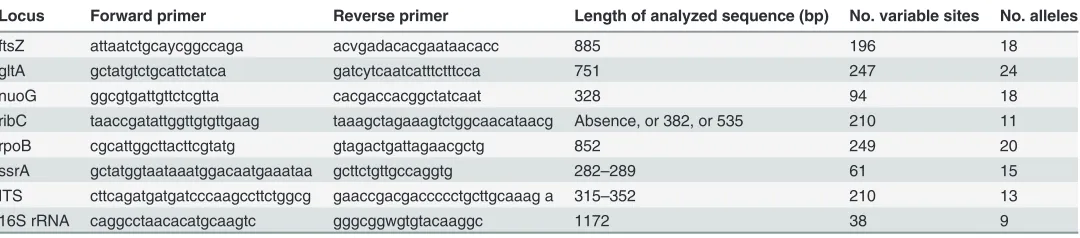
Eight loci (ftsZ,gltA,nuoG,ribC,rpoB,ssrA, ITS, and 16S rRNA) that have been previously used for bartonella description [27] were selected for MLST characterization of the bartonella isolates. Information on primers is provided inTable 2. A specific fragment of each locus was amplified by PCR for each of the 79 isolates. PCR products of each locus were purified with the QIAquick PCR Purification Kit (Qiagen, Germantown, MD) and sequenced in both directions using an Applied Biosystems Model 3130 Genetic Analyzer (Applied Biosystems, Foster City, CA). Using the Lasergene software package (DNASTAR, Madison, WI), obtained sequences were aligned by each locus and compared between the isolates and with other bat-originated
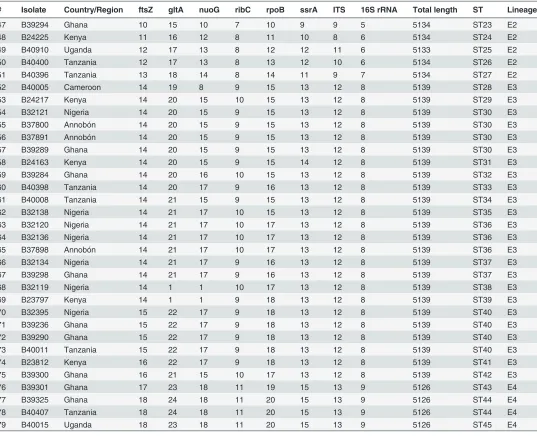
Table 1.Allelic profiles, sequence types (ST), and lineage identification for the 79Bartonellaisolates from different geographic locations.
# Isolate Country/Region ftsZ gltA nuoG ribC rpoB ssrA ITS 16S rRNA Total length ST Lineage
1 B32133 Nigeria 1 1 1 neg 1 1 1 1 4622 ST1 Ew
2 B37799 Annobón 1 1 1 neg 1 1 1 1 4622 ST1 Ew
3 B37802 Annobón 1 1 1 neg 1 1 1 1 4622 ST1 Ew
4 B37890 Annobón 1 1 1 neg 1 1 1 1 4622 ST1 Ew
5 B37893 Annobón 1 1 1 neg 1 1 1 1 4622 ST1 Ew
6 B37895 Annobón 1 1 1 neg 1 1 1 1 4622 ST1 Ew
7 B37897 Annobón 1 1 1 neg 1 1 1 1 4622 ST1 Ew
8 B39231 Ghana 1 1 1 neg 1 1 1 1 4622 ST1 Ew
9 B39235 Ghana 1 1 1 neg 1 1 1 1 4622 ST1 Ew
10 B39243 Ghana 1 1 1 neg 1 1 1 1 4622 ST1 Ew
11 B39248 Ghana 1 1 1 neg 1 1 1 1 4622 ST1 Ew
12 B39957 Cameroon 1 1 1 neg 1 1 1 1 4622 ST1 Ew
13 B39958 Cameroon 1 1 1 neg 1 1 1 1 4622 ST1 Ew
14 B40389 Tanzania 1 1 1 neg 1 1 1 1 4622 ST1 Ew
15 B40404 Tanzania 1 1 1 neg 1 1 1 1 4622 ST1 Ew
16 B40906 Uganda 1 1 1 neg 1 1 1 1 4622 ST1 Ew
17 B40907 Uganda 1 1 1 neg 1 1 1 1 4622 ST1 Ew
18 B32135 Nigeria 1 1 2 neg 1 1 1 1 4622 ST2 Ew
19 B23978 Kenya 1 1 2 neg 1 1 1 1 4622 ST2 Ew
20 B39238 Ghana 1 1 2 neg 1 1 1 1 4622 ST2 Ew
21 B40386 Tanzania 1 1 2 neg 1 1 1 1 4622 ST2 Ew
22 B23975 Kenya 2 2 3 1* 2 4 2 2 5007 ST3 E5
23 B39233 Ghana 2 2 4 1* 2 5 4 2 5007 ST4 E5
24 B39296 Ghana 2 3 5 2* 3 3 5 2 5007 ST5 E5
25 B40908 Uganda 3 4 6 3* 4 2 5 2 5007 ST6 E5
26 B39286 Ghana 4 5 10 4* 10 3 2 2 5007 ST7 E5
27 B39249 Ghana 4 6 6 4* 4 2 2 2 5007 ST8 E5
28 B40014 Tanzania 5 7 7 4* 5 5 3 2 5007 ST9 E5
29 B40406 Tanzania 6 8 7 5* 6 4 2 2 5007 ST10 E5
30 B40408 Tanzania 6 8 7 5* 6 4 2 2 5007 ST10 E5
31 B40391 Tanzania 7 9 6 5* 4 6 2 3 5008 ST11 E5
32 B23976 Kenya 8 10 8 6 7 7 6 4 5160 ST12 E1
33 B32112 Nigeria 8 10 8 6 8 7 6 4 5160 ST13 E1
34 B23983 Kenya 8 10 8 6 8 8 6 4 5160 ST14 E1
35 B24219 Kenya 8 10 8 6 8 8 6 4 5160 ST14 E1
36 B39239 Ghana 8 10 9 6 7 8 6 4 5160 ST15 E1
37 B23987 Kenya 8 10 9 6 8 7 6 4 5160 ST16 E1
38 B24003 Kenya 8 10 9 6 8 7 6 4 5160 ST16 E1
39 B23977 Kenya 8 11 8 6 7 7 6 4 5160 ST17 E1
40 B32314 Nigeria 8 11 8 6 7 8 6 4 5160 ST18 E1
41 B23973 Kenya 8 12 8 6 7 7 6 4 5160 ST19 E1
42 B23982 Kenya 8 12 8 6 7 7 6 4 5160 ST19 E1
43 B40402 Tanzania 8 13 8 6 7 8 6 4 5160 ST20 E1
44 B40006 Tanzania 8 14 8 6 7 7 6 4 5160 ST21 E1
45 B23979 Kenya 9 15 11 7 9 9 7 5 5159 ST22 E2
46 B39302 Ghana 9 15 11 7 9 9 7 5 5159 ST22 E2
Analysis of nucleotide polymorphism and diversity
[image:5.612.39.576.90.529.2]Sequence polymorphisms of the eight MLST loci were examined in MEGA v6.06 separately for eachBartonellalineage and among all 45 STs. For protein-coding loci (ftsZ,gltA,nuoG,ribC, andrpoB), the appropriate open reading frame that contained no stop codons was selected for each locus by checking all possible starting positions. To test for evidence of selection in these loci,dN/dSratios were calculated using the Nei-Gojobori method for each of the loci consider-ing each lineage separately and for all 45 STs together. Nucleotide diversity (π), determined by the number of nucleotide differences per site, was calculated as p-distance for all eight loci indi-vidually and for concatenated sequences considering each lineage separately and for all 45 STs
Table 1. (Continued)
# Isolate Country/Region ftsZ gltA nuoG ribC rpoB ssrA ITS 16S rRNA Total length ST Lineage
47 B39294 Ghana 10 15 10 7 10 9 9 5 5134 ST23 E2
48 B24225 Kenya 11 16 12 8 11 10 8 6 5134 ST24 E2
49 B40910 Uganda 12 17 13 8 12 12 11 6 5133 ST25 E2
50 B40400 Tanzania 12 17 13 8 13 12 10 6 5134 ST26 E2
51 B40396 Tanzania 13 18 14 8 14 11 9 7 5134 ST27 E2
52 B40005 Cameroon 14 19 8 9 15 13 12 8 5139 ST28 E3
53 B24217 Kenya 14 20 15 10 15 13 12 8 5139 ST29 E3
54 B32121 Nigeria 14 20 15 9 15 13 12 8 5139 ST30 E3
55 B37800 Annobón 14 20 15 9 15 13 12 8 5139 ST30 E3
56 B37891 Annobón 14 20 15 9 15 13 12 8 5139 ST30 E3
57 B39289 Ghana 14 20 15 9 15 13 12 8 5139 ST30 E3
58 B24163 Kenya 14 20 15 9 15 14 12 8 5139 ST31 E3
59 B39284 Ghana 14 20 16 10 15 13 12 8 5139 ST32 E3
60 B40398 Tanzania 14 20 17 9 16 13 12 8 5139 ST33 E3
61 B40008 Tanzania 14 21 15 9 15 13 12 8 5139 ST34 E3
62 B32138 Nigeria 14 21 17 10 15 13 12 8 5139 ST35 E3
63 B32120 Nigeria 14 21 17 10 17 13 12 8 5139 ST36 E3
64 B32136 Nigeria 14 21 17 10 17 13 12 8 5139 ST36 E3
65 B37898 Annobón 14 21 17 10 17 13 12 8 5139 ST36 E3
66 B32134 Nigeria 14 21 17 9 16 13 12 8 5139 ST37 E3
67 B39298 Ghana 14 21 17 9 16 13 12 8 5139 ST37 E3
68 B32119 Nigeria 14 1 1 10 17 13 12 8 5139 ST38 E3
69 B23797 Kenya 14 1 1 9 18 13 12 8 5139 ST39 E3
70 B32395 Nigeria 15 22 17 9 18 13 12 8 5139 ST40 E3
71 B39236 Ghana 15 22 17 9 18 13 12 8 5139 ST40 E3
72 B39290 Ghana 15 22 17 9 18 13 12 8 5139 ST40 E3
73 B40011 Tanzania 15 22 17 9 18 13 12 8 5139 ST40 E3
74 B23812 Kenya 16 22 17 9 18 13 12 8 5139 ST41 E3
75 B39300 Ghana 16 21 15 10 17 13 12 8 5139 ST42 E3
76 B39301 Ghana 17 23 18 11 19 15 13 9 5126 ST43 E4
77 B39325 Ghana 18 24 18 11 20 15 13 9 5126 ST44 E4
78 B40407 Tanzania 18 24 18 11 20 15 13 9 5126 ST44 E4
79 B40015 Uganda 18 23 18 11 20 15 13 9 5126 ST45 E4
together. For concatenated sequences, the total length included gap regions and missing genes, thus the pairwise deletion option was used.
Phylogenetic analysis
A neighbor-joining tree based on the concatenated MLST alleles alone was constructed using the Clustal W program within the Lasergene 11 package of DNASTAR (version 8). An addi-tional phylogeny was constructed, in which knownBartonellaspecies andBartonellastrains isolated from bats in Old World were included in addition to representative strains from straw-colored fruit bats (E1—E5,Ew), andBrucella abortuswas included as an outgroup, This phylogeny was inferred using sequences offtsZ,gltA,nuoG,ribC,rpoB,ssrA, and 16S rRNA; ITS sequences were not included due to the large number of gaps among the strains that could not be resolved. Sequences from each locus were aligned using Clustal X v2.1, trimmed to equal lengths, and concatenated. The best model of nucleotide substitution was determined using MEGA. Based on this model, a maximum-likelihood tree was generated in MEGA with 1000 bootstrap replicates. Due to missing genes among the strains as well as some alignment gaps, we used the pairwise deletion option when inferring the tree.
Recombination tests
To visualize potential recombination events among the sequence types, a phylogenetic network was inferred from concatenated sequences from the 45 STs using the Neighbor-Net algorithm in SplitsTree v4.13.1 with 1000 bootstrap replicates. Gaps in aligned sequences and from miss-ing genes were included. The pairwise homoplasy index (PHI) was implemented in SplitsTree to test for significant recombination among the isolates.
[image:6.612.37.577.96.215.2]ClonalFrame v1.1 was used to estimate the relative contribution of recombination and mu-tation in generating polymorphisms among the 45BartonellaSTs. Based on recommendations by Vos and Didelot [32], ITS and genes coding for RNA (ssrAand 16S rRNA) were not includ-ed because of potential confounding effects of selection on the detection of homologous recom-bination rates. Therefore, we used only the five protein-coding loci (ftsZ,gltA,nuoG,ribC, andrpoB) in the study. Two independent runs were performed in ClonalFrame using 200,000 MCMC iterations. The initial mutation rate (θ) was set using Watterson's moment estimator while the remaining initial parameters used the default settings in ClonalFrame. We assessed convergence and mixing properties of the dataset through visual inspection of the traces for the likelihood and model parameters.
Table 2.Characteristics of the eight loci evaluated for the straw-colored fruit bat (Eidolon helvum)-associatedBartonellaMLST scheme.
Locus Forward primer Reverse primer Length of analyzed sequence (bp) No. variable sites No. alleles
ftsZ attaatctgcaycggccaga acvgadacacgaataacacc 885 196 18
gltA gctatgtctgcattctatca gatcytcaatcatttctttcca 751 247 24
nuoG ggcgtgattgttctcgtta cacgaccacggctatcaat 328 94 18
ribC taaccgatattggttgtgttgaag taaagctagaaagtctggcaacataacg Absence, or 382, or 535 210 11
rpoB cgcattggcttacttcgtatg gtagactgattagaacgctg 852 249 20
ssrA gctatggtaataaatggacaatgaaataa gcttctgttgccaggtg 282–289 61 15
ITS cttcagatgatgatcccaagccttctggcg gaaccgacgaccccctgcttgcaaag a 315–352 210 13
16S rRNA caggcctaacacatgcaagtc gggcggwgtgtacaaggc 1172 38 9
Nucleotide sequence accession numbers
Newly-identified alleles from the current study were submitted to GenBank with the following accession numbers: KJ999677 to KJ999694 (ftsZ), KM030503 to KM030526 (gltA), KM030527 to KM030544 (nuoG), KM215178 to KM215188 (ribC), KM215189 to KM215208 (rpoB), KM233456 to KM233470 (ssrA), KM233471 to KM233471 (ITS), and KJ944271 to KJ944279 (16S rRNA).
Results
Individual sequence analysis of
gltA
and other loci
All 79 isolates were first compared based on the 751bpgltAfragment for the initial identifica-tion. ThegltAsequence alignment revealed 247 variable sites with 24 variants, delineating six unique genogroups with divergence of 7.3–23% among the genogroups and with similarities of
96.8% within a genogroup. Four genogroups were the same as previously identified in straw-colored fruit bats from Kenya, which were namedE1,E2,E3, andEw[18]; whereas the remain-ing two genogroups were distinct from these four and from any other previously reported Bar-tonellagenotypes. Continuing the same naming system proposed for discrimination of
Bartonellastrains discovered in Kenya [18], these two new genogroups were designated asE4
andE5.
Following the initial identification, additional analyses were performed with the other seven loci. Each analyzed locus, exceptribC, showed that all bartonella isolates obtained from straw-colored fruit bats also fell into the same six genogroups identified bygltA. Unexpectedly, analy-sis of theribClocus revealed a large variation in length of the examined fragment among the isolates. Depending on the group identified by other markers, the examinedribCfragment was either fully presented (535bp), or reduced (382bp), or non-amplifiable (PCR negative). The phylogenetic analysis based onribCsequences of the 79 isolates revealed five genogroups relat-ed toE1—E5clusters that correspond to the grouping by other loci. Absence of theribClocus was indicative for the genogroupEw. All isolates with a reducedribCfragment (partially miss-ing) belonged to the genogroupE5(Table 1).
Allelic profiles, sequence types (ST), and phylogenetic analysis
The size of sequenced fragments ranged between 282bp and 1172bp at different loci. The inves-tigated loci showed different degrees of variation, with 38–249 variable sites and 9–24 alleles (Table 2). The length of concatenated sequences ranged from 4,622bp to 5,160bp as a result of the variation in the fragment length ofribC(from 0 to 535bp), ITS (from 315 to 352bp), and
ssrA(from 282 to 289bp). Based on the allelic profiles, the MLST analysis distinguished 45 se-quence types (ST) among the 79 isolates, showing high heterogeneity. Most STs were repre-sented by a single isolate, while some were reprerepre-sented by 2–4 isolates, and ST1 was found in 17 isolates (Table 1). Phylogenetic analysis demonstrated that all of the 45 STs resolved into six lineages, namely,E1,E2,E3,E4,E5, andEw, to match the names proposed for grouping the strains based on sequences of one locus (Fig. 1). The divergence was 5.1–14% among lineages and4.2% within a lineage.
LineageE1contained 13 isolates of 10 sequence types (ST12—ST21). The distance among the STs was less than 2.1%. Eight isolates were from Kenya, and the others were from Ghana, Nigeria, and Tanzania (Table 1).
LineageE2included seven isolates of six sequence types (ST22—ST27). The distance among the STs was less than 2.1%. Isolates belonging to this lineage were from Kenya, Ghana, Tanza-nia, and Uganda (Table 1).
LineageE3contained 24 isolates of 15 sequence types (ST28—ST42). The distance among the STs was less than 4.2%. ST30, ST36, ST37, and ST40 were represented in four, three, two, and three isolates, respectively. The remaining STs were each represented by a single strain.
LineageE3was the most common among all bartonella lineages detected in straw-colored fruit bats, and accounted for 30.4% (26/79) of all isolates analyzed. Notably, mismatches in as-signment of isolates to specific ST lineages were observed for a few loci on several occasions. Specifically, isolate B32119 (ST38) from a Kenyan bat and isolate B23797 (ST39) from a Nige-rian bat were assigned to lineageE3by ST classification, but separate analyses of thegltAand
nuoGsequences of the two isolates indicated their closeness to genogroupEw. Similarly, isolate B40005 (ST28) from a Cameroonian bat was identified asE3by ST classification, but was closer to genogroupE1by thegltAandnuoGsequences.
LineageE4contained four isolates of three sequence type (ST43—ST45). These STs are very similar among themselves with distance0.1%. The isolates were from Ghana, Tanzania, and Uganda (Table 1).
LineageE5contained 10 isolates of eight sequence types (ST3—ST11). Compared to other lineages, the STs within this lineage were more distant (0.2–3.5%). All isolates/STs in this line-age presented shorter concatenated sequences due to the partial fragment missing inribC. One isolate (B39286) from this lineage also showed a mismatch in lineage assignment when ana-lyzed by individual loci. The isolate was from a Ghanaian bat and belonged to lineageE5by ST classification, but assigned to genogroupE2byrpoBandnuoGsequences.
Based on MEGA results, the best nucleotide substitution model for the concatenated se-quences ofgltA,ftsZ,nuoG,ribC,rpoB,ssrA, and 16S rRNA was determined to be GTR+G+I [33]. Comparison with knownBartonellaspecies and other bat-associatedBartonellastrains demonstrated that lineagesE1,E2,E3, andE5belong to a clade that includes otherBartonella
strains found in Old World bats, whileE4andEwappear to have arisen independently (Fig. 2).
Patterns of selection and diversity in nucleotide sequences
ThedN/dSratios calculated for protein-coding sequences ranged from 0.022 forftsZto 0.242 forribCwhen comparing all 45 STs. The values for each locus differed when eachBartonella
lineage was analyzed separately. Nucleotide diversity among STs varied by locus, ranging from 1.02% in 16S rRNA to 14.38% inribC. Among theBartonellalineages,E2andE5had the high-est nucleotide diversity when all loci were considered together, with 1.56% and 1.24%, respec-tively, whileEwhad the lowest (0.02%).
Recombination test
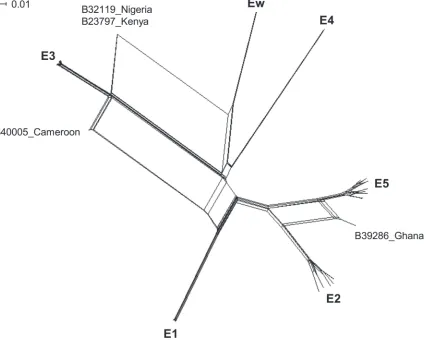
A network phylogeny based on the concatenated sequences for the 45 STs in SplitsTree (v4.13.1) shows that the 45 STs fall into the same six identified lineages identified by single loci.
Figure 1. Phylogenetic relationships of the 45 sequence types from 79 bartonella isolates obtained from straw-colored fruit bats (Eidolon helvum) in seven African countries/regions.The number of isolates belonging to each sequence type is given in parentheses. The phylogenetic tree was constructed from concatenated sequences (4,622bp—5,160bp) of eight loci (ftsZ,gltA,nuoG,ribC,rpoB,ssrA, ITS, and 16S rRNA) using the neighbor-joining method. Bootstrap values were calculated with 1000 replicates. The sequence types are grouped into six phylogenetic lineages (boxed clades) named asE1—E5andEw, with each lineage presumably representing a separate and uniqueBartonellaspecies.
However, isolates B32119 from Nigeria, B23797 from Kenya, B40005 from Cameroon, and B39286 from Ghana are split from the network, reflecting their mixed ancestry (Fig. 3). The pairwise homoplasy index (PHI) [34] found significant evidence of recombination in the net-work (mean = 0.2, variance = 4.5x10⁻⁶, p<0.01). Using ClonalFrame, ther/mvalue (the ratio of probabilities that a site is altered by recombination or mutation) was estimated to be 1.14 (95% CI 0.63, 1.82) and 1.06 (95% CI 0.53, 1.67) based on two independent runs (average = 1.1), while theρ/θvalue (the ratio of rates at which recombination and mutation occur) was es-timated to be 0.049 (95% CI 0.023, 0.087) and 0.037 (95% CI 0.016, 0.065).
Discussion
Straw-colored fruit bats have been reported to be commonly infected with multipleBartonella
strains based ongltAsequences [18,22]. In this study, we developed a MLST scheme using
Figure 2. Phylogenetic relationship of straw-colored fruit bats (E.helvum) with knownBartonellaspecies and other bat-associatedBartonella
strains.The maximum-likelihood tree was inferred using concatenated sequence of seven loci (ftsZ,gltA,nuoG,ribC,rpoB,ssrA, and 16S rRNA) from 31
Bartonellaspecies, other bat-associatedBartonellastrains, and 6 sequence types fromE.helvumrepresenting the lineagesE1—E5andEw(bold text). Groups of bat-associatedBartonellastrains are indicated with a bat silhouette. The numbers at the nodes correspond to bootstrap values greater than 60% based on 1000 replicates.
[image:11.612.70.496.322.667.2]doi:10.1371/journal.pntd.0003478.g002
eight loci which have been commonly used forBartonellaspecies description to characterize 79 bartonella isolates obtained from straw-colored fruit bats that were captured in different re-gions across Africa to better elucidate the genetic diversity among these isolates.
The analyses of selection pattern showed none of thedN/dSratios exceeded 1. This suggested that all of the protein-coding loci in the study are undergoing purifying selection. The analyzed bartonella isolates exhibited a high level of heterogeneity with 9–24 alleles identified by differ-ent loci. The MLST scheme resolved 45 STs among the 79 isolates and these isolates/STs clus-tered into six distinct lineages (E1—E5, andEw) with genetic distances of 5.1–14% among the lineages. MLST has been regarded as a highly discriminatory tool by a number of previous studies. According to the widely accepted criteria for a new bacterial species based on nucleo-tide divergence greater than 5% in housekeeping genes [31], the MLST analyses in the present study demonstrated that each lineage identified in straw-colored fruit bats in this study likely represents a newBartonellaspecies. TheseBartonellaspecies have never been found in other bat species, suggesting their specific co-adaptation toEidolonbats, though future studies are necessary to confirm this. The performed analyses allow us to conclude that there are at least sixBartonellaspecies associated with straw-colored fruit bats. Phylogenetic analysis based on multiple loci demonstrates that four of these lineages,E1,E2,E3, andE5, belong to a phyloge-netic lineage that includes otherBartonellastrains isolated from Old World bats [18,21–23], whileE4andEwappear to have evolved independently.
LineagesE3andEw, containing 24 and 21 isolates, respectively, and accounting for 57% of all isolates, are likely to be the more commonBartonellaspecies circulating among this bat species. However, because the original bat samples from which the analyzed bartonella isolates obtained were collected in different settings and during different seasons by multiple investiga-tors, there could be some bias in temporal or seasonal variations. Furthermore, the culturing procedure that was necessary for performing such bacterial classification may also contribute to misrepresentation of comparative prevalence ofBartonellaspecies as some of them could hardly be cultured [35]. Due to the limited number of isolates selected from each part of Africa, we did not attempt to investigate any patterns in the geographic distribution ofBartonella spe-cies in this study. The presented classification, however, can be used for future studies aimed at describing geographic patterns of bartonella distribution amongEidolonbats.
Most lineages consisted of multiple STs (from 4 to 14). Nevertheless, lineageEwconsisted of only two STs with a large number of isolates, and in fact there is only one nucleotide differ-ence between the two STs. This indicates a lower diversity of allelic polymorphisms in the isolates from this lineage and allows a speculation thatEwhas diverged more recently com-pared to the otherBartonellalineages. Further, our observations of partially missing or non-amplifiable sequences ofribCsuggests gene loss, a common evolutionary process in bacteria [36], possibly has occurred and resulted in the appearance of two newBartonellaspecies (E5
andEw). As a housekeeping gene,ribCparticipates in the regulation of riboflavin biosynthe-sis. The non-amplifiability of the gene might not be true but suggest the gene is in some un-detected form. If this gene is truly missing, its loss may be compensated by the fact that bartonellae are intracellular parasites which can perhaps utilize host riboflavin or they have lost the need of it. If this were true, fitness costs may lead to selection against this superfluous genetic material [37]. Overall, little is known about the mechanisms of regulation of bacterial riboflavin genes [38]. Although we cannot explain biological consequences of the loss of
ribC, the 'presence/absence' characteristics makeribCa marker for the differentiation and classification ofEidolon-associatedBartonellastrains. In addition, the dramatic variation in
Another intriguing observation in this study was the set of mismatches between MLST lineages and some genogroups comparing phylograms built based either on entire concatenat-ed sequences or individual locus sequences for four isolates. Particularly, three isolates belong-ing toE3based on the ST classification were eitherEw(two isolates) orE1(one isolate) by
nuoGorgltAalone and one isolate ofE5by ST classification would beE2bynuoGorrpoB
alone. The locirpoBandgltAhave been shown to be the most potent for species discrimination in other studies [31]. According to our observations in the present study, an analysis limited to two loci may still lead to a misclassification. Thus characterization of multiple loci should be preferably used forBartonellaspecies identification. The mismatches between lineages and genogroups identified by different loci indicate that recombination and/or lateral gene transfer events between differentBartonellaspecies are ongoing processes.
Our recombination test results indicate that while recombination happens infrequently, an individual recombination event introduces a large number of polymorphisms. Recombination inrpoB,gltA, and other housekeeping loci has been observed in otherBartonellaspecies [29,30,39]. Estimatedr/mvalues forB.grahamiialone (1.7 [38] and 6.81 [30]),B.tayloriialone (3.77 [27]), orB.grahamiiandB.tayloriiconsidered together (4.06 [30]) compare favorably with our estimate for recombination among six species ofBartonellainE.helvum(r/m= 1.1). These estimates contrast with results fromB.henselae(r/m= 0.1) [40] and the perception that intracellular bacteria have low rates of recombination and horizontal gene transfer [32]. Intermediate to high rates of recombination in these studies suggest that multipleBartonella
species may coexist at some point in the infection cycle, potentially in their mammalian hosts and/or arthropod vectors, thus facilitating gene exchange. Moreover, gene exchange appears to play an important role in generating sequence diversity among co-circulatingBartonella spe-cies. Further studies that could measure co-infection ofBartonellaspecies and resulting rates of recombination would help to explain these interesting dynamics.
Our study provides information on the genetic diversity of straw-colored fruit bat-associat-edBartonellaspecies that can be used for the discrimination of the lineages at the level corre-sponding to separate species. Additional information is needed to understand the interaction between theseBartonellaspecies and their bat hosts under natural conditions, as well as their putative ectoparasite vectors [41]. A biological approach to defineBartonellaspecies has been discussed [42] with emphasis on host-association as a phenomenon that promotes biological isolation ofBartonellaspecies. However, such an approach has limitations for situations when severalBartonellaspecies are associated with one animal host. A similar situation was also de-scribed amongBartonellastrains in grasshopper mice [43] and cotton rats [44]. Nevertheless, among all mammalian species described as a host of one or multipleBartonellaspecies, the number of presumptive species associated withE.helvumbats is clearly the highest. Although there is no evidence suggesting thatBartonellaspecies associated with African fruit bats may cause illnesses in humans or in bats themselves, a recent study reported the presence of Barto-nella mayotimonensis, a reported etiologic agent of endocarditis in humans, in the Dauben-ton's bat (Myotis daubentonii) and the Northern bat (Eptesicus nilssonii) in Europe [23], suggesting a potential role of bats as reservoirs for human bacterial pathogens. It is important to understand the role of straw-colored fruit bats in biotic communities and their importance as reservoir hosts contributing to the maintenance and transmission of bartonellae to other an-imals and humans.
mechanism to circumvent the host immune responses. We ultimately believe this system will be very informative for understanding the evolution of bacteria in a
host-vector-pathogen system.
Supporting Information
S1 Table. GenBank accession numbers forftsZ,gltA,nuoG,ribC,rpoB,ssrA, ITS, and 16S rRNA sequences for bat-associatedBartonellastrains.
(DOCX)
S2 Table. GenBank accession numbers forftsZ,gltA,nuoG,ribC,rpoB,ssrA, ITS, and 16S rRNA sequences of referenceBartonellaspecies.
(DOCX)
Acknowledgments
We are indebted to many people who collected blood samples from bats working in the field. We wish specifically to thank Alison Peel, Richard Suu-Ire, and Ivan Kuzmin for
their assistance.
Author Contributions
Conceived and designed the experiments: YB MYK DTSH. Performed the experiments: YB. Analyzed the data: YB CDM. Contributed reagents/materials/analysis tools: MYK. Wrote the paper: YB CDM MYK DTSH.
References
1. Welch DF, Pickett DA, Slater LN, Steigerwalt AG, Brenner DJ (1992)Rochalimaea henselaesp. nov., a cause of septicemia, bacillary angiomatosis, and parenchymal bacillary peliosis. J Clin Microbiol 30: 275–280. PMID:1537892
2. Daly JS, Worthington MG, Brenner DJ, Moss CW, Hollis DG, et al (1993)Rochalimaea elizabethaesp. nov. isolated from a patient with endocarditis. J Clin Microbiol 31: 872–881. PMID:7681847
3. Bass JW, Vincent JM, Person DA (1997) The expanding spectrum of bartonella infections II. Cat scratch disease. Pediatr Infect Dis J 16: 163–179. PMID:9041596
4. Kerkhoff FT, Bergmans AM, van Der Zee A, Rothova A (1999) Demonstration ofBartonella grahamii
DNA in ocular fluids of patient with neuroretinitis. J Clin Microbiol 37: 4034–4038. PMID:10565926
5. Roux V, Eykyn SJ, Wyllie S, Raoult D (2000)Bartonella vinsoniisubsp.berkhoffiias an agent of a fe-brile blood culture-negative endocarditis in a human. J Clin Microbiol 38: 1698–1700. PMID:10747175
6. Kosoy MY, Murray M, Gilmore RD, Bai Y, Gage K (2003) Bartonella strains from ground squirrels are identical toBartonella washoensisisolated from a human patient. J Clin Microbiol 41: 645–650. PMID: 12574261
7. Eremeeva ME, Gerns HL, Lydy SL, Goo JS, Ryan ET, et al (2007) Bacteremia, fever, and splenomega-ly caused by a newsplenomega-ly recognized Bartonella species. N Engl J Med 256: 2381–2387.
8. Kosoy M, Morway C, Sheff K, Bai Y, Colborn J, et al (2008)Bartonella tamiaesp. nov., a newly recog-nized pathogen isolated from human patients from Thailand. J Clin Microbiol 46: 772–775. PMID: 18077632
9. Welch DF, Carroll KC, Hofmeister EK, Persing DH, Robison DA, et al (1999) Isolation of a new subspe-cies,Bartonella vinsoniisubsp.arupensis, from a cattle rancher: identity with isolates found in conjunc-tion withBorrelia burgdorferiandBabesiamicroti among naturally infected mice. J Clin Microbiol 37: 2598–2601. PMID:10405408
10. Garcia-Caceres U, Garcia FU (1991) Bartonellosis: an immunodepressive disease and the life of Daniel Alcides Carrion. Am J Clin Pathol 95: s58–s66. PMID:2008885
12. Higgins JA, Radulovic S, Jaworski DC, Azad AF (1996) Acquisition of the cat scratch disease agent
Bartonella henselaeby cat fleas (Siphonaptera: Pulicidae). J Med Entomol 33: 490–495. PMID: 8667399
13. Pappalardo BL, Correa MT, York CC, Peat CY, Breitschwerdt EB (1997) Epidemiologic evaluation of the risk factors associated with exposure and seroreactivity toBartonella vinsoniiin dogs. Am J Vet Res 58: 467–471. PMID:9140552
14. Roux V, Raoult D (1999) Body lice as tools for diagnosis and surveillance of reemerging diseases. J Clin Microbiol 37: 596–599. PMID:9986818
15. Billeter SA, Sangmaneedet S, Kosakewich RC, Kosoy MY (2012)Bartonellaspecies in dogs and their ectoparasites from Khon Kaen Province, Thailand. Southeast Asian J Trop Med Public Health 43: 1186–1192. PMID:23431825
16. Luis AD, Hayman DTS, O'Shea TJ, Cryan PM, Gilbert AT, et al (2013) A comparison of bats and ro-dents as reservoirs of zoonotic viruses: are bats special? Proc Biol Sci 280: 20122753. doi:10.1098/ rspb.2012.2753PMID:23378666
17. Concannon R, Wynn-Owen K, Simpson VR, Birtles RJ (2005) Molecular characterization of haemoparasites infecting bats (Microchiroptera) in Cornwall, UK. Parasitology 131: 489–496. PMID:16174413
18. Kosoy M, Bai Y, Lynch T, Kuzmin I, Niezgoda M, et al. (2010)Bartonellaspp. in bats, Kenya. Emerg Infect Dis 16: 1875–1881. doi:10.3201/eid1612.100601PMID:21122216
19. Bai Y, Kosoy M, Recuenco S, Alvarez D, Moran D, et al (2011)Bartonellaspp. in bats, Guatemala. Emerg Infects Dis 17: 1269–1271. doi:10.3201/eid1707.101867PMID:21762584
20. Bai Y, Recuenco S, Turmelle A, Osikowicz LM, Gomez J, et al (2012) Prevalence and diversity of Bartonella spp. in bats in Peru. Am J Trop Med & Hyg 87: 518–523. PMID:25548383
21. Lin JW, Hsu YM, Chomel BB, Lin LK, Pei JC, et al (2012) Identification of novelBartonellaspp. in bats and evidence of Asian gray shrew as a new potential reservoir ofBartonella. Vet Microbiol 156: 119– 126. doi:10.1016/j.vetmic.2011.09.031PMID:22005177
22. Kamani J, Baneth G, Mitchell M, Mumcuoglu KY, Gutiérrez R, et al (2014)Bartonellaspecies in bats (Chiroptera) and bat flies (Nycteribiidae) from Nigeria, West Africa. VBZD 14: 625–632.
23. Veikkolainen V, Vesterinen EJ, Lilley TM, Pulliainen AT (2014) Bats as reservoir hosts of human bacterial pathogen,Bartonella mayotimonensis. Emerg Infect Dis 20: 960–967. doi:10.3201/eid2006. 130956PMID:24856523
24. Hayman DTS, McCrea R, Suu-Ire R, Wood JLN, Cunningham AA, et al (2012) Straw-colored fruit bat demography in Ghana. J Mammal 93: 1393–1404 PMID:23525358
25. Arvand M, Raoult D, Feil EJ (2010) Multi-locus sequence typing of a geographically and temporally di-verse sample of the highly clonal human pathogenBartonella quintana. PLoS One 5: e9765. doi:10. 1371/journal.pone.0009765PMID:20333257
26. Chaloner GL, Ventosilla P, Birtles RJ (2011) Multi-locus sequence analysis reveals profound genetic di-versity among isolates of the human pathogenBartonella bacilliformis. PLoS Negl Trop Dis 7: e1248. doi:10.1371/journal.pntd.0001248PMID:21811647
27. Mietze A, Morick D, Köhler H, Harrus S, Dehio C, et al (2011) Combined MLST and AFLP typing of Bartonella henselae isolated from cats reveals new sequence types and suggests clonal evolution. Vet Microbiol 148: 238–245. doi:10.1016/j.vetmic.2010.08.012PMID:20863631
28. Bai Y, Malania L, Castillo DA, Moran D, Boonmar S, et al (2013) Global distribution of bartonella infec-tions in domestic bovine and characterization ofBartonella bovisstrains using multi-locus sequence typing. PloS One.
29. Paziewska A, Harris PD, Zwolińska L, Bajer A, Siński E (2011) Recombination within and between spe-cies of the alpha proteobacteriumBartonellainfecting rodents. Microb Ecol 61: 134–145. doi:10.1007/ s00248-010-9735-1PMID:20740281
30. Buffet JP, Pisanu B, Brisse S, Roussel S, Félix B, et al (2013) DecipheringBartonelladiversity, recom-bination, and host specificity in a rodent community. PLoS One 8: e68956. doi:10.1371/journal.pone. 0068956PMID:23894381
31. La Scola B, Zeaiter Z, Khamis A, Raoult D (2003) Gene-sequence-based criteria for species definition in bacteriology: the Bartonella paradigm. Trends Microbiol 11: 318–321. PMID:12875815
32. Vos M, Didelot X (2009) A comparison of homologous recombination rates in bacteria and archaea. ISME J 3: 199–208. doi:10.1038/ismej.2008.93PMID:18830278
33. Tavaré S (1986) Some probabilistic and statistical problems in the analysis of DNA sequences. Lectures Math Life Sci 17: 57–86.
35. Gundi VA, Billeter SA, Rood MP, Kosoy MY (2012)Bartonellaspp. in rats and zoonoses, Los Angeles, California, USA. Emerg Infect Dis 18: 631–633. doi:10.3201/eid1804.110816PMID:22469313
36. Zhu Q, Kosoy M, Olival KJ, Dittmar K (2014) Horizontal Transfers and Gene Losses in the Phospholipid Pathway ofBartonellaReveal Clues about Early Ecological Niches. Genome Biol Evol 6: 2156–2169. doi:10.1093/gbe/evu169PMID:25106622
37. Koskiniemi S, Sun S, Berg OG, Andersson DI (2012) Selection-driven gene loss in bacteria. PLoS Genet 8: e1002787. doi:10.1371/journal.pgen.1002787PMID:22761588
38. Vitreschak AG, Rodionov DA, Mironov AA, Gelfand MS (2002) Regulation of riboflavin biosynthesis and transport genes in bacteria by transcriptional and translational attenuation. Nucleic Acids Res. 30: 3141–351. PMID:12136096
39. Berglund EC, Ellegaard K, Granberg F, Xie Z, Maruyama S, et al (2010) Rapid diversification by recombination inBartonella grahamiifrom wild rodents in Asia contrasts with low levels of genomic di-vergence in Northern Europe and America. Mol Ecol 19: 2241–2255. doi:10.1111/j.1365-294X.2010. 04646.xPMID:20465583
40. Arvand M, Feil EJ, Giladi M, Boulouis HJ, Viezens J (2007) Multi-locus sequence typing ofBartonella henselaeisolates from three continents reveals hypervirulent and feline-associated clones. PLoS One 2: e1346. PMID:18094753
41. Billeter SA, Hayman DTS, Peel A, Baker KS, Cunningham AA, et al (2012)Bartonellaspecies in bat flies (Diptera: Nycteribiidae) from western Africa. Parasitology 139: 324–329. doi:10.1017/ S0031182011002113PMID:22309510
42. Kosoy M, Hayman DT, Chan KS (2012) Bartonella bacteria in nature: where does population variability end and a species start? Infect Genet Evol 12: 894–904. doi:10.1016/j.meegid.2012.03.005PMID: 22449771
43. Bai Y, Kosoy MY, Cully JF, Bala T, Ray C, et al (2007) Acquisition of nonspecificBartonellastrains by the northern grasshopper mouse (Onychomys leucogaster). FEMS Microbiol Ecol 61: 438–48. PMID: 17672850
44. Kosoy M, Mandel E, Green D, Marston E, Jones D, et al (2004) Prospective studies ofBartonellaof ro-dents. Part II. Diverse infections in a single rodent community. Vector Borne Zoonotic Dis 4: 296–305. PMID:15671736
MASSEY RESEARCH ONLINE http://mro.massey.ac.nz/
Massey Documents by Type Journal Articles