steps of boundedly rational agents
Sonja Smets1 and Anthia Solaki1 ILLC, University of Amsterdam, the Netherlands
{s.j.l.smets,a.solaki2}@uva.nl
Abstract. In this paper we design a new logical system to explicitly model the different deductive reasoning steps of a boundedly rational agent. We present an adequate system in line with experimental findings about an agent’s reasoning limitations and the cognitive effort that is involved. Inspired by Dynamic Epistemic Logic, we work with dynamic operators denoting explicit applications of inference rules in our logical language. Our models are supplemented by (a) impossible worlds (not closed under logical consequence), suitably structured according to the effect of inference rules, and (b) quantitative components capturing the agent’s cognitive capacity and the cognitive costs of rules with respect to certain resources (e.g. memory, time). These ingredients allow us to avoid problematic logical closure principles, while at the same time deductive reasoning is reflected in our dynamic truth clauses. We finally show that our models can be reduced to awareness-like plausibility structures that validate the same formulas and a sound and complete axiomatization is given with respect to them.
Keywords: logical omniscience.bounded rationality.inference.dynamic epistemic logic.impossible worlds
1
Introduction
take into account limitations of time and memory, when setting the standard of what the agent should achieve. As we approach this topic from the context of logic, we aim to design a normative model, rather than a purely descriptive one. As an illustration we consider the standard Muddy Children Puzzle ([14]) which is based on the unrealistic assumption that children are unbounded and perfect logicians, who can perform demanding deductive steps at once.
Suppose that n children are playing together and k of them get mud on their foreheads. Each child can see the mud on the others but not on her own forehead. First their father announces “at least one of you is muddy” and then asks over and over “does any of you know whether you are muddy?” Assuming that the kids are unbounded reasoners, the first k−1 times the father asks, everybody responds “no” but thek-th time all the muddy children answer “yes”.
We support the argument in [21] stating that the limited capacity of humans, let alone children, can well lead to outcomes of the puzzle that are not in agreement with the standard textbook analysis. The mixture of reasoning steps a child has to take, needs to be “situated” in specific bounds of time, memory etc. As such, it is our aim in this paper to design a cognitively informed model of the dynamics of inference. To achieve this, we use tools from Dynamic Epistemic Logic (DEL) ([3, 4, 7, 11]). DEL is equipped with dynamic operators, which can well be used to denote applications of inference rules. We give a semantics of these operators via plausibility models ([4]). Our models are supplemented by (a) impossible worlds (not closed under logical consequence), suitably struc-tured according to the effect of inference rules, and (b) quantitative components capturing the agent’s cognitive capacity and the costs of rules with respect to certain resources (e.g. memory, time). Note that our work, while building fur-ther on the early approaches based on impossible worlds ([16]) to address logical omniscience, tries to overcome their main criticism of ignoring the agents’ logical competence and lacking explanatory power in terms of what really comes into play whenever we reason. In our work, deductive reasoning is reflected in the dy-namic truth clauses. These include resource-sensitive ‘preconditions’ and utilize a model update mechanism that modifies the set of worlds and their plausibility, but also reduces cognitive capacity by the appropriate cost. We therefore show that an epistemic state is not expanded effortlessly, but, instead, via applica-tions of rules, to the extent that they are cognitively affordable. We illustrate this formal setting on the above mentioned muddy children scenario for bounded rational children for the case k = 2. We further show that our models can be reduced to awareness-like plausibility structures that validate the same formulas and a sound and complete axiomatization is given with respect to them.
we refer to [1, 25, 26]. The first of these papers accounts for reasoning processes through, among others, inference-based state-transitions but their composition is not specified. The second includes operators for the agent’s applications of inference rules, accompanied by cognitive costs, but no semantic interpretation is given. The third uses operators standing for a number of reasoning steps, and an impossible-worlds semantics, but it is not clear how the number of steps can be determined nor what makes reasoning halt after that. In contrast, our work combines the benefits of plausibility models and impossible worlds in the realistic modelling of competent but bounded reasoners, and also suggests how their technical treatment can be facilitated.
The paper is structured as follows: in Section 2 we introduce our framework and discuss its contribution to the highlighted topics. The reduction laws (i.e. rewrite-rules) and the axiomatization are given in Section 3, followed by our conclusions and directions for further work in Section 4.
2
The logical framework to model the effort of inference
steps
Our framework has two technical aims: a) invalidating the closure properties of logical omniscience, and b) elucidating the details of agents engaging in a step-wise, orderly, effortful reasoning process.
2.1 Syntax
Let Lp denote a standard propositional language based on a set of atoms Φ.
Using this notation we first defineinference rules:
Definition 1 (Inference rule).Given φ1, . . . , φn, ψ∈ Lp, an inference ruleρ
is a formula of the form {φ1, . . . , φn} ψ, read as “whenever every formula in
{φ1, . . . , φn} is true,ψ is also true”.
We usepr(ρ) andcon(ρ) to abbreviate, respectively, the set of premises and the conclusion of a rule ρ and LR to denote the set of all inference rules. To
identify the truth-preserving rules, we define:
Definition 2 (Translation).The translation of a ruleρis given by the follow-ing implication inLp, i.e. tr(ρ) :=Vφ∈pr(ρ)φ→con(ρ)
We introduce the language L, extending Lp with two epistemic modalities:
Definition 3 (Language L). The set of terms T is defined as T :={cρ |ρ∈
LR} ∪ {cp}with elements for all the cognitive costscρof inference rulesρ∈ LR,
and the cognitive capacitycp. Given a set of propositional atomsΦ, the language
L is defined by:
φ ::= p|z1s1+. . .+znsn≥c| ¬φ|φ∧φ|Kφ|φ|Aρ| hρiφ
wherep∈Φ,z1, . . . , zn∈Z,c∈Zr,s1, . . . , sn ∈T, andρ∈ LR.
The language comprises linear inequalities of the formz1s1+. . .+znsn≥c, to
deal with cognitive effort via comparisons of costs and capacity.1The modalities Kandrepresent infallible and defeasible knowledge, respectively. The operator A indicates the agent’s availability of inference rules, i.e. Aρ denotes that the agent has acknowledged ruleρas truth-preserving (and is capable of applying it). The dynamic operators of the formhρiare such thathρiφreads “after applying the inference ruleρ,φ is true”. InL, formulas involving≤, =,−,∨, →can be defined as usual. Moreover, a formula of the forms1≥s2abbreviatess1−s2≥0.
2.2 Plausibility models
Our semantics is based on plausibility models ([4]). In line with [30] we use a mapping from the set of worlds to the class of ordinals Ω to derive the plau-sibility ordering. The model is augmented by impossible worlds, which need not be closed under logical consequence. However, while the agent’s fallibility is not precluded – it is in fact witnessed by the inclusion of impossible worlds – it is reasoning, i.e. applications of rules, that gradually eliminates the agent’s ignorance. As a starting point, we adopt a Minimal Consistency requirement, ruling out ‘explicit contradictions’ that are obvious cases of inconsistency for any (minimally) rational agent.
In order to capture the increasing cognitive load of deductive reasoning in line with empirical findings, we first introduce two parameters: (i) the agent’s cognitive resources, and (ii) the cognitive cost of applying inferential rules. Re-garding (i), we will use Res to denote the set of resources, which can contain memory,time,attention etc. and letr:=|Res|be the number of resources con-sidered in the modelling attempt. Regarding (ii), the cognitive effort of the agent with respect to each resource is captured by a functionc:LR→Nrthat assigns
a cognitive cost to each inference rule. As the results of experiments show, not all inference rules require equal cognitive effort: [17, 27, 33] claim that the asym-metry in performance observed when a subject uses Modus Ponens andModus Tollens is suggestive of an increased difficulty to apply the latter.2
1
Notice that c is anr-tuple. The choice ofris discussed in the next subsection.
2 We will focus onsound inference rules, i.e. rules whose translation is a tautology,
Every model that we consider comes equipped with the parametersResandc. We also introduce acognitive capacitycomponent to capture the agent’s available power with respect to each resource. As resources are depleted while reasoning evolves, capacity is not constant, but it changes after each reasoning step.
Concrete assignments of the different cognitive costs and capacity rely on empirical research. We hereby adopt a simple numerical approach to the values of resources because this seems convenient in terms of capturing the availability and cost oftime and it is also aligned with research onmemory ([10, 20]).3
Definition 4 (Plausibility model). A plausibility model is a tuple
M =hWP, WI, ord, V, R,cpiconsisting ofWP, WI, non-empty sets of possible
and impossible worlds respectively.ord is a function from W := (WP∪WI)to
the class of ordinalsΩ assigning an ordinal to each world. V :W → P(L) is a valuation function mapping each world to a set of formulas.R:W → P(LR)is
a function indicating the rules the agent has available (i.e. has acknowledged as truth-preserving) at each world. Cognitive capacity is denoted by cp, i.e. cp ∈Zr,
indicating what the agent is able to afford with regard to each resource.
Regarding possible worlds, the valuation function assigns the set of atoms that are true at the world. Regarding impossible worlds, the function assigns all formulas, atomic or complex, true at the world.4 The function ord induces a plausibility ordering, i.e. a binary relation on W: for w, u ∈ W: w ≥ u iff ord(w) ≥ord(u), its intended reading being “w is no more plausible than u”. Hence, the smaller the ordinal, the more plausible the world. The induced rela-tion≥is reflexive, transitive, connected and conversely well-founded.5We define
∼, representing epistemic indistinguishability:w∼uiff either w≥uor u≥w. To ensure that the rules available to the agent are truth-preserving, and assuming that propositional formulas are evaluated as usual in possible worlds, we impose Soundness of Rules: for everyw ∈ WP, if ρ ∈R(w) then M, w |=
tr(ρ). We also need a condition to hardwire the effect of deductive reasoning in the model. To that end, we take:
Definition 5 (Propositional truths). LetM be a model andw∈W a world of the model. If w ∈WP, its set of propositional truths is V∗(w) ={φ ∈ Lp |
M, w|=φ}. If w∈WI,V∗(w) ={φ∈ Lp|φ∈V(w)}.
involved in their instantiations relates to their difficulty (although determining the
exact relation between the complexity of formulas and the cognitive difficulty of a rule-application depends on empirical input and is left for future work). The cost assigned to non-sound rules is thus irrelevant and will not affect our constructions.
3
Numerical assignments might also pertain to the use of pupil assessment and eye-tracking as measures of attention and indicators of cognitive effort [18, 23, 37].
4 We will assume that worlds are valuation-wise unique, i.e. we view the valuation as
V :=Vp∪Vi, where the functionsVpandVi taking care of possible and impossible worlds are injective. This assumption is not vital but it serves the simplicity of the setting because we avoid a multiplicity of worlds unnecessary for our purposes.
5 These properties, which follow from the definition oford, will not force
Based onV∗, which is determined byV, we imposeSuccession on the model: for everyw∈W, if (i)pr(ρ)⊆V∗(w), (ii)¬con(ρ)6∈V∗(w), (iii) con(ρ)6=¬φ for allφ∈V∗(w) then there is someu∈W such thatV∗(u) =V∗(w)∪{con(ρ)}.
Definition 6 (ρ-radius). Theρ-radius of a world wis given by 6:
wρ:=
{w}, ifpr(ρ)6⊆V∗(w)
∅, ifpr(ρ)⊆V∗(w)and(¬con(ρ)∈V∗(w)orcon(ρ) =¬φ for someφ∈V∗(w))
{u|uthe successor ofw},if pr(ρ)⊆V∗(w)and¬con(ρ)6∈V∗(w)
andcon(ρ)6=¬φfor allφ∈V∗(w)
Theρ-radius, inspired by [26], represents how the rule ρ triggers an infor-mational change and its element, if it exists, is calledρ-expansion. A rule whose premises are not true at a world does not trigger any change, this is why the only expansion is the world itself. A rule that leads to an explicit contradiction forms the empty radius as is arguably the case for minimally rational agents. If the conditions of Succession are met, the radius contains the new “enriched” world. Due to the injectiveness of Vp and Vi, a world’s ρ-expansion is unique.
Asρ-expansions expand the state from which they originate, inferences are not defeated as reasoning steps are taken, henceSuccession warrants monotonicity, to the extent thatMinimal Consistencyis respected. Note thatw’sρ-expansion amounts to itself for w∈WP (due to the deductive closure of possible worlds)
while an impossible world’sρ-expansion is another impossible world.
2.3 Model transformations and semantic clauses
To evaluate hρiφ, we have to examine the truth value of φ in a transformed model, defined in such a way to capture the effect of applying ρ. Roughly, a pointed plausibility model (M0, w) (which consists of a plausibility model and a point indicating the real world) is the ρ-update of a given pointed plausibility model, whenever the set of worlds is replaced by the worlds reachable by an application ofρon them, while the ordering is accordingly adapted. That is, if a worlduwas initially entertained by the agent, but after an application ofρdoes not “survive”, then it is eliminated. This world must have been an impossible world and a deductive step uncovered its impossibility. Once such worlds are ruled out, the initial ordering is preserved to the extent that it is unaffected by the application of the rule. More concretely, letM =hWP, WI, ord, V, R,cpibe a plausibility model and (M, w) the pointed model based onw:
Step 1 Given a rule ρ, Wρ := S
v∈Wv
ρ. In words, the ρ-expansions of the worlds
initially entertained by the agent. So theρ-updated pointed model (Mρ, w)
should be such that its set of worlds isWρ. As observed above, any
elimina-tion of worlds is in fact an eliminaelimina-tion affecting the setWI.
6
Step 2 We now develop the new orderingordρ following the application of the
in-ference rule. Letu∈Wρ. This means that there is at least onev∈W such
that{u}=vρ. Denote the set of suchv’s byN. Then ordρ(u) =ord(z) for
z∈min(N). Therefore, if a world is inWρ, then it takes the position of the
most plausible of the worlds from which it originated.
Step 3 V and R are simply restricted to the worlds in Wρ and cpρ := cp−c(ρ). Again, for u, v ∈ Wρ, we say: u ≥ρ v iff ordρ(u) ≥ ordρ(v). It is easy to
check that all the required properties are preserved.
Prior to defining the truth clauses we need to assign interpretations to the terms inT. Their intended reading is that those of the formcρ correspond to the
cognitive costs of inference rules whereas those of the formcpcorrespond to the agent’s cognitive capacity. This is why cp is used both as a model component and as a term of our language. The use can be understood from the context.
Definition 7 (Interpretation of terms). Given a modelM, the terms ofT are interpreted as follows: cpM =cp and cMρ =c(ρ).
Our intended reading of ≥ is that s ≥ t iff every i-th component of s is greater or equal than the i-th component of t. The semantic clause for a rule-application should reflect that the rule must be “affordable” to be executable; the agent’s cognitive capacity must endure the resource consumption caused by firing the rule. The semantics is finally given by:
Definition 8 (Plausibility semantic clauses). The following clauses induc-tively define when a formula φ is true at w in M (notation: M, w |= φ) and when φ is false at w in M (notation: M, w φ). For w ∈ WI: M, w |= φ iff
φ ∈V(w), and M, w φ iff ¬φ∈ V(w). For w ∈WP, given that the boolean
cases are standard:
M, w|=piffp∈V(w), wherep∈Φ M, w φiffM, w6|=φ M, w|=KφiffM, u|=φfor all u∈W M, w|=Aρiffρ∈R(w)
M, w|=φiffM, u|=φ for allu∈W such that w≥u M, w|=hρiφiffM, w|= (cp≥cρ),M, w|=AρandMρ, w|=φ
M, w|=z1s1+. . .+znsn≥ciffz1sM1 +. . .+znsMn ≥c
2.4 Discussion
These constructions overcome logical omniscience, while still accounting for how we perform inferences lying within suitable applications of rules. In particular, the argument of impossible worlds suffices to invalidate the closure principles. Moreover, the truth conditions for h‡i♠φ, where h‡i abbreviates a sequence of inference rules and♠stands for a propositional attitude such asKor, demon-strate that an agent can come to knowφvia following anaffordableandavailable reasoning track. In fact, the rule-sensitivity, the measure on cognitive capacity and the way it is updated allow us to practically witness to what extent reason-ing evolves. Besides, runnreason-ing out of resources depends not only on the number but also on thekind andchronology of rules. Our approach takes these factors into account and explains how the agent exhausts her resources while reasoning. Unlike [12, 26] we abstain from a generic notion of reasoning process and we do not presuppose the existence of an arbitrary cutoff on reasoning. Instead, we account explicitly for (a) specific rules available to the agent, (b) their indi-vidual applications, (c) their chronology, and (d) their cognitive consumption. This elaborate analysis is crucial in bridging epistemic frameworks with empirical facts for it exploits studies in psychology of reasoning that usually study individ-ual inference rules in terms of cognitive difficulty.7 Furthermore, the enterprise of providing a semantics contributes to [25]’s attempt, who tracks reasoning pro-cesses, but lacks a principled way to defend his selection of axioms. Constructing a semantic model that captures the change triggered by rule-applications allows for a definition of validity important in assessing the adequacy of the solution.
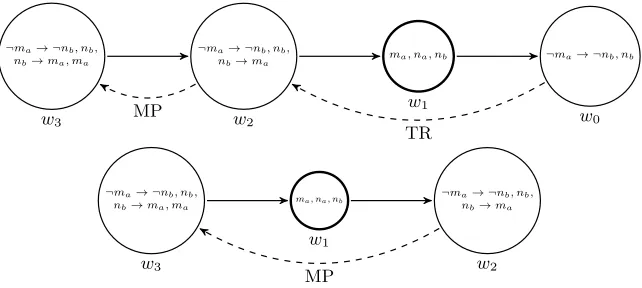
We will illustrate our framework on theMuddy Children Puzzle, highlighted in the introduction. We analyze the failure of applying a sequence of rules in the k= 2 scenario, attributed to the fact that the first rule applied is so cognitively costly for a child that her available time expires before she can apply the next. It thus becomes clear why in even more complex cases (e.g. fork >2) human agents are likely to fail, contrary to predictions of standard logics, whereby demanding reasoning steps are performed at once and without effort. Our attempt models the dynamics of inference and the resource consumption each step induces. Example 1 (Bounded muddy children). Take ma, mb as the atoms for “childa
(resp. b) is muddy” and na, nb for “child a (resp. b) answers no to the first
question”. Let M =hWP, WI, ord, V, R,cpi be as depicted in Fig.1. For sim-plicity, take two rules, transposition of the implication and modus ponens, so thatR={T R, M P}whereT R={¬ma→ ¬nb} nb→ma,M P ={nb, nb→
ma} ma,Res={time,memory},c(T R) = (5,2), c(M P) = (2,2),cp= (5,7).
Analyzing the reasoning of childa (see Fig.1.) after the father’s announce-ment and after child b answered “no” to the first question, we verify that
(¬ma→ ¬nb) andnb are valid, i.e. child ainitially knows that if she is not
muddy, then childbshould answer “yes” (as in that case onlybis muddy), and
7 See, for example, [9, 17, 27, 28, 29]. In fact, different schools in psychology of
thatbsaid “no”. Following aT R-application, the worldw0is eliminated and its position is taken by itsT R-expansion, i.e.w2andcpT R= (5,7)−(5,2) = (0,5). In addition, A(T R), and cp ≥ cT R. Therefore hT Ri(nb →ma) is also valid.
But now the cost of the next step is too high, i.e.MT R, w
16|=cp≥cM P (compare
cpT Randc(M P)), so overall the formula hT Ri¬hM Pi
ma is indeed valid.
¬ma→ ¬nb, nb,
nb→ma, ma
w3
¬ma→ ¬nb, nb,
nb→ma
w2
MP
ma, na, nb
w1
¬ma→ ¬nb, nb
w0
TR
¬ma→ ¬nb, nb,
nb→ma, ma
w3
ma, na, nb
w1
¬ma→ ¬nb, nb, nb→ma
w2
[image:9.612.148.469.197.341.2]MP
Fig. 1. The reasoning of boundedly rational child a. Thicker borders are used for deductively closed possible worlds. In impossible worlds, we write all propositional formulas satisfied and indicate (non-trivial) expansions via dashed arrows.
3
Reduction and axiomatization
Work in [35] shows how various models for knowledge and belief, including struc-tures for awareness ([13]), can be viewed as impossible-worlds models (more specifically, Rantala models, [24]), that validate precisely the same formulas (given a fixed background language). In the remainder, we explore the other direction and show thatour impossible-worlds framework can be reduced to an awareness-likeone, that only involves possible worlds. In the absence of impossi-ble worlds, standard techniques used in axiomatizing DEL settings (via reduction axioms) can be used. This reduction is a technical contribution; the components of the reduced model lack the intuitive readings of the original framework, but allow us to prove completeness. Further, this method has the advantage of com-bining the benefits of impossible worlds in modelling non-ideal agents and the technical treatment facilitated by awareness-like DEL structures.
formulas that contain no such operator. In this way, we use the completeness of the static part to get a complete axiomatization for the dynamic setting.
3.1 The (static) language for the reduction
We first fix an appropriate languageLr as the “common ground” needed to show that the reduction is successful, i.e. that the same formulas are valid under the original and the reduced models. As before, let ♠stand for K or and take the quantification set Q♠(w) to be W if ♠=K, and Q♠(w) :={u| w≥ u},
if♠=(to denote the set that the truth clauses forK and quantify over). Auxiliary operators are then introduced to the static fragment ofL, in order to capture (syntactically) the effect of impossible worlds in the interpretations of propositional attitudes. Forw∈WP:
– M, w|=L♠φiffM, u|=φfor allu∈WP∩Q♠(w) – M, w|=I♠φiffM, u|=φfor allu∈WI∩Q♠(w)
That is, L♠ provides the standard quantification over the possible worlds
while I♠ isolates the impossible words, for each ♠ = K,. In addition, we
introduce operators to encode the model’s structure:
– M, w|= ˆI♠φiffM, u|=φfor someu∈WI∩Q♠(w) – M, w|=hRADiρφiff for someu∈wρ:M, u|=φ
The operators hRADiρ, labeled by inference rules are such to ensure that
there is someφ-satisfyingρ-expansion. To express thatall ρ-expansions are φ-satisfying, we use [RAD]ρφ:=hRADiρ> → hRADiρφ, because once an
expan-sion exists, it is unique. Indexed operators of this form provide information on the model’s structure; they are introduced syntactically only as temporal-style projections of connections induced by inference rules on the model. This is why their interpretation should be independent of the distinction between possible and impossible worlds. For example, forw∈WI:M, w|=hRADi
ρφiff for some
u∈ wρ: M, u |=φ. We also use the following abbreviation: if φ is of the form
¬ψ, for some formula ψ, thenI♠φ:= ˆI♠ψ, elseI♠φ:=⊥.
3.2 Building the reduced model
Towards interpreting the auxiliary operators in the reduced model, we construct awareness-like functions. TakeV+(w) :={φ∈ Lr|M, w|=φ}forw∈WI and:
– I♠ : WP → P(Lr) such that I♠(w) = T
v∈WI∩Q
♠(w)
V+(v). Intuitively, I
♠
takes a possible worldw and yields the set of those formulas that are true at all impossible worlds in its quantification set.
– ˆI♠ : WP → P(Lr) such that ˆI♠(w) = S
v∈WI∩Q♠(w)
V+(v). Intuitively, ˆI♠
The functionordcaptures plausibility and the “world-swapping” effect of rule-applications. Since the latter will be treated via reduction axioms, we provide a reduced model equipped with a standard binary plausibility relation (to serve as anawareness-like plausibility structure(ALPS), with respect to which the static logic will be developed). Given the original modelM =hWP, WI, ord, V, R,cpi,
our reduced model is the tupleM=hW,≥,∼,V,R,cp,I♠,ˆI♠iwhere:
W =WP V(w) =V(w) forw∈W
u≥wifford(u)≥ord(w), forw, u∈W R(w) =R(w) forw∈W u∼wiffu≥worw≥u, forw, u∈W I♠,ˆI♠ as explained before
The clauses based on the reduced model are such that the auxiliary operators are interpreted via the awareness-like functions. They are presented in detail in the Appendix, along with the proof that the reduction is indeed successful:
Theorem 1 (Reduction). Given a modelM, letMbe its (candidate) reduced model. Then M is indeed a reduction of M, i.e. for anyw∈WP and formula
φ∈ Lr:M, w|=φ iffM, w|=φ.
3.3 Axiomatization
We have reduced plausibility models to ALPS. We now develop the (static) logic Λ, showing that it is sound and complete w.r.t. them.
Definition 9 (Axiomatization of Λ). Λ is axiomatized by Table 1 and the rules Modus Ponens, NecessitationK (from φ, infer LKφ) and Necessitation
[image:11.612.135.496.487.665.2](from φ, infer Lφ).
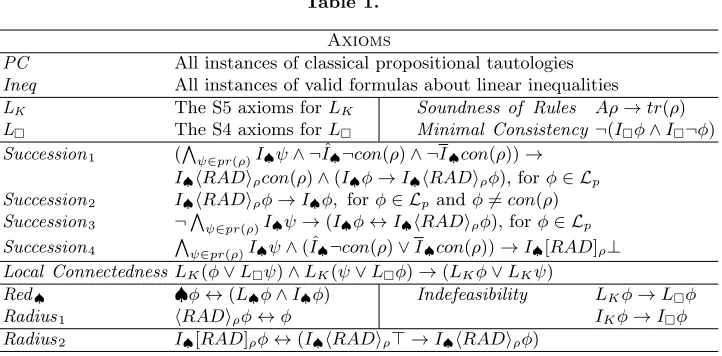
Table 1.
Axioms
PC All instances of classical propositional tautologies
Ineq All instances of valid formulas about linear inequalities
LK The S5 axioms forLK Soundness of Rules Aρ→tr(ρ) L The S4 axioms forL Minimal Consistency ¬(Iφ∧I¬φ)
Succession1 (V
ψ∈pr(ρ)I♠ψ∧ ¬Iˆ♠¬con(ρ)∧ ¬I♠con(ρ))→
I♠hRADiρcon(ρ)∧(I♠φ→I♠hRADiρφ), forφ∈ Lp
Succession2 I♠hRADiρφ→I♠φ, forφ∈ Lp andφ6=con(ρ)
Succession3 ¬V
ψ∈pr(ρ)I♠ψ→(I♠φ↔I♠hRADiρφ), forφ∈ Lp Succession4 V
ψ∈pr(ρ)I♠ψ∧( ˆI♠¬con(ρ)∨I♠con(ρ))→I♠[RAD]ρ⊥ Local ConnectednessLK(φ∨Lψ)∧LK(ψ∨Lφ)→(LKφ∨LKψ)
Red♠ ♠φ↔(L♠φ∧I♠φ) Indefeasibility LKφ→Lφ
Radius1 hRADiρφ↔φ IKφ→Iφ
Ineq, described in [15], is introduced to accommodate the linear inequalities.8 The S5 axioms forLKand S4 axioms forLmimic the behaviour ofKandin
the usual plausibility models: these operators quantify over possible worlds only. The (clusters of) axioms about Soundness of Rules, Minimal Consistency and Succession take care of the respective model conditions (to the extent that these affect our language, given its expressiveness). The same holds forIndefeasibility andLocal Connectedness, which also mimic their usual plausibility counterparts. To capture the behaviour of radius, we also introduce theRadiusaxioms. Finally, Red♠expressesK andin terms of the corresponding auxiliary operators. We
now move to the following theorems; the proofs can be found in the Appendix.
Theorem 2 (Soundness). Λ is sound w.r.t. ALPS.
Theorem 3 (Completeness). Λ is complete w.r.t. non-standard9 ALPS.
Given the static logic, it suffices to reduce formulas involvinghρiin order to get a dynamic axiomatization. It is useful to abbreviate updated terms in our language as follows:cpρ :=cp−cρ andcρρ:=cρ.
Theorem 4 (Reducinghρi).The following are valid in the class of our models
hρip↔(cp≥cρ)∧Aρ∧p hρi¬φ↔(cp ≥cρ)∧Aρ∧ ¬hρiφ hρi(φ∧ψ)↔(cp≥cρ)∧Aρ∧ hρiφ∧ hρiψ hρiL♠φ↔(cp≥cρ)∧Aρ∧L♠φ
hρiI♠φ↔(cp≥cρ)∧Aρ∧I♠[RAD]ρφ hρi♠φ↔(cp≥cρ)∧Aρ∧ ♠[RAD]ρφ
hρiAσ↔(cp≥cρ)∧Aρ∧Aσ hρiIˆ♠φ↔(cp≥cρ)∧Aρ∧Iˆ♠hRADiρφ
hρihRADiρφ↔(cp≥cρ)∧Aρ∧ hRADiρφ
hρi(z1s1+. . .+znsn≥c)↔(cp≥cρ)∧Aρ∧(z1sρ1+. . .+zns
ρ n≥c)
Theorem 5 (Dynamic axiomatization).The axiomatic system given by Ta-ble 1 and the reduction axioms of Theorem 4 is sound and complete w.r.t. non-standard ALPS.
4
Conclusions and further research
By combining DEL and an impossible-wolds semantics, we modeled fallible but boundedly rational agents who can in principle eliminate their ignorance as long as the task lies within cognitively allowed applications of inference rules. We discussed how this framework accommodates epistemic scenarios realistically and how it fits in the landscape of similar attempts put against logical omniscience. It was finally shown that this combination can be reduced to a syntactic, possible-worlds structure that allows for useful formal results.
8
Ineq is of course slightly adapted as terms are interpreted asr-tuples. This makes no difference for the axioms in [15], with the exception of dichotomy which is not needed given our reading of inequality.
9
We have focused on how deductive reasoning affects the agent’s epistemic state. As observed in [6], apart from “internal elucidation”, external actions, e.g. public announcements ([2, 22]), also enhance the agent’s state. The mixed tasks involved in bounded reasoning and in revising epistemic states (also discussed in [36]) require an account of both sorts of actions and of the ways they are inter-twined. The various policies of dynamic change triggered by interaction (public announcement, radical upgrades etc., [4, 5]) fit in our framework, provided that suitable dynamic operators and model transformations are defined. For instance, public announcements eliminate the worlds that do not satisfy the announced sentence and radical upgrades prioritize those that satisfy it.
Note that while factivity of knowledge is indeed warranted by the reflexivity of our models, the correspondence between other properties (such as transitivity) and forms of introspection is disrupted by the impossible worlds. Avoiding unlim-ited introspection falls within our wider project to model non-ideal agents. Just as with factual reasoning though, we propose a principle of moderation, achieved via the introduction of effortful introspective rules whose semantic effect is sim-ilarly projected on the structure of the model. Furthermore, it is precisely along these lines that a multi-agent extension of this setting can be pursued.
Apart from extending thelogical machinery in order to capture richer rea-soning processes, another natural development is towards fine-tuning elements of the model hitherto discussed, in order to better align it with the experimen-tal findings in the literature on rule-based human reasoning. We have already indicated that the function c, which is responsible for the assignment of cog-nitive costs, should be sensitive to both the rule-schemas in question and the complexity of their particular instances. Thewell-ordering of inferences that [9] suggests, is supported by the literature we referred to so far, but, at this stage, the evidence fits a qualitative ordering of schemas while a precise quantitative assignment calls for more empirical input. Specifying the intuitive assumption that the more complex an instance, the more cognitively costly it is, breaks into two tasks (i) choosing some appropriate measure of logical complexity: number of literals, (different) atoms, connectives etc., (ii) using experimental data to fix coefficients that associate the measure with the performance of agents (w.r.t. our selected resources). Such a procedure will be pursued in a future paper and it can illuminate whether there are classes of inferences, sharing properties in terms of our measure, that should be assigned equal cognitive costs, as one might intuitively expect.
Appendix
Due to the construction of awareness-like functions, properties of the original model, concerning Soundness of Rules, Minimal Consistency, and Succession are inherited by the reduced model. Clearly, the new quantification sets are QK(w) = W and Q(w) ={u∈W|w≥u}. The semantic clauses, based onM,
are standard for the boolean connectives; the remaining are given below:
– M, w|=z1s1+. . .+znsn≥c iffz1sM1 +. . .+znsMn ≥c
– M, w|=L♠φiffM, u|=φfor allu∈Q♠(w) – M, w|=I♠φiffφ∈I♠(w)
– M, w|=♠φiffM, w|=L♠φandM, w|=I♠φ – M, w|=Aρiffρ∈R(w)
– M, w|= ˆI♠φiffφ∈ˆI♠(w) – M, w|=hRADiρφiffM, w|=φ
Proof for Theorem 1:
Proof. The proof goes by induction on the complexity ofφ. Recall that validity is defined with respect to the possible worlds in the original model.
– Forφ:=p:M, w|=piffp∈V(w) iffp∈V(w) iffM, w|=p.
– For inequalities,¬,∧andA, the claim is straightforward.
– ForL♠ψ: M, w|=L♠ψ iff for all u∈WP ∩Q♠(w): M, u|=ψ iff (by I.H.)
for allu∈W∩Q♠(w):M, u|=ψiffM, w|=L♠ψ.
– Forφ:=I♠ψ: M, w|=I♠ψiff for allu∈WI∩Q♠(w):M, u|=ψ iff for all
u∈WI∩Q
♠(w):ψ∈V+(u) iffψ∈I♠(w) iffM, w|=I♠ψ.
– For φ := ♠ψ: M, w |= ♠ψ iff for all u ∈ Q♠(w): M, u |= ψ. Since u ∈
WP ∪WI, this is the case iff M, w |= L♠ψ and M, w |= I♠ψ. Given the
previous steps of the proof, this is the case iffM, w|=L♠ψandM, w|=I♠ψ,
iffM, w|=♠ψ.
– Forφ:= ˆI♠ψ: M, w|= ˆI♠ψ iff for someu∈WI∩Q♠(w): M, u|=ψ iff for
someu∈WI∩Q
♠(w):ψ∈V+(u) iffψ∈ˆI♠(w) iffM, w|= ˆI♠ψ.
– Forφ:=hRADiρψ:M, w|=hRADiρψiff for someu∈wρ:M, u|=ψiff (by
I.H. andwρ={w}sincew∈WP)M, w|=ψiffM, w|=hRADi ρψ.
Proof for Theorem 2:
Proof. Standard arguments suffice regardingPC,Ineq,LK,L andModus
Po-nens,NecessitationK,Necessitation preserve validity as usual. The axioms for
Soundness of Rules, Minimal Consistency, Succession are valid due to the re-spective conditions placed on the model. The validity of Local Connectedness is due to the connectedness of the model. The validity ofIndefeasibility,Red♠,
Radius2 is a direct consequence of the semantic clauses for ♠, L♠, I♠. Radius1 is valid due to the deductive closure of possible worlds.10
Proof for Theorem 3:
Towards showing completeness, we use a suitable canonical model. Taking (maximal)Λ-consistent sets and showing Lindenbaum’s lemma follow the stan-dard paradigm.
Definition 10 (Canonical model). The canonical model for the logic Λ is
M:=hW,≥,∼,V,R,cp,I♠,Iˆ♠iwhere: 10
– W is the set of all maximalΛ-consistent sets.
– ≥is such that forw, u∈ W:w≥uiff{φ|Lφ∈w} ⊆u.
– ∼is such that forw, u∈ W:w∼uiff{φ|LKφ∈w} ⊆u.
– V(w) ={p|p∈w}, with w∈ W.
– R(w) ={ρ|Aρ∈w}, with w∈ W.
– I♠(w) ={φ|I♠φ∈w}, withw∈ W. – Iˆ♠(w) ={φ|Iˆ♠φ∈w}, withw∈ W.
There are alternative but equivalent definitions of≥and∼ in terms of the duals ˆL and ˆLK, i.e. ˆLφ := ¬L¬φ and ˆLKφ := ¬LK¬φ. Then w≥u iff
{Lˆφ|φ∈u} ⊆w. The existence lemma is obtained by the traditional routine. That is, for any w ∈ W, if ˆLφ ∈ w then there is some v ∈ W such that w≥v and φ ∈ v. Analogous claims can be made for ∼ and ˆLK. Furthermore,
due toLK,L, Indefeasibility,Local Connectedness and modal logic results on
correspondence ([8]) the canonical model is reflexive, transitive and (locally) connected (with respect to ≥) and ∼ is the symmetric extension of ≥ (these properties yield the so-callednon-standard plausibility models). The axioms on Soundness of Rules, Minimal Consistency, Succession and Radius are such to ensure that the model has the desired properties.
We then perform induction on the complexity ofφto show our truth lemma:
M, w |= φ iff φ ∈ w. The claim for propositional atoms, the boolean cases, linear inequalities, and Aholds, due to the construction of the canonical model (namely, V and R), Ineq, the properties of maximal consistent sets and I.H.. The claim forhRADiρ follows by the I.H. andRadius1. The claims for ˆL and
ˆ
LK follow with the help of the existence lemmas and I.H., while forI,IK, ˆI
and ˆIK we rely on the construction of the awareness-like functions and then the
result is immediate. ForKφandφ, we make use ofRedK andRed, the I.H.
and the results of the previous steps onLK,IK andL,I.11
Proof for Theorem 4: Proof.
– The claim is easy for the atoms, the boolean cases, the inequalities, A,
hRADiρ, LK and L. We will only show why the claim holds for IK and
I, ˆIK and ˆI because the claims involvingK,will then follow from the
clause for♠and the distribution ofhρiover conjunction.
– LetM be an arbitrary model andwan arbitrary possible world of the model. Suppose M, w |= hρiIKφ. Therefore M, w |= (cp ≥ cρ), M, w |= Aρ and
Mρ, w|=I
Kφ. Recall thatWρ =Su∈Wuρ. Therefore for allv ∈Wρ∩WI,
Mρ, v |= φ [1]. Take arbitrary u ∈ WI and arbitrary v ∈ uρ. Then, v ∈
Wρ∩WI, and by [1] and the definitions ofV and radius:M, v|=φ. Over-all,M, w|=IK[RAD]ρφ and by M, w|= (cp ≥cρ), M, w|=Aρ, we finally
11
getM, w|= (cp ≥cρ)∧Aρ∧IK[RAD]ρφ. For the other direction, suppose
that M, w|= (cp ≥cρ)∧Aρ∧IK[RAD]ρφ. Take arbitrary v ∈ Wρ∩WI,
i.e. there is some u ∈ WI such that v ∈ uρ. By the truth conditions of
M, w|=IK[RAD]ρφ, for all u∈WI, M, u |= [RAD]ρφ, i.e. for all v ∈uρ:
M, v|=φ. Therefore, for our arbitraryv, it is the case thatM, v|=φ, and by definitions ofV and radius, Mρ, v |=φ. Overall, Mρ, w |=I
Kφ and finally
M, w|=hρiIKφ.
– Let M be an arbitrary model and w an arbitrary possible world of the model. SupposeM, w|=hρiIφ. ThereforeM, w|= (cp≥cρ),M, w|=Aρ
and Mρ, w |=I
φ. Since Wρ =
S
u∈W uρ, for all v ∈ Wρ∩WI such that
w≥ρ v:Mρ, v|=φ[1]. Then, take arbitraryu∈WI∩Q
(w) and arbitrary
v∈uρ. Sinceordρ(v)≤ord(u) (by Step 2 of transformation) andw≥u, we get thatw≥ρv. Thereforev∈Wρ∩WI, and by [1] and the definitions ofV
and radius:M, v|=φ. HenceM, w|=I[RAD]ρφand byM, w|= (cp≥cρ),
M, w|=Aρ, we finally get M, w|= (cp ≥cρ)∧Aρ∧I[RAD]ρφ. For the
other direction, suppose that M, w |= (cp ≥ cρ)∧Aρ∧I[RAD]ρφ. Take
arbitraryv ∈ Wρ∩WI such that w≥ρ v, i.e. there is some u∈WI such
that v ∈ uρ. Take the most plausible of these worlds (from which v
origi-nated). For thisu, sinceordρ(v) =ord(u) and w≥ρ v then w≥u. By the
truth conditions of M, w |= I[RAD]ρφ, for allu ∈WI such that w ≥u:
M, u|= [RAD]ρφ, i.e. for allv∈uρ: M, v|=φ. Therefore, for our arbitrary
v, it is the case thatM, v|=φ, and by definitions ofV and radius,Mρ, v|=φ
too. Overall,Mρ, w|=I
φand finally M, w|=hρiIφ.
– LetM be an arbitrary model andwan arbitrary possible world of the model. Suppose M, w |= hρiIˆKφ. Therefore M, w |= (cp ≥ cρ), M, w |= Aρ and
Mρ, w |= ˆI
Kφ. Since Wρ =Su∈Wuρ, for some v ∈Wρ∩WI:Mρ, v|=φ.
That is, there is some u ∈ WI such that v ∈ uρ and Mρ, v |= φ.
There-fore, for some u∈ WI there is some v ∈uρ such that (by definitions of V
and radius)M, v |=φ. This amounts to M, w |= ˆIKhRADiρφ, and overall
M, w |= (cp ≥ cρ)∧Aρ∧IˆKhRADiρφ. For the other direction, suppose
M, w|= (cp ≥cρ)∧Aρ∧IˆKhRADiρφ. From M, w|= ˆIKhRADiρφ, we get
that there is someu∈WI such that for some v∈uρ:M, v |=φ. But then v∈Wρ∩WI and by definitions ofV and radius, Mρ, w|= ˆI
Kφ. So overall
M, w|=hρiIˆKφ.
– Let M be an arbitrary model and w an arbitrary possible world of the model. SupposeM, w|=hρiIˆφ. ThereforeM, w|= (cp≥cρ),M, w|=Aρ
and Mρ, w |= ˆI
φ. Since Wρ = Su∈Wu
ρ, for some v ∈ Wρ∩WI with
w≥ρv:Mρ, v|=φ. That is, there isu∈WI such that v∈uρ, and w≥ρv
and Mρ, v |= φ. Take the most plausible such u. Sinceord(u) = ordρ(v),
w≥u. By these, and definitions ofV and radius: there isu∈WI∩Q
(w)
andv∈uρ withM, v|=φ, which is preciselyM, w|= ˆI
hRADiρφ. Overall:
M, w|= (cp≥cρ),M, w|=Aρ∧IˆhRADiρφ. This means that there is some
u∈WI ∩Q
(w) and some v ∈uρ withM, v |=φ. It suffices to show that
Mρ, w |= ˆI
φ. But from w ≥ u and v ∈ uρ, we obtain that w ≥ρ v, and
v ∈Wρ. Due to this and definitions ofV and radius:Mρ, v|=φand then
Mρ, w|= ˆI
φ. Overall indeedM, w|=hρiIˆφ.
References
[1] Alechina, N., Logan, B.: A logic of situated resource-bounded agents. Journal of Logic, Language and Information 18, 79–95 (2009)
[2] Baltag, A., Moss, L.S., Solecki, S.: The logic of public announcements, common knowledge, and private suspicions. In: Proceedings of the 7th Conference on The-oretical Aspects of Rationality and Knowledge. pp. 43–56. TARK ’98, Morgan Kaufmann Publishers Inc., San Francisco, CA, USA (1998)
[3] Baltag, A., Renne, B.: Dynamic epistemic logic. In: Zalta, E.N. (ed.) The Stan-ford Encyclopedia of Philosophy. Metaphysics Research Lab, StanStan-ford University, winter 2016 edn. (2016)
[4] Baltag, A., Smets, S.: A qualitative theory of dynamic interactive belief revision. Logic and the Foundations of Game and Decision Theory, Texts in Logic and Games 3, 9–58 (2008)
[5] van Benthem, J.: Dynamic logic for belief revision. Journal of Applied Non-Classical Logics 17(2), 129–155 (2007)
[6] van Benthem, J.: Tell it like it is: Information flow in logic. Journal of Peking University (Humanities and Social Science Edition) (2008)
[7] van Benthem, J.: Logical Dynamics of Information and Interaction. Cambridge University Press (2011)
[8] Blackburn, P., de Rijke, M., Venema, Y.: Modal Logic. Cambridge University Press, New York, NY, USA (2001)
[9] Cherniak, C.: Minimal Rationality. Bradford book, MIT Press (1986)
[10] Cowan, N.: The magical number 4 in short-term memory: A reconsideration of mental storage capacity. The Behavioral and Brain Sciences 24, 87–114 (2001) [11] van Ditmarsch, H., van der Hoek, W., Kooi, B.: Dynamic Epistemic Logic.
Springer Publishing Company, Incorporated, 1st edn. (2007)
[12] Duc, H.N.: Reasoning about rational, but not logically omniscient, agents. Journal of Logic and Computation 7(5), 633 (1997)
[13] Fagin, R., Halpern, J.Y.: Belief, awareness, and limited reasoning. Artificial Intel-ligence 34(1), 39–76 (1987)
[14] Fagin, R., Halpern, J.Y., Moses, Y., Vardi, M.Y.: Reasoning About Knowledge. MIT Press (1995)
[15] Fagin, R., Halpern, J.Y.: Reasoning about knowledge and probability. Journal of the ACM 41(2), 340–367 (1994)
[16] Hintikka, J.: Impossible possible worlds vindicated. Journal of Philosophical Logic 4(4), 475–484 (1975)
[17] Johnson-Laird, P.N., Byrne, R.M., Schaeken, W.: Propositional reasoning by model. Psychological Review 99(3), 418–439 (1992)
[18] Kahneman, D., Beatty, J.: Pupillary responses in a pitch-discrimination task. Perception & Psychophysics 2(3), 101–105 (1967)
[20] Miller, G.: The magical number seven, plus or minus 2: Some limits on our capacity for processing information. Psychological Review 63, 81–97 (1956)
[21] Parikh, R.: Knowledge and the problem of logical omniscience. In: Proceedings of the Second International Symposium on Methodologies for Intelligent Systems. pp. 432–439. North-Holland Publishing Co., Amsterdam, The Netherlands (1987) [22] Plaza, J.: Logics of public communications. Synthese 158(2), 165–179 (2007) [23] R Sears, C., Pylyshyn, Z.: Multiple object tracking and attentional processing.
Canadian Journal of Experimental Psychology 54, 1–14 (2000)
[24] Rantala, V.: Impossible worlds semantics and logical omniscience. Acta Philo-sophica Fennica 35, 106–115 (1982)
[25] Rasmussen, M.S.: Dynamic epistemic logic and logical omniscience. Logic and Logical Philosophy 24, 377–399 (2015)
[26] Rasmussen, M.S., Bjerring, J.C.: A dynamic solution to the problem of logical omniscience. Journal of Philosophical Logic (forthcoming)
[27] Rips, L.J.: The Psychology of Proof: Deductive Reasoning in Human Thinking. MIT Press, Cambridge, MA, USA (1994)
[28] Schroyens, W., Schaeken, W.: A critique of Oaksford, Chater, and Larkin’s (2000) conditional probability model of conditional reasoning 29, 140–9 (2003)
[29] Schroyens, W.J., Schaeken, W., D’Ydewalle, G.: The processing of negations in conditional reasoning: A meta-analytic case study in mental model and/or mental logic theory. Thinking & Reasoning 7(2), 121–172 (2001)
[30] Spohn, W.: Ordinal conditional functions. a dynamic theory of epistemic states. In: Harper, W.L., Skyrms, B. (eds.) Causation in Decision, Belief Change, and Statistics, vol. II. Kluwer Academic Publishers (1988)
[31] Stalnaker, R.: On logics of knowledge and belief. Philosophical Studies 128(1), 169–199 (2006)
[32] Stanovich, K.E., West, R.F.: Individual differences in reasoning: Implications for the rationality debate? Behavioral and Brain Sciences 23(5), 645–665 (2000) [33] Stenning, K., van Lambalgen, M.: Human Reasoning and Cognitive Science.
Boston, USA: MIT Press (2008)
[34] Vel´azquez-Quesada, F.R.: Small Steps in Dynamics of Information. Ph.D. thesis, Institute for Logic, Language and Computation (ILLC), Universiteit van Amster-dam (UvA), AmsterAmster-dam, The Netherlands (2011)
[35] Wansing, H.: A general possible worlds framework for reasoning about knowledge and belief. Studia Logica 49(4), 523–539 (1990)
[36] Wassermann, R.: Resource bounded belief revision. Erkenntnis 50(2), 429–446 (1999)
[37] Xu, Y., Chun, M.M.: Selecting and perceiving multiple visual objects. Trends in Cognitive Sciences 13(4), 167–174 (2009)