Vermicious thermo-responsive Pickering
emulsi
fi
ers
†
K. L. Thompson,aL. A. Fielding,aO. O. Mykhaylyk,*aJ. A. Lane,bM. J. Derrya and S. P. Armes*a
Thermo-responsive vermicious (or worm-like) diblock copolymer nanoparticles prepared directly inn -dodecaneviapolymerisation-induced self-assembly (PISA) were used to stabilise water-in-oil Pickering emulsions. Mean droplet diameters could be tuned from 8 to 117mm by varying the worm copolymer concentration and the water volume fraction and very high worm adsorption efficiencies (100%) could be obtained below a certain critical copolymer concentration (0.50%). Heating a worm dispersion up to 150C led to a worm-to-sphere transition, which proved to be irreversible if conducted at sufficiently low copolymer concentration. This affords a rare opportunity to directly compare the Pickering emulsifier performance of chemically identical worms and spheres. It is found that the former nanoparticles are markedly more efficient, since worm-stabilised water droplets are always smaller than the equivalent sphere-stabilised droplets prepared under identical conditions. Moreover, the latter emulsions are appreciablyflocculated, whereas the former emulsions proved to be stable. SAXS studies indicate that the mean thickness of the adsorbed worm layer surrounding the water droplets is comparable to that of the worm cross-section diameter determined for non-adsorbed worms dispersed in the continuous phase. Thus the adsorbed worms form a monolayer shell around the water droplets, rather than ill-defined multilayers. Under certain conditions, demulsification occurs on heating as a result of a partial worm-to-sphere morphological transition.
Introduction
Water or oil droplets stabilised by solid particles are known as Pickering emulsions and have been recognised since the turn of the last century.1 They offer various advantages over conven-tional surfactant-stabilised emulsions, such as enhanced stability towards droplet coalescence, reduced foam problems and low toxicity.2,3Many types of particles can act as Pickering emulsiers, with particle wettability being the most important parameter for determining emulsion type and stability. Spher-ical particles are utilised in the vast majority of cases,4–6and the energy of attachment of an individual particle adsorbed at the oil/water interface increases with particle radius.3As far as we are aware, there is only one literature example ofvermicious (or worm-like) diblock copolymer nanoparticlesbeing used as Pick-ering emulsiers.7 This is perhaps surprising, because it has
been known for several decades that diblock copolymer‘worms’ can be formed spontaneously in solutionvia self-assembly.8,9 Consider aexible worm of contour lengthLand mean worm width 2R, whereL[2R. Such worms can be prepared from the 1D fusion of spherical precursors of approximate radius Rat relatively high solidsviapolymerisation-induced self-assembly (PISA).10To arst approximation, a worm formed from the 1D fusion ofnspheres is expected to have an energy of attachment
ntimes larger than that of a single precursor sphere. In addi-tion, cooperativity is expected to play an important role. Thus it is expected to cost signicantly more energy to detach a highly anisotropic worm (for which L/2R > 20) from the oil/water interface compared to the detachment ofnspheres. Moreover, the specic surface area of such worms is only approximately one-third less that of than the precursor spheres (see ESI†). Hence block copolymer worms offer signicantly enhanced adsorptioncompared to spheres, while retaining arelatively high specic surface area. Recently the interfacial behavior of aniso-tropic particles has begun to receive some attention. For example, Nobleet al.11prepared so-called‘hairy’colloidosomes stabilised by relatively large polydisperse polymeric micro-rods12(10–70mm in length and 0.4–2mm in width) using a gel-trapping technique. The same microrods have also been used to stabilise aqueous foams.13 Vermant and co-workers14,15 have exploited a mechanical alignment technique to prepare near-a
Department of Chemistry, University of Sheffield, Brook Hill, Dainton Building, Sheffield, UK, S3 7HF. E-mail: o.mykhaylyk@sheffield.ac.uk; s.p.armes@sheffield.ac. uk
bDepartment of Chemical and Biological Engineering, The University of Sheffield,
Mappin Street, Sheffield, UK, S1 3JD
†Electronic supplementary information (ESI) available: The theoretical background to the SAXS analysis, gel permeation chromatography analysis of the worms, optical microscopy images and laser diffraction analysis of water droplets. See DOI: 10.1039/c5sc00598a
Cite this:Chem. Sci., 2015,6, 4207
Received 16th February 2015 Accepted 7th May 2015
DOI: 10.1039/c5sc00598a
www.rsc.org/chemicalscience
Science
EDGE ARTICLE
Open Access Article. Published on 07 May 2015. Downloaded on 16/02/2016 12:38:00.
This article is licensed under a
Creative Commons Attribution 3.0 Unported Licence.
View Article Online
monodisperse, micrometer-sized ellipsoidal polystyrene latex particles. When these model ellipsoids were adsorbed at the oil/ water interface a strong correlation between the particle aspect ratio and emulsion stability was observed. More specically, the spherical precursor latex particles proved to be ineffective emulsiers and a certain minimum aspect ratio was required before effective stabilisation could be achieved. However, the preparation of such ellipsoids does not appear to be readily amenable to scale-up. Cellulosebres have also been recently explored as Pickering emulsiers.16–20It was found that thebre aspect ratio dictated the droplet surface coverage.17Relatively shortbres led to a densely-packed layer at the oil/water inter-face (>80% surinter-face coverage), while longer bres led to the formation of a more open 2D network (surface coverage40%). Very recently, surface-modied cellulose was utilised in conjunction with non-modied cellulose for the construction of oil-in-water-in-oil double emulsions.21However, surface
modi-cation of cellulose bres involves multi-step protocols and extensive purication, which makes scale-up of such nano-particles potentially problematic. Thermo-responsive oil-in-water emulsions have also been prepared by graing poly-(N-isopropylacrylamide) onto cellulose bres.22 Thermo-responsive foams have also been reported, with fatty acid tube-stabilised foams becoming detube-stabilised upon heating as a result of a tube-to-micelle transition.23
Recent advances in polymerisation-induced self-assembly (PISA) formulations now allow well-dened diblock copolymer worms to be readily prepared on a multi-gram scale at 20% w/w solids.24 In particular, linear and cross-linked triblock copol-ymer worms prepared in aqueous mediaviaPISA are generally more effective emulsiers than spherical nanoparticles.7Such worms are approximatelytwo orders of magnitude smallerthan the polymeric micro-rods reported earlier.11,12Reversible addi-tion–fragmentation chain transfer (RAFT) dispersion polymer-isation of benzyl methacrylate (BzMA) in n-alkanes using a poly(lauryl methacrylate) macromolecular chain transfer agent
(PLMA macro-CTA) enables the reproducible synthesis of PLMA-PBzMA diblock copolymer worms (see Fig. 1).25,26 More-over, the worms undergo a worm-to-sphere transition on heat-ing.26 This change in morphology is the result of surface plasticisation of the core-forming PBzMA block by the hot solvent, which leads to a subtle reduction in the copolymer packing parameter,P.27
Herein these highly hydrophobic PLMA16-PBzMA37 worms are examined as putative Pickering emulsiers. It is emphasised that their thermo-responsive nature allows conversion into the corresponding spheres, which enables the Pickering perfor-mance of worms and spheres to be directly compared using
precisely the same diblock copolymer composition. Moreover, we examine whether the thermo-sensitivity of the worms can be exploited to obtainthermo-responsive emulsions.
Experimental
MaterialsMonomers were purchased from Sigma-Aldrich (UK) and passed through basic alumina prior to use.n-Dodecane ($90% technical grade), CDCl3and all other reagents were purchased from Sigma-Aldrich (UK) and were used as received, unless otherwise noted. THF and toluene were purchased from Fisher Scientic (UK), while CD2Cl2and d26-dodecane were purchased from Goss Scientic (UK).
Synthesis of diblock copolymer worms
PLMA16-PBzMA37diblock copolymer worms were prepared as a sofree-standing gel directly inn-dodecanevia polymerisation-induced self-assembly (PISA) at 20% w/w solids according to a previously reported protocol.26
Pickering emulsion preparation
The as-prepared 20% w/w dispersion of PLMA16-PBzMA37 worms was serially diluted usingn-dodecane to obtain copoly-mer concentrations ranging between 0.06 and 2.0 wt%. For the preparation of worm-stabilised Pickering emulsions, a dilute worm dispersion (0.20–3.20 mL) was homogenised directly with deionised water (0.80–3.80 mL) for 2.0 minutes using a IKA Ultra-Turrax T-18 homogeniser with a 10 mm dispersing tool operating at 12 000 rpm. For the corresponding sphere-stabi-lised emulsions, a 0.50% w/w worm dispersion wasrst heated to 150C in an oil bath for 90 minutes prior to cooling to 20C. The resulting dispersion of PLMA16-PBzMA37spheres (2.0 mL) was homogenised with water (2.0 mL) as above.
Characterisation
THF GPC.Molecular weight distributions were assessed by gel permeation chromatography (GPC) using THF eluent. The THF GPC system was equipped with two 5mm (30 cm) mixed C columns, a LC20AD ramped isocratic pump and a WellChrom K-2301 refractive index detector operating at 95030 nm. The THF mobile phase contained 2.0 v/v% triethylamine and 0.05 w/ v% butylhydroxytoluene (BHT) and theow rate was xed at 1.0 mL min1. A series of ten near-monodisperse poly(methyl
Fig. 1 Preparation of Pickering emulsions prepared by homogenisa-tion of PLMA16-PBzMA37 diblock copolymer worm-like micelles dispersed inn-dodecane with an equal volume of water at 12 000 rpm for 2 minutes at 20C.
Open Access Article. Published on 07 May 2015. Downloaded on 16/02/2016 12:38:00.
This article is licensed under a
[image:2.595.46.290.503.680.2]methacrylate) standards (Mp values ranging from 1280 to 330 000 g mol1) were used for calibration.
1H NMR spectroscopy. 1H NMR spectra were recorded in
either CDCl3or CD2Cl2using a Bruker Avance 400 spectrometer operating at 400 MHz.
Dynamic light scattering (DLS).Intensity-average hydrody-namic diameters were obtained by DLS using a Malvern Zeta-sizer NanoZS instrument at a xed scattering angle of 173. Dispersions of 0.01% w/w PLMA16-PBzMA37 particles in n -dodecane were analysed using glass cuvettes and the results were averaged over three consecutive runs. It should be noted that DLS reports intensity-average diameters and implicitly assumes a spherical morphology. Thus the DLS dimensions reported herein for the highly anisotropic worm-like particles are actually‘sphere-equivalent’diameters that do not provide accurate information regarding either the mean worm length or the mean worm width. Nevertheless, DLS observations of a relatively larger particle size (and also much greater poly-dispersity) are a useful indication of the presence of worms (as either a pure phase or as one or more mixed phases). In contrast, the corresponding spheres are signicantly smaller and have much lower polydispersities.
Transmission electron microscopy. Transmission electron microscopy (TEM) studies were conducted using a Philips CM 100 instrument operating at 100 kV and equipped with a Gatan 1k CCD camera. Diluted block copolymer dispersions (0.50% w/w) were placed on carbon-coated copper grids and exposed to either ruthenium tetraoxide vapor for 7 minutes at 20C or 0.75% w/w uranyl formate solution (9mL) was soaked on the sample-loaded grid for 20 seconds. In each case the heavy metal acts as a stain to improve contrast. The ruthenium(VIII) oxide
was prepared as follows: ruthenium(IV) oxide (0.30 g) was added
to water (50 g) to form a black slurry; addition of sodium peri-odate (2.0 g) with stirring produced a yellow solution of ruth-enium(VIII) oxide within 1 min at 20C.
Optical microscopy.Optical microscopy images were recor-ded using a Motic DMBA300 digital biological microscope equipped with a built-in camera and analysed using Motic Images Plus 2.0 ML soware. Number-average (DnorD[1,0]) and surface-average (D[3,2]) droplet sizes were estimated using Image J soware; >300 droplets per sample were measured in each case.
Laser diffraction. The volume-average droplet (D[4,3]) diameter was determined using a Malvern Mastersizer 2000 instrument equipped with a small volume Hydro 2000SM sample dispersion unit (ca.50 mL), a He–Ne laser operating at 633 nm, and a solid-state blue laser operating at 466 nm. The stirring rate was adjusted to 3000 rpm in order to avoid
sedi-mentation of the emulsion during analysis. Aer each
measurement, the cell was rinsed once withn-dodecane. The glass walls of the cell were carefully wiped to avoid cross-contamination and the laser was aligned centrally to the detector prior to data acquisition.
Small angle X-ray scattering (SAXS). SAXS patterns were collected using both a laboratory SAXS instrument (Bruker AXS Nanostar modied with a Xenocs GeniX 3D ultralow divergence X-ray source and a collimator comprising two scatterless slits)
and a synchrotron source (station ID02, ESRF, Grenoble, France) equipped with a HiStar area detector and a Rayonix MX170 detector, respectively. SAXS patterns were recorded over a scattering vector (q) range of 0.08 nm1<q< 1.6 nm1and 0.005 nm1<q< 0.12 nm1, respectively using monochromatic
X-ray radiation (wavelength l ¼ 0.154 nm and l ¼ 0.1 nm,
respectively), where the length of the scattering vector, q, is given byq¼(4psinq)/landqis half of the scattering angle. A
liquid cell comprising two mica windows (each of 25 mm
thickness) separated by a polytetrauoroethylene spacer of 1.0 mm thickness or a glass capillary (1.7 mm diameter) were used as sample holders for either in-house measurements or synchrotron measurements, respectively. All experiments were performed at 21C. Scattering data were reduced using Nika SAS data reduction macros for Igor Pro (integration, normalisation and background subtraction) and further analysed using Irena SAS macros for Igor Pro.28 Water and a glassy carbon standard were used for absolute intensity calibration.29 SAXS measure-ments were conducted on 1.0% w/w PLMA16-PBzMA37solution in
n-dodecane and a concentrated water-in-n-dodecane emulsion prepared by emulsication of 50 vol% water with 50 vol% of a 1.0% w/w PLMA16-PBzMA37 worm dispersion in n-dodecane at 12 000 rpm for two minutes at 21C. Excess non-adsorbed worms were removed from the continuous phase by successive replace-ment of the supernatants (obtained aer allowing the emulsion to stand at room temperature for at least 16 h) with freshn -dodec-ane. This supernatant replacement protocol was repeated ve times. The theoretical background for the structural model used for SAXS data analysis is given in the ESI.†
Results and discussion
General remarksThe as-prepared PLMA16-PBzMA37worms obtained at 20% w/w
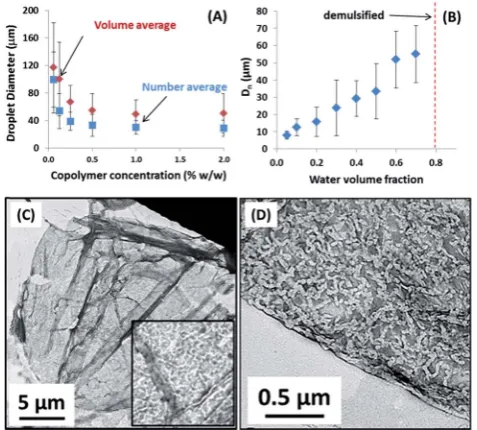
solids inn-dodecane were diluted using the same solvent. TEM studies conrmed that the worms were bothexible and highly anisotropic, with a mean aspect ratio (L/2R) greater than 20 being estimated from soware analysis of 100 particles (see Fig. 1). In initial high-shear homogenisation studies, the volume fraction of the oil and water phases werexed at 0.50 and the worm copolymer concentration was systematically varied from 2.0 to 0.06% w/wviaserial dilution (see Fig. 2A). Stable water-in-oil Pickering emulsions were obtained at all copolymer concentrations investigated, with representative optical micrographs of the aqueous emulsion droplets being shown in the ESI (see Fig. S2†). Gravitational sedimentation of the denser aqueous droplet phase occurred on standing over a time scale of minutes to hours (depending on the droplet diameter). However, excellent stability towards droplet coales-cence was observed, since essentially no change in mean droplet diameter with time was detected aer standing at 20C for several months.
Particle size analysis of emulsion droplets
Both optical microscopy and laser diffraction studies indicate an inverse relationship between the mean droplet diameter and
Open Access Article. Published on 07 May 2015. Downloaded on 16/02/2016 12:38:00.
This article is licensed under a
the worm copolymer concentration (see Fig. 2a; the former technique reports a number-average diameter and hence always undersizes relative to the latter). Similar trends have been observed for various spherical Pickering emulsiers.30 Recent work with diblock copolymer vesicles31has highlighted their rather delicate nature when prepared using an aqueous PISA formulation. In this case, high shear homogenisation led toin situ vesicle dissociation, with the resulting individual copol-ymer chains then acting as a polcopol-ymeric surfactant for the oil droplets. Such vesicle degradation was readily apparent, since the mean droplet diameter was essentially independent of the copolymer concentration. This is because only a very low copolymer concentration is required to stabilise the relatively large emulsion droplets if the copolymer is present as soluble chains. Chemical cross-linking of the copolymer vesicles was required to prevent vesicle dissociation during homogenisation. Such covalent stabilisation led to genuine Pickering emulsions that exhibited the expected concentration-dependent variation in mean droplet diameter.
Structure of adsorbed worms and adsorption efficiency
For the linear PLMA16-PBzMA37worms described herein, there is no evidence forin situworm dissociation during homogeni-sation. The TEM images of dried droplets shown in Fig. 2C
provide strong evidence that the PLMA16-PBzMA37 worms
remain intact during high shear homogenisation and subse-quently form a dense layer on the surface of the aqueous
droplets. The adsorption efficiency of the worms on the water droplets was estimated using a previously reported turbidi-metric assay (see ESI† for further details).31 At copolymer concentrations below 0.50% w/w, essentially all the worms adsorb at the oil/water interface (see Table S1†). This critical copolymer concentration also corresponds to the limiting OM droplet diameter of 30mm observed under these conditions. At
higher copolymer concentrations (1–2% w/w), lower worm
adsorption efficiencies are observed. An increase in mean
droplet diameter was observed at a xed worm copolymer
concentration of 0.50% w/w when varying the water volume fraction from 0.05 to 0.70. Phase inversion is oen observed in the literature when the volume fraction of the preferred droplet phase (in this case, water) exceeds that of the continuous phase.3In contrast, a high internal phase Pickering emulsion is obtained at water volume fractions of 0.60–0.70 in the present work, see Fig. 2B. However, above a critical volume fraction of 0.70, stable water droplets cannot be obtained; instead, complete demulsication is observed. This suggests that the PLMA16-PBzMA37 worms have a strong preference for the oil phase, which is not surprising given their highly hydrophobic character. The worm adsorption efficiency is reduced when the water volume fraction falls below 0.50, since there are now more worm-like particles available for adsorption.
Pickering emulsier performance of wormsvs.spheres
Recently, we reported that PLMA16-PBzMA37worms prepared in
n-dodecane display thermo-responsive behavior.26On heating, worms are converted into spheres as a result of surface plasti-cisation of the PBzMA block by the hot solvent. At sufficiently high copolymer concentration (>5% w/w), this order–order transition is essentially reversible, as judged by TEM, SAXS and
rheology studies.26 However, this worm-to-sphere
trans-formation isirreversiblewhen heating dilute worm dispersions (1.0% w/w). The spheres represent a kinetically-trapped morphology.32This is because the self-assembly of an individual worm from multiple spheres is a highly cooperative process that is disfavored at low copolymer concentrations.26 Thus the copolymer morphology remains spherical over experimentally accessible time scales aer cooling to 20 C. This thermal behavior provides a rare opportunity to directly compare the Pickering emulsier performance of highly anisotropic worms with chemically-identical spheres with essentially the same wettability. Two separate sets of experiments were conducted to assess whether the worm-stabilised Pickering emulsions also exhibited thermo-responsive behavior. First, dilute copolymer worm dispersions (0.06–1.00% w/w) were heated to 150C for 90 min and then cooled to 20C prior to homogenisation with an equal volume of water. In this case, the worms were expected to become ‘trapped’ in their spherical morphology prior to adsorption at the o/w interface. Indeed, this thermal treatment led to a signicant reduction in the sphere-equivalent DLS particle diameter and polydispersity (PDI) from 150 nm (PDI¼
0.28) to 30 nm (PDI ¼ 0.03). TEM studies conrmed the
expected worm-to-sphere transition (see Fig. S5†). It is
emphasised that the resulting PLMA16-PBzMA37 spherical
Fig. 2 (A) Water droplet diameter as a function of PLMA16-PBzMA37 worm concentration in n-dodecane as determined by optical microscopy (number-average) and laser diffraction (volume-average). (B) Number-average water droplet diametervs.water volume fraction for afixed copolymer concentration of 0.50% w/w. (C and D) TEM images of the surface of a dried, collapsed Pickering emulsion droplet (using a 0.50% w/w worm concentration and a water volume fraction of 0.50) after evaporation of both the aqueous droplet phase and the n-dodecane continuous phase. The PLMA16-PBzMA37 worms are clearly visible intact at the surface of this dried droplet.
Open Access Article. Published on 07 May 2015. Downloaded on 16/02/2016 12:38:00.
This article is licensed under a
[image:4.595.48.287.50.265.2]nanoparticles have precisely the same copolymer composition as the original worms, which enables the effect of copolymer
morphology on Pickering emulsier performance to be
assessed. Deploying the spherical nanoparticles at copolymer concentrations of 0.06–1.0% w/w invariably led to the formation of w/o emulsions. This is an interesting observation given that Vermant and co-workers reported that spherical polystyrene latex particles do not stabilise emulsions as effectively as ellip-soidal latexes with the same surface chemistry.14However, laser diffraction studies of the emulsions prepared using the PLMA16 -PBzMA37spheres indicated important differences compared to worm-stabilised emulsions. The former emulsions proved to be
occulated since volume-average diameters determined by laser diffraction were signicantly larger than the number-average diameters estimated from optical microscopy, see ESI Fig. S6.†
In contrast, the worm-stabilised emulsion droplets showed no signs ofocculation. In addition, a signicantly smaller mean droplet diameter (D) was always observed for the worms when working above a certain critical copolymer mass (mp), see Fig. 3. As shown in Fig. 2A, the mean droplet diameter can be controlled by the copolymer concentration (and hence copol-ymer mass). Assuming that all the particles are adsorbed at the oil/water interface, which is the case for copolymer concentra-tions#0.50% w/w,Dis calculated for spheres using eqn (1) and for worms using eqn (2):16,33
1 D¼
mp
4CrpdpVd
(1)
1 D¼
mp
6CrphVd
(2)
Herempis the particle mass,rpis the particle density (taken to be that of the PBzMA core-forming block, or 1.15 g cm3),d
pis the sphere diameter,his the worm thickness,Vdis the volume of the dispersed (droplet) phase andCis the fractional surface coverage (i.e.the fraction of the droplet interfacial area actually covered by adsorbed particles). By plotting the inverse of the mean droplet diameterDas a function ofmp,Ccan be deduced
from the gradient, see Fig. 3. [N.B. theocculated nature of the sphere-stabilised emulsions precluded using laser diffraction, so the mean droplet diameters used for this plot were estimated by optical microscopy.] A linear relationship is usually observed for spherical particles,33indicating thatCis constant over the entire droplet size range. As expected, sphere-stabilised drop-lets exhibited this relationship, with a corresponding fractional surface coverage of 0.61. This is physically reasonable for close-packed spheres on a curved 2D interface.34However, when the same plot is constructed for the worm-stabilised emulsions, a marked deviation from linearity is observed at high values of
mp. This suggests an increase in droplet surface coverage at higher copolymer concentration. Such behavior has been recently reported for Pickering emulsiers based on anisotropic bacterial cellulose nanobres.16 This increase in fractional surface coverage can be directly related to the anisotropic nature of the worms. At low worm concentrations, their high aspect ratio leads to rather loosely-packed particles at sub-monolayer coverage, while a much more densely packed worm layer is formed at relatively high worm concentrations. It is emphasised that the linear worms used in the present study are much more exible than the rigid rod-like bacterial cellulose particles used by Kalashnikova et al.16 This suggests that particle anisotropy, rather than‘stiffness’, is responsible for the similar interfacial behavior observed in both cases.
SAXS studies of worm-stabilised emulsions
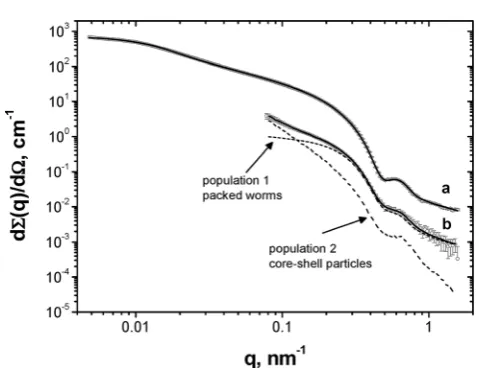
Unlike TEM, SAXS studies (see Fig. 4) enable the structure of the adsorbed worm layer surrounding the water droplets to be assessedin situ. In view of our TEM observations (Fig. 2), laser diffraction droplet diameter and previously reported SAXS data obtained for a PLMA16-PBzMA37worm dispersion in n -dodec-ane,26it was assumed that the SAXS patterns corresponded to (i)
Fig. 3 Effect of varying the copolymer particle massmpon the droplet diameter for two series of water-in-n-dodecane emulsions stabilised using (a) PLMA16-PBzMA37 spheres (red squares) and (b) PLMA16 -PBzMA37worms (blue diamonds). Note the deviation from linearity for the latter particles.
Fig. 4 Experimental SAXS data (circles) andfitting curves (solid lines) of (a) a dilute (1.0% w/w) PLMA16-PBzMA37worm dispersion inn -dodecane and (b) an emulsion comprising aqueous droplets inn -dodecane stabilised by PLMA16-PBzMA37worms. Two dashed curves indicate the relative contributions of each population to model 2 (adsorbed worms and core–shell particles) to the total scattering of the curvefit.
Open Access Article. Published on 07 May 2015. Downloaded on 16/02/2016 12:38:00.
This article is licensed under a
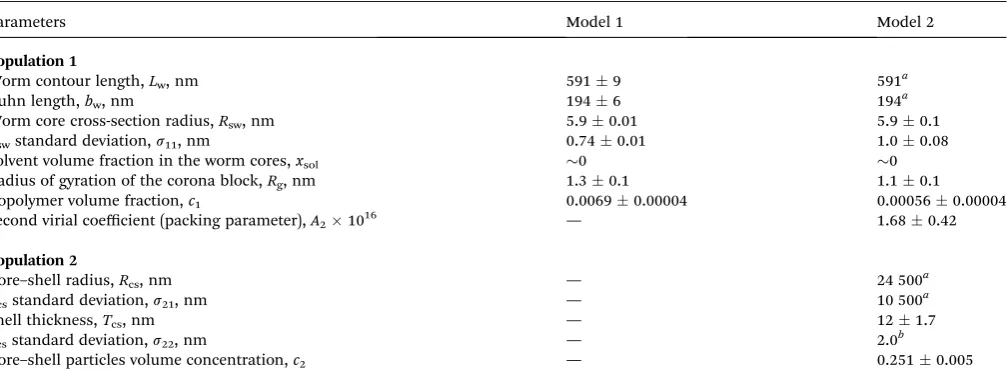
[image:5.595.308.548.466.650.2] [image:5.595.46.288.518.670.2]a pure worm phase (Fig. 4a) for the dilute PLMA16-PBzMA37 dispersion and (ii) spherical aqueous droplets stabilised by a layer of adsorbed worms for the concentrated water-in-n -dodecane emulsion (Fig. 4b). Thus data analysis utilised two models (see ESI†): a worm-like micelle model35,36(model 1) and a two population core–shell model comprising a particulate shell formed by the adsorbed worms (model 2).
In contrast to the original worm dispersion (Fig. 4a), the scattering pattern for the emulsion (Fig. 4b) exhibits an upturn in scattering intensity at lowq(below 0.15 nm1), indicating the presence of large objects, i.e. the aqueous droplets that are observed by optical microscopy and laser diffraction (Fig. 1). The X-ray data recorded at highq(0.5–1.6 nm1) are somewhat noisy because the worm volume fraction is relatively low (only
0.00056, see Table 1).37
No structure factor was required for satisfactory data analysis of the 1.0% w/w worm dispersion inn-dodecane (see Fig. 4a, eqn (S3)†and Table 1 for further details). In contrast, a structure factor for the worm population had to be incorporated (see eqn (S5) and (S6)†and Table 1 for further details) in order to obtain a satisfactory data t when using the two-population model. This suggests that the worms become interacting, which is consistent with their adsorption onto the surface of the aqueous droplets in the form of a network (Fig. 2c and d).
In addition, the modest increase in the standard deviation of the worm cross-section radius (s11) and reduction in the radius of gyration of the corona block (Rg) observed for the emulsion (model 2, Table 1) relative to the original worms (model 1, Table 1) may indicate some perturbation in the circular cross-section of the adsorbed worms at the oil/water interface. The SAXS
tting parameters conrm that the shell thickness of the core– shell particles, Tcs, is comparable to the cross-section worm diameter, 2Rsw(whereRswis the worm cross-section radius), see Table 1. To a goodrst approximation, this suggests that the worms adsorb onto the water droplets to form amonolayershell,
rather than a relatively thick multilayer shell. However, it is
emphasised that the scattering intensities originating
from both populations in model 2 have overlapping minima atq 0.50 nm1associated with either the shell thickness or with the worm cross-section (Fig. 4b). If a worm monolayer is formed around the emulsion droplets, then the shell dimensions are comparable to the worm cross-section, so these two associated scattering features occur at approximately the sameqvalue (and so cannot be resolved). Thus it follows that application of more sophisticated contrast variation techniques (for example, using small-angle neutron scattering, or SANS) in order to attempt to delineate the scattering contribution of the worms from that of the worm-stabilised aqueous droplets are unlikely to be more informative. The ratio of the volume fraction of the worm-sta-bilised aqueous droplets to that of the adsorbed worms present in the emulsion can be expressed as a ratio of the core–shell particle volume to the shell volume. Hence this volume ratio,V, can be estimated as follows from the tted SAXS parameters (model 2, Table 1):
V¼
Rcsþ1
2Tcs 3
Rcsþ
1 2Tcs
3
Rcs
1 2Tcs
3z435
This estimate is roughly comparable to the ratio of thetted volume fractions of the core–shell particles and the worm micelles,c2/c1z261 (see Table 1). Some discrepancy between these values is to be expected given the relatively large errors in
c1 andc2 (see Table 1) and also because the aqueous droplet diameter was determined by laser diffraction, rather than measured directly using SAXS.
[image:6.595.49.553.513.700.2]Curve-tting the SAXS data also suggests that the volume fraction of the aqueous droplets (core–shell particles), c2, is 0.25 (see Table 1). Given the various experimental uncertainties,
Table 1 Structural parameters obtained by SAXS analysis of a 1.0% w/w PLMA16-PBzMA37worm dispersion inn-dodecane (model 1) and a water-in-n-dodecane emulsion (water volume fraction¼0.50) stabilised using the same PLMA16-PBzMA37worms (model 2)a
Parameters Model 1 Model 2
Population 1
Worm contour length,Lw, nm 5919 591a
Kuhn length,bw, nm 1946 194a
Worm core cross-section radius,Rsw, nm 5.90.01 5.90.1 Rswstandard deviation,s11, nm 0.740.01 1.00.08 Solvent volume fraction in the worm cores,xsol 0 0 Radius of gyration of the corona block,Rg, nm 1.30.1 1.10.1 Copolymer volume fraction,c1 0.00690.00004 0.000560.00004 Second virial coefficient (packing parameter),A21016 — 1.680.42
Population 2
Core–shell radius,Rcs, nm — 24 500a
Rcsstandard deviation,s21, nm — 10 500a
Shell thickness,Tcs, nm — 121.7
Tcsstandard deviation,s22, nm — 2.0b
Core–shell particles volume concentration,c2 — 0.2510.005
aThe indicated parameters were determined independently and werexed during datatting.bThe standard deviation forT
csis directly related to that ofRsw(s22¼2s11).
Open Access Article. Published on 07 May 2015. Downloaded on 16/02/2016 12:38:00.
This article is licensed under a
this value is in fair agreement with the water volume fraction of 0.50 used for emulsion preparation. The discrepancy is most likely to arise from uncertainty regarding the true nature of the droplet size distribution (a Gaussian distribution was assumed in the SAXS analysis), the relatively broad range in droplet size indicated by the laser diffraction data (see last column in Table S1†) and the fact that the volume-average diameter reported by the latter technique was used in the SAXS analysis (rather than using SAXS to directly determine the core–shell particle size distribution).
Notwithstanding the above approximations, the SAXS data presented in Fig. 4 provide good evidence for the formation of anadsorbed worm monolayeron the surface of the water drop-lets, which is consistent with the 2D worm network structure observed by TEM (see Fig. 2).
Thermo-responsive emulsions
A second set of experiments were conducted whereby the sphere-and worm-stabilised emulsions were each heated in turn up to 95
C for 90 min in order to observe any change in emulsion stability
[N.B. 95C was selected to avoid signicant evaporation of the aqueous droplet phase]. Demulsication occurred to varying extents, depending on both the copolymer concentration and also whether the droplets were stabilised by worms or spheres (see Table S2†). Worm-stabilised droplets generally proved to be more stable aer heating. For example, at a copolymer concentration of 0.13% w/w, only 17% demulsication was observed for worms, compared to complete demulsication for sphere-stabilised droplets. Both types of emulsions underwent complete phase separation at a copolymer concentration of 0.06% w/w (e.g.see Fig. S7†). The original emulsions could be reformed via reho-mogenisation at 20 C. However, the heat-treated worms (DLS diameter¼45 nm; PDI¼0.17) were signicantly shorter than the
original worms (DLS diameter ¼ 150 nm; PDI ¼ 0.28). The
volume-average droplet diameter increased aer heating the worm-stabilised emulsions, particularly when using higher copolymer concentrations. Long worms are more strongly adsor-bed than short worms and also provide a more effective barrier to droplet coalescence, especially when present at low surface coverage. Hence the reduction in mean worm length that occurs on heating leads to limited droplet coalescence. At lower copol-ymer concentrations, complete demulsication is observed for the worm-stabilised emulsions at 95C. Again, this is related to the reduction in mean worm length. However, the fact that the sphere-stabilised water droplets also coalesce on heating was not anticipated. This observation suggests that the known partial plasticisation13of the core-forming PBzMA block at 95C causes appreciable swelling of the spheres, which lowers the particle contact angle and hence induces interfacial desorption. A similar mechanism has been invoked to account for the demulsication that occurs on addition of acid when using pH-responsive poly-mer particles as Pickering emulsiers.38–40
Conclusions
In summary, water-in-oil Pickering emulsions can be stabilised using highly anisotropic PLMA16-PBzMA37 diblock copolymer
worms preparedviaPISA directly in the oil phase. TEM studies indicate that these linear worms are stable to the high shear emulsication protocol.16The number-average aqueous droplet diameter can be tuned from 10 to 100mm diameter by varying the emulsication conditions. Turbidimetry studies indicate that essentially all of the worms are adsorbed onto the water droplets at a copolymer concentration of 0.50% w/w or below. Heating dilute worm dispersions in n-dodecane up to 150C leads to a worm-to-sphere transition, which proved to be irre-versible if conducted at sufficiently low copolymer concentra-tion. Thus this affords a rare opportunity to directly compare the Pickering emulsier performance of chemically identical
worms and spheres. However, analysis of the emulsion droplet size and stability with respect to the mass of adsorbed copol-ymer indicatesqualitatively different behavior for the spheres and worms. The anisotropic nanoparticles proved to be markedly more efficient, since worm-stabilised water droplets are always smaller than the equivalent sphere-stabilised droplets prepared under identical conditions. Moreover, the former emulsions are appreciablyocculated, whereas the latter emulsions proved to be stable. SAXS studies indicate that the thickness of the adsorbed worm layer on the water droplets is comparable to that of the worm cross-section diameter determined for non-adsorbed worms dispersed in the continuous phase. Thus this provides direct experimental evidence for the adsorbed worms forming a 2D network around the water droplets, with a mean thickness that corresponds to approximately monolayer coverage, rather than ill-dened multilayers. Both worm- and sphere-stabilised emulsions undergo spontaneous demulsi -cation on heating up to 95C. This thermo-responsive behav-iour is related to the plasticisation of the PBzMA core-forming block by the hotn-dodecane.26This induces a partial worm-to-sphere transition and hence causes copolymer desorption from the oil/water interface, leading to rapid droplet coalescence. Thus the thermo-responsive nature of these copolymer worms is conferred on the worm-stabilised water-in-oil Pickering emulsion. When combined with our recent complementary study,7the present work conrms that block copolymer worms can offer a generic strategy for the preparation of Pickering emulsions. This approach can be exploited to prepare Pickering
double emulsions, as recently reported elsewhere.41
Acknowledgements
EPSRC is thanked for post-doctoral support of KLT and LAF (EP/ J007846/1). The Lubrizol Corporation is thanked for funding a PhD studentship for MJD. SPA acknowledges ave-year ERC
Advanced Investigator grant (PISA 320372). The authors also thank the personnel of ID02 station at ESRF for their helpful assistance with the SAXS experiments. Finally, Dr. N. J. Warren is acknowledged for his suggestion of the term‘vermicious’in the title of this manuscript.
Notes and references
1 S. U. Pickering,J. Chem. Soc., 1907,91, 2001–2021.
Open Access Article. Published on 07 May 2015. Downloaded on 16/02/2016 12:38:00.
This article is licensed under a
2 R. Aveyard, B. P. Binks and J. H. Clint,Adv. Colloid Interface Sci., 2003,100–102, 503–546.
3 B. P. Binks,Curr. Opin. Colloid Interface Sci., 2002,7, 21–41. 4 B. P. Binks and S. O. Lumsdon,Langmuir, 2001, 17, 4540–
4547.
5 S. Levine, B. D. Bowen and S. J. Partridge,Colloids Surf., 1989,
38, 325–343.
6 B. P. Binks and S. O. Lumsdon, Phys. Chem. Chem. Phys., 1999,1, 3007–3016.
7 K. L. Thompson, C. J. Mable, A. Cockram, N. J. Warren, V. J. Cunningham, E. R. Jones, R. Verber and S. P. Armes,
SoMatter, 2014,10, 8615–8626.
8 Y. Y. Won, H. T. Davis and F. S. Bates,Science, 1999,283, 960– 963.
9 N. Petzetakis, A. P. Dove and R. K. O'Reilly,Chem. Sci., 2011,
2, 955–960.
10 S. Boisse, J. Rieger, K. Belal, A. Di-Cicco, P. Beaunier, M.-H. Li and B. Charleux,Chem. Commun., 2010,46, 1950– 1952.
11 P. F. Noble, O. J. Cayre, R. G. Alargova, O. D. Velev and V. N. Paunov,J. Am. Chem. Soc., 2004,126, 8092–8093. 12 R. G. Alargova, K. H. Bhatt, V. N. Paunov and O. D. Velev,Adv.
Mater., 2004,16, 1653–1657.
13 R. G. Alargova, D. S. Warhadpande, V. N. Paunov and O. D. Velev,Langmuir, 2004,20, 10371–10374.
14 B. Madivala, S. Vandebril, J. Fransaer and J. Vermant,So Matter, 2009,5, 1717–1727.
15 B. Madivala, J. Fransaer and J. Vermant,Langmuir, 2009,25, 2718–2728.
16 I. Kalashnikova, H. Bizot, B. Cathala and I. Capron,
Langmuir, 2011,27, 7471–7479.
17 I. Kalashnikova, H. Bizot, P. Bertoncini, B. Cathala and I. Capron,SoMatter, 2013,9, 952–959.
18 K.-Y. Lee, J. J. Blaker, R. Murakami, J. Y. Y. Heng and A. Bismarck,Langmuir, 2013,30, 452–460.
19 M. Andresen and P. Stenius,J. Dispersion Sci. Technol., 2007,
28, 837–844.
20 A. J. Svagan, A. Musyanovych, M. Kappl, M. Bernhardt, G. Glasser, C. Wohnhaas, L. A. Berglund, J. Risbo and K. Landfester,Biomacromolecules, 2014,15, 1852–1859. 21 A. G. Cunha, J.-B. Mougel, B. Cathala, L. A. Berglund and
I. Capron,Langmuir, 2014,30, 9327–9335.
22 J. O. Zoppe, R. A. Venditti and O. J. Rojas,J. Colloid Interface Sci., 2012,369, 202–209.
23 A.-L. Fameau, A. Saint-Jalmes, F. Cousin, B. Houinsou Houssou, B. Novales, L. Navailles, F. Nallet, C. Gaillard, F. Bou´e and J.-P. Douliez,Angew. Chem., Int. Ed., 2011,50, 8264–8269.
24 A. Blanazs, J. Madsen, G. Battaglia, A. J. Ryan and S. P. Armes,J. Am. Chem. Soc., 2011,133, 16581.
25 L. A. Fielding, M. J. Derry, V. Ladmiral, J. Rosselgong,
A. M. Rodrigues, L. P. D. Ratcliffe, S. Sugihara and
S. P. Armes,Chem. Sci., 2013,4, 2081–2087.
26 L. A. Fielding, J. A. Lane, M. J. Derry, O. O. Mykhaylyk and S. P. Armes,J. Am. Chem. Soc., 2014,136, 5790–5798. 27 J. N. Israelachvili, D. J. Mitchell and B. W. Ninham,J. Chem.
Soc., Faraday Trans. 2, 1976,72, 1525–1568.
28 J. Ilavsky and P. R. Jemian,J. Appl. Crystallogr., 2009,42, 347– 353.
29 L. Fan, M. Degen, S. Bendle, N. Grupido and J. Ilavsky,Xiv International Conference on Small-Angle Scattering (Sas09), 2010, vol. 247, p. 012005.
30 B. P. Binks and C. P. Whitby,Langmuir, 2004,20, 1130–1137. 31 K. L. Thompson, P. Chambon, R. Verber and S. P. Armes,J.
Am. Chem. Soc., 2012,134, 12450–12453.
32 A. Blanazs, A. J. Ryan and S. P. Armes,Macromolecules, 2012,
45, 5099–5107.
33 S. Arditty, C. P. Whitby, B. P. Binks, V. Schmitt and F. Leal-Calderon, Eur. Phys. J. E: So Matter Biol. Phys., 2003,11, 273–281.
34 J. A. Balmer, S. P. Armes, P. W. Fowler, T. Tarnai, Z. Gaspar, K. A. Murray and N. S. J. Williams,Langmuir, 2009,25, 5339– 5347.
35 J. S. Pedersen,J. Appl. Crystallogr., 2000,33, 637–640. 36 J. S. Pedersen and P. Schurtenberger,Macromolecules, 1996,
29, 7602–7612.
37 To prepare the water-in-oil emulsions used in this SAXS
study, a 1.0% w/w PLMA16-PBzMA37 worm dispersion was
homogenised with an equal volume of water, giving anal worm concentration of 0.43% w/w. Aer removal of any excess non-adsorbed worms from the oil-continuous phase
(via ve successive replacements of the supernatant
obtained aer droplet creaming), SAXS analysis shows that only 0.084% w/w worms (or 0.056 vol%, Table 1) are present in the emulsion. This suggests that a signicant fraction of the worms do not adsorb onto the aqueous droplets under these conditions.
38 S. Fujii, S. P. Armes, B. P. Binks and R. Murakami,Langmuir, 2006,22, 6818–6825.
39 S. Fujii, E. S. Read, B. P. Binks and S. P. Armes,Adv. Mater., 2005,17, 1014–1018.
40 T. Ngai, H. Auweter and S. H. Behrens,Macromolecules, 2006,
39, 8171–8177.
41 K. L. Thompson, C. J. Mable, J. A. Lane, M. J. Derry, L. A. Fielding and S. P. Armes, Langmuir, 2011,31, 4137– 4144.
Open Access Article. Published on 07 May 2015. Downloaded on 16/02/2016 12:38:00.
This article is licensed under a