This is a repository copy of Sulfur-mediated electron shuttling during bacterial iron reduction.
White Rose Research Online URL for this paper: http://eprints.whiterose.ac.uk/127219/
Version: Accepted Version
Article:
Flynn, TM, O'Loughlin, EJ, Mishra, B et al. (2 more authors) (2014) Sulfur-mediated electron shuttling during bacterial iron reduction. Science, 344 (6187). pp. 1039-1042. ISSN 0036-8075
https://doi.org/10.1126/science.1252066
(c) 2014, American Association for the Advancement of Science. This is the author's version of the work. It is posted here by permission of the AAAS for personal use, not for redistribution. The definitive version was published in Science VOL 344 (30 May 2014), doi: https://doi.org/10.1126/science.1252066
[email protected] https://eprints.whiterose.ac.uk/ Reuse
Unless indicated otherwise, fulltext items are protected by copyright with all rights reserved. The copyright exception in section 29 of the Copyright, Designs and Patents Act 1988 allows the making of a single copy solely for the purpose of non-commercial research or private study within the limits of fair dealing. The publisher or other rights-holder may allow further reproduction and re-use of this version - refer to the White Rose Research Online record for this item. Where records identify the publisher as the copyright holder, users can verify any specific terms of use on the publisher’s website.
Takedown
If you consider content in White Rose Research Online to be in breach of UK law, please notify us by
Geochemical Explanation for the Prevalence of S
0Reduction Among Many
1Fe(III)-Reducing Bacteria
2
Authors: Theodore M. Flynn1,2, Edward J. O’Loughlin1, Bhoopesh Mishra1,3, Thomas J.
3
DiChristina3, Kenneth M. Kemner1* 4
Affiliations:
5
1
Biosciences Division, Argonne National Laboratory, 9700 S. Cass Ave., Argonne, IL 60439. 6
2
Computation Institute, The University of Chicago, Chicago, IL 60637. 7
3Physics Department, Illinois Institute of Technology, Chicago, IL 60616.
8
4
School of Biology, Georgia Institute of Technology, Atlanta, GA 30332. 9
*Correspondence to: [email protected]. 10
Abstract: Microbial reduction of ferric iron [Fe(III)] is an important biogeochemical process 11
in anoxic aquifers. Depending upon groundwater pH, dissimilatory metal-reducing bacteria 12
(DMRB) can also respire alternative electron acceptors to survive, including elemental sulfur 13
(S0). To understand the interplay of Fe/S cycling under alkaline conditions, we combined
14
thermodynamic geochemical modeling with bioreactor experiments using Shewanella 15
oneidensis MR-1. Under these conditions, S. oneidensis can enzymatically reduce S0but not
16
goethite ( -FeOOH). The HS–produced subsequently reduces goethite abiotically. Due to the
17
prevalence of alkaline conditions in many aquifers, Fe(III) reduction may thus proceed via S0–
18
mediated electron-shuttling pathways whereby DMRB may require an active sulfate-reducing 19
bacterial partner to respire. 20
One Sentence Summary: Under alkaline conditions, metal-reducing bacteria are shown to
21
respire elemental sulfur rather than ferric iron. 22
Main Text:
23
Dissimilatory metal-reducing bacteria (DMRB) are diverse microorganisms that can use 24
insoluble, extracellular substrates as electron acceptors for respiration (1, 2). Although DMRB can 25
reduce a variety of chemical compounds, their ability to reduce ferric iron [Fe(III)] is their most 26
studied trait. Fe(III) is common in the environment as insoluble (oxyhydr)oxide minerals such as 27
ferrihydrite (Fe(OH)3 -FeOOH) . The reductive dissolution of these minerals by
28
DMRB produces highly reactive ferrous ions (Fe2+), making Fe(III) reduction important to water 29
quality (3), contaminant fate and transport (4), the biogeochemical cycling of carbon (5), and the 30
geochemical evolution of the early Earth (6). 31
In addition to Fe(III), many DMRB strains can use elemental sulfur (S0) as an electron 32
Although Fe(III) minerals are abundant in these environments, the steady-state concentration of 34
S0is frequently below detection (7). Nevertheless, S0may still serve as a transient but important
35
electron sink there (8). S0is also abundant in marine sediments where steep redox gradients allow
36
the direct mixing of sulfidic waters with dissolved O2, but it can be created in anoxic, freshwater
37
systems by the reaction of dissolved sulfide with ferric minerals such as goethite (9). Many 38
common DMRB in these environments (e.g. several Shewanella, Desulfuromonas, Geothrix, 39
Pelobacter, and Geobacter spp.) can respire S0directly. Genetic evidence suggests that this ability
40
is derived from an enzymatic mechanism distinct from the pathway used to reduce Fe(III) (10) and 41
is therefore unlikely to be simply an incidental consequence of these microorganisms’ ability to 42
reduce transition metals. Rather, the common co-occurrence in metal reducers of the ability to 43
reduce Fe(III) and S0suggests an evolutionary explanation linked to the ecology of the terrestrial
44
subsurface, where metal-reducing microorganisms are frequently abundant (2). 45
Most microorganisms can respire using a variety of substrates, but their ability to use any 46
one respiratory pathway depends on the amount of thermodynamic energy available from that 47
reaction (11). The available energy can be calculated directly from the chemical activity of 48
reactants and products in the metabolic reaction being catalyzed (12). For example, some 49
geomicrobial reactions such as Fe(III) reduction are strongly proton-consuming and therefore 50
much less energetically-favorable in alkaline environments (11). 51
Alkaline aquifers are common and serve as critical water resources, especially in arid 52
regions where water-rock interactions drive the pH up to 8–10 (13). Furthermore, alkaline 53
groundwater is often associated with high levels of arsenic, a toxic metal whose mobility in 54
To better understand the biogeochemistry of Fe and S in alkaline environments, we 56
calculated the energy available to microorganisms from the reduction of Fe(III) and S0 versus
57
sulfate by creating a thermodynamic model of a pristine, anoxic, electron-donor-limited aquifer 58
(Table S1). To test the model predictions regarding the effect of pH on the microbial reduction of 59
Fe(III) and S0, we inoculated pH-buffered suspensions of Fe(III)- and S0-bearing minerals
60
(goethite and rhombic S0) with Shewanella oneidensis MR-1, a DMRB capable of reducing both.
61
We chose strain MR-1 because a genetic mutant, PSRA1, contains an in-frame deletion of the gene 62
psrA and is unable to respire S0(10). Additional information on methodology is available as 63
Supplementary Online Materials. 64
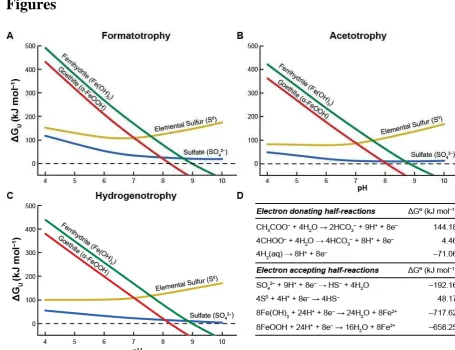
Our thermodynamic models show that under these hypothetical groundwater conditions, 65
the reduction of Fe(III)-containing minerals is favored much more strongly at acidic pH than 66
alkaline (Figure 1). With all three electron donors tested, goethite reduction yields as much energy 67
as sulfate reduction at pH 8 but considerably less than S0reduction above pH 7. The reduction of 68
ferrihydrite provides more energy per mole of substrate than reduction of goethite (Table S1), but 69
this pathway also ceases to provide sufficient energy for respiration at roughly pH 9 for the 70
conditions tested. Although the amount of energy available from these reactions also depends on 71
the concentration of the electron donor being utilized, the strong correlation of pH with the amount 72
of energy available from reducing ferric minerals shows that these means of respiration are likely 73
to be much less favorable at the near-neutral to slightly basic pH of aquifers like the Columbia 74
River Basalt Group (15) or the Continental Intercalaire aquifer (13). The reduction of S0, in 75
contrast, is energetically favorable at any pH and becomes more favorable with increasing pH. 76
Under the modeled conditions, the reduction of Fe(III) provides insufficient 77
respire and grow under these conditions. Indeed, under laboratory conditions with abundant 79
nutrients and large concentrations of electron donor and acceptor, microbial reduction of Fe(III) 80
has been shown to occur at pH > 11 via microorganisms such as Geoalkalibacter and 81
Anaerobranca (16). However, these idealized conditions differ markedly from those in most 82
aquifers, where concentrations of organic acids such as acetate and formate are typically found in 83
micromolar concentrations or less and the thermodynamic driving force is small (17). 84
In goethite-only bioreactors inoculated with wild-type S. oneidensis, considerably more 85
Fe2+was produced at pH 6.8 than pH 9.0 (Figure 2A). We attribute some reduction without added
86
donor to the accumulation of residual reducing power in S. oneidensis cells during their initial 87
growth in rich medium (see Supplementary Materials). At pH 6.8, however, more than twice as 88
much Fe2+ was produced when formate was added versus the no-donor control; at pH 9.0, Fe2+
89
production was the same in control and donor-containing experiments. This result suggests that 90
under the alkaline conditions tested, no respiratory reduction of goethite coupled to formate 91
oxidation occurred, where our model predicts it to be thermodynamically unfavorable (Figure S1). 92
As previously reported (10), the production of Fe2+via goethite reduction did not differ between
93
the PSRA1 mutant or the wild type (Figure 2A and 2B). 94
In bioreactors containing both goethite and S0, the overall production of Fe2+at pH 6.8 was 95
nearly equivalent to that of goethite-only experiments at pH 6.8 for both the wild-type and PSRA1 96
(Figures 2C and 2D). At pH 9.0, however, the wild type produced nearly three times more Fe2+
97
when given formate compared to no-donor controls (Figure 2C). The rate at which Fe2+
98
accumulated was slower at pH 9.0, which is likely due to the slower reaction kinetics between 99
sulfide and goethite at alkaline pH (18). In contrast, the amount of Fe2+produced by PSRA1 at pH
100
speciation by x-ray absorption spectroscopy confirmed that at pH 9.0, S0was reduced to sulfide
102
by the wild type but not by PSRA1 (Figure 3), leading to the formation of mackinawite (FeS). 103
Sulfide was detected in S0-containing bioreactors of both wild-type and PSRA1 cells at pH 6.8,
104
although for the mutant this likely resulted from the abiotic reaction of Fe2+ with S0 to form 105
mackinawite through a polysulfide intermediate (19). Our results indicate that, as predicted by the 106
model (Figure 1), under alkaline conditions S. oneidensis can enzymatically reduce S0 but not
107
goethite. The production of Fe2+ at pH 9 is instead due to the abiotic reduction of goethite by
108
sulfide produced through the enzymatic reduction of S0, suggesting that Fe(III) reduction at 109
alkaline pH proceeds via an indirect, sulfur-dependent electron shuttling pathway similar to those 110
previously known to occur via flavins or humic substances (20). 111
The primary source of dissolved sulfide in the subsurface is microbial sulfate reduction 112
(21), a process where the available energy is affected little by changes in pH (Figure 1). By 113
reducing sulfate to HS–in the presence of Fe(III) minerals in an alkaline aquifer, the respiration of 114
SRB would create S0and allow DMRB like Shewanella spp. to respire (Figure 4). Many studies
115
indicate that Fe(III) reduction and sulfate reduction co-occur frequently in the subsurface (22). 116
Therefore, under alkaline conditions DMRB would depend on the activity of SRB to respire in a 117
commensal or even mutualistic relationship (23). In addition to modern aquifers, such an 118
interaction could have been important on the early Earth, where alkaline conditions are thought to 119
have predominated in large areas of the ocean (24), and may have contributed to the formation of 120
sedimentary pyrite during the Archean and early Proterozoic (25). The extreme alkalinity of the 121
early oceans (pH >10) makes the direct, enzymatic reduction of Fe(III) even less likely to have 122
been energetically favorable, and dissimilatory iron reduction alone probably would not be 123
responsible for the production of Fe2+there.
This ecological connection explains why many DMRB would maintain separate genetic 125
pathways to respire Fe(III) and S0. In the presence of active sulfate reduction and faced with an
126
inability to respire Fe(III) due to energetic limitations, a microbe able to respire both S0and Fe(III)
127
would have a competitive advantage. For example, the microbial reduction of the Fe(III) minerals 128
ferrihydrite and goethite coupled to formate or acetate oxidation results in significant increases in 129
pH due to H+consumption during the corresponding catabolic half reactions (Table S1). The
130
ability to transition from enzymatic reduction of Fe(III) minerals at circumneutral pH to a S0
-131
reducing pathway at alkaline pH where Fe(III) minerals are thermodynamically unavailable for 132
use as electron acceptors thus provides DMRB with a mechanism to sustain energy-generating 133
electron transport processes over a much wider pH range (approaching nearly 4 orders of 134
magnitude) than direct enzymatic Fe(III) reduction alone. Furthermore, at alkaline pH, Fe2+ ions
135
are thought to sorb more strongly to the surfaces of iron oxides and thereby inhibit direct enzymatic 136
reduction (26). Sulfide production through the reduction of sulfate and S0would strip these sorbed
137
ions away and thereby circumvent the passivation of Fe(III) oxide surfaces, providing further 138
evidence for the important of sulfate reduction to the reduction of Fe(III) oxides at alkaline pH. 139
Indirect Fe(III) reduction via a S0 reduction pathway under alkaline conditions could be 140
highly relevant to geologic carbon sequestration. In addition to their critical role as water resources, 141
alkaline aquifers are primary targets for carbon capture and sequestration in the deep subsurface 142
because they can mineralize injected supercritical CO2as carbonate minerals (27). This ability is
143
derived from the superior pH buffering of alkali minerals in the aquifer, where groundwater 144
becomes more acidic after injection of supercritical CO2(28). The reductive dissolution of Fe(III)
145
minerals to aqueous Fe2+—regardless of whether it is mediated biotically or abiotically—is critical
146
thus trapping carbon in solid form (29). Assuming direct enzymatic reduction of ferric minerals is 148
unlikely to occur in alkaline, oligotrophic environments (Figure 1), microbial sulfate reduction and 149
the subsequent reaction of sulfide with ferric minerals to produce Fe2+and S0(which itself could
150
be re-reduced by DMRB to form additional sulfide) would be the primary mechanism responsible 151
for producing Fe2+and sequestering carbon.
152
153
Acknowledgments: This research is part of the Subsurface Science Scientific Focus Area (SFA)
154
at Argonne National Laboratory supported by the Subsurface Biogeochemical Research Program, 155
DOE Office of Science, Office of Biological and Environmental Research under DOE 156
contract DE-AC02-06CH11357. We appreciate the technical assistance of M. Newville and A. 157
Lanzarotti. K. Nealson and J. Fredrickson provided helpful comments which improved the 158
manuscript. X-ray analyses were conducted at Argonne National Laboratory’s Advanced Photon 159
Source (APS), GeoSoilEnviroCARS (Sector 13), supported by the National Science Foundation-160
Earth Sciences (EAR-1128799) and the U.S. Department of Energy (DOE)-GeoSciences (DE-161
FG02-94ER14466). Use of the APS was supported by the DOE Office of Science, Office of Basic 162
Energy Sciences. T.F. was supported in part by an Argonne Director’s Fellowship and the National 163
Institute of Allergy and Infectious Diseases, National Institutes of Health, Department of Health 164
and Human Service (Contract No. HHSN272200900040C). T.D. was supported by the National
165
Science Foundation (Molecular and Cellular Biosciences Grant No. 1021735). All additional 166
information has been archived in the Supplementary Online Material. 167
Fig. 1. Free energy change of microbial metabolisms in a hypothetical pristine aquifer. The amount
168
of usable energy ( GU) available to microorganisms from the reduction of S0, Fe(III) minerals
169
(ferrihydrite and goethite), and sulfate with either (A) formate, (B) acetate, or (C) hydrogen as an 170
electron donor changes with pH. The dotted line at GU = 0 kJ mol–1represents the theoretical
171
minimum energy required to support microbial respiration. Electron donating and accepting 172
processes modeled are shown in D. 173
Fig. 2. Total Fe2+ production in bioreactor experiments. Experiments were conducted at pH 6.8 174
and 9.0 using S. oneidensis MR-1 wild type (A,C) and psrA-deficient mutant PSRA1 (B,D) as an 175
inoculum. Bioreactors contained either 10 mM goethite alone (A,B) or 10 mM each of goethite 176
and S0(C,D). Data points represent the average of triplicate bioreactors with error bars ± standard
177
deviation. 178
Fig. 3. Sulfur K-edge XANES spectra of S-containing bioreactors. Standards shown are (A)
179
unreacted S. oneidensis MR-1 cells, (B) rhombic S0, and (C) mackinawite (FeS). Samples are
shown from bioreactors containing both goethite and S0at pH 9.0 (D, E) or pH 6.8 (F, G) that were
181
inoculated with cells of either the wild type (D, F) or PSRA1 mutant (E, G). 182
Fig. 4. Illustration of S0-mediated Fe(III) reduction under alkaline conditions. 183
Supplementary Materials:
184
Materials and Methods 185
Table S1 186
Figure S1 187
References 31–44. 188
Figures
191
192
Figure 1. Free energy change of microbial metabolisms in a hypothetical pristine aquifer. The
193
amount of usable energy ( GU) available to microorganisms from the reduction of S0, Fe(III)
194
minerals (ferrihydrite and goethite), and sulfate with either (A) formate, (B) acetate, or (C) 195
hydrogen as an electron donor changes with pH. The dotted line at GU = 0 kJ mol–1represents
196
the theoretical minimum energy required to support microbial respiration. Electron donating and 197
199
Figure 2. Total Fe2+production in bioreactor experiments. Experiments were conducted at pH
200
6.8 and 9.0 using Shewanella oneidensis MR-1 wild type (A,C) and psrA-deficient mutant 201
PSRA1 (B,D) as an inoculum. Bioreactors contained either 10 mM goethite alone (A,B) or 10 202
mM each of goethite and S0(C,D). Data points represent the average of triplicate bioreactors
203
with error bars ± standard deviation. 204
206
Figure 3. Sulfur K-edge XANES spectra of S-containing bioreactors. Standards shown are (A)
207
unreacted S. oneidensis MR-1 cells, (B) rhombic S0, and (C) mackinawite (FeS). Samples are
208
shown from bioreactors containing both goethite and S0 at pH 9.0 (D, E) or pH 6.8 (F, G) that 209
were inoculated with cells of either the wild type (D, F) or PSRA1 mutant (E, G). 210
212
[image:13.595.112.487.110.505.2]213
Figure 4. Illustration of S0-mediated Fe(III) reduction under alkaline conditions.
References and Notes
216
1. K. H. Nealson, A. Belz, B. McKee, Breathing metals as a way of life: geobiology in 217
action. Antonie van Leeuwenhoek 81, 215 (2002). 218
2. D. R. Lovley, in The Prokaryotes, E. Rosenberg, E. F. DeLong, S. Lory, E. Stackebrandt, 219
F. Thompson, Eds. (Springer, Berlin, 2013), pp. 287-308. 220
3. M. F. Kirk, L. J. Crossey, C. Takacs-Vesbach, D. L. Newell, R. S. Bowman, Influence of 221
upwelling saline groundwater on iron and manganese cycling in the Rio Grande 222
floodplain aquifer. Appl. Geochem. 24, 426 (2009). 223
4. T. Borch et al., Biogeochemical redox processes and their impact on contaminant 224
dynamics. Environ. Sci. Technol. 44, 15 (2010). 225
5. K. J. Edwards, K. Becker, F. Colwell, The deep, dark energy biosphere: Intraterrestrial 226
life on Earth. Annu. Rev. Earth Planet. Sci. 40, 551 (2012). 227
6. A. Heimann et al., Fe, C, and O isotope compositions of banded iron formation 228
carbonates demonstrate a major role for dissimilatory iron reduction in ~2.5 Ga marine 229
environments. Earth Planet. Sci. Lett. 294, 8 (2010). 230
7. K. H. Nealson, Sediment bacteria: Who's there, what are they doing, and what's new? 231
Annu. Rev. Earth Planet. Sci. 25, 403 (1997). 232
8. K. L. Straub, B. Schink, Ferrihydrite-dependent growth of Sulfurospirillum deleyianum 233
through electron transfer via sulfur cycling. Appl. Environ. Microbiol. 70, 5744 (2004). 234
9. S. W. Poulton, M. D. Krom, R. Raiswell, A revised scheme for the reactivity of iron 235
(oxyhydr)oxide minerals towards dissolved sulfide. Geochim. Cosmochim. Acta 68, 3703 236
(2004). 237
10. J. L. Burns, T. J. DiChristina, Anaerobic respiration of elemental sulfur and thiosulfate by 238
Shewanella oneidensis MR-1 requires psrA, a homolog of the phsA gene of Salmonella 239
enterica serovar Typhimurium LT2. Appl. Environ. Microbiol. 75, 5209 (2009). 240
11. C. M. Bethke, R. A. Sanford, M. F. Kirk, Q. Jin, T. M. Flynn, The thermodynamic ladder 241
in geomicrobiology. Am. J. Sci. 311, 183 (2011). 242
12. T. M. Hoehler, B. B. Jørgensen, Microbial life under extreme energy limitation. Nat. Rev. 243
Microbiol. 11, 83 (2013). 244
13. J. N. Andrews et al., The evolution of alkaline groundwaters in the continental 245
intercalaire aquifer of the Irhazer Plain, Niger. Water Resour. Res. 30, 45 (1994). 246
14. A. H. Welch, D. B. Westjohn, D. R. Helsel, R. B. Wanty, Arsenic in Ground Water of the 247
United States: Occurrence and Geochemistry. Ground Water 38, 589 (2000). 248
15. B. P. McGrail et al., Potential for carbon dioxide sequestration in flood basalts. J. 249
Geophys. Res.: Solid Earth 111, B12201 (2006). 250
16. A. J. Williamson et al., Microbial reduction of Fe(III) under alkaline conditions relevant 251
to geological disposal. Appl. Environ. Microbiol. 79, 3320 (2013). 252
17. P. B. McMahon, F. H. Chapelle, Microbial production of organic acids in aquitard 253
sediments and its role in aquifer geochemistry. Nature 349, 233 (1991). 254
18. S. W. Poulton, Sulfide oxidation and iron dissolution kinetics during the reaction of 255
dissolved sulfide with ferrihydrite. Chem. Geol. 202, 79 (2003). 256
19. K. Hellige, K. Pollok, P. Larese-Casanova, T. Behrends, S. Peiffer, Pathways of ferrous 257
iron mineral formation upon sulfidation of lepidocrocite surfaces. Geochim. Cosmochim. 258
20. S. J. Fuller et al., Extracellular Electron Transport-Mediated Fe(III) Reduction by a 260
Community of Alkaliphilic Bacteria That Use Flavins as Electron Shuttles. Appl. 261
Environ. Microbiol. 80, 128 (2014). 262
21. M. Ledin, K. Pedersen, The environmental impact of mine wastes — Roles of 263
microorganisms and their significance in treatment of mine wastes. Earth-Sci. Rev. 41, 67 264
(1996). 265
22. R. Jakobsen, D. Postma, Redox zoning, rates of sulfate reduction and interactions with 266
Fe-reduction and methanogenesis in a shallow sandy aquifer, Rømø, Denmark. Geochim. 267
Cosmochim. Acta 63, 137 (1999). 268
23. T. Flynn et al., Functional microbial diversity explains groundwater chemistry in a 269
pristine aquifer. BMC Microbiol. 13, 146 (2013). 270
24. S. Kempe, E. T. Degens, An early soda ocean? Chem. Geol. 53, 95 (1985). 271
25. C. M. Johnson, B. L. Beard, E. E. Roden, The iron isotope fingerprints of redox and 272
biogeochemical cycling in modern and ancient Earth. Annu. Rev. Earth Planet. Sci. 36, 273
457 (2008). 274
26. L. Wu, B. L. Beard, E. E. Roden, C. M. Johnson, Influence of pH and dissolved Si on Fe 275
isotope fractionation during dissimilatory microbial reduction of hematite. Geochim. 276
Cosmochim. Acta 73, 5584 (2009). 277
27. M. J. Bickle, Geological carbon storage. Nat. Geosci. 2, 815 (2009). 278
28. J. M. Matter, P. B. Kelemen, Permanent storage of carbon dioxide in geological 279
reservoirs by mineral carbonation. Nat. Geosci. 2, 837 (2009). 280
29. M. F. Kirk, Variation in energy available to populations of subsurface anaerobes in 281
response to geological carbon storage. Environ. Sci. Technol. 45, 6676 (2011). 282
283