White Rose Research Online
[email protected]
Universities of Leeds, Sheffield and York
http://eprints.whiterose.ac.uk/
This is a copy of the final published version of a paper published via gold open access
in
Implementation Science
.
This open access article is distributed under the terms of the Creative Commons
Attribution Licence (
http://creativecommons.org/licenses/by/4.0/
) which permits
unrestricted use, distribution, and reproduction in any medium, provided the
original work is properly cited.
White Rose Research Online URL for this paper:
http://eprints.whiterose.ac.uk/86757
Published paper
S Y S T E M A T I C R E V I E W
Open Access
Using the Knowledge to Action Framework in
practice: a citation analysis and systematic review
Becky Field
1*, Andrew Booth
1, Irene Ilott
2and Kate Gerrish
3,4,5Abstract
Background:Conceptual frameworks are recommended as a way of applying theory to enhance implementation efforts. The Knowledge to Action (KTA) Framework was developed in Canada by Graham and colleagues in the 2000s, following a review of 31 planned action theories. The framework has two components: Knowledge Creation and an Action Cycle, each of which comprises multiple phases. This review sought to answer two questions:‘Is the KTA Framework used in practice? And if so, how?’
Methods:This study is a citation analysis and systematic review. The index citation for the original paper was identified on three databases—Web of Science, Scopus and Google Scholar—with the facility for citation searching. Limitations of English language and year of publication 2006-June 2013 were set. A taxonomy categorising the continuum of usage was developed. Only studies applying the framework to implementation projects were included. Data were extracted and mapped against each phase of the framework for studies where it was integral to the implementation project.
Results:The citation search yielded 1,787 records. A total of 1,057 titles and abstracts were screened. One hundred and forty-six studies described usage to varying degrees, ranging from referenced to integrated. In ten studies, the KTA Framework was integral to the design, delivery and evaluation of the implementation activities. All ten described using the Action Cycle and seven referred to Knowledge Creation. The KTA Framework was enacted in different health care and academic settings with projects targeted at patients, the public, and nursing and allied health professionals.
Conclusions:The KTA Framework is being used in practice with varying degrees of completeness. It is frequently cited, with usage ranging from simple attribution via a reference, through informing planning, to making an intellectual contribution. When the framework was integral to knowledge translation, it guided action in idiosyncratic ways and there was theory fidelity. Prevailing wisdom encourages the use of theories, models and conceptual frameworks, yet their application is less evident in practice. This may be an artefact of reporting, indicating that prospective, primary research is needed to explore the real value of the KTA Framework and similar tools.
Keywords:Knowledge translation, Conceptual framework, Systematic review, Implementation, Citation analysis, Knowledge to Action Framework, Theory, Theory fidelity
* Correspondence:[email protected]
1
School of Health and Related Research (ScHARR), University of Sheffield, Sheffield, UK
Full list of author information is available at the end of the article
Background
Health professionals across the globe share the challenges of translating the best available evidence into actual health interventions in a timely way to provide the most effective care and service. The Knowledge to Action Framework [1] (‘the KTA Framework’) is a conceptual framework intended to help those concerned with knowledge transla-tion deliver sustainable, evidence-based interventransla-tions. Knowledge translation has been defined as a process‘that includes synthesis, dissemination, exchange and ethically sound application of knowledge to improve…health… provide more effective health services and products and strengthen the health care system’[2].
Conceptual frameworks are recommended as a way of preparing for the multiple, dynamic and interactive fac-tors that influence the uptake of evidence in practice [3-5]. Although the terms conceptual frameworks, theor-ies and models are often used interchangeably, concep-tual frameworks are broad and descriptive, whereas theories and models are more specific and amenable to hypothesis testing [6]. Conceptual frameworks provide a frame of reference for organising thinking, a guide for action and interpretation. Potential benefits from apply-ing a conceptual framework include makapply-ing the process of knowledge translation more systematic, with greater likelihood of changed practice and spread of evidence [4,6-9]. Several conceptual frameworks are pertinent for implementation scientists, including Promoting Action on Research Implementation in Health Services (PARIHS) [5,10] the Consolidated Framework for Implementation Research (CFIR) [3] as well as the KTA Framework [1].
The Knowledge to Action Framework
The KTA Framework [1] was developed in Canada by Graham and colleagues in the 2000s in response to the confusing multiplicity of terms used to describe the process of moving knowledge into action [1]. They reviewed 31 planned action theories about the process of change. Most of the theories were interdisciplinary or from nursing and were published between 1983 and 2006 [11]. The findings informed their conceptual framework, which was intended to‘address the need for conceptual clarity in the KTA field and to offer a framework to help elucidate what we believe to be the key elements of the KTA process’[1] (p. 14).
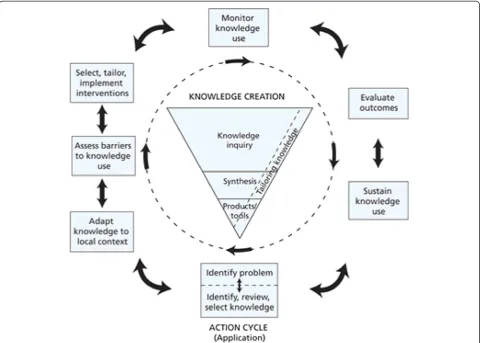
The KTA Framework comprises two distinct but related components: (i) Knowledge Creation (represented by the funnel) surrounded by (ii) the Action Cycle (Figure 1). Each component involves several phases which overlap and can be iterative; Graham and colleagues [1] describe the phases as‘dynamic…can influence each other’(p. 20). Action phases may be carried out sequentially or simul-taneously; knowledge phases may impact on the action phases. The Action Cycle outlines a process, representing the activities needed for knowledge to be applied in
practice; knowledge is adapted to the local context, and barriers and facilitators to its use are explicitly assessed. Involvement of stakeholders, and tailoring knowledge to the needs of people who are going to use it, is crucial.
The National Institute for Health Research (NIHR) Col-laboration for Leadership in Applied Health Research and Care for South Yorkshire (CLAHRC SY) used the KTA Framework to underpin a programme of knowledge trans-lation work undertaken between 2008 and 2013 [12]. As part of this programme, the first author (BF) undertook a knowledge translation project that sought to identify ex-amples of the use of the KTA Framework in practice. No existing systematic review was found on this subject. This review is designed to address this knowledge gap.
This review seeks to answer two questions: ‘Is the KTA Framework being used in practice?’and ‘If so, how is the KTA Framework being used in practice?’We were interested in the‘real-life’application of this conceptual framework to
‘real-world’implementation challenges. A secondary concern was theory fidelity [13], which relates to how this conceptual framework was being used in practice, specifically whether the KTA Framework was articulated in a way that was true to the source paper [1].
Methods
Citation analysis and systematic review
We chose citation searching as our preferred method to identify reports of practical applications of a model or framework [14,15]. Citation searching can circumvent the problems of variation in terminology (a retrieval problem) or uninformative abstracts (a reporting problem) typically encountered in topic-based searches of bibliographic data-bases. We sought to identify all reported citations of a par-ticular reference irrespective of the context within which that reference had been used. Citation searching was fur-ther indicated in this review given that our scoping search, using the databases MEDLINE and CINAHL, had previ-ously identified few abstracts reporting explicitly the use of the KTA Framework in practice.
non-English language articles were removed. Google Scholar also enabled access to book chapters whereas Scopus and Web of Science only indexed peer-reviewed journal articles. All results were imported and combined into an Excel spreadsheet for review by two reviewers.
Inclusion/exclusion criteria
All citations identified were screened by title and avail-able information according to agreed criteria. Papers were excluded if they were not empirical real-life appli-cations of the KTA Framework; if they were literature reviews; if they were only conceptual or descriptive pa-pers (including discussion, commentaries or protocols); if they described a single knowledge translation strategy, such as a clinical practice guideline; or if they were not topically relevant. Given the incomplete abstracts obtained via Google Scholar, a ‘rule-out’ strategy was employed. Citations were excluded where there was in-sufficient information to make a judgment about inclu-sion/exclusion criteria. In practice, the implications of this decision were minimal as many Google Scholar re-cords either duplicated full bibliographic rere-cords already
identified from Web of Science or Scopus or contained at least sufficient detail in the title or in the limited text displayed (text fragment), to indicate whether the paper merited further consideration.
The inclusion criteria were based on an affirmative an-swer to two questions ‘Does the paper describe a KT project?’ and ‘Is the KTA Framework a fundamental guide to this project?’ The initial sift phase was carried out by one researcher (BF), with another researcher cod-ing a proportion of these (II). Difficulties applycod-ing the exclusion criteria were discussed to ensure the inclu-sion/exclusion criteria were applied consistently. Any differences were discussed and resolved by consensus.
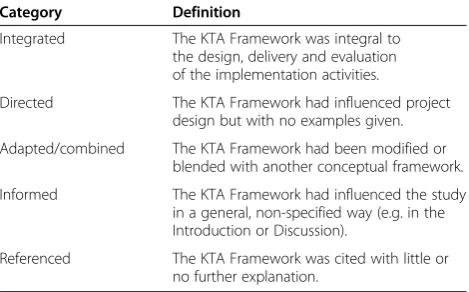
[image:4.595.58.542.89.432.2]Full-text articles were obtained for any article coded for inclusion and for any articles that appeared relevant but where it was unclear whether the KTA Framework had been actually used in practice. Two researchers (BF and II) conducted an initial assessment of the full-text articles. This showed that the degree of usage varied from merely citing the KTA Framework to full integration into the study. We developed a taxonomy to categorise this vari-ation (see Table 1). Included articles were re-examined
and re-coded according to this more detailed classifica-tion. The taxonomy enabled us to refine the inclusion cri-teria to identify studies that reported explicit application of the KTA Framework. This produced a subset of studies that contained examples of using the KTA Framework in an integral way.
Data extraction
The data were extracted from the ‘integrated’ studies where the KTA Framework was applied in practice. Data extracted were mapped to each phase of Knowledge Creation and the Action Cycle (see Figure 1) by one researcher (BF) and then discussed with the whole team.
Quality assessment
The quality of reporting was assessed using criteria adapted from Carroll and colleagues [16]. This involved checking whether the four elements were described. These were the question and study design, recruitment and se-lection and methods of data colse-lection and analysis. We did not assess the research rigour of the individual know-ledge translation projects. Rather, we focused on the appli-cation of, and theory fidelity to, the KTA Framework.
Data analysis
Each article was scrutinised and mapped against the corre-sponding phases within the Knowledge Creation and Ac-tion Cycle components of the framework. Data for each phase were then synthesised across studies to help under-stand how the framework had been used in practice.
Results
The citation search for the original source paper [1] yielded 1,787 records. The result set was reduced to 1,057 records following removal of duplicate and non-English language records. Next, 911 records were excluded at the sift stage. Those excluded at this stage included literature reviews and conceptual, descriptive or commentary pa-pers, papers describing a single knowledge translation
strategy or not topically relevant. In other cases, we made an initial judgement, based on the abstract or a Google text fragment, that the paper was not about an empirical, real-life, knowledge translation or implementation project. A total of 146 papers were identified as attributing use of the KTA Framework. The search results are illustrated in Figure 2, the PRISMA flow chart.
Attribution of use
The full text of the 146 papers was examined to establish the extent to which the use of the KTA Framework was at-tributed by the authors. The papers were coded according to the taxonomy in Table 1. Sixty two of the 146 papers (43%) were classified as‘referenced’, meaning that the frame-work was cited with little, if any, further explanation (see Table 2). Thirty nine (27%) were categorised as ‘informed’ because the KTA Framework had influenced the project in a‘non-specified’way without citing examples of how it had been applied. Seventeen studies (12%) were noted as
‘adaptedorcombined’where the KTA Framework had ei-ther been modified or blended with anoei-ther conceptual framework. A further eighteen (12%) were categorised as
‘directed’because the KTA Framework influenced the pro-ject design or helped to plan, structure or conceptualise what was done, but with no examples given. Only ten stud-ies were integrated, signifying that the KTA Framework was integral to the design, delivery and evaluation of the imple-mentation activities. Importantly, these integrated studies included examples to illustrate how the KTA Framework had been used as a guide. The following analysis focuses on results relating to these ten integrated studies.
Characteristics of studies using the KTA Framework in an integrated way
Eight of the ten studies were conducted in Canada, one in the Democratic Republic of Congo [17] and one in Denmark [18]. Studies were published between 2007 and 2013. Nine were published in peer-reviewed journals with the exception being a Master of Science degree dissertation [19].
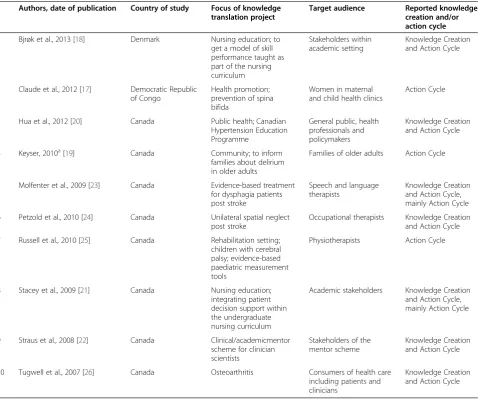
Each implementation study was very different (see Table 3). Two were concerned with public health or health pro-motion [17,20]; three focused on clinical academic or nurse education [18,21,22]. Others related to specific con-ditions, such as stroke [23,24], children with cerebral palsy and motor difficulties [25] and osteoarthritis [26]. The tar-get audience included the public and patients, the families of older adults, health professionals, occupational thera-pists, speech and language therathera-pists, physiotherapists and educationalists/academics within universities.
[image:5.595.57.292.112.258.2]All ten studies reported using the Action Cycle. Seven described using both the Knowledge Creation and the Action Cycle components [18,20-24,27]. None described applying every phase of the KTA Framework.
Table 1 Taxonomy for application of the KTA Framework within included studies
Category Definition
Integrated The KTA Framework was integral to the design, delivery and evaluation of the implementation activities.
Directed The KTA Framework had influenced project design but with no examples given.
Adapted/combined The KTA Framework had been modified or blended with another conceptual framework.
Informed The KTA Framework had influenced the study in a general, non-specified way (e.g. in the Introduction or Discussion).
Application of Knowledge Creation
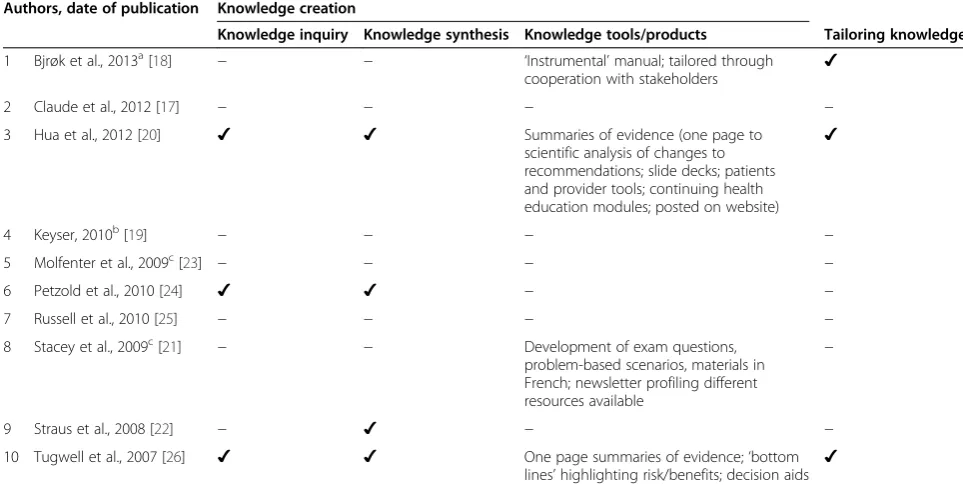
Two studies reported using all phases of Knowledge Creation [20,26] (see Table 4). Five studies applied one or more phases [18,20,22,24,26]. Tailoring knowledge was de-scribed in three studies [18,20,26]. Associated knowledge
tools included summaries of evidence targeted at specific audiences, continuing health care education modules, in-formation posted on websites and decision aids.
Application of the Action Cycle
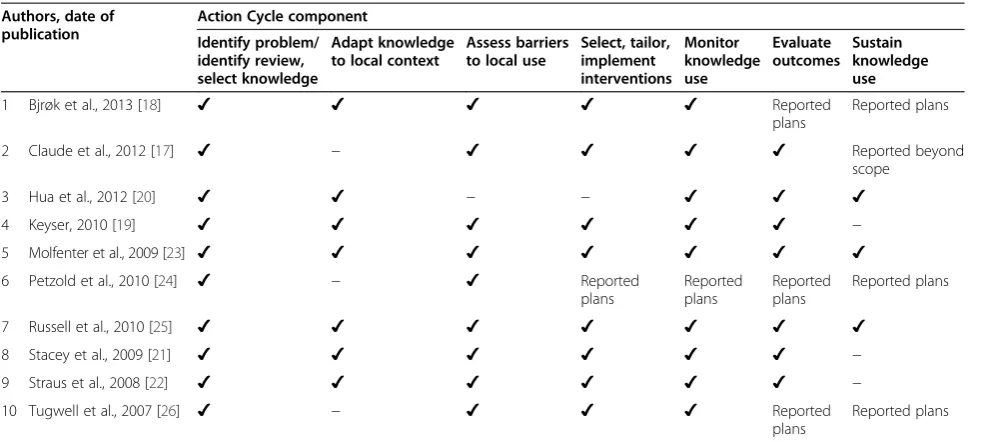
All ten studies reported applying the Action Cycle, de-scribing at least five of the seven possible phases (see Table 5). All undertook the first phase of ‘identifying the problem’. The least reported phase, or the phase carried out least often, was‘sustain knowledge use’. Three stud-ies illustrated each phase of the Action Cycle or ex-plained their reasons for not doing so [18,23,25].
Further information about how the different studies ap-plied the phases within the Action Cycle are shown in Table 6. Each study demonstrates the particularity of
Table 2 Frequency and percentage of types of KTA Framework used
Category n(%)
Integrated 10 (7%)
Directed 18 (12%)
Adapted/combined 17 (12%)
Informed 39 (27%)
Referenced 62 (43%)
[image:6.595.60.538.87.516.2]Total (N) 146
[image:6.595.57.292.639.733.2]implementation activities. Most studies illustrate how knowledge was adapted to the local context. Question-naires, interviews, workshops, focus groups and needs as-sessment were used to identify barriers to change. Education was the most frequently employed strategy albeit in a variety of forms.
Quality assessment
Quality assessment of the integrated studies proved prob-lematic given that many papers did not report research questions, traditional research designs or recruitment and selection of participants as required by the criteria [16]. Rather, papers typically stated aims and objectives, which often related to closing evidence/knowledge-practice gaps. Papers could be scrutinised according to how their aims and objectives had been operationalised. On this basis, all ten studies were judged as having described their projects
clearly. Four of the ten studies [17,19,21,23] reported gain-ing ethical approval, suggestgain-ing that these had been inde-pendently characterised as research.
Discussion
The KTA Framework [1] is being used in practice with varying degrees of completeness and theory fidelity when the conceptual framework is integrated into the imple-mentation project. It is one of the most frequently cited conceptual frameworks for knowledge translation. A cit-ation search of three databases tracking the source paper
[image:7.595.60.539.99.500.2]‘Lost in knowledge translation: time for a map?’ identi-fied 1,787 records between 2006 and July 2013. Some in-dication of the impact of this article can be gained from constructing a ‘normalised citation count’ for compari-son purposes. The source paper was cited four times more frequently than the next highest cited article from the same journal published in the same year. It was cited
Table 3 Characteristics of the studies reporting application of the KTA Framework in an integrated way
Authors, date of publication Country of study Focus of knowledge translation project
Target audience Reported knowledge creation and/or action cycle
1 Bjrøk et al., 2013 [18] Denmark Nursing education; to
get a model of skill performance taught as part of the nursing curriculum
Stakeholders within academic setting
Knowledge Creation and Action Cycle
2 Claude et al., 2012 [17] Democratic Republic of Congo
Health promotion; prevention of spina bifida
Women in maternal and child health clinics
Action Cycle
3 Hua et al., 2012 [20] Canada Public health; Canadian
Hypertension Education Programme
General public, health professionals and policymakers
Knowledge Creation and Action Cycle
4 Keyser, 2010a[19] Canada Community; to inform
families about delirium in older adults
Families of older adults Action Cycle
5 Molfenter et al., 2009 [23] Canada Evidence-based treatment
for dysphagia patients post stroke
Speech and language therapists
Knowledge Creation and Action Cycle, mainly Action Cycle
6 Petzold et al., 2010 [24] Canada Unilateral spatial neglect post stroke
Occupational therapists Knowledge Creation and Action Cycle
7 Russell et al., 2010 [25] Canada Rehabilitation setting;
children with cerebral palsy; evidence-based paediatric measurement tools
Physiotherapists Action Cycle
8 Stacey et al., 2009 [21] Canada Nursing education;
integrating patient decision support within the undergraduate nursing curriculum
Academic stakeholders Knowledge Creation and Action Cycle, mainly Action Cycle
9 Straus et al., 2008 [22] Canada Clinical/academicmentor
scheme for clinician scientists
Stakeholders of the mentor scheme
Knowledge Creation and Action Cycle
10 Tugwell et al., 2007 [26] Canada Osteoarthritis Consumers of health care
including patients and clinicians
Knowledge Creation and Action Cycle
a
470 unique times across all databases. However, citation figures do not reflect how this conceptual framework has actually been applied in practice. We initially in-cluded 146 studies that reported using the KTA Frame-work. Closer examination revealed that usage varied considerably, ranging from simple attribution via a refer-ence through to being integral to most aspects of the implementation work. Only ten studies reported and gave supportive examples of incorporating the KTA Framework in an integrated way. All these described the Action Cycle and seven referred to Knowledge Creation, articulating the KTA Framework in a way that was true to the source paper [1].
There was substantial variation in the setting and tar-get audience for each documented change, the methods used to apply the KTA Framework and the terminology employed to report the phases within Knowledge Cre-ation and the Action Cycle. This reflects the spread of the framework across a range of settings, to different health care services and systems and larger scale and smaller projects. The KTA Framework was adapted to different health service settings and resources, indicating a good fit for the diversity of real-world health care. However, the target audiences were primarily patients, the public and the nursing and allied health professions.
Most studies (8/10) were conducted in Canada where the KTA Framework originated. This frequency of use in Canada could be explained by the influence of national
Canadian networks and dissemination activities. Perhaps more significantly, the KTA Framework is associated with the Canadian Institutes of Health Research [27]. Estab-rooks and colleagues [28] comment that the Canadian re-search funding organisation had adopted the KTA Framework to guide knowledge translation, deploying spe-cific grant mechanisms ‘to ensure involvement of know-ledge users with researchers throughout the research process’ (p. 2). This may explain the varying degrees to which the framework was used.
The KTA Framework was enacted in a variety of ways, from informing to full integration, showing flexibility of use and that it can fit local circumstances and need. Use at a ‘lighter’ level through adapting or combining with other conceptual frameworks could be considered a strength, in that the KTA Framework offers the flexibil-ity to be combined with other frameworks, being responsive to facilitating practitioner preferences and context-specific needs. It is important to note that Graham and colleagues have continued to publish on applications of the framework and the multiple factors to be considered [29]. In addition, this suggests concep-tual frameworks do not have to be muconcep-tually exclusive.
[image:8.595.55.537.103.347.2]Each study applied the framework in an idiosyncratic way. None reported using every phase of the KTA Framework. Only four studies detailed Knowledge Cre-ation, yet existing knowledge was utilised in the other studies to identify knowledge-practice gaps, or as part of
Table 4 Application of the Knowledge Creation phases
Authors, date of publication Knowledge creation
Knowledge inquiry Knowledge synthesis Knowledge tools/products Tailoring knowledge
1 Bjrøk et al., 2013a[18]
− − ‘Instrumental’manual; tailored through
cooperation with stakeholders ✔
2 Claude et al., 2012 [17] − − − −
3 Hua et al., 2012 [20] ✔ ✔ Summaries of evidence (one page to
scientific analysis of changes to recommendations; slide decks; patients and provider tools; continuing health education modules; posted on website)
✔
4 Keyser, 2010b[19] − − − −
5 Molfenter et al., 2009c[23] − − − −
6 Petzold et al., 2010 [24] ✔ ✔ − −
7 Russell et al., 2010 [25] − − − −
8 Stacey et al., 2009c[21] − − Development of exam questions,
problem-based scenarios, materials in French; newsletter profiling different resources available
−
9 Straus et al., 2008 [22] − ✔ − −
10 Tugwell et al., 2007 [26] ✔ ✔ One page summaries of evidence;‘bottom
lines’highlighting risk/benefits; decision aids ✔
Key:−indicates that this phase was not named explicitly within the text.
a
Reported‘knowledge creation and tailoring’.
b
Masters of Science dissertation, involving a literature review.
c
the Action Cycle. This flexibility was intended, as Graham and colleagues [1] state the framework can‘…also accom-modate different phases being accomplished by different stakeholders and groups (working independently of each other) at different points in time’(p. 18). Implementation researchers and health professionals can learn from this flexibility. It may be useful for them to consider the extent to which they wish to follow or be guided by a conceptual framework before embarking on a knowledge translation project, especially regarding outcome measures because
‘....the focus of knowledge into action is ultimately to en-hance health status’ [1 p. 18]. The Action Cycle was re-ported in all the integrated examples, illustrating theory fidelity in this specific subset of studies. The prevalence of the Action Cycle may simply reflect the cyclical nature of the change process evident in other common, quality im-provement tools such as the ‘Plan, Do, Study, Act’cycle [30]. Also, this conceptual framework may appeal because of a lack of jargon and a simple diagram depicts the know-ledge translation process.
The integrated studies described different ways of inte-grating the KTA Framework, particularly the Action Cycle. Most studies focused on improving knowledge or awareness, supporting what we know about the prepon-derance of professional or educational knowledge trans-lation strategies within interventions aiming to promote the uptake of evidence [31]. Nine of the studies reported assessing barriers to change [17-19,21-26]. Knowledge-related barriers [32] were the most common, indicating the appropriateness of using educational strategies to ad-dress such barriers. Yet the albeit limited, evidence avail-able indicates that bringing information close to the
point of decision-making (such as using reminders or decision support tools) is likely to be more effective than using more traditional educational strategies (such as study, teaching or training) to try to address barriers and change practice [31,33]. Only one study [26] reported using decision support tools as a knowledge translation strategy, although it is possible others did not report all the details of strategies they used to promote the adoption of their interventions. Knowledge translation strategies can include elements such as linkage and exchange, audit and feedback, informatics and patient-mediated and or-ganisational interventions [29]. However, none of these knowledge translation strategies, designed to target differ-ent barriers, featured in the included studies, with one ex-ception. Russell and colleagues [25] describe use of a knowledge broker, an example of a‘linkage and exchange’ -type strategy.
[image:9.595.56.552.99.320.2]The importance of organisational or external factors and the ability to influence them is well recognised [1,3,33-35]. Authors identified many barriers relating to
‘environmental’factors [32] such as lack of time and/or resources. Generally, it was difficult to ascertain whether the methods used captured, and indeed subsequently ad-dressed, the full range of barriers. It may be that when people are consulted, they identify those barriers that they feel able to influence, such as knowledge or aware-ness, rather than organisational barriers, which could be perceived as more problematic or more distant. An ex-ception was the study by Russell and colleagues [25] who reported using a questionnaire to assess a range of potential barriers and facilitators. Molfenter and col-leagues [23] describe a strategy to assist clinicians with
Table 5 Application of the Action Cycle phases
Authors, date of publication
Action Cycle component
Identify problem/ identify review, select knowledge
Adapt knowledge to local context
Assess barriers to local use
Select, tailor, implement interventions
Monitor knowledge use
Evaluate outcomes
Sustain knowledge use
1 Bjrøk et al., 2013 [18] ✔ ✔ ✔ ✔ ✔ Reported
plans
Reported plans
2 Claude et al., 2012 [17] ✔ − ✔ ✔ ✔ ✔ Reported beyond
scope
3 Hua et al., 2012 [20] ✔ ✔ − − ✔ ✔ ✔
4 Keyser, 2010 [19] ✔ ✔ ✔ ✔ ✔ ✔ −
5 Molfenter et al., 2009 [23] ✔ ✔ ✔ ✔ ✔ ✔ ✔
6 Petzold et al., 2010 [24] ✔ − ✔ Reported
plans
Reported plans
Reported plans
Reported plans
7 Russell et al., 2010 [25] ✔ ✔ ✔ ✔ ✔ ✔ ✔
8 Stacey et al., 2009 [21] ✔ ✔ ✔ ✔ ✔ ✔ −
9 Straus et al., 2008 [22] ✔ ✔ ✔ ✔ ✔ ✔ −
10 Tugwell et al., 2007 [26] ✔ − ✔ ✔ ✔ Reported
plans
Reported plans
reviewed, selected interventions
1 Bjrøk et al., 2013 [18]
Problem of qualifying nursing students in practical skill acknowledged by educators, researchers and students
‘Research in nursing skills group’ refined theoretical model; developed a supplement to the model; developed‘heuristic’ devices
‘Research in nursing skills’group created; identifies barriers; language of manual; lack of examples
Implementation skills centres and clinical practice; working with students, teachers, clinical supervisors
Monitoring as part of defined projects; process and outcome evaluation of the model in ongoing studies; sustaining knowledge use planned
2 Claude et al., 2012 [17]
Reviewed evidence that spina bifida is preventable through use of peri-conceptual maternal folate supplements; reviewed local surgical cases at one hospital
− Knowledge, attitude and practices
questionnaire (n=150 women attendees at prenatal consultations) and focus group identified limited use and awareness of folic acid, willingness to take it and to pay cost
Radio broadcasts and educational video
142 women completed questionnaires before and after video; 95% agreed video was understandable and should be widely disseminated. Short-term knowledge gain (pre/post-test) was found to have increased significantly. Evaluation and sustaining phases stated as beyond the scope of this project
3 Hua et al., 2012 [20]
‘Canadian Hypertension Education Program Recommendations Task Force’identifies what is old but still important from evidence base and previous recommendations
Small group workshops; pilot testing of recommendations led by committee representative of the target health care professionals
‘Implementation task force’
‘addresses barriers to knowledge use’; specific barriers not reported
Information and educational resources for health care practitioners, patients and policymakers (e.g. fact sheets, one-page summaries, post cards);
‘train the trainer’programme to aid dissemination of materials (1-day course offered throughout the year in English and French, across Canada)
‘Outcomes Review Task Force’ examines national and provincial administrative data; for example, improved self-reported awareness of hypertension, use of multiple hypertensive agents, greater control of hypertension and improved age- and sex-standardised mortality rates
4 Keyser, 2010 [19]
Problem identified by focus group that families of elderly lacked understanding of delirium; literature reviewed and synthesised to ensure that information given was up to date
Existing educational resources gathered and appraised for level of appropriateness to lay population; best available chosen
Focus group with families identified limited awareness
Six education sessions and information package given to participants
‘Knowledge test’before and after intervention; limitations of this approach to monitoring and evaluation and sustaining knowledge use discussed
5 Molfenter et al., 2009 [23]
‘Knowledge to action’gap identified in swallowing rehabilitation; despite training, speech and language therapists not using recommended tool in practice; research team reviewed literature, designed treatment protocol
Adapted knowledge to the facility and individual clinicians—discussed potential application to their caseloads
Discussions between research team and clinicians identified time; appropriate patient selection; discomfort with the technology; competing priorities
Tailored support for clinicians; assistance to select appropriate patients on site; individualised training, ad hoc support and mentorship available via email, telephone and in person
Mentors monitored progress. Outcomes evaluated via qualitative interviews with clinicians; thematic analysis identified key themes. Sustaining knowledge use described as ongoing partnership between the research team and clinicians; clinicians continue to access support from mentors
6 Petzold et al., 2010 [24]
Two multicentre studies identified limited best practice for management of unilateral spatial neglect post stroke
Not reported Focus groups with clinicians; interviews between researchers and clinicians; key themes re: barriers and facilitators identified; specific barriers not reported
Plans reported a for multimodal knowledge translation intervention, informed by barriers and facilitators identified
Plans reported for follow-up studies to address whether desired change has occurred
[image:10.595.67.702.68.543.2]therapists and physiotherapists treating re: best practice guidelines and measurement tools
and instructional DVD for particular measurement tools, key articles, summaries and case scenarios; intranet site established; PowerPoint presentation for knowledge brokers to adapt as they wished
re: organisational structure, resources, target therapists, the children and families and the measurement tools themselves; specific barriers not reported
recorded their activities, regular teleconferences and use of intranet to facilitate sharing of strategies
and physiotherapists completed online survey re: knowledge and use pre and post intervention, and at 6, 12 and 18 months; semi-structured telephone interviews held with knowledge brokers, physiotherapists and centre administrators at 6 and 18 months
8 Stacey et al., 2009 [21]
Audit of nursing curriculum course identified lack of awareness and use of patient decision support resources (by nursing students and faculty members)
Plan for the integration of decision support throughout the nursing curriculum shared with key stakeholders; project advisory team established
Needs assessment with faculty members identified limited awareness , time pressures, limited resources in French and lack of instructional tools (e.g. case scenarios, exam questions assignments)
Faculty development activities to address identified barriers. For example, staff workshop, newsletter profiling different resources, exam questions, case scenarios, assignments created
Monitoring identified use of scenarios and assignments; lectures given; knowledge use observed amongst students in course assignments, seminars and exam questions; faculty members requested session on patient support plans for evaluation and sustaining knowledge use discussed
9 Straus et al., 2008 [22]
Need to provide adequate mentorship for clinical researchers identified by researchers and research funders
Workshop for funders, university administrators and clinician scientists to review evidence on mentorship tools
Workshop identified barriers as: lack of recognition of importance of mentoring at departmental/ university levels; lack of educational intervention for mentors/mentees and difficulty finding mentors; lack of time and capacity
Written summary of key messages, local opinion leaders/academic detailing, website, newsletters targeting administrators, departmental chairs, researchers, mass media, chairs of research institutes
Monitoring identified development of mentorship facilitators and workshops. Plans reported to evaluate impact of adopted mentorship strategies, for example, repeating qualitative study re: experiences of mentorship; sustainability considered for example by trying to ensure ongoing participation of stakeholders, and qualitative evaluation—if the intervention not found to be effective, iterative cycle of design and testing to try and refine it
10 Tugwell et al., 2007 [26]
People with musculoskeletal conditions, family members and physicians were interviewed as part of another project—results indicated people wanted information about treatments and what they could do to help themselves, but health care providers had difficulty translating information into lay language
Evidence was adapted, for example, by describing situations when individuals may want to consider treatment, by presenting benefits and harms out of 100 people and decision aids
Interviews re: barriers identified the Internet as an important source of information but that physicians were still regarded as gatekeepers to information and services; literature re: barriers and facilitators also considered and identified lack of awareness, difficulty accessing them or limited time of physicians
Aimed to increase consumer awareness of and access to knowledge products/tools (patient decision aids on key websites and given to key helplines/call centres); on website for physicians to access and print out decision aids
Describe plans to monitor use of these tools; basic evaluation of website visits and a web survey completed. Authors discuss challenges of evaluating outcome and sustaining knowledge use and other work related to this
Key:−indicates that this phase was not named explicitly within the text.
[image:11.595.65.702.69.506.2]patient selection which could be interpreted as seeking to influence organisational barriers such as ‘competing priorities’, as well as addressing knowledge-related bar-riers. Légaré [32] recommends using established taxon-omies developed for barriers and facilitators within knowledge translation projects. Our findings support this proposal. We further identified a need to use taxon-omies when analysing or evaluating knowledge transla-tion strategies [33,34]. This study also reinforces the importance of reporting standards [8,36], such as the new TIDieR checklist [37] to facilitate more explicit reporting of implementation studies and their subse-quent inclusion in systematic reviews.
The monitoring, outcomes or sustaining phases of the Action Cycle were less often described, although three noted their plans for doing so [18,24,26]. This may reflect a publication bias, between reporting process and out-comes. Claude and colleagues [17] stated that these phases were beyond the scope of their project. Such work may re-quire additional funding for longer term monitoring or strategies to sustain knowledge use over time. It may also be a reflection of the challenges for defining and reporting outcomes for knowledge translation projects. Tugwell and colleagues [26] highlight this particular challenge, com-menting that most outcomes in arthritis research are about pain and function. In contrast, they wanted to evaluate the impact of their intervention on people’s ability to understand their choices and make informed decisions about treatment. Consequently, we recommend that the phase ‘select, tailor, implement intervention’ be amended to include‘define and select outcomes and knowledge use measures’, as a prompt to those using the KTA Frame-work to specify such outcomes when selecting which knowledge translation strategies to use.
A notable feature of the KTA Framework is the develop-ment of knowledge tools or products as part of Knowledge Creation. Most studies created a range of products, either as part of Knowledge Creation [18,20,21,26] or the Action Cycle [21,23,24]. Interestingly, a recent evaluation of the Canadian Institutes of Health Research (CIHR) Knowledge Translation Funding Program [38] presented results relat-ing to knowledge translation products, academic outputs and capacity building together, giving the appearance, in our interpretation, that these different dimensions may be regarded as equally important.
Interest in using systematic literature reviews to inves-tigate theories, models and conceptual frameworks has increased in recent years [7,39]. Yet, this method may prove challenging, often because of limited and impre-cise reporting. Davies and colleagues [40] note that less than 6% of 235 studies, albeit published before 1998, ex-plicitly used theories of behaviour or behaviour change. They and we resorted to a simple taxonomy to describe the level and type of usage based on explicit reporting. A
coding scheme, with 19 categories for theory use for be-haviour change interventions, ranging from mentioned but not demonstrated, right through to theory refine-ment, has been developed [41]. This scheme may be use-ful for similar studies examining theory use. However, our review focused primarily on examining how a con-ceptual framework had been used in practice. Using the framework itself as a device through which to examine how it had been used seemed an appropriate and prag-matic approach for our purposes.
Bartholomew and Mullen [42] suggest that the ‘ pre-vailing wisdom in the field of health-related behaviour change is that well-designed and effective interventions are guided by theory’ (p. S20). Others argue that the ef-fectiveness and generalisability of implementation stud-ies are hindered by weak theoretical underpinnings [40,43,44]. Our review, and similar studies [39,40,43-45], consistently comments on the limited, haphazard use of theory, even though theories can be applied in many dif-ferent ways [41]. Primary studies, exploring the direct experience and perceptions of different stakeholders in implementation projects, which have been guided by conceptual frameworks, or theories, would add to our understanding of the utility and impact of these tools. A few authors have attempted this, such as McEvoy and colleagues [43] who examined benefits reported by au-thors using the Normalization Process Theory. A pro-spective design would strengthen research studies.
Future research could examine the studies which we categorised as using the KTA Framework to a lesser de-gree, perhaps for conceptual or persuasive reasons rather than instrumentally. It would be interesting to review the conceptual papers we excluded to explore how they were influenced by the framework and informed the de-velopment of conceptual frameworks more generally. Exploring the impact of the KTA Framework, and other conceptual frameworks, on patients and the public in terms of health improvement and outcomes would also be worthwhile, as would exploring their involvement in the application of the framework, not just as recipients of services but as key stakeholders in each phase.
Limitations
two authors (BF and II), and the synthesis was discussed in detail by the team. Initial ‘screening out’ by title and abstract on the basis of partial information from Google Scholar may also have excluded relevant studies. This is a limitation of using Google Scholar for citation searches. We acknowledge that there are multiple choices available when conducting citation searches. In the absence of for-mal comparisons of citation search techniques, we decided to operationalise citation searching using Google Scholar. Although there may be some small variation in the actual sets of references retrieved by different citation searches, we have no reason to believe that we have systematically under- or over-represented particular types of studies in our sample. Non-English language studies were excluded, reducing access to examples of applying the KTA Frame-work published in other languages. This is noteworthy given Canadian research may be published in French lan-guage journals. Further, the time frame of the citation searches only captures work up to a certain point (from the date of publication of the source paper to July 2013). We recognise that assimilation and utilisation of an influ-ential framework is a continuous process and that we have employed essentially a cross-sectional method to survey the literature. However, the method is replicable and could be repeated to update the review in future.
Selection bias is another limitation given that we aimed to identify papers reporting usage of the KTA Framework rather than considering or comparing with other conceptual frameworks. This reflected our focus on whether the KTA Framework is used in practice and, if so, how it is applied.
The search strategy was limited to citation searching of three databases. We did not follow up references (in-cluding book chapters) or contact authors of included or excluded studies. Neither did we seek out grey literature or search specific thesis/dissertation databases. Citation searching seeks to optimise sensitivity and specificity when seeking to identify reports of practical applications of a model or framework. Our experience certainly con-firms that this search method circumvents the problems of variation in terminology typically encountered in topic-based searches of bibliographic databases. How-ever, as shown by our study, citation searching in isola-tion from citaisola-tion analysis—the detailed examination of full-text—is unable to discriminate between where a model is simply mentioned ‘in passing’or even for ‘ cos-metic’ reasons and where it represents an explicit intel-lectual and conceptual contribution.
We acknowledge that faced with the same task, an-other review team might choose to include papers reporting a single knowledge translation strategy. We did not include the many papers about clinical practice guidelines for two interrelated reasons. Firstly, we were interested in the practical application of the KTA
Framework and thus in identifying papers where the KTA Framework appeared to be a fundamental guide to the work reported. Secondly, multifaceted strategies are more likely to be successful than a single strategy [27,46,47], as they target different barriers [40], which reflects our interest in the real-world use of the KTA Framework, where it is probably impossible to control and isolate one strategy [48]. However, it is worth noting that clinical guidelines could be categorised as know-ledge tools/products and/or implementation strategies depending on if, and how, the guideline features in the framework.
Similarly, we acknowledge that some readers may be interested in precise reasons for exclusions. We have chosen to report the aggregate number of excluded pa-pers on the PRISMA flow diagram (Figure 2). Due to overlapping categories (e.g. review papers, conceptual or descriptive papers and those describing a single know-ledge translation strategy or not topically relevant), we excluded against a single criterion, even when multiple criteria applied, as practical considerations rendered it unnecessary to exhaustively document all possible rea-sons for exclusion for each paper.
Inevitably, decisions about including or excluding studies were reliant on subjective judgements about whether the KTA Framework had been reported in an integrated way, or not. A continuum of usage, ranging from referenced to integrated, was developed to aid this process. Judging between informed and directed was dif-ficult, suggesting further refinement of the categories is required.
Data extraction and presenting results according to the phases were also challenging, given that the frame-work is dynamic, and can be non-sequential with overlap between phases [1]. There were occasions when we sensed that aspects of Knowledge Creation and Action Cycle had been done or combined, but as this was not explicit, we excluded these data. For example, the cre-ation of websites, interactive e-learning modules, train-ing packages and a protocol were reported as part of the Action Cycle [19,23,24], yet they could be knowledge tools/products. This reinforces the importance of theory fidelity and that authors refer to established taxonomies or reporting standards [36,37,40,41] so we can under-stand how conceptual frameworks, theories and models are really used to guide practice or inform research.
Conclusion
Citation searching for the original reference by Graham and colleagues [1] optimised the sensitivity and specificity of the search strategy. It was cited 470 unique times across the three databases, indicating the bibliometric impact of the source paper. However, we were interested in the real-world application of the KTA Framework as a guide to im-plementation activities in health care and whether it was used in a way that was true to the framework. The authors’ attribution of use was variable, with most merely referen-cing the framework or describing how it was used to in-form or structure projects. Only 10 of 146 papers reported direct use, with examples demonstrating that the frame-work was integral to their study. In these studies, the KTA Framework appeared to provide a practical yet flexible guide to getting research findings into practice, allowing it to be applied in idiosyncratic ways. This illustrates the adaptability of the conceptual framework to different health care settings and topics. The KTA could also be used as a literacy device to structure reporting of the framework.
Conventional views support the use of theories, models and conceptual frameworks to underpin the process of change, yet in practice, their application seems more lim-ited [40,43-45]. This may be an artefact of reporting: few studies justify or explain their theoretical stance; even fewer do so using the appropriate constructs or with the-ory fidelity. This presents an interpretation challenge both for those seeking to learn from such projects and system-atic reviewers. Understanding if and how these theoretical tools add value to implementation endeavours and out-comes merits further research.
Abbreviations
CIHR:Canadian Institutes of Health Research; CLAHRC SY: Collaboration for Leadership in Applied Health Research and Care for South Yorkshire; CLAHRC YH: Collaboration for Leadership in Applied Health Research and Care for Yorkshire and Humber; KTA Framework: Knowledge to Action Framework; NIHR: National Institute for Health Research.
Competing interests
AB is a member of the editorial board of Implementation Science. The authors declare that they have no competing interests.
Authors’contributions
BF, II and AB conceived the review; AB designed the study; AB undertook the searches; BF and II screened and extracted the data; BF wrote the review; and BF, II, AB and KG made comments and edited the review drafts. All authors read and approved the final manuscript.
Authors’information
BF is a researcher at the School of Health and Related Research (ScHARR), University of Sheffield, and also an occupational therapist. AB is Reader in Evidence Based Information Practice at the School of Health and Related Research (ScHARR), University of Sheffield, where he leads on systematic review and evidence synthesis activities. II is an occupational therapist. Between 2009 and 2013, she was a Knowledge Translation Project Lead with the NIHR CLAHRC SY. II provided BF with clinical supervision for her MSc dissertation. KG is a professor of nursing research at the University of Sheffield and Sheffield Teaching Hospitals NHS Foundation Trust where she leads the Translating Knowledge into Action theme of NIHR CLAHRC for Yorkshire and Humber. From 2008 to 2013, she led the Translating Knowledge into Action theme of NIHR CLAHRC SY.
Acknowledgements
This article presents independent research by the National Institute for Health Research Collaboration for Leadership in Applied Health Research and Care for Yorkshire and Humber (NIHR CLAHRC YH). The views and opinions expressed are those of the authors and not necessarily those of the NHS, the NIHR or the Department of Health.
The lead author (BF) contributed to this study while undertaking the National Institute for Health Research/Health Education England Clinical Academic Training Programme Master in Clinical Research scheme. CLAHRC YH would also like to acknowledge the participation and resources of our partner organisations. Further details can be found at www.clahrc-yh. nihr.ac.uk.
We thank Jennifer Read who provided BF with academic supervision for her MSc dissertation.
Funding
The study was funded by the National Institute for Health Research (NIHR) Collaboration for Leadership in Applied Health Research and Care (CLAHRC) for South Yorkshire and Collaboration for Leadership in Applied Health Research and Care (CLAHRC) for Yorkshire and Humber.
Author details
1
School of Health and Related Research (ScHARR), University of Sheffield, Sheffield, UK.2NIHR CLAHRC SY, Sheffield, UK.3School of Nursing and
Midwifery, University of Sheffield, Sheffield, UK.4Sheffield Teaching Hospitals NHS Foundation Trust, Sheffield, UK.5NIHR CLAHRC YH, Sheffield, UK.
Received: 7 July 2014 Accepted: 6 November 2014
References
1. Graham I, Logan J, Harrison M, Straus S, Tetroe J, Caswell W, Robinson N: Lost in knowledge translation: time for a map?J Contin Educ Health Prof 2006,26:13–24.
2. More About Knowledge Translation at CIHR—CIHR.[http://www.cihr-irsc. gc.ca/e/39033.html]
3. Damschroder LJ, Aron DC, Keith, Rosalind E, Kirsh SR, Alexander JA, Lowery JC:Fostering implementation of health services research findings into practice: a consolidated framework for advancing implementation science.Implement Sci2009,4:
4. Eccles M, Grimshaw J, Walker A, Johnston M, Pitts N:Changing the behavior of healthcare professionals: the use of theory in promoting the uptake of research findings.J Clin Epidemiol2005,58:107–12.
5. Rycroft-Malone J:The PARIHS framework: a framework for guiding the implementation of evidence based practice.J Nurs Care Qual2004, 19:297–304.
6. Rycroft-Malone J, Bucknall T:Models and Frameworks for Implementing Evidence-Based Practice.Chichester, UK: Wiley Blackwell; 2010.
7. Ilott I, Gerrish K, Booth A, Field B:Testing the consolidated framework for implementation research on health care innovations from South Yorkshire.J Eval Clin Pract2013,19:915–24.
8. Helfrich CD, Damschroder LJ, Hagedorn HJ, Daggett GS, Sahay A, Ritchie M, Damush T, Guihan M, Ullrich PM, Stetler CB:A critical synthesis of literature on the promoting action on research implementation in health services (PARIHS) framework.Implement Sci2010,5:82.
9. Tabak RG, Khoong EC, Chambers DA, Brownson RC:Bridging research and practice: models for dissemination and implementation research. Am J Prev Med2012,43:337–50.
10. Rycroft-Malone J, Harvey G, Kitson A, McCormack B, Seers K, Titchen A: Getting evidence into practice: ingredients for change.Nurs Stand2002, 16:38–43.
11. Graham ID, Tetroe J, KT Theories Research Group:Some theoretical underpinnings of knowledge translation.Acad Emerg Med2007, 14:936–941.
12. Ilott I, Gerrish K, Bray K, Laker S:Tackling the implementation challenge: bridging thegapbetweenresearchandpractice.[http://www.rcn.org.uk/__data/ assets/pdf_file/0014/512600/2013_RCN_research_W06.pdf]
14. Finfgeld-Connett D, Johnson ED:Literature search strategies for conducting knowledge-building and theory-generating qualitative systematic reviews.J Adv Nurs2013,69:194–204.
15. Booth A, Harris J, Croot E, Springett J, Campbell F, Wilkins E:Towards a methodology for cluster searching to provide conceptual and contextual
“richness”for systematic reviews of complex interventions: case study (CLUSTER).BMC Med Res Methodol2013,13:118.
16. Carroll C, Booth A, Cooper K:A worked example of“best fit”framework synthesis: a systematic review of views concerning the taking of some potential chemopreventive agents.BMC Med Res Methodol2011,11:29. 17. Claude KM, Juvenal KL, Hawkes M:Applying a knowledge-to-action
framework for primary prevention of spina bifida in tropical Africa. Matern Child Nutr2012,8:174–84.
18. Bjørk IT, Lomborg K, Nielsen CM, Brynildsen G, Frederiksen A-MS, Larsen K, Reierson IÅ, Sommer I, Stenholt B:From theoretical model to practical use: an example of knowledge translation.J Adv Nurs2013,69:2336–47. 19. Keyser SE:The Implementation of a Delirium Knowledge Translation Project for
Families of the Elderly.Ontario, Canada: Dissertation for Masters of Science, School of Nursing, Queen’s University; 2010.
20. Hua D, Carter S, Bellerive J, Allu SO, Reid D, Tremblay G, Lindsay P, Tobe SW: Bridging the gap: innovative knowledge translation and the Canadian hypertension education program.Can J Cardiol2012,28:258–61. 21. Stacey D, Higuchi K, Menard P:Integrating patient decision support in an
undergraduate nursing curriculum: an implementation project.Int J Nurs Educ Scholarsh2009,6:Paper 10.
22. Straus S, Graham I:Development of a mentorship strategy: a knowledge translation case study.J Contin Educ Health Prof2008,28:117–122. 23. Molfenter S, Ammoury A, Yeates E, Steele C:Decreasing the knowledge to
action gap through research-clinical partnerships in speech-language pathology.Can J Speech-Language Pathol Audiol2009,33:82–88. 24. Petzold A, Korner-Bitensky N, Menon A:Using the knowledge to action
process model to incite clinical change.J Contin Educ Health Prof2010, 30:167–71.
25. Russell DJ, Rivard LM, Walter SD, Rosenbaum PL, Roxborough L, Cameron D, Darrah J, Bartlett DJ, Hanna SE, Avery LM:Using knowledge brokers to facilitate the uptake of pediatric measurement tools into clinical practice: a before-after intervention study.Implement Sci2010,5:92. 26. Tugwell PS, Santesso NA, O’Connor AM, Wilson AJ:Knowledge translation
for effective consumers.Phys Ther2007,87:1728–38.
27. Kennedy CC, Ioannidis G, Giangregorio LM, Adachi JD, Thabane L, Morin SN, Crilly RG, Marr S, Josse RG, Lohfeld L, Pickard LE, King S, van der Horst M-L, Campbell G, Stroud J, Dolovich L, Sawka AM, Jain R, Nash L, Papaioannou A: An interdisciplinary knowledge translation intervention in long-term care: study protocol for the vitamin D and osteoporosis study (ViDOS) pilot cluster randomized controlled trial.Implement Sci2012,7:48. 28. Estabrooks CA, Teare GF, Norton PG:Should we feed back research results
in the midst of a study?Implement Sci2012,7:87.
29. Straus S, Tetroe J, Graham ID:Knowledge Translation in Health Care. Moving from Evidence to Practice.2nd edition. Oxford: Wiley-Blackwell BMJ Books; 2013. 30. Taylor MJ, McNicholas C, Nicolay C, Darzi A, Bell D, Reed JE:Systematic
review of the application of the plan-do-study-act method to improve quality in healthcare.BMJ Qual Saf2013,23(4):290–298.
31. Wensing M, Bosch M, Grol R:Selecting, tailoring, and implementing knowledge translation interventions.InKnowledge Translation in Health Care: Moving from Evidence to Practice.1st edition. Edited by Straus S, Tetroe J, Graham ID. Oxford: Wiley-Blackwell BMJ Books; 2009:94–113.
32. Légaré F:Assessing barriers and facilitators to knowledge use.In Knowledge Translation in Health Care: Moving from Evidence to Practice. 1st edition. Edited by Straus S, Tetroe J, Graham I. Chichester, UK: Wiley-Blackwell BMJ Books; 2009:83–93.
33. EPOC Taxonomy of Professional and OrganisationalInterventions. [https://epoc.cochrane.org/sites/epoc.cochrane.org/files/uploads/EPOC% 20Taxonomy%20of%20Interventions%202002.pdf]
34. Kitson AL, Rycroft-Malone J, Harvey G, McCormack B, Seers K, Titchen A: Evaluating the successful implementation of evidence into practice using the PARiHS framework: theoretical and practical challenges. Implement Sci2008,3:1.
35. McCormack B, Kitson A, Harvey G, Rycroft-Malone J, Titchen A, Seers K: Getting evidence into practice: the meaning of‘context’.J Adv Nurs2002, 38:94–104.
36. Davidoff F, Batalden P, Stevens D, Ogrinc G, Mooney SE:Publication guidelines for quality improvement studies in health care: evolution of the SQUIRE project.BMJ2009,338:a3152.
37. Hoffmann TC, Glasziou PP, Boutron I, Milne R, Perera R, Moher D, Altman DG, Barbour V, Macdonald H, Johnston M, Lamb SE, Dixon-Woods M, McCulloch P, Wyatt JC, Chan A-W, Michie S:Better reporting of interventions: template for intervention description and replication (TIDieR) checklist and guide. BMJ2014,348:g1687.
38. McLean R, Tucker J:Evaluation of CIHR’s Knowledge Translation Funding Program—CIHR.[http://www.cihr-irsc.gc.ca/e/47332.html#a2.1]
39. Grimshaw JM, Eccles MP, Lavis JN, Hill SJ, Squires JE:Knowledge translation of research findings.Implement Sci2012,7:50.
40. Davies P, Walker AE, Grimshaw JM:A systematic review of the use of theory in the design of guideline dissemination and implementation strategies and interpretation of the results of rigorous evaluations. Implement Sci2010,5:14.
41. Michie S, Prestwich A:Are interventions theory-based? Development of a theory coding scheme.Health Psychol2010,29:1–8.
42. Bartholomew LK, Mullen PD:Five roles for using theory and evidence in the design and testing of behaviour change interventions.J Public Health Dent2011,71(Suppl 1):S20–S33.
43. McEvoy R, Ballini L, Maltoni S, O Donnell CA, Mair FS, Macfarlane A:A qualitative systematic review of studies using the normalization process theory to research implementation processes.Implement Sci2014,9:2. 44. Thomas A, Menon A, Boruff J, Rodriguez AM, Ahmed S:Applications of
social constructivist learning theories in knowledge translation for healthcare professionals: a scoping review.Implent Sci2014,9:54. 45. Ullrich PM, Sahay A, Stetler CB:Use of implementation theory: a focus on
PARIHS.Worldviews Evid Based Nurs2014,11:26–34.
46. Menon A, Korner-Bitensky N, Kastner M, McKibbon KA, Straus S:Strategies for rehabilitation professionals to move evidence—based knowledge into practice: a systematic review.J Rehabil Med2009,41:1024–1032. 47. Powell BJ, McMillen C, Proctor E, Carpenter CR, Griffley RT, Bunger AC, Glass
JE, York JL:A compilation of strategies for implementing clinical innovations in health and mental health.Med Care Res Rev2012, 69:123–157.
48. Rycroft-Malone J:Implementing evidence-based practice in the reality of clinical practice.Worldviews Evid Based Nurs2012,9:1.
doi:10.1186/s13012-014-0172-2
Cite this article as:Fieldet al.:Using the Knowledge to Action Framework in practice: a citation analysis and systematic review.Implementation Science 20149:172.
Submit your next manuscript to BioMed Central and take full advantage of:
• Convenient online submission
• Thorough peer review
• No space constraints or color figure charges
• Immediate publication on acceptance
• Inclusion in PubMed, CAS, Scopus and Google Scholar
• Research which is freely available for redistribution