Studies in electrostatics and triply periodic minimal surfaces
Andrew Fogden
A thesis submitted for the degree of Doctor of Philosophy at the
Australian National University
-PREFACE
This thesis dissertation is the result of research conducted at the Department of Applied Mathematics, Research School of Physical Sciences and Engineering, Australian National University, between November 1988 and July 1991.
The content of this thesis represents work done in individual collaboration with, and under the supervision of, Stephen Hyde, John Mitchell and Barry Ninham.
The work presented is, not withstanding, my own. None of the work has been submitted to any other institution of learning for any degree.
A. Fogden
PUBLICATIONS
Fogden, A., Mitchell, DJ. and Ninham, B.W., Langmuir 6, 159-162 (1990).
Fogden, A., J. Physique (Coli.) C7, 149-156 (1990).
Fogden, A. and Ninham, B.W., Langmuir 7,590-595 (1991).
Fogden, A. and Hyde, S.T., J. Chern. Soc. (Faraday Trans.) 87, 949-955 (1991).
Fogden, A. and Hyde, S.T., Acta Cryst. (submitted 1991).
Fogden, A. and Hyde, S.T., Acta Cryst. (submitted 1991).
Fogden, A., Acta Cryst. (submitted 1991).
Fogden, A., 1. Physique (submitted 1991).
Hyde, S.T., Fogden, A. and Ninham, B.W., Macromolecules (submitted 1991).
i i i
ACKNOWLEDGEMENTS
I thank my supervisor Stephen Hyde and advisors John Mitchell and Barry Ninham for their support, encouragement and patience throughout.
I also thank Diana for solving all my secretarial and bureaucratic problems, thus allowing me to get on with the job of science. Thanks also to Andrea and Kathryn.
ABSTRACT
The key to theoretical prediction of the behaviour of self-assembling systems is an understanding of structure. This structure is the global spatial manifestation of the sum of all local interactions. As a consequence of the subtlety of this connection, prediction of structure from the basis of a detailed model of the specific molecular interactions is not feasible, as our mathematical limitations force the imposition of strict geometrical assumptions. Instead, such physical treatments are sacrificed for the freedom of description offered by simplified geometrical approaches. In this thesis two examples of such geometrical motivations, of particular reference to the phases observed in binary surfactant-water mixtures, are analysed and extended.
Helfrich attributed the energy cost of fluctuation of the surfactant aggregate to the bending of the interface separating the hydrophilic and hydrophobic regions, and proposed a simple curvature energy function describing this. Applying simple stability considerations, we find that this functional form cannot be reconciled with the intuition of a preferred interfacial curvature, and propose an alternative phenomenological description which is consistent with this notion and with existing continuum models of the surfactant film.
For the specific case of preferentially flat films (that is, zero spontaneous curvatures) the surfactant bilayers have a tendency to form lamellar phases, which exhibit interesting behaviour attributed to the bending energy. To investigate this, we calculate this energy directly for the specific case of ionic surfactants in aqueous electrolytes, thus permitting the inference of formulae for the bilayer bending modulus (characterising its degree of stiffness).
Preface
List of Publications ii
Acknowledgements iii
Abstract i v
Chapter 1 Introduction 1
References 15
Chapter 2 The phenomenological theory of membrane bending energy 17
2.1 Review and analysis of the Helfrich theory 1 7 2.1.1 Inconsistencies in the interpretation of spontaneous curvatures 18 2.2 A consistent phenomenological theory of bending 19 2.3 Comparison with existing continuum models of surfactant 23
films
2.3.1 The Kleman model 23
2.3.2 The Petrov, Derzhanski and Mitov model, and its consistent 25 reinterpretation
2.4 The surfactant parameter model
2.4.1 Surfactant monolayer 2.4.2 Surfactant bilayer 2.5 Conclusions
References
29 31 33 35 39
~--~~--
---
---
--
...
.
1
Chapter 3 The electrostatic contribution to the bending energy of 41 charged membranes
3.1 The isolated monolayer 3.2 The isolated bilayer
3.
2
.
1
The insulating case3
.
2
.
2
Variable swface chargeReferences Appendix A Appendix B
Chapter 4 Parametrisation of the regular class of triply periodic minimal surfaces
4.1 General properties of IPMS
4
.
1
.
1
The Weierstrass representation o/minimal swfaces4.1.2
The Weierstrass/unction0/
an JPMS4.2 The regular class of IPMS
4.2.1
Plane lines0/
curvature and linear asymptotes4.2.2
Perpendicular rotational symmetry4
.
2.3
Spherical geodesic tesselating polygons4.2.4
Schwarz triangle tesselations4
.
2
.
5
Branch point distributions4.3 Regular class surfaces
4.3.1
Global Riemann swface structure4.3.2
Regular class solutions/or the Schwarz triangles4.3.3
Schwarz derivative tesselations4.3.4
Regular class solutions/or the special case4.3
.
5
Triclinic JPMSReferences
Appendix C
Appendix D
104
Chapter 5 General parametrisation algorithm and specific examples for 105
the irregular class of triply periodic minimal surfaces
5.1 Global and local constraints 105
5.2 Symmetry constraints 115
5.3 Discriminant of the polynomial equation 119
5.4 Spherical geodesic tesselating polygons revisited 120
5.5 Parametrisation of specific 'irregular' IPMS 122
5.5.1 Preliminaries 5.5.2 The C(P) surface 5.5.3 The HS2 surface 5.5.4 The PT surface
5.5.5 The pCLP and VAL surfaces 5.5.6 The C(D) surface
References
122
126
131
134
137
138
CHAPTER 1
Introduction
A principal underlying aim of science is the explanation of structure. The
experimentalist seeks to detennine structure via observation of the response of the system
to a particular external influence, in terms of some relevant measurable property of the
system. His inference is necessarily dependent to some extent on an assumed model of
system behaviour, whether this model be empirical, semi-empirical or theoretical. The
theoretician seeks to explain this inferred structure in terms of its basic constituent units
by proposing a simplified description of the interactions of the units which hopefully
captures, to some degree, the essence of the system. This explanation, or justification, is
then extrapolated to a general observation capable of prediction within a particular class of
systems. Consistency between this pair of intimately coupled disciplines forces the
empirical to the realm of the semi-empirical and, in turn, the theoretical, and scientific
progress is achieved.
The foundation of our ability to comprehend spatial structure, either at an
experimental or theoretical level, is geometry. It represents the fundamental means of
classifying shape and form. Conversely, the limitations of our geometric intuition are a
major barrier to scientific progress, which necessarily requires that our capacity for
visualisation matches the diversity of physical structures. Vocabulary constrains thought.
Our traditional bias towards Euclidean geometry has bred a strong intuition, and
accordingly a strong mathematical inheritance, regarding planes, cylinders and spheres.
Naturally then, such simple shapes were proposed first as the basis for modelling the
structures of interest to modern science (ranging from the atom to the universe). While
their value as visual props will always remain, their inability to span the increasing
j
perhaps most strikingly illustrated with the conjecture of naturally occuring incommensurately modulated crystalline and quasi-crystalline structures1.2 as representative of a continuum merging the standard crystallographic distinction of completely ordered or disordered systems.
In this thesis we consider heterogeneous liquid state systems. For the simplest case, comprising two immiscible fluids (such as water and oil), the surface tension of the interface tends to drive the system to the state of minimal surface area attainable for the given volume enclosed. The general solution of this standard variational problem is the class of surfaces of constant mean curvature, the classical example of which is the sphere - a result which restores our familiar geometric intuition.
The situation is altered markedly on addition of a surfactant to the water-oil mixture. The surfactant molecule is amphiphilic, consisting of two well-defined parts -a hydrophilic headgroup and a hydrophobic tail. Accordingly, these molecules have a strong desire to resolve their ambiguity by residing at the interface with the headgroup in the water region and the tail in the oil. In this way the inconvenience of heterogeneity is minimised by partitioning the hydrophilic and hydophobic domains of the mixture with a surfactant monolayer. Such systems thus exhibit ultra-low surface tension, hence the drastic change in their properties from those of the original water-oil mixture.
A similar situation ensues in the absence of oil. In binary surfactant-water systems the surfactant molecules aggregate to form a partition shielding their (non-polar) hydrocarbon chain tails from the (polar) water region. This partition may comprise a surfactant monolayer, as in the case above, or a bilayer - two mono layers coupled with their tails back-to-back.
Although relatively little is known of the microscopic interfacial region of two immiscible simple fluids (specifically the density and stress profiles), the problem is further complicated on the addition of a surfactant. A full treatment must take into account all forces operating, including the hydrophobic effect in the water-chain interaction, the sterlc repulsion and van der Waals attraction of the chain-chain interaction, together with the specific headgroup interaction and any thermodynamic
coupling of the heads and tails3.4. Even if an adequate local treatment of the surfactant partition regions is granted (given that the basic constituent interactions involved are still
not fully understood), the complete Hamiltonian of the system must contain an additional
energy functional due to any long range interactions. Further, the partition function
yielding the free energy of the system can only be derived by restricting the statistical
ensemble to a particular geometrical class. Thus the solution of the problem - the prediction of the structure of the system, cannot be obtained without presupposing it. To
compound this, with our mathematical and computational limitations, this class is at best
restricted to a basis of planes, cylinders and spheres, which encompass only a small part
of the rich diversity of phases inferred from experiments.
Just as the interfacial region of an oil-water mixture is replaced by a
thermodynamically equivalent Gibbs dividing surface at which the interfacial tension is
assumed to be localised, it is convenient to visualise the surfactant partition in binary and
ternary mixtures as a well-defined surface. This surface is conventionally positioned at
the surfactant heads for a monolayer, and at the centre dividing the bilayer. In this model
we again assume that the material properties of the surfactant fIlm are concentrated at this
mathematical surface.
There are two fundamental differences between the models in this pair of
analogous systems. Firstly, the microstructure of the interfacial region of continuous
transition between the two immiscible fluids has no bearing upon the phase behaviour
(that is, the global structure of the system) and can be eradicated from the
thermodynamics via an appropriate choice of dividing surface. This is clearly not the
case for mixtures containing surfactant since the intermediate region is now chemically
distinct. In particular, the phase diagram of the system is, in general, strongly dependent
upon the volume fraction of surfactant. Thus, while a surface visualisation is an
extremely useful tool, the true three-dimensional nature of the surfactant partition must be
retained consistently in the model - whether it be incorporated explicitly via a treatment of
Secondly, as mentioned above, the energy contribution from the fluid interface is
observed to be proportional to its total area. Hence the interface is attributed a
phenomenological property called surface tension, representing the energy cost per unit
area for the system. On the other hand, films comprising amphiphilic molecules exhibit
ultra-low surface tension. This then raises the question of the appropriate
phenomenological description of the energy expenditure required to perturb such a film
from its equilibrium state. Now the deformation of any surface patch can be expressed
generally as a series, in which the leading order term is the area change and the first order
term comprises the change in the two local principal curvatures of the surface there.
Hence in the absence of surface tension (that is, stretching energy) the obvious
phenomenological basis for a theory of surfactant film energy is the change in the
principal curvatures of the dividing surface (representing a bending energy).
These deliberations were first formulated by Canham5 , and subsequently by
Helfrich6, who proposed that the bending energy per unit area of membrane be expressed
(up to a constant) as
g = 2~(H - Hof + kc{K -
Ko)
( 1.1)where Hand K denote the local mean and Gaussian curvatures (the average and the
product of the two local principal curvatures) of the dividing surface, respectively. Here
the constants kc and ~ are the moduli of the two modes of surface deformation
(analogous to the fluid interfacial tension y), and the parameters Ho and Ko are
representative of some particular property of the system. These constants are, of course,
indeterminate within the framework of the phenomenological approach. Their values
may, however, be inferred for a particular class of systems, or at least expressed in terms
of properties more amenable to measurement, if an independent description of the
self-assembly process exists for this class, and is compatible with the form (1.1).
The Helfrich theory is analysed in detail in Chapter 2. There it is shown that the
of the membrane (characterising its local equilibrium state in the absence of all global
constraints) cannot be simultaneously reconciled. This deficiency possesses severe
implications since prediction of the geometrical structure of the system is an important
aim of the theory. An alternative formula is subsequently proposed, from the more
natural basis of the changes in principal curvatures induced by bending, thus resolving
this inconsistency via a modification of the Helfrich expression.
To this level then, the global structure adopted by a binary or ternary system is
specified by the surface over which the integration of this local bending energy (per unit
area) is minimised subject to the constraints regarding the system composition. The first
stage in the investigation of this assertion involves the examination of the bending energy
formula with reference to local models of the surfactant film. Any such local treatment
must regard the three-dimensional film as generated from a basic dividing surface via a
foliation of parallel surfaces.
A natural starting point for this examination is the existing continuum theories,
which relate the material properties of the film to a particular surface, termed the neutral
surface. Imposing the condition that the neutral surface remains un stretched and free
from torsion in the deformation, the resulting energy cost is then identified as that due to
bending. This approach, utilised in the theories of Kleman? and of Petrov, Derzhanski
and Mitov8, borrows heavily from the theory of thin, elastic, solid shells9. In applying
solid shell results to liquid-state surfactant films the constraints of constant shell thickness
and mid surface inextension throughout the deformation must be relaxed, as the surfactant
molecules comprising the self-assembled film undergo rapid interchange with excess
such molecules in bulk so the membrane composition is not fixed during deformation
(hence there is a distinction between an unstretched and an inextended state). On analysis
of the abovementioned theories in Chapter 2 we find that their bending energy predictions
match the phenomenological form derived from our consistent modification of the
Helfrich result (1.1).
This conclusion is likewise borne out by an alternative continuum treatment which
manifestation of a preferred surfactant molecular shape. This shape is characterised by a
single quantity, termed the surfactant parameterlO, deflned as the dimensionless ratio vial of the chain volume, v, to the product of the headgroup area, a, and the chain length, l.
This approach has been employed successfully in the pastll to relate the range of system compositions over which a particular global structure is observed to bounds on the
permissible values of the parameter.
The fact that these continuum treatments of the surfactant film, spanning a variety
of physical models, reproduce a common functional form for the bending energy lends
credence to a geometrical approach based upon our phenomenological theory. This is
supported by the weight of experimental evidence that most binary, or ternary, systems
display similar behaviour with regard to the general features of the observed trends in the
phases they form for a diversity of surfactants. Thus it is possible that, in so far as
predicting phase behaviour, the speciflc (physical and chemical) nature of the surfactant
in its environment may be adequately characterised by a particular set of values of the
phenomenological constants kc, kc,
Ho
and Ko .Regardless of the explicit bending energy form, it is undeniable that the
introduction of surfactant, liberating the interfacial energy contributions from area
variations of those of the (higher order) curvature variations, leads to increased
geometrical subtlety. In recent years two particular examples of this increased diversity
of structure have challenged existing physical intuition and provoked much discussion.
The first such example concerns the remarkable swelling properties of certain
lamellar phases. A lamellar phase is visualised as alternating domains of water
segregated by surfactant bilayers. In the equilibrium state a bilayer comprising two
monolayers of identical chemical composition is symmetric about its central dividing
surface, so the preferred mean curvature of this surface is zero. Further, as bilayers
forming lamellar phases are preferentially flat, the Gaussian curvature of the surface in
this rest state is likewise zero. For this special case in which both
Ho
and Ko are zero,the Helfrich formula (1.1) and its modiflcation derived in Chapter 2 are in precise
( 1.2)
where H and K are the mean and Gaussian curvatures of the bilayer undulations due to
thermal fluctuation.
Consider, momentarily, the situation of a simple solid, for which the direct force between its consituent atoms is governed by a short range repulsion and a van der Waals attraction. Here the role of thermal fluctuations, in the form of lattice vibrations, is well understood. These fluctuations about atomic lattice sites give rise to terms in the free energy above and beyond the energy of cohesion and contribute an additional repulsive component to the pressure. On increasing the thermal fluctuations the solid ultimately melts.
In the analogy with a lamellar phase, the individual bilayers (with fluctuation energy given by equation (1.2» now play the part of the atoms in the solid. The undulations of the component bilayers must again produce supplementary terms in the free energy of the lamellar phase that result in an additional repulsive pressure.
Helfrich presented the first theoretical description of the mechanism for this entropy-driven renormalisation of the standard short range interbilayer forces to a long range repulsionl2. This new fluctuation force was subsequently adopted as the basis for explanation of the observed stability of swollen lamellar phases13 , for which the uptake of water (or oil) produces well-defined mean bilayer (or inverse bilayer) separations (up to thousands of angstroms) exceeding the range of all conventional forces of colloid science. While the formulation of the Helfrich force is plausible, it is justified so far only in the harmonic approximation (to which application of the formula (1.2) is limited). This approximation breaks down precisely in the regime of interest for swollen lamellar phases where the undulations are large and strictly anharmonic.
If the local bilayer interactions are assumed to be of zero range (that is, steric hindrance only) then the free energy change LlF per unit bilayer area A denved by
(l.3)
where ao is a numerical constant, ks is Boltzmann's constant, T is the absolute
temperature, d is the interlamellar distance and
kc
is the bilayer bending rigidity given inequation (1.2). As such, this excluded volume repulsion is in close competition with the
van der Waals attraction for the multilayered systems. The determination of the relative
magnitude of the two interactions for typical systems of interest requires an estimate of
the modulus kc . It is supposed that the lamellar phases stable at high dilutions
correspond to a particular range of bilayer rigidities. For large values of kc the membrane
is quite stiff and the energy cost of undulation too high for the steric interaction
motivating the Helfrich fluctuation force to be significant. Conversely, for small values
of
kc
the membranes are sufficiently floppy for thermal fluctuations to destroy theirorientational order (corresponding to the melting of the solid in the above analogy).
Although the phenomenological formulation (1.2) of the bending energy provides
no quantitative information regarding the modulus
kc,
the case of brine-swollen lamellarphases of ionic surfactant bilayers is amenable to analysis. To this case we proceed in
Chapter 3.
A diffuse electric double layer forms in the aqueous regions bounded by the two
charged monolayers constituting the bilayer14. For a 1-1 aqueous electrolyte the
Poisson-Boltzmann theory provides an accurate description of the system. Suppose that
the spontaneously planar bilayer undergoes a small, one-dimensional, sinusoidal
undulation (that is, it becomes corrugated). In this way its Gaussian curvature is
maintained at zero throughout the fluctuation, facilitating a direct comparison of the
electrostatic free energy of the perturbed system to the predicted splay energy in equation
(1.2). It is found that, in general, the electrostatic energy is given by this Helfrich form if
the wavelength of the small amplitude undulation is very much greater than the Debye
remainder of Chapter 3 we restrict attention to this long wavelength regime, in which comparison of the coefficients of the common energy forms permits the deduction of an expression for the electrostatic contribution to the bilayer rigidity kc in terms of the absolute temperature, the dielectric constant and concentration of the aqueous electrolyte and the charge density of the ionic surfactant monolayers.
In Chapter 3 we address the general case in which the pair of monolayers are electrostatically coupled, that is, the electrical double layers formed at each communicate via the electrostatics of the hydrocarbon interior of the bilayer. The even mode of oscillation (parallel monolayer undulations) is considered since the energy cost of the odd (anti parallel) mode is prohibitive. This scenario naturally spans the opposing limits of complete monolayer decoupling (for which the bilayer is treated as two independent monolayers) and complete coupling (where the monolayers are effectively merged), which represent a maximum and minimum, respectively, of the bilayer bending energy.
For the case in which the uniform charge density of the originally planar monolayer is maintained throughout the fluctuation, the general expression for the modulus kc thus inferred in the Debye-HUckel approximation varies by a factor of three between the two extremes. However it is found that, for this case, most typical systems studied possess
kc
values near the decoupled end of this spectrum. Alternatively, we suppose that the monolayers are free to redistribute their surface charge on undulation. It is then found that the optimal charge distribution corresponds to a bilayer bending rigidity precisely matching the kc value for the completely coupled mono layers bearing uniform charge density, independent of the specifics of the hydrocarbon interior.tails) must be related consistently to the distribution of the charges (the surfactant
headgroups). Such a calculation then reveals the extent to which the chain packing
constraints permit the electrostatics to approach their completely coupled minimum.
The second of the two examples alluded to earlier, which illustrate the structural
diversity exhibited by surfactant systems, is the observation of bicontinuous phases. In a
bicontinuous phase both the polar and non-polar regions display macroscopic continuity
with respect to the pathways of direct communication within either region. Such
structures are an obvious extension of the standard micellar, hexagonal and lamellar
phases, for which the macroscopic path connectivity is characterised by a distribution of
points, parallel lines and parallel planes in three-dimensional space. In fact, while this
visualisation pertains in the mean, these simpler phases must likewise display
three-dimensionality to some extent by virtue of inevitable connections between the basic units.
The bicontinuous phases are then distinguished as 'truly' three-dimensional, for which
the domains of the two components achieve full interpenetration.
The three-dimensional aggregate structures formed in binary systems of water and
surfactant (and to a lesser extent, the bicontinuous phases formed in ternary systems, on
addition of oil) exhibit order. Scattering experiments on these phases reveal long range
order consistent with crystallographic classification. Cubic symmetry is most frequently
inferred, hence the name cubic phases.15 ,16
Again the general problem is to determine the mathematical surface characterising
the surfactant partition (situated, as usual, at the surfactant heads of a monolayer, and at
the central division of a bilayer) which minimises the phenomenological bending energy
subject to the constraints of surfactant and water composition. The complete solution of
this geometrical problem, involving optimisation across the entire space of 2-manifolds,
remains intractible, again necessitating limitation of the analysis to particular surface
classes. For the micellar, hexagonal and lamellar phases the bases of the relevant classes
are immediately suggested by the corresponding uniform curvature surfaces -the sphere,
cylinder and plane, respectively. However bicontinuous phases are related to hyperbolic
surface visualisation which is a precursory requirement of any quantitative optimisation process, is not obvious.
The situation is made the more urgent by the observation of bicontinuous microstructures in a wide range of condensed matter. Within the liquid state other examples occur in cell membranes and thermotropic liquid crystals.I? The synthesis of a variety of block copolymers has led to an assortment of bicontinuous macromolecular
assemblies. IS The structures of proteins, enzymes and microporous framework
aluminosilicates, known as zeolites, also admit of a bicontinuous description.19 Although there exists no universal physical motivation for bicontinuity, the structural description of all such systems is greatly simplified by a systematic elucidation of hyperbolic surfaces.
The family of hyperbolic surfaces includes all saddle-shaped (anticlastic) 2-manifolds, the simplest subfamily of which are the so-called minimal surfaces. A minimal surface is, by definition, equally concave and convex everywhere, so its principal curvatures are equal and opposite at all points. Accordingly, minimal surfaces possess vanishing mean curvature, that is, H
=
O. This class of surface earned the title 'minimal' as they represent the general solution of the variational problem of the surface of minimum area bounding a given perimeter.Minimal surfaces are intimately related to analytic complex functions. Mapping such a surface into the plane, such that a point (x,y,z) is (Gauss) mapped to the point of
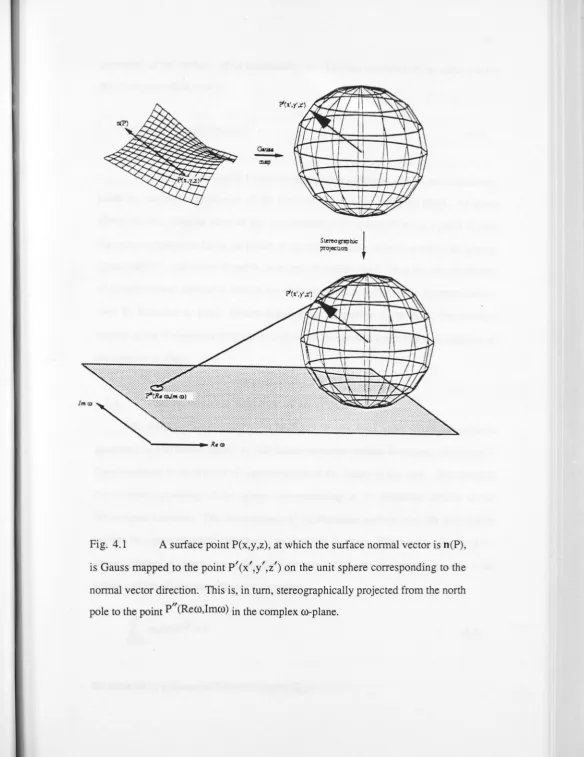
intersection of its surface normal vector with the unit sphere centred there, then stereographically projected to a complex number 0), Weierstrass proved that the parametrisation of the surface has the general form20
J
OO( '2. ,2 ,) ( ') d '(x,y,z)
=
Re 1 - 0) ,1 (1 + 0) ), 20) RO)O) ( 1.4)Schwarz subsequently utilised this representation in parametrising a pair of
minimal surfaces, denoted D and P, which repeat periodically in all three dimensions on analytic continuation.21 Nearly a century later, Alan Schoen demonstrated the existence of a number of further examples of such infinite (triply) periodic minimal surfaces (IPMS) free from self-intersections.22
In the following years several of these IPMS were found to be compatible with
particular observed microstructures of the same crystallographic symmetry. They offered
a new, simplified description of the structure, in which the constituents reside on, or are
disjointly partitioned by, the surface. In particular, the simplest IPMS of cubic symmetry - the D and P surfaces together with the associated G, or gyroid, surface of Schoen
-were suggested as models for the interface in cubic phases of surfactant systems, with the bicontinuous polar and non-polar regions thus corresponding to the pair of interpenetrating labyrinths defined by the surface.23 .24 Thus IPMS were found to provide the missing link of visualisation for bicontinuous media, together with a simple
means of structural classification in terms of their space group and genus.
With the utility of IPMS firmly established, the newly amassed wealth of
experimental observation challenges the dearth of specific, known examples of this class (an infinity of which have been shown to exist). This challenge has been answered
partially via the rigorous crystallographic analysis of Koch and Fischer, resulting in the isolation of a multitude of new IPMS.25 While the familiar genus three, cubic IPMS are
most frequently invoked in modelling structure, it is anticipated that knowledge of these new higher genus and/or non-cubic surfaces will inevitably lead to their observation in
physical systems.
Having secured the IPMS as a basis for description, we are naturally led to the deeper physical question of the extent to which the structural analogy is quantitatively applicable. By means of illustration, return to the case of bicontinuous phases in binary
surfactant-water mixtures. If the surfactant molecules aggregate as a bilayer (that is, a
symmetry and genus of this interface, inferred from experiment26 , match those of a
known IPMS, then it is tempting to identify the interface and the IPMS as one and the
same. However there are an infinite number of periodic surfaces possessing this
common symmetry and genus. That the minimal surface is the particular member of this
class which minimises the total bending energy (given by integration of our
phenomenological form) throughout the composition range of observation of the phase,
is not immediately apparent. To directly investigate such an experimentally based claim
we require additional information pertaining to the IPMS. This information entails an
exact knowledge of surface coordinates, and hence the parametrisation of the IPMS.
The examples of Schoen and Koch and Fischer were derived from a consideration
of crystallographic boundaries, with the existence of the spanning surface then
guaranteed by the resolution of Plateau's problem. Hence the discovery of these new
IPMS has evolved without any accompanying exact surface specification. The remainder
of this thesis is devoted to partially countering this imbalance.
Recall that the parametrisation of an IPMS is achieved via the representation (1.4)
by determination of its Weierstrass function. Returning to the birthplace of IPMS in the
parametrisation of the D and P surfaces by Schwarz, the corresponding Weierstrass
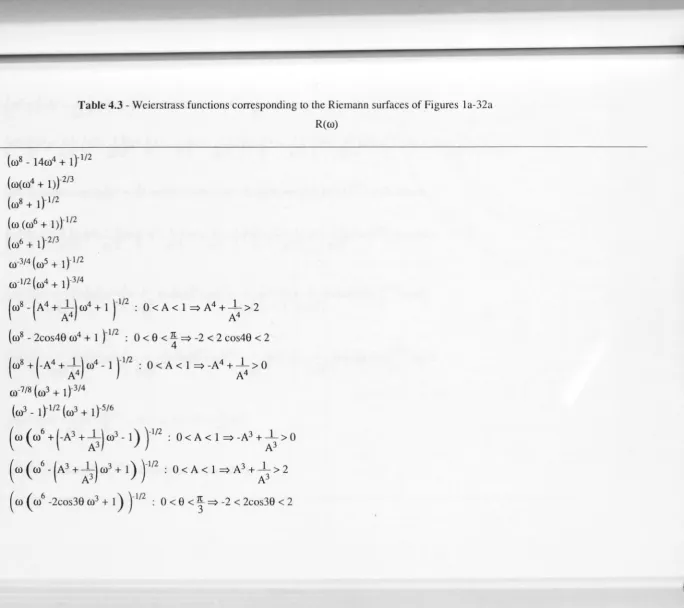
functions were found to possess an extremely simple form. This simple product form
was subsequently found to be shared by the CLP, H and T surfaces likewise discovered
by Schwarz, and by the G and 1-WP surfaces of Schoen. These observations provoke a
number of questions. Firstly, what common feature of this set of IPMS permits their
unification within this particular Weierstrass functional form? And secondly, do these
examples exhaust the complete set of all such IPMS displaying this feature? If not, are
there further examples of cubic IPMS residing in this class? The physical motivation for
resolution of this final question is strong, as such surfaces may be expected, by analogy
with the D, P and G surfaces, to have widespread occurrence in self-assembled
structures.
In Chapter 4 the answers to all of the above are elucidated. The simple product
u
14
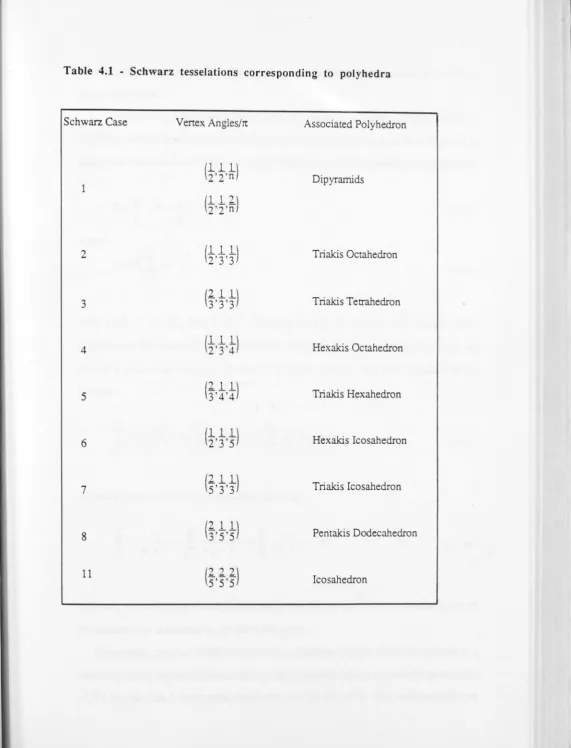
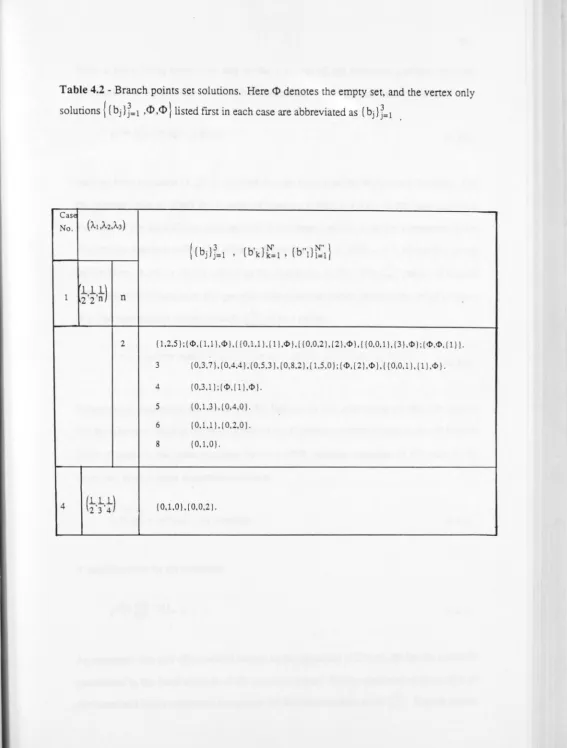
termed the 'regular' class, for which each (degenerate) flat point on the surface has normal vector coincident only with those of other identically degenerate flat points. Further, general topological and geometrical considerations reduce the enumeration of all 'regular' class surfaces to the solution of a finite counting problem. One elementary consequence of this formulation is that no new cubic IPMS are contained in this class. However it is found to yield a wealth of surfaces, in excess of the abovementioned examples. These include (lower symmetry) IPMS families of tetragonal, orthorhombic, monoclinic and triclinic distortions of the original 0, P and CLP surfaces, together with a new, self-intersection-free, orthorhombic IPMS christened the VAL surface. Further, it gives rise to families of orientation ally ordered, but non-crystallographic, minimal surfaces. One such regular class solution of interest is the pentagonal analogue of the CLP surface, exhibiting the same point group symmetry as that of the so-called T-phase in rapidly quenched alloys.27 One may conjecture that these minimal surfaces offer a structural description basis for quasi-crystalline phases.
References
1. de Wolff, P.M., Acta Cryst. A28, 511, (1972).
2. Schechtman, D., Blech, 1., Gratias, D., Cahn, J.W., Phys. Rev. Lett. 53, 1981
(1984).
3. Israelachvili, J.N., Marcelja, S., Hom, R.G., Quart. Rev. Biophys. 13,
121-200, (1988).
4. Ennis, J.P., 1. Chem. Phys. in press (1991).
5. Canham, P.B., 1. Theor. Bioi. 26, 61, (1970).
6. Helfrich, W., Z. Naturforsch. 28c, 693, (1973).
7. Kleman, M., Proc. Roy. Soc. Lond. 347, 387, (1976).
8. Petrov, A.G., Bivas, I., Prog. Surf. Sci. 16, 389, (1984).
9. Love, A.E.H., A treatise on the mathematical theory of elasticity. Cambridge University Press, (1927).
10. Israelachvili, J.N., Mitchell, DJ., Ninham, B.W., 1. Chem. Soc. Faraday
Trans. 2 72, 1525, (1976).
11. Hyde, S.T., 1. Physique (Coli.) C7, 209, (1990). 12. Helfrich, W., Z. Naturforsch. 33a, 305, (1978).
13. Larche, F.e., Appell, J., Porte, G., Bassereau, P., Marignan, J., Phys. Rev.
Lett. 56, 1700, (1986).
14. Verwey, E.J.W., Overbeek, J.Th.G., Theory of the stability of lyophobic
colloids. Elsevier, Amsterdam, (1948).
15. Luzatti, V., Mariani, P., Gulik-Krzywicki, T. in Physics of Amphiphilic Layers. Eds. Meunier, J., Langevin, D., Boccara, N., Springer, Berlin, (1987).
16. Fontell, K., Colloid Polym. Sci. 268, 264, (1990).
17. Pansu, B., Dubois-Violette, E., 1. Physique (Coli.) C7, 281, (1990).
18. Thomas, E.L., Reffner, J.R., Bellare, J., 1. Physique (Coli.) C7, 363, (1990).
19. Andersson, S., Hyde, S.T., Larsson, K., Lidin, S., Chern. Rev. 88, 221
20. Weierstrass, K., Math. Werke, Band 3. Berlin, Mayer U. Mayer, (1903).
21. Schwarz, H.A., Gesammelte Mathematische Abhandlunger. Berlin, Springer,
(1890).
22. Schoen, A.H., Infinite periodic minimal sUrfaces without self-intersections.
N.A.S.A. Technical Note # D5541, (1970).
23. Scriven, L.E., Nature 266, 123, (1976).
24. Hyde, S.T., Andersson, S., Ericsson, B., Larsson, K., Z. Kristallogr. 168,
213, (1984).
25. Fischer, W., Koch, E., Z. Kristallogr. 179, 31, (1987).
26. Barois, P., Hyde, S.T., Ninham, B.W., Dowling, T., Langmuir 6, 1136,
(1990).
CHAPTER 2
The phenomenological theory of membrane bending energy
The first appreciation of the relevance of interfacial curvature to the stability of
surfactant aggregate phases was embodied in the theory of the bending energy of
surfactant films attributed to Helfrich 1. He expressed the bending energy per unit area of
membrane as a quadratic form in the local curvatures, thus subsuming the specific
characteristics of the system into a number of constant coefficients. While such
phenomenology yields no information regarding the coefficients it defines, it is the basis
of all physical theories and provides useful constraints on the functional forms resulting
from any microscopic model. Thus as a starting point we summarise the simple
derivation of Helfrich.
2. 1 Review and analysis of the Helfrich theory
Assuming negligible thickness, the membrane is treated as a geometric surface,
which is materially isotropic. Consider the case where the membrane undergoes slight
undulations about the plane. The associated energy cost per unit area is assumed to be a
quadratic function of the curvatures, provided the undulations lie within the elastic regime
of the membrane. Since the membrane is considered to be (two-dimensionally) isotropic,
the bending energy can only involve a linear combination of coordinate invariant factors,
namely (to quadratic order) (C1+C2)' (C1+C2)2 and c1c2' where c1 and c2 are the local
principal curvatures of the undulated membrane. Since the mean and Gaussian curvatures
of the membrane are given by:
H
=
C1+C22
(2.1 )
respectively, the bending energy per unit area (up to an arbitrary constant) is given by:
(2.3)
The coefficients lee and
ICc
are termed the bending rigidity (or splay modulus) and theelastic modulus of Gaussian curvature (or saddle splay modulus), respectively. The
parameters
Ho
and Ko are referred to as the spontaneous mean and Gaussian curvaturesof the membrane.
2.1.1 Inconsistencies in the interpretation of spontaneous curvatures
The accepted notion of spontaneous curvatures is that of the curvatures adopted
by the membrane in the absence of any bending; viz. those curvatures which minimise the
total bending energy of the system. In the case of zero spontaneous curvatures (i.e.
spontaneously planar geometry), setting
flo
andKo
to zero in equation (2.3) results in theform for the bending energy:
(2.4)
In terms of the principal curvatures, this expression can be written as a difference of
squares to give
(2.5)
Hence, if the coefficients are positive, that is,
(2.6)
it is clear that the bending energy is minimised when c1=c2
=o'
so that the planar state isindeed stable with respect to small undulations, and
Ho
andKo
conform to the expectedproperties of the spontaneous curvatures.
On the other hand, if the values of the spontaneous curvatures, Ho and/or
Ko
arenonzero, the form analogous to equation (2.5) is:
(2.8)
where c? denote the spontaneous principal curvatures, related to Ho and Ko, via
equations (2.1) and (2.2). This means that cl = C2 =
~
Ho
is the only possible~-r1~
2
stable state, in obvious contradiction to the definition of the spontaneously preferred state
of the membrane. In this case, the bending energy cannot be expressed as a sum of
squares in the principal curvatures about their spontaneous values. So, it is inconsistent
to identify Ho and Ko as the spontaneous curvatures of the membrane, assuming the
bending energy is of the standard form of equation (2.3).
2.2 A consistent phenomenological theory of bending
These elementary deliberations reveal an inconsistency in the identification of the
spontaneous curvatures. Although the standard identification holds for a membrane
which is spontaneously flat, there is a problem in the case of a spontaneously curved
membrane. This inconsistency can only be resolved by writing the form for the bending
energy in such a way that the spontaneous values of the curvatures are indeed those
where we define:
and
(2.9)
(2.10)
(2. 11 )
(2.12)
represent the deviations of the principal curvatures from their preferred values c?
Replication of the derivation of equation (2.5) gives:
(2.13)
Hence, subject to the usual constraints 0 the bending moduli (equations (2.6) and (2.7))
stability about the spontaneous state
k =
c?) is ensured. Note that for spontaneously planar membranes the formula for the bending energy reduces to that of Helfrich.However in this approach, the intuitive meaning of the spontaneous curvatures is
preserved for all values.
In order to relate our proposed form for the bending energy to the Helfrich form,
we must relate the curvature deviations to the actual and spontaneous values of the mean
and Gaussian curvatures. The mean curvature is a linear function of the principal
curvatures,
(2.14 )
consequently, equations (2.3) and (2.9) contain equivalent splay terms, and the
Gaussian curvature is equal to the product of the principal curvatures, the two approaches
deviate, provided the values of at least one of the spontaneous curvatures is nonzero:
(2.15)
Inversion of the defmitions expressed in equations (2.1) and (2.2) yields:
Cj
=
H±
YH2_K i=I,2 (2.16)with an analogous relation for the spontaneous principal curvatures. Substitution into
equation (2.15) gives
K
=
K -!Co
-
2(HHo-Ko-vfH6-Ko YH2_K ) (2.17)Combining equations (2.9), (2.14) and (2.17) gives the bending energy in terms
of actual and spontaneous values of the mean and Gaussian curvatures:
2 - - ~2'~
g
=
2kc(H-Ho) + kc(K-Ko) -2kc(HHo-Ko- Ho-Ko' H"-K ) (2.18)This proposed fonn for the bending energy results in an extra term in the mean and
Gaussian curvatures, not present in the standard expression for the bending energy.
This equation can be further manipulated, since we have assumed that the
curvature deviations are small. This admits a two variable Taylor expansion about Ho and
Ko (retaining terms up to second order in (H-Ho) and (K-Ko»for the final square root
factor everywhere except when the argument vanishes, at which point the function is not
analytic. At this point (H02_KO)
=
0, so the values of the spontaneous principalcurvatures are equal, and the membrane is spontaneously spherical.
g = -2kcHo(H-Ho) + 2kc(H-Ho)2 + kc(K-Ko) (2.19)
including a linear tenn in the curvatures. This is symptomatic of stretching of the
membrane, in addition to the usual higher order bending contributions. This special case
is due to the rigidity of the sphere; a spherical surface cannot be bent without an
accompanying stretch. So our new fonn for the bending energy naturally encompasses
the special case of a spherical membrane, which is incapable of inextensional (pure bend)
defonnations.
For all other values of the spontaneous curvatures (H02_KO) >0, and standard
Taylor series expansion gives:
(2.20)
Note that the linear tenn in (H-Ho) has cancelled (as expected), leaving pure bending
terms of similar nature to those in the original Helfrich fonn, supplemented by
contributions (H-Ho)(K-Ko) and (K-Ko)2, which, in our approximation, are of
comparable size to those retained by Helfrich.
Finally, substitution back into equation (2.18) results in the following simple
modified expression for the bending energy:
g = 2(kc~kc)(H-Ho)2
_
1
kc 1 (2Ho(H-Ho)-(K-Ko» 2 + ...2 4 (H5-Ko)
(2.21)
The fonn of this equation is evident from equation (2.13); the required stability criteria
about H=Ho and K=Ko are now satisfied. The saddle splay (Gaussian curvature)
contribution to the bending energy has vanished - to first order - for all cases excepting
cubic and higher terms in the actual curvatures are omitted, the resulting bending energy
consists only of the splay term:
- 2 • 2
g - ~(H-Ho) + ... (2.22)
where
(2.23)
Further, note that the splay modulus differs from that of the Helfrich form. Here it also
contains the modulus from the modified Gaussian curvature term (equation (2.9»
-unless Ko=O and Ho;t:O - and so it generally depends on
lee
and also ~ and Ko (unlessHo=O, Ko;t:O).
2.3 Comparison with existing continuum models of surfactant films
So far, the relevance of these phenomenological constructs to actual surfactant
membranes is obscure, since the membrane has been idealised as a mathematical surface.
Clearly, actual membranes have a fInite thickness, and are typically anisotropic materials.
In the usual situation of molten surfactant chains the membrane is anisotropic, albeit
isotropic in its tangential plane. Since the membrane is no longer of negligible thickness it
is impossible to separate bending from stretching deformations; in general, bending
results in lateral contraction and expansion as well as thickness variations, whose relative
magnitudes are governed by appropriate physical constraints. In this section, we
consider a range of continuum models, and compare their predictions with those of the
phenomenological approach.
2.3.1 The Kleman model
A simple continuum analysis of membrane bending, due to Kleman, draws on the
large body of literature on the deformation of shells3. Regarding the shell as an isotropic
Hookean elastic medium whose radii of curvature are large compared to its thickness, the
perpendicular to the middle surface of the shell do not change their length or orientation
with respect to the mid-surface under deformation.
The energy of deformation of such a material is given by 5:
(2.24)
where E,
v
and h denote the Young's modulus, Poisson's ratio and thickness of the shelland the remaining parameters characterise the deformation of the mid-surface. The shear
term, (0, as well as the torsion, 't, are assumed to vanish at the mid-surface and
tj - dS'I -ds9 I ds9 I
(2.25)
(2.26)
are the relative length and curvature changes within the membrane. The fIrst term in
equation (2.24) represents the stretching energy contribution, while the second (higher order) term is due to bending of the mid-surface. A free undulating membrane will
alleviate stretching deformations - due to their high associated energy - equivalent to
setting tl=q=O so that the mid-surface is inextended.
Then, combining equations (2.24) and (2.26) and comparing with equations (2.9) _ (2.11), the bending energy per unit area of the mid-surface of the shell adopts precisely the form suggested by our phenomenological analysis. IdentifIcation of the coeffIcients
gives:
and
kc -
_ 12-Eh(l+v) 3 (2.27)the standard constraints on Young's modulus and Poisson's ratio for materials, E>O and -I<v<1/24.
In fact, Kleman notes that the inextensional mode of deformation of an elastic solid shell is similar to two-dimensional liquid behaviour, proposed by the model of Helfrich. He concludes that the phenomenological form (2.9)-(2.11) is appropriate in both cases, although mid-surface inextension at constant shell thickness is a more restrictive constraint than fluid incompressibility. The condition of inextension implies (by the Gauss-Bonnet theorem) that the Gaussian curvature of the mid-surface is conserved under bending, i.e. K=Ko. Consequently, the Gaussian curvature contributions to the bending energy are inadmissable, a result which is of less generality than our conclusions that, for nonzero spontaneous curvatures, this term cancels (to lowest order) in the bending energy.
2.3.2 The Petrov, Derzhanski and Mitov model, and its consistent reinterpretation
Subsequent analyses of the bending of membranes accounted for the microstructure of the membrane. The elastic model of Petrov, Derzhanski and Mitov6 assumes that the membrane curvatures are set by the stresses due to the surfactant chains and those due to surfactant head-groups*. It has been claimed that this model is consistent with the formula of Helfrich (2.3) for the bending energy 7. In order to investigate this claim, we summarise their model below.
For the simpler case of a surfactant monolayer the transverse stress distribution is assumed to be localised at distances ~ and
eSc
on either side of a neutral surface (about which the torques balance)6. Assuming that the thickness of the membrane is negligible compared to the radii of curvature (so that the thickness does not change under bending), the energy is given within the harmonic approximation by:(2.28)
Here Ah and Ac are the areas (per molecule) of the surfaces of stress parallel to the neu tral
surface, A~ and A2 are the relaxed (spontaneous) values of these areas and kh and kch are
the elastic constants of the heads and chains respectively. If A, H and K denote the area
per molecule, mean and Gaussian curvatures of the neutral surface, parallel surface
theory yields8:
(2.29)
The stretching energy can be determined by maintaining the membrane in a planar
geometry and substituting equation (2.29) into (2.28), giving:
<I> 1 (A
)
2
Ao
=
"2
ksAo -
1 + const.where the stretching coefficient and equilibrium area are given by
and
A _ kch Pc
-A2
2
(2.30)
(2.31 )
(2.32)
The bending energy can then be derived from equations (2.28) and (2.29),
Under bending, the area of the neutral surface remains at Ao in order to alleviate stretching terms (so that the neutral surface remains in a state of inextension). The resulting bending energy per unit area can be written in the Helfrich form (equation (2.3», where (setting O=Oh+Oc) the bending moduli are given by the expressions:
(2.33)
(2.34)
and the spontaneous curvatures obey the relations:
(2.35)
We can recast equation (2.35), via the definitions (2.31), (2.33) and (2.34), such that the spontaneous mean curvature is expressed in terms of the parallel surface areas:
Ho
=
A~-
A2
,
Ko
=
0.
(2.36)2oAo
These quantities are in fact equal to the curvatures of the neutral surface in the unperturbed state, related to A~ and
A2
through equation (2.29), consistent with our understanding of the spontaneous curvatures.mathematically equivalent) form by substituting equation (2.29) into (2.28),
(2.37)
It is clear then that a first order saddle splay term is not present, and the bending energy
combines the second order differences (H-Ho)2, (H-Ho)(K-Ko) and (K-Ko)2 in a form
minimised precisely when the spontaneous curvatures are adopted by the membrane -a
result in agreement with that of our phenomenological deliberations summed up by
equation (2.21). In fact, the contribution of the last two terms is negligible in this case,
owing to the assumption that the monolayer thickness is much smaller than the
(spontaneous and actual) radii of curvature. So, equation (2.37) reduces to:
(2.38)
where
kc
is precisely the bending rigidity given in equation (2.33). It is apparent that thebending energy adopts the form anticipated in equation (2.22). Note that the bending
modulus (which can be written in terms of the Ho and
Ko
rather than the cross-sectionalareas, A~, Ag, Ao) is generally a function of the original elasticity moduli and the
spontaneous curvatures, as we concluded from equation (2.23).
2
To the next order of smallness the cross-terms ±40j(H-Ho)Oj (K-Ko) 10 the
squares are present, giving rise to the additional contributions
=F40~HoK
to quadraticorder in the actual curvatures (since
Ko=O).
The bending energy is then:(2.39)
where again
kc
is precisely the modulus of Gaussian curvature defined in equationmirrors the original form of Helfrich.
However, in order to comply with the original quadratic approximation expressed
in equation (2.28), the ~4B;HoK term cannot be retained without the accompanying
3 .
±
4Bi HK term, whlch, although cubic in the actual curvatures, is of identical order ofsmallness in the expansion. Hence it is inappropriate to include a first order saddle splay
term here. In any case, the form of equation (2.22) is most suitable, since the resulting
modulus,
lee
is of order BRa relative to the moduluslee
common to both approaches, andis thus negligible. So, it is clear that in all cases in which the original assumptions hold
-viz. harmonic behaviour of membranes, thin compared to their radii of curvature - the
bending energy in the microscopic model of Petrov et al. does not include a flrst order
saddle splay term.
2.4 The surfactant parameter model
Other microscopic models can also be constructed, and a useful test of these must
be their compliance with the phenomenological form embodied in equation (2.21).
Israelachvili, Mitchell and Ninham suggested an alternative model for surfactant
aggregation, in which a preferred molecular shape for the membrane component
molecules is postulated 9, 10. This shape is described by the "surfactant parameter",
which relates the hydrophobic molecular chain volume, v, the surfactant head-group area,
a, and the chain length, I (resolved normal to the interface). The value of the surfactant
parameter is then equal to
vial.
For surfactant monolayers, the surfactant parameter is related to the mean and
Gaussian curvatures of the hydrophilic-hydrophobic interface by 11:
Y..=1+HI+ KI2
a1
3 (2.40)where we deflne the mean curvature to be positive (negative) when the monolayer is
curved towards the hydrophilic (hydrophobic) region. The curvatures of surfactant
hydrophilic/hydrophobic interfaces. Referred to this central surface, the surfactant
parameters for the two monolayers which constitute the bilayer are given by 11:
1
±
HL + KL 2v
=
3aL 1
±
2HL + KL 2 (2.41 )(Here the choice of sign distinguishes between the two constituent monolayers.)
It has been proposed that the surfactant parameter offers a convenient
characterisation of aggregation; the aggregate geometry is one which allows the surfactant
molecules to adopt their preferred value of this parameter. (Thus, for example, a lamellar
phase is favoured for molecules forming bilayers and with surfactant parameter close to
one.) A simple consequence of such a model is that the energy of deformation of a
surfactant film is related to the deviation of the actual surfactant parameter from its
preferred value. The change in this parameter on deformation of the membrane is due to
the variation in the surfactant molecular dimensions. To quadratic order then, the bending
energy is related to the change in the surfactant parameter 12:
(2.42)
where K is an elastic constant and vial and (v/ai)o denote the actual and preferred values
of the surfactant parameter respectively, given by the actual and preferred values of the
surfactant chain volume v and vo, the head-group areas a and <10, and the chain lengths, L
and Lo.
In order to evaluate the bending energy in terms of the changes in interfacial
curvatures, a further physical condition is required, namely that of constant density of the
surfactant hydrocarbon chains throughout the deformation. This condition has been
established by numerous theoretical and experimental studies (see, for example ref. 13)
-although is has been implicitly ignored in most treatments of membrane bending. A
simple consequence of this condition is that the membrane thickness changes upon
For convenience we shall also assume that the interface(s) separating hydrophilic
from hydrophobic moieties is inextensional relative to parallel surfaces in the chain
region, or equivalently identifying the hydrophobic-hydrophilic interface(s) as the neutral
surface(s). This assumption is not strictly valid, although it is a reasonable starting point
for analysis 14. In fact, the location of the neutral surface depends on the head-group and
chain pressures, as well as the film surface tension and will clearly depend on the
molecular structure of the surfactant. However, we argue (in the conclusion) that this assumption can be relaxed without altering the form of the bending energy. We thus
assume:
v= Vo and a=ao (2.43)
which imply that
L
(~)
=
Lo(~)o
(2.44)and, hence from equation (2.42):
(2.45)
so that the bending energy is that due to the change in the membrane thickness which accompanies the bending tp1der the condition of constant chain density.
2.4.1 Surfactant monolayer
We consider fIrstly the case of a surfactant monolayer in a binary surfactant-water
mixture. In order for the monolayer chains to aggregate without the formation of voids or
chain interdigitation, we require one of the radii of curvature to be equal to the chain
length, so that the area of the parallel surface to the interface at the chain ends vanishes.
This results in the additional constraint:
so that the mean and Gaussian curvatures are coupled in both the spontaneous and actual statel5 . Note here that the membrane radii of curvature are then always of the same order
as the membrane thickness, in contrast to the assumptions of the model of Petrov et al 6.
Since the deformation is assumed to be harmonic, the changes in surfactant molecular
dimensions must be small. Consequently, the curvature variations about their preferred values must also be small, although the actual magnitudes of these quantities can assume
any values.
Substitution of equations (2.40) and (2.46) into equation (2.44) results in the
relation:
1(2 + HI) = 10(2 + Ho/o) (2.47)
Since the deviations about the preferred values of the parameters are small, the solution adopts the perturbative form:
1= lo(l + al(H - Ho) 10+ ... ) (2.48)
in which only the first order term in (H-Ho) is retained, since the Gaussian curvature is coupled to the mean curvature in the case of a surfactant-water monolayer. Expansion of
equation (2.47) yields:
al
=
-12(1 + Holo) (2.49)
resulting in the following expression for the bending energy:
10 (1 + l Ho/o) } 2
g
=
K { 2 (H -HO)2 + ...3(1 + Holo)
(2.50)
phenomenological analysis, and the surfactant parameter description for monolayers is
consistent with the required bending form. This result is also in agreement (to quadratic
order) with that deduced from the model of Petrov et al. (equation (2.38)). However, the
absence of a linear saddle splay term is due here to the coupling of the mean and
Gaussian curvatures.
Note that the effective rigidity of the monolayer within this model is dependent on
the spontaneous curvatures, as well as the bending constant lC, as we have found from
the phenomenological model. The form of the bending constant is physically interesting;
it is undefined in the case where
flo= -
1//0, i.e. when the membrane forms a sphericalmicelle, with the chains ftlling the interior of the micelle. This is precisely the case where
the phenomenological analysis also breaks down, and is due to the rigidity of spheres,
which cannot be bent without some accompanying stretch.
2.4.2 Surfactant bilayer
We now turn to the case of a bilayer in a surfactant-water mixture. Again, for the
sake of convenience only, we assume that the head-group areas are fixed during the
bending deformation, which amounts to a model where the two constituent monolayers
within the bilayer are decoup1ed and free to slide against one another. (The-case of a
coupled bilayer can also be analysed: here the areas at the chain ends must be fixed during
the deformation, so that the neutral surface is located in the middle of the bilayer.)
For a bilayer made up of a single surfactant chemical component, the preferred
values of the molecular dimensions must be equal, so that we have the extra condition:
Ho=O (2.51)
Again, the harmonic approximation requires that all perturbations of curvatures and
molecular dimensions are small, although we are not restricted to a small Gaussian
curvature (relative to
1//5),
in contrast to earlier models. Hence the size of the preferredThe expression (2.41) for the two constituent monolayers may be replaced (due to
harmonicity) by its two-variable Taylor expansion about HL=HoLo=O and KL 2=KoLo2 and
combined with equation (2.44):
(2.52)
where
(2.53)
The solution of equation (2.52) has the form:
(2.54)
which yields on substitution:
(2.55)
The resulting bending energy for each monolayer making up the bilayer is given by
combining equations (2.45) and (2.54):
(2.56)
The net bending energy of the bilayer is then the sum of the energies for both monolayers
(2.57)
Again, we see that there is no linear saddle splay term and the quadratic cross term (H-Ho)(K-Ko) vanishes due to the symmetry of the bilayer, in accordance with the phenomenological analysis (equation (2.21)).
In the case of systems of current interest in the literature (e.g. swollen lamellar phases 16), the Gaussian curvature is small, viz. 1Kol«1!l6, and the value of the preferred surfactant parameter is close to one. This means that the quadratic term in the Gaussian curvature in equation (2.57) is negligible, so that the bending energy reverts to
the pure splay form:
(2.58)
where (to leading order) the effective bending rigidity is independent of the values of the spontaneous curvatures. Here then, the bending energy is exactly the same as that expected from the phenomenological analysis when
Ro=O
.
2.5 Conclusions
Shell theory and the modified analyses of both the microscopic model of Petrov et al. 6 and the surfactant parameter model 9, 10, 12 result in functionally equivalent forms for the bending energy; these forms are precisely those expected from the phenomenological analysis based only on stability considerations. In this sense then, the microscopic models cannot be discriminated, despite their diversity of physical assumptions. Indeed, any microscopic model will yield the same form for the bending energy, within the harmonic approximation. This can be understood as follows.