Abstract: Machine learning plays a major role from past years in image detection, spam reorganization, normal speech command, product recommendation and medical diagnosis. Present machine learning algorithms used for the identification of crops, their diseases and also provide remedies to them. In the present paper, we discuss the Crops Diseases and remedies. Agro consultant application deals with crops and its diseases, nutritive deficiency indication and providing remedy using machine learning techniques for automated vision system used at agricultural field. The task of identifying plants is time-consuming even for botanists. Real- time identification of crop diseases, nutritive deficiency symptoms, and providing a remedy is an application that will aid users in spotting plant species through their leaves. The system will allow the user to search the database, browse the list of collected leaf samples, and take pictures of leaves and analyze them. Crop diseases are a major hazard to food security, but their swift naming remains not easy in many parts of the world due to the lack of the necessary communications. Using a public dataset of diseased and healthy plant leaves collected under controlled conditions, we train a deep convolutional neural network to identify crop species, their diseases and also provide remedies for diseased crops, weeds, and damaged pest.
Index Terms: Machine learning algorithm, Convolution Neural Network
I. INTRODUCTION
What Is Learning? Vermin learning to avoid lethal Baits: Vermin normally stumble upon provisions items by its look and whiff and start eating in small amounts and later depending on food and physiological effect the feeding of provisions goes on. If the Vermin notices the illness of the provisions, the vermin will not touch that food. Similarly, the machine learning mechanism plays a vital role same as animal usage of experience for acquiring and expertise in detecting food safety. By mistake, if the knowledge with the food is negatively labeled, the prediction of the animal will also be negatively affected and encountered in the future. With the inspiration of the previous illustration of successful learning, we make obvious a typical machine learning algorithm.
Revised Manuscript Received on July 05, 2019.
Mr. K. Naresh, Assistant Professor, CSE Dept, BVRIT HYDERABAD
Dr. G. Naga Satish, Associate Professor, CSE Dept, BVRIT HYDERABAD
Mr. K. Bhargav Ram, Assistant Professor, CSE Dept, BVRIT HYDERABAD
Dr. Ch. Srinivasulu, Professor, CSE Dept, BVRIT HYDERABAD
Likewise, we would want to program a machine that learns how to sort out spam e-mails. A credulous result might be comparable to the lifestyle of vermin that, how to keep away from lethal baits. The machine will remember the past e-mails that needed to be been named similarly as spam e-mails by the
individual user. When another email arrives, the machine will look for it in the past set about spam e-mails. Though it matches among them, it will be trashed. Otherwise it will make moving of the user’s inbox organizer. At the same time, the first “learning by memorization” methodology may be useful, it fails to offer an imperative aspect known as learning systems – the capacity to mark un-noticed email messages. A fruitful apprentice ought to have the ability which will be the advancement from distinctive samples to more extensive generalization. This may be Likewise, as inductive thinking or inductive induction. In the attraction nervousness exhibited previously, after the vermin experience a sample of a certain sort about food; they apply their disposition at it once new, unseen illustrations from claiming nourishment of comparable emanation also taste. A situated about expressions whose presence for an email message is characteristic of spam. Then, at another email arrives, that machine could weigh if a standout among the suspicious expressions gives the idea on it, and foresee its mark appropriately. Such an arrangement might possibly have the ability effectively to foresee the name about unseen e-mails. Responsibilities further than Human Capabilities: an additional totally crew about errands that profit starting with machine Taking in systems are identified with the Investigation for extremely substantial and intricate information sets: galactic data, turning restorative chronicles under restorative knowledge, climate prediction, and dissection of ordering data, Web search engines, Also electronic trade. With an ever increasing amount accessible digitally traced data, it gets evident that there would riches about serious majority of the data covered clinched alongside information chronicles that would best approach excessively little and also as well perplexing to people with bode well. Taking in with recognizing serious examples over substantial also complex information sets may be a guaranteeing space for which the blending of projects that take for the Just about boundless memory limit and ever-increasing transforming velocity about PCs opens up new horizons. Regulated versus Unsupervised, since taking in includes an association between those learner and the environment, you quit offering on that one might separate taking in assignments as stated by those nature for that connection, to start with qualification will note the Contrast the middle of regulated and unsupervised Taking in. Likewise an illustrative example, think about that errand for Taking in will recognize spam email versus the undertaking aberrance identification. For the spam identification chore, we think about a setting to which the learner receives preparing
e-mails to which the mark spam/not-spam may be Gave. On the support from
Machine Learning Based Recognition of Crops
Diseases By CNN
claiming such preparation the apprentice ought to further
bolstering to evaluate a tenet to labeling a recently arriving email message. For contrast, for those assignment about aberrance detection, every last one of learner gets Concerning illustration preparing is an extensive form of email messages (with no labels) and the learner’s errand is on identify “unusual” messages.
II. OBJECTIVES
The chore of identifying plants is protracted even for botanists. Real-time identification of crops and its diseases nutritive deficiency symptoms and providing a remedy is an application that will aid users in spotting plant species through their leaves. The system will allow the user to investigate the database, browse the list of collected leaf samples, and take pictures of leaves and analyse them. Crop diseases are a foremost hazard to food security, but their speedy identification vestiges difficult in many parts of the world due to the deficient of the necessary communications.
III. IPROPOSED MODEL
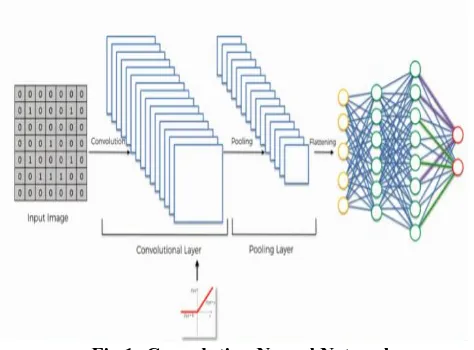
CNN architectures vary with the type of the problem at hand. The proposed model is expressed by three convolutional layers, each followed by a max pooling layer. The final layer is fully connected MLP. ReLu activation function is applied to the output of every convolutional layer and fully connected layer. The first convolutional layer filters the input image with 32 kernels of size 3x3. After max pooling is applied, the output is given as an input for the second convolutional layer with 64 kernels of size 4x4. The last convolutional layer has 128 kernels of size 1x1, followed by a fully connected layer of 512 neurons. The output of this layer is given to softmax function, which produces a probability distribution of the four output class. The model is trained using adaptive moment estimation (Adam) with batch size of 100 for 1000 epochs.
[image:2.595.309.542.49.247.2]Feature detector Feature map
Fig 2 Convolution in CNN
Max pooling: Max pooling is a sample-based prejudice process. The intent is to down-sample an input illustration (image, hidden-layer output matrix, etc.), plummeting its dimensionality and permitting for suppositions to be made
[image:2.595.310.558.325.460.2]about attributes contained in the sub-regions binned.
Fig.3 Max Pooling in CNN
[image:2.595.47.284.491.666.2] Fully-connected layer Output layer
Fig 5. Full Connection in CNN
IV. EXECUTION AND OUTPUTS
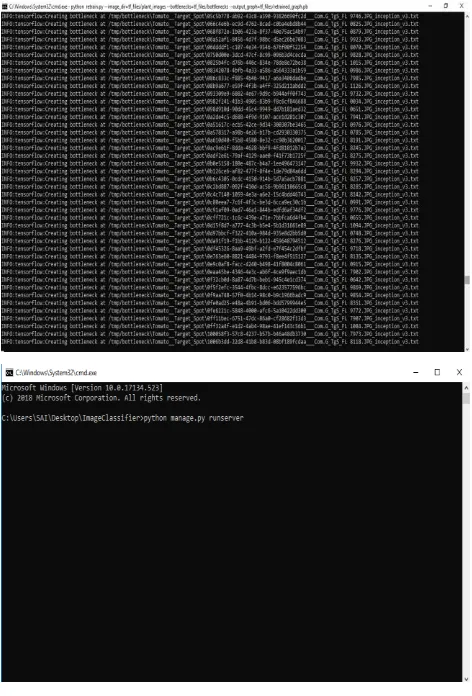
[image:3.595.223.531.44.647.2]Fig 5 Train the Dataset
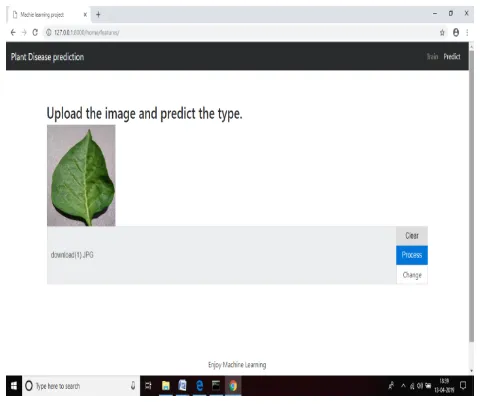
Fig 6: Input
[image:3.595.304.540.50.398.2]Fig 7: Test case showing description about the plant disease prediction
[image:4.595.181.533.45.486.2]Fig 8: Test case showing a description of the training
Fig 10: Test case showing plant name, disease and remedy
Fig 11: Test case showing plant name, disease and remedy
V. CONCLUSION
[image:4.595.304.542.259.473.2] [image:4.595.44.284.498.703.2]AUTHORS PROFILE
Naresh Koenni completed his Masters from Hindustan University, Chennai in 2012 and Bachelors degree from SV University, Tirupati in 2010. His Areas of interest are Software Engineering and Machine Learning. He published two papers in international journals and two papers in international conferences. He developed many applications using Java, PhP and ServiceNow. He is Certified Application Developer by ServiceNow and Oracle Academy. Presently He is working as Assistant Professor, Dept of Computer Science in BVRIT HYDERABAD College of Engineering for Women.
Dr.G.Naga Satish is working as Associate Professor in the Department of CSE at BVRIT HYDERABAD. He has More than 17 Years of teaching experience. He has published more than 34 Publications in reputed International Journals.
Kodumuri Bhargav Ram completed his Masters from JNTU Hyderabad in 2013 and Bachelors degree from JNTU Hyderabad in 2010. His Areas of interest are Software Engineering and Machine Learning. He published one paper in international journal. He is Certified Application Developer by Oracle Academy. Presently He is working as Assistant Professor, Dept of Computer Science in BVRIT HYDERABAD College of Engineering for Women.